Author: Anthony Llewellyn

  • Medical Internship Australia 2026 Clinical Year Application Guide

    Medical Internship Australia 2026 Clinical Year Application Guide

    *We will be regularly updating this post as the various States and Territories update their processes. Where information is not currently available for the 2026 clinical year we have used information from the previous year, i.e. 2025. If you notice anything incorrect please let us know in the comments below.

    It’s time for our well-liked guide on applying for internships in Australia. Wondering how to become an intern in Australia? It’s that time of year when the process of applying for and assigning medical intern positions in Australia gets underway. So, now is the ideal moment to outline the procedure. I managed the largest intern application system in Australia, specifically the NSW Intern application system, for four years. Therefore, I would like to impart some of the insights I gained from that experience to this year’s medical graduates. Wondering how to become an intern in Australia? It’s that time of year when the process of applying for and assigning medical intern positions in Australia gets underway. So, now is the ideal moment to outline the procedure.

    Recent Developments of Note.

    1. One interesting phenomenon of the past few years of internship allocations in Australia has been that most jurisdictions have not been able to fill all intern posts. This theoretically creates more opportunities for IMG doctors. We have attempted to indicate the number of unfilled posts from last year where known.
    2. Consistent with the move to a 2-year Prevocational Training framework we understand that all jurisdictions are now offering a minimum 2-year contract for Internship.

    (Disclaimer: All information here has been sourced in good faith but things do change so you should always do your own due diligence in such matters, we are providing this information to aid you in your application but take no responsibility for any outcomes)

    As has been the case in past years the main Intern application and allocation dates are aligned across Australia so that every State and Territory opens and closes their systems at the same time and makes offers at the same times. There are some variations to this in relation to special priority categories in some States and Territories. The key things that all medical graduates should consider in preparing their medical internship application in 2025 year for the 2026 clinical year are as follows:

    • Applications open on 6th May 2025.
    • Applications close on 5th June 2025.
    • Make sure that you have an Intern Placement Number; otherwise, you won’t be able to apply.
    • You should research the application requirements now as there may be some “surprises”. As soon as the application system opens, register or log in and ensure that you have everything you need to complete your application.
    • Understand where you sit on the priority list for any State or Territory you are applying to.
    • If you are required to attend an interview. Ensure you have obtained leave from your medical school requirements to attend.
    • Also, consider whether the interview will be in-person, via phone, or video.
    • Give yourself time to request referees, assemble a Resume, if required, and find other documents you may need.
    • The first National Intern Offer Period commences 14th July 2025.
    • Offers for Rural and other Special Pathways will come out starting from 14th July 2025.
    • The first offers for all other main pathways will come out from 16th July 2025.
    • Generally, you only have 48 hours to accept. So make sure that you have regular access to your email.
    • The National Close Date for 2026 Intern Recruitment is 17th October 2025. After which all remaining vacant intern positions move into the Late Vacancy Management Process.
    • The National Late Vacancy Management Process closes on 20th March 2025
    • Stay in touch with your medical school. you may be worried about completing your degree on time but they are all working very hard with the other institutions to give you the best chance of completion.

    Number of Intern Positions Available Across Australia in 2025

    last updated 13th April 2025

    JurisdictionIntern Numbers 2026Intern Numbers 2025Intern Numbers 2024PopulationInterns per 100K Person**Unfilled Posts 2025Annual Salary
    New South Wales1,1751,1621,135.5 8,511,20013.842$76,009
    Victoria973971960.57,013,00013.92025 unknown, 16 in 2024$85,414
    Queensland9218858625,608,70016.4not available$90,141
    Western Australia401#4014012,981,80013.5not available$90,864,– $119,165***
    South Australia353#3533111,882,70018.840$81,814
    Tasmania106#106105576,00018.4not available$87,000
    Australian Capital Territory96#9695475,60020.2not available$86,619
    Northern Territory888865255,60034.4not available$90,150
    Junior Doctor Training Program (Commonwealth)115#115115not availablevaries
    TOTAL42284,1774,05027,309,40015.4
    * indicates based on 2023 Annual Report
    ** From https://www.abs.gov.au/statistics/people/population/national-state-and-territory-population/latest-release

    ***If allocated to WA Country Health you will receive a higher payment
    #2025 numbers not yet released, PMCWA does not list intern numbers for Western Australia.

    Key Dates for Internship Applications in 2025 and 2026

    Applications OpenTuesday 6th May 2025
    Applications CloseThursday 5th June 2025
    National Offer Period 1 Opens (Rural and Aboriginal and Torres Strait Islander Pathways)Monday 14th July 2025
    National Offer Period 1 – Main OffersWednesday 16th July 2025
    National Offer Period 1 ClosesFriday 1st August 2025
    1st National Audit of Acceptances and Unplaced ApplicantsTuesday 5th August 2025
    National Offer Period 2 OpensThursday 14th August 2025
    National Offer Period 2 ClosesFriday 5th September 2025
    2nd National Audit of Acceptances and Unplaced ApplicantsTuesday 9th September 2025
    National Offer Period 3 OpensThursday 18th September 2025
    National Offer Period 3 ClosesFriday 17th October 2025
    3rd National Audit of Acceptances and Unplaced ApplicantsTuesday 21st October 2025
    National Late Vacancy Management Process StartsMonday 10th November 2025
    National Late Vacancy Management Process ClosesFriday 20th March 2026
    C/- HETI

    Tip #1. Your Medical Intern Placement Number.

    The IPN is a unique nine-digit number that has been generated by AHPRA and has been provided to medical schools for distribution to all 2025 final-year medical students. The number is used as part of the national audit process (which ensures that intern positions across the country are made available to as many applicants as possible) as well as to streamline registration.

    This number is not the same number as your AHPRA registration number or student number. If you have not received your IPN you should check with your school.

    If you are not an Australian medical student you won’t be issued an IPN. If you are applying as a non-Australian medical student you do not require an IPN. However, please note that unless you are a New Zealand medical student your chances of gaining an internship are very slim.

    Tip #2. Other Things You Will Likely Need to Become an Intern in Australia. 

    The majority of States and Territories require you to upload an academic transcript as proof that you are indeed a medical student. 

    They will also request evidence that you satisfactorily meet the AHPRA English Language requirements. This may seem a bit ridiculous given that you have been attending medical school in English for the last 4 or 5 years. But it is the law. So check whether you may need to submit an up-to-date English test result or some other form of documentary evidence such as a high school certificate.

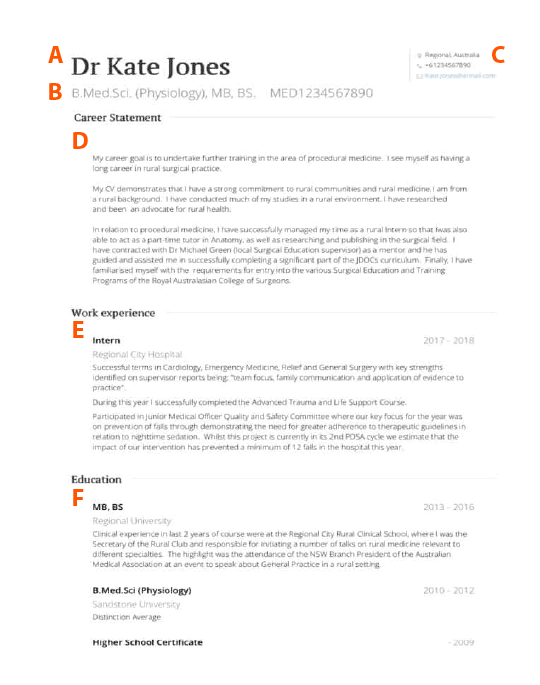
    Most States and Territories will also request a CV or Resume. For tips on your CV or Resume see our ultimate guide to CVs or watch a video series about this.

    Some States and Territories have a CV template that they suggest that you use to fill in your information. In the case of Victoria, you are no longer required to use the suggested template (change from last year). It’s probably fairly harmless to use the template for the other States and Territories. But if you are thinking about your future career, then now is a good time to be designing your own CV. The risk of using the template is that you don’t stand out from other candidates.

    You will need to also provide proof of your identity, citizenship, residency, or visa. And if you have had a name change along the way you will probably also need to provide some documentation in relation to this.

    Why All This Information?

    The State and Territory bodies who administer the Intern application process have a responsibility to ensure that you are eligible to apply for provisional registration at the end of the year in order to work as an Intern.  They collect this information to check that everything is in order so that you are indeed eligible to apply. Employers can get rightly annoyed when told that someone who has been allocated to work with them as an Intern will have a several-month delay whilst they resit an English language test.

    However, it’s your responsibility to ensure that you are eligible for registration. So you should also be checking these things yourself. 

    It’s hard to fathom given the amount of communication from health departments, medical schools and student colleagues. But every year there are a handful of medical students who forget to apply for their internship. This means having to wait another year. Don’t let that be you.

    Dr Anthony Llewellyn | Career Doctor

    Tip #3. Research and Apply Early.

    It’s hard to fathom given the amount of communication from health departments, medical schools, and student colleagues. But every year there are a handful of medical students who forget to apply for their internship. This means having to wait another year. Don’t let that be you.

    There are even more students who leave their applications to the last minute. Only to find that they are missing a vital document. For example, this could be evidence you need to substantiate that English is your first language, such as a high school certificate. Or perhaps your last name has changed whilst you have been in medical school? Or maybe you need to submit a CV with your application?

    As soon as the application page opens for each State and Territory you are going to apply to make sure you register. And then go as far through the process of applying as possible so you can see if there is some sort of document you need to obtain.

    Tip #4. Practice Your Interview Technique, Including Video Interview Technique.

    As part of your application to become and Intern in Australia you may need to undertake an interview. This could take the form of a faced to face interview or a video interview. The COVID pandemic resulted in a shift to a preference for video interviewing job applicants in Medicine in Australia. Many employers now see an inherent advantage to this. So you should still be prepared for the fact that this year your interview may be conducted on video.

    There’s a lot more than you think to video interviewing. For a rundown on this check out this post.

    Tip #5. Know Where You Sit In The Priority List.

    Its important to know where you sit on the priority list. Each State and Territory has a slightly different order but in essence, it goes something like this:

    1. If you are an Australian Citizen or Permanent Resident and went to Medical School in that State or Territory you are top of the list.
    2. If you are an Australian Citizen or Permanent Resident and went to Medical School in another State or Territory or New Zealand you are probably second.
    3. If you are an international student who studied Medicine in Australia you are probably next.

    Tip #6. Know the Key Dates, including Offer Dates.

    As noted above it’s crucial that you know the key dates. If you miss your application submission date (and it does happen) there is no allowance for a last-minute submission. You also need to make sure you are available to accept your offer. Generally, the window for offer acceptances is quite narrow (often 48 hours).

    For this year the day on which the first round of offers can be made nationally is 14th July 2025 for the rural and other special pathways. The first date that offers can be made to the main group of applicants is 16th July 2025 and most offers will come out on that day. Thereafter there is a series of offer windows for 2nd and 3rd round. In between which there is a mandated pause, which allows the National Intern Audit process to run. This is a system that works to ensure that vacancies are being freed up as soon as possible by highlighting medical students who may have an offer in more than one jurisdiction and ensuring that they accept one offer and decline others.

    The nationally coordinated offer system concludes on 17th October 2025. Technically this is the last date that the Medical Board can guarantee that they will be able to process your registration application in order for you to commence your internship on time the following year in 2026.

    However, there are generally still vacancies after this point and so the National Intern Audit Office switches over to an ad hoc coordinated late vacancy management process from 10th November 2025. This runs up until 20th March 2026, which is around the 1st term to 2nd term changeover for most interns. So it is still possible to commence your internship in 2026 but you might have to finish one or two terms in the following year.

    The National Intern Audit.

    States and territories share intern applicant information at pre-agreed dates. This data is then used to identify applicants who have applied for and/or accepted intern positions in more than one state/territory. Applicants who have accepted more than one intern position will be contacted by the National Audit Data Manager by phone or email and given 48 hours to withdraw from all intern positions, except the one where they intend to undertake their intern year.

    If you don’t respond to the National Audit Data Manager and/or do not withdraw from all positions except one, the relevant states/territories where you have accepted an offer will be advised and all offers, except for the first offer you received may be withdrawn.

    The Late Vacancy Management Process.

    The Late Vacancy Management (LVM) Process runs from Monday 10th November 2025 to Friday 20th March 2026. The process ensures any late vacancies are offered to eligible intern applicants who have not yet accepted an internship position.

    The Late Vacancy Management Process is coordinated by the National Audit Data Manager on behalf of states and territories. So you should ensure you have updated your contact details if you are going overseas during the Late Vacancy Management Process period.

    The National Audit Data Manager will send out emails to participants who will need to opt into the Late Vacancy Management Process if they still wish to receive an offer to be an Intern in Australia.

    If an applicant does not respond to this email, they will no longer be eligible to receive an internship offer, and their application will no longer be considered in any Australian jurisdictions.

    The process is open to medical graduates of AMC-accredited medical schools who have applied for and are not holding a 2026 intern position through the Commonwealth or states and territories at the National Close Date for Intern Recruitment. Participation in the LVM is an opt in process – you must confirm that you want to participate in the LVM by responding to the National Audit Data Manager by e-mail.

    Priorities Within Priorities.

    Some States and Territories also have priority pathways to ensure that groups such as Aboriginal and Torres Strait Islanders and doctors who wish to work rurally or regionally can obtain their preferred placement early.

    So if you are an International student and like the idea of working rurally, it’s probably a good idea to consider a rural pathway as it will likely boost your chances of gaining an Intern position earlier in the process.

    Further Information on Each Jurisdiction

    New South Wales

    Intern in Australia NSW
    Sydney Harbour Bridge, New South Wales.

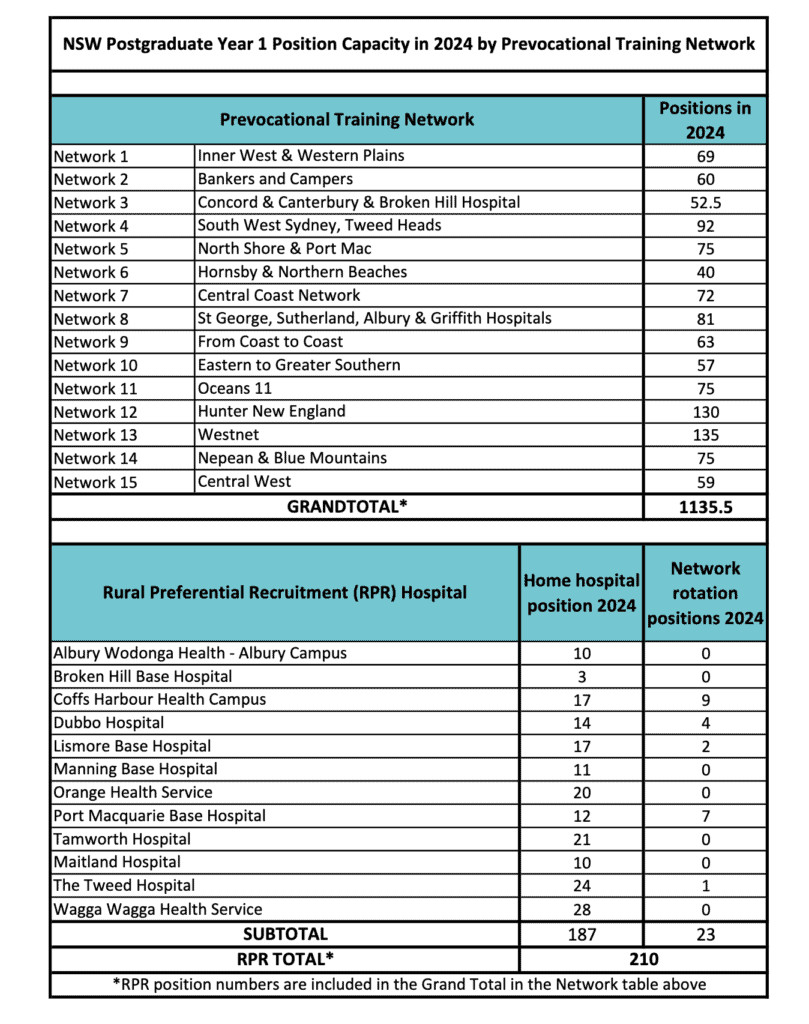
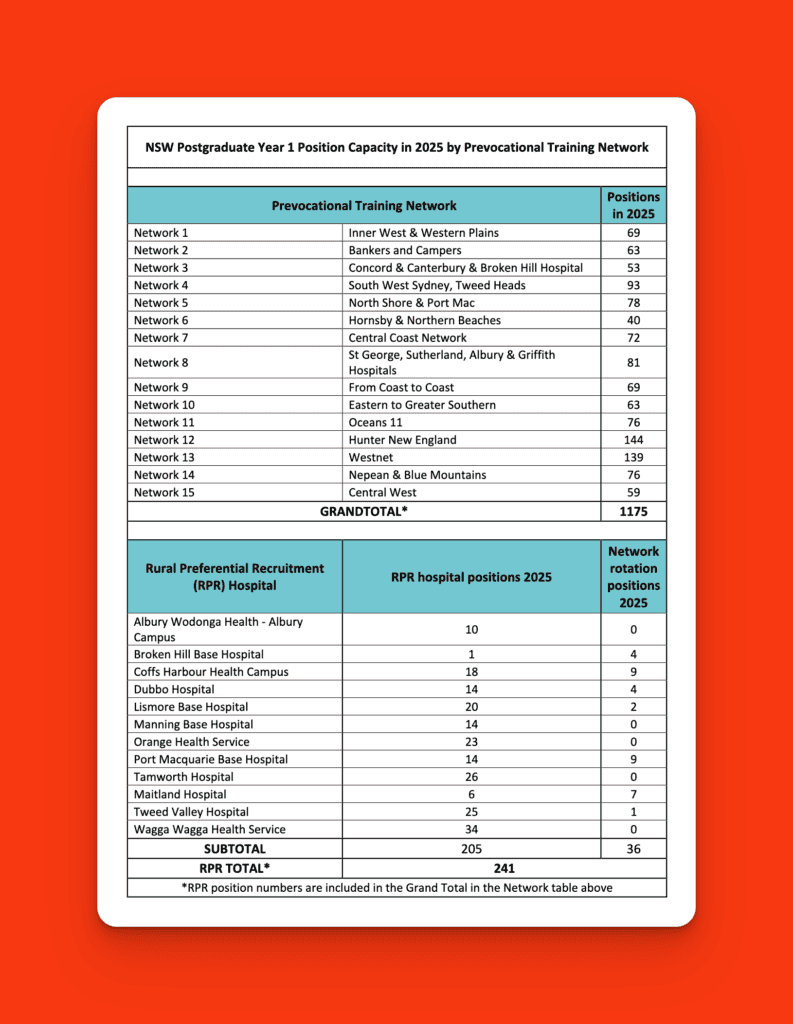
    Intern Positions = 1,175 (including 241 rural preferential) across 15 Networks
    Unfilled posts in 2025 = 42
    Annual Salary = $76,009
    Length of Contract = normally 2 years
    Professional Development Allowance = nil
    The 4 Pathways in NSW


    You have the option of applying through one of 4 pathways:
    – Aboriginal Recruitment Pathway
    – Rural Preferential Pathway
    – Regional Allocation Pathway
    – Optimised (or Main) Pathway

    Only applicants who go through the Rural Preferential Pathway need to submit a CV and attend an interview.  All other pathways are based on applications only. A key advantage of the Aboriginal, Rural, and Regional Allocation Pathways is that you are far more likely to be given your preferred hospital network.

    Can You Stack or Hack the HETI Optimised Pathway?

    Each year the question comes up. Is it possible to hack or game the HETI optimised pathway. If you search enough you will find various reddit threads or blog posts covering this topic by authors purporting to have much greater understanding of mathematics than this author.

    The posts give an outline of how the HETI allocation algorithm works. The algorithm incorporates an annealing component with the purpose of optimizing the outcomes for as many applicants as possible. Hence the name “Optimised Pathway”. It does this not necessarily by allocating everyone to their most preferred network but by attempting to allocate as many people as possible to a higher preference network, therefore, guaranteeing that more applicants get a 1st or 2nd or 3rd preference overall.

    The general gist of the blogs written about hacking the HEIT algorithm is that if you are super keen on a certain NSW network. Let’s call this Network A then you should attempt to put this as your highest preference and then load all of your next higher preferences with networks that are not as popular.

    You can probably already see how this tactic can backfire massively for you.

    There’s a couple of things that can go wrong here.

    First algorithm is more likely to identify you as one of those few applicants that prefer the unpopular Network Z and allocate you there, thereby satisfying the aims of the algorithm.

    Second, you will be stacking your preferences based on historical data that does not reflect the desires of the current applicant cohort.

    And third, if large number of applicants does the same thing then you are probably all going to advantage those applicants that just put down the networks in their actual order of preference.

    Take home message. Don’t try to stack or hack the HETI algorithm.

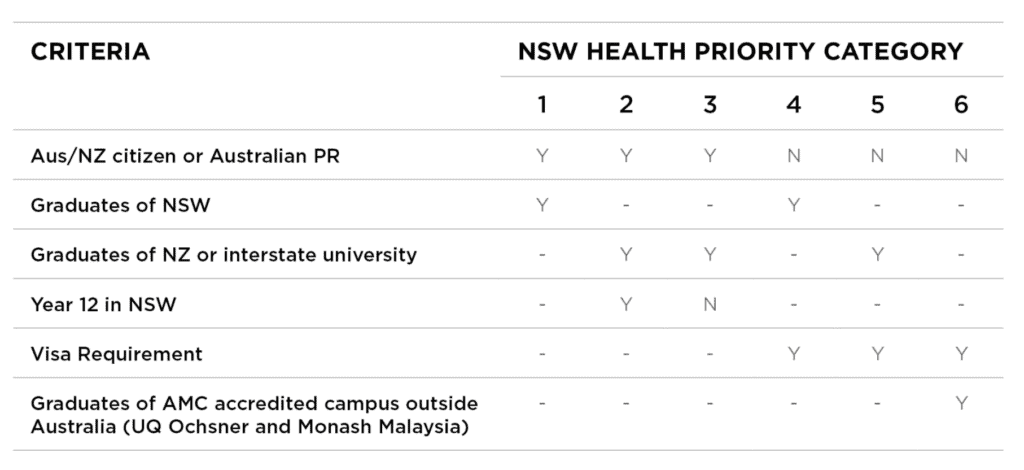
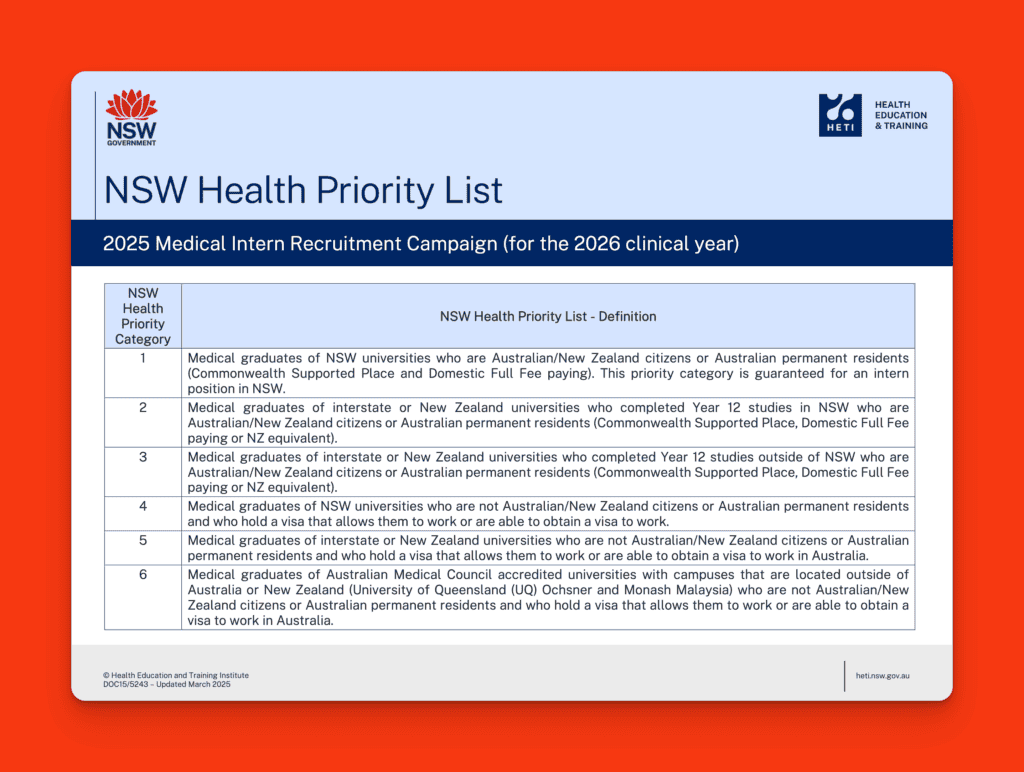
    Intern Placement Priorities in NSW:
    Victoria

    Trains leaving the Melbourne CBD passing the Melbourne Cricket Ground

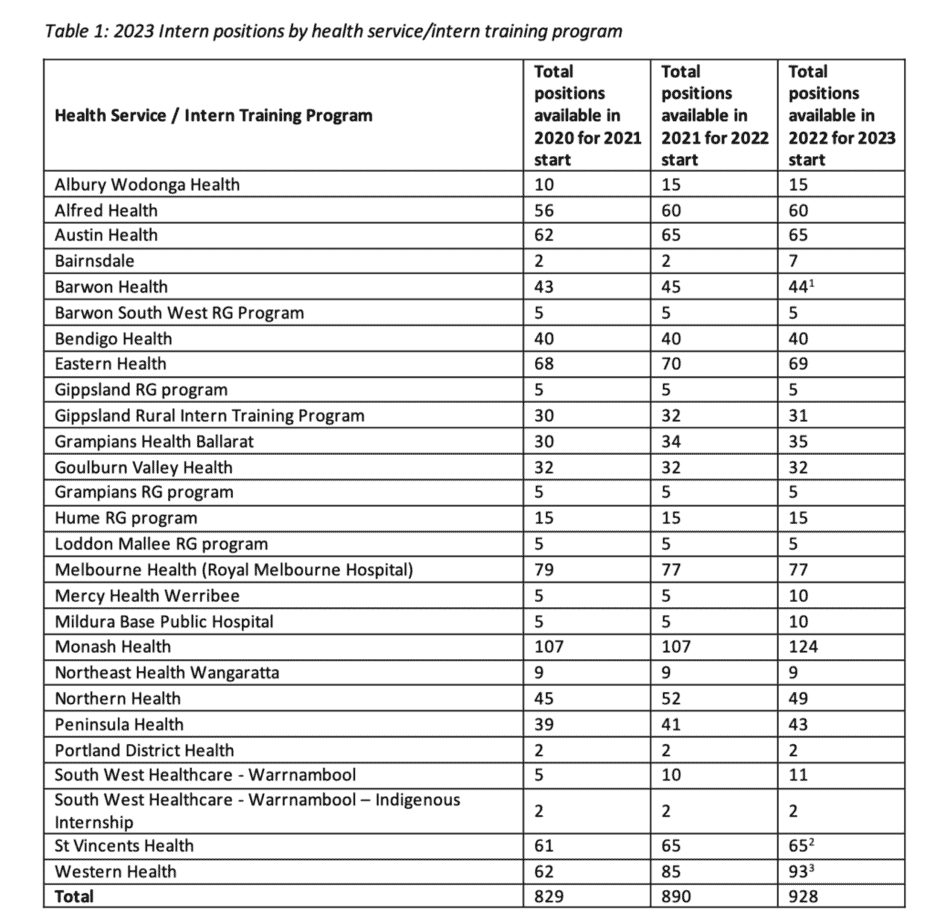
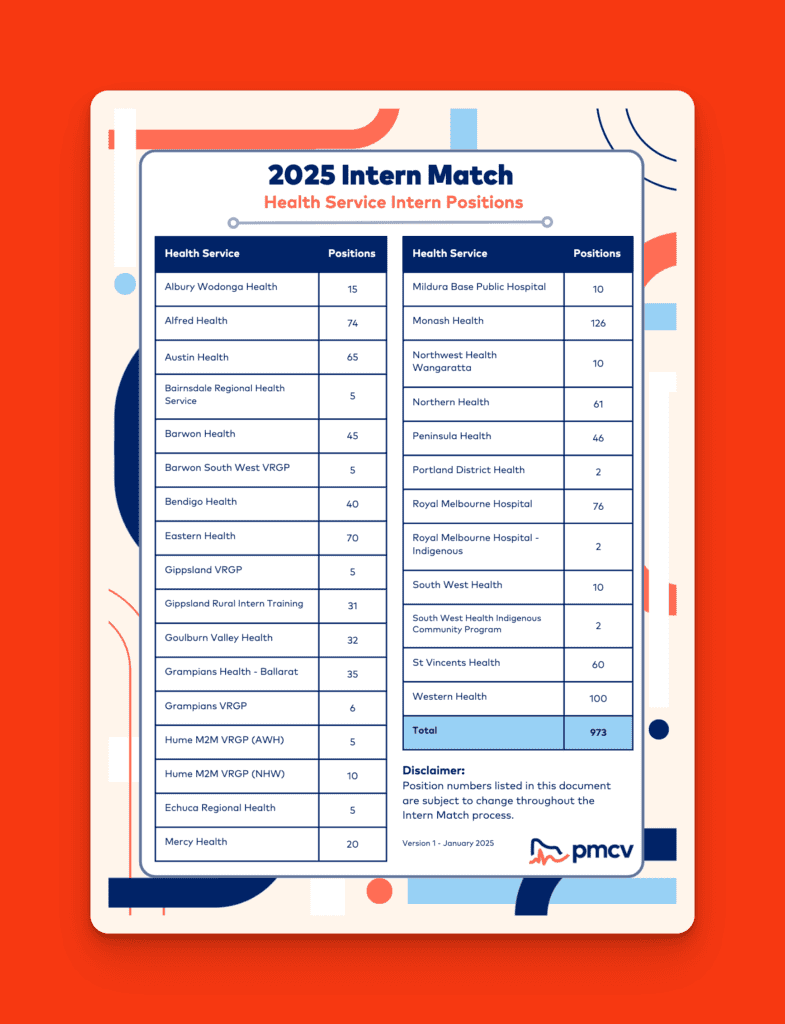
    Intern Numbers = 973 (includes an unspecified number of Rural Preferential posts)
    Unfilled Positions in 2025 = unknown (2024 was 16)
    Annual Salary = $85,414
    Length of Contract = 2 years
    Professional Development Allowance = $3,888 per annum
    c/- PMCV


    Internship in Victoria works around a computer matching system that the Postgraduate Medical Council of Victoria administers.

    The Allocation & Placement Service is a mathematical process that matches the preferences of both candidates and Health Services and is designed to be “impartial and transparent”. 

    Candidates create an account and then register with the Intern match. The second step is to select your preferred services. At the same time, the health services also place preferences. The matching process of successful candidates to positions according to rankings.

    For Victoria, you will need to submit referees as well as a CV. In past years this had to be on the quite unattractive PMCV standardised CV Template. The status of this template has now been downgraded to a “guide”. You don’t have to put a photo on your CV. I would recommend using your own CV template and not include a photo.

    Pre Recorded Video Interviews

    In 2020, Victorian Health Services began the use of video-recorded interviews. This continues for 2025 for certain candidates. The system appears to be being used as an efficient way for certain services or hospitals to review applications without arranging formal interview panel days and for candidates to appear in person.

    All VRPA applicants and all VIA Group 4 applicants will be required to complete a video interview.

    The way these interviews work because you are usually allocated a specific time to log into the system. Once you have gone through a couple of orientation steps you are usually given a series of questions and asked to record your answers. Generally, you don’t get a second go if you are not happy and the time is limited. It is vital therefore that you practice before you do your interview and ensure you have optimised your video environment.

    You are able to complete your recording at any time during the specified video interview period. All candidates are required to answer 3 questions. Questions are randomly selected from 3 different question banks. There is one additional question if you are applying for the Regional Pathway.

    Response times are 2 minutes per question. You get one minute to read the question and prepare your answer before recording.

    All health services can use these recordings to rate you along with your CV and referee reports.

    Metro hospitals may conduct live interviews with shortlisted candidates at any time before 3 July. Although I understand many do not and just rely on the candidates’ CV, referees and video interviews.

    Interns can be allocated to one of 22 hospitals and networks. This includes a small number of community-based internships where the focus is more on community-based models of care, including working in primary care and smaller hospitals.

    You can elect to be prioritised for an internship by entering the Victorian Rural Preferential Allocation (VRPA) match. Where you can be allocated to one of 5 rurally based networks. This pathway involves a live interview. First-round offers for VRPA come out on 18th July on the national rural allocation date.

    Intern Placement Priorities in Victoria

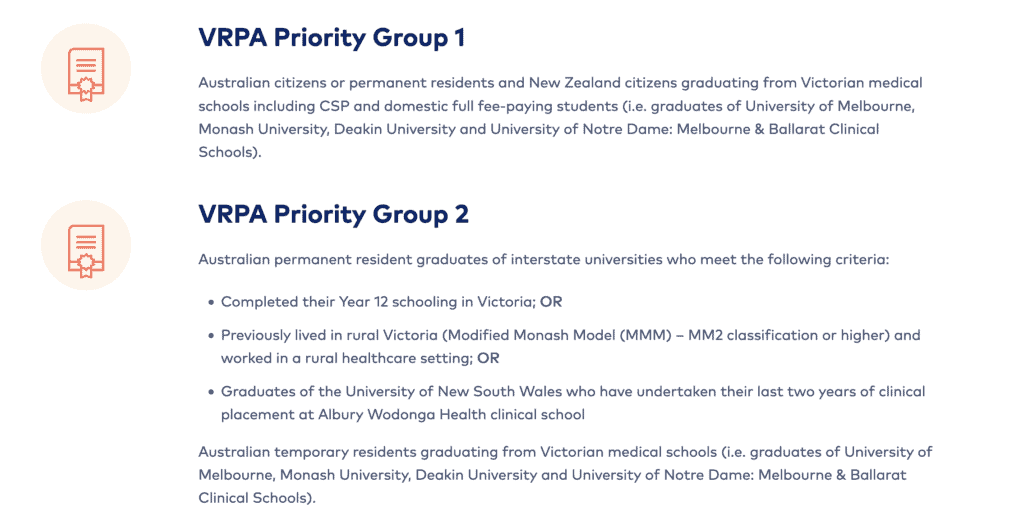
    Intern placement priorities have altered for 2025 with the introduction of a 3rd priorty group for the Victorian Rural Preferential Application (VRPA) pathway and renaming the main pathway to the Victorian Interns Allocatin (VIA) pathway with the creation of an additional fourth category for this pathway.

    VRPA Priority Group 1 – Graduates from an Australian University identifying as Aboriginal or Torre Strait Islander. Australian Citizen or permanent resident and New Zealand citizens graduating from a Victorian Medical School.

    VRPA Priority Group 2 – Australian Temporary residents graduating from a Victorian University. Graduates of the University of New South Wales who have undertaken their last two years of clinical placement at Albury Wodonga clinical School. Australian Citizen or permanent resident and New Zealand citizens graduating from an interstate Medical School but completed year 12 in Victoria. Completed their Year 12 schooling in Victoria; OR Previously lived in rural Victoria (Modified Monash Model (MMM)1 – MM2 classification or higher) and worked in a rural healthcare setting; OR Graduates of the University of New South Wales who have undertaken their last two years of clinical placement at Albury Wodonga Health clinical school.

    VRPA Priority Group 3 – Australian citizen or permanent resident or New Zealand citizen graduating from an interstate or New Zealand University. Australian Temporary resident graduating from an interstate
    University.

    VIA Group 1 – Graduates from an Australian University identifying as Aboriginal or Torre Strait Islander. Australian Citizen or permanent resident and New Zealand citizens graduating from a Victorian Medical School.

    VIA Group 2 – Australian Temporary residents graduating from a Victorian University. Australian citizens or permanent residents and New Zealand citizens graduating from an interstate University who completed their year 12 schooling in Victoria

    VIA Group 3 – Australian citizens or permanent residents and New Zealand citizens graduating from an interstate or New Zealand University. Australian Temporary residents graduating from an interstate
    University. New Zealand temporary resident graduating from a New Zealand University.

    VIA Group 4 – Graduates from and overseas campus of an Australian/New Zealand University accredited by the Australian Medical Council (i.e. Monash University, Malaysia or Ochsner).

    Indigenous Internships

    Both South West Health Care (based on Warnambool) and Melbourne Health have a small number of Internships reserved for Indigenous graduates.

    The Victorian Rural Medical Scholarship Scheme

    The Victorian Rural Medical Scholarship (VRMS) supports career pathways to rural medical practice and assists rural and regional health services to attract, employ and retain medical graduates. The VRMS supports medical students with a commitment to working in rural and regional Victoria by providing financial assistance towards living and tertiary expenses in the final year of their medical degree and into their rural intern year.

    The VRMS is administered by the PMCV on behalf of the Department of Health of Victoria. Scholarships valued at $20,000 each are available to be
    awarded to final year medical students in Victoria. Scholarship recipients are required to commit to a two- year return of service in rural or regional Victoria (within three years from graduating from medical school).

    Queensland

    Story Bridge Brisbane

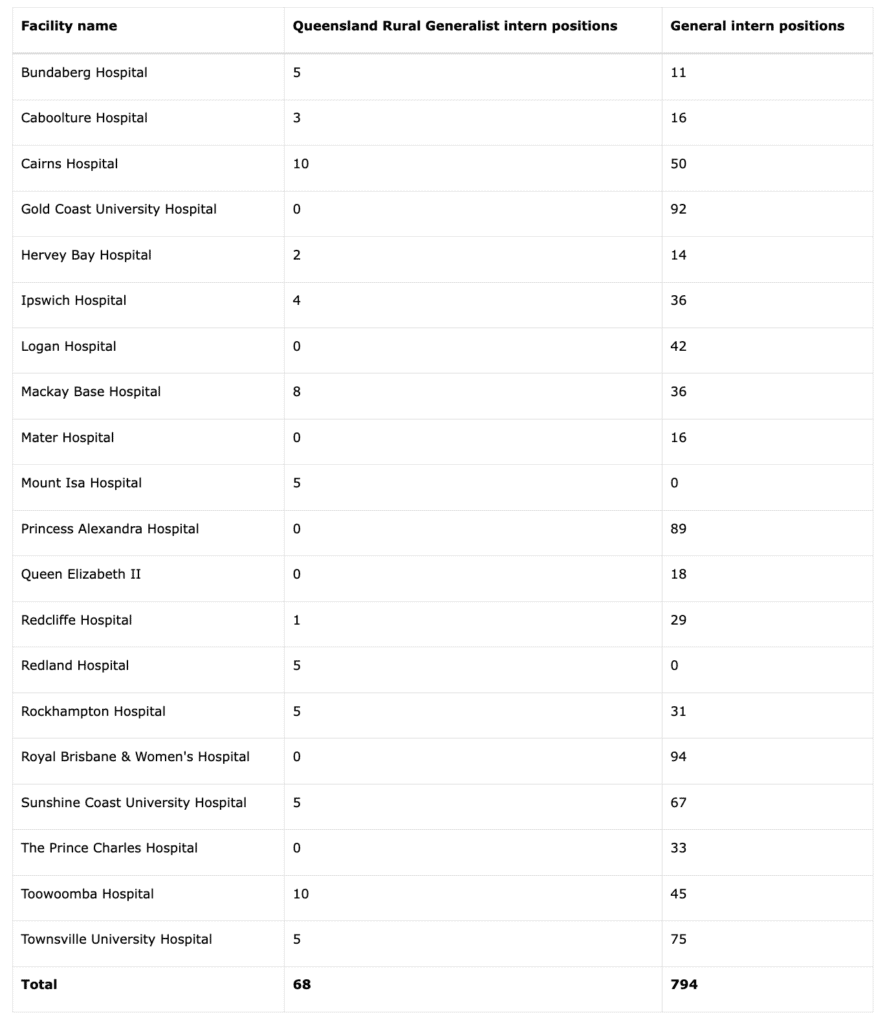
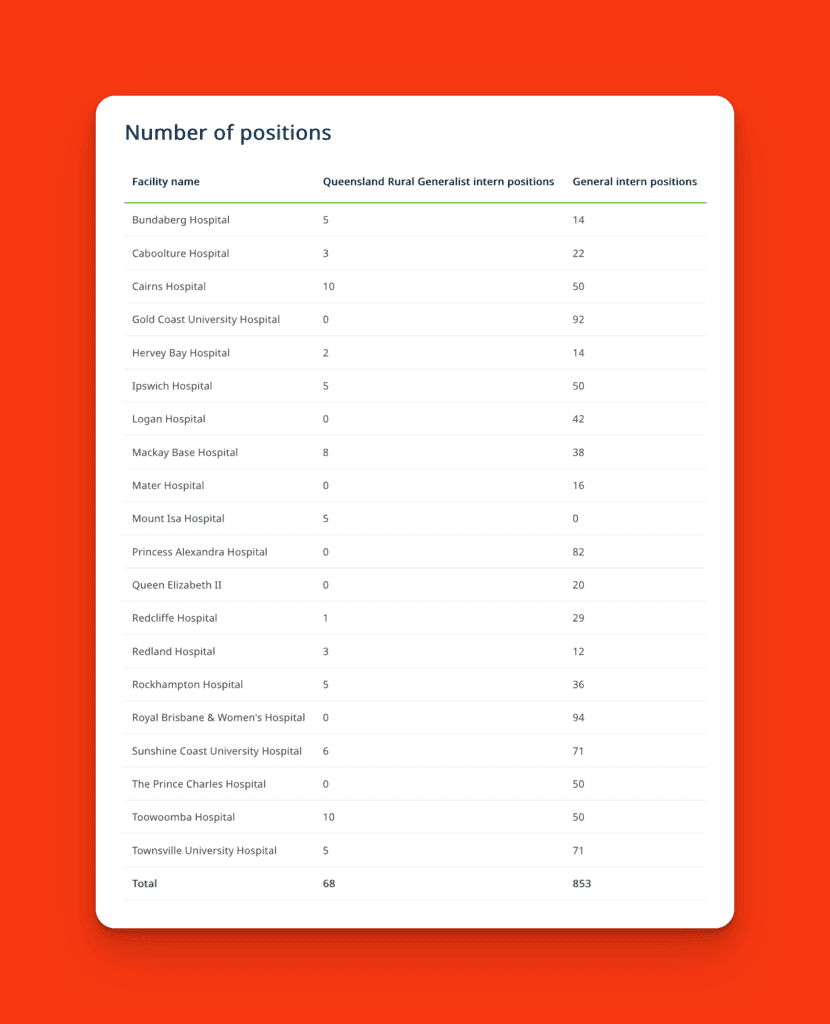
    Intern Numbers = 921 (including 68 rural generalist intern positions)
    Annual Salary = $90,141
    Length of Contract = 1 year
    Professional Development Allowance = nil for Interns but $2,640 for RMOs
     
    Queensland has possibly the most complex internal allocation system of all jurisdictions. With a number of pathways and a combination of allocating certain priority groups and merit selection for others.

    The Queensland Department of Health coordinates the annual campaign to recruit interns for positions in Hospital and Health Services across the state. There is only one method of application for the intern campaign – the lodgement of an online form via a central application portal.

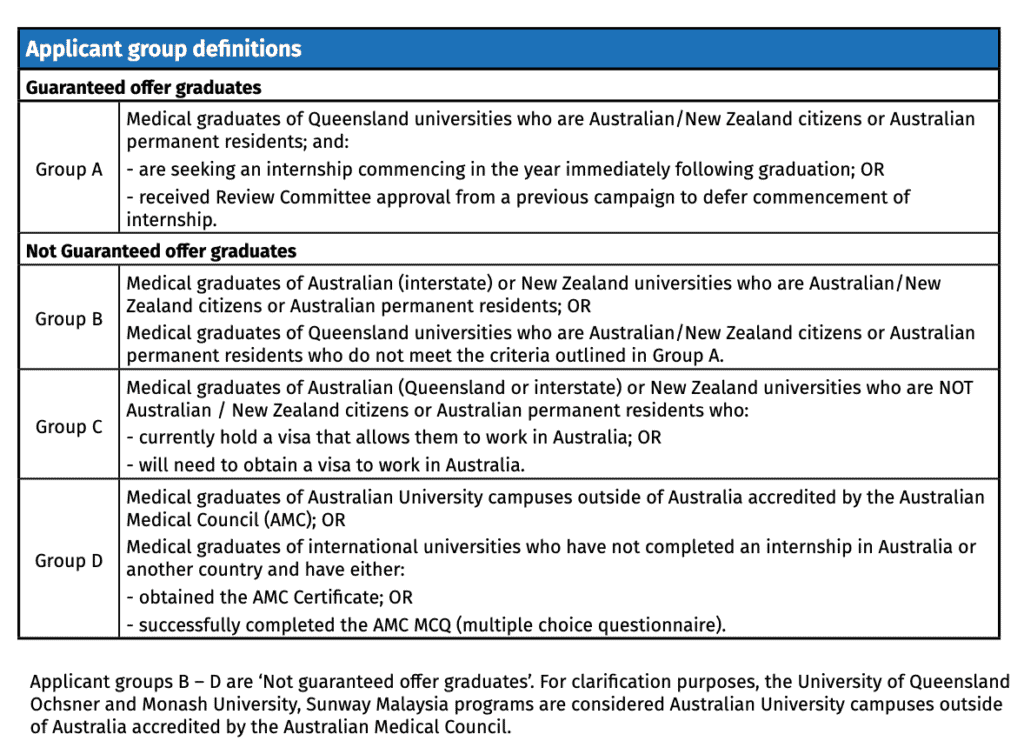
    Graduates assign a preference to all participating hospitals from highest to lowest (number 1 being the most preferred hospital). From the applications received via the campaign, graduates are either directly allocated to an intern position determined by their preferences (Group A) or will participate in a suitability assessment process conducted by participating hospitals with remaining intern vacancies (Applicant Groups B-D).

    The online portal is used for both the General intern campaign applications and the Queensland Rural Generalist Pathway (QRGP pathway). Applications for the QRGP are submitted first (usually in early March), followed by the General campaign (usually in May).

    So, by the time you are reading this post, if you were thinking of applying for the Queensland Rural Generalist Pathway you have missed your opportunity for 2026.

    Interns can be allocated to one of 20 Employment Hospitals.
    c/- Queensland Health

    Applicant Categories

    In Queensland, intern applicants are classified into two categories:

    Guaranteed offer graduates – Medical graduates who are guaranteed an offer of an intern position in Queensland within their immediate postgraduate year. Allocation to an intern position may be automatic or via random ballot, based on hospital preferences nominated by the individual in their intern application form. (For eligible applicants – see Group A).

    Not guaranteed offer graduates – Medical graduates who are not guaranteed an intern offer. A suitability assessment process is undertaken to determine if an offer of an intern position will be made. (For eligible applicants – see Groups B-D). There is no inherent prioritisation across applicant groups, the categorisation of groups are used for reporting for the intern campaign. Each participating Hospital and Health Service establishes suitability assessment processes to recruit from their available applicant pool and are not obligated to sequentially select through the applicant groups. Applicants who do not meet the outlined criteria for Groups A, B, C or D may be considered at the discretion of each participating hospital.
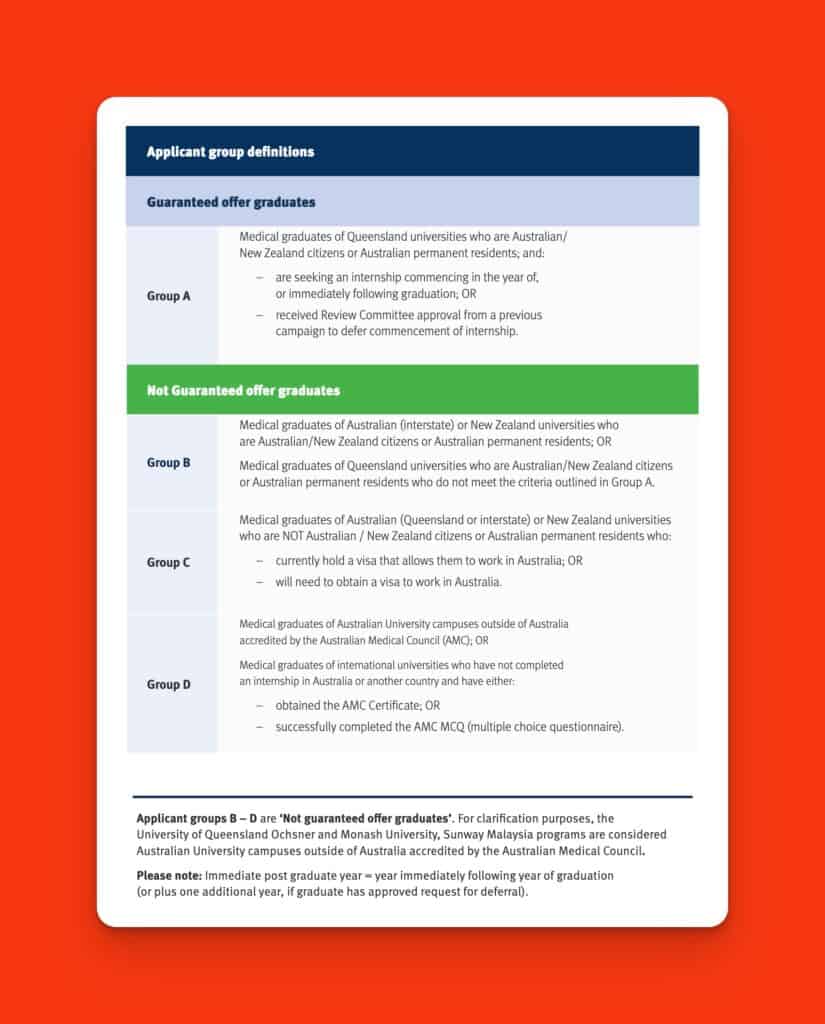
    c/- Queensland Health

    Note: Queensland is one of the few jurisdictions that offer an opportunity for IMG doctors to complete an internship in Australia. The number of doctors who are successful in doing so each year is rarely more than a handful.

    Internship pathways

    There are 4 pathways for Intern Allocation in Queensland.

    1. The Rural Generalist Program offers an opportunity to select a rural hospital centre as part of a program that is a pathway to working as a Rural GP. Applications open 4th March and close extremely early (18th March) for this pathway.
    2. Aboriginal and Torres Strait Islander Intern Allocation Initiative. The purpose of the initiative is “to promote the success of Aboriginal and Torres Strait Islander medical graduates in the Queensland Health workforce”. Eligible applicants can apply to the Aboriginal and Torres Strait Islander Intern Allocation Initiative to be allocated to their first preferenced hospital. Applications are reviewed by a panel that includes Aboriginal and Torres Strait Islander representation. Applicants who have been confirmed as eligible by the panel will be exempt from the ballot process and allocated to the facility nominated as first preference in their intern application.
    3. The General Intern Campaign. Which is a ballot process for all category A applicants.
    4. Suitability assessment for applicants in Group B-D.

    The General Intern Campaign Allocation Process.

    After the application period has closed, applications are sorted according to their applicant groups, preferences, and available positions at each facility.

    Prior to the ballot taking place a Review Committee considers applications for:

    • requests for special considerations
    • exemption requests
    • joint ticket applications
    • deferral requests

    After this the ballot commences.
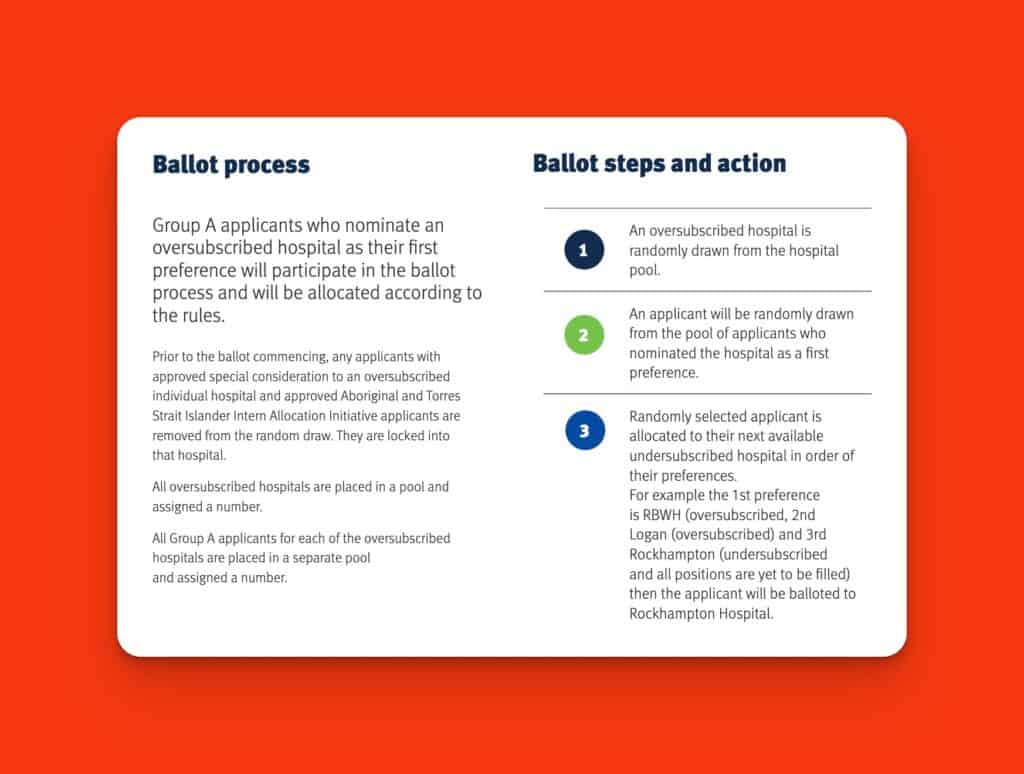
    c/- Queensland Health

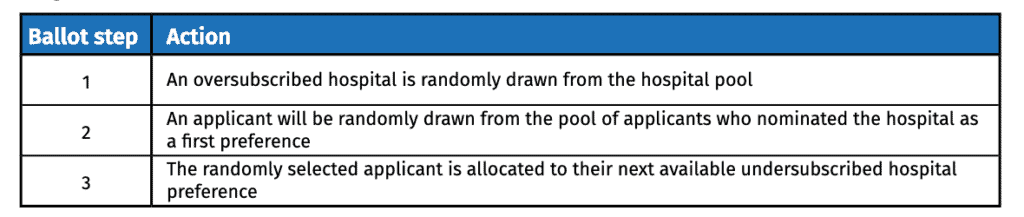
    Applicant Group A candidates who nominate an undersubscribed’ or equal in numbers hospital as first preference will automatically be allocated to that facility.

    Applicant Group A candidates who nominate an ‘oversubscribed’ hospital as their first preference may be allocated to another facility via the ballot process.

    Merit Selection for Groups B-D.

    There is no inherent prioritisation across applicant groups, the categorisation of these groups are used for reporting for the intern campaign. Each participating Hospital and Health Service establishes individual assessment processes to merit select from their available applicant pool and are not obligated to sequentially select through the applicant groups. Applicants who do not meet the outlined criteria for Groups A, B, C or D may be considered at the discretion of each participating hospital.

    Following the completion of first-round offers, the Position Status Report (PSR) is updated.

    This is an updated list of available positions remaining.

    Applicant group B-D candidates have 48 hours to change their preferences if they wish to.

    Queensland Health hospitals then assess applications and conduct their own meritorious selection processes. You should contact each Hospital and Health Service directly to find out what they look for in an intern.

    If vacancies become available after the First and Second Round offers, individual hospitals will meritoriously select from the remaining applicants for available vacancies. Recruitment to fill available vacancies will continue until the national closing date for intern recruitment. After the closing date, any further vacancies that arise will be filled via the Late Vacancy Management Process (LVMP).

    Western Australia

    Perth City Scape

    WA Health and the PMC of WA have previously indicated that they can not make Intern numbers available, as these are subject to confirmation by the Primary Employing Health Services.

    Estimated Numbers ≅ 401 including 25 Country Health places (based on 2023/2024 PMCWA Annual Report)
    Annual Salary = $90,864 ($119,165 if working for Country Health)
    Length of Contract = 3 years (in most cases, St John of God Midland = 2 years) with the ability to transfer to a different PEH if all internship requirements are met (IMGs may have shorter contracts tied to their visa status)
    Professional Development Allowance = $6,503

    c/- PMCWA

    Western Australia Intern Eligibility and Priorities

    In Western Australia applications that meet all eligibility criteria, and all essential criteria are included in the suitable recruitment pool. Once in the suitable pool, selection and recruitment decisions are made by the primary employing hospitals. 

    As with all other Australian jurisdictions, priority is given to Commonwealth funded medical students graduating from Western Australia. This is then followed by Western Australians graduating from interstate universities who want to return to WA; international medical students graduating from WA medical schools; then graduates from other jurisdictions (other than WA). The priority then shifts to international medical graduates from outside of Australia.

    Most notably, Western Australia has a final Category, Category 9, for graduates of universities in Competent Authority countries (as defined by Ahpra) who are Australian citizens or permanent residents, or New
    Zealand citizens who are eligible for limited registration. Presumably this is to permit Australian students who choose to study in countries such as the UK or Ireland to commence their internship in Australia. How they qualify for this is unclear, as technically, without any overseas experience they are not eligible for the Competent Authority pathway. It appears that they would have to sit and pass the AMC Part 1. Practically this probably means taking a risk and sitting out internship for 6 months to a year, because you can only sit the AMC Part 1 after you graduate from medical school.
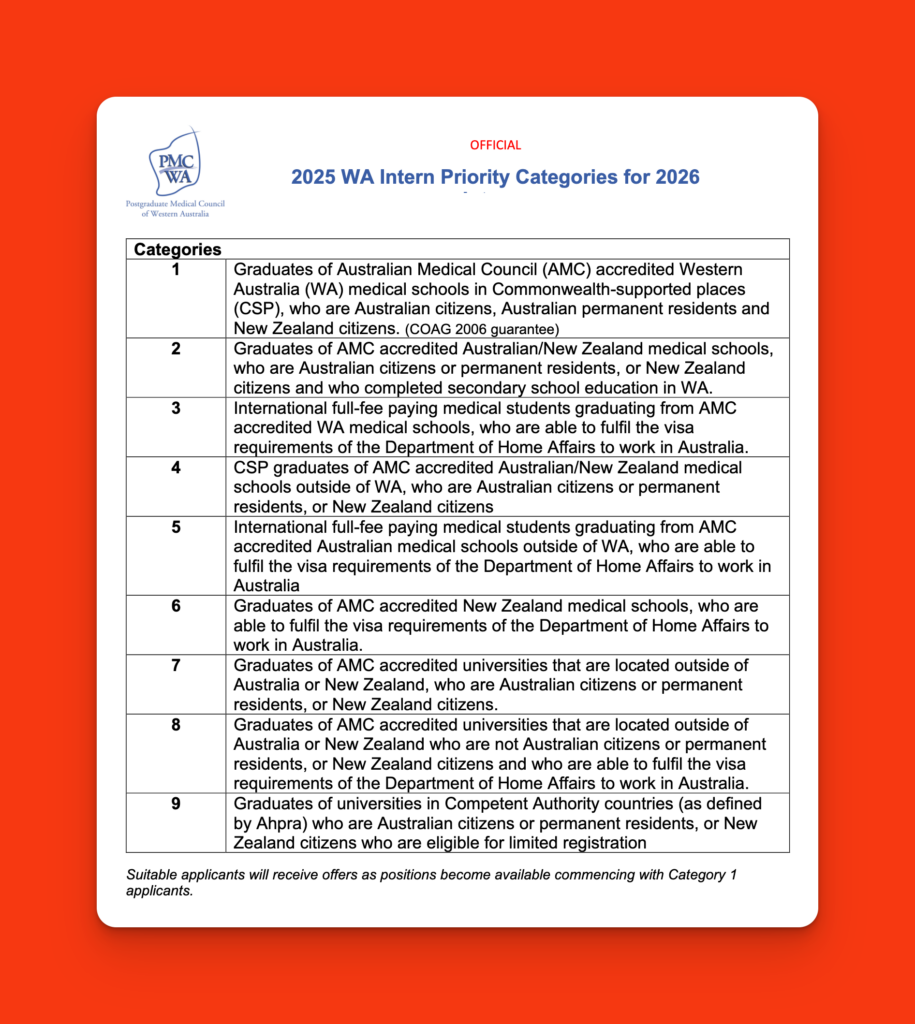
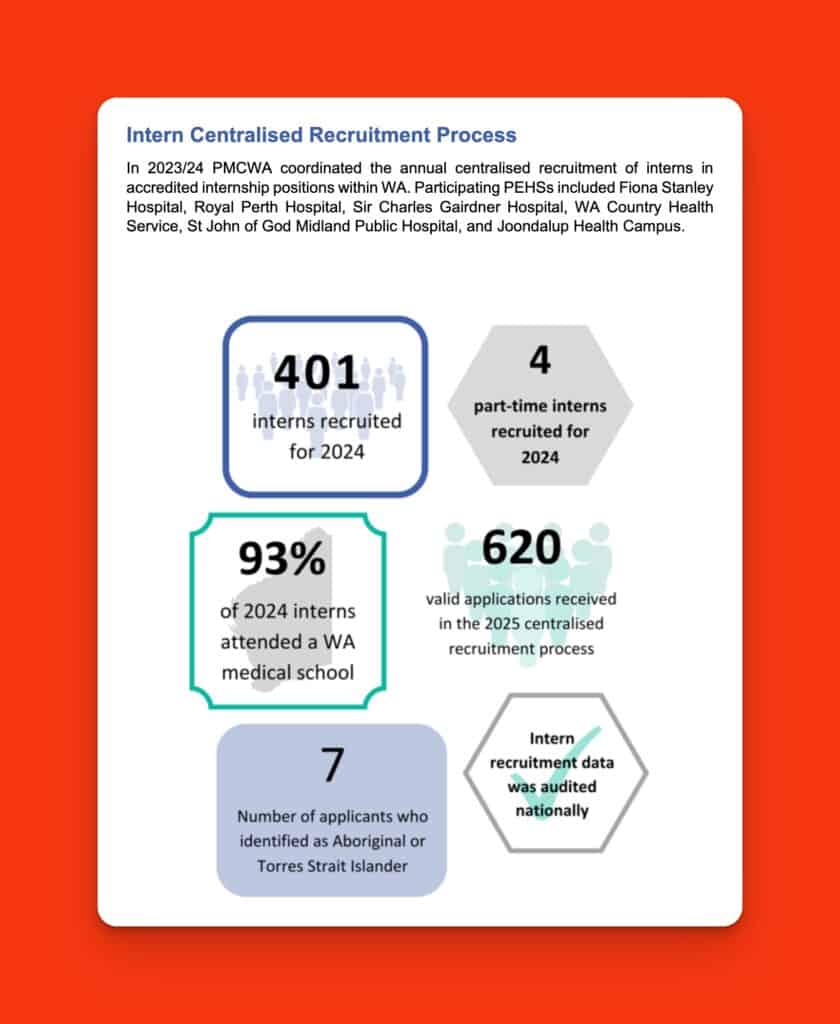
    c/- PMCWA

    Vacancies arise as offers are declined throughout the process, and these vacancies fluctuate each year and will affect how many students outside of WA are offered an intern position. 

    Western Australia is one of the few options for IMGs to do an Internship in Australia, although as you can see from the above, it is quite limited.

    In WA all interns are employed by a Primary Employing Health Service (PEHS). 

    In WA all interns are employed by a Primary Employing Health Service (PEHS) accredited by PMCWA. Each PEHS is a major tertiary hospital in WA which has been accredited to directly employ interns and provide a high quality intern training program.

    The six PEHSs in WA are:

    All six WA Health PEHS recruit through the Centralised Intern Application Process. Each PEHS holds an information session during the application period, with presentations from the Medical Education teams, current interns and more.

    Following the close of applications in the centralised application process, PMCWA reviews all applications and creates a pool for all suitable applications. Applications appointed to the pool are grouped and managed according to the applicable priority category. As positions become available and selection processes are completed, applicants will be offered positions according to category.

    Each PEHS is a major tertiary hospital in WA that has been accredited to directly employ interns and provide an intern training program.

    Employing Health ServiceMetro PlacementsRural Placements
    Fiona Stanley Fremantle Hospitals Group (Fiona Stanley Hospital)Fiona Stanley Hospital
    Fremantle Hospital
    Rockingham General Hospital
    Albany Health Service
    Broome Regional Hospital
    Northam Health Service
    Joondalup Health CampusJoondalup Health CampusKalgoorlie Regional Hospital
    Royal Perth Bentley Group (Royal Perth Hospital)Royal Perth Hospital
    Armadale Health Service
    Bentley Hospital
    Osborne Park (Women and Newborn Service)
    Perth Children’s Hospital
    Bunbury Hospital
    Hedland Health Campus
    Kalgoorlie Regional Hospital
    Sir Charles Gairdner Osborne Park Health Care Group (Sir Charles Gairdner Hospital)Sir Charles Gairdner Hospital
    Graylands Hospital
    Hollywood Private Hospital
    Joondalup Health Campus
    Osborne Park (Women and
    Newborn Service)
    Perth Children’s Hospital
    Geraldton Regional Hospital
    Hedland Health Campus
    Karratha Health Campus
    St John of God Health Care (St John of God Midland Public Hospital)St John of God Midland
    Public Hospital
    St John of God Subiaco
    Hospital
    St John of God Murdoch
    Hospital
    WA Country Health ServiceAlbany Health Campus
    Broome Regional Hospital
    Bunbury Hospital
    Geraldton Regional Hospital

    Each PEHS hosts an information night. You can also choose to work as a rural intern by applying to work through Western Australia Country Health Service.

    The intern application process is coordinated by the Postgraduate Medical Council of Western Australia but you apply through the WA Jobs site called MedJobsWA. You submit one application and rank each PEHS from most to least preferred. Selection occurs through panels representing each of the PEHSs. As part of your application, you need to provide a CV (maximum 3 pages) and cover letter (optional) and address the intern selection criteria, you will require a range of other documents as well as nominate 2 referees. If successful you will normally receive a contract for 3 years, which provides you with job security.

    South Australia

    The River Torrens in the city of Adelaide

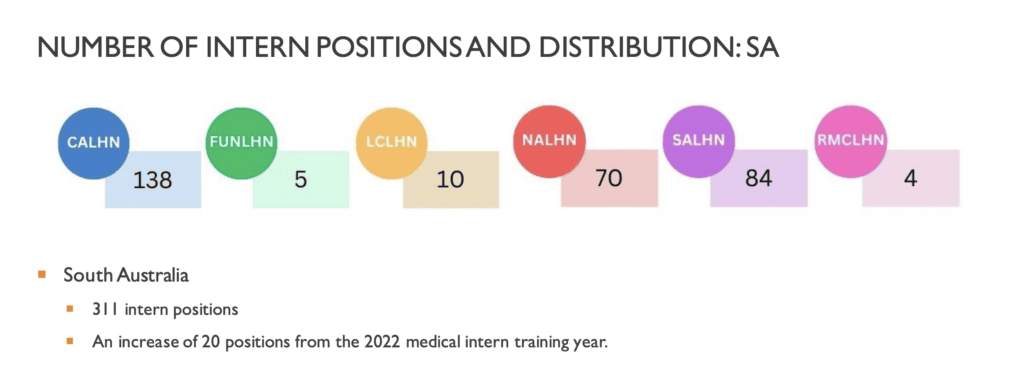
    Estimated Numbers = 353 (based on 2025 final positions, including 47 rural intern posts)
    Annual Salary = $81,814
    Length of Contract = 3 years in most cases (IMGs may have shorter contracts tied to their visa status)
    Professional Development Allowance = $4,500 per annum

    SA MET (South Australia Medical Education and Training) conducts the annual Intern application process in South Australia. There are 3 Adelaide-based Local Health Networks and 3 smaller country-based networks to which you can apply for the priority Rural Intern pathway. It should be noted that whatever network you are allocated to you may request or be required to undertake one or more rotations in other networks.

    The Rural Intern Pathway is a strength-based recruitment process for applicants who are interested in undertaking their internship (and potentially subsequent years) in rural hospitals within Country Health SA (CHSA). Rural intern positions provide broad opportunities in unique settings and are best suited for medical graduates with a history of living or working in rural areas or a desire to commence a career in the country. 

    To apply for internship in South Australia, you must comply with the following criteria:

    • Have graduated from a medical school in the last two years (i.e. to start an internship in 2026, you are / were a final year medical student in the 2025 or 2024 cohort).
    • Applicants who completed their medical degree at an overseas university NOT accredited by the Australian Medical Council (AMC) must have completed both Part 1 and 2 of the Australian Medical Council exams.
    • Can demonstrate that you meet the English Language Skills Registration Standard.
    • Be able to commence on the January start date, which includes compulsory orientation, and fulfil the minimum 12-month contract.
    • Have completed electronic medical record (Sunrise EMR and PAS) medical student training.
    • Be able to demonstrate that you will meet the requirements for registration with Ahpra.
    • Have NOT commenced or completed an internship or worked as a doctor before.
    • Be an Australian Citizen, Australian Permanent Resident, Australian Temporary Resident, New Zealand Citizen or New Zealand Permanent Resident.
    • Have a visa that allows you to work unrestricted in Australia for the duration of your internship.
    • Applicants completing their medical degrees in Australia who are on a student visa will need to obtain an appropriate Australian work visa before commencing their intern year (refer to page 33).
    • Have completed and submitted an online application, including the provision of valid supporting documentation, by the application closing date.
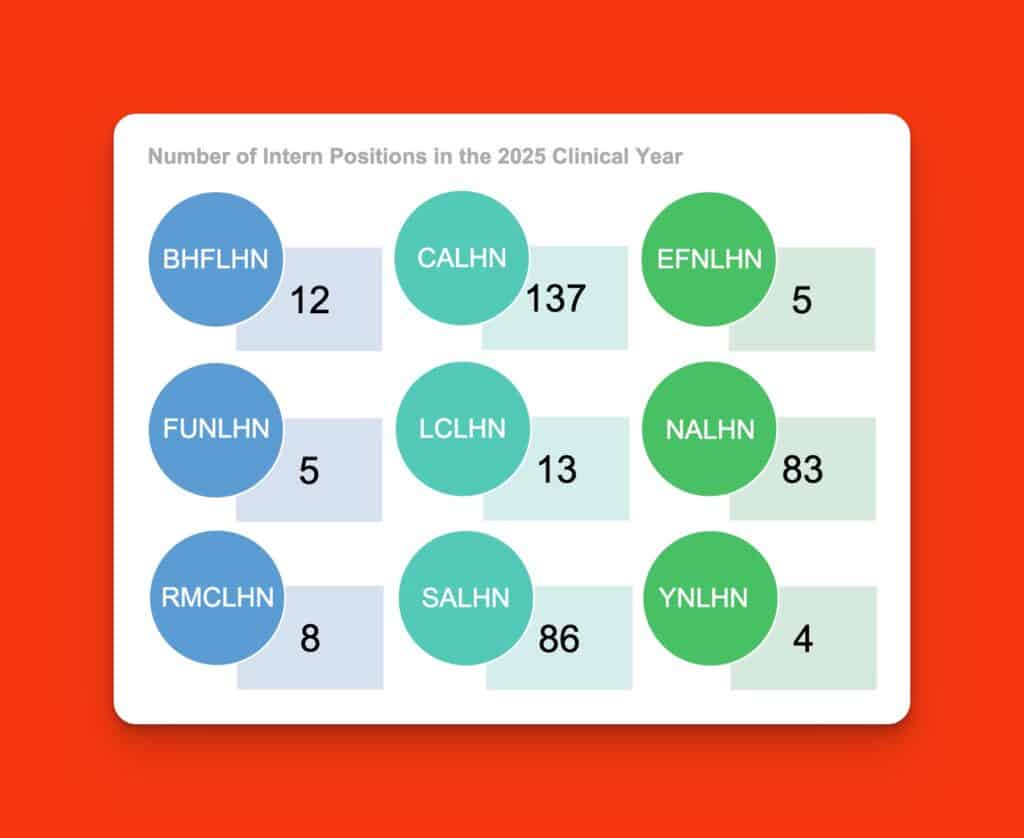
    C/- SAMET

    Barossa Hills Fleurieu Local Health Network (BHFLHN)

    Central Adelaide Local Health Network (CALHN)

    Eyre and Far North Local Health Network (EFNLHN)

    Flinders and Upper North Local Health Network (FUNLHN)

    Limestone Coast Local Health Network (LCLHN)

    Northern Adelaide Local Health Network (NALHN)

    Riverland Mallee Coorong Local Health Network (RMCLHN)

    Southern Adelaide Local Health Network (SALHN)

    Yorke and Northern Local Health Network (YNLHN)

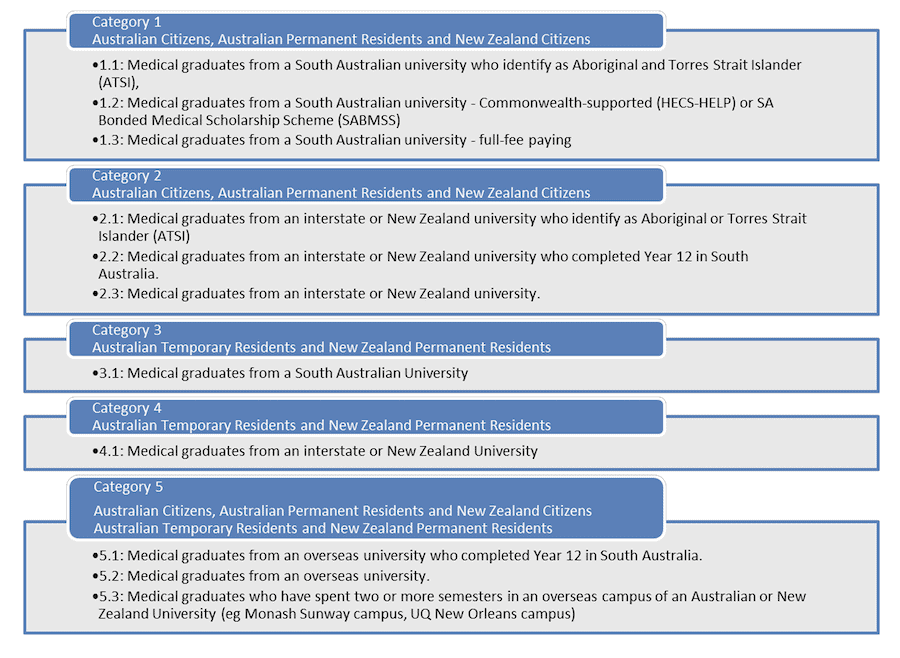
    SA Intern Priorities:

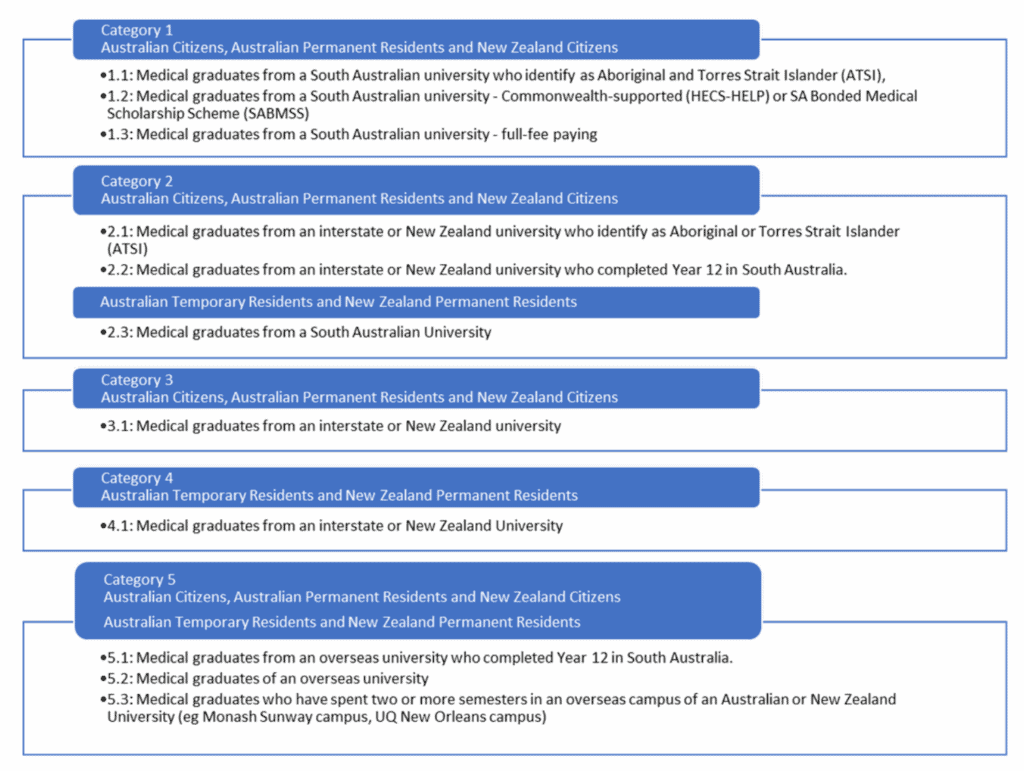
    Like most other jurisdictions, South Australia prioritises its medical graduates first, then graduates from other States and Territories. International Students are given lower priority than Australian Citizens, Australian Permanent Residents and New Zealand Citizens.

    Aboriginal and Torres Strait Islander applicants are given priority preference by being placed in the first subcategory for categories 1 and 2.

    International Medical Graduates from non-Australian medical schools can apply for the rural intern pathway so long as they have only graduated in the last 2 years and have completed the AMC Part 1, and can meet the other requirements (which are extensive) and include meeting the Medical Board English language requirements, completing electronic medical record training and have residency status or a visa that allows you to work unrestricted. They must also not have commenced or completed an internship.

    International Medical Graduates from non-Australian medical schools can also apply for the main round but in this case must have completed both AMC Part 1 and Part 2.

    Rural Intern Pathway

    Applications for the Rural Intern Pathway are included in the standard South Australian application for internship.

    All applicants are asked to preference all eight rural networks as well as the three metropolitan health networks.

    Eligible applicants wishing to apply for the Rural Intern Pathway must preference a rural site as their FIRST preference. Rural Intern Pathway applicants who preference a rural LHN as their first preference are asked additional questions within their application form. And must participate in interviews conducted by a selection panel from the rural LHNs.

    SA Health determines which applicants will receive rural internship offers using a preference matching process and the ranked list provided by the LHNs.

    The placement of applicants into rural intern positions will occur prior to the placement of applicants into metropolitan intern positions. SA Health will match applicants to specific rural LHNs as instructed.

    Internship Categories

    Within the respective South Australian category groups, applicants are randomly allocated to their highest possible Local Health Network preference.
    If an offer is made, applicants must respond via the electronic application system within the specified timeframe. Where an applicant has been made an offer and no response received, the offer will be automatically declined. Applicants are only eligible to receive one offer for an internship in South Australia.

    South Australia is one of few States that specifically permits medical graduates from other countries to apply for internship positions. But they are at the very bottom of the priority list. Please see the above information about the rural internship.

    In addition to a CV and referees, in order to apply for an internship in South Australia, you will need to provide a certificate confirming that you have completed the SA Health online electronic medical record (Sunrise EMR & PAS) training.

    Tasmania

    Hobart in Australia

    Estimated Number  = 106
    Annual Salary = $87,000
    Length of Contract = 1 year (attempting to confirm if this has become 2 years)
    Professional Development Allowance = nil for Interns but RMOs get an allowance of $2040 per annum

    Internships are coordinated in Tasmania via the Department of Health and Human Services.
     
    All applicants are required to apply online. As part of your application, you are asked to preference all of the 3 available sites:

    SiteNumber of Positions
    North (Launceston General Hospital)39
    South (Royal Hobart Hospital)48
    North-West (North-West Regional Hospital Burnies and Mersey Community Hospital, Latrobe)19

    Rural Option

    You can also preferentially apply for one of 5 places on the Tasmanian Rural Generalist Program. You will be allocated to one of the above sites based on your preference but also undertake a 13-week rural GP placement as part of your internship.

    Applying


    Applicants must be graduates of or graduating from an Australian Medical Council-accredited University.  

    All applicants are required to apply online. Only one application is required; you will be asked to indicate your preferred place of employment (Hobart, Launceston, North West Region) via the application form.  Applicants must list each site in order of preference.

    The online application form ensures all the information required to assess your application is provided. The form includes information on eligibility to work in Australia and details on how to submit electronic reference requests.

    The online application form requires you to include your University Student Number and your Australian Health Practitioner Regulation Agency (AHPRA) Intern Placement Number.

    Candidates are required to attach a CV/Resume and any other relevant information to their application.

    A written statement addressing the selection criteria is NOT required. 

    Intern Placement Priorities:

    The Tasmanian Department of Health currently gives priority, in order, to:

    1. Australian permanent resident Tasmanian-trained Australian Government supported and full-fee paying medical graduates.
    2. Australian temporary resident Tasmanian-trained full-fee paying medical graduates.
    3. Australian permanent resident interstate-trained Australian Government supported and full-fee paying medical graduates.
    4. Australian temporary resident interstate-trained full-fee paying medical graduates.
    5. Medical graduates of an Australian Medical Council-accredited overseas University.

    Selection

    The Tasmanian Department of Health will conduct a ballot-based allocation system for placing Priority 1 (Australian permanent resident Tasmanian-trained Australian Government supported and full-fee paying medical graduates) and Priority 2 (Australian temporary resident Tasmanian-trained full-fee paying medical graduates) applicants.

    It is not clear at this stage how further positions are filled according to the remaining priorities.

    Northern Territory

    ocean coast in Darwin, Northern Territory Australia

    Intern Numbers = 88
    Annual Salary = $90,150
    Length of Contract = 1 year
    Professional Development Allowance = $3,601 per annum with the option to apply for an additional $3,000 or $3,000 for HELP relief.

    The NT Prevocational Medical Assurance Services (PMAS) conducts a central review of eligible applicants and all intern positions are allocated within the two NT Health Services:

    • Top End Health Service (TEHS) – based upon Royal Darwin Hospital (RDH) (64 posts)
    • Central Australia Health Service (CAHS) – based upon Alice Springs Hospital (ASH) (24 posts)

    Each Health Service has a primary employing health service as well as additional placement hospitals as per below:
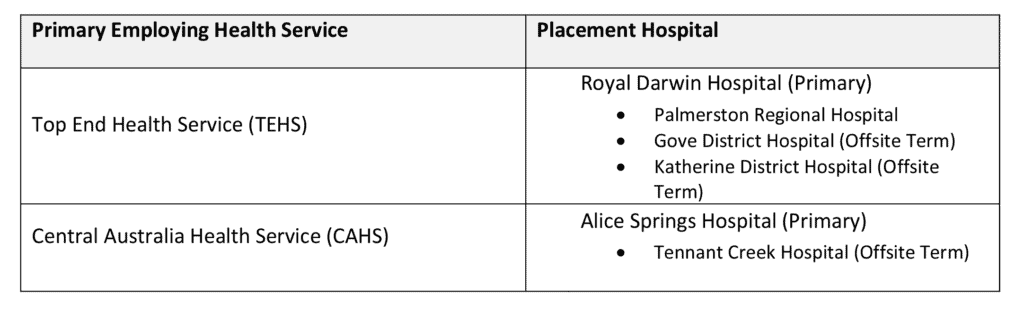
    C/- NTPMAS Guide

    Eligible applicants are allocated intern positions in line with the Northern Territory category groups. Within the relevant category groups, applicants are allocated to their highest possible Health Service preference, pending the availability of a position.

    Intern Priority Categories:

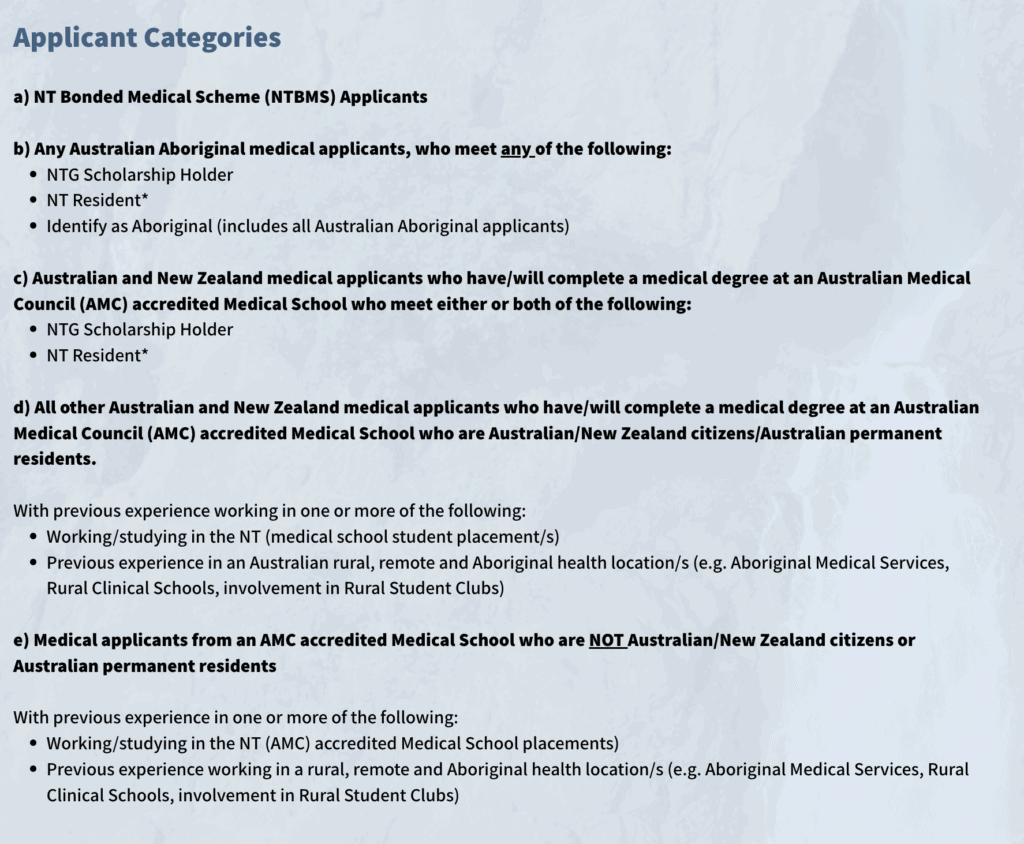
    According to the NTMETC the applicant eligibility categories in order of selection for Internship in the Northern Territory are:
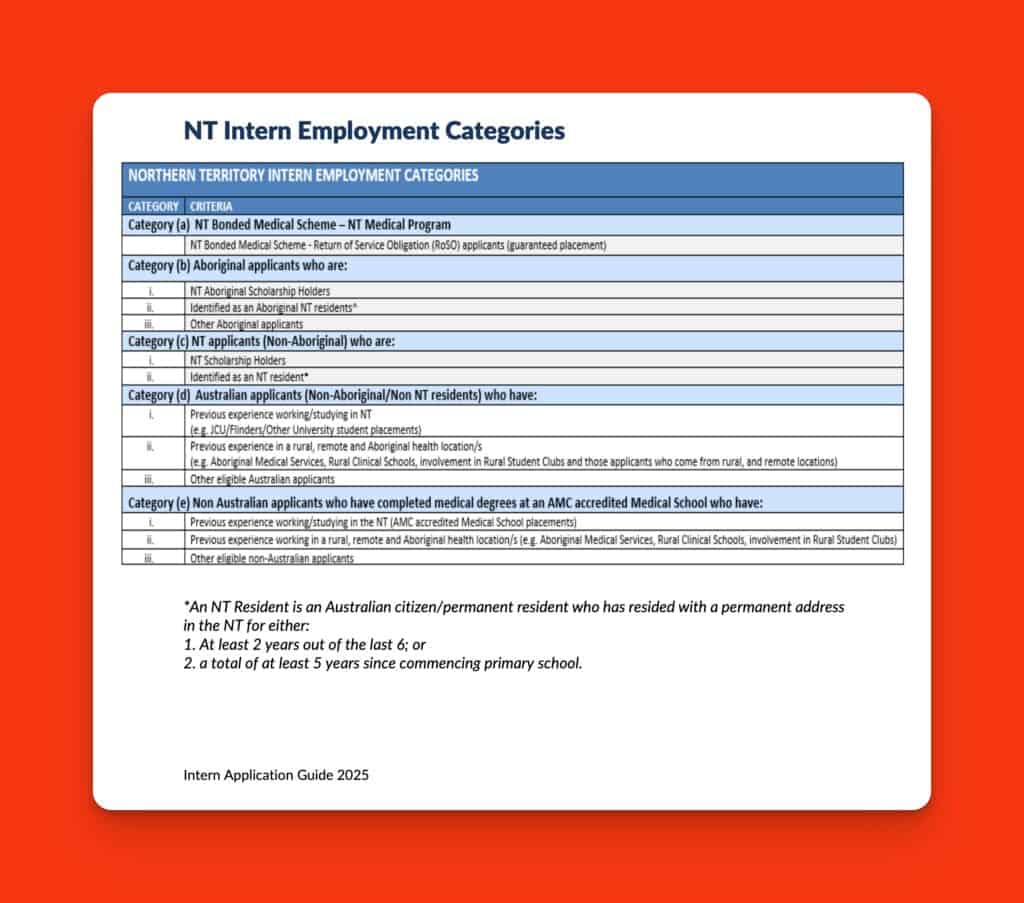
    c/- NTMETC

    Previously there was an F and G category that provided an option for IMG doctors. It is not clear whether this has been removed for the 2023 year.

    As part of your application, you are required to submit a curriculum vitae of no more than 2 A4 pages and address the selection criteria. Applications are submitted to the NT Government employment portal.

    Overall the intern allocation process is based on an applicant’s category group, Health Service preference, and the number of positions available in each health service.

    The two NT Health Services are responsible for selecting applicants and making their offers of employment, applicants are advised via email.  The Health Service responsible for making the offer of employment will after receiving an acceptance from an applicant arrange an employment contract for an Internship position within their health service to be provided prior to commencing their internship.

    Australian Capital Territory

    The Australian War Memorial in Canberra

    Intern Numbers = 96
    (6 of these positions are normally guaranteed to NSW medical students)
    Annual Salary = $86,619
    Length of Contract = 2 years
    Professional Development Allowance = $1,150 per annum + $900 Mobile Allowance + $4,000 Relocation Allowance.
     
    If you want to apply for an internship position in the Australian Capital Territory you do so via the ACT Health Recruitment page.

    Most of your time is spent at the Canberra Hospital. But ACT is interesting as it is one of the few chances you may have as an Intern to work in 2 separate States and Territories. Rotations may include secondments to Calvary Public Hospital, Goulburn Base Hospital, and South East Regional Hospital (SERH) at Bega. Because the ACT utilises some positions in NSW for intern posts there is a reciprocal arrangement whereby a number of NSW graduates are guaranteed an intern post in the ACT.

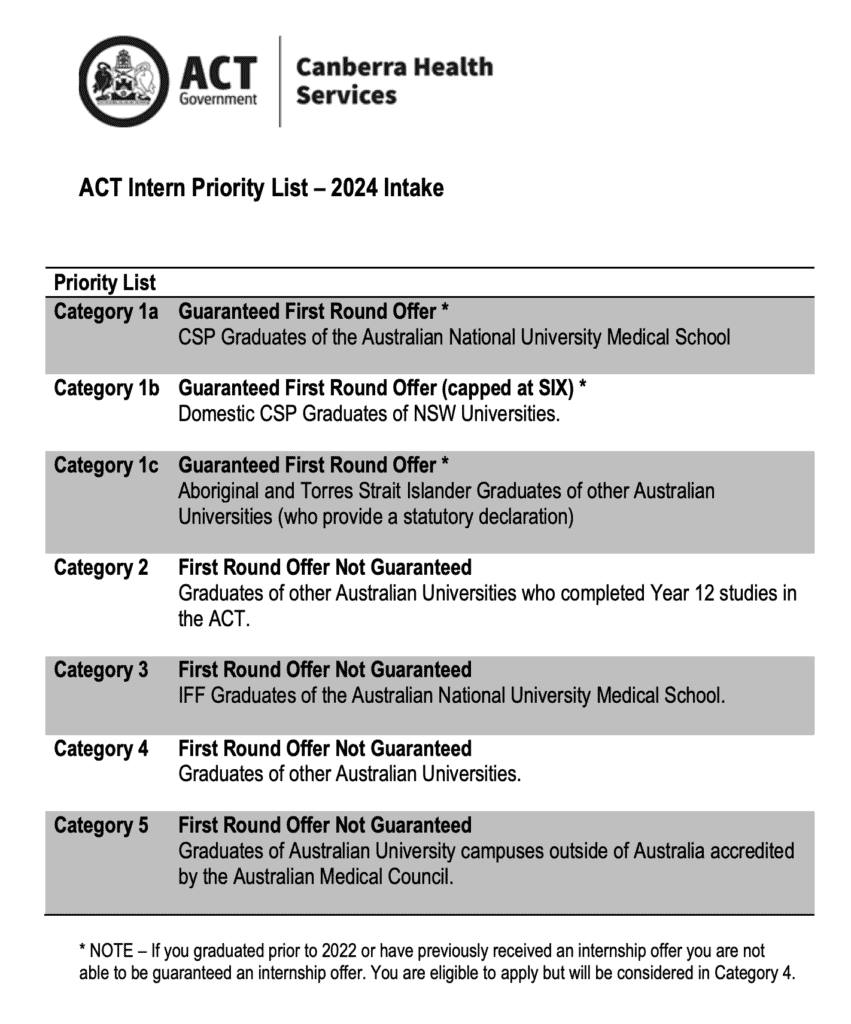
    Priority is given to:
    – Australian Graduates of ANU
    – A maximum of 6 graduates of NSW Universities
    – Graduates of other Universities who completed Year 12 in ACT

    ACT Intern Priority List:
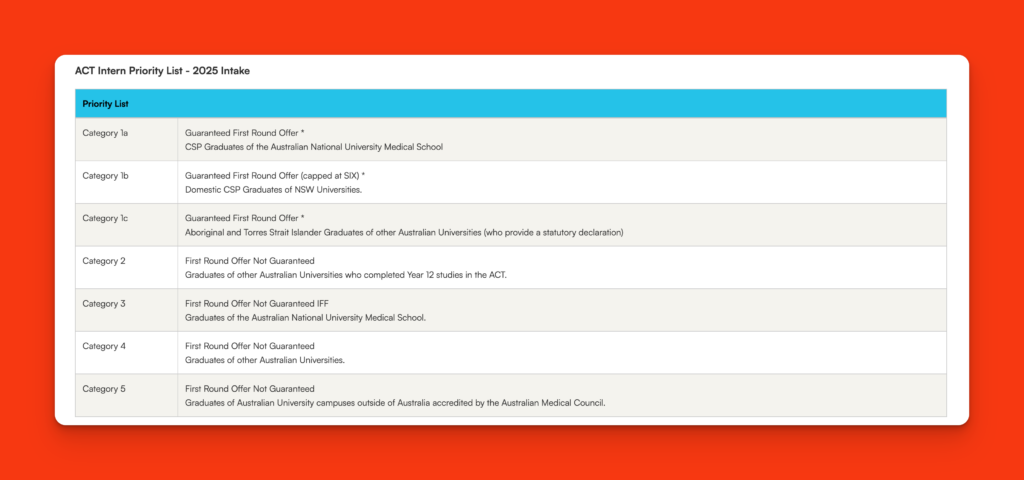
    c/- act.gov.au

    Junior Doctor Training Program (Previously the Commonwealth – Private Hospital Stream)

    2025/2026 Information not yet available

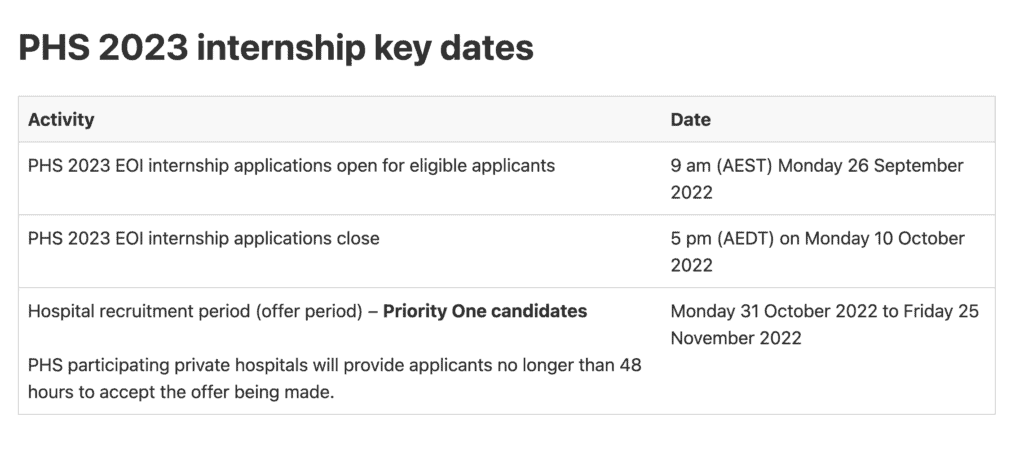
    The Private Hospital Stream (PHS) funds private hospitals to deliver medical internships and support junior doctors to work in expanded settings. It focuses on supporting training for junior doctors in rural, regional and remote areas in Modified Monash (MM) 2 to 7 locations.

    This includes fostering partnerships between private hospital providers, rural public hospitals and other training settings (such as Aboriginal Medical Services) working as part of expanded training networks.

    Annual Salary and conditions should reflect the annual salary for an intern in the State or Territory you are working in.

    Internships and places

    The PHS supported up to 115 internships and up to 80 PGY 2 and 3 eligible junior doctor places in the 2020, 2021, 2022 and 2023 training years.

    Expression of Interest (EOI) internships

    An annual EOI internship process is run for junior doctors to express interest in a PHS-funded medical internship place.

    This process is only for PGY 1-funded places. It opens each year after state and territory governments have offered and filled their internship positions.
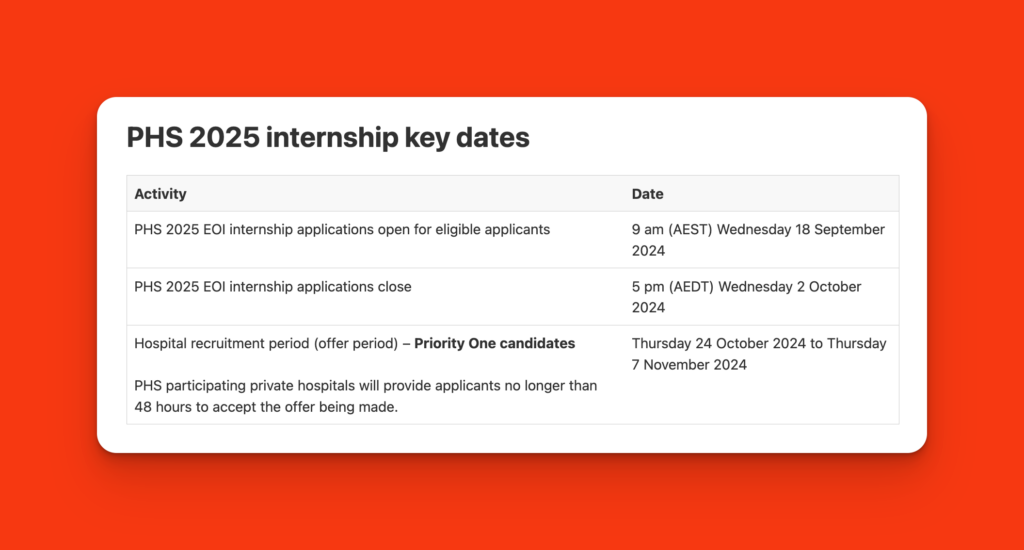
    Eligibility

    The program divides applicants into 2 categories – Priority One and Priority Two.

    Priority One eligibility criteria

    The Priority One category is for final year medical students who meet all eligibility criteria for an internship under the PHS.

    You are Priority One if you:

    • are a full-fee-paying international student completing your medical degree during the current calendar year from a medical school in Australia, having completed all of your medical degree in Australia (university-approved, short-term elective rotations completed overseas are allowed)
    • have met the Medical Board of Australia (MBA) English language proficiency requirements for registration purposes
    • are not an Australian Citizen
    • commit to getting a visa to work in Australia during your internship year.

    Priority Two eligibility criteria

    You are Priority Two if you:

    • have MBA provisional registration as a medical practitioner
    • have met the MBA English language proficiency requirements for registration purposes
    • commit to getting a visa to work in Australia during your internship year.

    Who is not eligible

    You are not eligible to apply for the PHS if you:

    • do not meet the Priority One or Priority Two eligibility criteria
    • have accepted an internship position from a state or territory government.

    Recruitment process

    The recruitment process aligns with the state and territory government recruitment processes and the national audit process.

    Suitable applications are forwarded to the PHS participating private hospitals by the due dates each year.

    The PHS participating private hospitals do eligibility checks. They will contact eligible applicants they want to interview.

    You should not make direct contact with the hospitals.

    Category prioritisation

    PHS participating private hospitals must fill PGY 1 places with Priority One applicants first.

    If there are still places available after the Priority One list is finished, the hospitals can then recruit Priority Two applicants.

    PGY 2 and 3 funded places

    PHS-participating private hospitals make their own recruitment and employment arrangements for PGY 2 and 3 junior doctors. This allows them to meet their own service needs.

    PHS-funded hospitals

    The Commonwealth funded the following private hospitals to deliver the PHS from 2020 to 2025:

    • Mater Misericordiae Limited Queensland through
      • Mater Health Services North Queensland (delivering PGY 1 places)
      • Mercy Health and Aged Care Central Queensland through Mater Private Hospital Bundaberg, Friendly Society Private Hospital Bundaberg, Bundaberg Base Hospital Bundaberg, Mackay Base Hospital Mackay and Mater Misericordiae Hospital Mackay (delivering PGY 1, 2 and 3 places)
    • Greenslopes Private Hospital, Queensland (delivering PGY 1, 2 and 3 places)
    • Calvary Health Care Riverina, New South Wales (delivering PGY 2 places)
    • Mater Hospital Sydney (delivering PGY 1 places)
    • St Vincent’s Private Hospital Sydney (delivering PGY 1 places)
    • MQ Health, New South Wales (Macquarie University Hospital) (deliver PGY 1 places)
    • St John of God Ballarat Hospital, Victoria – Grampians Intern Training Program (delivering PGY 1 places)
    • Ramsay Health Care, Western Australia (Joondalup) (delivering PGY 1, 2 and 3 places).

    How To Decide Where to Apply for Your Internship?

    There are lots of considerations when it comes to putting in your Intern application. Everyone is a bit different. Some graduates feel like they would like to be close to home and family whilst going through their transition to Intern. Others see it as a chance to get away and explore a new place and location. And then others focus on the long-term career prospects of certain locations.

    I think this last consideration is a little overrated for most. You can generally experience a wide range of medicine in your first couple of years of medicine after graduation and there is scant evidence that this affects your prospects of applying for specialty training posts.

    That being said if you have an interest in anything other than Medicine, Surgery or Emergency Medicine as a future career you should probably investigate whether this particular specialty is offered at the hospitals or networks to which you apply.

    Unfortunately, the internship model in Australia is quite antiquated and we have continued to use the experience as a proxy for competency when a large portion of the medical education world has moved on. The result has been the mandating of the 3 core terms for the internship of Medicine, Surgery, and Emergency Medicine. There is really no solid educational basis for this approach and one of the unfortunate outcomes is that all the other specialties get squeezed out and few interns get to experience psychiatry, general practice, obstetrics, paediatrics, pathology etc… which ultimately does have an effect on recruitment to these specialties.

    So the basic message is this. If you are really dead set keen on doing radiology as a career you should try to track down the very few locations that might offer this rotation to either interns or residents.

    Each year the Australian Medical Students’ Association produces a very useful Intern Guide with lots of information about the composition of intern training networks across the country. The 2023 version is not available but here’s a link to the 2022 version.

    Frequently Asked Questions

    Is There Any Restriction On Where I Can Complete My Internship?

    To meet the Medical Board of Australia’s requirements for general registration, an internship can be completed in any state or territory of Australia.

    Can I Apply to More Than One State or Territory for an Intern Position?

    Yes, you will need to apply separately to each state and territory where you would like to work. You will need to complete a separate application for each position, submit the documents, provide the information required and meet the selection requirements. As part of the application process, each state and territory requires you to include your intern Placement Number (IPN).

    What is an Intern Placement Number?

    The Intern Placement Number is a unique nine-digit number that has been generated by the Australian Health Practitioner Regulation Agency (AHPRA) and has been provided to medical schools for distribution to all final-year medical students. If you do not have an Intern Placement Number issued or you have misplaced it, you must contact your medical school to have the number issued or reissued. Do not contact AHPRA. Note: The Intern Placement Number is not your University Student Identification

    I Am Not an Australian Medical Student. How Do I Obtain an Intern Placement Number?

    In this situation, you do not require an IPN and will not be issued one. You can still apply for internships. But unless you are a New Zealand medical student your chances of gaining a place are very very limited.

    What If I Have Special Circumstances Which Make It Hard For Me To Work In Certain Places?

    All States and Territories Have processes for considering special circumstances. Some of the types of circumstances that are generally approved are: where you may have certain health conditions that mean you need to be close to certain hospitals or specialists; where you have dependents, such as young children, and are unable to relocate due to care arrangements; and where you and your partner want to work as doctors in the same location. Generally, requests to stay in certain locations, for reasons such as work commitments of partners or needs of school-aged children are not granted.

    I Have Received My Intern Offer. But I Would Like to Defer It. Is This Possible?

    This will partly depend on how long you wish to defer. If you just wish to defer for a few months. Once you have your offer and are in discussions with your new employer make inquiries. It may be possible to negotiate a later start with your employer. Most employers will generally prefer that you start on time so that you are not out of sync with your colleagues. But there might be some advantage for the employer in you attending orientation but then starting a bit later as it will probably help them to fill out roster gaps. On the other hand. If you wish to defer for a complete year. Then you will need to check the policy of the State or Territory that has provided you with an Intern offer. In some cases (for example Victoria) you will be permitted to defer and your place will be held for you the following year. In most other cases you will need to reapply the following year and check whether your priority status has altered. In most cases, you have the same priority status. But, for example, the ACT no longer guarantees you an internship and you start off at a minimum of Category 4. Also, bear in mind that it is unclear how long you can defer commencing your internship. However, the Medical Board of Australia expects that once you have commenced your internship you will have completed this process within 3 years.

    I am a Doctor With a Medical Degree From Outside Of Australia. Can I Apply For an Internship?

    Unless you obtained your medical degree from a New Zealand Medical School. Then the brief answer to this question is no. I would love to stop there. And I really think you should as well. But there are rare circumstances where you may be able to obtain an internship with a medical degree from outside of Australia. But the Medical Board of Australia strongly advises against this option and so do I. For good reasons. Firstly the whole Australian medical internship system is designed to ensure that Australian medical graduates are able to undertake an internship. Not for overseas graduates. Secondly (and as a result of the first point) it is very rare to be offered the chance. Some States and Territories will not even consider an application from an IMG for an internship. Others will only do so in limited circumstances, for example, the Northern Territory will accept applications from IMGs who may have done a medical student elective or clinical observership in the Northern Territory and who have experience in rural, remote and indigenous health locations. But even then these applicants are at the bottom of the priority list for obtaining an internship. South Australia will accept applications. But again you are bottom of the list. Queensland will also accept applicants, but only if you have never worked as a doctor. And again you are bottom of the list. A final note on this question is that the majority of IMGs who do obtain a medical internship position each year in Australia generally have Australian citizenship or permanent residency.

    I Have Heard That Some Graduates Miss Out On Internships. Is This True?

    Whilst it is theoretically a possibility that some medical graduates miss out on Internships according to annual reports provided by organisations like HETI and the PMCV at the end of intern applications no one is actually left at the end of the process without an offer. In fact, in some circumstances, there are vacant intern positions that are not able to be filled. Only Australian citizens and permanent residents are guaranteed an intern position under the COAG agreement. However, there are generally enough intern positions available for those students who have come to Australia to study medicine and the Commonwealth Private Hospital program offers additional spaces for those that may miss out. That being said. It is also clear that many graduates choose to drop out of the application process themselves. So not everyone who applies gets an offer. The assumption is that some graduates take up similar intern opportunities in other countries upon graduation.

    Can I Submit a Late Application?

    Acceptance of late applications is at the discretion of each state and territory.

    When Will Offers Be Made in 2025?

    All states and territories will commence making offers for Rural Pathways on Monday 14 July 2025 and will commence making offers for all other pathways on Wednesday 16 July 2025.

    What if I Receive More Than One Offer?

    You need to decide where you would like to undertake your internship and accept this position and decline all other positions. You should not hold onto more than one offer as this negatively impacts both the hospital that will have a vacancy if you fail to start work because you have started in another position in another state, and other applicants who would like to work at that hospital who do cannot receive an offer for that vacant position.

    What is the National Audit?

    States and territories share intern applicant information at pre-agreed dates. This data is then used to identify applicants who have applied for and/or accepted intern positions in more than one state/territory. Applicants who have accepted more than one intern position will be contacted by the National Audit Data Manager by phone or email and given 48 hours to withdraw from all intern positions, except the one where they intend to undertake their intern year.

    What if I Don’t Respond to the National Audit Data Manager?

    If you don’t respond to the National Audit Data Manager and/or do not withdraw from all positions except one, the relevant states/territories where you have accepted an offer will be advised and all offers, except for the first offer you received may be withdrawn.

    What is the Late Vacancy Management Process?

    The Late Vacancy Management (LVM) Process runs from Monday 10 November 2025 to Friday 20 March 2026. The process ensures any late vacancies are offered to eligible intern applicants who have not yet accepted an internship position. The Late Vacancy Management Process will be coordinated by the National Audit Data Manager on behalf of states and territories. Please ensure you have updated your contact details if you are going overseas during the Late Vacancy Management Process period. The National Audit Data Manager will send out emails to participants who will need to opt into the Late Vacancy Management Process if they still wish to receive an internship position offer in Australia. Note: if an applicant does not respond to this email, they will no longer be eligible to receive an internship offer and their application will no longer be considered in any Australian jurisdictions.

    Who can participate in the Late Vacancy Management Process?

    The process is open to medical graduates of AMC-accredited medical schools who have applied for and are not holding a 2024 intern position through the Commonwealth or states and territories at the National Close Date for Intern Recruitment. Participation in the LVM is an opt-in process -you must confirm that you want to participate in the LVM by responding to the National Audit Data Manager by e-mail.

    Can International Medical Graduates Apply to Become an Intern in Australia?

    With very few exceptions, International Medical Graduates (IMGs) cannot apply to become an Intern in Australia. Even if you are able to apply your chances of obtaining an intern post are quite low and you should explore other options. This situation is not to be confused with International Students who study for their medical degree in Australia who are eligible to apply. You won’t be able to apply if you have already completed an internship or worked clinically in another jurisdiction. The States and Territories that do allow IMGs to apply are Queensland, South Australia and the Northern Territory as well as Western Australia (for Australian or New Zealand graduates of competent authority medical schools only).

    Can International Students Apply to Become an Intern in Australia?

    International Students who undertake an Australian medical degree are eligible to apply to become an Intern in Australia.

    Can I Swap Intern Posts?

    As a general rule the jurisdictions either do not permit or strongly discourage the swapping of Internship posts. Medical Student bodies regularly lobby for there to be a swap process. Swaps are problematic for a number of reasons. Firstly the jurisdictions have set up processes to try to ensure that the outcome of allocations is as fair as possible to the most number of graduates. So it is generally the case at the end of this process that there are very few legitimate swap arrangements available, i.e. if you find yourself with an Intern post that you are not happy with it is unlikely that there is anyone who will be willing to swap with you as they will probably be happy with their allocation. Secondly, the whole process of swaps causes additional bureaucratic headaches when the jurisdictions are attempting to focus on getting through all of the allocations and providing as many applicants as possible an offer. Thirdly, the ability to swap could place certain applicants in a situation of duress, where they are put under pressure to swap. Fourthly, it is very likely that more than one applicant might want to swap. So it may be seen as unfair to allow swaps when not everyone who wants to swap can.

    Can I Defer my Intern Offer?

    If you are considering taking a year off between graduating and commencing medical school then you will be wanting to explore your options for deferral. The process varies from jurisdiction to jurisdiction. Jurisdictions will not hold onto your internship post for you. You will be expected to reapply the following year. And you will generally be in the same priority category again. For Victoria, you need to apply for a deferral in order to be able to enter the PMCV Match in the following year. You should also be aware that the Medical Board of Australia has specific requirements for registration that limit the time that an individual may defer undertaking their internship in order to obtain registration to 3 years from commencement. After which you may need to seek special approval from the Medical Board of Australia.

    Can I Be Allocated to the Same Spot as My Partner?

    Yes. It does happen. Medical Students do meet and fall in love during their medical school days. Jurisdictions do allow for genuine partners to work in the same facility or network. You may, however, have to compromise a bit in terms of your network preferences as in order to accommodate your request you may need to be matched to a less popular network. Depending on your jurisdiction you will either have to make a joint couple application or apply under special consideration.

    Can I Do My Intern Part Time or Job Share?

    Yes. It is possible to do your Intern in Australia part-time. In general, the hospital networks prefer you do this as part of a job-share arrangement with another part-time Intern. Job share and part-time employment are defined as a person or persons voluntarily seeking to work less than full-time hours. Medical graduates may request to complete their internship on a part-time or job share arrangement through the annual centralised applications. To avoid discrimination you are first allocated your position and then your hospital or network is informed of your request to work part-time. Hospitals and networks are then required to negotiate with you the terms of your employment. Interns must work a minimum of 0.5FTE so that the internship may be completed within a two-year period.

    What If I Have Special Circumstances?

    Every State and Territory has a Special Circumstances or Special Consideration policy. These policies are generally quite strict and generally only cover: – needing to be close to immediate partners and dependents – caring for young or elderly persons – access to specialised medical care. If you are approved for special circumstances you will not necessarily be placed in the hospital or network of your choice. For example, if you are applying in NSW and you have young children and your partner works in Sydney and it is not possible for your partner to relocate, then you will be approved to be allocated to one of the Sydney-based networks.

    (Disclaimer: All information here has been sourced in good faith but things do change so you should always do your own due diligence in such matters, we are providing this information to aid you in your application but take no responsibility for any outcomes)We’d welcome feedback from any Intern programs in relation to the accuracy of the above information.

  • Preparing for RACS SET Interviews: Ultimate Preparation Guide 21 Tips

    Preparing for RACS SET Interviews: Ultimate Preparation Guide 21 Tips

    Preparing for the RACS SET Interview: Your Ultimate Preparation Guide to Interview Training for Surgical Specialties SET Program Selection

    The RACS SET Interview selections are arguably the most competitive specialty selection interviews in Australia and New Zealand with only about 1 in 4 to 1 in 5 candidates succesful each year. Having coached over 60 clients to success with the RACS SET Interview Selection I wanted to share with you my tips for your ultimate preparation guide.

    What are the RACS SET Interviews?

    The Royal Australasian College of Surgeons conducts an annual selection process for selection into surgical training in Australia and New Zealand.

    Or to be more accurate RACS in collaboration with its 13 surgical specialty groups or societies conducts 13 application processes each year for Australian and New Zealand trainee doctors to become enrolled in SET selection.

    Once selected into training SET trainees face another 5 to 6 years of full time clinical training in hospitals as a SET Registrar prior to qualifying to become a consultant surgeon in their relevant specialty.

    What is the Structure of the RACS SET Selection Process?

    As an applicant for a surgical training program in Australia or New Zealand you have one opportunity per year to apply for a training position in one or more of the 9 RACS specialties (it is possible to apply for more than one program per year).  There are a number of steps you need to undertake in this highly competitive selection which ultimately culminate in appearing for an interview (if successful).

    The application process commences in January of each year with a registering with RACS as part of a centralised process. This is essentially an expression of interest as well as a preliminary eligibility check. You must register and pay the registration fee each year that you apply. 

    What are the Eligibility Requirements for Applying for RACS SET Training?

    1. You must have Australian or New Zealand Citizenship or Permanent Residency
    2. You must have general (unconditional) registration with AHPRA or general scope registration with the MCNZ
    3. You must have completed the RACS Operating With Respect (Anti-Bullying and Harassment) Training Module
    4. You must have satisfactorily passed the General Surgical Sciences Examination
    5. There may be additional requirements depending on the specialty you are applying for. Generally there is a requirement to have some surgical experience in the specialty increasingly many specialties are requiring that you pass the RACS Clinical Examination

    The RACS application process requires you to submit evidence of your eligibility, contact details for referees and a structured CV.

    After registering with RACS you are required to apply for the SET Program/s you wish to apply for. 

    The next steps vary depending on the specialty. But in general

    • Your CV will be scored
    • Your referees will be contacted for structured reports
    • You may be required to sit a Situational Judgement Test
    • Depending on specialty other evidence may me taken into account, such as examination performance
    • A final determination of eligibility for interview will be determined

    As mentioned at the end of this process, if you are deemed eligible to attend an interview, you will be invited to participate in a semi-structured interview process.

    Your final result is then normally determined by a combination of your CV score, reference scores, SJT score (if applicable) and the all important interview score.

    More details about the process for 2026 can be found here

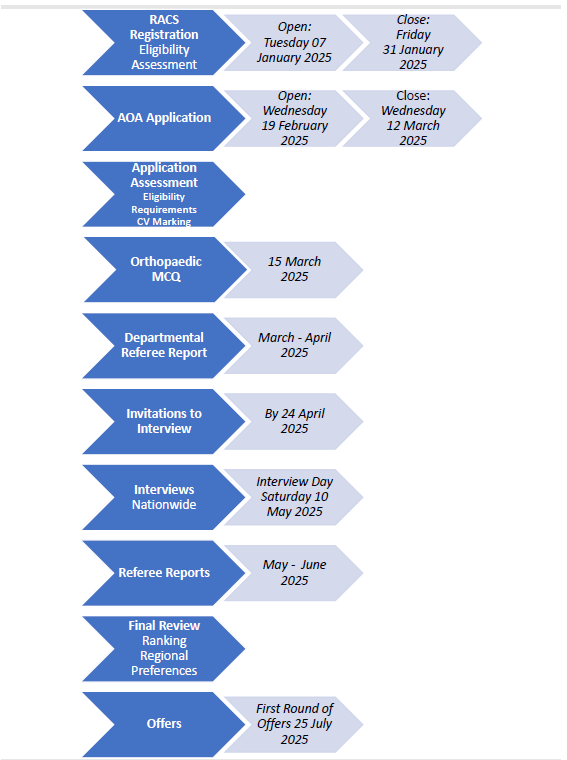
    Key Dates for the RACS Surgical Selection Process for 2025

    Stage 1: Registration for selection 

    Opens Tuesday 7 January 2025 (12:00 noon AEDT). Closes Friday 31 January 2025 (12:00 noon AEDT)

    Stage 2: Apply to the SET program 

    The opening and closing dates varies between specialties.  

    Stage 3: Referee reports collected

    April/May 2025

    Stage 4: Interviews

    The interview dates vary between specialties.  

    Stage 5: Announcement of offers

    Latest day of notification of outcome: Friday 7 November 2025

    What is a Semi-Structured Interview?

    A semi-structured interview generally means any form of interview with a reasonable amount of pre-planning in terms of the questions and the scoring approach. In the case of the RACS specialties this generally means meeting with more than one group of interviewers (panel members) for a determined amount of time in an interview station. The number of stations vary between 3 () to 8 (). When the number of stations is more than 6 the process tends to be called a Multiple Mini Interview process.

    RACS SpecialtyType of InterviewNumber of StationsNumber of InterviewersMinutes Per StationReading / Transition TimeStem to Read?Notes
    General Surgery AustraliaMMI52 +/- 1 Observer10 minutes2 minutes reading timeYes

    3 Clinical / 2 Non-Technical Stations

    2 questions + probing per station

    General Surgery New ZealandMMI62 to 3 +/- Observer10 minutes1 minute readingYesStructured initial question with probing
    Orthopaedics AustraliaMMI6210 minutes NoStandardised Stem + Probing questions
    Orthopaedics New ZealandMMI73 +/- Observers9 minutes2 minutesNoStandardised Stem + Probing questions
    Plastic and Reconstructive Surgery, AustraliaSemi Structured32 to 3 +/- Observer15 minutesNo reading timeNo3 questions per station
    Plastic and Reconstructive Surgery, New ZealandStructures3220 minutes NoStandardised Stem + Probing questions
    Otolaryngology Head and Neck Surgery, Aotearoa AustraliaSemi Structured32 + Observer15 minutes5 minutesYes2 Structured questions + probing per station
    Otolaryngology Head and Neck Surgery, Aotearoa New Zealand       
    Paediatric SurgeryMMI42  NoClinical + Professional Station / Article Station / Video Review Station / Theoretical Station
    Cardiothoracic SurgeryMMI3 15 minutes5 minutes reading timeYes3 questions per station
    UrologySemi-Structured Interview42 + Observer15 minutes Yes for Sim Pt Station

    1 Sim Patient Station

    1 Station specific to either Aus / NZ

    Vascular SurgeryMMI62 + Observer8 minutes 2 minutes reading time  
    NeurologyStructured4 15 minutes  Consists of four scenario and
    experience‐based sections, each with multiple questions designed to assess the suitability of the
    applicant.

    The above information comes from official information as well as advice from past candidates. You should check each year for changes.

    How Can I Best Prepare for the Interview? Tips for Effective SET Interview Preparation

    Having now coached around 150 clients through the SET interview challenge I am frequently asked to present on the topic of how best to prepare for the SET interviews. Below are my top ten tips. Some, such as tips 1 – 4, may seem a little obvious but are still worthy of highlighting. Others you may be less familiar with and will hopefully help you to better prepare.

    Tip # 1 Give Yourself Plenty of Time to Prepare for the RACS SET Program Selection Process

    Most clients start working with me at the start of the year, giving themselves several months to prepare. Some even commence the year prior.

    Do you need 12 months to be successful in the SET interviews? No. But its not a bad idea to give yourself that amount of time so long as you pace yourself (see tip 17). Like most performances its hard to improve by cramming a few weeks prior. You will often need time to first deconstruct your approach to answering interview questions and then build new techniques. This takes time and you won’t be sounding smooth and slick straight away.

    At a minimum I would recommend at least 3 months to prepare.

    Tip # 2 Ensure You Read Carefully Through the Selection Regulations

    Make sure you read carefully the selection regulations. Don’t rely on what past trainees say or even what I write here!. Be aware of any updates or changes throughout the year. They are generally revised and updated at least annually. Whilst in general most of the process stays the same, RACS and the specialty groups are always endeavouring to come up with a better process. An example of this has been the introduction of Situational Judgement Tests for certain surgical subspecialties, such as General Surgery, Orthopaedics and ENT in Australia.

    You particularly want to understand what the criteria are for the interview. Generally these are either literally the RACS competencies (based upon CanMEDS) or a variation of these.

    These are key to understanding why certain questions are being asked and what is being looked for.

    Tip # 3 Don’t Forget Your Registration and to Apply for Selection

    Whilst you should be aiming to focus on interview preparation throughout the journey take some time to complete your registration and make payment with RACS and application for selection panels and don’t leave these to the last minute.

    Tip # 4 Prepare Your CV Early

    As per above get your CV done as soon as possible so its no longer looming over you.

    Tip # 5 Make All Points Count on Your CV

    I find most clients are pretty comfortable with how to compile their CV to ensure that they obtain the maximum points possible.  Most applicants will generally not even bother applying unless they feel that they have a good CV. That being said I am aware of some trainees who successfully challenged their CV score (presumably because things were overlooked).

    For this reason I recommend a summary at the start which basically walks the reader through all of your relevant points.

    Tip # 6 Choose Your Referees Wisely and Prepare Them

    Selecting trainees for interview has become a zero sum game for RACS. Most clients max out their CV points. And most referees are aware that its important to give you a good reference (because every other referee is doing the same).

    Still. Its important to be choosy where you can be. Especially if one of your potential referees is more hawkish. But equally important is for you to provide your referees with some reminders of your good past performance. At a minimum give them your CV with some additional information about your achievements whilst you were working with them.

    Tip # 7 Invest in the Right Resources for Your Interview Preparation

    OK. Now we are getting more focused on the SET interviews themselves.

    There’s 3 key types of resources that most trainees will consider investing in for the interviews.

    Books, courses and coaching.

    Books for the SET Interviews

    There are very few Australian or New Zealand books specifically dedicated to the SET interviews. Although many past clients have found the Amanda Nikolic book for General Surgery interviews quite helpful.  There are also a range of books from the UK which may provide some assistance.

    For SJTs there are actually quite a few books already available written for the RACS SJT. I have not reviewed any of these or heard much about them. So purchase at your own cognizance.

    I am not aware of any books with banks of past questions (other than the Nikolic book).  The best public repository of past questions is our own one here at AdvanceMed. If you do find this useful then I would ask that you contribute some of your own question after, as many have done before you.

    Courses for the SET Interviews

    Courses are useful for understanding the theory behind certain interview questions and learning techniques for answering different questions.

    There are a few providers who offer RACS SET preparation workshops such as iPrep and IME. IME also offers an online course. At AdvanceMed we have a comprehensive interview skills course which covers off on college interviews.  The most powerful sections of this course for RACS applicants are the ones on question frameworks and sign posting. I tend to focus a lot on these sections in my actual coaching. So that’s why the interview skills course is included in my coaching packages.

    SET Interview Coaching

    You will find quite a few coaches online advertising themselves as being able to help with the RACS SET interviews. For example there’s Claire Berry Consulting and Jo Hely.

    As RACS itself says:

    RACS in partnership with the Specialty Societies delivering the Surgical Education and Training Program do not accredit, endorse or recommend any commercial providers delivering SET selection and interview training courses.

    RACS and the Specialty Societies do not share with commercial providers any information regarding the content and style of SET selection interviews or any other selection tools, and have no evidence of the usefulness of these commercial courses.

    So, its important to do your due diligence before engaging with an interview coach.

    I am happy to answer any questions that you may have about my own approach to preparing candidates for SET interviews. I would also recommend that you ask around for recommendations from colleagues. Much of my clientelle tends to find me now from word of mouth.

    I also offer a RISK FREE Strategy Call where we can see if we are a good fit for each other.

    What is Best: Coaching or a Course for Candidate Interview Preparation?

    If you can afford it then coaching will by far and away give you better value than an online course or one day workshop.

    Nothing beats personal one on one support where the coache is solely focused on your performance and helping you to improve.

    Many of the best coaches will have a course built into their coaching program for you as well as other resources. Having coached now for several years I have also built up a library of resources based around key topics that tend to come up in the RACS interviews, for example clinical governance (for which my favourite mnemonic is PIRATES – Patients, Information, Risk, Audit, Training, Evaluation, Supervision) and Artificial Intelligence.

    If you are going down the coaching route I would still recommend that you do what most other trainees do which is approach surgeons familiar with the interview process for some feedback sessions as well. Your coach can help you to maximize these.

    Tip # 8 Use the Competency Framework and Selection Criteria to Your Advantage

    To gain entry into specialty training programs, it’s crucial to use the Competency Framework and Selection Criteria to your advantage. The RACS Surgical Competence and Peformance Framework is an excellent and often overlooked resource that tells you the sorts of behaviours and capabilities RACS is looking for (and not looking for) and is a great touchstone for your interview preparation (as well as SJT prep if you need to sit for this as well).

    Some of these competencies are easier to understand and talk about, for example medical expertise, technical expertise and clinical decision making than others such as health advocacy. So give yourself the time to understand all of these and identify examples in your career history of how you have demonstrated all of these. Citing examples is really helpful in the interview and they will often also ask for an example.

    I suggest early on making yourself what I call an alignment table, based upon the selection criteria for the interview.

    Below is a video example of what I mean.


    Tip # 9 Use the Principles of Deliberative Practice

    Deliberative practice is a concept first described by Anders Ericsson, which emphasizes the importance of focused, structured, and purposeful practice in achieving high levels of expertise in any field. Unlike regular practice, which may involve mindless repetition, deliberative practice requires individuals to engage in activities that are specifically designed to improve performance. This involves setting clear goals, obtaining immediate feedback, and continuously pushing one’s limits to tackle challenges that are just beyond current capabilities.

    Ericsson’s research suggests that deliberate practice is not merely about the number of hours spent practicing, but rather about the quality and intensity of that practice. It involves breaking down skills into smaller components, honing specific aspects of performance, and gradually integrating these components into a cohesive whole. This approach is applicable across various domains, including music, sports, medicine, and education.

    Key elements of deliberative practice include:
    1. **Goal Setting**: Practitioners must set specific, measurable, achievable, relevant, and time-bound (SMART) goals to guide their practice sessions.
    2. **Feedback**: Immediate and constructive feedback is essential for identifying areas of improvement and making necessary adjustments.
    3. **Challenge**: Engaging with tasks that stretch one’s current abilities fosters growth. This means practitioners must consistently seek out challenging exercises.
    4. **Reflection**: Taking time to reflect on performance and practice sessions allows individuals to internalize lessons learned and strategize for future practice.
    5. **Repetition with Variation**: While repetition is crucial, introducing variations in practice conditions can enhance adaptability and skill transfer.

    By following these principles, individuals can accelerate their learning and mastery of complex skills, ultimately leading to higher levels of achievement and expertise. Deliberative practice has been influential in redefining how we understand talent and skill development, emphasizing that with the right approach and dedication, anyone can achieve excellence in their chosen field.

    How does this apply to the RACS SET interviews?  As I have noted above. It’s important to allow yourself time to breakdown the interview into its smaller elements.

    If we think about one MMI station. Within this station you will have somewhere between 2 to 6 questions to answer. Each question is in itself a mini part of the performance.

    And answering each question can be broken down into elements, including:

    • reading and or hearing the question
    • clarifying the question (if needed)
    • starting your answer – see below
    • expanding on your answer
    • completing your answer
    • handling any follow up or probing question

    Deliberative practice suggests that we should try to focus on the hardest part of the task. For most clients this tends to be the start of the answer. This is why I tend to focus a lot on what I call “sign posting:.

    Tip # 10 Practice “Sign Posting” Your Answers

    Sign posting is about ensuring that the opening part of the answer to each question is clear and gives yourself and the listener (panel members) a clear understanding of the direction you intend to take.

    A well constructed sign post can do many things, including:

    1. Give you and the panel members immediate confidence (make a good first impression).
    2. Ensure you have identified all the key components of the question (have a good list of issues).
    3. Prevent the panel members interrupting you unnecessarily, as they will understand what you intend to cover.
    4. Mitigate against you running out of time to discuss certain points.

    Tip # 11 Make Sure You Identify All the Issues

    Its really important that you identify all of the issues in a question.

    Oftentimes I see clients dealing well with the clinical aspects of a question but ignoring the more longer term or downstream issues, such as clinical governance issues or opportunities for you to reflect on your own practice or opportunities for quality improvement.

    As a bit of a rule I recommend that when you practice you should be targeting 4-6 issues per question. This is not a set in stone rule. But generally when clients are generating 1 to 3 issues they are missing something important.

    Being able to identify a less obvious issue may very well be the difference between a good performance and an outstanding performance on that question. And given the competitive nature of the SET interviews you are really wanting to get as many outstanding performance results as possible.

    Tip # 12 It’s OK to Question the Question

    You are applying to become a surgeon. Which means thinking for yourself. Don’t always take the question as literal and watch for traps or twists. Have you considered every word in the question – why did they include that bit of information? Is there some obvious information missing.

    Here’s an example from a past question.

    You are seeing an elderly man from a Non-English Speaking Background. His test results have just come back and it turns out that he has cancer. His family requests that you not inform him of the diagnosis as they feel it will unnecessarily upset him.

    What would you do?

    Most doctors when they see this question begin by outlining how they have identified issues in relation to:

    • dealing with ethical issues around autonomy and the right to know
    • planning treatment for the cancer
    • working with the family in the best interests of the patient
    • engaging with an appropriate interpretor
    • involving the consultant

    All great points.

    But overlooked here is the question as to why the family knows before the patient? Is there a capacity issue or has there been some form of breach of privacy?

    On this point. It’s okay to respectfully challenge the premise of the question by suggesting more information would be useful. Just be prepared to back this up with what that information is.

    Tip # 13 Adopt a Surgeon’s Mind Set

    This tip is a little bit complex to explain in a blog. It goes hand in hand with the above tip. It’s a kind of you know it when you see it and hear it sort of thing. Your aim is to try to think and talk like a surgeon, or at the very minimum a seasoned SET trainee in the specialty you are aiming for.

    Think of your most trusted surgical mentor. Who is that person that you regularly go to for advice? And when you do go for advice. Do they just give you the answer or do they take a step back and as a number of really insightful questions first? The latter is who you are aiming for.

    What you are wanting to avoid is narrow thinking. Don’t approach a question as if you are who you currently are, which is likely to be an unaccredited registrar or SRMO. If you answer from your current perspective you will tend to overlook all the extra tasks that a good surgeon or SET trainee would be expected to accomplish.

    Tip # 14 Get the Right Feedback

    There’s good feedback and unhelpful feedback. Good feedback should follow the principles of effective feedback, by which I mean it should be specific, clear, relevant and delivered as soon as possible.

    Who is providing the feedback is also important. You are not going to get very helpful feedback from family, friends or colleagues. Even some consultants will be of little use to you.

    Its important to try to obtain feedback with someone who has had experience with the process. This effectively means surgeons who have been on selection panels in previous years (possibly some registrars who have successfully navigated the process) and coaches who have the experience to know what works best for clients.

    Sessions with an experienced consultant surgeon are often gold. Because they are generally only offered a few times each year. Make sure you make the best of these by being clear and explicit about what sort of feedback you are seeking. The well meaning consultant may be keen to get through as many questions as possible. This is not going to help you as much as them providing one or two “gems” or insights by helping you focus on specific aspects of your performance, such as your opening approach.

    Tip # 15 Record Yourself

    When I coach clients for interviews I exclusively do this online. There’s a number of reasons for doing it this way. But one advantage is that we can easily provide a recording of the session, which I do for all of my clients. Those that do watch the videos tend to be more successful than those who do not.

    I strongly encourage you to record your practice sessions. If you are not doing this then you are missing out on lots of valuable and immediate feedback. You will be able to assess your tone and pace of voice, your body language, and pick up on bad words to avoid. And your competitors are doing this, so you are placing yourself at a disadvantage.

    Tip # 16 Regular Practice is Better than Intense Practice

    The next 2 tips also go together.

    Consistent with deliberative practice and general principles for improving and sustaining performance you want to be performing regularly not necessarily quantitatively. You can only learn and adjust a few things in one practice session before reaching cognitive overload. So there’s no point practicing for several hours.

    You can actually achieve quite a bit with a half hour practice session. And if you are prepared (with a bank of questions and recording option) you can even sneak a session into your break or downtime at work.

    At this time of the year I am generally recommending to my clients that they try to practice 30 to 60 minutes per week, twice a week. That’s enough at this stage. As you get closer to the interview you will likely want to increase the intensity. And that’s okay because you will have left yourself the energy and drive to do so.

    Tip # 17 Don’t Peak Too Early – Avoid Burn Out

    As I have mentioned previously. It is important to time your practice so that it is regular and not overly taxing during the months beforehand. As you get closer to the interview time you are going to want to increase the intensity of your practice.

    If you feel yourself getting frustrated weeks or months before the interview. Give yourself a bit of a break. Don’t burn out.

    With my clients I aim for them to peak by feeling something between ready for it and a bit frustrated (wanting to get on with it) a week or so prior. 

    Tip # 18 Optimize Your On the Day Performance Early

    By this tip I mean get all the logistics out of the way. Book your leave as soon as possible. Make sure you feel comfortable in your suit and that its dry-cleaned.

    If you are doing a video interview make sure your room, technology, lighting etcetera are optimised. See this post for a guide on video interviews.

    If you are attending in person, book your flights or travel. Book your hotel room. If interviewing in another city try to arrive a day or two earlier if possible. If you haven’t visited the site previously try to check it out in person a day or two beforehand so you know exactly where to go. I recommend booking a taxi or Uber for your travel rather than worrying about using your own car and finding a car space.

    If you have followed my recommendations about how to prepare then I don’t actually recommend doing much practice the day or two beforehand. It’s not going to do anything for you. Instead try to relax, whatever way works for you. Book a massage. Definitely go for a walk, run or swim. Have some nice food. Try to get some decent sleep. Treat yourself.

    Tip # 19 Remember Each Station or Panel is a New Chance to Make a Good Impression

    Some surgical specialties are quite small so you may have a consultant on a panel that knows you already. But generally the panel members have not met you before and don’t know your history or background. With an MMI process there is generally no discussion of candidate performance between panel members either.

    This has certain implications:

    1. Each new panel is another chance to make a good impression.
    2. If you feel like you had a bad station. The next station is a fresh chance to recover.
    3. You can use the same example in different stations.
    4. Try to give each panel some information about your career in order to give them confidence that you would be a safe pair of hands if you were their registrar.

    Tip # 20 Have a Plan B

    Not everyone is succesful in gaining a SET training place. This does not mean that you are a failure or that you would not make a good surgeon. Just to be eligible for an interview puts you in a rare cohort of trainee doctors and I can’t recall a single client who I felt would not make an effective trainee. There is a degree of luck in this process.

    Because you have invested so much you may be falling victim to the sunk cost fallacy. At a certain point its important to consider and identify another training option. In fact, doing this may just take the pressure off and I have seen this leading clients getting into surgical training.

    What are the things you like about surgery and how might this transfer into another career in another specialty or even a creative career?

    You may want to spend time with a career coach discussing this and identifying other options. Once you have decided on another option you may also want to discuss how this affects your CV and application process.

    Tip # 21 Thank Your Family and Friends

    At the end of this, likely, several month process, your family and friends have been cheering you on and wishing you the best. You have probably ended up spending less time than you would wish with them. Nows the time to thank them and pay them back.

    Notes on Surgical Education and Training Selection by Specialty

    General Surgery

    Australia

    With the introduction of GSET, the training program has moved to a five-year program for all trainees who commenced from 2022 onwards.

    Based on modelling through analysis of the above factors, the current predictions indicate that the 2025 selection process (for 2026 intake) will see fewer offers than usual being made, based on current Trainees exiting the program.

    Approximately 30 spots will be available for the 2026 intake (significantly less than normal).

    It is anticipated that in 2026 (for 2027 intake) the number of offers will revert to normal.

    Rotation TypeMinimum Duration
    General Surgery Rotation26 weeks
    Critical care rotation1 X 8 weeks

    Applicants must submit the completed Australian Board in General Surgery Procedural Skills and Professional Capabilities Form available on the GSA website.

    stages of RACS SET interviews and RACS SET selection

    New Zealand

    Applicants must have successfully completed the Royal Australasian College of Surgeons Generic Surgical Sciences Examination (GSSE) prior to the Specialty application closing date, in addition to having a minimum of 52 weeks General Surgery experience which must be completed by the time of application.

    A completed Procedural Skills and Professional Capabilities Form which shows validation by a supervisor of a number of professional activities and operative procedures is also required.  The procedures must be verified during rotations taken in the twelve (12) months prior to the closing date of applications.

    Selection Timetable 2025

    Selection Registration Opens – 7 January 2025

    Selection Registration Closes – 31 January 2025

    Selection Applications Open – 4 March 2025 – 2.00pm

    Selection Applications Close – 25 March 2025 – 2.00pm

    Referee Reporting Opens – 29 April 2025

    Referee Reporting Closes – 27 May 2025

    Interviews – 18 June 2025 in Wellington

    First offers made – 1 July 2025

    Last date for Offers – 7 November 2025

    Orthopaedics

    Australia

    Orthopaedic Multiple Choice Question (OMCQ) Test

    The 2026 Selection Intake process will include completion of an OMCQ Test.  More information on the OMCQ can be found on the OMCQ test information sheet.

    2026 intake timeline_updated

    New Zealand

    Stages of selection and key dates

    • Registration Opens 12pm AEDT: Tuesday 7 January 2025
    • Registration Closes 12pm AEDT: Friday 31 January 2025
    • Applications Open 12 noon AEDT: Wednesday 19 February 2025
    • Applications Close 12 noon AEDT Wednesday 19 March 2025
    • Workplace Assessments Open 9.00am AEST Wednesday 16 April 2025
    • Workplace Assessments Close 8.00pm AEST Wednesday 30 April 2025
    • Interviews will take place in New Zealand on a date and place to be determined and advised.

    Urology

    Eligibility

    • Applicants must also have passed the Clinical Examination (CE) by the application closing date.
    • Complete a minimum 26 weeks in Surgery in General at PGY2 or above by the application closing date.
    • Complete a minimum of 10 weeks in Emergency Department (ED) at PGY1 or above by the application closing date.
    • Complete a minimum 26 weeks in Urology at PGY2 or above by the application closing date.

    Registration

    Any person intending to apply for selection to the Surgical Education and Training Program in Urology must first register in accordance with the RACS Regulation: Registration and Selection to Surgical Education and TrainingApplicants who have not registered cannot lodge an application for the Surgical Education and Training Program in Urology.

    Registration is completed online on the RACS website. Registration fees apply.

    The Registration Period for the 2026 intake (conducted during 2025), is:

    • Registrations Open Tuesday 7 January 2025 at 12:00 noon AEDT
    • Registrations Close Friday 31 January 2025 at 12:00 noon AEDT

    Late registrations will not be considered.

    Application
    Applications may only be submitted by registered applicants using the online Urology Application form.

    Applicants will be required to pay an application fee to be considered for selection. This fee is non-refundable and must be paid prior to the closing date. Failure to pay the application fee by the closing date will result in the application being withdrawn.

    The Application Period for the 2026 intake (conducted during 2025) is:

    • Applications Open Wednesday 19 February 2025 at 12:00 noon AEDT
    • Applications Close Friday 21 March 2025 at 12:00 noon AEDT

    During this time, eligible registered applicants will be able to access an online application form. Late applications will not be considered.

    Referee Reporting
    The Referee Reporting Period for the 2026 intake (conducted during 2025) will be from Monday 21 April 2025 until Friday 23 May 2025 (approximately).

    Interviews
    Interviews for all shortlisted applicants will be held on Saturday 14 June 2025. Interview locations will be communicated when finalised.

    Vascular Surgery

    Vascular Surgery Selection Eligibility

    In addition to the RACS generic eligibility criteria applicants must fulfil the following specialty
    specific eligibility criteria:

    • Successful completion of RACS Generic Surgical Sciences Examination (GSSE) by date of
      application.
    • Successful completion of the Clinical Examination by date of application.
    • 8 weeks full time surgical rotation in General Surgery undertaken within the 7 years
      immediately prior to, and completed by, closing date of application.
    • 16 weeks full time surgical rotation in Vascular surgery undertaken within the 7 years
      immediately prior to, and completed by, closing date of application.

    No more than two rotations of at least four weeks can make up the minimum requirement for the surgical rotations. Vascular rotations must have at least two (2) Fellows of RACS (FRACS) employed as a specialist surgeon; or one (1) vocationally trained surgeon employed as a specialist surgeon who works at the hospital on a weekly basis and one (1) FRACS employed as a specialist surgeon.

    Applicants may apply to the BOVS Chair in writing at vascular.selection@anzsvs.org.au for an extension to 6.1.1c and d for interruptions due to family leave or other personal circumstances, e.g. illness, research, or higher degree.

    Rotations indicating leave cover, relief, or shift work will not meet the requirements.
    Rotations indicating Private Assisting will not meet the requirements
    Rotations in part time positions will count towards the requirements on a pro-rata basis of a full-time position. For example, working 19 hours per week for 8 weeks will calculate to 4 full time weeks.

    Plastics and Reconstructive Surgery

    Australia

    Key Dates for 2025:

    • Selection Registration Opens (RACS)    Tuesday 7 January 2025 12:00pm AEDT
    • Selection Registration Closes (RACS)    Friday 31 January 2025 12:00pm AEDT
    • Selection Application Opens (ASPS)    Monday 24 February 2025 12:00pm AEDT
    • Selection Application Closes (ASPS)    Monday 24 March 2025 12:00pm AEDT
    • Referee Reporting    May 2025 (evenings Mon-Thu)
    • Interviews (virtual)    June 2025 – all conducted virtually mid-week. Day TBC
    • Last Date for First Round Offers    Friday 25 July 2025
    • Last Date for Final Offers    Friday 7 November 2025

    New Zealand

    SET Selection timetable 2025

    • Selection Registration opens –  Tuesday 7 January, 12 noon AEDT
    • Selection Registration closes – Friday 31 January, 12 noon AEDT
    • Selection application opens – Wednesday 19 February
    • Selection application closes – Thursday 27 March
    • Referee reporting opens – Thursday 24 April
    • Referee reporting closes – Wednesday 21 May, 8pm AEST
    • PRS Interviews:  Thursday 19 June, Wellington
    • Last date for first round offers – Friday 25 July
    • Last date for final offers – Friday 7 November

    Otolaryngology Head and Neck Surgery (Ear Nose and Throat Surgery)

    Australia

    Selection: Key Dates for 2025

    • Selection Registration Opens Tuesday 7 January 2025
    • Selection Registration Closes Friday 31 January 2025
    • Selection Application Opens Wednesday 26 February 2025
    • Selection Application Closes Thursday 20 March 2025
    • CV Score Notification Thursday 3 April 2025
    • Referee Reporting and Multi-Source Feedback Collection April/May 2025
    • Referee Reporting and Multi-Source Feedback Score Notification by Friday 30 May 2025
    • MMI Interview Notification by Friday 30 May 2025
    • MMI Interviews Saturday 14 June 2025
    • Latest Date of First Round Offers by Thursday 10 July 2025
    • Last Date of Offers Friday 7 November 2025

    The selection process uses four selection tools, each contributing a weighted score as:

    • Structured Curriculum Vitae 15%
    • Multi-Source Feedback 10%
    • Structured Reference Reports 35%
    • Semi-Structured Interview 40%

    Only the top ranked suitable applicants will progress to the interview stage.  The number of applicants interviewed will be based on estimated number of positions available in 2026.

    New Zealand

    Cardiothoracic Surgery

    The Selection Process reflects the bi-national nature of the Training Program and is open to Applicants from both Australia and Aotearoa New Zealand. 

    The Training Program is overseen by the Committee across both Australia and Aotearoa New Zealand. Successful Applicants must be prepared to be allocated to a Training Post in either of those two jurisdictions for any rotations during their training, recognising that breadth of experience obtained across a variety of Training Posts is likely to help meet the goals of the Training Program. Applicants are expected to have a commitment to equity of health outcomes and understand issues that face marginalised and disadvantaged groups within our communities.

    Neurosurgery

    Key Dates 

    • Registration Opens for the Neurosurgery Anatomy Examination: 12 noon AEDT Monday 11 November 2024
    • Registration Closes for the Neurosurgery Anatomy Examination: 12 noon AEDT Monday 9 December 2024
    • RACS Selection Registration Opens: 12 noon AEDT Tuesday 7 January 2025
    • RACS Selection Registration Closes: 12 noon AEDT Friday 31 January 2025
    • Neurosurgery Anatomy Examination: Friday 21 February 2025
    • Neurosurgery Selection Applications Open: 12 noon AEDT on Monday 3 March 2025
    • Neurosurgery Selection Applications Close: 12 noon AEDT on Monday 24 March 2025
    • Interviews for shortlisted applicants: Thursday 26 June 2025
    • Release of Offers: Prior to 5pm AEST on Friday 27 June 2025

     The selection process uses four selection tools, each contributing the following weightings to the overall selection score out of 100:

    • Neurosurgery Anatomy Examination 30%
    • Structured Curriculum Vitae 10%
    • Reference Report 30%
    • Neurosurgery Semi-Structured Interview 30%

    Paediatric Surgery

    Paediatric Surgery Selection Criteria

    The SET Program is conducted by the Committee across both Australia and Aotearoa New Zealand. Successful Applicants must be prepared to be allocated to a Training Post in either of those two jurisdictions. The Selection Process reflects the bi-national nature of the SET Program and is open to Applicants from both Australia and Aotearoa New Zealand.

    • Applicants are expected to have a commitment to children’s health and wellbeing and understand how that requires different considerations to health systems designed to deliver care to adults.
    • Applicants are expected to have a commitment to equity of health outcomes and understand issues that face marginalised and disadvantaged groups within our communities.
    • Applicants are expected to have demonstrated capacity to deal with paediatric patients and their families.
    • Applicants are expected to have some experience with operating on children and infants. 2.3.7 Applicants are expected to have competency navigating medico-legal and ethical issues surround delegated consent to parents or legal guardians and tensions that can arise when there is conflict between carers and/or the interests of the child.
    • Applicants are expected to have a reasonable level of understanding of normal growth and development and be able to identify the significance of deviations from norms.
    • Applicants are expected to have an awareness of the potential for non-accidental injury and must understand local jurisdictional responsibilities related to identification and reporting.
    • Applicants must have knowledge and experience in managing the psycho-social implications of illness and hospitalisation for children and their families.

    How many candidates are successful in Australia and New Zealand each year?

    Answer. Success rates vary from year to year. RACS publishes an annual activities report where you can track competition ratios. The latest report available is the 2023 report (which reports on the 2023 selection process for 2024 commencements).

    You can see for 2023 competition ratios varied from 11.5% for Cardiothoracic Surgery to 50.0% for Urology with an overall success rate of 31.5%

    How Many SET Positions Are Available?

    Again, numbers vary from year to year. Some of the smaller specialties may not even offer interviews in some years.

    According to RACS there were 1269 active surgical trainees in 2023

    What are the dates for RACS Selection in 2026?

    These dates are generally determined towards the end of the previous year.

    Where can I find past questions to practice with?

    The best collection is the AdvanceMed QuestionBank


  • When Do I Start? Australian Trainee Doctor Term Dates for 2025

    When Do I Start? Australian Trainee Doctor Term Dates for 2025

    Suppose you are a trainee doctor in Australia or perhaps considering working as a trainee doctor in Australia. You may wonder what your commencement dates are and/or when you might be changing terms. Well, wonder no more. We have compiled the Australian Trainee Doctor Term Dates for 2025 just for you.

    Australian doctor training and trainee doctor term dates operate on an “academic year” that traditionally runs from mid to late January (sometimes February) each year to around the same date 12 months later the following year. Generally, the entire academic year runs for a 52-week period. But occasionally (about every four years), it runs for 53 weeks – to avoid slowly creeping back into the Christmas period.

    There have been past efforts to harmonise trainee doctor term dates across States and Territories and include an overlap period where interns can buddy up with last year’s interns. But as you can see from the tabbed document below, trainee doctor term dates now vary widely from the commencement of 6th January 2025 for interns in Western Australia to 3rd February 2025 for Registrars in NSW.

    If you are looking for information on salary please go here to our comprehensive post.

    For IMG doctors wondering. Yes. It is entirely possible to start your position in Australia outside of these particular trainee doctor term dates. Services won’t make you wait till the next changeover. This can often be useful as you might get a chance to work alongside a colleague for a week or two before “flying solo”, as they say.

    Trainee Doctor Term Dates for 2024

    Interns & RMOs:

    TermStartEndWeeks
    Intern orientation20 January 202526 January 20251
    Term 127 January 202513 April 202511
    Term 214 April 202529 June 202511
    Term 330 June 20257 September 202510
    Term 48 September 202516 November 202510
    Term 517 November 20251 February 202611
    Year20 January 20251 February 202654

    SRMOs & Registrars:

    TermStartEndWeeks
    Term 13 February 20254 May 202513
    Term 25 May 20253 August 202513
    Term 34 August 20252 November 202513
    Term 43 November 20251 February 202613
    Year3 February 20251 February 202652

    Intern 5 term year (52 Week Year)

    TermStartFinishNo. of Weeks
    Term 113/01/202523/03/202510
    Term 224/03/202501/06/202510
    Term 302/06/202510/08/202510
    Term 411/08/202519/10/202510
    Term 520/10/202511/01/202612

    HMO 4 term year (52 Week Year)

    TermStartFinishNo. of Weeks
    Term 103/02/202504/05/202513
    Term 205/05/202503/08/202513
    Term 304/08/202502/11/202513
    Term 403/11/202501/02/202613

    HMO 5 term year (52 Week Year)

    TermStartFinishNo. of Weeks
    Term 103/02/202513/04/202510
    Term 214/04/202522/06/202510
    Term 323/06/202531/08/202510
    Term 401/09/202509/11/202510
    Term 510/11/202501/02/202612

    SHOs and JHOs

    Queensland appoints JHOs (Interns) and SHOs (RMOs) over 5 terms from 20 January 2025 to 18 January 2026.

    Intern Orientation is before 22 January 2024 and hospital specific.

    TermDatesDuration
    120 January 2025 – 13 April 202512 weeks
    214 April 2025 – 22 June 202510 weeks
    323 June 2025 – 31 August 202510 weeks
    41 September 2025 – 9 November 202510 weeks
    510 November 2025 – 18 January 202610 weeks

    Registrars and PHOs

    Queensland Health appoint Registrars and PHOs over either 2, 3 or 4 terms from 3 February 2025 to 1 February 2026.

    2 terms

    TermDatesDuration
    13 February 2025 – 3 August 202526 weeks
    24 August 2025 – 1 February 202626 weeks

    3 terms

    TermDatesDuration
    13 February 2025 – 1 June 202517 weeks
    22 June 2025 – 28 September 202517 weeks
    329 September 2025 – 1 February 202618 weeks

    4 terms

    TermDatesDuration
    13 February 2025 – 11 May 202514 weeks
    212 May 2025 – 3 August 202512 weeks
    34 August 2025 – 26 October 202512 weeks
    427 October 2025 – 1 February 202614 weeks
    Intern/RMO Term Dates 2025 (refer below for SJOG Midland, PCH and Registrars)
    TermStart DateEnd DateDuration
    Intern Orientation06 January 202510 January 20251 week
    Term 113 January 202530 March 202511 weeks
    Term 231 March 202508 June 202510 weeks
    Term 309 June 202517 August 202510 weeks
    Term 418 August 202526 October 202510 weeks
    Term 527 October 202511 January 202611 weeks
    St John of God Health Care Term Dates 2025
    TermStart DateEnd DateDuration
    Intern Orientation06 January 202510 January 20251 week
    Term 113 January 202513 April 202513 weeks
    Term 214 April 202513 July 202513 weeks
    Term 314 July 202512 October 202513 weeks
    Term 413 October 202511 January 202613 weeks
    Perth Children’s Hospital RMO Term Dates 2025
    TermStart DateEnd DateDuration
    Term 113 January 202513 April 202513 weeks
    Term 214 April 202513 July 202513 weeks
    Term 314 July 202512 October 202513 weeks
    Term 413 October 202511 January 202613 weeks
    King Edward Memorial Hospital RMO Term Dates 2025
    TermStart DateEnd DateDuration
    Term 113 January 202530 March 202511 weeks
    Term 231 March 202508 June 202510 weeks
    Term 309 June 202517 August 202510 weeks
    Term 418 August 202526 October 202510 weeks
    Term 527 October 202511 January 202611 weeks
    Registrar Term Dates 2025
    TermStart DateEnd DateDuration
    Term 103 February 202504 May 202513 weeks
    Term 205 May 202503 August 202513 weeks
    Term 304 August 202502 November 202513 weeks
    Term 403 November 202501 February 202613 weeks

    Interns

    Term 1: Wednesday 08/01/2025 – Tuesday 01/04/2025   (includes compulsory orientation)

    Term 2: Wednesday 02/04/2025 – Tuesday 10/06/2025

    Term 3: Wednesday 11/06/2025 – Tuesday 26/08/2025

    Term 4: Wednesday 27/08/2025 – Tuesday 11/11/2025

    Term 5: Wednesday 12/11/2025 – Tuesday 20/01/2026

    RMOs and Registrars

    Term 1:  Monday 03/02/2025 – Tuesday 06/05/2025

    Term 2:  Wednesday 07/05/2025 – Tuesday 05/08/2025

    Term 3:  Wednesday 06/08/2025 – Tuesday 04/11/2025

    Term 4:  Wednesday 05/11/2025 – Sunday 01/02/2026

    Interns

    Information not currently available.

    We believe that the medical intern year commences on Monday 13th January 2025.

    RMOs and Registrar

    Information not currently available.

    Interns

    Information not currently available.

    JMO Term Dates 2024

    • Term 1: Monday 20 January to Sunday 20 April 2025
    • Term 2: Monday 21 April to Sunday 20 July 2025
    • Term 3: Monday 21 July to Sunday 19 October 2025
    • Term 4: Monday 20 October to Sunday 18 January 2026.
    trainee doctor term dates
    Put these dates in your diary

    *Some RMOs are on a 4-term schedule. Many Registrars work two 6-month semesters, i.e. Term 1 & 2 and Term 3 & 4.

    **Salary rates are current as of the latest published award documents or enterprise agreements.

    References for Trainee Doctor Term Dates 2025

  • CME vs CPD Explained: Know the Difference for Medical Pros

    CME vs CPD Explained: Know the Difference for Medical Pros

    CME (Continuing Medical Education) and CPD (Continuing Professional Development) are both important in maintaining a medical professional’s knowledge and skills. For medical practitioners, doing regular CME and CPD ensures that they can provide high-quality services for their patients and support their team well. CME highlights clinical knowledge and skills that are directly related to patient treatment. On the other hand, CPD covers a wider scope of skills. These include leadership, communication, and safety that fit within the guidelines of good medical practice.

    For medical professionals used to just doing CME outside of Australia. Understanding CPD can be a bit complicated at first. But don’t stress I am here to help you with my extensive experience on this topic on CME vs CPD.

    CME (Continuing Medical Education) and CPD (Continuing Professional Development) are essential lifelong learning practices for doctors post-training, aimed at keeping them updated in their fields. While CME primarily focuses on enhancing clinical skills and medical knowledge, CPD encompasses a broader range of competencies, including CME, but also other areas such as management, social, and personal skills. CPD integrates CME activities and emphasizes all facets of good medical practice, such as safety, quality, and communication. Both CME and CPD are crucial for maintaining doctors’ competence and ethical responsibility, ultimately improving patient care and benefiting the medical community.

    What’s the Difference: CME vs CPD?

    Definition of CME (Continuing Medical Education)

    Continuing Medical Education (CME) focuses purely on educational activities. These activities are designed to enhance the clinical skills and medical knowledge of healthcare professionals. CME programs focus on developing technical skills and expanding knowledge in specific medical fields. These include new treatment methods, diagnostic advancements, and updates on procedures. In many countries, healthcare professionals are required to earn CME credits every year or every two years. This allows them to keep their medical licenses, highlighting how important it is for professional responsibility.

    Definition of CPD (Continuing Professional Development)

    Continuing Professional Development (CPD) covers more than just Continuing Medical Education (CME). CPD also targets the overall improvement of doctors, not just their clinical skills. CPD involves many activities that boost different skills. This includes so called “soft skills” like communication and empathy, as well as technical and management skills. CPD helps improve both clinical and non-clinical skills to better handle complex healthcare situations by promoting balanced professional development for doctors and other healthcare professionals.

    CPD includes CME within its scope, while also focusing on personal, management, and ethical growth. Examples of CPD activities are participating in leadership seminars, ethics training, teaching, developing student assessments, conducting audits and quality improvement workshops. These are all designed to help doctors provide holistic, patient-centred care. Although the requirements for CPD can be widely different for every country and specialty, they generally promote ongoing professional development for doctors and other healthcare professionals.

    CME vs CPD: Core Differences

    CME and CPD both play supportive roles in the continuous learning of health professionals. CME is mainly focused on clinical skills. It is often required for licence renewal or registration in some countries. It covers areas like surgical methods, updates in pharmacology, and new diagnostic techniques. CPD, however, has a wider scope. It includes clinical skills but also covers soft skills, ethics, and quality improvement. It provides a well-rounded approach to professional growth.

    Essentially, CME is an important part of the larger CPD umbrella. So it doesn’t have to be a choice between CME vs CPD. You can do both by ensuring a broad approach to CPD!.

    While CME is known for its clinical focus, CPD offers a more extensive skill set. This will help healthcare workers develop their interpersonal and management skills which are very important for providing patient care and performing organisational duties.

    CME vs CPD in Practice

    CME and CPD have different formats and focuses. CME activities feature specialised training, like medical conferences, workshops, and webinars about new developments in medicine. For example, a CME event could offer practical training on new surgical methods or updates on managing diseases. These activities help healthcare workers remain skilled in the latest medical practices and comply with regulatory standards for their field.

    CPD activities in medicine cover a wider range of topics. They can involve leadership training, medical ethics classes, or workshops on how to communicate with patients. For example, a CPD activity might be a course on managing teams to help doctors work more effectively with various specialists. Or it could be a session focused on showing empathy during interactions with patients. This wider focus allows healthcare professionals to expand their knowledge beyond clinical skills. It helps them develop skills that are necessary to progress in their careers and handle different challenges in the present healthcare environment.

    Why Do Both CME vs CPD Matter for Physicians?

    CME and CPD are both essential for a doctor’s career growth, each playing unique but supportive roles. CME is about keeping clinical skills sharp. It helps doctors stay updated on new medical knowledge and techniques needed to provide safe and effective care for patients. 

    By participating in CME activities, doctors can enhance their skills and fulfil the requirements of registration organisations, which also helps secure their career stability. In contrast, CPD offers a wider scope of professional development for doctors and healthcare professionals, which also focuses on the non-clinical skills that contribute to the overall growth of doctors. CPD highlights the importance of leadership, communication, and ethical decision-making which are vital in taking on roles beyond just direct patient care. These skills are increasingly important in complex healthcare situations that require flexibility, teamwork, and strong management.

    Together, CME and CPD help doctors manage their clinical duties while pursuing long-term career goals. These prepare them to succeed in both patient care and leadership roles in healthcare.

    How to Balance CPD vs CME for Comprehensive Growth?

    Finding a balance between CPD vs CME helps healthcare professionals develop in all areas, improving both their clinical and professional skills. By combining these two, doctors can better meet the present challenges and demands in the medical field.

    By mixing CME activities like clinical workshops or medical conferences with CPD courses in leadership, ethics, and communication, they can build a more complete skill set that covers both technical and interpersonal skills. For a practical approach, doctors should focus on these activities according to their current job roles and career goals.

    Here are some examples:

    Newly Practising Specialists: Early-career specialists may focus on CME activities like advanced clinical training and procedure workshops to improve their medical skills. They may also take part in CPD courses on time management and patient communication to boost their efficiency and bedside manner.

    Experienced Surgeons: Senior surgeons can benefit from CME which covers the latest surgical techniques and advancements in their specialty to keep their skills updated. Combining this with CPD focused on mentorship or teaching skills enables them to effectively train junior doctors, which greatly helps the growth of their team.

    General Practitioners: Primary care doctors require a wide range of medical knowledge, making CME on common conditions and treatments essential. To enhance patient relationships, they can complement CME with CPD workshops about cultural competence or mental health communication. These can help them better serve diverse patients.

    Telemedicine Practitioners: Physicians specialising in telemedicine may pursue CME that tackles new digital tools and virtual care protocols. At the same time, CPD in digital communication and technology ethics can help them engage effectively with patients online and maintain their trust in a virtual environment.

    Setting specific annual goals, such as meeting CME hour requirements alongside important CPD activities in medicine, can ensure balanced development in both areas. This approach not only helps them meet licensing and certification needs. It also prepares healthcare professionals for the challenges and roles in healthcare and to become successful in their fields.

    How to Meet the Medical Board CPD Registration Standard?

    Starting in 2024, all registered medical practitioners in Australia must follow the new CPD Registration Standard set by the Medical Board of Australia. Here’s how you can meet these updated requirements:

    Main Requirements for CPD Compliance in 2024

    To meet the 2024 CPD Registration Standard, practitioners need to:

    • Join an accredited CPD Home: This offers a centralized program to track and manage CPD activities in medicine.
    • Complete 50 CPD hours each year, which includes:
      • 25 hours from a combined mix of performance review and outcome measurement activities, with a minimum of 5 hours in each
      • 12.5 hours for learning or educational activities
      • 12.5 hours of “free choice” activities from the above categories
    • Create a Professional Development Plan (PDP): This plan should outline the goals and planned CPD activities that will help practitioners align their growth with their career goals.
    • Keep Records: Doctors must keep their CPD activities documented for three years to prove compliance during audits.

    Are their any exemptions to CPD and CPD Home requirements?

    Prevocational Training Doctors (i.e. Interns and PGY2 RMOs) in Prevocational training programs and Specialty Trainee doctors in College training programs are assumed to be meeting their CPD program requirements by virtue of being in accredited training. Other than that there are very few exemptions available and most doctors do need to comply.

    Tips for Efficiently Fulfilling Annual CPD Hours

    Managing the 50-hour CPD requirement can be easier with good planning. Here are some tips on how you can do it:

    • Leverage Your CPD Home: Many CPD Homes provide flexible learning options, such as on-demand webinars and scheduled workshops, which you can complete at your convenience.
    • Monitor Your Progress: Use tracking tools from CPD Homes or apps to keep an eye on your completed hours and upcoming activities.
    • Prepare for Year-End Deadlines: This year you need to finish your CPD hours by December 31, 2024, but you can document activities until February 28, 2025. Focus on activities that meet both mandatory and personal development needs for smooth compliance.


    Meeting the 2024 CPD standards is crucial for keeping your professional credentials, advancing your career, and following the updated Medical Board requirements.

    What are the Types of CPD Activities You Can Join?

    CPD (Continuing Professional Development) activities include different ways of learning that support the various skills needed in today’s healthcare. These activities are grouped into specific types, helping healthcare workers to develop in areas like clinical skills, quality improvement, and self-reflection. Here are the main types of CPD activities in medicine along with examples for each.

    Educational Activities

    Learning activities aim to enhance a professional’s knowledge and skills. These are usually held in structured environments and focus on specific abilities. Some examples are:

    • Workshops: Practical training sessions on clinical techniques or new technologies.
    • Conferences and Seminars: Events where professionals discuss the latest medical research and advancements.
    • Online Courses and Webinars: Flexible courses available on-demand that cover a range of medical subjects, allowing for self-paced study.
    • Case Discussions: Group discussions about real patient cases to examine diagnosis and treatment methods.
    • Lectures and Podcasts: Audio or video talks on specialised subjects, including patient care and medical ethics.
    • Journal Clubs: Meetings where participants review and discuss recent articles. These help enhance research skills and critical thinking.
    • Simulations: Role-playing or practice exercises to work through clinical situations in a controlled setting.
    • Short Courses and Certification Programs: Focused courses that provide certification in specific areas, like Advanced Cardiac Life Support (ACLS) or Basic Life Support (BLS).

    Reviewing Performance Activities

    Reviewing performance is about ensuring that your practice is up to date and remains similar to other like colleagues. Some examples of reviewing performance activities include:

    • Peer Review: Collaborating with colleagues to evaluate and provide feedback on each other’s clinical performance.
    • Case Reviews: Analyzing patient cases to identify areas for improvement and discuss best practices.
    • Audit and Feedback: Assessing medical records and providing constructive feedback to enhance clinical outcomes.
    • Quality Improvement Projects: Participating in initiatives to enhance healthcare quality and patient safety.
    • Clinical Guidelines Review: Staying updated with current clinical guidelines and incorporating them into practice.

    Measuring Outcomes

    Activities that are focused on measuring outcomes aim to understand how healthcare practices affect patient results. These data-driven efforts seek to enhance clinical effectiveness by comparing current practices to the established standard. Here are some examples:

    • Mini Audits: These are small evaluations of clinical practices to check their adherence to guidelines.
    • Clinical Audits: These are detailed reviews of patient care outcomes and processes over a set period.
    • Plan-Do-Study-Act (PDSA) Cycles: These are repeated testing and improvement of processes that aim to enhance care.
    • Research and Data Analysis: Conducting clinical research to support evidence-based practices which could lead to better patient outcomes.
    • Practice Accreditation Programs: These are programs that evaluate and certify clinics or practices based on quality standards.
    • Patient Outcome Tracking: This is a continuous monitoring of patient outcomes following interventions, allowing for ongoing adjustments to care plans.

    Hybrid Activities

    Hybrid activities combine educational learning, performance evaluation, and outcome assessment. These activities create a comprehensive approach to continuing professional development (CPD). Hybrid activities are diverse, providing professionals with a well-rounded growth experience. Below are some examples:

    • Workshops with Practical Assessments: These are sessions that combine educational lectures with hands-on performance evaluations, such as skills stations or practical exams.
    • Peer Group Learning with Feedback: These are collaborative sessions where participants share their educational insights and provide feedback to one another.
    • Supervision and Mentoring: These activities are focused on guiding less experienced colleagues or overseeing peers. It emphasizes reflective feedback and improvement based on data.
    • Clinical Research with Outcome Tracking: These are research initiatives that measure performance and analyse data to evaluate the effectiveness of interventions.

    By participating in a mix of educational, reflective, and evaluative CPD activities, medical professionals can achieve the standards that are necessary for their professional development and effective practice.

    What Are Specialist High-Level CPD Requirements?

    Specialist high-level CPD (Continuing Professional Development) requirements are specific activities that specialists need to include in their yearly CPD plans. These requirements set by the Medical Board of Australia, help specialists maintain the high practice standards in their field. 

    They consist of various educational activities, performance evaluations, and outcome assessments. The specialists are responsible for meeting these requirements, and each CPD program must offer choices that match these standards.

    High-Level CPD Requirements by Specialty

    Each medical specialty has specific continuing professional development (CPD) activities that meet its unique needs. Here are some examples of high-level requirements:

    Anaesthesia: Anaesthesia specialists need to complete at least one emergency response activity each year. They can choose from options like patient surveys, peer reviews, or clinical audits to assess their clinical work.

    Emergency Medicine: Physicians in emergency medicine must perform three essential procedural skills annually, focusing on airway, breathing, and circulation to keep their critical response skills sharp.

    Radiology: Radiologists are required to undergo anaphylaxis training as part of their life support training every three years to make sure that they are ready for allergic reactions in clinical situations.

    Pain Medicine: Pain medicine specialists must participate in annual emergency response training and can select reflective practices such as multi-source feedback or clinical audits to improve patient care.

    These requirements are developed in partnership with AMC-accredited specialist medical colleges to ensure they align with the expected training outcomes for specialist registration.

    Meeting Compliance Through CPD Homes

    CPD Homes are essential in Australia’s healthcare system. They help doctors learn in a structured way by keeping them informed about new developments and maintaining professional standards. These accredited organisations, governed by the Australian Medical Council (AMC), provide tailored Continuing Professional Development (CPD) programs that meet the changing needs of medical professionals. 

    By providing these programs, CPD homes help doctors meet the Medical Board’s requirements and provide support through comprehensive auditing, reporting, and focused educational resources. They also help with registration and support medical professionals in their careers. Plus, they enhance the quality of service by promoting skill development that aligns with the standards in patient care.

    Understanding Your Options for CPD Homes

    The Australian Medical Council (AMC) approves 21 CPD homes for doctors to select from.

    Basically there is a choice between Specialist Medical Colleges, who are established member organisations who have been running CPD programs for their members (Fellows) for years and Non-college homes who are relatively new organisations offering an alternative to doctors who may not fit neatly into a college CPD home or who wish to seek an alternative to a college CPD home.

    Specialist Medical Colleges

    These colleges provide structured CPD programs tailored to the advanced training and educational needs of specialists. By participating in the accredited CPD programs offered by their respective colleges, specialist trainees can ensure they meet the Medical Board of Australia’s CPD standards without needing additional CPD home registration. This arrangement facilitates a streamlined approach for trainees to maintain compliance and focus on specialty-specific competencies within their fields.

    Non-college Homes

    Non-College CPD Homes are recognized organisations that tend to offer a broad selection of CPD services to members. Members are generally those who are not linked to specific medical colleges or prefer independent choices. These homes generally provide doctors with convenient support for tracking and documenting CPD, as well as normally some learning content that focuses on general skills and competencies. 

    All CPD homes are required to to ensure that doctors over essential topics such as culturally safe practices, health equity, professionalism, and ethical conduct. They must also show how these topics are integrated into their programs.

    Examples of CPD Programs from Australian and New Zealand Medical Colleges

    Many medical colleges in Australia and New Zealand provide various Continuing Professional Development (CPD) programs designed for healthcare professionals in different specialties. Here are a few examples:

    Royal Australian and New Zealand College of Psychiatrists (RANZCP): The CPD program at RANZCP includes activities like reviewing clinical cases, gathering feedback from multiple sources, and evaluating professional practices. Psychiatrists are required to complete certain tasks every year. These involve a set number of hours in different CPD areas, such as peer review (reviewing performance) and measuring outcomes.

    Royal Australasian College of Surgeons (RACS): RACS has a CPD program that requires participation in the Australia and New Zealand Audit of Surgical Mortality (ANZASM). This program includes peer-reviewed evaluations and documentation of surgical cases. It helps surgeons assess patient outcomes and improve their surgical techniques.

    Royal Australian College of General Practitioners (RACGP): The CPD requirements for general practitioners at RACGP include training in CPR, engaging in quality improvement activities, and collecting feedback from patients. General practitioners can also join webinars and workshops organized by RACGP. This will help them earn their CPD hours while focusing on essential skills in patient care and communication.

    CPD Australia: Is an example of the new type of CPD Homes. It was developed by 2 Registrars Hamish and Tristan to give trainee doctors who need a CPD Home and easy and affordable option.

    Who Qualifies for CPD Exemptions or Variations?

    There are actually very few exemptions from doing CPD.

    Doctors can apply for exemptions or changes for Continuing Professional Development (CPD) through their CPD home, usually in special situations.

    These exemptions are for doctors who are away from work for six to twelve months because of things like parental leave, taking care of someone, or serious health issues. Also, doctors who have non-practising registration, limited registration for teaching or research for a short time.

    Prevocational and specialist trainees and international medical graduates with limited registration completing specialist pathway requirements are assumed to meet CPD requirements if they are taking part in accredited programs from specialist medical colleges, which helps them focus on their training or assessment.

    Related Questions

    Do CPD Requirements Vary by Specialty?

    Yes, the requirements for Continuing Professional Development (CPD) do change depending on the medical specialty to meet the specific needs of each field. In Australia, the Medical Board of Australia establishes CPD guidelines that are customised for different specialties, making sure that specialists keep up with the skills and knowledge necessary for their work.

    For instance, anaesthetists are required to take part in emergency response training every year and participate in peer reviews or clinical audits. On the other hand, emergency medicine specialists need to focus on essential skills related to airway, breathing, and circulation. Each specialty also has its own educational and performance review requirements created by recognized medical colleges to ensure that training stays relevant.

    Are CPD Requirements Different for Part-Time Medical Professionals?

    Part-time medical professionals in Australia have to complete the same number of annual Continuing Professional Development (CPD) hours as full-time doctors, which is 50 hours each year. The Medical Board of Australia has a CPD Registration Standard that requires all doctors to meet this 50-hour goal to keep their registration active, no matter how many hours they work. This rule helps ensure that all doctors, whether they work full-time or part-time, stay updated on their clinical skills and knowledge.

    Besides part-time doctors, new doctors, overseas doctors, and even senior or retired doctors must also meet these CPD standards to keep their registration. New doctors need to complete CPD hours as they progress in their careers to stay in line with what is expected of them. For overseas doctors working in Australia, fulfilling CPD requirements is essential for keeping their registration active. Likewise, senior doctors who are still practising or retired doctors who want to keep their registration must continue to complete their CPD hours every year. These rules give high importance on ongoing learning for all medical professionals in Australia throughout their careers.

    What Types of CPD Activities Are Best for Early-Career Doctors?

    For doctors just starting, continuing professional development (CPD) activities that strengthen basic clinical skills and teach non-clinical abilities are helpful. Some important CPD activities are:

    • Clinical Workshops and Simulation Training: These hands-on sessions help build confidence in performing procedures and making diagnoses, giving practical experience in real-life situations while keeping things safe.
    • Communication and Patient Interaction Workshops: These activities focus on how to talk to patients better, which helps improve bedside manner and empathy—both super important for new doctors.
    • Peer Group Learning and Mentorship: Learning from more experienced doctors through organized peer reviews and mentorship provides early-career doctors with useful insights and practical tips.
    • Professional Development Seminars: These sessions cover topics like time management, ethics, and teamwork, which are crucial for career growth and adaptability.

    All these activities help new doctors develop important skills, enhancing both their clinical abilities and professional knowledge for a successful career in medicine.

    Are There Exceptions to the CPD Requirement?

    Yes, there are some limited exemptions. Some doctors don’t have to follow the CPD (Continuing Professional Development) requirement. This includes medical students, doctors who are registered but not practising, and those with short-term limited registration for less than four weeks.

    Doctors can also apply for exemptions from CPD organisations, usually because of reasons such as being sick or taking parental leave, don’t need to meet the CPD standards. Interns and PGY2 doctors in special training programs that lead to a completion certificate also meet their professional development needs through these programs, so they don’t have to worry about extra CPD requirements.

    How Do I Join a CPD Home?

    To become a member of a CPD home, start by finding accredited CPD providers that match your career or specialty needs. You can look into professional medical colleges or non-college CPD homes since both have accredited programs. After that, check with your medical board or the appropriate CPD authority to get a list of approved CPD homes. 

    Once you pick a CPD home, you can sign up through the provider’s official website or reach out to their support team for help with enrollment. After you join, your CPD home will assist you in creating a professional development plan and show you how to access the CPD resources available, making sure you meet all licensing and specialty requirements.

  • Medical Internship Australia 2025 Clinical Year Application Guide

    Medical Internship Australia 2025 Clinical Year Application Guide

    *We will be regularly updating this post as the various States and Territories update their processes. Where information is not currently available for the 2025 clinical year we have used information from the previous year, i.e. 2024. If you notice anything incorrect please let us know in the comments below.

    It’s time for our well-liked guide on applying for internships in Australia. Wondering how to become an intern in Australia? It’s that time of year when the process of applying for and assigning medical intern positions in Australia gets underway. So, now is the ideal moment to outline the procedure. I managed the largest intern application system in Australia, specifically the NSW Intern application system, for four years. Therefore, I would like to impart some of the insights I gained from that experience to this year’s medical graduates. Wondering how to become an intern in Australia? It’s that time of year when the process of applying for and assigning medical intern positions in Australia gets underway. So, now is the ideal moment to outline the procedure.

    (Disclaimer: All information here has been sourced in good faith but things do change so you should always do your own due diligence in such matters, we are providing this information to aid you in your application but take no responsibility for any outcomes)

    As has been the case in past years the main Intern application and allocation dates are aligned across Australia so that every State and Territory opens and closes their systems at the same time and makes offers at the same times. There are some variations to this in relation to special priority categories in some States and Territories. The key things that all medical graduates should consider in preparing their medical internship application in 2024 year for the 2025 clinical year are as follows:

    • Applications open on 6th May 2024.
    • Applications close on 6th June 2024.
    • Make sure that you have an Intern Placement Number; otherwise, you won’t be able to apply.
    • You should research the application requirements now as there may be some “surprises”. As soon as the application system opens, register or log in and ensure that you have everything you need to complete your application.
    • Understand where you sit on the priority list for any State or Territory you are applying to.
    • If you are required to attend an interview. Ensure you have obtained leave from your medical school requirements to attend.
    • Also, consider whether the interview will be in-person, via phone, or video.
    • Give yourself time to request referees, assemble a Resume, if required, and find other documents you may need.
    • The first National Intern Offer Period commences 15th July 2024.
    • Offers for Rural and other Special Pathways will come out starting from 15th July 2024.
    • The first offers for all other main pathways will come out from 17th July 2024.
    • Generally, you only have 48 hours to accept. So make sure that you have regular access to your email.
    • The National Close Date for 2025 Intern Recruitment is 11th November 2023. After which all remaining vacant intern positions move into the Late Vacancy Management Process.
    • The National Late Vacancy Management Process closes on 21st March 2025
    • Stay in touch with your medical school. you may be worried about completing your degree on time but they are all working very hard with the other institutions to give you the best chance of completion.

    Number of Intern Positions Available Across Australia in 2024

    last updated 30th May 2024

    JurisdictionIntern Numbers 2025Intern Numbers 2024IncreasePopulationInterns per 100K Person**Annual Salary
    New South Wales11621,135.526.5 8,394,70013.8$73,086
    Victoria985960.524.56,865,40014.3$83,331
    Queensland885862235,495,50016.1$87,517
    Western Australia39339032,905,90013.5$82,893 – $109,650***
    South Australia328311171,860,10017.6$81,814
    Tasmania****105105573,30018.4$87,000
    Australian Capital Territory****96951469,20020.5$77,898
    Northern Territory886523252,50034.9$84,975
    Commonwealth Private Hospital Stream115*115varies
    TOTAL4,1574,03911826,821,55715.4
    * indicates based on 2023 Annual Report
    ** From https://www.abs.gov.au/statistics/people/population/national-state-and-territory-population/sep-2023

    ***If allocated to WA Country Health you will receive a higher payment
    ****2024 numbers not yet released

    Key Dates for Internship Applications in 2024 and 2025

    Applications OpenMonday 6th May 2024
    Applications CloseThursday 6th June 2024
    National Offer Period 1 Opens (Rural and Aboriginal and Torres Strait Islander Pathways)Monday 15th July 2024
    National Offer Period 1 – Main OffersWednesday 17th July 2024
    National Offer Period 1 ClosesFriday 2nd August 2024
    1st National Audit of Acceptances and Unplaced ApplicantsTuesday 6th August 2024
    National Offer Period 2 OpensThursday 15th August 2024
    National Offer Period 2 ClosesFriday 6th September 2024
    2nd National Audit of Acceptances and Unplaced ApplicantsTuesday 10th September 2024
    National Offer Period 3 OpensThursday 19th September 2024
    National Offer Period 3 ClosesFriday 18th October 2024
    3rd National Audit of Acceptances and Unplaced ApplicantsTuesday 22nd October 2024
    National Late Vacancy Management Process StartsMonday 11th November 2024
    National Late Vacancy Management Process ClosesFriday 21st March 2025
    C/- HETI

    Tip #1. Your Medical Intern Placement Number.

    The IPN is a unique nine-digit number that has been generated by AHPRA and has been provided to medical schools for distribution to all 2023 final-year medical students. The number is used as part of the national audit process (which ensures that intern positions across the country are made available to as many applicants as possible) as well as to streamline registration.

    This number is not the same number as your AHPRA registration number or student number. If you have not received your IPN you should check with your school.

    If you are not an Australian medical student you won’t be issued an IPN. If you are applying as a non-Australian medical student you do not require an IPN. However, please note that unless you are a New Zealand medical student your chances of gaining an internship are very slim.

    Tip #2. Other Things You Will Likely Need to Become an Intern in Australia. 

    The majority of States and Territories require you to upload an academic transcript as proof that you are indeed a medical student. 

    They will also request evidence that you satisfactorily meet the AHPRA English Language requirements. This may seem a bit ridiculous given that you have been attending medical school in English for the last 4 or 5 years. But it is the law. So check whether you may need to submit an up-to-date English test result or some other form of documentary evidence such as a high school certificate.

    Most States and Territories will also request a CV or Resume. For tips on your CV or Resume see our ultimate guide to CVs or watch a video series about this.

    Some States and Territories have a CV template that they suggest that you use to fill in your information. In the case of Victoria, you are no longer required to use the suggested template (change from last year). It’s probably fairly harmless to use the template for the other States and Territories. But if you are thinking about your future career, then now is a good time to be designing your own CV. The risk of using the template is that you don’t stand out from other candidates.

    You will need to also provide proof of your identity, citizenship, residency, or visa. And if you have had a name change along the way you will probably also need to provide some documentation in relation to this.

    Why All This Information?

    The State and Territory bodies who administer the Intern application process have a responsibility to ensure that you are eligible to apply for provisional registration at the end of the year in order to work as an Intern.  They collect this information to check that everything is in order so that you are indeed eligible to apply. Employers can get rightly annoyed when told that someone who has been allocated to work with them as an Intern will have a several-month delay whilst they resit an English language test.

    However, it’s your responsibility to ensure that you are eligible for registration. So you should also be checking these things yourself. 

    It’s hard to fathom given the amount of communication from health departments, medical schools and student colleagues. But every year there are a handful of medical students who forget to apply for their internship. This means having to wait another year. Don’t let that be you.

    Dr Anthony Llewellyn | Career Doctor

    Tip #3. Research and Apply Early.

    It’s hard to fathom given the amount of communication from health departments, medical schools, and student colleagues. But every year there are a handful of medical students who forget to apply for their internship. This means having to wait another year. Don’t let that be you.

    There are even more students who leave their applications to the last minute. Only to find that they are missing a vital document. For example, this could be evidence you need to substantiate that English is your first language, such as a high school certificate. Or perhaps your last name has changed whilst you have been in medical school? Or maybe you need to submit a CV with your application?

    As soon as the application page opens for each State and Territory you are going to apply to make sure you register. And then go as far through the process of applying as possible so you can see if there is some sort of document you need to obtain.

    Tip #4. Practice Your Interview Technique, Including Video Interview Technique.

    As part of your application to become and Intern in Australia you may need to undertake an interview. This could take the form of a faced to face interview or a video interview. The COVID pandemic resulted in a shift to a preference for video interviewing job applicants in Medicine in Australia. Many employers now see an inherent advantage to this. So you should still be prepared for the fact that this year your interview may be conducted on video.

    There’s a lot more than you think to video interviewing. For a rundown on this check out this recent post.

    Tip #5. Know Where You Sit In The Priority List.

    ts important to know where you sit on the priority list. Each State and Territory has a slightly different order but in essence, it goes something like this:

    1. If you are an Australian Citizen or Permanent Resident and went to Medical School in that State or Territory you are top of the list.
    2. If you are an Australian Citizen or Permanent Resident and went to Medical School in another State or Territory or New Zealand you are probably second.
    3. If you are an international student who studied Medicine in Australia you are probably next.

    Tip #6. Know the Key Dates, including Offer Dates.

    As noted above it’s crucial that you know the key dates. If you miss your application submission date (and it does happen) there is no allowance for a last-minute submission. You also need to make sure you are available to accept your offer. Generally, the window for offer acceptances is quite narrow (often 48 hours).

    For this year the day on which the first round of offers can be made nationally is 15th July 2024 for the rural and other special pathways. The first date that offers can be made to the main group of applicants is 17th July 2024 and most offers will come out on that day. Thereafter there is a series of offer windows for 2nd and 3rd round. In between which there is a mandated pause, which allows the National Intern Audit process to run. This is a system that works to ensure that vacancies are being freed up as soon as possible by highlighting medical students who may have an offer in more than one jurisdiction and ensuring that they accept one offer and decline others.

    The nationally coordinated offer system concludes on 18th October 2024. Technically this is the last date that the Medical Board can guarantee that they will be able to process your registration application in order for you to commence your internship on time the following year in 2024.

    However, there are generally still vacancies after this point and so the National Intern Audit Office switches over to an ad hoc coordinated late vacancy management process from 11th November 2024. This runs up until 21st March 2025, which is around the 1st term to 2nd term changeover for most interns. So it is still possible to commence your internship in 2025 but you might have to finish one or two terms in the following year.

    The National Intern Audit.

    States and territories share intern applicant information at pre-agreed dates. This data is then used to identify applicants who have applied for and/or accepted intern positions in more than one state/territory. Applicants who have accepted more than one intern position will be contacted by the National Audit Data Manager by phone or email and given 48 hours to withdraw from all intern positions, except the one where they intend to undertake their intern year.

    If you don’t respond to the National Audit Data Manager and/or do not withdraw from all positions except one, the relevant states/territories where you have accepted an offer will be advised and all offers, except for the first offer you received may be withdrawn.

    The Late Vacancy Management Process.

    The Late Vacancy Management (LVM) Process runs from Monday 11th November 2024 to Friday 21st March 2025. The process ensures any late vacancies are offered to eligible intern applicants who have not yet accepted an internship position.

    The Late Vacancy Management Process is coordinated by the National Audit Data Manager on behalf of states and territories. So you should ensure you have updated your contact details if you are going overseas during the Late Vacancy Management Process period.

    The National Audit Data Manager will send out emails on Monday 4th November 2024 to participants who will need to opt into the Late Vacancy Management Process if they still wish to receive an offer to be an Intern in Australia.

    If an applicant does not respond to this email, they will no longer be eligible to receive an internship offer, and their application will no longer be considered in any Australian jurisdictions.

    The process is open to medical graduates of AMC-accredited medical schools who have applied for and are not holding a 2025 intern position through the Commonwealth or states and territories at the National Close Date for Intern Recruitment (18th October 2024). Participation in the LVM is an opt in process – you must confirm that you want to participate in the LVM by responding to the National Audit Data Manager by e-mail.

    Priorities Within Priorities.

    Some States and Territories also have priority pathways to ensure that groups such as Aboriginal and Torres Strait Islanders and doctors who wish to work rurally or regionally can obtain their preferred placement early.

    So if you are an International student and like the idea of working rurally, it’s probably a good idea to consider a rural pathway as it will likely boost your chances of gaining an Intern position earlier in the process.

    Further Information on Each Jurisdiction

    New South Wales

    Intern in Australia NSW
    Sydney Harbour Bridge, New South Wales.

    Intern Positions = 1,62 (including 230 rural preferential) across 15 Networks
    Annual Salary = $73,086
    Length of Contract = normally 2 years
    Professional Development Allowance = nil

    The 4 Pathways in NSW


    You have the option of applying through one of 4 pathways:
    – Aboriginal Recruitment Pathway
    – Rural Preferential Pathway
    – Regional Allocation Pathway
    – Optimised (or Main) Pathway

    Only applicants who go through the Rural Preferential Pathway need to submit a CV and attend an interview.  All other pathways are based on applications only. A key advantage of the Aboriginal, Rural, and Regional Allocation Pathways is that you are far more likely to be given your preferred hospital network.

    Can You Stack or Hack the HETI Optimised Pathway?

    Each year the question comes up. Is it possible to hack or game the HETI optimised pathway. If you search enough you will find various reddit threads or blog posts covering this topic by authors purporting to have much greater understanding of mathematics than this author.

    The posts give an outline of how the HETI allocation algorithm works. The algorithm incorporates an annealing component with the purpose of optimizing the outcomes for as many applicants as possible. Hence the name “Optimised Pathway”. It does this not necessarily by allocating everyone to their most preferred network but by attempting to allocate as many people as possible to a higher preference network, therefore, guaranteeing that more applicants get a 1st or 2nd or 3rd preference overall.

    The general gist of the blogs written about hacking the HEIT algorithm is that if you are super keen on a certain NSW network. Let’s call this Network A then you should attempt to put this as your highest preference and then load all of your next higher preferences with networks that are not as popular.

    You can probably already see how this tactic can backfire massively for you.

    There’s a couple of things that can go wrong here.

    First algorithm is more likely to identify you as one of those few applicants that prefer the unpopular Network Z and allocate you there, thereby satisfying the aims of the algorithm.

    Second, you will be stacking your preferences based on historical data that does not reflect the desires of the current applicant cohort.

    And third, if large number of applicants does the same thing then you are probably all going to advantage those applicants that just put down the networks in their actual order of preference.

    Take home message. Don’t try to stack or hack the HETI algorithm.

    c/- HETI https://www.heti.nsw.gov.au/education-and-training/courses-and-programs/medical-graduate-recruitment

    Intern Placement Priorities in NSW:

    Victoria

    Trains leaving the Melbourne CBD passing the Melbourne Cricket Ground

    Intern Numbers = 985
    Annual Salary = $83,331
    Length of Contract = 1 year
    Professional Development Allowance = $65 per week for FT Intern = $3,380


    c/- PMCV


    Internship in Victoria works around a computer matching system that the Postgraduate Medical Council of Victoria administers. The system had a significant overhaul in the previous year.


    The Allocation & Placement Service is a mathematical process that matches the preferences of both candidates and Health Services and is designed to be “impartial and transparent”. 

    Candidates create an account and then register with the Intern match. The second step is to select your preferred services. At the same time, the health services also place preferences. The matching process of successful candidates to positions according to rankings.

    For Victoria, you will need to submit referees as well as a CV. In past years this had to be on the quite unattractive PMCV standardised CV Template. The status of this template has now been downgraded to a “guide”. You don’t have to put a photo on your CV. I would recommend using your own CV template and not include a photo.

    Pre Recorded Video Interviews

    In 2020, Victorian Health Services began the use of video-recorded interviews. This continues for 2024 for certain candidates. The system appears to be being used as an efficient way for certain services or hospitals to review applications without arranging formal interview panel days and for candidates to appear in person.

    The way these interviews work because you are usually allocated a specific time to log into the system. Once you have gone through a couple of orientation steps you are usually given a series of questions and asked to record your answers. Generally, you don’t get a second go if you are not happy and the time is limited. It is vital therefore that you practice before you do your interview and ensure you have optimised your video environment.

    You are able to complete your recording at any time during the specified video interview period. All candidates are required to answer 3 questions. Questions are randomly selected from 3 different question banks. There is one additional question if you are applying for the Regional Pathway.

    Response times are 2 minutes per question. You get one minute to read the question and prepare your answer before recording.

    All health services can use these recordings to rate you along with your CV and referee reports.


    Metro hospitals may conduct live interviews with shortlisted candidates at any time before 3 July. Although I understand many do not and just rely on the candidates’ CV, referees and video interviews.

    Interns can be allocated to one of 22 hospitals and networks. This includes a small number of community-based internships where the focus is more on community-based models of care, including working in primary care and smaller hospitals.

    You can elect to be prioritised for an internship by entering the Victorian Rural Preferential Allocation (VRPA) match. Where you can be allocated to one of 5 rurally based networks. This pathway involves a live interview. First-round offers for VRPA come out on 18th July on the national rural allocation date.

    Intern Placement Priorities in Victoria:

    VRPA Priority Group 1 – Australian citizens or permanent residents and New Zealand citizens graduating from Victorian medical schools including CSP and domestic full fee-paying students (i.e. graduates of University of Melbourne, Monash University, Deakin University and University of Notre Dame: Melbourne & Ballarat Clinical Schools).

    VRPA Priority Group 2 – Australian permanent resident graduates of interstate universities who meet the following criteria:

    • Completed their Year 12 schooling in Victoria; OR
    • Previously lived in rural Victoria (Modified Monash Model (MMM)1 – MM2 classification or higher) and worked in a rural healthcare setting; OR
    • Graduates of the University of New South Wales who have undertaken their last two years of clinical placement at Albury Wodonga Health clinical school.

    As well as Australian temporary residents graduating from Victorian medical schools (i.e. graduates of the University of Melbourne, Monash University, Deakin University and the University of Notre Dame: Melbourne & Ballarat Clinical Schools).

    Priority Group 1 – Australian citizens or permanent residents and New Zealand citizens graduating from Victorian medical schools including CSP and domestic full fee-paying students (i.e. graduates of University of Melbourne, Monash University, Deakin University and University of Notre Dame: Melbourne & Ballarat Clinical Schools).

    Priority Group 2 – Australian temporary resident graduates of Victorian medical schools. As well as Interstate Special Considerations*.

    Priority Group 3 – Australian citizens or permanent residents and New Zealand citizens graduating from interstate or New Zealand medical schools; Australian temporary resident graduates of interstate universities; New Zealand temporary resident graduates of New Zealand universities; Graduates from an overseas campus of an Australian/New Zealand University accredited by the Australian Medical Council (i.e. Monash University, Malaysia or Ochsner).

    *There are a number of special consideration categories available including for significant medical, disability and carer responsibilities. Check with the PMCV directly for this.

    Indigenous Internships

    Both South West Health Care (based on Warnambool) and Melbourne Health have a small number of Internships reserved for Indigenous graduates.

    The Victorian Rural Medical Scholarship Scheme

    The Victorian Rural Medical Scholarship (VRMS) supports career pathways to rural medical practice and assists rural and regional health services to attract, employ and retain medical graduates. The VRMS supports medical students with a commitment to working in rural and regional Victoria by providing financial assistance towards living and tertiary expenses in the final year of their medical degree and into their rural intern year.

    The VRMS is administered by the PMCV on behalf of the Department of Health of Victoria. Scholarships valued at $20,000 each are available to be
    awarded to final year medical students in Victoria. Scholarship recipients are required to commit to a two- year return of service in rural or regional Victoria (within three years from graduating from medical school).

    Queensland

    Story Bridge Brisbane

    Intern Numbers = 885 (including 66 rural generalist intern positions)
    Annual Salary = $87,517
    Length of Contract = 1 year
    Professional Development Allowance = nil for Interns but $2,311 for RMOs
     
    Queensland has possibly the most complex internal allocation system of all jurisdictions. With a number of pathways and a combination of allocating certain priority groups and merit selection for others.

    Queensland Health conducts the annual intern allocation process in Queensland. To apply you will need to use the online portal and upload a range of documents, including a curriculum vitae and referee details. Note: Queensland Health has also produced an unattractive CV template for you to use. But this also has the status of “guide only”, therefore I recommend you use your own.

    Graduates assign a preference to all participating hospitals from highest to lowest (number 1 being the most preferred hospital).

    Interns can be allocated to one of 20 Employment Hospitals.

    c/- Queensland Health

    Applicant Categories

    In Queensland, intern applicants are classified into 2 categories: Guaranteed offer and Not guaranteed offer – see below.

    c/- Queensland Health

    Note: Queensland is one of the few jurisdictions that offer an opportunity for IMG doctors to complete an internship in Australia. The number of doctors who are successful in doing so each year is rarely more than a handful.

    Internship pathways

    There are 3 pathways for Intern Allocation in Queensland.

    1. The Rural Generalist Program offers an opportunity to select a rural hospital centre as part of a program that is a pathway to working as a Rural GP. Applications open 4th March and close extremely early (18th March) for this pathway.
    2. Aboriginal and Torres Strait Islander Intern Allocation Initiative. The purpose of the initiative is “to promote the success of Aboriginal and Torres Strait Islander medical graduates in the Queensland Health workforce”. Eligible applicants can apply to the Aboriginal and Torres Strait Islander Intern Allocation Initiative to be allocated to their first preferenced hospital. Applications are reviewed by a panel that includes Aboriginal and Torres Strait Islander representation. Applicants who have been confirmed as eligible by the panel will be exempt from the ballot process and allocated to the facility nominated as first preference in their intern application.
    3. The General Intern Campaign. Which is a ballot process.

    The General Intern Campaign Allocation Process.

    After the application period has closed, applications are sorted according to their applicant groups, preferences, and available positions at each facility.

    Prior to the ballot taking place a Review Committee considers applications for:

    • requests for special considerations
    • exemption requests
    • joint ticket applications
    • deferral requests

    After this the ballot commences.

    c/- Queensland Health

    Applicant Group A candidates who nominate an undersubscribed’ or equal in numbers hospital as first preference will automatically be allocated to that facility.

    Applicant Group A candidates who nominate an ‘oversubscribed’ hospital as their first preference may be allocated to another facility via the ballot process.

    Merit Selection for Groups B-D.

    There is no inherent prioritisation across applicant groups, the categorisation of these groups are used for reporting for the intern campaign. Each participating Hospital and Health Service establishes individual assessment processes to merit select from their available applicant pool and are not obligated to sequentially select through the applicant groups. Applicants who do not meet the outlined criteria for Groups A, B, C or D may be considered at the discretion of each participating hospital.

    Following the completion of first-round offers, the Position Status Report (PSR) is updated.

    This is an updated list of available positions remaining.

    Applicant group B-D candidates have 48 hours to change their preferences if they wish to.

    Queensland Health hospitals then assess applications and conduct their own meritorious selection processes. You should contact each Hospital and Health Service directly to find out what they look for in an intern.

    If vacancies become available after the First and Second Round offers, individual hospitals will meritoriously select from the remaining applicants for available vacancies. Recruitment to fill available vacancies will continue until the national closing date for intern recruitment. After the closing date, any further vacancies that arise will be filled via the Late Vacancy Management Process (LVMP).

    Western Australia

    Perth City Scape

    WA Health and the PMC of WA have previously indicated that they can not make Intern numbers available, as these are subject to confirmation by the Primary Employing Health Services.

    Estimated Numbers ≅ 393 including 25 Country Health places (based on 2022/2023 PMCWA Annual Report)
    Annual Salary = $82,893 – $109,650 (rates payable differ according to your location and industrial agreement with Country Health doctors receiving higher rates of pay)
    Length of Contract = 3 years in most cases with the ability to transfer to a different PEH if all internship requirements are met (IMGs may have shorter contracts tied to their visa status)
    Professional Development Allowance = $5,984

    c/- PMCWA

    Western Australia Intern Eligibility and Priorities

    In Western Australia applications that meet all eligibility criteria, and all essential criteria are included in the suitable recruitment pool. Once in the suitable pool, selection and recruitment decisions are made by the primary employing hospitals. 

    As with all other Australian jurisdictions, priority is given to Commonwealth funded medical students graduating from Western Australia. This is then followed by Western Australians graduating from interstate universities who want to return to WA; international medical students graduating from WA medical schools; then graduates from other jurisdictions (other than WA). The priority then shifts to international medical graduates from outside of Australia.

    c/- PMCWA

    Vacancies arise as offers are declined throughout the process, and these vacancies fluctuate each year and will affect how many students outside of WA are offered an intern position. 

    So Western Australia is one of the few options for IMGs to do an Internship in Australia. Although you can see from the above it is quite limited.

    In WA all interns are employed by a Primary Employing Health Service (PEHS). 

    In WA all interns are employed by a Primary Employing Health Service (PEHS) accredited by PMCWA. Each PEHS is a major tertiary hospital in WA which has been accredited to directly employ interns and provide a high quality intern training program.

    The six PEHSs in WA are:

    All six WA Health PEHS recruit through the Centralised Intern Application Process. Each PEHS holds an information session during the application period, with presentations from the Medical Education teams, current interns and more.

    Following the close of applications in the centralised application process, all applications are reviewed by PMCWA and a pool created for all suitable applications. Applications appointed to the pool are grouped and managed according to the applicable priority category. Applications appointed to the pool will be offered positions according to category as positions are available and selection processes completed.

    Each PEHS is a major tertiary hospital in WA that has been accredited to directly employ interns and provide an intern training program.

    Employing Health ServiceMetro PlacementsRural Placements
    Fiona Stanley Fremantle Hospitals Group (Fiona Stanley Hospital)Fiona Stanley Hospital
    Fremantle Hospital
    Rockingham General Hospital
    Albany Health Service
    Broome Regional Hospital
    Northam Health Service
    Joondalup Health CampusJoondalup Health CampusKalgoorlie Regional Hospital
    Royal Perth Bentley Group (Royal Perth Hospital)Royal Perth Hospital
    Armadale Health Service
    Bentley Hospital
    Osborne Park (Women and Newborn Service)
    Perth Children’s Hospital
    Bunbury Hospital
    Hedland Health Campus
    Kalgoorlie Regional Hospital
    Sir Charles Gairdner Osborne Park Health Care Group (Sir Charles Gairdner Hospital)Sir Charles Gairdner Hospital
    Graylands Hospital
    Hollywood Private Hospital
    Joondalup Health Campus
    Osborne Park (Women and
    Newborn Service)
    Perth Children’s Hospital
    Geraldton Regional Hospital
    Hedland Health Campus
    Karratha Health Campus
    St John of God Health Care (St John of God Midland Public Hospital)St John of God Midland
    Public Hospital
    St John of God Subiaco
    Hospital
    St John of God Murdoch
    Hospital
    WA Country Health ServiceAlbany Health Campus
    Broome Regional Hospital
    Bunbury Hospital
    Geraldton Regional Hospital

    Each PEHS hosts an information night. You can also choose to work as a rural intern by applying to work through Western Australia Country Health Service.

    The intern application process is coordinated by the Postgraduate Medical Council of Western Australia but you apply through the WA Jobs site called MedJobsWA. You submit one application and rank each PEHS from most to least preferred. Selection occurs through panels representing each of the PEHSs. As part of your application, you need to provide a CV and cover letter and address the intern selection criteria, you will require a range of other documents as well as nominate 2 referees. If successful you will receive a contract for 3 years, which provides you with job security.

    South Australia

    The River Torrens in the city of Adelaide

    Estimated Numbers = 328 (based on 2024 final positions, including 37 rural intern posts)
    Annual Salary = $81,814
    Length of Contract = 3 years in most cases (IMGs may have shorter contracts tied to their visa status)
    Professional Development Allowance = nil

    SA MET (South Australia Medical Education and Training) conducts the annual Intern application process in South Australia. There are 3 Adelaide-based Local Health Networks and 3 smaller country-based networks to which you can apply for the priority Rural Intern pathway. It should be noted that whatever network you are allocated to you may request or be required to undertake one or more rotations in other networks.

    The Rural Intern Pathway is a strength-based recruitment process for applicants who are interested in undertaking their internship (and potentially subsequent years) in rural hospitals within Country Health SA (CHSA). Rural intern positions provide broad opportunities in unique settings and are best suited for medical graduates with a history of living or working in rural areas or a desire to commence a career in the country. 

    To apply for internship in South Australia, you must comply with the following criteria:

    • Have graduated from a medical school in the last two years (i.e. to start an internship in 2025, you are / were a final year medical student in the 2024 or 2023 cohort).
    • Applicants who completed their medical degree at an overseas university NOT accredited by the Australian Medical Council (AMC) must have completed both Part 1 and 2 of the Australian Medical Council exams.
    • Can demonstrate that you meet the English Language Skills Registration Standard.
    • Be able to commence on the January start date, which includes compulsory orientation, and fulfil the minimum 12-month contract.
    • Have completed electronic medical record (Sunrise EMR and PAS) medical student training.
    • Be able to demonstrate that you will meet the requirements for registration with Ahpra.
    • Have NOT commenced or completed an internship or worked as a doctor before.
    • Be an Australian Citizen, Australian Permanent Resident, Australian Temporary Resident, New Zealand Citizen or New Zealand Permanent Resident.
    • Have a visa that allows you to work unrestricted in Australia for the duration of your internship.
    • Applicants completing their medical degrees in Australia who are on a student visa will need to obtain an appropriate Australian work visa before commencing their intern year (refer to page 33).
    • Have completed and submitted an online application, including the provision of valid supporting documentation, by the application closing date.

    Barossa Hills Fleurieu Local Health Network (BHFLHN)

    Central Adelaide Local Health Network (CALHN)

    Eyre and Far North Local Health Network (EFNLHN)

    Flinders and Upper North Local Health Network (FUNLHN)

    Limestone Coast Local Health Network (LCLHN)

    Northern Adelaide Local Health Network (NALHN)

    Riverland Mallee Coorong Local Health Network (RMCLHN)

    Southern Adelaide Local Health Network (SALHN)

    *Yorke and Northern Local Health Network (YNLHN)

    Rural Interns will also be able to work in the Yorke and Northern Local Health Network in 2025

    SA Intern Priorities:

    Like most other jurisdictions, South Australia prioritises its medical graduates first, then graduates from other States and Territories. International Students are given lower priority than Australian Citizens, Australian Permanent Residents and New Zealand Citizens.

    Aboriginal and Torres Strait Islander applicants are given priority preference by being placed in the first subcategory for categories 1 and 2.

    International Medical Graduates from non-Australian medical schools can apply for the rural intern pathway so long as they have only graduated in the last 2 years and have completed the AMC Part 1, and can meet the other requirements (which are extensive) and include meeting the Medical Board English language requirements, completing electronic medical record training and have residency status or a visa that allows you to work unrestricted. They must also not have commenced or completed an internship.

    International Medical Graduates from non-Australian medical schools can also apply for the main round but in this case must have completed both AMC Part 1 and Part 2.

    Rural Intern Pathway

    Applications for the Rural Intern Pathway are included in the standard South Australian application for internship.

    All applicants are asked to preference all eight rural networks as well as the three metropolitan health networks.

    Eligible applicants wishing to apply for the Rural Intern Pathway must preference a rural site as their FIRST preference. Rural Intern Pathway applicants who preference a rural LHN as their first preference are asked additional questions within their application form. And must participate in interviews conducted by a selection panel from the rural LHNs.

    SA Health determines which applicants will receive rural internship offers using a preference matching process and the ranked list provided by the LHNs.

    The placement of applicants into rural intern positions will occur prior to the placement of applicants into metropolitan intern positions. SA Health will match applicants to specific rural LHNs as instructed.

    Internship Categories

    Within the respective South Australian category groups, applicants are randomly allocated to their highest possible Local Health Network preference.
    If an offer is made, applicants must respond via the electronic application system within the specified timeframe. Where an applicant has been made an offer and no response received, the offer will be automatically declined. Applicants are only eligible to receive one offer for an internship in South Australia.

    South Australia is one of few States that specifically permits medical graduates from other countries to apply for internship positions. But they are at the very bottom of the priority list. Please see the above information about the rural internship.

    In addition to a CV and referees, in order to apply for an internship in South Australia, you will need to provide a certificate confirming that you have completed the SA Health online electronic medical record (Sunrise EMR & PAS) training.

    Tasmania

    Hobart in Australia

    Estimated Number  = 106
    Annual Salary = $87,000
    Length of Contract = 1 year
    Professional Development Allowance = nil for Interns but RMOs get an allowance of $2040 per annum

    Internships are coordinated in Tasmania via the Department of Health and Human Services.
     
    All applicants are required to apply online. As part of your application, you are asked to preference all of the 3 available sites:

    SiteNumber of Positions
    North (Launceston General Hospital)40
    South (Royal Hobart Hospital)46
    North-West (North-West Regional Hospital Burnies and Mersey Community Hospital, Latrobe)19

    Rural Option

    You can also preferentially apply for one of 5 places on the Tasmanian Rural Generalist Program. You will be allocated to one of the above sites based on your preference but also undertake a 13-week rural GP placement as part of your internship.

    Applying


    Applicants must be graduates of or graduating from an Australian Medical Council-accredited University.  

    All applicants are required to apply online. Only one application is required; you will be asked to indicate your preferred place of employment (Hobart, Launceston, North West Region) via the application form.  Applicants must list each site in order of preference.

    The online application form ensures all the information required to assess your application is provided. The form includes information on eligibility to work in Australia and details on how to submit electronic reference requests.

    The online application form requires you to include your University Student Number and your Australian Health Practitioner Regulation Agency (AHPRA) Intern Placement Number.

    Candidates are required to attach a CV/Resume and any other relevant information to their application.

    A written statement addressing the selection criteria is NOT required. 

    Intern Placement Priorities:

    The Tasmanian Department of Health currently gives priority, in order, to:

    1. Australian permanent resident Tasmanian-trained Australian Government supported and full-fee paying medical graduates.
    2. Australian temporary resident Tasmanian-trained full-fee paying medical graduates.
    3. Australian permanent resident interstate-trained Australian Government supported and full-fee paying medical graduates.
    4. Australian temporary resident interstate-trained full-fee paying medical graduates.
    5. Medical graduates of an Australian Medical Council-accredited overseas University.

    Selection

    The Tasmanian Department of Health will conduct a ballot-based allocation system for placing Priority 1 (Australian permanent resident Tasmanian-trained Australian Government supported and full-fee paying medical graduates) and Priority 2 (Australian temporary resident Tasmanian-trained full-fee paying medical graduates) applicants.

    It is not clear at this stage how further positions are filled according to the remaining priorities.

    Northern Territory

    ocean coast in Darwin, Northern Territory Australia

    Intern Numbers = 88
    Annual Salary = $84,975
    Length of Contract = 1 year
    Professional Development Allowance = $3,295 per annum with the option to apply for an additional $3,000 or $3,000 for HELP relief.

    The NT Prevocational Medical Assurance Services (PMAS) conducts a central review of eligible applicants and all intern positions are allocated within the two NT Health Services:

    • Top End Health Service (TEHS) – based upon Royal Darwin Hospital (RDH) (45 posts)
    • Central Australia Health Service (CAHS) – based upon Alice Springs Hospital (ASH) (20 posts)

    Each Health Service has a primary employing health service as well as additional placement hospitals as per below:

    C/- NTPMAS Guide

    Eligible applicants are allocated intern positions in line with the Northern Territory category groups. Within the relevant category groups, applicants are allocated to their highest possible Health Service preference, pending the availability of a position.

    Intern Priority Categories:

    According to the NTMETC the applicant eligibility categories in order of selection for Internship in the Northern Territory are:

    c/- NTMETC

    Previously there was an F and G category that provided an option for IMG doctors. It is not clear whether this has been removed for the 2023 year.

    As part of your application, you are required to submit a curriculum vitae of no more than 2 A4 pages and address the selection criteria. Applications are submitted to the NT Government employment portal.

    Overall the intern allocation process is based on an applicant’s category group, Health Service preference, and the number of positions available in each health service.

    The two NT Health Services are responsible for selecting applicants and making their offers of employment, applicants are advised via email.  The Health Service responsible for making the offer of employment will after receiving an acceptance from an applicant arrange an employment contract for an Internship position within their health service to be provided prior to commencing their internship.

    Australian Capital Territory

    The Australian War Memorial in Canberra

    Intern Numbers = 96
    (6 of these positions are normally guaranteed to NSW medical students)
    Annual Salary = $77,898
    Length of Contract = 2 year
    Professional Development Allowance = $1,040 per annum + $900 Mobile Allowance + $4,000 Relocation Allowance.
     
    If you want to apply for an internship position in the Australian Capital Territory you do so via the ACT Health Recruitment page.

    Most of your time is spent at the Canberra Hospital. But ACT is interesting as it is one of the few chances you may have as an Intern to work in 2 separate States and Territories. Rotations may include secondments to Calvary Public Hospital, Goulburn Base Hospital, and South East Regional Hospital (SERH) at Bega. Because the ACT utilises some positions in NSW for intern posts there is a reciprocal arrangement whereby a number of NSW graduates are guaranteed an intern post in the ACT.

    Priority is given to:
    – Australian Graduates of ANU
    – A maximum of 6 graduates of NSW Universities
    – Graduates of other Universities who completed Year 12 in ACT

    ACT Intern Priority List:

    c/- act.gov.au

    The Commonwealth – Private Hospital Stream

    **2024/2025 Information not yet available**

    The Private Hospital Stream (PHS) funds private hospitals to deliver medical internships and support junior doctors to work in expanded settings. It focuses on supporting training for junior doctors in rural, regional and remote areas in Modified Monash (MM) 2 to 7 locations.

    This includes fostering partnerships between private hospital providers, rural public hospitals and other training settings (such as Aboriginal Medical Services) working as part of expanded training networks.

    Annual Salary and conditions should reflect the annual salary for an intern in the State or Territory you are working in.

    Internships and places

    The PHS supported up to 115 internships and up to 80 PGY 2 and 3 eligible junior doctor places in the 2020, 2021, 2022 and 2023 training years.

    Expression of Interest (EOI) internships

    An annual EOI internship process is run for junior doctors to express interest in a PHS-funded medical internship place.

    This process is only for PGY 1-funded places. It opens each year after state and territory governments have offered and filled their internship positions.

    Eligibility

    The program divides applicants into 2 categories – Priority One and Priority Two.

    Priority One eligibility criteria

    The Priority One category is for final year medical students who meet all eligibility criteria for an internship under the PHS.

    You are Priority One if you:

    • are a full-fee-paying international student completing your medical degree during the current calendar year from a medical school in Australia, having completed all of your medical degree in Australia (university-approved, short-term elective rotations completed overseas are allowed)
    • have met the Medical Board of Australia (MBA) English language proficiency requirements for registration purposes
    • are not an Australian Citizen
    • commit to getting a visa to work in Australia during your internship year.

    Priority Two eligibility criteria

    You are Priority Two if you:

    • have MBA provisional registration as a medical practitioner
    • have met the MBA English language proficiency requirements for registration purposes
    • commit to getting a visa to work in Australia during your internship year.

    Who is not eligible

    You are not eligible to apply for the PHS if you:

    • do not meet the Priority One or Priority Two eligibility criteria
    • have accepted an internship position from a state or territory government.

    Recruitment process

    The recruitment process aligns with the state and territory government recruitment processes and the national audit process.

    Suitable applications are forwarded to the PHS participating private hospitals by the due dates each year.

    The PHS participating private hospitals do eligibility checks. They will contact eligible applicants they want to interview.

    You should not make direct contact with the hospitals.

    Category prioritisation

    PHS participating private hospitals must fill PGY 1 places with Priority One applicants first.

    If there are still places available after the Priority One list is finished, the hospitals can then recruit Priority Two applicants.

    PGY 2 and 3 funded places

    PHS-participating private hospitals make their own recruitment and employment arrangements for PGY 2 and 3 junior doctors. This allows them to meet their own service needs.

    PHS-funded hospitals

    The Commonwealth funded the following private hospitals to deliver the PHS from 2020 to 2024:

    • Mater Misericordiae Limited Queensland through
      • Mater Health Services North Queensland (delivering PGY 1 places)
      • Mercy Health and Aged Care Central Queensland through Mater Private Hospital Bundaberg, Friendly Society Private Hospital Bundaberg, Bundaberg Base Hospital Bundaberg, Mackay Base Hospital Mackay and Mater Misericordiae Hospital Mackay (delivering PGY 1, 2 and 3 places)
    • Greenslopes Private Hospital, Queensland (delivering PGY 1, 2 and 3 places)
    • Calvary Health Care Riverina, New South Wales (delivering PGY 2 places)
    • Mater Hospital Sydney (delivering PGY 1 places)
    • St Vincent’s Private Hospital Sydney (delivering PGY 1 places)
    • MQ Health, New South Wales (Macquarie University Hospital) (deliver PGY 1 places)
    • St John of God Ballarat Hospital, Victoria – Grampians Intern Training Program (delivering PGY 1 places)
    • Ramsay Health Care, Western Australia (Joondalup) (delivering PGY 1, 2 and 3 places).

    How To Decide Where to Apply for Your Internship?

    There are lots of considerations when it comes to putting in your Intern application. Everyone is a bit different. Some graduates feel like they would like to be close to home and family whilst going through their transition to Intern. Others see it as a chance to get away and explore a new place and location. And then others focus on the long-term career prospects of certain locations.

    I think this last consideration is a little overrated for most. You can generally experience a wide range of medicine in your first couple of years of medicine after graduation and there is scant evidence that this affects your prospects of applying for specialty training posts.

    That being said if you have an interest in anything other than Medicine, Surgery or Emergency Medicine as a future career you should probably investigate whether this particular specialty is offered at the hospitals or networks to which you apply.

    Unfortunately, the internship model in Australia is quite antiquated and we have continued to use the experience as a proxy for competency when a large portion of the medical education world has moved on. The result has been the mandating of the 3 core terms for the internship of Medicine, Surgery, and Emergency Medicine. There is really no solid educational basis for this approach and one of the unfortunate outcomes is that all the other specialties get squeezed out and few interns get to experience psychiatry, general practice, obstetrics, paediatrics, pathology etc… which ultimately does have an effect on recruitment to these specialties.

    So the basic message is this. If you are really dead set keen on doing radiology as a career you should try to track down the very few locations that might offer this rotation to either interns or residents.

    Each year the Australian Medical Students’ Association produces a very useful Intern Guide with lots of information about the composition of intern training networks across the country. The 2023 version is not available but here’s a link to the 2022 version.

    Frequently Asked Questions

    Is There Any Restriction On Where I Can Complete My Internship?

    To meet the Medical Board of Australia’s requirements for general registration, an internship can be completed in any state or territory of Australia.

    Can I Apply to More Than One State or Territory for an Intern Position?

    Yes, you will need to apply separately to each state and territory where you would like to work. You will need to complete a separate application for each position, submit the documents, provide the information required and meet the selection requirements. As part of the application process, each state and territory requires you to include your intern Placement Number (IPN).

    What is an Intern Placement Number?

    The Intern Placement Number is a unique nine-digit number that has been generated by the Australian Health Practitioner Regulation Agency (AHPRA) and has been provided to medical schools for distribution to all 2024 final-year medical students. If you do not have an Intern Placement Number issued or you have misplaced it, you must contact your medical school to have the number issued or reissued. Do not contact AHPRA. Note: The Intern Placement Number is not your University Student Identification

    I Am Not an Australian Medical Student. How Do I Obtain an Intern Placement Number?

    In this situation, you do not require an IPN and will not be issued one. You can still apply for internships. But unless you are a New Zealand medical student your chances of gaining a place are very very limited.

    What If I Have Special Circumstances Which Make It Hard For Me To Work In Certain Places?

    All States and Territories Have processes for considering special circumstances. Some of the types of circumstances that are generally approved are: where you may have certain health conditions that mean you need to be close to certain hospitals or specialists; where you have dependents, such as young children, and are unable to relocate due to care arrangements; and where you and your partner want to work as doctors in the same location. Generally, requests to stay in certain locations, for reasons such as work commitments of partners or needs of school-aged children are not granted.

    I Have Received My Intern Offer. But I Would Like to Defer It. Is This Possible?

    This will partly depend on how long you wish to defer. If you just wish to defer for a few months. Once you have your offer and are in discussions with your new employer make inquiries. It may be possible to negotiate a later start with your employer. Most employers will generally prefer that you start on time so that you are not out of sync with your colleagues. But there might be some advantage for the employer in you attending orientation but then starting a bit later as it will probably help them to fill out roster gaps. On the other hand. If you wish to defer for a complete year. Then you will need to check the policy of the State or Territory that has provided you with an Intern offer. In some cases (for example Victoria) you will be permitted to defer and your place will be held for you the following year. In most other cases you will need to reapply the following year and check whether your priority status has altered. In most cases, you have the same priority status. But, for example, the ACT no longer guarantees you an internship and you start off at a minimum of Category 4. Also, bear in mind that it is unclear how long you can defer commencing your internship. However, the Medical Board of Australia expects that once you have commenced your internship you will have completed this process within 3 years.

    I am a Doctor With a Medical Degree From Outside Of Australia. Can I Apply For an Internship?

    Unless you obtained your medical degree from a New Zealand Medical School. Then the brief answer to this question is no. I would love to stop there. And I really think you should as well. But there are rare circumstances where you may be able to obtain an internship with a medical degree from outside of Australia. But the Medical Board of Australia strongly advises against this option and so do I. For good reasons. Firstly the whole Australian medical internship system is designed to ensure that Australian medical graduates are able to undertake an internship. Not for overseas graduates. Secondly (and as a result of the first point) it is very rare to be offered the chance. Some States and Territories will not even consider an application from an IMG for an internship. Others will only do so in limited circumstances, for example, the Northern Territory will accept applications from IMGs who may have done a medical student elective or clinical observership in the Northern Territory and who have experience in rural, remote and indigenous health locations. But even then these applicants are at the bottom of the priority list for obtaining an internship. South Australia will accept applications. But again you are bottom of the list. Queensland will also accept applicants, but only if you have never worked as a doctor. And again you are bottom of the list. A final note on this question is that the majority of IMGs who do obtain a medical internship position each year in Australia generally have Australian citizenship or permanent residency.

    I Have Heard That Some Graduates Miss Out On Internships. Is This True?

    Whilst it is theoretically a possibility that some medical graduates miss out on Internships according to annual reports provided by organisations like HETI and the PMCV at the end of intern applications no one is actually left at the end of the process without an offer. In fact, in some circumstances, there are vacant intern positions that are not able to be filled. Only Australian citizens and permanent residents are guaranteed an intern position under the COAG agreement. However, there are generally enough intern positions available for those students who have come to Australia to study medicine and the Commonwealth Private Hospital program offers additional spaces for those that may miss out. That being said. It is also clear that many graduates choose to drop out of the application process themselves. So not everyone who applies gets an offer. The assumption is that some graduates take up similar intern opportunities in other countries upon graduation.

    Can I Submit a Late Application?

    Acceptance of late applications is at the discretion of each state and territory.

    When Will Offers Be Made in 2024?

    All states and territories will commence making offers for Rural Pathways on Monday 15 July 2024 and will commence making offers for all other pathways on Wednesday 17 July 2024. The National Close Date for 2023 Intern Recruitment is Friday 18 October 2024.

    What if I Receive More Than One Offer?

    You need to decide where you would like to undertake your internship and accept this position and decline all other positions. You should not hold onto more than one offer as this negatively impacts both the hospital that will have a vacancy if you fail to start work because you have started in another position in another state, and other applicants who would like to work at that hospital who do cannot receive an offer for that vacant position.

    What is the National Audit?

    States and territories share intern applicant information at pre-agreed dates. This data is then used to identify applicants who have applied for and/or accepted intern positions in more than one state/territory. Applicants who have accepted more than one intern position will be contacted by the National Audit Data Manager by phone or email and given 48 hours to withdraw from all intern positions, except the one where they intend to undertake their intern year.

    What if I Don’t Respond to the National Audit Data Manager?

    If you don’t respond to the National Audit Data Manager and/or do not withdraw from all positions except one, the relevant states/territories where you have accepted an offer will be advised and all offers, except for the first offer you received may be withdrawn.

    What is the Late Vacancy Management Process?

    The Late Vacancy Management (LVM) Process runs from Monday 11 November 2024 to Friday 21 March 2025. The process ensures any late vacancies are offered to eligible intern applicants who have not yet accepted an internship position. The Late Vacancy Management Process will be coordinated by the National Audit Data Manager on behalf of states and territories. Please ensure you have updated your contact details if you are going overseas during the Late Vacancy Management Process period. The National Audit Data Manager will send out emails to participants who will need to opt into the Late Vacancy Management Process if they still wish to receive an internship position offer in Australia. u003cbru003eu003cbru003eNote: if an applicant does not respond to this email, they will no longer be eligible to receive an internship offer and their application will no longer be considered in any Australian jurisdictions.

    Who can participate in the Late Vacancy Management Process?

    The process is open to medical graduates of AMC-accredited medical schools who have applied for and are not holding a 2024 intern position through the Commonwealth or states and territories at the National Close Date for Intern Recruitment (18 October 2024). Participation in the LVM is an opt-in process -you must confirm that you want to participate in the LVM by responding to the National Audit Data Manager by e-mail.

    Can International Medical Graduates Apply to Become an Intern in Australia?

    With very few exceptions, International Medical Graduates (IMGs) cannot apply to become an Intern in Australia. Even if you are able to apply your chances of obtaining an intern post are quite low and you should explore other options. This situation is not to be confused with International Students who study for their medical degree in Australia who are eligible to apply. You won’t be able to apply if you have already completed an internship or worked clinically in another jurisdiction. The States and Territories that do allow IMGs to apply are Queensland, South Australia and the Northern Territory as well as Western Australia (for Australian or New Zealand graduates of competent authority medical schools only).

    Can International Students Apply to Become an Intern in Australia?

    International Students who undertake an Australian medical degree are eligible to apply to become an Intern in Australia.

    Can I Swap Intern Posts?

    As a general rule the jurisdictions either do not permit or strongly discourage the swapping of Internship posts. Medical Student bodies regularly lobby for there to be a swap process. Swaps are problematic for a number of reasons. Firstly the jurisdictions have set up processes to try to ensure that the outcome of allocations is as fair as possible to the most number of graduates. So it is generally the case at the end of this process that there are very few legitimate swap arrangements available, i.e. if you find yourself with an Intern post that you are not happy with it is unlikely that there is anyone who will be willing to swap with you as they will probably be happy with their allocation. Secondly, the whole process of swaps causes additional bureaucratic headaches when the jurisdictions are attempting to focus on getting through all of the allocations and providing as many applicants as possible an offer. Thirdly, the ability to swap could place certain applicants in a situation of duress, where they are put under pressure to swap. Fourthly, it is very likely that more than one applicant might want to swap. So it may be seen as unfair to allow swaps when not everyone who wants to swap can.

    Can I Defer my Intern Offer?

    If you are considering taking a year off between graduating and commencing medical school then you will be wanting to explore your options for deferral. The process varies from jurisdiction to jurisdiction. Jurisdictions will not hold onto your internship post for you. You will be expected to reapply the following year. And you will generally be in the same priority category again. For Victoria, you need to apply for a deferral in order to be able to enter the PMCV Match in the following year. You should also be aware that the Medical Board of Australia has specific requirements for registration that limit the time that an individual may defer undertaking their internship in order to obtain registration to 3 years from commencement. After which you may need to seek special approval from the Medical Board of Australia.

    Can I Be Allocated to the Same Spot as My Partner?

    Yes. It does happen. Medical Students do meet and fall in love during their medical school days. Jurisdictions do allow for genuine partners to work in the same facility or network. You may, however, have to compromise a bit in terms of your network preferences as in order to accommodate your request you may need to be matched to a less popular network. Depending on your jurisdiction you will either have to make a joint couple application or apply under special consideration.

    Can I Do My Intern Part Time or Job Share?

    Yes. It is possible to do your Intern in Australia part-time. In general, the hospital networks prefer you do this as part of a job-share arrangement with another part-time Intern. Job share and part-time employment are defined as a person or persons voluntarily seeking to work less than full-time hours. Medical graduates may request to complete their internship on a part-time or job share arrangement through the annual centralised applications. To avoid discrimination you are first allocated your position and then your hospital or network is informed of your request to work part-time. Hospitals and networks are then required to negotiate with you the terms of your employment. Interns must work a minimum of 0.5FTE so that the internship may be completed within a two-year period.

    What If I Have Special Circumstances?

    Every State and Territory has a Special Circumstances or Special Consideration policy. These policies are generally quite strict and generally only cover: – needing to be close to immediate partners and dependents – caring for young or elderly persons – access to specialised medical care. If you are approved for special circumstances you will not necessarily be placed in the hospital or network of your choice. For example, if you are applying in NSW and you have young children and your partner works in Sydney and it is not possible for your partner to relocate, then you will be approved to be allocated to one of the Sydney-based networks.

    (Disclaimer: All information here has been sourced in good faith but things do change so you should always do your own due diligence in such matters, we are providing this information to aid you in your application but take no responsibility for any outcomes)We’d welcome feedback from any Intern programs in relation to the accuracy of the above information.

  • Tips for Navigating Your First Year: A Guide for New Intern Doctors Australia | 2024

    Tips for Navigating Your First Year: A Guide for New Intern Doctors Australia | 2024

    With thanks to the contributors of the Australian Junior Doctors reddit community https://www.reddit.com/r/ausjdocs/

    The beginning of each year heralds a new chapter for the new intern doctors Australia welcomes to its health care system. This exciting yet demanding journey demands medical knowledge but also a set of soft skills and an understanding of the healthcare environment. As someone who has literally onboarded hundreds of new Interns in previous roles as a Director Training and Medical Workforce Executive, I know how important it is to provide support and guidance, particularly in the first few weeks. I reached out to other junior doctors on reddit on the /r/ausjdocs/ community to share essential tips to help you navigate this critical phase of your career.

    Intern Doctors Australia Tip 1. It’s OK to say I Don’t Know.

    There is general agreement that this tip is “the most important”.

    As C2-H6-E puts it:

    Learning to say “I don’t know” is a skill. You should practice saying it to your seniors, patients, nursing staff, etc. It’s about being a safe practitioner and recognizing your limitations.

    No one is going to be critical of you if you say, “I don’t know”. But they may be unhappy if you stay silent and something bad happens.

    If you are not aware of the concept of Impostor Syndrome. Here’s a quick precis.

    Impostor syndrome is a common phenomenon in the medical field and can have detrimental effects. It refers to the persistent belief that one is not competent or deserving of their achievements, leading to self-doubt and anxiety. This mindset can be dangerous as it may hinder the ability to seek help, ask questions, and admit when one doesn’t know something. It is crucial for intern doctors to acknowledge and address impostor syndrome to ensure patient safety and personal growth.

    If you are worried about saying “I don’t know” a lot. Try adding the following seven extra words

    “I don’t know. But I will find out for you.”

    Intern Doctors Australia Tip 2. Adapting to Hospital Work

    Nothing can prepare you absolutely for your first few days and weeks working as an Intern.

    Just know that you will be surprisingly tired at the end of each day.

    I remember the Term 1 Intern check-ins I would conduct with Interns. They would often arrive to my office looking physically exhausted and slump in the chair.

    It’s primarily a mental exhaustion as you will be spending lots of your time trying to take in new or adapt existing knowledge. But walking the corridors of a big hospital can also be physically exhausting. There is the cognitive challenge of having to think through every thing you are doing because you are doing lots of things for the first time.

    And then there is the overtime and night work!!

    As Doc_Quin explains, your Intern work will likely juxtapose with a lot of administrative tasks during the day. Something that your medical school experience is likely to have only partially prepared you for; and then the stress of having to make clinical judgements and decisions after hours.

    Intern Doctors Australia - hospital culture

    Adapting to Hospital Culture

    Every hospital has its unique culture and dynamics. Observe, learn, and adapt to these nuances. Being a team player and understanding the hierarchy will help you navigate through your intern year more smoothly.

    Your reputation as a team member is of utmost importance as an Intern. You will be rotating through hospital units where the rest of the staff are more permanent fixtures. You are joining their team. The Interns of the hospital are frequently discussed by these teams, especially the ones who have unfortunately developed a bad reputation.

    Our reddit advisors suggest that you try to be “reliable”, “be nice” and “be honest” – the golden rule again.

    Intern Doctors Australia Tip 3. Time to Understand the Australian Healthcare System

    Generally, you don’t get taught a lot in medical school about how the health care system actually operates.

    Australia’s healthcare landscape is dynamic and multifaceted, encompassing public and private sectors. Familiarize yourself with hospital protocols, healthcare policies, and patient rights. Remember, your role is crucial in this ecosystem, and understanding it deeply will help you integrate faster and perform better.

    Now is the time to start showing an interest, as you are now fully vested in it.

    Find out about how Medicare works, and in particular, provider numbers and referrals.

    Learn about the PBS system and how medications are prescribed. Try not to be a doctor who sends a patient home on a medication they and their GP cannot actually access outside of the hospital.

    What is this thing called Clinical Governance? What happens when I put in a RiskMan?

    By being more situationally aware of how the hospital operates and decisions are made you are not just more likely to be in a position to influence decisions but likely to find opportunities to expand on your resume to enhance your prospects for future job applications around the corner – “did that patient safety officer say they had an audit they needed a hand with?”

    Intern Doctors Australia Tip 4. Effective Communication Skills.

    Communication as an Intern goes beyond patient interactions. It’s about effectively liaising with colleagues, nurses, and other healthcare professionals. Be clear, concise, and compassionate in your communication. Remember, empathy is key when dealing with patients and their families, especially in stressful situations.

    Probably the most stressful communication task for an Intern is the Specialty Consult request. Here’s a bit of advice from one of our Redditors on how to tackle this part of the job.

    Intern Doctors Australia Tip 5. Time Management and Organization

    Intern years are known for their hectic schedules. Prioritize your tasks, learn to say no when necessary, and organize your schedule efficiently. Keeping a balance between your professional responsibilities and personal life is crucial for long-term success and well-being.

    Intern Doctors Australia Tip 6. Developing Clinical Competence

    As has already been highlighted, no one expects you as an Intern to be a clinical expert. It’s enough to develop your practical skills and focus on your awareness in terms of gaps in knowledge.

    Hands-on experience is your best teacher. Take every opportunity to learn and refine your clinical skills. Seek feedback constructively and don’t avoid challenging situations – they are often the best learning opportunities.

    There are plenty of resources to guide you in your hospital work. Here are some suggestions from our Redditors.

    Intern Doctors Australia Tip 7. Maintaining Work-Life Balance

    It’s easy to get overwhelmed in your first year. Remember to take care of your mental and physical health. Find hobbies or activities outside work that help you relax and recharge.

    Don’t get carried away at work and be a martyr. Remember to take your breaks and find times to decompress and debrief.

    Seeking Support and Mentorship

    Don’t hesitate to seek support. Find a mentor who can guide you through the challenges of your first year. A supportive network can provide invaluable advice, emotional support, and career guidance.

    Preparing for Future Career Steps

    Think about your career trajectory early. Explore different specialties, talk to senior doctors, and plan your steps post-internship. Setting clear goals will give you a direction and help you stay motivated.

    Conclusion

    Your intern year in Australia is just the beginning of a rewarding journey in medicine. Embrace the challenges, stay curious, and strive for excellence but be okay with good some of the time. Remember, this year will shape you not just as a doctor but as a lifelong learner in the field of healthcare.

    Related Questions

    How much will I get paid as an Intern?

    Base Salary is around $80,000 pa but varies by jurisdiction and will be bumped up by overtime. You can read this post for a comprehensive break down.

    Is it possible to fail Internship and what happens if I do?

    Every year, a small handful of interns require some extra time to complete their internship requirements. This can be for many reasons, including personal illness, family circumstances or the stress of the role.
    The good news is the vast majority of intern doctors complete their internship within the year and the rest only normally require another term or at the most extreme a couple of terms.
    Whist it is technically possible to not progress from internship this is a rarity. The Medical Board permits you up to 3 years’ time to complete so you should not be worried about this.
  • How To Write A Medical CV. Updated Ultimate Guide.

    How To Write A Medical CV. Updated Ultimate Guide.

    Crafting an effective medical CV or resume is a crucial step for medical professionals in advancing their careers. In this updated guide, we delve into the essentials of creating a CV that stands out, combining our extensive experience with the latest trends in medical recruitment.

    One of the interesting aspects of medical training is that we tend to assume that doctors have the professional skills to manage their careers. However, it’s been my experience that many doctors struggle with the job application process because this has not been the focus of their training to date. So if you are feeling a bit lost as to what to write in and how to write a medical CV. Here’s an overview.

    How To Write a Medical CV. The Best Way.

    The key things to writing a successful medical CV are to:

    1. Understanding that employers spend about 6 or 8 seconds the first time they look at your CV.
    2. The final document that employers actually want is more a resume than a CV.
    3. Pay close attention to what you put on your front page. Everything that is good about you should be on the front page. This includes your basic details, short qualifications, recent work achievements and a summary.
    4. Tailor your CV to the role you are applying for. The best way to do this is provide a Personal Summary or Career Goal Statement as the first block of writing. This way you get to control the initial narrative. Not the reviewer.
    5. Don’t worry too much about page length. A good CV should be as long as it needs to be and no longer.
    6. Don’t put a photograph on your CV. This introduces unnecessary bias.
    7. Do make your name the biggest thing on the front page. That’s what you want them to remember.

    What’s The Purpose of a Medical CV or Doctor Resume?

    The aim of your CV or Resume should be to present a summary of your career, including education, professional history and job qualifications with a strong emphasis on demonstrating that you have the specific skills related to the position you are applying for.

    The person who is shortlisting candidates for interview will on average be spending only a few seconds to review your CV the first time.  Their primary aim at this stage is to determine whether your application should be considered further. Therefore, the purpose of knowing how to write a medical CV is to ensure that you develop a CV that moves you forward in the application process.  You should ensure that your CV is relevant, clear and concise.

    What Exactly Are You Writing? A CV Or A Resume.

    Let’s start firstly with defining what this document that you are writing is all about.  I’ve seen quite a few blogs and posts about how to write a medical CV or how to construct a medical resume. For example this one. But they all seem to skip a basic issue.

    Which is whether you are actually compiling a CV or a Resume? In a funny little typical Australian quirk, most medical employers ask you to submit a CV but in fact they don’t really want a CV.  That’s just what they call it.

    The Meaning of Curriculum Vitae

    Curriculum Vitae means course of life in latin. A proper CV therefore is literally a blow by blow account of everything that has occurred in your career and would stretch into several pages for many doctors.

    The Meaning of Resume

    A Resume on the other hand comes from the French meaning to interrupt and therefore is meant to be an abridged and tailored account of your career. You are tailoring your career history and achievements to best address the job you are currently applying for.

    So in fact what you are really writing is more akin to a resume. But you still need to ensure that certain information is included, in particular all your educational qualifications and history as well as all your work history.

    Where To Start With Your Doctor CV.

    The CV is bookended by the front page and the referees which come at the very end.  These are the two most important elements of a good doctor CV or doctor resume. So when someone asks me how to write a medical CV, the obvious starting point for my explanation is with the front page.  We will discuss this in more depth and then move on to the other elements.  

    First it may be helpful to illustrate what I am talking about.  The letters in the image indicates different parts of your CV.

    Diagram: The importance of the front page is illustrated above

    A – Your name should be the most prominent item on your CV

    B – A qualification summary helps the employer to quickly determine whether you are eligible for the position.  It also means you don’t need to put your education history on the front page.  Its also a good idea to include your medical registration number. If you are an International Medical Graduate you could also include your english test results and visa status.

    C – Provide contact details to make it easier to get in touch.  A mobile phone number and a professional email (which you check regularly) are key.

    D – A career statement or personal summary is crucial. Think of it as an executive summary where you get to control the narrative of your career.

    It should demonstrate why you are a good candidate for the job by drawing on key items in your CV. You should also show how you can add value to the employer. If using a career goal summary format try to set your career horizon 2 to 5 years into the future.

    E – Employers are most interested in your work history. This should be written in reverse chronological order. Don’t waste space listing too many details of the position (i.e. specific dates of rotations and job responsibilities) instead use this as an opportunity to highlight your achievements with additional narrative.

    F – If you have worked more than 2 or 3 jobs already you probably will not have space for education history on your first page. If you do have space try to ensure you once again make this section relevant to the post and supportive of your career statement.

    The Front Page.

    The Front Page is where you should focus your effort most. So its best to at least start here. Remember you can always make a draft of this bit then fill in other remaining elements and then come back to it.

    Don’t worry too much about formatting for now.  Just open a word document and concentrate on the content and the order.  Try to keep all your formatting, text and styling to a minimum so that you can do that at the end.  That way you will have a more consistent look.

    Alternatively, you can use one of the many online CV builders that are available. I recommend VisualCV because it is free to use and if you want to upgrade to one of their slightly nicer templates you can do so for a few dollars.

    6 to 8 Seconds To Review Your CV.

    Whats all this fuss about the front page? Well, studies show that experienced recruiters spend only a few seconds reviewing your CV (or resume) on the first pass and that most of this time is spent on the first page.

    The front page is therefore extremely critical. It should be where you put all your best information.  This makes it easy for the person reviewing your CV to determine that you are worthy of a more deeper review. Which in most cases means progressing to the interview phase.

    The Front Page should consist of the following elements (see the hot-spotted image):

    • Your Name – which should be the biggest thing on the page because you want them to remember your name*
    • Your contact details – you want them to be able to find you
    • Your short qualifications
    • A career statement or personal statement
    • Your work history in reverse chronological order

    If you have any space left. Which most doctors do not. You can start to account for your educational history. Again in reverse chronological order.

    I’ve written before about the importance of the career statement. But remember this is where you can highlight all the other good things that are worthy of being on your front page.  The things that are buried on pages 2, 3, 4, 5 etc… because you are following the rule of work history first, then education history.

    Your Name Is The Hero. Not Your Photo.

    For an in-depth explanation as to why photos are not recommended on medical resumes go here.  The 3 main reasons are that photographs can unnecessarily bias the reviewers impression of you as a candidate, are seen by many panel members as breaking an informal rule AND take up a lot of that valuable 6 to 8 seconds that the reviewer spends reviewing your CV the first time.

    What you do want to stand out on the page is your name.  This seems an obvious point.  But I have seen plenty of CV and resumes where the applicant used a small heading for their name.  If you are going to go big with any font and any styling (sometimes a dark background header with your name in white looks good, but don’t go too crazy) then make it your name.  You want the reviewer to remember it AND when they go back through that pile of CVs the next time be able to easily find it.

    Lots of Narrative Please!

    Its important to talk about yourself in your CV.  Control the narrative from the start with your career goal statement.  But don’t switch straight over to bullet points for the rest of your CV.  There are probably some really memorable moments in your work career and education and they deserve a sentence or two if they relate to the job that you are aiming for.

    Too often on CVs and Resumes candidates waste valuable space listing all the job specifics (e.g. dates and locations and role responsibilities) whilst not talking about what they achieved or learnt in the role.

    Try not to bore the employer.

    In most cases you can safely assume that the employer knows what an Intern does on a daily basis.  So use the opportunity to talk about the unique things you did as an Intern.

    For example, perhaps you are aiming for a specialty trainee position in emergency medicine and one of the selection criteria is about rapid decision making.

    Perhaps in your intern or resident role you had an opportunity to demonstrate rapid decision-making? Maybe you worked one doctor down for a significant period so had to bring those skills to bear.  If so, write about this element of your work history and relate it to how it will help you in the new role.

    “Nailing” Your Personal Summary Section.

    Your personal summary section (or Career Goal Summary if you prefer this approach) is arguably the most important section of your CV or resume.

    Writing a personal summary for your medical CV is a strategic exercise in controlling your professional narrative. This concise, introductory segment empowers you to set the stage for your entire CV, allowing you to steer the focus towards your most compelling attributes and experiences. It’s an opportunity to succinctly articulate your career objectives, strengths, and unique selling points, framing your profile in the light most favorable to your aspirations.

    By carefully crafting your personal summary, you can guide the reader’s perception, ensuring they view your experiences and qualifications through the lens you’ve designed. This deliberate shaping of narrative is particularly important in the medical field, where differentiating oneself in a sea of highly qualified professionals is crucial.

    This concise section allows you to highlight your most significant achievements, skills, and experiences, setting the tone for the rest of your CV. It’s particularly beneficial for illustrating how your background aligns with the specific needs of the role and the organization. Moreover, a well-crafted personal summary can differentiate you from other candidates by showcasing your individuality and professional ethos.

    The V.E.G. Approach to Personal Summarys.

    My favourite mnemonic for aiding in crafting your Personal Summary is the V.E.G. appeoach.

    Value in the Personal Summary:

    • Integrating ‘Value’: You should always lead with the key value you bring to the role. For instance, achievements like implementing a telehealth system or leading health outreach programs can be highlighted to show how you as a candidate can lead and enhance the team.

    Ease of Transition:

    • Highlighting ‘Ease of Transition’: It’s important to allay any fears the panel may have that this job is “too big a step up” for you. Provide examples of how you have mastered key aspects of the new job in your current or previous roles.

    Gratitude in the Application Process:

    • Expressing ‘Gratitude’: Finally it’s important to finish your personal summary by conveying a sense of passion for the role and gratitude for the opportunity. What do you like about the job or the team or the hospital? How will this job help you out? Panels will generally award jobs to candidates they feel will be grateful.

    Talk About Your Achievements.

    I’m hammering the point here a bit.  But it is important to sell yourself.  Try to put down at least one important thing that you did in your most recent 2 job roles. If you can back this up with hard statistics. Like “implemented a new pre-admission protocol that reduced the number of patients needing to be re-scheduled for day surgery by 10%” that’s even better.

    But maybe its just a compliment your received from a grateful family or something unique your consultant wrote about your performance on your end of term report.

    Think also about what things you did that were special in medical school and write about one or two achievements there.  Anything that shows leadership or organisation or teaching skills is good.  So examples might be being secretary for a club or tutoring pre-clinical students.  For the former you can talk about what the aims of the club were and what was achieved that year.  For the latter you can talk about how many students you tutored and if you do have some teaching evaluations you can talk about these as well.

    The Order. And The Rest.

    The expected and recommended order on a Doctor CV is as follows:

    • Details (name, contacts, registration, short qualifications),
    • Career Summary,
    • Work History (Achievements) most recent job first and following in reverse chronological order,
    • Education History, again most recent qualification first,
    • The Rest,
    • Referees.

    With “The Rest”. Its totally up to you what you put how you list it and in what order. 

    If your teaching achievements sell you best then put this next. If its your skills put that next etc…

    Some other headings you may wish to consider using are:

    • Teaching
    • Professional Development
    • Publication
    • Academic Achievements
    • Extra Qualifications
    • Qualifcations
    • Certificates
    • Volunteer Work
    • Research
    • Skills
    • Publications
    • Quality Improvement
    • Leadership and Management
    • Committees
    • Presentations
    • Conferences
    • Languages
    • Computer Skills

    But again. I emphasis you don’t need to use all of these.

    Don’t Worry Too Much About Research If You Haven’t Done Much.

    Many trainee doctors fret that they don’t have 10 peer review publications to list on their CV and that this will count badly against them.  For most of the jobs that you are applying for research will at best be a secondary consideration.  The panel will probably be more worried if they see a CV that has an excessive amount of research listed.  As they will get the impression that you may be more interested in research than looking after the patients on your team.

    There is no rule that says you have to put the word “Research” as a heading on your CV.  You could for example use something else like “Publications” which gives you a bit more breadth to talk about your academic profile.  For example maybe you have presented a poster at a conference.  That’s a publication.  Even blog posts are now becoming recognised as scholarly activities.

    You can also focus on related areas such as quality improvement. Perhaps you were involved in an audit as well as teaching (for e.g. grand rounds presentations).  There’s lots of scope here.

    And as I say. Not having much research rarely counts against a candidate.  The only situation that it might count against you is in college selection where sometimes points are awarded for having certain qualifications or amounts of publications.

    Referees.

    Referees are arguably the most important aspect of your CV. Especially if you make it through to the interview round.  Your referees should be contacted to provide some information about you.  This information is gold and should be treated as more important than the actual interview itself.

    This is the reason why referees are placed last on the CV. It makes them easier to find. 

    Experienced recruiters know to weight the value of a well taken reference or set of references above the quality of your interview performance. This is because studies show that references have greater predictive validity in selection. 

    Sadly, many of the doctors you will encounter on selection panels do not know this fact and place too much emphasis on the interview performance. But this does not mean that they are not interested in your referees. They are. 

    Who should I choose for my referees? 

    In most industries, your first referee will be your current supervisor or manager and your second referee will generally be you’re the previous supervisor or manager. Medicine is a little different because trainee doctors are rotating around frequently and are interacting with several supervisors and managers on a regular basis.

    There are three key principles that I outline to trainee doctors when selecting referees.

    The first is recency, the second is relevancy and the third is diversity.

    Recruiters will generally want to speak to someone who has recently worked with you, preferably your current manager. In some circumstances this is a requirement. Some good options for this might be your Director of Training, Director of Medical Services or Medical Workforce Unit or JMO Manager.

    You also want at least one referee who is relevant to your chosen future career. For most this generally means one Consultant who is a Fellow of the Specialty College you are aiming to enroll with. Some doctors in training try to have 3 College Fellows listed as their only referees and worry if this is not the case. It can be incredibly hard to collect 3 good referees from one College and I actually don’t recommend this approach. You are far better off focusing on obtaining one College referee who has actually supervised you in a term. Most trainee doctors will have a chance to work one term in their preferred specialty before applying for posts. 

    So who else might you ask to act as a referee? 

    This is where diversity is a consideration. There may be a Consultant from another specialty who you got on well with in their term. If so, it’s a good idea to put them down. Other options include: Nurse Managers, Senior Allied Health Professionals and Advanced Trainees. The key consideration here is that these should be people that you have worked with who have gotten to know you reasonably well. 

    I would also recommend that at least one of your referees is male and at least one is female. 

    By having a diverse list of referees you are telling the selection panel that you value teamwork and the roles of others in the team and also that you are able to get on well with a range of different people in the workplace.

    By having a diverse list of referees you are telling the selection panel that you value teamwork and the roles of others in the team and also that you are able to get on well with a range of different people in the workplace.

    Anthony Llewellyn

    Are there some referees I should avoid or seek out? 

    As a trainee, you may be worried that a certain referee may be tougher than another referee or that some referees carry more wright because of their name, reputation and connections. 

    There is really no hard and fast way of knowing whether a referee is more or less likely to improve your chances of an interview or successful job application. Gut feel is probably your best ally here. If you feel that you have established a good authentic working relationship with a referee, they are likely to give you a good reference or at worst a balanced one. 

    Personally I would avoid any referee that infers that their name on your CV will carry some sort of additional weight. 

    How many referees do I need? 

    The short answer is 3. The panel will be required to contact at least 2 referees and they usually only collect 2. The third referee is there in case one of your other 2 referees are not able to be contacted. There is no rule that says you have to stop at 3 referees. You can list more and it may be sensible to add a couple of more referees if you feel that this enhances your candidacy. Extra referees can for example demonstrate your ability to be a team player by listing additional referees from a range of areas of medicine and a range of disciplines. 

    More than 5 or 6 referees is probably excessive and you should also be mindful of the order in which you list your referees. 

    How to order and list your referees.

    Remember that the first two people listed on your CV as a referee are the ones that will be contacted first for a reference. So you should generally order your list of referees in the order that you would prefer them to be contacted. However, if one of your referees is someone you have not worked with in over 12 months then you should either rethink using them as a reference or put them a bit further down your list (3 or 4 or 5). 

    You should list your referees as follows: 

    [Prefix] [First Name] [Second Name], [Job Title] [Organization], [Location] 

    e.g. Dr Sandy Duncan, Head of Department of Medicine, St Cliffs Hospital, Sydney 

    You may wish to add relevant qualifications (e.g. College Fellowship) if this clarifies the nature of the referee better. But you don’t need to list all of their qualifications. You generally do not need to provide a physical address or postal address. 

    If possible list a mobile phone number and email address as this makes the job of the person taking a reference much easier. 

    Referees available upon request.

    Sometimes you may see the words “Referees available upon request” listed on a CV. This might occur for example when applying for more senior training or consultant posts. It is generally done when you may wish to ensure that you speak to your referees prior to them being contacted by someone from the selection panel, for example where there might be some sensitivity around you leaving your current role

    What Is the Optimal Length For a Doctor CV or Resume?

    If you look for advice online about Resume length you will quickly be told that a resume should be no more than 2 pages.  This is however unrealistic for most doctors. Because we tend to move jobs initially once a year when starting out we tend to accumulate a lengthy work history fairly quickly.  Along with this also normally comes publications or extra professional development which is worth including. 

    The optimum length for a doctor CV or resume should be as long as it needs to be and no more.  Practically getting it down to 2 pages is unrealistic. Most doctors can comfortably restrict their CV to a maximum of 4 pages. But again the emphasis is on what information needs to be provided. Not how much.  Your emphasis should always be on relevance and creating a narrative that sells you to the employer, so if that means going a little longer in length then that is fine.  So long as you spend most of your time refining your front page.

    Tips For Ensuring That Your Doctor CV (Resume) Stands Out In A Good Way – How To Write a Professional Medical CV.

    • As long as it needs to be — Your CV should give the reader enough information for them to explore relevant points during the interview. Most are able to manage this in 4 pages but remember that quality is much more important than quantity.
    • Do not waste valuable space — Don’t include a cover sheet or index in your CV.  Don’t be overly inclusive in relation to specific rotation dates and job duties unless this aids your application. 
    • Easy on the eye — Avoid using too many fonts and lots of different formatting styles (such as bold, underlining, and italics) as this will draw attention away from what matters the most in your CV—the content. Use the same font throughout. A “sans serif” style font, such as Arial is best as these are easier to read. Ensure that the layout, spacing, and structure of your CV are consistent throughout and do not differ from section to section.
    • Avoid block after block of text — It is better to present your skills and achievements in a given section as bullet points rather than paragraph after paragraph of solid text as this can be off-putting and daunting to the reader.  However, this does not mean that you cannot still use a narrative approach.  The aim of a good CV is to make your experience and achievements leap off the page.
    • Do not make things up — Your CV is a statement of fact, and if it is found to include information this can be very bad for your career.

    *Never include a photo on your CV. Unless this is mandated.

    Related Questions.

    What is a Career Goal Statement?

    Career Goal Statement is a summary of you as a candidate. What you are looking for and how you can bring value to the role and the employer.  For further details check out this post.

    Is there a recommended formula for referees?

    For most posts its recommended that you get a mix of referees.  At least one referee should have supervised or managed you in the last 6 months.  Have at least one consultant from the specialty you are applying for.  Try to have a mix of male and female and strongly consider having at least one referee who is outside of the medical profession.

    Do I need anything else other than a CV to apply for a job?

    The things you will generally also need to put in a job application are a cover letter and you will need to complete a form.  Normally this form is online as part of the employer’s erecruitment system. If you have written your CV and cover letter well you probably have all the information you need to fill in the application, including addressing the selection criteria.

    How long should my Medical CV be?

    Your CV should be as long as it needs be. But no longer. Remember to only including information that is relevant to the job you are applying. For example, if its a clinical role with not much research it’s probably best to shorten up your research section to recent and relevant activities.

    Don’t sacrifice page length for aesthetics. If you need an extra page so it looks well set out then use that extra page.

    As a basic rule of thumb most RMOs and Registrars will be able to get their CV to 4 pages. Most Advanced Trainees and Consultants might need 6 to 8 pages.

    How often should I update my Medical CV?

    Short Answer. Each and every time you apply for a new position.

    Try to keep a “master CV” somewhere with all your experiences and achievements. LinkedIn can be useful for this.

    Review your master CV alongside your most recent CV. Make a copy of this recent CV and update it for the new job adding in relevant components from your master CV.

    Can I include volunteer experiences and hobbies on my Medical CV?

    Yes you can. But try to show how these are relevant to your ability to perform the job. Some volunteer experiences and hobbies will be more obvious for this than others.
  • What Every Australian Trainee Doctor Earns. Junior Doctor Salary Guide

    What Every Australian Trainee Doctor Earns. Junior Doctor Salary Guide

    I often get asked about junior doctor salary rates. Personally, I hate the term “junior doctor”. Most trainee doctors I know are very mature and have often had a meaningful adult life before medicine. But unfortunately, this appears to be the most common term used for the group of doctors who are “pre-specialist”. So here is a comprehensive breakdown for you. Along with some additional interesting observations.

    As of 2025 If you are an intern doctor in NSW (postgraduate year 1) you are earning an annual full-time salary (before tax) of $76,000 AUD and you are officially on the lowest-paid junior doctor salary in Australia. On the other end of the spectrum if you are living in Western Australia and are a Senior Registrar Year 2, then you are on $192,371 AUD of annual junior doctor salary. And you are officially the best-paid trainee doctor in Australia. Although, because you have been at this training gig now for about 10 years. It is very likely that a lot of your colleagues have finished being trainee doctors by now and are earning far superior salaries as specialists.

    The rest of you are somewhere in between in your junior doctor salary. And if you refer to this handy table below you will be able to see how much salary you should be making (at least officially). And if you are thinking about moving States or Territories or are an IMG doctor thinking about working in Australia. You can also use this table to get a bit of an estimate of your salary expectations. But be warned some employers are known to play it hardball and discount your prior clinical experience and try to start you off on lower salary rates.

    So how much does a junior doctor in Australia make? What is the lowest salary for a junior doctor in Australia? And what does a first year doctor salary in Australia look like? You can answer all of these questions in the table below. And if you would prefer this in hourly or monthly rates we have these covered in tables at the end of this post.

    [ninja_tables id=”128185″]

    *Western Australia pays a significantly higher rate for doctors working for the Country Health Service north of the 26 degree latitude. Intern annual salary is $119,165 and Senior Registrar as much as $293,564 as of September, 2025

    Thanks to one of our readers that pointed out we had the incorrect rates for WA Health in a previous version.

    Sources:

    NSWVictoriaQueenslandWestern AustraliaSouth AustraliaTasmaniaACTNorthern TerritoryGeneral Practice
    Sources

    By the way. This is one of those posts where if you spot something wrong or out of date. I would really love to know. Leave me a comment below.

    So let’s cut to the chase what does every trainee doctor in Australia earn? Or. What does their junior doctor salary look like?

    How do these junior doctor salary rates compare with reported incomes?

    Now. Please bear in mind I have just shown you the official annual junior doctor salary for each trainee doctor type in Australia. I have even included for you General Practice Registrar’s Salaries, with thanks to the GP Registrars Association. But these are baseline salaries. They are the junior doctor salary you would get paid if you came to work from 8.30 to 5 pm each weekday. had a half-hour lunch break. Left on time every day. Took your 4 weeks of annual leave and a monthly rostered day off. And never worked an evening or overnight shift or weekend overtime or on-call.

    We all know that working as a trainee doctor is just not like that. i.e. these are not the true take-home junior doctor salary rates.

    To work out what these look like we need to dig a little deeper. One additional source of data is the Australian Taxation Office.

    What does the Australian Taxation Office say about junior doctor salary rates in Australia?

    According to Australian Taxation Office data

    Resident Medical Officers earned an average of $128,145 AUD of average taxable income in the 2021 to 2022 financial year. Which is approximately the current annual pay rate of a first year Registrar in Victoria or a third year registrar in New South Wales, again employed full-time.

    However, due to the way, the classification system works it’s not clear whether this category includes all trainee doctors. The figure is based upon 16,883 individual tax returns.

    According to. the Health Workforce Data Set in 2019, there were 16,526 Specialists in Training in Australia. Along with 12,098 Hospital Non-Specialists, a category that mostly includes prevocational trainee doctors, i.e. interns and resident medical officers. There were also 31,102 General Practitioners, a category that will include GP trainees.

    So were are likely comparing some apples with some oranges here.

    But the point is that there are probably another 15,000 – 20,000 tax returns completed by medical practitioners who are specialists in training, where they put a different occupation group down. on their form. Presumably the specialty they were training in.

    So the ATO data will likely reflect a junior doctor salary of a doctor in their earlier years of training. And are therefore fairly consistent with the salary rates in the big table above.

    The Junior Doctor Awards and Enterprise Agreements

    The other source of information is the Junior Doctor Awards and Enterprise Agreements.

    If you are an international reader you may be a little unfamiliar with the concept of an Award or Enterprise Agreement.

    In Australia, responsibility for industrial law is primarily the responsibility of State and Territory governments. Which explains why pay rates and conditions for doctors vary so widely in the above table.

    Awards are legal documents that outline the minimum pay rates and conditions of employment for certain categories of employees. Awards apply to employers and employees depending on the industry they work in and the type of job worked. Awards are authorised through a special legal court of law called an Industrial Relations Commission.

    For much of Australia’s history Awards were the main form of employment agreements. In the 1990s Enterprise Agreements were introduced.

    Awards don’t apply when an employer has an Enterprise agreement in place. Enterprise agreements set out minimum employment conditions and can apply to one business or a group of businesses.

    So the main difference between these two documents is Awards apply to the whole industry whereas Enterprise Agreements apply to a business or group of businesses.

    In essence, these legal documents look and read very similar to each other. Despite the ability to have Enterprise Agreements now in several States and Territories, there has only ever been one Enterprise Agreement for doctors working in public hospitals per State or Territory.

    Overtime, Penalty Rates and On-Call

    In Australia, it has been the historical practice that employees are further compensated for having to work additional or extra hours (commonly referred to as overtime). For these additional hours, you will generally get paid somewhere between 50% more (commonly referred to as time and a half) or 100% more (referred to as double time).

    Shift work and penalty rates are important aspects of employment for trainee doctors, especially in healthcare services where hospitals operate around the clock.

    Shift Work for Trainee Doctors:

    1. Nature of Shift Work: Trainee doctors often work in shift patterns to ensure continuous patient care. These shifts can include regular daytime hours, as well as evening, night, and weekend shifts. Shift work may also involve being on call, where the doctor must be available to work if needed.
    2. Rostering: Shifts are usually determined by a roster set out by the hospital or healthcare facility. This roster aims to balance the training needs of the doctor with the operational requirements of the hospital.
    3. Duration and Frequency: The duration of shifts can vary, but long shifts (sometimes 12 hours or more) are not uncommon in the medical field. The frequency of shifts, including night and weekend work, depends on the hospital’s policies and the specific department.

    Penalty Rates for Trainee Doctors:

    1. What Are Penalty Rates?: Penalty rates are higher rates of pay that are provided to employees for working outside of normal working hours, such as late nights, weekends, or public holidays. They are designed to compensate for the unsocial hours and increased demands of working these periods.
    2. Calculation of Rates: Penalty rates are typically calculated as a percentage above the standard pay rate. For example, a trainee doctor might receive a 150% pay rate (time and a half) for working on a weekend or a 200% rate (double time) for public holidays.
    3. Variation by State and Sector: Penalty rates can vary depending on the state or territory in Australia, as well as whether the doctor is working in the public or private sector.
    4. Impact on Income: For many trainee doctors, penalty rates can significantly increase their income, reflecting the demanding nature of their work schedule.

    It’s important for trainee doctors to be aware of their work conditions, including shift patterns and entitlements to penalty rates, as these significantly impact their work-life balance and overall compensation. These details should be clearly outlined in their employment contracts and governed by the relevant industrial agreements.

    Finally, you may be required to be on-call as part of your job. This is often the case for Registrars who are covering certain specialties in the hospital, where the hospital does not generally need a trainee to be in the hospital all of the time. Typical examples would be psychiatry or gastroenterology or Ear Nose and Throat Surgery. Traditionally, this was intended to be for the purpose of “calling you back in” so you could review an urgent patient after hours. Nowadays with ith the advent of improved telecommunications being on-call is often for the purpose of giving advice about the patient, without necessarily needing to go back in.

    On-call arrangements are probably one of the most hated components of Awards or Enterprise Agreements. As an example, being on-call in NSW attracts a very paltry $16.60 for a 24-hour period if you were already on duty that day. This does not include payments for attending whilst on-call which are covered by overtime. But it’s not a lot of money if all you are doing is giving phone advice all night. The situation is similar in Queensland, Western Australia and Victoria. Although Victoria at least has a clause about limiting the number of unnecessary phone calls.

    When one considers overtime, penalty rates and on-call one can see how your take-home junior doctors salary pay will likely lift significantly with even a few additional hours per week which is quite common for most trainee doctors.

    Other Benefits to Bear in Mind

    There are a range of other benefits and leave entitlements that you will normally be eligible for whilst working as a trainee doctor in Australia.

    The National Employment Standards and Trainee Doctors.

    Trainee doctors like all employees in Australia are supported under a national set of common employment conditions

    The National Employment Standards (NES) in Australia significantly impact trainee doctors, providing a foundational framework for their employment conditions. These standards offer a set of minimum entitlements that apply to all employees, including those in the healthcare sector. Here’s how they specifically affect trainee doctors:

    1. Working Hours and Rest Breaks: The NES sets limits on weekly working hours and mandates rest breaks and days off. This is crucial for trainee doctors, who often work long and irregular hours, helping to prevent burnout and ensuring they can provide quality care.
    2. Annual Leave: Trainee doctors are entitled to four weeks of paid annual leave per year, as per the NES. This ensures they have adequate time for rest and recuperation, away from the demanding hospital environment.
    3. Personal/Carer’s and Sick Leave: The NES allows for 10 days of paid personal/carer’s leave per year, plus additional unpaid carer’s leave if needed. This is vital for trainee doctors to manage their health and care responsibilities.
    4. Parental Leave: Trainee doctors are entitled to unpaid parental leave for the birth or adoption of a child. This includes maternity, paternity, and adoption leave, ensuring they can spend time with their new child without the fear of losing their job.
    5. Public Holidays: The NES provides for paid leave on national public holidays, a benefit that contributes to the work-life balance for trainee doctors.
    6. Notice of Termination and Redundancy Pay: These provisions under the NES protect trainee doctors in cases of job termination or redundancy, ensuring fair treatment and adequate notice or compensation.
    7. Flexibility in the Workplace: The NES allows for requests for flexible working arrangements, which can be particularly beneficial for trainee doctors balancing work with training or family commitments.
    8. Long Service Leave: While governed more specifically by state legislation, the NES acknowledges long service leave, allowing trainee doctors to accumulate leave over time for extended breaks.

    In essence, the NES provides a safety net of minimum employment conditions for trainee doctors, helping to safeguard their well-being and rights in a demanding and often high-pressure profession. It ensures a degree of uniformity and fairness across the healthcare sector and supports the sustainability of medical careers in Australia.

    Below is a more fuller description of each benefit available.

    Superannuation

    Superannuation is a pension program in Australia, designed to provide retirement income to our citizens. It is a compulsory system where employers are required to make contributions to a superannuation fund on behalf of their employees. This fund accumulates over time and is invested, with the aim to grow the savings for the employee’s retirement. As of July 2023, the current superannuation guarantee rate is 11% of an employee’s ordinary time earnings. This means employers must contribute an amount equal to 11% of their employees’ salaries and wages into their superannuation fund, ensuring a secure financial foundation for their retirement years. This rate of superannuation is expected to reach 12% by July 2025.

    Higher Duties Allowances and In-Charge Allowances

    A “higher duty allowance” and an “in charge allowance” are types of additional payments commonly found in various employment sectors, including healthcare. They usually amount to a few tens or hundreds of dollars extra per shift. Here’s a brief explanation of each:

    1. Higher Duty Allowance: This is a type of compensation provided to an employee when they temporarily take on higher-level responsibilities or duties that are above their regular job classification. For instance, in a healthcare setting, a nurse or a doctor might receive a higher duty allowance when they temporarily fill a position at a higher level, such as acting in a managerial or specialized role. This allowance is meant to compensate for the increased workload and the higher level of responsibilities.
    2. In Charge Allowance: This allowance is typically given to an employee who takes on the role of being ‘in charge’ of a shift, unit, or department, often in the absence of the regular supervisor or manager. In healthcare, this could apply to a nurse or other medical professional who oversees the operations of a ward or unit during a particular shift. The allowance is a recognition of the additional responsibilities and decision-making requirements that come with managing operations and supervising other staff in the absence of the usual leadership.

    Both allowances are ways of acknowledging and compensating employees for taking on more significant responsibilities, either on a temporary or ongoing basis, and are important for morale and motivation in the workplace.

    Travel and Accommodation Allowances

    Travel and accommodation allowances are forms of financial reimbursement provided to employees to cover expenses incurred when they are required to travel for work purposes. Here’s a brief overview of each:

    1. Travel Allowance: This allowance is designed to cover the cost of travel-related expenses, such as transportation, meals, and incidental costs, incurred by an employee while traveling for work. It can be structured in various ways: as a per diem, where a set daily amount is provided; as a reimbursement for actual expenses based on receipts; or as a mileage allowance for using a personal vehicle. For example, a doctor who needs to attend a medical conference in a different city might receive a travel allowance to cover airfare, taxi fares, and meals.
    2. Accommodation Allowance: This allowance specifically covers lodging expenses when an employee is required to stay away from their usual place of residence due to work-related travel. It is intended to cover costs such as hotel or motel charges and may sometimes include additional funds for meals if not already covered under a separate travel allowance. An example would be providing a healthcare professional with an accommodation allowance when they are sent to a rural area for a temporary assignment or training.

    If you area a trainee doctor and you are seconded to another region for a short stint as part of your employment contract (for e.g. 13 weeks or 6 months) you will generally be offered accommodation by the hospital you are working at. It’s unusual to be offered subsidy to find your own accommodation. But as a past medical administrator I have approved such requests when the trainee has given me reasonable notice (I had a trainee who wanted to rent a place he could have his pet at as part of a required rural rotation. He gave me about a year’s notice so I was happy to negotiate with the local manager and arrange an approval for this).

    Both allowances are important for ensuring that employees are not financially disadvantaged when they are required to travel for their job. They are typically governed by the government employment agreements (awards and enterprise bargain agreements), and may also be subject to tax considerations depending on the regulations in the specific country or region.

    junior doctor salary exam leave

    Professional Development, Learning, Training, Exam Leave

    Other Award and Agreement conditions vary somewhat between State and Territory. Over the past few years most States and Territories, with the notable exception of NSW have brought in some form of paid professional development funding and leave for trainee doctors. For example, Victoria might be considered the most progressive jurisdiction due to the fact that it provides for both a professional development allowance and professional development leave for all trainee doctors, including interns.

    [ninja_tables id=”128917″]

    Employee Assistance Programs and Trainee Doctors

    Employee Assistance Programs (EAPs) are supportive services offered by employers, including healthcare institutions for trainee doctors, to assist employees with personal or work-related issues that might impact their job performance, health, and well-being. EAPs are a critical resource in high-stress professions like healthcare.

    1. Scope of Services: EAPs typically offer a range of confidential and free counseling services, addressing issues such as stress, mental health, family problems, financial concerns, and workplace conflicts. These programs are designed to provide short-term support, with referrals to more specialized services if needed.
    2. Accessibility and Confidentiality: One of the key features of EAPs is their confidentiality, ensuring that employees can seek help without fear of stigma or repercussions at work. Services are often available 24/7, providing easy and immediate access for employees.
    3. Professional Support: EAPs are usually staffed by trained professionals like psychologists, counselors, and social workers who are equipped to provide expert assistance and guidance.
    4. Benefits for Trainee Doctors: For trainee doctors, EAPs are especially beneficial. The medical field can be exceptionally demanding, with long hours, high-stress situations, and emotional challenges. EAPs offer a valuable outlet for managing these pressures, promoting mental health and resilience.
    5. Workplace Well-being: EAPs contribute to a healthier workplace by addressing the root causes of work-related stress and improving overall employee well-being. This, in turn, can lead to increased job satisfaction, higher productivity, and reduced absenteeism.
    6. Preventive Approach: By providing early intervention, EAPs help prevent the escalation of issues, supporting not just the individual employee but also the broader workplace environment.

    Some employers choose to go beyond free professional counseling programs and offer other additional employee benefits, such as on-site recreational facilities or access to reduced cost gym memberships.

    Employee Assistance Programs are an essential part of modern employee benefits packages, reflecting a holistic understanding of the interplay between personal well-being and professional performance. For trainee doctors, EAPs represent a crucial support system, aiding them in navigating the complexities of both their professional and personal lives.

    Other Types of Leave for Trainee Doctors in Australia

    Doctors coming from most other countries will be surprised how many actual days of leave workers in Australia get. There are a plethora of leave types many of them quite standard across all sectors of the workforce.

    Annual Leave

    In Australia, the annual leave entitlements for trainee doctors, like all employees, are governed by national employment standards and specific industry agreements. Here’s how it typically works:

    1. Entitlement: Trainee doctors in Australia are usually entitled to four weeks of paid annual leave per year. This entitlement is a standard in line with the National Employment Standards (NES) set forth by the Fair Work Act.
    2. Accrual: Annual leave accrues progressively during the year, based on the number of normal hours worked (additional hours and overtime do not count).
    3. Taking Leave: To take annual leave, trainee doctors generally need to request and have their leave approved by their employer. This process often requires consideration of the staffing needs of the hospital or healthcare facility, as well as the educational requirements of the trainee’s program.
    4. Payment During Leave and Leave Loading: While on annual leave, trainee doctors are paid at slightly higher than their regular base pay. The standard rate for leave loading is often 17.5% of the employee’s ordinary earnings. This means that when an employee takes annual leave, they receive their usual pay plus an additional 17.5%. The leave payments do not include overtime or other special allowances they might normally receive.
    5. Public Holidays: Public holidays that fall during a period of annual leave do not typically count as annual leave days. So you do not lose a day if your annual leave falls on a public holiday.
    6. Carry-over and Cashing Out: Depending on the terms of their employment and relevant industrial agreements, trainee doctors may be able to carry over unused annual leave to the next year or, in some cases, cash out their unused leave.

    It’s important to note that specific details can vary depending on the state or territory, the healthcare institution, and any applicable enterprise agreements or contracts. Trainee doctors should refer to their individual employment contracts and consult with their HR department for detailed information regarding their annual leave entitlements.

    Rostered Days Off

    Rostered Days Off (RDOs) are scheduled days when an employee is not required to work, despite normally being part of their regular work schedule. This system is often used in industries with extended working hours or shift work, like healthcare, construction, or emergency services. Here’s how RDOs work for trainee doctors:

    1. Accrual: RDOs typically accrue over time. For instance, an employee might work extra hours each day or week, which then accumulate to provide a full day off on a regular basis. Typically trainee doctors in Australia work 40 hours of normal employment per week but are paid for 38 hours. The extra 2 hours goes towards their RDO.
    2. Scheduling: RDOs are usually planned and agreed upon in advance and are part of the employee’s work schedule or roster. This helps in ensuring that both the employer’s operational needs and the employee’s rest periods are balanced effectively.
    3. Purpose: The primary goal of RDOs is to provide employees with additional rest time, recognizing the demands of extended working hours or intense workloads. It’s a way to ensure work-life balance and reduce the risk of burnout, especially in high-stress jobs.
    4. Payment: Employees are typically paid for RDOs, as these days off are considered part of their normal working hours.
    5. Impact on Work Patterns: In sectors like healthcare, where staffing needs are constant, RDOs must be carefully managed to ensure that all shifts are adequately covered. This might involve rotating schedules or flexible staffing arrangements. In some parts of the hospital, such as operating theatres and clinics Low Activity Days maybe scheduled to allow employees to take RDOs.

    Public Holiday Leave

    As a trainee doctor in Australia you are entitled to leave for public holidays. If you are required to work on a public holiday you will be paid a higher rate than normal and accrue a leave day.

    Australia has a variety of public holidays, which include both national and state/territory-specific holidays. The number and dates of these holidays can vary depending on the state or territory.

    National Public Holidays:

    1. New Year’s Day (January 1st)
    2. Australia Day (January 26th)
    3. Good Friday (date varies each year as it’s based on the Christian calendar)
    4. Easter Monday (the day after Easter Sunday)
    5. ANZAC Day (April 25th)
    6. Christmas Day (December 25th)
    7. Boxing Day (December 26th)

    Additional Public Holidays (Varies by State/Territory):

    • Labour Day: Celebrated on different dates in different states.
    • Queen’s Birthday: Usually observed on the second Monday in June, except in Western Australia and Queensland.
    • Melbourne Cup Day: Only in Victoria, on the first Tuesday of November.

    State-Specific Holidays:

    • Each state and territory may have its own specific public holidays. For example, Adelaide Cup Day in South Australia, Canberra Day in the Australian Capital Territory, and Royal Queensland Show (Ekka) Day in Brisbane, Queensland.

    Total Number of Public Holidays:

    • The total number of public holidays can range from 8 to 13 days annually, depending on where one lives and works in Australia.

    When a standard public holiday falls on a weekend, a substitute public holiday may be observed on the next non-weekend day, usually a Monday.

    Sick Leave

    Sick leave is a critical employment benefit that allows employees, including trainee doctors, to take time off work due to illness or injury without loss of income. In Australia, full-time employees are typically entitled to a set number of paid sick leave days per year, with the standard entitlement being 10 days per annum for full-time employees. Part-time employees receive a pro-rata amount based on their hours worked.

    One of the key features of sick leave in Australia is its accumulative nature. If an employee doesn’t use all of their allocated sick leave in a given year, the unused days can be carried over to the next year, accumulating over time. This means that if an employee has a serious illness or injury that requires extended time off, they may have a reserve of sick leave days to draw from. Sick leave accumulation provides an important safety net, ensuring that employees do not suffer financial hardship due to illness or injury.

    Long Service Leave

    Long Service Leave (LSL) is an employment benefit with a unique and interesting history, particularly in Australia. Its origins are traced back to the 19th century and are closely linked to the country’s colonial past.

    1. Origins in Colonial Australia: Long Service Leave originated during the colonial era in Australia. It was initially introduced to allow public servants and later, other employees, the opportunity to visit their homelands, typically in the UK and Europe, after a period of service in Australia. Given the long sea voyage required at the time, an extended leave period was necessary.
    2. Evolution Over Time: Over the years, as travel times decreased and Australia’s identity and workforce evolved, so the purpose of LSL shifted. It became a means to acknowledge and reward long-term service and loyalty to an employer, and to provide an extended break for rest and rejuvenation.
    3. Legislation and Standardization: By the mid-20th century, LSL was legislated in various Australian states, with standard entitlements typically being after 10 years of continuous service. The specifics, such as the amount of leave and conditions for eligibility, can vary between jurisdictions and are outlined in employment laws and agreements.
    4. Global Perspective: While Long Service Leave is particularly characteristic of the Australian employment landscape, similar concepts do exist in other countries, albeit under different terms and conditions. For example, in some European countries, ‘sabbatical leave’ is offered, allowing for extended breaks for personal or professional development. However, the specific concept of LSL as it is known in Australia, particularly with its historical ties and specific conditions, is quite unique to the country.

    Generally, most trainee doctors do not benefit from LSL as a trainee, as they are normally finished with their training before the 10 year period accumulates. However, because most trainee doctors work in the public sector, if you continue to work in the public sector as a Consultant you will shortly be eligible for LSL. And the bonus is that you will be paid at your current rate (e.g. Consultant rates).

    A key aspect of long service leave, especially within the public sector, is its portability across government jobs. This means that when an individual moves from one government job to another, their accumulated long service leave entitlements can often be transferred or ‘ported’ to their new position. This portability ensures continuity of service benefits, recognizing the total contribution of an individual to public service, regardless of changes in specific government employment. The ability to port long service leave is particularly beneficial for professionals like trainee doctors who might move between different public hospitals or health services or states and territories, allowing them to retain and build upon their long service leave entitlements.

    Family and Carer’s Leave

    Family and Carers Leave is a provision in Australian employment law, designed to support employees, including trainee doctors, in balancing their work commitments with family responsibilities. This type of leave allows employees to take time off to care for a family member who is sick or needs assistance due to an unexpected emergency. Here’s a more detailed look:

    1. Entitlement: Under the National Employment Standards (NES), all Australian employees, including full-time, part-time, and casual employees, are entitled to unpaid carer’s leave. Full-time and part-time employees also have an entitlement to paid personal/carer’s leave.
    2. Paid Personal/Carer’s Leave: Full-time employees are typically entitled to 10 days of paid personal/carer’s leave per year, which can be used for their own illness or injury, or to provide care or support to a family or household member who is ill, injured, or experiencing an emergency. Part-time employees are entitled to a pro-rata amount based on their regular hours of work.
    3. Unpaid Carer’s Leave: In addition to the paid entitlement, employees can also take two days of unpaid carer’s leave whenever they need to care for a family member or a member of their household who is sick or in case of an emergency. This leave is available to all employees, including casuals.
    4. Notice and Evidence Requirements: Employees are required to notify their employer as soon as possible about the need to take carer’s leave and may need to provide evidence, such as a medical certificate, to support their leave request.
    5. Impact on Trainee Doctors: For trainee doctors, who often work in high-pressure environments with demanding schedules, access to family and carer’s leave is essential. It provides them with the flexibility to attend to personal and family health needs without the added stress of job insecurity or loss of income.

    Parental Leave

    Certainly. In Australia, trainee doctors, like all employees, are entitled to maternity, paternity, and adoption leave.

    1. Maternity Leave: Female trainee doctors in Australia are entitled to maternity leave as per the National Employment Standards (NES). Typically, they can avail up to 12 months of unpaid leave, with the possibility to request an additional 12 months. Additionally, they may be eligible for the Australian Government’s Paid Parental Leave scheme, which offers up to 18 weeks of pay at the national minimum wage. Some hospitals or health services may provide additional paid maternity leave benefits as part of their employment agreements.
    2. Paternity/Partner Leave: Male trainee doctors or partners, including same-sex partners, are entitled to paternity leave. Under the NES, they can take up to two weeks of paid leave at the national minimum wage under the Paid Parental Leave scheme (under most hospital agreements this will be paid at your normal rate). Fathers are also entitled to up to 12 months of unpaid leave to care for their child, which can be extended for another 12 months upon request.
    3. Adoption Leave: Trainee doctors who are adopting a child have similar entitlements to those on maternity or paternity leave. They can take up to 12 months of unpaid adoption leave, with the option to request an additional 12 months. The Paid Parental Leave scheme may also apply, offering financial support during the initial period following the adoption.

    In all cases, there are specific eligibility criteria, such as length of service and the requirement to be the primary caregiver. Furthermore, many hospitals and health services have their own policies that might provide more generous leave provisions than the minimum standards. These leaves are crucial for trainee doctors, allowing them to balance their demanding professional responsibilities with significant family life events.

    Defence Force Leave

    Defence Force Leave is a special form of leave for trainee doctors, who are members of the Australian Defence Force (ADF) Reserve. This leave enables them to fulfill their defence force commitments without impacting their civilian employment. Here’s a detailed look:

    1. Entitlement and Purpose: Defence Force Leave allows reservists to take time off from their civilian job to engage in various Defence Force activities, including training and operational deployments. This leave is essential for reservists to fulfill their military obligations while maintaining their civilian careers.
    2. Types of Leave: The leave can be categorized into two types – voluntary and obligatory. Voluntary defence service includes activities like training and exercises, while obligatory service refers to situations where a reservist is called upon for operational duties.
    3. Duration: The duration of Defence Force Leave varies based on the nature and requirement of the military service. It can range from a few days for short training exercises to several months for operational deployment.
    4. Paid and Unpaid Leave: Some periods of Defence Force Leave may be paid leave, particularly for short-term commitments or annual training obligations. However, longer deployments or extended training might be unpaid. Specifics depend on the employer’s policies and the nature of the service.
    5. Job Protection and Benefits: Employees on Defence Force Leave are typically protected by legislation that ensures they can return to their civilian job with the same terms and conditions. Their absence for defence service does not adversely affect their career progression, including entitlements like annual leave accumulation.
    6. Significance for Trainee Doctors: For trainee doctors who are Defence Force reservists, this leave is particularly valuable. It allows them to continue their medical training and career development while also serving their country. Hospitals and healthcare employers usually have policies in place to support these dual responsibilities.

    Family Violence Leave

    Family Violence Leave is a relatively recent but vital addition to workplace entitlements in Australia. It is designed to support employees, including trainee doctors, who are experiencing family violence. This type of leave provides necessary time off to attend to issues arising from family violence, acknowledging the profound impact such circumstances can have on an individual’s life and work. Here’s an overview:

    1. Entitlement: Under the National Employment Standards (NES), employees, including trainee doctors, are entitled to unpaid family and domestic violence leave. This allows them to deal with the impact of family violence without the added worry of losing their job or income.
    2. Duration and Conditions: The NES provides for five days of unpaid leave per year, which can be taken in single or multiple-day spans. Employees are eligible for this leave from the day they start their job, and it doesn’t accumulate year-to-year if not used.
    3. Purpose of Leave: Family Violence Leave can be used for various purposes, such as making safety arrangements for the employee or a close family member, attending court hearings, or accessing police services. The aim is to provide time and space to manage the complexities and challenges that arise from such situations.
    4. Confidentiality and Sensitivity: Given the sensitive nature of family violence, requests for leave are handled with strict confidentiality. Employers are required to protect the privacy of the employee taking this leave.
    5. Importance for Trainee Doctors: In the demanding and high-stress environment of healthcare, having access to Family Violence Leave is particularly important. It ensures that trainee doctors dealing with family violence can seek support and manage their personal circumstances without fear of repercussion in their professional lives.
    6. Workplace Support: Many healthcare employers also offer additional support services, such as counseling or referral to professional help, to assist employees experiencing family violence.

    Civic Duties

    Civic Duty Leave in Australia encompasses not only Jury Service Leave but also provisions for other types of civic responsibilities, such as participating in elections or serving in emergency services. This is particularly relevant for employees like trainee doctors, who may need to balance these duties with their professional obligations. Here’s an overview:

    1. Jury Service Leave: As previously mentioned, this allows employees to fulfill jury duties without loss of income or job security. Employers often provide paid leave for a set period, and longer services might be compensated by the government.
    2. Election Duty Leave: Individuals involved in conducting or working at elections may be entitled to take leave from their jobs. This can include roles like polling station officers or electoral officials. In many cases, this type of leave is unpaid, but it allows employees to participate in the democratic process without fear of losing their job.
    3. Emergency Services Leave: Trainee doctors who are also members of volunteer emergency services, such as the State Emergency Service (SES) or rural fire services, may be entitled to leave for duties related to these roles. This leave is crucial during times of natural disasters or emergencies when these volunteers are called upon to provide essential services. Employers generally support this leave, recognizing the importance of these services to the community. In some cases, this leave may be paid, especially for extended emergency situations, or it may be unpaid but protected, ensuring job security.
    4. Other Civic Duties: This can also include other types of leave for civic responsibilities, such as attending mandatory government appointments or participating in community service activities.

    Cashing Out Leave

    Cashing out leave is a practice in Australian employment, including for trainee doctors, where employees can exchange a portion of their accrued leave entitlements for a corresponding financial payment. This option offers flexibility in managing leave balances and provides a financial benefit. Here’s a closer look:

    1. Types of Leave Eligible for Cashing Out: Typically, the types of leave that can be cashed out include annual leave. It’s important to note that not all types of leave, such as personal/carer’s leave, are eligible for cashing out.
    2. Conditions and Limits: Cashing out leave is subject to certain conditions to ensure that the employee’s well-being and leave entitlements are not adversely affected. For instance, an employee must retain a minimum balance of annual leave (often four weeks) after the cashing out. Additionally, there are often limits on the amount of leave that can be cashed out in a given year.
    3. Employment Agreements and Policies: The specifics of cashing out leave, including the rate of payment and any restrictions, are typically outlined in the relevant industrial awards, enterprise agreements, or employment contracts. It’s important for trainee doctors to refer to these documents to understand their specific entitlements and conditions.
    4. Voluntary Agreement: Cashing out leave must be a mutual agreement between the employer and the employee. It cannot be forced or demanded unilaterally by either party.
    5. Benefit for Trainee Doctors: For trainee doctors, who may accrue significant amounts of leave due to demanding work schedules, the option to cash out can provide a welcome financial boost. It can be particularly beneficial in circumstances where taking time off might not be feasible due to work commitments or training requirements.
    6. Tax Implications: The cashed-out portion of leave is treated as income and is subject to taxation. Employees should be aware of these implications when considering cashing out their leave.

    Cashing out leave is a practical option that provides financial flexibility to employees, including those in demanding fields like medical training, while ensuring that their primary entitlement to rest and recuperation through leave is preserved.

    Junior Doctor Salary NSW, Junior Doctor Salary Victoria, Junior Doctor Salary Qld, Junior Doctor Salary WA, Junior Doctor Salary SA, Junior Doctor Salary Tas, Junior Doctor Salary ACT, Junior Doctor Salary NT

    Frequently Asked Questions

    How do I go up in pay?

    The general rule is that after 12 months’ service at one level you go up a further pay grade by year within the same band. So Interns and RMOs progress up the RMO pay scale until they hit the top level. You need to be selected to a Registrar spot in order to progress up the Registrar pay scale. You do not need to work full time for 12 months to progress to the next year. You can be working part-time.

    What are the normal starting dates for trainee doctors in Australia?

    The academic term loosely goes from late January one year to late January the following. But varies in different states and territories and by seniority with more senior positions turning over a bit later to enable a smoother handover of patients at a critical time for patient care. For exact details we have you covered in this post here.

    If I am from another country. What sort of salary will I be offered?

    This can vary considerably. Most employers will generally recognise at least some part of your experience. However, often IMG doctors are going into more junior roles in Auatralia compared to the ones they may be filling overseas. So, for example if you are a Consultant Surgeon in your country but you are taking up an RMO position via the Standard Pathway you are not going to be paid as a Consultant here. The most you can probably hope for is the highest level of RMO salary level possible. If you are being offered something less than you think you should it doesn’t hurt to ask. But do so politely.

  • When Do I Start? Australian Trainee Doctor Term Dates for 2024

    When Do I Start? Australian Trainee Doctor Term Dates for 2024

    Suppose you are a trainee doctor in Australia or perhaps considering working as a trainee doctor in Australia. You may wonder what your commencement dates are and/or when you might be changing terms. Well, wonder no more. We have compiled the Australian Trainee Doctor Term Dates for 2024 just for you.

    Australian doctor training and trainee doctor term dates operate on an “academic year” that traditionally runs from mid to late January (sometimes February) each year to around the same date 12 months later the following year. Generally, the entire academic year runs for a 52-week period. But occasionally (about every four years), it runs for 53 weeks – to avoid slowly creeping back into the Christmas period.

    There have been past efforts to harmonise trainee doctor term dates across States and Territories and include an overlap period where interns can buddy up with last year’s interns. But as you can see from the tabbed document below, trainee doctor term dates now vary widely from the commencement of 8th January 2024 for interns in ACT, Tasmania and Western Australia to 5th February 2024 for Registrars in most States and Territories.

    If you are looking for information on salary please go here to our comprehensive post.

    For IMG doctors wondering. Yes. It is entirely possible to start your position in Australia outside of these particular trainee doctor term dates. Services won’t make you wait till the next changeover. This can often be useful as you might get a chance to work alongside a colleague for a week or two before “flying solo”, as they say.

    Trainee Doctor Term Dates for 2024

    Interns & RMOs:

    TermStartEndWeeks
    Intern orientation22 January 202428 January 20241
    Term 129 January 202414 April 202411
    Term 215 April 202430 June 202411
    Term 31 July 20248 September 202410
    Term 49 September 202417 November 202410
    Term 518 November 20242 February 202511
    Year22 January 20242 February 202554

    SRMOs & Registrars:

    TermStartEndWeeks
    Term 15 February 20245 May 202413
    Term 26 May 20244 August 202413
    Term 35 August 20243 November 202413
    Term 44 November 20242 February 202513
    Year5 February 20242 February 202552

    Intern 5 term year (52 Week Year)

    TermStartFinishNo. of Weeks
    Term 115/01/202424/03/202410
    Term 225/03/202402/06/202410
    Term 303/06/202411/08/202410
    Term 412/08/202420/10/202410
    Term 521/10/202412/01/202512

    HMO 4 term year (52 Week Year)

    TermStartFinishNo. of Weeks
    Term 105/02/202405/05/202413
    Term 206/05/202404/08/202413
    Term 305/08/202403/11/202413
    Term 404/11/202402/02/202513

    HMO 5 term year (52 Week Year)

    TermStartFinishNo. of Weeks
    Term 105/02/202414/04/202410
    Term 215/04/202423/06/202410
    Term 324/06/202401/09/202410
    Term 402/09/202410/11/202410
    Term 511/11/202402/02/202512

    SHOs and JHOs

    Queensland appoints JHOs (Interns) and SHOs (RMOs) over 5 terms from 22 January 2024 to 19 January 2025.

    Intern Orientation is before 22 January 2024 and hospital specific.

    TermDatesDuration
    122 January 2024 – 14 April 202412 weeks
    215 April 2024 – 23 June 202410 weeks
    324 June 2024 – 1 September 202410 weeks
    42 September 2024 – 10 November 202410 weeks
    511 November 2024 – 19 January 202510 weeks

    Registrars and PHOs

    Queensland appoints PHOs (SRMOs) and Registrars over either 2, 3 or 4 terms from 5 February 2024 to 2 February 2025.

    Principal House Officers (PHOs) and Registrars commence two weeks after Interns, Junior House Officers (JHOs), and Senior House Officers (SHOs) in the interest of patient safety.

    2 terms

    TermDatesDuration
    15 February 2024 – 4 August 202426 weeks
    25 August 2024 – 2 February 202526 weeks

    3 terms

    TermDatesDuration
    15 February 2024 – 2 June 202417 weeks
    23 June 2024 – 29 September 202417 weeks
    330 September 2024 – 2 February 202518 weeks

    4 terms

    TermDatesDuration
    15 February 2024 – 12 May 202414 weeks
    213 May 2024 – 4 August 202412 weeks
    35 August 2024 – 10 November 202414 weeks
    411 November 2024 – 2 February 202512 weeks
    Intern/RMO Term Dates 2024 (refer below for SJOG Midland, PCH and Registrars)
    TermStart DateEnd DateDuration
    Intern Orientation08 January 202412 January 20241 week
    Term 115 January 202424 March 202410 weeks
    Term 225 March 202409 June 202411 weeks
    Term 310 June 202418 August 202410 weeks
    Term 419 August 202427 October 202410 weeks
    Term 528 October 202412 January 202511 weeks
    St John of God Health Care Term Dates 2024
    TermStart DateEnd DateDuration
    Intern Orientation08 January 202412 January 20241 week
    Term 115 January 202414 April 202413 weeks
    Term 215 April 202414 July 202413 weeks
    Term 315 July 202413 October 202413 weeks
    Term 414 October 202412 January 202513 weeks
    Perth Children’s Hospital RMO Term Dates 2024
    TermStart DateEnd DateDuration
    Term 115 January 202414 April 202412 weeks
    Term 215 April 202414 July 202414 weeks
    Term 315 July 202413 October 202413 weeks
    Term 414 October 202412 January 202513 weeks
    Registrar Term Dates 2024
    TermStart DateEnd DateDuration
    Term 105 February 202405 May 202413 weeks
    Term 206 May 202404 August 202413 weeks
    Term 305 August 202403 November 202413 weeks
    Term 404 November 202402 February 202513 weeks

    Interns

    Term 1: Wednesday 10/01/2024 – Tuesday 26/03/2024   (includes compulsory orientation)

    Term 2: Wednesday 27/03/2024 – Tuesday 04/06/2024

    Term 3: Wednesday 05/06/2024 – Tuesday 20/08/2024

    Term 4: Wednesday 21/08/2024 – Tuesday 29/10/2024

    Term 5: Wednesday 30/10/2024 – Tuesday 14/01/2025

    RMOs and Registrars

    Term 1:  Monday 05/02/2024 – Tuesday 07/05/2024

    Term 2:  Wednesday 08/05/2024 – Tuesday 06/08/2024

    Term 3:  Wednesday 07/08/2024 – Tuesday 05/11/2024

    Term 4:  Wednesday 06/11/2024 – Sunday 02/02/2025

    Interns

    The medical intern year commences on Monday 8 January 2024. Interns are required to undertake a paid orientation program prior to the start of the official hospital year on 15 January 2024.

    RMOs and Registrar

    The Resident Medical Officer year commences on Monday 15 January 2024.

    *Term Dates for 2024 not currently available.

    Interns

    Intern Orientation commences 8th January 2024

    Intern Clinical Year commences 5th February 2024

    *Other Term Dates are currently unavailable.

    JMO Term Dates 2024

    • Term 1: Monday 22 January to Sunday 21 April 2024
    • Term 2: Monday 22 April to Sunday 21 July 2024
    • Term 3: Monday 22 July to Sunday 20 October 2024
    • Term 4: Monday 21 October to Sunday 19 January 2025.

    *Some RMOs are on a 4-term schedule. Many Registrars work two 6-month semesters, i.e. Term 1 & 2 and Term 3 & 4.

    **Salary rates are current as of the latest published award documents or enterprise agreements.

    References for Trainee Doctor Term Dates 2023

  • Surviving the Festivities: A Junior Doctor’s Guide to Working Through Christmas

    Surviving the Festivities: A Junior Doctor’s Guide to Working Through Christmas

    Working as a junior doctor during the holiday season can be particularly challenging. While many people are enjoying time off with their families and loved ones, junior doctors often find themselves working long hours, dealing with increased patient loads, and facing the pressures of the job. It can be difficult to maintain physical and mental well-being during this time, but it is crucial to prioritize self-care in order to provide the best possible care for patients. If you are a doctor working Christmas this year. Here are a few tips for improving your experience.

    The festive season is a time when many people experience heightened emotions and stress. As a junior doctor, it is important to recognize the impact that this can have on your own well-being. It is common to feel overwhelmed and exhausted during this time, but it is essential to take steps to manage these feelings and prioritize self-care.

    Planning Ahead: How to Prepare for a Busy Christmas Schedule

    One of the key strategies for managing a busy Christmas schedule as a junior doctor is effective planning. This involves organizing your schedule and prioritizing tasks to ensure that you are able to meet your professional obligations while also taking care of yourself.

    Start by reviewing your schedule and identifying potential conflicts or areas where you may need additional support. Think about how you can continue delegating responsibilities to colleagues or seeking assistance from other healthcare team members within the Christmas roster’s constraints. This can help to alleviate some of the pressure and ensure that you are able to provide quality care to your patients.

    Staying Healthy as a Doctor Working Christmas: Tips for Maintaining Your Physical and Mental Well-being

    Maintaining physical and mental well-being is crucial for junior doctors, especially during the busy holiday season. It is important to prioritize sleep, exercise, and healthy eating in order to keep your energy levels up and reduce the risk of burnout.

    Make sure you get enough sleep each night, even if it means adjusting your schedule or creating a bedtime routine that promotes relaxation. Incorporate regular exercise into your routine, even if it is just a short walk or stretching session. And be mindful of what you are eating, making sure to fuel your body with nutritious foods that will support your overall health.

    In addition to these physical aspects of self-care, it is also important to find time for mental well-being. This can include activities such as meditation, journaling, or engaging in hobbies that bring you joy and relaxation. Taking breaks throughout the day and finding time for self-care can help to reduce stress and improve overall well-being.

    Dealing with Difficult Patients: How to Handle Challenging Situations

    As a junior doctor, you may encounter patients who seem difficult and challenging situations over Christmas. It is important to have effective communication skills to navigate these encounters and provide the best possible care.

    One key aspect of effective communication is to use your empathy and active listening skills. Try to put yourself in the patient’s shoes and understand their perspective. This can help you to respond with compassion and understanding, even in difficult situations. Whilst everyone is generally on their best behaviour over this time, patients included. It’s important to remember that your patient probably didn’t plan to be in the hospital over Christmas and would also prefer to be somewhere else

    Working as a Team: Collaborating with Colleagues to Deliver Quality Care

    doctor working Christmas

    Working as a junior doctor is not a solitary endeavour. It is important to collaborate with colleagues and other members of the healthcare team in order to deliver quality care to patients.

    Effective communication is key to successful teamwork. This includes clear and concise communication, active listening, and being open to feedback. By communicating effectively, you can ensure that everyone is on the same page and working towards a common goal.

    Conflict resolution is another important aspect of teamwork. It is inevitable that conflicts will arise in any workplace, but it is important to address them in a constructive and respectful manner. This can involve open and honest communication, seeking compromise, and finding solutions that benefit everyone involved.

    Balancing Work and Personal Life: Finding Time for Family and Friends

    Finding a work-life balance can be particularly challenging for junior doctors during the holiday season. However, it is important to prioritize personal time and make time for family and friends.

    Setting boundaries is crucial for maintaining a healthy work-life balance. This may involve setting limits on your availability outside of work hours or scheduling regular breaks throughout the day. By setting boundaries, you can ensure that you have time for personal activities and relationships.

    It is also important to prioritize self-care and make time for activities that bring you joy and relaxation. This could include spending time with loved ones, engaging in hobbies, or simply taking time for yourself. By prioritizing personal time, you can recharge and maintain your well-being.

    Making the Most of the Experience: Opportunities for Professional Development

    While working during the holiday season as a junior doctor can be challenging, it also presents opportunities for learning and professional growth. It is important to approach the experience with a positive mindset and embrace the opportunities that come your way.

    Working during the holiday season can provide exposure to a wide range of cases and experiences. This can help to broaden your knowledge and skills, and provide valuable learning opportunities. Take advantage of these experiences and seek out opportunities for professional development.

    Celebrating the Season: Ways to Enjoy the Festivities Despite Being a Doctor Working Christmas

    Even though you may be working during the holiday season, there are still ways to celebrate and enjoy the festivities. It is important to find joy and gratitude in the work you do, even during challenging times.

    One way to celebrate the season is by creating a festive work environment. Decorate your workspace with holiday decorations, play festive music, or organize small celebrations with colleagues. These small gestures can help to create a sense of joy and celebration, even in a busy work environment.

    Another way to enjoy the festivities is by finding time for small moments of celebration throughout the day. This could include taking a few minutes to enjoy a holiday treat, participating in a workplace Secret Santa, or organizing a small holiday gathering with colleagues. By finding small moments of celebration, you can bring joy into your workday.

    Reflections on the Rewards of Being a Junior Doctor During Christmas

    Working as a junior doctor during the holiday season can be challenging, but it also presents opportunities for growth, learning, and making a difference in the lives of patients. It is important to find meaning and purpose in your work, even during difficult times.

    Reflect on the rewards of being a junior doctor working Christmas. Remember that you are providing care to those who need it most during this time, and that your work is making a difference in the lives of patients and their families. Find joy and gratitude in the work you do, and take pride in the impact you are making.

    By prioritizing self-care, effective communication, and teamwork, you can navigate the challenges of working as a junior doctor during the holiday season. Remember to take care of yourself, find moments of celebration, and embrace the opportunities for growth and learning that come your way.

    FAQs

    Why do junior doctors have to work during Christmas?

    Hospitals and healthcare facilities operate 24/7, 365 days a year, and patients require medical attention regardless of the holiday season. Junior doctors are an essential part of the healthcare workforce and are required to work during Christmas to ensure that patients receive the necessary medical care.

    What are some tips for junior doctors to survive Christmas at work?

    Some tips for junior doctors to survive Christmas at work include staying hydrated, taking breaks when possible, prioritizing tasks, and seeking support from colleagues and supervisors. It is also essential to maintain a healthy work-life balance and take care of one’s mental and physical health.

    What are some challenges that junior doctors may face during Christmas at work?

    Some challenges that junior doctors may face during Christmas at work include long working hours, increased workload, and limited access to resources and support. They may also experience feelings of isolation and loneliness due to being away from family and friends during the holiday season.

    How can hospitals and healthcare facilities support junior doctors during Christmas?

    Hospitals and healthcare facilities can support junior doctors during Christmas by providing adequate staffing levels, offering mental health support services, and recognizing the efforts of junior doctors during the holiday season. They can also provide opportunities for junior doctors to take breaks and spend time with their loved ones when possible.

  • Discover 14 Doctors who Coach Doctors

    Discover 14 Doctors who Coach Doctors

    Coaching for doctors or physician coaching can improve a range of skills and capabilities. Some doctors turn to coaching to improve their communication skills, to enhance patient satisfaction, and increase overall healthcare outcomes. Coaching for doctors can improve clinical skills such as challenging conversations, or delivering difficult diagnoses or discussing end-of-life care, with compassion and sensitivity. In fact a number of recent peer reviewed articles have shown that coaching can have a positive effect on doctors including their well-being and resilience. If you are a doctor considering hiring a coach then why not utilize the professional skills of fellow doctors who coach other doctors?

    In an effort to support coaching for physicians we have compiled a listing of doctors who coach doctors. In this list you will find a range of doctors with varying backgrounds and coaching approaches and experience. Approaches and types of coaching are varied. From career coaches for doctors, to doctors who business coach for doctors, to doctors who coach doctors for life challenges, to doctors who coach doctors with burnout. We are sure that you will find more than one coach on our list that will be a good coaching fit for you.

    Please note: All the doctors listed here provide coaching as a service distinct from health care provision. Information provided is sourced directly from each coach.

    Tabitha Healey

    FRACP Medical Oncology GAICD AICGC

    Executive, leadership, health and wellbeing, burnout coach.

    Coaching Approach: Tabitha utilises a strong foundation in health and wellbeing coaching.

    Tabitha began coaching in 2019 out of a recognition of the crisis in healthcare and a desire to empower health professionals to take back control of their personal and professional lives and prioritise their own wellbeing in order to sustainably care for others.

    Tabitha enjoys the shifts that occur for clients, supporting someone who is completely overwhelmed and often disengaged and to see them reconnect with themselves, their relationships and their profession.

    Tabitha coaches a range of health professionals.

    Dr Tabitha Healey - Doctors who Coach Doctors

    Sadly it is often the more committed you are as a professional, and the more of yourself you give to your patients, the less is left to sustain you. Coaching provides a safe, supportive environment that empowers you to reclaim elements of self and regain clarity, focus and strength to craft a sustainable practice that benefits you and your patients.

    Tabitha Healey
    Dr Ira van der Steenstraten - doctors who coach doctors

    Doctors are often such nice people and it is a privilege to be working with our colleagues. It is disheartening to see how many of us suffer from (systemic) pressures and having been there myself, I will never judge you.

    Ira van der Steenstraten

    Ira van der Steenstraten

    MD | Professional Coach | CReC

    Personal and Professional Wellbeing Coaching

    Coaching Approach: It all starts with the person within. Non-directive evidence-based coaching, tailored to the client. Ira’s Online Wellbeing Program (Compass of Life) will be available in 2024.

    Introductory Call Available? Ira offers a free introductory call available for new clients.

    Ira began coaching in 2013 having previously trained as Psychiatrist, Psychotherapist and Systems therapist in The Netherlands, Ira now works as a Professional Coach in Australia and uses her extensive experience to help clients get greater clarity, choice and balance in life.

    Ira works with doctors, health care workers, other professionals in high-pressure environments, such as lawyers, managers, CEOs, and teachers. Ira loves to work with Women in Leadership roles.

    Ira’s favourite thing about coaching is providing the support that empowers people.

    Ira believes every doctor should have a coach because we cannot and do not have to do it all alone. Having worked with over 4000 doctors as part of the Wellbeing at Work Program (which Ira developed and presented on behalf of AMAQ) Ira understand that we often don’t feel supported at work as doctors. The workload on doctors is huge, we feel the pressure of carrying the ultimate responsibility for our patients, and combine this with (formal or informal) leadership roles.

    Working in the medical culture of toughness can make it hard to ask for help and there is so little time. We have many (conflicting) demands put upon us at work and in our private lives and little time to take a step back and reflect. To know what we truly want and what our next step should be. Ira wishes for every doctor that they allow themselves to have some time set aside to focus on themselves in a safe and supportive environment. It will enhance the quality of our lives and patient care.

    Rates: Introductory/chemistry call (max 20 min): free, telecoaching 1:1 $180/45 min, $220/60 min (excl GST)

    Jo Braid

    FAFRM (RACP)

    “Burnout”, “Life”, “Burnout Recovery”, “Burnout Prevention”

    Coaching Approach: Jo uses a range of approaches in coaching, including cognitive behavioural therapy derived tools, NLP, self-reflective practice, role playing and developing emotional granularity.

    Introductory Call Available? Book in a Burnout Recovery Session with Dr Jo Braid.
    This is a free 25 minute call via Zoom where you can discuss with Jo what is going on and what you want to change. Jo will ask some questions and you are welcome to as well. If it’s a good fit, Jo will share details about working together.

    Jo commenced coaching in 2021 after realizing her own request for performance coaching while sitting her specialist exams in 2007. Jo was part of a group coaching program in 2020, and the coaching was helpful in her own recovery from burnout. Jo wanted to understand the tools in the coaches toolbox….and following professional certification decided to open her own coaching practice to provide this evidence based tool (coaching) to healthcare professionals.

    Jo’s favourite think about coaching is the depth of relationship we can have with ourselves through questions asked in a coaching space. Jo believes every doctor should have a coach because doctors are high-level experts in their game, and having a non-judgemental reflective space (a coach) is an evidence based way to maintain a fulfilling and sustainable career.

    Dr Jo Braid - Doctors Who Coach Doctors
    Dr Heidi Baker - doctors who coach doctors

    Heidi Baker

    MBBS FRACP FACEM MPHTM

    Career & life coaching for professionals, including Exam and interview coaching.

    Coaching Approach: Organic and client led

    Introductory Call Available? Heidi offers an introductory call where you can discuss coaching goals and expectations, frequency and learning styles.

    Heidi commenced coaching in 2020 afer a positive experience of being a coaching client herself and a long history of sports coachings and enjoys exploring clients “quiet story” which often sits behind their “cover story.” Heidi believes in giving clients the time and space to reflect and explore their future potential.

    Heidi believes that every doctor should have a coach so that they can ensure that their potential is not quietened by the noise of work.

    Heidi’s clients are mainly from within the health sector. Although she als offers life and sports performance coaching for adolescents.

    Rates vary between $150-$250 per session depending on number of sessions.

    Simon Craig

    MBBS FRANZCOG MAPP

    Strengths based executive and performance coaching

    Coaching Approach: Simon’s approach is through listening and uncovering strengths and solutions within the client. This is further informed through Simon’s own experience and and backed by well-being science

    Introductory Call Available? You can book a free introductory call via emailing Simon. At the introductory discussion you can mutually decide on the path forward.

    Simon commenced coaching in 2020. Simon has always been interested in team performance. Simon once struggled with his own personal and professional challenges and found coaching a powerful way to address these issues.

    Simon’s aim is to help others perform at their best. Simon believes coaching can help to overcome obstacles, find solutions which had not been previously considered, and increase life satisfaction. Simon enjoys the personal interation of coaching and being able to help clients realise their goals.

    Simon offers different rates for nurses, doctors, and corporate. These are outline after a free initial free discussion

    Dr Simon Craig - doctors who coach doctors
    Dr Isabella Townshend - Doctors who Coach doctors

    Coaching has been proven to help mindset, wellbeing, fulfilment in career and life for high performing professionals. Medicine is high stakes and we are all high performers! It’s normal to be affected by the day-to-day, our rosters, and training. We’re human beings. Coaching is a partnership that believes in you completely, helps strengthen your relationship with yourself, and design a life that is ideal for you. We all deserve that. It not only benefits you, but it will have ripple effects on your work, relationships and life.

    Isabella Townshend

    Isabella Townshend

    Life & career coaching.

    Coaching Approach: Isabella is a Co-Active trained coach. Isabella commits to holding everyone as naturally creative, resourceful and whole and providing a safe space to dream and achieve.

    Introductory Call Available? Free 30 minute Chemistry Call available.

    Isabella commenced coaching in 2022 after experiencing her own personal career transition from full-time doctor with burnout to coach. Isabella loves the relationship created between the coach and client and witnessing the transformative nature of coaching and its real effect on life.

    Rates:

    Isabella coaches a mix of doctors wanting to improve their current practice, including medical students, doctors changing careers, and non-medical professionals.

    Currently Isabella charges $100 per session whilst completing her coaching certification.

    Urszula Carr

    PhD, MBChB, FRCPA, FRCPathUK

    Empowering doctors to overcome burnout and create lives they desire.

    Introductory Call Available? Urszula offers a powerful 30 minute clarity session to first time clients.

    Urszula started coaching in 2022 and coaches overwhelmed, exhausted and stressed out doctors to navigate through their challenges, overcome burnout, achieve clarity and create desired outcomes.

    Urszula got interested in coaching after the loss of her husband and the transition into single motherhood with four young children, all while maintaining a full-time specialist job. Urszula faced severe burnout. However, she successfully overcame my challenges and crafted an efficient system for managing stress and overwhelm, leading to a fulfilled and content life. Urszula pursued coaching qualifications to empower others to achieve the same.

    Urszula’s favourite thing about coaching is witnessing her clients make lasting transformations and embark on joyful, fulfilling journeys in life.

    Dr Urszula Carr - doctors who coach doctors

    I conquered burnout through extensive reading of self-development li, podcasts, webinars, and courses. However, it was a lengthy journey. A coach, on the other hand, accelerates desired changes, offers accountability, and provides invaluable support along the way.

    Urszula Carr
    Dr David Woods - doctors who coach doctors

    The coaching process is a catalyst for positive change, witnessing that change is deeply rewarding.

    David Woods

    David Woods

    MBBS FAChPM

    Leadership, Communication and Compassion Coaching

    Coaching Approach: Traditional Coaching methods supported by the models of Process Communication and Leading Out of Drama®.

    David commenced coaching in 2019 and solely focuses on working with other doctors.

    David got interested in coaching after relecting on the complexity of navigating the challenges of a demanding healthcare system. David realised that in common with many doctors, he was ill-equipped to handle modern workplace conflict.

    David’s journey in understanding these dynamics deepened his insight into the role of compassion, even more than his two decades working in palliative care. Through coaching, David discovered its unparalleled power in enhancing professional satisfaction, and it ignited a passionate about offering this transformative experience to his peers.

    David believes every doctor should have a coach to enhance and maintain their professional and personal satisfaction. Just do it …

    Olivia Ong

    FFPMANZCA, FAFRM (RACP)

    Mindset Leadership and Business Coaching for High Performing Doctors

    Coaching Approach: Deep and exponential – listening and understanding the motivations, dreams, and unique talents of my clients.

    By listening with her heart and intuitive leadership skills, Olivia is able to mirror back, using the speaker’s own words, a seemingly revelatory perspective. Armed with this sacred new outlook, Olivia’s clients are able to see beyond blind spots that have taken them a lifetime to create to the version of themselves they’ve been longing to share with the world.

    Olivia’s clients do things that few people on the planet can do. They are powerful, passionate and successful, yet whatever is coming next still feels like a really big leap.

    Olivia commenced coaching in 2020 and works with high performing doctors who want to live big and create impact.

    In 2020, Olivia wanted to rediscover the passion in her work, restore her mental & emotional wellbeing, thrive after burnout, and reconnect with family, inner self, and identity beyond the physician. Olivia discovered self-compassion and coaching tools. They helped Olivia to thrive at home and at work. I

    Olivia had seen many of her medical colleagues burn out and realised she could help her medical peers discover these heart-based tools for themselves so they can rediscover their self-worth and lead the heart-centered life they truly deserve.

    Why should every doctor have a coach?

    Rates: Power hour session for 60 minutes $497 AUD

    Dr Olivia Ong - doctors who coach doctors

    Every doctor should have a coach for these reasons:
    1. To perform at their peak through focus, productivity and accountability
    2. To lead others through self – leadership
    3. To deal with workplace challenges
    4. To be a more effective communicator
    5. To have more emotional resilience

    We need more heart-centred doctors in medicine.

    This is my driving force. This is my WHY.

    Olivia Ong
    Emily Amos Doctors Who Coach Doctors

    We’ve all got blind spots. Being smart, high achieving people doesn’t make us immune to the human condition.

    Emily Amos

    Emily Amos

    MBBS FRACGP DCH IBCLC

    Mindful Performance Coaching

    Coaching Approach: Emily utilies mindfulness based coaching and trauma informed coaching with a hint of meditation (if desired).

    Introductory Call Available? Emily has a 15 minute introductor call available for new clients. See link.

    Emily commenced coaching in 2022 and has a particular interest in supporting doctors. Emily loved the health coaching aspect of her General Practice training and work, but really wanted to delve deeper into human behaviour and motivation.

    Emily loves learning more about her clients goals and motivation and using that to help facilitate transformation for them, on their terms.

    Jill Gamberg

    BSc Exi Sci, MBBS, MSc Coach Psych, FASLM, FRACGP

    Health, Performance, Life, Burnout and Leadership Coaching

    Coaching Approach: Cognitive behavioural coaching, positive psychology coaching, peak performance/mental skills, mindfulness acceptance and commitment coaching.

    Introductory Call Available? Jill offers a 30 minute Introductory Discovery Call

    Jill commenced coaching in 2020 after working as a mental health GP and completing a Masters degreee in Coaching Psychology.

    Jill’s clientelle include doctors, athletes and leaders and Jill enyos helping to guide and support people through behaviour change and attain/sustain peak performance/

    Jill believes every doctor should have a coach because becoming and being a doctor is a tough road with many joys and challenges, high performance requirements and high risk of burnout.

    Sarah Dalton

    B.Med, MMgtHlth, FRACP, GAICD

    Health, Performance, Life, Burnout and Leadership Coaching

    Coaching Approach: Professional coaching to support workplace challenges such as performance, career decisions, leadership and balancing work-life priorities.

    Sarah started coaching in 2019 after receiving executive coaching as part of her own personal leadership development where Sarah discovered the power of coaching to help me solve problems and do my best work.

    Sarah works as a group of coaches at Capstan Coaching and Ioves working with healthcare professionals from all backgrounds, with a majority of her clients being doctors.

    Sarah believes coaching has the unique ability to unlock individual potential – that the best person to solve the problem is the individual themselves.

    I love it when I’m working with a client and I reflect back to them something they said in a slightly different way, and they suddenly have this “a-ha” moment where they see things in a new light. All I did was reframe their thinking – and it often leads to powerful new insights or actions.

    Sarah Dalton

    Sarah believes every doctor should have a coach because as doctors we believe in setting and meeting high standards, and the continuous improvement required to achieve that. Coaching holds a space for just that – to set goals, reflect on progress and set actions to move forward. A coach is your professional development partner – someone who creates a safe space and walks together with you to change.

    Sue Hookey

    FRACGP, Grad Dip Womens Health

    Life Coach, personalised visualisations & introspections to guide you towards the life you’d love

    Coaching Approach: Sue provides a safe non-judgemental space to explore your current issues and goals. Together, Sue helps to map your personalised path to thrive and grow towards the life you’d love.

    Introductory Call Available? Sue offers a free Free 15 minute call to explore if journeying together is our path.

    Sue draws on over 20 years of working with GP registrars, students and health professionals in a variety of roles across community and hospital settings.

    Sue loves supporting people to find the wisdom that is within them, and apply that to bring out the best in themselves.

    Sue believes every doctor have a coach because Medicine has a culture of putting on a brave face and soldiering on. Consulting can be lonely and isolating. A coach provides a safe space to explore what is really going on behind the Dr’s facade, be real, and move towards goals that are tailored to their specific needs.

    Rates: Introductory online session for $150AUD

    Dr Olivia Ong - doctors who coach doctors

    A few years ago, I woke up and realised that I had become numb to life, I’d lost touch with joy and fun. Life was serious, heavy and full of responsibilities. Fortunately, I found the right people at the right time who supported my journey to seek help and coaching. New skills, mindsets and tools helped me to grow in courage, heal hurt emotions, set boundaries, and reconnect with my love for life. The Journey Life Coaching has changed my life for the better, so I felt a strong desire to train and share the amazing results with others.

    Sue Hookey

    Finally AdvanceMed has it’s own doctors who coach doctors

    Anthony Llewellyn

    Dr Anthony Llewellyn - Doctors who coach doctors

    B MEd Sci, MBBS, FRANZCP, MHA, GAICD, Coaching Certificate

    Job Application & Interviews, College Selection, Career, Leadership and Executive Coaching

    Coaching Approach: Anthony utilizes his extensive background as a trained Psychiatrist, along with decades of management and executive experience where Anthony provided internal coaching to organisations, along with formal training in the IGROW and COACH coaching models to meet the particular needs of the coaching client in a flexible way.

    Anthony provides coaching online using Zoom. Anthony believes that online coaching offers a number of advantages over traditional face to face coaching including easier appointment scheduling, lower costs,greater access to coaching and the ability to offer a recording of the session.

    Introductory Call Available? You can book a RISK-FREE Introductory Call with Anthony for a 30 minute coaching call where we can further explore your issues or goals. Client’s who do not feel they gain value from the call can request their money back (hardly happens only 3 clients out of over 650 calls).

    It’s hard for Anthony to say exactly when he started coaching. But a pivotal year was 2012 when Anthony was the Executive Medical Director of the Health Education & Training Institute. In this role Anthony was both responsible for developing coaching programs for other doctors, including a Difficult Conversations in Supervision Program and a Management and Leadership Program, Anthony also utilized a high performance coach to assist him to be succesful in his role as well as implemented coaching programs for his Senior Leadership Team.

    Upon leaving HETI in 2016 Anthony was approached by doctors to help with their job application and interview performance and he has since assisted over 1,100 doctors of all levels of seniority, all specialties and both domestic and IMG with their various coaching challenges accumulating over 4,000 coaching hours.

    Anthony is currently undertaking a coaching program to gain Professional accreditation with the International Coaching Federation.

    Rates: RISK FREE Call $197AUD for 30 minutes. Individual appointments start at $497AUD for 45 minutes. Discounts available via programs and block payments for coaching sessions. VIP Program $3,997AUD includes a Strategy Call and up to 6 Coaching Sessions + courses and VIP Support.

    If you are interested in working with Anthony as a coach, then check out the AdvanceMed coaching website.

    Doctor Coaching Directory

    Looking for a Doctor Coach?
    You can find one in the Doctors Who Coach Doctors Directory

    Check Out the Directory

    Related Questions

    What is a doctor coach?

    A “doctor coach,” or “physician coach,” refers to a professional who provides coaching services specifically to physicians or other healthcare professionals. These coaches are often experienced in the healthcare field themselves and offer support and guidance to medical practitioners who are looking to improve various aspects of their professional and personal lives. The coaching can cover a wide range of topics, including:

    Career Development: Helping doctors navigate career transitions, develop leadership skills, or advance within their current roles.
    Work-Life Balance: Assisting physicians in managing the demands of their profession while maintaining personal well-being and managing stress.
    Professional Skills: Focusing on enhancing specific skills such as communication, teamwork, or management skills within a healthcare setting.
    Personal Growth: Guiding doctors on a journey of self-discovery, personal development, and fulfillment.
    Burnout Prevention and Recovery: Offering strategies to deal with or prevent burnout, which is particularly common in high-stress medical environments.
    Executive Coaching: For those in leadership positions, such as department heads or hospital administrators, to improve their executive presence and organizational impact.
    Transition Coaching: Supporting physicians who are transitioning into or out of clinical practice, whether it’s moving into a non-clinical role or retiring.

    A doctor coach may work with individuals or groups, and their services can be sought independently by the physician or may be provided by the healthcare institution as part of professional development programs. The coaching process typically involves setting goals, creating action plans, and ongoing support to help the physician overcome challenges and achieve their desired outcomes.

    What are the goals of physician coaching?

    The goals of physician coaching can be varied and personalized, depending on the individual needs and circumstances of the physician being coached. However, there are common objectives that many physicians seek to achieve through coaching:

    Improving Clinical Performance: Enhancing the quality of patient care, clinical decision-making, and overall medical performance.
    Career Advancement: Developing the skills and strategies necessary to take on more advanced roles or navigate through different career paths within the medical field.
    Leadership Development: Building effective leadership skills for those in or aspiring to be in leadership positions, such as heads of departments, team leads, or other administrative roles.
    Work-Life Integration: Finding balance between a demanding career and personal life, which includes managing time effectively, reducing work-related stress, and preventing burnout.
    Professional Satisfaction and Fulfillment: Seeking greater satisfaction and meaning in their work, which can involve aligning professional activities with personal values and goals.
    Communication Skills: Enhancing interpersonal communication with colleagues, patients, and healthcare teams to improve collaboration and patient outcomes.
    Conflict Resolution: Developing strategies to handle conflicts in the workplace effectively, whether they are interpersonal, administrative, or related to patient care.
    Financial Management: For some, coaching may also include guidance on financial planning, especially for those running their own practice or looking to optimize their financial health.
    Entrepreneurial Pursuits: Assisting physicians who want to develop their own healthcare-related businesses, products, or services outside of traditional clinical practice.
    Adaptation to Change: Helping physicians adapt to changes in the healthcare industry, including new technologies, policies, or practices.
    Enhancing Team Dynamics: Creating a positive and efficient work environment, improving team collaboration, and fostering a culture of mutual support and respect.
    Personal Health and Wellness: Focusing on the physician’s own health and well-being, including physical health, mental health, and emotional resilience.
    Burnout Recovery: Providing tools and strategies to recover from or prevent burnout, which is common among healthcare professionals due to the high-stress nature of their work.

    Ultimately, the overarching goal of physician coaching is to empower doctors to make informed decisions about their professional and personal lives, leading to improved performance, satisfaction, and well-being. Coaches work to help physicians reach their full potential by unlocking their capabilities, which can have a ripple effect on their practice, their patients, and the healthcare system as a whole.

    What is executive coaching for leadership?


    Executive coaching for leadership is generally a tailored developmental process for business leaders — such as CEOs, directors, managers, and other executives — that focuses on enhancing their leadership skills and performance. The goal is to help these professionals maximize their potential and lead their organizations more effectively.

    Here are some of the key aspects and goals of executive coaching for leadership:

    Leadership Development: Improving the individual’s capacity to lead teams, drive change, and influence others.
    Self-Awareness: Increasing awareness of personal strengths, weaknesses, beliefs, and the impact one has on others.
    Communication Skills: Enhancing the ability to communicate clearly and effectively, which is vital for leadership roles.
    Strategic Thinking: Encouraging the development of a long-term vision and the ability to think strategically about the future of the organization.
    Decision Making: Improving the ability to make informed, effective decisions in complex and uncertain business environments.
    Emotional Intelligence: Developing the capacity to understand and manage one’s own emotions, as well as the emotions of others, to improve interpersonal interactions.
    Performance Improvement: Identifying areas for improvement in the executive’s performance and the performance of their teams.
    Change Management: Equipping leaders with the skills to lead their organization through periods of change, whether it’s due to growth, restructuring, mergers, or cultural shifts.
    Succession Planning: Preparing for the future by developing the skills necessary to take on greater responsibility or to ensure a smooth transition for their successor.
    Work-Life Balance: Addressing personal well-being and helping executives find a balance between their professional responsibilities and personal life.
    Team Building and Management: Creating and sustaining high-performance teams, and managing team dynamics effectively.
    Conflict Resolution: Handling and mediating conflicts within the organization and turning them into constructive opportunities.
    Accountability: Helping executives establish a culture of accountability within their organizations, starting with their own example.

    Executive coaching involves one-on-one sessions between the coach and the executive, and may also include 360-degree feedback from colleagues, direct reports, and others. It’s a collaborative process that usually involves setting specific, measurable goals and using various tools and techniques to achieve those goals. The coach acts as a facilitator, providing support, guidance, and feedback to help the executive make progress and overcome challenges.

    Coaching can be particularly effective during periods of career transition, when an executive is taking on new responsibilities, or when a company is undergoing significant changes. It can also be helpful for successful leaders who want to get even better at what they do, ensuring that they continue to grow and do not become complacent.

    How do life coaches help?


    A life coach typically works with clients through one-on-one coaching sessions, which can occur in person, over the phone, or online. These sessions are conversations that challenge and support the client to reflect on their current situation, identify the changes they wish to make, and take action towards their goals. The relationship between a life coach and a client is collaborative and often transformative, offering a space where clients can think aloud, be heard, and gain clarity.
    Life coaches help individuals in a variety of ways, depending on the person’s goals, challenges, and specific situations. Generally, life coaching is about assisting clients to create and live the life they desire. Here’s how life coaches can help:

    Goal Setting: They help clients identify and articulate their goals, aspirations, and desired outcomes in various aspects of life, whether it’s career, relationships, health, personal growth, or balance.
    Accountability: Coaches provide a structure of accountability that encourages clients to take consistent action toward their goals.
    Uncovering Obstacles: They work with clients to identify and overcome barriers, whether those are external circumstances or internal beliefs and behaviors that are holding them back.
    Clarifying Values: Life coaches assist individuals in understanding their core values and making sure their goals are aligned with these values.
    Empowering Decisions: They support clients in making empowered choices by exploring options and potential outcomes.
    Strategy and Planning: Coaches help clients develop strategies and action plans to move toward their goals in a structured way.
    Enhancing Mindset: They work on shifting mindsets that may be limiting, fostering a growth mindset that is open to learning and new experiences.
    Improving Focus and Effectiveness: Coaches help individuals improve their focus, productivity, and effectiveness, often by helping them to manage time and resources more efficiently.
    Support through Transitions: Whether it’s a career change, a move, relationship changes, or any other significant life transition, life coaches can provide support and guidance through these periods.
    Building Confidence: They encourage and support clients in building self-confidence and self-efficacy, which are essential for making positive life changes.
    Enhancing Communication Skills: Life coaches often work with clients to improve personal and professional communication skills.
    Stress Management and Resilience: They teach techniques for managing stress and building resilience in the face of life’s challenges.
    Health and Wellness: Some life coaches also focus on health and wellness, helping clients develop healthier habits and lifestyles.
    Personal Development: Life coaches encourage continuous personal development, helping clients to remain open to learning and self-improvement.
    Navigating Complexity: They help individuals manage and thrive within the complexities of modern life.

    A life coach typically works with clients through one-on-one coaching sessions, which can occur in person, over the phone, or online. These sessions are conversations that challenge and support the client to reflect on their current situation, identify the changes they wish to make, and take action towards their goals. The relationship between a life coach and a client is collaborative and often transformative, offering a space where clients can think aloud, be heard, and gain clarity.
  • Medical Internship Australia. Application Guide For 2024 Posts.

    Medical Internship Australia. Application Guide For 2024 Posts.

    *We will be regularly updating this post as the various States and Territories update their processes. Where information is not currently available for the 2024 clinical year we have used information from the previous year, i.e. 2023. If you notice anything incorrect please let us know in the comments below.

    How do you become an Intern in Australia? Well, it’s that time of the year again when the system of applying for and allocating medical intern posts in Australia system kicks into gear. So now is the perfect time to explain the process. For four years I was responsible for running the largest Intern application system in Australia for 4 years. The NSW Intern application system. So I’d like to share with this year’s medical graduates some of the wisdom I gained from that experience.

    (Disclaimer: All information here has been sourced in good faith but things do change so you should always do your own due diligence in such matters, we are providing this information to aid you in your application but take no responsibility for any outcomes)

    As has been the case in past years the main Intern application and allocation dates are aligned across Australia so that every State and Territory opens and closes their systems at the same time and makes offers at the same times. There are some variations to this in relation to special priority categories in some States and Territories. The key things that all medical graduates should consider in preparing their medical internship application for 2023 year are as follows:

    • Applications open on 8th May 2023.
    • Applications close on 8th June 2023.
    • Make sure that you have an Intern Placement Number otherwise, you won’t be able to apply.
    • You should research the application requirements now as there may be some “surprises”. As soon as the application system opens, register or log in and ensure that you have everything you need to complete your application.
    • Understand where you sit on the priority list for any State or Territory you are applying to.
    • If you are required to attend an interview. Make sure that you have obtained leave from your medical school requirements to attend.
    • Also, consider that the interview is likely to be either via phone or video this year.
    • Give yourself time to request referees, put together a Resume, if required, and find other documents that you may need.
    • Offers for Rural and other Special Pathways will come out starting from Monday 17th July 2023.
    • The first offers for all other main pathways will come out on Wednesday, 19th July 2023.
    • Generally, you only have 48 hours to accept. So make sure that you have regular access to your email.
    • The National Close Date for 2023 Intern Recruitment is Friday 17th November 2023. After which all remaining vacant intern positions move into the Late Vacancy Management Process.
    • Stay in touch with your medical school. you may be worried about completing your degree on time but they are all working very hard with the other institutions to give you the best chance of completion.

    Number of Intern Positions Available Across Australia in 2024

    JurisdictionIntern Numbers 2024Intern Numbers 2023IncreasePopulationInterns per 100K Person**Annual Salary
    New South Wales1,135.51,10035.5 8,193,54913.9$71,283
    Victoria960.589169.5 6,656,28114.4$79,138
    Queensland862805575,354,80116.1$78,941
    Western Australia390*390 2,805,01913.9$82,893 – $109,650
    South Australia311301101,828,70117.0$79,414
    Tasmania1059213571,87318.4$75,315
    Australian Capital Territory95950459,04820.7$75,836
    Northern Territory655015250,60225.9$78,757
    Commonwealth Private Hospital Stream115*115varies
    TOTAL4,0393,83920126,119,87415.5
    * indicates based on 2023 numbers
    ** From https://population.gov.au/

    Tip #1. Your Medical Intern Placement Number.

    The IPN is a unique nine-digit number that has been generated by AHPRA and has been provided to medical schools for distribution to all 2023 final-year medical students. The number is used as part of the national audit process (which ensures that intern positions across the country are made available to as many applicants as possible) as well as to streamline registration.

    This number is not the same number as your AHPRA registration number or student number. If you have not received your IPN you should check with your school.

    If you are not an Australian medical student you won’t be issued an IPN. If you are applying as a non-Australian medical student you do not require an IPN. However, please note that unless you are a New Zealand medical student your chances of gaining an internship are very slim.

    Tip #2. Other Things You Will Likely Need to Become an Intern in Australia. 

    The majority of States and Territories require you to upload an academic transcript as proof that you are indeed a medical student. 

    They will also request evidence that you satisfactorily meet the AHPRA English Language requirements. This may seem a bit ridiculous given that you have been attending medical school in English for the last 4 or 5 years. But it is the law. So check whether you may need to submit an up-to-date English test result or some other form of documentary evidence such as a high school certificate.

    Most States and Territories will also request a CV or Resume. For tips on your CV or Resume see our ultimate guide to CVs or watch a video series about this.

    Some States and Territories have a CV template that they suggest that you use to fill in your information. In the case of Victoria, you are no longer required to use the suggested template (change from last year). It’s probably fairly harmless to use the template for the other States and Territories. But if you are thinking about your future career, then now is a good time to be designing your own CV. The risk of using the template is that you don’t stand out from other candidates.

    You will need to also provide proof of your identity, citizenship, residency, or visa. And if you have had a name change along the way you will probably also need to provide some documentation in relation to this.

    Why All This Information?

    The State and Territory bodies who administer the Intern application process have a responsibility to ensure that you are eligible to apply for provisional registration at the end of the year in order to work as an Intern.  They collect this information to check that everything is in order so that you are indeed eligible to apply. Employers can get rightly annoyed when told that someone who has been allocated to work with them as an Intern will have a several-month delay whilst they resit an English language test.

    However, it’s your responsibility to ensure that you are eligible for registration. So you should also be checking these things yourself. 

    It’s hard to fathom given the amount of communication from health departments, medical schools and student colleagues. But every year there are a handful of medical students who forget to apply for their internship. This means having to wait another year. Don’t let that be you.

    Dr Anthony Llewellyn | Career Doctor

    Tip #3. Research and Apply Early.

    It’s hard to fathom given the amount of communication from health departments, medical schools, and student colleagues. But every year there are a handful of medical students who forget to apply for their internship. This means having to wait another year. Don’t let that be you.

    There are even more students who leave their applications to the last minute. Only to find that they are missing a vital document. For example, this could be evidence you need to substantiate that English is your first language, such as a high school certificate. Or perhaps your last name has changed whilst you have been in medical school? Or maybe you need to submit a CV with your application?

    As soon as the application page opens for each State and Territory you are going to apply to make sure you register. And then go as far through the process of applying as possible so you can see if there is some sort of document you need to obtain.

    Tip #4. Practice Your Interview Technique, Including Video Interview Technique.

    As part of your application to become and Intern in Australia you may need to undertake an interview. This could take the form of a faced to face interview or a video interview. The COVID pandemic resulted in a shift to a preference for video interviewing job applicants in Medicine in Australia. Many employers now see an inherent advantage to this. So you should still be prepared for the fact that this year your interview may be conducted on video.

    There’s a lot more than you think to video interviewing. For a rundown on this check out this recent post.

    Tip #5. Know Where You Sit In The Priority List.

    ts important to know where you sit on the priority list. Each State and Territory has a slightly different order but in essence, it goes something like this:

    1. If you are an Australian Citizen or Permanent Resident and went to Medical School in that State or Territory you are top of the list.
    2. If you are an Australian Citizen or Permanent Resident and went to Medical School in another State or Territory or New Zealand you are probably second.
    3. If you are an international student who studied Medicine in Australia you are probably next.

    Tip #6. Know the Key Dates, including Offer Dates.

    As noted above it’s crucial that you know the key dates. If you miss your application submission date (and it does happen) there is no allowance for a last-minute submission. You also need to make sure you are available to accept your offer. Generally, the window for offer acceptances is quite narrow (often 48 hours).

    For this year the day on which the first round of offers can be made nationally is 17th July 2023 for the rural and other special pathways. The first date that offers can be made to the main group of applicants is 19th July 2023 and most offers will come out on that day. Thereafter there is a series of offer windows for 2nd and 3rd and 4th rounds etc… in between which there is a mandated pause, which allows the National Intern Audit process to run. This is a system that works to ensure that vacancies are being freed up as soon as possible by highlighting medical students who may have an offer in more than one jurisdiction and ensuring that they accept one offer and decline others.

    The nationally coordinated offer system concludes on 17th November 2023. Technically this is the last date that the Medical Board can guarantee that they will be able to process your registration application in order for you to commence your internship on time the following year in 2023.

    However, there are generally still vacancies after this point and so the National Intern Audit Office switches over to an ad hoc coordinated late vacancy management process from 4th December 2023. This runs up until 22nd March 2024, which is around the 1st term to 2nd term changeover for most interns. So it is still possible to commence your internship in 2024 but you might have to finish one or two terms in the following year.

    The National Intern Audit.

    States and territories share intern applicant information at pre-agreed dates. This data is then used to identify applicants who have applied for and/or accepted intern positions in more than one state/territory. Applicants who have accepted more than one intern position will be contacted by the National Audit Data Manager by phone or email and given 48 hours to withdraw from all intern positions, except the one where they intend to undertake their intern year.

    If you don’t respond to the National Audit Data Manager and/or do not withdraw from all positions except one, the relevant states/territories where you have accepted an offer will be advised and all offers, except for the first offer you received may be withdrawn.

    The Late Vacancy Management Process.

    The Late Vacancy Management (LVM) Process runs from Monday 4 December 2023 to Friday 22 March 2024. The process ensures any late vacancies are offered to eligible intern applicants who have not yet accepted an internship position.

    The Late Vacancy Management Process is coordinated by the National Audit Data Manager on behalf of states and territories. So you should ensure you have updated your contact details if you are going overseas during the Late Vacancy Management Process period.

    The National Audit Data Manager will send out emails on Monday 27 November 2023 to participants who will need to opt into the Late Vacancy Management Process if they still wish to receive an offer to be an Intern in Australia.

    If an applicant does not respond to this email, they will no longer be eligible to receive an internship offer, and their application will no longer be considered in any Australian jurisdictions.

    The process is open to medical graduates of AMC-accredited medical schools who have applied for and are not holding a 2024 intern position through the Commonwealth or states and territories at the National Close Date for Intern Recruitment (17 November 2023). Participation in the LVM is an opt in process – you must confirm that you want to participate in the LVM by responding to the National Audit Data Manager by e-mail.

    Priorities Within Priorities.

    Some States and Territories also have priority pathways to ensure that groups such as Aboriginal and Torres Strait Islanders and doctors who wish to work rurally or regionally can obtain their preferred placement early.

    So if you are an International student and like the idea of working rurally, it’s probably a good idea to consider a rural pathway as it will likely boost your chances of gaining an Intern position earlier in the process.

    Further Information on Each Jurisdiction

    New South Wales

    Intern in Australia NSW
    Sydney Harbour Bridge, New South Wales.

    Intern Positions = 1,135.5 (including 210 rural preferential) across 15 Networks
    Annual Salary = $71,283
    Length of Contract = normally 2 years
    Professional Development Allowance = nil

    The 4 Pathways in NSW


    You have the option of applying through one of 4 pathways:
    – Aboriginal Recruitment Pathway
    – Rural Preferential Pathway
    – Regional Allocation Pathway
    – Optimised (or Main) Pathway

    Only applicants who go through the Rural Preferential Pathway need to submit a CV and attend an interview.  All other pathways are based on applications only. A key advantage of the Aboriginal, Rural, and Regional Allocation Pathways is that you are far more likely to be given your preferred hospital network.

    c/- HETI https://www.heti.nsw.gov.au/education-and-training/courses-and-programs/medical-graduate-recruitment

    Intern Placement Priorities in NSW:


     Priority 1 – Medical graduates of NSW universities who are Australian/New Zealand citizens or Australian permanent residents (Commonwealth Supported Place and Domestic Full Fee paying). This priority category is guaranteed an intern position in NSW. 

    Priority 2 – Medical graduates of interstate or New Zealand universities who completed Year 12 studies in NSW who are Australian/New Zealand citizens or Australian permanent residents (Commonwealth Supported Place, Domestic Full Fee paying or NZ equivalent). 

    Priority 3 – Medical graduates of interstate or New Zealand universities who completed Year 12 studies outside of NSW who are Australian/New Zealand citizens or Australian permanent residents (Commonwealth Supported Place, Domestic Full Fee paying or NZ equivalent). 

    Priority 4 – Medical graduates of NSW universities who are not Australian/New Zealand citizens or Australian permanent residents and who hold a visa that allows them to work or are able to obtain a visa to work.

    Priority 5 – Medical graduates of interstate or New Zealand universities who are not Australian/New Zealand citizens or Australian permanent residents and who hold a visa that allows them to work or are able to obtain a visa to work in Australia. 

    Priority 6 – Medical graduates of Australian Medical Council accredited universities with campuses that are located outside of Australia or New Zealand who are not Australian/New Zealand citizens or Australian permanent residents and who hold a visa that allows them to work or are able to obtain a visa to work in Australia.

    Victoria

    Trains leaving the Melbourne CBD passing the Melbourne Cricket Ground

    Intern Numbers = 960.5
    Annual Salary = $79,138
    Length of Contract = 1 year
    Professional Development Allowance = $65 per week for FT Intern = $3,380

    Hospital / NetworkIntern Numbers for 2024
    Albury / Wodonga Health15
    Alfred Health60
    Austin Health65
    Bairnsdale Regional Health15
    Barwon Health45
    Bendigo Health40
    Eastern Health70
    East Grampians Health Service8
    Echuca Regional Health5
    Goulburn Valley Health32
    Grampians Health Ballarat34
    Latrobe Regional Hospital31
    Melbourne Health77
    Mercy Health13
    Mildura Base Public Hospital10
    Monash Health124
    North East Health Wangaratta9
    Northern Health50
    Peninsula Health43
    Portland District Health2
    South West Health Care17
    St Vincents Health65
    Western Health95.5
    Victorian Rural Generalist Program – Barwon South West5
    Victorian Rural Generalist Program – Gippsland5
    Victorian Rural Generalist Program – Grampians5
    Victorian Rural Generalist Program – Hume Murray to the Mountains15
    Victorian Rural Generalist Program – Loddon Mallee5
    TOTAL960.5

     
    Internship in Victoria works around a computer matching system which is administered by the Postgraduate Medical Council of Victoria. The system had a significant overhaul in the previous year.

    The Allocation & Placement Service is a mathematical process that matches the preferences of both candidates and Health Services and is designed to be “impartial and transparent”. 

    Candidates create an account and then register with the Intern match. The second step is to preference your preferred services. At the same time, the health services also place preferences. The matching process successful candidates to positions according to rankings.

    For Victoria, you will need to submit referees as well as a CV. In past years this had to be on the quite unattractive PMCV standardised CV Template. The status of this template has now been downgraded to a “guide”. You don’t have to put a photo on your CV. I would recommend using your own CV template and not include a photo.

    In 2020 Victorian Health services began the use of video-recorded interviews. This continues for 2023 for certain candidates. The system appears to be being used as an efficient way for certain services or hospitals to review applications without having to arrange formal interview panel days and for candidates to appear in person.

    The way these interviews work is you are usually allocated a specific time to log into the system. Once you have gone through a couple of orientation steps you are usually given a series of questions and asked to record your answers. Generally, you don’t get a second go if you are not happy and the time is limited. It is vital therefore that you practice before you do your interview and ensure you have optimised your video environment.

    You are able to complete your recording at any time during the specified video interview period. All candidates are required to answer 3 questions. Questions are randomly selected from 3 different question banks. There is one additional question if you are applying for the Regional Pathway.

    Response times are 2 minutes per question. You get one minute to read the question and prepare your answer before recording.

    All health services can use these recordings to rate you along with your CV and referee reports.

    Metro hospitals may conduct live interviews with shortlisted candidates at any time before 3 July. Although I understand many do not and just rely on the candidates’ CV, referees and video interviews.

    Interns can be allocated to one of 22 hospitals and networks. This includes a small number of community-based internships where the focus is more on community-based models of care, including working in primary care and smaller hospitals.

    You can elect to be prioritised for an internship by entering the Victorian Rural Preferential Allocation (VRPA) match. Where you can be allocated to one of 5 rurally based networks. This pathway involves a live interview. First-round offers for VRPA come out on 18th July on the national rural allocation date.

    Intern Placement Priorities in Victoria:

    VRPA Priority Group 1 – Australian citizens or permanent residents and New Zealand citizens graduating from Victorian medical schools including CSP and domestic full fee-paying students (i.e. graduates of University of Melbourne, Monash University, Deakin University and University of Notre Dame: Melbourne & Ballarat Clinical Schools).

    VRPA Priority Group 2 – Australian permanent resident graduates of interstate universities who meet the following criteria:

    • Completed their Year 12 schooling in Victoria; OR
    • Previously lived in rural Victoria (Modified Monash Model (MMM)1 – MM2 classification or higher) and worked in a rural healthcare setting; OR
    • Graduates of the University of New South Wales who have undertaken their last two years of clinical placement at Albury Wodonga Health clinical school.

    As well as Australian temporary residents graduating from Victorian medical schools (i.e. graduates of the University of Melbourne, Monash University, Deakin University and the University of Notre Dame: Melbourne & Ballarat Clinical Schools).

    Priority Group 1 – Australian citizens or permanent residents and New Zealand citizens graduating from Victorian medical schools including CSP and domestic full fee-paying students (i.e. graduates of University of Melbourne, Monash University, Deakin University and University of Notre Dame: Melbourne & Ballarat Clinical Schools).

    Priority Group 2 – Australian temporary resident graduates of Victorian medical schools. As well as Interstate Special Considerations*.

    Priority Group 3 – Australian citizens or permanent residents and New Zealand citizens graduating from interstate or New Zealand medical schools; Australian temporary resident graduates of interstate universities; New Zealand temporary resident graduates of New Zealand universities; Graduates from an overseas campus of an Australian/New Zealand University accredited by the Australian Medical Council (i.e. Monash University, Malaysia or Ochsner).

    *There are a number of special consideration categories available including for significant medical, disability and carer responsibilities. Check with the PMCV directly for this.

    Indigenous Internships

    Both South West Health Care (based on Warnambool) and Melbourne Health have a small number of Internships reserved for Indigenous graduates.

    The Victorian Rural Medical Scholarship Scheme

    The Victorian Rural Medical Scholarship (VRMS) supports career pathways to rural medical practice and assists rural and regional health services to attract, employ and retain medical graduates. The VRMS supports medical students with a commitment to working in rural and regional Victoria by providing financial assistance towards living and tertiary expenses in the final year of their medical degree and into their rural intern year.

    The VRMS is administered by the PMCV on behalf of the Department of Health of Victoria. Scholarships valued at $20,000 each are available to be
    awarded to final year medical students in Victoria. Scholarship recipients are required to commit to a two- year return of service in rural or regional Victoria (within three years from graduating from medical school).

    Queensland

    Story Bridge Brisbane

    Intern Numbers = 862 (including 68 rural generalist intern positions)
    Annual Salary = $78,941
    Length of Contract = 1 year
    Professional Development Allowance = nil for Interns but $2,311 for RMOs
     
    Queensland has possibly the most complex internal allocation system of all jurisdictions. With a number of pathways and a combination of allocating certain priority groups and merit selection for others.

    Queensland Health conducts the annual intern allocation process in Queensland. To apply you will need to use the online portal and upload a range of documents, including a curriculum vitae and referee details. Note: Queensland Health has also produced an unattractive CV template for you to use. But this also has the status of “guide only”, therefore I recommend you use your own.

    Interns can be allocated to one of 20 Employment Hospitals.

    There are 4 Intern priority groups in Queensland:

    Group A – Medical graduates of Queensland universities who are Australian/New Zealand citizens or Australian permanent residents; and:- are seeking an internship commencing in the year immediately following graduation; OR – received Review Committee approval from a previous campaign to defer commencement of their internship.

    Group B – Medical graduates of Australian (interstate) or New Zealand universities who are Australian/New Zealand citizens or Australian permanent residents; OR Medical graduates of Queensland universities who are Australian/New Zealand citizens or Australian permanent residents who do not meet the criteria outlined in Group A.

    Group C – Medical graduates of Australian (Queensland or interstate) or New Zealand universities who are NOT Australian / New Zealand citizens or Australian permanent residents who: – – currently hold a visa that allows them to work in Australia; OR- will need to obtain a visa to work in Australia.

    Group D – Medical graduates of Australian University campuses outside of Australia accredited by the Australian Medical Council (AMC); OR Medical graduates of international universities who have not completed an internship in Australia or another country and have either: – obtained the AMC Certificate – successfully completed the AMC MCQ (multiple choice questionnaire).

    Note: Queensland is one of the few jurisdictions that offer an opportunity for IMG doctors to complete an internship in Australia. The number of doctors who are successful in doing so each year is rarely more than a handful.

    There are 3 pathways for Intern Allocation in Queensland.

    1. The Rural Generalist Program offers an opportunity to select a rural hospital centre as part of a program that is a pathway to working as a Rural GP. Applications open March and close extremely early (March) for this pathway.
    2. Aboriginal and Torres Strait Islander Intern Allocation Initiative. The purpose of the initiative is “to promote the success of Aboriginal and Torres Strait Islander medical graduates in the Queensland Health workforce”. Eligible applicants can apply to the Aboriginal and Torres Strait Islander Intern Allocation Initiative to be allocated to their first preferenced hospital. Applications are reviewed by a panel that includes Aboriginal and Torres Strait Islander representation.
    3. The General Intern Campaign.

    The General Intern Campaign Allocation Process.

    In Queensland, intern applicants are classified into two categories;

    Guaranteed offer graduates – Medical graduates who are guaranteed an offer of an intern position in Queensland for their immediate postgraduate year. Allocation to an intern position may be automatic or via random ballot, based on hospital preferences nominated by the individual in their intern application form.

    Not guaranteed offer graduates – Medical graduates who are not guaranteed an intern offer. A merit selection process is undertaken to determine if an offer of an intern position will be made.

    There is no inherent prioritisation across applicant groups, the categorisation of these groups are used for reporting for the intern campaign. Each participating Hospital and Health Service establishes individual assessment processes to merit select from their available applicant pool and are not obligated to sequentially select through the applicant groups. Applicants who do not meet the outlined criteria for Groups A, B, C or D may be considered at the discretion of each participating hospital.

    Merit Selection for Groups B-D.

    Group A Applicants are allocated according to a Balloting Process.

    Following the completion of first-round offers, the Position Status Report (PSR) is updated.

    This is an updated list of available positions remaining.

    Applicant group B-D candidates have 48 hours to change their preferences if they wish to.

    Queensland Health hospitals then assess applications and conduct their own meritorious selection processes. You should contact each Hospital and Health Service directly to find out what they look for in an intern.

    If vacancies become available after the First and Second Round offers, individual hospitals will meritoriously select from the remaining applicants for available vacancies. Recruitment to fill available vacancies will continue until the national closing date for intern recruitment. After the closing date, any further vacancies that arise will be filled via the Late Vacancy Management Process (LVMP).

    Western Australia

    Perth City Scape

    When contacted WA Health and the PMC of WA indicated that they could not make the 2024 Intern numbers available, as these are subject to confirmation by the Primary Employing Health Services.

    Estimated Numbers ≅ 390-395 (based on 2023 Clinical Year)
    Annual Salary = $82,893 – $109,650 (rates payable differ according to your location and industrial agreement)
    Length of Contract = 3 years in most cases with the ability to transfer to a different PEH if all internship requirements are met (IMGs may have shorter contracts tied to their visa status)
    Professional Development Allowance = $5,984

    WA Intern Eligibility and Priorities

    WA does not have a formal priority list. However, in order to apply for an internship in WA you must:

    • complete an application
    • be a graduate from a university accredited by the Australian Medical Council OR be a graduate from a university in a competent authority country AND be an Australian Citizen or Permanent Resident or New Zealand Citizen
    • possess a valid Intern Placement Number
    • have not previously commenced or completed an internship or worked as a doctor either in Australia or overseas
    • meet the Medical Board’s English language skills registration standard
    • be eligible to work in Australia

    So Western Australia is one of the few options for IMGs to do an Internship in Australia. Although you can see from the above it is quite limited.

    In WA all interns are employed by a Primary Employing Health Service (PEHS). 

    Each PEHS is a major tertiary hospital in WA that has been accredited to directly employ interns and provide an intern training program.

    The six PEHSs in WA and their seconding/rotating health sites are:

    Employing Health ServiceMetro PlacementsRural Placements
    Fiona Stanley Fremantle Hospitals Group (Fiona Stanley Hospital)Fiona Stanley Hospital
    Fremantle Hospital
    Rockingham General Hospital
    Albany Health Service
    Broome Regional Hospital
    Northam Health Service
    Joondalup Health CampusJoondalup Health CampusKalgoorlie Regional Hospital
    Royal Perth Bentley Group (Royal Perth Hospital)Royal Perth Hospital
    Armadale Health Service
    Bentley Hospital
    Osborne Park (Women and Newborn Service)
    Perth Children’s Hospital
    Bunbury Hospital
    Hedland Health Campus
    Kalgoorlie Regional Hospital
    Sir Charles Gairdner Osborne Park Health Care Group (Sir Charles Gairdner Hospital)Sir Charles Gairdner Hospital
    Graylands Hospital
    Hollywood Private Hospital
    Joondalup Health Campus
    Osborne Park (Women and
    Newborn Service)
    Perth Children’s Hospital
    Geraldton Regional Hospital
    Hedland Health Campus
    Karratha Health Campus
    St John of God Health Care (St John of God Midland Public Hospital)St John of God Midland
    Public Hospital
    St John of God Subiaco
    Hospital
    St John of God Murdoch
    Hospital
    WA Country Health ServiceAlbany Health Campus
    Broome Regional Hospital
    Bunbury Hospital
    Geraldton Regional Hospital

    Each PEHS hosts an information night. You can also choose to work as a rural intern by applying to work through Western Australia Country Health Service.

    The intern application process is coordinated by the Postgraduate Medical Council of Western Australia but you apply through the WA Jobs site called MedJobsWA. You submit one application and rank each PEHS from most to least preferred. Selection occurs through panels representing each of the PEHSs. As part of your application, you need to provide a CV and cover letter and address the intern selection criteria, you will require a range of other documents as well as nominate 2 referees. If successful you will receive a contract for 3 years, which provides you with job security.

    South Australia

    The River Torrens in the city of Adelaide

    Intern Numbers = 311 (including 18 rural intern posts)
    Annual Salary = $79,414
    Length of Contract = 3 years in most cases (IMGs may have shorter contracts tied to their visa status)
    Professional Development Allowance = nil

    SA MET (South Australia Medical Education and Training) conducts the annual Intern application process in South Australia. There are 3 Adelaide-based Local Health Networks and 3 smaller country-based networks to which you can apply for the priority Rural Intern pathway. It should be noted that whatever network you are allocated to you may request or be required to undertake one or more rotations in other networks.

    The Rural Intern Pathway is a strength-based recruitment process for applicants who are interested in undertaking their internship (and potentially subsequent years) in rural hospitals within Country Health SA (CHSA). Rural intern positions provide broad opportunities in unique settings and are best suited for medical graduates with a history of living or working in rural areas or a desire to commence a career in the country. 

    Those applying for the rural intern pathway undertake an interview from 26 June to 30 June and offers come out on the national rural allocation date of 17th July.

    Barossa Hills Fleurieu Local Health Network (BHFLHN)
    Central Adelaide Local Health Network (CALHN)
    Eyre and Far North Local Health Network (EFNLHN)
    Flinders and Upper North Local Health Network (FUNLHN)
    Limestone Coast Local Health Network (LCLHN)
    Northern Adelaide Local Health Network (NALHN)
    Riverland Mallee Coorong Local Health Network (RMCLHN)
    Southern Adelaide Local Health Network (SALHN)

    SA Intern Priorities:

    Like most other jurisdictions, South Australia prioritises its medical graduates first, then graduates from other States and Territories. International Students are given lower priority than Australian Citizens, Australian Permanent Residents and New Zealand Citizens.

    Aboriginal and Torres Strait Islander applicants are given priority preference by being placed in the first subcategory for categories 1 and 2.

    International Medical Graduates from non-Australian medical schools can apply for the rural intern pathway so long as they have only graduated in the last 2 years and have completed the AMC Part 1, and can meet the other requirements (which are extensive) and include meeting the Medical Board English language requirements, completing electronic medical record training and have residency status or a visa that allows you to work unrestricted. They must also not have commenced or completed an internship.

    International Medical Graduates from non-Australian medical schools can also apply for the main round but in this case must have completed both AMC Part 1 and Part 2.

    Rural Intern Pathway

    Applications for the Rural Intern Pathway are included in the standard South Australian application for internship.

    All applicants are asked to preference all eight rural networks as well as the three metropolitan health networks.

    Eligible applicants wishing to apply for the Rural Intern Pathway must preference a rural site as their FIRST preference. Rural Intern Pathway applicants who preference a rural LHN as their first preference are asked additional questions within their application form. And must participate in interviews conducted by a selection panel from the rural LHNs.

    SA Health determines which applicants will receive rural internship offers using a preference matching process and the ranked list provided by the LHNs.

    The placement of applicants into rural intern positions will occur prior to the placement of applicants into metropolitan intern positions. SA Health will match applicants to specific rural LHNs as instructed.

    Metro Internship Allocation

    Within the respective South Australian category groups, applicants are randomly allocated to their highest possible Local Health Network preference.
    If an offer is made, applicants must respond via the electronic application system within the specified timeframe. Where an applicant has been made an offer and no response received, the offer will be automatically declined. Applicants are only eligible to receive one offer for an internship in South Australia.

    South Australia is one of few States that specifically permits medical graduates from other countries to apply for internship positions. But they are at the very bottom of the priority list. Please see the above information about the rural internship.

    In addition to a CV and referees, in order to apply for an internship in South Australia, you will need to provide a certificate confirming that you have completed the SA Health online electronic medical record (Sunrise EMR & PAS) training.

    Tasmania

    Hobart in Australia

    Estimated Number  = 106
    Annual Salary = $75,315
    Length of Contract = 1 year
    Professional Development Allowance = nil for Interns but RMOs get an allowance of $2040 per annum

    Internships are coordinated in Tasmania via the Department of Health and Human Services.
     
    All applicants are required to apply online. As part of your application, you are asked to preference all of the 3 available sites:

    SiteNumber of Positions
    North (Launceston General Hospital)40
    South (Royal Hobart Hospital)46
    North-West (North-West Regional Hospital Burnies and Mersey Community Hospital, Latrobe)19

    Rural Option

    You can also preferentially apply for one of 5 places on the Tasmanian Rural Generalist Program. You will be allocated to one of the above sites based on your preference but also undertake a 13-week rural GP placement as part of your internship.

    Applying


    Applicants must be graduates of or graduating from an Australian Medical Council-accredited University.  

    All applicants are required to apply online. Only one application is required; you will be asked to indicate your preferred place of employment (Hobart, Launceston, North West Region) via the application form.  Applicants must list each site in order of preference.

    The online application form ensures all the information required to assess your application is provided. The form includes information on eligibility to work in Australia and details on how to submit electronic reference requests.

    The online application form requires you to include your University Student Number and your Australian Health Practitioner Regulation Agency (AHPRA) Intern Placement Number.

    Candidates are required to attach a CV/Resume and any other relevant information to their application.

    A written statement addressing the selection criteria is NOT required. 

    Intern Placement Priorities:

    The Tasmanian Department of Health currently gives priority, in order, to:

    1. Australian permanent resident Tasmanian-trained Australian Government supported and full-fee paying medical graduates.
    2. Australian temporary resident Tasmanian-trained full-fee paying medical graduates.
    3. Australian permanent resident interstate-trained Australian Government supported and full-fee paying medical graduates.
    4. Australian temporary resident interstate-trained full-fee paying medical graduates.
    5. Medical graduates of an Australian Medical Council-accredited overseas University.

    Selection

    The Tasmanian Department of Health will conduct a ballot-based allocation system for placing Priority 1 (Australian permanent resident Tasmanian-trained Australian Government supported and full-fee paying medical graduates) and Priority 2 (Australian temporary resident Tasmanian-trained full-fee paying medical graduates) applicants.

    It is not clear at this stage how further positions are filled according to the remaining priorities.

    Northern Territory

    ocean coast in Darwin, Northern Territory Australia

    Intern Numbers = 65
    Annual Salary = $78,757
    Length of Contract = 1 year
    Professional Development Allowance = $3,295 per annum with the option to apply for an additional $3,000 or $3,000 for HELP relief.

    The NT Prevocational Medical Assurance Services (PMAS) conducts a central review of eligible applicants and all intern positions are allocated within the two NT Health Services:

    • Top End Health Service (TEHS) – based upon Royal Darwin Hospital (RDH) (45 posts)
    • Central Australia Health Service (CAHS) – based upon Alice Springs Hospital (ASH) (20 posts)

    Each Health Service has a primary employing health service as well as additional placement hospitals as per below:

    C/- NTPMAS Guide

    Eligible applicants are allocated intern positions in line with the Northern Territory category groups. Within the relevant category groups, applicants are allocated to their highest possible Health Service preference, pending the availability of a position.

    Intern Priority Categories:

    According to the NTMETC the applicant eligibility categories in order of selection for Internship in the Northern Territory are:

    Previously there was an F and G category that provided an option for IMG doctors. It is not clear whether this has been removed for the 2023 year.

    As part of your application, you are required to submit a curriculum vitae of no more than 2 A4 pages and address the selection criteria. Applications are submitted to the NT Government employment portal.

    Overall the intern allocation process is based on an applicant’s category group, Health Service preference, and the number of positions available in each health service.

    The two NT Health Services are responsible for selecting applicants and making their offers of employment, applicants are advised via email.  The Health Service responsible for making the offer of employment will after receiving an acceptance from an applicant arrange an employment contract for an Internship position within their health service to be provided prior to commencing their internship.

    Australian Capital Territory

    The Australian War Memorial in Canberra

    Intern Numbers = 95
    (6 of these positions are normally guaranteed to NSW medical students)
    Annual Salary = $75,836
    Length of Contract = 2 year
    Professional Development Allowance = $1,040 per annum + $900 Mobile Allowance + $4,000 Relocation Allowance.
     
    If you want to apply for an internship position in the Australian Capital Territory you do so via the ACT Health Recruitment page.

    Most of your time is spent at the Canberra Hospital. But ACT is interesting as it is one of the few chances you may have as an Intern to work in 2 separate States and Territories. Rotations may include secondments to Calvary Public Hospital, Goulburn Base Hospital, and South East Regional Hospital (SERH) at Bega. Because the ACT utilises some positions in NSW for intern posts there is a reciprocal arrangement whereby a number of NSW graduates are guaranteed an intern post in the ACT.

    Priority is given to:
    – Australian Graduates of ANU
    – A maximum of 6 graduates of NSW Universities
    – Graduates of other Universities who completed Year 12 in ACT

    ACT Intern Priority List:

    The Commonwealth – Private Hospital Stream

    **2023 Information not yet available**

    The Private Hospital Stream (PHS) funds private hospitals to deliver medical internships and support junior doctors to work in expanded settings. It focuses on supporting training for junior doctors in rural, regional and remote areas in Modified Monash (MM) 2 to 7 locations.

    This includes fostering partnerships between private hospital providers, rural public hospitals and other training settings (such as Aboriginal Medical Services) working as part of expanded training networks.

    Annual Salary and conditions should reflect the annual salary for an intern in the State or Territory you are working in.

    Internships and places

    The PHS supported up to 115 internships and up to 80 PGY 2 and 3 eligible junior doctor places in the 2020, 2021, 2022 and 2023 training years.

    Expression of Interest (EOI) internships

    An annual EOI internship process is run for junior doctors to express interest in a PHS-funded medical internship place.

    This process is only for PGY 1-funded places. It opens each year after state and territory governments have offered and filled their internship positions.

    Eligibility

    The program divides applicants into 2 categories – Priority One and Priority Two.

    Priority One eligibility criteria

    The Priority One category is for final year medical students who meet all eligibility criteria for an internship under the PHS.

    You are Priority One if you:

    • are a full-fee-paying international student completing your medical degree during the current calendar year from a medical school in Australia, having completed all of your medical degree in Australia (university-approved, short-term elective rotations completed overseas are allowed)
    • have met the Medical Board of Australia (MBA) English language proficiency requirements for registration purposes
    • are not an Australian Citizen
    • commit to getting a visa to work in Australia during your internship year.

    Priority Two eligibility criteria

    You are Priority Two if you:

    • have MBA provisional registration as a medical practitioner
    • have met the MBA English language proficiency requirements for registration purposes
    • commit to getting a visa to work in Australia during your internship year.

    Who is not eligible

    You are not eligible to apply for the PHS if you:

    • do not meet the Priority One or Priority Two eligibility criteria
    • have accepted an internship position from a state or territory government.

    Recruitment process

    The recruitment process aligns with the state and territory government recruitment processes and the national audit process.

    Suitable applications are forwarded to the PHS participating private hospitals by the due dates each year.

    The PHS participating private hospitals do eligibility checks. They will contact eligible applicants they want to interview.

    You should not make direct contact with the hospitals.

    Category prioritisation

    PHS participating private hospitals must fill PGY 1 places with Priority One applicants first.

    If there are still places available after the Priority One list is finished, the hospitals can then recruit Priority Two applicants.

    PGY 2 and 3 funded places

    PHS-participating private hospitals make their own recruitment and employment arrangements for PGY 2 and 3 junior doctors. This allows them to meet their own service needs.

    PHS-funded hospitals

    The Commonwealth funded the following private hospitals to deliver the PHS from 2020 to 2023:

    • Mater Health Services North Queensland (PGY 1 places)
    • Mercy Health and Aged Care Central Queensland – Friendly Society Hospital, Bundaberg; Mater Private Hospital, Bundaberg; Bundaberg Base Hospital, Bundaberg; Mackay Base Hospital, Mackay; Mater Misericordiae Hospital, Mackay (PGY 1, 2 and 2 places)
    • MQ Health, New South Wales (Macquarie University Hospital) (PGY 1 places)
    • St John of God Ballarat Hospital, Victoria – Grampians Intern Training Program (PGY 1 places)
    • Mater Hospital Sydney (PGY 1 places)
    • St Vincent’s Private Hospital Sydney (PGY 1 places)
    • Ramsay Health Care, Western Australia (Joondalup) (PGY 1, 2 and 3 places)
    • Greenslopes Private Hospital, Queensland (PGY 1, 2 and 3 places)
    • Calvary Health Care Riverina, New South Wales (PGY 2 places)

    How To Decide Where to Apply for Your Internship?

    There are lots of considerations when it comes to putting in your Intern application. Everyone is a bit different. Some graduates feel like they would like to be close to home and family whilst going through their transition to Intern. Others see it as a chance to get away and explore a new place and location. And then others focus on the long-term career prospects of certain locations.

    I think this last consideration is a little overrated for most. You can generally experience a wide range of medicine in your first couple of years of medicine after graduation and there is scant evidence that this affects your prospects of applying for specialty training posts.

    That being said if you have an interest in anything other than Medicine, Surgery or Emergency Medicine as a future career you should probably investigate whether this particular specialty is offered at the hospitals or networks to which you apply.

    Unfortunately, the internship model in Australia is quite antiquated and we have continued to use the experience as a proxy for competency when a large portion of the medical education world has moved on. The result has been the mandating of the 3 core terms for the internship of Medicine, Surgery, and Emergency Medicine. There is really no solid educational basis for this approach and one of the unfortunate outcomes is that all the other specialties get squeezed out and few interns get to experience psychiatry, general practice, obstetrics, paediatrics, pathology etc… which ultimately does have an effect on recruitment to these specialties.

    So the basic message is this. If you are really dead set keen on doing radiology as a career you should try to track down the very few locations that might offer this rotation to either interns or residents.

    Each year the Australian Medical Students’ Association produces a very useful Intern Guide with lots of information about the composition of intern training networks across the country. The 2023 version is not available but here’s a link to the 2022 version.

    Frequently Asked Questions

    Is There Any Restriction On Where I Can Complete My Internship?

    To meet the Medical Board of Australia’s requirements for general registration, an internship can be completed in any state or territory of Australia.

    Can I Apply to More Than One State or Territory for an Intern Position?

    Yes, you will need to apply separately to each state and territory where you would like to work. You will need to complete a separate application for each position, submit the documents, provide the information required and meet the selection requirements. As part of the application process, each state and territory requires you to include your intern Placement Number (IPN).

    What is an Intern Placement Number?

    The Intern Placement Number is a unique nine-digit number that has been generated by the Australian Health Practitioner Regulation Agency (AHPRA) and has been provided to medical schools for distribution to all 2023 final-year medical students. If you do not have an Intern Placement Number issued or you have misplaced it, you must contact your medical school to have the number issued or reissued. Do not contact AHPRA. Note: The Intern Placement Number is not your University Student Identification

    I Am Not an Australian Medical Student. How Do I Obtain an Intern Placement Number?

    In this situation, you do not require an IPN and will not be issued one. You can still apply for internships. But unless you are a New Zealand medical student your chances of gaining a place are very very limited.

    What If I Have Special Circumstances Which Make It Hard For Me To Work In Certain Places?

    All States and Territories Have processes for considering special circumstances. Some of the types of circumstances that are generally approved are: where you may have certain health conditions that mean you need to be close to certain hospitals or specialists; where you have dependents, such as young children, and are unable to relocate due to care arrangements; and where you and your partner want to work as doctors in the same location. Generally, requests to stay in certain locations, for reasons such as work commitments of partners or needs of school-aged children are not granted.

    I Have Received My Intern Offer. But I Would Like to Defer It. Is This Possible?

    This will partly depend on how long you wish to defer. If you just wish to defer for a few months. Once you have your offer and are in discussions with your new employer make enquiries. It may be possible to negotiate a later start with your employer. Most employers will generally prefer that you start on time so that you are not out of sync with your colleagues. But there might be some advantage for the employer in you attending orientation but then starting a bit later as it will probably help them to fill out roster gaps. On the other hand. If you wish to defer for a complete year. Then you will need to check the policy of the State or Territory that has provided you with an Intern offer. In some cases (for example Victoria) you will be permitted to defer and your place will be held for you the following year. In most other cases you will need to reapply the following year and check whether your priority status has altered. In most cases, you have the same priority status. But, for example, the ACT no longer guarantees you an internship and you start off at a minimum of Category 4. Also, bear in mind that it is unclear how long you can defer commencing your internship. However, the Medical Board of Australia expects that once you have commenced your internship you will have completed this process within 3 years.

    I am a Doctor With a Medical Degree From Outside Of Australia. Can I Apply For an Internship?

    Unless you obtained your medical degree from a New Zealand Medical School. Then the brief answer to this question is no. I would love to stop there. And I really think you should as well. But there are rare circumstances where you may be able to obtain an internship with a medical degree from outside of Australia. But the Medical Board of Australia strongly advises against this option and so do I. For good reasons. Firstly the whole Australian medical internship system is designed to ensure that Australian medical graduates are able to undertake an internship. Not for overseas graduates. Secondly (and as a result of the first point) it is very rare to be offered the chance. Some States and Territories will not even consider an application from an IMG for an internship. Others will only do so in limited circumstances, for example, the Northern Territory will accept applications from IMGs who may have done a medical student elective or clinical observership in the Northern Territory and who have experience in rural, remote and indigenous health locations. But even then these applicants are at the bottom of the priority list for obtaining an internship. South Australia will accept applications. But again you are bottom of the list. Queensland will also accept applicants, but only if you have never worked as a doctor. And again you are bottom of the list. A final note on this question is that the majority of IMGs who do obtain a medical internship position each year in Australia generally have Australian citizenship or permanent residency.

    I Have Heard That Some Graduates Miss Out On Internships. Is This True?

    Whilst it is theoretically a possibility that some medical graduates miss out on Internships according to annual reports provided by organisations like HETI and the PMCV at the end of intern applications no one is actually left at the end of the process without an offer. In fact, in some circumstances, there are vacant intern positions that are not able to be filled. Only Australian citizens and permanent residents are guaranteed an intern position under the COAG agreement. However, there are generally enough intern positions available for those students who have come to Australia to study medicine and the Commonwealth Private Hospital program offers additional spaces for those that may miss out. That being said. It is also clear that many graduates choose to drop out of the application process themselves. So not everyone who applies gets an offer. The assumption is that some graduates take up similar intern opportunities in other countries upon graduation.

    Can I Submit a Late Application?

    Acceptance of late applications is at the discretion of each state and territory.

    When Will Offers Be Made in 2023?

    All states and territories will commence making offers for Rural Pathways on Monday 17 July 2023 and will commence making offers for all other pathways on Wednesday 19 July 2023. The National Close Date for 2023 Intern Recruitment is Friday 17 November 2023.

    What if I Receive More Than One Offer?

    You need to decide where you would like to undertake your internship and accept this position and decline all other positions. You should not hold onto more than one offer as this negatively impacts both the hospital that will have a vacancy if you fail to start work because you have started in another position in another state, and other applicants who would like to work at that hospital who do cannot receive an offer for that vacant position.

    What is the National Audit?

    States and territories share intern applicant information at pre-agreed dates. This data is then used to identify applicants who have applied for and/or accepted intern positions in more than one state/territory. Applicants who have accepted more than one intern position will be contacted by the National Audit Data Manager by phone or email and given 48 hours to withdraw from all intern positions, except the one where they intend to undertake their intern year.

    What if I Don’t Respond to the National Audit Data Manager?

    If you don’t respond to the National Audit Data Manager and/or do not withdraw from all positions except one, the relevant states/territories where you have accepted an offer will be advised and all offers, except for the first offer you received may be withdrawn.

    What is the Late Vacancy Management Process?

    The Late Vacancy Management (LVM) Process runs from Monday 4 December 2023 to Friday 22 March 2024.

    The process ensures any late vacancies are offered to eligible intern applicants who have not yet accepted an internship position. The Late Vacancy Management Process will be coordinated by the National Audit Data Manager on behalf of states and territories. Please ensure you have updated your contact details if you are going overseas during the Late Vacancy Management Process period.

    The National Audit Data Manager will send out emails to participants who will need to opt into the Late Vacancy Management Process if they still wish to receive an internship position offer in Australia.

    Note: if an applicant does not respond to this email, they will no longer be eligible to receive an internship offer and their application will no longer be considered in any Australian jurisdictions.

    Who can participate in the Late Vacancy Management Process?

    The process is open to medical graduates of AMC-accredited medical schools who have applied for and are not holding a 2023 intern position through the Commonwealth or states and territories at the National Close Date for Intern Recruitment (17 November 2023). Participation in the LVM is an opt-in process -you must confirm that you want to participate in the LVM by responding to the National Audit Data Manager by e-mail.

    Can International Medical Graduates Apply to Become an Intern in Australia?

    With very few exceptions, International Medical Graduates (IMGs) cannot apply to become an Intern in Australia. Even if you are able to apply your chances of obtaining an intern post are quite low and you should explore other options.

    This situation is not to be confused with International Students who study for their medical degree in Australia who are eligible to apply.

    You won’t be able to apply if you have already completed an internship or worked clinically in another jurisdiction.

    The States and Territories that do allow IMGs to apply are Queensland, South Australia and the Northern Territory as well as Western Australia (for Australian or New Zealand graduates of competent authority medical schools only).

    Can International Students Apply to Become an Intern in Australia?

    International Students who undertake an Australian medical degree are eligible to apply to become an Intern in Australia.

    Can I Swap Intern Posts?

    As a general rule the jurisdictions either do not permit or strongly discourage the swapping of Internship posts. Medical Student bodies regularly lobby for there to be a swap process.
    Swaps are problematic for a number of reasons.
    Firstly the jurisdictions have set up processes to try to ensure that the outcome of allocations is as fair as possible to the most number of graduates. So it is generally the case at the end of this process that there are very few legitimate swap arrangements available, i.e. if you find yourself with an Intern post that you are not happy with it is unlikely that there is anyone who will be willing to swap with you as they will probably be happy with their allocation.
    Secondly, the whole process of swaps causes additional bureaucratic headaches when the jurisdictions are attempting to focus on getting through all of the allocations and providing as many applicants as possible an offer.
    Thirdly, the ability to swap could place certain applicants in a situation of duress, where they are put under pressure to swap.
    Fourthly, it is very likely that more than one applicant might want to swap. So it may be seen as unfair to allow swaps when not everyone who wants to swap can.

    Can I Defer my Intern Offer?

    If you are considering taking a year off between graduating and commencing medical school then you will be wanting to explore your options for deferral. The process varies from jurisdiction to jurisdiction. Jurisdictions will not hold onto your internship post for you. You will be expected to reapply the following year. And you will generally be in the same priority category again.

    For Victoria, you need to apply for a deferral in order to be able to enter the PMCV Match in the following year.
    You should also be aware that the Medical Board of Australia has specific requirements for registration that limit the time that an individual may defer undertaking their internship in order to obtain registration to 3 years from commencement. After which you may need to seek special approval from the Medical Board of Australia.

    Can I Be Allocated to the Same Spot as My Partner?

    Yes. It does happen. Medical Students do meet and fall in love during their medical school days. Jurisdictions do allow for genuine partners to work in the same facility or network.
    You may, however, have to compromise a bit in terms of your network preferences as in order to accommodate your request you may need to be matched to a less popular network.
    Depending on your jurisdiction you will either have to make a joint couple application or apply under special consideration.

    Can I Do My Intern Part Time or Job Share?

    Yes. It is possible to do your Intern in Australia part-time. In general, the hospital networks prefer you do this as part of a job-share arrangement with another part-time Intern.

    Job share and part-time employment are defined as a person or persons voluntarily seeking to work less than full-time hours. Medical graduates may request to complete their internship on a part-time or job share arrangement through the annual centralised applications.

    To avoid discrimination you are first allocated your position and then your hospital or network is informed of your request to work part-time. Hospitals and networks are then required to negotiate with you the terms of your employment. Interns must work a minimum of 0.5FTE so that the internship may be completed within a two-year period.

    What If I Have Special Circumstances?

    Every State and Territory has a Special Circumstances or Special Consideration policy. These policies are generally quite strict and generally only cover:
    – needing to be close to immediate partners and dependents
    – caring for young or elderly persons
    – access to specialised medical care

    If approved for special circumstances you will not necessarily be placed in the hospital or network of your choice. For example, if you are applying in NSW and you have young children and your partner works in Sydney and it is not possible for your partner to relocate, then you will be approved to be allocated to one of the Sydney-based networks.

    (Disclaimer: All information here has been sourced in good faith but things do change so you should always do your own due diligence in such matters, we are providing this information to aid you in your application but take no responsibility for any outcomes)We’d welcome feedback from any Intern programs in relation to the accuracy of the above information.

  • Medical Internship in Australia – the Case for Change

    Medical Internship in Australia – the Case for Change

    Over the next three years in Australia, some significant changes will occur to the medical training system here. One of these important changes will be to the Australian medical internship system or, more correctly, the prevocational training system. The prevocational training system in Australia covers the first two years after graduation from medical school. In this post, I will summarise the case for change for the medical internship in Australia. And in a later post, I will provide an overview of what those intended changes will be.

    TL:DR

    The medical internship system in Australia has been largely unchanged since the 1990s when accreditation bodies were formed to oversight internships, and it was determined that completion of an internship required satisfactory completion of a 12-month provisional year experience, including mandatory core rotations in medicine, surgery and emergency medicine. Since that time, much has changed in the internship or prevocational training space: our healthcare systems and needs have changed markedly, as has the broad approach to medical education and training.

    Stakeholders have concurred that the current system is not fit for purpose as it does not provide enough supervision, feedback and assessment and lacks focus on crucial issues such as the professional development and wellbeing of interns; skills in communication, feedback and patient safety; exposure to non-acute and community type experiences; and leaves a large group of doctors, the resident or PGY2 doctors, unsupported with no training or accreditation authority to protect their needs and interests.

    Prevocational Training in Australia.

    The two years following medical school graduation are generally agreed to be the prevocational medical training period in Australia (and New Zealand). This definition is somewhat arbitrary for a couple of reasons.

    Firstly, historically, the medical internship in Australia has been given a special status as a provisional year undertaken after graduating and before being granted general registration.

    According to Geffen (2014) the internship was gradually introduced by state and territory medical registration boards between the 1930s and 1970s in Australia. It was initially “intended to be a period of apprenticeship with little formal educational structure when junior doctors progressed under supervision from ‘knowing’ to ‘doing’.”

    It is for this reason that the Australian internship system is largely off-limits to anyone other than a graduate from an Australian (or New Zealand) medical school.

    IMG doctors can generally not apply for intern programs or internships in Australia. Rather than try to intern in Australia they should generally look for resident medical officer jobs.

    Secondly, the immediate period after an internship in Australia has also evolved. Before the reforms to General Practice Training in the 1990s, a doctor could work as a general practitioner after gaining their general registration.

    Since the advent of vocational registration for general practice and its recognition as a specialty in its own right, we have seen the postgraduate year 2 (PGY2) period evolve into a largely hospital-based year and sometimes extend into a PGY3, PGY4, PGY5 or more period before doctors being able to enter specialty training.

    The prevocational medical councils also have had a variable stance on supporting PGY2 doctors. Leading to a concern about a “lost tribe” of trainee doctors who are not protected or supported by an accreditation or training body.

    The Current Status of Internship in Australia

    The nature of the medical internship in Australia has mainly remained the same since the 1990s when I completed my own medical internship.

    Beginning in 1982 with the Postgraduate Medical Education of Council, bodies were formed in the States and Territories to accredit hospitals to be allocated interns to ensure that the interns were well supervised and that the care they were involved in was safe (Geffen, 2014). By 2000 all States had a form of prevocational medical education council with the 2 Territories being served by other State councils.

    Around this time, the nature of the modern internship in Australia took shape. The internship experience and assessment process revolved primarily around the satisfactory completion of 5 rotations of 10 to 11 weeks duration. Within these rotations, each intern was required to complete a term in a medical unit, a term in a surgical unit and a term in emergency.

    This intern experience has continued to the modern day with few modifications. Some jurisdictions have trialled a 4 term system and some prevocational councils have extended their accreditation approach through to the PGY2 resident year. Requirements to attend an educational program have been brought in. But the key requirements to complete internship and be able to move on to general registration, i.e. completion of a satisfactory 12 months with core rotations in medicine, surgery and emergency have remained.

    So What Is Wrong with the Status Quo of Internship in Australia?

    In 2014 in recognition of growing concern about the fitness for the purpose of the Australian intern system the Council of Australian Governments – that’s all the State and Territory and the Federal Government commissioned a review of internship in Australia.

    The final report in 2015 made a case for change for internship in Australia. There were inconsistencies in the quality of training across different states and territories, leading to disparities in the level of competency and preparedness of interns.

    Problems with workload and professional development for current Interns

    The report identified high workloads and long working hours experienced by medical interns, limited opportunities for professional development and a lack of focus on essential communication and handover skills, which are needed to ensure safe and effective care of patients.

    Interns being exposed to the wrong sorts of experiences

    The report also noted that general practice is a critical area of need in Australia, given the aging population and the high prevalence of chronic diseases and that the current internship system failed to focus on chronic disease management and community-based care, which is where the bulk of health care is provided in Australia.

    The internship period is when most trainee doctors select a specialty to focus their careers on. So by focusing the internship experience on acute and specialised medical and surgical care, interns were not adequately exposed to several specialties where there was a need for more trainee doctors, such as general practice, general medicine and psychiatry.

    Problems with assessment, feedback and supervision in Internship

    The report also highlighted the lack of adequate supervision and feedback in the internship program and that the current assessment process lacked standardization. The report also highlighted the need to improve the quality and consistency of feedback provided to medical interns to help them identify areas where they need to improve and to support their ongoing learning and development.

    Indeed when I was the Medical Director of the Health Education and Training Institute between 2012 and 2016, we were aware that the current supervisor rating reports for interns provided very little discrimination in rating interns’ performance and were not identifying underperformance (Bingham, Crampton 2011).

    Furthermore, the report recommended that the assessment process should be redesigned to focus more on the development of skills and competencies, rather than just the acquisition of knowledge. The report suggests that this could be achieved by adopting a more competency-based approach to assessment, which would involve defining the key skills and competencies that medical interns should possess upon completion of the internship program and assessing their progress towards these goals throughout the program.

    The suggestion is that improvements to the assessment process were necessary to ensure that medical interns receive the support and feedback they need to develop their skills and competencies and provide high-quality care to patients.

    What About PGY2 Doctors?

    The final report also briefly discussed the postgraduate year two (PGY2) training and highlighted concerns regarding the current system. Specifically, the report noted a lack of consistency in the structure and content of PGY2 training across different states and territories in Australia. The report recommends that the PGY2 training program should be standardized across the country and that there should be a focus on ensuring that doctors receive appropriate supervision, feedback, and opportunities for professional development during this period.

    The Medical Training World Has Moved On.

    Suppose you are a medical student and you are reading this post. In that case, you are probably thinking that the current internship system in Australia is pretty archaic and very dissimilar to how you are taught and assessed as a student.

    And indeed, much has changed in other countries in this time. Internship programs in the United Kingdom, New Zealand and Canada are examples of programs that have successfully addressed some of the challenges faced by the Australian system.

    For example, the United Kingdom has implemented a foundation program, a two-year training program for medical graduates that includes rotations through various clinical specialties, as well as a focus on developing generic skills such as communication, teamwork, and leadership.

    Canada has been even more radical in this time by dispensing with the internship altogether.

    Finally, New Zealand has implemented a competency-based internship program that focuses on the development of specific skills and competencies rather than just the acquisition of knowledge.

    There is much that Australia can learn from these international examples, and a more innovative and flexible approach to medical intern training is needed to ensure that medical graduates are well-prepared to meet the changing needs of patients and the healthcare system.

    Even within Australia, we have seen major reforms to medical school and specialty training. In particular, a focus on more frequent feedback and greater, lower stakes in-training assessments. Adopting the same competency-based model that the Final Intern Review Report recommends.

    Conclusion

    It would be foolish to hold on to a system designed in the 1990s for a much different world than today. Especially when so many stakeholders have advocated that the system is no longer fit for purpose. Much has changed both in healthcare and the health and well-being needs of our nation. There have also been many changes to education and technology at this time.

    Bringing Resident (PGY2) doctors under an accreditation system will go a long way to ensuring that fewer trainee doctors are left exposed to the whim of hospitals, providing “service” jobs and working unsafe rosters. There will still be other “unaccredited trainees” and SRMOs remaining who also require a body to protect their needs and interests. But. this step is a much-needed reform.

    A change to the philosophy (pedagogy) of internship training and assessment has the potential to bring improvements to patient safety, the satisfaction and well-being of interns and intern preparedness.

    A positive for the suggested change in model is that most other components of the Australian medical training system have adopted competency-based medical education already. So the approach and tools will be familiar to most.

    I wholeheartedly agree that we need better to align the career aspirations of medical graduates with population needs moving away from expensive models of patch-up acute care to community-based preventative and primary care. Exposure to non-traditional intern rotations, including working in chronic care and community care, will hopefully help to sway the minds of some.

    But it is essential to recognise that the intern or prevocational training system is only one piece in a much larger medical training system, many components of which have an investment in maintaining the status quo model of health care delivery.

    The devil lies in the details of the proposed changes and their implementation.

    References:

    1. Geffen, L. (2014). A brief history of medical education and training in Australia. Medical Journal of Australia, 201(S1). https://doi.org/10.5694/mja14.00118
    2. Wilson, A., & Feyer, A. M. (2015). (rep.). Review of Medical Intern Training: Final Report. Council of Australian Governments.
    3. Bingham, C. M., & Crampton, R. (2011). A review of prevocational medical trainee assessment in New South Wales. The Medical Journal of Australia, 195(7), 410–412. https://doi.org/10.5694/mja11.10109
  • The Competent Authority Pathway Explained.

    The Competent Authority Pathway Explained.

    One of the most common requests I receive from International Medical Graduates (IMGs) on this blog or my YouTube channel is to explain the competent authority pathway process and/or answer who is eligible for the AHPRA competent authority pathway. There is a big reason for this. You see, the competent authority pathway is the most straightforward pathway for a doctor outside of Australia to gain work in Australia. Let me explain.

    Competent Authority Pathway TL;DR

    Any doctor who graduates from medical school in any of the four competent authority pathway countries and has completed the required one or two years of supervised experience is generally eligible to work as a doctor in Australia under a year of provisional registration. After which, if their performance is deemed suitable, they will be invited to apply for general registration. The four competent authority pathway countries are the United Kingdom, the United States, Republic of Ireland and Canada. The pathway is the best option for any trainee or prevocational trainee from these countries. IMG doctors from other countries can become eligible for the competent authority pathway by completing the USMLE, PLAB or LMCC process and obtaining the necessary experience. The PRES (Ireland) is not recognised by the Medical Board of Australia.

    Doctors from the United Kingdom, Ireland, Canada and the United States have a strong track record of success in coming to Australia. These 4 countries comprise what is known as the competent authority pathway countries in Australia.

    For example, for the years 2016 to 2021, 2077 UK Specialists were approved to work in Australia the next biggest group was specialists from India at 485.

    And in the same time period many more UK, US, Irish and Canadian trainee doctors made the move to Australia during that time via what is called the competent authority pathway Australia.

    So the prospects for working in Australia as a doctor from Ireland, the United States, the United Kingdom and Canada are excellent.

    There is largely a historical rationale for this situation. It is based on the premise that all these jurisdictions have similar approaches to medical school training and similar standards.

    New Zealand is not included in the list above as its medical schools are accredited by the same body as Australian medical schools – the Australian Medical Council. So doctors from New Zealand in Australia are generally treated identically (almost) as those from Australia. There is no need for a competent authority pathway New Zealand style, except for IMG doctors who qualify in New Zealand (see FAQs).

    Historically UK medical qualifications have been recognized by the Australian Medical Council and the Medical Boards in Australia as being of high quality. The reason for this is quite simple. Australia inherited its medical training system from the United Kingdom, and to this day, both its undergraduate and postgraduate training systems remain pretty similar to those in the UK.

    For this reason, again, Australia has recognized doctors from Ireland as having a higher quality. Because, once again, our training and regulatory systems are pretty similar.

    The reasons why doctors from the United States and Canada are also recognised as being of higher quality are less clear. It is undoubtedly the case that these systems whilst somewhat different in their approaches to training are on par in terms of outcomes and the quality of health care in these countries.

    An IMG doctor may, at this point, question why it is that these 4 countries are given priority status above other countries for the purpose of registering IMG doctors in Australia. This is, in my opinion a reasonable question. Unfortunately, there is no clear information about this on the Medical Board of Australia website. Nor does there appear to be a process for a new country to apply for competent authority status.

    In any case, the main point of this post is to outline how an individual doctor can achieve eligibility and utilise this pathway.

    Step 1 For Any UK Doctor Wanting to Work in Australia. Work Out Your Pathway.

    The first step that any IMG doctor wishing to work in Australia needs to consider is which pathway they will be utilising. Often times you will be eligible for more than one pathway.

    So, for example, a Specialist Anaesthetist, from the United States would in fact be eligible for all 4 pathways. Let me explain:

    • They would be eligible to attempt the Standard Pathway (as this is open to all IMG doctors);
    • They would be eligible to register via Competent Authority (as they achieved their medical degree in the United States and trained in the United States);
    • They would be eligible for the Short Term Training in a Medical Specialty Pathway (as they are a qualified specialist); and finally
    • They would be eligible for the Specialist Pathway (as they are a Specialist IMG), and this is, of course the pathway they would most likely be opting for.

    As a side note, even if you are a Specialist from a Competent Authority Pathway country, you end up being registered via your Competent Authority status and are given provisional (as opposed to limited) registration as your first registration.

    In summary, if you are a trainee doctor from any of the Competent Authority countries, you should choose the Competent Authority pathway. There are no advantages to the other 2 pathways.

    And, if you are a Specialist IMG doctor from any of the Competent Authority countries, you should choose the Specialist pathway. Unless you are certain you only want to come to Australia to train for a limited period of time. In this case, choose the Competent Authority pathway as it will allow you to stay longer than the maximum period of 2 years under the Short Term Training pathway.

    competent authority

    Competent Authority Pathway Course

    A Free Course For Trainee Doctors

    This course covers all the required steps for working as a doctor in Australia if you are a trainee doctor from Ireland, the UK, US or Canada.

    The Competent Authority Pathway. The Option For Trainee Doctors from the UK, Ireland, Canada and USA

    If you are a trainee doctor (or Prevocational Trainee) in the UK, Ireland, Canada or the USA. Then you are looking at the competent authority pathway for working in Australia.

    The competent authority pathway assigns a preferential status to any doctor who has completed their primary medical training in one of the following countries: the United Kingdom, Canada, the United States, and the Republic of Ireland.

    The Competent Authority Pathway. A Possible Option for IMG Doctors from the UK, Canada and USA

    In addition, if you are an international medical graduate and you have achieved general registration in the United States, Canada, or the United Kingdom (but not the Republic of Ireland), you may also be eligible for the competent authority pathway.

    What are the steps involved in the competent authority pathway?

    You can find out more about the competent authority pathway on the Medical Board of Australia website.

    The key steps for the competent authority pathway are as follows:

    1. Securing an employment offer.
    2. Applying to the Australian Medical Council for primary source verification.
    3. Applying for registration to the Medical Board of Australia.
    4. Completing 12 months of supervised practice.
    5. Applying again to the Medical Board of Australia for general registration.

    Eligibility for Competent Authority

    You can do a “self-assessment of your eligibility for the competent authority pathway on the Medical Board of Australia website here.

    The essential Competent Authority pathway requirements for graduates of UK, USA, Canada, Ireland are.

    You need to be a graduate of a medical course conducted by a medical school in one of the Competent Authority countries

    AND

    Successfully complete the experiential component required in that country. It is a requirement that this experience is in a supervised position. For the UK, Canada and Ireland you need a minimum 12months supervised experience. For the United States, you need a minimum of 2 years.

    The essential Competent Authority pathway requirements for IMGs who have qualified in UK, USA and Canada are.

    You need to have completed the AMC Certificate equivalent in the UK, USA or Canada. So the PLAB or the USMLE or the LMCC. You must complete all steps of this qualification.

    Plus

    Successfully complete the experiential component required in that country. It is a requirement that this experience is in a supervised position. For the UK, Canada and Ireland, you need a minimum of 12 months of supervised experience. For the United States, you need a minimum of 2 years.

    No, the MRC… Does Not Count. Nor does just getting registered.

    For this reason, doctors who have completed medical school in another European Union country are often unable to register in Australia via working in the United Kingdom as they are usually not required to complete the PLAB. Similarly, many doctors for Gulf State and Asian countries meet one of the multitudes of Royal College exams in the UK and are able to gain registration in the UK without needing to complete the PLAB. Unfortunately, skipping the PLAB means that you are not eligible for the Competent Authority Pathway.

    What about the UKMLA?

    There is no word yet from the Medical Board of Australia about the United Kingdom Medical Licensing Examination. But I would expect that this would be recognised.

    What types of jobs can I apply for as a Competent Authority Pathway Trainee?

    You can pretty much apply for any sort of trainee job. There are often a number of postgraduate years 2 or 3 general jobs on offer. They have generally termed Resident Medical Officers in most States and Territories, but may also be called House Officers or Hospital Medical Officers in some places.

    Above these sorts of posts come specialty training positions. Australia’s specialty training system is pretty much parallel with the United Kingdom. So you tend to enter specialty training around postgraduate year 3. These positions are generally referred to as Registrar positions. But you might also see them advertised as Senior House Officer or Trainee or Advanced Trainee.

    One key thing to look out for is that most of these jobs will not accept an overseas applicant.

    A key thing to look for is the phrase “eligible for registration” in the selection criteria.

    It is very important to try and secure an employment offer. Whilst you can apply to the Australian Medical Council to check your primary medical degree at any stage. You won’t be able to gain registration until you have an offer of employment. This is because the Medical Board needs to see a supervision plan from your employer.

    Outside of general practice, the majority of employment opportunities for trainee doctors occur within public hospitals. So your best places for finding suitable job postings are on the State and Territory health department recruitment sites. We have a listing of these on our international doctors’ resource page.

    What Type of Supervision Do I Need Or Get?

    The Medical Board of Australia is very vigilant around supervision standards for IMG doctors. What sort of supervision you receive will depend on several factors, including:

    • Your qualifications
    • Your previous experience, especially in the type of position for which you have applied
    • Whether you have practised recently and the scope of your recent practice
    • The requirements of the position, including the type of skills required for the position
    • The position itself, including the level of risk, the location of the hospital or practice and the availability of support (supervisors)
    • The seniority of the position for a hospital position

    In general, you will either be approved for Level 1 or Level 2 Supervision. There are 4 Levels, and the higher up you go, the less direct oversight you require.

    Level 1 Supervision.

    Level 1 Supervision requires your supervisor (or alternative supervisor) to be present in the hospital or practice with you at all times, and you must consult with them about all patients. Remote supervision (for e.g. by telephone) is not permitted. This type of supervision is generally recommended when you are very junior yourself or entering a junior role with which you are not very familiar. In Australian major public hospitals, there are many layers of other doctors from who you can get supervision. So Level 1 is not too much of an issue in these circumstances.

    Level 2 Supervision.

    Level 2 Supervision, which most competent authority trainees approved to work in Australia will usually be approved for. Level 2 is a step up from Level 1 Supervision. Supervision must primarily be in person, but your supervisor can leave you to do work on your own, and you can discuss by phone. You should consult with them on a regular (daily) basis about what you have been doing with patients. But do not need to discuss every case.

    Level 3 Supervision.

    Level 3 Supervision is what you might receive if you are working in an Advanced Trainee role in the UK and transferring to something similar in Australia. In this case, you have much more primary responsibility for the patient. Your supervisor needs to make regular contact with you but can be working elsewhere and available by phone or video.

    What happens after I commence my position?

    Once you are approved for registration, and you have your visa issues sorted, you will be able to commence work. Generally, your employer helps you out with all these things. You will be working under “provisional registration” by the Medical Board of Australia.

    Generally, all you need to do for these 12 months is to pay attention, show that you can learn and grow and get regular feedback from your supervisors. Your supervisors will need to complete regular reports for the Medical Board of Australia, and it is your responsibility, not theirs, to see that they are completed and returned on time. If all the reports go well you can be recommended at the end of the 12 months for general registration.

    You will probably be looking for another job or negotiating an extension around this time. With general registration, you may be able to apply for a skilled visa and look at applying for permanent residency.

    Permanent residency is crucial for applying for some specialist training programs. See below.

    Specialist Pathway Course

    Specialist Pathway Course

    Free Course

    You can enrol now in this free course that will step you through all the requirements for working as a specialist doctor in Australia

    The Specialist Pathway. The Option For UK, USA, Irish and Canadian Specialists

    For Competent Authority Pathway country specialists, your option for working in Australia is called the Specialist Pathway.

    Once again, this starts with becoming verified as a doctor with the Australian Medical Council and should again coincide with an active search for a position.

    You may be lucky enough to be in a targeted specialty area where you might successfully be approved for what is called an Area of Need position, in which case the employer or recruitment agent will provide you with a lot of support and will likely pick up the costs of being assessed.

    However, Area of Need is becoming extremely rare these days, and I don’t advise actively looking for such a post as you will likely waste lots of time.

    For most International Doctor specialists, you will approach the college directly to be assessed for specialist recognition. This is not something to be trifled with. The paperwork requirements and the cost (generally around $10,000 AUD or more) are considerable.

    On the plus side, the colleges all have reasonably helpful information on their websites, including the application forms and a little bit about their criteria for assessment.

    The Key Steps for the Specialist Pathway Are As Follows:

    1. Apply to the Australian Medical Council for primary degree and postgraduate degree source verification
    2. Apply to the relevant college for a comparability assessment.
    3. Apply for a suitable job offer.
    4. Apply for registration with the Medical Board of Australia.
    5. Complete 12 to 24 months of supervised practice +/- examinations.
    6. Applying again to the Medical Board of Australia for specialist registration.

    Finding Out What You Need To Do.

    We have saved you the trouble of finding those pages by putting them on our International Doctors resource page here.

    The majority of UK specialties (but not all) map to a similar college or specialty in Australia. This is similar for Ireland and Canada. The United States has a more complex arrangement of specialties and subspecialties. But generally working out which specialty goes into which Australian college is generally not too confusing. We have put together a summary of the Australian specialist medical colleges here.

    After you go through your specialist assessment, you are given an outcome.

    In most cases for Competent Authority specialists, you will be deemed substantially comparable. This essentially means that you will need to work under some form of peer review for up to 12 months and so long as your reports are satisfactory, you will be recommended for specialist registration at the end.

    Occasionally Competent Authority Pathway specialists are deemed to be partially comparable (a situation where this may occur is if you have just recently finished specialty training but have not worked as a specialist for very long). In this situation, you will need to work under supervision for longer and face some formal examinations.

    Rarely are Competent Authority country specialists deemed not to be comparable by the college. This only happened to 6 out of 409 UK doctors in 2017 (less than 1%). If you are deemed to be not comparable, this means you cannot directly become a specialist in Australia. You will probably have to go through the competent authority route and re-enter training in Australia.

    How to Maximize Your Chances of Getting a Substantially Comparable Outcome.

    To ensure that you are seen as substantially comparable by the relevant college, I would recommend the following:

    • You should have your Certificate of Completion of Training and relevant college Fellowship for the UK or equivalent for other countries e.g. Board Certificate for the US.
    • You should ideally have worked substantively at a Consultant level in your field for 3 years or more
    • You should be able to demonstrate good standing with your medical board and your employers
    • You should be able to demonstrate ongoing continuing professional development
    • You should prepare for your interview with the college as if it were an important job interview

    Can you enter training in Australia if you are a Competent Authority Pathway doctor?

    To undertake formal specialty training in Australia you need to be accepted into a college training program. In all circumstances, you will need general registration and in many cases permanent residency or citizenship.

    After receiving your general registration Competent Authority pathway doctors can apply for specialty training in the same way that Australian-trained doctors do. And if accepted will go through the exact training program and experience. Some colleges may offer some recognition of prior learning that you have done already. But this is often quite limited and may at best normally shave one year from your training.

    Can you do your internship in Australia as a UK, US, Irish or Canadian doctor?

    Basically no. Internship in Australia is a provisional year that only applies to medical graduates from medical schools in Australia and New Zealand. There is a “loophole” that only applies to doctors who have not been able to complete an internship or equivalent in their own country. But the Medical Board warns that this is not a great option and is only granted in limited cases. You are far better off applying for the Foundation Program in the UK and completing at least Foundation Year 1, completing the Internship program in Ireland, completing 1 year of residency in Canada or 2 years in the United States.

    How many Competent Authority doctors are working in Australia?

    There is no one public data source to tell us how many Competent Authority doctors are currently working in Australia.

    From data collected by the Australian Government, we know that for trainee doctors for 2018:

    • 639 applications were made for provisional registration via the competent authority pathway by UK doctors with 623 granted provisional registration.
    • An additional 36 applications were made for provisional registration via the competent authority pathway by doctors who had completed the PLAB in the UK, with most of these also being granted provisional registration.
    • 263 applications were made for provisional registration via the competent authority pathway by doctors from Ireland with 257 granted provisional registration.
    • 40 applications were made for the competent authority pathway by US doctors with 30 granted provisional registration through that pathway.
    • 21 applications were made for registration under the Competent Authority Pathway by Canadian doctors with 20 being granted.

    How hard is it to become a specialist in Australia if you are from a Competent Authority country?

    Specialist doctors from the competent authority countries are not automatically granted specialist recognition. However, most are. For example, in 2019 there were 430 applications made for specialist assessment to the Australian colleges by UK doctors and of these, the majority were deemed substantially comparable.

    UK doctors tend to get a very favourable outcome in comparison to doctors from most other countries. The UK has generally the highest rate for doctors being seen as substantially comparable. Even when comparing to the other competent authority countries of the United States, Canada and the Republic of Ireland.

    Are there any particular specialties that are easier to apply for?

    The majority of specialties have some vacancies and will provide opportunities for Competent Authority IMG doctors from time to time. This is particularly the case if you are prepared to go outside of the major cities. Some areas of medicine are more popular and so finding jobs in areas such as most surgical fields, as well as other fields such as cardiology can be pretty difficult.

    On the other end of the spectrum general practice, psychiatry, and most parts of critical care medicine are often always looking for doctors.

    Costs of Moving To Australia and Working As a Doctor.

    There are many costs to consider when considering moving to Australia to work as a doctor.

    There are some direct costs to consider. Most relate to the bureaucratic process of being assessed and gaining registration.

    Some of the costs you may be up for include:

    AUD (unless otherwise noted)
    Establish a Portfolio with the Australian Medical Council$600
    Registering with EPIC and having one primary degree checked $130 USD + $100 USD
    Medical Board Application Fee for Provisional Registration$430
    Medical Board Application Fee for Specialist or General Registration $860
    Medical Board Provisional Registration Fee$430
    Medical Board General or Specialist Registration Fee$860
    College Specialist Assessment Fees*$7,000-$15,000
    College Placement Fees (for a period of supervision)*$8,000-$30,000
    as of 2023

    *Only applicable to Specialist Pathway

    Compared to the regulatory costs for other pathways, the Competent Authority Pathway is quite cheap.

    The Cost of Your Time and Effort.

    To all of this cost, you will need to factor in the cost of your own time. It takes some time effort and persistence to deal with the paperwork and track down the records you need, particularly for the specialist pathway.

    In addition, you will probably have to pay costs in your own country for things like records of schooling and certificates of good standing.

    There are also visa costs.

    And then there is the cost of airfares and transporting your belongings halfway across the world.

    Depending on where you work in Australia, you may find that the cost of living is higher or lower than you are used to. House prices and therefore house rental rates have gone through the roof in Australia in the last decade or so but are starting to come down.

    You will probably have to factor in some initial extra hotel or short-term rental charges whilst settling in, and you may find if you have children that you have to pay to enrol them in school as public schooling is only generally free if you are a citizen or permanent resident.

    If you are lucky and in one of the specialty areas of demand, your employer may offer to pay for some of these costs. It’s certainly worth asking about it.

    Why do UK doctors move to Australia?

    ‍Compared to the United Kingdom, Australia generally offers improved quality of life, work-life balance, finances, and weather. For these reasons, Australia is a popular destination for doctors worldwide. In addition, the UK medical degree and specialty qualifications are well recognised by the Australian Medical Council, Medical Board of Australia and Australian specialty colleges, which makes the transfer easier than for most other countries.

    Are there other options for working as a UK doctor in Australia?

    Answer. The Competent Authority Pathway and the Specialist Pathway are the best two pathways for UK doctors to work in Australia. The other pathways do not offer any more advantages and actually have many disadvantages.

    Should I use a medical recruitment company if considering working in Australia?

    Answer. It is possible to deal directly with employers in Australia as a UK doctor. In general, however, when moving from one country to another most doctors find it useful to engage with a medical recruitment company as they can tend to take some of the stress out of the planning for you and help with all the paperwork and negotiating with prospective employers. Some medical recruitment companies also provide migration services and relocation services as well. We have written more on this subject here

    How much do doctors earn in Australia?

    For many, this is the most important question. And the reason that UK doctors seek to work in Australia. Generally, doctors are paid better in Australia compared to the UK but finances are more complicated than just salaries because you obviously need to consider other factors such as taxes, housing, insurance, schooling, and transportation (Australia is a big place) which can vary.

    The cost of living in Australia is generally on a par with that of living in the other competent authority countries.

    Salaries also differ in Australia depending on the state or territory. But generally, an intern (PGY1 or FY1) earns between $70,000 and $80,000 AUD baseline salary in Australia. After completing the internship your salary will vary somewhere between $80,000 to $160,000 AUD as you progress through your training.

    Consultant salaries in Australia can be quite considerable.

    GPs earn the least but still generally manage to earn over $200,000 AUD if they work full time and some specialties can earn as much as $600,000 AUD on average.

    What is the Australian equivalent of the GMC (General Medical Council)?

    This is a little complicated as the General Medical Council in the UK has both registration and performance and safety functions as well as verification functions.
    You would think that by virtue of its name the Australian Medical Council is the same as the GMC. But it is not. The AMC accredits medical training insitutions such as medical schools and specialty colleges as well as some aspects of the verification of IMG doctors.
    The Medical Board of Australia is responsible for the registration process as well as reviewing maintenance and upholding of standards, dealing with complaints against doctors and reviewing their performance if needed.
    The competent authority pathway really belongs to the Medical Board. It is not really an AMC competent authority pathway.

    How do I become an IMG in Australia?

    Assuming that you mean as an IMG doctor how can I work in Australia. You do this by attempting and completing one of the 4 pathways eligible to IMG doctors.

    Can I work in Australia with GMC registration?

    Most doctors who have registration in the United Kingdom with the General Medical Council can gain registration in Australia under either the Competent Authority Pathway or Specialist Pathway. However, it is essential to note that it is not a direct transfer between registering authorities. There is always a provisional registration period.

    I qualified in New Zealand under the NZREX. Am I eligible for the Competent Authority pathway?

    Yes. If you have completed all the requirements for the NZREX, including the supervised experience requirement you qualify for the Competent Authority Pathway via New Zealand. Well done! You are in a very niche part of the pathway.

    I completed an Osteopathic Medicine program in the United States. Am I eligible for the Competent Authority pathway?

    Yes. The Medical Board of Australia recognises medical graduates of Osteopathic Medicine programs in the United States. The requirements are similar to other US doctors and IMG doctors who qualify in the United States.
    You are required to complete all phases of the Comprehensive Osteopathic Medical Licensing Examination (COMLEX-USA) as well as a minimum of 2 years of graduate medical education in a residency program accredited by either the ACGMR or American Osteopathic Association.

  • When Do I Start? Australian Trainee Doctor Term Dates for 2023

    When Do I Start? Australian Trainee Doctor Term Dates for 2023

    Suppose you are a trainee doctor in Australia or perhaps considering working as a trainee doctor in Australia. You may wonder what your commencement dates are and/or when you might be changing terms. Well, wonder no more. We have compiled the 2023 Australian Trainee Doctor Term Dates for 2023 just for you.

    As an added bonus, we have also attached a salary guide. You can get more information about trainee doctor salaries and conditions here and here.

    Australian doctor training and trainee doctor term dates operate on an “academic year” that traditionally runs from mid to late January (sometimes February) each year to around the same date 12 months later the following year. Generally, the entire academic year runs for a 52-week period. But occasionally (about every four years), it runs for 53 weeks – to avoid slowly creeping back into the Christmas period.

    There have been past efforts to harmonise trainee doctor term dates across States and Territories and include an overlap period where interns can buddy up with last year’s interns. But as you can see from the tabbed document below, trainee doctor term dates now vary widely from the commencement of 9th January 2023 for interns in Tasmania and Western Australia to 23rd January for interns in NSW, Queensland and the NT.

    For IMG doctors wondering. Yes. It is entirely possible to start your position in Australia outside of these particular trainee doctor term dates. Services won’t make you wait till the next changeover. This can often be useful as you might get a chance to work alongside a colleague for a week or two before “flying solo”, as they say.

    Trainee Doctor Term Dates for 2023

    Interns:

    Intern orientation23 January 202329 January 20231
    Term 130 January 202316 April 202311
    Term 217 April 20232 July 202311
    Term 33 July 202310 September 202310
    Term 411 September 202319 November 202310
    Term 520 November 20234 February 202411
    Year23 January 20234 February 202454

    Base Pay = $71283

    RMOs:

    Term 16 February 202316 April 202310
    Term 217 April 20232 July 202311
    Term 33 July 202310 September 202310
    Term 411 September 202319 November 202310
    Term 520 November 20234 February 202411
    Year6 February 20234 February 202452

    Salary $83554 to $112996

    Registrars:

    Term 16 February 20237 May 202313
    Term 28 May 20236 August 202313
    Term 37 August 20235 November 202313
    Term 46 November 20234 February 202413
    Year6 February 20234 February 202452

    Salary $104084 to $146672

    Interns:

    Term 116/01/202326/03/202310
    Term 227/03/202304/06/202310
    Term 305/06/202313/08/202310
    Term 414/08/202322/10/202310
    Term 523/10/202314/01/202412

    Salary = $79138

    RMOs:

    Term 106/02/202316/04/202310
    Term 217/04/202325/06/202310
    Term 326/06/202303/09/202310
    Term 404/09/202312/11/202310
    Term 513/11/202304/02/202412

    Salary = $87,387 to $147571

    Registrars:

    Term 106/02/202307/05/202313
    Term 208/05/202306/08/202313
    Term 307/08/202305/11/202313
    Term 406/11/202304/02/202413

    Salary = $119865 to $164981

    Interns & RMOs (JHOs & SHOs)

    Term5 x Terms for Interns/JHOs/SHOsDuration
    123 January 2023 – 2 April 202310 weeks
    23 April 2023 – 11 June 202310 weeks
    312 June 2023 – 20 August 202310 weeks
    421 August 2023 – 29 October 202310 weeks
    530 October 2023 – 21 January 202412 weeks

    Intern Salary = $78,941

    RMO Salary = $85,521 to $124,991

    PHOs & Registrars

    Term4 x Terms for PHOs and RegistrarsDuration
    16 February 2023 – 14 May 202314 weeks
    215 May 2023 – 6 August 202312 weeks
    37 August 2023 – 12 November 202314 weeks
    413 November 2023 – 4 February 202412 weeks
    Term3 x Terms for PHOs and RegistrarsDuration
    16 February 2023 – 11 June 202318 weeks
    212 June 2023 – 8 October 202317 weeks
    39 October 2023 – 4 February 202417 weeks
    Term2 x Terms for PHOs and RegistrarsDuration
    16 February 2023 – 6 August 202326 weeks
    27 August 2023 – 4 February 202426 weeks

    Salary = $113,481 to $159,479

    Intern/RMO Term Dates 2023
    TermStart DateEnd DateDuration
    Intern Orientation09 January 202313 January 20231 week
    Term 116 January 202326 March 202310 weeks
    Term 227 March 202311 June 202311 weeks
    Term 312 June 202320 August 202310 weeks
    Term 421 August 202329 October 202310 weeks
    Term 530 October 202314 January 202411 weeks

    Intern Salary = $82,893.00

    RMO Salary = $90,978.00 to $109,650.00

    St John of God Midland Term Dates 2023
    TermStart DateEnd DateDuration
    Intern Orientation09 January 202313 January 20231 week
    Term 116 January 202316 April 202313 weeks
    Term 217 April 202316 July 202313 weeks
    Term 317 July 202315 October 202313 weeks
    Term 416 October 202314 January 202413 weeks
    Perth Children’s Hospital RMO Term Dates 2023
    TermStart DateEnd DateDuration
    Term 116 January 202316 April 202313 weeks
    Term 217 April 202316 July 202313 weeks
    Term 317 July 202315 October 202313 weeks
    Term 416 October 202314 January 202413 weeks
    King Edward Memorial Hospital RMO Term Dates 2023
    TermStart DateEnd DateDuration
    Term 116 January 202312 March 20238 weeks
    Term 213 March 202314 May 20239 weeks
    Term 315 May 202316 July 20239 weeks
    Term 417 July 202317 September 20239 weeks
    Term 518 September 202319 November 20239 weeks
    Term 620 November 202314 January 20248 weeks
    Registrar Term Dates 2023
    TermStart DateEnd DateDuration
    Term 106 February 202307 May 202313 weeks
    Term 208 May 202306 August 202313 weeks
    Term 307 August 202305 November 202313 weeks
    Term 406 November 202304 February 202413 weeks

    Registrar Salary = $115,028.00 to $115,028.00

    Interns

    Term 1: Wednesday 11/01/2023 – Tuesday 28/03/2023   (includes compulsory orientation)

    Term 2: Wednesday 29/03/2023 – Tuesday 06/06/2023

    Term 3: Wednesday 07/06/2023 – Tuesday 22/08/2023

    Term 4: Wednesday 23/08/2023 – Tuesday 31/10/2023

    Term 5: Wednesday 01/11/2023 – Tuesday 16/01/2024

    Intern Salary = $79,414.00

    RMOs and Registrars

    Term 1:  Monday 06/02/2023 – Tuesday 09/05/2023

    Term 2:  Wednesday 10/05/2023 – Tuesday 08/08/2023

    Term 3:  Wednesday 09/08/2023 – Tuesday 07/11/2023

    Term 4:  Wednesday 08/11/2023 – Sunday 04/02/2024

    RMO Salary = $79,414.00 to $140,058.00

    Registrar Salary = $140,058.00 to $150,164.00

    Interns

    Orientation 3rd January 2023 to 7th January 2023

    Interns and RMOs

    Term 1 9th January 2023 to 16th April 2023 (14 weeks)

    Term 2 17th April 2023 to 16th July 2023 (13 weeks)

    Term 3 17th July 2023 to 15th October 2023 (13 weeks)

    Term 4 16th October 2023 to 15th January 2024 (13 weeks)

    Intern Salary = $ 75,315.00

    RMO Salary = $ 79,578.00 to $ 116,260.00

    Registrars / Senior RMOs / Basic Trainees

    Term 1 6th February 2023 to 7th May 2023 (13 weeks)

    Term 2 8th May 2023 to 16th July 2023 (13 weeks)

    Term 3 17th July 2023 to 15th October 2023 (13 weeks)

    Term 4 16th October 2023 to 15th January 2024 (13 weeks)

    Registrar Salary = $ 116,260.00 to $ 116,260.00

    Term Dates unavailable

    The 2022 Year ends on 5th February 2023 for Interns and RMOs.

    Intern Orientation commences 23rd January 2023 and Buddy week is 30th January 2023

    Intern Salary = $ 75,836.00

    RMO Salary = $ 75,836.00 to $ 119,121.00

    Registrar Salary = $ 109,929.00 to $ 154,436.00

    JMO term dates 2023

    • Term 1: Monday 23 January to Sunday 23 April 2023
    • Term 2: Monday 24 April to Sunday 23 July 2023
    • Term 3: Monday 24 July to Sunday 22 October 2023
    • Term 4: Monday 23 October to Sunday 21 January 2024

    Intern Salary = $ 154,436.00

    RMO Salary = $ 91,319.00 to $ 91,319.00

    Registrar Salary = $ 91,319.00 to $ 161,831.00

    *Some RMOs are on a 4-term schedule. Many Registrars work two 6-month semesters, i.e. Term 1 & 2 and Term 3 & 4.

    **Salary rates are current as of the latest published award documents or enterprise agreements.

    References for Trainee Doctor Term Dates 2023

  • A Guide to Medical Internship In Australia

    A Guide to Medical Internship In Australia

    Internship

    For four years I was the Executive Medical Director at the Health Education and Training Institute of NSW. Amongst one of my many responsibilities was the oversight of the allocation of the 1000+ NSW medical internships each year, as well as governance of the accreditation and training system for medical internships and medical residents in NSW. So basically I know quite a bit about how medical internships operate in Australia. Some of these came from the heavy burden of responsibility but much of my insights were also gained from interacting with interns as part of regular stakeholder meetings which are really important if you truly want to have a high-quality process.

    This post will form part of a guide to the medical training continuum that it exists in Australia. Which will describe the processes by which people become doctors and how they end up working in certain areas or careers in medicine. In so doing you will understand how medical internships fit into this continuum.

    Before getting into depth and details. Let’s go over the quick facts about a medical internship in Australia.

    • The purpose of medical internships is generally seen to be about providing an opportunity to consolidate after medical school and be assessed as a safe practitioner prior to general registration.
    • Medical internships are intended to provide graduates from Australian medical schools a provisional year of experience and are not intended for other doctors, such as international medical graduates.
    • In 2022 there are approximately 3,779 intern posts in Australia for medical internships.
    • Applications open in about May every year and allocations occur from around July to November.
    • An internship requires you to successfully complete a full year of work, including mandatory terms in medicine, surgery, and emergency medicine.
    • Interns get paid somewhere between $71,000 and $83,000 per annum, not accounting for additional income from things like overtime.

    What Is the Purpose of the Medical Internship?

    Put simply the medical internship forms a provisional or pre-registration year between medical school and working as a clinical doctor. It can be considered as a final test or assessment of a trainee doctor’s capabilities prior to being able to work independently.

    Historically the internship formed the final barrier to general registration after which doctors could work independently in a number of roles, including as general practitioners. At one point in history, medical schools were, in fact, more clearly focussed on preparing their graduates for general practice.

    However, the amount of medical knowledge and the nature of the general practice, in particular, has expanded so significantly that sending doctors out into the community to work independently after only an internship is no longer considered safe. And the option to work as what is termed a “non-vocationally registered doctor” in general practice was closed down in 1996.

    So whilst officially the successful completion of the internship is the last step in obtaining general registration. The reality for trainee doctors now is that they continue to work in supervised roles for a number of years after completing an internship.

    In fact, the nature and purpose of the internship in Australia have recently come into question with a national report recommending significant changes. See more about this below.

    Who Is Eligible For a Medical Internship?

    As I have highlighted in other posts medical intern positions are reserved for students graduating from Australian medical schools. This includes both Australian citizens and permanent residents who are enrolled in these schools as well as international students. By virtue of the close relationship between the countries of Australia and New Zealand, which includes sharing a medical school accreditation system, graduates of the two New Zealand medical schools are also able to apply for internships in Australia, although generally very few do.

    A common misconception is that IMGs are eligible to apply for internships. Whilst technically they can in limited circumstances the reality is that most do not need to and that the chances of obtaining an internship as an IMG are extremely limited.

    The reasons for this misunderstanding are complex but possibly stem from both the fact that the “provisional year” that IMGs undertaking the standard pathway process towards general registration is quite similar to the one that interns are required to complete. And that it is a requirement for registration that you have completed an equivalent internship process in another country.

    There are simply not enough internship positions available each year to permit the many hundreds of IMGs in Australia to also undertake a provisional year and so these doctors have to look for alternative posts, usually resident medical officer positions.

    How Many Interns Are There?

    The number of intern positions in Australia goes up at a steady but small pace every year. The number is fluid as there are often a handful of increases after each State and Territory publishes its official numbers around Mar/April of each year. Also, there are sometimes a few late withdrawals which bring down the total number of positions occupied.

    The most significant way the total numbers tend to be reduced is via the Junior Doctor Training Program Private Hospital Stream, which provides capacity, particularly for international students who are unable to secure a place. In past years the total number of positions has tended to be significantly undersubscribed at the final analysis

    You also need to take into account that a small number of the positions may also split amongst 2 doctors undertaking a job-share arrangement (this is pretty rare but is possible).

    For the 2023 clinical year the approximate number of Intern posts in Australia is as follows:

    Table of Intern Post Numbers.

    State / TerritoryNumber
    NSW1100
    Victoria891
    Queensland805
    Western Australia330
    South Australia301
    Australian Capital Territory95
    Tasmania92
    Northern Territory50
    Junior Doctor Training Program Private Hospital Stream*115
    TOTAL3779

    The deeper question is why this particular number of Interns?

    The major driver of increases in Intern numbers is generally the number of medical students graduating from Australian medical schools. Failure to provide provisional registration opportunities for these graduates has downstream effects on the other parts of the medical training continuum or pipeline illustrated above. A fair deal of work goes into working out how many medical students Australia needs. This is mainly based on predicting how many overall doctors Australia needs now and into the future. But as Medicine is a complex field with various specialties and future changes in practice and service need are also hard to predict, medical workforce planning is not an exact science. It is also safe to say that a fair bit of politics is involved in the internship debate. Announcing new medical schools, particularly in rural and regional areas is a popular thing to do for political parties. And with each new medical school, there comes a need for more internships. Finally, hospitals themselves grow and new hospitals are also often being built. Many of these new hospitals need “junior doctors” to run them. So this also drives up the demand for positions.

    How Do You Apply for Internship?

    In a nutshell, you fill in a form (online) for each State and Territory you are applying to. You will need to submit a number of details. It’s worth checking ahead of time what these are. Because you may be asked to do things like certifying your English language proficiency, your change of name, citizenship, or visa status.

    You will also need your Intern Placement Number (IPN). The Intern Placement Number is a unique nine-digit number that is generated by the Australian Health Practitioner Regulation Agency (AHPRA) and is provided to all medical schools to issue to their graduating students. The IPN helps to track candidates through the system.

    Note: The Intern Placement Number is not your University Student Identification Number!

    In most States and Territories you will also be asked to submit a Resume and referees. This is not the case for NSW (other than its Rural Preferential Recruitment pathway).

    Most but not all of the application processes require you to participate in some interviews.

    What Is the Process of Allocation? Are There Any Special Options?

    Most of the jurisdictions use some form of software program or database to fairly allocate or match graduates to placements.

    Within these systems, there are usually options for you to apply for rural placement options. In which case you will generally be allocated first. NSW also offers a preferential option for Aboriginal graduates to be placed and the other States and Territories really should be doing the same.

    There are also processes for applying for special consideration (e.g. requesting certain locations due to carer responsibilities or health reasons).

    Some jurisdictions will allow you to be allocated with your partner (if you happen to be in the same graduating class). Victoria even allows you to defer your placement for a year.

    For medical students who are classed as international the Junior Doctor Training Program Private Hospital Stream provides an opportunity to gain an internship outside of the normal jurisdictional processes. Australian medical students are not eligible to apply for this scheme. Notably, if the scheme is undersubscribed this is also one of the few ways that International Medical Graduates can gain a medical internship experience in Australia.

    How And When You Are Allocated Depends On A Few Key Factors.

    The main things that will affect how and when you are allocated are:

    • If you are a citizen or permanent resident
    • If you are graduating from a medical school in that State or Territory

    If the answer to both of these questions is yes. You will normally be given the highest priority for that particular allocation process.

    The rankings then vary for each State and Territory. But in general medical graduates with citizenship or permanent residency get higher preference than students on visas.

    When Do Applications Occur And When Are Offers Made?

    Each State and Territory is slightly different. But in general, most of the dates are aligned.

    Applications are normally open for around a month in May each year.

    The first round of allocations normally occur in July and continue till around November. Offer timings are coordinated across all the jurisdictions

    After this, there is what is called a Late Vacancy Management Process where each State and Territory is free to make offers as they need to.

    The Junior Doctor Training Program Private Hospital Stream process is advertised as an EOI process later in the year and its allocations are done separately and normally after most of the jurisdiction places have been allocated to.

    Does Anyone Ever Miss Out On An Internship?

    Since about 2012 there have been concerns that some types of students (particularly international students) are at risk of missing out on a medical internship. There is no hard evidence that this is actually the case. Whilst the final figures for the intern allocation process are hard to come by. Information from organizations like HETI indicates that very few applicants are left in the system by the time of the start of the new intern year. Through a combination of the State and Territory and Commonwealth internship process, as well as opportunities to do internships overseas it appears that at least for now all graduates are gaining an internship position.

    Applicants who do miss out in one year are eligible to apply in the following year. I have not heard of any doctor who has been in this situation due to having missed out the year before.

    What Happens During the Internship?

    You are given 2 weeks to gain an orientation to your hospital or network, which normally includes a period of overlap with a current intern.

    After this most interns tend to work in either rotation of 4 blocks (12 weeks) or 5 blocks (10 to 11 weeks). By Medical Board requirement these blocks have to include a medical rotation, a surgery rotation, and an emergency medicine rotation. Most interns also have to work a relief term (where they cover other interns on leave and often take their own leave). So this usually doesn’t leave much room for any choices in terms. Mostly you will be offered the choice of one additional rotation, which could be another medical or surgical term or perhaps from another specialty like psychiatry.

    What’s the Job Like?

    It’s been many decades since I have been an Intern. So I have to rely on what the Interns that I work with tell me and what I observe from them.

    The positive aspects of the job are often reported to be the amount of support and supervision reported from not just more senior medical colleagues but other health professionals and managers. Everyone tends to recognize that you are new and are keen to help where possible. Added to this is the collegiality and help that you can expect from your colleagues. Plus you are now getting paid!

    The key downside tends to be the feeling that you are often employed as a glorified administrative assistant. Interns tend to confront and deal with the brunt of the “paperwork” (really computer work) in the hospital and some days can seem like an endless parade of updating the notes, completing discharge summaries, following up consults, and checking on results.

    Many interns that I speak to tell me that the best learning experiences often come after hours when you are doing things like evening and overnight cover. These are the times when you can feel like you are truly using your medical knowledge to address things like urgent patient reviews.

    However, the amount of overtime and after-hours cover that Interns get exposed to has significantly reduced over the last 2 decades.

    You can also expect to get some regular formal teachings (about half a day a week or fortnight). But most of your learning and teaching will occur opportunistically on ward rounds and in other clinical episodes. Being proactive and asking for feedback and opportunities from seniors is a vital key to getting the most out of the experience.

    How Much Do Medical Interns Get Paid?

    This varies around the country. The lowest annual wage currently is in the ACT at a little over $68,000 per annum and the highest is in Western Australia at a bit over $78,000. Depending on where you are working you should factor in about 25 to 50% extra for doing some overtime or working weekends and evenings and accumulating penalty rates.

    What Do You Learn During Internship?

    There are formal outcome statements for Internship written by the Medical Board of Australia. Funnily enough these align with the Medical Graduate Outcome Statements and like most Medical Competency Frameworks resemble the CanMEDS Framework.

    If I was to be critical of one aspect of these statements is the lack of inclusion of the word “communication” in the top-level domains. It seems strange that we would not feel this is important at the Intern level.

    Whilst I was at HETI I also sponsored the writing of a more detailed curriculum for internship.

    Whether you achieve all of these outcomes or not is a bit of a moot point as the individual sign-off is more dependent on supervisor reports than a focus on the curriculum. The postgraduate medical councils do however try to assess whether the hospitals are attempting to implement a learning framework.

    On a practical level you can expect to consolidate the medical knowledge you gained in medical school and develop or improve a whole range of new skills, particularly tactical skills like personal and team time management, collaboration, and of course verbal and written communication.

    How Is Internship Completed?

    As hinted at above currently you complete an internship by. Successfully completing 47 weeks of full-time work, including successfully completing specific terms comprising 8 weeks of emergency medicine, 10 weeks of medicine, and 10 weeks of surgery.

    Your terms and rotations are assessed by completing a mid and end-of-term supervisor report. Your supervisor is generally a consultant and they are meant to sit down with you and go through a series of questions and ratings that assess things like your knowledge, prescribing, procedures, communication, teamwork, and professionalism.

    Hospitals and networks have committees to review the progress of all interns, including flagging those that they may have a concern about or whom they may feel need additional support. These committees receive the supervisor reports. They may have some additional requirements for your progression, such as a minimum attendance at teaching sessions. But largely they rely on the supervisor reports to assess your progress.

    If your supervisor reports are satisfactory you will probably be signed off at the end of the year.

    If not. You may need a bit more time to complete the requirements. This might be due to a performance issue or maybe because you had to have some time off for another reason. This is usually not a problem. In the case of some States, you have a 2 or more year contract so there is some leeway. But at most hospitals, they will give you some more time if you need it.

    What Happens After Internship?

    Once the hospital is satisfied with your completion of the internship you will be recommended to the Medical Board for general registration. For most doctors, not much else different happens as they elect to stay in the hospital system for another year as a resident medical officer. You will be able to call yourself something other than Intern and get a slight bump in your pay.

    In some cases, you can apply to enter into specialty training (General Practice is one of the big ones where you can apply as a PGY2). But most choose to wait another year before trying.

    Question: You Say That International Medical Graduates Cannot Apply for Australian Internships. So What Are My Options?

    Answer.

    What you are generally looking for is what is called a Resident Medical Officer position (sometimes House Officer in certain States) role. Most of these are not advertised as intended for IMGs. But some are. The key things for you to be looking at are the Selection Criteria and an indication that they will take someone who is “eligible for registration.” See this video for a deeper explanation.

    Question: Can I Apply to New Zealand?

    Answer.

    Yes. All Australian graduates are eligible to work in New Zealand without having to sit further exams. As mentioned this is a reciprocal thing as NZ graduates can apply to work as interns in Australia as well.

    New Zealand intern/ house surgeon positions are offered to doctors by the District Health Boards (DHB) that administer the hospitals. Job offers are allocated to graduates through a system called ACE (Advanced Choice of Employment), which matches applicants’ preferences to available DHB positions. There is a special portal for Australian graduates to apply for access to these posts.

    Question: Are There Any Planned Changes to Internship?

    Answer.

    Yes, there are.

    In 2015. The Council of Australian Governments received the final independent report into the Australian Intern system. This report noted a number of problems with the current model of internship in Australia which has largely been unaltered for many decades. These included finding that:

    1. While the concept of a general internship remained valid, the current model was not fit for purpose, particularly in light of major changes in the health system and in medical education.
    2. The internship is currently not aligned with societal health care needs, plays a limited role in supporting generalist practice and has variability in the quality of the learning experience.
    3. While the internship has a role in career planning, a more holistic approach to planning is needed than the current reliance on clinical exposure.
    4. There is a need for expansion in intern training settings for educational and capacity reasons and to align the internship with modern health care delivery.

    There were many recommendations made, some of which have been enacted already, such as the introduction of a national training survey to ascertain how the internship is performing. Many others remain in a state of development. But you should expect to see in the next coming years:

    • Formalization of a 2-year approach to the prevocational training phase, which already occurs in some States.
    • Reduced emphasis on the amount of time spent in certain terms and experiences
    • Greater emphasis on learning goals and outcomes as well as better processes for assessing these

    Reflecting back on this report and the progress that has been made in 5 years. My personal opinion is that this was a missed opportunity to do something more radical. I’m really surprised that politicians essentially accepted that the length of the internship period needed to be actually extended, rather than some option for reducing the overall time for producing specialist doctors.

    The rotating internship was abolished in Canada in the 1990s and replaced with a system of matching into specialty training similar to the United States. From all accounts, the sky did not fall in.

  • Can a UK Doctor Work in Australia? Yes. Step By Step Guide.

    Can a UK Doctor Work in Australia? Yes. Step By Step Guide.

    Any doctor who has worked for more than a few months in Australia will likely have worked alongside a UK doctor who has decided to work in Australia. Whether this is for a short-term working holiday or a permanent move. Although you may graduate with a medical degree from the United Kingdom, you may not want to work there for your entire career (or ever!). For UK doctors it is certainly worth considering what your options are in Australia.

    Can a UK doctor work in Australia?

    The short answer is, yes. The United Kingdom provides the largest source of overseas doctors or International Medical Graduates (IMGs) working in Australia. This is because the undergraduate and postgraduate training systems between the UK and Australia are quite similar which makes transferring between the two a relatively simple process. At least on the Australia end of the transfer.

    UK doctors have good success coming to Australia. For the years 2016-2021, 1261 UK specialists were approved to work in Australia under what is called the specialist pathway (which includes 2 years heavily affected by COVID-19). And many more UK trainee doctors made the move to Australia during that time via what is called the competent authority pathway.

    So the prospects for working in Australia as a UK doctor are extremely good. UK medical qualifications are recognised by the Australian Medical Council and Medical Board in Australia as being of high quality. However, there are a number of processes and requirements that need to be met in order for registration to be granted.

    In order to give you the detail you need. I have highlighted that there are two main options for getting registered. So we will talk about these first and then go into some other common questions.

    Step 1 For Any UK Doctor Wanting to Work in Australia. Work Out Your Pathway.

    The Competent Authority Pathway. The Option For Trainee UK Doctors Australia.

    If you are a trainee doctor in the UK. Then you are looking at the competent authority pathway for working in Australia.

    The competent authority pathway assigns a preferential status to any doctor who has completed their primary medical training in one of the following countries: the United Kingdom, Canada, the United States, and the Republic of Ireland.

    There is largely a historical rationale for this situation. It is based on the premise that all these jurisdictions have similar approaches to medical school training and similar standards.

    New Zealand is not included in the list above as its medical schools are accredited by the same body as Australian medical schools, the Australian Medical Council. So doctors from New Zealand in Australia are generally treated identically as those from Australia.

    If you are an international medical graduate and you have achieved general registration in the United States, Canada, or the United Kingdom (but not the Republic of Ireland) you are also eligible for the competent authority pathway.

    What are the steps involved in the competent authority pathway?

    You can find out more about the competent authority pathway on the Medical Board of Australia website.

    The key steps for the competent authority pathway are as follows:

    1. Securing an employment offer.
    2. Applying to the Australian Medical Council for primary source verification.
    3. Applying for registration to the Medical Board of Australia.
    4. Completing 12 months of supervised practice.
    5. Applying again to the Medical Board of Australia for general registration.

    Eligibility for Competent Authority

    You can do a “self-assessment of your eligibility for the competent authority pathway on the Medical Board of Australia website here.

    The essential requirements are:

    You need to be a graduate of a medical course conducted by a medical school in the United Kingdom which is accredited by the General Medical Council

    AND

    Successfully complete Foundation Year 1, or complete 12 months of supervised training (internship equivalent) in the United Kingdom, or complete 12 months of supervised training (internship equivalent) in another Medical Board of Australia approved competent authority country, which is also approved by the GMC.

    OR if you are an IMG who has been working in the United Kingdom you need to

    Successfully complete the Professional and Linguistic Assessments Board (PLAB) test

    AND

    Successfully complete the Foundation Year 1, or 12 months supervised training (internship equivalent) in the United Kingdom, or 12 months supervised training (internship equivalent) completed in another Medical Board Australia approved competent authority country, approved by the GMC.

    For this reason, doctors who have completed medical school in another European Union country are often unable to get registered in Australia via working in the United Kingdom as they are often not required to complete the PLAB.

    How Do I Prove My Supervised Training? What Evidence is Required?

    From the Medical Board of Australia, current at the time of posting – please do your own checks.

    As per above the requirement to prove 12 months of supervised training is fairly liberal and essentially requires you to demonstrate that you have practised at an FY1 level or superior for the minimum of 12 months.

    What types of jobs can I apply for as a UK Trainee?

    You can pretty much apply for any sort of trainee job. There are often a number of postgraduate year 2 or 3 general jobs on offer. They are generally termed Resident Medical Officers in most States and Territories, but may also be called House Officers or Hospital Medical Officers in some places.

    Above these sorts of posts, come the specialty training positions. Australia’s specialty training system is fairly much in parallel with the United Kingdom. So you tend to enter specialty training around postgraduate year 3. These positions are generally referred to as Registrar positions. But you might also see advertised as Senior House Officer or Trainee or Advanced Trainee.

    One key thing to look out for is that most of these jobs will not accept an overseas applicant.

    A key thing to look for is the phrase “eligible for registration” in the selection criteria.

    It is very important to try and secure an employment offer. Whilst you can apply to the Australian Medical Council to check your primary medical degree at any stage. You won’t be able to gain registration until you have an offer of employment. This is because the Medical Board needs to see a supervision plan from your employer.

    Outside of general practice, the majority of employment opportunities for trainee doctors occur within public hospitals. So your best places for finding suitable job postings are on the State and Territory health department recruitment sites. We have a listing of these on our international doctors’ resource page.

    What Type of Supervision Do I Need Or Get?

    The Medical Board of Australia is very vigilant around supervision standards for IMG doctors. What sort of supervision you receive will depend on a number of factors, including:

    • your qualifications
    • your previous experience, especially in the type of position for which you have applied
    • whether you have practised recently and the scope of your recent practice
    • the requirements of the position including the type of skills required for the position
    • the position itself, including the level of risk, the location of the hospital or practice and the availability of supports (supervisors)
    • the seniority of the position, for a hospital position

    In general, you will either be approved for Level 1 or Level 2 Supervision. There are 4 Levels and the higher up you go the less direct oversight you require.

    Level 1 Supervision.

    Level 1 Supervision requires your supervisor (or alternative supervisor) to be present in the hospital or practice with you at all times and you must consult with them about all patients. Remote supervision (for e.g. by telephone) is not permitted. This type of supervision is generally recommended when you are very junior yourself or entering a junior role with which you are not very familiar with. In Australian major public hospitals, there are many layers of other doctors from who you can get supervision from. So Level 1 is not too much of an issue in these circumstances.

    Level 2 Supervision.

    Level 2 Supervision, which is what most UK trainees approved to work in Australia will normally be approved for is a step up from Level 1 Supervision. Supervision must primarily be in person but your supervisor can leave you to do work on your own and you can discuss by phone. You should discuss with them on a regular (daily) basis what you have been doing with patients. But do not need to discuss every case.

    Level 3 Supervision.

    Level 3 Supervision, is what you might receive if you are working in an Advanced Trainee role in the UK and transferring to something similar in Australia. In this case, you have much more primary responsibility for the patient. Your supervisor needs to make regular contact with you but can be working elsewhere and available by phone or video.

    What happens after I commence my position?

    Once you are approved for registration and you have your visa issues sorted you will be able to commence work. Generally, your employer helps you out with all these things. You will be working under what is called “provisional registration” by the Medical Board of Australia.

    Generally, all you need to do for these 12 months is to pay attention, show that you can learn and grow and get regular feedback from your supervisors. Your supervisors will need to complete regular reports for the Medical Board of Australia and it is your responsibility, not theirs to see that they are completed and returned on time. If all the reports go well you will be able to be recommended at the end of the 12 months for general registration.

    You will probably be starting to look for another job or negotiating an extension around this time. With general registration, you may be able to apply for a skilled visa, as well as be looking at applying for permanent residency.

    Permanent residency is crucial for applying for most specialty training programs. See below.

    The Specialist Pathway. The Option For UK Specialists

    For UK specialists your option for working in Australia is what is called the Specialist Pathway.

    Once again this starts with becoming verified as a doctor with the Australian Medical Council and should again coincide with an active search for a position.

    You may be lucky enough to be in a targeted specialty area where you might successfully be approved for what is called an Area of Need position, in which case the employer or recruitment agent will provide you with a lot of support and will likely pick up the costs of being assessed.

    For most International Doctor specialists however these days you will be approaching the college directly to be assessed for specialist recognition. This is not something to be trifled with. The paperwork requirements and the cost (generally around $10,000 AUD or more) are considerable.

    On the plus side, the colleges all have reasonably helpful information on their websites, including the application forms and a little bit about their criteria for assessment.

    The Key Steps for the Specialist Pathway Are As Follows:

    1. Apply to the Australian Medical Council for primary degree and postgraduate degree source verification
    2. Apply to the relevant college for a comparability assessment.
    3. Apply for a suitable job offer.
    4. Apply for registration with the Medical Board of Australia.
    5. Complete 12 to 24 months of supervised practice +/- examinations.
    6. Applying again to the Medical Board of Australia for specialist registration.

    Finding Out What You Need To Do.

    We have saved you the trouble of finding those pages by putting them on our International Doctors resource page here.

    The majority of UK specialties (but not all) map to a similar college or specialty in Australia. So working out which specialty goes into which Australian college is generally not too confusing. We have put together a summary of the Australian specialist medical colleges here.

    After you go through your specialist assessment you are given an outcome.

    In the majority of cases for UK specialists, you will be deemed substantially comparable. This essentially means that you will need to work under some form of peer review for up to 12 months and so long as your reports are satisfactory you will be recommended for specialist registration at the end.

    Occasionally UK specialists are deemed to be partially comparable (a situation where this may occur is if you have just recently finished specialty training but have not worked as a specialist for very long). In this situation, you will need to work under supervision for longer and may well also face some formal examinations.

    Rarely are UK specialists deemed not to be comparable by the college. This only happened to 6 out of 409 UK doctors in 2017 (less than 1%). If you are deemed to be not comparable, this means you cannot directly become a specialist in Australia. You will probably have to go through the competent authority route and re-enter training in Australia.

    How to Maximize Your Chances of Getting a Substantially Comparable Outcome.

    To ensure that you are seen as substantially comparable by the relevant college I would recommend the following:

    • You should have your Certificate of Completion of Training and relevant college Fellowship
    • You should ideally have worked substantively at a Consultant level in your field for 3 years or more
    • You should be able to demonstrate good standing with the GMC and your employers
    • You should be able to demonstrate ongoing continuing professional development
    • You should prepare for your interview with the college as if it were an important job interview

    Can you enter training in Australia if you are a UK doctor?

    To undertake formal specialty training in Australia you need to be accepted into a college training program. In all circumstances, you will need general registration and in many cases permanent residency or citizenship.

    After receiving your general registration UK doctors can apply for specialty training in the same way that Australian-trained doctors do. And if accepted will go through the exact training program and experience. Some colleges may offer recognition of prior learning for any UK training you have done already. But this is often quite limited and may at best normally shave one year off of your training.

    Can you do your internship in Australia as a UK doctor?

    Basically no. Internship in Australia is a provisional year that only applies to medical graduates from medical schools in Australia and New Zealand. There is a “loophole” that only applies to doctors who have not been able to complete an internship or equivalent in their own country. But the Medical Board warns that this is not a great option and is only granted in limited cases. You are far better off applying for the Foundation Program in the UK and completing at least Foundation Year 1.

    How many UK doctors are working in Australia?

    There is no one public data source to tell us how many UK doctors are currently working in Australia.

    From data collected by the Australian Government, we know that for UK trainee doctors for 2018 (latest available year):

    • 639 applications were made for provisional registration via the competent authority pathway by UK doctors with 623 granted provisional registration
    • An additional 36 applications were made for provisional registration via the competent authority pathway by doctors who had completed the PLAB in the UK, with most of these also being granted provisional registration

    We also now know that for the year 2021 40 UK-trained specialists applied to work in Australia with all being deemed comparable.

    2021 was not a very indicative year however as it was strongly affected by COVID-19

    In 2019, 249 UK specialists applied for comparability in Australia with 240 being granted approval.

    In 2017, 430 UK specialists applied for comparability in Australia with 418 being granted approval.

    How hard is it to become a specialist in Australia if you are from the UK?

    Specialist doctors from the United Kingdom are not automatically granted specialist recognition. However, most are. As you can see from above in 2019 there were 430 applications made for specialist assessment to the Australian colleges by UK doctors and of these, the majority were deemed substantially comparable.

    UK doctors tend to get a very favourable outcome in comparison to doctors from most other countries. The UK has generally the highest rate for doctors being seen as substantially comparable. Even when comparing to the other competent authority countries of the United States, Canada and the Republic of Ireland.

    We hope that you found this summary about how UK doctors can work in Australia useful. If you have any questions or queries or just want to relate your experience. Please feel free to leave a comment below. We would love to hear from UK doctors who have made the journey to Australia.

    Are there any particular specialties that are easier to apply for?

    The majority of specialties have some vacancies and will provide opportunities for the UK and other IMG doctors from time to time. This is particularly the case if you are prepared to go outside of the major cities. Some areas of medicine are more popular and so finding jobs in areas such as most surgical fields, as well as other fields such as cardiology can be quite difficult.

    On the other end of the spectrum general practice, psychiatry and most parts of critical care medicine are often always looking for doctors.

    Costs of Moving To Australia and Working As a Doctor.

    There are lots of costs to consider when thinking about moving to Australia to work as a doctor.

    There are some direct costs to consider. Most of which relate to the bureaucratic process of being assessed and gaining registration.

    Some of the costs you may be up for, include:

    AUD (unless otherwise noted)
    Establish a Portfolio with the Australian Medical Council$500
    Registering with EPIC and having one primary degree checked $125 USD + $80 USD
    Medical Board Application Fee for Provisional Registration$382
    Medical Board Application Fee for Specialist or General Registration $764
    Medical Board Provisional Registration Fee$382
    Medical Board General or Specialist Registration Fee$764
    College Specialist Assessment Fees$6,000-$11,000
    College Placement Fees (for a period of supervision)$8,000-$24,000

    Further, if you are required to undertake further exams there will be a cost for this as well. As an example, RACS charges an exam fee is $8,495.

    The Cost of Your Time and Effort.

    To all of this cost, you will need to factor in the cost of your own time. It takes a lot of effort and persistence to deal with the paperwork and track down the records you need.

    In addition, you are probably going to have to pay costs in your own country for things like records of schooling and certificates of good standing.

    There are also visa costs.

    And then there is the cost of airfares and transporting your belongings halfway across the world.

    Depending on where you work in Australia you may find that the cost of living is higher or lower than you are used to. House prices and therefore house rental rates have gone through the roof in Australia in the last decade or so but are starting to come down.

    You will probably have to factor in some initial extra hotel or short-term rental charges whilst settling in and you may find if you have children that you have to pay to enrol them in school as public schooling is only generally free if you are a citizen or permanent resident.

    If you are lucky and in one of the specialty areas of demand your employer may offer to pay for some of these costs. It’s certainly worth asking about it.

    UK doctor work in Australia
    UK Doctors in Australia

    Question: Why do UK doctors move to Australia?

    ‍Compared to the United Kingdom, Australia generally offers improved quality of life, work-life balance, finances, and weather. For these reasons, Australia is a popular destination for doctors around the world. In addition, the UK medical degree and specialty qualifications are well recognised by the Australian Medical Council, Medical Board of Australia and Australian specialty colleges, which makes the transfer easier than for most other countries.

    Question: Are there any other options for working as a UK doctor in Australia?

    Answer. The Competent Authority Pathway and the Specialist Pathway are the only two pathways for UK doctors to work in Australia.

    Question: Should I use a medical recruitment company if I am considering working in Australia?

    Answer. It is possible to deal directly with employers in Australia as a UK doctor. In general, however, when moving from one country to another most doctors find it useful to engage with a medical recruitment company as they can tend to take some of the stress out of the planning for you and help with all the paperwork and negotiating with prospective employers. Some medical recruitment companies also provide migration services and relocation services as well. We have written more on this subject here. And a list of medical recruitment companies is available here.

    Question: How much do doctors earn in Australia?

    For many, this is the most important question. And the reason that UK doctors seek to work in Australia. Generally, doctors are paid better in Australia compared to the UK but finances are more complicated than just salaries because you obviously need to consider other factors such as taxes, housing, insurance, schooling, and transportation (Australia is a big place) which can vary.

    The cost of living in Australia is generally on a par with that of living in the United Kingdom.

    Salaries also differ in Australia depending on the state or territory. But generally, an intern (PGY1 or FY1) earns between $70,000 and $80,000 AUD baseline salary in Australia. After completing the internship your salary will vary somewhere between $80,000 to $160,000 AUD as you progress through your training.

    Consultant salaries in Australia can be quite considerable. GPs earn the least but still generally manage to earn over $200,000 AUD if they work full time and some specialties can earn as much as $600,000 AUD on average.

    A key difference between the UK and Australia is the opportunity to earn considerably as a private practitioner.

  • 2 Big Reasons Why General Practice is in Crisis in Australia

    2 Big Reasons Why General Practice is in Crisis in Australia

    Over the past few weeks, there has been a number of media articles about a growing crisis in General Practice in Australia, including this informative article in the SMH. 2 significant pieces of government information landed this week which help to shine further light on why General Practice is in crisis in Australia.

    Tax Office Data Shows General Practice Falling Behind Other Specialties

    The first piece of data came from the Australian Taxation Office which showed that for the financial year 2019-2020 incomes for general practitioners, whilst relatively healthy compared to other occupations in Australia continue to lag well behind all other medical specialties in Australia, apart from Pathologists. This information has been well reported in the media.

    Medical Board Report Explicitly Shows That General Practice is in Crisis and on a Steep Downward Trajectory.

    Some even more interesting information that has been missed by the mainstream media so far is that this week the Medical Board of Australia finally delivered its annual report on the assessment of Specialist International Medical Graduates for entry to work in Australia for 2021.

    This report documents how each specialty college, including the 2 specialist General Practice colleges, in Australia assesses specialist doctors from other countries (SIMGs) in terms of their comparability to the equivalent Australian specialist under what is termed the Specialist Pathway. This assessment, therefore, determines the suitability of SIMGs to practice and apply to work in Australia.

    As someone who regularly assists SIMG doctors with the process in Australia. I regularly monitor these reports. And for 2021, I was prepared to see that there had been a reduction in the number of applications and assessments for SIMGs. But even I was blown away by what this report revealed.

    The number of assessments and approvals of SIMGs was significantly down across the board. Between the years 2015 and 2021, the average number of SIMG doctors deemed as comparable (and therefore eligible to apply for work as a specialist in Australia) across all specialties was 590 Specialist IMGs.

    In the year 2020 which was the first year to be affected by COVID-19 this number took a small dip down to 491 SIMGs approved as comparable. But in 2021 this number has crashed to only 177 SIMGs being approved!

    Only 9 International Doctors Were Approved to Work as General Practitioners in Australia in 2021.

    For General Practice the picture has become even dimmer. In 2020 84 Specialist IMG GPs approved as comparable across the 2 general practice colleges. In 2021 this number sunk even lower to just 9 overseas trained GPs approved to seek employment in Australia!!

    To me, this is the strongest indicator or confirmation to date that General Practice is in Crisis in Australia.

    general practice is in crisis in Australia

    This number of only 9 Specialist IMG GPs comes off a high water mark of 308 approvals in 2018. If you look at the graphic below you will see that normally Australia relies on around 200 to 300 General Practitioners from overseas being approved to work in Australia under the Specialist Pathway under its strategy of providing a sufficient general practice workforce.

    What is most worrying on this graph is that even before 2020, there was a significant dip in approvals in the year 2019. The message here is that it would be foolhardy just to attribute the current concerns about the General Practice workforce to the impacts of COVID-19.

    We need to understand the reasons why both overseas trained doctors and Australian medical graduates are not embracing General Practice as a specialty in the numbers that they used to and which we need them to.

    A long-term freeze on the indexation of Medicare billing items has undoubtedly hurt General Practice more than other specialties as it is generally more difficult for GPs than other specialists to charge gap fees in order to keep up with the costs of running a practice.

    Regular government changes to the processes of alternate pathways for IMG doctors to enter General Practice, such as the phasing out of the General Practice Experience Pathway for the new Fellowship Support Program also cause confusion.

    The Australian General Practice Training Program, which is the main program by which Australian medical graduates can train to become a General Practitioner is also undergoing significant change in 2023. Moving responsibility for training from the previous Regional Training Providers back to the Specialist General Practice Colleges. Hopefully, this change will be as smooth as possible and not lead to further disruption in this vital workforce.

  • Coaching for Doctors. What Are the Key Benefits?

    Coaching for Doctors. What Are the Key Benefits?

    Coaching is a process that helps people achieve their personal or professional goals. A coach works with a client to identify areas of improvement, set goals and create a plan to achieve those goals. Coaching is based on the premise that everyone has the ability to grow and improve, and that with the right support, anyone can reach their full potential. Coaching can teach you how to be a better leader, how to work with a team, and how to be more effective in your career.

    Coaching can help doctors achieve their goals. The coach works with the doctor to identify the goals and then creates a plan to help them to achieve those goals. The doctor’s coach provides support and guidance along the way and helps the doctor stay on track. This is important because coaching for doctors can help to learn new skills, improve performance, and make positive changes in their lives.

    There are many key benefits or advantages to coaching for doctors, including better communication, time management, self-awareness, and problem-solving skills. Coaching can also help doctors set and achieve personal and professional goals. In addition, coaching can assist doctors to overcome challenges in different areas of their lives such as their careers or relationships.

    A Brief History of Coaching

    The first recorded use of the word “coach” in English was in the 1530s when it referred to a horse-drawn carriage. By the early 1800s, the word had come to mean a person who travelled with and cared for horses. The modern meaning of “coach” as someone who provides guidance and advice dates from the mid-19th century.

    The first professional coaches were probably sports coaches, who began to appear in the late 19th century as sports began to take on a more professional and competitive format. The first academic coaches were probably tutors or mentors, who helped students prepare for exams or choose careers. Today, coaching is used in a variety of fields, from business to education to personal development.

    Coaching as a Profession.

    Coaching is a profession that helps people achieve their personal and professional goals and improve performance. Coaches work with clients to help them identify their goals, create action plans to achieve those goals, and provide support and accountability along the way. Coaching can be a great career choice or side interest for doctors who are passionate about helping others reach their full potential and who like to facilitate change. Doctors who coach can coach as part of or internal to an organisation. Or doctors who coach can work as an external coach. Some doctors who coach may also act as consultants to organisations, particularly organisations wanting to improve their performance or undertake change.

    What Types of Coaching are Available for Doctors?

    There are many different types of coaches, each with their own unique approach to helping people achieve their goals. Some common types of coaching for doctors include performance coaching, business coaching, executive coaching, and career coaching. But doctors may also seek coaching to help with challenges outside of their careers such as life coaching or relationship coaching. Life coaches help people identify and achieve their personal and professional goals. Business coaches can help entrepreneurs start and grow their businesses. Executive coaches help leaders develop their skills and effectiveness. Relationship coaches help people improve their relationships.

    How do you define a coach?

    A coach is someone who helps you improve your skills and performance in a particular activity. They can give you advice and feedback, and help you to set goals and plan your training. A coach can also motivate you and provide support.

    Coach Versus Mentor?

    There is some overlap between coaching and mentoring. But there is also a big difference between a coach and a mentor. A coach is someone who often helps you improve your skills and performance in a particular activity or area of your life. A mentor is someone who provides guidance, advice, and support, and helps you develop by utilising their own experience.

    Mentors will generally volunteer to help you. Coaches may also volunteer (for example as part of an in-house work program) but are normally paid for their specific coaching work.

    Directive versus Non-Directive Coaching for Doctors.

    There are two main types of coaching: directive and non-directive.

    Directive coaching is when the coach tells the client what to do and how to do it. For example, a tennis coach who instructs a player on how to correct their serve or a job interview coach who gives instructions about how to answer interview questions.

    Non-directive coaching is when the coach asks the client questions and lets the client figure out the answers for themselves. This is often what happens when you engage executive coaches or life coaches.

    Coaching and the Inner Game

    The inner game is an important part of coaching. It was first described by Tim Gallwey.

    According to Gallwey, the inner game is the game that we play with ourselves. It is the game that goes on inside our heads. It is this game that determines whether we will be successful or not. The inner game can be a game of self-doubt, self-criticism, and self-defeating thoughts.

    By focusing on the inner game coaches can help people to find their own inner wisdom and strength and to use it to achieve their goals. Coaches can help clients to overcome their fears, doubts, and limiting beliefs, and to tap into their full potential.

    Key Benefits of Coaching for Doctors

    Coaching for doctors can help in many different ways. Some key benefits of coaching can include improved communication, better time management, increased self-awareness, and enhanced problem-solving skills. Coaching can also help doctors to set and achieve personal and professional goals. In addition, coaching can help people to overcome challenges and obstacles in different aspects of their lives such as their careers or relationships.

    Coaching for Doctors Can Improve Communication

    Coaching can improve your communication by teaching you how to better express yourself and listen to others. Through coaching skills, you can learn how to use body language, tone of voice, and words to effectively communicate your thoughts and feelings. This improved communication will help you in both your personal and professional life.

    Coaching for Doctors Can Improve Personal Management

    Coaching can help doctors to improve their personal management skills in a number of ways. Firstly, it can help you to identify your goals and priorities, and develop a plan to achieve them. Secondly, it can help you to develop specific skills such as effective time management and organisation skills so that you can make the most of your time and resources. Finally, coaching for doctors can also help to develop better communication and interpersonal skills, which are essential for effective personal management.

    Coaching for Doctors Can Improve Self-Awareness

    When you engage in coaching it can help you to develop a greater sense of self-awareness, which can be beneficial in both your personal and professional life. By working with a coach, you can learn to identify your strengths and weaknesses, as well as your triggers and blind spots. This can help you to make better decisions, both in your personal life and in your career. In addition, self-awareness can help you to manage stress and emotions more effectively.

    Coaching For Doctors Can Improve Problem Solving Skills

    Coaching can help you develop your problem-solving skills in a number of ways. First, coaching can help you learn how to identify and define problems more effectively. Second, coaching can encourage your creativity and risk-taking to help you develop creative thinking and brainstorming skills so that you can generate more effective solutions to problems. Third, coaching can help you learn how to evaluate potential solutions to problems more effectively so that you can choose the best possible option. Finally, coaching can help you develop implementation and follow-through skills so that you can successfully execute your chosen solution.

    Coaching for Doctors Can Help Clarify Goals and Achieve Them

    Often times clients come to coaching as they sense a need to change but are unable to identify what that change is or should be. Doctors may have multiple goals or areas they want to improve. By asking the right questions a coach can help you to identify your goals and develop a plan to achieve them. A coach can also provide support and accountability to help you stay on track.

    Oftentimes coaching is about unlocking a person’s potential. Most coaches believe that everyone has the potential to be great at something. It’s just a matter of finding out what that is and then working hard to develop that talent or skill. Coaching can enable doctors to identify their potential and then work with them to develop it.

    Coaching for Doctors Can Help Overcome Challenges and Obstacles

    Coaching for doctors can help overcome challenges and obstacles by providing doctors with the tools and resources that you need to succeed. A coach can help you identify your goals, develop a plan to achieve them, and provide support and accountability along the way. If you are facing a difficult situation or challenge, coaching can help you find a way through it.

    Does coaching for doctors work?

    There is a great deal of evidence for coaching. In fact, there are over 1,000 studies that have been conducted on the subject of coaching and its effectiveness. The vast majority of these studies have found that coaching is an effective tool for improving individual performance, developing leadership skills, and increasing job satisfaction.

    It is thought that coaching works because it is a process that helps people identify their goals, develop action plans to achieve those goals, and then provides support and accountability to make sure the goals are met.

    In relation to whether coaching for doctors works? There is growing evidence for coaching.

    A recent 2019 study reported a significant reduction in emotional exhaustion and overall symptoms of burnout, as well as improvements in overall quality of life and resilience for doctors who undertook coaching.

    And a 2017 literature review in Medical Education showed that there was weak- to medium-strength evidence to support coaching as a method of improving doctor well-being and enhancing non-technical skills and strong evidence to support coaching as a method to improve technical skills.

    There is a growing trend for doctors to utilize coaching for a range of purposes.

    Atul Gawande is perhaps one of the most famous doctors on the planet. Well known for his ability to reflect and innovate, Atul has been using coaching in his surgical practice for over 20 years!!

    Will Coaching Work for Me?

    There is no one-size-fits-all answer to this question “will coaching work for me?” The effectiveness of coaching depends on a number of factors, including the coach’s experience and style, the doctor’s goals and motivation, and the rapport between the two. That said, coaching can be an effective way to help people make positive changes in their lives, whether they’re looking to improve their career prospects, relationships, or health. If you’re considering hiring a coach, do your research to find someone who you feel confident can help you achieve your objectives.

    What are the Common Themes of Coaching?

    There are many common themes that emerge in coaching. One of the most common is the need for clarity and focus. This can manifest itself in different ways, such as needing to set better boundaries or learning to say “no” more often. Other common themes include developing a greater sense of self-awareness, increasing self-confidence, and learning to trust your intuition. During a coaching engagement expect to gain new insights into yourself and to be set one or more tasks to undertake between coaching sessions.

    Coaching Can Help You Identify Goals and Overcome Challenges.

    As mentioned above coaching can help you to set realistic goals and develop a plan to achieve them. A coach can also provide support and accountability, which can be invaluable when you’re trying to make changes in your life. If you’re facing a difficult situation, coaching can help you find new ways to cope and give you the strength to keep going.

    What Happens in Coaching?

    In short, most coaching involves a dialogue between the coach and the client.

    Many coaches employ a framework to assist their clients to improve.

    John Whitmore is a British author and business coach. He is the founder of Performance Consultants International, a coaching and training company. He has written several books on coaching, including Coaching for Performance: GROWing Human Potential and Possibility in Organizations (1992), which is considered a classic in the field of coaching.

    Whitmore is credited with popularizing the use of GROW model in coaching.

    The GROW model is a simple framework that can be used to structure coaching conversations. It stands for Goal, Reality, Options, and Way forward.

    During a coaching session using the GROW method a coach will ask various questions of their client to understand better:

    • What their goals may be.
    • What the reality of their situation is (what may be preventing achieving goals).
    • What possible options there are to meet goals by doing things differently.
    • How willing the client may be to experiment and try an alternative course of action.

    Is coaching for doctors worth it?

    There is no definitive answer to this question. Some people feel that coaching is an invaluable investment, while others may feel that it is not worth the cost. There is a reason why most professional tennis players employ a coach. As they believe that a coach can help them improve their performance and win more competitions.

    Ultimately, the decision of whether or not to seek out coaching services depends on the doctor and their specific goals. If a doctor is struggling in a particular area of their life and feels that coaching could help them overcome these challenges, then it may be worth pursuing. It is also important to understand that coaching requires a commitment on the part of the coaching client.

    On the flip side, if a doctor is generally content with their life and does not feel that coaching would offer them any significant benefits, then it may not be worth the investment.

    When should you not use coaching?

    There are a few situations when coaching is not appropriate. If the doctor being coached is not ready or willing to change, then coaching will not be effective. Additionally, if the doctor being coached does not have the ability to take action on their own, coaching will also be ineffective. Finally, if the goal of coaching is not clear, it will be difficult to measure progress and determine whether or not coaching is successful.

    Question: Who Can Become a Coach?

    Lots of people can become coaches. Including many doctors. Some coaches are former athletes or professionals who have experience in the area that they now coach. Other coaches are simply passionate and have a wealth of knowledge, expertise and skills to share. Some coaches are certified through courses and organizations such as the International Coaching Federation (the ICF), while others have no formal training or coaching certification. Ultimately, it is up to the individual or organization to decide who they feel would be the best coach for their needs.

    Question: How Do I Find a Coach For Me?

    The best coach for you will depend on your individual needs and goals. However, there are a few things you can keep in mind when searching for a coach that will help you find the right fit.
    First, consider what you want to achieve through coaching. This will help you narrow down the type of coach you are looking for. For example, if you want to improve your communication skills, you will want to find a coach who specializes in that area.
    Next, take some time to research different coaches and read reviews from past clients. This will give you a better idea of what each coach is like and whether or not they would be a good fit for you.
    Finally, schedule a consultation with a few different coaches to get a feel for their personality and style. This will help you decide which coach is the right one for you.

    Question: What Type of Coach Do I Need?

    There is no one-size-fits-all answer to this question, as the type of coach you need will depend on your individual goals and needs. However, there are a few general things to keep in mind when choosing a coach. First, consider what you want to achieve through coaching. Do you need help with specific goals, such as improving your performance at work or developing healthier habits? Or do you simply want someone to provide support and accountability as you pursue your goals? Once you know what you want to get out of coaching, you can start to narrow down your options.
    Next, consider what type of coaching style would best fit your needs. Some coaches are very directive, while others take a more hands-off approach. Some coaches focus on helping you develop specific skills, while others focus on helping you explore your values and beliefs. There is no right or wrong answer here – it simply depends on what you are looking for in a coach.
    Finally, make sure to choose a coach who is a good fit for you personally. This means finding someone who you feel comfortable talking to and who understands your individual needs. It is also important to find a coach who is reputable and has experience helping people achieve their goals.

    Question: Is There a Difference Between Mentoring and Coaching?

    Yes. There is a difference between mentoring and coaching. Whilst both mentoring and coaching are focused on helping people improve, mentoring is more about providing guidance and advice, while coaching is more about helping someone achieve their goals. Both can be helpful, but it depends on what the person needs. In addition, mentors generally have experience in the area that you are working on, for example as a junior trainee doctor you might seek out a senior trainee doctor as a mentor. Whereas coaches do not always need to have specific knowledge of the areas in which you are facing challenges.

  • Medical Internship Australia. Application Guide For 2023 Posts.

    Medical Internship Australia. Application Guide For 2023 Posts.

    *We will be regularly updating this post as the various States and Territories update their processes. Where information is not currently available for the 2023 year we have used information from the previous year, i.e. 2022. If you notice anything incorrect please let us know in the comments below.

    It’s that time of the year again when the whole medical internship Australia system kicks into gear. The time when each of the States and Territories in Australia opens up their process to allow applications for medical internships for the following year. For four years I was responsible for running the largest Intern application system in Australia for 4 years. The NSW Intern application system. So I’d like to share with this year’s medical graduates some of the wisdom I gained from that experience.

    (Disclaimer: All information here has been sourced in good faith but things do change so you should always do your own due diligence in such matters, we are providing this information to aid you in your application but take no responsibility for any outcomes)

    As has been the case in past years the main Intern application and allocation dates are aligned across Australia so that every State and Territory opens and closes their systems at the same time and makes offers at the same times. There are some variations to this in relation to special priority categories in some States and Territories. The key things that all medical graduates should consider in preparing their medical internship application for 2023 year are as follows:

    • Applications open on 9th May 2022.
    • Applications close on 6th June 2022.
    • Make sure that you have an Intern Placement Number otherwise you won’t be able to apply.
    • You should research the application requirements now as there may be some “surprises”. As soon as the application system opens, register or log in and ensure that you have everything you need to complete your application.
    • Understand where you sit on the priority list for any State or Territory you are applying to.
    • If you are required to attend an interview. Make sure that you have obtained leave from your medical school requirements to attend.
    • Also, consider that the interview is likely to be either via phone or video this year.
    • Give yourself time to request referees, put together a Resume, if required, and find other documents that you may need.
    • Offers for Rural and other Special Pathways will come out on 18th July. The first offers for all other main pathways will come out on Wednesday, 20th July. So make sure that you have regular access to your email as your time for accepting offers can be quite short.
    • The National Close Date for 2023 Intern Recruitment is Friday 18th November 2022. After which all remaining vacant intern positions move into the Late Vacancy Management Process.
    • Stay in touch with your medical school. you may be worried about completing your degree on time but they are all working very hard with the other institutions to give you the best chance of completion.

    Tip #1. Your Medical Intern Placement Number.

    The IPN is a unique nine-digit number that has been generated by AHPRA and has been provided to medical schools for distribution to all 2022 final-year medical students. The number is used as part of the national audit process (which ensures that intern positions across the country are made available to as many applicants as possible) as well as to streamline registration.

    This number is not the same number as your AHPRA registration number or student number. If you have not received your IPN you should check with your school.

    If you are not an Australian medical student you won’t be issued an IPN. If you are applying as a non-Australian medical student you do not require an IPN. However, please note that unless you are a New Zealand medical student your chances of gaining an internship are very slim.

    Tip #2. Other Things You Will Likely Need. 

    The majority of States and Territories require you to upload an academic transcript as proof that you are indeed a medical student. 

    They will also request evidence that you satisfactorily meet the AHPRA English Language requirements. This may seem a bit ridiculous given that you have been attending medical school in English for the last 4 or 5 years. But it is the law. So check whether you may need to submit an up-to-date English test result or some other form of documentary evidence such as a high school certificate.

    Most States and Territories will also request a CV or Resume. For tips on your CV or Resume see our ultimate guide to CVs or watch a video series about this.

    Some States and Territories have a CV template that they suggest that you use to fill in your information. In the case of Victoria, you are no longer required to use the suggested template (change from last year). It’s probably fairly harmless to use the template for the other States and Territories. But if you are thinking about your future career, then now is a good time to be designing your own CV. The risk of using the template is that you don’t stand out from other candidates.

    You will need to also provide proof of your identity, citizenship, residency, or visa. And if you have had a name change along the way you will probably also need to provide some documentation in relation to this.

    Why All This Information?

    The State and Territory bodies who administer the Intern application process have a responsibility to ensure that you are eligible to apply for provisional registration at the end of the year in order to work as an Intern.  They collect this information to check that everything is in order so that you are indeed eligible to apply. Employers can get rightly annoyed when told that someone who has been allocated to work with them as an Intern will have a several-month delay whilst they resit an English language test.

    However, it’s your responsibility to ensure that you are eligible for registration. So you should also be checking these things yourself. 

    It’s hard to fathom given the amount of communication from health departments, medical schools and student colleagues. But every year there are a handful of medical students who forget to apply for their internship. This means having to wait another year. Don’t let that be you.

    Dr Anthony Llewellyn | Career Doctor

    Tip #3. Research and Apply Early.

    It’s hard to fathom given the amount of communication from health departments, medical schools, and student colleagues. But every year there are a handful of medical students who forget to apply for their internship. This means having to wait another year. Don’t let that be you.

    There are even more students who leave their applications to the last minute. Only to find that they are missing a vital document. For example, this could be evidence you need to substantiate that English is your first language, such as a high school certificate. Or perhaps your last name has changed whilst you have been in medical school? Or maybe you need to submit a CV with your application?

    As soon as the application page opens for each State and Territory you are going to apply to make sure you register. And then go as far through the process of applying as possible so you can see if there is some sort of document you need to obtain.

    Tip #4. Practice Your Video Interview Technique.

    If you are one of the many students who may need to undertake an interview for your internship choices as occurs in certain situations, such as rural preferential recruitment and certain States such as Victoria. The COVID pandemic resulted in a shift to a preference for video interviewing job applicants in Medicine in Australia. Many employers now see an inherent advantage to this. So you should still be prepared for the fact that this year your interview may be conducted on video.

    There’s a lot more than you think to video interviewing. For a rundown on this check out this recent post.

    Tip #5. Know Where You Sit In The Priority List.

    ts important to know where you sit on the priority list. Each State and Territory has a slightly different order but in essence, it goes something like this:

    1. If you are an Australian Citizen or Permanent Resident and went to Medical School in that State or Territory you are top of the list.
    2. If you are an Australian Citizen or Permanent Resident and went to Medical School in another State or Territory or New Zealand you are probably second.
    3. If you are an international student who studied Medicine in Australia you are probably next.

    Tip #6. Know the Key Dates, including Offer Dates.

    As noted above it’s crucial that you know the key dates. If you miss your application submission date (and it does happen) there is no allowance for a last-minute submission. You also need to make sure you are available to accept your offer. Generally, the window for offer acceptances is quite narrow (often 48 hours).

    For this year the day on which the first round of offers can be made nationally is 18th July for the rural and other special pathways. The first date that offers can be made to the main group of applicants is 20th July and most offers will come out on that day. Thereafter there is a series of offer windows for 2nd and 3rd and 4th rounds etc… in between which there is a mandated pause, which allows the National Intern Audit process to run. This is a system that works to ensure that vacancies are being freed up as soon as possible by highlighting medical students who may have an offer in more than one jurisdiction and ensuring that they accept one offer and decline others.

    The nationally coordinated offer system concludes on 18th November 2022. Technically this is the last date that the Medical Board can guarantee that they will be able to process your registration application in order for you to commence your internship on time the following year in 2023.

    However, there are generally still vacancies after this point and so the National Intern Audit Office switches over to an ad hoc coordinated late vacancy management process from December 2023. This runs up until 24th March 2023, which is around the 1st term to 2nd term change over for most interns. So it is still possible to commence your internship in 2023 but you might have to finish one or two terms in the following year.

    Priorities Within Priorities.

    Some States and Territories also have priority pathways to ensure that groups such as Aboriginal and Torres Strait Islanders and doctors who wish to work rurally or regionally can obtain their preferred placement early.

    So if you are an International student and like the idea of working rurally it’s probably a good idea to consider a rural pathway as it will likely boost your chances of gaining an Intern position earlier in the process.

    More Information on Each Jurisdiction

    New South Wales

    Medical Internship Australia NSW 2023
    Sydney Harbour Bridge, New South Wales.

    Intern Positions = 1,100 (including 202 rural preferential) across 15 Networks
    Annual Salary = $71,283
    Length of Contract = normally 2 years
    Professional Development Allowance = nil
    Orientation = 23rd January 2023
    Term 1 Start – 30th January 2023

    The 4 Pathways in NSW


    You have the option of applying through one of 4 pathways:
    – Aboriginal Recruitment Pathway
    – Rural Preferential Pathway
    – Regional Allocation Pathway
    – Optimised (or Main) Pathway

    Only applicants who go through the Rural Preferential Pathway need to submit a CV and attend an interview.  All other pathways are based on applications only. A key advantage of the Aboriginal, Rural, and Regional Allocation Pathways is that you are far more likely to be given your preferred hospital network.

    c/- HETI https://www.heti.nsw.gov.au/education-and-training/courses-and-programs/medical-graduate-recruitment

    Intern Placement Priorities in NSW:


     Priority 1 – Medical graduates of NSW universities who are Australian/New Zealand citizens or Australian permanent residents (Commonwealth Supported Place and Domestic Full Fee paying). This priority category is guaranteed an intern position in NSW. 

    Priority 2 – Medical graduates of interstate or New Zealand universities who completed Year 12 studies in NSW who are Australian/New Zealand citizens or Australian permanent residents (Commonwealth Supported Place, Domestic Full Fee paying or NZ equivalent). 

    Priority 3 – Medical graduates of interstate or New Zealand universities who completed Year 12 studies outside of NSW who are Australian/New Zealand citizens or Australian permanent residents (Commonwealth Supported Place, Domestic Full Fee paying or NZ equivalent). 

    Priority 4 – Medical graduates of NSW universities who are not Australian/New Zealand citizens or Australian permanent residents and who hold a visa that allows them to work or are able to obtain a visa to work.

    Priority 5 – Medical graduates of interstate or New Zealand universities who are not Australian/New Zealand citizens or Australian permanent residents and who hold a visa that allows them to work or are able to obtain a visa to work in Australia. 

    Priority 6 – Medical graduates of Australian Medical Council accredited universities with campuses that are located outside of Australia or New Zealand who are not Australian/New Zealand citizens or Australian permanent residents and who hold a visa that allows them to work or are able to obtain a visa to work in Australia.

    Victoria

    Trains leaving the Melbourne CBD passing the Melbourne Cricket Ground

    Intern Numbers = 891
    Annual Salary = $79,138
    Length of Contract = 1 year
    Professional Development Allowance = $65 per week for FT Intern = $3,380
    Term 1 Start Date = 16th January 2023
    Orientation varies but is usually the week before
     
    Internship in Victoria works around a computer matching system which is administered by the Postgraduate Medical Council of Victoria. The system had a significant overhaul in the previous year.

    The Allocation & Placement Service is a mathematical process that matches the preferences of both candidates and Health Services and is designed to be “impartial and transparent”. 

    Candidates create an account and then register with the Intern match. The second step is to preference your preferred services. At the same time, the health services also place preferences. The matching process successful candidates to positions according to rankings.

    For Victoria, you will need to submit referees as well as a CV. In past years this had to be on the quite unattractive PMCV standardised CV Template. The status of this template has now been downgraded to a “guide”. You don’t have to put a photo on your CV. I would recommend using your own CV template and now included a photo.

    In 2020 Victorian Health services began the use of video-recorded interviews. This continues for 2022 for certain candidates. The system appears to be being used as an efficient way for certain services or hospitals to review applications without having to arrange formal interview panel days and for candidates to appear in person.

    The way these interviews work is you are usually allocated a specific time to log into the system. Once you have gone through a couple of orientation steps you are usually given a series of questions and asked to record your answers. Generally, you don’t get a second go if you are not happy and the time is limited. It is vital therefore that you practice before you do your interview and ensure you have optimised your video environment.

    All health services can use these recordings to rate you along with your CV and referee reports.

    Metro hospitals may conduct live interviews with shortlisted candidates at any time before 3 July. Although I understand many do not and just rely on the candidates’ CV, referees and video interviews.

    Interns can be allocated to one of 22 hospitals and networks. This includes a small number of community-based internships where the focus is more on community-based models of care, including working in primary care and smaller hospitals.

    You can elect to be prioritised for an internship by entering the Victorian Rural Preferential Allocation (VRPA) match. Where you can be allocated to one of 5 rurally based networks. This pathway involves a live interview. First-round offers for VRPA come out on 18th July on the national rural allocation date.

    Intern Placement Priorities in Victoria:

    VRPA Priority Group 1 – Australian citizens or permanent residents and New Zealand citizens graduating from Victorian medical schools including CSP and domestic full fee-paying students (i.e. graduates of University of Melbourne, Monash University, Deakin University and University of Notre Dame: Melbourne & Ballarat Clinical Schools).

    VRPA Priority Group 2 – Australian permanent resident graduates of interstate universities who meet the following criteria:

    • Completed their Year 12 schooling in Victoria; OR
    • Previously lived in rural Victoria (Modified Monash Model (MMM)1 – MM2 classification or higher) and worked in a rural healthcare setting; OR
    • Graduates of the University of New South Wales who have undertaken their last two years of clinical placement at Albury Wodonga Health clinical school.

    As well as Australian temporary residents graduating from Victorian medical schools (i.e. graduates of the University of Melbourne, Monash University, Deakin University and the University of Notre Dame: Melbourne & Ballarat Clinical Schools).

    Priority Group 1 – Australian citizens or permanent residents and New Zealand citizens graduating from Victorian medical schools including CSP and domestic full fee-paying students (i.e. graduates of University of Melbourne, Monash University, Deakin University and University of Notre Dame: Melbourne & Ballarat Clinical Schools).

    Priority Group 2 – Australian temporary resident graduates of Victorian medical schools. As well as Interstate Special Considerations*.

    Priority Group 3 – Australian citizens or permanent residents and New Zealand citizens graduating from interstate or New Zealand medical schools; Australian temporary resident graduates of interstate universities; New Zealand temporary resident graduates of New Zealand universities; Graduates from an overseas campus of an Australian/New Zealand University accredited by the Australian Medical Council (i.e. Monash University, Malaysia or Ochsner).

    *There are a number of special consideration categories available including for significant medical, disability and carer responsibilities. Check with the PMCV directly for this.

    Queensland

    Story Bridge Brisbane

    Estimated Numbers = 805 (including 61 rural generalist intern positions)
    Annual Salary = $78,941
    Length of Contract = 1 year
    Professional Development Allowance = nil for Interns but $2,311 for RMOs
    Term 1 Start Date = 23rd January 2023
    Orientation varies but is usually the week before
     
    Queensland has possibly the most complex internal allocation system of all jurisdictions. With a number of pathways and a combination of allocating certain priority groups and merit selection for others.

    Queensland Health conducts the annual intern allocation process in Queensland. To apply you will need to use the online portal and upload a range of documents, including a curriculum vitae and referee details. Note: Queensland Health has also produced an unattractive CV template for you to use. But this also has the status of “guide only”, therefore I recommend you use your own.

    Interns can be allocated to one of 20 Employment Hospitals.

    There are 4 Intern priority groups in Queensland:

    Group A – Medical graduates of Queensland universities who are Australian/New Zealand citizens or Australian permanent residents; and:- are seeking an internship commencing in the year immediately following graduation; OR – received Review Committee approval from a previous campaign to defer commencement of their internship.

    Group B – Medical graduates of Australian (interstate) or New Zealand universities who are Australian/New Zealand citizens or Australian permanent residents; OR Medical graduates of Queensland universities who are Australian/New Zealand citizens or Australian permanent residents who do not meet the criteria outlined in Group A.

    Group C – Medical graduates of Australian (Queensland or interstate) or New Zealand universities who are NOT Australian / New Zealand citizens or Australian permanent residents who: – – currently hold a visa that allows them to work in Australia; OR- will need to obtain a visa to work in Australia.

    Group D – Medical graduates of Australian University campuses outside of Australia accredited by the Australian Medical Council (AMC); OR Medical graduates of international universities who have not completed an internship in Australia or another country and have either: – obtained the AMC Certificate – successfully completed the AMC MCQ (multiple choice questionnaire).

    Note: Queensland is one of the few jurisdictions that offer an opportunity for IMG doctors to complete an internship in Australia. The number of doctors who are successful in doing so each year is rarely more than a handful.

    There are 3 pathways for Intern Allocation in Queensland.

    1. The Rural Generalist Program offers an opportunity to select a rural hospital centre as part of a program that is a pathway to working as a Rural GP. Applications open (8th March) and close extremely early (22nd March) for this pathway.
    2. Aboriginal and Torres Strait Islander Intern Allocation Initiative. The purpose of the initiative is “to promote the success of Aboriginal and Torres Strait Islander medical graduates in the Queensland Health workforce”. Eligible applicants can apply to the Aboriginal and Torres Strait Islander Intern Allocation Initiative to be allocated to their first preferenced hospital. Applications are reviewed by a panel that includes Aboriginal and Torres Strait Islander representation.
    3. The General Intern Campaign.

    The General Intern Campaign Allocation Process.

    An interesting aspect of the previous Queensland application portal is that you could see a live indication of where other applicants have preferenced other hospitals. This was presumably designed to encourage medical students to consider other hospitals and get the student group itself to work out the allocation. Queensland Health has instead now put in place an interesting “rollback” system.

    For the General Intern Allocation process. Group A applicants are allocated via a ballot process. The first consideration is whether a hospital is undersubscribed or oversubscribed with Group A (top priority applicants)

    If the hospital is undersubscribed all Group A applicants are offered their posts at this hospital.

    If the hospital is oversubscribed with Group A applicants. All Group A applicant candidates for oversubscribed hospitals are placed in a pool and assigned a number. Oversubscribed hospitals are drawn randomly and applicants with first preference for this hospital are also drawn randomly. The process continues until all applicants are offered their next available preference for hospitals and are placed.

    After this, a “roll-back” process may occur. The roll-back process only applies to Applicant Group A candidates who tentatively accepted their first-round offer (because they did not receive their first preference). The roll-back occurs after the ballot and first-round offers have been finalised and aims to match Applicant Group A candidates to a higher preference hospital should a vacancy become available due to another Applicant Group A candidate declining their offer.

    The whole roll-back process happens in 1 day.

    If an applicant is unavailable on the day of rollback they can nominate a proxy to be available via phone.

    Merit Selection for Groups B-D.

    Following the completion of first-round offers, the Position Status Report (PSR) is updated.

    This is an updated list of available positions remaining.

    Applicant group B-D candidates have 48 hours to change their preferences if they wish to.

    Queensland Health hospitals then assess applications and conduct their own meritorious selection processes. You should contact each Hospital and Health Service directly to find out what they look for in an intern.

    If vacancies become available after the First and Second Round offers, individual hospitals will meritoriously select from the remaining applicants for available vacancies. Recruitment to fill available vacancies will continue until the national closing date for intern recruitment. After the closing date, any further vacancies that arise will be filled via the Late Vacancy Management Process (LVMP).

    Western Australia

    Perth CityScape

    **2022 Information not currently available**

    Estimated Numbers ≅ 330 (based on 2021)
    Annual Salary = $79,479
    Length of Contract = 3 years in most cases (IMGs may have shorter contracts tied to their visa status)
    Professional Development Allowance = nil
    Term 1 Start Date = Not Available
    Orientation varies but is usually the week before

    WA Intern Eligibility and Priorities

    WA does not have a formal priority list. However, in order to apply for an internship in WA you must:

    • complete an application
    • be a graduate from a university accredited by the Australian Medical Council
    • possess a valid Intern Placement Number
    • have not previously worked as an intern either in Australia or overseas
    • meet the Medical Board’s English language skills registration standard
    • be eligible to work in Australia

    In WA all interns are employed by a Primary Employing Health Service (PEHS). 

    Each PEHS is a major tertiary hospital in WA that has been accredited to directly employ interns and provide an intern training program.

    The six PEHSs in WA are:

    • Fiona Stanley Fremantle Hospitals Group (Fiona Stanley Hospital)
    • Joondalup Health Campus
    • Royal Perth Bentley Group (Royal Perth Hospital)
    • Sir Charles Gairdner Osborne Park Health Care Group (Sir Charles Gairdner Hospital)
    • St John of God Health Care (St John of God Midland Public Hospital)
    • WA Country Health Service

    Each PEHS normally holds an information night. You can also choose to work as a rural intern by applying to work through Western Australia Country Health Service.

    Intern Applications in WA open on 9th May. Information nights are as follows:

    • Sir Charles Gardiner 9 May
    • St John of God Midland 11 May
    • WA Country Health Service 12 May
    • Royal Perth 13 May
    • Joondalup Health Campus 17 May
    • Fiona Stanley 18 May

    The process is coordinated by the Postgraduate Medical Council of Western Australia but you apply through the WA Jobs site and selection occurs through panels representing each of the PEHSs. As part of your application, you need to provide a cover letter and address the intern selection criteria, a CV and will require a range of other documents as well as to nominate 3 referees. If successful you will receive a contract for 3 years.

    South Australia

    The River Torrens in the city of Adelaide

    Estimated Number = 301 (including 18 rural intern posts)
    Annual Salary = $77,084
    Length of Contract = 3 years in most cases (IMGs may have shorter contracts tied to their visa status)
    Professional Development Allowance = nil
    Term 1 Start Date = 6th February 2023
    Orientation varies but is usually the week before

    SA Health Careers conducts the annual Intern application process in South Australia. There are 3 Adelaide-based Local Health Networks and 3 smaller country-based networks to which you can apply for the priority Rural Intern pathway. It should be noted that whatever network you are allocated to you may request or be required to undertake one or more rotations in other networks.

    The Rural Intern Pathway is a strength-based recruitment process for applicants who are interested in undertaking their internship (and potentially subsequent years) in rural hospitals within Country Health SA (CHSA). Rural intern positions provide broad opportunities in unique settings and are best suited for medical graduates with a history of living or working in rural areas or a desire to commence a career in the country. 

    Those applying for the rural intern pathway undertake an interview from 27 June to 1 July and offers come out on the national rural allocation date of 18th July.

    SA Intern Priorities:

    International Medical Graduates from non-Australian medical schools can apply for the rural intern pathway so long as they have only graduated in the last 2 years and have completed the AMC Part 1, and can meet the other requirements which are extensive and include meeting the Medical Board English language requirements, completing electronic medical record training and have residency status or a visa that allows you to work unrestricted.

    South Australia’s main round intern allocation priorities are the most complex of all jurisdictions.

    Aboriginal and Torres Strait Islander applicants are given priority preference by being placed in the first subcategory for categories 1 and 2.

    From 2022 Guide C/- SAMET

    Within the respective South Australian category groups, applicants are randomly allocated to their highest possible Local Health Network preference.
    If an offer is made, applicants must respond via the electronic application system within the specified timeframe. Where an applicant has been made an offer and no response received, the offer will be automatically declined. Applicants are only eligible to receive one offer for an internship in South Australia.

    South Australia is one of few States that specifically permits medical graduates from other countries to apply for internship positions. But they are at the very bottom of the priority list. Please see the above information about the rural internship.

    In addition to a CV and referees, in order to apply for an internship in South Australia, you will need to provide a certificate confirming that you have completed the SA Health online electronic medical record (Sunrise EMR & PAS) training.

    Tasmania

    Hobart in Australia

    **2022 Information not currently available**

    Estimated Number  = 92 (Based upon last year).
    Annual Salary = $73,586
    Length of Contract = 1 year
    Professional Development Allowance = nil for Interns but RMOs get an allowance of $2040 per annum
    Term 1 Start Date = 9th January 2023
    Orientation = 4rd January 2023

    Internships are coordinated in Tasmania via the Department of Health and Human Services.
     
    All applicants are required to apply online. As part of your application you are asked to preference all of the 3 available sites:
    – Hobart
    – Launceston
    – North West Region

    You can also preferentially apply for the Tasmanian Rural Generalist Program. You will be allocated to one of the above sites based on your preference but also undertake a 13 week rural GP placement as part of your internship.

    Candidates need to attach a CV/Resume and any other relevant information to their application and must arrange the completion of two electronic referee reports:

    – One (1) referee that is employed in a clinical role (Clinical Academic) with the University where you are studying/or studied medicine and is aware of your studies in the past 12-24 months; AND

    – One (1) that is – a senior clinician (>4 years’ experience post general registration) who has observed you (you have worked with) during your clinical placements in the past 12-24 months, and can comment on your suitability for hospital-based practice.

    Intern Placement Priorities:

    In the past, The Tasmanian Health Service currently has given priority order to:
    1. Australian permanent resident Tasmanian-trained Australian Government supported and full-fee paying medical graduates.
    2. Australian temporary resident Tasmanian-trained full-fee paying medical graduates.-
    3. Australian permanent resident interstate-trained Australian Government supported and full-fee paying medical graduates.
    4. Australian temporary resident interstate-trained full-fee paying medical graduates.
    5. Medical graduates of an Australian Medical Council accredited overseas University.

    At this point, it is not clear how selection will work for 2022. In past years there has been an interview process. However, the information to date indicates that priority 1 candidates will be placed on a ballot and allocated according to preferences. This seems to indicate there will be no interview or merit-based selection at least for this group.

    Northern Territory

    ocean coast in Darwin, Northern Territory Australia

    **2022 Information not currently available**

    Estimated Number = 50 (24 for Central Australia Health Service, unknown for Top End Health Service)
    Annual Salary = $78,750
    Length of Contract = 1 year
    Professional Development Allowance = $3,295 per annum with option to apply for additional $3,000 or $3,000 for HELP relief.
    Term 1 Start Date = Not Available
    Orientation varies but is usually the week before

    The NT Prevocational Medical Assurance Services (PMAS) conducts a central review of eligible applicants and all intern positions are allocated within the two NT Health Services:
    Top End Health Service (TEHS) – based upon Royal Darwin Hospital (RDH)
    Central Australia Health Service (CAHS) – based upon Alice Springs Hospital (ASH)

    Each Health Service has a primary employing health service as well as additional placement hospitals as per below:

    C/- NTPMAS Guide

    Eligible applicants are allocated intern positions in line with the Northern Territory category groups. Within the relevant category groups, applicants are allocated to their highest possible Health Service preference, pending availability of a position.

    Intern Priority Categories:

    The applicant eligibility categories in order of selection for Internship in the Northern Territory are:

    CategoryCriteria
    ANT Medical Program Bonded Scheme / Return of Service Obligation (RoSO) applicants (guaranteed placement)
    BNT Indigenous applicants who have completed medical degrees at accredited Australian and New Zealand medical schools who are:
    NT Indigenous scholarship holders;
    Identified as an NT Indigenous resident.
    CNon-NT Indigenous applicants.
    DNT applicants (non-Indigenous) who have completed medical degrees at accredited Australian and New Zealand medical schools who are: NT scholarship holders;
    Identified as NT residents (may include non-bonded JCU/Flinders NTMP students).
    EAustralian applicants (non-Indigenous / non-NT residents):
    Previous experience working/studying in NT (JCU/Flinders/Other university student placements);
    Previous experience in a rural, remote and Indigenous health location/s (eg. Aboriginal Medical Services, Rural Clinical Schools, involvement in Rural Student Clubs and those applicants who come from rural, and remote locations).
    FInternational applicants on a student visa, now an Australian medical graduate who has:
    Previous experience working/studying in NT (JCU/Flinders/Other university student placements);
    Previous experience in a rural, remote and Indigenous health location/s (e.g. Aboriginal Medical Services, Rural Clinical Schools, involvement in Rural Student Clubs and those applicants who come from rural, and remote locations).
    GInternational medical degree applicants who have:
    Previous experience in NT student placements/clinical observers;
    Experience in rural, remote and Indigenous health locations.


    As part of your application, you are required to submit a curriculum vitae of no more than 2 A4 pages and address the selection criteria. Applications are submitted to the NT Government employment portal.

    Overall the intern allocation process is based on an applicant’s category group, Health Service preference, and the number of positions available in each health service.

    The two NT Health Services are responsible for selecting applicants and making their offers of employment, applicants are advised via email.  The Health Service responsible for making the offer of employment will after receiving an acceptance from an applicant arrange an employment contract for an Internship position within their health service to be provided prior to commencing their internship.

    *NT is one of a few jurisdictions which will consider IMG applicants. Generally, you will have to have had previous experience in the NT.

    Australian Capital Territory

    The Australian War Memorial in Canberra


    **No current information for 2022**

    Below is the information for last year.

    Estimated Numbers = 95
    (6 of these positions are normally guaranteed to NSW medical students)
    Annual Salary = $74,826
    Length of Contract = 1 year
    Professional Development Allowance = $1,040 per annum
    Term 1 Start Date = Not Available
    Orientation varies but is usually the week before
     
    If you want to apply for an internship position in the Australian Capital Territory you do so via the ACT Health Recruitment page.

    Most of your time is spent at the Canberra Hospital. But ACT is interesting as it is one of the few chances you may have as an Intern to work in 2 separate States and Territories. Rotations may include secondments to Calvary Public Hospital, Goulburn Base Hospital, and South East Regional Hospital (SERH) at Bega. Because the ACT utilises some positions in NSW for intern posts there is a reciprocal arrangement whereby a number of NSW graduates are guaranteed an intern post in the ACT.

    Priority is given to:
    – Australian Graduates of ANU
    – A maximum of 6 graduates of NSW Universities
    – Graduates of other Universities who completed Year 12 in ACT

    ACT Intern Priority List:

    Category 1a (Guaranteed First Round Offer) – Domestic Graduates of the Australian National University Medical School

    Category 1b Guaranteed First Round Offer (capped at SIX) – Domestic Graduates of NSW Universities.

    Category 1c Guaranteed First Round Offer – Aboriginal and Torres Strait Islander Graduates of other Australian Universities (who provide a statutory declaration regarding Aboriginality)

    Category 2 First Round Offer Not Guaranteed – Graduates of other Australian Universities who completed Year 12 studies in the ACT.

    Category 3 First Round Offer Not Guaranteed – International Student Graduates of the Australian National University Medical School.

    Category 4 First Round Offer Not Guaranteed – Graduates of other Australian Universities.

    Category 5 First Round Offer Not Guaranteed – Graduates of Australian University campuses outside of Australia accredited by the Australian Medical Council.

    The Commonwealth – Private Hospital Stream

    **2022 Information not yet available**

    The Private Hospital Stream (PHS) funds private hospitals to deliver medical internships and support junior doctors to work in expanded settings. It focuses on supporting training for junior doctors in rural, regional and remote areas in Modified Monash (MM) 2 to 7 locations.

    This includes fostering partnerships between private hospital providers, rural public hospitals and other training settings (such as Aboriginal Medical Services) working as part of expanded training networks.

    Annual Salary and conditions = should reflect the annual salary for an intern in the State or Territory you are working in.

    Internships and places

    The PHS supported up to 115 internships and up to 80 PGY 2 and 3 eligible junior doctor places in the 2020, 2021 and 2022 training years.

    Expression of Interest (EOI) internships

    An annual EOI internship process is run for junior doctors to express interest in a PHS-funded medical internship place.

    This process is only for PGY 1 funded places. It opens each year after state and territory governments have offered and filled their internship positions.

    Eligibility

    The program divides applicants into 2 categories – Priority One and Priority Two.

    Priority One eligibility criteria

    The Priority One category is for final year medical students who meet all eligibility criteria for an internship under the PHS.

    You are Priority One if you:

    • are a full-fee-paying international student completing your medical degree during the current calendar year from a medical school in Australia, having completed all of your medical degree in Australia (university-approved, short-term elective rotations completed overseas are allowed)
    • have met the Medical Board of Australia (MBA) English language proficiency requirements for registration purposes
    • are not an Australian Citizen
    • commit to getting a visa to work in Australia during your internship year.

    Priority Two eligibility criteria

    You are Priority Two if you:

    • have MBA provisional registration as a medical practitioner
    • have met the MBA English language proficiency requirements for registration purposes
    • commit to getting a visa to work in Australia during your internship year.

    Who is not eligible

    You are not eligible to apply for the PHS if you:

    • do not meet the Priority One or Priority Two eligibility criteria
    • have accepted an internship position from a state or territory government.

    Recruitment process

    The recruitment process aligns with the state and territory government recruitment processes and the national audit process.

    Suitable applications are forwarded to the PHS participating private hospitals by the due dates each year.

    The PHS participating private hospitals do eligibility checks. They will contact eligible applicants they want to interview.

    You should not make direct contact with the hospitals.

    Category prioritisation

    PHS participating private hospitals must fill PGY 1 places with Priority One applicants first.

    If there are still places available after the Priority One list is finished, the hospitals can then recruit Priority Two applicants.

    PGY 2 and 3 funded places

    PHS participating private hospitals make their own recruitment and employment arrangements for PGY 2 and 3 junior doctors. This allows them to meet their own service needs.

    PHS-funded hospitals

    The Commonwealth funded the following private hospitals to deliver the PHS from 2020 to 2022:

    • Mater Health Services North Queensland (PGY 1 places)
    • Mercy Health and Aged Care Central Queensland – Friendly Society Hospital, Bundaberg; Mater Private Hospital, Bundaberg; Bundaberg Base Hospital, Bundaberg; Mackay Base Hospital, Mackay; Mater Misericordiae Hospital, Mackay (PGY 1, 2 and 2 places)
    • MQ Health, New South Wales (Macquarie University Hospital) (PGY 1 places)
    • St John of God Ballarat Hospital, Victoria – Grampians Intern Training Program (PGY 1 places)
    • Mater Hospital Sydney (PGY 1 places)
    • St Vincent’s Private Hospital Sydney (PGY 1 places)
    • Ramsay Health Care, Western Australia (Joondalup) (PGY 1, 2 and 3 places)
    • Greenslopes Private Hospital, Queensland (PGY 1, 2 and 3 places)
    • Calvary Health Care Riverina, New South Wales (PGY 2 places)

    How To Decide Where to Apply for Your Internship?

    There are lots of considerations when it comes to putting in your Intern application. Everyone is a bit different. Some graduates feel like they would like to be close to home and family whilst going through their transition to Intern. Others see it as a chance to get away and explore a new place and location. And then others focus on the long-term career prospects of certain locations.

    I think this last consideration is a little overrated for most. You can generally experience a wide range of medicine in your first couple of years of medicine after graduation and there is scant evidence that this affects your prospects of applying for specialty training posts.

    That being said if you have an interest in anything other than Medicine, Surgery or Emergency Medicine as a future career you should probably investigate whether this particular specialty is offered at the hospitals or networks to which you apply.

    Unfortunately, the internship model in Australia is quite antiquated and we have continued to use the experience as a proxy for competency when a large portion of the medical education world has moved on. The result has been the mandating of the 3 core terms for internship of Medicine, Surgery, and Emergency Medicine. There is really no solid educational basis for this approach and one of the unfortunate outcomes is that all the other specialties get squeezed out and few interns get to experience psychiatry, general practice, obstetrics, paediatrics, pathology etc… which ultimately does have an effect on recruitment to these specialties.

    So the basic message is this. If you are really dead set keen on doing radiology as a career you should try to track down the very few locations that might offer this rotation to either interns or residents.

    Each year the Australian Medical Students’ Association produces a very useful Intern Guide with lots of information about the composition of intern training networks across the country. The 2022 version is not available but here’s a link to the 2021 version.

    Related Questions

    Is There Any Restriction On Where I Can Complete My Internship?

    To meet the Medical Board of Australia’s requirements for general registration, an internship can be completed in any state or territory of Australia.

    Can I Apply to More Than One State or Territory for an Intern Position?

    Yes, you will need to apply separately to each state and territory where you would like to work. You will need to complete a separate application for each position, submit the documents, provide the information required and meet the selection requirements. As part of the application process, each state and territory requires you to include your intern Placement Number (IPN).

    What is an Intern Placement Number?

    The Intern Placement Number is a unique nine-digit number that has been generated by the Australian Health Practitioner Regulation Agency (AHPRA) and has been provided to medical schools for distribution to all 2022final year medical students. If you do not have an Intern Placement Number issued or you have misplaced it, you must contact your medical school to have the number issued or reissued. Do not contact AHPRA.
    Note: The Intern Placement Number is not your University Student Identification Number.

    I Am Not an Australian Medical Student. How Do I Obtain an Intern Placement Number?

    In this situation, you do not require an IPN and will not be issued with one. You can still apply for internships. But unless you are a New Zealand medical student your chances of gaining a place are very very limited.

    What If I Have Special Circumstances Which Make It Hard For Me To Work In Certain Places?

    All States and Territories Have processes for considering special circumstances. Some of the types of circumstances that are generally approved are: where you may have certain health conditions that mean you need to be close to certain hospitals or specialists; where you have dependents, such as young children, and are unable to relocate due to care arrangements; and where you and your partner want to work as doctors in the same location. Generally, requests to stay in certain locations, for reasons such as work commitments of partners or needs of school-aged children are not granted.

    I Have Received My Intern Offer. But I Would Like to Defer It. Is This Possible?

    This will partly depend on how long you wish to defer. If you just wish to defer for a few months. Once you have your offer and are in discussions with your new employer make enquiries. It may be possible to negotiate a later start with your employer. Most employers will generally prefer that you start on time so that you are not out of sync with your colleagues. But there might be some advantage for the employer in you attending orientation but then starting a bit later as it will probably help them to fill out roster gaps. On the other hand. If you wish to defer for a complete year. Then you will need to check the policy of the State or Territory that has provided you with an Intern offer. In some cases (for example Victoria) you will be permitted to defer and your place will be held for you the following year. In most other cases you will need to reapply the following year and check whether your priority status has altered. In most cases, you have the same priority status. Also bear in mind that it is unclear how long you can defer commencing your internship. However, the Medical Board of Australia expects that once you have commenced your internship you will have completed this process within 3 years.

    I am a Doctor With a Medical Degree From Outside Of Australia. Can I Apply For an Internship?

    Unless you obtained your medical degree from a New Zealand Medical School. Then the brief answer to this question is no. I would love to stop there. And I really think you should as well. But there are rare circumstances where you may be able to obtain an internship with a medical degree from outside of Australia. But the Medical Board of Australia strongly advises against this option and so do I. For good reasons. Firstly the whole Australian medical internship system is designed to ensure that Australian medical graduates are able to undertake an internship. Not for overseas graduates. Secondly (and as a result of the first point) it is very rare to be offered the chance. Some States and Territories will not even consider an application from an IMG for an internship. Others will only do so in limited circumstances, for example, the Northern Territory will accept applications from IMGs who may have done a medical student elective or clinical observership in the Northern Territory and who have experience in rural, remote and indigenous health locations. But even then these applicants are at the bottom of the priority list for obtaining an internship. South Australia will accept applications. But again you are bottom of the list. Queensland will also accept applicants, but only if you have never worked as a doctor. And again you are bottom of the list. A final note on this question is that the majority of IMGs who do obtain a medical internship position each year in Australia generally have Australian citizenship or permanent residency.

    I Have Heard That Some Graduates Miss Out On Internship. Is This True?

    Whilst it is theoretically a possibility that some medical graduates miss out on Internships according to information provided by HETI for the most recent year of intern applications no one was actually left at the end of the process without an offer. Only Australian citizens and permanent residents are guaranteed an intern position under the COAG agreement. However, there are generally enough intern positions available for those students who have come to Australia to study medicine and the Commonwealth Private Hospital program offers additional spaces for those that may miss out. That being said. It is also clear that many graduates choose to drop out of the application process themselves. So not everyone who applies gets an offer. The assumption is that some graduates take up similar intern opportunities in other countries upon graduation.

    Can I Submit a Late Application?

    Acceptance of late applications is at the discretion of each state and territory.

    When Will Offers Be Made in 2022?

    All states and territories will commence making offers for Rural Pathways on Monday 18 July 2022 and will commence making offers for all other pathways on Wednesday 20 July 2022. The National Close Date for 2023 Intern Recruitment is Friday 18 November 2022.

    What if I Receive More Than One Offer?

    You need to decide where you would like to undertake your internship and accept this position and decline all other positions. You should not hold onto more than one offer as this negatively impacts both the hospital that will have a vacancy if you fail to start work because you have started in another position in another state, and other applicants who would like to work at that hospital who do cannot receive an offer for that vacant position.

    What is the National Audit?

    States and territories share intern applicant information at pre-agreed dates. This data is then used to identify applicants who have applied for and/or accepted intern positions in more than one state/territory. Applicants who have accepted more than one intern position will be contacted by the National Audit Data Manager by phone or email and given 48 hours to withdraw from all intern positions, except the one where they intend to undertake their intern year.

    What if I Don’t Respond to the National Audit Data Manager?

    If you don’t respond to the National Audit Data Manager and/or do not withdraw from all positions except one, the relevant states/territories where you have accepted an offer will be advised and all offers, except for the first offer you received may be withdrawn.

    What is the Late Vacancy Management Process?

    The Late Vacancy Management (LVM) Process runs from Monday 5 December 2022 to Friday 24 March 2023.
    The process ensures any late vacancies are offered to eligible intern applicants who have not yet accepted an internship position. The Late Vacancy Management Process will be coordinated by the National Audit Data Manager on behalf of states and territories. Please ensure you have updated your contact details if you are going overseas during the Late Vacancy Management Process period.
    The National Audit Data Manager will send out emails on Friday 25 November 2022 to participants who will need to opt into the Late Vacancy Management Process if they still wish to receive an internship position offer in Australia.
    Note: if an applicant does not respond to this email, they will no longer be eligible to receive an internship offer and their application will no longer be considered in any Australian jurisdictions.

    Who can participate in the Late Vacancy Management Process?

    The process is open to medical graduates of AMC accredited medical schools who have applied for and are not holding a 2023 intern position through the Commonwealth or states and territories at the National Close Date for Intern Recruitment (18 November 2022). Participation in the LVM is an opt-in process -you must confirm that you want to participate in the LVM by responding to the National Audit Data Manager by e-mail.

    (Disclaimer: All information here has been sourced in good faith but things do change so you should always do your own due diligence in such matters, we are providing this information to aid you in your application but take no responsibility for any outcomes)We’d welcome feedback from any Intern programs in relation to the accuracy of the above information.