Come back regularly as we endeavour to give you the most comprehensive information on the doctor job application process. All things medical job-related.
Are you looking for a career in health that’s both challenging and rewarding? Whilst we primarily focus on medicine on this blog, the Nursing profession certainly fits these criteria. And we often get queries about how to become a nurse in Australia. Caring for patients and ensuring their safety and comfort are demanding tasks, But these are worth it once you see how much patients benefit from your help. As a nurse, you’re making a difference, and the results are visible almost immediately.
Nurses are in demand across the globe, and Australia is no exception. In fact, thanks to high salaries and the numerous benefits nursing come with, it’s one of the most popular professions in the country. And it’s not just Australians that can apply — anyone who meets the requirements can become a nurse, no matter where they come from.
In short, to become a nurse in Australia, you have to decide whether you’d like to be a Registered or Enrolled Nurse first. To become a Registered Nurse in Australia, you will need a Bachelor of Nursing, while a Diploma of Nursing will suffice for an Enrolled Nurse career in Australia. You should apply to AHPRA in both cases, and if you meet the criteria, you can start working as a nurse in general roles. Nurses and midwives from other countries can also apply to work as nurses and midwives in Australia, but on top of the requirements above, they also need to get a visa to stay.
Keep on reading to find out all you need to know about becoming a nurse in Australia, including the requirements, the salary, and the benefits this career brings.
Two Types of Nurses in Australia
If you want to become a nurse in Australia the first thing you should know is that there are two main types of nurses in Australia: Registered Nurses (RN) and Enrolled Nurses (EN). You should decide which one you want to be right off the bat, as that will determine the kind of education you need to pursue.
Registered Nurses (RNs) are highly skilled and responsible, often acting as team leaders or unit managers. They receive the most training. Registered nurses take on various tasks and are trained to respond to a range of complex situations and provide the best possible care. Because of this, they also earn more — around $79,169 annually.
On the other hand, Enrolled Nurses are usually supervised by an RN, and they tend to the patients’ comfort, safety, and hygiene. They bear a lot of responsibility, but not as much as a Registered Nurse. RNs and doctors are the ones making decisions about a patient’s well-being, while an EN typically only assists. That’s why their nursing salary is lower — they make about $61,778 a year.
How to Become a Registered Nurse
There are a few steps you need to complete to become a Registered Nurse in Australia. Those include:
Completing a Bachelor of Nursing
Applying to the Australian Health Practitioners Regulation Agency (AHPRA) to practice as an RN
Working for a few years as an RN in a general capacity. After that, you can specialise in one area of interest
The process seems straightforward, but there are a few things to keep in mind.
Bachelor of Nursing
Before attending a university that offers Bachelor of Nursing courses, you need to have a Higher School Certificate (HSC) with an appropriate Universities Admission Index (UAI). The bachelor itself takes three years to complete and includes around 840 hours of clinical practice. If you opt for fast-tracking, you can cut this time down to two years, though.
How to Become a Registered Midwife
A Midwife is a role often confused with Nursing. But there is a difference. A midwife is a registered health professional, having acquired the appropriate qualifications to practice midwifery. They work in partnership with women to give the necessary support, care and advice during pregnancy, labour, birth and the postnatal period. They can provide care for the newborn infant and are trained in the birthing process and can deal capably with any adverse situation including seeking medical assistance when required.
Midwives work in a range of settings including:
Maternity units in public and private hospitals
Antenatal clinics
Labour and Birth units
Birth centres
Postnatal and neonatal units
Childbirth and parent education
Private midwifery practice
Community based health service
Universities
Caseload/midwifery Group practice
Practice with obstetricians (doctors)
The process of becoming a Registered midwife is similar to the process of becoming a Registered nurse in that you complete a Bachelor of Midwifery 3 years full time. There is also the option to become a Registered nurse first and then complete postgraduate studies in midwifery.
Applying to AHPRA
To become a nurse in Australia you need to be registered with the Australian Health Practitioner Regulation Agency (AHPRA).
Applying to AHPRA is relatively simple — all you need to do is follow the instructions on the official website, upload the required documents and make a payment. Students are encouraged to register even before their courses are entirely over. That way, there will be no delays and waiting times when they graduate.
Once you apply, the Nursing and Midwifery Board of Australia will have to check whether you meet their standards. If you do, your application will be accepted, and you can start practising as an RN or RW. But don’t forget — you need to renew your AHPRA registration annually.
Specialising in One Field
Once you have become a nurse in Australia you may want to consider specialising. If you have a preferred field of nursing or midwifery that you’d like to be working in you might consider completing additional postgraduate education, as this will enhance your ability to work in a specialist area, give you additional skills, allow you to take on more responsibility and likely boost your take-home pay. Ultimately, nursing is a career that requires you to keep learning and improving your skills, so be prepared to do just that.
How to Become an Enrolled Nurse
The steps to becoming an Enrolled Nurse (EN) in Australia are similar to those you need to take to become an RN, but not quite the same. They include:
Completing an HLT54115 — Diploma of Nursing
Applying to AHPRA
Meeting NMBA’s registration standards
Gaining practical experience as an EN and then deciding whether you’d like to stay in that career or become an RN
A Diploma of Nursing is generally a 102-week course that gives you all the necessary skills that an EN needs. You can complete these courses at a number of institutions, including universities as well as Vocational Education Training (VET) providers, such as TAFE’s and Colleges of Nursing. Your course will include around 400 hours of unpaid clinical placement which you can attend during the semester or the semester breaks. If you study full-time, you can complete the course in 20 months, after which you officially become an Enrolled Nurse.
From then on, you’ll have a similar path to an RN but with different responsibilities. If you want to further your education, you can enrol in a Bachelor of Nursing and become a Registered Nurse after completion. Since you already have a Diploma of Nursing, you will be granted some recognition of prior learning and your course is likely to be two years rather than three years.
How to Become a Nurse in Australia as an Internationally Qualified Nurse or Midwife
Since nurses are in such high demand in Australia, you can come to work here as a nurse, even if you’re not a citizen. There are a few steps you need to take before you do, though. Let’s break it down.
1. Check If Your Qualifications Meet the Requirements of NMBA
Just like Australian citizens who complete their Bachelor of Nursing, you need to meet the registration requirements of the Nursing and Midwifery Board of Australia. Here is what that entails:
Providing proof of identity documents such as a passport and passport-sized photos
Demonstrating an appropriate level of English language proficiency on one of the approved tests — IELTS, OET, PTE, or TOEFL
Meeting Australian education standards (each applicant is assessed individually, but those from certain countries, such as Canada, Hong Kong, USA, United Kingdom, New Zealand, and Ireland, are more likely to pass)
Providing evidence that you have practised as a nurse in the five years before applying
Demonstrating that there are no disciplinary proceedings against you and restrictions arising from physical or mental incapacity
Before you can be allowed to work, though, you need to register with AHPRA as an internationally qualified nurse or midwife (IQNM). The whole registration process is explained in detail on the official website, but we’ll still give you an overview of what you can expect.
Completing the Self-check
Before applying for registration as an IQNM, you should complete a self-check on the official website, providing your qualification information. If your qualifications match what is available on the list, you’ll be assigned to one of the three registration streams. If not, AHPRA will advise you on what steps to take to improve your qualification.
The three registration streams are:
Stream A for those with equivalent or similar competencies to an approved qualification
Stream B for those with a relevant qualification but not necessarily equivalent or similar
Stream C for those with a qualification that is neither relevant nor equivalent to an approved qualification
Once you’re assigned a stream, you can proceed with the assessment stage which entails a number of steps. After completing it, you become eligible for registration.
Assessment Stage for Stream A
To be assigned stream A, your qualification has to be rather strong, so the assessment stage has only one step. Before you take it, though, you need to pay a non-refundable IQNM assessment fee of $640. Then you can proceed to Orientation Part 1, an online course that serves as an introduction to Australian healthcare. Complete it within 90 days from creating your account in order to progress to registration.
Assessment Stage for Stream B
Stream B’s assessment stage begins similarly to Stream A’s — with an IQNM assessment fee and Orientation Part 1. After that, though, there are two more steps to take:
Portfolio — a stage that requires you to provide identification and qualification details
These exams assess the graduate’s professional knowledge and check whether the candidate has the necessary skills and competencies to work in Australian healthcare. If you pass them both successfully, you can move on to the registration stage.
Assessment Stage for Stream C
Stream C members usually can’t proceed with the registration unless they upgrade their qualifications first. They can do that by obtaining a midwifery or nursing Bachelor’s degree or a nursing Diploma in Australia or the equivalent in a country of their choice. Once they finish upgrading, they can come back and get assigned to a different stream.
2. Register With AHPRA
Once an internationally qualified nurse or midwife (IQNMs) successfully completes the Self-check and any required assessment stages, they are eligible to apply for registration. Once an IQNM is eligible to apply for registration, the registration application form will be made available within the IQNM candidate dashboard on the Nursing and Midwifery Board website.
Note. This is different to International Medical Graduates (IMGs). IMG doctors are not able to apply for registration until they have a suitable first job offer.
If you’ve successfully passed the assessment stage, you can finally apply for registration. This process has a few stages as well, but those are completed by AHPRA. All you need to do is send your application form and supporting documentation by post or bring them to AHPRA’s office in person.
AHPRA may take some time to process your application, but in the end, you’ll receive an email or a letter with the outcome. If you’re not happy with it, you can appeal the decision within 30 days of receiving the notice.
In case you don’t fit the education criterion but meet all other requirements, you can apply for a training visa to improve your skills. Then you can begin working as a nurse in Australia.
3. Get a Visa
You can’t live and work in Australia if you don’t have a visa, so obtaining one has to be your next step. Typically, workers in Australia pursue the General Skilled Migration (GSM) visa. However, if you secure sponsorship from your employer, you can obtain a few different kinds. For example:
Make sure to follow the instructions for obtaining each type carefully. The last thing you want is to have trouble with your visa after securing everything else on the list. And consider talking to a Registered Migration Agent.
Benefits of Becoming a Nurse in Australia
So, you may be wondering — what exactly makes Australia a better place to pursue a nursing career than other countries? We’ve already covered some of the key benefits, but let’s quickly go through all of them.
Due to the ageing population, nurses are in high demand
There are numerous job openings and opportunities
Working conditions are excellent, and job satisfaction is high
The profession is well-paid
There are many career advancement opportunities
On average, you’ll be working 33 hours a week
You’ll be able to specialise in one field, pursue additional trainine and pursue a career you really want
In addition, if you’re a foreigner, you’ll have a much easier time moving to Australia as a nurse. That’s certainly a huge plus if you’ve always wanted to live in this country!
Related Questions
Can IMG Doctors Become Nurses in Australia?
Yes. A number of IMG doctors have chosen to undertake nursing careers in Australia. This is either as a permanent career change or as part of a plan to ultimately work in Medicine in Australia. Having an overseas medical degree will generally assist you to enrol in a postgraduate nursing degree. Entry into nursing degrees is far less competitive than gaining entry into a medical school program.
How Much Will a Bachelor of Nursing Cost You?
An average Bachelor of Nursing degree will cost you around $20,000-$35,000 in tuition fees. If you’re planning to attend a more prestigious university, that price tag might be even higher. However, as an Australian citizen or permanent resident, you can apply for the government’s Commonwealth Support Place subsidy. In that case, the government will pay some of the fees for you.
Where Can You Get Your Bachelor of Nursing?
Many universities in Australia offer a Bachelor of Nursing, so you shouldn’t have too much trouble finding a school that suits you. However, here are some of the top Australian universities where you can get this bachelor: – University of Sydney – University of Queensland – Deakin University – University of Adelaide – University of Newcastle – Australian Catholic University
What Are a Registered Nurse’s Responsibilities in Australia?
A Registered Nurse has quite a few tasks to carry out on a daily basis. Those include: – Assessing and monitoring patients’ conditions and responses to treatment – Offering health advice, providing first aid, and conducting physical examinations – Adjusting and monitoring medical equipment during patient treatment -Supervising Enrolled Nurses, junior RNs and Nursing students – Administering medicine – Participating in health education and promotion activities – Undertaking professional development – Contributing to the clinical training of nursing students
This article was written by the Medshop Editor – Medshop is a leading medical supplier, servicing the Australasian region with an unbeatable range of medical supplies and a drive to exceed consumer needs.
*We will be regularly updating this post as the various States and Territories update their processes. Where information is not currently available for the 2023 year we have used information from the previous year, i.e. 2022. If you notice anything incorrect please let us know in the comments below.
It’s that time of the year again when the whole medical internship Australia system kicks into gear. The time when each of the States and Territories in Australia opens up their process to allow applications for medical internships for the following year. For four years I was responsible for running the largest Intern application system in Australia for 4 years. The NSW Intern application system. So I’d like to share with this year’s medical graduates some of the wisdom I gained from that experience.
(Disclaimer: All information here has been sourced in good faith but things do change so you should always do your own due diligence in such matters, we are providing this information to aid you in your application but take no responsibility for any outcomes)
As has been the case in past years the main Intern application and allocation dates are aligned across Australia so that every State and Territory opens and closes their systems at the same time and makes offers at the same times. There are some variations to this in relation to special priority categories in some States and Territories. The key things that all medical graduates should consider in preparing their medical internship application for 2023 year are as follows:
Applications open on 9th May 2022.
Applications close on 6th June 2022.
Make sure that you have an Intern Placement Number otherwise you won’t be able to apply.
You should research the application requirements now as there may be some “surprises”. As soon as the application system opens, register or log in and ensure that you have everything you need to complete your application.
Understand where you sit on the priority list for any State or Territory you are applying to.
If you are required to attend an interview. Make sure that you have obtained leave from your medical school requirements to attend.
Also, consider that the interview is likely to be either via phone or video this year.
Give yourself time to request referees, put together a Resume, if required, and find other documents that you may need.
Offers for Rural and other Special Pathways will come out on 18th July. The first offers for all other main pathways will come out on Wednesday, 20th July. So make sure that you have regular access to your email as your time for accepting offers can be quite short.
The National Close Date for 2023 Intern Recruitment is Friday 18th November 2022. After which all remaining vacant intern positions move into the Late Vacancy Management Process.
Stay in touch with your medical school. you may be worried about completing your degree on time but they are all working very hard with the other institutions to give you the best chance of completion.
Tip #1. Your Medical Intern Placement Number.
The IPN is a unique nine-digit number that has been generated by AHPRA and has been provided to medical schools for distribution to all 2022 final-year medical students. The number is used as part of the national audit process (which ensures that intern positions across the country are made available to as many applicants as possible) as well as to streamline registration.
This number is not the same number as your AHPRA registration number or student number. If you have not received your IPN you should check with your school.
If you are not an Australian medical student you won’t be issued an IPN. If you are applying as a non-Australian medical student you do not require an IPN. However, please note that unless you are a New Zealand medical student your chances of gaining an internship are very slim.
Tip #2. Other Things You Will Likely Need.
The majority of States and Territories require you to upload an academic transcript as proof that you are indeed a medical student.
They will also request evidence that you satisfactorily meet the AHPRA English Language requirements. This may seem a bit ridiculous given that you have been attending medical school in English for the last 4 or 5 years. But it is the law. So check whether you may need to submit an up-to-date English test result or some other form of documentary evidence such as a high school certificate.
Some States and Territories have a CV template that they suggest that you use to fill in your information. In the case of Victoria, you are no longer required to use the suggested template (change from last year). It’s probably fairly harmless to use the template for the other States and Territories. But if you are thinking about your future career, then now is a good time to be designing your own CV. The risk of using the template is that you don’t stand out from other candidates.
You will need to also provide proof of your identity, citizenship, residency, or visa. And if you have had a name change along the way you will probably also need to provide some documentation in relation to this.
Why All This Information?
The State and Territory bodies who administer the Intern application process have a responsibility to ensure that you are eligible to apply for provisional registration at the end of the year in order to work as an Intern. They collect this information to check that everything is in order so that you are indeed eligible to apply. Employers can get rightly annoyed when told that someone who has been allocated to work with them as an Intern will have a several-month delay whilst they resit an English language test.
However, it’s your responsibility to ensure that you are eligible for registration. So you should also be checking these things yourself.
It’s hard to fathom given the amount of communication from health departments, medical schools and student colleagues. But every year there are a handful of medical students who forget to apply for their internship. This means having to wait another year. Don’t let that be you.
Dr Anthony Llewellyn | Career Doctor
Tip #3. Research and Apply Early.
It’s hard to fathom given the amount of communication from health departments, medical schools, and student colleagues. But every year there are a handful of medical students who forget to apply for their internship. This means having to wait another year. Don’t let that be you.
There are even more students who leave their applications to the last minute. Only to find that they are missing a vital document. For example, this could be evidence you need to substantiate that English is your first language, such as a high school certificate. Or perhaps your last name has changed whilst you have been in medical school? Or maybe you need to submit a CV with your application?
As soon as the application page opens for each State and Territory you are going to apply to make sure you register. And then go as far through the process of applying as possible so you can see if there is some sort of document you need to obtain.
Tip #4. Practice Your Video Interview Technique.
If you are one of the many students who may need to undertake an interview for your internship choices as occurs in certain situations, such as rural preferential recruitment and certain States such as Victoria. The COVID pandemic resulted in a shift to a preference for video interviewing job applicants in Medicine in Australia. Many employers now see an inherent advantage to this. So you should still be prepared for the fact that this year your interview may be conducted on video.
There’s a lot more than you think to video interviewing. For a rundown on this check out this recent post.
Tip #5. Know Where You Sit In The Priority List.
ts important to know where you sit on the priority list. Each State and Territory has a slightly different order but in essence, it goes something like this:
If you are an Australian Citizen or Permanent Resident and went to Medical School in that State or Territory you are top of the list.
If you are an Australian Citizen or Permanent Resident and went to Medical School in another State or Territory or New Zealand you are probably second.
If you are an international student who studied Medicine in Australia you are probably next.
Tip #6. Know the Key Dates, including Offer Dates.
As noted above it’s crucial that you know the key dates. If you miss your application submission date (and it does happen) there is no allowance for a last-minute submission. You also need to make sure you are available to accept your offer. Generally, the window for offer acceptances is quite narrow (often 48 hours).
For this year the day on which the first round of offers can be made nationally is 18th July for the rural and other special pathways. The first date that offers can be made to the main group of applicants is 20th July and most offers will come out on that day. Thereafter there is a series of offer windows for 2nd and 3rd and 4th rounds etc… in between which there is a mandated pause, which allows the National Intern Audit process to run. This is a system that works to ensure that vacancies are being freed up as soon as possible by highlighting medical students who may have an offer in more than one jurisdiction and ensuring that they accept one offer and decline others.
The nationally coordinated offer system concludes on 18th November 2022. Technically this is the last date that the Medical Board can guarantee that they will be able to process your registration application in order for you to commence your internship on time the following year in 2023.
However, there are generally still vacancies after this point and so the National Intern Audit Office switches over to an ad hoc coordinated late vacancy management process from December 2023. This runs up until 24th March 2023, which is around the 1st term to 2nd term change over for most interns. So it is still possible to commence your internship in 2023 but you might have to finish one or two terms in the following year.
Priorities Within Priorities.
Some States and Territories also have priority pathways to ensure that groups such as Aboriginal and Torres Strait Islanders and doctors who wish to work rurally or regionally can obtain their preferred placement early.
So if you are an International student and like the idea of working rurally it’s probably a good idea to consider a rural pathway as it will likely boost your chances of gaining an Intern position earlier in the process.
More Information on Each Jurisdiction
New South Wales
Sydney Harbour Bridge, New South Wales.
Intern Positions = 1,100 (including 202 rural preferential) across 15 Networks Annual Salary = $71,283 Length of Contract = normally 2 years Professional Development Allowance = nil Orientation = 23rd January 2023 Term 1 Start – 30th January 2023
The 4 Pathways in NSW
You have the option of applying through one of 4 pathways: – Aboriginal Recruitment Pathway – Rural Preferential Pathway – Regional Allocation Pathway – Optimised (or Main) Pathway
Only applicants who go through the Rural Preferential Pathway need to submit a CV and attend an interview. All other pathways are based on applications only. A key advantage of the Aboriginal, Rural, and Regional Allocation Pathways is that you are far more likely to be given your preferred hospital network.
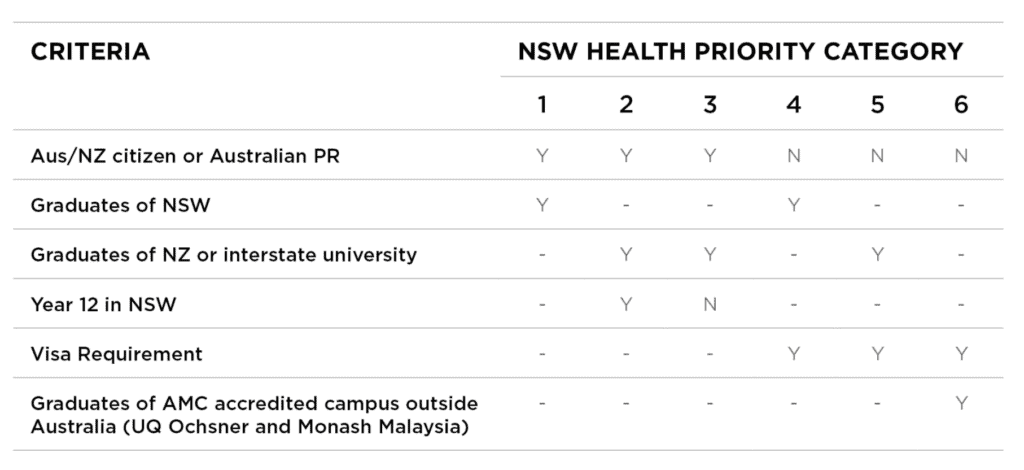
Priority 1 – Medical graduates of NSW universities who are Australian/New Zealand citizens or Australian permanent residents (Commonwealth Supported Place and Domestic Full Fee paying). This priority category is guaranteed an intern position in NSW.
Priority 2 – Medical graduates of interstate or New Zealand universities who completed Year 12 studies in NSW who are Australian/New Zealand citizens or Australian permanent residents (Commonwealth Supported Place, Domestic Full Fee paying or NZ equivalent).
Priority 3 – Medical graduates of interstate or New Zealand universities who completed Year 12 studies outside of NSW who are Australian/New Zealand citizens or Australian permanent residents (Commonwealth Supported Place, Domestic Full Fee paying or NZ equivalent).
Priority 4 – Medical graduates of NSW universities who are not Australian/New Zealand citizens or Australian permanent residents and who hold a visa that allows them to work or are able to obtain a visa to work.
Priority 5 – Medical graduates of interstate or New Zealand universities who are not Australian/New Zealand citizens or Australian permanent residents and who hold a visa that allows them to work or are able to obtain a visa to work in Australia.
Priority 6 – Medical graduates of Australian Medical Council accredited universities with campuses that are located outside of Australia or New Zealand who are not Australian/New Zealand citizens or Australian permanent residents and who hold a visa that allows them to work or are able to obtain a visa to work in Australia.
Trains leaving the Melbourne CBD passing the Melbourne Cricket Ground
Intern Numbers = 891 Annual Salary = $79,138 Length of Contract = 1 year Professional Development Allowance = $65 per week for FT Intern = $3,380 Term 1 Start Date = 16th January 2023 Orientation varies but is usually the week before
Internship in Victoria works around a computer matching system which is administered by the Postgraduate Medical Council of Victoria. The system had a significant overhaul in the previous year.
The Allocation & Placement Service is a mathematical process that matches the preferences of both candidates and Health Services and is designed to be “impartial and transparent”.
Candidates create an account and then register with the Intern match. The second step is to preference your preferred services. At the same time, the health services also place preferences. The matching process successful candidates to positions according to rankings.
For Victoria, you will need to submit referees as well as a CV. In past years this had to be on the quite unattractive PMCV standardised CV Template. The status of this template has now been downgraded to a “guide”. You don’t have to put a photo on your CV. I would recommend using your own CV template and now included a photo.
In 2020 Victorian Health services began the use of video-recorded interviews. This continues for 2022 for certain candidates. The system appears to be being used as an efficient way for certain services or hospitals to review applications without having to arrange formal interview panel days and for candidates to appear in person.
The way these interviews work is you are usually allocated a specific time to log into the system. Once you have gone through a couple of orientation steps you are usually given a series of questions and asked to record your answers. Generally, you don’t get a second go if you are not happy and the time is limited. It is vital therefore that you practice before you do your interview and ensure you have optimised your video environment.
All health services can use these recordings to rate you along with your CV and referee reports.
Metro hospitals may conduct live interviews with shortlisted candidates at any time before 3 July. Although I understand many do not and just rely on the candidates’ CV, referees and video interviews.
Interns can be allocated to one of 22 hospitals and networks. This includes a small number of community-based internships where the focus is more on community-based models of care, including working in primary care and smaller hospitals.
You can elect to be prioritised for an internship by entering the Victorian Rural Preferential Allocation (VRPA) match. Where you can be allocated to one of 5 rurally based networks. This pathway involves a live interview. First-round offers for VRPA come out on 18th July on the national rural allocation date.
Intern Placement Priorities in Victoria:
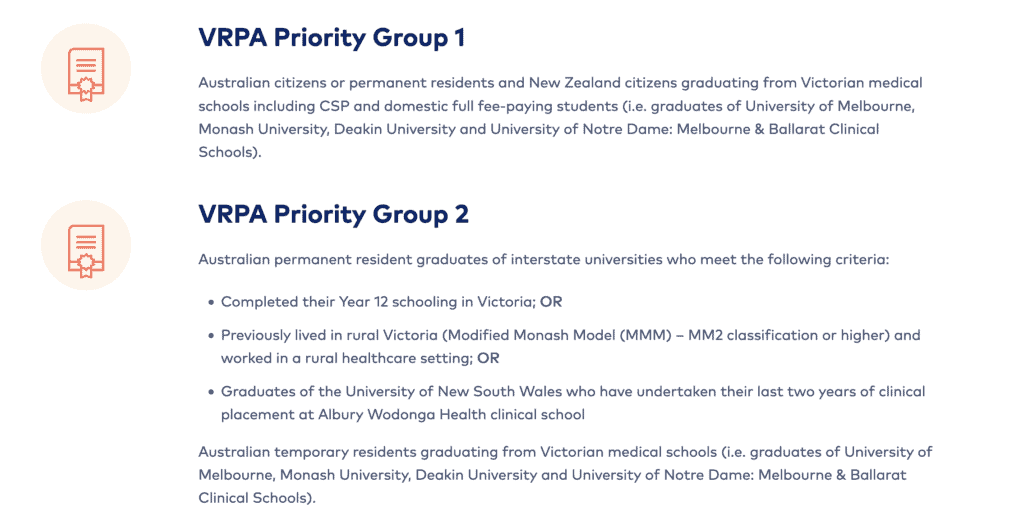
VRPA Priority Group 1 – Australian citizens or permanent residents and New Zealand citizens graduating from Victorian medical schools including CSP and domestic full fee-paying students (i.e. graduates of University of Melbourne, Monash University, Deakin University and University of Notre Dame: Melbourne & Ballarat Clinical Schools).
VRPA Priority Group 2 – Australian permanent resident graduates of interstate universities who meet the following criteria:
Completed their Year 12 schooling in Victoria; OR
Previously lived in rural Victoria (Modified Monash Model (MMM)1 – MM2 classification or higher) and worked in a rural healthcare setting; OR
Graduates of the University of New South Wales who have undertaken their last two years of clinical placement at Albury Wodonga Health clinical school.
As well as Australian temporary residents graduating from Victorian medical schools (i.e. graduates of the University of Melbourne, Monash University, Deakin University and the University of Notre Dame: Melbourne & Ballarat Clinical Schools).
Priority Group 1 – Australian citizens or permanent residents and New Zealand citizens graduating from Victorian medical schools including CSP and domestic full fee-paying students (i.e. graduates of University of Melbourne, Monash University, Deakin University and University of Notre Dame: Melbourne & Ballarat Clinical Schools).
Priority Group 2 – Australian temporary resident graduates of Victorian medical schools. As well as Interstate Special Considerations*.
Priority Group 3 – Australian citizens or permanent residents and New Zealand citizens graduating from interstate or New Zealand medical schools; Australian temporary resident graduates of interstate universities; New Zealand temporary resident graduates of New Zealand universities; Graduates from an overseas campus of an Australian/New Zealand University accredited by the Australian Medical Council (i.e. Monash University, Malaysia or Ochsner).
*There are a number of special consideration categories available including for significant medical, disability and carer responsibilities. Check with the PMCV directly for this.
Estimated Numbers = 805 (including 61 rural generalist intern positions) Annual Salary = $78,941 Length of Contract = 1 year Professional Development Allowance = nil for Interns but $2,311 for RMOs Term 1 Start Date = 23rd January 2023 Orientation varies but is usually the week before
Queensland has possibly the most complex internal allocation system of all jurisdictions. With a number of pathways and a combination of allocating certain priority groups and merit selection for others.
Queensland Health conducts the annual intern allocation process in Queensland. To apply you will need to use the online portal and upload a range of documents, including a curriculum vitae and referee details. Note: Queensland Health has also produced an unattractive CV template for you to use. But this also has the status of “guide only”, therefore I recommend you use your own.
Interns can be allocated to one of 20 Employment Hospitals.
There are 4 Intern priority groups in Queensland:
Group A – Medical graduates of Queensland universities who are Australian/New Zealand citizens or Australian permanent residents; and:- are seeking an internship commencing in the year immediately following graduation; OR – received Review Committee approval from a previous campaign to defer commencement of their internship.
Group B – Medical graduates of Australian (interstate) or New Zealand universities who are Australian/New Zealand citizens or Australian permanent residents; OR Medical graduates of Queensland universities who are Australian/New Zealand citizens or Australian permanent residents who do not meet the criteria outlined in Group A.
Group C – Medical graduates of Australian (Queensland or interstate) or New Zealand universities who are NOT Australian / New Zealand citizens or Australian permanent residents who: – – currently hold a visa that allows them to work in Australia; OR- will need to obtain a visa to work in Australia.
Group D – Medical graduates of Australian University campuses outside of Australia accredited by the Australian Medical Council (AMC); OR Medical graduates of international universities who have not completed an internship in Australia or another country and have either: – obtained the AMC Certificate – successfully completed the AMC MCQ (multiple choice questionnaire).
Note: Queensland is one of the few jurisdictions that offer an opportunity for IMG doctors to complete an internship in Australia. The number of doctors who are successful in doing so each year is rarely more than a handful.
There are 3 pathways for Intern Allocation in Queensland.
The Rural Generalist Program offers an opportunity to select a rural hospital centre as part of a program that is a pathway to working as a Rural GP. Applications open (8th March) and close extremely early (22nd March) for this pathway.
Aboriginal and Torres Strait Islander Intern Allocation Initiative. The purpose of the initiative is “to promote the success of Aboriginal and Torres Strait Islander medical graduates in the Queensland Health workforce”. Eligible applicants can apply to the Aboriginal and Torres Strait Islander Intern Allocation Initiative to be allocated to their first preferenced hospital. Applications are reviewed by a panel that includes Aboriginal and Torres Strait Islander representation.
The General Intern Campaign.
The General Intern Campaign Allocation Process.
An interesting aspect of the previous Queensland application portal is that you could see a live indication of where other applicants have preferenced other hospitals. This was presumably designed to encourage medical students to consider other hospitals and get the student group itself to work out the allocation. Queensland Health has instead now put in place an interesting “rollback” system.
For the General Intern Allocation process. Group A applicants are allocated via a ballot process. The first consideration is whether a hospital is undersubscribed or oversubscribed with Group A (top priority applicants)
If the hospital is undersubscribed all Group A applicants are offered their posts at this hospital.
If the hospital is oversubscribed with Group A applicants. All Group A applicant candidates for oversubscribed hospitals are placed in a pool and assigned a number. Oversubscribed hospitals are drawn randomly and applicants with first preference for this hospital are also drawn randomly. The process continues until all applicants are offered their next available preference for hospitals and are placed.
After this, a “roll-back” process may occur. The roll-back process only applies to Applicant Group A candidates who tentatively accepted their first-round offer (because they did not receive their first preference). The roll-back occurs after the ballot and first-round offers have been finalised and aims to match Applicant Group A candidates to a higher preference hospital should a vacancy become available due to another Applicant Group A candidate declining their offer.
The whole roll-back process happens in 1 day.
If an applicant is unavailable on the day of rollback they can nominate a proxy to be available via phone.
Merit Selection for Groups B-D.
Following the completion of first-round offers, the Position Status Report (PSR) is updated.
This is an updated list of available positions remaining.
Applicant group B-D candidates have 48 hours to change their preferences if they wish to.
Queensland Health hospitals then assess applications and conduct their own meritorious selection processes. You should contact each Hospital and Health Service directly to find out what they look for in an intern.
If vacancies become available after the First and Second Round offers, individual hospitals will meritoriously select from the remaining applicants for available vacancies. Recruitment to fill available vacancies will continue until the national closing date for intern recruitment. After the closing date, any further vacancies that arise will be filled via the Late Vacancy Management Process (LVMP).
Estimated Numbers ≅ 330 (based on 2021) Annual Salary = $79,479 Length of Contract = 3 years in most cases (IMGs may have shorter contracts tied to their visa status) Professional Development Allowance = nil Term 1 Start Date = Not Available Orientation varies but is usually the week before
WA Intern Eligibility and Priorities
WA does not have a formal priority list. However, in order to apply for an internship in WA you must:
complete an application
be a graduate from a university accredited by the Australian Medical Council
possess a valid Intern Placement Number
have not previously worked as an intern either in Australia or overseas
meet the Medical Board’s English language skills registration standard
be eligible to work in Australia
In WA all interns are employed by a Primary Employing Health Service (PEHS).
Each PEHS is a major tertiary hospital in WA that has been accredited to directly employ interns and provide an intern training program.
The six PEHSs in WA are:
Fiona Stanley Fremantle Hospitals Group (Fiona Stanley Hospital)
Joondalup Health Campus
Royal Perth Bentley Group (Royal Perth Hospital)
Sir Charles Gairdner Osborne Park Health Care Group (Sir Charles Gairdner Hospital)
St John of God Health Care (St John of God Midland Public Hospital)
WA Country Health Service
Each PEHS normally holds an information night. You can also choose to work as a rural intern by applying to work through Western Australia Country Health Service.
Intern Applications in WA open on 9th May. Information nights are as follows:
Sir Charles Gardiner 9 May
St John of God Midland 11 May
WA Country Health Service 12 May
Royal Perth 13 May
Joondalup Health Campus 17 May
Fiona Stanley 18 May
The process is coordinated by the Postgraduate Medical Council of Western Australia but you apply through the WA Jobs site and selection occurs through panels representing each of the PEHSs. As part of your application, you need to provide a cover letter and address the intern selection criteria, a CV and will require a range of other documents as well as to nominate 3 referees. If successful you will receive a contract for 3 years.
Estimated Number = 301 (including 18 rural intern posts) Annual Salary = $77,084 Length of Contract = 3 years in most cases (IMGs may have shorter contracts tied to their visa status) Professional Development Allowance = nil Term 1 Start Date = 6th February 2023 Orientation varies but is usually the week before
SA Health Careers conducts the annual Intern application process in South Australia. There are 3 Adelaide-based Local Health Networks and 3 smaller country-based networks to which you can apply for the priority Rural Intern pathway. It should be noted that whatever network you are allocated to you may request or be required to undertake one or more rotations in other networks.
The Rural Intern Pathway is a strength-based recruitment process for applicants who are interested in undertaking their internship (and potentially subsequent years) in rural hospitals within Country Health SA (CHSA). Rural intern positions provide broad opportunities in unique settings and are best suited for medical graduates with a history of living or working in rural areas or a desire to commence a career in the country.
Those applying for the rural intern pathway undertake an interview from 27 June to 1 July and offers come out on the national rural allocation date of 18th July.
SA Intern Priorities:
International Medical Graduates from non-Australian medical schools can apply for the rural intern pathway so long as they have only graduated in the last 2 years and have completed the AMC Part 1, and can meet the other requirements which are extensive and include meeting the Medical Board English language requirements, completing electronic medical record training and have residency status or a visa that allows you to work unrestricted.
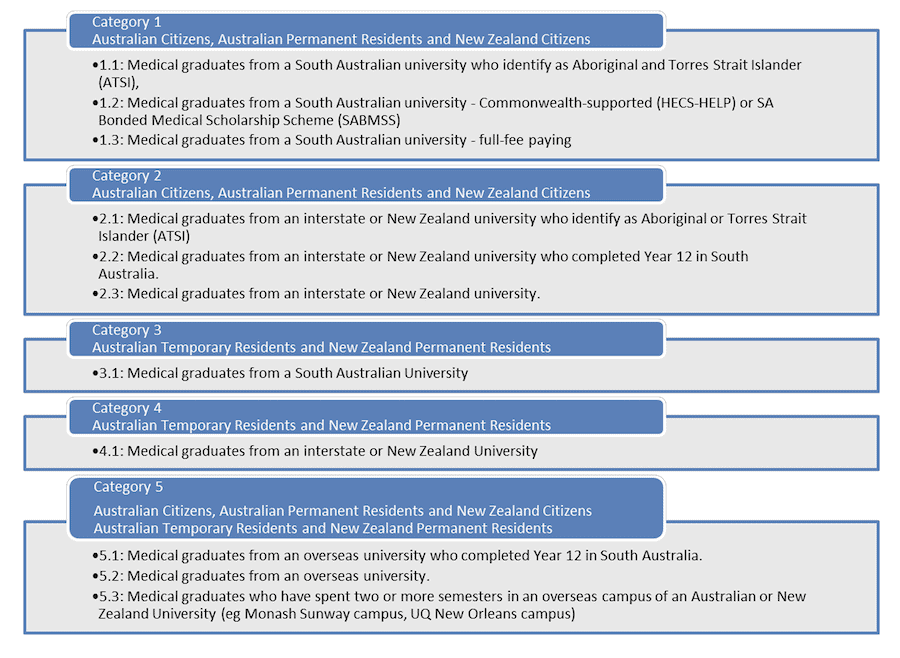
South Australia’s main round intern allocation priorities are the most complex of all jurisdictions.
Aboriginal and Torres Strait Islander applicants are given priority preference by being placed in the first subcategory for categories 1 and 2.
From 2022 Guide C/- SAMET
Within the respective South Australian category groups, applicants are randomly allocated to their highest possible Local Health Network preference. If an offer is made, applicants must respond via the electronic application system within the specified timeframe. Where an applicant has been made an offer and no response received, the offer will be automatically declined. Applicants are only eligible to receive one offer for an internship in South Australia.
South Australia is one of few States that specifically permits medical graduates from other countries to apply for internship positions. But they are at the very bottom of the priority list. Please see the above information about the rural internship.
In addition to a CV and referees, in order to apply for an internship in South Australia, you will need to provide a certificate confirming that you have completed the SA Health online electronic medical record (Sunrise EMR & PAS) training.
Estimated Number = 92 (Based upon last year). Annual Salary = $73,586 Length of Contract = 1 year Professional Development Allowance = nil for Interns but RMOs get an allowance of $2040 per annum Term 1 Start Date = 9th January 2023 Orientation = 4rd January 2023
Internships are coordinated in Tasmania via the Department of Health and Human Services.
All applicants are required to apply online. As part of your application you are asked to preference all of the 3 available sites: – Hobart – Launceston – North West Region
You can also preferentially apply for the Tasmanian Rural Generalist Program. You will be allocated to one of the above sites based on your preference but also undertake a 13 week rural GP placement as part of your internship.
Candidates need to attach a CV/Resume and any other relevant information to their application and must arrange the completion of two electronic referee reports:
– One (1) referee that is employed in a clinical role (Clinical Academic) with the University where you are studying/or studied medicine and is aware of your studies in the past 12-24 months; AND
– One (1) that is – a senior clinician (>4 years’ experience post general registration) who has observed you (you have worked with) during your clinical placements in the past 12-24 months, and can comment on your suitability for hospital-based practice.
Intern Placement Priorities:
In the past, The Tasmanian Health Service currently has given priority order to: 1. Australian permanent resident Tasmanian-trained Australian Government supported and full-fee paying medical graduates. 2. Australian temporary resident Tasmanian-trained full-fee paying medical graduates.- 3. Australian permanent resident interstate-trained Australian Government supported and full-fee paying medical graduates. 4. Australian temporary resident interstate-trained full-fee paying medical graduates. 5. Medical graduates of an Australian Medical Council accredited overseas University.
At this point, it is not clear how selection will work for 2022. In past years there has been an interview process. However, the information to date indicates that priority 1 candidates will be placed on a ballot and allocated according to preferences. This seems to indicate there will be no interview or merit-based selection at least for this group.
ocean coast in Darwin, Northern Territory Australia
**2022 Information not currently available**
Estimated Number = 50 (24 for Central Australia Health Service, unknown for Top End Health Service) Annual Salary = $78,750 Length of Contract = 1 year Professional Development Allowance = $3,295 per annum with option to apply for additional $3,000 or $3,000 for HELP relief. Term 1 Start Date = Not Available Orientation varies but is usually the week before
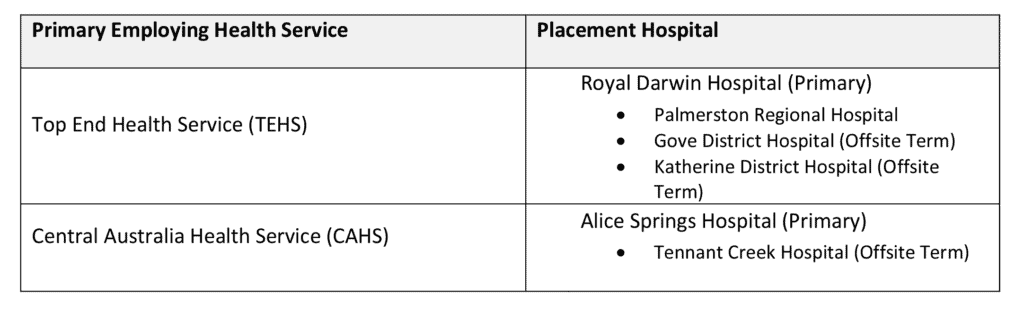
The NT Prevocational Medical Assurance Services (PMAS) conducts a central review of eligible applicants and all intern positions are allocated within the two NT Health Services: Top End Health Service (TEHS) – based upon Royal Darwin Hospital (RDH) Central Australia Health Service (CAHS) – based upon Alice Springs Hospital (ASH)
Each Health Service has a primary employing health service as well as additional placement hospitals as per below:
C/- NTPMAS Guide
Eligible applicants are allocated intern positions in line with the Northern Territory category groups. Within the relevant category groups, applicants are allocated to their highest possible Health Service preference, pending availability of a position.
Intern Priority Categories:
The applicant eligibility categories in order of selection for Internship in the Northern Territory are:
Category
Criteria
A
NT Medical Program Bonded Scheme / Return of Service Obligation (RoSO) applicants (guaranteed placement)
B
NT Indigenous applicants who have completed medical degrees at accredited Australian and New Zealand medical schools who are: NT Indigenous scholarship holders; Identified as an NT Indigenous resident.
C
Non-NT Indigenous applicants.
D
NT applicants (non-Indigenous) who have completed medical degrees at accredited Australian and New Zealand medical schools who are: NT scholarship holders; Identified as NT residents (may include non-bonded JCU/Flinders NTMP students).
E
Australian applicants (non-Indigenous / non-NT residents): Previous experience working/studying in NT (JCU/Flinders/Other university student placements); Previous experience in a rural, remote and Indigenous health location/s (eg. Aboriginal Medical Services, Rural Clinical Schools, involvement in Rural Student Clubs and those applicants who come from rural, and remote locations).
F
International applicants on a student visa, now an Australian medical graduate who has: Previous experience working/studying in NT (JCU/Flinders/Other university student placements); Previous experience in a rural, remote and Indigenous health location/s (e.g. Aboriginal Medical Services, Rural Clinical Schools, involvement in Rural Student Clubs and those applicants who come from rural, and remote locations).
G
International medical degree applicants who have: Previous experience in NT student placements/clinical observers; Experience in rural, remote and Indigenous health locations.
As part of your application, you are required to submit a curriculum vitae of no more than 2 A4 pages and address the selection criteria. Applications are submitted to the NT Government employment portal.
Overall the intern allocation process is based on an applicant’s category group, Health Service preference, and the number of positions available in each health service.
The two NT Health Services are responsible for selecting applicants and making their offers of employment, applicants are advised via email. The Health Service responsible for making the offer of employment will after receiving an acceptance from an applicant arrange an employment contract for an Internship position within their health service to be provided prior to commencing their internship.
*NT is one of a few jurisdictions which will consider IMG applicants. Generally, you will have to have had previous experience in the NT.
Estimated Numbers = 95 (6 of these positions are normally guaranteed to NSW medical students) Annual Salary = $74,826 Length of Contract = 1 year Professional Development Allowance = $1,040 per annum Term 1 Start Date = Not Available Orientation varies but is usually the week before
If you want to apply for an internship position in the Australian Capital Territory you do so via the ACT Health Recruitment page.
Most of your time is spent at the Canberra Hospital. But ACT is interesting as it is one of the few chances you may have as an Intern to work in 2 separate States and Territories. Rotations may include secondments to Calvary Public Hospital, Goulburn Base Hospital, and South East Regional Hospital (SERH) at Bega. Because the ACT utilises some positions in NSW for intern posts there is a reciprocal arrangement whereby a number of NSW graduates are guaranteed an intern post in the ACT.
Priority is given to: – Australian Graduates of ANU – A maximum of 6 graduates of NSW Universities – Graduates of other Universities who completed Year 12 in ACT
ACT Intern Priority List:
Category 1a (Guaranteed First Round Offer) – Domestic Graduates of the Australian National University Medical School
Category 1b Guaranteed First Round Offer (capped at SIX) – Domestic Graduates of NSW Universities.
Category 1c Guaranteed First Round Offer – Aboriginal and Torres Strait Islander Graduates of other Australian Universities (who provide a statutory declaration regarding Aboriginality)
Category 2 First Round Offer Not Guaranteed – Graduates of other Australian Universities who completed Year 12 studies in the ACT.
Category 3 First Round Offer Not Guaranteed – International Student Graduates of the Australian National University Medical School.
Category 4 First Round Offer Not Guaranteed – Graduates of other Australian Universities.
Category 5 First Round Offer Not Guaranteed – Graduates of Australian University campuses outside of Australia accredited by the Australian Medical Council.
The Private Hospital Stream (PHS) funds private hospitals to deliver medical internships and support junior doctors to work in expanded settings. It focuses on supporting training for junior doctors in rural, regional and remote areas in Modified Monash (MM) 2 to 7 locations.
This includes fostering partnerships between private hospital providers, rural public hospitals and other training settings (such as Aboriginal Medical Services) working as part of expanded training networks.
Annual Salary and conditions = should reflect the annual salary for an intern in the State or Territory you are working in.
Internships and places
The PHS supported up to 115 internships and up to 80 PGY 2 and 3 eligible junior doctor places in the 2020, 2021 and 2022 training years.
Expression of Interest (EOI) internships
An annual EOI internship process is run for junior doctors to express interest in a PHS-funded medical internship place.
This process is only for PGY 1 funded places. It opens each year after state and territory governments have offered and filled their internship positions.
Eligibility
The program divides applicants into 2 categories – Priority One and Priority Two.
Priority One eligibility criteria
The Priority One category is for final year medical students who meet all eligibility criteria for an internship under the PHS.
You are Priority One if you:
are a full-fee-paying international student completing your medical degree during the current calendar year from a medical school in Australia, having completed all of your medical degree in Australia (university-approved, short-term elective rotations completed overseas are allowed)
have met the Medical Board of Australia (MBA) English language proficiency requirements for registration purposes
are not an Australian Citizen
commit to getting a visa to work in Australia during your internship year.
Priority Two eligibility criteria
You are Priority Two if you:
have MBA provisional registration as a medical practitioner
have met the MBA English language proficiency requirements for registration purposes
commit to getting a visa to work in Australia during your internship year.
Who is not eligible
You are not eligible to apply for the PHS if you:
do not meet the Priority One or Priority Two eligibility criteria
have accepted an internship position from a state or territory government.
Recruitment process
The recruitment process aligns with the state and territory government recruitment processes and the national audit process.
Suitable applications are forwarded to the PHS participating private hospitals by the due dates each year.
The PHS participating private hospitals do eligibility checks. They will contact eligible applicants they want to interview.
You should not make direct contact with the hospitals.
Category prioritisation
PHS participating private hospitals must fill PGY 1 places with Priority One applicants first.
If there are still places available after the Priority One list is finished, the hospitals can then recruit Priority Two applicants.
PGY 2 and 3 funded places
PHS participating private hospitals make their own recruitment and employment arrangements for PGY 2 and 3 junior doctors. This allows them to meet their own service needs.
PHS-funded hospitals
The Commonwealth funded the following private hospitals to deliver the PHS from 2020 to 2022:
Mater Health Services North Queensland (PGY 1 places)
Mercy Health and Aged Care Central Queensland – Friendly Society Hospital, Bundaberg; Mater Private Hospital, Bundaberg; Bundaberg Base Hospital, Bundaberg; Mackay Base Hospital, Mackay; Mater Misericordiae Hospital, Mackay (PGY 1, 2 and 2 places)
MQ Health, New South Wales (Macquarie University Hospital) (PGY 1 places)
St John of God Ballarat Hospital, Victoria – Grampians Intern Training Program (PGY 1 places)
Mater Hospital Sydney (PGY 1 places)
St Vincent’s Private Hospital Sydney (PGY 1 places)
Ramsay Health Care, Western Australia (Joondalup) (PGY 1, 2 and 3 places)
Greenslopes Private Hospital, Queensland (PGY 1, 2 and 3 places)
Calvary Health Care Riverina, New South Wales (PGY 2 places)
There are lots of considerations when it comes to putting in your Intern application. Everyone is a bit different. Some graduates feel like they would like to be close to home and family whilst going through their transition to Intern. Others see it as a chance to get away and explore a new place and location. And then others focus on the long-term career prospects of certain locations.
I think this last consideration is a little overrated for most. You can generally experience a wide range of medicine in your first couple of years of medicine after graduation and there is scant evidence that this affects your prospects of applying for specialty training posts.
That being said if you have an interest in anything other than Medicine, Surgery or Emergency Medicine as a future career you should probably investigate whether this particular specialty is offered at the hospitals or networks to which you apply.
Unfortunately, the internship model in Australia is quite antiquated and we have continued to use the experience as a proxy for competency when a large portion of the medical education world has moved on. The result has been the mandating of the 3 core terms for internship of Medicine, Surgery, and Emergency Medicine. There is really no solid educational basis for this approach and one of the unfortunate outcomes is that all the other specialties get squeezed out and few interns get to experience psychiatry, general practice, obstetrics, paediatrics, pathology etc… which ultimately does have an effect on recruitment to these specialties.
So the basic message is this. If you are really dead set keen on doing radiology as a career you should try to track down the very few locations that might offer this rotation to either interns or residents.
Each year the Australian Medical Students’ Association produces a very useful Intern Guide with lots of information about the composition of intern training networks across the country. The 2022 version is not available but here’s a link to the 2021 version.
Related Questions
Is There Any Restriction On Where I Can Complete My Internship?
To meet the Medical Board of Australia’s requirements for general registration, an internship can be completed in any state or territory of Australia.
Can I Apply to More Than One State or Territory for an Intern Position?
Yes, you will need to apply separately to each state and territory where you would like to work. You will need to complete a separate application for each position, submit the documents, provide the information required and meet the selection requirements. As part of the application process, each state and territory requires you to include your intern Placement Number (IPN).
What is an Intern Placement Number?
The Intern Placement Number is a unique nine-digit number that has been generated by the Australian Health Practitioner Regulation Agency (AHPRA) and has been provided to medical schools for distribution to all 2022final year medical students. If you do not have an Intern Placement Number issued or you have misplaced it, you must contact your medical school to have the number issued or reissued. Do not contact AHPRA. Note: The Intern Placement Number is not your University Student Identification Number.
I Am Not an Australian Medical Student. How Do I Obtain an Intern Placement Number?
In this situation, you do not require an IPN and will not be issued with one. You can still apply for internships. But unless you are a New Zealand medical student your chances of gaining a place are very very limited.
What If I Have Special Circumstances Which Make It Hard For Me To Work In Certain Places?
All States and Territories Have processes for considering special circumstances. Some of the types of circumstances that are generally approved are: where you may have certain health conditions that mean you need to be close to certain hospitals or specialists; where you have dependents, such as young children, and are unable to relocate due to care arrangements; and where you and your partner want to work as doctors in the same location. Generally, requests to stay in certain locations, for reasons such as work commitments of partners or needs of school-aged children are not granted.
I Have Received My Intern Offer. But I Would Like to Defer It. Is This Possible?
This will partly depend on how long you wish to defer. If you just wish to defer for a few months. Once you have your offer and are in discussions with your new employer make enquiries. It may be possible to negotiate a later start with your employer. Most employers will generally prefer that you start on time so that you are not out of sync with your colleagues. But there might be some advantage for the employer in you attending orientation but then starting a bit later as it will probably help them to fill out roster gaps. On the other hand. If you wish to defer for a complete year. Then you will need to check the policy of the State or Territory that has provided you with an Intern offer. In some cases (for example Victoria) you will be permitted to defer and your place will be held for you the following year. In most other cases you will need to reapply the following year and check whether your priority status has altered. In most cases, you have the same priority status. Also bear in mind that it is unclear how long you can defer commencing your internship. However, the Medical Board of Australia expects that once you have commenced your internship you will have completed this process within 3 years.
I am a Doctor With a Medical Degree From Outside Of Australia. Can I Apply For an Internship?
Unless you obtained your medical degree from a New Zealand Medical School. Then the brief answer to this question is no. I would love to stop there. And I really think you should as well. But there are rare circumstances where you may be able to obtain an internship with a medical degree from outside of Australia. But the Medical Board of Australia strongly advises against this option and so do I. For good reasons. Firstly the whole Australian medical internship system is designed to ensure that Australian medical graduates are able to undertake an internship. Not for overseas graduates. Secondly (and as a result of the first point) it is very rare to be offered the chance. Some States and Territories will not even consider an application from an IMG for an internship. Others will only do so in limited circumstances, for example, the Northern Territory will accept applications from IMGs who may have done a medical student elective or clinical observership in the Northern Territory and who have experience in rural, remote and indigenous health locations. But even then these applicants are at the bottom of the priority list for obtaining an internship. South Australia will accept applications. But again you are bottom of the list. Queensland will also accept applicants, but only if you have never worked as a doctor. And again you are bottom of the list. A final note on this question is that the majority of IMGs who do obtain a medical internship position each year in Australia generally have Australian citizenship or permanent residency.
I Have Heard That Some Graduates Miss Out On Internship. Is This True?
Whilst it is theoretically a possibility that some medical graduates miss out on Internships according to information provided by HETI for the most recent year of intern applications no one was actually left at the end of the process without an offer. Only Australian citizens and permanent residents are guaranteed an intern position under the COAG agreement. However, there are generally enough intern positions available for those students who have come to Australia to study medicine and the Commonwealth Private Hospital program offers additional spaces for those that may miss out. That being said. It is also clear that many graduates choose to drop out of the application process themselves. So not everyone who applies gets an offer. The assumption is that some graduates take up similar intern opportunities in other countries upon graduation.
Can I Submit a Late Application?
Acceptance of late applications is at the discretion of each state and territory.
When Will Offers Be Made in 2022?
All states and territories will commence making offers for Rural Pathways on Monday 18 July 2022 and will commence making offers for all other pathways on Wednesday 20 July 2022. The National Close Date for 2023 Intern Recruitment is Friday 18 November 2022.
What if I Receive More Than One Offer?
You need to decide where you would like to undertake your internship and accept this position and decline all other positions. You should not hold onto more than one offer as this negatively impacts both the hospital that will have a vacancy if you fail to start work because you have started in another position in another state, and other applicants who would like to work at that hospital who do cannot receive an offer for that vacant position.
What is the National Audit?
States and territories share intern applicant information at pre-agreed dates. This data is then used to identify applicants who have applied for and/or accepted intern positions in more than one state/territory. Applicants who have accepted more than one intern position will be contacted by the National Audit Data Manager by phone or email and given 48 hours to withdraw from all intern positions, except the one where they intend to undertake their intern year.
What if I Don’t Respond to the National Audit Data Manager?
If you don’t respond to the National Audit Data Manager and/or do not withdraw from all positions except one, the relevant states/territories where you have accepted an offer will be advised and all offers, except for the first offer you received may be withdrawn.
What is the Late Vacancy Management Process?
The Late Vacancy Management (LVM) Process runs from Monday 5 December 2022 to Friday 24 March 2023. The process ensures any late vacancies are offered to eligible intern applicants who have not yet accepted an internship position. The Late Vacancy Management Process will be coordinated by the National Audit Data Manager on behalf of states and territories. Please ensure you have updated your contact details if you are going overseas during the Late Vacancy Management Process period. The National Audit Data Manager will send out emails on Friday 25 November 2022 to participants who will need to opt into the Late Vacancy Management Process if they still wish to receive an internship position offer in Australia. Note: if an applicant does not respond to this email, they will no longer be eligible to receive an internship offer and their application will no longer be considered in any Australian jurisdictions.
Who can participate in the Late Vacancy Management Process?
The process is open to medical graduates of AMC accredited medical schools who have applied for and are not holding a 2023 intern position through the Commonwealth or states and territories at the National Close Date for Intern Recruitment (18 November 2022). Participation in the LVM is an opt-in process -you must confirm that you want to participate in the LVM by responding to the National Audit Data Manager by e-mail.
(Disclaimer: All information here has been sourced in good faith but things do change so you should always do your own due diligence in such matters, we are providing this information to aid you in your application but take no responsibility for any outcomes)We’d welcome feedback from any Intern programs in relation to the accuracy of the above information.
Did you know that your CV sucks? Well, I’m pretty sure it does. And in this post, I am going to talk to you about the most likely reasons why your CV sucks. And how to fix these problems so your CV stands out.
As a real doctor who is also a medical HR expert, I get to see a lot of professional CVs and resumes mainly from other doctors. And inevitably most of them have some real obvious faults and problems that need to be fixed up. These are simple errors that you can fix yourself which will dramatically affect the performance of this key document.
In summary, the top errors on CVs that I generally see and which result in me concluding that a resume sucks or a cv sucks are as follows:
Including a photo on a professional CV. This is an absolute no no.
Not taking the time to customise your CV to the job you are applying for.
Putting your information in the wrong order (to what the employer wants/needs).
Too many embelishments.
Typographical errors, grammatical errors and spelling mistakes.
Read on further as we discuss these problems so you can find out why your CV sucks and fix it.
Does your resume really suck? Does your CV suck?
Yes. Probably at least a little bit. It doesn’t mean that what you have written is all bad. It’s just that perhaps you haven’t looked at it from a sales and marketing perspective. Once you understand that your CV or resume is a key marketing document (i.e. it’s meant to sell you!) you will start to figure out why I am saying that your CV sucks.
Most of the clients that I work with are doctors or other health professionals. Looking at it from a professional CV perspective it’s important that you try to maximise the success rate of your CV. Or what we are really talking about here is your resume.
Your CV or resume’s main job (arguably only job) is to ensure that you get an interview for the job you applied for. If it hasn’t done that, it’s failed you. And then that CV definitely does suck.
The Number One Reason Why Your CV Sucks. Including a Photograph.
The number one problem that I see with people’s CVs is photographs. As nice as you may be able to look in a photo there are so many reasons why including one on a professional CV or resume is simply a bad idea.
I go over the reasons in more detail in this post. Or if you prefer a video watch this.
However, a key reason you want to avoid including a photograph is that it is not expected by the panel and therefore often seen as pretentious.
Another reason you want to avoid using a photograph is that it will introduce biases. Once the reader sees what you look like they can make all sorts of assumptions. Why not wait till they meet you in person so you can make a true first impression.
Finally, a photograph is distracting on a CV or resume and may just take up a few vital seconds that you would prefer that the reader use to examine the contents of your document.
Now, the inclusion of a photograph does depend on what sort of job you’re going for. But again, for the clients that I work with who are medical practitioners, professionals, it really is not accepted practice to put a photo on your CV. And therefore you should refrain from doing so.
Leaving the photo off actually gives you a bit more real estate on the front page to play with, which is the added bonus there.
So the solution is no photos on your CV.
The Second Reason Why Your CV Sucks. Not Customizing to the Job.
Now the number two problem that I see with people’s CVs and resumes and why you might hear me say your CV sucks is a failure to customize your document.
What do I mean by customizing? I mean tailoring it or adjusting it. This is something that you should do every time you go for a new job. You should be submitting a different resume each time.
You should be ensuring that that your cv represents you effectively in terms of how you are the best fit for that particular job.
This doesn’t necessarily mean that all of your cv sucks. And you don’t necessarily have to go through and edit all of the sections on it. But have a think about it. What highlights, particularly in your personal summary, do you want to put across that show that you meet the specific criteria and key challenges of that job?
And of course, the solution then is to customize your cv.
Because you may be applying for a number of jobs on a regular basis or over time. What I would actually recommend that you do, is keep a master document, a proper curriculum vitae if you will, with all of the information tracking your career over the years. That is all your jobs, all your education, all your qualifications, all your professional development, et cetera…
Then each time you go for a job, reflect on that master CV and your most recent resume and put together a new resume, which is a tailored version of these 2 documents aimed at the new job.
The Third Reason Why Your CV Sucks. The Wrong Information in the Wrong Order.
The third problem that I see with CVs and resumes is information being presented to the reader in the wrong order. Especially the wrong information being presented on the first page.
Not putting the key information that employers want to see on the first page of your resume is a sure fire way to frustrate a potential boss and be overlooked for an interview.
The first page is critical. It’s like real estate. When you understand that generally, someone is only glancing at your CV for a few seconds on the first review. This brings this particular point to home.
The first page of your resume is the thing that people first look at, and it’s the thing that recruiters spend the most time glancing over. And then they will usually hop over to the end and look at your references, and will probably skip all the stuff in the middle.
So you want to optimize the first page. It’s really valuable real estate for you from a marketing perspective, you need to know the key things that need to be on that first page. And what you can leave for other pages.
So what are the key components for the first page of your CV?
Firstly, obviously, you should have your name. And your name should be in the biggest font size on the page. Because it should be the hero of your page. And it is the thing you want them to remember.
So rather than having a photo, have your name in the biggest font size that you can comfortably fit it into on one line at the top of the document.
Next. You will obviously need some contact details. These days that really only has to be a mobile phone number and a professional email address. You can skip the postal address. They are probably not going to mail you anything.
Next. Is “key information”.
What do I mean by key information?
So again, my example here is medicine. Key information in medicine would be things like your short qualifications, i.e. MB BS or similar. Things that you must have to do the job. In some cases, this will also be specialty qualifications, like FRANZCP.
Other key information might include medical registration information (which is generally also essential for most medical jobs), as well as things like English language tests and visa status.
Put down all the key things that you know the employer is wanting to see very quickly that will help them determine whether you’re actually eligible and meet the key eligibility criteria.
After this, you should have enough room on the first page for the other two key components.
The first of these is a personal summary, which should take up around a third of the page and maybe one to two paragraphs. which is your executive summary, presenting your career your way (rather than them interpreting it from looking through the rest of the document).
And finally, but importantly, work history.
Employers want to see what you’ve been doing in your job. Remember, you’re going for a job, so they want to see what the current job is that you’re doing.
What are you achieving currently in that job? And maybe, if you’ve only been in the present job for a little while, what did you achieve in the job before that.
This is the key thing that employers want to know. What are you doing now? Who are you working for? How well are you performing currently (not 10 years ago)?
So what can I leave till the next page of my CV?
Some of the things you can leave for the next page or the one after that include things like education history, courses, professional development, and research. These are not as essential as the things I have listed above.
Sadly, sometimes I see candidates list lots of other things, such as a detailed education section, courses and certifications before we get to the work history, buried on the 2nd or 3rd page. This is really putting you at a disadvantage. And in this case, I can definitively say that your CV sucks.
So the first page is crucial to have the right information in the right order.
The Fourth Reason Why Your CV May Suck. Too Many Things Happening!
Now, the fourth and the second last tip I’m going to give you about how to fix your CV. Is to watch out for too much going on or too much happening on your CV.
Now, what do I mean by this?
This could mean many things. But common issues I see are things like:
having too many different fonts,
having too many styles,
having different bullet points,
indents not aligning,
text cramped up,
too many colours being used,
not enough use of white space,
images and icons
Things that just kind of make the document jar on you.
For a professional CV. Try to keep your CV as simple as possible.
It should look sober and fairly conservative, but be readable and still pleasant to look at.
Of course, you can still put a bit of your own sort of style into it. But less is more.
You don’t want to be overloading the reader. You want them to see the critical information that you’ve got.
What’s my solution for that?
Well, you can spend a lot of time trying to work with Word documents and templates or Google Docs. I’ve seen people recommend going into Canva, for goodness sake!
I don’t know why you would do that. Canva is good for graphic design. But very slow for long documents.
Don’t do any of these things.
Use something that’s developed to help make a very professional polished. CV easily and cheaply, which is an online CV builder.
Online CV Builders A Great Hack for How to Fix Your CV
The Fifth Reason Why Your CV Sucks. Spelling Mistakes and Typos.
You’ll be amazed how easy it is for one or two spelling mistakes and typographical errors to creep into your document. These errors can just really bring it down.
Again. If we are talking about professional or professional people going for jobs where attention to detail is critical, particularly in medicine. Errors on your CV can leave a significant negative impression.
So it’s important that your resume, or your CV, be absolutely perfect. That there not be any sort of missing dots or commas or spelling mistakes. Things that make the reader think, well this person really didn’t check this document properly, did they?
So what’s the solution to this problem?
Well, you have spent all this time putting this document together, and you have probably gone through it several times. So you are probably missing things now because you’re skimming over them.
So get someone else to check your CV or resume.
Make sure that they identify any of those spelling errors and typographical mistakes.
In addition, use the inbuilt functions of things like Microsoft Word. Or if you’ve got Grammarly for the internet use something like that if you’re working online. These programs are built to show you your errors and may even help improve the tone of your document.
This blog is open to comments, I also run a YouTube Channel and a Facebook group and frankly way too many other ways for people to contact me. So no surprise. I do get a lot of questions and queries on a daily basis. One of the surprisingly common and interesting questions that I do get a lot from doctors from other countries is “do doctors get paid to train in Australia?”. Being paid for work is part of our culture in Australia. But I am aware that in other systems you may not necessarily be paid when you train in medicine or even have to pay for your training.
So let’s try to clear up this question in this blog post. Along with answering some related questions that come up around this topic.
From the time after you graduate from medical school in Australia, you will be entitled to and will receive payment for your services as a doctor. This includes any further career stage which might be referred to under the label of training. So you get paid to be an Intern, you get paid to be a Resident and you get paid to be a Registrar (which is what most doctors who are undertaking specialty training in Australia are referred to).
Therefore, you also get paid when you are doing surgical training, physician training, psychiatry training, emergency training, general practice training etcetera. You also get paid when you become a specialist doctor or consultant, although in some cases you may be working for yourself, in which case, you are paying yourself out of the revenue you collect.
What does all of the above means for international medical graduates (IMGs)?
Do IMG Doctors Get Paid to Train in Australia?
The answer is again yes. If you are an IMG doctor and you get appointed to any training position, whether this is a resident position for the purposes of completing the standard pathway process or a specialty training (Registrar) post as part of any of the competent authority, the specialist, or the short term training in a medical specialty pathways. You will get paid.
Whilst wage theft and the exploitation of overseas workers in Australia have become a real concern in Australia over the past decade or so. I am not aware of any such situations that have involved international medical graduates. If you do know of such a circumstance I would be interested to hear from you.
Do IMG Doctors Get Paid Differently to Australian Doctors?
This is a more complicated question to answer.
As a general rule if you are an IMG doctor and you are recruited to a position you will be paid under the same classification as any Australian doctor also doing the same job. So if, for example you are appointed to a Resident position you will be paid as a Resident.
However, for most classifications, there are steps or levels that increase based on your years’ of experience. Sometimes the employer may try to start you out at the bottom of this classification scale, even though you may actually have more experience, citing that you don’t have any experience in Australia. So in this case you may end up being paid slightly less. In my experience, most employers in Australia will try to recognise your experience and pay you at a higher rate if you are eligible. This is a grey area in terms of what is correct. So it’s definitely worth querying things if you feel you are on the wrong end of the stick.
Why Do Doctors Get Paid to Train in Australia?
The answer to the question of why doctors get paid whilst training is that they are performing real and substantial services in these roles. The training is on top of this work or embedded into this work. They are generally not taking large amounts of time away from the workplace to attend things like lectures and seminars or workshops. Much of the training occurs within the workplace and a lot of the additional studying occurs in the doctor’s own time after work.
Many Doctors Do Have to Pay to Train
Hang on. What’s that? You just said that doctors get paid to train. But now you are saying they also have to pay?
Doctors do get paid to train in Australia. But there are some costs associated with being a trainee doctor in Australia.
There are the normal regular costs like paying your medical registration every year and having a car so you can get to work.
But there are also some specific costs associated with being a trainee doctor.
As an intern, you generally won’t have any particular costs associated with your training as it will normally be provided for you by the hospital.
As a resident doctor, you will probably be thinking about paying for some courses that might help you get into a particular training program. So things like emergency courses and anatomy courses and radiology courses and the like.
As a specialty trainee doctor, you will have to pay college membership fees, you may also have to pay for a formal education course and you will have to pay to sit examinations.
Personal costs for training as a trainee doctor in Australia can rack up to several thousand dollars and even pass into the tens of thousands of dollars range. But this is generally over a significant period of around 5 to 10 years.
We are approaching that time of the year again in Australia. The time where the majority of trainee doctors go up one step of responsibility on the ladder. It’s also the time that our newly graduated medical students commence their first paid position as a doctor. Commonly referred to as the internship. You might be keen to know how much you are going to be paid and how this compares to other States and Territories. How much do interns make? You may be surprised how much it actually varies.
Interns across Australia are paid according to State or Territory based Awards or Enterprise Agreements. The annual rate of Intern pay varies considerably with NSW Interns being paid the worst and Western Australian Interns being paid the best. In order of ascending annual Intern salaries are as follows: New South Wales $71,283, Tasmania $73,586, Australian Capital Territory $74,826, South Australia $77,084, Northern Territory $78,757, Queensland $78,941, Victoria $79,138, Western Australia $79,479
NSW
Tas
ACT
SA
NT
Qld
Vic
WA
$71,283.00
$73,586.00
$74,826.00
$77,084.00
$78,757.00
$78,941.00
$79,138.09
$79,479.00
as of Jul 2021
as of Jul 2021
as of Dec 2020
as of Apr 2020
as of Jan 2021
as of Jul 2021
as of Jan 2021
as of Oct 2020
as of the latest publicly available Award document or equivalent
How Much Do Interns Make? There Is A Wide Variation In the Entry Doctor Pay Rate
The results above reveal that there is a wide variation of $8,196 or a 9.5% difference between the lowest paid annual salary and the best paid annual salary. Interestingly this gap has closed somewhat since we looked at it a couple of years ago.
The reason for the large variation is that each State and Territory sets its wages for public employees separately through something called an Award or an Agreement. These are formal documents that state the conditions of employment. They include matters such as the hours of work, the leave available and of course how much you get paid.
These Awards or Agreements are generally only comprehensively reviewed every few years at best. In the meantime State and Territory governments generally negotiate with the employee’s unions for an across the board annual wage increase somewhere around the rate of inflation.
Doctors like other public employees do not generally contract as individuals for their services with hospitals. So everyone gets the same conditions based on what role they are employed in and what year they are at.
According to the Australian Bureau of Statistics Full Time Adult Average Annual Ordinary Earnings was $93,729 in 2021. So bearing in mind that it takes a minimum of 5 years of university study (with a fair collection of higher education debt to pay off) to get to this point we can certainly not consider Interns to be extremely well paid.
But it’s not all that doom and gloom. Whilst, Interns certainly do not work the amount of overtime they used to 10 or 20 years ago. Overtime provisions, as well as loadings (working rostered hours on an evening, night or weekend) under most Awards and Agreements, can lift the annual take-home pay of an Intern significantly. For e.g. most overtime starts off being paid at 150% and rapidly goes to 200%.
So, if we take this into account when asking the question how much do interns make. If an Intern works on average 50 hours per week they are likely to hit Full-Time Adult Average Annual Ordinary Earnings, even in a State such as NSW.
An additional bonus for Interns comes at the first tax time. In Australia, the Financial Tax Year runs from July to June. So, because you have not been paying much in the way of taxes for the first half of the financial year, you end up paying more tax than you need to in your first 6 months of Internship and get a reasonable return come tax time. For this reason, some Interns seek to work extra overtime before 30th June.
What’s Going On in NSW?
NSW has the highest number of intern positions in the country. So it may be that you came to this blog post wondering how much do interns make in NSW.
When I was an Intern, NSW paid some of the best salaries for trainee doctors in the country. States like Western Australia (which is now first) were actually towards the bottom of this list.
Given that NSW is the biggest State in Australia by population and one of the richest States economically. And given that Sydney (NSW’s capital city) is probably the least affordable place in Australia to live it makes little sense that NSW Interns get paid the least.
It’s hard to know exactly why this situation has occurred. It is possible that the industrial groups that represent doctors in other States and Territories have been more successful in representing trainee doctors over the years.
This certainly seems to be the case if one looks at the Enterprise Agreement for doctors in Victoria. Which even includes an allowance for continuing medical education, as well as separate provisions for internal training leave, examination leave and conference leave.
So whilst the question of how much do interns make is an important factor in determining which State or Territory is the best to be an intern. We do need to take into consideration a range of other factors.
It’s that time of the year again in Australia for the medical system. The time where around 90% of the trainee doctors in the health care system step up a level in responsibility. And it’s all done in a matter of a few weeks from mid-January to early February. This includes all the new graduated medical student doctors who are commencing their first paid role in the system as interns.
Add into this equation the current additional pressure being experienced on our health care system due to increasing COVID-19 cases it is even more important to have good systems in place to ensure that doctors taking on new levels of responsibility are appropriately supported. If your formal orientation and onboarding system does not include a well thought out buddy program then it should.
So here are my 7 top tips for a successful buddy program in medicine:
Have a checklist
Get the buddies to write the checklist
Sell the buddies on the personal and organizational benefits
Have a clear exit date for the buddy relationship
Support your buddies through the program
Give guidance about how often buddies should meet with their new doctor
Troubleshoot problems with the program if/as they emerge
Read on further to find out more about what exactly is a buddy program in medicine, how it can complement and benefit a hospital’s formal orientation and onboarding system and a more detailed explanation of my key tips for a successful program.
What is a Buddy Program?
Buddy programs have been used in a range of industries and educational settings for many years and are proven to be effective ways of ensuring that employees/students get off to a good start. This has all sorts of benefits to both employee/student and the organisation.
Simply put a buddy program involves assigning a new employee a workplace buddy. For a buddy program in medicine, the buddy is an existing doctor who guides the new doctor through the first few weeks or months on the job.
In Australia we have started to see the rise (or in some cases rebirth) of buddy programs, sometimes also referred to as mentor programs. In particular, it is now common in the State of NSW, for the second of the 2 weeks of Intern induction to consist of a “buddy week”, where the new intern gets the chance to understudy a finishing intern in their first new rotation.
Whilst these buddy weeks are quite popular they do have their limitations. The key one is that because the relationship is very brief it only really permits a small transfer of knowledge and in particular doesn’t afford the new intern doctor a chance to reflect and ask questions of their buddy about the “hidden curriculum” of the workplace.
Evidence has emerged that longer relationships between new employees and existing employees in Medicine can help reduce stress and improve morale, sense of support and job satisfaction.
Tip Number 1 For a Succesful Buddy Program in Medicine – Implement a CheckList
Buddy programs in medicine should include a formal documented process that outlines the buddies’ responsibilities as well as what items they should cover over the first few weeks or months of employment. The buddy program should also encourage the buddy to share with the new employee to share tips, tools, knowledge, and techniques they have learned about the workplace.
The documentation does not need to be lengthy or complex. It can be as simple as a one-page checklist.
In fact, here’s an example of a buddy checklist I once implemented in my own hospital setting for new interns in mental health that was very successful.
Topic
Completion Check
Has downloaded Med App and is able to login and access
Knows where to find things in the Med App
Tour of Ward
Tour of Hospital
Introduced to Team
Introduced to Consultant
Introduced to Registrar
Introduced to NUM
Has Term Description
Access to Resources on Shared Drive
Duress Trained and Aware. Knows not to actively participate in a Code Black (PMVA) restraint – need to be trained (It’s OK to go fetch the patient’s notes and med chart and be available)
Knows when education is and where and where to find the topic list in RG
Knows how to get a patient list
Can access email and Clinical Applications
Has read weekend After Hours Roster and understands weekend After Hours responsibilities
Can complete a Discharge Summary
Can complete a Tribunal Report
Knows how to contact the community team
Knows how to request pathology and imaging
Knows how to obtain drug levels and withhold morning medications if necessary
Knows not to prescribe Clozapine till registered
Run through any MedChart, EDRS, IIMS, CAP etc… #hacks that you have found useful
Can write a schedule and Form 1
Knows role in the ward round
Can describe the roles of other team members (e.g. Consultant, Registrar, NUM, ward clerk, nursing staff, psychology, social work, occupational therapy etc…)
Has visited the library and can access CIAP
Knows where to lookup drug information (e.g. eTGA, UptoDate)
Understands process for dealing with a Medical Emergency (MET) call
Understands process for dealing with a deteriorating patient
Understands process for requesting a medical or surgical consult
Understands how to request/arrange a rostered day off
Why Implement a Buddy Program?
The last thing we should hear from a doctor on their first day is “Nobody knew I was starting today.” At the end of their first few weeks in the job, we want new interns to feel that they made the right decision to study medicine and for other doctors starting new jobs we want them to feel that they accepted the right position.
First impressions are key. The initial enthusiasm that interns experience to have “finally made it” can be either lifted or ruined, depending on their start.
Regardless of whether there is a formal process in place or not, onboarding is going to happen. The real issue is the quality of the experience. When onboarding is done well it sets up new doctors for long-term success. If an orientation simply consists of handing the new intern a pile of forms to fill out on their first day, then there are going to be future problems, which is where a buddy program may come in handy.
Implementing a buddy program in medicine can be part of an effective onboarding program that provides new doctors with a way of resolving questions regarding work processes. Some of which may be difficult to predict and/or hard to deal with in a formal orientation seminar. This socialization and support can make a big difference.
Well executed buddy programs complement the existing formal orientation talks and employee handbooks by allowing the new doctor to ask questions of an expert (the buddy), to make sense of the information they have received and address gaps in information that the orientation program has not identified.
They also allow for a transfer of “real-world” knowledge that would be difficult to do in a handbook or orientation seminar. Buddies are better situated to deal with the “profane” aspects of the workplace, the hidden rules and processes.
Tip Number 2 For Implementing a Successful Buddy Program in Medicine – Get the Buddies to Create the CheckList
Buddies are the real experts in how to do the job. Because they have been living it and doing it for the past year or so. They are therefore better situated to create a more effective checklist for the buddy program because they can still remember the things that they found difficult or surprising to do in the first few weeks.
To do this I recommend sitting down with your prospective buddies a few weeks out from the transition and engaging them in a discussion about being a potential buddy. Explain what you are seeking from them (see below) and then ask them to help you generate a checklist.
By all means, have a list of things you might think are important. But be prepared to alter this based on the buddies feedback.
Here’s a classic example.
When I was an intern (many moons ago now) it was quite common for interns to have one or two small books that they could carry around with them in their pocket as reference guides for how to deal with certain clinical situations.
When I was putting together my own buddy program in medicine, I asked my potential buddies what sort of books they would recommend to new interns to buy. The buddies uniformly told me that they would not recommend purchasing a book either in a physical or digital format. Instead, they recommended that new interns use the Med App* that their hospital had purchased for them that had a wealth of information curated for them and tailored to local needs.
Tip Number 3 For Implementing a Successful Buddy Program in Medicine – Sell the Buddies on the Benefits of the Program
The buddy program in medicine is not only valuable to the new doctor. Its obviously also an opportunity for existing doctors to develop skills as a mentor and may foster the early development of a range of people management and leadership skills.
From a bottom-line point of view, a well-executed buddy system will likely reduce the number of doctors leaving a hospital or organisation, particularly early. And this will save the hospital a lot of money in re-recruitment costs. But it also means to the buddy that they are investing in a stable workforce that means they are less likely to need to step in to fill gaps on the roster.
At a deeper level, buddy systems can improve employee engagement with the organisation which can be a vital component of instilling a positive workplace culture. Which in itself is likely to lead to better outcomes in terms of both patient care and cost.
Benefits To Buddy
Benefits To New Doctor
Recognition
One-on-one assistance and single point of comfortable contact
Expand Network
Jumpstart on networking
Opportunity To Lead
Smoother acclimation
Fresh Perspective
Knowledge of “how things really get done”
Tip Number 4 For Implementing a Successful Buddy Program in Medicine – Have a Clear Exit Strategy
Hospitals and health care networks are busy spaces and constantly changing. Rosters are open to disruption. On a practical level, it’s likely that your buddy and their new doctor pair only have a limited time when they will be in the same location before one or the other might be working somewhere else.
Buddies may be worried about the commitment you are asking for.
So I recommend being clear about this issue in your discussion with both the potential buddies and new doctors. I recommend asking for a minimum one-month commitment from your buddies. This will usually permit an intense initial one-week buddying experience followed by some regularly weekly catch-ups to address any ongoing gaps.
Who Makes a Good Buddy?
A buddy is someone who partners with a new doctor during their first few weeks or months of employment. He or she is a colleague assigned to assist the new doctor to get through this period. They can provide insight into the daily activities of the hospital and help the new doctor fit in more quickly.
A buddy also potentially gives the new doctor a psychologically safe opportunity to offer confidential feedback about how their onboarding process is going. For these reasons the closer the buddy is to the new doctor in terms of peer relations the better.
An effective buddy is a good communicator, has an interest in the development of others and is the type of doctor the organisation hopes to emulate (fits with the value system). They will generally take the new doctor around their hospital and orientate them and introduce them to key people who can help them out.
Tip Number 5 For Implementing a Successful Buddy Program in Medicine – Choose Good Buddies and Support Them
A Good Buddy
Is known as a good performer and well regarded;
Is willing and able to mentor others;
Has the time to be available;
Knows the new doctors job;
Is a peer of the new doctor;
Has good communications and interpersonal skills.
A good buddy should be a good representative of the culture and values of the hospital and organisation and be familiar enough with the formal and informal organizational structures to be a reliable source of information.
Buddies Should Not Be
A buddy is definitely not a supervisor and probably should not be a mentor (at least in the first few months). This helps to make the task of the buddy more limited and definable.
Learning how to be an effective buddy can be useful as a foundation step to learning how to be a mentor or supervisor. The buddy is are available to answer straightforward questions about how the hospital operates. It is important to make clear to both the new doctor and the buddy that the buddy is not being asked to develop the new doctor and is not accountable for performance. This makes the buddies role easier in terms of being able to support the new doctor without fear of reprisal.
If a doctor does not want this extra responsibility, then they should not be assigned the buddy role. Some doctors simply don’t want the responsibility or are not ready.
Worse, some doctors are not well suited temperamentally for the role. A doctor who is known to be someone who gossips at work is probably not a good fit for a buddy role. The last thing a new doctor wants to hear about is gossip and speculation in their first few weeks.
For a successful buddy program in medicine, buddies should have the skills and knowledge to be able to:
Teach or tutor, for e.g. explain an unfamiliar task;
Explain tactical matters, such as how to submit a time-sheet and where the pathology forms go;
Talk about and explain the hospital’s structure, written as well as unwritten rules;
Share insights on how things are done in the hospital;
Involving the new doctor in social activities, such as coffee and lunch with new team.
In my experience, most doctors who put their hand up to be a buddy already have these skills for the most part. But they may still be somewhat anxious about whether they are doing a good job.
Buddies can benefit from some training and support in their role. But probably the best thing that can be provided is a suggested list of tasks and a timeline for completing them as I have highlighted above.
As part of your succesful buddy program in medicine, I recommend scheduling regular sessions with your buddies throughout the timeframe of the buddy program so you can support them, find out how the program is going and help troubleshoot any issues. This can normally be done as a group meeting.
Tip Number 6 For Implementing a Successful Buddy Program in Medicine – Give Guidance About How Often the Buddy Should Meet With the New Doctor
Generally speaking, the buddy is encouraged to meet more frequently with the new doctor e.g. daily for the first week, weekly for the first month, monthly for the next few months and formally exit from the relationship.
For your particular buddy program in medicine, it is helpful to set a solid time frame for when the relationship finishes. A month is okay, 3 months is good, 6 months is great if you can manage it.
Emphasise to your buddies that during the first few meetings that they should work to help with urgent and practical questions. As the relationship matures and the new doctor finds their feet the explaining turns into more of the “why things are done this way around here.”
Tip Number 7 For Implmenting a Succesful Buddy Program in Medicine – Troubleshoot Problems With Buddy Programs
There are some practical problems with buddy programs in medicine, particularly when assigning buddies in hospitals. Firstly, there are often not enough experienced buddies to go around. Especially if you have 100+ new interns starting all at the same time. Secondly, often those who are identified to act as buddies are taking leave or moving on at the same time as when the new doctors are arriving.
One way to get smart about this issue is to gather information and consider the level of readiness of the new doctors. There are likely to be some in this group that require more support than others. Typically some may have already studied at the hospital as students or worked in the hospital already and have a level of familiarity. These new doctors can probably more safely be assigned less experienced buddies and you can save your best buddies for the completely new doctor.
As part of your buddy program in medicine, set up regular training and check-ins with your buddy group can identify gaps and issues. This can be triangulated with sessions with the new doctors themselves.
Tips for Being a Buddy
If you are asked to be a buddy, here are some tips that can help you:
Keep a list and timetable of what things the new doctor needs to know or be shown;
Be patient. Relationships take time to develop. Your new colleague is unlikely to open up to you until they have spent a bit of time getting to know you and you have earnt their trust;
You are not the expert on everything, instead think about who else can answer questions you don’t know the answer to and introduce them to the new doctor;
Don’t try to cover everything at once. Remember the new doctor is going to feel overwhelmed in the first few weeks. So try to avoid cognitive overload. Leave the deeper discussion till later;
Stay positive. New doctors will grow into their roles in time with appropriate support and confidence is infectious. Maintain a positive, teaching attitude;
If possible try to identify the new doctor’s personality and communication style and adapt;
Be open and don’t judge. Your new doctor is relying on you to be a safe place to get answers to their many questions.
Remember. Despite the best efforts of the manager who asked you to be a buddy. Sometimes buddy relationships don’t work out. Don’t be afraid to approach your manager to express concern and/or suggest an alternative buddy.
Summary
Creating a buddy program in medicine for new doctors requires some time investment and buddy choice should be carefully considered. However, this is not a difficult or expensive option to implement.
Make sure you’ve chosen a willing and effective buddy; create some documents to support them and the new doctor. Set an end date for the formal buddy relationship. Watch for the things that do not work so you can guide both the experienced and new doctors.
A buddy system can dramatically reduce the time a new doctor requires to be productive and aid retention. An additional benefit of a buddy program is that it allows for corporate knowledge sharing and positive recognition for the buddy.
Related Questions
What’s the Difference Between Buddying and Mentoring?
There are a number of key differences between buddying and mentoring. The relationship in buddying tends to be more superficial, social and focused on helping to solve immediate problems. The time frame of a buddying relationship is generally more limited than in mentoring. As a buddy, you may be asked to work with your new colleague for a week to a few months. In contrast, mentoring relationships in medicine tend to last for many months and generally years. The relationship, therefore, becomes deeper over time and is focussed on the mentor imparting their knowledge and experience to the mentee to assist the mentee in their development in their role.
*The author declares that they are an investor in Med Apps the company that produces the Med App Application.
Of all the medical specialties surgeons have the reputation of being the most confident and competitive. At face value, these are traits you would definitely want to have for someone operating on you. So it’s not surprising that the process to become a surgeon in Australia, or gaining entry into surgical training is one of, if not the most, competitive processes in medicine. In this post and guide, we will take you through the key steps in becoming a surgical trainee, including looking at what information exists in relation to competition ratios.
In summary, in order to become a surgeon in Australia, you must first compete to gain entry into a medical school program, graduate and complete an internship year. You will most likely spend several years working in RMO, Senior RMO and unaccredited posts whilst accumulating experiences that count as points towards your application, learning the basics of surgery and perfecting your interview technique. If your application is deemed sufficient, once per year you will be invited to participate in the Surgical Education Training selection interviews for one of the 9 surgical subspecialties that make up the Royal Australasian College of Surgeons. The interviews are all structured and generally of the Multiple Mini Interview format. Acceptance rates vary by specialty and from year to year but your chances of getting accepted range from between about 1 in 5 to 1 in 4, making it important that you have a Plan B.
Becoming a surgeon definitely presents a great vocation. Surgeons generally attract the highest incomes amongst the medical profession (and in fact amongst all Australians). But the downside of this can be the number of hours you need to put in per week. Not just part of training but afterwards.
So let’s take a deeper look into the process. Starting with the preliminary steps you will need to undertake if you wish to become a surgeon in Australia.
Get Help with your SET Interview Preparation
If you are appearing for the RACS SET Interview you can get some help and early assistance by attending our free webinar where Anthony takes you some of the tips and techniques he has used with past clients who have had success in their application.
Gaining entry into medical school. Your first step in the process to become a surgeon in Australia.
In the old days, your local barber was also your surgeon. And you learned the “trade” by being an apprentice. However, nowadays you can’t just directly apply to become a surgeon. You must first go to medical school.
You can do this directly out of high school as part of an undergraduate program of study which will take you 5 to 6 years or a little bit later in life after completing another degree as part of a postgraduate program, which will take you 4 years (plus the years for your first degree).
Gaining entry into medicine is competitive in itself and medical programs in Australia have the lowest offer rates for students (i.e. the number of students applying versus who gets in is the highest).
For example, according to this article. 3 particular medical schools in 2020 had a combined number of 9,000 applications for 458 places. So only 5% of applications received an offer.
Does it matter which medical school you go to if you want to become a surgeon in Australia?
One question many high school students have is: does the medical school that you go to influence your future career.
The simple answer and truth to this question is not a great deal. You see all medical schools are accredited by the same body (the Australian Medical Council) and therefore at the end of the day produce the same quality of graduates. As an experienced medical recruiter, I have never really been all that bothered about where a particular doctor did their medical school.
The main purpose of completing a medical degree is to gain an internship offer. And because, by and large, all Australian medical school graduates do gain an internship offer (most are guaranteed one) no one really focuses on your medical school background as there is very little point in doing so.
So where you go to for your medical school does not matter. But what you do during your time at medical school can matter.
Are there things you can do in medical school in order to improve your chances of entry into surgical training?
There are definitely some things you can do during medical school to advance your prospects of gaining entry into surgical training. Many medical students are quite focused on becoming a surgeon from an early stage.
So if that’s you. You will probably want to look ahead and review both the general selection requirements for surgical training as well as the specific requirements for certain specialties. And then think about how you might be able to accomplish some of these whilst during medical school.
For example, for most of the RACS SET training applications points are awarded for items such as academic excellence, teaching and mentoring, rural and remote experience and research experience.
In addition, a lot of medical school programs will have surgical interest groups or extra opportunities to experience surgery as part of medical school. Engaging in these opportunities will not only enhance your knowledge of surgery but also provide the opportunity to establish mentoring relationships with current surgical trainees and even consultant surgeons.
Now. If you have already come to the end of your medical school training and feel like you may have missed out on some opportunities. Don’t fret. There’s plenty of time still to prepare.
The Prevocational Years.
After completing medical school in Australia or New Zealand you will be required to complete a mandatory provisional year or internship in order to obtain general registration. As part of this year, you will generally be required to undertake at least 10 weeks of experience in a surgical role. Whilst this post may give you some exposure to the operating theatre you are likely to spend most of the time on the wards admitting patients prior to operations and assisting in their postoperative recovery.
After completing an internship it is quite rare to be able to gain a role working entirely in surgery so most trainee doctors who want to apply for surgical training will undertake a second general year which is normally referred to as a resident medical officer role. In this year you may be lucky to gain more than one term in surgery.
The Postgraduate Year 1 and 2 years are commonly referred to as the “prevocational” training period in Australia and New Zealand, i.e. the time after medical school and before entering into specialty training.
There are lots of ways that you can maximise your prevocational years if you are intending to apply for surgical training. These include:
gaining as much experience in surgery as possible during this time;
ensuring that when you are on a surgical term you manage your ward patients effectively and efficiently so that you learn about perioperative care and so that you are invited to theatre by registrars and consultants;
attending theatre when able, which will generally include you having an opportunity to assist as a third pair of hands or occasionally as the primary assistant;
making the most of your other rotations to acquire knowledge and learn skills relevant to surgery (there are some terms that make a lot of sense if you want to do surgical training, for e.g. emergency, anaesthetics and intensive care, but don’t underestimate how much you can learn from a medicine term or even a psychiatry term);
attending local surgical clubs;
offering to assist the local medical school in tutoring in surgery and related areas such as anatomy;
completing relevant and required courses (see below);
developing mentoring relationships;
participating in surgical audits; and
participating in surgical research.
The Unaccredited Years.
It is important to note that many trainee doctors spend several years in various SRMO and unaccredited registrar roles without gaining entry into SET training. During this time there is no official training body representing your interests so you may be more open to exploitation. The cautionary tale of Dr Yumiko Kadota shines a light on some of the problems that may confront you.
Most wannabe surgical trainees will use these years to continually improve on their application for surgical training and prepare for the selection interviews which are held once per year.
They will attempt to accumulate as much surgical experience as possible, including operative experiences and will generally keep a logbook.
It is also at this stage that most trainees will settle on a particular surgical specialty of choice and attempt to gain the most experience and knowledge in this particular specialty.
The 9 options are:
Cardiothoracic Surgery
General Surgery
Neurosurgery
Orthopaedic Surgery
Otolaryngology (ENT)
Paediatric Surgery
Plastic and Reconstructive Surgery
Urology
Vascular Surgery
Preliminary Requirements for Surgical Training.
The process for applying for SET training begins early every year.
Anyone intending to apply for SET selection must first register their intention to apply within the specified time frame, normally in January of each year. At the time of registration, applicants must be able to meet all generic eligibility requirements (see below). A registration fee of $595AUD must be paid by any applicant who is not a current SET Trainee or RACS Fellow. All registrations are conducted online through RACS. This fee is in addition to your application fee.
According to the Royal Australasian College of Surgeons which governs surgeons and surgical training in Australia and New Zealand there are a number of general requirements that you will need to have in order to apply for surgical training.
Firstly, anyone wishing to apply to surgical specialty training in Australia must have Australian citizenship or permanent residency and General Registration.
Secondly, applicants must also complete a RACS specific Hand Hygiene Learning Module and the RACS Operating with Respect eModule to submit with their application.
The final generic eligibility requirement for the RACS is passing the General Surgical Sciences Exam (GSSE), an exam covering anatomy, pathology and physiology costing $4145 to sit in 2021.
Trainee doctors who register for SET selection and are confirmed as satisfying the generic eligibility requirements may then lodge an application for selection from the specified date in February or March.
Specific Requirements for SET Training Schemes.
All SET training schemes have additional prerequisites which you must meet in order to be able to apply.
As an example, to apply for cardiothoracic training applicants must have had a minimum of 2 surgical terms of at least 10 weeks duration in any surgical specialty in the past 6 years, plus a minimum 10-week rotation in cardiothoracic surgery (this cannot be just cardiac or just thoracic).
Applicants must also have proof of competency for the procedural skill of inserting a chest drain, as well as for harvesting a long saphenous vein and harvesting a radial artery.
The Application Process.
All SET training schemes generally require an application process where your CV and referee reports are scored and this determines whether you progress to the interview phase.
You apply separately for each SET training scheme you are interested in. Just to repeat your 9 options are:
Cardiothoracic Surgery
General Surgery
Neurosurgery
Orthopaedic Surgery
Otolaryngology (ENT)
Paediatric Surgery
Plastic and Reconstructive Surgery
Urology
Vascular Surgery
In general, a percentage is applied to scoring your application and CV, as well as a percentage applied to scoring referee reports. Depending on the specialty these scores may or may not be combined with the interview score at the end. But the interview tends to attract the most weighting…
As there are generally many more applicants than training positions the application and referee scores from all applicants will normally be combined to determine who will be invited to interview.
In 2021 RACS introduced a Situational Judgement Test (SJT) as part of their selection criteria. This was mandatory to complete for application to any of the surgical specialties, however as it is newly implemented the results of SJT test did not impact on application results for 2021. The RACS SJT is apparently designed to test the domains of the RACS competencies of professionalism and ethics, Management and Leadership, Collaboration and Teamwork, Communications, and Health Advocacy.
Entry Requirements for Specialty Training in Cardiothoracic Surgery
Applicants to the cardiothoracic surgery training program are required to have specific experience prior to application. Within the last 6 years, the applicant must have had a minimum of 2 surgical terms of at least 10 weeks duration in any surgical specialty, plus a minimum 10-week rotation in cardiothoracic surgery (cannot be just cardiac or just thoracic).
Applicants must also have proof of competency for the procedural skill of inserting a chest drain, harvesting a long saphenous vein and harvesting a radial artery.
The referee requirements for cardiothoracic surgery training is for 12 total referees who are specialists and have been your supervisor in the past 4 years. At least 2 must be from the most recent cardiothoracic rotation, at least 1 from the rotation the applicant is currently on, and at least 3 from rotations in either anaesthesia, cardiology, oncology or respiratory medicine where the referee had clinical interaction with the applicant for at least 3 months.
The application fee is the RACS selection processing fee of $825.
Entry Requirements for Specialty Training in General Surgery
The General Surgery Australia (GSA) website describes the role of a general surgeon as a surgeon who, “is trained to provide expert treatment across a broad range of emergency and planned surgical procedures”.
The minimum experience requirements for entry to General Surgery includes 26 weeks of General Surgery in rotations of at least 8 weeks, and 8 weeks of critical care experience in a single rotation.
As well as this experience, applicants must also provide proof of competency in the areas of common procedural skills and professional capabilities. GSA provides a document listing all 26 skills and capabilities and requires applicants to get surgical consultants to sign the applicant off as competent in all skills and capabilities to be eligible for training. More information about which specialty rotations can be used for general surgery and critical care rotations, and the list of procedural skills and professional capabilities at the link below.
Referee requirements for General Surgery SET involve 6-10 surgical consultants who have directly supervised you as an applicant during their eligible surgical rotations. Included in this must be at least 2 specialist General Surgeons. All applicants must also pay the General Surgery Selection fee of $935 to be eligible for selection into training
Entry Requirements for Specialty Training in Neurosurgery
The role of a specialist neurosurgeon according to the Neurosurgical Society of Australasia (NSA) is to “treat conditions and diseases related to the brain, spine and nervous system.”
Applicants are allowed a maximum of 4 attempts at selection into the NSA training program. For entry into the specialty neurosurgery SET applicants are required to have 24 weeks FTE of direct neurosurgical experience within the 3 years prior to application.
Applicants must pay the $985 selection application fee prior to the application closing date. This fee pays for the neurosurgery anatomy examination which must be attempted prior to selection and a score over 70% must be achieved to pass.
Referee requirements for neurosurgery SET require the reporting of every neurosurgical specialist who has been a direct supervisor of the applicant in the previous 3 years. 3 of the specialists will be selected at the NSA’s discretion to provide a referee report.
Entry Requirements for Specialty Training in Orthopaedics
The Australian Orthopaedic Association (AOA) describes an orthopaedic surgeon as “a medical doctor with extensive training in the diagnosis and surgical, as well as non-surgical, treatment of the musculoskeletal system.”
Applicants are allowed a maximum of 3 attempts at selection into the AOA training program. The experience requirements for specialty orthopaedic training involve a minimum of 26 weeks FTE orthopaedic surgical experience within 2 years of application, made up of rotations of at least 6 weeks duration. Experience must be completed during PGY 3 or later.
All applicants must also complete a Radiation Safety Course, licenced in the state of their application.
The referee requirements for AOA SET involve providing a ‘departmental referee report’ from all orthopaedic rotations completed in the past 2 years. The ‘departmental referee report’ is a single report per rotation completed involving the opinion of the surgical team and non-surgical colleagues working with the applicant during the rotation.
The Selection Application Fee of $1,480 must be paid prior to the application due date.
Entry Requirements for Specialty Training in Otolaryngology
According to the Australian Society of Otolaryngology Head and Neck Surgery (ASOHNS), otolaryngologists are “specialist surgeons who investigate and treat conditions of the ear, nose, throat, and head and neck”.
Applicants are allowed a maximum of 4 attempts for selection into the ASOHNS training program. The minimum experience requirements for application include 10 consecutive weeks in otolaryngology and 20 weeks of surgical experience completed in rotations of at least 10 weeks duration, completed 1 January 2019. Applicants must also have completed a rotation of at least 8 weeks duration in both a dedicated Emergency Department, and a dedicated Intensive Care Unit, but these rotations can be completed at any time from the first year post-graduation.
Application processing fee of AUD $900 must be paid before the application due date.
The referee requirements involve a minimum of 8 and a maximum of 12 referees who must all be surgical consultants who have directly supervised the applicant during a rotation of at least 10 weeks. All specialist otolaryngologists who have been supervisors during the required otolaryngology rotation must be included for reference.
Entry Requirements for Specialty Training in Paediatric Surgery
The Australian and New Zealand Association of Paediatric Surgeons (ANZAPS) website describes paediatric surgery as “the specialty that includes surgeons who have specialist training in the management of children who have conditions that may require surgery. Specialist paediatric surgeons manage non-cardiac thoracic surgery, general paediatric surgery and paediatric urology. Their responsibilities include involvement in the antenatal management of congenital structural abnormalities, neonatal surgery and oncological surgery of children.”
The minimum experience requirements for the paediatric SET program involves 26 weeks FTE experience in any surgical specialty working at a registrar level, and at least 10 weeks of FTE experience in a paediatric surgery unit. Both must have been completed within the 3 years prior to application.
Applicants must also show competence in a range of procedural skills and professional capabilities to be eligible for selection. These skills are recorded in a report provided by RACS which included 27 skills that applicants must get signed off by a surgical consultant who has supervised the applicant on a surgical rotation in the past 3 years.
The referee requirements for the paediatric SET involves the submission of all supervising surgical consultants from all surgical rotations in the past 2 years, and from all paediatric surgical rotations at any time post-graduation. The selection board will then contact 3 consultants from this list for reference.
The application fee is the RACS selection processing fee of $825.
Entry Requirements for Specialty Training in Plastic and Reconstructive Surgery
The Australian Society of Plastic Surgeons (ASPS) describes the role of a plastic surgeon on their website as, “a broad scope of practice from procedures to improve your aesthetic appearance to reconstructive surgery.”
Applicants are allowed a maximum of 3 attempts for selection into the ASPS training program.
The experience requirements for eligibility involves 3 specific rotations. The first is an Emergency Department or Intensive Care Unit rotation for a minimum of 8 weeks FTE completed at any time post-graduation. Second is a rotation with direct experience in Plastic and Reconstructive Surgery for a minimum of 10 weeks FTE at any time from first-year post-graduation but within 5 years of application. The final is a surgical rotation in any surgical specialty for a minimum of 26 continuous weeks, completed at post-graduate year 2 or later, but within 5 years of application.
The Plastic and Reconstructive Surgery SET program requires a reference from 3 to 5 consultant surgeons, with direct contact with the applicant, from every surgical rotation of any surgical specialty completed in the past 3 years. It requires at least 1 reference from a clinical nurse who has worked directly with the applicant, for each surgical rotation of any surgical specialty completed in the last two years prior to application. It also requires a reference from all consultant Plastic and Reconstructive Surgeons from the most recently completed Plastic and Reconstructive Surgery rotation.
An application fee of $860 must be paid at the time of application.
Entry Requirements for Specialty Training in Urology
The Urological Society of Australia and New Zealand (USANZ) describes the role of a urologist on their website as “surgeons who treat men, women and children with problems involving the kidney, bladder, prostate and male reproductive organs. These conditions include cancer, stones, infection, incontinence, sexual dysfunction and pelvic floor problems.”
The minimum experience requirements for eligibility for an application involves 26 weeks of Surgery in General at PGY2 or above, a further 26 weeks in Urology at PGY 2 or above and 10 weeks in Emergency medicine at PGY 1 or above. All experience must be completed in rotations of a minimum of 6 continuous weeks. The Surgery in General requirement can only be met on a surgical rotation in the specialties of General Surgery, Acute Surgical Unit, Breast and Endocrine, Colorectal, Surgical Oncology, Transplant, Trauma, Upper GI/Hepatobiliary, Vascular Surgery, Paediatric Surgery or Urology (cannot also count as the urology specific rotation).
Eligibility for an application requires references from 8 consultants and 6 allied health professionals. The consultants must have been direct clinical supervisors during any rotation in the last 3 years, they can be surgical or non-surgical consultants. Of the 8 nominated, 6 are the primary referees and 2 will be reserve referees. No more than 3 consultants nominated as primary referees can be from rotations undertaken during the same year. The allied health references are divided into 4 primary referees and 2 reserve referees. Eligible allied health is ideally a senior nurse with direct and regular clinical interactions with the applicant during a rotation, though other allied health professionals can be nominated if there is proof of significant clinical interaction between the nominated referee and the applicant.
An application fee must be paid before the application due date. There is no current indication of the cost of this fee.
Entry Requirements for Specialty Training in Vascular Surgery
The Australia and New Zealand Society for Vascular Surgery (ANZVSV) describes Vascular Surgery as “a specialty of surgery in which diseases of the vascular system, or arteries and veins, are managed by medical therapy, minimally-invasive catheter procedures and surgical reconstruction. The SET Program in Vascular Surgery is designed to provide trainees with clinical and operative experience to enable them to manage patients with conditions that relate to the specialty”.
The experience requirements for Vascular surgery involves 8 weeks of General Surgery, 8 weeks of Intensive Care, and 16 weeks of Vascular Surgery completed within the last 5 years prior to application. Experience can be completed in no more than two rotations for each requirement, and rotations must be at least 4 weeks in duration. The Vascular Surgery rotation must have at least 2 specialist Vascular Surgeons employed at the hospital to be eligible.
The referee requirements for the ANZVSV training program is a minimum of 7 and a maximum of 10 supervising surgical consultants, with at least 2 being Vascular Surgery Consultants. At least 1 and a maximum of 3 referees must be nominated from each surgical rotation listed on the application.
An application fee must be paid before the application due date. There is no current indication of the cost of this fee.
Gaining “Points” in order to Become a Surgeon in Australia.
Apart from the general requirements, each surgical specialty has published criteria for how they will score and evaluate applications.
Potential applicants will take note of what items on their CV or application attract merit or attract points and will generally seek to maximise their total possible points.
Depending on the SET scheme points may be awarded for things like outstanding academic achievement in medical school, teaching and mentoring experience, research experience and/or completion of a higher degree, courses, surgical experience, and rural and remote experience.
In general, most applicants will “max out” their application score to the total amount possible for them.
This will often then make the referee reports more critical in determining who makes it through to interview.
Supporting Rural, Indigenous and Female Trainees.
RACS has developed a number of initiatives to support trainees from non-traditional surgical backgrounds, namely female trainees, trainees of rural backgrounds and Indigenous trainees.
In some instances, applicants may receive additional application points if they can demonstrate one or more of these backgrounds. Or there may be a set number of positions reserved for an applicant from any of these categories.
Referee Reports.
As mentioned referee reports are critical in the RACS SET selection process and the RACS takes the collection of references very seriously.
Given that the majority of applicants tend to “max out” their application score where they can, referee report scores tend to be more critical in determining who progresses to the interview as well as the overall outcome.
Get Help with your SET Interview Preparation
If you are appearing for the RACS SET Interview you can get some help and early assistance by attending our free webinar where Anthony takes you some of the tips and techniques he has used with past clients who have had success in their application.
The format of the interview is determined by each specialty group but is structured and in most cases conducted as a Semi-Structured or Multiple Mini Interview format. The distinction between the two is somewhat arbitrary as with semistructured there are usually 3 separate panels and with MMI around 6 panels. All questions have been carefully developed, scored and calibrated beforehand.
Interviews are usually given in a ratio of 3 interviewees to every one training post.
A number of “stations” are designed where candidates may be given questions based on clinical cases to discuss or provided with professional or ethical or other non-technical scenarios to work through.
SET Program
Application Fee
Application % Weight
Referees % Weight
Interview % Weight
Interview Format
Applicants 2020
Succesful 2020
Number of Attempts Allowed
Cardiothoracics
$840AUD
20%
20%
60%
Semi Structured
6*
Not Specified
General Surgery
$935AUD
35%
25%
40%
Semi Structured
323
108
Not Specified
Neurosurgery
$985AUD
10%**
30%**
30%**
Semi Structured
65
13
4
Orthopaedics
$840AUD
Candidates must meet a minimum CV score to progress to Referee Checks
25%
75%
MMI
219
54
4
OHNS
$900AUD
20%
40%
40%
MMI
97
15
4
Paediatric Surgery
$840AUD
Must achieve a minimum score on CV to progress
25%
75%
MMI
21
3
3
Plastic & Reconstructive Surgery
$886AUD
20%
35%
45%
Semi Structured
76
21
3 (4 with permission)
Urology
$840AUD
30%
30%
40%
MMI
51
21
3
Vascular Surgery
$840AUD
25%
35%
40%
MMI
42
9
3
* results for 2021 (Cardiothoracics did not select in 2020) **Neurosurgery also holds a neuroanatomy entrance examination worth 30%
Competition Rates.
As you can see from the above competition rates for SET training posts are fierce. For the year 2020 (if we ignore Cardiothoracics which did not appoint that year) we had 244 successful appointments amongst 894 applicants, which is around a 27% rate. According to the Neurosurgical Society of Australasia of 340 applicants across 6 years, only 63 appointments to training positions were made. Which is a less than 1 in 5 ratio.
3 Strikes and You Are Out
Bear in mind also that many programs will only allow you to apply a certain number of times. Normally a maximum of 3 times.
The Importance of Having a Plan B.
For all of the above reasons any doctor considering a career in surgery in Australia should definitely have a backup plan or alternative career path. Because even though you may be highly talented and knowledgeable about surgery it’s highly possible that there are even more talented candidates who rank above you.
Related Questions.
When does selection into RACS training occur?
Applying for and selection into RACS occurs very early in the year. Registrations usually open in January of each year and close in February. Applications usually open in February of each year and close in March. Application scoring, referee checking and testing then occur between March and April with interviews normally in June and offers announced in July.
What are the costs associated with applying for surgical training?
Applying for SET training is not cheap and the registration and application fee will normally set you back the best part of $1,700 AUD or more. Of course, there is also the cost of travel and accommodation to attend an interview and the cost of employing an interview coach to bear in mind.
Is there a typical surgical personality?
A number of scientific studies have examined the question as to whether there is a typical surgical personality that differentiates itself from other medical specialties for example this study demonstrated that surgeons are more extraverted and open to new experiences. Currently, RACS does not specifically select for certain personality traits. Although the use of an SJT could be seen as a proxy for this.
Given that doctors from Canada have the same preferred status in Australia as doctors from the United Kingdom, Ireland and the US. It’s really surprising that there are not more Canadian doctors in Australia. The same rules apply for Canadian doctors as per doctors from the above mentioned other countries. And employers are generally very open to an application from a doctor from Canada. Whether this is for a short-term working holiday or a permanent move.
So how can Canadian doctors work in Australia? The short answer is that if they are a trainee doctor they should apply for a vacant post under the competent authority pathway and if they are a recognised specialist in Canada they should first apply to the relevant college for recognition. Of course, no doctor coming from another country is absolutely guaranteed to be able to work in Australia. But if you are from Canada you have a very good chance.
Because the Canadian medical training system is recognized by the Medical Board of Australia as being on par or what is termed “competent”, Canadian doctors have good success with either becoming generally registered through the competent authority pathway or being recognized as a specialist through the specialist pathway. In the year 2019 (the latest year we have figures for) 33 trainee doctors from Canada applied for registration in Australia with 31 of those applications granted. In addition, from the years 2015 to 2021, 94 Specialist doctors from Canada have applied for assessment in Australia with 82 being granted comparability.
So the prospects for Canadian doctors working in Australia are generally positive. But it’s important to have a bit more detail. As I have highlighted there are two main options for getting registered. So we will talk about these first and then go into some other common questions.
The Competent Authority Pathway. The Option For Trainee Canadian Doctors in Australia.
If you are a trainee doctor in Canada. Then you are most likely looking at the competent authority pathway for working in Australia.
The competent authority pathway assigns a preferential status to any doctor who has completed their primary medical training in one of the following countries: the United Kingdom, Canada, the United States and the Republic of Ireland.
There is largely a historical rationale for this situation. It is based on the premise that all these jurisdictions have similar approaches to medical school training and similar standards.
New Zealand is not included in the list above as its medical schools are accredited by the same body as Australian medical schools, the Australian Medical Council. So doctors from New Zealand in Australia are generally treated identically to those from Australia. Or are more competent!
If you are an international medical graduate (IMGs) and you have achieved general registration in the United States, Canada or the United Kingdom (but not the Republic of Ireland) you are also eligible for the competent authority pathway.
So for doctors from Canada who did their primary medical degree elsewhere, this involves completing all steps of the Licentiate of the Medical Council of Canada and completing 12 months of postgraduate education or residency training in Canada, either as part of the LMCC or otherwise.
In essence, this is identical to the requirements that you would need to demonstrate if you had just graduated from a medical school in Canada.
What are the steps involved in the competent authority pathway?
What Types of Jobs Can I Apply for as a Canadian Trainee Doctor in Australia?
You can pretty much apply for any sort of trainee job. There are often a number of postgraduate year 2 or 3 general jobs on offer. They are normally termed Resident Medical Officers in most States and Territories, but may also be called House Officers or Hospital Medical Officers in some places.
Above these sorts of posts, come the specialty training positions. These are usually referred to as Registrar posts. Australia’s specialty training system is a little different to Canada’s in that Australian doctors do not immediately enter specialty training. You tend to enter specialty training around postgraduate year 3. You might also see advertised as Senior House Officer or Trainee or Advanced Trainee.
One key thing to look out for is that most jobs you come across will not accept an overseas applicant.
A key thing to look for is the phrase “eligible for registration” in the selection criteria.
It is very important to try and secure an employment offer. Whilst you can apply to the Australian Medical Council to check your primary medical degree at any stage. You won’t be able to gain registration until you have an offer of employment. This is because the Medical Board needs to see a supervision plan from your employer.
Outside of general practice, the majority of employment opportunities for trainee doctors occur within public hospitals. So your best places for finding suitable job postings are on the State and Territory health department recruitment sites. We have a listing of these on our international doctors’ resource page.
your previous experience, especially in the type of position for which you have applied
whether you have practised recently and the scope of your recent practice
the requirements of the position including the type of skills required for the position
the position itself, including the level of risk, the location of the hospital or practice and the availability of supports (supervisors)
the seniority of the position, for a hospital position
In general, you will either be approved for Level 1 or Level 2 Supervision. If you are quite a senior trainee doctor in your own right you might be granted Level 3. There are 4 Levels and the higher up you go the less direct oversight you require.
Level 1 Supervision.
Level 1 Supervision requires your supervisor (or alternative supervisor) to be present in the hospital or practice with you at all times and you must consult with them about all patients. Remote supervision (e.g. by telephone) is not permitted. This type of supervision is generally recommended when you are very junior yourself or entering a junior role with which you are not very familiar. In Australian major public hospitals, there are many layers of other doctors from who you can get supervision. So Level 1 is not too much of an issue in these circumstances.
Level 2 Supervision.
Level 2 Supervision, which is what most competent authority trainees receive is a step up from Level 1 Supervision. Supervision must primarily be in person but your supervisor can leave you to do work on your own and you can discuss it by phone. You should discuss with them on a regular (daily) basis what you have been doing with patients. But do not need to discuss every case.
Level 3 Supervision.
Level 3 Supervision, is what you might receive if you are working in an Advanced Trainee role in Canada and transferring to something similar in Australia. In this case, you have much more primary responsibility for the patient. Your supervisor needs to make regular contact with you but can be working elsewhere and available by phone or video.
What happens after I commence my position?
Once you are approved for registration and you have your visa issues sorted you will be able to commence work. Generally, your employer helps you out with these things. You will be working under what is called “provisional registration” by the Medical Board of Australia.
Generally, all you need to do for these 12 months is to pay attention, show that you can learn and grow and get regular feedback from your supervisors. Your supervisors will need to complete regular reports for the Medical Board of Australia and it is your responsibility (not theirs’) to see that they are completed and returned on time. If all the reports go well you will be able to be recommended at the end of the 12 months for general registration.
You will probably be starting to look for another job or negotiating an extension around this time. With general registration, you may be able to apply for a skilled visa, as well as be looking at applying for permanent residency.
Permanent residency is crucial for applying for some specialty training programs. See below.
The Specialist Pathway. The Option For Canadian Specialists
For qualified specialists from Canada, your option for working in Australia is what is called the Specialist Pathway.
Actually, it’s a combination of the Specialist Pathway and the Competent Authority Pathway. More on that in a bit.
Once again your process starts with becoming verified as a doctor with the Australian Medical Council and should again coincide with an active search for a position.
You may be lucky enough to be in a targeted specialty area where you might successfully be approved for what is called an Area of Need position, in which case the employer or recruitment agent will provide you with a lot of support and will likely pick up the costs of being assessed.
For most International Doctor specialists however these days you will be approaching the college directly to be assessed for specialist recognition. This is not something to be trifled with. The paperwork requirements and the cost (generally around $10,000 AUD or more) is considerable.
On the plus side, the colleges all have reasonably helpful information on their websites, including the application forms and a little bit about their criteria for assessment.
Specialist Pathway Course
Free Course
You can enrol now in this free course that will step you through all the requirements for working as a specialist doctor in Australia
We have saved you the trouble of finding those pages by putting them on our International Doctors resource page here.
The majority of Canadian specialties (but not all) map to a similar college or specialty in Australia. So working out which specialty goes into which Australian college is generally not too confusing. We have put together a summary of the Australian specialist medical colleges here.
After you go through your specialist assessment you are given an outcome.
In the majority of cases for Canadian specialists, you will be deemed substantially comparable. This essentially means that you will need to work under some form of peer review for up to 12 months and so long as your reports are satisfactory you will be recommended for specialist registration at the end.
Occasionally specialists from Canada are deemed to be partially comparable (a situation where this may occur is if you have just recently finished specialty training but have not worked as a specialist for very long). In this situation, you will need to work under supervision for longer and may well also face some formal examinations.
Rarely are specialists from Canada deemed not to be comparable by the college. This has only happened to 12 out of 94 specialist doctors from Canada from 2015 to 2021. If you are deemed to be not comparable, this means you cannot directly become a specialist in Australia. You will probably have to go through the competent authority route and re-enter training in Australia.
Alternatively, if you are just looking for a short period of time in Australia you may want to consider the Short Term Training in a Medical Specialty Pathway.
How to Maximize Your Chances of Getting a Substantially Comparable Outcome.
To ensure that you are seen as substantially comparable by the relevant college I would recommend the following:
You should be recognised as a specialist in Canada and be a Fellow of the RCPSC or CFPC
You should ideally have worked substantively at a Consultant level in your field for 2 years or more
You should be able to demonstrate good standing with the Medical Council of Canada, your College and your employers
You should be able to demonstrate ongoing continuing professional development
You should prepare for your interview with the college as if it were an important job interview
Can you enter training in Australia if you are a doctor from Canada?
To undertake formal specialty training in Australia you need to be accepted into a college training program. In all circumstances, you will need general registration and in many cases permanent residency or citizenship.
After receiving their general registration doctors from Canada can apply for specialty training in the same way that Australian trained doctors do. And if accepted will go through the exact training program and experience. Some colleges may offer recognition of prior learning for training you have done already. But this varies and may at best normally shave one or two years off from your training.
An Alternative But Limited Option.
There is an alternative but time-limited pathway for Canadian doctors who are just seeking a short-term experience in Australia to add to their training in Ireland. This is called Short-Term Training in a Medical Specialty Pathway. To do this you must be offered a training position first and you must have either completed your training in Canada or be less than two years from completion. So this is a program mainly for early-career specialists or advanced trainees.
In this pathway, you go through the same steps with the AMC as per the competent authority pathway to gain registration. You will not, however, be able to apply for specialist assessment as part of this pathway. But if you gain general registration you may then be able to apply for another position and then apply for specialist assessment.
Generally Canadian doctors do not opt for this pathway as they have the option to get registered for these posts under the Competent Authority Pathway.
How many doctors from Canada are working in Australia?
There is no one public data source to tell us how many Canadian doctors are currently working in Australia.
From data collected by the Australian Government, we know that for 2018 and 2019 (the latest available years):
In 2018, 21 applications were made for registration under the Competent Authority Pathway with 20 being granted.
In 2019, 33 applications were made for registration under the Competent Authority Pathway with 31 being granted.
So the best estimate is that there are probably a few hundred Canadian doctors working in Australia.
It should also be noted that quite a few students come from Canada to Australia to study medicine.
Costs of Moving To Australia and Working As a Doctor.
There are lots of costs to consider when thinking about moving to Australia to work as a doctor.
There are some direct costs to consider. Most of which relate to the bureaucratic process of being assessed and gaining registration.
Some of the costs you may be up for, include:
AUD (unless otherwise noted)
Establish a Portfolio with the Australian Medical Council
$600
Registering with EPIC and having one primary degree checked
$125 USD + $80 USD
Medical Board Application Fee for Provisional Registration
$430
Medical Board Application Fee for Specialist or General Registration
$860
College Specialist Assessment Fees
$6,000-$11,000
College Placement Fees (for the period of supervision)
$8,000-$24,000
Costs for Working as a Doctor in Australia
Further, if you are required to undertake further exams there will be a cost for this as well. As an example, RACS charges an exam fee of $8,495.
The Cost of Your Time and Effort.
For all of this financial cost, you will also need to factor in the cost of your own time. It takes a lot of effort and persistence to deal with the paperwork and track down the records you need.
In addition, you are probably going to have to pay costs in your own country for things like records of schooling and certificates of good standing.
There are also visa costs.
And then there is the cost of airfares and transporting your belongings halfway across the world.
Depending on where you work in Australia you may find that the cost of living is higher or lower than you are used to. House prices and therefore house rental rates have gone through the roof in Australia in the last decade or so but are starting to come down.
You will probably have to factor in some initial extra hotel or short term rental charges whilst settling in and you may find if you have children that you have to pay to enroll them in school as public schooling is only generally free if you are a citizen or permanent resident.
If you are lucky and in one of the specialty areas of demand your employer may offer to pay for some of these costs. Its certainly worth asking about it.
We hope that you found this summary about how Canadian doctors can work in Australia useful. If you have any questions or queries or just want to relate your experience. Please feel free to leave a comment below. We would love to hear from Canadian doctors who have made the journey to Australia.
Get a Clarity Call
If you are wanting to gain further guidance about your personal situation or just get some answers to questions then you can book a RISK-FREE Clarity Call. Held over Zoom
Answer. Doctors from Canada are amongst a select group of countries for which the Medical Board does not expect an English proficiency test. However, there may still be some circumstances where you do need this. If, for example, some of your schooling was in another country. You should always check the requirements.
Are there any other options for working as a Canadian doctor in Australia?
Answer. Some doctors just want to come to Australia for a limited period of time as an opportunity to train in another country. As we have highlighted above there is an alternative but time-limited pathway for Canadian doctors who are just seeking a short-term experience in Australia to add to their training in Canada. This is called the Short-Term Training in a Medical Specialty Pathway. To do this you must be offered a training position first and you must have either completed your training in Canada or be less than two years from completion. So this is a program mainly for early-career specialists or advanced trainees. Most Canadian doctors do not use this pathway as the Competent Authority Pathway is more accessible and able to be used for the same purpose.
Should I use a medical recruitment company if I am considering working in Australia?
Answer. It is possible to deal directly with employers in Australia. In general, however, when moving from one country to another most doctors find it useful to engage with a medical recruitment company as they can tend to take some of the stress out of the planning for you and help with all the paperwork and negotiating with prospective employers. Some medical recruitment companies also provide migration services and relocation services as well. We have written more on this subject here. And a list of medical recruitment companies is available here. Feel free to contact us first for recommendations.
How hard is it to become a specialist in Australia if you are from Canada?
Answer. Specialist doctors from Canada are not automatically granted specialist recognition. However, most are. Canada has generally one of the highest rates for doctors being seen as substantially comparable.
Are there any particular specialties that are easier to apply for?
Answer. The majority of specialties have some vacancies and will provide opportunities for Irish and other IMG doctors from time to time. This is particularly the case if you are prepared to go outside of the major cities. Some areas of medicine are more popular and so finding jobs in areas such as most surgical fields, as well as other fields such as cardiology can be quite difficult. On the other end of the spectrum general practice, psychiatry and most parts of critical care medicine are often always looking for doctors.
Doctors are often put into positions that can cause them stress, burnout and depression. Many doctors will reach a stage in their career when they question their choice to practice medicine. If this sounds like you then perhaps the concept of Ikigai is worth reflecting upon. Ikigai is a Japanese word that roughly translates to “reason for being.” It is similar to the French term raison d’etre.
If you are able to combine Ikigai and Medicine. It could be the reason why you get out of bed in the morning. Ikigai can be found through any activity that brings joy, which is why it’s important to find these activities and indulge in them more often. The problem is there are powerful barriers in Medicine that can prevent us from finding our Ikigai. Most notably salary expectations and the stigma of being seen to “reject” a career in medicine for something else.
Venn diagram exploring the Ikigai concept. Note this is based on the Western author Hector Garcia’s conceptualisation of the idea and not a true representation of the original concept.
The Japanese Concept of Ikigai
Ikigai is closely tied to the Japanese concept of Seika (貞知). Seika is about making the most of your life. Every human being has the opportunity to lead a fulfilled and happy life. The concept of Ikigai, which was formed by Japanese author Haruki Murakami. Ikigai does not require that an individual’s pursuit of happiness be grandiose or complicated, nor does living a fulfilling life mean achieving success as defined by society; one might find meaning in their work as an engineer for example.
Everybody has a reason for living. For many of us, pursuing our goals and passions is sufficient motivation to meet life’s challenges. But some people have trouble identifying what is important to them. Sometimes it takes a tragedy or a crisis to help with this realization, but most often, it just happens naturally as we grow older.
Moral Injury and Medicine
Working in the medical profession, we can often encounter a stage where we question our worth or whether it is worth it. We may feel guilty or ashamed of what we are doing in our work. It is a very common feeling and one that can be extremely debilitating. One reason we may question our worth as medical professionals is through moral transgressions.
Most of us are taught early on that the right thing to do is the moral thing to do. It means that you are doing what is right. If you are forced into a position of not doing exactly the right thing. You might think that it is not very important, but it still matters because if you do things differently, then you are doing something wrong by being bad. If you are constantly put in a position where you feel you are not doing right, it will eventually challenge your resilience and cause moral injury.
Moral injury is a concept in psychology and psychiatry. It is thought to arise from feelings of guilt or shame felt by an individual who has taken part in wrongdoing, for example, war crimes, genocide, torture, or other such atrocities. Whilst these are extreme examples of wrongdoing we can also experience moral injury if we are constantly put in a position in our work of feeling that we are not doing good or constantly having to compromise on what is right.
A classic example in medicine might be the feeling that we are constantly medicalising people’s problems, i.e. providing medications or physical treatments when the root causes are far deeper than this. Or being forced to discharge patients when the care available at home is inadequate because we need to create beds for “sicker patients”.
Finding Your Ikigai in Medicine
As I have noted, Ikigai is often translated as ‘reason for being, the reason why you get up in the morning. It is believed that your Ikigai must be fulfilled before you can die. While it is not always easy to find one’s Ikigai, there are some things to remember when searching for it.
How to find your Ikigai
Many people search for a sense of meaning or Ikigai in their life. You may find your Ikigai by doing what you love and pursuing your passions. Ikigai is found through actions and not just through words. It can be found in medicine, as well as other professions. For those of us looking for our Ikigai, we can find it most easily by taking action and finding the things that speak to us and energize us.
It is important to understand that Ikigai is not just about your own personal purpose and fulfilment. It is also about your contribution to society at large. In the end, Ikigai should bring meaning and purpose to your life while you contribute to the good of others.
It is said that everyone has an Ikigai – their particular intersection of passion, talent, and potential to benefit others. It is only a matter of finding it. The journey to Ikigai, however, might require significant time, reflection, and effort to get there.
From a personal perspective. As someone who has always felt a little edgy about their career and a desire to try new things. I wonder if Ikigai is perhaps more of an iterative process for some.
But How Does Ikigai Pay the Bills?
Ikigai is not just about finding meaning and purpose. It can also be about making money.
Ikigai can be a way to work out how to make a living whilst feeling fulfilled and with purpose. Ikigai does not have to be part of your formal career. It can be part of your hobbies, your family or a profession. Ikigai is not necessarily tied to a job, but it is tied to a passion. It is about finding the job that is the right fit for your passion.
In order to arrive at our Ikigai, we can consider four key spheres. (Note: this concept relates to the author Hector Garcia’s conceptualisation of Ikigai, not the original Japanese concept)
I Love It!
Clearly, this sphere encompasses what we do or experience that brings us the most joy in life and makes us feel most alive and fulfilled. This might be playing cricket, singing in a bad, playing computer games, hanging out with friends or travelling the world.
What is important here is to think about what we truly love without thinking about whether we are good at it or not and whether we can earn a living from it. This is the most indulgent sphere.
Something I Am Great At
This sphere includes anything you are particularly good at. These can be skills you have learnt or hobbies you have pursued, or talents you have had from an early age. What you are good at might be, for example, playing the guitar, displaying empathy, sports, performing surgery, or painting pictures.
This sphere encompasses talents or capabilities, whether or not you are passionate about them, whether the world needs them, or if you can get paid for them.
The World Needs This
Whether it’s the entire world or a small community you are in touch with. The “world’s” needs might include skilled doctors, clean energy, volunteers, or improved teacher training.
This is the area of Ikigai that is most practical. It connects most explicitly with other people and doing good for them beyond your own needs.
Can I Get Paid For This?
This dimension of the Ikigai diagram also refers to the world or society at large. It involves a transaction where someone else is willing to pay you for something you provide. Or that there is a market for your skills or expertise. You might be passionate about your poetry writing or be very good at canoeing, but this does not necessarily mean that you can get paid for it.
Whether you can get paid for your passions or talents depends on factors such as the state of the economy and whether your passions or talents are in demand.
Ikigai and Medicine – Threading the Needle?
What I notice most about the Ikigai concept is how much overlap one needs between these 4 spheres of love, good at, need, and monetizable.
I suspect it is for this reason that many of us settle on compromises where we end up doing things that the world needs (and there are plenty of medical jobs that fit this bill) or things we are good at. So we can get paid for our efforts. But missing any passion or sense of mission for what we are doing.
Barriers to Ikigai in Medicine
You only have to work your way through this recent post to see that money is probably one of the biggest barriers to doctors gaining a sense of purpose and Ikigai.
If we are lucky, we do find an area of medicine we truly love. That has a need and needs us and our skills. But it may well mean that we compromise on our salary expectations somewhat. I say somewhat because a salary compromise in a medical career still represents an outstanding salary in most other people’s careers.
So, for example, even though we are quite good at surgery. We might choose to work in general practice as we have more autonomy over our patient care decisions and get to work holistically with people which we love. In so doing, we probably compromise somewhat on salary expectations. But we probably also create room for other things we love in life, like family and hobbies.
However, as doctors, we have the potential to create economic expectations for ourselves that can trap us in careers that are creating us harm. Doctors generally have good credit risks. So we often end up servicing high loads of debts and other financial expectations, which can make exciting a particular medical career difficult.
Finding Your Ikigai Alongside Medicine
Perhaps your medical job is not your be-all and end-all. Perhaps it’s your way of paying for the thing in life that brings you passion and satisfaction and others enjoyment?
I certainly know of many doctors who work so that they can indulge their passion in music or the arts and, in so doing, bring joy and something to others that they need.
Consider also those doctors who do stints working for organisations like Doctors Without Borders. The years of critical care training and experience at home may not be exactly what they would like to be doing on a daily basis. But the trips abroad where they can “make a real difference” helped to balance out having to fight the bureaucracy of hospital care in your real job whilst you are maintaining and improving upon your skills.
Finding Your Ikigai Out of Medicine
And finally. Maybe it’s just possible that the skills, talents and passions that brought you into Medicine are the sorts of skills, talents and passions that are needed in other parts of our world.
Maybe. Just maybe. It’s possible for you to find a career completely outside of medicine.
Here is where I think doctors face another real but under-recognised barrier to finding their Ikigai. Which is the stigma and possible shame or guilt associated with being a doctor who is no longer a doctor.
I was once providing career coaching for a doctor who was considering exiting medicine altogether for a career in real estate.
Real Estate happened to be something that she loved and was very good at. Having flipped several properties on the side during her medical school and training. And, of course. The world needs houses.
What surprised me most of all about our encounter was her statement that I was the first doctor that she had ever talked to who would even consider not working in medicine as a possible career choice.
A couple of years ago I wrote this post reflecting the fact that according to the Australian Taxation office doctors are extremely well paid in Australia. This blog is both an update to that post. But also a focus on who are the highest paid doctors in Australia? This time I am going to try to go into more detail as I had lots of questions last time, likes “what about pathologists?” or “I’m a neurosurgeon is that any different from an orthopaedic surgeon.
First for the overview:
Just like 2 years ago if we look at things at a macro level not much has changed and doctors still maintain their high rankings in the ATO data, with Surgeons sitting at number 1 on an average taxable income of $394,303 AUD. Followed by Anaesthetists at number 2 on $386,065 AUD, Internal Medicine Specialists at number 3 on $304,752 AUD and Psychiatrists ($235,558 AUD) and Other Medical Specialists ($222,933 AUD) at 5th and 6th. Just squeezed out for number 4 by Financial Dealers. This is in fact the same as it was 2 years ago.
But if we go down to a more granular level and look at subclassifications where Surgeons are divided into specialties like Neurosurgery and Orthopaedics and Internal Medicine Specialists are divided into specialties like Cardiology and Paediatrics we see that some medical specialists do even better with medical professionals dominating 34 of the top 50 occupations for average taxable income in Australia.
With the highest paid occupations and the highest-paid doctors being Neurosurgeons coming number 1 at $575,687 AUD, followed by Ophthalmologists at 2 with $524,804 AUD and Ear Nose and Throat Surgeons 3 at $468,525 AUD. What is also interesting is the huge discrepancy in earnings between male and female doctors of all specialties with a male Neurosurgeon earning more than double the average taxable income of a female Neurosurgeon $629967 AUD vs $304,290 AUD.
Read on further for some further analysis and discussion about medical specialist salary in Australia.
Australia’s Highest Paid Doctors Still Do Very Well in Comparison to Other Occupation Groups
Here’s a list of the top ten occupation groups by Average Taxable Income for 2018 to 2019 (the most up to date figures).
[ninja_tables id=”126355″]
Surgeons sit at number 1 on the list on an average taxable income of $394,303 AUD. Followed by Anaesthetists at number 2 on $386,065 AUD, Internal Medicine Specialists at number 3 on $304,752 AUD and Psychiatrists ($235,558 AUD) and Other Medical Specialists ($222,933 AUD) at 5th and 6th. Just squeezed out for number 4 by Financial Dealers. This is in fact the same as it was 2 years ago.
In fact, according to the ATO Surgeons have been topping the list (for occupation groups) since 2010.
Now some of you with a keen eye will have noticed that if we look at the fifth and final column would have noticed that if we go on median taxable income then it is actually the Surgeons colleagues the Anaesthetists who are the better paid. What’s all that about then?
Well, first we have to understand what is meant by taxable income.
According to the ATO: Your taxable income is “the income you have to pay tax on” (d’oh!).
More precisely.
The taxable amount is the amount left after you claim a deduction for all the expenses you can. These amounts reduce the amount of assessable income you pay tax on.
Assessable income − allowable deductions = taxable income
So we have average taxable income and median taxable income. If we recall our statistics from high school average generally refers to the mean.
We calculate the mean by adding up all the values (in this case taxable incomes of Surgeons) and divide the sum by the total number of values (the number of Surgeons who completed a tax return). The median is calculated by listing all numbers (taxable incomes) in ascending order and then locating the number in the centre of that distribution.
Now. I’m only speculating here. But the most likely answer to why the big difference is variance.
And this is borne out when you look at some of the more detailed tables below.
Whilst the ATO doesn’t help us out with confidence intervals or ranges. It’s most likely that the statistics for Surgeons are more skewed by a small but significant group of Surgeons doing particularly well as some of the highest paid doctors in the country.
Another way to look at it is. Working in Anaesthetics you can make some really good but steady income. But you are probably less likely to be declaring $1million per annum. Whereas as a Surgeon you are more likely to have that opportunity.
And of course, we need to also account for the fact that the ATO does not collect statistics on hours of work. It’s a safe bet that many doctors are doing more than 40 hours a week. But there will be a number who will also be working part-time. We know that different occupations in medicine tend to have different percentages of doctors who work full time versus part-time. So this will have some impact as well.
For example in a fairly recent Australian Institute of Health and Welfare Report average weekly hours worked across 20 specialties varied from 38.2 hours per week (Psychiatrists) to 54.1 hours per week (Intensive Care Physicians).
When We Look Even Further Australian Doctors Are Almost Universally Well Paid
As I said the last time I blogged about these statistics I had lots of questions about different scenarios. Like what if I am this particular type of Surgeon? Or you haven’t talked about Pathologists. Or what about if I work privately versus publicly.
So let me attempt to address as many of your questions as possible in the next 3 tables.
Firstly below I have listed the top 51 occupations by taxable income in Australia for 2018 to 2019 again according to the ATO. Why 51? Well. If you go through this table you will see that 32 of the 51 occupations here are medical practitioner occupations.
So medical practitioners also occupy 32 of the top 51 occupations in Australia.
[ninja_tables id=”126336″]
Now. What you might be surprised to know is this. There are only 2 other medical occupations that are not on this list. Which are 253000 Doctor – Specialist – type not specified, which sits at 217 at $137,480 Average Taxable Income and 253112 Medical Officer – Resident which sits at 422 on the list at $107,191 Average Taxable Income. And arguably these are the two categories that will cover most trainee doctors.
The list is of occupations is 3535 long by the way. So even if you are a Medical Officer – Resident you are already sitting in the top 12%.
And if you are a specialist you are doing very well in comparison to most other occupations.
So if you have a particular thesis that a certain occupation in medicine is poorly done by. Then I’m sorry to burst your bubble. But the data doesn’t support you. At least if you are comparing doctors to the rest of Australia.
Another way of putting it would be that the highest paid doctors in Australia are doctors. But clearly to paraphrase George Orwell. Some doctors are more highest paid doctors than other doctors.
The Highest of the Highest Paid Doctors in Australia Are Proceduralists
Have a look at the top of the table. Neurosurgeons have the highest average taxable income in Australia at $575,687 AUD. Then come Ophthalmologists, ENT Surgeons, Cardiologists, Urologists, Orthopaedic Surgeons, Plastic Surgeons, Vascular Surgeons and Gastroenterologists.
It’s only at number ten that a non-medical practitioner occupation makes an appearance. And that’s Judges!
What do the top nine all have in common? They perform procedures. There is a common conception that if your medical specialty includes significant procedural work (for which you can bill) you will do better from a monetary perspective. And here is some evidence that supports that idea, i.e. the highest paid doctors are procedural doctors.
If we go down the list further. The next 6 specialists are also involved in procedures. It is not till we hit Medical Oncologist on the list at 17 that we encounter a medical specialist who arguably does not have the opportunity to perform a lot of procedures.
Oh. And then we hit our next non-doctor at 18. The Financial Investment Manager.
I am often asked by international medical graduates which specialties are hard to get into in Australia. With the exception of Radiologists and perhaps Oncologists. This list of the top 18 highest paid doctors is a good reference of specialties where you are more likely to struggle.
Another 6 medical occupations (total of 24) come before State Governors at 28 on the list of highest paid occupations. (I’m also wondering how there are 23 returns for State Governors, given there are only 6 States, 2 Territories and one Commonwealth?)
General Physicians make on average slightly more than Magistrates and Psychiatrists are only just beaten by Members of Parliament. There are only 3 medical occupations that make less on average than Dentists and Cricketers.
Surprisingly, General Practitioner is not last on the list of Medical Practitioners. Its Pathologist.
Which Doctor Occupation Am I In?
Now you may be wondering what is covered by these doctor groups. As I said I got lots of questions about this last time.
To understand the way the ATO classifies occupations we need to refer to the ANZSCO classification system.
The Australian and New Zealand Standard Classification of Occupations (2013 version 1.3) is a joint collaboration between the Australian Bureau of Statistics (ABS) and its New Zealand counterpart, StatsNZ.
According to the ABS:
ANZSCO provides a basis for the standardised collection, analysis and dissemination of occupation data for Australia and New Zealand. The use of ANZSCO has resulted in improved comparability of occupation statistics produced by the two countries.
ANZSCO has a 5 level hierarchy starting with Major Groups, Sub-Major Groups, Minor Groups, Unit Groups and finally Occupations.
So when the media claims that Surgeons are the highest-paid occupation in Australia they are technically not correct. They should be referring to Neurosurgeons (see below).
There are 8 Major Groups
Managers
Professionals
Technicians and Trade Workers
Community and Personal Service Workers
Clerical and Administrative Workers
Sales Workers
Machinery Operators and Drivers
Labourers
With the notable exception of perhaps medical administrators (who perhaps are technically classified under Managers), all other medical practitioners are classified under Professionals > Health Professionals > Medical Practitioners.
I also suspect however that Directors of Medical Services and the like do not classify themselves as Medical Administrators as the average taxable income of $55,000 really does not make sense for this occupation. So I suspect they are selecting another medical occupation when completing their tax return.
This brings me to an important point. The ATO doesn’t audit (as far as I know) what occupation you put down on your tax return. So there is an element of discretion here.
On this point. It’s possible that some university academic doctors also elect to classify themselves as Educational Professionals > Tertiary Education Teachers > University Lecturers and Tutors.
But returning to our classification of Professionals > Health Professionals > Medical Practitioners. Medical Practitioners is the Minor Sub Group.
The Occupational Groups below this Minor Sub Group with their Occupation Sub Set are:
Occupation Group
Occupations
Other Titles or Specialisations
2531 General Practitioners and Resident Medical Officers
253111 General Practitioner 253112 Resident Medical Officer
General Medical Practitioner Medical Intern
2532 Anaesthetists
253211 Anaesthetist
Intensive Care Anaesthetist Obstetric Anaesthetist Pain Management Specialist
2533 Specialist Physicians
253311 Specialist Physician (General Medicine) 253312 Cardiologist 253313 Clinical Haematologist 253314 Medical Oncologist 253315 Endocrinologist 253316 Gastroenterologist 253317 Intensive Care Specialist 253318 Neurologist 253321 Paediatrician 253322 Renal Medicine Specialist 253323 Rheumatologist 253324 Thoracic Medicine Specialist 253399 Specialist Physicians nec*
Intensive Care Medicine Specialist & Intensivist are alternative for Intensive Care Specialist
The only specialisation options for paediatrician are Neonatologist and Paediatric Thoracic Physician
Occupations in the nec group include: Clinical Allergist Clinical Geneticist Clinical Immunologist Clinical Pharmacologist Geriatrician Infectious Diseases Physician Musculoskeletal Physician (NZ) Occupational Medicine Physician Palliative Medicine Physician Public Health Physician Rehabilitation Medicine Physician Sexual Health Physician Sleep Medicine Physician
2534 Psychiatrists
253411 Psychiatrist
Specialisations: Adolescent Psychiatrist Child and Adolescent Psychiatrist Child Psychiatrist Forensic Psychiatrist Geriatric Psychiatrist Medical Psychotherapist
Alternative Titles for Otorhinolaryngologist are Ear, Nose and Throat Specialist Head and Neck Surgeon
2539 Other Medical Practitioners
253911 Dermatologist 253912 Emergency Medicine Specialist 253913 Obstetrician and Gynaecologist 253914 Ophthalmologist 253915 Pathologist 253917 Diagnostic and Interventional Radiologist 253918 Radiation Oncologist 253999 Medical Practitioners nec
Specialisations for Pathologists are: Clinical Cytopathologist Forensic Pathologist Immunologist
Occupations under Medical Practitioner nec are: Nuclear Medicine Physician Sports Physician
c/- Australian Bureau of Statistics
*nec = not elsewhere classified
In any case, you can now go look up the code that best represents your specialty and get some more detailed information of your earning potential from either the table above or the next one below. I’d recommend the next one.
And if you still can’t find yourself on the list. Feel free to have a wander through the ANZSCO information yourself.
The Highest Paid Doctors in Australia Are Men
You may not be all that shocked to know that male doctors do better than their counterparts.
What shocked me however was the extent to which this occurs. Try clicking on ‘M’ and ‘F’ and leaving ‘Total’ off on the table below.
[ninja_tables id=”126342″]
You see a wall of blue.
Click on the pagination tabs to see some pink.
If we filter for M & F and Neurosurgeon we get the following result:
What’s most curious to note here is that the 30 female Neurosurgeons almost match their 150 male colleagues in terms of average wage income. This would indicate to me that they are earning similar salaries from public health service roles. In fact, the median salary or wage result tends to indicate to me that proportionately female Neurosurgeons might be working more in the public health system than their male counterparts. It’s clearly non-salary or wage income that is making the difference here.
This will undoubtedly be partly related to other income through operating a private service. But is probably also due to income from other sources such as investments.
This leads to the following result. In the top paid occupation in Australia, men more than double the average taxable income of women.
And it’s the same result for each specialty. There’s not one specialist occupation in Medicine where women do better than men in terms of average taxable income.
How Does this Income Compare to Salary Information?
Most general practitioner specialists and trainees work in the private sector in Australia. As do a significant number of other specialists. So the ATO data will reflect that many doctors are working for themselves on a fee for service or contractual basis. If a doctor wants to earn a more regular income or salaried wage then they will generally opt to find employment in the public hospital system as a Staff Specialist.
As a point of reference to the ATO data, a full-time employed Staff Specialist in the NSW Health system will generally be earning between $246059 and $303643 depending on their year’s of experience and level of seniority. Although they may earn as much as $484799 if they opt to split their private billings with the health service.
So whilst you clearly need to be doing some private practice to hit the top of the income tables. You can see that for most specialties you can actually do better than the average amongst your peers by working in public.
In a future post, I will update you on the salaried rates of pays for trainee doctors.
Do you have aspirations to be a doctor but are only familiar with the one title – that being “doctor”? Or maybe you have previously been admitted to the hospital and befuddled by the myriad of busy staff members you’ve come across who have been part of your care? Or you might be part of the allied health workforce and can’t seem to get your head around the difference between a resident and a registrar?
Whatever the reason might be, understanding the medical system and the doctor hierarchy in Australian hospitals can be very difficult and this blog post will aim to clear up a few common misunderstandings about the different job titles that doctors have and hopefully some other helpful information about their roles.
At its simplest form the doctor hierarchy for a medical team usually comprises one or more intern doctors as the most junior doctor in the team, followed by one or more resident doctors, then registrars, and finally consultant doctors as the most senior doctor/s in charge.
This explanation is however a very simplified one. And the actual composition of teams can vary considerably according to whichever State or Territory you are in, the hospital you are working in and the area of specialty. Some other common terms for doctor job titles include JMO, which stands for “junior medical officer”, which may refer to an intern or interns or residents and occasionally even more senior doctors; house officers, which are generally alternative titles for residents; career medical officers, who are generally quite experienced doctors, almost at the level of consultant; and staff specialist and visiting medical officers, which are two common titles for consultant staff.
Currently, I’m in the final year of my medical degree and this topic is something that confused me for a large part of my first clinical year in the hospital.
Alongside my studies, I am actually working as what is called an Assistant in Medicine, which means that I have been able to gain first-hand experience of how medical teams in Australian hospitals work and who works in them.
So, whilst this topic isn’t necessarily something you get taught specifically in medical school, it’s one that has been of keen interest to me lately. And hopefully, you will also find this blog will help you to feel a bit more comfortable when you are in hospital and words like registrar, BPT, or fellow are being thrown around!
The Basics of the Doctor Hierarchy in Australia
So let’s get started by breaking it down a little bit. The foundations of the hierarchy can best be shown with the following basic diagram:
Basic Australian Hospital Doctor Hierarchy
At its simplest form the doctor hierarchy for a medical team usually comprises one or more intern doctors as the most junior doctor in the team, followed by one or more resident doctors, then registrars, and finally consultant doctors as the most senior doctor/s in charge.
The diagram above however is a very simplified version of the doctor hierarchy in Australia. Whilst it breaks down the doctor hierarchy quite nicely if working in the medical field is something you’re interested in then this level of information becomes too basic quite quickly.
You’ll soon be exposed to terms such as principal house officer, career medical officer, fellow, advanced trainee etc. and things get much more complicated. For example, below is a more complex diagram illustrating the various doctor roles from the State of Queensland.
C/- Qld Health
Read on further as I go through each of these job titles, their variations, what they do and how they form the medical team, and how they interact with patients and the rest of the hospital staff.
The Medical Team
An important concept that can sometimes be a bit confusing is the medical team. So before explaining each individual role, let’s see how they fit together as a team.
Medical teams or teams of doctors are normally split into different medical specialities such as cardiology, emergency, paediatrics, psychiatry and orthopaedics.
The basic structure of a medical team is, ideally, at least one of each of the following individuals – intern, resident, registrar, and consultant (in order of least to most seniority).
The consultant is in charge of the team and all patients are under their care. The rest of the team supports the consultant in taking care of patients by doing the majority of the grunt work which eventually gets reported to the consultant. This allows the consultant to take on multiple patients and prioritize their time to the most important tasks.
Depending on how many patients the team has (and therefore how busy they are) or sometimes on consultant preference, the number of junior staff (i.e. interns, residents, and registrars) may change.
For example on a busy team, there may be 2 interns assigned to one team whilst less busy teams may only have an intern, a registrar, and a consultant.
The Roles of Individual Doctor Team Members
Now to let’s look at each individual team member and understand their role. Luckily there is some logic behind it all and we can work off the basic diagram to slowly add more pieces to the puzzle. However, before adding more, let’s start by tackling some of the basic roles and titles.
The Intern Doctor
So what does internship even mean? Well, an internship is a period of work experience for students or new graduates.
Originally this term was used mainly in the medical field, however, these days it’s seen in a wide range of professions such as business, law firms, and government agencies. For some professions, internships can be voluntary positions, solely for the purpose of gaining work experience.
This is especially the case for students undertaking an internship. However, in the medical profession, an internship is always a paid position. Yet it still serves as a period of work experience.
During internship, you are provisionally registered by the Medical Board of Australia and at the end of the mandatory 12 months, you are eligible for general medical registration.
There are multiple different conditions to fulfil before becoming eligible for an internship in Australia, however, the most basic requirement is that you must be a graduate of an Australian or New Zealand Medical school that has been accredited by the Australian Medical Council.
Interns in Australia must complete at least one term in each of Medicine, Surgery, and Emergency Medicine to progress to residency and full registration with the Medical Board.
In explaining the basics of the medical team – we already know that interns are the most junior team members, hence their official title being Junior Medical Officer (JMO).
Interestingly, despite being called Junior Medical Officers, you may find this term to be slightly misleading too. With many universities moving to a post-graduate medical degree, medical students are a bit older and additionally, there are always mature age students, some of whom have had successful careers in other fields!
So whilst the term JMO is accurate in terms of experience in the hospital, it doesn’t account for one’s maturity and worldly experience!
Also, the term JMO can often be used by some to refer to residents as well as interns. And some hospital managers may even use this term to refer to all the trainee medical staff, i.e. everyone other than the consultants.
What Does an Intern Do?
Interns are in essence the backbone of the team, doing much of the grunt work.
A good example of this is seen during ward rounds. As an intern, an important aspect of your job is to ensure that the ward rounds go smoothly and efficiently. To do this, interns will often come in a bit earlier to print off a list of the patients under the care of their team.
During the ward round they will find the correct patient files and take notes whilst the consultant and registrar talk to the patient and conduct any relevant physical examination.
The intern will also be the doctor asked to organise any investigations (e.g. blood tests, scans) or medications that the consultant would like. If a consultant would like to see letters from the patient’s GP or notes from previous hospital admissions, it is the intern’s job to find such documents. So in a way, the intern role is very much a secretarial role.
Now after reading the last paragraph, you might be a little put off by the role of the intern, especially if like me you are a medical student. After all, when you think of being a doctor, secretarial work isn’t the first thing that necessarily comes to mind!
This is quite a common thought, even for medical students who are in the latter part of their studies. You may expect to be making the big medical decisions as soon as you graduate but realistically that is not the case.
Despite having studied for up to 6 years, making the big decisions is not something you can expect to be doing – this requires experience, experience, and more experience! This is why the road to becoming a consultant is more often than not, a long and time-consuming process.
Internship, residency, and your years as a registrar are all about gaining experience and finding a field that you want to specialise in. Some may find the role of an intern degrading; however, it should really be seen as a time where you are being paid to learn!
For example, taking notes during ward rounds is a great way to see how your consultant and registrar think about the medical problem at hand and gives you first-hand experience to use when you eventually are in their position.
Since an intern’s role has a lot of non-medical aspects to it, you will find many interns and residents enjoy doing after-hours work.
On after-hours shifts, as an intern, you get to do more “pure” medicine such as taking a history and doing a physical exam which is largely what you’ve been training to do throughout your medical degree. It’s the time where you actually feel like a doctor instead of a secretary or assistant.
And to make things even better, you are well supported during after-hours shifts as there will be a registrar, who is more experienced, that can provide support whenever there are times you are unsure.
The Official Role of an Intern Explained
Here is an official statement found in a Western Australia internship Job Description Form outlining the key responsibilities:
“To provide a high-quality clinical service to all hospital patients under the supervision of Clinical Supervisors (including Consultants and Registrars) and within a multidisciplinary team. To work within your ability and according to the hospital’s core values. To expand your knowledge and skills through the available learning opportunities. To perform satisfactorily under supervision in a range of accredited terms and complete the mandatory experience required to be granted general registration with the Medical Board of Australia under the registration standard “Granting general registration as a medical practitioner to Australian and New Zealand medical graduates on completion of intern training”
This is quite a succinct and clear description of the role of an intern however to break it down further and explain some of the key elements here is a summary of some of the critical points:
1. Providing high-quality service under the supervision of a clinical supervisor and within the multidisciplinary team (MDT)
This is an important point and there are a few different aspects to it. Firstly, as discussed above, as an intern, you are working under the supervision of senior staff members (i.e. registrars and consultants). You will often find patients asking questions which you are unable to answer, and this is completely acceptable. You should be very comfortable in saying you will need to double check with your consultant or registrar.
Secondly, it’s very important that you remember the other members of your team. Whilst doctors play a critical role in the functioning of a hospital, without the rest of the MDT, the whole system would fall apart very quickly. So, familiarising yourself with the MDT, which includes the nursing staff, physiotherapists, occupational therapists, social workers, pharmacists, discharge planners and a range of other professionals is vital. You’ll find how much easier your life becomes when everyone comes together as a team so be sure to use every asset available to you!
2. Working within your ability and the hospital’s values
Working within your ability is once again a reminder that you are an intern and that there will be many things you will need to ask for help about and that this is perfectly reasonable
Most hospitals will have a set of core values which you will be expected to abide. Whilst they are mostly common sense, and in some ways used more for the positive public image it’s a good idea to familiarise yourself with the values that your specific hospital advocates for
3. Expanding your knowledge and skills
This is a direct reminder that as an intern, you are still training and learning. At no one point in medicine will you stop learning (even as a consultant) and its important to remember this point despite having graduated from university.
4. Working in a range of terms/rotations to be granted general registration by the Medical Board of Australia
There are 3 terms that are mandatory to complete before being granted general registration and becoming a resident. These three rotations are Emergency Medicine, Surgery, and Internal Medicine. Usually, you will complete 12-week rotations in each of these and the rest of your year could be in any other terms, such as psychiatry, obstetrics, and gynaecology etc. Your hospital will allocate you into your rotations (with all interns doing the three mandatory rotations at some point in the year) and depending on your hospital system you may get to preference which specialty you would like to work in
Resident or Resident Medical Officer (RMO)
So, moving on, let’s have a look at the next step up the ladder – residents.
A resident is a medical officer who has completed their internship and has been granted general registration by the medical board of Australia.
But have you ever wondered where the term resident originates from? It’s quite a funny little fact! The term arises from the fact that resident physicians would spend so much time in the hospital that they would be considered residents of the hospital. And would often actually live at the hospital!
Thankfully, however, over the years, there’s been a push towards supporting junior doctors more and more and you won’t find yourself working as much as the original residents did back in the day, not to say resident physicians have it so much easier off now. And most residents do have their own home to go to now!
Another term that you will hear is Senior Resident Medical Officer (SRMO) or Senior House Officer (SHO).
This is a doctor who has completed at least one year of residency however has not yet applied to a training program. One of the reasons you may choose to become an SRMO and extend your residency period is to gain further experience or to work in a field you haven’t worked in before to test whether or not it’s something you are interested in pursuing.
Through your internship and your first year as a resident, there’s no guarantee that you will have worked in the field you are most interested in and an extra year as an SRMO might give you that experience. It does however come with the disadvantage of delaying your training by at least a year.
What Does a Resident Do?
Now as a medical student, my training has given me a good understanding of the role of an intern.
However, in my opinion, to get an understanding of what a resident does it would be best to hear from an actual resident medical officer. So, to help me explain the roles of a resident, I’ve asked Dr Asim Soomro, who is currently an RMO at Tamworth Rural Referral Hospital to give me some first-hand insight. Here are a few questions I’ve asked him to help explain his role. What are your main roles and responsibilities?How does your role differ from an intern?How would you describe your role to a first-year medical student?
Registrars
Now registrarship is where things get the most complicated! I’ll make an effort to explain as many of the different titles a registrar can have however, I’m sure there will be some that I’ll end up missing. So feel free to post a comment or a query in the comments section below.
First of all, registrars are medical officers who have enrolled in a specialty training program. By completing a specialty program, you can become a consultant in that field. However, you must first go through the training program which involves examinations, interviews, and hours and hours of work experience.
The training programs can last anywhere between 3 and 6 years however this is a minimum. Many doctors will defer their exams to allow themselves more time to study or some may have to re-sit exams/interviews if they are unable to get through the first time. In competitive specialties, it may take several years to get on the program as well.
However, throughout this period you will be a registrar, and depending on where you are along your chosen pathway, you may have other specialised terms applicable to you.
Let’s have a look at some of these specific terms and make some sense out of them:
Basic Trainee
Some colleges, such as the Royal Australian College of Physicians, have a basic and advanced training component. Basic training is the entry point for the specialty training program and must be completed before being eligible for advanced training. In NSW you are eligible to apply for a RACP training program in your second postgraduate year (PGY2) to begin your basic training at the start of your third (PGY3). So, logically, a Basic Trainee (or sometimes referred to as a Basic Physician Trainee/BPT) is a medical officer who is in the process of completing their basic training component.
In NSW, BPTs must complete 36 months of full-time equivalent (FTE) training before applying for advanced training
Trainee
A trainee is similar to a Basic/Advanced trainee; however, this term is reserved for those colleges that don’t have a basic and advanced component and only have one pathway towards specialist qualification.
Unaccrediteded Trainee
This is a medical officer who is working at the level of a trainee, i.e. a Registrar. But has yet to be formally accepted into a training program. This generally occurs in specialties where there are fewer training posts versus the number of doctors who want to train. The classic example being surgery.
Advanced Trainee
This is a medical officer who has completed their basic training component. This means they have completed the required amount of work-experience (usually about 36 months FTE) and have usually passed their basic exams. Depending on the college, advanced training is usually around 24 to36 months FTE and includes a range of assessments which differ depending on what specialty you have chosen. At the end of advanced training, you become a fellow of your respective college and can work as a consultant.
Provisional trainee
Some colleges require a period of provisional training before entering the training program. The Australian College of Emergency Medicine is an example of a college that requires an additional year of provisional training. In most cases, this provisional training is 1 year in duration.
Provisional Fellow
Some colleges require an addition Fellowship year before being eligible for specialist registration. It is also possible to choose to do an extra provisional year before becoming a consultant to gain further experience in your field. During this year you are given the title of Provisional Fellow
Principal House Officer
This is a term that is used in specific states such as Queensland. It is a medical officer who has not undertaken a specialty training program. It is only eligible to those who are PGY3 and greater and is an equivalent level to a registrar
What Does a Registrar Do?
To explain the roles of a registrar, I’ve once again asked for some experienced hands to help. Dr Georgina Wallace is a Basic Physician Trainee who is currently working at Tamworth Rural Referral Hospital. Heres what Georgina had to say about being a registrar: What are your main roles and responsibilities?How does your role differ from a resident/SRMO?How would you describe your role to a first-year medical student?
Senior Grade Doctors
There are a couple of other terms you may come across that I’ve put under the umbrella term of ‘Senior Grade Doctors’. These are doctors who don’t classify as registrars or consultants and find themselves somewhere in between.
The main term you will hear for such doctors is Career Medical Officer or Career Hospital Doctor. These are doctors who have not specialised in any one field. They can work in a variety of different fields such as obstetrics and gynaecology, emergency, or psychiatry depending on choice and their past experiences.
These doctors are usually very experienced in their area of medicine and have often completed some of the training components of the related specialty program.
Here is a list of some of the terms you may come across in relation to Senior Grade Doctors and where these terms are commonly used:
Career Medical Officer – Tasmania, ACT, NSW
Senior Hospital Medical Officer – NT
Career Hospital Doctor – Qld
Health Service Medical Practitioner/Senior Medical Officer – WA
Senior Medical Practitioner – SA
Interestingly, there doesn’t seem to be an equivalent term in the Victorian System, at least according to the remuneration rates published by the Victorian Department of Health and Human Services.
Consultants
Finally, we come to the top of the doctor hierarchy – the consultant.
This is one of the easier roles to explain since, in reality, they are just the boss! All the major decisions are made by the consultant and at the end of the day, the buck stops with them.
Whilst their role may be easy enough to explain, there are a few different terms you will here that describe a consultant so let’s clear those up:
Staff Specialist
This is a medical officer who has competed their training through one of the many colleges and is employed by the hospital either full-time or part-time on a salary. Most staff specialist just perform public work. But it is possible to work part-time as a staff specialist and work tyour other time in the private sector.
Visiting Medical Officer (VMO)
A VMO is a doctor who has completed their training through their respective college and is contracted to a public hospital to care for public patients. They are not employed by the hospital and they normally have their own private practice which they work in.
Physician
A physician is a consultant who has completed their training through the Royal Australian College of Physicians. This term could relate to any of the sub specialties within the College such as Cardiologist, Neurologist, Gastroenterologist etc.
FACEM/FRACP/FRACS etc etc etc
Whilst they aren’t used commonly these terms can sometimes be the most confusing if you haven’t heard them before. These terms are actually a qualification, just like MD and MBBS are. They denote completion of specialty training, for example FRACS stands for Fellow of the Royal Australian College of Surgery. You will usually only see these terms written next to names however in the Emergency Department, you may here the term FACEM (pronounced “face-em”) being thrown around as many ED doctors go by this term instead of consultant/specialist
What About General Practice?
Compared to other hospital specialties, General Practice has far fewer descriptive terms and titles. So we should be able to breeze through this much quicker than the other specialties!
To be eligible to enrol into the Royal Australian College of General Practice (RACGP), you must first complete your internship and residency. After this, you can begin your training through the RACGP during which you will be known as a GP Registrar. Once you have completed all the requirements of your training you become a fellow of the RACGP and henceforth are a fully-fledged GP.
Breaking it down like this may make it seem like a simple task but it’s important to remember that the training process involves many hours of work experience, exams and interviews before you finally become a fellow of the college.
It’s important to understand that General Practitioners are specialist doctors in their own rights. And in fact, in most rural towns with hospitals, it is the GPs who are providing medical services to the hospital. Usually as Visiting Medical Officers. Often termed as GP-VMOs.
Related Questions
How much can I expect to be paid as an Intern or Resident or Registrar etcetera?
Pay rates for the various jobs and titles vary. As a general rule the more senior you are the more you get paid. But rates and scales can vary considerably across the different States and Territories. You can find more information about pay rates in some of our other posts. Intern pay post. Resident pay post. Trainee pay post. Specialist pay post.
How does one gain entry into specialist training and become a Registrar?
The first step is knowing which specialty you are hoping to train in. If you aren’t familiar with the different specialties and Colleges in Australia or you want to know how to become a registrar in a specific specialty, you can read through our post about Specialty Training in Australia.
I am an IMG doctor – what sort of job should I be aiming for?
This is a difficult one and will depend on your experience in your home country. For example, if you are coming via the Standard Pathway then the sorts of jobs you should be targeting are generally at the Resident level. For a variety of information on the options available to IMGs head over to our forum on International Doctors in Australia
What is the difference between being a Resident in Australia vs a Resident in the United States?
This is one of the most common questions we get from international doctors at AdvanceMed. We are also often specifically asked how one gets into residency training in Australia. I guess this sadly somewhat represents the Americanization of the world. As the article above highlights there is no “residency training” program in Australia. The equivalent term is specialty training and you will normally be called a Registrar when you are training. So the key difference here is that in Australia there is a period of training between medical graduation and specialty training, called prevocational training, inhabited by intern and resident doctors. Whereas in countries like the United States medical students generally skip internship altogether and head into resident roles, which are specialty training positions.
Each year I do a round 700 hours of coaching with various clients for job interviews. Clients often ask for advice on what to do if they make a mistake in a job interview? What should you do if you make an error or stuff up? There’s quite a few posts about what you should do after a job interview if you realize you have made an error. But not so many about what you can do to effectively recover from a mistake in a job interview.
Some quick tips for dealing with making a mistake in a job interview include: taking your research notes about the job with you to the interview to help you, apologizing as soon as possible if you make a mistake, and asking for clarification or taking a sip of water if you are having a mental block. A half answer is better than no answer at all. And always leave the interview on a positive by thanking them for their time, even if you feel you have performed poorly.
Let’s go through some of the various scenarios now in more detail.
How to Prevent Yourself From Making a Mistake in a Job Interview
Before I discuss how you can recover from your mistake in an interview. Let’s talk about how you can prepare yourself effectively so that you minimize the risk of an error.
The most obvious thing that you can do to prevent yourself from making a mistake is to give yourself plenty of time to research the role and practice possible interview questions.
But what if you don’t have a lot of time to prepare and practice?
My favourite strategy for getting ready for a job interview will also help you to be better prepared for questions. With the bonus of something handy to take with you into the interview.
I call this process job alignment.
Put simply draw up a table with 3 columns in it.
Column A will be the selection criteria. Put each criterion in a single row by itself. And if there are other topics in the job description that you think might be relevant to the interview questions, for example organizational values. Put these in a row as well.
Column B is your evidence. You have probably already considered this in your application. But put it down again and go over it thoroughly. Do you really meet the criteria? Can you explain this effectively. Does your evidence include examples of achievements and outcomes?
Your final Column is Column C. And it is here that you want to come up with at least one good example that shows how you meet each criteria.
With this job now done you are armed with the information, you need to succeed in your interview.
What to do if You Make An Error in Your Answer?
Okay you have made it to your job interview and you have prepared your best. But sometimes things just happen.
So what should you do if you realize that you have made an awful mistake in answer to one of the questions posed?
Recover Quickly if You Can
If you realize mid-answer that you have made a fundamental error. For example, maybe you got the dosing of a medication wrong. It’s best to apologize straight away and correct your mistake. Then move on.
Whilst making mistakes in a medical job interview can be particularly fatal. Correcting yourself may actually be seen as a good sign. After all, errors do occur in medicine and if you can recognise one in yourself then you are showing a good trait.
Don’t Disrupt the Interview Flow to Correct a Mistake in a Job Interview
One thing you don’t want to do is disrupt the interview flow in order to correct a mistake.
If you do realize halfway through the interview that you made a mistake in question 1. Make a note. Write yourself a quick bullet point if you can.
Then when it comes time for the wrap up of the interview. Take the opportunity to add a correction.
Don’t make a big deal of your error. Just quickly point out that you want to correct something you said earlier and state your correction.
What to do if You Have a Mental Block?
We have all been there. You get asked a question that you know that you have prepared really well for. But your mind turns to fog. Perhaps you struggle to remember a term or a diagnosis or a name of someone important that you want to mention.
The first thing to do is to avoid panicking. Ask the interviewer if they can repeat the question. You can use this time to think. There is also nothing wrong with asking for a few moments or taking a sip of water. If you are still struggling after all this, then you should at least deliver a half answer as this is better than no answer at all.
Again. Some additional information may come to you by the time the interview comes to a close. If so request to add some clarification to your interview.
What to Do if You Are Asked an Odd or Confusing Question?
If you have done your preparation effectively you should be able to anticipate the intent of each interview question. But occasionally interview panels design weird questions for which the reasons are not immediately obvious. Sometimes these questions are designed to determine whether you have the skills or attitudes required to complete the job you are applying for.
If you are confused by a question or the angle in which you should respond, always try to bring your answer back to demonstrating a skill or quality you possess that shows you are able to do the job. This is a great time to consult your job alignment table for some inspiration.
Again. You may want to ask the interviewer for clarification or to put the question in a different way.
Make an Apology. But Don’t Over Do It
If you make a mistake during an interview, a simple apology can quickly remedy the situation. But don’t let this linger. Try to turn the interview back to a positive.
Focus on What You Bring to the Role
Once you have apologized focusing on your professionalism and qualifications can help save your application. For example, if you make an error discussing a clinical scenario. Try to point out how you are very systematic in your clinical practice and all the things you have learnt to do to remove errors from your practice.
Thank Them for Their Time
Even if you feel you have made a really bad mistake in a job interview be sure to end the conversation on a positive. The best way to do this is by telling them how thankful you are for their time and attention. This could potentially balance out your mistakes.
Use This Experience to be Fully Prepared for the Next Interview.
If you make a mistake in a job interview. Learn from your mistakes to present the best version of yourself in the next interview. For example, if you realize you were thrown by a number of the questions asked during your interview, write as many of them down as you can remember. And practice these questions for next time.
Forgive Yourself for Making a Mistake
Try to use your mistakes as a learning experience to make future interview performances more impressive. And most importantly, forgive yourself, because mistakes do happen.
Are you a current medical student or an international medical graduate thinking about doing specialty training in Australia? The entry requirements for specialty training and how to go about applying to specialty colleges can be extremely confusing. This guide summarises the key entry requirements for specialty training and pathways for training with all 15 specialty training colleges in Australia.
At the time of writing this post, I am a final year medical student in Newcastle and until looking into specialty training in Australia for this post, I didn’t realise that some of the specialty colleges below even existed. The requirements needed for each college can vary greatly. So if you are nearing the end of medical school, as I am, you will need to really plan the next two years of your career to make sure you are able to apply effectively.
There are 15 medical specialty colleges you can apply to after finishing your medical degree in Australia, with a 16th, the college of dental surgeons, available to medical practitioners that have also completed a Dental degree. Whilst the entry requirements for specialty training for each college vary there are some common requirements, which include the fact that in most cases you will require general registration, and some level of postgraduate experience in Australia, usually at least 2 years (although this can vary). In addition, a number of the specialty colleges also require that you have permanent residency or citizenship, including surgical training, sports medicine training, obstetrics and gynaecology, dermatology, ophthalmology and oral-maxillofacial surgery.
An Overview of the Specialty Colleges.
Let’s start by listing the 16 specialty colleges. These are the bodies that have been recognised by the Medical Board of Australia for providing postgraduate medical training. They determine the entry requirements for specialist training in Australia. You can also find out more information about these colleges in a related post on this blog.
The 16 specialist colleges in Australia are:
Australasian College of Sport and Exercise Physicians (ACSEP)
Australasian College for Emergency Medicine (ACEM)
Australian College of Rural and Remote Medicine (ACRRM)
Australasian College of Dermatologists (ACD)
Australian and New Zealand College of Anaesthetists (ANZCA)
College of Intensive Care Medicine of Australia and New Zealand (CICM)
Royal Australian College of General Practitioners (RACGP)
Royal Australasian College of Medical Administrators (RACMA)
Royal Australasian College of Physicians (RACP)
Royal Australasian College of Surgeons (RACS)
Royal Australian and New Zealand College of Ophthalmologists (RANZCO)
Royal Australian College of Obstetricians and Gynaecologists (RANZCOG)
Royal Australian and New Zealand College of Psychiatrists (RANZCP)
Royal Australian and New Zealand College of Radiologists (RANZCR)
Royal College of Pathologists of Australasia (RCPA)
Royal Australasian College of Dental Surgeons (RACDS)
But how do I know what college to apply for? Below I have provided for you a brief description of what types of specialties each college trains for. Along with the entry requirements for specialty training for each college.
You can also read more about how the specialty training system in Australia works in general on this related post.
The Australasian College of Sport and Exercise Physicians (ACSEP)
The ACSEP website describes the role of a Sports and Exercise Medicine practitioner as follows:
A Sports Physician “provides for safe and effective sporting performance at all levels. Alongside this is the increasing recognition of the importance of exercise in the prevention and treatment of common and often serious medical conditions, such as arthritis, heart disease, diabetes and many cancers.”
Entry Requirements for Specialty Training as a Sports Physician
Entrance to the training program is open to Australian citizens or permanent residents with general registration completing PGY 3 or more. The first step is passing the ACSEP entrance examination held twice a year in March and July which costs $2100. Then paying the application fee of $896.50 to submit your CV and referees for scoring. Your application must contain 3 referees, one of which being an ACSEP fellow.
The Australasian College for Emergency Medicine (ACEM)
ACEM Fellows deal with all people requiring urgent medical care. They manage conditions from every area of medicine. The majority of your work as an emergency physician will be in an emergency department. But FACEM’s can also be asked to work in other areas of critical care medicine such as retrieval services, or providing urgent ward cover or even coverage to intensive care units.
Entry Requirements for Specialty Training in Emergency Medicine.
Entrance to the ACEM training program is available to Australian and New Zealand citizens, permanent residents, or people with relevant visas (you need a visa for the length of your training). You must have general registration and be completing PGY 3 or more.
The experiential requirements are quite complex.
You must have completed the following as a minimum:
One 6-month (FTE) ED placement that must have been completed:
in a single Emergency Department where the applicant assesses and manages all types of patients in that Emergency Department (i.e. not only fast-track patients) in Australia or New Zealand
entirely within the date range relevant to the round in which you are applying
during or after PGY2
at a minimum of 0.5 FTE
Your ED placement must NOT IN ANY PART be completed:
at an Australian Urgent Care Centre
of your six months FTE ED placement, no more than five weeks can be leave
Three placements in three different disciplines other than emergency medicine, each of which must have been completed:
as a minimum of eight weeks full-time equivalent (FTE) of clinical work at a single site, exclusive of any leave
at a minimum of 0.5 FTE
At least one of your non-ED placements must have been completed during or after PGY2. Non-ED placements may have been completed in PGY1 and/or overseas.
To enrol with ACEM you also need to have had relevant experience prior to application involving 6 months FTE in a single Emergency Department in Australia or New Zealand after PGY 2 and in the year prior to application. You will also need 3 placements in 3 different disciplines other than Emergency Medicine, for a minimum of 8 weeks each, with at least 1 placement completed during or after PGY 2.
As of 2022 ACEM has developed a new training program and application process. The application no longer includes an interview. It comprises a structured CV, nominated references and an institutional reference.
You can nominate 4 referees
Your selection of referees must comprise the following roles:
The Director of Emergency Medicine Training (DEMT), or the Director of EM (DEM) in departments not accredited for the FACEM Training Program;
The Term Supervisor if this is not also the DEMT;
One other senior EM consultant (FACEM), defined as at least three years since commencing employment as an EM consultant;
One other senior clinician (medical or EM nurse) who has worked with you during your ED term. This may include non-EM consultants who have worked with you in the ED but must not be someone with whom you have worked exclusively in a non-ED term.
Australian College of Rural and Remote Medicine (ACRRM)
As described by the ACRRM website, the role of the Rural Generalist is, “a General Practitioner who has specific expertise in providing medical care for rural and remote or isolated communities. A Rural Generalist medical practitioner understands and responds to the diverse needs of rural communities: this includes applying a population approach, providing safe primary, secondary and emergency care, culturally engaged Aboriginal and Torres Strait Islander peoples’ health care as required, and providing specialised medical care in at least one additional discipline.”
Fellowship of ACRRM is one of two ways of becoming recognised as a specialist general practitioner in Australia. The other being via the Royal Australian College of General Practice.
Entry Requirements for Specialty Training in Rural General Practice with ACRRM
There are a number of different pathways that you can choose from in order to obtain your Fellowship with the ACRRM (FACRRM). Therefore the entry requirements for specialty training with ACRRM vary a little bit.
There are four training pathways that lead to fellowship with the ACCRM. The Independent Pathway, the Rural Generalist Training Scheme, Australian General Practice Training, and the Remote Vocational training.
The Australian General Practice Training Program.
The Australian General Practice Training is a, “fully funded Commonwealth pathway providing vocational training through accredited Regional Training Organisations” according to the ACRRM website. This is the most common pathway in which doctors achieve the FACRRM.
Eligibility for this pathway has no citizenship requirements, however evidence of citizenship, residency or relevant visa is required for application. Applicants must have general registration and pay the $700 application fee to meet eligibility requirements.
The Rural Generalist Training Scheme is, “a four-year, fully funded stream of the College-led Independent Pathway that leads to Fellowship of ACRRM” according to the ACRRM website. It is available to Australian citizens or permanent residents.
Doctors born overseas and who obtained their primary medical degree in Australia or New Zealand may be eligible to apply with Australian temporary residency. Applicants are required to have general registration. 2 referees who were direct supervisors for at least 4 weeks within the past 3 years are required for application. A $700 application fee must be paid with the submission of your application.
Becoming a rural generalist is similar to the AGPT pathway but also involves an additional one or two years in an Advanced Specialty Training post (AST). Undertaking an AST is a great idea if you are considering working as a rural GP where you both provide primary care services but also hospital services in a smaller rural centre. Some of the advanced specialties that rural generalists can choose to work in include: anaesthetics, obstetrics and gynaecology, mental health and surgery.
The Independent Pathway is “A flexible, self-directed, self-funded Fellowship training pathway delivered and supported directly by ACRRM” according to the ACRRM website. It is available to Australian citizens, permanent residents, and people with skilled migration visas.
The level of registration needed can be general registration, Specialist registration, Provisional registration, or Limited registration for an area of need. So this is also a potential pathway for IMG doctors.
To apply you will require 2 referees who were direct supervisors for at least 4 weeks within the past 3 years are required for application. The application fee for this pathway is $700, and a $495 enrolment fee is due on acceptance to the college, as well as a $24,950 Education Program Gee to cover the first year of education.
The Remote Vocational Training Scheme is a, “Fully funded Commonwealth pathway providing vocational training for medical practitioners in remote and isolated communities and Aboriginal and Torres Strait Islander communities throughout Australia” according to the ACRRM website. Australian citizens, permanent and temporary residents are eligible to apply if they currently work in a remote community of MMM 4-7, or an Aboriginal community of MMM2-7, and will stay there throughout their training.
Applicants can have General, Provisional, or Limited Registration for Area of Need if they have completed the AMC part 1 examination. So this is a training pathway that is open to IMG doctors as well.
The ACD training program teaches about all conditions of the skin, hair and nails. It is a 4 year course only undertaken in accredited training positions in hospitals and come private dermatology practices.
The program involves onsite clinical training, workshops for procedural skills and professional development, and online learning modules ($3250). The assessments for the program involves summative in-training assessments, workplace-based assessments, a fellowship examination ($4000) undertaken in the final year, and the completion of a research project. The training fee for the program is $5602.
Entry Requirements for Specialty Training in Dermatology
Entrance to the training program is available to Australian citizens and permanent residents with general registration in Australia. You must have successfully completed a primary medical degree and can apply while completing PGY 2 or more, with no specific specialty rotations being taking into consideration for application. There is an application fee of $1600 which is required to be paid before your application can be submitted.
Your application requires 6 referees who have worked directly with you in the last 2 years. Two referees need to be medical practitioners of the same level, 2 others being medical practitioners who have supervised you, and 2 paramedical or nursing staff.
There is also a situational judgement test. If you are selected for an interview then this is conducted as a Multiple Mini Interview held as part of a national process.
Australian and New Zealand College of Anaesthetists (ANZCA)
According to the ANZCA website, “Anaesthetists are highly qualified specialist doctors with unique clinical knowledge and skills. They have a major role in the perioperative care of surgical patients and are closely involved in other important fields of medicine such as resuscitation, intensive care medicine, pain medicine, retrieval, disaster response and hyperbaric medicine. Core anaesthesia practice involves assessing patients thoroughly and applying both physiological and pharmacological knowledge to best care for them through surgery.”
The ANZCA fellowship training program is a 5-year program broken down into 4 training blocks, each with an assessment called a Core Unit Review at the end of the clinical placement. The program starts with 6-months of fundamental clinical skills called introductory training, followed by 18 months of basic training where trainees sit their primary exam (formerly Part 1) costing $5525. Next is 2 years of advanced training where the Final exam (formerly Part 2) is sat costing $6145. The final year of training is called Provisional fellowship training and focuses on clinical training and workplace-based assessments.
Entry Requirements for Specialty Training in Anaesthesia
Application to the training program is available to any medical practitioner who has secured an accredited training position in Australia or New Zealand. Citizenship requirements are dependant on the position applied for.
You must be at least completing PGY 2 at the time of application with a minimum of 12 months of experience in specialties other than anaesthetics or intensive care. There is a $750 application fee, and a $2435 trainee registration fee if successful.
College of Intensive Care Medicine of Australia and New Zealand (CICM)
As described by the CICM website, “An intensive care specialist is a medical specialist trained and assessed to be proficient in the comprehensive clinical management of critically ill patients as the leader of a multidisciplinary team. Critically ill patients include patients with life-threatening single and multiple organ system failures, those at risk of clinical deterioration as well as those requiring resuscitation and/or management in an intensive care unit or a high dependency unit.”
The CICM has two training programs: General Intensive Care Medicine and Paediatric Intensive Care Medicine. Both programs are a minimum of 6 years in duration and have the same application requirements.
The programs differ in the rotation requirements with the Paediatric program requiring a minimum of 18 months of the 24 months of core training to be in a Paediatric ICU and the additional 12-month medicine rotation to be in Paediatric medicine.
Both programs require a 3-month rural rotation during training. The assessments of the course include 2 exams, one during the first year of training, and the second after completion of at least 12 months of ICU core placement.
Entry Requirements for Specialty Training in Intensive Care Medicine
Application to the training program is available to any doctor who meets the citizenship or visa requirements to work at the hospital they intend to train at. Trainees are required to have general registration and have completed a minimum of 1-year post-graduate experience, as well as a minimum of 6 months supervised experience in an ICU accredited by the CICM within three years of application.
A trainee registration fee of $2160 must be paid before the submission of your application. Three referees are required for the application, two of which must be CICM fellows and one a senior ICU nurse who has worked directly with the applicant. A situational judgement test has been implemented in 2021 as part of the application process and is mandatory to sit for a valid application, however, results currently do not impact applicant performance.
Royal Australian College of General Practitioners (RACGP)
The RACGP website describes the role of the General Practitioner as the “most likely the first point of contact in matters of personal health.”
The RACGP is one of two colleges recognised for training for general practice. The other being ACRRM.
A GP “coordinates the care of patients and refers patients to other specialists; cares for patients in a whole of person approach and in the context of their work, family and community; cares for patients of all ages, both sexes, children and adults across all disease categories; cares for patients over a period of their lifetime; provides advice and education on health care; performs legal processes such as certification of documents or provision of reports in relation to motor transport or work accidents.”
The RACGP has a single training program for all trainees but has a general and rural pathway for entrance. The general pathway is for all applicants training in an accredited general practice, and the rural pathway is for applicants applying to work in rural general practice with the option for an additional extra year of training to obtain the additional Fellowship in Advanced Rural General Practice (FARGP).
Entry Requirements for Specialty Training in General Practice
Application to the Australian General Practice Training Program is available to all Australian and New Zealand citizens or permanent residents with general medical registration.
You must have a primary medical qualification obtained in Australia or New Zealand, or be an international graduate with an AMC certificate. Trainees must have completed one year of postgraduate experience in any specialties to be eligible but can apply during this first year.
If you are an IMG or completed your medical degree in Australia as an international student you are only eligible to apply for the rural pathway.
Similar to ACRRM there are a number of other routes for completing the FRACGP. However, these are generally only accessed by IMG doctors. So we have not listed them here. You may wish to also view the related post on general practice training pathways here.
Royal Australasian College of Medical Administrators (RACMA)
RACMA describes the role of a Fellow as a doctor who is involved with “administration or management utilising the medical and clinical knowledge, skill, and judgement of a registered medical practitioner, and capable of affecting the health and safety of the public or any person. This may include administering or managing a hospital or other health service, or developing health operational policy, or planning or purchasing health services.”
The RACMA fellowship training program is a minimum of 3 years of clinical experience in an accredited training post. The program involves training in health care systems, health law and ethics, health economics, financial management, epidemiology, and statistics.
Entry Requirements for Specialty Training in Medical Administration
Application to the training program is available to any doctor working in a RACMA accredited training post. There are no specific citizenship or residency requirements if the applicant is approved to work in an accredited training post. Applicants must hold a primary medical degree and general registration, and have a minimum of 3 years of postgraduate clinical experience with direct patient contact. An application fee of $1433.50 is required to be paid before the submission of your application to the program.
The RACP website describes the role of Fellows of the RACP as “physicians and paediatricians are medical doctors who have completed Advanced Training in a medical specialty with the RACP to diagnose and manage complex medical conditions.”
The RACP is by far the most complex college in the types of specialists and subspecialists it trains and supports as Fellows. It also has a lot of overlap with other colleges for certain join training schemes.
The two largest RACP training programs are for adult internal medicine and paediatrics and child health. Both are 6-year programs with 3 years of basic training undertaken by all trainees, followed by 3 years of advanced training in an advanced training program. A fee of $3646 if required to undertake basic training.
Trainees can select the Adult Internal Medicine pathway, or the Paediatrics and Child Health Pathway.
The Paediatric and Child Health pathway requires 24 months of the 36 months of core teaching to be done in paediatric specialties. Completion of the RACP Divisional Examinations and basic training allows paediatric trainees to apply to do advanced training in areas such as General Paediatrics, Community Child Health, Neonatal/Perinatal Medicine, Paediatric Rehabilitation Medicine, and Paediatric Emergency Medicine.
Entry into Advanced Training in Paediatrics is conducted by a separate and new application and interview process.
The Adult Internal Medicine pathway requires a minimum of 12 months of training in medical specialties and a minimum of 3 months in general and acute care medicine. Once again, you will also need to complete the Divisional Examinations in order to progress. This pathway is required for trainees wishing to do advanced training in areas such as General and Acute Care Medicine, Geriatric Medicine, Respiratory Medicine, Neurology and Cardiology.
Similar to Paediatrics entry into Advanced Training in Adult Medicine is conducted by a separate and new application and interview process.
There are a number of other specialty programs that you can undertake with the RACP. These are:
Occupational and Environmental Medicine
Rehabilitation Medicine
Sexual Health Medicine
Palliative Medicine
Public Health Medicine
Addiction Medicine
In addition, there are a number of joint training programs, including 4 with the Royal College of Pathologists of Australia (RCPA) in:
Haemtaology
Immunology and Allergy
Endocrinology and Pathology
Infectious Diseases and Microbiology
A link to a full list of the RACP Advanced Training programs is below
Entry Requirements for Specialty Training in Adult Internal Medicine and Paediatrics and Child Health
To be eligible to enter basic training applicants must have general registration and have completed at least one year of clinical experience (intern year).
Applicants must also be employed in an accredited hospital where basic training will be undertaken, with approval to apply for Basic Training from the hospital/network Director of Physician Education. Submission of an application, as well as a $1173 application fee, is required.
The role of a RACS surgeon is described on their website as, “highly qualified specialists who stay up-to-date with the latest developments in their area of skill. They have considerable knowledge and provide the best possible care to their patients.
“With a proven commitment to lifelong learning and the highest standards of professionalism, RACS Fellows offer you and your family caring, safe and comprehensive surgical care.”
“Being a RACS surgeon requires ongoing learning and maintenance of knowledge and skills demonstrated through Continuing Professional Development (CPD) programs ensuring that Fellows not only maintain competency but also continuously build on and improve their clinical knowledge and skills to provide high-quality contemporary healthcare.”
Each surgical specialty is applied for separately through the surgical specialty societies or associations. They all have their own specific entry requirements for specialty training, however all specialties are also required to follow the RACS Generic Eligibility requirements for Surgical Education Training (SET) as well. To apply for any surgical specialty, applicants must first register to apply for SET on the RACS website before registering for SET training on the appropriate surgical specialty website. The exception is the Cardiothoracic and Paediatric surgery SET programs where the applications are made through the RACS online system.
The 9 Surgical Specialties in Australia are:
Cardiothoracic Surgery
General Surgery
Neurosurgery
Orthopaedic Surgery
Otolaryngology
Paediatric Surgery
Plastic and Reconstructive Surgery
Urology
Vascular Surgery
RACS Generic Eligibility Requirements for Selection
Anyone wishing to apply to surgical specialty training in Australia must have Australian citizenship or permanent residency and General Registration.
Applicants must also complete a RACS specific Hand Hygiene Learning Module and the RACS Operating with Respect eModule to submit with their application. The final generic eligibility requirement for the RACS is passing the General Surgical Sciences Exam (GSSE), an exam covering anatomy, pathology and physiology costing $4145 to sit.
All SET training schemes generally require an application process where your CV and referee reports are scored and this determines whether you progress to the interview phase.
This year the RACS has introduced a Situational Judgement Test (SJT) as part of their selection criteria. This is mandatory to complete for application to any of the surgical specialties, however as it is newly implemented the results of the test do not impact application results for this year. The RACS SJT is designed to test the domains of the RACS competencies of professionalism and ethics, Management and Leadership, Collaboration and Teamwork, Communications, and Health Advocacy.
The format of the interview is generally a multiple mini interview format.
Entry Requirements for Specialty Training in Cardiothoracic Surgery
Applicants to the cardiothoracic surgery training program are required to have specific experience prior to application. Within the last 6 years, the applicant must have had a minimum of 2 surgical terms of at least 10 weeks duration in any surgical specialty, plus a minimum 10-week rotation in cardiothoracic surgery (cannot be just cardiac or just thoracic).
Applicants must also have proof of competency for the procedural skill of inserting a chest drain, harvesting a long saphenous vein and harvesting a radial artery.
The referee requirements for cardiothoracic surgery training is for 12 total referees who are specialists and have been your supervisor in the past 4 years. At least 2 must be from the most recent cardiothoracic rotation, at least 1 from the rotation the applicant is currently on, and at least 3 from rotations in either anaesthesia, cardiology, oncology or respiratory medicine where the referee had clinical interaction with the applicant for at least 3 months.
The application fee is the RACS selection processing fee of $825.
Entry Requirements for Specialty Training in General Surgery
The General Surgery Australia (GSA) website describes the role of a general surgeon as a surgeon who, “is trained to provide expert treatment across a broad range of emergency and planned surgical procedures”.
The minimum experience requirements for entry to General Surgery includes 26 weeks of General Surgery in rotations of at least 8 weeks, and 8 weeks of critical care experience in a single rotation.
As well as this experience, applicants must also provide proof of competency in the areas of common procedural skills and professional capabilities. GSA provides a document listing all 26 skills and capabilities and requires applicants to get surgical consultants to sign the applicant off as competent in all skills and capabilities to be eligible for training. More information about which specialty rotations can be used for general surgery and critical care rotations, and the list of procedural skills and professional capabilities at the link below.
Referee requirements for General Surgery SET involve 6-10 surgical consultants who have directly supervised you as an applicant during their eligible surgical rotations. Included in this must be at least 2 specialist General Surgeons. All applicants must also pay the General Surgery Selection fee of $935 to be eligible for selection into training.
Entry Requirements for Specialty Training in Neurosurgery
The role of a specialist neurosurgeon according to the Neurosurgical Society of Australasia (NSA) is to “treat conditions and diseases related to the brain, spine and nervous system.”
Applicants are allowed a maximum of 4 attempts at selection into the NSA training program. For entry into the specialty neurosurgery SET applicants are required to have 24 weeks FTE of direct neurosurgical experience within the 3 years prior to application.
Applicants must pay the $985 selection application fee prior to the application closing date. This fee pays for the neurosurgery anatomy examination which must be attempted prior to selection and a score over 70% must be achieved to pass.
Referee requirements for neurosurgery SET require the reporting of every neurosurgical specialist who has been a direct supervisor of the applicant in the previous 3 years. 3 of the specialists will be selected at the NSA’s discretion to provide a referee report.
Entry Requirements for Specialty Training in Orthopaedics
The Australian Orthopaedic Association (AOA) describes an orthopaedic surgeon as “a medical doctor with extensive training in the diagnosis and surgical, as well as non-surgical, treatment of the musculoskeletal system.”
Applicants are allowed a maximum of 3 attempts at selection into the AOA training program. The experience requirements for specialty orthopaedic training involves a minimum of 26 weeks FTE orthopaedic surgical experience within 2 years of application, made up of rotations of at least 6 weeks duration. Experience must be completed during PGY 3 or later.
All applicants must also complete a Radiation Safety Course, licenced in the state of their application.
The referee requirements for AOA SET involves providing a ‘departmental referee report’ from all orthopaedic rotations completed in the past 2 years. The ‘departmental referee report’ is a single report per rotation completed involving the opinion of the surgical team and non-surgical colleagues working with the applicant during the rotation.
The Selection Application Fee of $1,480 must be paid prior to the application due date.
Entry Requirements for Specialty Training in Otolaryngology
According to the Australian Society of Otolaryngology Head and Neck Surgery (ASOHNS), otolaryngologists are “specialist Surgeons who investigate and treat conditions of the ear, nose, throat, and head and neck”.
Applicants are allowed a maximum of 4 attempts for selection into the ASOHNS training program. The minimum experience requirements for application include 10 consecutive weeks in otolaryngology and 20 weeks of surgical experience completed in rotations of at least 10 weeks duration, completed 1 January 2019. Applicants must also have completed a rotation of at least 8 weeks duration in both a dedicated Emergency Department, and a dedicated Intensive Care Unit, but these rotations can be completed at any time from the first year post-graduation.
Application processing fee of AUD $900 must be paid before the application due date.
The referee requirements involve a minimum of 8 and a maximum of 12 referees who must all be surgical consultants who have directly supervised the applicant during a rotation of at least 10 weeks. All specialist otolaryngologists who have been supervisors during the required otolaryngology rotation must be included for reference.
Entry Requirements for Specialty Training in Paediatric Surgery
The Australian and New Zealand Association of Paediatric Surgeons (ANZAPS) website describes paediatric surgery as “the specialty that includes surgeons who have specialist training in the management of children who have conditions that may require surgery. Specialist paediatric surgeons manage non-cardiac thoracic surgery, general paediatric surgery and paediatric urology. Their responsibilities include involvement in the antenatal management of congenital structural abnormalities, neonatal surgery and oncological surgery of children.”
The minimum experience requirements for the paediatric SET program involves 26 weeks FTE experience in any surgical specialty working at a registrar level, and at least 10 weeks of FTE experience in a paediatric surgery unit. Both must have been completed within the 3 years prior to application.
Applicants must also show competence in a range of procedural skills and professional capabilities to be eligible for selection. These skills are recorded in a report provided by RACS which included 27 skills that applicants must get signed off by a surgical consultant who has supervised the applicant on a surgical rotation in the past 3 years.
The referee requirements for the paediatric SET involves the submission of all supervising surgical consultants from all surgical rotations in the past 2 years, and from all paediatric surgical rotations at any time post-graduation. The selection board will then contact 3 consultants from this list for reference.
The application fee is the RACS selection processing fee of $825.
Entry Requirements for Specialty Training in Plastic and Reconstructive Surgery
The Australian Society of Plastic Surgeons (ASPS) describes the role of a plastic surgeon on their website as, “a broad scope of practice from procedures to improve your aesthetic appearance to reconstructive surgery.”
Applicants are allowed a maximum of 3 attempts for selection into the ASPS training program.
The experience requirements for eligibility involves 3 specific rotations. The first is an Emergency Department or Intensive Care Unit rotation for a minimum of 8 weeks FTE completed at any time post-graduation. Second is a rotation with direct experience in Plastic and Reconstructive Surgery for a minimum of 10 weeks FTE at any time from first-year post-graduation but within 5 years of application. The final is a surgical rotation in any surgical specialty for a minimum of 26 continuous weeks, completed at post-graduate year 2 or later, but within 5 years of application.
The Plastic and Reconstructive Surgery SET program requires a reference from 3 to 5 consultant surgeons, with direct contact with the applicant, from every surgical rotation of any surgical specialty completed in the past 3 years. It requires at least 1 reference from a clinical nurse who has worked directly with the applicant, for each surgical rotation of any surgical specialty completed in the last two years prior to application. It also requires a reference from all consultant Plastic and Reconstructive Surgeons from the most recently completed Plastic and Reconstructive Surgery rotation.
An application fee of $860 must be paid at the time of application.
Entry Requirements for Specialty Training in Urology
The Urological Society of Australia and New Zealand (USANZ) describes the role of a urologist on their website as “surgeons who treat men, women and children with problems involving the kidney, bladder, prostate and male reproductive organs. These conditions include cancer, stones, infection, incontinence, sexual dysfunction and pelvic floor problems.”
The minimum experience requirements for eligibility for an application involves 26 weeks of Surgery in General at PGY2 or above, a further 26 weeks in Urology at PGY 2 or above and 10 weeks in Emergency medicine at PGY 1 or above. All experience must be completed in rotations of a minimum of 6 continuous weeks. The Surgery in General requirement can only be met on a surgical rotation in the specialties of General Surgery, Acute Surgical Unit, Breast and Endocrine, Colorectal, Surgical Oncology, Transplant, Trauma, Upper GI/Hepatobiliary, Vascular Surgery, Paediatric Surgery or Urology (cannot also count as the urology specific rotation).
Eligibility for an application requires references from 8 consultants and 6 allied health professionals. The consultants must have been direct clinical supervisors during any rotation in the last 3 years, they can be surgical or non-surgical consultants. Of the 8 nominated, 6 are the primary referees and 2 will be reserve referees. No more than 3 consultants nominated as primary referees can be from rotations undertaken during the same year. The allied health references are divided into 4 primary referees and 2 reserve referees. Eligible allied health is ideally a senior nurse with direct and regular clinical interactions with the applicant during a rotation, though other allied health professionals can be nominated if there is proof of significant clinical interaction between the nominated referee and the applicant.
An application fee must be paid before the application due date. There is no current indication of the cost of this fee.
Entry Requirements for Specialty Training in Vascular Surgery
The Australia and New Zealand Society for Vascular Surgery (ANZVSV) describes Vascular Surgery as “a specialty of surgery in which diseases of the vascular system, or arteries and veins, are managed by medical therapy, minimally-invasive catheter procedures and surgical reconstruction. The SET Program in Vascular Surgery is designed to provide trainees with clinical and operative experience to enable them to manage patients with conditions that relate to the specialty”.
The experience requirements for Vascular surgery involves 8 weeks of General Surgery, 8 weeks of Intensive Care, and 16 weeks of Vascular Surgery completed within the last 5 years prior to application. Experience can be completed in no more than two rotations for each requirement, and rotations must be at least 4 weeks in duration. The Vascular Surgery rotation must have at least 2 specialist Vascular Surgeons employed at the hospital to be eligible.
The referee requirements for the ANZVSV training program is a minimum of 7 and a maximum of 10 supervising surgical consultants, with at least 2 being Vascular Surgery Consultants. At least 1 and a maximum of 3 referees must be nominated from each surgical rotation listed on the application.
An application fee must be paid before the application due date. There is no current indication of the cost of this fee.
Royal Australian and New Zealand College of Ophthalmologists (RANZCO)
According to the RANZCO website, “the objective of the Vocational Training Program (VTP) is to produce a specialist ophthalmologist who, on completion of training, is equipped to undertake safe, unsupervised, comprehensive, general ophthalmology practice… Training and assessment through the VTP continues to produce ophthalmologists of the highest order through the seven key roles that underpin the selection of trainees. These are ophthalmic expert and clinical decision-maker, communicator, collaborator, manager, health advocate, scholar, and professional.”
The RANZCO Vocational Training Program is a minimum of 5 years of training. Two years of Basic Training in ophthalmic science and clinical skills, two years of Advanced Training to integrate knowledge and surgical skills, and one year of Final Year Training to develop the trainee into an independent ophthalmologist ready for independent practice.
Entry Requirements for Specialty Training in Ophthalmology
Application to the Vocational Training Program is open to all Australian citizens or permanent residents with a medical degree and general registration in Australia. And have completed a minimum of two years of post-graduate experience, at least 18 months of which cannot be in ophthalmology. The RANZCO encourages a broad range of experience for their trainees.
Entry into RANZCO is under review. But for 2022 will likely involve an application process and scoring of references as well as a situational judgement test. The results of this process will determine which candidates progress to a binational coordinated multiple mini interviews (MMIs).
Candidates who are successful in the MMIs finally progress to State or jurisdictional interview panels where they are interviewed again for specific posts.
Royal Australian and New Zealand College of Obstetricians and Gynaecologists (RANZCOG)
RANZCOG’s website says that “Doctors hoping to become specialists in O&G have an interest in pregnancy, childbirth and the reproductive health of women.” The role of a specialist Obstetrician and Gynaecologist is to hold “the overall responsibility for the care of each patient referred to them. Specialists may lead a team of trainee doctors and are responsible for their training, as well as managing the patients that the trainee doctors see. They also have managerial, educational and organisational roles and will usually have a special area of interest.”
The RANZCOG Training program is a minimum of 6 years of training comprised of 4 years of the Core Training Program and 2 years of the Advanced Training program.
Entry Requirements for Specialty Training in Obstetrics and Gynaecology
Applicants are allowed a maximum of 3 attempts for selection to the RANZCOG specialty training program.
Eligibility for the training program requires applicants to be Australian Citizens or permanent residents with general registration in Australia who have graduated with a primary medical degree or successfully completed the AMC certificate.
Applicants must be PGY2 or above to start on the training program, and have secured an accredited training position in Australia with approval to undertake training.
Applicants are required to provide a minimum of 2 and a maximum of 4 referees for application. Ideally 2 should be Fellows of the RANZCOG, however, if that cannot be achieved, RANZCOG trainees in advanced training are eligible to be referees, or otherwise any other specialist consultant from another specialty who the applicant has close clinical contact. If the applicant has completed a prevocational Obstetrics and Gynaecology rotation of minimum 6 months in the last years, the RANZCOG selection board will also contact the department worked in for reference.
The application fee is $803 with an additional fee for the interview being $1,242.
Royal Australian and New Zealand College of Psychiatrists (RANZCP)
The RANZCP website describes the role of a psychiatrist as, to: “listen to and provide expert care for vulnerable people and their families and whanau; prevent, diagnose and treat mental health conditions; lead teams of other doctors and health professionals; research to lead breakthroughs in psychiatry and mental health; foster new generations of psychiatrists; provide expert opinion to the community, government and courts.”
The RANZCP Fellowship Training program is a minimum five-year course divided into three stages. Stage 1 is 12 months of adult clinical psychiatry including a minimum of 6 months in an acute setting. Stage 2 is 24 months divided into 6 months of consultation-liaison psychiatry, 6 months of child and adolescent psychiatry, and two 6-month rotations from any of addiction, adult, forensic, indigenous, or old-age psychiatry. Stage 3 is 24 months of training divided into 4 6-month rotations into any RANZCP-approved areas of practice. The assessments for the program include workplace-based assessments, written exams, OSCEs, a written case, and a research project.
Entry Requirements for Specialty Training in Psychiatry
Eligibility for the program requires general registration in Australia, a primary medical degree and the completion of PGY1 or later at the time of starting training. Applicants must be appointed to an accredited training post and then selected to enter the Fellowship Training Program and pay the initial registration fee of $702.
Royal Australian and New Zealand College of Radiologists (RANZCR)
The RANZCR is comprised of the Faculty of Clinical Radiology and the Faculty of Radiation Oncology.
According to the RANZCR website, the role of a Clinical Radiologist is “a specialist medical doctor who has had postgraduate training in performing and interpreting diagnostic imaging tests, and carrying out interventional procedures or treatments, using X-ray, ultrasound, and magnetic resonance imaging equipment.”
The role of a Radiation Oncologist is “a specialist doctor who uses radiation therapy in the treatment of cancer patients. Radiation oncologists work in teams with other doctors to create and deliver radiation therapy programs.”
Both the Clinical Radiology and Radiation Oncology training programs are a minimum of 5 years of training and can be applied for directly through the RANZCR website. The requirements for entry to both training programs are the same.
Entry Requirements for Specialty Training in Clinical Radiology
Applicants must have completed a recognised primary medical qualification and obtained general registration in Australia. Applicants must have completed PGY2 or above before beginning training.
A Review Application fee of $1000 is required to be paid at the time of application.
Applicants are then able to apply for an accredited training position in Australia
Entry Requirements for Specialty Training in Radiation Oncology
Applicants must have completed a recognised primary medical qualification and obtained general registration in Australia. Applicants must have completed PGY2 or above before beginning training.
A Review Application fee of $1000 is required to be paid at the time of application.
Applicants are then able to apply for an accredited training position in Australia
Royal College of Pathologists of Australasia (RCPA)
The role of a pathologist is described on the RCPA website as “specialist medical practitioners who study the cause of disease and the ways in which diseases affect our bodies by examining changes in the tissues and in blood and other body fluids. Some of these changes show the potential to develop a disease, while others show its presence, cause or severity or monitor its progress or the effects of treatment.”
The RCPA training program is a minimum of 5 years of experience in accredited laboratories. The training program offers the opportunity to train in General or Clinical Pathology, or to elect to train in a specific discipline of Anatomical Pathology, Chemical pathology, Genetic Pathology, Forensic pathology, Haematology, Immunopathology or Microbiology.
Trainees can also elect to do a dual Fellowship with the RACP if they have chosen to train in Chemical pathology, Haematology, Immunopathology or Microbiology.
Before applying for the RCPA training program, applicants must be working in an accredited training position.
Entry Requirements for Specialty Training in Pathology
Applicants must have graduated with a recognised primary medical degree from Australia, or have a primary medical degree obtained outside Australia and have completed the AMC certificate. Trainees must have general registration in Australia and have completed a minimum of 2 years post-graduate clinical experience in any specialties.
Payment of the registration fee of $110 and annual training fee of $1375 is required to be paid pa prior to 2 months of starting training.
The Basic Pathology Sciences examination is not a requirement for entry to the RCPA training program.
Royal Australasian College of Dental Surgeons (RACDS)
The RACDS describes the role of an oral maxillofacial surgeon on their website as a specialist in “the oral and maxillofacial regions of the neck and head. They diagnose and treat problem wisdom teeth, facial pain, and misaligned jaws. They also treat accident victims for facial injuries, carry out reconstructive and dental implant surgery, treat tumors, developmental craniofacial abnormalities of the jaws or facial regions.”
The program is 4 years of clinical education and training in accredited teaching hospitals. The assessments for the program involve a Surgical Science and Training Examination in the first year and a final examination for Fellowship as well as work-based assessments throughout.
Entry Requirements for Specialty Training in Oral Maxillofacial Surgery
Applicants to the RACDS training program must hold an accredited training position to be accepted into the program. They must be Australian citizens or permanent residents with General Medical and Dental Registration in Australia. They must have completed both a recognised medical degree and dental degree to be eligible.
The experience requirements for eligibility are 1 year of Surgery in General with a minimum of 9 months in a related surgical discipline (ENT surgery, orthopaedic surgery, neurosurgery, ophthalmology, general and trauma surgery, plastic and reconstructive surgery, ICU, Anaesthetics and Emergency medicine).
A fee for Application for Selection into OMS Training Program of $1800 is due at the time of application.
This information is current as of the 2021 applications for 2022. All costs are in Australian Dollars and include GST where applicable.
Links have been provided where available to the relevant sources of information on College websites. If you are set on a specialty already, follow the links and read the detailed information on how to accrue points for your CV. This is another important consideration for Specialty Training that you should start to think about as soon as you know what you want to do. If you notice a broken link or information out of date, please let us know.
Related Questions.
What sort of medical registration do I need to undertake specialty training in Australia?
You will generally need general registration in order to undertake specialty training in Australia. The exception is some of the pathways to general practice. Medical registration in Australia is conducted through the Medical Board of Australia (MBA) and has 6 types of registration: General, Specialist, Provisional, Limited, Non-Practising and Student. General registration is provided to Australian or New Zealand medical graduates, doctors previously with general registration and international medical graduates in the competent authority pathway or who have an AMC certificate. Specialist registration is granted to medical practitioners eligible for fellowship with one of the specialist colleges. Provisional registration is granted to medical practitioners requiring a period of supervision before receiving general registration. This applies to Australia or New Zealand medical graduates currently undertaking internship in Australia, or have completed their internship outside of Australia. International medical graduates eligible for the Competent Authority Pathway, or in the Standard Pathway with an AMC certificate. Limited registration applies to medical practitioners with qualifications outside Australia or New Zealand and it can be granted for applicants applying for postgraduate training, working in an Area of Need, for the public interest, or for teaching and research.
Will I get paid for doing specialty training?
Generally, you will be paid for undertaking specialty training in Australia. And you should receive the same rates and conditions of employment as other equivalent doctors you work alongside. There are some situations where you may not receive a payment. These include fellowship arrangements where an institution in another country may have a relationship with a hospital in Australia. You should be wary of any employer offering for you to work for them on a voluntary basis.
How much do I get paid when I do specialty training?
Salaries can range between States and Territories. For hospital-based positions, you can generally expect a starting salary somewhere between $90,000AUD and $160,000AUD depending on your seniority. Bear in mind that on-call and overtime can hugely increase these salaries. You can read our guide on trainee doctor salaries here.
Do I need permanent residency or citizenship to apply for specialty training?
As outlined above the majority of training programs will accept suitable applicants with relevant visas. However, there are some colleges that do require you to also have citizenship or permanent residency. At the time of writing this blog, these colleges are RACS, ACSEP, ACD, RANZCO, RANZCOG and RACDS.
An AMC Part 2 Clinical OSCE Examination Study Guide
Imagine having spent 6 to 7 years of medical school and tens of thousands of dollars on examinations, tuition, and books in order to gain your first doctor job in Australia. Imagine doing well on all these other exams but failing in one final exam. And failing this exam is severely impacting your chances of gaining a job in Australia. If you are wondering what examination I am talking about, it’s known as the Australian Medical Council Part 2 Clinical OSCE examination. The AMC Clinical Exam has a reputation of being one of the most difficult medical assessment examinations, and one that International Medical Graduates (IMGs) frequently underestimate. This error has led to many candidates failing this examination. This situation is even more painful when you learn that the AMC clinical exam is in fact a straightforward examination to study for, and it requires nothing more than readily available medical knowledge, practice and organization.
Before diving into tactics and strategies. Here’s a brief overview of the AMC clinical exam:
The AMC Clinical Examination is the second of two examinations that comprise the AMC Clinical Certificate. The AMC Clinical Certificate is a prerequisite for many IMGs in order to gain general registration in Australia.
The AMC Clinical Exam is set at the standard of a final year medical student in Australia.
Play the AMC Clinical Exam by the rules.
The AMC clinical exam is like a game, you need to play by the rules. I have heard others say it is like a dance and you have to know the steps well.
The exam itself is set at the standard of a final year Australian medical student (and the AMC calibrates its exam questions against Australian medical schools). The exam, therefore, is quite “doable” with the appropriate preparation and understanding of its nature.
Many IMGs love the format of this examination. They get to interact with standardized patients and diagnose their problems. The play-acting element makes the AMC clinical exam quite interesting, but that doesn’t mean it’s easy to pass.
And even though you can take the AMC Clinical Exam again if you fail. Clearing it the first time around gets closer to your goal of a medical career in Australia.
Preparing for the Australian Medical Council Part 2 Clinical OSCE examination can be frustrating. You know it’s a graded pass or fail and that there is a low pass rate. It is expensive and takes a lot of your time away from other pursuits, so no one wants to deal with taking it more than once.
Here I have assembled the most important pieces of advice for International Medical Graduates who are thinking about or preparing for the Australian Medical Council Part 2 Clinical OSCE examination.
Format of the AMC Clinical Exam
The AMC Clinical Exam is a 3 hour and 20-minute examination. That tests for skills necessary for a doctor to work under supervised clinical practice. This is done using 16 different simulated clinical scenarios.
Most of the time, the scenario is pretty straightforward, you’re a physician meeting a patient in an office that is presenting with some sort of problem that you are asked to address.
A clinical encounter usually consists of a patient-centred interview, physical examination, sharing your clinical impressions and further workup required, and patient counselling and education.
The examination assesses your command of the spoken English language, measuring clarity, pronunciation, word choice, and how easily patients can understand your questions or statements. It also assesses your communication and soft skills, including how well you provide information to patients, whether you put them at ease, helped with making decisions, etc.
Last but not least, the AMC Clinical Exam assesses your clinical reasoning through data collection and data analysis by requiring you to take a focused history driven by a differential and conducting a focused physical examination.
You will deal mainly with role players and usually the examiner does not ask any questions but just observes your performance. There are sometimes real patients with, for e.g., rheumatoid features, cardiac murmurs, peripheral neuropathy, joint problems, liver symptoms but they are a rarity.
In general, the patients and examiners are very supportive and want to help you even though you might not believe this. So please listen to them carefully, they often try to give you valuable hints. On many occasions, there is a second examiner present who is there to assess the process of the examination itself and rotates through the stations. The examiner does not judge your performance, so please do not worry about their presence.
Textbooks for the AMC Clinical Exam
It is important to remember that the Australian Medical Council Part 2 Clinical OSCE examination assesses your knowledge of the most common diseases in Australia.
Australian Handbook of Clinical Assessment
Finding the perfect resource is crucial. The Australian Handbook of Clinical Assessment is by far the most important resource to passing this examination. It should take under 4 days to get through this book. This book includes detailed sample cases for the majority of cases encountered in Australia. It gives you a very comprehensive explanation of the examination process, has incredibly important hints for the different clinical areas with fantastic examples with detailed explanations of all aspects of the scenario.
Each chapter is prefaced with the most valuable explanatory notes which I encourage you to read thoroughly.
A great example is an introduction to “The Psychiatric Consultation” which covers in a very brief and precise way what you are expected to consider when examining a mental health patient. I recommend being aware of topics but working through them in a thorough way, realizing that a scenario can easily change.
For example, Right Lower Quadrant pain in a female patient might be appendicitis in one exam but could be ectopic, a twisted ovarian cyst, renal colic, or domestic violence in another examination.
You need to have a good understanding of the underlying issues.
The examiner will generally know very quickly if a candidate has just rote learned a case, and is regurgitating facts, but not demonstrating a thorough understanding of the case.
I believe that the publication of this particular book has allowed International Medical Graduates to understand the nature and requirements of this examination much better than ever before and it is really important to know about the expectations and to understand the importance of for example critical errors.
Key Components of AMC Clinical Exam Stations
Differential Diagnosis
Reaching a diagnosis involves the process of establishing a “differential diagnosis,” in which all possibilities for a patient’s symptoms are initially considered.
The possible causal factors are then narrowed down through a systematic collection of information, which makes some diagnoses more likely and rules out others.
The goal of differential diagnosis is to systematically collect information on the pattern of symptoms to allow you to accurately diagnose what is causing them. Knowing the key buzzwords for the prototypic cases is necessary to nail the diagnosis.
If in one station you are presented with a 40-year-old female patient with right upper quadrant pain who happens to be obese, you will right away think Cholecystitis. But there are still other diagnoses to consider in this scenario.
Having someone else quiz you on differential diagnosis tables or challenging yourself by covering up part of the information is useful. So I would recommend studying differential diagnoses from the very beginning of your preparation period, and follow up 1-2 days before you take the examination to keep them fresh in your mind.
History Taking
For history taking, it is useful to memorize a skeleton to structure your history-taking. It is generally expected that you cover every category, even if superficially, with every patient, just like in real life. Different categories will yield richer information with different patients. Here is an example structure:
Chief Complaint
History of Present Illness
Review of Symptoms
Past Medical History
Past Surgical History
Social History: Living Situation / Drugs-Alcohol / Sexual History / Smoking
Family History
Medications
Allergies
All of this should be addressed with every patient and should be recorded in your notes, even if very briefly. This is the basis of the first part of the encounter.
Physical Examination
The best way to prepare for the actual physical examinations manoeuvres is to study with a partner. I recommend using the Oxford Handbook of Clinical Examination and Practical Skills to brush up on physical examination skills. A YouTube search will get you to what you’re looking for as well.
Study Partners and Flash Cards
I know of many International Medical Graduates who have tried to practice for the AMC Clinical Exam by using Skype or over the phone but the problem is that you do not get to interact face to face and in person with your study partner, and that’s what the AMC Clinical Exam is currently all about. Although it should be noted that the AMC is now establishing a virtual clinical examination.
If at all possible, rather than practising over a video chat or phone call, work on practice cases in person with other International Medical Graduates, family members, or friends.
Your live partner does not have to be a doctor, or even in a medical field, all you need is someone to practice with or on. This way, you can try out your communication and interpersonal skills before facing standardized patients during the actual examination.
Ideally, you have a third partner who can keep time and give feedback about issues like time management and communication skills.
I suggest practising AMC Clinical Exam long cases with a partner at least twice, and then create flashcards for all the cases.
Include the patient’s name, age, primary complaint, and vital signs on each of these cards, shuffle them and practice again.
Since you won’t know which specific cases will show up on your AMC Clinical Exam, shuffling the flashcards simulates a random selection process, which is similar to what you’ll experience on your examination day.
Also, if you don’t perform well in a certain case then put the corresponding flashcard in a different batch. Ideally, you should organize a real trial exam of a number of cases in a row with your partners, in order to simulate the actual AMC Clinical Exam.
Try to get as real and authentic as possible. For example, hang the stem to the station on the wall or a door and pretend that you come into the examination room. It helps you to understand the pressure of the exam and to learn how to put a bad performance behind you.
Time Management for the AMC Clinical Exam
It is important to time yourself while practising. You cannot perform well if you don’t know how to stick to the time limits. You might think you are going to do okay even without practicing with a timer, but in reality, on the day of the examination, you will be too nervous and stressed to even think about time.
But if you have practised all of your cases with a timer then your brain will be much better at managing the time for you. Therefore you will have one less problem to worry about, which will enhance your performance.
Be aware that sometimes there will be a bell ringing during the exam and the examiner might interrupt you after 4 minutes to say “Please move on to your next task” or “It is time to move on to your next task”.
The Importance of Empathy in the AMC Clinical Exam
As funny as this may sound, remember that being “human” gets you points in the AMC Clinical Exam.
Empathy is something many medical associations feel is lost in patient encounters in the new generation of doctors and is something the panel wants you to demonstrate to your patients.
When you practice before your examination, remember to flex your empathy muscle and make sure your “patient” feels heard and supported.
Practice PEARLS in each of your patient encounters: Partnership, Empathy, Apology, Respect, Legitimisation, and Support.
What To Do A Few Days Before The AMC Clinical Exam Day
The AMC Clinical Exam can be tough if you haven’t developed the stamina for it.
To prepare for the real thing, I suggest selecting 16 sample cases from amongst the ones you find most difficult and practice performing them a few days before the examination.
Do this with the same time limits and allotted breaks that you would face on the examination day so they can stay fresh in your mind.
Simulating the actual exam will give you a really good idea of how rough the exam day is going to be. This will also, allow your brain and your body to adjust and make you more ready and energetic on the day of your AMC Clinical Exam.
Relying on too many study resources will just leave you overwhelmed. The only primary resources I believe that you need are mentioned in this post.
We are all different and will experience different emotional and physiological responses to the examination stress, which also influences our social and family environment. Many candidates exhibit symptoms of anxiety or sometimes even depression which needs to be addressed possibly with a referral to a counsellor.
A healthy balance of mind and body is important and can be supported by relaxation techniques, massage, physical fitness exercises, etc.
If you’re travelling to the AMC Clinical Exam interstate, allow sufficient time to familiarize yourself with the location of the examination centre. Make sure to have a relaxing evening before the examination day, that might include a massage, a romantic dinner, a walk on the beach, a concert, or whatever tickles your fancy.
Do not study on that day, what you haven’t learned by then would not be something you would catch up with tonight.
What To Do On The Day Of The AMC Clinical Exam
On the day of your AMC Clinical Exam, you should have a good breakfast. Pamper yourself, put your favourite make-up on, dress up a bit, wear loose clothing, most of us start to get very nervous and to sweat a bit and no doubt you’ll feel uncomfortable if you have tight-fitting clothes on with a sweat stain under your arms.
Try to stay calm and remind yourself that these patients are only actors and they are not sick. The AMC provides all the necessary tools. However, you might have to ask for them and then the examiner will produce them for you. In some stations, things are on the desk and you just have to grab them and it is surprising how often a candidate will not use the provided things, such as cotton wool for sensory testing, etc.
However, remember to bring the following items to the examination centre:
Confirmation notice
Unexpired Primary Identification bearing your name, photo, and signature
Comfortable professional clothing
Clean white lab coat
Standard Non-Enhanced Stethoscope
The following items are not permitted in the AMC Clinical Exam:
Electronic devices such as beepers, recorders, watches, cameras, cell phones and other devices
Study materials: any type of notes, reading materials and study summaries
Other medical equipment
Carefully Read the Stem of Every AMC Clinical Exam Station
While reading the stem, every word has a meaning.
If the stem mentions that a male patient is an abattoir worker, this can be an extremely important fact that. For e.g., he might suffer from Zoonosis, a disease transmitted by working with animals.
If the stem says that a female patient is on tamoxifen, she probably has or had breast cancer.
If you are not sure about any aspect regarding the stem, you will have an opportunity to ask the examiner for clarification. The scenarios are usually single topic stations, so the main diagnosis will be apparent fairly early on.
If, for example, it seems to be a case of cholecystitis, try to demonstrate an organized, structured, and focused approach, honing in on the main problem. However, keep an open mind and talk about differential diagnoses as well, because you might just think it is “cholecystitis” but in reality, it might be pancreatitis or something else.
This becomes especially important if the patient or the examiner makes comments like: “Dr. last time I had cholecystitis, it felt quite different.”
Prick up your ears and rethink if the patient is trying to give you a hint that this case is something different.
Occasionally, one station can contain two separate issues. For example, a paediatric case might be complicated by a parent with a psychiatric or social problem and you might be expected to cover both topics.
If you deal quite well with the paediatric component but ignore the parent’s drinking problem you could still be at high risk of failing the station.
In summary, in most stations, you should have a good idea about the task and a well-structured plan of approach in your head at the end of the reading time.
How to Approach the Patient in the AMC Clinical Exam
Demonstrating good communication skills, empathy and patient-centredness is an important component of the AMC Clinical Exam. To open the encounter with the patient, I would like to recommend the GRIPS approach:
G: Greet the Patient
R: Build a Rapport with the Patient
Introduce yourself and state your position as a doctor
Ensure Privacy
Social Courtesy
In simple words, greet the patient, smile, and introduce yourself, state your purpose, ensure the patient is comfortable and make good conversational history.
(Note: Prior to COVID-19, it was generally a good idea to offer to shake the patient’s hand. I would advise against doing this now. Instead, look for a bottle of antibacterial liquid and make a deliberate show of using good hand hygiene).
Here’s a basic outline:
Knock on the Door Before Entering the Room
Enter the Room
Clean your Hands
Introduce Yourself, “Hello Mr / Ms ______. My name is Dr ____. I’ll be taking care of you today. What brings you in?”
Patient: “ABC”
You: “Is there anything else you wanted to address today?”
Patient: “ABC”
You: “That sounds very important. I’m glad you came in today. Could you tell me more about ABC?”
History Taking in the AMC Clinical Exam.
When taking a history be mindful of your body position, sit upright with an open stance towards the patient, but not too close, and relax, that way you appear more confident. Keep your back straight, lean forward a little bit, and keep your arms relaxed in your lap or on the desk. Try to be super nice to your patients but don’t be fake. It is really important to form a doctor-patient relationship, this is why eye contact and smiling are essential.
Relax your facial muscles and smile (but not in breaking the bad news stations). Speak, not too fast, avoid being monotonous, and don’t be too loud. Use a moderately pitched, soft voice. It is very useful to ask one or two non-medical-related questions during some of my patient encounters. Show genuine empathy and build rapport, for example, by asking about kids’ names, education and how they like their job where appropriate.
If, for example, your patient is a retired music teacher, ask her what type of musical instruments he/she plays or which instrument is his/her favourite.
Just by asking these simple questions, your patient will feel much more comfortable for the rest of your encounter and they might even give you a few hints here and there.
Let the patient speak as much as possible, and use as few questions as you can. “Could you tell me more about the pain?” ends up being much more efficient than “Did the pain radiate anywhere?”.
Although of course if it’s an important question and the patient has not elaborated you can be more specific.
Where appropriate, you can ask how an issue has affected someone’s life. This can lead to appropriate referrals that will help a patient be compliant with treatment.
Try not to interrupt the patient although you might have to interrupt if the patient goes on and on. If they use terms that you don’t understand, ask them for an explanation. Continue to work your way through the skeleton as above. Make sure you’ve covered all of the elements mentioned above before you move on to the exam.
Summarize your understanding of the history of the present illness and ask if there is anything he or she would like to add. This reinforces to patients that you are listening to what they are saying. It’s perfectly appropriate to finish with a few quick and direct questions.
Before commencing your physical examination at each AMC Clinical Exam station, encourage the patient to ask questions whenever possible. They are there to help you and might put you on the right track or give you clues in which direction to go.
You might ask the patient “Now if it’s okay with you I would like to do a few physical examinations to help me narrow down my diagnosis, but before I proceed is there anything that you feel might be important that you would like to mention?” or “Any questions you want to ask me?” or “Anything else you want to tell me?”.
Some patients will give you a few hints but others will not, which is fine because this question only takes a few seconds to ask and it can help you if you have somehow missed asking something very important.
One important thing in the history station is to respond to the patient’s complaints. For example, if he or she has got pain, you could ask the examiner to provide painkillers, or if the patient has photophobia you might offer to dim the lights in the room.
If the patient is forgetful or confused, they will likely answer your questions by stating, I don’t know or I can’t remember. In such cases, ask your patient, “Is there anyone who knows about your problem, and may I contact him to obtain some information? “ If the patient doesn’t know the names of their medications or is taking medications whose names you don’t recognize: Ask the patient if they have a prescription or a written list of the medications. If not, ask them to bring their list with them as soon as possible.
If the patient is hard-of-hearing, face the patient directly to allow them to read your lips. Speak slowly, and do not cover your mouth. Use gestures to reinforce your words. If the patient has unilateral hearing loss, sit close to the hearing side. If necessary, you can also write your question down and show it to them.
If you encounter a crying patient, allow them to express their feelings, and wait in silence for them to finish. Offer them a tissue, and show empathy in your facial expressions.
With the current pandemic situation, it’s probably best to avoid reassuring gestures such as placing your hand lightly on the patient’s shoulder or arm.
Don’t worry about time constraints in such cases? Remember that the patient is an actor and that their crying is timed for a certain amount of time. They will allow you to continue the encounter in peace if you respond correctly. If the patient is angry, stay calm and don’t be frightened. Remember that the actor is not really angry, they are just acting angry to test your response.
Let the patient express their feelings, and inquire about the reasons for anger. You should also reasonably address the patient’s anger.
For example, if the patient is complaining that they have been waiting for a long time, you can validate their feelings by saying, “I can understand why anyone in your situation might become angry under the same circumstances. I am sorry I am late. The clinic is crowded, and many patients had appointments before yours.”
Reassure the patient that now that it is their turn, you will focus on their case and take care of them.
If the patient is anxious, encourage them to talk about their feelings. Ask about the things that are causing the anxiety. Offer reasonable reassurance. You can also validate the patient’s response by saying, “Any patient in your situation might react in this way, but I want you to know that I will do my best to address your concerns.”
Performing a Clinical Examination in the AMC Clinical Exam.
Before you touch the patient, wash your hands with soap and dry them carefully. Make sure your hands are warm, so rub your hands together if they are cold.
Similarly, rub the diaphragm of your stethoscope to warm it up before you use it. Do not auscultate or palpate through the patient’s gown.
As you proceed, be sure to ask the patient’s permission before you uncover any part of his or her body (eg, is it okay if I untie your gown to examine your chest? or can I move the sheet down to examine your belly?).
You may also ask patients to uncover themselves. But you should expose only the area you need to examine. Do not expose large areas of the patient’s body at once.
After you have examined a given area, cover it immediately. If the patient refuses to let you physically examine them, don’t push.
What to do if a Patient Refuses a Physical Examination.
A patient in severe pain may initially seem unapproachable, refuse a physical examination, or insist that you give them something to stop the pain first. In such cases, show compassion for their pain. Say something like “I know that you are in pain.” Offer help by asking, if there is anything you can do to help them feel more comfortable?
It’s good to ask if the patient has taken any painkillers in the past few hours and if they are allergic to any painkillers before you prescribe any.
Then ask the patient’s permission to perform the physical examination first then offer painkillers next. If the patient refuses, gently say, “I understand that you are in severe pain, and I want to help you. The physical examination that I want to do is very important in helping determine what is causing your pain. I will be as quick and gentle as possible, and once I find the reason for your pain and to reach the diagnosis, I should be able to give you something to make you more comfortable.”
If the patient still refuses to cooperate, skip the physical examination or manoeuvre, and document the fact they declined the exam.
Conducting the Physical Examination.
During the physical examination, always examine the heart and lungs, even if very briefly.
Then move on to examining the system of interest to the chief complaint, eg abdomen, shoulder, neurologic, etc.
In other words, the exam should consist of listening to the Heart and Lungs + “The system of interest” depending on the chief complaint.
You can examine a body part that the patient says hurts.
Be gentle, do not poke too hard, apologize or say something nice as you do it, and do not repeat a painful exam manoeuvre.
If you see a scar, a mole (nevus), a psoriatic lesion, or any other skin lesion or bruise during the physical examination, you should mention it and ask the patient about it even if it is not related to the patient’s complaint and think about abuse as a possible cause.
When doing a physical examination, it’s often easy to get wrapped up in thought and not explain what it is you’re doing. Thus, you should show and describe that you’re performing a particular exam.
For example, if performing an abdominal exam and observing the patient’s abdomen, an out-loud statement of “Your abdomen doesn’t look distended, and there doesn’t appear to be any bruising” may earn valuable points as an alternative to simply staring at their abdomen for a few seconds.
Please note that you cannot do the following physical examinations in the AMC Clinical Exam:
rectal
pelvic
genitourinary
inguinal hernia
female breast
corneal reflex examinations.
If you believe one or more of these examinations are indicated, say them to the examiner.
Physical Examination in the Online Version of the AMC Clinical Exam.
During the online format of the examination, you cannot perform a physical examination but you have to ask the examiner for the findings.
Please use the same approach.
Firstly tell the patient that you will ask the examiner for the findings and then be pleased to the examiner and it does not hurt to say “Thank you” at the end.
Regarding the vital signs, the examiner will normally provide pulse, blood pressure, respiratory rate, oxygen saturation, and temperature but you should always specifically ask for them.
However, if you suspect a possible difference in e.g. blood pressure in the right and left arm, or if you expect an orthostatic or if there is a chance of coarctation of the aorta, you will have to specifically request the specific corresponding findings like blood pressure in right and left arm, blood pressure while lying and standing and radial as well as femoral pulses.
You need to realize that the examiner will only give you findings if you specifically ask. For example, it is pretty useless to ask “What are the findings on inspection of the abdomen?” or “Are there signs of liver failure?”, the examiner most likely will respond “What are you looking for?” This wastes a lot of time.
Please ask straight away “On inspection, I am looking for distension of the abdomen.” The answer will be “It is” or “it is not.”
Ideally, you should tell the examiner at the same time why you are performing an examination and what you expect to find and what the underlying problem could be, e.g. “I am looking for tenderness in the right iliac fossa over the McBurney’s point to confirm or exclude likely appendicitis.”
After the physical examination, you must “close” the encounter with some kind of compassionate statement that acknowledges the patients’ frustration by sharing what you think might be going on, and some of the tests that you will order:
“I’m so sorry you’re dealing with this back pain, it sounds frustrating”
“After hearing about your symptoms and doing the physical examination, I’m going to go over what I think might be wrong and what we can do to further figure it out.” This is a good indication of your intent to transition.
“I’d like to order a few tests to address the most likely cause.”
“Thanks again for your time. I’m very glad you came in today to get this taken care of.”
“Do you have any other questions or is there any other aspect of your health care we haven’t already discussed?”
If you don’t have time for a full mini-mental status exam, at least ask patients if they know their name, where they are, and what day it is.
Note Taking
During note-taking, do not make up history or physical examination findings. Only write information that you obtained. Note any pertinent positive or negative history or physical examination findings. Note the diagnostic tests that you recommend and make sure these directly address your differential. Do not order unnecessary tests that you cannot justify. Do not order invasive or expensive tests if you can achieve the diagnosis with a less invasive and/or less expensive test.
Phone Cases
The AMC Clinical Exam will also include one or two phone cases, where a patient or a patient’s relative calls you with certain symptoms.
As with other encounters, patient information will be given before you enter the examination room. Once you are inside, sit in front of the desk with the telephone, and push the speaker button by the yellow dot to be connected to the patient.
Do not dial any numbers or touch any other buttons. You are only permitted to call the patient once. Treat this as a normal encounter and gather all the necessary information. To end the call, press the speaker button above the yellow dot.
As in the paediatric encounter, there is no physical examination. Here’s a basic outline:
Take a focused but thorough history.
Express empathy and use patient-centred communication skills.
Decide if the patient’s concern can be addressed over the phone or if the patient needs to come into the clinic or the Emergency Department to be seen in person.
In general, if the patient expresses pain, fever, wound redness or discharge after a procedure or surgery, then they likely need to be seen in person and examined.
When in doubt, ask the patient to come in to be seen. If you think that the patient needs to be seen in person, do not let them talk you out of it such as by saying it is too late at night, or that transportation is difficult, this is likely a distractor. So apologize for the inconvenience, explain to them your differential and why it is important to be assessed in person.
Management and Counselling
You should be able to establish a probable or even definite diagnosis after a proper interpretation of the history. Make sure you have a systematic approach and plan your approach to physical examination, investigations and management:
What would be the three most likely differential diagnoses?
What would be important to concentrate on in physical examination and investigations to confirm or exclude diagnoses?
Were there other important factors or risks in the patient’s history supporting one of the diagnoses over another?
How do you explain the diagnosis and differentials including prognosis and possible complications to the patient?
What is the most appropriate management for the main and other differential diagnoses, including lifestyle, counselling and prevention?
Often the diagnosis is clear very early, so tell the patient what you suspect it is in lay language and terms the patient understands. Ask the patient if they know the diagnosis and what they know about it.
If the patient seems hesitant to accept your diagnosis or advice, be prepared to change your mind if the evidence doesn’t support your diagnosis. This is very much a patient-centred examination and it is always appreciated if you draw a picture, a diagram or a decision tree as there are pen and paper on the desk to make your explanations clearer for the patient and the examiner and you can always add that you will give them a hand out to take home so they can remember what you said.
Investigations
Regarding investigations, it is not a good idea to ask for “Complete Blood Count, Electrolyte Sedimentation Rate, C-Reactive Protein, Urine Electrolytes, Liver Function Tests, etc.”
It is best to be specific and indicate to the examiner the relevance of why you order the test, what you suspected and what the test results would mean for either diagnosis or management and treatment.
Show perspective rather than ordering irrelevant and unnecessary tests!
For example, don’t just order a complete blood count in a patient with a suspected chest infection. It is much better to focus on the white blood cells count to exclude leucocytosis.
Order simple investigations first, especially office tests if applicable, and more complex investigations like CT and MRI will come later.
The most valuable office tests are the urine dip-stick, urine pregnancy test and finger prick for glucose.
Do not order unnecessary tests that you cannot justify.
Do not order invasive or expensive tests if you can achieve the diagnosis with a less invasive and/or less expensive test.
You should also explain to the patient the diagnostic tests you are planning to order. In doing so, you should again use lay language and terms.
For example, we need to run some blood tests to check the function of your liver and kidneys, or you need to have a chest x-ray and a CT scan of the head.
You might further explain the latter by saying, The CT scan is a form of x-ray imaging that gives us clear images of sections of the body.
Specific Types of Patients You May Encounter in the AMC Clinical Exam.
If you encounter a reserved, unemotional, or upset patient, remember that this is by design. Continue to engage the patient despite their difficult attitude. One of the best ways to do this is to describe your observation and ask them about it: “I see you are angry, would you like to talk about it?”, or “You seem quiet, is something bothering you?”
If you encounter a patient who uses drugs, alcohol, or tobacco, you will not have time to counsel them on each issue, although you should address them directly. One possible way to do this is to say supportive words such as “I’d like to spend more time with you to discuss this. Will you be back in 3-4 weeks so we can discuss it then?”
Wrapping Up With the Patient.
Always state the plan in layperson terms and if the patient is comfortable with the plan moving forward. Don’t use medical jargon, but simple language.
Sometimes you may want to use a medical term like “Subarachnoid Haemorrhage” to demonstrate your knowledge to the examiner. But you also have to explain in simple terms to the patient, i.e. that this is the space between the skull and the brain or ask the patient if s/he understands what you are talking about in the examination. The patient most likely will answer “Yes, I have heard that term before”, so there is no time wasted.
Explain the treatment options including both pharmacological and non-pharmacological options.
Explain red flags e.g. Hypoglycemia & Hyperglycemia in Diabetes & what to do if they happen.
Always ask for their understanding and if the patient has any questions. Don’t be too firm in your advice to the patient, rather present options. It is the patient’s choice what they are comfortable with.
Don’t be sucked in to say “Oh, yes, you definitely should have a hysterectomy” for example in menorrhagia. It is only one option of a range of management possibilities.
Make sure the patient understands the options available to them clearly.
If the patient does not accept your advice, e.g., Jehovah’s witness refusing to have a blood transfusion or have their children immunised, all you are expected to do in such a situation is to accept their point of view but to explain the issues and consequences to the patient.
In rare circumstances, you might have to refer to a guardianship board.
If the patient cannot pay for certain tests or treatments that may not be covered by Medicare, reassure the patient by saying, “Not having enough money doesn’t mean you can’t get treatment.” You might also add, “We will refer you to a social worker who can help you find resources.”.
The comment of “Don’t worry” does not go down well with the patient because even it is a trivial problem, the patient would be worried and they would think that you just don’t understand their chief complaint which is not a good start to develop a doctor-patient relationship.
Make Appropriate Referrals
Never forget that you’re acting as an intern or a junior medical officer. Don’t hesitate to ask for help or a second opinion from a senior doctor. At least mention that you would ask or check with them if you’re unsure. In some stations, it’s important to refer the patient to a specialist.
But. do not refer a patient to a senior doctor without explaining to the patient exactly what will happen. It is a mistake to try to get out of a situation by saying “I’ll refer you to the orthopaedic surgeon.”. You have to be quite specific about why and what will happen there.
Follow Up
Hand out a reading material they can take home so they can remember what you said.
Always provide a safety net by arranging a follow up often the next day, but maybe a few days or weeks later.
Be willing to reassure if indicated and medically possible and do not hesitate to arrange admission to the hospital if indicated.
Everything counts from your attitude, manner, voice, to your language. Don’t end the consultation in a way that patient feels more confused, threatened, without an option, or not being taken care of.
If time constraints dictate that you choose between a thorough physical examination and an appropriate closure, give priority to the execution of proper closure with:
Initial diagnostic impressions.
Initial management plans:
Need for follow-up tests
Ask the patient if they have any other questions or concerns.
Failing Some Stations
Most candidates fail a few stations, so be prepared for that.
Often there is one scenario that you might not know much about at all and you soon think that you have failed that station.
Remaining calm in unexpected or difficult circumstances is the key to surviving stations or even the rest stations. You may never know that you will still pass that station even if you don’t know much or you feel so bad.
It is extremely important not to think about it any longer, once you have moved past that station, clear your mind, forget about it, put it behind you and concentrate on the next station and believe in yourself. Even if a candidate fails the examination, it is not a disaster. A wise man said: “Failure is only a word, not a sentence.”
One Last Word of Advice
The last and the most important advice that I can truly give you is PRACTICE, PRACTICE, and PRACTICE.
The only way to pass this exam is to prepare well. The preparation time required will depend on your medical knowledge, your communication skills and how familiar yourself to the Australian healthcare system.
You may know every little detail in your book. But this is worthless if you cannot perform well. So please make sure not to rush and take as much time as necessary to practice a few times before you schedule your examination.
The Aftermath
Just a reminder that you also should look forward to your life after the examination and that means finding a job. Remember you need to have all your paperwork ready for provisional registration with the Medical Board of Australia.
The most common hold-ups are lack of current language certificate as it has to be within the last 2 years and the certificate of good standing from medical authorities in every country where you have been previously and currently registered. It happens regularly that International Medical Graduates are delayed or refused registration because of some aspects of the paperwork being missing.
Related Questions.
How Do I Pass the AMC MCQ Exam?
Nawaf has also written a guide to the Part 1 Exam where he shares his tips for success. You can read this post here.
Do I Need to Sit the AMC Clinical Exam?
As a basic rule of thumb if you gained your medical degree from a country outside of Australia, New Zealand, the United Kingdom, Ireland, Canada or the USA. And you do not have a specialist qualification. Then you will need to sit the AMC exams. However, there are a few exceptions to this rule, these include gaining registration through similar processes in other countries, such as completing the USMLE and PLAB and completing the Workplace Based Assessment program (which is an exception to having to sit the AMC clinical exam). For more information see our Standard Pathway Q&A guide.
How Do I Obtain a Job After Completing the AMC Clinical Exam?
The first thing to know here is that you can actually apply for jobs after you pass the AMC Part 1 MCQ Exam. Generally speaking, you will need to look for a vacant Resident Medical Officer type of role in a public hospital. One that the hospital has not been able to fill with local graduates. Unfortunately, a medical recruitment company is unlikely to want to help you with your search so you need to look for and apply for jobs directly. More information is available in our Standard Pathway Q&A guide.
What Is the Cost of the AMC Clinical Exam?
As of July 2021, the cost of the AMC Clinical Exam is $3,530AUD
Can I Sit the AMC Clinical Exam More Than Once?
Yes. Although there is generally a long wait for each exam.
What Is the Format of the AMC Clinical Exam?
The AMC clinical examination is an integrated multidisciplinary structured clinical assessment.
The examination comprises 16 assessed stations and 4 rest stations. It is administered either online via a video conferencing format at a location organized by the candidate, or when health restrictions are allowed, at the National Test Centre in Melbourne (NTC).
Candidates rotate through a series of stations and will undertake a variety of clinical tasks. All candidates in a clinical examination session are assessed against the same stations.
Most stations are of 10 minutes duration (comprising two minutes reading time, and eight minutes assessment time).
Stations may use actual patients, simulated patients, or videotaped patient presentations. Other relevant materials, such as charts, digital images and photographs may also be used in the examination.
How Long Is a Pass on the AMC Clinical Exam Valid For?
There is no expiry date for the AMC Clinical Exam.
Can I Sit the AMC Clinical Exam Outside of Australia?
Unlike the AMC MCQ exam, all of the in-person clinical exams occur at the National Testing Centre in Melbourne. However, with the advent of the AMC Online Exam, you can now sit this anywhere.
Australia is a popular choice for immigration thanks to the high quality of life, prosperous economy and diverse population that is already home to tens of thousands of expatriates from all over the world. It is not surprising therefore that there is lots of interest from doctors from other countries about working as a doctor in Australia. One of the first topics that such doctors often ask about is the migration process. As an experienced registered migration agent with over ten years of experience, I would like to share with you some answers to common questions and queries I get asked about migrating to Australia as a doctor, by doctors like yourself.
In summary, there are two main programs by which doctors can migrate to Australia, the General Migration Stream and Employer-Sponsored Migration. The most common visa currently used for migrating to Australia as a doctor is the 482 Visa. As part of your visa, you will be permitted to bring direct relatives (e.g. your spouse and children) to Australia. The typical range of costs for an individual visa is between $2,600 and $4,000 AUD. For most of the visas used for migrating to Australia as a doctor, there is the possibility to move from a visa to obtaining permanent residency. With the 482 Visa, you can generally apply for permanent residency after 3 years.
Read on to find answers to the top ten questions about migrating to Australia as a doctor.
1. Why Is There So Much Interest in Migrating to Australia as a Doctor?
Australia is a popular choice due to its quality of life and good economy. Another attractive reason for migrating to Australia as a doctor is the reputation of its health care system and the way in which medical practitioners are remunerated. As noted elsewhere on this blog the medical profession dominates the top ten wage earner list according to the ATO.
Australia is also heading for an acute doctor shortage in the coming decade, especially of full-time GPs. By 2030, researchers project a shortfall of 9,298 full-time GPs which is 24.7% of the GP workforce. Opportunities exist in a number of other doctor specialties as well.
There is a particularly high demand in regional areas. Many Aussie medical school graduates are reluctant to practice in rural or isolated low population places. They often do not wish to leave the city and go country or bush. And if they choose to specialize they often stay in city areas for training.
Therefore there is a demand for suitably qualified doctors all over Australia.
2. What Are the Immigration Options Open to Doctors from Other Countries?
Australia’s skilled migration programme offers several temporary and permanent residence visa options to overseas trained doctors who hold qualifications that are equivalent to Australian standards, as well as applicants who have completed their medical training in Australia on a student visa.
Occupations in the medical profession that may be nominated for a skilled visa cover a broad range. Which professions are on the list does change over time. But generally includes a number of medical practitioner types, including (at the time of writing this post) general practitioners, anaesthetists, specialist physicians and surgeons.
There are two main categories for skilled migration to Australia for Doctors:
The General Migration stream (GMS) which encompasses a range of permanent points-tested visas such as:
Skilled Independent visa (Subclass 189)
Skilled Nominated Visa (Subclass 190)
Skilled work Regional (Provisional) Visa (Subclass 491)
The highest scores under the current test are for occupations in demand requiring specialised training, and then for general degree levels. Points are then awarded on a scale for age, English proficiency and other factors including Australian work or study experience, regional living and study, partner qualifications or state or territory government nomination.
Employer Sponsored migration which allows employers to nominate/sponsor personnel from overseas to work in Australia in skilled occupations through a number of visa options on a permanent basis. The following categories apply:
The Employer Nomination Scheme (ENS) (Subclass 186)—allows Australian employers to nominate overseas workers for permanent residence in Australia to fill skilled vacancies in their business.
The Regional Sponsored Migration Scheme (RSMS) (Subclass 187)— designed to encourage migration to regional and low population growth areas of Australia. Employers in these areas can nominate overseas workers for permanent residence to fill skilled vacancies in their business.
Temporary Skill Shortage (subclass 482) visa – This visa enables employers to address labour shortages by bringing in skilled workers where employers can’t source an appropriately skilled Australian worker.
3. Which Medical Occupations Qualify for an Australia Skilled Visa?
For migration law purposes, each nominated occupation is defined based on theAustralian and New Zealand Standard Classification of Occupations (ANZSCO). The ANZSCO occupational classification system provides a general description of each occupation, skill level, registration and/or licensing requirements and tasks and duties that may be required to be performed as part of each occupation.
As a starting point, we can begin with an overview of the general Medical Practitioners ANZSCO category (referred to as minor group 253). This encapsulates all occupations contained in this grouping.
ANZSCO General Description: Medical practitioners diagnose physical and mental illnesses, disorders and injuries, provide medical care to patients, and prescribe and perform medical and surgical treatments to promote and restore good health.
ANZSCO Skill level: Bachelor degree or higher qualification and one to two years hospital-based training. In some instances, at least five years specialist study and training is also required (ANZSCO Skill Level 1).
The ANZSCO minor group 253 is next broken down into the following unit groups:
Unit Group 2531 General Practitioners and Resident Medical Officers
Unit Group 2532 Anaesthetists
Unit Group 2533 Specialist Physicians
Unit Group 2534 Psychiatrists
Unit Group 2535 Surgeons
Unit Group 2539 Other Medical Practitioners
Note. The ANZSCO Codes do not incorporate every particular specialty of medical practice. If you are unsure which occupation and skill level you fit into you can search on the Australian Bureau of Statistics website or discuss with a registered migration agent.
4. What is the Best Temporary Visa For a Pathway to Permanent Residence in Australia?
The Temporary Skill Shortage (subclass 482) this visa is the most common pathway for migrating to Australia as a doctor and requires that you be sponsored by an Australian medical practice or hospital.
Once the visa application is approved, the employee must work for their sponsor whilst the visa remains in effect. However, there are certain provisions which apply to doctors which allow them to work under a contract arrangement or take on additional work (such as private patients) outside of their normal working hours with their sponsor. There is no age limit for this visa.
Medical practitioners can apply for permanent residency after three years, depending on meeting the age, English, Health and Character requirements. Obtaining permanent residency after age 45 is much more difficult.
Other Visa categories that might be used are 186, 189, 190 and 491 visas.
5. Can I Sponsor My Family When Migrating to Australia as a Doctor?
With Permanent Visas in Australia you can include direct family members in your application when you apply.
The family members you can include are:
your partner
your dependent child or stepchild
your partner’s dependent child or stepchild
the dependent child or stepchild of your or your partner’s dependent child or stepchild
This means that you are not able to sponsor other members of your family. For example, your parents or brother or sister or grandparents.
6. What Are the Steps for Migrating to Australia as a Doctor Under Subclass 482 Visa?
The TSS 482 visa process is a three-step process:
Step 1: Requires a sponsorship application put forward by the employer (the employer needs to be a lawful, active, operating business and meet local labour and employment practices).
Step 2: The second part of the application process is the nomination application. Again, this is completed by the employer. This form requires that information regarding the position be completed, including salary details, efforts to hire Australian workers and the ‘genuineness’ of the position. The business must also be viable to sponsor from overseas.
Step 3: A visa application by the nominated employee. The visa applicant must demonstrate that they meet the skills required for their occupation as well as health and character requirements. The candidate completes this step.
7. What Are the Steps for Migrating to Australia as a Doctor Under ENS 186?
Step 1: Check if you meet the all the requirements to work in Australia
Step 2: Have Your Employer Lodge their Nomination
Before you can submit an application for the Subclass 186 visa your employer must lodge a nomination for you with the Australian Department of Home Affairs (DHA). You must apply less than six months after the nomination is approved.
Step 3: Prepare Your Documents
The Subclass 186 Visa requires you submit several documents with your application, in order to prove the claims made.
Step 4: Lodge Your Application Online
The Employer Nomination Scheme (Subclass 186) visa requires you to apply online.
Step 5: Wait for a decision
It can take several months for the DHA to make a decision on your visa application, the current wait is 5- 11 months.
Step 6: Receive your visa and start working
Once your application is approved, you will receive your visa and can start or continue working in Australia.
8. What are the Steps for Migrating to Australia as a Doctor Under General Skilled Migration (189, 190 & 491)?
Step 1 – Registration / Skills assessment
Step 2 – Submit an expression of interest with Skill Select, with:
Skills assessment results
Your points
English results
Select a state/territory
Step 3 – wait for an Invitation from the state/territory
Step 4 – Once invited, gather your documents and with 60 days of invitation
Step 5 – Apply for your visa, 189, 190 or 491
9. What Are the Typical Visa Application Costs When Migrating to Australia as a Doctor?
Visa application costs depend on the Visa you are applying for, for example:
General Skilled Migration (189, 190 & 491) – $4045 Main applicant, additional applicant +18 $2025, additional applicant <18 $1015.
482 Temporary Skills Shortage Visa – $2645 Main Applicant, additional applicant +18 $2645, additional applicant <18 $660.
The Visa application fee’s must be paid by the visa applicant. The employer may at its discretion choose to reimburse you for this cost. Its best to discuss this up front as part of your contract negotiations.
The Employer under a 482 TSS visa will be required to pay a nomination fee for the position ($330) and pay the Skilling Australian Fund Levy. This is $1200 per year if their turnover is less than $10 million and $1800 per year if over $10 million.
10. How Do I Go About Moving from a Temporary Visa to Permanent Residency?
The skilled nominated visa’s 189, 190 are permanent visas once granted.
The skilled regional visa 491 is a temporary visa and the applicant must live in work in the regional area for a period of 3 years before they can apply for permanent residence.
With the 482 TSS visa, the applicant will be on a temporary visa for 3 years and then can apply for permanent residency.
The information provided is general in nature and does not take into account your personal situation. You should consider whether the information is appropriate to your needs, and where appropriate, seek professional advice from a Registered Migration Agent.
Looking for Further Help?
You can book an appointment to talk to a migration agent by following this link
Overall, even though there are fees involved for hiring a Registered migration agent, the benefits will generally outweigh the cost. A Registered migration agent can: – help you determine what type of visa you need; – assess your suitability; – ensure you have included all necessary documentation in your application; and – save you unnecessary stress. A Migration agent will provide: – Trusted legal advice with a peace of mind for your migration journey; – Prepare, lodge and liaise with the authority on yours and your family’s behalf and; – Project-manage the application until the visa is granted and bring you to Australia.
Is It Better to Obtain Medical Registration First Before Applying for a Visa?
Yes, a full registration with APHRA is required to obtain a positive skills assessment. A positive skills skills assessment is required to apply for Temporary or Permanent visas Answer. If you have a suitable job offer you should be making all efforts to apply for both registration and a visa at the same time. As both processes require significant amount of paperwork and there can be unforeseen delays. As mentioned prior, you first need to obtain the registration with APHRA and positive skills assessment before you can apply for the Visa. If you do not have a suitable job offer yet then it is not possible for you to apply for registration or a work visa. You can still apply for General Skilled Migration and it will be up to the state/territory as to which applicants they send an invitation to apply for a visa. You do not need a job offer at this stage but prefer us usually given to those that do.
How has the COVID-19 Pandemic Affected Visa Applications for Australia?
The COVID-19 pandemic continues to be a driving force behind the evolving Australian immigration landscape as the Federal Government takes action to grant certain concessions to temporary visa holders in Australia, while also centring on how migration can play a long-term role in the economic recovery. The Budget announced the program numbers for the 2021-22 Migration Program planning levels will be maintained at the current level of 160,000. Family and skilled stream places will be maintained with a continued focus on onshore visa applications. With respect to skilled visas, priority will be given to highly skilled migrants in the employer-sponsored, business innovation and investor program and global talent program.
What is the Most Common Visa When Migrating to Australia as a Doctor?
The 482 Visa is the most commonly used visa for this situation.
*We will be regularly updating this post as the various States and Territories update their processes. Where information is not currently available for the 2021 year we have used information from the previous year, i.e. 2020.
It’s that time of the year again, where the whole medical internship Australia system kicks into gear. The time when each of the States and Territories in Australia open up their process to allow applications for medical internships for the following year. For four years I was responsible for running the largest Intern application system in Australia for 4 years. The NSW Intern application system. So I’d like to share with this year’s medical graduates some of the wisdom I gained from that experience.
(Disclaimer: all information here has been sourced in good faith but things do change so you should always do your own due diligence in such matters, we are providing this information to aid you in your application but take no responsibility for any outcomes)
As has been the case in past years the main Intern application and allocation dates are aligned across Australia so that every State and Territory opens and closes their systems at the same time and makes offers at the same times. There are some variations to this in relation to special priority categories in some States and Territories. The key things that all medical graduates should consider in preparing their medical internship application for the 2022 year in 2021 are as follows:
Applications open on 4th May 2021.
Applications close on 3rd June 2021.
Make sure that you have an Intern Placement Number otherwise you won’t be able to apply.
You should research the application requirements now as there may be some “surprises”. As soon as the application system opens, register or log in and ensure that you have everything you need to complete your application.
Understand where you sit in the priority list for any State or Territory you are applying to.
If you are required to attend an interview. Make sure that you have obtained leave from your medical school requirements to attend.
Also, consider that the interview is likely to be either via phone or video this year.
Give yourself time to request referees, put together a Resume, if required and find other documents that you may need.
The first main round offers come out from 12th July. So make sure that you have regular access to your email as your time for accepting offers can be quite short.
Stay in touch with your medical school. you may be worried about completing your degree on time but they are all working very hard with the other institutions to give you the best chance of completion.
Tip #1. Your Medical Intern Placement Number.
The IPN is a unique nine-digit number that has been generated by AHPRA and has been provided to medical schools for distribution to all 2021 final-year medical students. The number is used as part of the national audit process (which ensures that intern positions across the country are made available to as many applicants as possible) as well as to streamline registration.
This number is not the same number as your AHPRA registration number or student number. If you have not received you IPN you should check with your school.
If you are not an Australian medical student you won’t be issued an IPN. If you are applying as a non-Australian medical student you do not require an IPN. However, please note that unless you are a New Zealand medical student your chances of gaining an internship are very slim.
Tip #2. Other Things You Will Likely Need.
The majority of States and Territories require you to upload an academic transcript as proof that you are indeed a medical student.
They will also request evidence that you satisfactorily meet the AHPRA English Language requirements. This may seem a bit ridiculous given that you have been attending medical school in English for the last 4 or 5 years. But it is the law. So check whether you may need to submit an up-to-date English test result or some other form of documentary evidence such as a high school certificate.
Some States and Territories have a CV template that they suggest that you use to fill in your information. In the case of Victoria, you are required to use this template. It’s probably fairly harmless to use the template for the other States and Territories. But if you are thinking about your future career, then nows is a good time to be designing your own CV. The risk of using the template is that you don’t stand out from other candidates.
You will need to also provide proof of your identity, citizenship, residency, or visa. And if you have had a name change along the way you will probably also need to provide some documentation in relation to this.
Why All This Information?
The State and Territory bodies who administer the Intern application process have a responsibility to ensure that you are eligible to apply for provisional registration at the end of the year in order to work as an Intern. They collect this information to check that everything is in order so that you are indeed eligible to apply. Employers can get rightly annoyed when told that someone who has been allocated to work with them as an Intern will have a several-month delay whilst they resit an English language test.
However, it’s your responsibility to ensure that you are eligible for registration. So you should also be checking these things yourself.
It’s hard to fathom given the amount of communication from health departments, medical schools and student colleagues. But every year there are a handful of medical students who forget to apply for their internship. This means having to wait another year. Don’t let that be you.
Dr Anthony Llewellyn | Career Doctor
Tip #3. Research and Apply Early.
It’s hard to fathom given the amount of communication from health departments, medical schools, and student colleagues. But every year there are a handful of medical students who forget to apply for their internship. This means having to wait another year. Don’t let that be you.
There are even more students who leave their applications to the last minute. Only to find that they are missing a vital document. For example, this could be evidence you need to substantiate that English is your first language, such as a high school certificate. Or perhaps your last name has changed whilst you have been in medical school? Or maybe you need to submit a CV with your application?
As soon as the application page opens for each State and Territory you are going to apply to make sure your register. And then go as far through the process of applying as possible so you can see if there is some sort of document you need to obtain.
Tip #4. Practice Your Video Interview Technique.
If you are one of the many students who may need to undertake an interview for your internship choices as occurs in certain situations, such as rural preferential recruitment and certain States such as Victoria. Then you should be prepared for the fact that this year your interview is unlikely to be held in person and very likely to be conducted on video.
There’s a lot more than you think to video interviewing. For a rundown on this check out this recent post.
Tip #5. Know Where You Sit In The Priority List.
ts important to know where you sit on the priority list. Each State and Territory has a slightly different order but in essence, it goes something like this:
If you are an Australian Citizen or Permanent Resident and went to Medical School in that State or Territory you are top of the list.
If you are an Australian Citizen or Permanent Resident and went to Medical School in another State or Territory or New Zealand you are probably second.
If you are an International student who studied Medicine in Australia you are probably next.
Tip #6. Know the Key Dates, including Offer Dates.
As noted above it’s crucial that you know the key dates. If you miss your application submission date (and it does happen) there is no allowance for a last-minute submission. You also need to make sure you are available to accept your offer. Generally, the window for offer acceptances is quite narrow (often 48 hours).
For this year the day on which the first round of offers can be made nationally is 12th July and most offers will come out on that day. Thereafter there is a series of offer windows for 2nd and 3rd and 4th rounds etc… in between which there is a mandated pause, which allows the National Intern Audit process to run. This is a system that works to ensure that vacancies are being freed up as soon as possible by highlighting medical students who may have an offer in more than one jurisdiction and ensuring that they accept one offer and decline others.
Priorities Within Priorities.
Some States and Territories also have priority pathways to ensure that groups such as Aboriginal and Torres Strait Islanders and doctors who wish to work rurally or regionally can obtain their preferred placement early.
So if you are an International student and like the idea of working rurally it’s probably a good idea to consider a rural pathway as it will likely boost your chances of gaining an Intern position earlier in the process.
The Commonwealth – Junior Doctor Training Program Private Hospital Stream
Intern Positions TBD
The information below is for the previous year.
Annual Salary = will depend on which State or Territory you are employed in.
The Commonwealth provides an additional Internship program for international students who study at Australian medical schools.
*Any excess posts may be applied for by other IMGs in Australia
The main function for this program over the years has been to provide additional opportunities for international students studying Medicine in Australia a chance to complete their internship. This is done by tendering to various private hospitals for additional intern positions.
The program was retitled in 2020 to the Junior Doctor Training Program Private Hospital Stream when there were 115 positions on offer.
Normally there is not as much information about the program available until a mad flurry at the end of the year. And 2020 seems to be no different. They are still sorting out which hospitals will provide internships. After which there will probably be some information about how to apply.
For now we know that the eligibility requirements are that you must either be an international full fee-paying medical graduate from an onshore Australian medical school. This is Priority One. If not all positions are filled by priority one medical graduates then the private hospitals may then recruit other medical graduates who have provisional registration. This is the Priority Two category. I am not sure how this priority category two helps any IMG as they must already have provisional registration. I guess it might help some IMGs already employed and on the standard pathway jump into a better training program.
Eligibility Requirements for Intern (PGY 1) Junior Doctor Training Places under the Junior Doctor Training Program Private Hospital Stream
Under the PHS, participating private hospitals must prioritise international full fee-paying medical graduates from onshore Australian medical schools (Priority One). Should these places not be filled, private hospitals may then recruit other medical graduates eligible for provisional registration (Priority Two). This means that the Commonwealth Scheme provides one of the few opportunities for IMGs who are applying via the standard pathway process to gain an internship position in Australia.
To do so you will need to have met the Medical Board of Australia provisional registration requirements as a medical practitioner. And also have met the English language proficiency requirements for registration purposes. And commit to obtaining an appropriate visa to work in Australia during the internship year. Private Hospitals funded to deliver the Private Hospital Stream from 2020-2022 are: – Mater Health Services North Queensland (delivering PGY1 places) – Mercy Health and Aged Care Central QLD – Friendly Society Hospital, Bundaberg; Mater Private Hospital, Bundaberg; Bundaberg Base Hospital, Bundaberg; – — — Mackay Base Hospital, Mackay; Mater Misericordiae Hospital, Mackay (delivering PGY1, PGY2 and PGY3 places) – MQ Health (Macquarie University Hospital) (delivering PGY1 places) – St John of God Ballarat Hospital – Grampians Intern Training Program (delivering PGY1 places) – Mater Hospital Sydney (delivering PGY1 places) – St Vincent’s Private Hospital Sydney (delivering PGY1 places) – Ramsay Health Care WA (Joondalup) (delivering PGY1, PGY2 and PGY3 places) – Greenslopes Private Hospital (delivering PGY1, PGY2 and PGY3 places) – Calvary Health Care Riverina (delivering PGY2 places)
There are lots of considerations when it comes to putting in your Intern application. Everyone is a bit different. Some graduates feel like they would like to be close to home and family whilst going through their transition to Intern. Others see it as a chance to get away and explore a new place and location. And then others focus on the long-term career prospects of certain locations.
I think this last consideration is a little overrated for most. You can generally experience a wide range of medicine in your first couple of years of medicine after graduation and there is scant evidence that this affects your prospects of applying for specialty training posts.
That being said if you have an interest in anything other than Medicine, Surgery or Emergency Medicine as a future career you should probably investigate whether this particular specialty is offered at the hospitals or networks to which you apply.
Unfortunately, the internship model in Australia is quite antiquated and we have continued to use the experience as a proxy for competency when a large portion of the medical education world has moved on. The result has been the mandating of the 3 core terms for internship of Medicine, Surgery, and Emergency Medicine. There is really no solid educational basis for this approach and one of the unfortunate outcomes is that all the other specialties get squeezed out and few interns get to experience psychiatry, general practice, obstetrics, paediatrics, pathology etc… which ultimately does have an effect on recruitment to these specialties.
So the basic message is this. If you are really dead set keen on doing radiology as a career you should try to track down the very few locations that might offer this rotation to either interns or residents.
Each year the Australian Medical Students’ Association produces a very useful Intern Guide with lots of information about the composition of intern training networks across the country. The 2020 version did not appear to eventuate. So I can only assume they are no longer compiling this. But here’s a link to the 2019 version.
Related Questions
What If I Have Special Circumstances Which Make It Hard For Me To Work In Certain Places?
All States and Territories Have processes for considering special circumstances. Some of the types of circumstances that are generally approved are: where you may have certain health conditions that mean you need to be close to certain hospitals or specialists; where you have dependents, such as young children, and are unable to relocate due to care arrangements; and where you and your partner want to work as doctors in the same location. Generally, requests to stay in certain locations, for reasons such as work commitments of partners or needs of school-aged children are not granted.
I Have Received My Intern Offer. But I Would Like to Defer It. Is This Possible?
This will partly depend on how long you wish to defer for. If you just wish to defer for a a few months. Once you have your offer and are in discussions with your new employer make enquiries. It may be possible to negotiate a later start with your employer. Most employers will generally prefer that you start on time, so that you are not out of sync with your colleagues. But there might be some advantage for the employer in you attending orientation but then starting a bit later as it will probably help them to fill out roster gaps. On the other hand. If you wish to defer for a complete year. Then you will need to check the policy of the State or Territory that has provided you an Intern offer. In some cases (for example Victoria) you will be permitted to defer and your place will be held for you the following year. In most other cases you will need to reapply the following year and check whether your priority status has altered. In most cases you have the same priority status. Also bear in mind that it is unclear how long you can defer commencing your internship. However, the eMedical Board of Australia expects that once you have commenced your internship you will have completed this process within 3 years.
I Am a Doctor With a Medical Degree From Outside Of Australia. Can I Apply For Internship?
Unless you obtained your medical degree from a New Zealand Medical School. Then the brief answer to this question is no. I would love to stop there. And I really think you should as well. But there are rare circumstances where you may be able to obtain an internship with a medical degree from outside of Australia. But the Medical Board of Australia strongly advises against this option and so do I. For good reasons. Firstly the whole Australian medical internship system is designed to ensure that Australian medical graduates are able to undertake an internship. Not for overseas graduates. Secondly (and as a result of the first point) it is very rare to be offered the chance. Some States and Territories will not even consider an application from an IMG for internship. Others will only do so in limited circumstances, for example, the Northern Territory will accept applications from IMGs who may have done a medical student elective or clinical observership in the Northern Territory and who have experience in rural, remote and indigenous health locations. But even then these applicants are at the bottom of the priority list for obtaining an internship. South Australia will accept applications. But again you are bottom of the list. Queensland will also accept applicants, but only if you have never worked as a doctor. And again you are bottom of the list. A final note on this question is that the majority of IMGs who do obtain a medical internship position each year in Australia generally have Australian citizenship or permanent residency.
I Have Heard That Some Graduates Miss Out On Internship. Is This True?
Whilst it is theoretically a possibility that some medical graduates miss out on Internship according to information provided by HETI for the most recent year of intern applications no-one was actually left at the end of the process without an offer. Only Australian citizens and permanent residents are guaranteed an intern position under the COAG agreement. However, there are generally enough intern positions available for those students who have come to Australia to study medicine and the Commonwealth Private Hospital program offers additional spaces for those that may miss out. That being said. It is also clear that many graduates choose to drop out of the application process themselves. So not everyone who applies gets an offer. The assumption is that some graduates take up similar intern opportunities in other countries upon graduation.
I Am Not an Australian Medical Student. How Do I Obtain an Intern Placement Number?
In this situation you do not require an IPN and will not be issued with one. You can still apply for internships. But unless you are a New Zealand medical student your chances of gaining a place are very very limited.
(Disclaimer: all information here has been sourced in good faith but things do change so you should always do your own due diligence in such matters, we are providing this information to aid you in your application but take no responsibility for any outcomes)We’d welcome feedback from any Intern programs in relation to the accuracy of the above information.
This post is specifically about addressing employment gaps on your resume. There are several posts online talking about how to explain employment gaps in your resume in an interview. But surprisingly nothing of great quality about how to actually write these up on your actual CV or resume.
It is critical that you do acknowledge employment gaps in your resume. Here’s what you need to know:
If you are a professional such as a doctor, employers expect a full work history so any employment gap is going to be obvious to a trained eye.
It is best to list gaps in the appropriate spot in the chronological order of your work history.
If your gap was for personal or family reasons, such as having children or caring for a loved one. All you need to do is write the date of the time off work and “personal reasons” or “family reasons”
Some gaps, for example time off to study or time off to do volunteer work might merit a little bit more information, particularly if they enhance your employability
If during your “gap” you have actually been working in another type of job. Then you don’t actually have a gap. You should just include this work in your work history. Despite what you think it will be seen as a good things by employers in countries like Australia.
So you are probably wondering at this point, why do you need to address an employment gap in your CV or resume? Let’s dig into that a bit further. And then go over the most common scenarios where you might see employment gaps on resumes.
Why Gaps On Your Resume Are Important to Address.
In a job such as medicine, it is a big deal that you tell the truth and a requirement that you do not lie on your resume. Whilst it’s possibly a bit of a grey area, omitting things of substance, will not generally go over well.
When someone from a selection panel reviews your resume and sees a big hole in it between, for example, your resident year and your senior resident year. They will wonder why this is the case. They will wonder whether something bad happened, such as you being dismissed from your post for performance reasons.
You don’t want to leave this hanging in the air.
The problem, of course, is that many of the reasons for taking time off in a job such as medicine are not related to your work or employability, but other things that you are passionate about in your life. And some of these things can bring into scope the issue of job discrimination.
So how do you best deal appropriately with this situation?
Where Do You List Gaps In Employment On Your Resume?
I generally recommend that you do this in the most obvious place, the employment history section. In the appropriate place, i.e. between the job before your time and the next time you were employed. This makes it easy for the person reviewing your resume to find and comprehend.
If, however, you feel that this might detract from the look and feel of your work section you can alternatively add another heading in your resume entitled “Gaps in Employment” and then list your gaps here.
I tend to advise my clients against this as it’s drawing more attention than is necessary.
So. Now we know where to write up gaps on your resume. Let’s talk about how to write about the specific types of gaps.
What to Do If Your Resume Gap Is Due to Having Children.
Questions and information about your family are an off-limit area for your prospective employer. Whilst being a good Mum or Dad is definitely a translatable skill. For these gaps on your resume, you are best off not providing any further details.
Simply write something like: “family reasons” or “family leave” or even something less specific such as “personal reasons”.
What to Do If Your Resume Gap Is Due to Caring for A Family Member.
Similar to having children. Your prospective employer does not need to know the details of your child caring arrangements or sick relative. Once again for these gaps on your resume, you can just simply indicate that the time off was for “family reasons” or “personal reasons”.
What to Do If the Gaps On Your Resume Are Due to Travelling.
The desire to take time off to travel is understandable to most employers. In most situations, your vacation probably didn’t result in you obtaining a new skill related to your employability. Even if you personally feel your trip to South America effectively dealt with your burn-out. So for these gaps on your resume, you can just say something like “time off to travel”
What to Do If the Gap On Your Resume Is Due to Study.
In most cases, the study you are undertaking will have some form of relevance to your medical career. So here it’s worth spending a few words explaining your time off to study.
For example, you may have taken 6 months off to prepare for your major examinations. So you might write something like: “I took 6 months of approved leave from my post in order to prepare effectively for the [insert name of college] written examinations.”
As another example, your time off might have been to help complete a formal degree course that will advance your career. So you might write something like: “I took 6 months of approved leave in order to finalize my Masters in Medicine, including the publication of 2 research papers.” Remember, you will want to also spend some time explaining your formal study in the Education section of your resume as well.
What to Do If the Gap On Your Resume Is Due to Volunteering.
In general, volunteering work will be seen as commendable by prospective employers. And the experience is likely to have left you with some additional skills in terms of the general capabilities required of a doctor. For example, if we take the CanMEDS framework, volunteer work is likely to tick a number of boxes, including communicator, collaborator, and health advocate.
So again for these particular gaps on your resume, it’s generally worth spending a few lines to provide some information about your volunteer activity.
For example: “During this period of approved leave I took time to work with an NGO in East Timor, where I was involved in the establishment of a new primary care clinic, the experience taught me some vital lessons about communicating across cultures different to my own and working with different types of health and non-healthcare team members, including roles that I would not normally come across in Australia, for e.g. health promotion officers.
What to Do If the Gaps On Your Resume Are Due to Moving Countries.
The process of moving country and re-establishing oneself in the local medical profession takes time. This is understood by employers. Generally, during this time you are not just moving country but also studying or preparing yourself for the examinations required to become a doctor in that country.
So for these sorts of gaps on your resume, if we take an Australian example you might write something like:
“During this period of time, I migrated to Australia and prepared myself for the Australian Medical Council exams. I also undertook an observership at Hospital X.”
Are the Gaps On Your Resume Really Gaps?
One final thing to consider is whether that gap on your resume is indeed a gap?
This is particularly the case with IMG doctors. Because often the gap is not because they are not working but just because they are not working in medicine. IMG doctors in Australia often take up other forms of employment whilst getting reaccredited in the country.
So you should really just write this up as another work experience on your resume. It is not seen as a bad thing by Australian employers. On the contrary, it’s a sign that you are at least employable in Australia and can work in a team.
And there are generally more skills that you can demonstrate out of such experience.
Related Questions.
My gap in employment was a few weeks between jobs. Do I need to address this?
No. If your time between jobs was only a few weeks, then it’s not necessary to specifically indicate this on your resume.
2020 was an unusual year. That’s obviously an understatement. Despite all the pandemic concerns the need for doctors to be helped with their doctor job applications remained ever-present. Possibly prompted a little bit by the advent of video interviewing. In 2020 I clocked up 437 coaching hours, including my first group interview coaching session. This was a highlight for me as all 3 candidates gained entry into the highly competitive RANZCOG program. So. We’ve prepared this reference for you for medical recruitment 2021 to help you make the right choices.
If you are preparing for a new job in medicine in 2021 then here is a summary of what we at AdvanceMed advise that you should be doing right now:
Keep an eye on the main annual medical recruitment portals. We don’t anticipate as much disruption this year. But its always good to know your timeline as well in advance of time as possible.
There are plenty of things you can be doing now to prepare yourself for your next career move in medicine, regardless of whether there is a clear application date, these include preparing your resume, gathering referees and beginning the process of interview preparation.
The majority of interviews this year are likely to be again conducted via videoconference, therefore, its important to invest some time and effort preparing to interview on this medium.
Let’s now look at some of these issues in more detail including the key things you can be doing now to be present the best version of yourself on the day.
How Best To Prepare Yourself for Medical Recruitment 2021.
What key advice do I have for medical trainees who would like to know how they can prepare themselves for medical recruitment in 2021? Here are my top 5 tips.
1. Enact Your Medical Selection Plan Now.
There’s no reason to wait if you know that you are going to be going for a new job this year. Annual medical recruitment is likely to be one of the most important events of the year for you. You should be enacting the first part of your plan now if you have not already done so. Make sure you find out as soon as the jobs portals and timelines open when you will be able to apply and when your interview is likely to be.
Even if you are a bit uncertain. Perhaps you are an IMG doctor who thinks they might get an interview opportunity. But doesn’t really know. You should not wait till the interview call to start preparing. Because by then it’s likely to be all too late for you. Start putting the preparation in now.
Of critical importance to your preparation will be your Resume. There’s plenty of advice on this blog about how you can make this document stand out. You should be aligning this with the competencies being sought for the position/s you are intending to apply for. Think about adding in a story about COVID-19 that shows off one of these competencies. Ensuring that you have relevant, recent, and diverse referees to speak on your behalf is also something you can be doing now.
You should also be thinking about starting your interview preparation and medical interview coaching if you are intending to use a coach. Many candidates that I coach start this process far too late. In my experience, there is little risk of starting too early (you can always pause for a bit if you lose momentum). Interview skills are like muscles. They need regular training to help you show your best on the day. The problem is. If you haven’t interviewed for a while. This muscle is likely to have atrophied.
2. Practice
This is the most vital tip in my opinion. You should definitely treat the interview as an examination or a performance. I’m betting that throughout medical school you practiced and prepared for exams. So why would you expect to just turn up for your next job interview, “wing it” and turn in a great performance?
Your next job in medicine is just as important, if not more important than getting a pass on an exam. So you need a bit of a practice schedule and you need to actually practice. I recommend giving yourself at least 6 weeks if possible and do at least one practice session per week prior to your actual interview. If you have less notice of your interview then obviously you will need to condense this and increase the frequency. Better yet. If you are anticipating a new job in the next 6 months. Think about setting up a practice schedule now.
3. Find out what the panel is looking for
You need to understand what the interview panel is looking for. So you can practice the right questions and prepare the right examples. I’m often asked by doctors.
“How can I predict what sorts of questions I will be asked?”
Well. It’s actually a lot easier than you think.
The questions you get asked in the interview should relate to the Selection Criteria. So to find these go to the appropriate section on the job description and review it. They are usually placed towards the end of the document. These should give you a fair indication of the types of questions you will be asked.
Sometimes, particularly for college selection, rather than selection criteria, there is a competency framework. These are normally easy to find on the college website. Again these will give you a very good guide to what you will be asked about.
You can then generate appropriate questions or there are places online you can find a bunch of them. You can access our free question bank here.
4. Review your CV for examples.
Your CV or resume is a treasure trove of achievements from which to draw upon examples of your past work (or at least it should be). Review your CV for examples so that you can use these as part of your answers to questions when you engage in the annual medical recruitment process.
Remember providing an example from your past work is extremely powerful at the interview.
Dr Anthony Llewellyn, Career Doctor
Sometimes you will be asked for an example as part of a behavioural question. But don’t be afraid to offer one, even if the question is a hypothetical question.
You are basically telling the panel.
“I can do this. Because I’ve done it before.”
And panels know that past behaviour predicts future behaviour so they will value this information.
5. Review Your Video Conference Set-Up
It’s important to understand that your next doctor job interview is most likely to be conducted on something like Zoom. There are significant differences in interviewing on video versus in person. Both from a technical perspective as well as from a practice perspective.
You should definitely be reviewing and modifying your videoconference setup and your environment as well as actually practising interview questions using video. The latter is actually a good idea in general as it affords you the chance to record and review your performance.
Why do I say that you need to record yourself and watch yourself back? Well. Interviews are as much about body language and tone of speech. In fact even more about these things. Than what you say.
So. It’s important to know how you appear during an interview.
The only way you will know this is to observe yourself.
Here’s a great example:
Often when I am coaching candidates for an interview I notice that they appear quite stiff in their presentation. This is normally because they are trying to control their hands. By sitting on them or anchoring them in their lap. Actually, you generally want to let your hands get involved in your interview performance. Once we fix this problem. The visual performance always looks a lot better.
There are a number of options for filming yourself for an interview performance. My recommendation would be to use a desktop or laptop set up and record yourself on Skype or Zoom. This way you should easily be able to get at least a head and shoulders view of how you look whilst seated. It’s particularly important to be able to see what you do with your hands.
Alternatively, you can use your smartphone with a tripod if you have one or even just a stack of books on the table. Selfie videos are not as good as you have at least one hand engaged for the filming purpose. Similarly observing yourself in the mirror is not as good as you cannot rewind and go back.
7. Engage an Expert
My final tip is to get some interview practice with an expert.
What do I mean by an expert?
I mean anyone who has had significant experience being a member of a selection panel and/or experiences in coaching candidates for interviews.
Preferably both.
So as a minimum. Try and get someone like a Director of Training or Director of Medical Services to give you a couple of sessions. These people have generally sat in on hundreds of interviews.
Don’t fall into the trap of relying on feedback from fellow candidates, your family, or friends. Their feedback is likely to be unhelpful and too much on the positive and encouraging side. Because they have no context for what the panel is looking for and they are too invested in your success and you as a person. You want as critical feedback as possible.
And. If you want to up your game and performance to a higher level.
The most obvious reason is that interview coaching can help increase your chances of getting a job. There are a number of ways this can occur.
Coaching can help you overcome any nerves or anxiety you have about the process. Coaching gives you a chance to experience answering many different interview questions. Coaches provide you with feedback to help improve your responses during interviews. The more you practice with a coach, the more confident you will become. By engaging with a coach you are also ensuring that you commit to your own practice regimen, which is important for a good performance.
Some reasons you may want to consider engaging a doctor interview coach.
It’s been awhile. If it’s been a few years since the last time you interviewed for a doctor job or if your last interview was fairly simple and you anticipate this one will not be the same, then a coach can help you rehearse and regain your interview confidence.
You get nervous before interviews. A little bit of anxiety is good going into an interview. But too much anxiety can affect performance. Practicing with a coach can help you feel more comfortable, relaxed and prepared.
You get interviews, but not offers. Often its difficult to get honest feedback from medical interviews. A coach may be able to help work out what is going wrong for you.
You are not sure about something on your CV. Maybe you have had to have a break in work. Or your last job didn’t go so well. Are you perhaps switching specialties. A coach can help you with how to tell the right story in relation to these sorts of issues.
Its your dream job and you want to land it. A coach can help with feeling confident in these situations.
On the other hand, if you’re a confident interviewer and have always tended to perform well during interviews, then a coach may not be necessary.
Types of Interview Coaching
There are many types of interview coaching. Some coaches meet with you in person, and others speak with you online or on the phone. In general interview coaches work on something called “performance coaching”. Think of it like a sports coach working with an elite athlete. A key element is practice with feedback. The more practice and the more immediate the feedback the better.
If you meet the coach in person or online, they can also help you develop effective visual communication. The coach can work with you on facial and body expressions that convey trust and show active listening.
Coaches may also help you with other elements of the interview, including how to ask the right questions of the employer, how to research the job and the panel, and even some advice on how to dress.
How to Find a Doctor Interview Coach
There are lots of coaches available to choose from. Career coaches often offer interview coaching. Some things you should consider in a coach are the following:
What is their training and experience in interview coaching?
What sort of knowledge and experience do they have with the actual interview process. Medical interviews can be fairly unique, particularly in terms of the types of questions asked and what panels may be looking for. So someone who has actual doctor interview panel experience is ideal.
Do they provide face to face coaching or on the phone or online. Face to face may seem best initially. But consider that you may need to travel to see the coach and often during normal work hours. Phone coaching and online coaching may be more convenient and cut down on travel.
What feedback is provided after each session. Phone and online coaches can often give you a recording of the session for you to review.
What is the price of the coaching.
If you cannot afford a coach, there are some opportunities for less expensive or even free coaching. Your Director of Training may be skilled in interview coaching or may be able to recommend another Consultant in your hospital who is.
An Australian Medical Council Part 1 CAT MCQ Examination Study Guide.
Are you wondering how to pass the AMC exams? Well. Having passed the Australian Medical Council AMC Part 1 CAT MCQ Examination in the first go, I am often asked by doctors questions like “What’s your secret?”, “How can I plan my study schedule to pass the AMC Part 1 CAT MCQ Examination?”, “How long should I study for it”, and “What’s the best study plan?”.
Chances are, if you’re reading this post, you are preparing to take the AMC Part 1 CAT MCQ Examination within the next few weeks to months, and are looking for actionable advice about how to set yourself up for success in the here and now. I’m going, to be honest: if I had a single secret or silver bullet, I would tell you. The harsh truth is that if you want to pass the AMC Part 1 CAT MCQ Examination, work as early as possible with concerted efforts to build a solid knowledge base that you can then consolidate during your dedicated study periods.
In this article, I will try to point out the ideal way of doing things. Things I wish someone would have told me while I was preparing. things that would have saved me a lot of money and time (spent scouting for the ideal resources).
Here’s a summary of what I learnt about how to pass the AMC exams:
Start as Early as Possible.
Commit to An Examination Date to Give You Something to Plan For.
If Possible Study Whilst Undertaking Clinical Rotations or Work.
Make Sure You Choose Your Preparation Resources Wisely.
Try to dedicate study time each day and take plenty of breaks.
Work out the areas you are most week in and focus on them.
Try to do some practice where you emulate the actual conditions of the AMC Part 1 CAT MCQ Exam.
Work out if you have problems in areas such as time management, understanding the answers, overthinking questions and address these.
There’s a lot more to it than just that. So let me give you some further details about my approach:
Starting Early to Pass the AMC MCQ Exams.
Believe it or not, my preparation for the AMC Part 1 CAT MCQ Examination started at the beginning of the 5th year of medical school. As I went through clerkships, I knew one thing. Studying hard would certainly put me at an advantage for the AMC Part 1 CAT MCQ Examination
Your best first step in preparing for the AMC Part 1 CAT MCQ Examination is to plan far ahead. Thinking about the AMC Part 1 CAT MCQ Examination 4 to 6 months before your scheduled AMC Part 1 CAT MCQ Examination preparation will ensure that you have enough time to identify appropriate resources, create a daily schedule that works for you, and cover all the material you will need to review before your AMC Part 1 CAT MCQ Examination.
One thing you do have a fair bit of control over is when you sit the examination. There are normally a few examinations scheduled every month. If you are aiming to sit in a certain international location you might be a bit more limited to when you sit but if you do have an option, pick a date that allows you plenty of time to prepare for it.
But also, don’t procrastinate around picking your date. Don’t start studying first to get to a certain point before picking your AMC Part 1 CAT MCQ Examination date. It is always helpful to have a hard timeframe to be aiming for. It will keep you motivated.
Exactly How Long Should You Study to Pass The AMC Part 1 CAT MCQ Examination?
No matter when you take the AMC Part 1 CAT MCQ Examination if you want to pass in the first go it is critical to have a dedicated study period with no other significant obligations to consolidate your knowledge and hammer home AMC Part 1 CAT MCQ Examination preparation.
The answer to this question depends on a lot of factors, two of the most important being, your knowledge baseline, and the amount of dedicated time you have.
Exactly how much-dedicated study time you need depends on how far out you are from core clinical rotations in medical school. Is your knowledge recent or is it rusty? If your schedule does not allow for a prolonged dedicated study period because of clinical or personal obligations, then incorporating study over 6-8 months is sensible.
In my opinion prolonging dedicated study more than say 8 months is not advisable, however, as the likelihood of forgetting topics studied at the beginning of your review period increases with increasing time spent studying.
Also, factor in giving yourself enough breaks in between studying in earnest to avoid burnout.
Building a Firm Foundation: The Importance of Clinical Rotations to Passing the AMC Exams.
The most common question types in the AMC Part 1 CAT MCQ Examination are “What is the most likely diagnosis?” and “What is the next best test?” rather than “What is the mechanism of action of the appropriate antibiotic?” or “What is the makeup of the genome of the most likely causative virus?”
As we know from adult learning theory, interleaved practice is crucial to consolidating knowledge and making memories stick. This involves making associations between patients and disease processes you see on clinical rotations and the textbook versions of their diseases you read about in clinical resources like RACGP and Better Health Victoria guidelines, journal articles, review books, and question banks.
Studying hard pays dividends in both directions: clinical experiences in which you can put a face and a story to a disease increase the salience of the medical information you are reading while gaining a deeper understanding of patients’ disease processes will make you a more engaged and effective physician.
Because of this, there is no better time to consolidate clinical medical knowledge pertinent to the AMC Part 1 CAT MCQ Examination than during clinical rotations.
Tip. Squeeze In Study Time At The Hospital Or Clinic.
If you think about it, there is often a ton of downtime during hospital rotations. That period between completing your rounds and returning home might as well be a black hole where the free time goes to disappear. So how can you fit in some valuable moments of studying while not appearing nonchalant?
First, study primarily on your tablet or laptop rather than on your phone. This prevents people from thinking that you’re just browsing on your phone. Second, nobody will look twice if you’re reading John Murtagh’s General Practice or RACGP and Better Health Victoria Guidelines during the day, especially if you’re looking up topics related to your patients. Reading up on your patients and their conditions from textbooks during the day will also free up time in the evening for other resources such as question banks’ practice questions.
But What If You Are Not Working or Studying At the Moment?
Not every International Medical Graduate is studying or working clinically when they prepare for the AMC Part 1 CAT MCQ Examination. Especially those already in Australia. But in my opinion, it’s a big advantage if you are.
Here are a few options you may wish to consider that may help.
Consider using your networks to obtain an extended clinical observership. If you have colleagues or family or friends that work in general practices or hospitals. Ask if they can connect you with someone in charge. Even being able to spend a day a week in general practice or an emergency department will be an advantage for you.
Consider returning home to undertake some more clinical practice. This option not only helps with your study. But also will update your recency of practice.
Obtain employment in another clinical role. It may be that you have sufficient qualifications or can gain qualifications to work in another capacity in a healthcare setting. Examples might be as a nurse or phlebotomist. Working as a nurse in Australia (if that’s something open to you) can be a particularly good way to prepare for the AMC MCQ exam process.
I have specifically not added options such as clinical bridging programs. As, whilst useful for other purposes, I don’t think they give you the real experience of patients to enable your learning for the AMC MCQ Exam.
What Are the Best Resources for the AMC Part 1 CAT MCQ Examination Preparation?
A common misconception is that using more resources equates to better AMC Part 1 CAT MCQ Examination performance. One pitfall of utilizing too many resources is that you tend to dabble in each resource rather than focusing on comprehensively utilizing all the material in a handful of high-yield resources.
In my view, it is important to select three or four high-quality resources and focus all of your attention on the material within these. Your study schedule should include enough time to thoroughly and completely review all of your selected resources.
In my experience, doctors commonly fall into the trap of assuming that “If I review ‘everything’ in each of these study resources, then I’ll be more prepared than if I only reviewed a single resource”, or so goes the argument. This is a fallacy. Based upon my experience and the consensus of several peers the highest yield resources are:
Getting through the entirety of your chosen books and question banks and understanding each topic should be your top study priority.
What Textbooks Should You Use for the AMC MCQ Examination Preparation?
Many preparation books exist for each subject area, but doctors should avoid studying from 20 books at the same time. Instead, the best strategy is to use a single book. John Murtagh’s General Practice rates highly. It provides a very good review of all important subject areas tested. Do not underestimate any details presented in John Murtagh’s General Practice book. Even the most minute detail can come up in the form of a question on the AMC Part 1 CAT MCQ Examination.
Even after reading the book multiple times, you may find details that you had missed before. It is imperative to read the small italicized font that you thought wasn’t important, the captions on the images, and the labels of any diagrams.
Although you might find some sections of the book less interesting or easier, do not skip any of them. I aimed to have everything in John Murtagh’s General Practice memorized, to the best of my ability. The main advantage of using this is you get an excellent but yet detailed overview of the syllabus. The drawback being it’s time-consuming.
Why this book in particular and not other books? It is true that the AMC MCQ (and the clinical) test across a range of specialties. But Murtagh’s book is considered “the bible” for general practice in Australia and it provides the Australian medical context that no other book does. Its also recommended by the AMC themselves.
Should You Subscribe to Question Banks for the AMC MCQ Exam?
Practice questions are the most important part of the AMC Part 1 CAT MCQ Examination preparation, I cannot emphasize that enough. Since the AMC Part 1 CAT MCQ Examination is a multiple-choice examination, it is important to practice applying your knowledge by utilizing question banks, or QBanks in short.
Avoid using “handed down” questions or so-called “Recalls” that are circulated for free. These are often very poor in quality. And often suffer from “recall bias”.
Commonly used question banks include AMEDEX and AMCQBank. Make sure that you choose a question bank that gives detailed explanations about why an answer is correct and the others are incorrect. Below, I get into more details on how to approach practice questions, but as a general rule of thumb, you should put a lot of your focus and energy into working through Question Banks.
They provide hundreds of practice questions that you can take either timed or untimed as full Examination, sections, or by category. They also offer explanations for each answer.
How To Use Your Question Banks Effectively?
If you have questions banks to study with. Which you should. Then you want to know how to make the most of them. It’s not as difficult as you might think to make the most of these. Use these tips to make them work for you:
If you miss a question, make a note of it and come back to try those questions again at a later time. With just about any question bank, you’re going to have the ability to flag questions if you have a problem with them or if you can’t get them right. That way, you can check your flagged questions later for study or to try and answer them again.
Don’t assume that a question bank, or even a couple of question banks, is going to be enough. You need other study materials of different types as well. For example, videos and flashcards are a good idea too. These can help you break up the monotony of just one topic and also help you get a better understanding of the subject rather than just memorizing facts.
If you get a question wrong, read through the information that you’re given about just why that answer is incorrect. If you don’t know why it’s the wrong answer, you run the risk of making the same mistake again. Also, read the reason why the right answer is correct. This will help you remember the answers better the next time.
AMEDEX question banks include various question categories covering all topics as well as updated explanations and references. There are approximately 1300+ questions in this question bank. This question bank is considered to be the emperor of the AMC Part 1 CAT MCQ Examination.
Whenever I’m asked about how to study for the AMC Part 1 CAT MCQ Examination, I will mention the AMEDEX Question bank and give this one simple piece of advice. Use it. The AMEDEX question bank was the closest thing to the real thing I found during my study preparation.
The vignettes are close to the length of the actual AMC Part 1 CAT MCQ Examination, and questions are also similar in difficulty. I did AMEDEX 3 times before my AMC Part 1 CAT MCQ Examination. I attribute my success in large part to this.
Many doctors use this resource to get comfortable with the question style. Because practice questions are so critical to effective AMC Part 1 CAT MCQ Examination preparation, make sure that you are using your AMEDEX question bank in a way that most closely replicates real-time AMC Part 1 CAT MCQ Examination conditions. This means using timed-mode and using randomized, mixed blocks as you get more familiar with AMC Part 1 CAT MCQ Examination style questions.
Initially, you will want to do subject-specific questions to get familiar with and master the concepts that are tested in each subject area, but later on, you should transition to randomized, mixed questions. Using too many subject-specific questions during your prep will give you far more comfort than you’ll have on the Examination day.
You will need to train your brain to do the mental acrobatics needed to quickly switch from one subject area to another, within time constraints. After your first complete pass through the question bank, do a quick take through all the questions to see which ones you got wrong or right.
Identify weaknesses and high-yield topics that you struggled with, and work on solidifying your knowledge base in these areas. Then take a second pass. After your second pass, you should go back and do a complete review, spending most of your time on the questions that you got wrong as well as the questions you are uncertain about but got right.
Is another good yet more expensive option and consists of 1,800 on-line questions; similar to AMEDEX question bank. It has a large question bank with an excellent library feature that breaks down the topics covered by each question. The answer explanations that AMCQBank provides are excellent, and they are easily searchable at any time. One of the best parts of doing practice questions is how much you learn from the answer explanations.
Should You Attend Any Courses for the AMC MCQ Examination?
There are a number of courses available to help you with preparing for the AMC MCQ. Generally, these also include question banks for you to practice on, with the added benefit of their being instructors to assist you in understanding the reason behind certain questions. You will also be studying with other students so this can help from a motivation perspective.
I did not use any courses and personally I don’t feel that they add any benefit over and above having question banks and other good resources and a study group. So my recommendation would be to save your money for other things.
Are Flashcards Helpful for the AMC MCQ Exam?
I recommend also using flashcards to document important concepts or points that you learned. Use Anki to make your flashcards. The web version is free.
Anki’s spaced-repetition method is ideal for long-term learning and retention. Every flashcard you make should be concise and prompt a short, to the point answer. Be diligent, and keep up with making flashcards on concepts and points that you learn from practice questions. This will give you an extremely solid knowledge base for the AMC Part 1 CAT MCQ Examination.
Here’s what I recommend. When you’re reviewing your question banks, make short and to the point flashcards for any question, you missed or guessed correctly on. Do your cards the next morning before beginning with a few review cards. This will help you avoid making the same mistakes again on the question bank and the real AMC Part 1 CAT MCQ Examination.
So if I missed a question about shock, for example, I’d make a short sentence about the key concept or try to replicate the vignette. Then I’d put just the important info that I didn’t understand quite right before.
Remember these shouldn’t be elaborate flashcards. Don’t waste too much time on making the flashcards and have no time to study them. Make sure they’re in a quick question and answer format. There are also some flashcard banks that you can check out on different subjects if you don’t want to create your own.
Preparation Strategies to Pass the AMC Exams.
Here’s how I recommend you prepare for this examination.
Balance out your schedule. You want to make sure you’re studying about the same amount each day between now and the day that you’re going to take your AMC Part 1 CAT MCQ Examination. That means you should be looking closely at how many days you have available and what you need to study to find a good amount to do each day. Don’t get too rigid about the schedule and study plan that you have.
You need to be prepared to make changes that fit your life. If something has changed, and you don’t have as much time to study each day as you thought you did then adjust your schedule to reflect that. If you have some areas that need even more practice than you thought to go ahead and change that too. This plan only works if you make it.
Some claim the only way to ace the AMC Part 1 CAT MCQ Examination is to study 14 hours a day; I disagree.
Yes, you need to study a lot, but not so much that you’re sleeping less than 8 hours a night. Take frequent, short (15-minute) breaks. Take a day off from studying periodically, exercise and maybe even meditate. Stay attuned to when you feel overworked, and cut back accordingly.
If you’re a bit of a workaholic, and grinding through the question banks two times makes you truly happy, that’s okay too. Don’t try to dramatically change your way of life during your dedicated study period. You’ve already come so far and had your fair share of successes: do what you can to stay true to that best version of yourself.
Distractions are the worst enemy of efficient studying. Avoid them at all costs! Stay far away from the computer except for using the question banks. That includes emails as well. Just set up a vacation message in your email, so others will understand.
If you can achieve a dedicated study period in the end, make sure you do nothing else except study, eat, drink, use the bathroom, and sleep.
Sometimes the questions in the question banks can be tough. Be not dismayed, but rather use that as motivation to study even harder to overcome it.
Don’t just sit down and do several hours of questions all in a row. Mix things up a bit and go through some questions and then switch out and watch some videos or read some text. By going to different things each time you come back from a break, you’ll give your mind something different to focus on, keeping you from getting too bored with the study.
Study the topics that you don’t know. Take the time to figure out where your weak points are. These are the things you want to spend the most time on. Schedule your hardest subjects each day, if you have three subjects, you’re not as good at, schedule one of them for each day you’re studying. Then, schedule the topics that you’re about average or less than average on for every two to three days.
Finally, plan the topics you feel confident in every four to five days. Many doctors slip into the habit of studying the subjects they’re already confident in, but if you’ve mastered a subject, spend time focusing on areas that give you trouble.
Study with a friend or study group, and use mnemonics, even humorous ones to help you memorize the material. Remember that the amygdala (emotion) is connected to the hippocampus (memory).
Schedule breaks, research shows that the ideal amount of time to study is 52 minutes, followed by a 17-minute break. This gives you time to really dive into the material and then relax, take a breath, and process what you’ve read before you start up again.
Even though you’re working hard to get the passing score, that doesn’t mean you should ignore having some fun. Schedule in some breaks that are a little longer than 17 minutes or a lot longer and take some time to have fun with your family or friends. This is going to help you feel a lot better jumping back into studying, and who knows, you may perform better too.
Set realistic goals. Do not set reading plans that you cannot possibly fulfil. Even then, you will inevitably fall behind at the time. Let it not discourage you, but catch up as soon as you can. If you finish a task before schedule, great! Don’t use that as an excuse to do something fun, however. Instead, start doing the next item on the list immediately. Trust me, you will fall behind eventually, so you should get an early start to prepare for that.
Some claim the only way to ace the AMC Part 1 CAT MCQ Examination is to study 14 hours a day; I disagree.
Nawaf DANDACHI
Should You Change the Date of Your AMC MCQ Exam?
As you are approaching the date of your examination you may start to worry that you have not prepared enough.
It’s okay to change your AMC Part 1 CAT MCQ Examination date. But do so for the Right Reasons. While you should not hesitate to move your AMC Part 1 CAT MCQ Examination date if you’re not feeling 100%, try not to change your AMC Part 1 CAT MCQ Examination date in response to self-doubt.
The AMC Part 1 CAT MCQ Examination can cause extreme anxiety. But once you have an AMC Part 1 CAT MCQ Examination date, try your best to stick to it, or you can find yourself constantly pushing back your AMC Part 1 CAT MCQ Examination date and self-doubting, preventing the most efficient study plan, and risking burnout.
Remember most International Medical Graduates pass the AMC MCQ exam at some point. You won’t know 100% whether you are going to pass without sitting it. So better to sit and fail and get feedback than never to sit at all.
What to do If You Are Sitting for the Second or Third Time.
If you are retaking the AMC Part 1 CAT MCQ Examination, focus your preparation on the areas where you struggled. Thankfully, the feedback sheet from your previous AMC Part 1 CAT MCQ Examinations provides graphical performance profiles for each station category. These will allow you to see where you need to concentrate your efforts.
How To Do Well In Your AMC Part 1 CAT MCQ Examination.
If you can, get a great night’s sleep the night before the AMC Part 1 CAT MCQ Examination. Anecdotally, doctors and admissions counsellors report that this night of sleep is an important and easily accomplished AMC Part 1 CAT MCQ Examination-preparation goal.
Know how to get to your AMC Part 1 CAT MCQ Examination site. Do a practice run in advance. There is nothing worse than feeling rushed on the morning of the AMC Part 1 CAT MCQ Examination.
Get to the Pearson VUE AMC Part 1 CAT MCQ Examination site at least 45 minutes early and be sure to have a current picture ID with your name and signature, an acceptable form of a secondary ID bearing your name and signature, along with a printed copy of your scheduling permit.
Think of the AMC Part 1 CAT MCQ Examination as 3 mini-tests, that is, three blocks of 50 or so questions each.
Focus solely on the question you are on, complete it, clear your mind, and move to the next question.
Answer every question. Wrong answers do not count against you. You cannot proceed to the next question without answering the question before.
You’re Earning Points Not Losing Them
When we typically take an Examination like the AMC Part 1 CAT MCQ Examination, we see every question as an opportunity to lower our grade. This is a common reason we’re always anxious throughout and after the AMC Part 1 CAT MCQ Examination. We just focus too much time and energy on what we don’t know. But instead, think about earning points!
Think about getting excited about the questions you know well and see your grade getting higher. If you have a difficult question (which you will) shrug your shoulders at it, guess, and think that getting it right may only help your score. This shift in mindset can help you so much during your preparation and the AMC Part 1 CAT MCQ Examination.
You’ll feel more confident and not give too much weight to the questions you don’t know. When you’re answering a question that should be the only question that you’re thinking about and when you’ve answered it, you should put it behind you and jump in with the next one. Don’t think about a question once you’ve answered it, or you could find yourself second-guessing your answers.
Be sure you have checked all the questions before hitting “end.” Don’t let the timer go off on its own, press “end” to submit your test.
If you can manage your time wisely, you’re going to be in much better shape to get the scores that you’re looking for.
Keep in mind the average amount of time you have per question is generally about 100 seconds and learn how to keep your thought process within that 100-second mark. That way, you have time to think about the answer, but you aren’t going to run out of time before you answer every question.
How to Plan Out Your Breaks During the AMC MCQ Examination.
The AMC Part 1 CAT MCQ Examination is long. 3.5 hours to be exact, so it’s all about pacing. Make sure you have a game plan.
When will you take your breaks? During the last few weeks of your preparation, try to do a few sections of questions in a row. When do you find your energy tanking? This is probably a good time to introduce a break during the real AMC Part 1 CAT MCQ Examination.
After doing thousands of practice questions I felt I had developed a pretty good sense for how long each question should take, so once that internal alarm went off, I would pick the answer I felt was the most correct and move on. I took a 5-minute break between every 50 questions, in the end, neither fatigue nor timing was an issue.
I left the AMC Part 1 CAT MCQ Examination centre with absolutely no clue what my score was going to be. Furthermore, I was pretty confident I had surpassed 250 but was unsure beyond that.
What Are the Reasons Why Doctors Fail the AMC MCQ Exam?
The passing rate of the AMC Part 1 CAT MCQ examination throughout the years is approximately 53%. However, it can be argued that most candidates do not fail due to a lack of medical knowledge. Failure is caused as a result of one or several of the following:
Poor time management, i.e., not finishing due to time running out.
Not reading or understanding the question properly, i.e., If you don’t have the correct information to start how can you choose a correct answer?
Not knowing how to navigate through the answers, i.e., getting confused with your options.
Thinking at too high a level. The examination is set at the level of a graduating medical student in Australia. So if you think like a GP or Specialist you may not be satisfied with any of the answer options.
Not understanding Australian medical and social culture: Australia does not deal with many of the serious things that are experienced in other countries, therefore things that may not be so serious in your country may be quite serious in Australia. For example, if a young child has whooping cough. In your country, you are likely to treat them and send them home with follow up. In Australia, this is often considered so serious that you would hospitalize them.
What to Do About Poor Time Management.
An effective technique to combat poor time management is called cycling. It may seem strange at first but once you master this it will take you less time to answer the questions, and you will always end up finishing ahead of time.
This is explained and should be initially practised on a paper exam.
After you have been studying for some time, make sure you also go on to the AMC website and try their online mock AMC Part 1 CAT MCQ Examination. It is the same questions as in the AMC Handbook of Multiple Choice Questions, so it won’t be new study material, but it is important that you know how to use the AMC Part 1 CAT MCQ Examination and are comfortable with it when you sit the AMC Part 1 CAT MCQ Examination. You don’t want to waste important time during your 3 hours learning to use it.
What to Do About Not Reading And Understanding The Question Properly?
This is a common problem. There are two techniques to overcome this.
The first is you have to acknowledge the importance of the nonmedical.
Each question in the AMC Part 1 CAT MCQ Examination has taken hours of labour by several examiners to write before being tested and reviewed by other examiners and then tried in the AMC Part 1 CAT MCQ Examination, 30 non scored pilot questions.
Every single word in the question is important. So if the question mentions things like clothes or patient’s concerns or similar nonmedical information, do not ignore this as it could be the clue to the answer and of course, this also applies to the annoying words like not and except that change what the question is asking.
This is also why practising amateur recall questions is often a bad idea. As generally, they do not capture these sorts of nuances.
The second technique that will assist you in your AMC Part 1 CAT MCQ Examination preparation is to try to think like the examiners.
Have you ever heard the saying ‘to catch a criminal you must think like a criminal?. Well, this is similar, to successfully take the AMC Part 1 CAT MCQ Examination you must think like an examiner. If you understand how to write an AMC Part 1 CAT MCQ Examination question you will understand how to read one.
Chapter 4 will give you templates and detailed instructions on how to write a question. You will find if you write your questions for each topic you study it will also help you remember the details you are studying. This is also great to do with a study partner, located anywhere. Choose a topic to study, write a set number of questions each e.g. 5 or 10, and then email the questions to each other to attempt.
What to Do About Not Knowing How to Navigate Through the Answers?
You will find some great techniques to use for this in ‘Mastering Multiple Choice’ from page 53 onwards.
What to Do About Thinking At Too High Level?
Most doctors who sit the AMC Part 1 CAT MCQ Examination are already medical professionals in their own right. They have usually studied medicine for more than 8 years, have been working in a clinical environment for several years, and have often begun studying and working in a specialist environment. So by the time you sit the AMC Part 1 CAT MCQ Examination your medical knowledge is quite high and developed. So you need to make sure you bring it back down to an undergraduate level. Commonly, people sitting the AMC Part 1 CAT MCQ Examination do the worst in their area of specialty because they are thinking at too complex a level.
What to Do About Not Understanding Australian Medical And Social Culture?
There are several ways you can gain knowledge about this. If you are in Australia, get out into the community. Talk to people on the street, watch Australian TV dramas like Neighbours and Home and Away and join a hobby club or group. It might sound like a waste of time but the information you learn from an Australian about the culture you can not find in a book.
Use Google to locate things near you that might interest you. Council community centres are a great place to start because they are usually close to where you live and their classes/activates are free or cheap e.g. $5. You can also use online resources such as newspapers like The Advertiser or The Age, a Google Australian newspaper to get an understanding of the type of things that are important in Australia, you can also see what local medical stories are included. Some online medical resources include RACGP AFP (this is free in Australia, but you may have to pay if you are overseas) and Better Health Victoria. These can be used as support for your main study material.
Summary
I would recommend you study from a textbook first. John Murtagh’s General Practice is the most suited.
After finishing the textbook, revise all the notes you took thoroughly.
Then move on to the AMC handbooks, there are 2. The handbook of MCQ and the annotated MCQ. Take notes of the questions. Read the explanations carefully. Be sure to know why the correct option is correct, and why the other options are not.
After finishing both handbooks, revise all the notes you took thoroughly.
Now it’s time for the question banks. Use the same approach for the question banks, carefully reading the explanations, and taking notes.
After finishing both question banks, revise all the notes you took thoroughly
By now you’ve studied the textbook thoroughly, solved all the questions, and revised them 3 times along the way.
Be sure to check the growth milestones, school exclusion guidelines for communicable diseases in children, cancer screening guidelines, and the immunization guidelines. Always follow the latest guidelines on RACGP and Better Health Victoria websites.
Be sure to know common ECG rhythms and important XRAY presentations, for example, Pneumonia, TB, or Sarcoidosis.
Revise all the notes you took thoroughly again. The key is always revising after finishing a step so the information stays fresh.
Although the AMC Part 1 CAT MCQ Examination is a difficult Examination, with diligent and focused work, it is possible to be prepared and confident on AMC Part 1 CAT MCQ Examination day.
Whilst doctors from the United Kingdom and India are generally more frequently encountered in Australia. It is not unusual at all to come across a doctor from Ireland who is now happily working in Australia. Whether this is for a short-term working holiday or a permanent move. As someone who has worked in Medical HR for more than two decades, I have found that Irish doctors on the whole to be a really good group to work with.
Can doctors from Ireland find employment in Australia? The answer is, of course, yes. The Republic of Ireland provides a significant but steady source of overseas doctors or International Medical Graduates (IMGs) working in Australia. Of course, no doctor coming from another country is absolutely guaranteed to be able to work in Australia. But if you are from Ireland you have a very good chance.
Because the Irish medical training system is recognized by the Medical Board of Australia as being on par or what is termed “competent”, Irish doctors have good success with either becoming generally registered through the competent authority pathway or being recognized as a specialist through the specialist pathway. In 2019 (the latest year we have figures for) 263 doctors from Ireland applied for provisional registration in Australia with 257 of those applications granted. That is on top of the hundreds of Irish doctors already working in Australia.
So the prospects for working in Australia as a doctor from Ireland are positive. But it’s important to have a bit more detail. As I have highlighted there are two main options for getting registered. So we will talk about these first and then go into some other common questions.
The Competent Authority Pathway. The Trainee Option For Ireland Doctors Australia.
If you are a trainee doctor in the Republic of Ireland. Then you are looking at the competent authority pathway for working in Australia.
The competent authority pathway assigns a preferential status to any doctor who has completed their primary medical training in one of the following countries: the United Kingdom, Canada, the United States and the Republic of Ireland.
There is largely a historical rationale for this situation. It is based on the premise that all these jurisdictions have similar approaches to medical school training and similar standards.
New Zealand is not included in the list above as its medical schools are accredited by the same body as Australian medical schools, the Australian Medical Council. So doctors from New Zealand in Australia are generally treated identically as those from Australia.
If you are an international medical graduate (IMGs) and you have achieved general registration in the United States, Canada or the United Kingdom (but not the Republic of Ireland) you are also eligible for the competent authority pathway.
So it is important to note here that there is no competent authority pathway for IMGs to gain full registration in Ireland and then attempt to gain registration in Australia. You have to have graduated from a medical school in Ireland.
What are the steps involved in the competent authority pathway for Ireland Doctors Australia?
The key steps are as follows:
Securing an employment offer
Applying to the Australian Medical Council for primary source verification
Applying for registration to the Medical Board of Australia
Completing 12 months supervised practice
Applying again to the Medical Board of Australia for general registration.
Eligibility for Competent Authority
You can do a “self-assessment of your eligibility for the competent authority pathway on the Medical Board of Australia website here.
The essential requirements are:
You need to be a graduate of a medical course conducted by a medical school in the Republic of Ireland which is accredited by the Medical Council of Ireland (MCI).
(Of note this now includes off-shore courses which are accredited by the MCI which, as of the writing of this post included 3 courses run by the National University of Ireland in Malaysia (x2) and Bahrain.
AND
Successful completion of an internship in Ireland (Certificate of experience).
What types of jobs can I apply for as an Irish Trainee Doctor in Australia?
You can pretty much apply for any sort of trainee job. There are often a number of postgraduate year 2 or 3 general jobs on offer. They are generally termed Resident Medical Officer in most States and Territories, but may also be called House Officer or Hospital Medical Officer in some places.
Above these sorts of posts, come the specialty training positions. Australia’s specialty training system is fairly much in parallel with the Republic of Ireland. So you tend to enter specialty training around postgraduate year 3. These positions are generally referred to as Registrar positions. But you might also see advertised as Senior House Officer or Trainee or Advanced Trainee.
One key thing to look out for is that most jobs you come across will not accept an overseas applicant.
A key thing to look for is the phrase “eligible for registration” in the selection criteria.
It is very important to try and secure an employment offer. Whilst you can apply to the Australian Medical Council to check your primary medical degree at any stage. You won’t be able to gain registration until you have an offer of employment. This is because the Medical Board needs to see a supervision plan from your employer.
Outside of general practice, the majority of employment opportunities for trainee doctors occur within public hospitals. So your best places for finding suitable job postings are on the State and Territory health department recruitment sites. We have a listing of these on our international doctors’ resource page.
your previous experience, especially in the type of position for which you have applied
whether you have practiced recently and the scope of your recent practice
the requirements of the position including the type of skills required for the position
the position itself, including the level of risk, the location of the hospital or practice and the availability of supports (supervisors)
the seniority of the position, for hospital position
In general you will either be approved for Level 1 or Level 2 Supervision. There are 4 Levels and the higher up you go the less direct oversight you require.
Level 1 Supervision.
Level 1 Supervision requires your supervisor (or alternative supervisor) to be present in the hospital or practice with you at all times and you must consult with them about all patients.
Remote supervision (for e.g. by telephone) is not permitted. This type of supervision is generally recommended when you are very junior yourself or entering a junior role which you are not very familiar with. In Australian major public hospitals, there are many layers of other doctors who you can get supervision from. So Level 1 is not too much of an issue in these circumstances.
Level 2 Supervision.
Level 2 Supervision, which is what most Irish trainees will normally be approved for is a step up from Level 1 Supervision.
Supervision must primarily be in person but your supervisor can leave you to do work on your own and you can discuss by phone. You should discuss with them on a regular (daily) basis what you have been doing with patients. But do not need to discuss every case.
Level 3 Supervision.
Level 3 Supervision, is what you might receive if you are working in an Advanced Trainee role in Ireland and transferring to something similar in Australia. In this case, you have much more primary responsibility for the patient. Your supervisor needs to make regular contact with you but can be working elsewhere and available by phone or video.
What happens after I commence my position?
Once you are approved for registration and you have your visa issues sorted you will be able to commence work. Generally, your employer helps you out with all these things. You will be working under what is called “provisional registration” by the Medical Board of Australia.
Generally, all you need to do for these 12 months is to pay attention, show that you can learn and grow and get regular feedback from your supervisors. Your supervisors will need to complete regular reports for the Medical Board of Australia and it is your responsibility, not theirs to see that they are completed and returned on time. If all the reports go well you will be able to be recommended at the end of the 12 months for general registration.
You will probably be starting to look for another job or negotiating an extension around this time. With general registration, you may be able to apply for a skilled visa, as well as be looking at applying for permanent residency.
Permanent residency is crucial for applying for most specialty training programs. See below.
The Specialist Pathway. The Option For Irish Specialists
For qualified specialists from Ireland, your option for working in Australia is what is called the Specialist Pathway.
Actually, it’s a combination of the Specialist Pathway and the Competent Authority Pathway. More on that in a bit.
Once again your process starts with becoming verified as a doctor with the Australian Medical Council and should again coincide with an active search for a position.
You may be lucky enough to be in a targeted specialty area where you might successfully be approved for what is called an Area of Need Position, in which case the employer or recruitment agent will provide you a lot of support and will likely pick up the costs of being assessed.
For most International Doctor specialists however these days you will be approaching the college directly to be assessed for specialist recognition. This is not something to be trifled with. The paperwork requirements and the cost (generally around $10,000 AUD or more) is considerable.
On the plus side, the colleges all have reasonably helpful information on their websites, including the application forms and a little bit about their criteria for assessment.
Finding Out What You Need To Do.
We have saved you the trouble of finding those pages by putting them on our International Doctors resource page here.
The majority of Irish specialties (but not all) map to a similar college or specialty in Australia. So working out which specialty goes into which Australian college is generally not too confusing. We have put together a summary of the Australian specialist medical colleges here.
After you go through your specialist assessment you are given an outcome.
In the majority of cases for Irish specialists, you will be deemed substantially comparable. This essentially means that you will need to work under some form of peer review for up to 12 months and so long as your reports are satisfactory you will be recommended for specialist registration at the end.
Occasionally specialists from Ireland are deemed to be partially comparable (a situation where this may occur is if you have just recently finished specialty training but have not worked as a specialist for very long). In this situation, you will need to work under supervision for longer and may well also face some formal examinations.
Rarely are specialists from Ireland deemed not to be comparable by the college. This only happened to 1 out of 31 specialist doctors from Ireland in 2018. If you are deemed to be not comparable, this means you cannot directly become a specialist in Australia. You will probably have to go through the competent authority route and re-enter training in Australia.
How to Maximize Your Chances of Getting a Substantially Comparable Outcome.
To ensure that you are seen as substantially comparable by the relevant college I would recommend the following:
You should have your Certificate of Satisfactory Completion of Training and relevant college Fellowship and be registered as a specialist with the Medical Council of Ireland
You should ideally have worked substantively at a Consultant level in your field for 2 years or more
You should be able to demonstrate good standing with the Medical Council of Ireland and your employers
You should be able to demonstrate ongoing continuing professional development
You should prepare for your interview with the college as if it were an important job interview
Specialist Pathway Course
Free Course
You can enrol now in this free course that will step you through all the requirements for working as a specialist doctor in Australia
Can you enter training in Australia if you are a doctor from Ireland?
To undertake formal specialty training in Australia you need to be accepted into a college training program. In all circumstances, you will need general registration and in many cases permanent residency or citizenship.
After receiving your general registration doctors from Ireland can apply for specialty training in the same way that Australian trained doctors do. And if accepted will go through the exact training program and experience. Some colleges may offer recognition of prior learning for training you have done already. But this varies and may at best normally shave one or two years off of your training.
An Alternative But Limited Option.
There is an alternative but time-limited pathway for Irish doctors who are just seeking a short term experience in Australia to add to their training in Ireland. This is called the Short Term Training in a Medical Specialty Pathway. To do this you must be offered a training position first and you must have either completed your training in Ireland or be less than two years from completion. So this is a program mainly for early-career specialists or advanced trainees.
In this pathway, you go through the same steps with the AMC as per the competent authority pathway to gain registration. You will not, however, be able to apply for specialist assessment as part of this pathway. But if you gain general registration you may then be able to apply for another position and then apply for specialist assessment.
How many doctors from Ireland are working in Australia?
There is no one public data source to tell us how many Irish doctors are currently working in Australia.
From data collected by the Australian Government, we know that for 2018 and 2019 (latest available years):
In 2018, 263 applications were made for provisional registration via the competent authority pathway by doctors from Ireland with 257 granted provisional registration.
In 2019, 39 applications were made for specialist assessment, 8 were withdrawn prior to full assessment. Of the remainder, only 1 was deemed not comparable, 10 partially comparable and 20 substantially comparable.
In 2019, 13 out of 13 specialty doctors from Ireland were recommended for specialist recognition.
Costs of Moving To Australia and Working As a Doctor.
There are lots of costs to consider when thinking about moving to Australia to work as a doctor.
There are some direct costs to consider. Most of which relate to the bureaucratic process of being assessed and gaining registration.
Some of the costs you may be up for, include:
AUD (unless other wise noted)
Establish Portfolio with Australian Medical Council
$500
Registering with EPIC and having one primary degree checked
$125 USD + $80 USD
Medical Board Application Fee for Provisional Registration
$382
Medical Board Application Fee for Specialist orGeneral Registration
$764
Medical Board Provisional Registration Fee
$382
Medical Board General or Specialist Registration Fee
$764
College Specialist Assessment Fees
$6,000-$11,000
College Placement Fees (for the period of supervision)
$8,000-$24,000
Further, if you are required to undertake further exams there will be a cost for this as well. As an example, RACS charges an exam fee of $8,495.
The Cost of Your Time and Effort.
To all of this cost, you will need to factor in the cost of your own time. It takes a lot of effort and persistence to deal with the paperwork and track down the records you need.
In addition, you are probably going to have to pay costs in your own country for things like records of schooling and certificates of good standing.
There are also visa costs.
And then there is the cost of airfares and transporting your belongings halfway across the world.
Depending on where you work in Australia you may find that the cost of living is higher or lower than you are used to. House prices and therefore house rental rates have gone through the roof in Australia in the last decade or so but are starting to come down.
You will probably have to factor in some initial extra hotel or short term rental charges whilst settling in and you may find if you have children that you have to pay to enrol them in school as public schooling is only generally free if you are a citizen or permanent resident.
If you are lucky and in one of the specialty areas of demand your employer may offer to pay for some of these costs. It’s certainly worth asking about it.
We hope that you found this summary about how Irish doctors can work in Australia useful. If you have any questions or queries or just want to relate your experience. Please feel free to leave a comment below. We would love to hear from doctors from Ireland who have made the journey to Australia.
Related Questions.
Do I Need to Sit An English Test?
Doctors from Ireland are amongst a select group of countries for which the Medical Board does not expect an English proficiency test. However, there may still be some circumstances where you do need this. If, for example, some of your schooling was in another country. You should always check the requirements.
Are there any other options for working as an Irish doctor in Australia?
Some doctors just want to come to Australia for a limited period of time as an opportunity to train in another country.<br>As we have highlighted above there is an alternative but time-limited pathway for US doctors who are just seeking a short term experience in Australia to add to their training in the US. This is called the Short Term Training in a Medical Specialty Pathway. To do this you must be offered a training position first and you must have either completed your training in the US or be less than two years from completion. So this is a program mainly for early-career specialists or advanced trainees.
Should I use a medical recruitment company if I am considering working in Australia?
It is possible to deal directly with employers in Australia as an Irish doctor. In general, however, when moving from one country to another most doctors find it useful to engage with a medical recruitment company as they can tend to take some of the stress out of the planning for you and help with all the paperwork and negotiating with prospective employers. Some medical recruitment companies also provide migration services and relocation services as well. We have written more on this subject
Can you do your internship in Australia as a doctor from Ireland?
Basically no. Internship in Australia is a provisional year that only applies to medical graduates from medical schools in Australia and New Zealand. There is a \”loophole\” which only applies to doctors who have not been able to complete an internship or equivalent in their own country. But the Medical Board warns that this is not a great option and is only granted in limited cases. You are far better off applying for Intern training in Ireland and completing this year first.
How hard is it to become a specialist in Australia if you are from the Republic of Ireland?
Specialist doctors from the Republic of Ireland are not automatically granted specialist recognition. However, most are. As you can see from above in 2019 there were 39 applications made for specialist assessment to the Australian colleges by Irish doctors and of these, the majority were deemed substantially comparable. Irish doctors tend to get a very favourable outcome in comparison to doctors from most other countries. Ireland has generally one of the highest rates for doctors being seen as substantially comparable.
Are there any particular specialties that are easier to apply for?
The majority of specialties have some vacancies and will provide opportunities for Irish and other IMG doctors from time to time. This is particularly the case if you are prepared to go outside of the major cities. Some areas of medicine are more popular and so finding jobs in areas such as most surgical fields, as well as other fields such as cardiology can be quite difficult. On the other end of the spectrum general practice, psychiatry and most parts of critical care medicine are often always looking for doctors.