Category: Blog

Our Doctor Career & Medical Job Blog

Come back regularly as we endeavour to give you the most comprehensive information on the doctor job application process.  All things medical job-related.

  • What is Recency of Practice? Huge Implications for Doctors.

    What is Recency of Practice? Huge Implications for Doctors.

    Recency of practice is an important concern for medical practitioners in Australia. It’s something you must address both when you register with the Medical Board of Australia for the first time, as well as each time you apply for re-registration. Most doctors tend to focus on the Medical Board standard in relation to recency of practice. But you will also find that most employers have their own expectations and standards around recency of practice. In this post, I am going to guide you through what you need to know about recency of practice, so that you can be appropriately addressing this issue both with the Medical Board as well as with employers.

    So, firstly let us define what we mean by recency of practice for doctors in Australia. According to the Medical Board of Australia, every registered medical practitioner is required to demonstrate recency of practice, which is defined as working a minimum amount of four weeks full time within your scope of practice in one year (one registration period) or 12 weeks full time within your scope of practice across 3 years (3 registration periods).

    From an employment perspective, whilst employers need to be mindful of the Medical Board standard they will generally apply their own standards. A good rule of thumb is if it has been more than 2 or 3 years since you have done a significant amount of clinical work this may be seen as a negative by a prospective employer.

    So, in the rest of this post, we will discuss some of the finer details of the recency practice standard, what might happen if you are found to not be recent enough in practice as well as the options for addressing recency of practice from both a Medical Board as well as employer perspective.

    Why have a recency of practice standard?

    It is important that doctors remain current in the type of clinical medicine that they practice. Most laypeople would consider a situation where a doctor had for example not practiced medicine at all for 5 years and not engaged in any continuing professional development during this time as one where such a doctor may pose a risk to the public if they were to return to clinical medicine with no initial support or oversight.

    The question, therefore, is how much recency of practice is enough? Interestingly the Australian Health Practitioner’s Regulation Agency (AHPRA) which oversights the National Boards, including the Medical Board, has reviewed this question a few times. In their most recent report they comment that:

    Research undertaken for this and previous reviews of the ROP registration standards did not provide a definitive answer to the question of how much recent practice a health practitioner needs to maintain their skills and knowledge, or whether minimum hours to maintain competence vary according to the profession, type and scope of practice. National Boards have drawn on the research that is available as well as their regulatory experience and the experience of other National Boards to set requirements for recent practice.

    AHPRA 2019 Report

    They concluded that the revised registration standards balance public safety versus the regulatory burden of allowing practitioners some level of flexibility in their working arrangements.

    Scope is just as important as recency.

    It is important to note that the Medical Board still expects doctors to recognise their own limitations. Even if they have met the recency of practice requirements they should still consider if what they are doing is within their current scope of practice or whether they should be self-limiting themselves or engaging in further training, assessment, and oversight.

    Scope of practice can be a bit difficult to define at times. The Medical Board of Australia defines it as follows:

    Scope of practice means the professional role and services that an individual health practitioner is trained, qualified and competent to perform.

    Medical Board Australia

    Most specialty colleges, for example, will have a statement on their website in relation to the type of clinical practice that they consider a Fellow of the college can safely engage in as a current Fellow of that college.

    If you are working as an International Medical Graduate in Australia you may have some limits on your (scope of) practice imposed as part of your registration by the Medical Board. Typically these may be about only working in a particular area of medicine or only working in certain locations where supervision has been approved.

    How do you prove recency of practice with the Medical Board of Australia?

    Primarily and initially it’s an honesty system. Whenever you apply for registration or a new form of registration or apply to re-register you must indicate to the Medical Board that you meet the recency of practice standard.

    The Medical Board does, however, expect that you keep a record of evidence to prove your recency of practice. And also indicates that it does from time to time audit for compliance and will look into your recency of practice further if it receives a notification about you.

    What can happen if I give the wrong information to the Medical Board about my recency of practice?

    In confirming your recency of practice you are confirming that you comply with the law. Deliberately lying about your recency of practice therefore can have serious consequences if you are found out. Even if you were not deliberately attempting to lie about your recency of practice if it turns out that you were non-compliant you could be in trouble.

    What happens to my registration if I am not recent enough in my practice?

    If you don’t meet the recency of practice standard then the Board can impose conditions on your registration or refuse your registration.

    It is up to you to provide information to the Medical Board to help it decide whether you can safely continue with your registration.

    Requirements for medical practitioners with non-practising registration or medical practitioners who are not registered and wish to return to practice (includes international medical graduates).

    Have had 2 or more years of clinical experienceNot practising for up to 12 monthsNo additional requirements to be met
    Have had 2 or more years of clinical experienceNot practising for between 12 months and 3 yearsBefore re-commencing must complete the equivalent of 1 year’s relevant CPD
    Have had 2 or more years of clinical experienceNot practising for more than 3 yearsNeed to provide a plan for professional development and re-entry into practice
    Have had less than 2 years of clinical experienceNot practising for more than 12 monthsRequired to recommence in a supervised training position
    C/- Medical Board of Australia
    REGISTRATION STANDARD:
    Recency of practice
    1 October 2016

    For those doctors who are required to catch up with Continuing Professional Development the easiest path for doing this is via a college CPD program if you are a member of such a college. Many IMGs will register with the RACGP for this purpose, although it should be noted that RACPG CPD is technically only relevant to general practice and not hospital medicine, although clearly there is overlap.

    If you have been out for more than 3 years and are a member of a college then you will normally find that the college provides a re-entry program option that will satisfy the Medical Board requirement. Generally, this will involve working under the oversight of a college fellow for a period of time.

    What if I am changing scope of practice?

    Again according to the Medical Board, if you are changing your field or scope of practice, you may need to undertake further training to ensure your competency.

    If the change is to a subset of your current practice, i.e. you are narrowing your current practice, there are no additional requirements.

    If you are changing your practice in a way that your peers might view as requiring you to undertake more training or you are changing to an entirely different field of practice then you will be required by the Medical Board to consult with the relevant specialist college to develop a professional development plan before entering the new field of practice.

    Why do employers have a different interpretation of recency of practice?

    Employers are of course obliged to take the Medical Board recency of practice standards into account when considering applicants for job positions. However, employers can and often do make their own interpretations around recency of practice.

    Because working supervised is an option for addressing issues around recency of practice employers may consider doctors for posts where the doctors have been out of practice for significant periods.

    However, it is my experience, particularly when it comes to trainee positions and international medical graduates that employers are unlikely to see large gaps in clinical practice favourably. Employers usually have several applications to consider and they will tend to take the easier path of employing a doctor who is either just moving between jobs or has 2 years or less time out of medicine.

    What are the options for addressing recency of medical practice?

    Option 1. Work under supervision to obtain recency of practice

    As the Medical Board itself indicates if you have recency of practice issue then working under supervision is an option for addressing this matter. A key point of this standard is to ensure that doctors who are not recent enough in their practice are given some oversight to return to work.

    So in theory this means that if you are applying for a resident or registrar (trainee) role recency of practice should not really be an issue from a registration standpoint. But as we have highlighted above it may cause a problem in terms of your candidacy versus other candidates who do have recency of practice.

    Option 2. Gain some clinical experience elsewhere to gain recency of practice

    If working under supervision in Australia is not really an option for you then your next option is to regain clinical experience by working in another country. The Medical Board indicates that it considers clinical practice in overseas countries as meeting the standard of recency of practice.

    This is generally an option for most IMGs and something I tend to recommend if they have been more than 2 years away from clinical medicine.

    I will generally advise that you try to work for 3 months back in your own country, or another country where you have a registration, as this will then help you to both meet the Medical Board’s recency of practice standard as well as provide some reassurance to employers.

    Are courses and observerships useful for recency of medical practice?

    In a couple of words not really. Neither really helps that much.

    Certainly, from a Medical Board perspective, observerships do not count as clinical practice towards the recency of practice requirement. Courses may be of assistance if you are required to undertake CPD relevant to your scope of practice.

    From an employer’s perspective, a relevant course might help a fractional amount and an observership may also assist in a small way. The key benefit for an observership may be in being able to nominate a referee who has recent contact with you in the Australian health context. However, the merits of an observership are marginal compared to actual clinical practice.

    Disclaimer. This post was written having researched the current standards for recency of practice. You should always consult an expert to gain individual advice on your circumstances, check out the official advice, and be mindful that guidelines and policies do change over time.

    Related Questions.

    Who Does Recency of Practice Apply to?

    The recency of practice registration standard applies to all registered medical practitioners, except those with non-practising registration and recent graduates applying for provisional registration to undertake an accredited intern position.

    Who Does Recency of Practice Not Apply to?

    Recency of practice does not apply to non-practising clinicians or interns provisionally registered. It also does not apply to registered students.

    Does Recency of Practice Only Affect International Medical Graduates?

    No. The recency of practice standard affects all medical practitioners seeking registration or re-registration in Australia, including locally trained doctors.

    What is Meant by Scope of Practice?

    Scope of practice generally refers to the areas of medicine you are deemed fit to practice within.

    If I Work More Than 38 Hours in a Week. Can I count These Additional Hours Towards Demonstrating Recency of Practice?

    No. You may only accumulate 38 hours in one week. Additional time will not count towards the standard.

    What If I Work Part-Time?

    Doctors who work part-time must still complete the same minimum number of hours of practice – this can obviously be completed part-time over more weeks, for e.g. working 20 hours per week for 8 weeks of the year would meet the standard.

    Will Doing a Certain Course Help My Recency of Practice?

    From a Medical Board perspective courses and degrees do not assist in any way with the recent of practice standard. From an employer perspective, they might assist in a very marginal way but really nothing beats recent clinical practice.

    Will Doing an Observership Help My Recency of Practice?

    From a Medical Board perspective, observerships do not count as clinical practice towards recent of practice. From an employer perspective, an observership may assist in a small way. The key benefit may be in being able to nominate a referee who has recent contact with you in the Australian health context. However, the merits of an observership are marginal compared to actual clinical practice.

    Does Overseas Experience Count?

    Absolutely. The Medical Board “accepts practice outside Australia for the purposes of meeting the recency of practice registration standard.”
  • Psychiatrists Australia. Good Job Prospects in Psychiatry.

    Psychiatrists Australia. Good Job Prospects in Psychiatry.

    For psychiatrists, Australia presents excellent job prospects. And it really has been this way for a long, long time. As a Fellow of the Royal Australian and New Zealand College of Psychiatrists (RANZCP) you can literally work anywhere in Australia and pretty much in any particular field, whether that be general psychiatry or something specific like a child and adolescent psychiatry or working in public or private or even both. Having spent a fair amount of my career filling positions in psychiatry I wanted to share my experience and advice with you.

    In answer to the key question. How does one become a psychiatrist in Australia? Well, to work as a psychiatrist in Australia, you must obtain a Fellowship of the Royal Australian and New Zealand College of Psychiatrists (the RANZCP). For locally-trained doctors, this involves completing a medical degree, at least one year internship, and a minimum of 5 years of training with the RANZCP. For specialist international medical graduates (IMGs) you must apply to the RANZCP for specialist recognition of your overseas training and experience.

    Let’s look at psychiatry careers now in a bit more depth.

    There are lots of job vacancies for both local as well as overseas trained psychiatrists in Australia.

    There are lots of job vacancies for Psychiatrists in Australia (as there is in most other parts of the world). Mental health is a growth area, although arguably it’s more accurate to say that we are just now realizing how important it is relative to somatic medicine.

    This all makes the task of those recruiting to Psychiatry positions tricky. I have had personal experience with this in past roles and have been quite successful in managing to put together strategies to fill positions. In Australia, it is quite common for recruiters to have a strategy of filling positions from international medical graduates (IMGs).

    If you are an IMG Psychiatrist or even an IMG trainee in some cases. Then you will find that there are plenty of opportunities available to you in Australia. In fact, psychiatry is possibly the most accessible medical specialty for IMGs to access in this country.

    In this blog post, I wanted to share my experience with you and highlight some tips. Here’s a summary of what we will discuss about the prospects of IMG doctors working in psychiatry in Australia:

    1. There are a number of vacant psychiatry consultant positions as well as vacant psychiatry trainee posts all year round in Australia.
    2. Unlike the specialist pathway for most other specialties, if you are an IMG psychiatrist you must have a job offer first before the RANZCP will consider your application, this is a good thing.
    3. The majority of specialist psychiatrists from Competent Authority countries will likely be found to have substantial comparability and specialist psychiatrists from other countries are likely to be found partially comparability although substantially comparable is not out of the question.
    4. If you are a trainee psychiatrist from the United Kingdom, Rep Ireland, Canada or the United States you will easily find a spare training post to fill under the competent authority pathway process.
    5. Whilst the prospects are very good you do need to be sincere, prepared to do some work to make yourself an attractive candidate and be prepared to be a little bit flexible, particularly in where you might work for your first job.

    If you are excited so far then you may wish to fill out the quick survey below where we can provide you with an immediate quick appraisal of your prospects, as well as review your career profile in more depth for you.

    Take Our Survey and See If you Qualify for a Free Call

    [fluentform id=”9″]

    With that synopsis out of the way let’s dive further into the detail.

    What does a psychiatrist do in Australia?

    According to the RANZCP a psychiatrist, you will be able to:

    listen to and provide expert care for vulnerable people and their families and work to prevent, diagnose and treat mental health conditions, lead teams of other doctors and health professionals, research to lead breakthroughs in psychiatry and mental health, foster new generations of psychiatrists, provide expert opinion to the community, government and courts.

    How do Australian doctors become psychiatrists?

    For an Australian doctor to become a psychiatrist they need to:

    • complete a medical degree
    • do on-the-job training in a hospital for at least 12 months, i.e. complete an internship
    • enrol and complete training in the medical specialty of psychiatry with RANZCP.

    Specialty training is a minimum of 5 years and leads to the Fellowship of RANZCP, the FRANZCP. Whilst the RANZCP still views the FRANZCP as a generalist qualification there are a number of Advanced Training programs or certificates that you can undertake to extend your knowledge in certain aspects of psychiatry, including child and adolescent, consultation-liaison, psychotherapy, forensics, old age to name a few.

    How do overseas training programs align with the RANZCP?

    Because being a psychiatrist is still considered to be mainly a generalist role in Australia most overseas specialty programs will align well with the RANZCP because these are also fairly generalist in their approach in the main as well.

    There are sometimes some exceptions. For example, in the United States, it is possible to train primarily as a child and adolescent psychiatrist with little or no adult experience.

    And occasionally when IMG psychiatrists apply to the RANZCP they are found to be a bit lacking in certain experiences that are a requirement here in Australia. Again, the most notable is the requirement to do at least 6 months of child and adolescent psychiatry training. This is however rarely a deal-breaker and usually only results in an extra recommendation of some additional time in child and adolescent psychiatry as part of the supervised component of the specialist pathway.

    What are the chances of getting a job as a Psychiatrist in Australia?

    Again, according to the RANZCP:

    The likelihood of finding a job as a psychiatrist is very high. There are not enough psychiatrists to meet demand, especially in rural areas.

    ranzcp.org

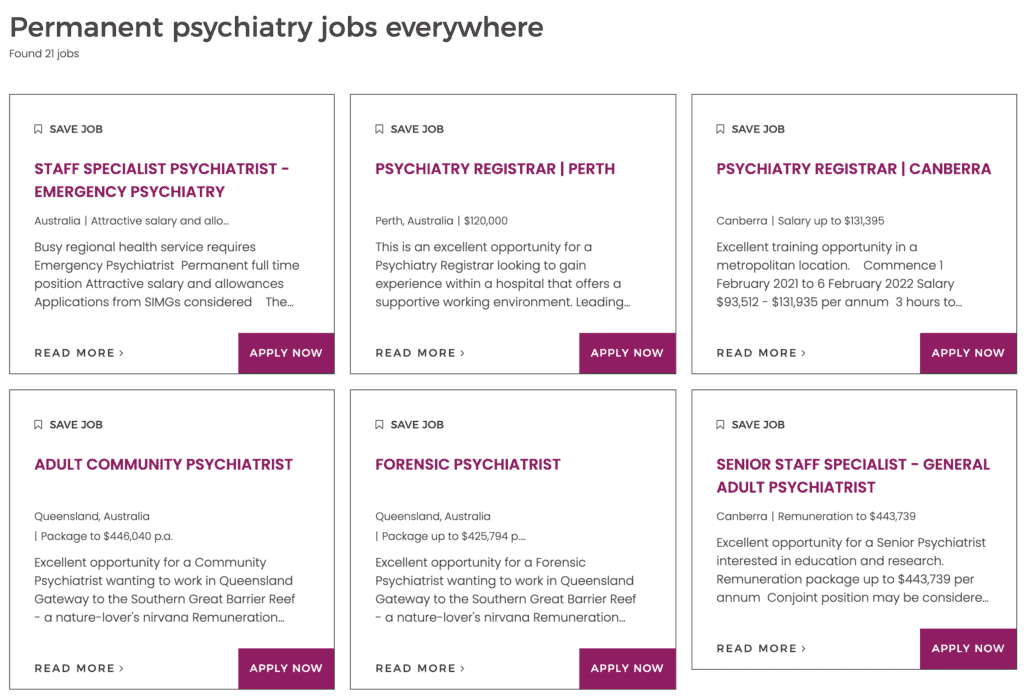
    In fact you don’t really even need to look at rural areas of Australia. As you can see by this recent shot from one medical recruitment company website.

    psychiatrists australia
    courtesy of Elective Recruitment

    As you can see from above there are both consultant (Staff Specialist) roles available as well as trainee roles (Registrar) in major capital cities such as Perth and Canberra and regional coastal areas.

    What can you earn working in Psychiatry in Australia?

    The above image also gives you an indication of the salary packages, which for Consultant Psychiatrists range from $300K to the high $400K.

    Sometimes specific additional incentives are applicable for psychiatrists and I was recently successful in obtaining a package of almost $500K for a particular psychiatrist. This is one of the reasons why being open to working in regional areas may make sense as your package may be better and generally your standard of living (particularly housing costs) will be much lower.

    On top of the package for IMG Psychiatrists, employers are often also prepared to help with moving costs and may also pay for the cost of applying to the RANZCP from your professional development fund.

    Whilst the pay packets for trainee psychiatry doctors are obviously not nearly as large as for consultants, you may still earn a bit more than the annual salary through performing overtime shifts (which are generally paid at 2x the hourly rate) and it is not unheard of employers also offering to cover some moving costs for trainee doctors as well.

    What qualifications do you need to work in a Psychiatry job in Australia?

    Your qualifications will be assessed by the RANZCP. In general, you will need some form of postgraduate qualification that is preferably at least 4 years duration.

    For the UK/Ireland – MRCPsych combined with the CCT in the UK or CSCST for Ireland.

    For Canada, you will require a Certificate in Psychiatry from the Royal College of Physicians and Surgeons of Canada.

    For the USA, you will require a Certificate of the American Board of Psychiatry and Neurology.

    For India, you will need a minimum of an MD or equivalent in Psychiatry, preferably you will do more than 3 years training. The addition of the Diplomate of the National Board is generally seen as a good addition.

    For Sri Lanka, you will need a minimum of MD in Psychiatry recognised through the Postgraduate Institute of Medicine and be board certified as a psychiatrist via the Sri Lankan Medical Council.

    What is the process for obtaining specialist recognition as a Psychiatrist in Australia?

    The process is the same as for other specialist IMGs. Your educational qualifications and training as well as your specialist practice will be assessed by the RANZCP for comparability.

    If you are deemed to be within 12 months of becoming a psychiatrist, you will be offered substantial comparability, which is the best outcome as this generally requires you to work as a specialist under peer review by current Fellows of the RANZCP for 12 months.

    If you are deemed to be within 24 months of becoming a psychiatrist, you will be offered partial comparability. This is the next best outcome and generally requires you to work in an appropriate Advanced Trainee position, as well as under peer review by current RANZCP Fellows. It will also require you to undertake a range of assessments and activities as well as sit for written and clinical examinations.

    If you are not deemed to be able to become a psychiatrist within 24 months you will be found not comparable. This means that you need to consider alternative pathways for registration and working in Australia.

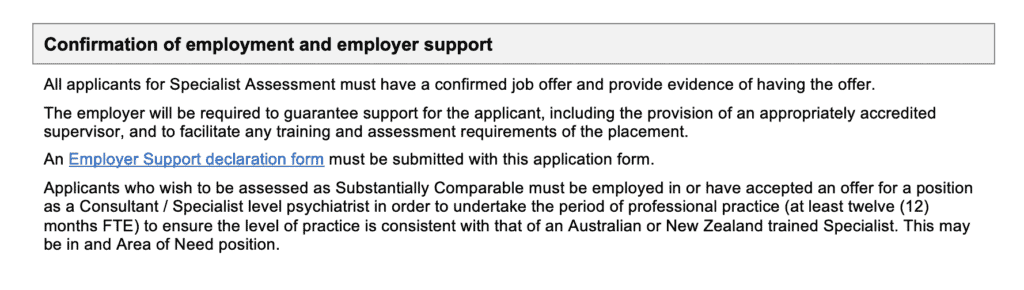
    RANZCP assessment requires a job offer
    from RANZCP SIMG Assessment Form

    One key difference from the process of specialist assessment for other colleges is that the RANZCP requires you to have an offer of an appropriate position first before considering your specialist pathway application.

    Whilst this may seem initially restrictive it is probably better. Because it reduces the number of specialist IMGs who are deemed comparable but are unable to gain an appropriate job offer. It also means that you are more likely to be supported by your employer to go through the RANZCP assessment process.

    Whilst it is not absolutely guaranteed. Being interviewed successfully for a position as a psychiatrist in Australia will generally mean that the RANZCP will also find you comparable.

    What types of comparability outcomes are likely for international psychiatrists in Australia?

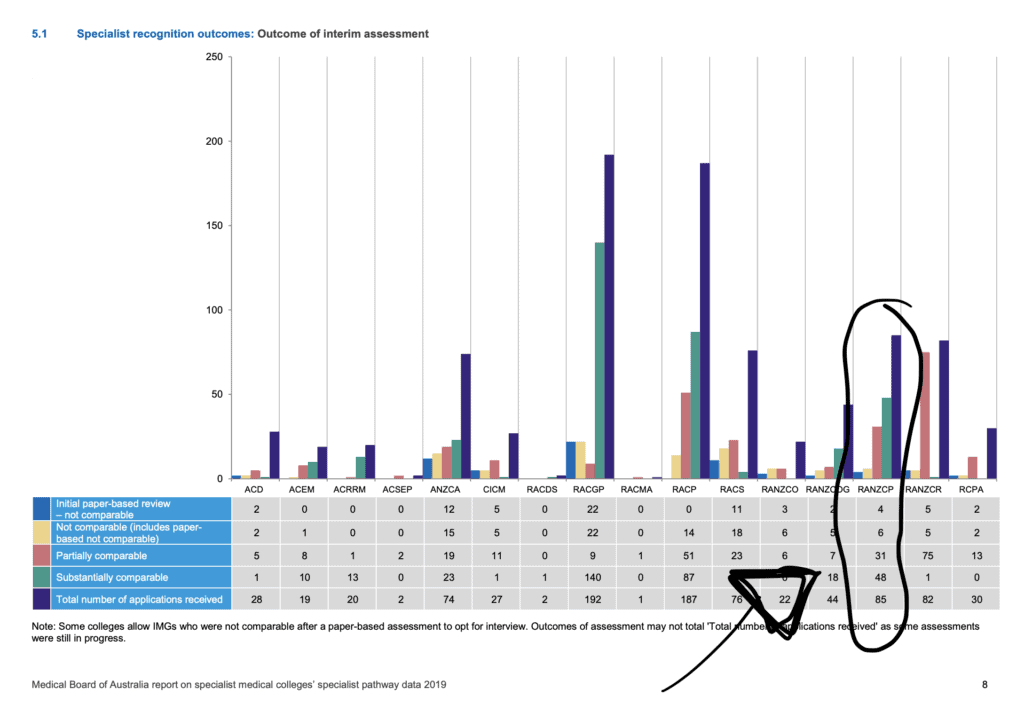
    As can be seen in the images below taken from the most recent Medical Board of Australia report the majority of specialist IMG applications to the RANZCP are deemed substantially comparable with a significant number deemed partially comparable and only a small number seen as not comparable.

    psychiatrists australia
    Outcome of interim assessment 2019 by college.

    Does your country of training have any impact on your prospects for psychiatry jobs in Australia?

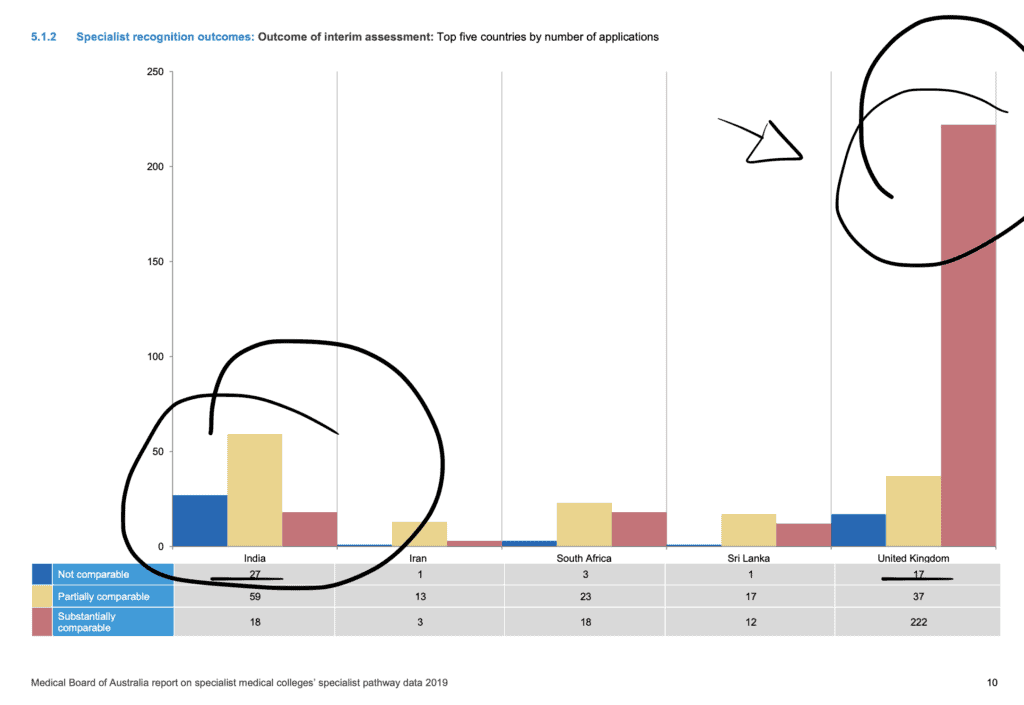
    Whilst we don’t have figures by country of IMG versus the RANZCP assessment process it’s my experience that specialist psychiatrists from the competent authority countries are generally found to be substantially comparable. Specialist psychiatrists from other countries are more likely to be found substantially comparable, however, it depends on your individual circumstances and it is not uncommon for specialist psychiatrists from India, Sri Lanka, and South Africa to be found substantially comparable at times.

    Empirical evidence for this exists when you look at the overall comparison between specialists from India and the UK in the same report.

    specialist recognition outcomes
    Outcome of Interim Assessment 2019 by country.

    What do you need to demonstrate if you want to work as a Psychiatry Trainee in Australia?

    In order to convince an employer that you are suitable to work in a trainee psychiatry role you generally need some prior psychiatry trainee experience in your own country.

    Because the process of becoming registered under the competent authority pathway is more streamlined and because the training programs in the competent authority countries are similar to that in Australia, trainee doctors with psychiatry experience in the UK, Ireland, Canada, or the US tend to be preferred by Australian employers when it comes to filling vacant trainee positions that have not been able to be filled by local graduates.

    Whilst it is not impossible for trainee psychiatry doctors from other countries to also obtain posts it is more difficult as the process of gaining registration is more complex. If you have significant experience as a trainee psychiatrist, you may be able to obtain a position for a maximum of 2 years under the short-term specialist medical training pathway.

    Is there recognition of prior learning for IMG trainees?

    Colleges have become better at assessing trainee doctors from other countries for recognition of prior learning (RPL). In fact, I recently assisted a trainee doctor from the UK to obtain 2 years and 7 months from their 5-year RANZCP psychiatry training program.

    That being said RPL generally reduces the amount of experience you may have to undertake and doesn’t normally excuse you from the key RANZCP examinations. The end effect may be to compact the number of assessment requirements you need to complete in the remaining time.

    Take Our Survey and See If you Qualify for a Free Call

    [fluentform id=”9″]

    Some Tips For Securing A Psychiatry Post In Australia.

    Thus far it probably sounds like being able to work as a psychiatrist in Australia is a bit of a laydown misere. And whilst it is true that psychiatry is one of the top medical specialties that employers are regularly trying to fill in Australia. It is not just a matter of sending off a quick email with a CV that hasn’t been updated in a few years. There is still a bit of work ahead of you.

    Here are my recommendations for what you should do if you are keen on working in psychiatry in Australia.

    1. First off, ensure that you have an up to date and employer-friendly resume. This should be around 3 to 6 pages depending on your experience. And you should make sure wherever possible you tailor it to individual job openings. If you are needing tips on your resume (CV) we have several posts about this matter on the blog, as well as a service for helping you redo your resume if you would like some assistance with this key document.
    2. Second, if you are going to apply for a specialist role it’s worth reviewing the documentation on the RANZCP website to see if you will be eligible. And we also have a handy free short course on the specialist pathway that you can take as well.
    3. Third, whilst it is sometimes possible to score a post in a major Australian city like Sydney or Melbourne. If you are too prescriptive about where you want to work you are very likely to severely limit your chances and miss out. Bear in mind that once you complete your first year or two under supervision you will normally then be eligible for either specialist registration or general registration. At this point, you can often move jobs and locations more easily. So the key message here is to be open to all possibilities for your first position. You may even like working in regional Western Australia or the North West Coast of Tasmania!
    4. Fourthly. And following on from the above point. Whilst it is possible to directly approach employers for posts in psychiatry. This is only really about 50% of the job market. It is often unclear which publicly advertised positions are open to IMG doctors and employers are also often directly working with medical recruitment companies to fill vacant spots. For this reason, I generally recommend that you do contact a medical recruitment company if you believe you are eligible for a specialist position as an IMG or a trainee psychiatry doctor from one of the competent authority countries. If you fill in the survey below we can put you in contact with our recommended medical recruitment company.
    5. Fifth and finally. If an employer is interested in you they will invite you for an interview. This may be the first time you have sat a job interview in sometime and will almost certainly be the first job interview you have sat in Australia. You may be a little nervous and it will be important to give an impression. You may therefore want to consider getting some assistance by way of some interview coaching beforehand.

    Related Questions

    Can overseas doctors work as a psychiatrist in Australia?

    Yes. There are lots of opportunities and vacant positions for suitably qualified psychiatrists from other countries (IMGs) to work in psychiatry jobs in Australia. There are also numerous openings for appropriately experienced psychiatry trainees.

    Do psychiatrists make good money?

    Yes. consultant psychiatrists will generally earn at least $350000AUD if they work full time. And psychiatrists are 5th on the list of top salary earners in Australia.

    What qualifications do you need to become a psychiatrist in Australia?

    To become a psychiatrist you need to:
    1. complete a medical degree.
    2. do on-the-job training in a hospital for at least 12 months (internship).
    3.enrol and complete training in the medical specialty of psychiatry with RANZCP.
    Qualified psychiatrists from other countries apply to the RANZCP for assessment of their specialist recognition under the specialist pathway for medical registration.

    How much does a consultant psychiatrist earn in Australia?

    As we have highlighted in this article for a permanent full time public health service position you can be expecting to earn around $350,000AUD to $450,000AUD per annum.
    Psychiatrists also do relatively well in the private sector and you can potentially earn far more than in the public sector and up to $800,000AUD. As we have highlighted in this related blog post, psychiatrists are 5th on the list of top ten professions by earnings according to the Australian Tax Office.

    How long does it take to become a psychiatrist in Australia?

    To become a psychiatrist you: study medicine and complete a medical degree (4-6 years) do on the job training in a hospital after your degree (1 year) enrol and complete specialist training in psychiatry (5 years) with RANZCP. So all up its at least 10 years, generally longer.

    What field of psychiatry makes the most money?

    As is generally the case with other medical specialties, consultant psychiatrists will make significantly more money than other health professionals working in the mental health field, e.g. psychiatry trainees, psychologists, social workers and nurses.
    It’s hard to say which actual field of psychiatry makes the most money. There are certain subspecialties in psychiatry that are more limited to working in public hospital settings, for e.g. consultation-liaison psychiatry, so these consultants will earn a bit less than someone working in the private sector. Subspecialties that lend themselves best to private sector work, and which will therefore, have higher earning potentials, including forensic psychiatry and adult psychiatry.
  • Getting Registered In Australia. The Four Options for International Doctors.

    Getting Registered In Australia. The Four Options for International Doctors.

    *The process of getting a job and getting registered as a doctor in Australia is complex, it’s important to understand that you do need to get individual advice on your circumstance. Circumstances do vary for individuals and also things change over time.

    If you are an ad doctor looking for some general information about your options for getting registered in Australia, then this post is for you. I spend a lot of time on Zoom calls these days explaining to doctors from overseas countries (International Medical Graduates or IMGs) what their options are for working as a doctor in Australia. It’s quite a complex process. And inevitably at some point, it makes sense to talk one on one. Particularly if you are starting to get serious about the idea of working as a doctor in Australia. If that’s you I’d recommend booking a strategy call.

    With that being said. Let’s look at the four pathways available for IMG doctors to become registered in Australia from overseas. And let me be quite clear here. These are not the main pathways. They are the only pathways available for getting registered in Australia, at the time of writing this post. If you are a doctor coming from overseas to Australia your pathways to registration are:

    • The Standard Pathway, which is a general registration pathway for doctors from any country who do not have specialist qualifications and are looking to start at junior doctor level in Australia.
    • The Competent Authority Pathway, which is a restricted pathway that enables both specialist and non-specialist doctors from the United Kingdom, United States of America, Republic of Ireland and Canada to commence their work in Australia.
    • The Specialist Pathway, which is a pathway that can ultimately lead to recognition as a specialist in Australia and requires you to be initially assessed by the relevant medical specialty college.
    • The Short Term Training in a Medical Specialty Pathway, which allows for time-limited registration, so that advanced trainees and specialists from other countries can obtain some top-up training in Australia.

    It All Comes Down To the Medical Board of Australia.

    So the first thing to know about getting registered in Australia is that it’s the same final authority wherever you work in the country. No matter what state or territory you are in, it’s all conducted through what’s called the Medical Board of Australia under the overarching umbrella of the Australian Health Practitioners Regulation Agency.

    This is actually a reasonably new thing in Australia. Prior to 2010, the various state and territory medical boards were responsible for registration, which actually made the process even more complex.

    Under the Medical Board of Australia, there are essentially four pathways to becoming registered as a doctor in the country. And if you’re an IMG, you can find some very helpful information about these pathways on the board website.

    There are even handy flow charts that can help you make some decisions about which option might be best for you.

    But It All Starts with the Australian Medical Council.

    Whilst the endpoint for registration for IMGs is the Medical Board the starting point is always the Australian Medical Council. For some IMGs (those attempting the Standard Pathway) you will have a lot to do with the AMC. But for the rest it’s really a very quick but mandatory step where you have to get your medical degrees verified.

    Why Have Pathways to Registration?

    Pathways to registration in this country for international medical graduates are essentially comparisons against the process by which Australian and also New Zealand medical graduates are given registration.

    Australian graduates first become registered in the system upon graduating from medical school as interns and progress through what is called provisional registration to general registration. After this most Australian doctors hope to eventually add what is called specialist registration to their registration status at some point.

    The four pathways to getting registered in Australia are therefore pathways that lead to a form of initial or provisional registration. But which ultimately lead to the IMG being able to gain either general or specialist registration. This is with one notable exception. The Short Term Specialist Training Pathway, which is a time-limited pathway that does not lead to either general or specialist training.

    The Competent Authority Pathway.

    The competent authority (CA) pathway essentially recognises that doctors that come from other healthcare systems, with similar systems, and processes, and standards to the Australian context, have a level of equivalence.

    The competent authority pathway is for both non-specialists as well as specialist doctors. It is a streamlined process for becoming granted registration in Australia. The board has approved a number of international authorities as competent in their assessment of doctors for medical registration. The reason that these authorities are deemed competent (and others are not) is unclear but historically well before the advent of the Medical Board of Australia, these jurisdictions were given preferred status by the old State and Territory Medical Boards. Arguably these countries do have medical training systems that are equivalent to Australia.

    The authorities are:

    • the General Medical Council in the UK for local UK graduates as well as international graduates who go through the PLAB pathway.
    • the Medical Council of Canada.
    • the Educational Commission for Foreign Medical Graduates of the United States and the United States Medical Licensing Exam (essentially, anyone who has the USMLE certificate).
    • the Medical Council of Ireland.
    • And the Medical Council of New Zealand*

    *The Medical Council of New Zealand is only listed here for IMG doctors who go through what’s called the NZREX process. Something akin to the AMC Standard Pathway process in Australia. Actual medical graduates of medical schools in New Zealand are considered absolutely equivalent to Australian graduates of Australian medical schools because these schools are actually also accredited by the Australian Medical Council.

    So if you have primary qualifications in medicine awarded by a training institute, which is recognised in the competent authority jurisdictions and also recognised by the Australian Medical Council you will normally be permitted to apply to work as a doctor in Australia under this pathway.

    This is on the proviso that you have completed some clinical training or assessment within that authority. This differs from jurisdiction to jurisdiction but is either a year of training or two. So, for example, in the UK, that would be the first foundation years. Whereas in the US it would mean completing 2 residency years in an ACGME accredited post.

    Why Is The Competent Authority Pathway Attractive?

    If you are eligible for the Competent Authority Pathway in Australia this is generally a good thing as it is considered to be the easiest pathway to getting registered and being able to start working here.

    Often times employers will also prefer say a UK-trained doctor over a doctor from Sri Lanka when there is a need to employ an IMGs.

    If you are eligible for the Competent Authority pathway essentially all you need to do is convince an employer to offer you a suitable position and have the intended supervision for this position assessed by the Medical Board of Australia.

    Once you are approved for registration you work for 12 months under provisional registration and will need to complete satisfactory supervisor reports. If all goes well at the end of this process you are able to apply for general registration. There’s no need for examinations or other forms of assessment (other than supervisor reports).

    (It should be noted that sometimes doctors from CA countries who are applying for specialist registration also work for 12 months under this pathway. In this situation you do not gain general registration at the end of the process you gain specialist registration in your particular specialty.)

    The Standard Pathway.

    The next pathway is the most common pathway that the majority of IMGs attempt in order to work as doctors in Australia.

    The standard pathway applies to IMGs who are not eligible for the competent authority pathway and who do not have specialist qualifications. To come in through this category, you need to have a recognised primary qualification in medicine. But before you can apply to the Medical Board of Australia for registration or approach employers for jobs, you have to go through some additional steps with the Australian Medical Council.

    These steps include the mandatory check of your degree, which all IMGs have to do. But also include sitting for the AMC Certificate examinations, which is a 2 part examination, consisting of a Part 1 MCQ Exam, and then a Part 2 Clinical Examination.

    You can actually begin to apply for jobs once you have successfully passed the AMC Part 1. But you will only be able to gain general registration once you have completed the full certificate.

    We have a guide to the AMC exam here. The AMC Exam, particularly the clinical exam, is generally considered to be a very tough and difficult examination to complete. Despite this, there are quite a few IMG doctors who have obtained their certificate but have been unable to find employment as a doctor in Australia.

    The Specialist Pathway.

    The final main pathway for most IMGs is the specialist pathway. This pathway is for overseas trained specialists so that they can apply to be assessed against the capability of a similar Australian-trained specialist. A process that is called “comparability”.

    This process includes IMGs applying for what is called Area of Need positions, which are extremely rare to find these days. As well as specialist IMGs just going for assessment with the college.

    As with all other pathways, you need to have a recognised primary degree first. But then just to create more confusion IMGs applying for the specialist pathway don’t apply to the AMC or the Medical Board for assessment they apply to the relevant specialist college. Which then performs an assessment.

    So if, for example, you’re a specialist from a competent authority country, it can be very confusing because you can apply to the Medical Board of Australia for provisional registration under the competent authority pathway to work in a supervised position.

    But at the same time, you need to also apply it to the college to assess your specialty training and experience and qualifications in order to get registered as a specialist and come through the specialist pathway.

    Applying for the Specialist Pathway assessment involves quite a bit of time and money. In general, you will need to fill out an extensive application outlining all of your past experiences to date. The more complete and detailed you make this generally the better the outcome. The college may just reject you based on your application. But generally, in the case of most colleges you are then invited to an interview to further explore your credentials.

    There are only 3 outcomes for this assessment process:

    1. You are deemed not comparable.
    2. You are deemed partially comparable.
    3. You are deemed substantially comparable.

    Being deemed not comparable means you need to think about other pathways.

    Being deemed partially comparable or substantially comparable means that the college views you as either being within 2 years (partially comparable) or 1 year (substantially comparable) of becoming a specialist in Australia.

    If you achieve comparability you will still need to secure an appropriate post where you can receive oversight by other specialists in your field. In the case of partially comparable, it is also likely that you will need to sit further examinations.

    If you gain a post and complete all the requirements you will finally be recommended to the Medical Board for specialist registration.

    We will eventually have a more detailed post about the specialist pathway. But in the meantime the following 2 blog posts are useful:

    As well as our series of videos on the Specialist Pathway on YouTube.

    The Short Term Specialist Training Pathway. The Final Pathway.

    There is actually a fourth pathway option. This option is not as well known to IMGs as the other 3 options. And this is perhaps because it is not a pathway to permanent registration in Australia.

    The final pathway is called the Short Term Training in a Medical Specialty Pathway, or Short Term Specialist Training Pathway. This pathway is limited to IMG doctors who are either already specialists or in the advanced or final phase of their specialty training. Ostensibly the pathway is designed to facilitate additional “top-up” training or experience, i.e. it is designed to give a specialist from another country some additional training and experience to help when they return to their own country.

    The pathway is therefore strictly limited to 2 years and you generally have to complete a form indicating that you are intending to return to your own country at the end of this period of registration.

    To be eligible for this pathway you first need to secure a job offer (usually an Advanced Training post) from an employer. Like all other pathways, you need to verify your degree with the AMC. You also need to apply to the specialist college for assessment of your credentials against the post you have secured.

    Unlike the specialist pathway, the college assessment is only paper-based, requires less information, and generally easier to pass.

    Is Short Term Specialist Training A Pathway to Working Permanently in Australia?

    Even prior to the advent of the one Medical Board there were registration categories in existence that enabled trainee doctors from other countries to come to Australia and work for a limited period of time.

    It was not uncommon for these doctors to take the opportunity whilst working in Australia to pursue other forms of registration and the case is the same still with the Short Term Specialist Training Pathway.

    So, whilst the pathway itself is designed to be time-limited and there is a requirement to state your intention to return at the end of your registration period. There is really no way of enforcing this and there is nothing to say that you might change your mind halfway through the process.

    And I have certainly seen a number of IMG doctors use this particular pathway as a “stepping stone” to a more permanent registration category.

    Whilst, specialist colleges are not permitted to take into account any experience you have gathered under the Short Term Specialist Training Pathway, it is hard for them to ignore the fact that you have already worked successfully in the Australian context and also hard to ignore references from Australian College Fellows attesting to your capability.

    Similarly, if you have proven your work capability in an Australian health service then this tends to dramatically improve your prospects with employers in Australia for other jobs over and above most other things, including things like qualifications and observerships.

    Related Questions.

    I Have More Questions About the Standard Pathway and AMC Exams.

    We recommend you check out this extensive post that we wrote.

    Where Can I Find More Information About the Specialist Colleges?

    We have you covered in this post

    Do I Need to Pass an English Test?

    Unless you have high schooled and trained in English in a small number of countries that the Medical Board recognises it is likely that you will have to pass one of the English competency tests. This is a requirement prior to obtaining registration and may also be required prior to other assessments, such as specialty college assessments. We have a detailed guide about this issue here.

  • A Guide To Specialty Training For Doctors In Australia

    A Guide To Specialty Training For Doctors In Australia

    One of the most frequent questions I receive from doctors from overseas is “How do I get into residency training in Australia?”  Becoming a specialist doctor is generally a very rewarding pathway, which can afford a lot of independence and financial stability and is probably the ultimate aim of most doctors in Australia

    So I have put this post together as an overview of how this all works. In so doing I wanted to make a few key points:

    1. The process of becoming a specialist doctor in Australia is termed “specialty training” and in most cases is conducted via one of the 16 specialist medical colleges.

    2. Residency training, which is often what doctors from places such as North American and Asian countries refer to when they are talking about specialty training, does not exist as a concept in Australia. And in fact, being a “resident medical officer” means something quite different here.

    3. There are around 64 different medical specialties to choose from in Australia, and this includes general practice, which is recognised as a specialty in its own right.

    How and when do local graduates enter into specialty training?

    Medical school has been rapidly evolving in Australia of late with the majority of schools phasing out the old MB BS programs in favour of 4 or 5 year MDs. Some of these are graduate programs. So its not surprising to hear that for some the process of choosing and targeting a particular specialty begins early in medical school.

    However, unlike say the North American system you can’t simply apply for specialty training at the end of your medical school.

    Upon graduating there is a requirement for a minimum of one year supervised training which is referred to as an “internship”.  It is only after you satisfactorily complete your internship that you gain general registration. Doctors from the United Kingdom and the Republic of Ireland would be familiar with something similar.  The Australian medical training system has largely been adapted from the UK system.  

    The internship period is heavily supervised and there are a formal training and assessment processes, with oversight provided by bodies in each State and Territory called Prevocational Medical Councils.

    This prevocational period often extends for at least another year and we call it prevocational training.

    Resident Means Something Different in Australia.

    A Resident or Resident Medical Officer, or RMO in Australia is a doctor in their second year out of medical school, i.e. someone who has completed their internship. 

    Whilst it is technically possible to enter into some specialty training programs as a Resident (Psychiatry and General Practice being examples) generally most doctors wait until the end of their second year to enter into training. And in the case of some particularly competitive specialties, such as surgical specialties and anaesthesia, may wait several more years to get on to a training scheme.

    A doctor who is still a resident in their third year is generally referred to as a Senior Resident.

    For most senior resident doctors, there is no set standard or oversight for training. So the quality of support provided can vary quite considerably.  And it can often be left up to the individual to develop their own program. This situation has unfortunately led to some fairly famous recent cases of exploitation of doctors working what are termed “unaccredited posts”. These are posts that are not oversighted as an official training post by a college. Often referred also to as service roles.

    It’s for this reason that doctors in Australia are often relieved when they finally make it into a specialty.

    For International Medical Graduates coming via the standard pathway or in some cases also the competent authority pathway. Its a Resident post that you are looking to fill as your first job in Medicine in Australia, i.e. a pre-specialty training position.

    Key Requirements for Specialty Training.

    The requirements for entry into specialty training differ between colleges and this post is not intended to address each one specifically.  But let’s look at some of the general requirements.

    You Must Have General Registration to Enter Specialty Training.

    One thing that every doctor must have to enter into specialty training in Australia is general registration.  So for local graduates, this means completing an internship first. For IMGs this means completing a provisional year, normally as a resident, either via the standard pathway or competent authority pathway, after which you will also be granted general registration.

    This is why I often tell IMG candidates that once you have completed your supervised year you are almost on an equal footing with local graduates.

    You Generally Need at Least 2 Year’s Experience.

    Most but not all colleges require you to have gained a minimum amount of clinical experience prior to applying. The most common requirement is for 2 years.

    Whether this is a valid requirement or not is somewhat questionable. As noted some colleges now allow doctors to apply after completing an internship.

    A key driver for maintaining a second-year residency in Australia is the need for doctors to fill service level roles.  But to be fair many doctors themselves also value having 2 years to consolidate after medical school.

    Having Permanent Residency Or Citizenship Can Also Be A Requirement.

    In some cases, for example, the Royal Australasian College of Surgeons, you will also need to prove that you are a Citizen or permanent resident. So this can be a discriminator against IMG doctors.

    I am often asked why there is this discrimination in place. To be fair to the colleges they are really only applying the Australian law which essentially dictates that jobs must be provided to citizens and residents first before being offered to someone on a visa. Many other countries have similar arrangements for their own citizens.

    The Application Process Itself.

    The application process itself is similar to a normal job recruitment process.  There are 2 main ways to get selected into specialty training in Australia.

    1. College Goes First.

    The first way is to get selected by the College first. This is the approach that most Colleges adopt. Examples, include RACS, RANZCO, RANZCOG and RANZCP.

    For trainee doctors, this selection process may be the most rigorous job interview that they ever encounter, with many colleges employing scoring criteria for both your CV, as well as referees and submitting candidates to psychometric testing and a multiple mini interview approach.

    There is often a fee of several thousand dollars to apply with no refund if you don’t make it!

    After the college has selected which candidates it prefers for training the employers (the hospitals) may invoke their own second selection process or just accept the finding of the college.

    2. Employer Goes First (Alone).

    If you are applying for Physician training or Radiology training then you will start off by interviewing for a training post which is held by a hospital or health services. This will generally be a more standard affair, with an online application, CV and referee checks and interviews. Normally its just a panel interview but there has been a trend lately to making some of these recruitments multiple mini interviews.

    There will generally be representatives of the respective college on the selection panel.

    Once you have gained a post you will apply to be recognised as a trainee by the relevant college. In the case of Physicians, you can even do this beforehand. The process is generally just an application and fee and rarely are doctors rejected.

    General Practice Selection.

    General Practice Selection is a whole beast to itself, with many pathways.

    The main pathway into GP training is conducted by the regional training providers, which are separate from the GP colleges. Selection is quite rigorous and also involves both psychometric testing as well as formal interviewing. Once selected, candidates then apply for one or both other College training programs for which they have already been deemed eligible bypassing the training selection process.

    What Specialties Can You Apply For?

    If we take the latest view from the Medical Board of Australia there are 64 recognised specialties for medicine in Australia.  And below that many hospitals and employers will recognise even more subspecialties.

    That seems a lot of choices. But actually the initial choice is made a little bit easier by virtue of the fact that many specialties break their training up into Basic and Advanced Training.  Basic Training is usually around 2 or 3 years and more generalised. Once you complete Basic Training you can specialise further in Advanced Training. Which usually requires you to undertake an additional selection step.

    Let’s look at some of the more popular specialty choices in Australia.

    For General Practice. As indicated there are a number of pathways but the main pathway is the Australian General Practice Training Program under which you train for a Fellowship with either the Royal Australian College of General Practitioners or Australian College of Rural Remote Medicine.

    For both Adult Medicine and Paediatrics you commence Basic Training with the Royal Australasian College of Physicians. After which you can choose to stay general in your Advanced Training or do one of many different specialties. The RACP also looks after some other smaller training programs, including Occupational Health and Rehabilitation Medicine.

    For Radiology, you apply to the Royal Australian and New Zealand College of Radiology. This is a relatively straight forward specialty. There are really only two options. Diagnostic Radiology and Radiotherapy.

    For Psychiatry, you apply to the Royal Australian and New Zealand College of Psychiatrists.

    For Emergency Medicine, it’s the Australasian College for Emergency Medicine.

    Surgery is a little different. Because its such a competitive specialty trainees have generally completed a lot of experience and courses just to get in. So you apply directly for “SET” (Surgical Education Training) in either of General, Vascular, Orthopaedics, Ear Nose and Throat, Paediatrics, Cardiothoracic, Neurosurgery, Urology or Plastic Surgery.

    We have a more detailed post about the Specialty Colleges here.

    Other Related Questions.

    How Long Does Specialty Training Run For?

    Answer. Most training programs are around 5 or 6 years minimum. Although General Practice can be as little as 3 years.

    Do You Get Paid When Training?

    Answer. It’s surprising how often this question is asked. And I guess it must be because in many countries you have to pay for a specialty training post or residency position.  If you are employed as a doctor in Australia you are paid. This includes training roles. The salaries are pretty good although the work can be quite long in some cases. We have a salary guide here.

    How Do You Enter Training Via the Competent Authority Pathway?

    Answer. First of all. Like any other IMG you will need to get your credentials reviewed by the Australian Medical Council and then gain an appropriate job offer which permits you to have provisional registration with the Medical Board of Australia.

    What post you are able to fill will largely depend on your current level of experience and training. If you have just finished Foundation Year in the UK then you will probably only be able to apply for Resident level jobs.

    But let’s say you have almost finished your Residency in Anaesthetics in the US. Then you will probably be permitted to fill an unaccredited Anaesthetic Registrar post. But not something that you are not experienced in, such as a Psychiatry post.
    Once you have completed your 12 months supervision successfully you can apply for general registration, after which you can apply to enter training in Australia. You may be eligible for some recognition of prior learning.

    How Do You Enter Training Via the Standard Pathway?

    You must register with the Australian Medical Council and complete your AMC Certificate (Part 1 and 2). As well as obtain a post that allows you to work towards general registration. Its at this point that you can start applying for training posts.

    Is There Some Recognition For Prior Learning?

    Answer. In the past, it has been difficult to obtain much in the way of Recognition of Prior Learning from colleges but recently I was successful in helping one trainee doctor get almost 3 years credit for Psychiatry!  Generally, you might expect to get one or two years off your basic training. Depending on how much training you have already done and how similar it is to training in Australia. Candidates from competent authority countries tend to do better with this process.

    How Are Specialists From Overseas Treated?

    Specialists from other countries can apply directly to the relevant college for an assessment of their capability to work as a specialist in Australia. This is known as the specialist pathway.
  • 3 Common Mistakes to Avoid When Applying for the Specialist Pathway Australia

    3 Common Mistakes to Avoid When Applying for the Specialist Pathway Australia

    In this post, I want to go over a few of the common mistakes that I see specialists from other countries make when going through the process of applying to work via the specialist pathway in Australia. If you are reading this post. You are probably a specialist doctor in another country who is thinking about applying to work in Australia. Thanks for putting your trust in our blog. I have helped several doctors just like you to make this career move in the past.

    I’d like to highlight that I now have a short course on the specialist pathway on my website that you can take for free that will help you to better assess your readiness to embark on this journey. There is a handy checklist in this course that will help you to make sure that this is the right option for your and if so that you are on track with your application and you don’t overlook a key element (such as the ones we have talked about already).

    And a reminder that there may be other ways that I can help you out, including my RISK-FREE Strategy Call which is a great option if you just have a few questions or are struggling to know how to get started with the process.

    In this post, I want to go over the 3 key mistakes that I see the majority of Specialist IMGs ignore to their detriment when attempting to work via the specialist pathway in Australia. These are mistakes that I see time after time. And the sad thing is that it is only often that someone comes to me late in the process to seek help on one of these problems. When, if they had come to me earlier or known about these issues, they could have saved themselves a lot of time, pain and heartache.

    Specialist Pathway Mistake Number 1.  English Language Proficiency.

    So the first mistake often made with the specialist pathway is a pretty simple one. It’s not having the right English language proficiency. I’ve blogged and vlogged on this matter before. So I won’t give a detailed overview about English language proficiency in this post.

    But suffice to say. An Australian specialty college is not going to assess you if you are required to prove your English Language proficiency.

    Now if you are from a country where English is the main language, like the UK or Canada or the United States you are probably okay (BUT YOU SHOULD ALWAYS CHECK).

    But if you are from most other countries such as India, for example, you will need to sit one of the four approved tests and achieve the required score.

    It is vital that you do your very best on these tests by the way. As the level at which you score will affect whether employers are interested in interviewing you.  With for example a candidate with an IELTS score of 8/9 being much more likely in my experience to score an interview than a candidate with the par score of 7/9.  (All other things being equal).

    If you haven’t sat your test and you apply to a college. Your application will be rejected until such time as you complete the proficiency test.

    So this is a delay you can avoid. 

    I generally recommend preparing and sitting for your proficiency test whilst you pull together all the information required for your application.

    Specialist Pathway Mistake Number 2. Not Reviewing Your Specialist Pathway Application Against the College Curricula.

    In my experience, most Specialist IMGs (SIMGs) are able to navigate to the relevant college website and read through the relevant pages for IMGs, including finding the application guide and forms.

    However, there are two things that most SIMGs do not look at on these websites, which are crucial to a successful application for the specialist pathway.

    The first of these are the college’s relevant training curriculum

    You see it is vitally important that you are able to demonstrate both in your application as well as your interview that your training and experience is as close as possible to what is expected of a specialist in Australia.

    The best guide to this is what and how the college determines its own locally trainees should do.

    As an example of this if you were applying to the Royal Australasian College of Physician as a General Physician you would be best advised to review your application against:

    the RACP Advanced Training Curriculum for General Medicine & Acute Care

    This document goes over in explicit detail what experiences and learning outcomes local physicians are meant to go through and how these are assessed.

    This is by far the easiest way to work out how your training in your country stacks up against a specialist here and how to explain this training.

    Most of these documents are publicly available. You just need to know where to find them. (See below). And they are normally very detailed. Often going for about 30 or 40 pages in length.

    These documents can give you some hints about extra things you could do now to increase your chances for the specialist pathway.  For example, perhaps there is a certain skill or procedure an Australia trainee is required to demonstrate. Maybe you can do a course on this skill or procedure or take a short post in a service in your own country that performs this skill or procedure?

    Specialist Pathway Mistake Number 3. Not Reviewing Your Specialist Pathway Application Against the College Professional Frameworks.

    The 3rd and last mistake when applying for the specialist pathway is similar to the previous one.  That is not taking the time to find out about the Professional Framework for college Fellows in Australia.

    Again. Most of these frameworks are easily found on college websites.

    They give a guide to the types of behaviour and skills a consultant is expected to demonstrate and have and maintain in Australia.

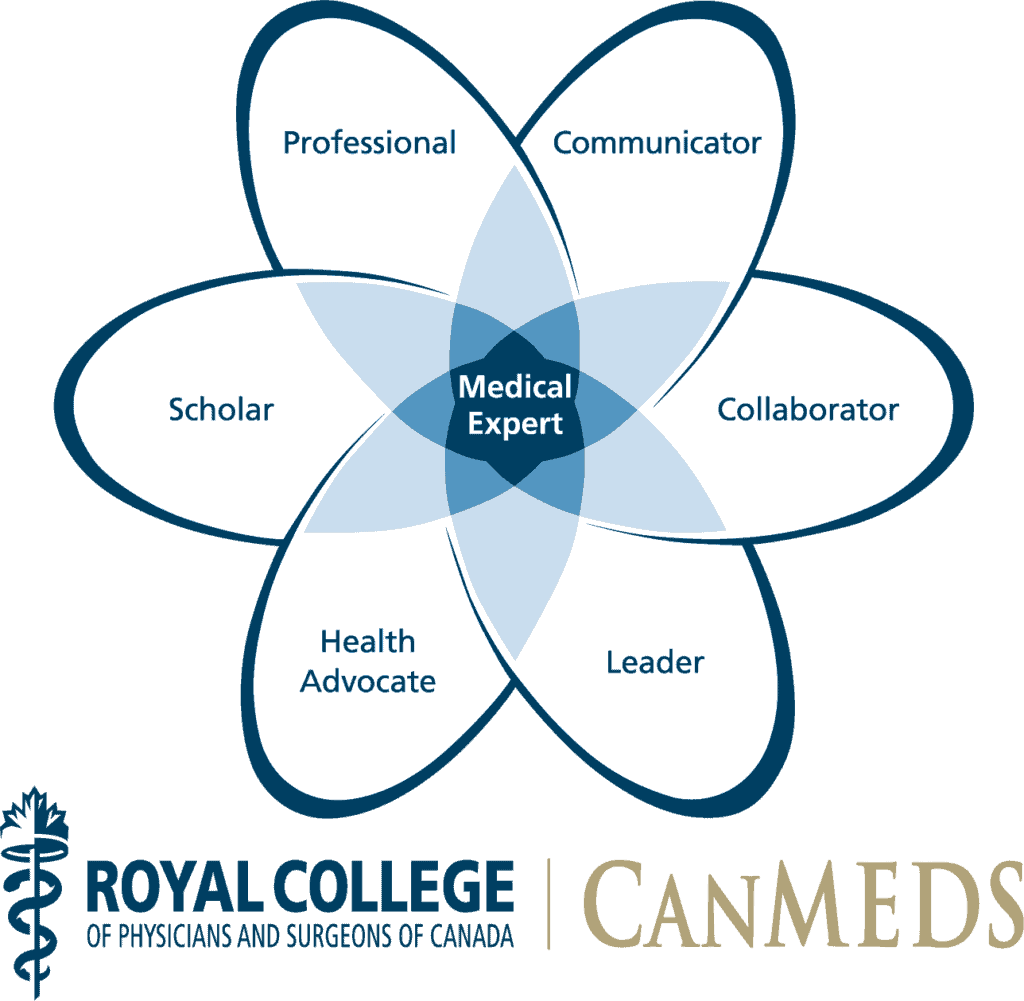
    Most of these are based upon the famous CanMEDS framework.

    CanMEDS Framework AdvanceMed
    used with permission of RCPSC

    If you are aware of these frameworks then you will be able to avoid a common error I see when reviewing applications for specialist assessment via the specialist pathway.

    This mistake is to poorly describe your consultant experience in a narrow and clinical way.

    Remember. The first thing that colleges tend to look at is the length and then the quality of your training.

    If this is in any doubt (which it can often be). They want to then see that you are working in a consultant role in your own country, similar to how a consultant might work in Australia.

    This not only involves demonstrating medical expertise at an independent level.

    But also other things from these competency frameworks, such as managerial roles and quality improvement roles and of course teaching and supervision roles.

    As a rule its important to document for every consultant job you have worked both:

    • The clinical responsibilities and achievements, including the level of autonomy you worked at (the colleges are generally looking to see that you were the most senior doctor responsible for your patients’ care)
    • As well as a broad range of other skills and achievements, such as teaching and training, performance managing other, being responsible for quality and safety, as well as research activities.

    So these are the 3 key mistakes to avoid when applying for the specialist pathway in Australia.

    Below for you is a handy overview of the colleges themselves.

    A short list of the 16 Australian Specialist Medical Colleges
    (we include the College of Dental Surgeons here):

    Read on further for more details about these colleges and what they do.

    Now that you know what a specialty medical college is.  Let’s talk more about some of the confusing points of colleges.  What types of colleges there are in Australia and importantly how to work out which college is the right college for you.

    The Status of the Specialty Medical Colleges in Australia.

     In Australia the specialty medical colleges remain very powerful.  With the possible exception of general practice (which is a specialty by the way) the specialist medical colleges generally have the oversight of and organize much of the specialty training that occurs in this country as well as continue to monitor the continuing professional development of their members (called Fellows).

    What are the Medical Specialty Colleges in Australia?

    Something that should be pointed out at this point is that most (but not all) of the specialty medical colleges in Australia are also the same college for the country of New Zealand.  This has the handy advantage for Fellows of these particular colleges being able to be recognized and work in either jurisdiction.  You will notice most colleges either refer to themselves and the “Australian and New Zealand College of”… or “Australasian College of”, for this reason.

    See below for a full list of the current Medical Specialty Colleges in Australia along with links to their websites.

    From each College home page there is usually an easily found link in the menu bar for prospective trainees, as well as international specialists looking for information about the specialist assessment process.  We also have the direct links to the specialist assessment page here.

    Our data sources for the table below come from the Colleges themselves as well as the latest available 2017 health workforce data, from the Federal Government. You can find the homepage for this data collection here.

    Royal Australasian College of Physicians

    Number of Fellows: 7661 Adult Medicine, 2258 Paediatrics*
    Main Post Nominals (FRACP).

    *Actual total slightly higher due to other programs offered, some of which are jointly run with other colleges.


    The RACP is one of the biggest Colleges. It also the most complex in terms of training programs. There are about 37 training programs. Fellowship of the RACP covers a range of aspects of specialty medical training, with a focus on Adult Medicine and Paediatrics.

    If you are struggling to work out where your field of medicine fits, chances are it fits within the Physicians College.
    In the two main groups of Adult Medicine and Paediatrics and Child Health there are many subspecialties including General Medicine and General Paediatrics as well as things like Cardiology, Infectious Diseases, Geriatrics and Neonatal Care.

    The RACP also covers 3 Chapter Training Programs in Addiction Medicine, Palliative Medicine as well as Sexual Health Medicine which you can enter after doing your Basic Training with the RACP or via training with another college.

    Finally the RACP also provides 3 Faculty Training Programs in Public Health Medicine, Occupational and Environmental Medicine and Rehabilitation Medicine. Again, you can either enter into these after Basic Physician Training or by completing other prerequisites.

    Fun Fact: The RACP even covers Dermatology for New Zealand!

    Link to Professional Framework

    Link to Advanced Training Handbooks

    Royal Australasian College of Surgeons

    Number of Fellows: 5041.
    Post Nominals (FRACS).

    Fellowship of the Royal Australasian College of Surgeons is one of the most highly sought after fellowships. Entry into any one of the 9 specialty training programs is highly competitive.

    Professional Framework

    The subspecialty areas are (with links to handbooks where available):

    • Cardiothoracic Surgery,
    • General Surgery,
    • Orthopaedic Surgery,
    • Otolaryngology,
    • Head & Neck Surgery,
    • Paediatric Surgery,
    • Plastic & Reconstructive Surgery,
    • Urology,
    • Vascular Surgery, and
    • Neurosurgery

    Royal Australasian College of General Practitioners

    Number of Fellows: 40000+.
    Post Nominals (FRACGP).

    The RACGP is by far and away the largest College in Australia. It is also one of the few colleges which does not have recognition in New Zealand.

    General Practice is recognized as a specialty in Australia. In other countries this specialty may be referred to as Family Medicine, a Family Physician or Primary Care

    Training to be a GP is conducted via a few different pathways. The largest one is the Australian General Practice Training Program, which is separate to the RACGP.

    So the RACGP is a little different to other colleges in that, whilst it still sets training program requirements and conducts examinations, selection into training programs and training itself is done externally to the college.

    The RACGP also provides an extension to its Fellowship where with a small amount of additional training you can be recognised as a rural GP (FARGP).

    Royal Australian and New Zealand College of Psychiatrists

    Number of Fellows: 3753.
    Post Nominals (FRANZCP).

    The RANZCP is one of the last true generalist specialist colleges in Australia. Its training program runs for 5 years and includes mandatory training in Adult Psychiatry, Consultation-Liaison Psychiatry (General Hospital Psychiatry), Child and Adolescent Psychiatry as well as a range of other types of experiences and assessments.


    Towards the end of training, trainees can elect to undertake Advanced Training in a certain area of Psychiatry, including Child and Adolescent, Consultation-Liaision, Adult Psychiatry, Old Age Psychiatry, Neuropsychiatry, Forensic Psychiatry and Psychotherapy, however all trainees emerge from the program considered competent to work in all fields of the specialty.


    It is expected that the position on generalism in Psychiatry will change in the not too distant future.

    Australian and New Zealand College of Anaesthetists

    Number of Fellows: 6400.
    Post Nominals (FANZCA).

    ANZCA ANZCA is responsible for the training, examination and specialist accreditation of anaesthetists and pain medicine specialists in Australia and New Zealand. In any given year there are about 1500 trainees undergoing training accredited by ANZCA in Australia and New Zealand. The College also has a number of trainees in Singapore, Malaysia and Hong Kong.

    Australian College for Emergency Medicine

    Number of Fellows: 2161.
    Post Nominals (FACEM).

    At 35 years ACEM is one of the newer colleges in Australia. It is also one of the first colleges in the world that represented the specialty of emergency medicine that emerged (pardon the pun) in the 1970s from hospital casualty department medicine.


    The Association of Casualty Supervisors of Victorian Hospitals (ACSVH) was the first body in Australia to focus on Emergency Medicine. Its formation followed a 1973 report on the Royal Melbourne Hospital’s Casualty Department and observations of similar facilities in Western Australia, the USA and the United Kingdom.

    Australian College for Rural and Remote Medicine

    Number of Fellows: 2161.
    Post Nominals (FACRRM).

    The Australian College of Rural and Remote Medicine is one of two colleges accredited by the Australian Medical Council (AMC) for setting professional medical standards for training, assessment, certification and continuing professional development in the specialty of general practice. It is the only College in Australia dedicated to rural and remote medicine, and is active in supporting junior doctors and medical students considering a career in rural medicine.

    ACRRM’s training approach is quite different from most other colleges and based partly around modularised learning. ACRRM Fellows receive full vocational recognition for Medicare General Practice Items and are not just restricted to working rurally, they can practise unsupervised anywhere in Australia.

    As a relatively new and small college ACRRM tends to be particularly welcoming to International Medical Graduates.

    Royal Australian and New Zealand College of Obstetricians and Gynaecologists

    Number of Fellows: 2013.
    Post Nominals (FRANZCOG).
    RANZCOG is the College that deals with the specialty of womens’ and maternal health.

    RANZCOG has recently recognised 5 subspecialty fields within its specialty area:
    Gynaecological oncology, Maternal–fetal medicine, Reproductive endocrinology and infertility Ultrasound, and Urogynaecology.

    Royal College of Pathologists Australia.

    Number of Fellows: 1275 + 603 jointly with RACP.
    Post Nominals (FRCPA).
    The RCPA represents Pathologists and Senior Scientists (working in medicine) in Australasia. Its mission is to train and support pathologists and to improve the use of pathology testing to achieve better healthcare.

    It is novel as a college in that it trains non-medical professionals as well.

    There is some degree of overlap in training and representation with the RACP. Particularly in relation to the areas of haematology and microbiology. Post fellowship diplomas are also available in anatomical pathology, chemical pathology, clinical pathology, forensic pathology, general pathology, immunopathology and genetic pathology.


    A Faculty of Clinical Forensic Medicine also exists within RCPA.

    Royal Australian and New Zealand College of Radiologists.

    Number of Fellows: 1945 (Clinical) + 345 (Radiation Oncology).
    Post Nominals (FRANZCR).

    RANZCR encompasses two Faculties, the Faculty of Clinical Radiology and the Faculty of Radiation Oncology.

    Many Radiologists carry out radiological investigative techniques and with the pace of medical technology some are now also delivering treatments.

    College of Intensive Care Medicine

    Number of Fellows: 1000+.
    Post Nominals (FCICM).

    The College of Intensive Care Medicine is the body responsible for intensive care medicine specialist training and education in Australia and New Zealand. The College offers a minimum six year training program, in both general and paediatric intensive care, with a number of assessments, culminating in Fellowship of the College of Intensive Care Medicine (FCICM). The College has over 1000 Fellows throughout the world.


    The College of Intensive Care Medicine was established in 2008 and formally took over the responsibility for training and certification of intensive care specialists from the Joint Faculty of Intensive Care Medicine (RACP & ANZCA) on 1st January 2010.

    Australasian College of Dermatology

    Number of Fellows: 550+.
    Post Nominals (FACD).

    The ACD is the peak medical college accredited by the Australian Medical Council for the training and professional development of medical practitioners in the specialty of dermatology.

    Royal Australasian and New Zealand College of Ophthalmologists

    Number of Fellows: 1155.
    Post Nominals (RANZCO).

    The Royal Australian and New Zealand College of Ophthalmologists (RANZCO) is the medical college responsible for the training and professional development of ophthalmologists in Australia and New Zealand.

    Royal Australasian College of Medical Administrators

    Number of Fellows: 282.
    Post Nominals (FRACMA).

    The Royal Australasian College of Medical Administrators (RACMA) is a specialist medical college that provides education, training, knowledge and advice in medical management. Recognised by the Australian and New Zealand Medical Councils, it delivers programs to medical managers and other medical practitioners who are training for or occupying Specialist Leadership or Administration positions.

    Whilst you generally do not require a Fellowship in Medical Administration to work in a leader role, RACMA is the only college based training program where you can become a Fellow in the Speciality of Medical Administration.

    RACMA also has significant options for recognition of prior learning.

    Australasian College of Sport and Exercise Physicians

    Number of Fellows: 156.
    Post Nominals (FACSEP).

    ACSEP is the professional body representing Sport and Exercise Physicians and Sport and Exercise Medicine in Australasia. Sport and Exercise Physicians are committed to excellence in the practice of medicine as it applies to all aspects of physical activity. Safe and effective sporting performance at all levels is a major focus.

    Alongside this is the increasing recognition of the importance of exercise in the prevention and treatment of common and often serious medical conditions, such as arthritis, heart disease, diabetes and many cancers.

    The goal of all Sport and Exercise Physicians should be to facilitate all members of the community to enjoy exercise safely to 100 years and beyond, knowing that physical activity provides them the ‘best buy’ to prevent chronic disease.

    Royal Australasian College of Dental Surgeons

    Number of Fellows: 282.
    Post Nominals (FRACDS(+/-OMS)).

    The RACDS has been existence now for 50 years providing a broad range of activities to enhance the professional development of both general and specialist dentists through individually mediated studies, examinations and continued professional development. It is responsible for the RACDS OMS Training Program.

    The OMS Training Program is designed to provide trainees with sufficient theoretical and practical background to meet all current standards available in Oral and Maxillofacial Surgery in Australia and New Zealand.

    Eligibility for this program includes the requirement to have both a medical and a dental degree and full registration in both specialties, as well as a year of general surgical experience. So becoming an OMFS surgeon is possibly the longest specialty training program in Australia!

    Related Questions.

    How To Work Out Which College Is For You If You Are A Specialist International Doctor?

    Answer. If you are from overseas it can sometimes be tough to work out how your particular specialty fits into the specialist pathway and the Australian system or in fact how your training may differ from what occurs in Australia.

    Here’s an example, in the United States Child and Adolescent Psychiatrists train primarily within the field of child and adolescent psychiatry and probably learn more paediatric medicine than any other form of psychiatry.  Whereas in Australia, you have to start out training in general psychiatry and only at the stage of Advanced Training do you undertake significant periods of study in Child and Adolescent Psychiatry.

    This can have significant issues for child psychiatrists as much of their training won’t stack up against the program in Australia.

    If you are considering working here as a specialist via the specialist pathway, here are a few tips to consider when working out which college fits you:

    1. There may be an obvious first starting point. For example if you field is within the surgical domain, you are likely (but not always) to be covered by the Royal Australasian College of Surgeons. Exceptions might include Ophthalmic Surgeons and Dental Surgeons.
    2.  If you have worked generally for many years and are considered a specialist in your country. But you do not have a certificate or have not undergone a formal specialty training program or course. You are unlikely to be granted specialist status in Australia.
    3. If you cannot work out where your particular specialty fits and its not surgically related it probably fits within the Royal Australasian College of Physicians and there many programs Or as an alternative it may be covered by General Practice.
    4. You can actually ask the colleges. They will answer some basic questions before charging you to look at your specialist application.  A question likes “this is my subspecialty, do you cover it here?” will be answered free of charge.
  • The PLAB vs AMC: A comprehensive comparison

    The PLAB vs AMC: A comprehensive comparison

    Nick and Kim are guest authors who run a blog in the UK called the SavvyIMG. We partnered with them on this post to help answer a question that often arises for IMGs considering either the UK or Australia as a pathway.

    Life is full of choices, and for the aspiring IMG, one of the first choices is where to work? This choice is often heavily influenced by the difficulty of the licensing exam. So in this article, we’re comparing the UK and Australian licensing exams, otherwise known as the PLAB and AMC respectively, to help you make a choice.

    Questions about how PLAB impacts on the AMC examination process in Australia are some of the most common questions we get here at AdvanceMed. So we invited our guest authors Drs Nick and Kimberly Tan to collaborate with us on this post.

    So what factors should an IMG consider when contemplating which exam to take? These are the ones that we think are important and we’ll explain each in more detail below:

    • Eligibility requirements
    • Exam format
    • Pass rates
    • Fees
    • Test locations and dates
    • Maximum number of attempts allowed
    • Preparation time
    • Level of difficulty
    • Job prospects

    So let’s dig deeper into each of these factors.

    Eligibility requirements

    Before you can think about booking one of these exams, you’ll first need to meet the eligibility requirements. The requirements for the 2 exams are listed below:

    PLABAMC
    Acceptable medical degree (Primary Medical Qualification or PMQ)Verification not required to book PLAB 1Proof of English Proficiency which can be one of the following:IELTS Academic – overall score of 7.5 with a minimum of 7.0 in each sectionOET Medicine – Grade B or score of 350 in all sectionsPMQ was taught in English (this one is quite complex, you can read more about it here)
    Internship is NOT a requirement to sit PLAB.
    ECFMG/EPIC verified medical degree (Primary Medical Qualification or PMQ)
    Proof of English proficiency is not required to sit the AMC, however it is required later on as part of your application for AMC registration.Internship is also not required to sit the AMC, however it is a requirement for provisional registration that you prove that you completed an internship in your own country. (This can be a particularly confusing point for more on this issue check out this post.
    PLAB vs AMC a quick comparison of eligibility requirements

    Source: General Medical Council (2020). How do you book or cancel a place [for PLAB 1]?  [Link] [Accessed 10 Mar. 2020]. Australian Medical Council (2020). AMC Portfolio [Link][Accessed 10 Mar. 2020]

    Exam format

    Both exams consist of 2 parts: a multiple choice test, and a practical exam. 

    PLABAMC
    Multiple choice testPLAB 1
    Paper-based written test with 180 questions over 3 hours
    AMC MCQ examination
    Computer-based test with 150 questions over 3.5 hours
    Practical examPLAB 2
    18 stations, each 8 minutes long
    AMC Clinical examination
    20 stations over 3 hours and 20 minutes
    PLAB vs AMC exam formats

    Pass rates

    In general, PLAB has quite good pass rates. More than two thirds of IMGs pass both exams.

    PLAB

    YearPLAB 1PLAB 2
    201463%65%
    201569%68%
    201672%73%
    201776%79%
    201869%66%
    PLAB pass rates

    Source: General Medical Council (2020). Recent pass rates for PLAB 1 and PLAB 2. [online] [Link] [Accessed 10 Mar. 2020].

    AMC

    The pass rates for AMC are lower than PLAB, especially for the clinical exam, so IMGs should be prepared for potentially multiple attempts. This will require a larger investment.

    YearAMC MCQAMC Clinical exam
    201556%30%
    201660%29%
    201758%28%
    201864%29%
    201963%27%
    AMC pass rates

    Source: Australian Medical Council (2020). Annual Reports. [Link] [Accessed 10 Mar. 2020].

    It is worth noting that there is an alternate option to the AMC Clinical exam called the workplace based assessment pathway. This pathway is only open to IMG doctors who are successfully employed at one of ten sites accredited by the AMC for this purpose in Australia. The rates of completion for this pathway are significantly better at around 99%.

    Fees

    The AMC is significantly more expensive than PLAB 1. Given the low pass rates and expensive fees, we would only recommend sitting for the AMC after very extensive preparation.

    PLABAMC
    Multiple choice testPLAB 1AUD 467 (£ 235) until 31 March 2020 AUD 474 (£ 239) from 1 April 202AMC MCQ examinationAUD 2,720(£ 1,366)
    Practical examPLAB 2AUD 1,708 (£ 860) until 31 March 2020AUD 1,738 (£ 875) from 1 April 2020AMC Clinical examinationAUD 3,530(£ 1,772)
    PLAB vs AMC a comparison of fees

    Source: General Medical Council (2020). Fees and funding [Link] Australian Medical Council (2020). Fees and charges [Link]  [Accessed 10 Mar. 2020].

    Test locations and dates

    The first parts of both PLAB and AMC are available worldwide, however PLAB 1 is only held a maximum of 4 times per year whilst the AMC MCQ is held on multiple dates every month.

    The practical exam of both PLAB and AMC are only available in their respective countries. There is currently no option to take PLAB 2 outside of the UK, or to take the AMC Clinical examination outside of Australia. 

    PLABAMC
    Multiple choice testPLAB 1
    Available 4 times per year worldwide.
    View the dates and locations here
    AMC MCQ examination
    Available on multiple dates every month worldwide.
    View the dates hereView the locations here
    Practical examPLAB 2
    Available on multiple dates every month in the UK only.
    Dates can only be viewed on your GMC online account once you have passed PLAB 1.
    AMC Clinical examination
    Available on multiple dates every month in Australia only.
    Dates are released monthly, view them here
    PLAB vs AMC a quick comparison of test locations and availability

    Correct as of March 10, 2020

    Maximum number of attempts

    There is a limit on the number of times you can attempt PLAB. You have a maximum of 5 attempts for both PLAB 1 and PLAB 2, however after the 4th attempt there are quite a few hurdles to overcome before you will be allowed your 5th and final attempt. You can read more about this here on the GMC website.

    If you fail your final 5th attempt at PLAB 1 or 2, you will no longer be able to gain GMC registration and cannot work as a doctor in the UK.

    There is no limit on the number of times you attempt any part of the AMC.

    PLABAMC
    Multiple choice testPLAB 1
    AMC MCQ examination
    Unlimited
    Practical examPLAB 2
    5
    AMC Clinical examination
    Unlimited
    PLAB vs AMC a comparison of number of maximum attempts permitted

    Level of difficulty

    PLAB is set at the level of a doctor who has graduated from medical school and completed one year of internship, however internship is not a requirement to sit the exam.

    AMC is set at the level of a doctor who has just graduated from an Australian medical school, however despite the supposedly lower level of difficulty, the AMC has a much lower pass rate compared to the PLAB.

    Preparation time

    Since both these exams represent a large investment for IMGs, with the AMC more so than PLAB, it would be wise to dedicate enough time for preparation.

    These are the times that are recommended when preparing for these exams. Keep in mind that the shorter times are suitable if you do not work while preparing for the exam, and the longer times are for if you work while preparing.

    PLABAMC
    Multiple choice testPLAB 1
    1.5 – 4 months
    AMC MCQ examination
    3 months to 1 year
    Practical examPLAB 2
    1.5 – 4 months
    AMC Clinical examination
    3 months to 1 year
    PLAB vs AMC a comparison of recommended preparation times

    Job prospects

    PLAB 

    Once you have gained registration with the medical authority in the UK, the General Medical Council (GMC), you will be able to apply for jobs that are suitable to your previous experience and qualifications. 

    As of October 2019, all medical jobs were included in the UK Shortage Occupation List. This means that IMGs will be given equal opportunity for training and non-training jobs, and UK graduates and UK/EU nationals will no longer be given first priority. 

    So provided you work well on your CV, job application and interview skills, the doors are pretty much open.

    This is an incredible opportunity for IMGs that we write about more in this article: 9 ways the new Shortage Occupation List affects IMGs dreaming of UK specialty training.

    AMC

    The process for obtaining work in Australia via the AMC Standards Pathway is a bit different. You must be offered employment first and you will then be able to gain a conditional form of registration with the Medical Board.  You are essentially required to work for 12 months to prove that you meet a certain level of safety and competency.  However, you can actually start this process after obtaining the AMC Part 1 examination and don’t need to wait for your Part 2.

    The situation for IMG doctors in Australia who pursue the AMC Standard Pathway process is less positive than for the UK.  Good data is not kept but there are likely to be thousands of doctors who have completed the AMC Part 1 still waiting for a job opportunity and hundreds who have completed both Parts 1 and 2, similarly vying for the limited number of posts that are advertised where IMG doctors can apply for provisional and conditional positions.

    Generally the employers will only advertise these positions when they have exhausted the candidate pool for doctors who already have general registration.

    This all may sound a bit gloomy. But its important to understand that hundreds of IMG doctors do still make it through this journey each year in Australia.  And once you do obtain general registration the picture improves significantly.

    Once you have completed your provisional year and completed both the AMC Part 1 and 2 you are permitted to obtain general registration. Your job prospects at this point are much better and you will likely be able to obtain a training position. However, this may not be in the particular area you are most interested in.  Like most other places positions in areas such as surgery and anaesthesia are highly competitive whereas it is generally easier to get into specialty training programs in areas such as emergency medicine, general practice and psychiatry.

    There is also the small chance that you may be overlooked in favour of another suitable candidate who has Australian citizenship or permanent residency. However, once you have worked for a while in Australia as a doctor you can usually apply for permanent residency yourself.

    Summary

    Exams make up just one part of the IMG journey. This article has compared some of the major factors that may influence your decision and here are some take home points for each factor:

    • Eligibility requirements: You must provide proof of English proficiency before you can book PLAB 1. You must have your medical degree verified first before you can book AMC MCQ.
    • Exam format: Both exams have a multiple-choice test and a practical component. PLAB 1 is a written exam while AMC MCQ is a computer-based test. Both PLAB and AMC have a practical exam.
    • Pass rates: AMC pass rates are lower than PLAB, particularly for the practical exam.
    • Fees: AMC is significantly more expensive compared to PLAB.
    • Test locations and dates: PLAB 1 has very few available dates throughout the year. AMC MCQ is available on multiple dates each month. The practical exam of both AMC and PLAB can only be taken in their respective countries.
    • Maximum number of attempts: There is a limit to the number of times you can take PLAB (maximum of 5), while there is no limit for the AMC.
    • Preparation time: Since AMC has lower pass rates, preparation time is longer compared to PLAB.
    • Level of difficulty: PLAB is actually set at a higher level as it is designed for those who have completed internship, while AMC is for new medical graduates.
    • Job prospects: Recent changes in UK immigration law means that the UK currently has its doors open to IMGs. Prospects in Australia are more difficult for IMGs but not impossible.

    Final Thought

    Most IMG doctors are not just seeking to work abroad anywhere. Many have personal reasons for choosing one particular country over another. Having read through all of the above you may be reconsidering your choices. Or you may now be considering a more complicated plan to ultimately work in country X by first working in country Y.

    At the end of the day if you have a definite preference for a certain country then it likely still makes sense to take the direct route for that country.

    Now that you’ve had a chance to compare the 2, which exam do you think you’ll take?

    If you would like to know more about the process of working in the UK we recommend checking out Nick and Kim’s blog thesavvyimg

    Related Questions.

    Question. Is the PLAB A Route to Working in Australia?

    Answer. Yes. But only if you fully complete all steps of the PLAB including working 12 months supervised. Read more here.

  • 10 Tips For Creating A Great LinkedIn Profile for Doctors

    10 Tips For Creating A Great LinkedIn Profile for Doctors

    By Dr Adam Harrison, LinkedIn User

    Are you thinking that you need a LinkedIn profile for your next job application? In this special guest post, Dr Adam Harrison, expert LinkedIn user takes us through the steps that you should implement to create a great Linkedin profile for doctors.

    Of particular importance when creating a LinkedIn profile as a doctor you should…

    The best news is that these steps are all fairly easy to implement and won’t take you a great deal of time. Let’s dig into the details

    1. How to Create a Great Linkedin Profile for Doctors. Add a professional profile picture (not a selfie!) of yourself.

    We all know that with social media the most important thing to do is to add a photo. Yes. Counterintuitively to all the advice we give on this blog about not having a photo on your CV or resume. A photo on LinkedIn is a must-have!

    This is probably the most important thing for LinkedIn.

    Profiles with pictures get at least 14x more views and 9x more connection requests than those without. As Jamie White (Irish entrepreneur with >25K followers) says:

    “How many times will people see you today but how many times will people see your social media profile today?”

    Jamie White

    The answer is many more times. So, spend as much time thinking about your virtual image as you do your real-life image.

    Your photo should ideally be from the waist or upper body up, and not a whole body shot.

    Smile, dress appropriately and look directly at the camera. Do not use a photograph of yourself wearing a hat or sunglasses. Or from your wedding photo.

    Consider hiring a professional photographer to do this for you.

    2. How to Create a Great Linkedin Profile for Doctors. Customise your headline.

    It is the second place that people look at after your profile picture. You have 120 characters to create a really catchy industry-specific headline, so keep it simple.

    Make sure your professional headline emphasises any keywords you want to use to promote yourself.

    If you are a jobseeker, tailor your headline to your target industry.

    Also incorporate your specialty / subspecialty if you have one e.g.

    ‘Orthopaedic Surgeon specialising in knee and hip replacements”.

    3. How to Create a Great Linkedin Profile for Doctors. Produce a well-written summary section written in the first person.

    Heather Austin advises this includes answers to the questions “Who are you?”, “Who do you help?” and “How do you help them?”.

    She suggests you write an opening paragraph describing what your work passion is / what drives you. In the next paragraph go on to outline what your greatest strength is and try to tailor this to your industry of choice.

    The paragraphs should each be no more than 3-4 sentences long.

    Bullet points are a useful way to highlight key pieces of information and the judicious use of symbols can make your profile stand out.

    Use emojis on your linkedin profile for doctors.
    https://www.linkedin.com/pulse/symbols-making-your-linkedin-profile-stand-out-karen-tisdell/

    Finally, include a paragraph on your ‘expertise’ using keywords that you would like to be flagged up in recruiters’ searches.

    Jamie White also advises users to show off their characters and personalities in this section as “People work with people”. True enough!

    4. How to Create a Great Linkedin Profile for Doctors. Add in your work experience (present and past work roles).

    As Heather Austin says, use this section as “A better way to tell your career story”.

    Tell the reader who you are and how you got there but in a less formal way than you would in a CV.

    Write a few sentences on your greatest accomplishment in each role, again in the first person, if possible including at least one that is quantifiable e.g. “Within six months of implementation, my novel back pain pathway led to patients being seen three months quicker than previously”.

    As with the headline and summary sections, utilise some ‘strategically placed keywords’ e.g.

    “At TIR Global we deliver innovative corporate consulting to bring more to the top- and bottom-line, leveraging the concepts and unlocking the potential of inclusion, diversity, and culture using mind-set coaching coupled with the power of social media.”

    (Cory Warfield, LinkedIn ‘VIP’ with >100K followers).

    5. How to Create a Great Linkedin Profile for Doctors. Include your education.

    Restrict it to the highest level of institution you attended e.g. if you attended university, do not record your secondary / high school qualifications (unless there was something noteworthy about them e.g. highest mark in your cohort, prize for a certain subject etc).

    Add in any certifications e.g. ‘Postgraduate Certificate in Substance Misuse, RACGP, 2020.’

    Put an area of subspecialism into the ‘Field of Study’ box (if you have one) and write your awards/honours and clubs/societies/committees / other activities in the ‘Description’ section.

    Of note, this is the best way to connect with old classmates or alumni from your alma mater.

    6. How to Create a Great Linkedin Profile for Doctors. Always complete the volunteer section if appropriate.

    41% of companies find this just as valuable as paid work (Heather Austin). We all know that skills gained from third sector work are just as valuable as those which can be acquired from paid employment.

    7. How to Create a Great Linkedin Profile for Doctors. Add some keyword-specific skills in the ‘Skills & Endorsements’ section

    e.g. mine has ‘Medicine’, ‘Mediation’ and ‘Legal Research’ to name just a few.

    Not only does this show people what you can do, but the way the LinkedIn algorithm works means that you’ll then get more ‘Likes’ and hence, ultimately, more connections.

    Do not, however, overload this section, especially when your profile is still fairly new.

    8. How to Create a Great Linkedin Profile for Doctors. Personalise the URL for your profile via the ‘Edit public profile & URL’ section

    e.g. mine is ‘www.linkedin.com/in/dradamharrison’ (as opposed to my original URL ‘www.linkedin.com/in/dr-adam-harrison-8a66861a’).

    This will make your profile easier to find online. It’s a quick and easy way to differentiate you from all the other LinkedIn users out there. This is particularly important for those with common names.

    9. How to Create a Great Linkedin Profile for Doctors. Put content out there at least once a week

    According to Jamie White, you should really think about what value it will provide the reader and how it might ‘get people talking’. Keep it relevant – I have seen the phrase “Content in context” being used to warn people off posting about anything and everything on LinkedIn.

    Don’t forget that LinkedIn has a great video algorithm, so some high-quality vlogging could really get you noticed. Also, some LinkedIn big wigs like Cory Warfield, advocate the liberal use of hashtags, emojis and tagging in other well-connected users. Given he has >100K followers, these must be strategies that are working for him.

    10. How to Create a Great Linkedin Profile for Doctors. Network (make connections)!

    Spend a small but productive amount of time, on a regular basis, updating and maintaining your network.

    Remember, you can only please some of the people some of the time.

    Different people will have different preferences when it comes to the appearance and content of LinkedIn profiles e.g. the use of symbols. Above all else, be true to yourself and let your personality shine through – if someone is put off reading the content of your profile because of its appearance, you probably don’t want to work with them anyway!

    About the author:

    Adam is a seasoned doctor, medical leader and educator. He has experience of medical careers coaching, including teaching doctors about LinkedIn, and is currently undertaking formal coach training.

    Reach out to him via LinkedIn (www.linkedin.com/in/dradamharrison) for professional coaching (including careers / LinkedIn / CVs (résumés) as well as more general coaching), personal / team / leadership development and mentoring.

    Related Questions.

    1. What is LinkedIn?
    LifeWire https://www.lifewire.com/what-is-linkedin-3486382 “… think of LinkedIn as the high-tech equivalent of going to a traditional networking event where you go and meet other professionals in person, talk a little bit about what you do and exchange business cards, but on LinkedIn you [can] add “connections” similar to how you’d make a friend request on Facebook, converse via private message (or available contact information) and have all of your professional experience and achievements laid out in a neatly organised profile to show off to other users.”

    2. What can you use it for?

    Get back in touch with old colleagues. You can use the My Network section to find old colleagues, teachers, people you went to school with and anyone else you might think is worth having in your professional network. Just enter or connect your email to sync your contacts with LinkedIn.

    Use your profile as your CV. Your LinkedIn profile basically represents a more complete (and interactive) CV. You can include it as a link perhaps in an email or your cover letter when you apply to jobs. Some websites that allow you to apply to jobs will even allow you to connect to your LinkedIn profile to import all your information.

    Find and apply to jobs. Remember that LinkedIn is one of the best places to look for job postings online. You’ll always get recommendations from LinkedIn about jobs you may be interested in, but you can always use the search bar to look for specific positions too.

    Find and connect with new professionals. It’s great to get back in touch with old colleagues and connect with everyone at your current workplace who may also be on LinkedIn, but what’s even better is that you have the opportunity to discover new professionals either locally or internationally that may be able to help out with your professional endeavours.

    Participate in relevant groups. A great way to meet new professionals to connect with is to join groups based on your interests or current profession and start participating. Other group members may like what they see and want to connect with you.

    Blog about what you know. LinkedIn’s very own publishing platform allows users to publish blog posts and gain the opportunity to have their content read by thousands. Published posts will also show up on your profile, which will increase your credibility in related fields that are relevant to your professional experience.

    3. Why use LinkedIn as a doctor?

    Recruitment either via your profile as above or to send your CV to people.

    Create opportunities either through new ‘stand alone’ connections, membership of specialist groups or personal blogging.

    Advertising / marketing yourself / your company
    Some doctors have portfolio careers which include business interests and some are very entrepreneurial, and these groups of doctors in particular will potentially find LinkedIn a very powerful way of getting their personal brand out there.

  • Medical Interview Coaching 2020

    Medical Interview Coaching 2020

    Some Things You Ought To Consider If You Are Planning On Medical Interview Coaching This Year. Before You Commit

    Are you planning on undertaking medical interview coaching in 2019?

    Career Planning

    A Wrap Up Of 2020

    2020 was another successful year for coaching clients.  Demonstrating the value of performance coaching to secure career progression.  We managed to help clients secure some fairly competitive posts, including Paediatrics, Cardiothoracics, Radiology and Ophthalmology in some pretty prestigious locations (think Prince of Wales & Royal Melbourne).

    Overall I’m probably most proud of helping those trainees who were passionate about their career choice but were being let down by a lack of confidence and poor past advice.

    Late last year I did a project for the College of Radiologists looking at their trainee selection processes and how to incorporate things like diversity into the future selection of trainees. I look forward to hearing some results from this work.

    Whilst the median number of coaching sessions for 2020 was once again 3.  Some coachees, in particular trainees, opted for an additional fourth or fifth session. I clocked well over 500 interview coaching sessions.

    Some also approached me for some “last minute” coaching.  A once-off medical interview coaching session can be challenging.  Particularly in relation to not overloading the coachee with too much new information.  However, many doctors reported these sessions as helpful, particularly in being able to calm their nerves prior to the interview and to ask background questions and test out potential work examples to use.

    There remains no doubt in my mind, however, that a planned and stepped out coaching approach is far superior and will address higher levels of interview capability and performance.

    Key Observations

    • The format of most interviews remains remarkably conservative.  Usually a single small panel of 3 to 5 running for 15 to 30 minutes (shorter for more junior roles, longer for more senior)
    • The types of questions remain highly predictable and if you practice enough you will likely cover the majority (with slight variation) bar any clinical problem they may put to you
    • Questions about experience (some what of a waste given they already have your CV), conflict resolution, strengths and weaknesses and preparedness for the position remain popular
    • Ethical questions, particularly in relation to trainee doctor wellbeing and managing upwards appear to becoming more popular
    • Most doctors can identify 3 or 4 good examples (good stories) from their CVs that can be used to fit the range of interview questions.  Sometimes to more than one question and even if an example is not asked for

    Thanks to our community and coaching clients.  We have now collected more than 640 interview questions.  Providing a useful bank of questions for you to practice upon.

    Key Considerations For Interview Coaching

    Career coaches often offer medical interview coaching. There are lots of coaches available to choose from if you live in a capital city.  Less so in rural and regional places. But video technology now lets you connect virtually and also offers some additional benefits (such as not having to travel and the ability to record sessions easily).   Some things you should consider in a coach are the following:

    • What is the coaches training and experience in interview coaching?
    • What sort of knowledge and experience do they have with the actual interview process?  Medical interviews can be fairly unique, particularly in terms of the types of questions asked and what panels may be looking for.  So someone who has actual doctor interview panel experience is ideal.
    • Does the interview coach provide face to face coaching or on the phone or online?  Face to face may seem best initially.  But consider that you may need to travel to see the coach and often during normal work hours.  Phone coaching and online coaching may be more convenient and cut down on travel.
    • What feedback is provided after each session?  Phone and online coaches can often give you a recording of the session for you to review.
    • What is the price of the coaching?

    To this I would add that your medical interview coach really should know about video coaching in 2020. For obvious reasons.

    If you cannot afford a coach, there are some opportunities for less expensive or even free coaching. Your Director of Training may be skilled in interview coaching or may be able to recommend another Consultant in your hospital who is.

    My Approach For 2020

    I have a passion for medical career development and truly enjoy working with other doctors in a coaching format to reach their goals.

    For 2020, I will continue to be offering the 3 session online coaching service as my main format for coaching doctors who wish to improve their medical job interview performance.

    As an additional bonus this year I will review your video confernce set up for you. To make sure it looks good for your actual interview.

    All this in addition to the ability to offer coaching at a mutually convenient time in the comfort of your own home (or private work area if you prefer). With a recording of each session available to review usually within the hour.

    I am always happy to work with doctors on a once-off basis when I can. But I will continue to prioritise coaching clients on a sessional coaching plan.

    What Can Be Achieved In a Single Session?

    In short. Quite  a lot. 

    We can: 

    • Orientate you to the interview process.
    • Resolve any queries you may have about the panel.
    • Practice an opening type question, during which we can also introduce some techniques for relaxing into the interview.
    • Go over your work examples as they relate to particular common questions.
    • And review some interview answer frameworks.

    What Are The Benefits of a Series of Coaching Sessions?

    Everything that is covered in a once-off session can be covered but with more depth and the opportunity for deliberate practice so that improved performance sticks and generalises. 

    We also use the extended time to develop better examples and practice answering multiple questions in relation to past example and hypothetical frameworks.

    Over this time you incorporate relaxation and “panel warming” techniques into your answer approach.  You become better at selling your examples and competencies and agile at answering a range of question

  • How To Be Prepared For Medical Recruitment In 2020.

    How To Be Prepared For Medical Recruitment In 2020.

    Now that Australia appears to have succeeded in dealing successfully with the initial impact of COVID-19 and getting ourselves prepared, there are signs of society returning to some sort of “more normal”. Many doctors, myself included are returning their minds back towards the medical career process. With all the disruptions to the health system and society, in general, it’s not a surprise that there is also a level of uncertainty about what is happening with medical recruitment this year and some uncertainty about how best to prepare.  So. We’ve prepared this medical recruitment 2020 reference for you to help you make the right choices.

    If you were preparing for a new job in medicine in 2020 then here is a summary of what we advise that you should be doing right now at AdvanceMed:

    • Keep an eye on the main annual medical recruitment portals. Many have already signalled that recruitment is about to commence.
    • There are plenty of things you can be doing now to prepare yourself for your next career move in medicine, regardless of whether there is a clear application date, these include preparing your resume, gathering referees and beginning the process of interview preparation.
    • The majority of interviews this year are likely to be conducted via videoconference, therefore, its important to invest some time and effort preparing to interview on this medium.

    Let’s now look at some of these issues in more detail beginning with an assessment of where medical recruitment is up to currently in Australia.

    The good news for medical recruitment 2020. Medical Internship is on track.

    First the good news. The medical internship recruitment system is going ahead as planned as per the original dates for 2020.  All States and Territories will begin to receive applications on 4th May 2020 and close their portals on 4th June 2020. With the majority of intern offers being sent out in July.

    This is fantastic news if you are a final year medical student worried about commencing your internship in 2021. But there is one big caveat. You do have to still graduate first.  And it’s reasonable to say that the majority of medical school programs have been put into disarray in Australia due to concerns about exposing medical students to COVID-19, diverting normal supervisory resources to COVID preparedness and enforcing social distancing in clinical environments, which has significantly challenged clinical placements which are absolutely important in the final years of medical school.

    The Australian Medical Council, Medical Board of Australia and Medical Deans have been working together to put in place changes and processes to assist medical students in completing their education on time, which should help.

    But one of the paradoxical outcomes of Australia being more successful in dealing with COVID-19 is that there hasn’t been a mad rush to adopt alternative models of placing medical students in pre intern posts as has occurred in other countries like the United Kingdom and the United States.

    So it remains somewhat uncertain whether there may be a decline in the number of intern positions taken up in Australia in 2021.

    The Not So Good News.  Some Colleges have delayed Selection into Training.

    The not so good news is that some colleges have made announcements in relation to delaying their normal selection into training processes. In particular, the Royal Australasian College of Surgeons has indicated that its selection into the various SET programs for 2021 is delayed until further notice. My information is that RACS is hoping that they may still be able to conduct their normal panel interviews in person later in the year.

    Other colleges have indicated that there may be some disruptions but that selection into training will still occur.  Many like the Royal Australian and New Zealand College of Obstetricians and Gynaecologists have indicated that interviews will be conducted using videoconferencing.

    Of course, some colleges have more “skin in the game” for selection into training posts than others.  So there has been little or no impact for example on the Royal Australasian College of Physicians, which generally selects trainees for Adult Medicine and Paediatrics into basic training after they have secured an employer post. And does not conduct interviews for selection.

    The Mixed News. There Is Some Disruption to the Annual RMO Campaigns.

    The mixed news is that the impact of COVID-19 preparedness and uncertainty around some college selection processes has caused some of the State and Territory Departments of Health to place notices on their jobs board indicating that there will be some impact on annual medical recruitment related to COVID-19.

    In particular, NSW Health has, as of the writing of this article, placed a pause on its process and indicating it is considering a range of options for medical recruitment. And the Postgraduate Medical Council of Victoria has placed a pause on its selection to Radiology training posts.

    However, a scan of most of the other State and Territory medical recruitment campaign sites, for example, Western Australia and Queensland, appears to indicate that these jurisdictions are on schedule to open as planned.

    So What Does This All Mean?

    My interpretation of all this information is that there is likely to be a small level of disruption to the annual medical recruitment processes across Australia. However, the combined fact that internship is on track and that many of the States and Territory RMO campaigns appear to be “situation somewhat normal” would indicate that annual medical recruitment is likely to commence on or near to normal schedule across Australia.  States like NSW and Victoria are unlikely to totally abandon or significantly delay their systems if other jurisdictions are going ahead.

    Expect, perhaps, that some positions, in particular ones linked to college selection, might be delayed to a later round and recruited to a little bit later than usual.

    How Best To Prepare Yourself In These Uncertain Times.

    So what advice do I have for medical trainees who would like to know how they can prepare themselves for medical recruitment in 2020.

    Enact Your Medical Selection Plan Now.

    My first piece of advice would be to try and treat the process as you would normally do. That would mean for most doctors that you should be enacting the first part of your plan now if you have not already done so.

    Of critical importance will be your Resume. There’s plenty of advice on this blog about how you can make this document stand out. You should be aligning this with the competencies being sought for the position/s you are intending to apply for.  Think about adding in a story about COVID-19 2020 that shows off one of these competencies.  Ensuring that you have relevant, recent and diverse referees to speak on your behalf is also something you can be doing now.

    You should also be thinking about starting your interview preparation. Many candidates that I coach start this process far too late. In my experience, there is little risk of starting too early (you can always pause for a bit if you lose momentum). Interview skills are like muscles. They need regular training to help you show your best on the day. The problem is. If you haven’t interviewed for a while. This muscle is likely to have atrophied.

    Review Your Video Conference Set-Up

    Finally, it’s important to understand that your next doctor job interview is most likely to be conducted on something like Zoom. There are significant differences in interviewing on video versus in person. Both from a technical perspective as well as from a practice perspective.

    You should definitely be reviewing and modifying your videoconference set up and your environment as well as actually practising interview questions using video.  The latter is actually a good idea in general as it affords you the chance to record and review your performance.

    To help you with this challenge we’ve written a specific blog post on the topic.

  • Medical Internship 2020 / 2021 Australia

    Medical Internship 2020 / 2021 Australia

    *We will be regularly updating this post as information is updated about the Medical Internship process in Australia. The situation is fluid and has been disrupted somewhat due to COVID-19.

    It’s that time of the year again. The time when each of the States and Territories in Australia open up the process of applications for medical internships for the following year. For four years I was responsible for running the largest Intern application system in Australia for 4 years. The NSW Intern application system. So I’d like to share with this year’s medical graduates some of the wisdom I gained from that experience.

    (Disclaimer: All information here has been sourced in good faith but things do change so you should always do your own due diligence in such matters, we are providing this information to aid you in your application but take no responsibility for any outcomes)

    Intern applications and allocations are normally coordinated across Australia so that every State and Territory opens and closes their systems at the same time and makes offers at the same times. It still appears that this will be the case in 2020, despite COVID-19. The key things that all medical graduates should consider in preparing their medical internship application for the 2021 year in 2020 are as follows:

    • Applications open on 4th May 2020.
    • Applications close on 4th June 2020.
    • Make sure that you have an Intern Placement Number otherwise you won’t be able to apply.
    • You should research the application requirements now as there may be some “surprises”. As soon as the application system opens, register or log in and ensure that you have everything you need to complete your application.
    • Understand where you sit in the priority list for any State or Territory you are applying to.
    • If you will need to attend an interview. Make sure you have gotten leave from your medical school requirements to attend.
    • Also, consider that the interview is likely to be either via phone or video this year.
    • Give yourself time to request referees, put together a Resume, if required and find other documents that you may need.
    • First offers come out from 13th July 2020. So make sure that you have regular access to your email as your time for accepting offers can be quite short.
    • Stay in touch with your medical school. you may be worried about completing your degree on time but they are all working very hard with the other institutions to give you the best chance of completion.

    Tip #1. Your Medical Intern Placement Number.

    The IPN is a unique nine-digit number that has been generated by AHPRA and has been provided to medical schools for distribution to all 2020 final year medical students. The number is used as part of the national audit process (which ensures that intern positions across the country are made available to as many applicants as possible) as well as to streamline registration.

    This number is not the same number as your AHPRA registration number or student number. If you have not received you IPN you should check with your school

    Tip #2. Other Things You Will Likely Need. 

    The majority of States and Territories require you to upload an academic transcript as proof that you are indeed a medical student. 

    They will also request evidence that you satisfactorily meet the AHPRA English Language requirements. This may seem a bit ridiculous given that you have been attending medical school in English for the last 4 or 5 years. But it is the law. So check whether you may need to submit an up-to-date English test result or some other form of documentary evidence such as a high school certificate.

    Most States and Territories will also request a CV or Resume. For tips on your CV or Resume see our ultimate guide to CVs or watch a video series about this.

    Some States and Territories have a CV template that they suggest that you use to fill in your information. In the case of Victoria, you are required to use this template. It’s probably fairly harmless to use the template for the other States and Territories. But if you are thinking about your future career, then nows is a good time to be designing your own CV. The risk of using the template is that you don’t stand out from other candidates.

    You will need to also provide proof of your identity, citizenship, residency, or visa. And if you have had a name change along the way you will probably also need to provide some documentation in relation to this.

    Why All This Information?

    The State and Territory bodies who administer the Intern application process have a responsibility to ensure that you are eligible to apply for provisional registration at the end of the year in order to work as an Intern.  They collect this information to check that everything is in order so that you are indeed eligible to apply. Employers can get rightly annoyed when told that someone who has been allocated to work with them as an Intern will have a several-month delay whilst they resit an English language test.

    However, it’s your responsibility to ensure that you are eligible for registration. So you should also be checking these things yourself. 

    It’s hard to fathom given the amount of communication from health departments, medical schools and student colleagues. But every year there are a handful of medical students who forget to apply for their internship. This means having to wait another year. Don’t let that be you.

    Dr Anthony Llewellyn | Career Doctor

    Tip #3. Research and Apply Early.

    It’s hard to fathom given the amount of communication from health departments, medical schools and student colleagues. But every year there are a handful of medical students who forget to apply for their internship. This means having to wait another year. Don’t let that be you.

    There are even more students who leave their applications to the last minute. Only to find that they are missing a vital document. For example, this could be evidence you need to substantiate that English is your first language, such as a high school certificate. Or perhaps your last name has changed whilst you have been in medical school? Or maybe you need to submit a CV with your application?

    As soon as the application page opens for each State and Territory you are going to apply to make sure your register. And then go as far through the process of applying as possible so you can see if there is some sort of document you need to obtain.

    Tip #4. Practice Your Video Interview Technique.

    If you are one of the many students who may need to undertake an interview for your internship choices as occurs in certain situations, such as rural preferential recruitment and certain States such as Victoria. Then you should be prepared for the fact that this year your interview is unlikely to be held in person and very likely to be conducted on video.

    There’s a lot more than you think to video interviewing. For a rundown on this check out this recent post.

    Tip #5. Know Where You Sit In The Priority List.

    ts important to know where you sit on the priority list. Each State and Territory has a slightly different order but in essence, it goes something like this:

    1. If you are an Australian Citizen or Permanent Resident and went to Medical School in that State or Territory you are top of the list.
    2. If you are an Australian Citizen or Permanent Resident and went to Medical School in another State or Territory or New Zealand you are probably second.
    3. If you are an International student who studied Medicine in Australia you are probably next.

    Priorities Within Priorities.

    Some States and Territories also have priority pathways to ensure that groups such as Aboriginal and Torres Strait Islanders and doctors who wish to work rurally or regionally can obtain their preferred placement early.

    So if you are an International student and like the idea of working rurally it’s probably a good idea to consider a rural pathway as it will likely boost your chances of gaining an Intern position earlier in the process.

    More Information on Each Jurisdiction

    New South Wales

    Intern Positions ≅ 1,039 (including 170 rural preferential)
    Annual Salary = $69,649

    The Health Education & Training Institute runs the countries largest Intern application process. Offering over 1,000 internships.

    Interns can be allocated to one of 15 networks of hospitals. The offer is for a 2-year contract to cover both internship and residency.

    You have the option of applying through one of 4 pathways:
    – Aboriginal Recruitment Pathway
    – Rural Preferential Pathway
    – Regional Allocation Pathway
    – Optimised (or Main) Pathway

    Only applicants who go through the Rural Preferential Pathway need to submit a CV and attend an interview.  All other pathways are based on applications only.

    Intern Placement Priorities:

    Priority 1 – Medical graduates of NSW universities who are Australian/New Zealand citizens or Australian permanent residents (Commonwealth Supported Place and Domestic Full Fee paying). This priority category is guaranteed an intern position in NSW. 

    Priority 2 – Medical graduates of interstate or New Zealand universities who completed Year 12 studies in NSW who are Australian/New Zealand citizens or Australian permanent residents (Commonwealth Supported Place, Domestic Full Fee paying or NZ equivalent). 

    Priority 3 – Medical graduates of interstate or New Zealand universities who completed Year 12 studies outside of NSW who are Australian/New Zealand citizens or Australian permanent residents (Commonwealth Supported Place, Domestic Full Fee paying or NZ equivalent). 

    Priority 4 – Medical graduates of NSW universities who are not Australian/New Zealand citizens or Australian permanent residents and who hold a visa that allows them to work or are able to obtain a visa to work.

    Priority 5 – Medical graduates of interstate or New Zealand universities who are not Australian/New Zealand citizens or Australian permanent residents and who hold a visa that allows them to work or are able to obtain a visa to work in Australia. 

    Priority 6 – Medical graduates of Australian Medical Council accredited universities with campuses that are located outside of Australia or New Zealand who are not Australian/New Zealand citizens or Australian permanent residents and who hold a visa that allows them to work or are able to obtain a visa to work in Australia.

    HETI Medical Graduate Recruitment Page.

    HETI Prevocational Training Application Program Portal.

    Victoria

    Estimated Numbers = 820
    Annual Salary = $79,138

    Internship in Victoria works around a computer matching system which is administered by the Postgraduate Medical Council of Victoria. The system appears to have had a significant overall this year and looks to be much more user friendly.

    Portal

    There is no other information available at this stage.

    Below is information from last year.

    Once you have submitted all your details and preferences the match informs the various hospitals and health networks who then conduct a selection process.  Some but not all hospitals and networks perform interviews.  Your selection may just be based on where you sit in the priority list plus your CV and referee reports.

    Interns can be allocated to one of 22 hospitals and networks. This includes a small number of community based internships where the focus is more on community based models of care, including working in primary care and smaller hospitals.

    For Victoria you will need to submit a CV. This MUST BE on the quite unattractive PMCV Standardised CV Template. You don’t have to put a photo on your CV. And I would not recommend doing so.
    Intern Placement Priorities:

    Priority Group 1 – Australian permanent residents or citizens and New Zealand citizens graduating from a Victorian medical schools including CSP and domestic full fee paying students (i.e. graduates of University of Melbourne, Monash University, Deakin University and University of Notre Dame: Melbourne & Ballarat Clinical Schools).

    Priority Group 2 – Australian temporary resident graduates of Victorian medical schools  Interstate Special Consideration candidates (approved by DHHS)

    Priority Group 3 – Australian permanent resident graduates of interstate or New Zealand universities (including previous residents of Victoria); Australian temporary resident graduates of interstate universities; New Zealand temporary resident graduates of New Zealand universities; and Graduates from an overseas campus of an Australian/New Zealand University accredited by the Australian Medical Council (e.g. Monash University – Sunway Campus, Malaysia)

    Queensland

    Estimated Numbers = 776 (including 67 rural generalist)
    Annual Salary = $78,941

    Queensland Health conducts the annual intern allocation process in Queensland. Interns can be allocated to one of 20 primary allocation centres. An interesting aspect of the Queensland application portal is that you can see a live indication of where other applicants have preferenced other hospitals. This is presumably designed to encourage medical students to consider other hospitals and get the student group itself to work out the allocation. I have no indication whether its a useful process or not. If you know anything about this. Leave a comment below.

    Intern Allocation Priorities:

    Group A
    Medical graduates of Queensland universities who are Australia/New Zealand citizens or Australian permanent residents; and are seeking an internship commencing in the year immediately following graduation;
    OR 
    received Review Committee approval from a previous campaign to defer commencement of internship

    Group B
    Medical graduates of Australian (interstate) or New Zealand universities who are Australian/New Zealand citizens or Australian permanent residents;
    OR
    Medical graduates of Queensland universities who are Australian/New Zealand citizens or Australian permanent residents who do not meet the criteria outlined in Group A

    Group C
    Medical graduates of Australian (Queensland or interstate) or New Zealand universities who are NOT Australian / New Zealand citizens or Australian permanent residents who: 
    currently hold a visa that allows them to work in Australia;
    OR
    will need to obtain a visa to work in Australia

    Group D
    Medical graduates of Australian University campuses outside of Australia accredited by the Australian Medical Council.
    OR
    Medical graduates of international universities who have not completed an internship in Australia or another country and have either: 
    – obtained the AMC Certificate (and are eligible for provisional registration)
    – successfully completed the AMC MCQ (multiple choice questionnaire) (and are eligible for limited registration)

    The Queensland Rural Generalist Pathway (QRGP) offers graduating medical students the opportunity to explore a wide variety of clinical training and develop the advanced skill set required to support the health needs of rural communities. It’s a priority pathway that you can opt for first.

    If you are not interested in the Rural Generalist pathway then you need to work out which category you are in.

    Intern Application Info Page.

    How To Apply.

    Application Portal.

    *Queensland is one of a few jurisdictions that does permit International Medical Graduates to apply for positions as part of the last Applicant Group.

    South Australia

    Estimated Number = 260
    Annual Salary = $77,084

    SA Health Careers conducts the annual Intern application process in South Australia. There are 3 Adelaide based Local Health Networks and one small Country Health Network (based at Mt Gambier & Whyalla) to which you can apply for the priority Rural Intern pathway.

    The Rural Intern Pathway is a strength based recruitment process for applicants who are interested in undertaking their internship (and potentially subsequent years) in rural hospitals within Country Health SA (CHSA). Rural intern positions provide broad opportunities in unique settings and are best suited for medical graduates with a history of living or working in a rural areas or a desire to commence a career in the country. 

    Intern Allocation Priorities:

    Category 1 Australian Citizens, Australian Permanent Residents and New Zealand Citizens
    1.1: Medical graduates from a South Australian university who identify as Aboriginal and Torres Strait Islander (ATSI)
    1.2: Medical graduates from a South Australian university – Commonwealth-supported (HECS-HELP) or SA Bonded Medical Scholarship Scheme (SABMSS)
    1.3: Medical graduates from a South Australian university – full-fee paying

    Category 2 Australian Citizens, Australian Permanent Residents and New Zealand Citizens
    2.1: Medical graduates from an interstate or New Zealand university who identify as Aboriginal or Torres Strait Islander (ATSI)
    2.2: Medical graduates from an interstate or New Zealand university who completed Year 12 in South Australia
    2.3: Medical graduates from an interstate or New Zealand university
    2.4: Medical graduates from an overseas university who completed Year 12 in South Australia
    2.5: Medical graduates from an overseas university 

    Category 3 Australian Temporary Residents and New Zealand Permanent Residents
    3.1: Medical Students from a South Australian University 

    Category 4 Australian Temporary Residents and New Zealand Permanent Residents
    4.1: Medical graduates from an interstate or New Zealand University 

    Category 5 Australian Temporary Residents and New Zealand Permanent Residents
    5.1: Medical graduates who have spent two or more semesters in an overseas campus of an Australian or New Zealand University (eg Monash Sunway campus, UQ New Orleans campus)
    5.2: Medical graduates of an overseas university

    South Australia is one of few States that specifically permits medical graduates from other countries to apply for internship positions. But they are at the very bottom of the priority list.

    If you are not a South Australian medical student, in order to apply for an internship in South Australia you will need to provide a certificate confirming that you have completed the SA Health online electronic medical record (Sunrise EMR & PAS) training. 

    Western Australia

    Estimated Numbers = 310 (based on 2020)
    Annual Salary = $78,749

    In WA all interns are employed by a Primary Employing Health Service (PEHS). 

    There are 4 PEHSs and each PEHS is a major tertiary hospital in WA which have been accredited to directly employ interns and provide a high-quality intern training program. Each PEHS normally holds an information night. There is no information available about these at the moment. You can also choose to work as a rural intern by applying to work through Western Australia Country Health Service.

    The process is coordinated by the Postgraduate Medical Council of Western Australia but you apply through the WA Jobs site and selection occurs through panels representing each of the PEHSs. As part of your application, you need to provide a cover letter and CV and will require a range of other documents as well as to nominate 3 referees. If successful you will receive a contract for 3 years.

    Application Portal

    Key Dates

    Northern Territory

    Estimated Number = 50
    Annual Salary = $78,750

    The NT Prevocational Medical Assurance Services (PMAS) conducts a central review of eligible applicants and all intern positions are allocated within the two  NT Health Services:
    Top End Health Service (TEHS) – Royal Darwin Hospital (RDH)
    Central Australia Health Service (CAHS) – Alice Springs Hospital (ASH)

    Eligible applicants are allocated intern positions in line with the Northern Territory category groups. Within the relevant category groups applicants are allocated to their highest possible Health Service preference, pending availability of a position.

    Overall the intern allocation process is based on an applicant’s category group, Health Service preference and the number of positions available in each health service.

    The two NT Health Services are responsible for selecting applicants and making their offers of employment, applicants are advised via email.  The Health Service responsible for making the offer of employment will after receiving an acceptance from an applicant arrange an employment contract for an Internship position within their health service to be provided prior to commencing internship.

    NTPMAS Site

    NT Department of Health Intern Recruitment Link (includes information on Categories)

    *NT is one of a few jurisdictions which will consider 

    Australian Capital Territory

    Estimated Numbers = 95
    Annual Salary = $74,826
    (6 of these positions are normally guaranteed to NSW medical students)

    If you want to apply for an internship position in the Australian Capital Territory you do so via the ACT Health Recruitment page.

    Most of your time is spent at the Canberra Hospital. But ACT is interesting as it is one of the few chances you may have as an Intern to work in 2 separate States and Territories. Rotations may include secondments to Calvary Public Hospital, Goulburn Base Hospital and South East Regional Hospital (SERH) at Bega. 

    Priority is given to:
    – Australian Graduates of ANU
    – Maximum 6 graduates of NSW Universities
    – Graduates of other Universities who completed Year 12 in ACT
    – International Fee Paying Graduates of ANU
    – Graduates of other Australian Universities
    – Graduates of Australian University campuses outside of Australia

    Other details are limited at this stage. 

    Intern Priority List

    Recruitment Page.

    Tasmania

    Estimated Number  = 90
    Annual Salary = $70,315
    Internships are coordinated in Tasmania via the Department of Health and Human Services.

    All applicants are required to apply online. As part of your application you are asked to preference all of the 3 available sites:
    – Hobart
    – Launceston
    – North West Region

    Candidates need to attach a CV/Resume and any other relevant information to their application and must arrange completion of two electronic referee reports:

    – One (1) referee that is employed in a clinical role (Clinical Academic) with the University where you are studying/or studied medicine and is aware of your studies in the past 12-24 months; AND

    – One (1) that is – a senior clinician (>4 years’ experience post general registration) who has observed you (you have worked with) during your clinical placements in the past 12-24 months, and can comment on your suitability for hospital-based practice.

    Intern Placement Priorities:

    The Tasmanian Health Service currently gives priority, in order, to:
    – Australian permanent resident Tasmanian-trained Australian Government supported and full-fee paying medical graduates.
    – Australian temporary resident Tasmanian-trained full-fee paying medical graduates.-
    – Australian permanent resident interstate-trained Australian Government supported and full-fee paying medical graduates.
    – Australian temporary resident interstate-trained full-fee paying medical graduates.
    – Medical graduates of an Australian Medical Council accredited overseas University.

    Selection occurs via face-to-face interviews (likely to change). Following interview successful applicants will be placed in an order of merit with applicant performance at interview accounting for 70% of the overall score, and each referee report accounting for 15% of the overall score. Vacant positions are offered in order of merit and the Tasmanian Health Service Priority Placement Framework.

    Recruitment Link

    Commonwealth – Junior Doctor Training Program Private Hospital Stream

    Intern Positions TBD
    Annual Salary = will depend on which State or Territory you are employed in.

    The Commonwealth provides an additional Internship program for international students who study at Australian medical schools.

    *Any excess posts may be applied for by other IMGs in Australia

    The main function for this program over the years has been to provide additional opportunities for international students studying Medicine in Australia a chance to complete their internship.  This is done by tendering to various private hospitals for additional intern positions.

    The program was retitled in 2020 to the Junior Doctor Training Program Private Hospital Stream when there was 115 positions on offer.

    Normally there is not as much information about the program available until a mad flurry at the end of the year.  And 2020 seems to be no different. They are still sorting out which hospitals will provide internships.  After which there will probably be some information about how to apply.

    For now we know that the eligibility requirements are that you must either be an international full fee paying medical graduate from an onshore Australian medical school. This is Priority One. If not all positions are filled by priority one medical graduates then the private hospitals may then recruit other medical graduates who are eligible for provisional registration. This is the Priority Two category.

    Eligibility Requirements for Intern (PGY 1) Junior Doctor Training Places under the Junior Doctor Training Program Private Hospital Stream

    Under the PHS, participating private hospitals must prioritise international full fee paying medical graduates from onshore Australian medical schools (Priority One). Should these places not be filled, private hospitals may then recruit other medical graduates eligible for provisional registration (Priority Two). This means that the Commonwealth Scheme provides one of the few opportunities for IMGs who are applying via the standard pathway process to gain an internship position in Australia.

    To do so you will need to have met the Medical Board of Australia provisional registration requirements as a medical practitioner. And also have met the English language proficiency requirements for registration purposes. And commit to obtaining an appropriate visa to work in Australia during the internship year.
    Private Hospitals participating in delivering the Private Hospital Stream in past years were:
    – Mater Health Services North Queensland Limited
    – Mercy Health and Aged Care Central QLD
    – MQ Health (Macquarie University Hospital)
    – St John of God Health Care Inc.
    – St Vincent’s Private Hospital Limited
    – St Vincent’s Private Hospital Sydney
    – Ramsay Health Care
    – Greenslopes Private Hospital
    – Joondalup Hospital

    Link to Program details

    How To Decide?

    There are lots of considerations when it comes to putting in your Intern application. Everyone is a bit different. Some graduates feel like they would like to be close to home and family whilst going through their transition to Intern. Others see it as a chance to get away and explore a new place and location. And then others focus on the long-term career prospects of certain locations.

    I think this last consideration is a little overrated for most. You can generally experience a wide range of medicine in your first couple of years of medicine after graduation and there is scant evidence that this affects your prospects of applying for specialty training posts.

    That being said if you have an interest in anything other than Medicine, Surgery, or Emergency Medicine as a future career you should probably investigate whether this particular specialty is offered at the hospitals or networks to which you apply.

    Unfortunately, the internship model in Australia is quite antiquated and we have used the experience as a proxy for competency. The result has been the mandating of the 3 core terms for internship of Medicine, Surgery, and Emergency Medicine. There is really no solid educational basis for this approach and one of the unfortunate outcomes is that all the other specialties get squeezed out and few interns get to experience psychiatry, general practice, obstetrics, paediatrics, pathology, etc… which ultimately does have an effect on recruitment to these specialties.

    So the basic message is this. If you are really dead set keen on doing radiology as a career you should try to track down the very few locations that might offer this rotation to either interns or residents.

    Each year the Australian Medical Students’ Association produces a very useful Intern Guide with lots of information about the composition of intern training networks across the country. We are currently waiting on the 2020 version. But here’s a link to the 2019 version.

    Related Questions

    Question: What If I Have Special Circumstances Which Make It Hard For Me To Work In Certain Places?

    Answer: All States and Territories Have processes for considering special circumstances. Some of the types of circumstances that are generally approved are: where you may have certain health conditions that mean you need to be close to certain hospitals or specialists; where you have dependents, such as young children, and are unable to relocate due to care arrangements; and where you and your partner want to work as doctors in the same location.

    Generally requests to stay in certain locations, for reasons such as work commitments of partners or needs of school aged children are not granted.Question: I Have Received My Intern Offer. But I Would Like to Defer It. Is This Possible?

    Answer: This will partly depend on how long you wish to defer for. 

    If you just wish to defer for a a few months. Once you have your offer and are in discussions with your new employer make enquiries. It may be possible to negotiate a later start with your employer. Most employers will generally prefer that you start on time, so that you are not out of sync with your colleagues. But there might be some advantage for the employer in you attending orientation but then starting a bit later as it will probably help them to fill out roster gaps.
     
    On the other hand. If you wish to defer for a complete year. Then you will need to check the policy of the State or Territory that has provided you an Intern offer. In some cases (for example Victoria) you will be permitted to defer and your place will be held for you the following year. In most other cases you will need to reapply the following year and check whether your priority status has altered. In most cases you have the same priority status.

    Also bear in mind that it is unclear how long you can defer commencing your internship. However, the Medical Board of Australia expects that once you have commenced your internship you will have completed this process within 3 years.
    Question: I Am a Doctor With a Medical Degree From Outside Of Australia. Can I Apply For Internship?

    Answer: Unless you obtained your medical degree from a New Zealand Medical School. Then the brief answer to this question is no.

    I would love to stop there. And I really think you should as well. But there are rare circumstances where you may be able to obtain an internship with a medical degree from outside of Australia. But the Medical Board of Australia strongly advises against this option and so do I. For good reasons. Firstly the whole Australian medical internship system is designed to ensure that Australian medical graduates are able to undertake an internship. Not for overseas graduates. Secondly (and as a result of the first point) it is very rare to be offered the chance.

    Some States and Territories will not even consider an application from an IMG for internship. Others will only do so in limited circumstances, for example, the Northern Territory will accept applications from IMGs who may have done a medical student elective or clinical observership in the Northern Territory and who have experience in rural, remote and indigenous health locations. But even then these applicants are at the bottom of the priority list for obtaining an internship. South Australia will accept applications. But again you are bottom of the list. Queensland will also accept applicants, but only if you have never worked as a doctor. And again you are bottom of the list.

    A final note on this question is that the majority of IMGs who do obtain a medical internship position each year in Australia generally have Australian citizenship or permanent residency.Question: I Have Heard That Some Graduates Miss Out On Internship. Is This True?

    Answer: Whilst it is theoretically a possibility that some medical graduates miss out on Internship according to information provided by HETI for the most recent year of intern applications no-one was actually left at the end of the process without an offer.

    Only Australian citizens and permanent residents are guaranteed an intern position under the COAG agreement. However, there are generally enough intern positions available for those students who have come to Australia to study medicine and the Commonwealth Private Hospital program offers additional spaces for those that may miss out.

    That being said. It is also clear that many graduates choose to drop out of the application process themselves. So not everyone who applies gets an offer. The assumption is that some graduates take up similar intern opportunities in other countries upon graduation.

    (Disclaimer: all information here has been sourced in good faith but things do change so you should always do your own due diligence in such matters, we are providing this information to aid you in your application but take no responsibility for any outcomes)

    We’d welcome feedback from any Intern programs in relation to the accuracy of the above information.

  • Tips for Compiling A Great Rural Medical Student Resume.

    Tips for Compiling A Great Rural Medical Student Resume.

    Based On An Article Originally Requested By the NSW Medical Students Council about medical student resumes.

    Being able to compile a CV or Resume is an essential skill for pretty much any career.  But as a medical graduate, you may not necessarily have been taught this specific skill so far.

    In my experience it is uncommon for medical schools in Australia to cover how to compile a medical student resume as part of their formal curriculum.  But that’s okay. It is a skill that you can actually teach yourself with a bit of research and guidance.  I’ve reviewed tens of thousands of CVs and Resumes in my time and helped hundreds of doctors write or rewrite their resumes. So, you are in good hands.

    Unique to the state of New South Wales, where I reside, the only medical graduates who need to put a resume together are those applicants applying for Rural Preferential Recruitment (RPR).  This is because this is the only pathway that employers are directly involved in the selection process.  So, I am pleased to have been invited to write this article specifically for that purpose. But even if you are not applying for RPR you will probably learn something by reading this article because you will definitely need a resume in the next few years.

    Let’s start with the basic features of your medical student resume, which components are most important, and the recommended order. After which I will go into some more detail about 3 key aspects of your resume that are important to consider when applying for a rural internship (your personal statement, describing your education and choosing your referees).

    The Basic Medical Student Resume Format

    Included in this article is an example of how you can put together a 2-page medical student resume for your internship application. 

    You can also download this as a word doc template from the following link [will provide you the link].

    Most medical graduates will only need 2 pages for their medical student resume. But honestly if you need to go to another page or two that is fine.  Just know that when your CV is reviewed the first time, its not reviewed for very long (about 8 seconds) and most of that time is spent reviewing what is on the first page.  So, you need to be circumspect about what you do and don’t include on this page.

    The Front Page

    The front page of your medical student resume and in fact the top third of the front page is where you need to put down all the essential information that you absolutely want the employer to see and acknowledge.  You will notice in the example above the biggest element on the front page is the candidate’s name.  That’s deliberate.  That’s the one thing you want them to remember the most.  You notice I have also put Dr as a prefix.  Now you may not feel comfortable doing this if you have not officially completed your degree yet.  If so. That’s OK.  But definitely include it in future resumes.  It displays confidence and formality.

    You will also notice that high up on the front page of this medical student resume are some basic details, including your contacts (you want the employer to be able to contact you easily) and your short qualifications.  For medical jobs there are some essential requirements for most jobs.  These include items like having a medical degree, having the appropriate registration, and in some cases things like being registered with a college, having English language proficiency, and eligibility to work in Australia are also important.  So, all of these should be high up on the front page so that they are seen, and the employer can tick the necessary boxes.

    You will see that the other prominent element in the top third of the medical student resume is a statement.  We generally refer to this as a personal statement or career goal statement.  I recommend spending some time on getting this piece of text right.  It should provide a compelling story for the reviewer to want to talk to you in person.  But do this last after you have put together all the other elements of your resume as you will want to draw on some of these.  More about the personal statement shortly.

    For most medical student resumes work history comes straight after the personal statement.  Employers are most interested in what you have been doing in your most recent job.

    For medical graduates however your most recent significant activity has been your education, so this comes next and this provides yet another opportunity to describe some of the things you have been doing and most importantly have achieved.

    If you do have work history, it’s a very good idea to include some information about this as a bare minimum it demonstrates that you have been employable in the past and in most cases demonstrates many more things about you.

    What Other Headings Should You Use on Your Medical Student Resume?

    Medical Student Resume Page 2

    You will see that I have suggested a range of other headings that you can use both in the short right hand column and after work history.  Other than work and education there is no set rule as to what you should include and where in your Resume.  I would recommend including the next thing that shows your strengths.  So if this is your teaching experience talk about this next. Or if it is the fact that you have already done some decent research, talk about this.

    The only caveat to this is that referees always come last on the resume.

    3 Specific Areas to Focus In Your Medical Student Resume For a Rural Internship

    Picking appropriate referees, describing achievements and writing a compelling personal statement are key to all resumes.  Let’s talk about how to make them relevant in your resume application.

    Referee Selection

    When I speak to medical students about the need to have referees on their resume, they often get caught up in the need to have well-known consultants as referees on their resume.

    This is not the case. And often times your exposure to brand name consultants who really get to know you is limited anyway.

    It’s more important to focus on a having a diverse range of referees that have recent and relevant knowledge of you.

    A mixture such as a consultant, a registrar and a Nurse Unit Manager or even a professional staff member from your medical school is generally fine.  But try to ensure that there is at least one female and one female on your list.  And aim for at least some of these people to have had decent exposure to you in the last 12 months or so.

    In terms of relevancy for a rural internship, it may seem an obvious point but having people listed who work in rural areas is going to go a long way in terms of your candidacy.  Here’s something that you probably don’t know.  The rural hospitals in NSW that take internships have strong networks with each other.  The JMO Managers and Directors of Training at these hospitals generally know each other on a first name basis.  This network also usually extends to local clinical school staff.  So, if you are able to put someone like a Clinical Dean on your resume this will go a long way for you.

    Educational Achievements 

    One of the more tedious parts to read of most doctor resumes is their work history and education history. It’s almost 99% a list of rotations and responsibilities, which says nothing about how they actually performed.

    By all means give a quick summary of where you were for each of your years of medical school.  But quickly focus in on the things that you particularly did that prove that you are suited for a rural medical career.  There are some obvious candidates here, such as spending a year at a rural clinical school or being a member of a rural club.

    Less obvious might be parts of your course where you focused on generalist medical skills and methods of delivering health care.

    If possible, list at least a couple of things under your education history that show you can get things done.  This does not necessarily need to directly link to rural health.  But is a bonus if it can.  I like the SMART acronym for this.

    Try to describe your achievement end ensure you are Specific about what your achievement was. That you can Measure the success of your achievement. That you can describe your specific Actions in that achievement. And that you can describe the Result and Timeframe in which it occurred.

    So, here is an example that demonstrates SMART,

    “In my final year of medical school, we were set a group task to deliver a presentation on the differences between urban and rural mental health outcomes.  I noticed that we were having some initial trouble as a group in developing individual roles and accountability. So, I volunteered to act as the secretary of the group to ensure better coordination of group roles and tasks. This had an almost immediate effect on improving group dynamics and ultimately contributed to our group delivering the project ahead of time, gaining a higher distinction for our project and being selected as one of two groups to present our findings at the end of the year.”

    You will notice that the example doesn’t really touch much on medical knowledge or skills, but demonstrates skills and values such as emotional intelligence, professionalism, and a desire to achieve success as part of a team.  These are all highly desirable characteristics for employers.

    In terms of competencies that you could demonstrate in your resume I recommend you review the CanMEDS framework [http://www.royalcollege.ca/rcsite/canmeds/canmeds-framework-e] for further inspiration.

    Personal Statements

    Finally, we come to the personal statement.  There is a lot to personal statements.  So if you want to explore them more fully I have written more about the topic on the AdvanceMed Blog (advancemed.com.au).  However, I think for rural preferential internship there are 2 unique ways to go with your personal statement.

    Some of the medical graduates applying for rural interest will be from a rural background and the remaining will have an interest in rural health.

    For the first group. Those with a rural background. This is a strong selling point. The evidence around rural background and the rural training pipeline is well-known to rural hospitals and they are actively seeking candidates from this group as they know they have a high chance of becoming more permanent than just completing a year of internship and residency.  So, it’s definitely worth weaving this into your personal statement.

    My general formula for the personal statement is to:

    1. Offer some value to the employer.
    2. Show natural progression.
    3. Demonstrate how the opportunity helps you.

    So, for graduates from a rural background you can easily weave your background in at points 2 and 3 of this formula.  In which case you can if you want talk about one or two other key strengths for points 1.

    For example,

    “I bring 4 years of high-quality medical school training with a strong emphasis on communication and teamwork schools, I was also awarded a prize for my academic prowess in the area of surgery.  Having been born and high-schooled in a rural NSW town and spent 50% of my medical school at a rural clinical school, I am very prepared and excited to commence my internship at a rural hospital. A rural internship will also help me with my longer-term career aspiration to be a rural general surgeon.”

    For graduates who do not have a rural background but are interested in rural health you should take the opportunity to point out that a rural internship is the obvious next step for someone interested in rural health and will help you to define a rural career.  But, because you do not have that obvious rural background. I would suggest that its also worth pointing out what specific rural exposure and training you have had so far at Item 1.

    For example,

    “I have spent the last 2 years of medical school studying at 2 separate rural clinical schools. In that time I had developed a good understanding of the challenges for rural health as well as been able to identify that some of my strengths, such as personal communication and working within small and agile teams, are well suited to working in a rural hospital.  My rural hospital experience to date means that I am well prepared to take on a rural internship. Further a rural internship will greatly assist me in my desire to one day become a rural general practitioner.”

  • How to Ace A Video Job Interview – Doctor Interview Video

    How to Ace A Video Job Interview – Doctor Interview Video

    As we turn to measures of social distancing in order to reduce the impact of COVID-19 it’s quite likely that your next job interview will be a video job interview conducted online.  Having spent the past 4 years coaching doctors online, I am uniquely situated to give you some tips on how to ensure that using video for your next job interview does not impede your success.

    If we were to summarise the key things you should be thinking about when invited to a video job interview via a video link they would be as follows: 1. Treat the interview with the same level of seriousness and preparation that you would any other job interview 2. Practice with the technology beforehand and make sure everything is running well beforehand 3. Have backup plans in place in case the technology fails 4. Be aware of additional things you will need to consider such as your background and lighting.

    Shortly I will dive into these video job interview tips with a bit more detail to ensure that you are correctly set up.  But before I do this let’s talk about why your success in being able to cope with a video interview might also be important.

    Can You Handle Technology?

    For most jobs these days being an adept end-user of technology is important.  Employers don’t want to spend lots of time training you how to use common technology when they can probably find other candidates who can already do so. Medicine, the area that I work in is no different.

    So I am going to go out on a bit of a limb here and suggest that we will see a couple of recruitment trends arising out of the COVID-19 crisis:

    1. Employers will move over to interviewing more candidates on video and many won’t go back as they will discover benefits from this approach.
    2. The ability for candidates to handle the use of video will be taken as a proxy for their general overall level of skill in information technology.

    Why Employers Will Love Video Interviewing

    I predict that once employers embrace video interviewing they will soon discover that it offers great benefits over traditional interviewing.  A key issue will be flexibility. Candidates will be able to more flexibly attend interviews and panel members will also be more flexible in their attendance.  

    Some video interview systems even allow candidates to lodge their answers to questions independent of the panel, who can then come in and review the recordings later.

    This type of approach can be used to ensure that all panel members have reviewed the candidates even if they are not in the same room at the same time, which can be a compliance issue for recruitment in some industries.

    Why Your Ability To Use Video Technology Is Important

    In a traditional face-to-face job interview, your oral communication is normally assessed by the panel as part of your overall performance.  From this assessment, implications are made about your general ability to communicate. These assessments will often be wrong as communication performance in a stressful job interview is often unlikely to correlate with normal day-to-day communication.

    In the same vein, you might be the most technology literate candidate but if you are seemingly struggling with the video technology you will probably be judged by the panel, in this case unfairly, that you will have big problems using the technology in the workplace.

    So let’s look at how you can turn this potential bias into an advantage for you.

    1. Treat A Video Interview the Same As Any Normal Job Interview

    The mantra has always been that you should always attend the interview in person if at all possible  And there are good reasons for this. So much communication is missed if you are not there live. Particularly body language, which can go a long way to interpreting cues from the interview panel, for e.g. “are they liking my answer right now or not?”

    But having worked in online video platforms now for the past four years let me reassure you that the technology is definitely catching up quickly and whilst it will probably never really completely replace an in-person interview. If you use the right technology and the right approach you can definitely come very close, even to the point of being able to see most of the important body language cues.

    This is why my first tip has completely nothing to do with the actual medium or technology but a reminder that you should be treating the video interview just the same as any normal job interview.

    This, of course, means things like preparing beforehand, finding out the names of the interview panel beforehand, having the appropriate outfit on, combing your hair, and arriving early to the interview.

    In relation to arriving early. This will generally mean logging into the video platform a few minutes ahead of time. Say for ten minutes. Depending on what platform the interviewer is using you will normally be placed into some form of waiting room until the panel is ready to see you.

    Like most interviews, you can probably safely assume that they will be running behind.  Depending on how familiar they are themselves with the technology they may be way behind!  Remember this year, in particular, a lot of places may be doing this for the first time.

    Whilst you are finding out about the interview panel members’ names also ask about the video platform to be used for the interview.  See below.

    2. Include the Fact That You Are Conducting A Video Job Interview Into Your Preparation

    If you know that your interview is going to be conducted via video it makes sense to actually practice that way. This can be a big advantage for you. Practice answering interview questions using video technology. You can even use something like (my preferred video platform) where you can record your answers and watch them back OR be engaging with an interview coach or colleague online for feedback.

    3. Make Sure You Have a Good Set Up

    I recommend setting up a room in your house or apartment as your interview practice and actual interview space.  If possible use a desktop computer with a fixed camera and either ensure that the inbuilt microphone is suitable or think about getting a USB microphone. 

    In most cases the inbuilt webcams and speakers of a modern desktop PC or laptop are fine so you should not need to add to these.  But if you have something a bit older you may have to upgrade (see below).

    I do suggest improving your microphone and speakers over the use of headsets and earplugs and the like.  Just because these can be visually distracting and take away from a professional look. For this reason, discrete wireless earbuds are more preferred over anything with wires or which can be more obviously seen.

    Make sure this desktop PC is on a desk that allows you to sit at it comfortably with easy access to the mouse, keyboard and some space to put documents down, in case you need to be referring to something during the interview.

    If you don’t have a desktop PC then your next best option is a laptop. Again try to sort out an area where you can have this sitting in your house for practice and particularly look at the section about framing below.

    A tablet is the next best option.  If so, you need to be able to fix it in a position somehow.  You definitely don’t want to be holding it selfie-style during an interview.

    If at all possible, avoid doing the interview on a smartphone.

    Here are some Amazon options for webcams, speakers, and USB mics based upon the assumption that you are stuck at home and drop-shipping is your best option.

    USB Mic. 

    I like Blue Yetis for a USB Mic.  You can get cheaper versions but if you are going to upgrade I reckon it’s best to get something with good audio quality.

    WebCam.

    The Logitech Brio is a good multipurpose WebCam that has the ability to record in 4K and decent inbuilt microphones which can avoid you needing to also purchase a USB microphone.

    Speakers

    You probably don’t need to go all out to improve your speaker quality.  Again here’s an option from logitech.

    4. Get Your Framing Right

    framing for video interview
    make sure your face is in the centre of view but they can also see your shoulders and hands.

    You should spend some time getting the framing of your video capture correct.

    Test your eye level and make sure you are positioned correctly in the frame. While it’s ideal to have your medical school or college degrees or awards on display, they shouldn’t be the sole focus on-camera—you should be! 

    You don’t want to connect to the conference call only to find that the other participants can’t see you properly or that half your face is cut off onscreen. In addition, having your eye level too high or too low can make it difficult for the other callers to effectively communicate with you for the duration of the conference. 

    So it’s crucial that you double-check this before you begin. The best positioning is to have your face firmly in the centre of the frame with your torso visible so that your hand gestures can also be observed.

    As for the angle, the camera should be placed at your eye level or just above. If you are using a laptop, place something beneath it to raise it until your eyes are at the same level as the camera lens.

    5. Declutter Your Background

    Make sure your background is uncluttered and professional. Less is more. Get rid of all the family pictures hanging on the wall. The same goes for anything that can make you look unprofessional — clutter, clothes, piles of boxes, and food and beverages.

    Sit at your desk and take a selfie or a screenshot of what others see in your background. Or use the inbuilt webcam to guide you.

    Remove objects on your desk or on your wall that may detract. If you have windows behind you make sure that the lighting is ok (generally lighting coming from behind will make your face dark which is not ideal).  If what’s behind you is something else. Think about whether you need to set up a screen.

    6. Check Your Lighting

    Lights and angles are as important for video calls as they are for professional photoshoots. As a general rule, avoid fluorescent lights, which can cast unflattering shadows. Avoid overhead lights, too, as they can create dark under-eye shadows.

    Place your primary light source behind your camera. This way, the light and the camera point in the same direction. You could also use two light sources behind the camera, one on the right side, one on the left.

    7. Make Sure You Have Good Bandwidth

    Now is the time to upgrade your bandwidth (if possible) if it’s not great. If that’s not possible consider your options for other things like 4G.

    A good way to test whether your bandwidth sufficiency is to try testing the actual platform you are going to use. 

    8. Practice With Their Technology

    You may have a preferred video platform but you will probably not be allowed to use this and be asked to use whatever the employer prefers. Some employers who are well adept at this process will probably send you some information about how you can test out the platform or even arrange a quick time to test it with you.

    As mentioned earlier you should try to find out beforehand what platform the interview will be held on.

    9. Have a Back-Up Plan If Everything Goes All Wrong

    Technology can and does fail. It is important to plan to have some redundancy. In particular, have a backup plan for when the internet fails.  Practice setting up a 4G hotspot and being able to switch over quickly in case you need to.

    Also, anticipate that the technology that the interviewers are utilising will fall over. Enquire as to whether there is a backup plan, for e.g. switching to a phone call, if so what number should you call in on?

    10. Get Their Framing Right

    This might be a little harder to do than getting your framing right.  But once you log in to the interview check whether you can adequately see all members of the interview panel.  They may be in one room or possible also joining remotely.

    If someone is too far off in the distance (so that you can’t see their lips move when they talk) you can at least politely enquire whether it’s possible for them to adjust the camera.

    11. Stare Into the Camera

    A really good tip for making the video interview seem like a real interview is to be aware of where you are looking.  Often you are looking at your screen to see who is talking to you. But this may well be then taking your eyes away from your camera.

    Try to bring the video frame that you are looking into the centre of your screen so that you can still be looking as directly as possible into the camera.  Most webcams have a light to show that they are on. If you stare right at this light it will ensure that you are making eye contact with the other side.

    12. Never Blame the Technology

    A key rule of interviews is to keep things positive and never make excuses or blame anyone or anything else.  This extends to technology. If despite all your and their best efforts the technology is just not working then it’s best to just soldier on in a positive way. 

    Related Questions.

    Question. What’s the Best Platform For Conducting Video Interviews.

    Answer. There are now many great platforms for meeting up online.  The one I prefer to use is .  There’s a range of reasons for this but key amongst these are:

    • its ease of setting up and use
    • its integration with many other applications
    • its reliability

    With the paid version of you can also record your sessions.

  • Key Medical Recruitment Trends You Need to Know

    Key Medical Recruitment Trends You Need to Know

    In the business of modern medicine, there are a few overarching priorities. Primarily, creating a thriving business brand and organizational culture that drives the patient experience. These shifting priorities are now dramatically changing recruiting practices in medicine.  If you have not interviewed for a job post for a while, you may well be surprised by some of the medical recruitment trends and what sorts of tasks you will be asked to perform.

    Preparation is key during any recruitment process. In this post, we provide a summary of some of the new approaches that you can expect to see regarding the selection process. Some of these advancements in doctor selection processes include the use of psychometric tests to pre-screen candidates, and other forms of technology such as candidate tracking systems with artificial intelligence.

    Read on so that you can better understand some of these trends  So that when you go for your next job you can present yourself in the best possible light.

    Technological Advancements and Specialized Skill Sets

    More healthcare recruiters are looking for specialized skill sets and a foothold on modern medical technology. These compelling characteristics can set you apart from the competition. As such, they should be highlighted on your resume and throughout the interview process.

    It should come as no surprise that more medical facilities are incorporating technology into their daily operations, from using tablets in lieu of paper charts to centralized HR payroll systems that strive toward improved retention. Showcasing your skills with emerging technologies, such as mobile medicine, applications, and health wearables is attractive to recruiters looking for someone who meets the needs of both the present and the future. As retention is an overarching goal in the face of a doctor shortage, proving your long-term value is a must.

    Attention Spans are Decreasing

    Crafting a resume is both an art and a science, as well as a process that’s ever-evolving. The best practices of yesteryear are now dated and can cause your resume to be cast aside, despite showcasing years of experience and skills. While there are still many human recruiters who haven’t converted to data-driven hiring and automation, they’re taking a similar approach: a quick scan for keywords to increase pre-screening efficiency.

    It’s estimated that the modern recruiter makes a decision about whether or not to interview you within six to eight seconds. Thus, having a shorter, punchier resume will make a bigger impact during the job search process.

    Use a resume template that highlights three key areas: your name, the key skills and qualifications the employer is looking for and a personal statement that connects you to the rest of your resume. Avoid including a headshot, there’s plenty of evidence that this will go against you rather than for you. In addition, as previously mentioned, social media plays a significant role in modern healthcare recruiting. Including a headshot takes up valuable real estate on your resume with a superfluous image that’s easy to find online.

    As the healthcare industry is facing a doctor shortage, highlighting specialized skills will make your resume more appealing to recruiters. Use a template that frames these or gives them a prime spot on the page.

    Value-Based Alignment. Key Medical Recruitment Trends

    As healthcare organizations work to build brand awareness that attracts both patients and top talent, assessing value alignment is becoming more popular during the hiring process. You can expect to be asked questions about what you value, your ethics, and your ability to collaborate and cooperate.

    Expect questions like:

    1. Tell us about an ethical dilemma you faced and how you handled it.
    2. Tell us about a time you worked with a team and it failed. What would you change?
    3. How do you balance giving quality care while mitigating costs? What steps do you take to improve one aspect without damaging the other?

    Value has multi-faceted meanings in the healthcare business. Take time to learn about the organization you’re applying for, their mission statement, their philosophies, philanthropic efforts, etc.

    Reading the Digital Footprint

    Facing the world with integrity and class is essential in the digital era, especially leading up to the hiring and recruiting process. Employers have been looking at social media for a long time, but now they’re being transparent about their actions. This is especially important to consider in terms of finding value-based alignment and organizational culture.

    Before you start the application process, take time to scan your social media, and remove anything that could be viewed as inflammatory or unprofessional. Consider everything from photos of you on vacation to memes and links you’ve shared. It’s also worth adding to your profiles to highlight your extracurriculars that add value to your career, such as volunteering and continued education.

    Using Personality and Skills Assessment Tools

    Skills assessments and personality tests will become a staple for the modern physician hiring process. These tools have been growing in popularity in the business world, and you can expect to see them in medicine as well.

    Using these tools allows the recruiter to assess your fit with the organization and challenges you to show evidence about what you say about yourself in your resume and interview.

    Situational Judgement Tests.

    One of the tests you can expect to see is a Situational Judgment Test (SJT). These are now being used by a number of Colleges in Australia, including the College of Ophthalmology (RANZCO) and College of General Practice (RACGP)

    Consider an SJT to be similar to your virtual first day at work. During your SJT, you’ll be presented with various realistic and hypothetical scenarios and asked to present the best possible response. This tech-driven tool uses an algorithm to assess your answers and compares you to industry and organization-specific benchmarks.

    The University of Sydney administers a Multiple Mini-Interview (MMI) to applicants, which is a great example of this tool in practice. The SJT is used to evaluate essential soft skills, like empathy and integrity. The UCAT is another prime example of an SJT in action.

    As this sort of evaluation becomes more prevalent in healthcare hiring practices, it’s worth revisiting the ethical expectations of the contemporary medical practice. 

    Hogan Personality Inventory.

    Personality-based tests, like the Hogan Personality Inventory assessment, also help organizations determine your fit for the role and their culture. This test is now being used by the Australasian College of Dermatologists for its selection of trainees. This Hogan Personality Inventory asks questions that determine how well you work with others and how you motivate yourself, then analyze the results to see if you would be a fit with the organization.

    Being prepared is the key to landing the job you want, and when it comes to getting hired, knowledge is power.

    The Birkman Method

    The Birkman Method is a rising star in the healthcare recruiting world. This personality assessment tool provides deeper insights into someone’s perceptions and reactions to events. What makes it so appealing to healthcare recruiters is that it allows for a deep dive into how someone deals with stress. With just shy of 300 questions, it’s not hard to see how detailed the results can be.

    As a doctor, stress is a part of the job. The Birkman Method not only helps recruiters identify any red flags with self-management, but it also helps identify potential leaders and strong interpersonal skills. These are invaluable insights in the face of a doctor shortage.

    Myers-Briggs Type Indicator

    The Myers-Briggs Type Indicator has long been used in the corporate world as a valuable assessment tool. More recently, however, the healthcare industry is seeing the benefit of using this approach to screen candidates.

    An overarching theme in medical hiring is looking beyond qualifications and hard skills to soft skills and interpersonal communication abilities. Professionalism and bedside manner is what will set one candidate apart from the next.

    The MBTI is being used in medical schools as well as candidate screening to highlight burn out risks, adaptability, and communication skills. Be proactive and take the assessment for yourself.

    Related Questions

    Question. How can I build a resume that highlights my name and skills?

    Use a resume building app to find a template that works for you. We have a helpful guide on building a winning resume with novoresume here

    Question. How can I brush up on the ethical expectations and best practices to prepare for an SJT?

    There’s no harm in reviewing the medical Code of Conduct to brush up on ethical expectations. It’s like taking a driving test: even if you’ve been driving for years and follow the rules of the road, refreshing your knowledge will help you feel calm and confident during your evaluation.

    Question. Are cover letters still relevant in digital recruiting and hiring?

    Yes. Unless the organization you’re applying to specifies that they don’t want a cover letter, it’s always worth including a brief introduction to your resume. Use this opportunity to make a connection and create intrigue. Check out our blog post on writing a cover letter here

  • 11 Top Tips For Preparing For A Doctor Job Interview With Videos

    11 Top Tips For Preparing For A Doctor Job Interview With Videos

    Are you a doctor preparing for an upcoming job interview. Or are you contemplating your next career move? For many doctors, job interviews are a regular and even annual process. For some doctors, they can act as an annoyance (i.e. why do I need to reinterview for my job). For other doctors, they can be nerve-wracking (i.e. I really would like this prized training or consultant post). Very few doctors would actually say that they enjoy the process of a job interview. Yet job interviews are crucial for our career progression. Here are some top tips for doctor job interviews.

    As someone who has literally interviewed well over a thousand doctors for jobs and now prepared over 500 doctors with interview training and interview coaching, I’d like to give you a hand by outlining my top 11 tips for preparing for a doctor job interview. AND. At the bottom of this post (to encourage you to read the post) I have also placed a link to some free training you can take to prepare you for the doctor job interview.

    So first, let’s look at the most important tips for how you should best prepare for a doctor job interview. Unsurprisingly, practice and preparation is the most important tip that you can implement to ensure your success at your next doctor job interview. But try not to make this practice unfocused. It’s important to understand that there are key aspects and components of any job interview and it is much more effective if you spend time practising each of these. This is the same principle for how high-performance athletes achieve success in their sporting careers.

    Okay, let’s dig in a bit deeper now to these tips starting with the most obvious starting point. Practice and Preparation.

    Top Tips for Doctor Job Interviews #1

    top tips for doctor job interviews

    Practising Is The Number One Tip For Preparing For Your Next Doctor Job Interview.

    It should go without saying but the absence of practice and preparation generally leads to underperformance and is the number one reason for job candidates being unhappy with the result of their interview.

    Yet. Surprisingly many doctors do not practice or prepare for job interviews. In fact a poll, we are running on a related post indicates that well over 2/3 of doctors either did not prepare at all or only prepared the night before for their last job interview!

    Think about that a bit more. What this means is that if you actually do some practice you are probably boosting your chances significantly and likely elevating yourself to the top third of candidates. Just by taking the process seriously.

    But how long should you practice for a doctor job interview? The answer to this question is a bit more complicated than you would initially think. But in general, the best advice would be to give yourself at least a few weeks and try to do a number of actual interview practice sessions in that space of time. At least some of these practice sessions should incorporate some form of feedback.

    Top Tips for Doctor Job Interviews #2

    Make Sure You Practice The Smart Way.

    But it’s not just about the amount of practice. It’s how you practice. When a high performing athlete attempts to improve their performance they don’t just do more competitions or play more games. They do things smarter. They engage in what is called deliberate practise (usually with a coach). They break the components of their sport down to more definable elements and concentrate on improving one of these at a time.

    The same should apply to your interview preparation and practice. You need to spend time mastering the various elements of an interview. Elements such as:

    • beginning the interview
    • talking about yourself
    • providing examples
    • answering hypothetical questions
    • not getting flustered by an unanticipated question
    • giving each panel member attention
    • wrapping up the interview

    Trying to practice doing all of these things at once is going to lead you to become overwhelmed and likely to give up. Conversely, the point where you feel bored in practising one of these elements is probably the best indication that you should move on to another element.

    Top Tips for Doctor Job Interviews #3

    Read The Position Description Several Times.

    It’s surprising how many doctors tell me that they are uncertain about what the panel is actually looking for. When the answer is actually staring you in the face.

    Best employment practice (which is often backed up by strict policies and guidelines) guides selection panels to ask questions looking for evidence that meets the advertised selection criteria for the role.

    So if you understand the job description and, in particular, the selection criteria. You will understand what the panel is looking for. And be far less surprised by the sorts of questions you get.

    Top Tips for Doctor Job Interviews #4

    Prepare Examples Based On The Selection Criteria.

    Trust me on this one. You are much less likely to be thrown by an interview question if you have taken the time to prepare an example that fits each of the selection criteria.

    At a bare minimum, you will at least have something relevant-ish to talk about whilst you are trying to work out exactly what they are asking in that curveball question.

    But more likely your answer to any question will now start with the phrase “Yes, I can actually think of an example that demonstrates that particular issue”.

    Of course. Not all interview questions directly ask you for an example. But even if it’s a hypothetical question it’s rare for the panel to knock back an actual real-world example that shows your competency in that particular area.

    Top Tips for Doctor Job Interviews #5

    Practice Common Questions.

    Following on from the above point it’s important to practice common questions that generally come up in the interview. Medical job interview practices are remarkably stable. I generally see the same types of questions being asked across various jobs and consistently across time as well. A good starting point is to find out from past candidates what they have been asked before.

    Make sure you are prepared to answer particularly common questions like:

    • Can you give an example of work conflict?
    • What would you do if your colleague was upset?
    • How have you prepared for the role? and
    • Do you have any questions for us?

    With the help of past candidates, we have collected over 600 past interview questions in our interview question bank.

    Top Tips for Doctor Job Interviews #6

    Prepare For The Most Common Starting Question.

    Without a doubt, in the majority of most doctor job panel interviews, the most common opening question is some version of providing the panel with an overview of your strengths and fitness for the role.

    Most commonly asked in a very lazy way “Tell Us About Yourself?”

    Even if you are participating in a multiple mini interview process there will be stations and questions where you need to be able to talk succinctly to your strengths and fitness for the role. So it’s important to be able to answer this type of question well.

    There are a number of methods for doing this. Most notably the CAMP method. But it’s important to understand and practice these frameworks well before applying them.

    If you would like some training on the opening question. Then there is a free training webinar running over here.

    Top Tips for Doctor Job Interviews #7

    Your Smile Is Your Secret Weapon.

    Many doctors forget that before you even open your mouth to answer a question, there are lots of things that happen in the interview, which can definitely affect the outcome (see below). One of these is your ability to engage the panel in positive body language.

    The easiest way to do this is to perfect using your smile in the interview. A well-placed smile at the start of the interview will not only convey an aura of positivity, but it will also help you feel more relaxed at the start of the process. And might just also trigger a reciprocated smile from some or all of the panel members.

    Bearing in mind that many panel members make their minds up about candidates in the first few seconds. It’s so much harder to dislike someone if you are smiling at them.

    Top Tips for Doctor Job Interviews #8

    Get All The Other Details Out Of The Way Early.

    Another way of being more relaxed about your upcoming interview is to handle all those interview-related matters early so you don’t have to stress about them and can concentrate on your actual interview preparation.

    Things like:

    • what outfit you will wear
    • working out how to get to the interview (travel options, parking options)
    • what pieces of paperwork you need to take with you
    • finding out the names of panel members

    Top Tips for Doctor Job Interviews #9

    Don’t Arrive Too Early.

    It’s obviously important to not be late for your interview. But did you know that you can also reduce the result by arriving too early?

    Arriving more than 30 minutes could mean that you are bumping into other candidates who are ahead of you in the interview schedule, increasing your anxiety. It could also annoy the interview panel or secretary because they feel that they have to entertain you or offer you a coffee.

    If offered a coffee, politely decline.

    Better yet. If you do arrive a bit early. Check-in at the desk to let them know you have arrived. But then tell them that you are going to stretch your legs for a bit.

    Top Tips for Doctor Job Interviews #10

    Take Your Time In the Interview.

    Doctor job interviews, particularly the trainee doctor ones, can seem and actually be quite short! So the tendency is to try to rush to ensure that you maximise your time.

    This, however, can be a real error as it often leads to a response that the panel interprets as unsophisticated, rambling and unfiltered.

    It is still possible to give sharp succinct answers if you prepare properly and learn how to provide structure to your responses. More often than not the panel are looking for broad principles rather than detail.

    Top Tips for Doctor Job Interviews #11

    Ask For Feedback At The End Of The Interview.

    Asking for feedback after the interview process is inevitably unsatisfying. The panel has usually forgotten the details of your interview by that time. And all they have at their disposal normally is a bunch of handwritten notes, which they may feel uncomfortable interpreting for you.

    The best time to ask for feedback is at the actual end of the interview. You might choose to use this approach as your final question to the panel. If so try to be specific, ask if there was a particular question you did badly on. If there was, perhaps there’s an opportunity to add to your answer.

    Asking for feedback at the end signals that you are both interested in and open to feedback in order to improve. Which is generally considered a good employee character trait.

    Need More Help Preparing For Your Next Doctor Job Interview?

    With the above tips, you should be able to more effectively prepare for your next interview. But if you are looking for more guidance and help to even better prepare we mentioned above that there is some free training currently available.

    If you would like to take advantage of this training just click on the link below.

    Related Questions.

    Question. If I am thinking about getting a coach to help me with my interview preparation what should I be looking for?

    Answer. A coach is a really good idea for interview preparation. In fact, one of the problems that often cause candidates to seek me out is that in past attempts they have relied on other types of people for feedback, such as family and colleagues. Often this type of feedback can be misleading and worsen your performance. There are lots to consider in choosing a good coach. Price is obviously one. But like in most situations you generally get the quality that you pay for. So don’t just choose the cheapest coach. Look for coaches who can provide good testimonials and references from past clients. Look for coaches who have had actual experience in coaching others for the type of interview you are facing. Coaches who offer a free or discounted initial session are often a good choice as they wouldn’t generally do this if they were not confident in the service they provide. Finally don’t just choose a coach in your local area. There are actually not that many really good interview coaches in a place like Australia. You are far more likely to find a good coach by looking for online coaching options. Online coaching has a number of benefits over attending a live session. For one it eliminates travel. Secondly, often you can get more convenient booking times. And finally, you generally can also get a record of your session to review later.

    Question. Are there any good places to find interview questions to practice on?

    Answer. You will generally find that if you look online and ask within your networks that you will be able to get your hands on some interview questions to prepare on. It’s important however that you do vet these questions. Make sure that they are relevant to the selection criteria and other information about the selection process. Questions from last year are likely to still be based around the same process. But questions from 5 years ago are probably not. To help you get started we have collected over 900 questions from a range of job interview types in Medicine on our AdvanceMed Question Bank
  • Mobilizing the Doctor Workforce to Fight COVID-19 Should Include IMGs.

    Mobilizing the Doctor Workforce to Fight COVID-19 Should Include IMGs.

    With recent announcements, it appears that Australia has lost the initial attempt to tightly contain the spread of the coronavirus. Including reports that it is now starting to spread within the health workforce itself. There is a need to consider how we can develop plans to ensure that we have enough doctors, nurses, allied health and other important staff to cope with a predicted environment where there are increased cases of viral illnesses presenting to our health services and large amounts of staff either sick or in isolation.

    It has been suggested that we will need to pull staff from some of the existing pools that we tend to rely upon to deal with shortages, such as locum or casual staff pools. But these sources are often already closely tapped. It has also been suggested that we may need to bring doctors and other health professionals back from leave or out of retirement. Which may help to an extent.

    A Big Group of Doctors Has Not Been Thought About So Far.

    What doesn’t seem to have been considered so far is that there is another large group of doctors already in this country who are champing at the bit to get involved in helping with this potential increased demand on our health system.

    There Are Literally Hundreds of IMGs Who Could Fill Basic Posts In Hospitals.

    According to the latest sources from the Australian Medical Council, there were 660 international medical graduates vetted to commence supervised training posts, as part of what is called the standard pathway process, in 2019 by obtaining what is called the AMC Certificate (normally a 2-step examination process).

    It is difficult to know exactly how many of these doctors have been able to obtain positions. As it is hard to get a link between those who obtained an AMC Certificate and registration status.

    According to the Federal Governments workforce data set, I could only find data on the number of doctors who had completed the AMC process and been granted provisional registration for 2018. The number of completions was 862 and the number provisionally registered that year was 76. Now some of these doctors may have already obtained limited registration, for which there is no accessible data.

    But I think it is reasonably safe to assume, given that the number will accumulate on a yearly basis, that we are talking hundreds if not over a thousand IMG doctors with an AMC Certificate who have not been able to obtain a position. The number of IMGs who contact me in these circumstances backs up this feeling.

    There Are Also Quite a Few Specialist IMGs Who Could Help Out As Well.

    Whilst the data from the Medical Board of Australia is a little bit older we know that in 2018 755 specialist IMG doctors were approved by medical colleges to commence supervised postings to work towards specialist recognition. Whilst in the same year only 614 specialist doctors were recommended or not recommended for specialist recognition. Whilst we are talking separate groups here (i.e. those at the start of the application versus those at the end), again anecdotally I am aware of many IMG specialists who have been granted approval to work as a specialist under supervision who have been now trying for a position for over 2 years.

    So whilst the number of specialist IMGs who have been approved and are still waiting is likely to be far less than those on the standard pathway it is still likely to be in the hundreds of doctors.

    Why Are These Doctors Not Employed Already?

    The problem for most of these doctors is not their lack of competency or capability. This has already been assessed. It’s just that there are limited available places for them and strong and stiff competition for them. When they do get a chance of a job they generally do very well. And are often willing to work in places and circumstances that locally trained doctors do not.

    Many of these doctors would jump at the chance to work for 3 months to help out with our current emerging health system crisis.

    Just to be clear, I am not talking about using or exploiting IMG doctors to help staff temporary virus clinics or our emergency rooms to save local doctors from being exposed. The most logical way to deploy this workforce would be to relieve or fill in for medical staff in regular roles, such as working on hospital wards to ensure that we are able to continue to manage the regular health needs of patients with other conditions.

    What Would Need To Change To Make This Happen?

    One of the big problems with getting IMGs up and running in positions in Australia has always been the bureaucracy involved. This includes paperwork to establish that they are not competing for a post with an Australian trained doctor, paperwork to satisfy the registration requirements and paperwork to obtain a working visa.

    It is important that we maintain a certain standard of care in the registration requirements of doctors. But given that we are anticipating that there will be many vacancies at various levels in the system. It is reasonable to assume that many of these will be in posts that are supervised and supervisable for which an IMG doctor could be deployed.

    Conversely, a system whereby such an IMG doctor could be more quickly be granted a short period of registration (say 3 months) would provide ease for the system but also reduce the risk of such a doctor not being supervised properly.

    It would also then give the IMG actual experience in the Australian health care system, which is something that would tremendously help their resume and case for future employment opportunities.

  • Medical Student Resumes A Written And Video Guide

    Medical Student Resumes A Written And Video Guide

    This is an evolving blog and vlog post specifically about how to write a medical student resume put together by request from a number of medical students who have contacted me asking for this type of information.

    In my experience, many medical students are at a bit of a loss composing a resume in their final years of medical school. There may be a number of reasons for this but high amongst these reasons is the fact that for many it’s their first experience at doing something like this. So before I dive into the details and specifics lets me give you my key tips on how you can get a good medical student resume together.

    1. It’s really helpful to start with a template. Problem is there are not too many that are specifically for medical students. So I’ve supplied you one at the end of this post (to encourage you to read the whole way through).
    2. It’s best to not get caught up with particular headings or what should go where. Just start writing in the sections that you can and get the juices flowing. Leave your personal statement to the very last.
    3. Understand that employers spend only a few seconds the first time they see your resume. So in order to maximise its impact, you need to ensure that important matters are on the first page.
    4. Personal statements can be tricky to construct. Especially the first time you try to do it. For most of us, it’s hard to talk ourselves up. In this article, I have provided a personal statement formula that works well for most doctor’s

    So, if you are a medical student and would like some help with your resume you are in the right place.  And look even if you are not a student you may find some of these tips useful so please feel free to keep reading as we dig a bit deeper.

    What Is Unique About the Medical Student Resume?

    There are a number of unique features of the medical student resume. And I should clarify we are talking here about the one that you put together at the end of your medical school years.  The one you need for your intern application.

    A key unique feature of the medical student resume is that it can be a struggle to show big points of difference at this point.  You might be lucky to have won some awards or have a higher than normal grade point average in your medical school.  But generally, most medical students have the same types of experiences and learn the same things in medical school.  So, this can make it really hard to stand out.

    On the positive side, there is generally less emphasis on the importance of your resume at this point. The key reason for this is that from an employer perspective you have not been tested as yet through work experience. Work experience is a key thing that most employers look at on any candidate’s resume.

    So with a similar educational experience and lack of any work experience (at least as a doctor), it can seem hard to stand out.

    Or can it?

    Describing Competencies Can Boost Your Resume.

    I recently gave a seminar to some 4th-year medical students (students in their penultimate year) at my local university. The talk was about the importance of being well-rounded in one’s medical career and being able to demonstrate a range of competencies on your resume.

    Being able to articulate your competencies and demonstrate evidence for them is a really good way to shine on your resume. The problem is many medical students and doctors alike don’t know what competency is. Which is a real shame as competencies underpin much of what is currently occurring in medical training.

    The framework I like for describing competencies is the CanMEDS framework. I’ve done a few more extended videos about CanMEDS so here’s one of those videos if you want some further details.

    But suffice enough to say, CanMEDS is a thoroughly well-tested model that says that what we are looking for in a good doctor is someone who is not only a medical expert but has strengths in the areas of communication, collaboration, advocating for patients and good health outcomes, scholarship (i.e. teaching, learning and research), being a leader and of course being a professional.

    All good so far when I spoke to my students about this concept.  They could all see that there was more to being a doctor than their medical knowledge and skills.

    BUT they asked me.  How can we actually demonstrate that we have competencies in those areas?

    What are the opportunities we have between now and graduation where we can develop these other competencies more or demonstrate our proficiency?

    Fair enough question.

    So let’s take one of these competencies.  Let’s take communication.

    I have deliberately chosen communication as it can be an extremely difficult competency to write about in a resume.  Yet it’s almost always there as a key selection criterion.

    Lots of doctors (not just medical students) will just write that they are very effective communicators.

    I am a highly effective communicator

    Typical statement seen on a doctor resume which frankly means nothing.

    But so what. Who says?  Where’s the evidence?

    Well. If you think about it for a minute. In medical school, there are actually plenty of opportunities to demonstrate your capability as a communicator and collect evidence for your resume.

    You just have to be strategic and have a bit of a plan.

    If you just rely on what the medical school says to guide your learning you are going to miss these opportunities that I am now going to point out for you.

    Communication Opportunity Number 1.

    Communication Training sessions.

    Most medical schools these days incorporate specific sessions or training around communication.  Engage in these sessions.  Find out what the curriculum or learning outcomes are for them.  Write these learning outcomes down in a logbook or a diary somewhere.

    Go into these sessions with a specific goal in mind.  If, for example, you feel that you want to work on counseling patients, as part of your communication training.  Tell the teacher of the workshop this at the start and ask if there is a specific opportunity in the session for you to practice this aspect of your communication.

    Write a short reflective piece about what you learned as a reminder and reinforcer.

    Now. When it comes to putting your resume together you suddenly have something substantial to write.

    For example,

    as a communicator, I was trained and assessed in my medical school training to be an effective and patient-centred listener and communicator. I learnt the benefits and utility of various communication techniques, including both open and closed questions.  I learnt how to successfully handle difficult communication challenges, such as breaking bad news or enquiring about suicide. A personal goal for me in all of this was to achieve high-quality counselling skills, which I am pleased to say I was able to achieve so that I am competent in a range of counselling situations for interns, including discharge planning, the impact of lifestyle on health, and discussing common medications and their possible side effects.

    Communication Opportunity Number 2.

    End of Term Reports.

    Most medical schools will require that you get some sort of end-of rotation or end-of-term supervisor report. Use these to collect feedback and information about your communication strengths and weak points.

    I would encourage all medical students to start out each rotation again with a few clear learning goals in mind.  If communication is one of these.  Make sure that this is clear to the consultant and the trainee doctors and other team members that you are working with.

    Be as specific as possible about what it is that you are wanting to work on.  And encourage them to be as specific as possible.

    So again, going back to our previous example. Perhaps you want feedback on your counseling skills. Say this upfront and your team will most likely help construct opportunities to practise these skills and get feedback.

    At the end of this rotation and others.  You will then hopefully have meaningful comments in your supervisor reports which you can use on your resume.  Check with your supervisor about your end-of-term reports before the term wraps up.  Make sure that you are provided with plenty of written feedback.

    Then when it comes to putting together your resume.  You have more to write about.

    For example,

    across my last 2 clinical years of medical school, my supervisor reports consistently showed that I excelled in communication.  I was signed off as competent in being able to gather a relevant history, make appropriate file notes, complete an effective discharge summary, conduct a handover and do basic patient counselling.

    Communication Opportunity Number 3.

    So, my final opportunity for you to both enhance your communication and demonstrate it on your resume might be seen as a little bit more unorthodox than the last 2 suggestions.

    But I’d encourage you to consider this one.

    As someone who has interviewed thousands of doctors over time for various jobs.  There are few things that speak more highly about someone’s communication skills than actual patient feedback.

    Very few doctors bother to gather feedback from patients about things like communication.

    So here is a really great opportunity for you to stand out.

    Think about putting together a short survey or questionnaire for the patients you are seeing.  Make sure of course that you consider issues of consent and privacy. It’s probably best not to collect any demographics or even case details.

    Whenever you see a patient ask them if they would mind filling out a quick survey about your communication.

    Very quickly you will be able to compile a useful set of data and information that will probably show you your areas of strength (which you can now point out on your resume) and areas for improvement.

    For example,

    During medical school I also conducted a survey of 20 patients who indicated that I was an effective listener, was able to communicate in lay language and that they would be more than happy with having me as their intern.

    So there you go.

    Some tips about how to talk about your communication on your CV.  Some of these you may be able to act based on existing data that you have collected.  Some may require you to think about the remainder of your medical student days.

    Personal Statements

    One of the most crucial elements of any resume is your personal statement or what is sometimes referred to as your career goal statement.

    If you don’t know what a personal statement is. It’s that piece of narrative text that normally immediately follows your name and brief details on your resume and summarizes you as a job applicant.

    Other names for personal statements are:

    • Personal summary
    • Personal profile, and
    • Career goal statement

    Now. If you have watched any of my videos about CVs and resumes you will know how important I view your personal statement to be. It’s possibly the most important part of your resume.

    And personal statements are even more important. If that’s possible. When it comes to medical student resumes.

    This is because you have no formal on-the-job experience as a doctor. Which is normally the next most critical part of your resume.

    Benefits of Personal Statements on Medical Student Resumes.

    So, let’s talk first briefly about the benefits of a personal statement and we will go over how you should construct your personal statement.

    The benefits of a personal statement really boil down to one big thing, which is your ability to control the narrative of your resume.

    Think about it. If a prospective employer has not met you before. And they are reviewing your resume along with a bunch of others. Having a quick snappy well-written summary at the top of your resume is like gold to them.

    It saves them time by giving them key things that they need to know.

    Think of it as the abstract on a research paper or an executive summary on a report. How many times have you read one or other of these and then not even bothered reading the rest of the paper or report? Or possibly just skimmed the rest. I’m betting it’s at least 9 times out of 10.

    People only have limited memories and like it or not they are going to try to simplify you. To make it easier on them. So what is better than to control this simplification through the use of a well-constructed and controlled statement on the top of your resume?

    Why not control the narrative of your career rather than them making it up by hopping all over your CV?

    And even if they do know you. Which happens a lot in medicine. The summary is still going to help them in that simplification. As they really know everything about you.

    So that’s why a personal statement is crucial.

    Let’s now talk about how to construct one.

    How to Construct a Personal Statement for Your Medical Student Resume.

    So, in order to construct your personal statement, you are going to need a few other things as well.

    First. You should ideally have written at least the first draft of your resume already. You need that. Because personal statements should link to the other components of your resume.

    Secondly. You should also ideally have a position description. Now, this may be hard depending on where you are located. If you are in Australia or New Zealand you are normally applying for an intern position at a number of locations across these two countries so there may not be a clear job description. In the UK it may be a similar issue applying for foundation posts. For residency applications in North America, there may be a job description available for the post.

    Normally there is some form of document that has the selection criteria on it. Which is what we are looking for.

    What we are endeavouring to do is match our best strengths to the job and tailor our resume and statement as much as possible.

    So, once you know what the key things the employer is looking for. Think about the key strengths or key skills that you have in your resume which match these criteria.

    We have already talked about one of these in our previous topic about talking about communication in your resume.

    Communication almost always comes up as a key selection criterion for intern and resident posts. It’s so crucial that you have good communication skills.

    A Formula for Great Personal Statements.

    My formula for personal statements is as follows:

    First off start by telling them what you can offer them. What value you do you bring. It’s really important that you lead with this first. Employers are looking for people who can add value to their organisation even if it is future potential. You are being respectful by offering something first.

    So for example as a medical student you might say something like:

    I have recently graduated from one of Australia’s most innovative medical school training programs where I developed strong clinical capabilities along with excellent communication and teamwork skills as evidenced by high ratings in communications workshops and excellent supervisor reports which I have listed in my resume.

    It’s important that you provide some measure justification for your strengths even if it is referring to someone independent, particularly with something like communication.

    The second part is that you need to show them why this position is a natural next step or fit for you. Now, this is relatively easy to do for a medical student resume. But there is an opportunity to personalise things a bit.

    For example,

    In seeking this internship opportunity, I would strongly welcome the opportunity to work in your hospital as I feel that I have already developed a strong understanding of the organisation through my 12 months on placement.

    Finally, you want to leave them with a personal reason for why you feel you are a good fit for this particular job. Now, this may be a little bit hard if your resume has to be submitted to a number of hospitals at the same time. So, it might be a little difficult to personalise it down to that level. But if you can then do so.

    One way of achieving this is to make your personal statement a career goal statement.

    Converting from Personal Statement to Career Goal Statement.

    So, we can do this by finishing off our personal statement by talking about where we see this job helping us or taking us into the future (let’s say in about 3 to 5 years time).

    For example

    Working at this hospital will, in particular, give me a strong opportunity to develop my passion for general medicine as it is one of the few tertiary facilities in the State that has retained a general medicine department. Ultimately, I would love to do my basic physician training at your institution.

    If you can point out something that’s good about the hospital and make reference to seeing yourself working there for a good while then employers love that.

    So that’s one example of a medical student resume personal statement.

    Because it can be hard to craft one of these the first time. Let me leave you with a couple of more examples.

    Example of A Personal Statement for a Doctor Targetting a Rural Internship.

    I offer a commitment to rural medicine.

    Example of a Personal Statement for a Medical Graduate Targetting a Hospital With a Particular Program.

    Referees.

    Now that you’re entering the final years of medical school, it’s time to start preparing for your transition to becoming a “real doctor”. In Australia, we call this the internship. But you might refer to it as other things like your residency or foundation program. Depending on where you are in the world.

    Now the requirements for applying for an intern post vary a little bit depending on where you are applying.

    But one thing that most of you will need to consider is having referees for your application.

    So in this section, I’m going to talk about.

    • How to go about finding referees.
    • What sort of referees you should consider.
    • And of course how to list your referees on your resume.

    References are required for intern applications in most States and territories of Australia. But they’re not required in New South Wales if you’re going through the general application system. But if you are applying for the rural preferential system, they are required.

    So basically, most Australian medical students need referees.

    What exactly is a referee?

    Basically. A referee is someone who agrees to have their name and contact details listed on your application and resume so that the selection panel can contact them to ask questions about you.

    These questions might just to confirm that you are who you say you are. Or may go quite a bit deeper seeking to validate things you say about yourself on your application and get a better feel for how you operate from another person’s perspective.

    So, it’s pretty important to choose your referees wisely. More about this soon.

    Now the first thing you should be thinking about before you get to selecting referees is to be thinking where you might be applying for with your internship and checking out all the requirements that there are including what sort of documents you may need to submit.

    In general, you will need to submit the names of at least two people who can vouch for the fact that you’ve been a medical student and preferably talk more about you than that.

    It’s generally wise also to have a third referee just in case.

    In most cases, it’s ok for your referees to be supervisors that you’ve worked with, a faculty member or even something like a professional staff member. It’s best to have at least one medical professional as a referee.

    In a few cases, there may be requirements are for all of your referees to be medical professionals, particularly in certain other countries. So again, you need to check out the actual requirements.

    How to Approach Potential Referees As A Medical Student.

    So here’s my suggestion for how you should go about collecting referees.

    After you’ve completed a placement or rotation, you should consider approaching your supervisor to ask if they would be happy to act as a referee for you.

    Explain to them carefully that you don’t need them to do anything at this point.

    It may even be that they just need to be listed as a name on your application. Just write down their contact details including:

    • The correct spelling of their name
    • Their title or position in the hospital or facility
    • Their best email and phone number

    Is preferable to get a mobile or cell number, if they’re happy to give this. Tell your referee that you may need to contact them in a few month’s time to act as a referee. Make sure they don’t get too carried away now and start writing you a letter of reference (unless you truly think that you may use this).

    In my experience, in most cases, referees for internship posts are not actually contacted or just quickly contacted to verify you are who you say you are.

    Now. Before you end this rotation. Think about the other members of the team. Who did you get on well with? Who did you respect? Could they also be a good potential referee?

    Think about specialty trainee doctors, Nurse Managers and Allied Health staff.

    Repeat the step you just went through with your supervisor to ask these people for a reference.

    Pretty soon in a very little amount of time, you will have a bunch of options for referees for your resume and application.

    Does Brand Recognition Matter for Medical Student Referees?

    Now. Some people say it’s a good idea to collect the names of well-known people as your referee. You might call this going for “brand recognition” on your resume.

    In my experience, particularly for the internship applications, it makes little difference whether you have a well-known person on your resume.

    What is more important are a few other matters.

    Recency, Relevancy and Diversity Matter More for References on Medical Student Resumes.

    When selecting your referees it’s a good idea to think about 3 key points

    • Recency
    • Relevancy
    • Diversity

    Let’s unpack that a bit more.

    Recency

    Recency is about having referees with up to date knowledge of your performance. As a medical student, you probably have a number of options here. Try to ensure that your referees have had some contact with you in the last couple of years. And in particular, make sure that one has had a good view of your performance in the last 12 months.

    Relevancy

    Relevancy is about someone speaking to the role that you are going into. Amongst your referees, you ideally need one or two who have an idea about the job you are going to perform. Clearly, for a prospective intern, this means having at least one medical referee. But think about this more deeply. Are you perhaps applying for a rural internship? If so, it really makes sense to have at least one rural doctor as a referee who can attest to your aptitude for rural medicine.

    Diversity

    Diversity. is probably the most often overlooked of the criteria. You don’t need to have all doctors on your resume. And these doctors don’t need to be all-male consultants over 50. A good way to show that you can work well in a diverse health team is to have a range of referees on your resume. At least one male and female is a good start. But think also about registrars, as well as nursing staff, allied health and managers. Often these people get a much better look at you than a consultant. So make a more effective referee anyway.

    How to Know If A Referee Will Be a Good Referee.

    I am often asked how to tell whether a certain referee will be a good referee. The best way to assess whether someone will act as a good referee for you is the direct approach. Ask them.

    Ask them what they would say about you if approached for a reference. Most people will be honest with you. If someone feels like that they can’t give you a great reference they will probably say so. And you will likely learn something vital about yourself in doing so.

    It’s worth noting, however, that you probably don’t want someone as a referee who tends to be really overenthusiastic about your performance (to the point where you don’t feel you merit at all their praise). This may come across as lacking in authenticity when they are rung up.

    From a recent literature review, I was involved in there was some small (limited) evidence that choosing a more junior or younger referee may provide a more positive reference. But honestly, I wouldn’t make this the key criteria for choosing your referee. Because as I say the evidence was small in its significance at best.

    Finally, you are probably wondering how to go about listing your referee on your resume.

    How to List Your Referees On Your Medical Student Resume

    Example of how to list your referees

    Basic Physician Trainee example:

    Dr Michael Reeves (FRACP) Cardiologist and current supervisor, Regional Hospital, Regional City 0444 555 666 777, email@advancemed.com.au

    Of note, you want the name, their title, where they work and a mobile number and email address for contact. You don’t need to include all of their qualifications. But anything that relates to your job application (in this case we are wanting to become a Fellow of the RACP) can go in. If it is unclear from your work history how this person knows you make sure this is explained as well.

    So remember:

    • Recency
    • Relevancy
    • Diversity

    Describing Your Education and Other Achievements

    One thing that is unique about a medical student resume over other doctors resumes is the absence of work history. Or at least the absence of medical work history. It’s one of the rare situations where it generally makes sense to put education next after your personal statement.

    But don’t forget to include any substantial work history. That job you did in a previous life as a management consultant for Deloitte’s might just be the big thing that stands you out over other candidates.

    In terms of describing your education history. Much the same as for your work history. You should see this as an opportunity to highlight your ability to perform and achieve.

    Don’t just put down a list of your medical curriculum requirements. This is boring and the employer will just assume that you did the same thing as everyone else at your school.

    Try to find opportunities to show that you can stand out and did more.

    For example, was there a particular clinical rotation where you were given some additional responsibility? Or perhaps took on a small audit for the unit. Or did you take on a leadership role in your medical society and did you actually achieve something in that role?

    Be SMARTE

    Use the acronym SMARTE to describe your achievements.

    SMARTE stands for

    • Specific task or Situation: describe the actual task including specific details. Create a “mental picture” of the accomplishment.
    • Measurable details and Metrics: quantify the accomplishment use facts, figures, dates, and percentages.
    • Actions taken and your Actual role: talk about your actual involvement in the change, were you in charge? did you take on a key role? did you show initiative? Acknowledge team contributions wherever possible (Medicine is a team game) but make it clear that you made an active contribution to the teams’ success.
    • Results achieved and deliverables defined: describe the overall outcome or final product, it’s overall quality compared to some important benchmark, inform the reader if you received any positive recognition for the work.
    • Timeframe to accomplish the task and the Team involved: talk about the time to create the outcome and the other members of the team. Especially if you met your objectives in a period of time that was under pressure (where it often was) or earlier than expected. And if you displayed good teamwork skills in getting other members on board.
    • Environment, culture and underlying circumstances: talk about the challenges that may have been present in the environment and how you overcome barriers.

    Now not every achievement will have all of SMARTE in it. But the more the better.

    Here is an examples

    During my Cardiology term as a final year medical student, I was placed on one of the State’s busiest units.  On a weekly basis I was regularly helping the intern to clerk 24 inpatients along with attending the weekly general outpatient clinic, 2 stress test sessions per week (some of which I was permitted to conduct under supervision) and following the registrar for an average 2 consults per day. I learnt a lot during this time.

    Now not everyone has hard cold factual achievements that they can list under their work history.  But even something like being praised in a supervisor report for something is better than you just providing a list of responsibilities.

    If you have learnt and developed certain skills or capabilities then its also ok to put these down.

    My paediatric term in combination with the APLS course I attended helped me to become comfortable in managing sick children.

    Don’t forget it doesn’t have to be about your academic work. It could be:

    That you managed to get your research project accepted to a peer reviewed publication.

    Or that you dedicated extra time to developing up a teaching program in your school.  But if you have don’t just say you started a program. How many students did you have? How many teaching sessions did you provide etc…

    In terms of extra things. There are a few don’ts or things to avoid.

    Don’t put down extra responsibilities without talking about the achievements.

    A classic is being a member of a certain committee.  If that committee did nothing the year you were on it (as many do). Best not to put this down as you have basically just shown that you like to contribute to inefficiency.

    If however that committee fixed something important then take some credit for this.

    Putting It All Together

    Once you have the content of your Resume pulled together you should first go back and review your personal statement and make sure it fits with the rest of your resume and has all the gems in it.

    Then its time to assemble. It’s essential that you compile it in a way that ensures that the most important information is presented first. In particular that you maximise what is on your first page. As this is the page that employers will spend most of their time on.

    Things that should go on your first page include:

    • Your name, which should be the biggest thing.
    • Short qualifications
    • Contact details
    • Personal statement
    • Education history

    You may have other things you wish to include but these generally will come on the next pages.

    There are lots of options for doing this but either an online CV-builder or a document template will probably ensure that you stick to a simple and professional style and format.

    Templates that have 2 columns often work better as they allow you to set out information well but increase what is included on the first page.

    In terms of online CV builders here are 3 that we recommend:

    VisualCV

    Resume.Io

    novoresume

    A Medical Student Resume Template

    Click here to go to a related post where we have a template waiting for you.

    Related Questions

    Question. Am I limited to listing just one strength in my personal statement?

    Answer. No. But you will probably find it hard to provide strengths for all of the criteria. So it’s best to limit yourself to 2 to 3 at the most. Otherwise, you lose their attention and also stop them from focusing on where you want to be. Remember this is determining the narrative that you want them to remember you by. So you have to decide if you want to be known as a medical graduate with a strong research background or perhaps the medical graduate who used to be a management consultant. Try not to confuse them too much.

    Question. How long should a personal statement be?

    Answer. You should try to make it as brief as possible. Get someone else to read it for you. If you can use one word rather than three go for the one word. As a general rule for a medical graduate, I wouldn’t do more than a couple of paragraphs filling up the top 1/3 of your front page. But its all relative and as you go on further in your career you may want to devote more front-page real estate to your personal statement.

    Question. Is there anything I should not put in my personal statement?

    Answer. The main thing to avoid is statements or claims that you don’t back up in your resume. For example, if you say that you have excellent clinical skills then you should at least list the key ones you have developed under education. As I say statements such as “a strong focus on high-quality communication” or “strongly valuing teamwork” get quite cliched and grate on experienced employers. Don’t add something in like this unless you can really back up how you have demonstrated it in your career so far.

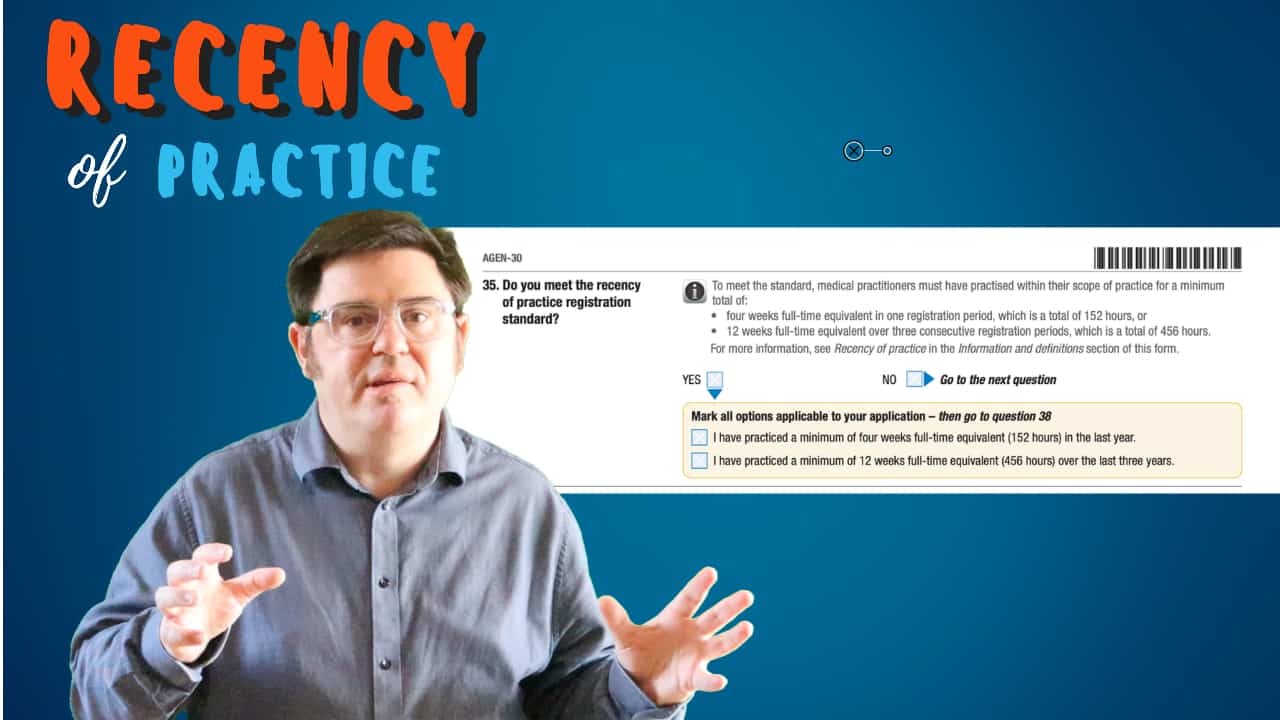
  • How Long and How Often Should You Prepare for a Doctor Job Interview?

    How Long and How Often Should You Prepare for a Doctor Job Interview?

    [fluentform id=”4″]

    Recently we ran a poll as part of some free training that we have been offering to doctors to help them better prepare for a doctor job interview. We ask the participants in this training what their approach to their last job interview was. So far over 100 doctors have registered for this training and the results are very interesting.

    Only 11% of participants indicated that they just winged the interview (i.e. did no preparation) which is a good result. But 53% of participants indicated that they had only done some preparation the night before, versus equal parts having done one practice session 18% or more than one practice 18%. We have added the same poll to the top of this post and would be interested to see what your approach was last time.

    prepare for a doctor job interview

    So How Long Should You Take to Prepare For a Doctor Job Interview?

    As someone who has coached hundreds of doctors through the interview process, I can definitely vouch for the fact that doing some amount of practice for the interview is much more likely to help you succeed. But the question is how long and how often should you prepare for your next doctor job interview? The answer to this question is a bit complicated but in general, the best advice would be to give yourself at least a few weeks and try to do a number of actual interview practice sessions in that space of time. At least some of these practice sessions should incorporate some form of feedback.

    But let’s unpack this a little bit more. Because there are definitely a few ways of practicing smarter so that if you have only a little bit of time then your practice can be more effective and if you have heaps of time you will get the maximum out of your endeavours.

    We will start by looking at why you should practice and then how you should practice.

    Why Should You Practice For Your Next Doctor Job Interview?

    I’m assuming that most of you are probably sold on the idea of some sort of practice for your next medical job interview and will skip over this section to the next heading.

    A question I would pose if you are not sold on interview preparation is why? Perhaps you have always been good at job interviews. There are some lucky ones who are. Or perhaps more likely you have been lucky up until this point.

    Did you study and prepare for examinations in medical school? For most, the answer to this question is yes.

    I’d like you to think about a job interview as similar to an important clinical exam. In many ways, its even more important than an exam as it will likely determine the speed and progression of your career. A job interview is a performance. And performances are skills. Skills need development to get to a high level but also top up to sustain them.

    The reason so many doctors struggle with doctor job interviews is not that they haven’t had the skills in the past to do well at an interview (for example a clinical examination). But we don’t sustain this skill over time. Because we don’t really need it all the time.

    So, unless you are regularly interviewing for jobs. Which thankfully is not the majority of us. You won’t be getting the type of skills practice you need. Unless of course, you do some practice of your own.

    Exactly How Much Practice Do You Need?

    The answer to this question is a bit complicated. Because it depends on what type of practice you are doing. You should obviously be practising answering questions. But there are many ways of doing this. Apart from establishing that some practice is better than no or little practice, there is no real empirical evidence out there to guide us as to what a good amount of practice is for job interviews.

    Malcolm Gladwell in his book Outliers explains that 10,000 hours is the key to mastery but this has been called into question.

    If you are looking for a good rule of thumb based on my personal observations about 6 practice sessions of an hour each spaced a few days apart is a good medium to head for. This is based on about 100 coaching engagements where I was providing about 3 of these 6 sessions. So if you are practising without a coach you may need a few more.

    Can You Practice Too Much for a Doctor Job Interview?

    Absolutely you can over practice for an interview. But in my experience few doctor job candidates get to this point. If you are practising regularly you will eventually get to the point where you feel a bit bored about the whole thing. This may be the point where you want to slow down your process a little. As regular practice will help you overcome the anxiety of performance but if you are too practised this will show across in the interview. And you won’t have that small amount of anticipation anxiety that most people use to get themselves alert and awake for a good performance.

    However, be wary that you are not just boring yourself because you are going over the same processes over and over again.

    Which leads me to.

    What Exactly Should You Practice for a Doctor Job Interview?

    Questions obviously. But consider what types of questions. And also consider practising components of these questions so that you get better at structuring your answers.

    You should be able to anticipate what types of questions you might get from a doctor job interview by reviewing the selection criteria.

    Be strategic about what bits of what questions you practice. Use deliberative practice and feedback methods to accelerate your performance. When you notice that you are only making fractional gains. That’s the time to move on to practising another bit of another question.

    What Forms of Feedback Should You Incorporate In Your Doctor Job Interview Preparation?

    You have to be careful about who you choose to help you with your coaching. For a real case study wake-up call see the video below I made about Kevin’s experience.

    There’s a lot of risk in asking friends, colleagues, and family to review your performance. They are cheering for you. So it will be hard for them to give you the critical feedback you need. Plus. They don’t really know what the panel is looking for.

    My advice is to choose either someone who has sat on many similar panels before or think about hiring an interview coach.

    Also, consider recording your sessions. So you can watch them back. Try to do one question or one part of a question and then force yourself to review the performance straight away. This is playing on the immediacy of feedback. It’s what high-performance athletes do. And it works.

    Related Questions.

    Question. What Is The Best Way To Record Your Interview Preparation?

    You can record yourself easily on an iPhone or similar mobile device. However, it’s best to not be holding these “selfie-style’. Try seeing if you can rest it somewhere so you can be sitting relaxed. Ideally, you want to frame your shot so you can see from the waist up. Just like a real interviewer would see you.

    If you want to step it up a bit. You can also get a free which allows you to record yourself in a meeting for up to 40 minutes. This is ideal for both live feedback sessions with say a coach or to review the recording later (and even send it to someone else for review). Zoom is the system we use for our coaching at AdvanceMed

    Question. What Should I Consider In Selecting An Interview Coach?

    There are a number of things to consider. Price is obviously one thing. But like in many endeavours you get what you pay for. So it shouldn’t be the only consideration. Actual knowledge of the doctor job interview process is quite desirable. Look for a strong track record and also consider that there are quite a few advantages of video coaching over face-to-face coaching. For more, we have written a blog post on this topic for you.

    Question. How Can I Best Get Feedback On My Actual Interview Performance?

    The best time to ask for feedback is at the end of the actual interview if you are brave enough. Check out this video we made about this topic.

  • 5 Key Take Aways From the New National Medical Training Survey

    5 Key Take Aways From the New National Medical Training Survey

    This week the Medical Board of Australia released the findings of the first-ever national medical training survey (MTS). As someone who has previously championed and developed these types of reports on the New South Wales level, it is truly pleasing to see this report launched. And boy did they release some findings!

    With the results of 59 headline questions reported across several different segments, including interns, prevocational and unaccredited trainees, IMGs and specialty trainees. With the main report running 249 pages, several other reports drilling down to College level, State and Territory level and even an Aboriginal and Torres Strait Islander report.  As well as an online interactive dashboard and a page where you can customize your own reports. There’s truly something for everyone in it. 

    So, what are some of the key findings from this report? Key points from this survey are that greater than 75% of doctors in training are happy with their training and workplace, however, 22% had experienced some form of bullying, harassment or discrimination. Most doctors in training are working safe hours but a concerning amount are still working in excess of 60 hours and even 90 hours per week, with surgery being one particularly bad specialty for this. Contrastingly far too many doctors in training aspire to enter a specialty like surgery than there is the actual capacity or need for. The survey shows that individual doctor career plans are out of alignment with medical workforce planning. Finally, even though we do have information about how medical schools are now performing as part of the medical training pipeline this information is surprisingly absent from the survey.

    Let’s drill a bit further into some of the key initial findings from the survey.

    Overall Impressions Of the Medical Training Survey.

    The Medical Training Survey will be run each year to get feedback from doctors in training in Australia (and in time their supervisors) to (according to the Medical Board of Australia):

    • better understand the quality of medical training in Australia
    • identify how best to improve medical training in Australia, and
    • recognize and deal with potential issues in medical training that could impact on patient safety, including environment and culture, unacceptable behaviours and poor supervision.

    It will take a while to assess the impact of this report. What we will need to see over time is the collection of data and the monitoring of trends to see whether the presence of the survey itself can spur on positive change.

    There is some hope that it might do that.  As similar surveys which have been running in the United Kingdom for some time now have shown improvements on parameters such as the extent to which Foundation doctors felt adequately prepared for their posts by their medical school has improved over time.

    GMC Foundation Results

    Image from the UK medical training survey depicting a sharp rise in “preparedness” from 2012 to 2013 (previous surveys would show this trend as going upwards from a lower level, but the 70% appears to be a natural barrier to further improvement). Source gmc-uk.org

    Overall Most Trainee Doctors Are Happy.

    With all the negative stories associated with the lot of trainee doctors in Australia over the past few years.  It may be tempting to conclude that trainee doctors in Australia are a deeply unhappy lot.  However, that’s simply not the case.

    And whilst, those stories should not be ignored and whilst there is empirical evidence of trainee doctors in Australia being exposed to adverse experiences in the workplace at unacceptable rates.  This experience is thankfully not the experience of the majority.

    In fact, 78% of the survey respondents indicated that they would recommend their current training position to other doctors (agreed or strongly agreed), followed closely by 76% of respondents being comfortable recommending their workplace as a place to train (again agreed or strongly agreed).

    Medical Training Survey snapshot

    International Doctors Are Even Happier According to the Medical Training Survey.

    I get asked a lot by international doctors if hospitals in Australia are good environments for IMGs.

    Here’s a table that shows you that overall IMGs are actually even happier than interns about their training post and workplace.

    82% IMGs would recommend their training post to another doctor, compared to 75% of interns. And 80% of IMGs would recommend their workplace to another doctor, compared to 75% of interns.

    Doctors In Training Are Still Working Too Much.

    The survey shows that the majority of doctors in training are now working under 49 hours per week.  However, 17% are in a risky area of working up to 59 hours a week and there are concerning outliers with 13% reporting working greater than 60 hours per week, including up to 90 hours or beyond.

    What is also interesting is that whilst one might expect that excessive work hours are more of a problem for specialty trainees when one compares the figures between, say interns and specialty trainees the difference is the other way with 16% of interns working over 60 hours a week and only 12% of specialty trainees working over 60 hours per week.

    But if we go a bit more granular and check out a specialty like surgery, we see more of what we expect to see.

    52% of RACS trainees report working greater than 60 hours a week. If you spot a worse group than this on the survey, I’d love to know about it.

    Where Did That Unrostered Overtime Go?

    Also, only 47% of doctors in training report being paid for unrostered over time, which is a deep concern.

    There Are Still Too Many Doctors In Training Being Exposed to Bad Behaviour.

    22% of doctors in training report personal experience of bullying, harassment or discrimination and 27% report witnessing this.  This is on part with other reports conducted around this issue, including one I helped write a few years back.

    Similar to our report findings only 35% of the recipients and 29% of the witnesses reported reporting this behaviour.  Which again is consistent with other studies.  What is most worrying is the level of non-witness report as this is probably the key statistic to be focussing in on here.

    If there is a silver lining to all of this it is that 52% of recipients who reported bullying, harassment or discrimination received a follow up to their report.  Now 52% may not seem all that great.  But this is actually a pretty good baseline result given what we know so far about the skills and capabilities of senior colleagues in handling the difficult issue of bullying, harassment and discrimination.

    Career Aspirations Greatly MisMatch the Reality.

    The MTS also included questions about career planning and intentions. Apparently 16% of Interns were unsure whether they did or did not have a training plan.  In my book that means you don’t have a plan.

    But check out the next table for an example of poor expectations management! 

    According to another medical workforce data set, the Health Workforce Australia, Medical Education and Training Dataset there were 1051 accredited surgical training positions in Australia. Now bear in mind that these 1051 positions aren’t just occupied by an individual doctor for one year but several years in order to complete a training program.

    Contrast this with the fact that 26% of the interns, resident medical officers, senior residents and unaccredited trainees indicated they were most interested in pursuing surgery as a career.  That’s a raw number of 351 of survey respondents alone. If we scaled it up to include those in these cohorts who did not complete the survey then we are probably talking 1500 to 2000, when the true capacity is around 200 to 300 per annum.

    If we look at the other end of the spectrum we then see a specialty such as psychiatry which traditionally struggles to attract trainee doctors sitting at only 4% when in fact it has capacity for and needs more trainees than surgery.  By the way, psychiatry also ranks in the top 5 professions for salary in Australia, along with Surgery.  Just saying.

    I was disappointed to see that this particular question was not asked of international medical graduates.  This would be important information to have.

    We Are Not Connecting the Dots (Yet) Between Medical School and Doctors In Training.

    So the last key finding is really a non-finding. I was surprised to see with all the effort that went into making this survey right a failure to ask a really obvious question about the transition from medical school to being a doctor-in-training. 

    As we have alluded to in the United Kingdom survey this has been a key and consistent question in their national report.  And it is an important one as we need to ensure that various parts of the medical training continuum are connecting with each other.

    What is even more surprising is that this question does get asked in Australia. It is asked as part of a survey led by the Australian Medical Council but with the participation of the Medical Board of Australia in a separate survey called the Preparedness for Internship Survey. This survey showed that 74% of respondents (interns) felt their medical school training had been sufficient.

    I believe it’s a mistake not to include this question in the national training survey as it helps us to connect some important dots with other questions.  Hopefully, over time, the Medical Board will find a way of combining the results of both surveys.

    I would encourage you to go and have a look at the survey yourself. Play around with it and see what you find.

    In this post, I haven’t even touched on things like the differences between various States and Territories or touched on very much issues around specialty training or other specific groups.

    I would love to get your feedback on the type of follow up post you would like to see to this one.

    Question. What is the Medical Training Survey (MTS)?

    Answer. The Medical Training Survey is a national, profession-wide survey of all doctors in training in Australia. It is conducted in a confidential way to get national, comparative, profession-wide data. With the aim of strengthening medical training in Australia.

    The survey is designed to be quick to complete and done on all manner of online devices and has the support of key stakeholders, such as doctors in training groups, employers, educators, the AMA and regulatory bodies.

    Question. How does The Medical Training Survey happen?

    Answer. The Medical Training Survey is open during August and September of each year, which coincides with the medical registration renewal period for most doctors in Australia.

    The survey is run independently by research agency EY Sweeney.  The survey is confidential, and data is gathered from online entry. Only aggregated data is ever reported, with the minimum threshold being ten (10) data points on any item and group to report back.

    Question. Who can do the survey?

    Answer. All doctors in training in Australia can do the survey. This includes interns, hospital medical officers, resident medical officers, non-accredited trainees, postgraduate trainees, principal house officers, registrars, specialist trainees and international medical graduates. Career medical officers who intend to undertake further postgraduate training in medicine can also participate.

  • Do International Doctors Have to Work as A Rural Doctor in Australia?

    Do International Doctors Have to Work as A Rural Doctor in Australia?

    In terms of land area, Australia is a large country, the 6th largest in the world. About 7,700,000 square kilometres. It’s a big country and as such has a lot of “country” or rural areas. Australia is also one of the most urban countries in the world, with about 85% of the population living within 50km of the coast. Just like other big countries. When doctors attempt to migrate to Australia from overseas some of the first questions they often will have are: “Whereabouts will I be able to work?” And “will I have to work as a rural doctor?” They will have normally already heard how big Australia is as a country and often heard rumours that international doctors can only work in rural parts of Australia.

    If you are reading this blog as a doctor from another country, I think it’s important to understand the facts and I’d like you to not feel too put off by the thought of potentially working in a rural part of Australia. There are far more important and difficult parts of the process of coming to work here. Don’t be put off by potential work locations.

    The quick facts about whether an international doctor has to work as a rural doctor in Australia are as follows:

    • Both international medical graduates, as well as medical students studying in Australia from other countries, are both subject to a ten-year restriction on being able to access Medicare billings as a service provider which can prevent you from being able to work in certain locations. This is commonly referred to as a 19AB restriction or the 10-year-moratorium.
    • There are many urban, regional and semi-rural areas (as well as more rural and remote areas) where you can still work in under Medicare.
    • But you generally won’t need to access Medicare for all of this ten year period. And if you are working as a trainee doctor or consultant in a public hospital you can potentially work in any part of Australia without having to worry about this restriction.

    The 19AB Medicare restrictions are the most significant policy that impacts international doctors working in Australia. But there is a range of other rules, restrictions as well as incentives that might affect you, including visa restrictions. So let’s look at these a bit more. As well as taking a deeper dive looking at the 19AB 10-year-moratorium.

    Government rules generally require IMG doctors to spend a period of time as a rural doctor. But not always.

    Australia is a vast country with large population centres concentrated in cities on the coastal fringes and much smaller populations throughout its landmass. This creates a problem whereby people who live in smaller population areas tend to miss out on access to a range of services in comparison to those based in the cities. This includes access to health care.

    Doctors themselves as an overall group tend to want to live and work in larger centres. The Federal Government, therefore, provides a range of incentives to entice doctors to work as rural doctors. As well as creating a number of restrictions for IMGs to make working in rural areas the only viable option.

    There are a couple of ways in which the Federal Government attempts to control the distribution of IMG doctors in Australia. The first is through Medicare billings. The second is through visa restrictions.

    Medicare and the 19AB Restriction Explained In More Detail.

    What is 19AB?

    International medical graduates are restricted in where they can work in Australia and access Medicare benefits as health care providers.

    What is Medicare?

    Medicare is Australia’s universal health insurance scheme. It guarantees all Australians (and some overseas visitors) access to a wide range of health and hospital services at low or no cost.

    Australians make more than 150 million visits to a GP every year. Medicare helps pay for the majority of the cost of these visits.
    Patients who have a Medicare card can access a range of health care services for free or at a lower cost, including:

    • medical services by doctors, specialists and other health professionals
    • hospital treatment
    • prescription medicines
    • diagnostic and imaging services
    • psychological services

    The Medical Benefits Schedule (MBS) lists the medical services covered by Medicare.

    The schedule includes an MBS fee for each service. This is the amount (or benefit) the Australian Government believes that the service should cost.

    Whilst it is possible to work as a doctor outside of the Medicare system. On a practical level, without access to the Medicare Benefits Schedule, it is pretty tough for a doctor to make a living. Doctors would have to either significantly reduce their fees to a level which matches the out of pocket costs that other doctors charge on top of Medicare or set up in an area where there was very little competition. Even then it is likely that patients would not be happy as the Australian population is used to being able to access Medicare for their health care.

    Section 19AB of Australia’s Health Insurance Act 1973 sets out the rules for international medical graduates and these restrictions.

    Medicare Provider Numbers.

    In order to bill Medicare for services, a doctor needs to have a Medicare provider number. Most doctors have more than one Medicare provider number. The reason being that you are required to have a provider number for each unique location where you might work.
    By tieing provider numbers to geographical locations, the Federal Government is able to restrict where doctors are able to practice.

    Who does 19AB apply to?

    Restrictions under 19AB apply to two groups of doctors. The federal government calls both of these groups of doctors international medical graduates. This is a bit confusing as really only one of these categories of doctors is really an international medical graduate as most people understand this term to mean. You are deemed to be an international medical graduate if you:

    • got your degree outside of Australia or New Zealand
    • enrolled in a degree in Australia or New Zealand as a temporary resident

    So the second group is basically doctors who graduated from an Australian or New Zealand medical school but did so as a student paying fees from overseas.

    So Australian Doctors Can Just Work Anywhere Then?

    Yes and No.

    In order to charge for Medicare services all doctors, including Australian graduates and those under 19AB restrictions, have to meet certain other qualifications.

    For most doctors, this means being what is called “vocationally-registered” or what many might call recognised as a specialist. General Practice is recognised as a specialty in Australia.

    There are also some restrictions for what is called Bonded Medical Place Scheme.

    Doctors who are Australian Citizens or Permanent Residents are subject to another section of the same legislation Section 19AA.

    What is 19AA?

    Doctors who are permanent residents or citizens of Australia must become vocationally recognised. Doctors become vocationally recognised by getting a Fellowship qualification in a specialty that is recognised in Australia.

    Under 19AA, you can’t get a Medicare provider number if you are a permanent resident or citizen of Australia, and you are not:

    • recognised as a Fellow by the Royal Australian College of General Practitioners
    • recognised as a Fellow by the Australian College of Rural and Remote Medicine
    • recognised as a Fellow by another Australian specialist college
    • on an approved 3GA program

    3GA Explained. Sorry I Promise I Am Going to Finish With the Meaningless Letters and Numbers Soon.

    If you do not hold Fellowship, you can provide services covered by Medicare if you are on a section 3GA approved training or workforce program. As of the time of writing this post, there were a number of open 3GA programs:

    As well as some programs which are closed to new applicants.

    Most of these programs relate to supporting doctors on a training pathway to general practice, e.g. the Australian General Practice Training Program.

    DPA and DWS (Sorry 🙂 )

    Under 19AB, you must work in a Distribution Priority Area (DPA) if you’re a GP, or a District of Workforce Shortage (DWS) if you’re a non-GP specialist, for at least 10 years.

    Distribution Priority Areas are a new concept. They have been developed because the previous concept, which is and was District of Workforce Shortage wasn’t making a whole lot of sense.

    To explain this I am going to use a few images from the Health Workforce Locator tool, which is a very handy and useful tool that you yourself can use to find out more about where doctors in Australia are needed and can work if they are under restrictions.

    Let’s take Melbourne, Victoria as our example. Melbourne is Australia’s second-largest city by population.

    The first image depicts the most current classification scheme for locations in Australia, the Modified Monash Model. It is named the Monash Model as it is based on some work done by researchers at Monash University.

    The Modified Monash Model (MMM) is used to define whether a location is a city, rural, remote or very remote.

    The model measures remoteness and population size on a scale of Modified Monash (MM) category MM 1 to MM 7. MM 1 is a major city and MM 7 is very remote.

    Using the MMM classification system can in theory help distribute the health workforce better in rural and remote areas.

    MMM classifications are based on the previous Australian Statistical Geography Standard – Remoteness Areas (ASGS-RA) framework.

    The Distribution Priority Area classification uses MMM boundaries.

    Some government programs use the MMM to define their eligibility requirements.

    From January 2020, Department of Health programs are transitioning to use the MMM classification.

    Areas of classification from urban to remote around Melbourne, depicting the Modified-Monash Classification
    Areas of classification from urban to remote around Melbourne, depicting the Modified-Monash Classification

    The next image again centred around Melbourne depicts the current status of General Practice using the DPA system.

    The DPA system takes into account gender and age demographics, and the socio-economic status of patients living in an area.

    An area is automatically classified as DPA when it is: 

    • classified under the Modified Monash Model as MM 5 to 7 
    • in the Northern Territory

    Other areas can be classified as DPA when the level of health services for the population does not meet a service benchmark.

    The average level of health services under MM 2 is the benchmark for international medical graduates to work in DPA areas.

    This benchmark is compared to the needs of an area, taking into account gender and age demographics, and the socio-economic status of patients living in an area.

    Areas around Melbourne where IMGs can work as General Practitioners (Yellow is good).

    The next image, again around Melbourne, depicts the previous ASGS Remoteness Area classification system. It is still used to determine a range of programs including District Workforce Shortage. As well as determine how doctors can speed up their 10-year moratorium.

    The previous ASGS Remoteness Area Classification Scheme

    The final image around Melbourne using the same tool shows you the state of general surgery around Melbourne. Notice a difference between this image and the one for General Practice? There are large areas of Melbourne available to work in for an IMG general surgeon. Yet big parts of rural Victoria are seemingly off-limits.


    Areas around Melbourne depicting where IMG General Surgeons could potentially work

    Under the DWS system, you would also see quite bizarre patterns for general practice. This is why there has been a switch to DPA.

    The problem is that the DWS system is a cruder system. It basically looks at Medicare billings for a particular specialty in a certain location and determines if that area is above or below the average of billings.

    For this reason, one would and should expect that all specialties will eventually be switched over to DPA over time.

    Bonded Medical Place Scheme

    Under the BMP Scheme, the Government provides a Commonwealth Supported Place (CSP) at a medical school at an Australian university.

    In exchange for a medical place, once they have graduated, bonded participants agree to work in an area of workforce shortage for one to six years. The length of time depends on your agreement and is called the return of service period.

    The 10-Year Moratorium

    The 10 year moratorium period starts from the first day of medical registration. This is called the 10 Year Moratorium. 

    All international medical graduates are subject to the moratorium. There are no exceptions.

    The moratorium and 19AB restrictions will end for you after 10 years if you are a permanent resident or citizen by this time. Most IMGs, if they have gotten this far, will be eligible for permanent residency.

    If however, a doctor does remain a temporary resident, their moratorium continues until the time they become a permanent resident or citizen.

    But if you do not have a Fellowship qualification when you become a permanent resident, you will subject to the other rules under 19AA.

    Speeding Up Your Ten Year Wait.

    So are there any options for reducing the amount of time under which you are restricted in your Medicare Provider Number?

    Yes, there are some options. But as we have highlighted above you may not necessarily wish to consider these options if you do not have a clear path to permanent residency or citizenship.

    Moratorium Scaling

    Moratorium scaling allows you to reduce the amount of time you must work in an area classified as DPA or DWS.

    Working in eligible locations lets you collect ‘scaling credits’. The more credits you have, the sooner you can work in any location across Australia you want. That is provided you satisfy all the other requirements.

    The more remote a location is, the more scaling credits you will get for working there. In theory, this directs the workforce to the areas that need it the most.

    The moratorium is always 10 years, minimum. However, once you have enough scaling credits, you will have a class exemption for the remainder of your moratorium.

    You can then apply to practise in an area that is not classified as DPA or DWS.

    How Moratorium Scaling Works

    You can scale the moratorium if all of the following apply:

    • you are an international medical graduate working in an eligible regional or remote area under 19AB
    • you are claiming Medicare Benefits Schedule items for services as part of your employment
    • your monthly billing threshold is $5,000

    So for example, you can’t just fly out to Bourke once a month for a day and run a clinic and count this for scaling. Unless you are good enough to collect $5,000 on that particular day.

    Also, if you have worked in multiple areas in a month, Medicare will be able to work this out and your credit will be based on the area where you billed the most, as long as you reached the $5,000 threshold.

    Scaling locations are based on the Australian Standard Geographic Classification – Remoteness Area system.

    ClassificationRA CategoryMonthly scaling benefit (where billing threshold is met)Potential reduction of DPA period under the moratorium
    RA 1Major citiesNilNot reduced
    RA 2Inner regional3.37 days9 years
    RA 3Outer regional13 days7 years
    RA 4Remote20.3 days6 years
    RA 5Very remote30.4 days5 years

    Is Sitting It Out An Option?

    I hesitate to write an answer to this question because I truly do believe that working in regional and rural Australia offers significant benefits to doctors. But if you are truly not inclined to work in one of the more rural regions of Australia then sitting it out may be an option for you.

    Let’s take the situation of an IMG who comes to Australia and works their way into a Resident Medical Officer role in a city hospital as part of the Standard Pathway. So this doctor will work off one of their ten years just doing their provisional registration year to gain general registration.

    Lets then say that they take a further couple of years of Senior Resident roles whilst working themselves towards a specialty training program. So we now have 3 of the ten years done.

    And then let’s say they enrol in Adult Physician training take 3 years to complete Basic training. Take a further 3 years to complete an Advanced Training program and a year off to complete a PhD.

    That’s a fairly common path even for an Australian trainee. And its ten years in total.

    Sitting It Out Is Not An Option For General Practice Training Or Specialist IMGs.

    The situation would be much more different obviously for a trained specialist IMG who comes to Australia. If you are lucky enough to be assessed as either partially or substantially comparable then you will need to find a position where you can work supervised to complete the rest of your assessment. Whilst this post could be potentially anywhere in Australia, we will see below how its likely not to be in a major metropolitan centre.

    You won’t necessarily need to worry about Medicare initially as its most likely you will be working in the public hospital system. But after a while, if you wish to work privately you are definitely going to be subject to 19AB restrictions.

    Similarly, for any international medical graduate who comes to Australia via the Standard Pathway and wishes to enter general practice training. In order to enter the largest General Practice training program, the AGPT program you will be required to training under the rural pathway and not be able to train under the general pathway.

    Once you finish GP training there are very few options for GPs to work salaried in a hospital or medical centre and urban GP practices will be unlikely to offer you a post if you cannot bill Medicare, so you will definitely need to work in a DPA area.

    Visa Restrictions.

    Up until this point we have pretty much solely focused on Medicare Provider number restrictions. But it is also important to point out that the Federal Government is able to and does attempt to control the supply of various professionals working in Australia through visa restrictions.

    Firstly, in order to be able to gain a work visa there needs to be a recognition that there is an undersupply of the work category that you are in. Luckily for doctors, most medical categories are seen as being in undersupply in most parts of Australia.

    If you are lucky enough to gain a post in Australia and are not already a permanent resident or citizen then the most likely visa that you will be able to gain is a Subclass 482 or Temporary Skill Shortage visa.

    482 Temporary Skills Visas

    These visas let an employer sponsor a suitably skilled worker to fill a position they can’t find a suitably skilled Australian to fill.

    They run from about 2 to 4 years depending on whether you are on the short-term or medium-term or labour agreement stream. Your medical area will need to be on one of several lists that the federal government keeps to identify strategic workforce needs.

    In most cases, you are not necessarily restricted to working in a certain location on a 482 Visa. But some may have restrictions (for example Anaesthetics is currently listed as needing to be in a regional area).

    However, you are generally tied to your employer on a 482 Visa and its not very easy to transfer between one employer and another without gaining another visa.

    If you are interested in more information about visa options you should definitely discuss with a qualified migration agent. I am only providing the above information as general information and not specific advice.

    The Labour Market Also Dictates That IMGs Are More Likely To Find Work in Regional and Rural Areas.

    Up until now we really haven’t discussed much about the role of the State and Territory governments or the employers in the whole process.

    Public hospitals in Australia are run by the State and Territory governments and these governments also often pick up a lot of the slack around primary care in the rural regions.

    So unsurprisingly, these governments also attempt to exert some control over where international medical graduates work. Mostly they do this through marketing and the use of incentives. But they can also restrict whether a hospital can advertise a certain position to an international medical graduate and set rules around these circumstances.

    But there’s another big factor that weighs upon where IMG doctors do end up working and that is the labour market itself. Generally speaking, medical positions fill up towards the major capital centres and vacancies will draw doctors in from regional and rural areas.

    So its therefore not surprising that there are simply more opportunities for IMG doctors in regional, rural and remote areas as there are must more vacancies to fill in these places.

    On the flip side, a number of these locations have focussed on the IMG market as a workforce solution and become really good at supporting IMGs to get their headstart in Australia.

    I often hear comments about how IMGs are not wanted by Australian employers. There are always good and bad employers around. If you are applying for jobs as an IMG in Australia you are probably going to find that the big city hospitals are the more inhospitable and that the regional and rural hospitals much more receptive.

    Summary.

    So to summarise. There are many reasons why as an international doctor you may find yourself working in rural Australia. At least for a period of time. But this does not necessarily mean working a long distance from an urban centre. And the experiences of many international doctors who have trod this path before you have often been positive. Compared to things like actually finding a job or putting yourself through the AMC or college assessment process. I frankly think that there are more important matters to be worried about if Australia is your destination.

    Question. How Do I Get Registered To Work In Australia?

    Answer. As an International Doctor, you first need an employment offer to gain registration. After that, there are two main pathways to registration: the standard pathway (if you are not a specialist) and the specialist pathway.

    Question. Where Can I Get Further Information About the Specialty Colleges?

    Answer. We have a post written about that very topic.

    Question. Where Can I Find Information About Jobs?

    Answer. Head over to our IMG resources page.

  • Intern, Resident and Registrar Salary Australia. 2020 Guide.

    Intern, Resident and Registrar Salary Australia. 2020 Guide.

    We have an updated salary guide at this post.

    On this blog we want to give you the best information possible about Medical Careers. That obviously includes information about pay rates and related conditions. We have already given you the low down on Interns and Residents, as well as Specialists. So its high time we discussed Specialty Trainees. Right?

    In this post we are going to talk about Specialty Trainees, also referred to as Registrars and how much they earn. Specialty Trainee Registrars working full-time in the hospital system will earn between $89,649 as a first-year Registrar in Tasmania up to $161,766 per annum working at the most senior Registrar level in Western Australia. General Practice Trainee Registrars working full-time are guaranteed $75,328 per annum in their first year of training. Going up to a guaranteed $96,724 per annum in their 3rd and final year of training.

    Once again it’s important to emphasize that these salaries are base salaries for full-time employees. Specialty Registrars are often required to work considerable amounts of overtime and on-call which will increase their pay rate significantly. And General Practice Registrars are able to negotiate with their employers above the guaranteed rate of pay. Often this will be on the basis of a proportion of the Medicare revenue that they generate for the practice. So, again they can possibly earn significantly more.

    Specialty Trainees Can and Often Do Earn Much, Much More.

    We can see evidence of the fact that Registrars do earn much more than their base rate of pay. “Other Medical Practitioners”, which is where most Registrars classify themselves for tax purposes with the Australian Tax Office earned on average $204,387 of taxable income in 2016/17 according to the ATO.

    Whilst these figures are likely to be conflated by General Practitioners and other Specialists indicating this category as their profession as well they do back up the contention that most trainee doctors earn significantly more than their base salary due to working excessive hours with specialty trainees at most risk of working excessive hours and amongst these Intensive Care and Surgical trainees being at the highest risk of fatigue.

    Its certainly been my observation over the years that surgical trainees in particular work long hours. This is generally a combination of rostered and unrostered overtime as well as being “on-call”. I was literally at a meeting last week where an administrator reported that the surgical trainees at her hospital were the best paid doctors last year due to their workload. Meaning that they were paid even more than the specialists.

    Its easy to see why and how this would be the case. Lets take a typical situation of a medium hospital which employs 3 General Surgical trainees. Each is on the roster approximately 1 in 3 on top of their normal 40 hours per week. This means being on call around 2 weeknights per week and 1 weekend in 3.

    Let’s assume one of these surgical trainees does slightly more than their share of weeknights in a month (4 weeks). 8 in total. But only one weekend. Let’s say that they get called on average 2 times per weeknight and 15 times over the course of that weekend.

    In New South Wales each of these call-backs would amount to a period of 4 hours of overtime. This is initially paid at time and a half for the first two hours and thereafter double time.

    So we have:

    • 160 hours of normal time
    • 2 callbacks X 8 = 64 hours of overtime for the weeknights
    • 15 callbacks for the weekend = 60 hours

    This gives us a total of 284 hours for that 4 week period. Which is close to double the base hours! But wait. Because those overtime hours get paid initially as time and a half and then very quickly as double time. The total amount of hours paid becomes about 400 hours!

    Now this example is obviously not typical for every specialty and there are some specialties which may not have to do as much overtime and not get called in as much. But it is also not the most extreme example either as the case of Dr. Yumiko Kadota has demonstrated to us.

    Breakdown By State and Territory.

    We have compiled below a table that demonstrates the current base rates of pay for Intern, Resident, Senior Resident, Registrar and Senior Registrar for each State and Territory in Australia.

    Please bear in mind a number of things. Once again we are talking Full-Time Annual Salary. Also, as I have pointed out above the actual take-home pay can vary considerably. Also, the Awards and agreements for each State and Territory are set independently and at different times from each other. So over time, the tendency is for there to be movement both up and down through the table.

    What is apparent, however, as we have pointed out on our other blog posts about Interns and Residents is that Western Australia is clearly the best place to work if your sole interest is finances. Victoria is next best and rates a special mention as its Enterprise Agreement contains a lot of additional friendly provisions that others do not.

    $31,000 in difference between the highest rate of pay between Western Australia and Tasmania is a bit hard to fathom and justify. It’s almost a 20% difference.

    State / TerritoryInternResidentSenior Resident*RegistrarSenior Registrar**
    Western Australia***[]$78,479$86,328$94,960$109,678$161,766
    Victoria$74,563$79,391$86,060$116,460$155,477
    New South Wales[]$69,649$81,639$89,793$101,698$143,398
    Australian Capital Territory***[]$68,094$79,682$87,410$98,704$138,667
    Queensland$73,306$79,413$85,521$105,377$134,389
    Northern Territory$71,350$82,731$88,629$98,413$134,113
    South Australia$73,370$80,041$86,710$100,717$133,400
    Tasmania$68,936$72,837$89,649$89,649$126,854

    *Being appointed to a specialty trainee position does not automatically mean appointment to a Registrar role in all States and Territories. For some, for example NSW, the entry point is the Senior Resident Medical Officer position.

    **Not all States and Territories have a Senior Registrar role. We have used the maximum Registrar pay grade where there is no Senior Registrar role.

    ***The Australian Capital Territory Enterprise Agreement expired in July 2017. Therefore we expect that the salaries quoted here will increase significantly when there is a finalization of the new agreement. Similarly, the WA Agreement experied in 2018.

    What About General Practice?

    Ok. So far I have ignored General Practice. But this has not been deliberate. It’s because General Practice is a different set of circumstances to the other specialty training cases. This is because General Practice works more on a national basis. Because there is an Australia-wide minimum set of pay standards.

    So, according to the General Practice Registrar Association website the current base rate of pay for a first-year General Practice Registrar is $75,328.23 per year and for a Registrar in their final year (which is either 3rd or 4th year) $96,724.43 per year. Again, this is for full-time work.

    Now, whilst these rates appear to be somewhat lower than for Specialty Trainees paid as Registrars you should bear in mind four things about General Practice training.

    The first is that General Practice training is a minimum of 4 years, whereas most other specialties are 5 years and possibly longer. So there is no need for higher Registrar levels in general practice.

    The second is that is actually possible to enter General Practice training in your PGY2 hospital year. So when you enter your first actual GP training post you are actually in your second year of training.

    The third is that the pay agreements are a minimum standard as part of an employment contract below which your employer may not go. But it is quite common for GP trainees to negotiate a better agreement with their employer, by agreeing to collect a share of their Medicare billings. So it is possible to do far better than these minimum amounts. Although, clearly this partly has to do with your own productivity as a GP trainee. And I don’t have any meaningful information to tell you how much this can increase salaries.

    The fourth and final thing is that clearly, GP trainees become specialists earlier. So whilst other specialists can and do eventually earn more than GPs. You get there first as a GP and so you get a head start on the rest of the field. Also, GPs are generally working less time than other specialists. So in theory more able to enjoy their very reasonable salary.

    Time To Complete Training and Other Costs.

    It has been suggested to me by my readers and viewers that in order to tell the complete picture I should talk about the time it takes one to complete training as well as some of the other costs involved in getting there.

    Whilst I agree that this probably does make the picture a little bit more complex for Specialty groups such as Surgeons. As I have also pointed out. Whilst one is working as a Surgical Trainee, either accredited or unaccredited you are in a group of doctors who are going to be earning quite a bit due to the amount of time worked. Now. This observation in itself is not really an attractive reason to enter Surgical training in my opinion.

    But it does mean that if you are successful in getting your way through Surgical training to your FRACS you are probably going to end up earning one of the highest incomes of doctors across your medical career.

    This is all pretty relative when we consider that most medical professions are in or close to the top ten occupations in terms of average income in Australia.

    Some key things to observe here are:

    • Some specialties are somewhat easier to get into at an earlier stage of training, examples being Emergency Medicine, Psychiatry, Physician Training and Emergency Medicine.
    • Other specialties have long waiting lists where you might end up becoming a very, very senior Resident before you get onto the program. Examples here are Surgery, Ophthalmology and Dermatology
    • Costs of training fees and exam fees can also vary significantly. Annual College fees usually start at over a thousand dollars for most Colleges. Examination fees can be a few thousand dollars to over ten thousand dollars. These costs are all tax deductible.
    • You may also need to or find it desirable to enter a formal training course. Some Colleges make this mandatory. This will also cost you a few thousand dollars. Again. This is also tax deductible.
    • Depending on your specialty there may be some equipment that you need to buy. For example, some of the surgical specialties utilise special equipment (think Ear, Nose and Throat).

    Other Related Questions.

    Question: What Other Benefits Do You Get As a Specialty Trainee?

    Answer.

    There are a range of other benefits that you get when working as an employed doctor in Australia.

    • On top of your salary, your employer is required to pay an additional 9.5% into a superannuation fund to assist with your retirement.
    • As an employee, you are covered by workers compensation for any injury or accident that might occur at work. Although payouts are often fairly poor and below what most professionals earn. So you may wish to consider taking out additional income protection insurance.
    • If you are asked to be on-call you will get a small allowance for this and be paid if you are called back into work.
    • You may get an allowance or even a mobile phone provided to you if you are required to be on call.
    • You might get some meal allowances for shifts.
    • If you have been seconded a reasonable distance from your normal place of appointment you will generally be provided with free temporary accommodation (you may need to pay a bond) and a travel allowance, for example, a free air ticket back home every 13 weeks or so.
    • You will get at least 4 weeks of annual leave per year.
    • Most doctors will also get one extra day off per month. Called a Rostered Day Off or RDO.
    • You will get a certain amount of sick leave every year which you can accumulate if you don’t use.
    • You also get access to other types of leave, such as leave to take your child to the doctor.

    Question: If I Am a Specialty Trainee From Overseas. How Much Will I Get Paid?

    Answer.

    You should be paid the same as the equivalent doctor in Australia. But this is a case where it’s always best to check. Once you are offered a position you should make sure that the employer is taking into account your current status as a trainee doctor overseas and in particular the amount of years of experience you have had. Some employers may indicate that they only take into account years of clinical experience worked in Australia. This can be a grey point. When pushed they will generally recognise your overseas experience as well.

    Special thanks to Dr Rachel Seaniger for the research conducted on this post