Category: Blog

Our Doctor Career & Medical Job Blog

Come back regularly as we endeavour to give you the most comprehensive information on the doctor job application process.  All things medical job-related.

  • 5 Tips to Get You Prepared for the Annual Medical Recruitment Process

    5 Tips to Get You Prepared for the Annual Medical Recruitment Process

    So you have settled into your new year at work.  For some, this means the excitement of finally making it to an internship is still there.  At least to some extent.  For others, it’s the relief of having conquered that first year.  Now being able to officially call yourself a Resident (apologies for use of NSW-centric terminology throughout this post).  But your attention has already turned to that next hurdle in your career. Well, I’m guessing it has otherwise you probably would not be reading this post).  We commonly refer to this hurdle as the JMO annual medical recruitment process.

    Like every other hurdle in Medicine, the process can initially seem a bit daunting and unclear.  But with a bit of planning of your time and seeking help, there are lots that you can do to ease the anxiety and maximise your chances of success.

    You can Prepare for the JMO Annual Medical Recruitment Process with our Top 5 Tips

    1. Work Out What Your Ideal Next Job Is (and then work out a fallback job)

    In any goal setting its important to define early on What Does Success Looks Like?  Its hard to put in place any reasonable plan without having a final objective in mind.

    For those familiar with SMART Goals it’s important that we define something Specific, Measurable, Achievable, Relevant and Timebound.  We won’t go over these 5 components in too much detail here.  Measurable, relevant and time-bound are generally self-explanatory and established in the JMO Annual Medical Recruitment process in Australia and New Zealand.

    Specific and Achievable are where you should focus your efforts.  Many trainee doctors already have a fairly specific first preference job in mind.  This is usually either to gain access to a basic specialty training program where the role is fairly broadly defined, or if you are further down the track a more defined Advanced Training position.  (If you are still uncertain at this point, then that’s ok by the way.  We will talk about what you can do to be more specific shortly).

    If you do know already what your Ideal Next Job is.  Ask yourself is this really achievable?  Or to be more precise what if for some unforeseen reason it just doesn’t work out?  Maybe your first choice is highly competitive or maybe you perform badly at interviews.

    Have a Plan B

    It’s important to have a backup or Plan B.  So as an example let’s take Adult Basic Physician Training.

    Your Goal might be stated like this

    To secure a new contract by the end of this year to work  in the area of Adult Internal Medicine either as a Basic Trainee or in an unaccredited SRMO role, so that I can continue to learn in this area that is of most relevance to me.

    If you are uncertain about your Ideal Next Job or your Plan B, browse the JMO annual medical recruitment sites to see what sort of positions have been on offer in past years.  This will give you a better idea of what is available.

    2. Plan Your Time Wisely in the lead up to JMO Annual Medical Recruitment

    Now that we have our Goal we can make a plan and the first thing to do is work out how much time you have so you can prioritize and allocate your time appropriately.

    Again a good starting point is to review the JMO annual medical recruitment websites for the positions you intend to apply for.  In most jurisdictions or regions there will be some sort of jurisdiction-wide site through which trainees put in their application for jobs for the following year.

    Here are a couple of examples:

    NSWHealth

    Canterbury District Health Board

    Look at these sites.  In most cases, there is one date by which you must submit your application.  Mark this down this is your first hard deadline from which you need to work backwards to ensure that you have everything you need (particularly a CV, Letter of Application and Referees).  You probably need to aim to fit in pre-interviews or pre-meets before this date as well as there is usually not much time (or availability) to meet with a Director of Training once applications close.

    The other dates you are looking for are the interview dates for the jobs you are applying for.  They may not be well advertised so you may need to make some inquiries.  These are also crucial as you will need to plan to take some leave from service to attend and you need to fit your interview practice in before these dates.

    3. Work Out Who You Would Like to Ask to be a Referee

    It seems obvious but we see so many medical trainees scramble to obtain referees at the last minute.  You can help yourself out now by dropping an email or making a quick phone call to those people you have recently worked with or for.

    Interns may not have had much contact so you are probably limited to a few key staff that you have worked with.  For Residents, you probably have a few more choices.

    You should try and line up at least 4 referees.  These don’t need to all be a Fellow of the College you are aiming for.  Other Fellows, Senior Trainees, Nurse Unit Managers, Senior Allied Health Staff are all good people to approach as a referee.  Having a diverse range of referees on your CV looks better to most CV reviewers than a homogeneous mix of College Fellows.

    At this point, you don’t need them to write you a reference (in a lot of cases they get emailed a form to fill out).  Just make sure they will be happy when the time comes and check their contact details.  If possible get a mobile number to put down.  This makes it easier for anyone who wants to take a verbal reference.

    4. Start Writing Or Revising Your CV

    A good CV should always be tailored to the role you are applying for.  This normally takes some time and several revisions to get right.  You should also factor in time for someone else to proofread it for you and give you feedback.  It’s likely that the CV you currently have will not be appropriate and need significant reshaping.  Allow some time for this important task.  Start thinking about what your Career Goal Statement looks like.

    5. Start to Practice Talking About Yourself and Your Achievements

    Start to think of the Interview as a form of high-stakes Viva Examination.  Did you practice for these in medical school right?  Well, you need to practice for the interview as well.  There are lots of approaches to doing this.  A good first step is to start thinking about your work and educational achievements.  Think about how you can weave these into answers to interview questions.  Many of us don’t normally like to “talk ourselves up”.  So practising this activity makes sense and will help it come across as more authentic at the interview if you do.

    Image Credit: janjf3 @ Pixabay

  • Is “Tell Us About Your Experience?” The Laziest Interview Question Of All Time?

    Is “Tell Us About Your Experience?” The Laziest Interview Question Of All Time?

    The standard of medical interview panels can vary considerably. Some times great thought goes into the questions put to candidates. Sometimes not.

    The other day I heard about an interview panel for a Resident Medical Officer (junior doctor) position where the questions put to candidates were extremely predictable: “Why do you want to work here?” “Tell us about a work conflict?” “What skills do you bring?”.

    The opening question was “Tell Us About Your Experience?”

    As a candidate one ought to be insulted by such a question. Especially if one has bothered (as they should) to prepare a tailored CV/Resume which explains your background and what you can bring to the organization.

    In this day of digital there is really no excuse for the panel not knowing about the experience of the candidates. Asking the candidate to detail their experience is a waste of a valuable interview question. Not to mention that focusing on future potential is far more important than past achievement.

    So how should a candidate prepare for the “Tell Us About Your Experience?” question?

    Well the question could be massively improved through a slight alteration to “Tell us how your experience makes you a good candidate for this position?”

    And that would be the way I would recommend answering the question. This approach gives you a chance to stand out and get on the front foot. You can probably also throw in a few results based examples as well to really impress them.

    Regardless of how the question is asked you should answer it by telling the panel about how your experience makes you a good candidate.

    Do this by picking out one, two or three of the selection criteria and relating your experience to them.

    So, for example, a common selection criteria is around communication skills. So talk about how your recent experience has been working in a hospital with lots of patients who are from a Non-English speaking background and how you have had to collaborate (probably another selection criteria) with other members of the team to meet this challenge.

    I recommend that you take a portfolio of relevant files to the interview. One of which should be a print out of the selection criteria. So that you can more easily address these in your answers.

    What about you? What’s the laziest job interview question you have ever been asked?

    Get Interview Ready

    Explore our options for Interview Practice & Preparation

  • Welcome to the #PrevocSpace. The Intern Transition.

    Welcome to the #PrevocSpace. The Intern Transition.

    A hearty congratulations on making it to this exciting phase of your career.  Around Australia and New Zealand January is the time of year that we welcome a bunch of new doctors to our profession as part of the intern transition.

    Here are 11 tips on handling the transition that I originally shared with the graduating class of the Joint Medical Program in their Celebration Week, November 2017.

    Number 1.

    Be humble and don’t be afraid to ask for help.

    There’s this thing called Impostor Syndrome that affects most doctors, particularly at transition times.  Know about it.  It’s that thing stopping you from asking a question because logically you know you should but emotionally you are embarrassed and emotions tend to override logic.

    Number 2.

    Get to know those who are here to help you with the next step of your journey.

    Most of us who go through medical school can remember a friendly Dean or Lecturer who helped them out and the hard-working support staff who keep everything going behind the scenes (at the JMP we call them Year Managers).  Those roles still exist in the intern transition, they are just called something different:

    In NSW we call the Director of Training who looks after Interns and Residents the DPET.  It stands for Director of Prevocational Education and Training.  In other jurisdictions, the equivalent might be a Program Director or Postgraduate Dean.  Here’s a short video that explains what DPETs do and can do

    Basically DPETs are here to help you with your intern transition. To advocate for and support you with your training and other needs.

    JMO Managers support interns and residents in their day to day activities in the hospital. What does a JMO Manager do?  Often the answer is “EVERYTHING”.  The role can includes: recruitment, rostering, leave allocation, organizing pays, providing education, sorting out grievances, maintaining accreditation and being a firendly support to JMOs.

    An effective JMO Manager can have a significant impact on the ability of a hospital to attract and retain junior doctors.

    Jan Worsley, HETI JMO Manager’s Guide.

    Number 3.

    Be competent at a range of things not just excellent at one thing only.

    When I reflect on the stories about the recent tragic deaths of so many of our colleagues one thing that concerns me about the current medical culture is that we seem to be (at least in some cases) still promoting the idea of the hero doctor.  The problem with investing so much in a narrow identity is that if it doesn’t go well you don’t have other things to fall back on.  Having a range of competencies helps with resilience and can buffer you against those “bad days” that we all have in medicine.

    So,

    If you used to like playing badminton.  Take it up again.  If you have always wanted to learn a new language or play the bass guitar but kept putting it off.  Start taking lessons.  If there are some friends you haven’t contacted in a while, do so now.  Do this before the business and routine of a new career starts to take over or reallocate your time.  These will all be important for the intern transition.

    Number 4.

    Remember its about life not work.

    4 kind of follows on from 3.  Why do we always talk about “work-life balance” and never “life-work balance”?  It seems as if life is intended to take second place to work and we have to work to ensure it gets its fair allocation of our time.  It shouldn’t be this way, whether you are one of the lucky few that lives to work (because they enjoy it) or works to live.

    How can you start flipping work-life balance to life-work balance?  It can be hard when you are in the middle of the intern transition.  When you  start out things like rosters and allocations and leave are not entirely under your control.  But there are small things you can still do. Like making sure you take your allotted lunch time.  Or say no to that additional shift that is being offered up and work with your colleagues to make sure you can all take your rostered days off.

    Number 5.

    Good enough is OK.  You can’t be great all the time.

    5 also follows on from 3 and 4.  When I was a Psychiatry Trainee I found that there were always things at the end of the day that could be done for patients.  The Psychiatry trainees I now work with express the same feeling.  We always want to do the best for our patients and their families.  But we also have to be fair and ensure we give enough time to each of our patients.

    Maybe that discharge summary could benefit from a bit more information but it has the key essentials?  Maybe you could spend a bit more time going over the discharge medications?  Maybe you could stay back another hour to talk to the brother of the patient who has just come to visit (but you already talked to his mother this afternoon)?

    Learning to prioritize tasks, manage your time and work within a team to get the job done is what makes a great doctor in my opinion.  Being able to say I have done a good enough job today and I am going home to my family on time and I will be back refreshed in the morning also makes a great doctor.

    Number 6.

    Get Serious!
    • Get some Medical Defence (if you don’t already).  Spoiler alert, most hospitals don’t employ lawyers, they have insurers that have lawyers who may help you out if the interests coincide (but not necessarily).  Also its really cheap (like less than $100 if you are publicly employed), which is really great value for being able to “phone a friend” whenever you need to.
    • Get an Accountant.  They will save you money (fairly) and save you time.  It get’s harder and harder to manage your financial affairs as you progress through the system.  They will also recommend that you get some:
    • Income Protection.  In case things go badly for your personally.  Or if you are unfortunate to be injured at work, most worker’s compensation schemes don’t pay out anywhere near the salary of a doctor (and often they don’t pay out at all).

    Number 7.

    Get a GP.

    After all they are “Your Specialist’s in Life”.  Seriously every doctor needs their own doctor.  ‘Nuff said.

    Number 8.

    Start a CV.

    It makes it easier when the time comes to apply for jobs for next year.  Which for everyone in Australia outside of NSW comes very quickly (like in a few months).  Also start politely asking your supervisors and other team workers if they would be happy to be a referee for you.

    Number 9.

    Enjoy being part of a Team.

    Medicine is very much a “team game” now.  Take an active interest in those you work with in the intern transition.  Get to know their roles, strengths and capabilities.  It will make your own life at work so much easier.  Becoming good at team work will set you up nicely for the rest of your career.

    Number 10.

    Don’t Be a Bystander.

    Sadly, bullying, harassment and workplace incivility does occur in our workplaces.  The limited evidence is that it is the observers of this behaviour that are in the best position to intervene.  We all have a role to play in improving the culture.


    Number 11.

    Be a teacher.

    Doctor is derived from the latin word ‘docere’, which literally means “to teach.”

    There is a long history of teaching in Medicine and doctors who have the opportunity to teach are generally happier in their work.

    There are also lots of great teaching courses now to help you improve your skills.

    intern transition
     
  • Make Your Medical CV Stand Out

    Make Your Medical CV Stand Out

    Interviewers see lots of CV’s and to be honest most of them look the same. The internet has a lot of information about resumes- to help you out we have picked the eyes out of the best of them.  So that you can make your CV stand out.


    Format

    There are lots of formats out there; here is one that won’t go too wrong:

    • Personal details
    • Career statement
    • Present position
    • Career history (ensure that any gaps in employment are accounted for)
    • Education and qualifications
    • Clinical skills and experience
    • Research
    • Quality assurance
    • Teaching
    • Learning
    • Summary

    The basic principles aren’t rocket science

    1. Write more than one resume
    2. Write in complete sentences
    3. Quantify your resume
    4. Pay attention to professionalism
    5. Make your resume aesthetically pleasing
    6. Do not lie on your resume
    7. Try not repeat bullet points
    8. Do not make spelling and grammar errors

    From website www.resumegenius.com (software and guide) for 10 Commandments of good resume writing

    Describing your experience is the meat of your CV- here are a few methods you can try to make your CV stand out.


    Methods for describing experience

    WHO Method

    Michigan State University

    • What you did
    • How did you do it (skills strategies, methods, tools, attitudes)
    • Outcomes


    Experience bullet points

    3 Parts of a strong bullet point:

    • 1st: Action Verb (should always be first)
    • 2nd: Quantifiable Point
    • 3rd: Specific and relevant job duty

    Example: “Managed a busy clinical team with an average of 50 new admissions per weekend while doing general medicine registrar at St Elsewhere”

    Suggestions for a Summary Statement

    From Rockport Institute: How to write a masterpiece of a resume.

    “Here are the most common ingredients of a well-written summary.

    • A short phrase describing your profession
    • Followed by a statement of broad or specialised expertise
    • Followed by two or three additional statements related to any of the following:
      • breadth or depth of skills
      • unique mix of skills
      • range of environments in which you have experience
      • a special or well-documented accomplishment
      • a history of awards, promotions, or superior performance commendations
      • one or more professional or appropriate personal characteristics
    • A sentence describing professional objective or interest.

    You would not necessarily use all these ingredients in one summary. Use the ones that highlight you best.”

    Suggestions for a Career Goal Statement

    From Rockport Institute: How to write a masterpiece of a resume

    So many resumes we see make a gallant effort to inform the reader. But we don’t want the employer to be informed; we want them to be interested and curious. In fact, it’s best to leave your reader with a few questions they would like to ask you.

    In your assertions section, state your Objective – your intended job. Ideally, your resume should convey why you are the perfect candidate for one specific job or job title. There is debate out there about whether to state an Objective, but in conclusion we think it’s a good idea. Keep it to the point, and keep the employer front and centre as your write.”

    Useful Resources to Make Your CV Stand Out

    BMJ Careers

    A useful resource for general career advice and specifically tailored to medicine

    BMJ Careers – CV writing skills, Interview Skills


    TEDX

    Your Future Success Is Not In Your Resume But Your Capability: Kevin O’Connor at TEDxLUC
    Inspiring talk on the principle that it’s not about you

    How to write a good CV

    Video on Generic Resume principles around formatting

    Forbes Aug 27 2014 6 Secrets of Great Resumes, Backed By Psychology

    Great article on how to get a job at google

    • Quantify your impact
    • Makes your interests quirky
    • Show the competition (came 4th out of 10,000)
    • Ask an employee for feedback
    • Associate yourself with big brands
    • Reinforce key message (rule of seven)

    For many more tips and advice please visit our Blog.

    To have your CV reviewed by an AdvanceMed HR Expert, click here for more info.

    Dr Matthew Links | Make Your CV Stand Out
    Dr Matthew Links

    – Dr Matthew Links www.nextmeded.com.au

    Image courtesy http://www.irishjobs.ie/careeradvice/wp-content/uploads/Standout.CV_.jpg
  • What is a Career Goal Statement & Why Include it on Your CV?

    What is a Career Goal Statement & Why Include it on Your CV?

    The purpose of having a career goal statement is to give you a clear and inspiring direction for the future.

    The reason you may wish to include one in your CV is to convey this information to those involved in the selection process. A really good career goal statement will help the person who reviews your CV see where you see yourself in the future.  Let’s say in about 5 to 10 years’ time.  It will also tell what you have done already to get there.  It will illustrate how you plan to keep working towards your career goal. And vitally it will also  Career goal statements are normally placed at the very start of your CV.

    An example of a career goal statement – for a JMO wishing to train in paediatrics

    I wish to pursue a career in community paediatrics with a research focus on improving rates of childhood obesity. In order to pursue my goal. As a JMO I have managed to obtain placements in paediatrics, volunteered my services teaching healthy lifestyles to children and parents at my local community centre and conducted research into rates of obesity in children in Western Sydney as part of my undergraduate medical degree. I have also developed a range of basic skills and procedures in children which will mean that I come to the role ready to start. I now plan to formally enrol in the Paediatric Training program of the College and have familiarised myself with the requirements for training and contracted with a mentor to assist me in training.

    When might you not want to include a career goal statement?

    There are some situations where including a career goal statement may be risky.

    The first is if your career goal statement does not read as authentic.  Or perhaps appears to be somewhat unrealistic. You will likely be passionate about your career goals.  So a good idea is to get some other trusted people to read your statement.  As a matter of fact, you should ask other people to read your entire CV for you.   Ask them their opinion.

    The second situation is similar to the first.  It is where your career goal statement is ambitious but you are unable to demonstrate much evidence in relation to pursuing your career goal. In this case, you may wish to temper your career goal statement somewhat to fit your achievements to date. Or perhaps you could consider an alternative. The third situation may be where your CV is being used for multiple job applications and you are only able to submit one CV. In this situation, it will be risky having a CV that has a career goal statement that does not fit with all jobs you are interviewing for.

    Are there alternatives to career goal statements?

    The answer is Yes. You can write a career summary, highlighting a few key achievements. You might want to intersperse these with some key capabilities.  The point here is to try to include things that you do particularly well.  Alternatively, you may have a really good quote from a written reference.  Something from one of your referees that you feel helps to sell your candidacy.

    Tip: The content of your CV should reinforce your career goal statement.

    Someone who reviews your CV should be able to see several examples which demonstrate how you have been endeavoring to pursue your goal. As an example, if your goal is to be a hand surgeon in ten years’ time.  Have you undertaken any placements in hand surgery?  Have you taken any postgraduate surgical courses?  Do you have a hand surgeon as a mentor or referee?

    For many more tips and advice please visit our Blog.

    Also, check out this video on youtube

    To have your CV reviewed by an AdvanceMed HR Expert, click here for more info.

  • Gain insights into the medical recruitment specialty selection process

    Gain insights into the medical recruitment specialty selection process

    I am often asked to advise medical trainees about how to best prepare for annual medical recruitment and the specialty selection process.

    In my career, I have sat in on upwards of a thousand interviews and seen several more thousand CVs and applications. Like all things in medicine, preparation and practice can really help to boost your performance.

    The process of obtaining a specialty position is becoming more and more competitive. In 2015 in NSW alone there were 45,000 applications for around 3,600 positions!

    That is why a colleague and I hosted the very first AdvanceMed: Medical Trainee Career and Interview Preparation Workshop in Sydney on 8th July 2017. We had a great line-up of speakers, all experts in the process in their own way. From trainees recently selected to posts to senior medical practitioners who advise junior staff and/or participate in selection panels.

    The process of obtaining a specialty post is becoming more and more competitive. In 2015 in NSW alone there were 45,000 applications for around 3,600 positions!

    In 2018, we are holding two workshops in June: one in Brisbane on 9 June 2018, and the other one in Sydney on 16 June 2018.

    It will be great to see as many medical trainees attend as possible. But for those who cannot here are a few tips.  They come from a recent presentation I made on this subject to the NSW JMO Forum:

    3 ways to miss out on a medical recruitment interview

    1. Don’t have a Plan B. Getting into medicine in the first place requires a range of skills and capabilities. Whilst confidence is definitely one of these.  Try not to let your confidence cloud your impression of your chances of getting into your job of first choice. Have a back-up in case it doesn’t go according to plan. Whether that is another specialty, taking an SRMO year or locuming.
    2. Don’t organise your referees. It may sound strange but on more than one occasion I have discovered that a trainee has put down a person as a potential referee without ever checking with them in the first place. That’s a definite no no. Also bear in mind that the folks you are asking to attest for you are likely getting several requests so keep them updated and send them your CV to make it a bit easier on them when the time comes for a reference.
    3. Leave your application to the last minute. OK. Its true. Trainee are able to push the apply button on the last day.  But that doesn’t necessarily mean that these trainees were not organised enough to be able to apply earlier. A rushed application is far more likely to lead to errors in your CV and how you address the selection criteria.


    3 ways to stand out at medical recruitment interviews

    1. Prepare. Do as much research ahead of time, so you can control your anxiety on the day. If possible, find out who will be on the panel so you can learn their names ahead of time.
    2. Practice. If you practice you can often predict some of the questions that will be used. Practice how you might answer these. Think of examples that you can use to back up your assertion.
    3. Thank the panel for their time and if you can, send an email to the Chair of the panel a couple of days later to back it up. Politeness can go a long way.

    These are just a few ways that you can think about improving your performance in the selection process.

    For many more tips and advice please visit our Blog and we’d love to see you at our Career workshops (Brisbane on 9 June 2018, and Sydney on 16 June 2018). Trainees who are interested should get in fast as there are limited tickets on offer.

     
  • Time Management and the Flipped Ward Round

    Time Management and the Flipped Ward Round

    I have recently been reviewing several Leadership and Management modules produced by the Royal College of Psychiatrists in the United Kingdom.

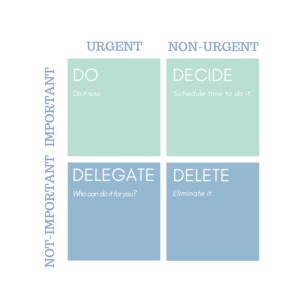
    I was reminded during the course of this module that it was Dwight Eisenhower that developed this famous decision matrix which you may have seen once or twice in your life:

    Eisenhower Box

    Author’s Own Design

    The “Eisenhower Box” apparently enabled Dwight to sustain high levels of productivity over significant periods of time.

    I often think that knowing how and what to prioritize is a key challenge in any transition in a medical career.  One can see this challenge for example when Advanced Trainees take on the Consultant role.  Suddenly the doctor is responsible for a significant number of more patients and normally now has trainees and other health professionals reporting to him or her about these patients.

    The tendency is to retreat to the medical expert role and continue to review all patients as if the doctor was still the trainee rather than to work through the other members of the team and more judiciously intervene.  In Organizational Psychology this phenomenon is referred to as the Peter Principle* and Ken Blanchard (he of the “One Minute Manager” fame) wrote a book about this problem called the “One Minute Manager Meets the Monkey” which I highly recommend to readers that have made it thus far in this post.

    *The Peter principle is a concept in management theory formulated by Laurence J. Peter and published in 1969. The theory is that the selection of a candidate for a position is based on the candidate’s performance in their current role, rather than on abilities relevant to the intended role. Thus, employees only stop being promoted once they can no longer perform effectively, and ‘managers rise to the level of their incompetence.’

    Peter Drucker followed on from Dwight shortly after and in “The Effective Executive” spoke about effective prioritization as requiring rules about delegating, developing action plans, running efficient meetings and choosing what you can best contribute to “What is it that only I can do?”

    For us to cope with managing our workload, many of us will generate to-do lists.  However, the problem with a to-do list (particularly an unstructured one) is that tasks rarely diminish over time as the list tends to get longer because more items are added than come off, the list itself does not guarantee task completion and the visual presence of an ever-increasing list can increase stress levels.

    To-Do lists are okay but I’d recommend adding a prioritization process or ranking process e.g. the Eisenhower Box.  By being proactive and applying a regular discipline of prioritization you will be amazed how more control of work you will feel and will probably notice that you are scheduling time for non-urgent but important activities as well as time to effectively delegate and maybe even cancelling a few unimportant activities out from your diary.

    “What is important is seldom urgent and what is urgent is seldom important.”

    – Dwight Eisenhower, 34th President of the United States.

    The Flipped Ward Round:

    Finally, after all this discussion of time and prioritization, I’d like to introduce to the world a prioritization technique or tip that I have used for some time.  I call this the “Reversed List” or the “Flipped Ward Round”.

    As a Psychiatrist who has generally been in management or educational roles my clinical time has often been fractional.  I have over the years found it particularly helpful to briefly fill in for my colleagues during their periods of leave rather than having a regular clinical load myself.  This has been highly popular for my colleagues with the added benefit of giving me greater exposure to a range of services.

    In doing these intra-service locums I would, of course, inherit established processes around the review of patients whether this be a patient list or a ward round process itself.  In general, these processes would include a very static order process, i.e. the format for a ward round discussion would generally start with a discussion of Mr Jones in Bed 1, then Mrs Smith in Bed 2 and so on and so forth down to Ms Brown in Bed 24.  For those readers familiar with the pitfalls of meetings where time is not allotted to agenda items you are no doubt aware that the same problem can occur on ward rounds, i.e. there is an overgenerous discussion of those cases at the top of the list and inadequate time allocated to those patients at the bottom of the list.  This can, of course, lead to issues not being properly addressed for such patients, errors of omission and unnecessarily lengthy stay.

    So, my approach to this problem.  Simple.  As the consultant covering I found it fairly easy to convince the rest of the team to indulge me in a simple experiment.  “What if we start at the bottom of the list this time?”  It would often lead to some interesting discussions about patient problems that had been overlooked up until that point.

    I wonder if there is something in this for us as medical educators as well?  Do we get hooked on to do lists?  Do we tend to dwell too much at the top of these and neglect important issues at the bottom?  When we design new courses do we often find ourselves flagging for ideas toward the end?  Do the topics at the end of a seminar series get as well covered as those at the start?

  • The Relevance of Personal Learning Environments in #MedEd

    The Relevance of Personal Learning Environments in #MedEd

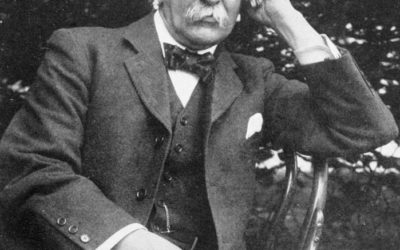
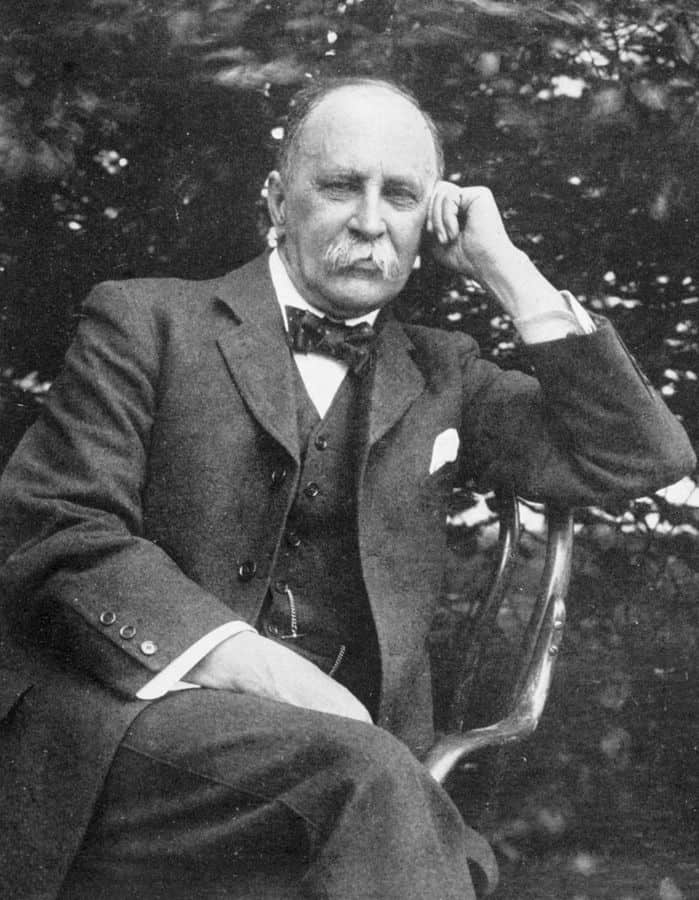
    Sir William Osler

    Sir William Osler was said to be the “Father of Modern Medicine” and the first to bring medical students from the lecture hall to the clinical bedside.

    Source – Prof Oliver Wong, Wellcome Images Library *

    Part 1 – The Medical Educator

    Credit where it’s due, Mike D’Alessandro appears to be the first doctor to write about the potential of Personal Learning Environments in Medical Education, writing here about the development of a course using the concept in the Journal of Pediatric Radiology in 2011.

    A personal learning environment helps learners take control of and manage their own learning. By entering cases into a learning portfolio you store your experience, reflection, knowledge, and wisdom and create your own knowledge management and E-memory system. Furthermore, by participating in a community of practice where you contribute content, engage in conversations, and make connections you are enabling peer-to-peer and master-to apprentice teaching. In the future, it is hoped that tying your learning to your practice and being awarded continuing medical education credit for it will fulfill a larger role in the process of Maintenance of Certification and Continuing Professional Development.

    Recently I presented the concept at a meeting of Clinician Educators at the 2015 International Conference on Residency in Vancouver. For want of a better definition, this was a group of medical educationalists, those that have a role (or several roles) in teaching medicine to other doctors. The participants appeared to find the concept helpful to their own practice. Many had already thought about their personal learning networks in a technology sense, see here recent ICE blog by Felix Ankel and Anand Swaminathan but only perhaps in the sense of how they might share information about medical education. The PLE concept can be seen as extending the Personal Learning Network (PLN) further into additional areas such as storing, remembering, and retrieving. Many of those who attended could also see that both the technological and the non-technological were valid in constructing their own personal learning networks with many reflecting on how, for example, the concept of peer review is drawn into a PLE.

    The Clinician Educators present could see some of the opportunities as wells as challenges presented by the PLE concept. We looked at some of the questions posed by Hicks and Sinkinson in their 2014 open-source article:

    1. What capacities and practices will learners and teachers need to develop?
    2. How will the learner and teacher role be defined within these approaches?
    3. What barriers will inhibit the exploration of these approaches?
    4. What components of the traditional approach should be protected and maintained?
    If we focus on each of these questions in turn:

    For question one – if we do accept the PLE concept then the medical educator of today and tomorrow will need to develop capacities and practices to be informed of the types and kinds of learning environments his/her medical learner is involved with. It obviously will be important to attempt to ascertain what sorts of sources of information learners are using and sharing, for e.g. blogs and podcasts, and consider the credibility of some of the more common sources at least. However, it is likely to quickly challenge the time and resources of the medical educator if they endeavour to map each of their learner’s PLE (not to mention that perhaps the learner may not wish to give access to certain aspects of their PLE.

    This then turns us to question two and the potential importance of the medical educator focusing on their role as both a facilitator of learning but also a facilitator of critical analysis and thinking, so as to encourage the medical learner not to believe everything that is written on the internet and perhaps also consider the risks of “group-think” in the construction of knowledge.

    For question three, many barriers may inhibit the medical educator, some of which may not be in their own control to address, for example working within institutions that close off their learning management systems and e-portfolio systems and even worse parts of the internet itself.

    Finally for question four, if the medical educator manages to successfully address some of the issues raised by the previous questions there opens up a possible opportunity for them to focus on those aspects of learning that truly have an impact on their particular training endeavour by, for example, removing the need to teach and provide information sources for a large swathe of the curriculum and then focusing more on issues such as practical skills development, work-place based assessment or developing reflective-practice skills in the medical learner.

    The above is by no means a comprehensive assessment of the impact of these questions on medical education but hopefully might guide the reader to why I think this is an area worthy of further investigation.

    Next blog I will attempt to touch on a definition of PLEs as well as speak to the potential relevance to medical learners.

  • The Impostor Syndrome in Medical Education

    The Impostor Syndrome in Medical Education

    Recently I hosted an inaugural Medical Education event in my local area. One of the key repeated claims from many of our speakers was of Impostor Syndrome (IS).  It became quite a theme through the Conference.  The typical argument went something along the line of “well really I don’t consider myself to be a medical educationalist first and foremost so I was a bit surprised to be asked to give a talk on the medical education topic of …”

    Given that the participant feedback indicated a high quality of presentation and content from our speakers, the claim of Impostor Syndrome seemed to be most justified.

    The Impostor Syndrome was first hypothesized by a pair of female Clinical Psychologists Pauline Clance and Suzanne Imes in 1978 to describe a phenomenon they had observed in their practices amongst high-achieving individuals (predominantly women) who struggled to accept their accomplishments despite contrary external evidence and constantly feared being placed in an expert role as they might be discovered to be a fraud.

    Is it surprising that medical educationalists feel like imposters or is it a broader phenomenon in medicine itself?  Well, in a 2008 article in the Journal of General Internal Medicine, of the 48 participating Internal Medicine residents 44% were found on the survey to exhibit signs of “impostorisim”.  It’s probably not surprising that, particularly at times of transition in our medical careers, we as doctors might feel a bit more fraudulent, for example when transitioning from an undergraduate to a postgraduate as the JGIM article shows or when someone gets asked to talk at a medical education conference for the first time not many of us appear to deliberately set out to become medical educators.

    I’ve recently been undergoing a transition back into some clinical practice and feeling the IS myself a bit.  I felt that my first day in outpatient practice was possibly my worst workday in a long time.  I was particularly troubled by the amount of time it took me to document my patient encounters.  To deal with this I found it reassuring to discuss my experience and cases within a peer review group and get some of my documentation confidentially checked by a peer.  I soon discovered that my experience was quite normal.

    By the way, Impostor Syndrome is not a mental disorder it didn’t make it into the latest DSM5. But there are still reasons, in my opinion, to take this issue on seriously.

    One worrying possible consequence of Impostor Syndrome is its potential impact on patient care.  I observed this issue at play some time ago in my psychiatry training program.  A colleague and I noticed a pattern in the psychiatry trainees and their behavior when on-call after hours.  We noticed that there was an inverse relationship between the seniority of the trainees and the number of times that they would call the Consultant to review a patient.

    We had some reasonable data on the numbers of patients presenting and were aware of how many patients were being admitted overnight and so we could compare this with the actual frequency of calls.  This would often get to a point of comedic-tragedic proportions where I can recall having meetings with trainees around wanting to write detailed policies about when trainees should call the Consultant.  I pointed out at the time that this didn’t seem to be the real problem as the Consultants were always happy to be called and if we wrote a policy and a trainee didn’t follow it (which I assessed was a high probability) this would create even more problems for the trainee.

    When I talked to the trainees about why it was they called more as a senior trainee versus a junior trainee the responses indicated that junior trainees felt they were not experienced enough and didn’t know enough to call the Consultant (were worried about embarrassing themselves) whereas senior trainees highly valued the opportunity to discuss with a Consultant because they felt it was more of a peer relationship and they even confessed that perhaps they were calling a little more than they felt they really needed to because they had already made a good assessment and plan ”bounce things off the Consultant”.

    I’ve talked to other colleagues from other disciplines about this observation and they have observed it as well.  By definition, its not true Impostor Syndrome but it’s something quite close; doctors close in experience and/or capability and/or seniority to other doctors are less anxious about revealing a weakness than those further apart.

    I haven’t been an on-call Consultant for a little while but when I was I tried a simple experiment in countering this problem.  Each morning after my on-call I would send the trainee doctor a quick email thanking them for being on-call and giving them some feedback on the presentations from the night before.  If I hadn’t been called at all I would remind them that I was on-call and still hoped the night went well for them.  My experiment didn’t last long enough for me to know whether it had an effect on the Trainee Impostor Syndrome but as I am shortly returning to on-call again I think I might give it another go.

    What about you?  Have you encountered Impostor Syndrome in your work?  Have you developed any methods of addressing the seniority gap in patient handover?

    Footnote:  We were very fortunate indeed to have Jason Frank as our international speaker for our Conference. There were many points as to why we decided to hold a local #MedEd event but the primary reason was that we wanted an event where we could bring all the key players in the medical training pipeline together in one room for two days.  On that measure our event was a great success as it spawned a lot of collaborative conversations from organizations that attended including after the event.  It’s often stated that the real learning at a Conference happens at the sidelines.