Category: Registration

  • Medical Internship Australia 2026 Clinical Year Application Guide

    Medical Internship Australia 2026 Clinical Year Application Guide

    *We will be regularly updating this post as the various States and Territories update their processes. Where information is not currently available for the 2026 clinical year we have used information from the previous year, i.e. 2025. If you notice anything incorrect please let us know in the comments below.

    It’s time for our well-liked guide on applying for internships in Australia. Wondering how to become an intern in Australia? It’s that time of year when the process of applying for and assigning medical intern positions in Australia gets underway. So, now is the ideal moment to outline the procedure. I managed the largest intern application system in Australia, specifically the NSW Intern application system, for four years. Therefore, I would like to impart some of the insights I gained from that experience to this year’s medical graduates. Wondering how to become an intern in Australia? It’s that time of year when the process of applying for and assigning medical intern positions in Australia gets underway. So, now is the ideal moment to outline the procedure.

    Recent Developments of Note.

    1. One interesting phenomenon of the past few years of internship allocations in Australia has been that most jurisdictions have not been able to fill all intern posts. This theoretically creates more opportunities for IMG doctors. We have attempted to indicate the number of unfilled posts from last year where known.
    2. Consistent with the move to a 2-year Prevocational Training framework we understand that all jurisdictions are now offering a minimum 2-year contract for Internship.

    (Disclaimer: All information here has been sourced in good faith but things do change so you should always do your own due diligence in such matters, we are providing this information to aid you in your application but take no responsibility for any outcomes)

    As has been the case in past years the main Intern application and allocation dates are aligned across Australia so that every State and Territory opens and closes their systems at the same time and makes offers at the same times. There are some variations to this in relation to special priority categories in some States and Territories. The key things that all medical graduates should consider in preparing their medical internship application in 2025 year for the 2026 clinical year are as follows:

    • Applications open on 6th May 2025.
    • Applications close on 5th June 2025.
    • Make sure that you have an Intern Placement Number; otherwise, you won’t be able to apply.
    • You should research the application requirements now as there may be some “surprises”. As soon as the application system opens, register or log in and ensure that you have everything you need to complete your application.
    • Understand where you sit on the priority list for any State or Territory you are applying to.
    • If you are required to attend an interview. Ensure you have obtained leave from your medical school requirements to attend.
    • Also, consider whether the interview will be in-person, via phone, or video.
    • Give yourself time to request referees, assemble a Resume, if required, and find other documents you may need.
    • The first National Intern Offer Period commences 14th July 2025.
    • Offers for Rural and other Special Pathways will come out starting from 14th July 2025.
    • The first offers for all other main pathways will come out from 16th July 2025.
    • Generally, you only have 48 hours to accept. So make sure that you have regular access to your email.
    • The National Close Date for 2026 Intern Recruitment is 17th October 2025. After which all remaining vacant intern positions move into the Late Vacancy Management Process.
    • The National Late Vacancy Management Process closes on 20th March 2025
    • Stay in touch with your medical school. you may be worried about completing your degree on time but they are all working very hard with the other institutions to give you the best chance of completion.

    Number of Intern Positions Available Across Australia in 2025

    last updated 13th April 2025

    JurisdictionIntern Numbers 2026Intern Numbers 2025Intern Numbers 2024PopulationInterns per 100K Person**Unfilled Posts 2025Annual Salary
    New South Wales1,1751,1621,135.5 8,511,20013.842$76,009
    Victoria973971960.57,013,00013.92025 unknown, 16 in 2024$85,414
    Queensland9218858625,608,70016.4not available$90,141
    Western Australia401#4014012,981,80013.5not available$90,864,– $119,165***
    South Australia353#3533111,882,70018.840$81,814
    Tasmania106#106105576,00018.4not available$87,000
    Australian Capital Territory96#9695475,60020.2not available$86,619
    Northern Territory888865255,60034.4not available$90,150
    Junior Doctor Training Program (Commonwealth)115#115115not availablevaries
    TOTAL42284,1774,05027,309,40015.4
    * indicates based on 2023 Annual Report
    ** From https://www.abs.gov.au/statistics/people/population/national-state-and-territory-population/latest-release

    ***If allocated to WA Country Health you will receive a higher payment
    #2025 numbers not yet released, PMCWA does not list intern numbers for Western Australia.

    Key Dates for Internship Applications in 2025 and 2026

    Applications OpenTuesday 6th May 2025
    Applications CloseThursday 5th June 2025
    National Offer Period 1 Opens (Rural and Aboriginal and Torres Strait Islander Pathways)Monday 14th July 2025
    National Offer Period 1 – Main OffersWednesday 16th July 2025
    National Offer Period 1 ClosesFriday 1st August 2025
    1st National Audit of Acceptances and Unplaced ApplicantsTuesday 5th August 2025
    National Offer Period 2 OpensThursday 14th August 2025
    National Offer Period 2 ClosesFriday 5th September 2025
    2nd National Audit of Acceptances and Unplaced ApplicantsTuesday 9th September 2025
    National Offer Period 3 OpensThursday 18th September 2025
    National Offer Period 3 ClosesFriday 17th October 2025
    3rd National Audit of Acceptances and Unplaced ApplicantsTuesday 21st October 2025
    National Late Vacancy Management Process StartsMonday 10th November 2025
    National Late Vacancy Management Process ClosesFriday 20th March 2026
    C/- HETI

    Tip #1. Your Medical Intern Placement Number.

    The IPN is a unique nine-digit number that has been generated by AHPRA and has been provided to medical schools for distribution to all 2025 final-year medical students. The number is used as part of the national audit process (which ensures that intern positions across the country are made available to as many applicants as possible) as well as to streamline registration.

    This number is not the same number as your AHPRA registration number or student number. If you have not received your IPN you should check with your school.

    If you are not an Australian medical student you won’t be issued an IPN. If you are applying as a non-Australian medical student you do not require an IPN. However, please note that unless you are a New Zealand medical student your chances of gaining an internship are very slim.

    Tip #2. Other Things You Will Likely Need to Become an Intern in Australia. 

    The majority of States and Territories require you to upload an academic transcript as proof that you are indeed a medical student. 

    They will also request evidence that you satisfactorily meet the AHPRA English Language requirements. This may seem a bit ridiculous given that you have been attending medical school in English for the last 4 or 5 years. But it is the law. So check whether you may need to submit an up-to-date English test result or some other form of documentary evidence such as a high school certificate.

    Most States and Territories will also request a CV or Resume. For tips on your CV or Resume see our ultimate guide to CVs or watch a video series about this.

    Some States and Territories have a CV template that they suggest that you use to fill in your information. In the case of Victoria, you are no longer required to use the suggested template (change from last year). It’s probably fairly harmless to use the template for the other States and Territories. But if you are thinking about your future career, then now is a good time to be designing your own CV. The risk of using the template is that you don’t stand out from other candidates.

    You will need to also provide proof of your identity, citizenship, residency, or visa. And if you have had a name change along the way you will probably also need to provide some documentation in relation to this.

    Why All This Information?

    The State and Territory bodies who administer the Intern application process have a responsibility to ensure that you are eligible to apply for provisional registration at the end of the year in order to work as an Intern.  They collect this information to check that everything is in order so that you are indeed eligible to apply. Employers can get rightly annoyed when told that someone who has been allocated to work with them as an Intern will have a several-month delay whilst they resit an English language test.

    However, it’s your responsibility to ensure that you are eligible for registration. So you should also be checking these things yourself. 

    It’s hard to fathom given the amount of communication from health departments, medical schools and student colleagues. But every year there are a handful of medical students who forget to apply for their internship. This means having to wait another year. Don’t let that be you.

    Dr Anthony Llewellyn | Career Doctor

    Tip #3. Research and Apply Early.

    It’s hard to fathom given the amount of communication from health departments, medical schools, and student colleagues. But every year there are a handful of medical students who forget to apply for their internship. This means having to wait another year. Don’t let that be you.

    There are even more students who leave their applications to the last minute. Only to find that they are missing a vital document. For example, this could be evidence you need to substantiate that English is your first language, such as a high school certificate. Or perhaps your last name has changed whilst you have been in medical school? Or maybe you need to submit a CV with your application?

    As soon as the application page opens for each State and Territory you are going to apply to make sure you register. And then go as far through the process of applying as possible so you can see if there is some sort of document you need to obtain.

    Tip #4. Practice Your Interview Technique, Including Video Interview Technique.

    As part of your application to become and Intern in Australia you may need to undertake an interview. This could take the form of a faced to face interview or a video interview. The COVID pandemic resulted in a shift to a preference for video interviewing job applicants in Medicine in Australia. Many employers now see an inherent advantage to this. So you should still be prepared for the fact that this year your interview may be conducted on video.

    There’s a lot more than you think to video interviewing. For a rundown on this check out this post.

    Tip #5. Know Where You Sit In The Priority List.

    Its important to know where you sit on the priority list. Each State and Territory has a slightly different order but in essence, it goes something like this:

    1. If you are an Australian Citizen or Permanent Resident and went to Medical School in that State or Territory you are top of the list.
    2. If you are an Australian Citizen or Permanent Resident and went to Medical School in another State or Territory or New Zealand you are probably second.
    3. If you are an international student who studied Medicine in Australia you are probably next.

    Tip #6. Know the Key Dates, including Offer Dates.

    As noted above it’s crucial that you know the key dates. If you miss your application submission date (and it does happen) there is no allowance for a last-minute submission. You also need to make sure you are available to accept your offer. Generally, the window for offer acceptances is quite narrow (often 48 hours).

    For this year the day on which the first round of offers can be made nationally is 14th July 2025 for the rural and other special pathways. The first date that offers can be made to the main group of applicants is 16th July 2025 and most offers will come out on that day. Thereafter there is a series of offer windows for 2nd and 3rd round. In between which there is a mandated pause, which allows the National Intern Audit process to run. This is a system that works to ensure that vacancies are being freed up as soon as possible by highlighting medical students who may have an offer in more than one jurisdiction and ensuring that they accept one offer and decline others.

    The nationally coordinated offer system concludes on 17th October 2025. Technically this is the last date that the Medical Board can guarantee that they will be able to process your registration application in order for you to commence your internship on time the following year in 2026.

    However, there are generally still vacancies after this point and so the National Intern Audit Office switches over to an ad hoc coordinated late vacancy management process from 10th November 2025. This runs up until 20th March 2026, which is around the 1st term to 2nd term changeover for most interns. So it is still possible to commence your internship in 2026 but you might have to finish one or two terms in the following year.

    The National Intern Audit.

    States and territories share intern applicant information at pre-agreed dates. This data is then used to identify applicants who have applied for and/or accepted intern positions in more than one state/territory. Applicants who have accepted more than one intern position will be contacted by the National Audit Data Manager by phone or email and given 48 hours to withdraw from all intern positions, except the one where they intend to undertake their intern year.

    If you don’t respond to the National Audit Data Manager and/or do not withdraw from all positions except one, the relevant states/territories where you have accepted an offer will be advised and all offers, except for the first offer you received may be withdrawn.

    The Late Vacancy Management Process.

    The Late Vacancy Management (LVM) Process runs from Monday 10th November 2025 to Friday 20th March 2026. The process ensures any late vacancies are offered to eligible intern applicants who have not yet accepted an internship position.

    The Late Vacancy Management Process is coordinated by the National Audit Data Manager on behalf of states and territories. So you should ensure you have updated your contact details if you are going overseas during the Late Vacancy Management Process period.

    The National Audit Data Manager will send out emails to participants who will need to opt into the Late Vacancy Management Process if they still wish to receive an offer to be an Intern in Australia.

    If an applicant does not respond to this email, they will no longer be eligible to receive an internship offer, and their application will no longer be considered in any Australian jurisdictions.

    The process is open to medical graduates of AMC-accredited medical schools who have applied for and are not holding a 2026 intern position through the Commonwealth or states and territories at the National Close Date for Intern Recruitment. Participation in the LVM is an opt in process – you must confirm that you want to participate in the LVM by responding to the National Audit Data Manager by e-mail.

    Priorities Within Priorities.

    Some States and Territories also have priority pathways to ensure that groups such as Aboriginal and Torres Strait Islanders and doctors who wish to work rurally or regionally can obtain their preferred placement early.

    So if you are an International student and like the idea of working rurally, it’s probably a good idea to consider a rural pathway as it will likely boost your chances of gaining an Intern position earlier in the process.

    Further Information on Each Jurisdiction

    New South Wales

    Intern in Australia NSW
    Sydney Harbour Bridge, New South Wales.

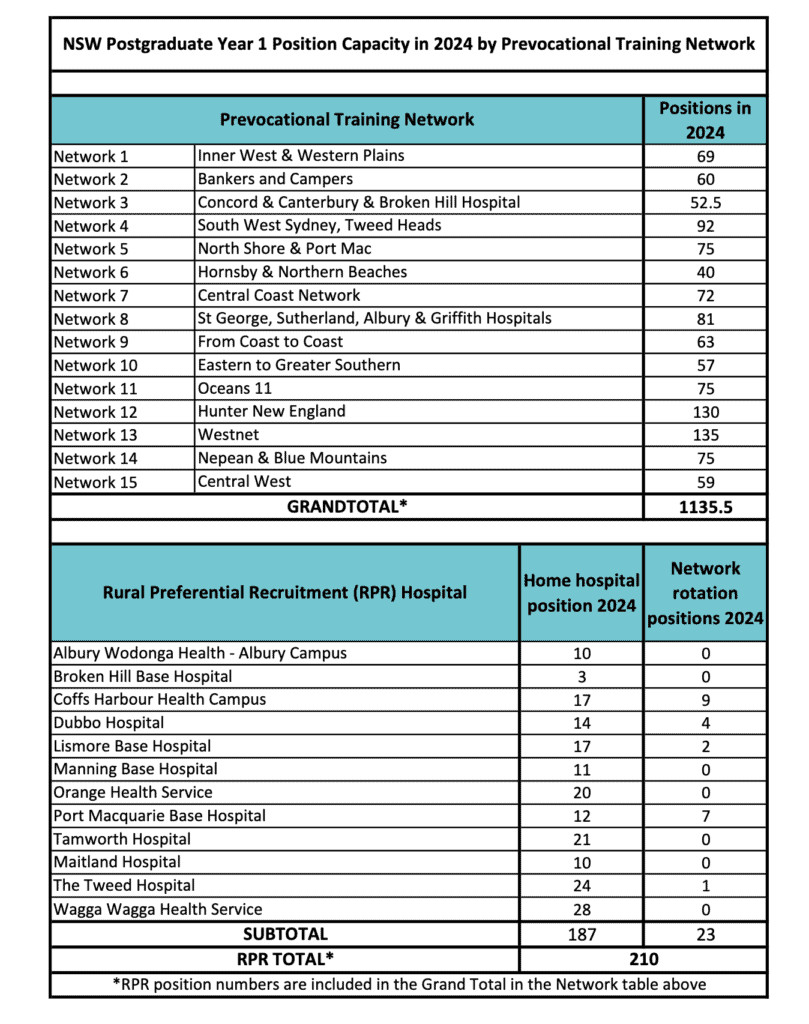
    Intern Positions = 1,175 (including 241 rural preferential) across 15 Networks
    Unfilled posts in 2025 = 42
    Annual Salary = $76,009
    Length of Contract = normally 2 years
    Professional Development Allowance = nil
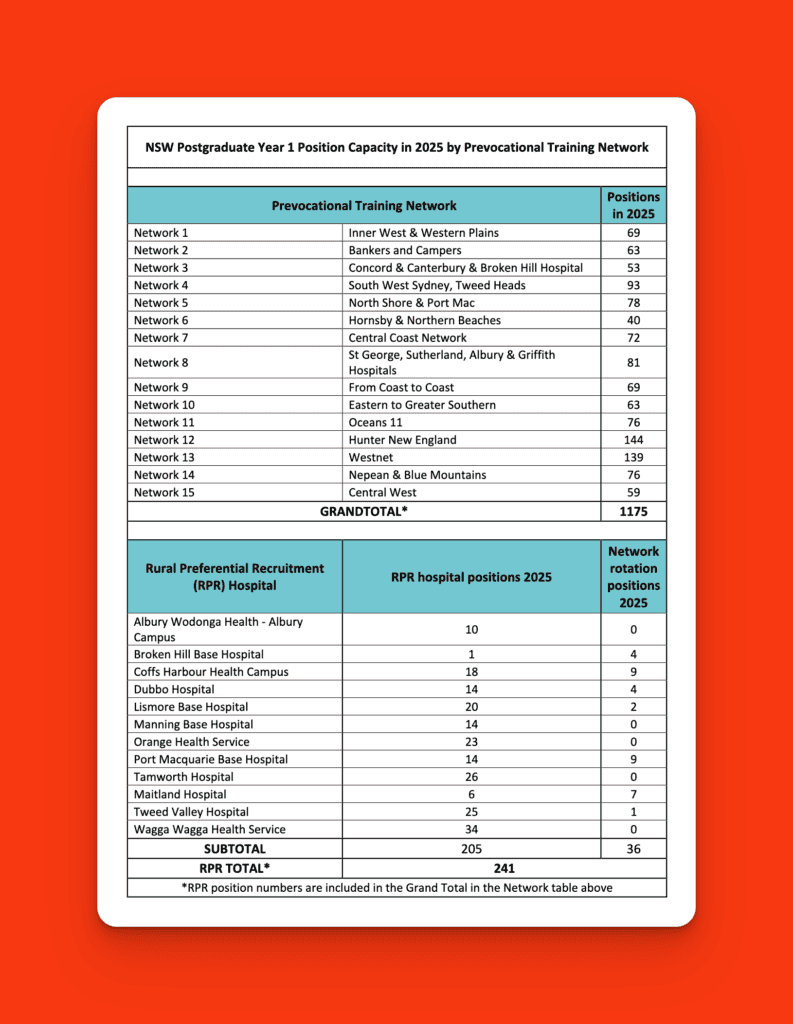
    The 4 Pathways in NSW


    You have the option of applying through one of 4 pathways:
    – Aboriginal Recruitment Pathway
    – Rural Preferential Pathway
    – Regional Allocation Pathway
    – Optimised (or Main) Pathway

    Only applicants who go through the Rural Preferential Pathway need to submit a CV and attend an interview.  All other pathways are based on applications only. A key advantage of the Aboriginal, Rural, and Regional Allocation Pathways is that you are far more likely to be given your preferred hospital network.

    Can You Stack or Hack the HETI Optimised Pathway?

    Each year the question comes up. Is it possible to hack or game the HETI optimised pathway. If you search enough you will find various reddit threads or blog posts covering this topic by authors purporting to have much greater understanding of mathematics than this author.

    The posts give an outline of how the HETI allocation algorithm works. The algorithm incorporates an annealing component with the purpose of optimizing the outcomes for as many applicants as possible. Hence the name “Optimised Pathway”. It does this not necessarily by allocating everyone to their most preferred network but by attempting to allocate as many people as possible to a higher preference network, therefore, guaranteeing that more applicants get a 1st or 2nd or 3rd preference overall.

    The general gist of the blogs written about hacking the HEIT algorithm is that if you are super keen on a certain NSW network. Let’s call this Network A then you should attempt to put this as your highest preference and then load all of your next higher preferences with networks that are not as popular.

    You can probably already see how this tactic can backfire massively for you.

    There’s a couple of things that can go wrong here.

    First algorithm is more likely to identify you as one of those few applicants that prefer the unpopular Network Z and allocate you there, thereby satisfying the aims of the algorithm.

    Second, you will be stacking your preferences based on historical data that does not reflect the desires of the current applicant cohort.

    And third, if large number of applicants does the same thing then you are probably all going to advantage those applicants that just put down the networks in their actual order of preference.

    Take home message. Don’t try to stack or hack the HETI algorithm.

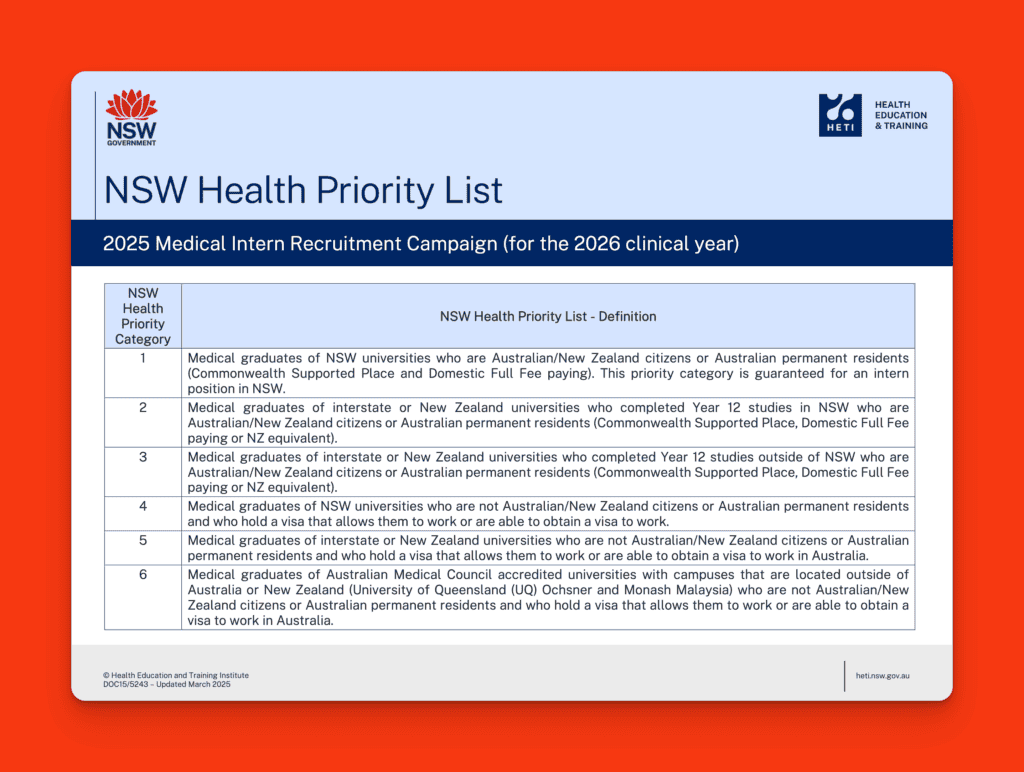
    Intern Placement Priorities in NSW:
    Victoria

    Trains leaving the Melbourne CBD passing the Melbourne Cricket Ground

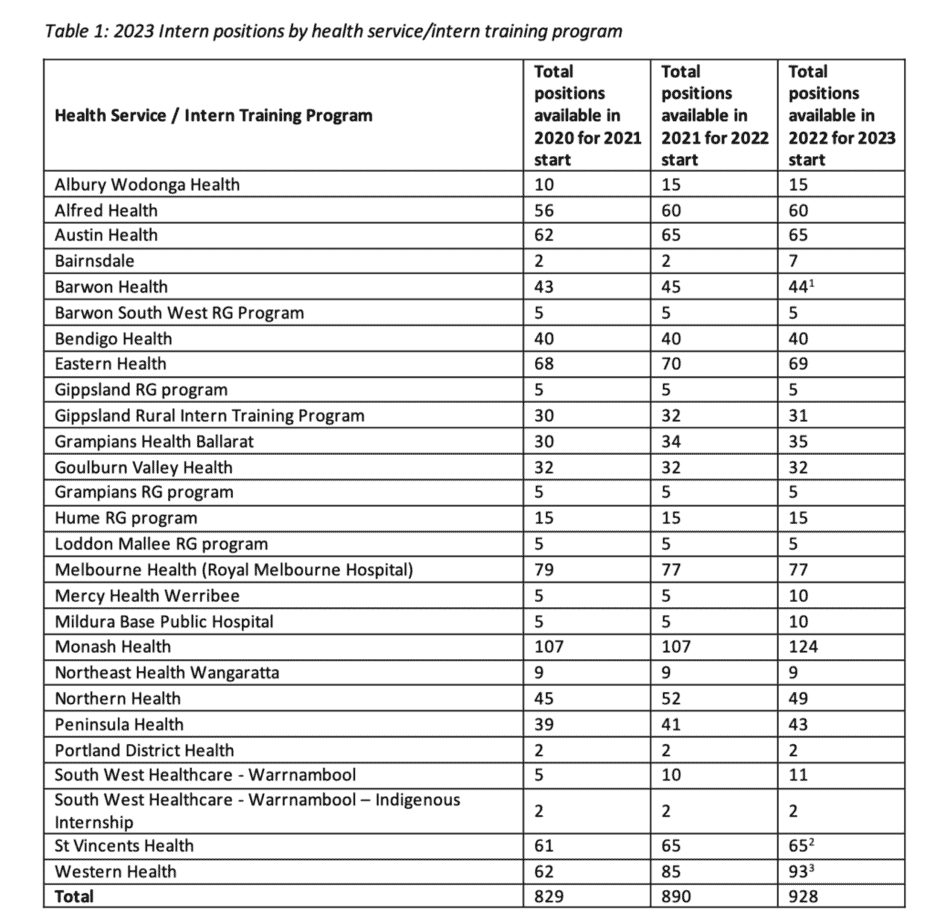
    Intern Numbers = 973 (includes an unspecified number of Rural Preferential posts)
    Unfilled Positions in 2025 = unknown (2024 was 16)
    Annual Salary = $85,414
    Length of Contract = 2 years
    Professional Development Allowance = $3,888 per annum
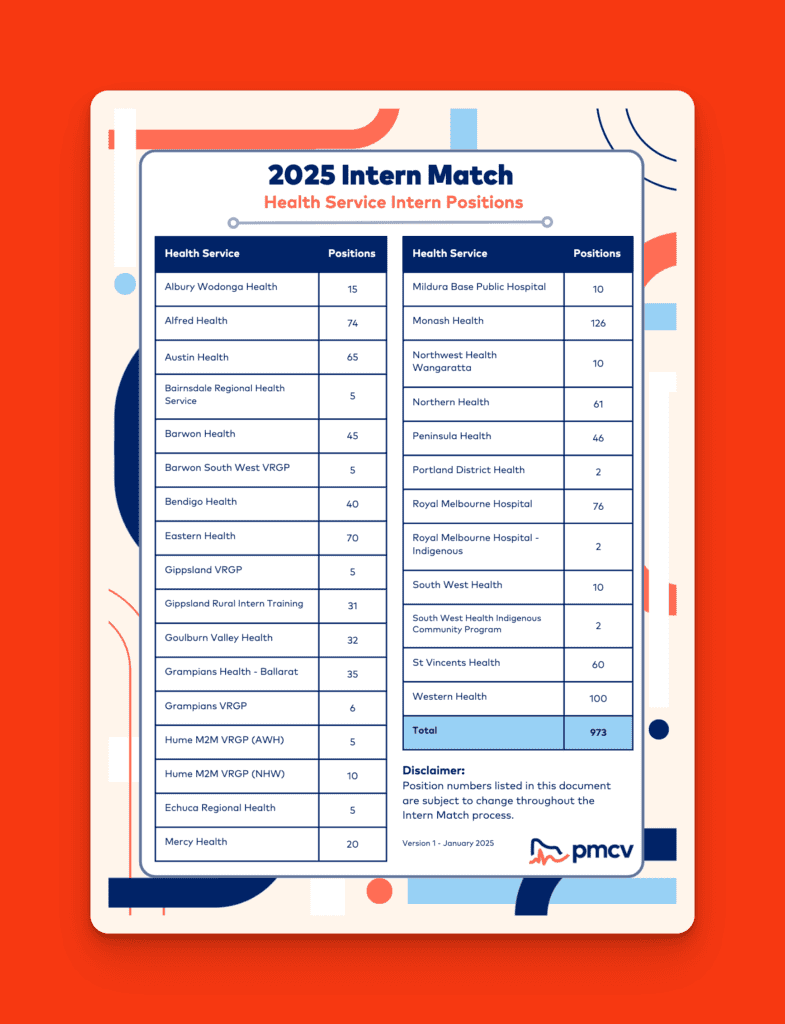
    c/- PMCV


    Internship in Victoria works around a computer matching system that the Postgraduate Medical Council of Victoria administers.

    The Allocation & Placement Service is a mathematical process that matches the preferences of both candidates and Health Services and is designed to be “impartial and transparent”. 

    Candidates create an account and then register with the Intern match. The second step is to select your preferred services. At the same time, the health services also place preferences. The matching process of successful candidates to positions according to rankings.

    For Victoria, you will need to submit referees as well as a CV. In past years this had to be on the quite unattractive PMCV standardised CV Template. The status of this template has now been downgraded to a “guide”. You don’t have to put a photo on your CV. I would recommend using your own CV template and not include a photo.

    Pre Recorded Video Interviews

    In 2020, Victorian Health Services began the use of video-recorded interviews. This continues for 2025 for certain candidates. The system appears to be being used as an efficient way for certain services or hospitals to review applications without arranging formal interview panel days and for candidates to appear in person.

    All VRPA applicants and all VIA Group 4 applicants will be required to complete a video interview.

    The way these interviews work because you are usually allocated a specific time to log into the system. Once you have gone through a couple of orientation steps you are usually given a series of questions and asked to record your answers. Generally, you don’t get a second go if you are not happy and the time is limited. It is vital therefore that you practice before you do your interview and ensure you have optimised your video environment.

    You are able to complete your recording at any time during the specified video interview period. All candidates are required to answer 3 questions. Questions are randomly selected from 3 different question banks. There is one additional question if you are applying for the Regional Pathway.

    Response times are 2 minutes per question. You get one minute to read the question and prepare your answer before recording.

    All health services can use these recordings to rate you along with your CV and referee reports.

    Metro hospitals may conduct live interviews with shortlisted candidates at any time before 3 July. Although I understand many do not and just rely on the candidates’ CV, referees and video interviews.

    Interns can be allocated to one of 22 hospitals and networks. This includes a small number of community-based internships where the focus is more on community-based models of care, including working in primary care and smaller hospitals.

    You can elect to be prioritised for an internship by entering the Victorian Rural Preferential Allocation (VRPA) match. Where you can be allocated to one of 5 rurally based networks. This pathway involves a live interview. First-round offers for VRPA come out on 18th July on the national rural allocation date.

    Intern Placement Priorities in Victoria

    Intern placement priorities have altered for 2025 with the introduction of a 3rd priorty group for the Victorian Rural Preferential Application (VRPA) pathway and renaming the main pathway to the Victorian Interns Allocatin (VIA) pathway with the creation of an additional fourth category for this pathway.

    VRPA Priority Group 1 – Graduates from an Australian University identifying as Aboriginal or Torre Strait Islander. Australian Citizen or permanent resident and New Zealand citizens graduating from a Victorian Medical School.

    VRPA Priority Group 2 – Australian Temporary residents graduating from a Victorian University. Graduates of the University of New South Wales who have undertaken their last two years of clinical placement at Albury Wodonga clinical School. Australian Citizen or permanent resident and New Zealand citizens graduating from an interstate Medical School but completed year 12 in Victoria. Completed their Year 12 schooling in Victoria; OR Previously lived in rural Victoria (Modified Monash Model (MMM)1 – MM2 classification or higher) and worked in a rural healthcare setting; OR Graduates of the University of New South Wales who have undertaken their last two years of clinical placement at Albury Wodonga Health clinical school.

    VRPA Priority Group 3 – Australian citizen or permanent resident or New Zealand citizen graduating from an interstate or New Zealand University. Australian Temporary resident graduating from an interstate
    University.

    VIA Group 1 – Graduates from an Australian University identifying as Aboriginal or Torre Strait Islander. Australian Citizen or permanent resident and New Zealand citizens graduating from a Victorian Medical School.

    VIA Group 2 – Australian Temporary residents graduating from a Victorian University. Australian citizens or permanent residents and New Zealand citizens graduating from an interstate University who completed their year 12 schooling in Victoria

    VIA Group 3 – Australian citizens or permanent residents and New Zealand citizens graduating from an interstate or New Zealand University. Australian Temporary residents graduating from an interstate
    University. New Zealand temporary resident graduating from a New Zealand University.

    VIA Group 4 – Graduates from and overseas campus of an Australian/New Zealand University accredited by the Australian Medical Council (i.e. Monash University, Malaysia or Ochsner).

    Indigenous Internships

    Both South West Health Care (based on Warnambool) and Melbourne Health have a small number of Internships reserved for Indigenous graduates.

    The Victorian Rural Medical Scholarship Scheme

    The Victorian Rural Medical Scholarship (VRMS) supports career pathways to rural medical practice and assists rural and regional health services to attract, employ and retain medical graduates. The VRMS supports medical students with a commitment to working in rural and regional Victoria by providing financial assistance towards living and tertiary expenses in the final year of their medical degree and into their rural intern year.

    The VRMS is administered by the PMCV on behalf of the Department of Health of Victoria. Scholarships valued at $20,000 each are available to be
    awarded to final year medical students in Victoria. Scholarship recipients are required to commit to a two- year return of service in rural or regional Victoria (within three years from graduating from medical school).

    Queensland

    Story Bridge Brisbane

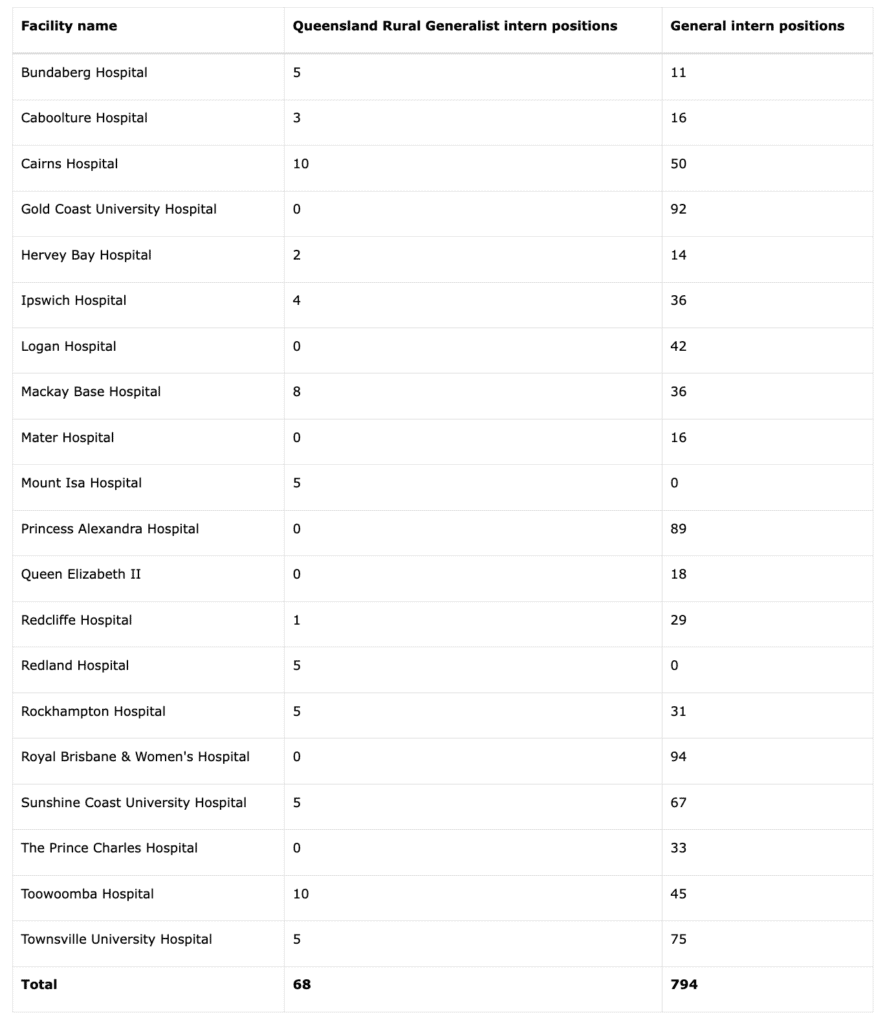
    Intern Numbers = 921 (including 68 rural generalist intern positions)
    Annual Salary = $90,141
    Length of Contract = 1 year
    Professional Development Allowance = nil for Interns but $2,640 for RMOs
     
    Queensland has possibly the most complex internal allocation system of all jurisdictions. With a number of pathways and a combination of allocating certain priority groups and merit selection for others.

    The Queensland Department of Health coordinates the annual campaign to recruit interns for positions in Hospital and Health Services across the state. There is only one method of application for the intern campaign – the lodgement of an online form via a central application portal.

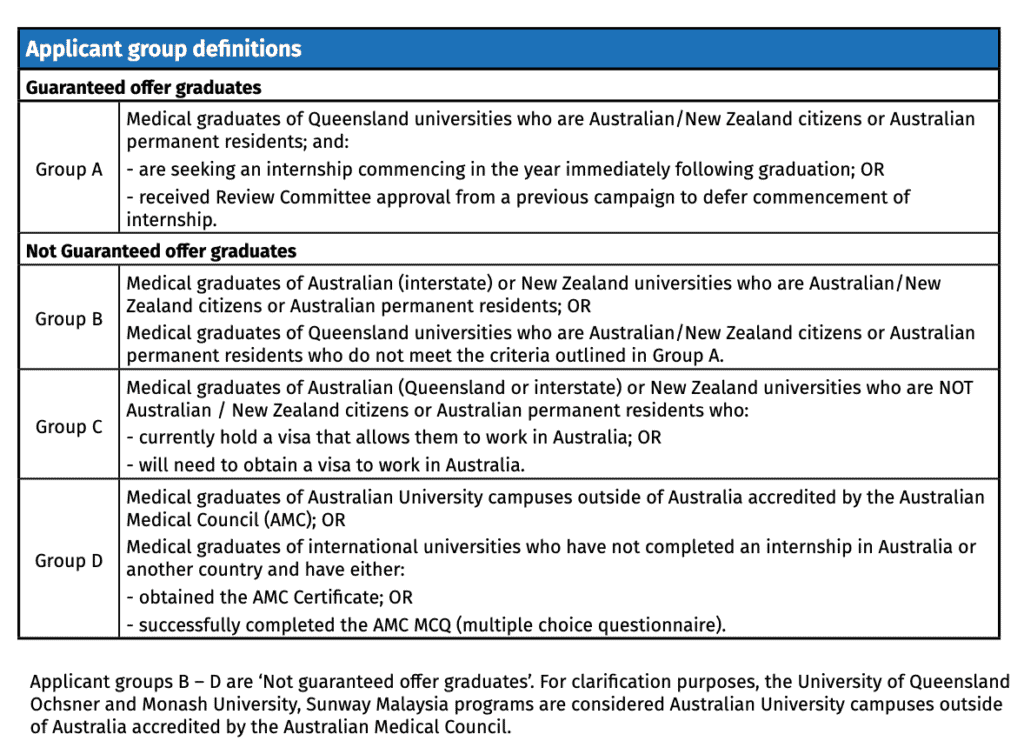
    Graduates assign a preference to all participating hospitals from highest to lowest (number 1 being the most preferred hospital). From the applications received via the campaign, graduates are either directly allocated to an intern position determined by their preferences (Group A) or will participate in a suitability assessment process conducted by participating hospitals with remaining intern vacancies (Applicant Groups B-D).

    The online portal is used for both the General intern campaign applications and the Queensland Rural Generalist Pathway (QRGP pathway). Applications for the QRGP are submitted first (usually in early March), followed by the General campaign (usually in May).

    So, by the time you are reading this post, if you were thinking of applying for the Queensland Rural Generalist Pathway you have missed your opportunity for 2026.

    Interns can be allocated to one of 20 Employment Hospitals.
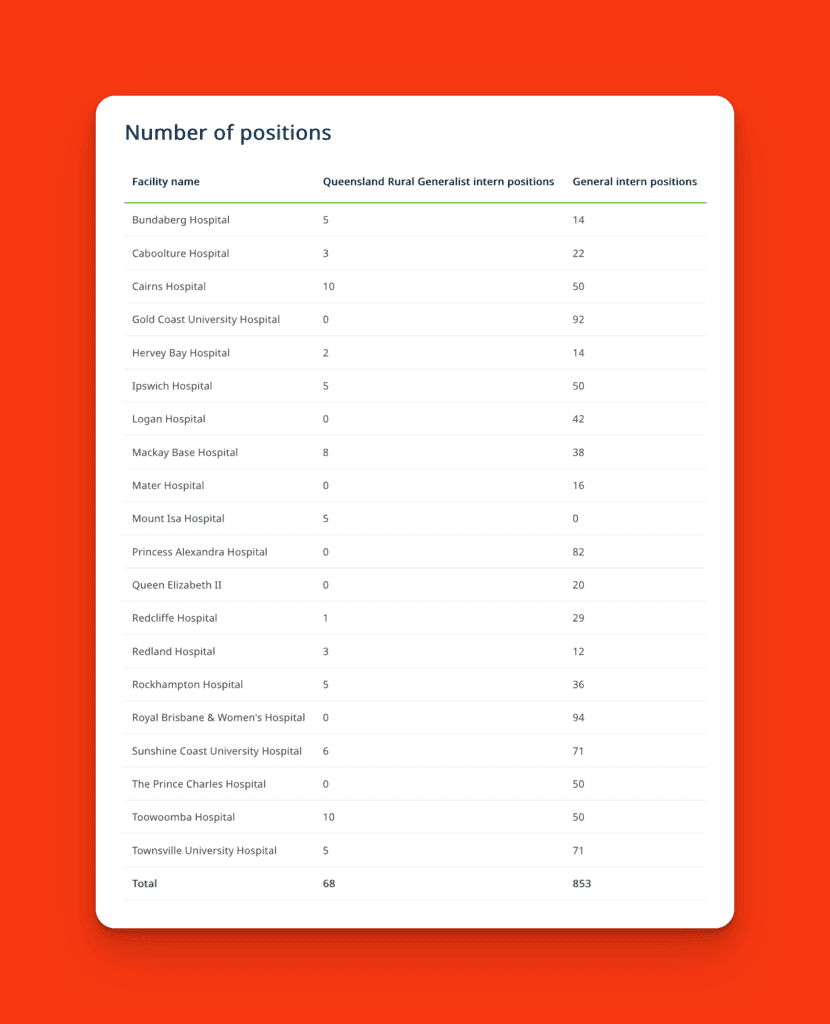
    c/- Queensland Health

    Applicant Categories

    In Queensland, intern applicants are classified into two categories:

    Guaranteed offer graduates – Medical graduates who are guaranteed an offer of an intern position in Queensland within their immediate postgraduate year. Allocation to an intern position may be automatic or via random ballot, based on hospital preferences nominated by the individual in their intern application form. (For eligible applicants – see Group A).

    Not guaranteed offer graduates – Medical graduates who are not guaranteed an intern offer. A suitability assessment process is undertaken to determine if an offer of an intern position will be made. (For eligible applicants – see Groups B-D). There is no inherent prioritisation across applicant groups, the categorisation of groups are used for reporting for the intern campaign. Each participating Hospital and Health Service establishes suitability assessment processes to recruit from their available applicant pool and are not obligated to sequentially select through the applicant groups. Applicants who do not meet the outlined criteria for Groups A, B, C or D may be considered at the discretion of each participating hospital.
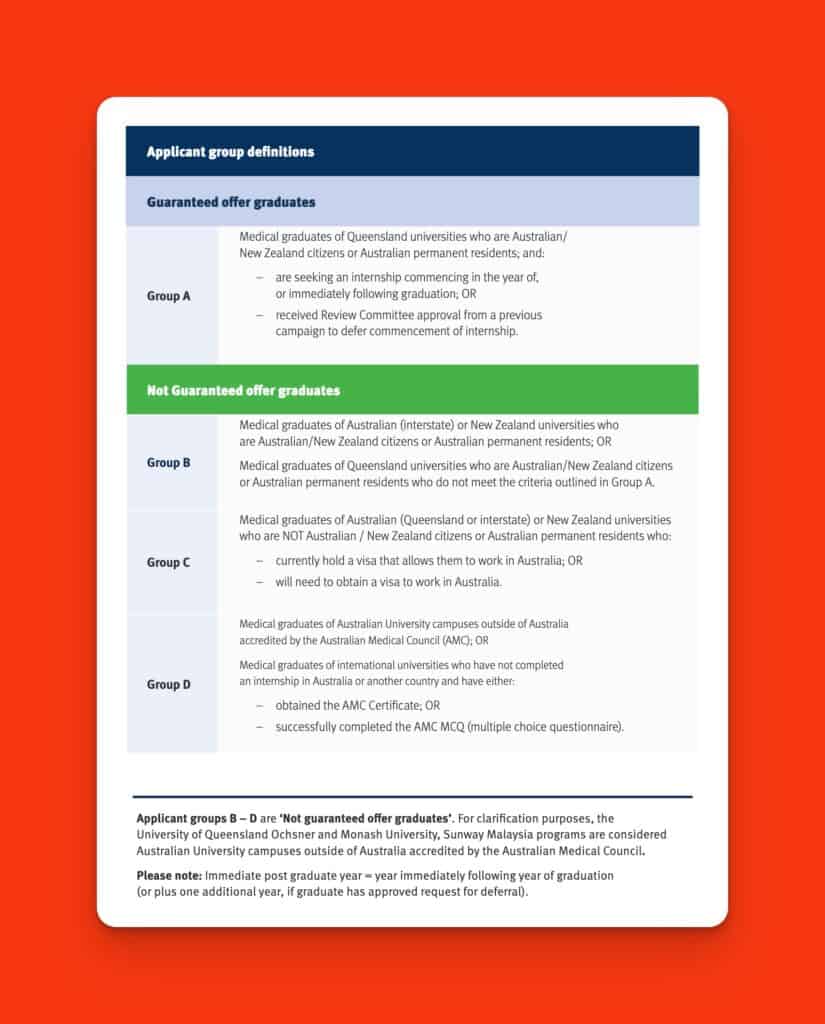
    c/- Queensland Health

    Note: Queensland is one of the few jurisdictions that offer an opportunity for IMG doctors to complete an internship in Australia. The number of doctors who are successful in doing so each year is rarely more than a handful.

    Internship pathways

    There are 4 pathways for Intern Allocation in Queensland.

    1. The Rural Generalist Program offers an opportunity to select a rural hospital centre as part of a program that is a pathway to working as a Rural GP. Applications open 4th March and close extremely early (18th March) for this pathway.
    2. Aboriginal and Torres Strait Islander Intern Allocation Initiative. The purpose of the initiative is “to promote the success of Aboriginal and Torres Strait Islander medical graduates in the Queensland Health workforce”. Eligible applicants can apply to the Aboriginal and Torres Strait Islander Intern Allocation Initiative to be allocated to their first preferenced hospital. Applications are reviewed by a panel that includes Aboriginal and Torres Strait Islander representation. Applicants who have been confirmed as eligible by the panel will be exempt from the ballot process and allocated to the facility nominated as first preference in their intern application.
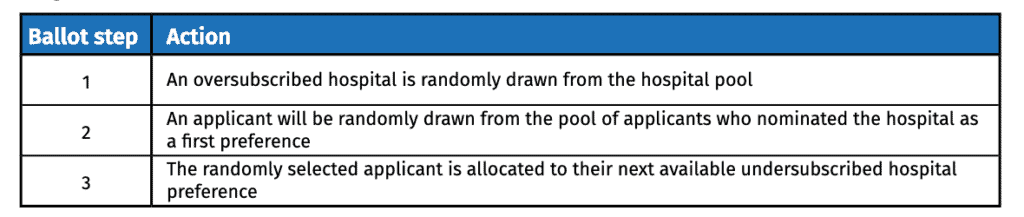
    3. The General Intern Campaign. Which is a ballot process for all category A applicants.
    4. Suitability assessment for applicants in Group B-D.

    The General Intern Campaign Allocation Process.

    After the application period has closed, applications are sorted according to their applicant groups, preferences, and available positions at each facility.

    Prior to the ballot taking place a Review Committee considers applications for:

    • requests for special considerations
    • exemption requests
    • joint ticket applications
    • deferral requests

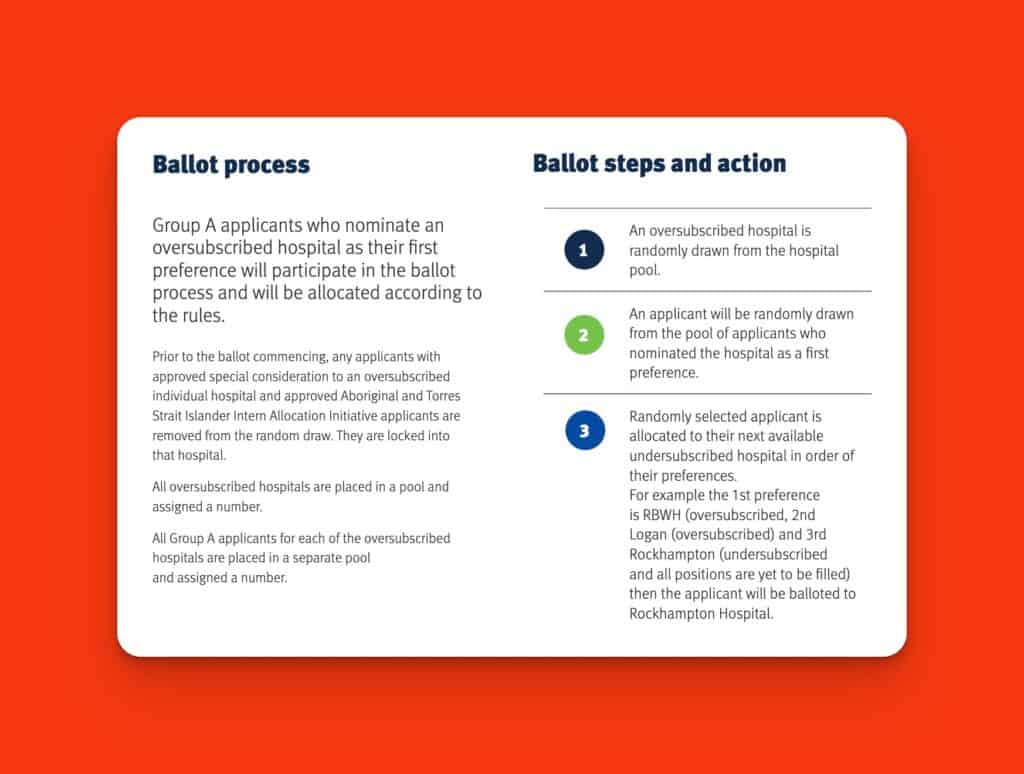
    After this the ballot commences.
    c/- Queensland Health

    Applicant Group A candidates who nominate an undersubscribed’ or equal in numbers hospital as first preference will automatically be allocated to that facility.

    Applicant Group A candidates who nominate an ‘oversubscribed’ hospital as their first preference may be allocated to another facility via the ballot process.

    Merit Selection for Groups B-D.

    There is no inherent prioritisation across applicant groups, the categorisation of these groups are used for reporting for the intern campaign. Each participating Hospital and Health Service establishes individual assessment processes to merit select from their available applicant pool and are not obligated to sequentially select through the applicant groups. Applicants who do not meet the outlined criteria for Groups A, B, C or D may be considered at the discretion of each participating hospital.

    Following the completion of first-round offers, the Position Status Report (PSR) is updated.

    This is an updated list of available positions remaining.

    Applicant group B-D candidates have 48 hours to change their preferences if they wish to.

    Queensland Health hospitals then assess applications and conduct their own meritorious selection processes. You should contact each Hospital and Health Service directly to find out what they look for in an intern.

    If vacancies become available after the First and Second Round offers, individual hospitals will meritoriously select from the remaining applicants for available vacancies. Recruitment to fill available vacancies will continue until the national closing date for intern recruitment. After the closing date, any further vacancies that arise will be filled via the Late Vacancy Management Process (LVMP).

    Western Australia

    Perth City Scape

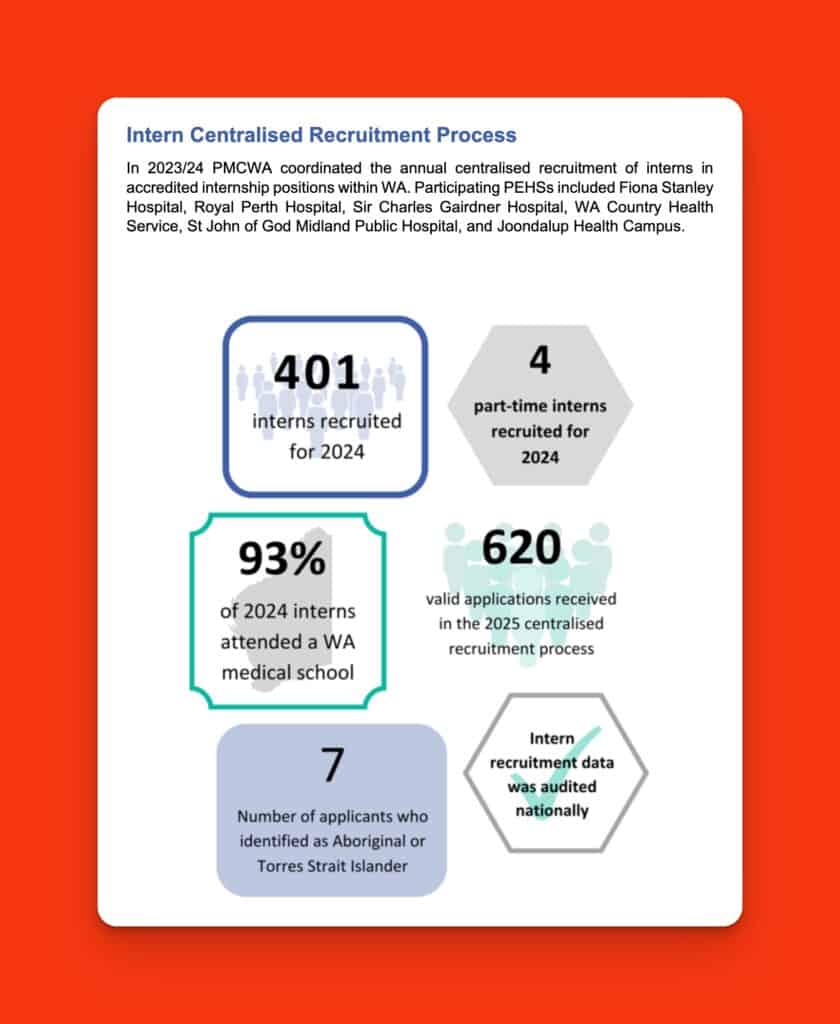
    WA Health and the PMC of WA have previously indicated that they can not make Intern numbers available, as these are subject to confirmation by the Primary Employing Health Services.

    Estimated Numbers ≅ 401 including 25 Country Health places (based on 2023/2024 PMCWA Annual Report)
    Annual Salary = $90,864 ($119,165 if working for Country Health)
    Length of Contract = 3 years (in most cases, St John of God Midland = 2 years) with the ability to transfer to a different PEH if all internship requirements are met (IMGs may have shorter contracts tied to their visa status)
    Professional Development Allowance = $6,503

    c/- PMCWA

    Western Australia Intern Eligibility and Priorities

    In Western Australia applications that meet all eligibility criteria, and all essential criteria are included in the suitable recruitment pool. Once in the suitable pool, selection and recruitment decisions are made by the primary employing hospitals. 

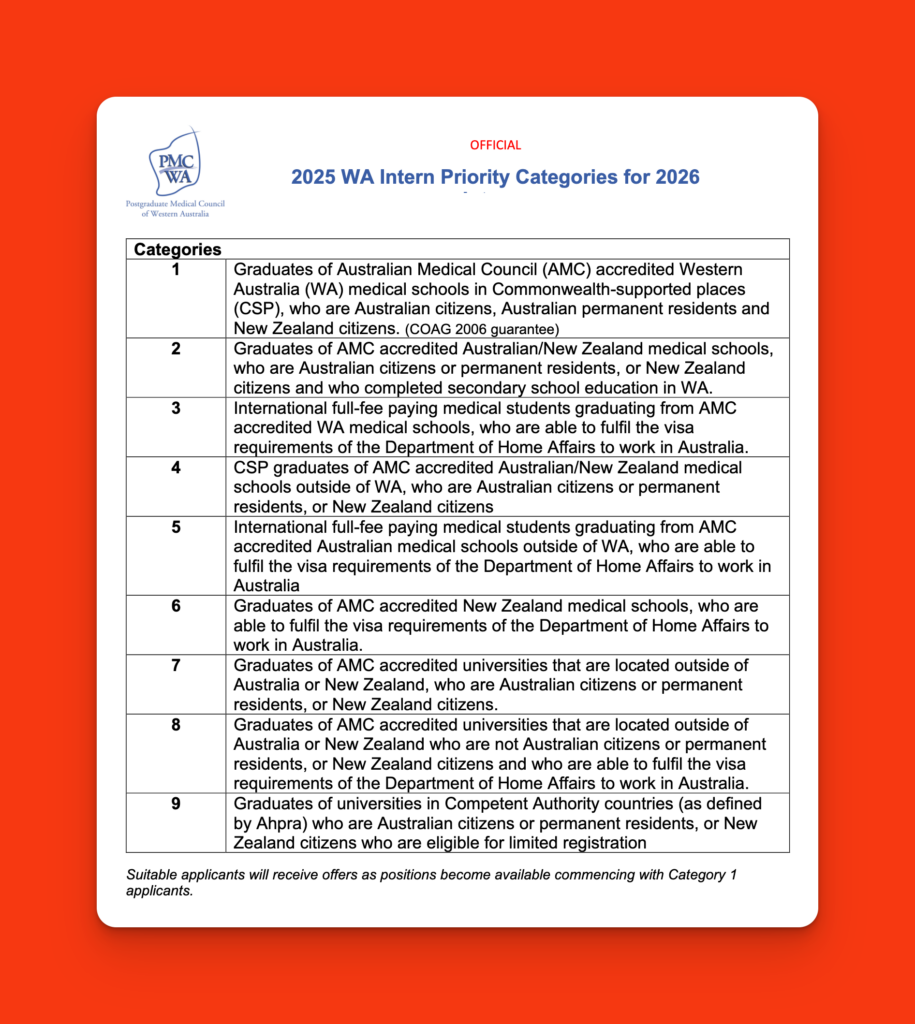
    As with all other Australian jurisdictions, priority is given to Commonwealth funded medical students graduating from Western Australia. This is then followed by Western Australians graduating from interstate universities who want to return to WA; international medical students graduating from WA medical schools; then graduates from other jurisdictions (other than WA). The priority then shifts to international medical graduates from outside of Australia.

    Most notably, Western Australia has a final Category, Category 9, for graduates of universities in Competent Authority countries (as defined by Ahpra) who are Australian citizens or permanent residents, or New
    Zealand citizens who are eligible for limited registration. Presumably this is to permit Australian students who choose to study in countries such as the UK or Ireland to commence their internship in Australia. How they qualify for this is unclear, as technically, without any overseas experience they are not eligible for the Competent Authority pathway. It appears that they would have to sit and pass the AMC Part 1. Practically this probably means taking a risk and sitting out internship for 6 months to a year, because you can only sit the AMC Part 1 after you graduate from medical school.
    c/- PMCWA

    Vacancies arise as offers are declined throughout the process, and these vacancies fluctuate each year and will affect how many students outside of WA are offered an intern position. 

    Western Australia is one of the few options for IMGs to do an Internship in Australia, although as you can see from the above, it is quite limited.

    In WA all interns are employed by a Primary Employing Health Service (PEHS). 

    In WA all interns are employed by a Primary Employing Health Service (PEHS) accredited by PMCWA. Each PEHS is a major tertiary hospital in WA which has been accredited to directly employ interns and provide a high quality intern training program.

    The six PEHSs in WA are:

    All six WA Health PEHS recruit through the Centralised Intern Application Process. Each PEHS holds an information session during the application period, with presentations from the Medical Education teams, current interns and more.

    Following the close of applications in the centralised application process, PMCWA reviews all applications and creates a pool for all suitable applications. Applications appointed to the pool are grouped and managed according to the applicable priority category. As positions become available and selection processes are completed, applicants will be offered positions according to category.

    Each PEHS is a major tertiary hospital in WA that has been accredited to directly employ interns and provide an intern training program.

    Employing Health ServiceMetro PlacementsRural Placements
    Fiona Stanley Fremantle Hospitals Group (Fiona Stanley Hospital)Fiona Stanley Hospital
    Fremantle Hospital
    Rockingham General Hospital
    Albany Health Service
    Broome Regional Hospital
    Northam Health Service
    Joondalup Health CampusJoondalup Health CampusKalgoorlie Regional Hospital
    Royal Perth Bentley Group (Royal Perth Hospital)Royal Perth Hospital
    Armadale Health Service
    Bentley Hospital
    Osborne Park (Women and Newborn Service)
    Perth Children’s Hospital
    Bunbury Hospital
    Hedland Health Campus
    Kalgoorlie Regional Hospital
    Sir Charles Gairdner Osborne Park Health Care Group (Sir Charles Gairdner Hospital)Sir Charles Gairdner Hospital
    Graylands Hospital
    Hollywood Private Hospital
    Joondalup Health Campus
    Osborne Park (Women and
    Newborn Service)
    Perth Children’s Hospital
    Geraldton Regional Hospital
    Hedland Health Campus
    Karratha Health Campus
    St John of God Health Care (St John of God Midland Public Hospital)St John of God Midland
    Public Hospital
    St John of God Subiaco
    Hospital
    St John of God Murdoch
    Hospital
    WA Country Health ServiceAlbany Health Campus
    Broome Regional Hospital
    Bunbury Hospital
    Geraldton Regional Hospital

    Each PEHS hosts an information night. You can also choose to work as a rural intern by applying to work through Western Australia Country Health Service.

    The intern application process is coordinated by the Postgraduate Medical Council of Western Australia but you apply through the WA Jobs site called MedJobsWA. You submit one application and rank each PEHS from most to least preferred. Selection occurs through panels representing each of the PEHSs. As part of your application, you need to provide a CV (maximum 3 pages) and cover letter (optional) and address the intern selection criteria, you will require a range of other documents as well as nominate 2 referees. If successful you will normally receive a contract for 3 years, which provides you with job security.

    South Australia

    The River Torrens in the city of Adelaide

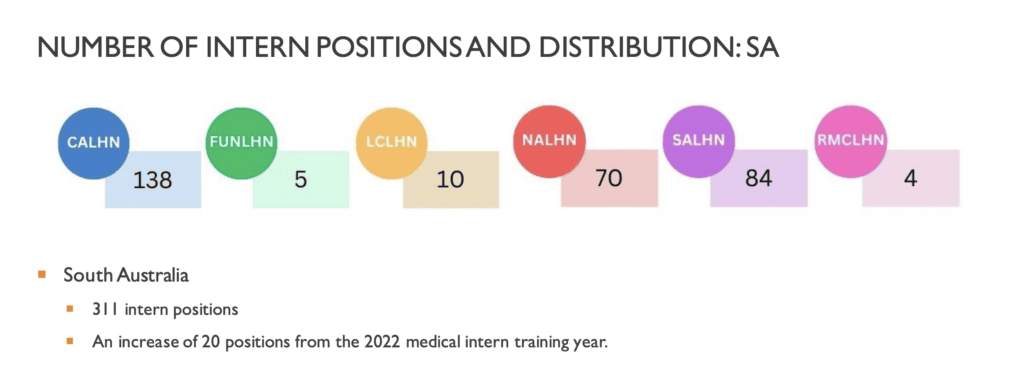
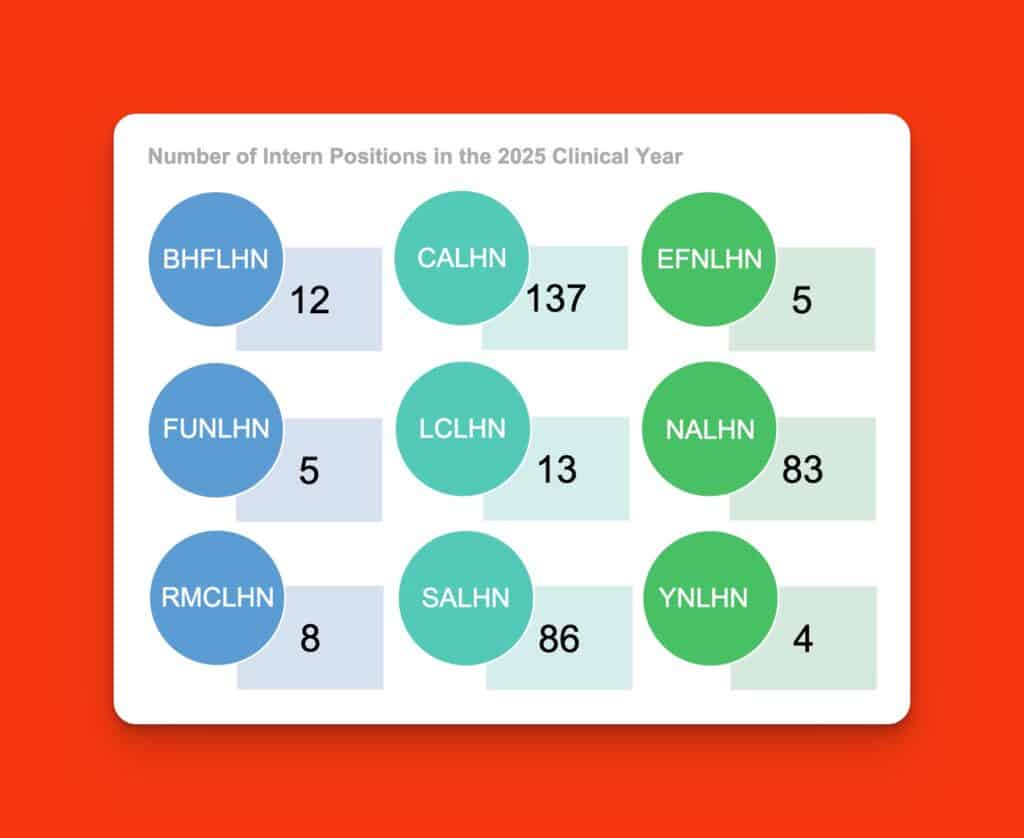
    Estimated Numbers = 353 (based on 2025 final positions, including 47 rural intern posts)
    Annual Salary = $81,814
    Length of Contract = 3 years in most cases (IMGs may have shorter contracts tied to their visa status)
    Professional Development Allowance = $4,500 per annum

    SA MET (South Australia Medical Education and Training) conducts the annual Intern application process in South Australia. There are 3 Adelaide-based Local Health Networks and 3 smaller country-based networks to which you can apply for the priority Rural Intern pathway. It should be noted that whatever network you are allocated to you may request or be required to undertake one or more rotations in other networks.

    The Rural Intern Pathway is a strength-based recruitment process for applicants who are interested in undertaking their internship (and potentially subsequent years) in rural hospitals within Country Health SA (CHSA). Rural intern positions provide broad opportunities in unique settings and are best suited for medical graduates with a history of living or working in rural areas or a desire to commence a career in the country. 

    To apply for internship in South Australia, you must comply with the following criteria:

    • Have graduated from a medical school in the last two years (i.e. to start an internship in 2026, you are / were a final year medical student in the 2025 or 2024 cohort).
    • Applicants who completed their medical degree at an overseas university NOT accredited by the Australian Medical Council (AMC) must have completed both Part 1 and 2 of the Australian Medical Council exams.
    • Can demonstrate that you meet the English Language Skills Registration Standard.
    • Be able to commence on the January start date, which includes compulsory orientation, and fulfil the minimum 12-month contract.
    • Have completed electronic medical record (Sunrise EMR and PAS) medical student training.
    • Be able to demonstrate that you will meet the requirements for registration with Ahpra.
    • Have NOT commenced or completed an internship or worked as a doctor before.
    • Be an Australian Citizen, Australian Permanent Resident, Australian Temporary Resident, New Zealand Citizen or New Zealand Permanent Resident.
    • Have a visa that allows you to work unrestricted in Australia for the duration of your internship.
    • Applicants completing their medical degrees in Australia who are on a student visa will need to obtain an appropriate Australian work visa before commencing their intern year (refer to page 33).
    • Have completed and submitted an online application, including the provision of valid supporting documentation, by the application closing date.
    C/- SAMET

    Barossa Hills Fleurieu Local Health Network (BHFLHN)

    Central Adelaide Local Health Network (CALHN)

    Eyre and Far North Local Health Network (EFNLHN)

    Flinders and Upper North Local Health Network (FUNLHN)

    Limestone Coast Local Health Network (LCLHN)

    Northern Adelaide Local Health Network (NALHN)

    Riverland Mallee Coorong Local Health Network (RMCLHN)

    Southern Adelaide Local Health Network (SALHN)

    Yorke and Northern Local Health Network (YNLHN)

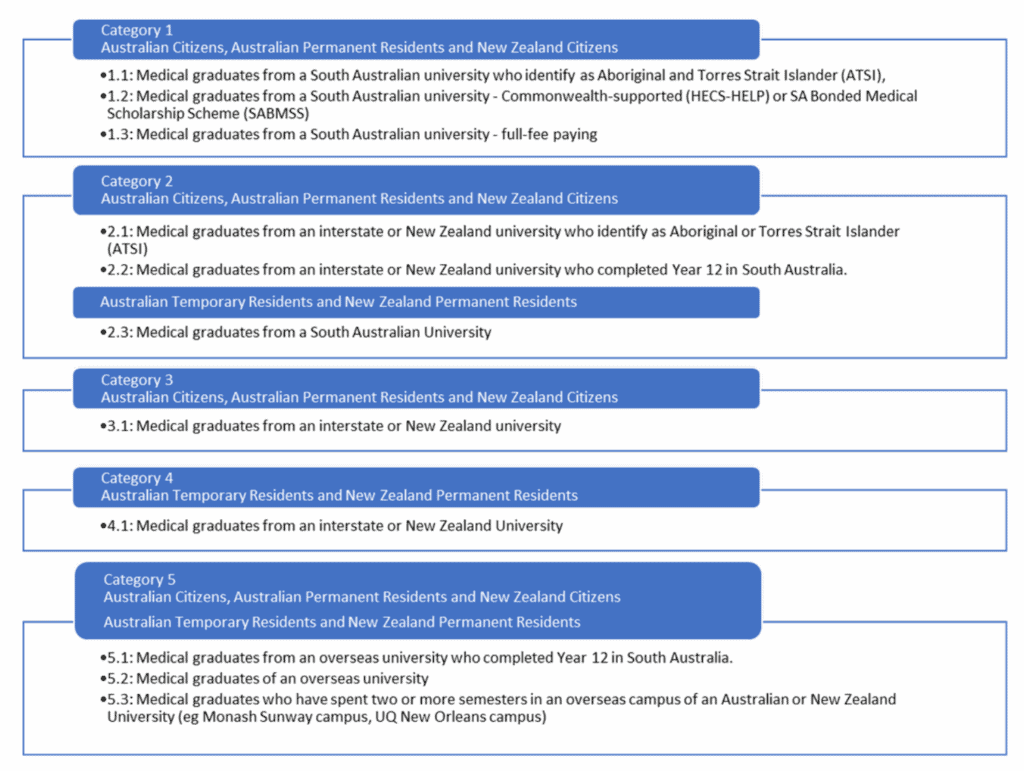
    SA Intern Priorities:

    Like most other jurisdictions, South Australia prioritises its medical graduates first, then graduates from other States and Territories. International Students are given lower priority than Australian Citizens, Australian Permanent Residents and New Zealand Citizens.

    Aboriginal and Torres Strait Islander applicants are given priority preference by being placed in the first subcategory for categories 1 and 2.

    International Medical Graduates from non-Australian medical schools can apply for the rural intern pathway so long as they have only graduated in the last 2 years and have completed the AMC Part 1, and can meet the other requirements (which are extensive) and include meeting the Medical Board English language requirements, completing electronic medical record training and have residency status or a visa that allows you to work unrestricted. They must also not have commenced or completed an internship.

    International Medical Graduates from non-Australian medical schools can also apply for the main round but in this case must have completed both AMC Part 1 and Part 2.

    Rural Intern Pathway

    Applications for the Rural Intern Pathway are included in the standard South Australian application for internship.

    All applicants are asked to preference all eight rural networks as well as the three metropolitan health networks.

    Eligible applicants wishing to apply for the Rural Intern Pathway must preference a rural site as their FIRST preference. Rural Intern Pathway applicants who preference a rural LHN as their first preference are asked additional questions within their application form. And must participate in interviews conducted by a selection panel from the rural LHNs.

    SA Health determines which applicants will receive rural internship offers using a preference matching process and the ranked list provided by the LHNs.

    The placement of applicants into rural intern positions will occur prior to the placement of applicants into metropolitan intern positions. SA Health will match applicants to specific rural LHNs as instructed.

    Internship Categories

    Within the respective South Australian category groups, applicants are randomly allocated to their highest possible Local Health Network preference.
    If an offer is made, applicants must respond via the electronic application system within the specified timeframe. Where an applicant has been made an offer and no response received, the offer will be automatically declined. Applicants are only eligible to receive one offer for an internship in South Australia.

    South Australia is one of few States that specifically permits medical graduates from other countries to apply for internship positions. But they are at the very bottom of the priority list. Please see the above information about the rural internship.

    In addition to a CV and referees, in order to apply for an internship in South Australia, you will need to provide a certificate confirming that you have completed the SA Health online electronic medical record (Sunrise EMR & PAS) training.

    Tasmania

    Hobart in Australia

    Estimated Number  = 106
    Annual Salary = $87,000
    Length of Contract = 1 year (attempting to confirm if this has become 2 years)
    Professional Development Allowance = nil for Interns but RMOs get an allowance of $2040 per annum

    Internships are coordinated in Tasmania via the Department of Health and Human Services.
     
    All applicants are required to apply online. As part of your application, you are asked to preference all of the 3 available sites:

    SiteNumber of Positions
    North (Launceston General Hospital)39
    South (Royal Hobart Hospital)48
    North-West (North-West Regional Hospital Burnies and Mersey Community Hospital, Latrobe)19

    Rural Option

    You can also preferentially apply for one of 5 places on the Tasmanian Rural Generalist Program. You will be allocated to one of the above sites based on your preference but also undertake a 13-week rural GP placement as part of your internship.

    Applying


    Applicants must be graduates of or graduating from an Australian Medical Council-accredited University.  

    All applicants are required to apply online. Only one application is required; you will be asked to indicate your preferred place of employment (Hobart, Launceston, North West Region) via the application form.  Applicants must list each site in order of preference.

    The online application form ensures all the information required to assess your application is provided. The form includes information on eligibility to work in Australia and details on how to submit electronic reference requests.

    The online application form requires you to include your University Student Number and your Australian Health Practitioner Regulation Agency (AHPRA) Intern Placement Number.

    Candidates are required to attach a CV/Resume and any other relevant information to their application.

    A written statement addressing the selection criteria is NOT required. 

    Intern Placement Priorities:

    The Tasmanian Department of Health currently gives priority, in order, to:

    1. Australian permanent resident Tasmanian-trained Australian Government supported and full-fee paying medical graduates.
    2. Australian temporary resident Tasmanian-trained full-fee paying medical graduates.
    3. Australian permanent resident interstate-trained Australian Government supported and full-fee paying medical graduates.
    4. Australian temporary resident interstate-trained full-fee paying medical graduates.
    5. Medical graduates of an Australian Medical Council-accredited overseas University.

    Selection

    The Tasmanian Department of Health will conduct a ballot-based allocation system for placing Priority 1 (Australian permanent resident Tasmanian-trained Australian Government supported and full-fee paying medical graduates) and Priority 2 (Australian temporary resident Tasmanian-trained full-fee paying medical graduates) applicants.

    It is not clear at this stage how further positions are filled according to the remaining priorities.

    Northern Territory

    ocean coast in Darwin, Northern Territory Australia

    Intern Numbers = 88
    Annual Salary = $90,150
    Length of Contract = 1 year
    Professional Development Allowance = $3,601 per annum with the option to apply for an additional $3,000 or $3,000 for HELP relief.

    The NT Prevocational Medical Assurance Services (PMAS) conducts a central review of eligible applicants and all intern positions are allocated within the two NT Health Services:

    • Top End Health Service (TEHS) – based upon Royal Darwin Hospital (RDH) (64 posts)
    • Central Australia Health Service (CAHS) – based upon Alice Springs Hospital (ASH) (24 posts)

    Each Health Service has a primary employing health service as well as additional placement hospitals as per below:
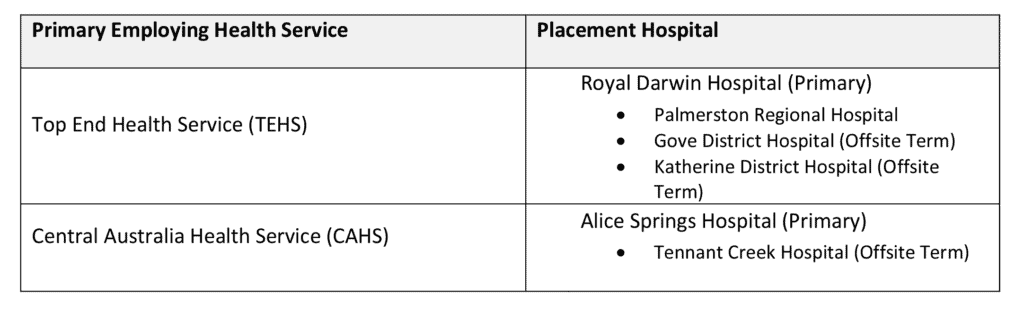
    C/- NTPMAS Guide

    Eligible applicants are allocated intern positions in line with the Northern Territory category groups. Within the relevant category groups, applicants are allocated to their highest possible Health Service preference, pending the availability of a position.

    Intern Priority Categories:

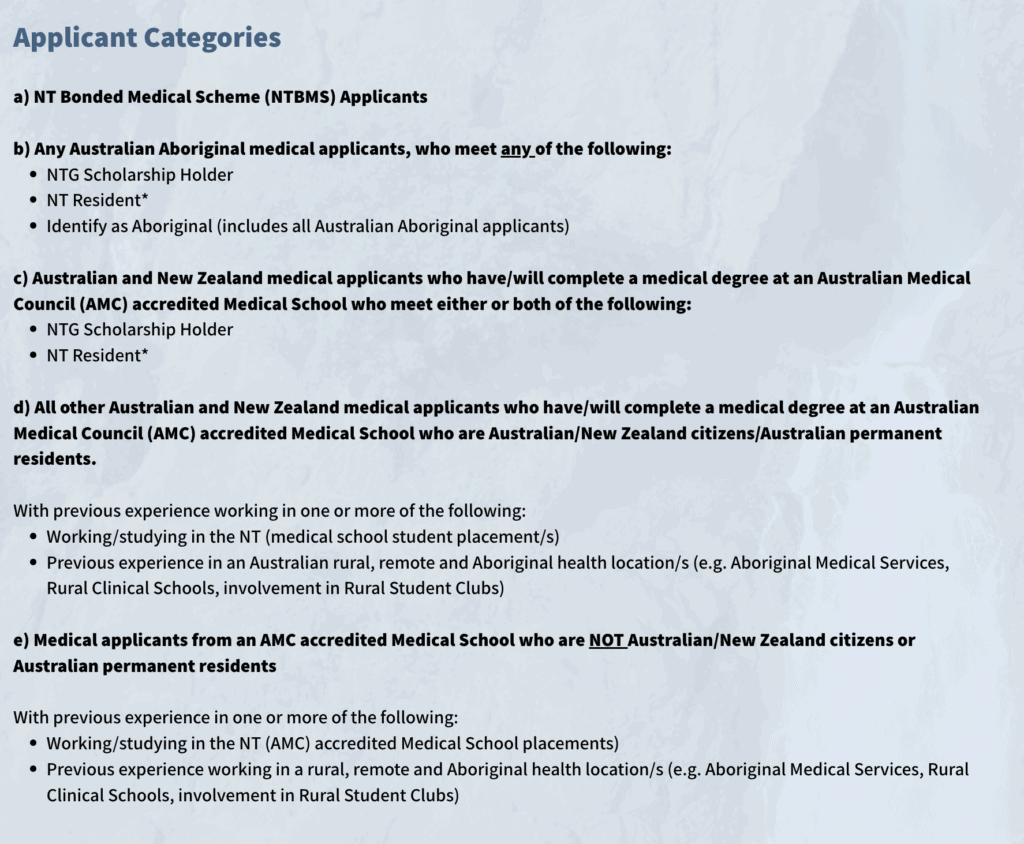
    According to the NTMETC the applicant eligibility categories in order of selection for Internship in the Northern Territory are:
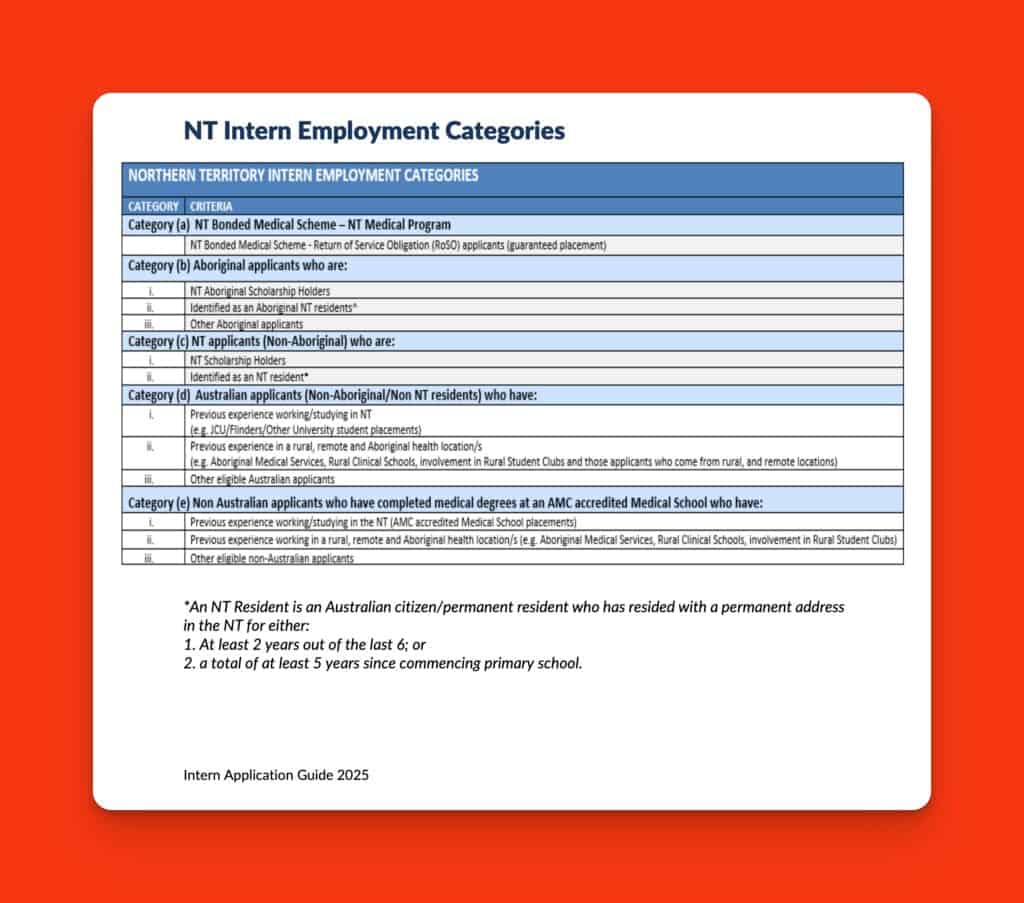
    c/- NTMETC

    Previously there was an F and G category that provided an option for IMG doctors. It is not clear whether this has been removed for the 2023 year.

    As part of your application, you are required to submit a curriculum vitae of no more than 2 A4 pages and address the selection criteria. Applications are submitted to the NT Government employment portal.

    Overall the intern allocation process is based on an applicant’s category group, Health Service preference, and the number of positions available in each health service.

    The two NT Health Services are responsible for selecting applicants and making their offers of employment, applicants are advised via email.  The Health Service responsible for making the offer of employment will after receiving an acceptance from an applicant arrange an employment contract for an Internship position within their health service to be provided prior to commencing their internship.

    Australian Capital Territory

    The Australian War Memorial in Canberra

    Intern Numbers = 96
    (6 of these positions are normally guaranteed to NSW medical students)
    Annual Salary = $86,619
    Length of Contract = 2 years
    Professional Development Allowance = $1,150 per annum + $900 Mobile Allowance + $4,000 Relocation Allowance.
     
    If you want to apply for an internship position in the Australian Capital Territory you do so via the ACT Health Recruitment page.

    Most of your time is spent at the Canberra Hospital. But ACT is interesting as it is one of the few chances you may have as an Intern to work in 2 separate States and Territories. Rotations may include secondments to Calvary Public Hospital, Goulburn Base Hospital, and South East Regional Hospital (SERH) at Bega. Because the ACT utilises some positions in NSW for intern posts there is a reciprocal arrangement whereby a number of NSW graduates are guaranteed an intern post in the ACT.

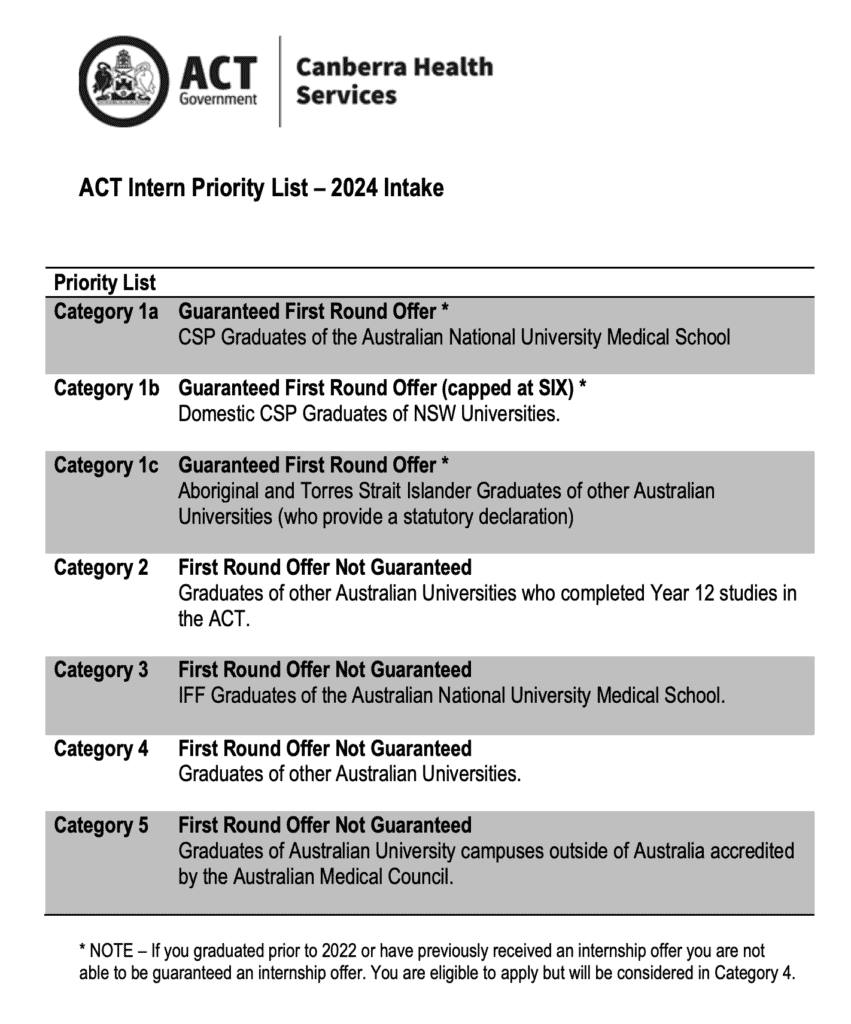
    Priority is given to:
    – Australian Graduates of ANU
    – A maximum of 6 graduates of NSW Universities
    – Graduates of other Universities who completed Year 12 in ACT

    ACT Intern Priority List:
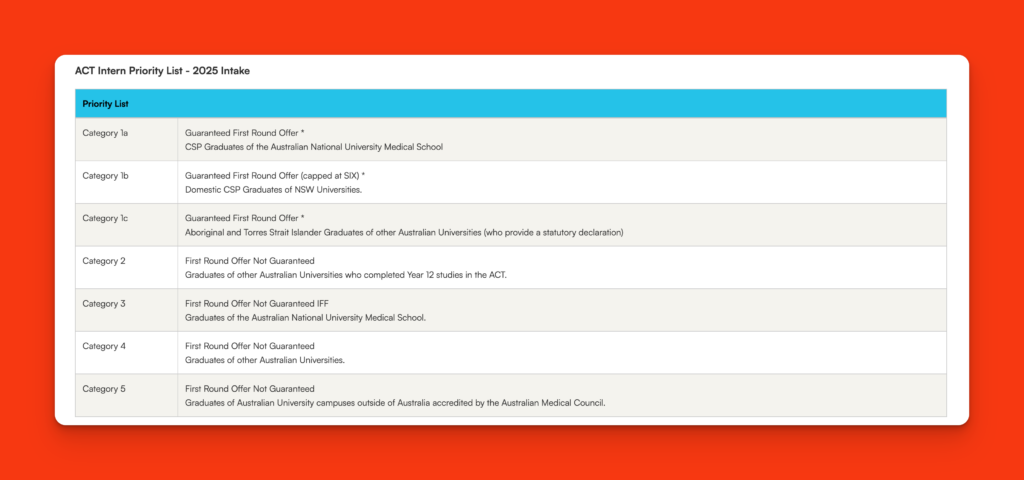
    c/- act.gov.au

    Junior Doctor Training Program (Previously the Commonwealth – Private Hospital Stream)

    2025/2026 Information not yet available

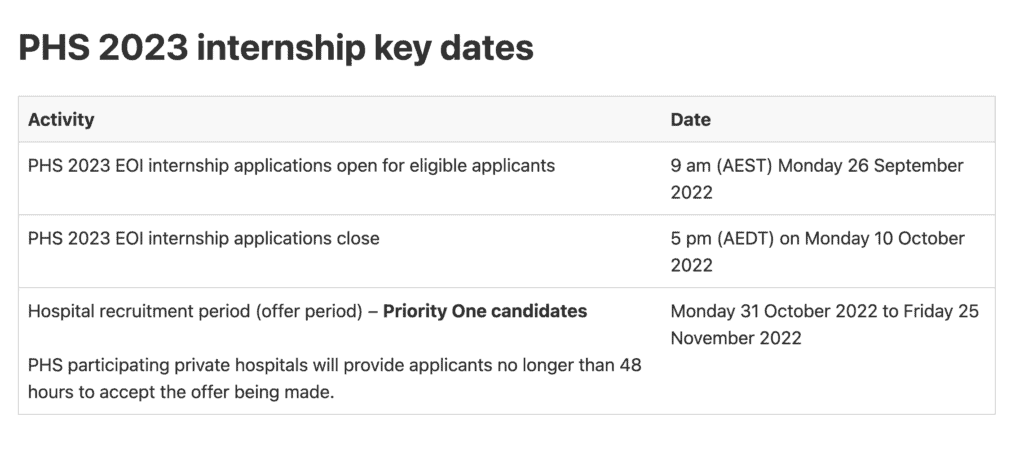
    The Private Hospital Stream (PHS) funds private hospitals to deliver medical internships and support junior doctors to work in expanded settings. It focuses on supporting training for junior doctors in rural, regional and remote areas in Modified Monash (MM) 2 to 7 locations.

    This includes fostering partnerships between private hospital providers, rural public hospitals and other training settings (such as Aboriginal Medical Services) working as part of expanded training networks.

    Annual Salary and conditions should reflect the annual salary for an intern in the State or Territory you are working in.

    Internships and places

    The PHS supported up to 115 internships and up to 80 PGY 2 and 3 eligible junior doctor places in the 2020, 2021, 2022 and 2023 training years.

    Expression of Interest (EOI) internships

    An annual EOI internship process is run for junior doctors to express interest in a PHS-funded medical internship place.

    This process is only for PGY 1-funded places. It opens each year after state and territory governments have offered and filled their internship positions.
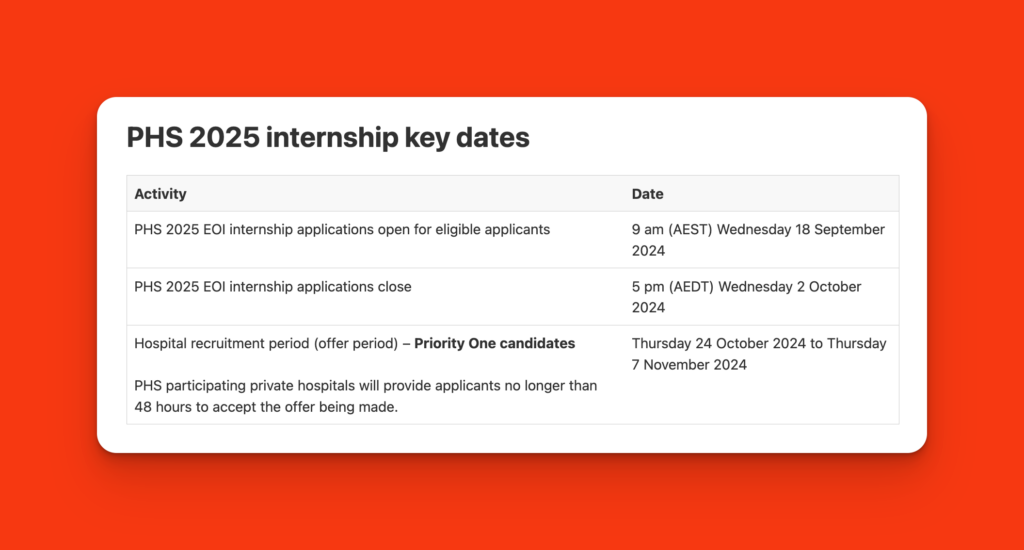
    Eligibility

    The program divides applicants into 2 categories – Priority One and Priority Two.

    Priority One eligibility criteria

    The Priority One category is for final year medical students who meet all eligibility criteria for an internship under the PHS.

    You are Priority One if you:

    • are a full-fee-paying international student completing your medical degree during the current calendar year from a medical school in Australia, having completed all of your medical degree in Australia (university-approved, short-term elective rotations completed overseas are allowed)
    • have met the Medical Board of Australia (MBA) English language proficiency requirements for registration purposes
    • are not an Australian Citizen
    • commit to getting a visa to work in Australia during your internship year.

    Priority Two eligibility criteria

    You are Priority Two if you:

    • have MBA provisional registration as a medical practitioner
    • have met the MBA English language proficiency requirements for registration purposes
    • commit to getting a visa to work in Australia during your internship year.

    Who is not eligible

    You are not eligible to apply for the PHS if you:

    • do not meet the Priority One or Priority Two eligibility criteria
    • have accepted an internship position from a state or territory government.

    Recruitment process

    The recruitment process aligns with the state and territory government recruitment processes and the national audit process.

    Suitable applications are forwarded to the PHS participating private hospitals by the due dates each year.

    The PHS participating private hospitals do eligibility checks. They will contact eligible applicants they want to interview.

    You should not make direct contact with the hospitals.

    Category prioritisation

    PHS participating private hospitals must fill PGY 1 places with Priority One applicants first.

    If there are still places available after the Priority One list is finished, the hospitals can then recruit Priority Two applicants.

    PGY 2 and 3 funded places

    PHS-participating private hospitals make their own recruitment and employment arrangements for PGY 2 and 3 junior doctors. This allows them to meet their own service needs.

    PHS-funded hospitals

    The Commonwealth funded the following private hospitals to deliver the PHS from 2020 to 2025:

    • Mater Misericordiae Limited Queensland through
      • Mater Health Services North Queensland (delivering PGY 1 places)
      • Mercy Health and Aged Care Central Queensland through Mater Private Hospital Bundaberg, Friendly Society Private Hospital Bundaberg, Bundaberg Base Hospital Bundaberg, Mackay Base Hospital Mackay and Mater Misericordiae Hospital Mackay (delivering PGY 1, 2 and 3 places)
    • Greenslopes Private Hospital, Queensland (delivering PGY 1, 2 and 3 places)
    • Calvary Health Care Riverina, New South Wales (delivering PGY 2 places)
    • Mater Hospital Sydney (delivering PGY 1 places)
    • St Vincent’s Private Hospital Sydney (delivering PGY 1 places)
    • MQ Health, New South Wales (Macquarie University Hospital) (deliver PGY 1 places)
    • St John of God Ballarat Hospital, Victoria – Grampians Intern Training Program (delivering PGY 1 places)
    • Ramsay Health Care, Western Australia (Joondalup) (delivering PGY 1, 2 and 3 places).

    How To Decide Where to Apply for Your Internship?

    There are lots of considerations when it comes to putting in your Intern application. Everyone is a bit different. Some graduates feel like they would like to be close to home and family whilst going through their transition to Intern. Others see it as a chance to get away and explore a new place and location. And then others focus on the long-term career prospects of certain locations.

    I think this last consideration is a little overrated for most. You can generally experience a wide range of medicine in your first couple of years of medicine after graduation and there is scant evidence that this affects your prospects of applying for specialty training posts.

    That being said if you have an interest in anything other than Medicine, Surgery or Emergency Medicine as a future career you should probably investigate whether this particular specialty is offered at the hospitals or networks to which you apply.

    Unfortunately, the internship model in Australia is quite antiquated and we have continued to use the experience as a proxy for competency when a large portion of the medical education world has moved on. The result has been the mandating of the 3 core terms for the internship of Medicine, Surgery, and Emergency Medicine. There is really no solid educational basis for this approach and one of the unfortunate outcomes is that all the other specialties get squeezed out and few interns get to experience psychiatry, general practice, obstetrics, paediatrics, pathology etc… which ultimately does have an effect on recruitment to these specialties.

    So the basic message is this. If you are really dead set keen on doing radiology as a career you should try to track down the very few locations that might offer this rotation to either interns or residents.

    Each year the Australian Medical Students’ Association produces a very useful Intern Guide with lots of information about the composition of intern training networks across the country. The 2023 version is not available but here’s a link to the 2022 version.

    Frequently Asked Questions

    Is There Any Restriction On Where I Can Complete My Internship?

    To meet the Medical Board of Australia’s requirements for general registration, an internship can be completed in any state or territory of Australia.

    Can I Apply to More Than One State or Territory for an Intern Position?

    Yes, you will need to apply separately to each state and territory where you would like to work. You will need to complete a separate application for each position, submit the documents, provide the information required and meet the selection requirements. As part of the application process, each state and territory requires you to include your intern Placement Number (IPN).

    What is an Intern Placement Number?

    The Intern Placement Number is a unique nine-digit number that has been generated by the Australian Health Practitioner Regulation Agency (AHPRA) and has been provided to medical schools for distribution to all final-year medical students. If you do not have an Intern Placement Number issued or you have misplaced it, you must contact your medical school to have the number issued or reissued. Do not contact AHPRA. Note: The Intern Placement Number is not your University Student Identification

    I Am Not an Australian Medical Student. How Do I Obtain an Intern Placement Number?

    In this situation, you do not require an IPN and will not be issued one. You can still apply for internships. But unless you are a New Zealand medical student your chances of gaining a place are very very limited.

    What If I Have Special Circumstances Which Make It Hard For Me To Work In Certain Places?

    All States and Territories Have processes for considering special circumstances. Some of the types of circumstances that are generally approved are: where you may have certain health conditions that mean you need to be close to certain hospitals or specialists; where you have dependents, such as young children, and are unable to relocate due to care arrangements; and where you and your partner want to work as doctors in the same location. Generally, requests to stay in certain locations, for reasons such as work commitments of partners or needs of school-aged children are not granted.

    I Have Received My Intern Offer. But I Would Like to Defer It. Is This Possible?

    This will partly depend on how long you wish to defer. If you just wish to defer for a few months. Once you have your offer and are in discussions with your new employer make inquiries. It may be possible to negotiate a later start with your employer. Most employers will generally prefer that you start on time so that you are not out of sync with your colleagues. But there might be some advantage for the employer in you attending orientation but then starting a bit later as it will probably help them to fill out roster gaps. On the other hand. If you wish to defer for a complete year. Then you will need to check the policy of the State or Territory that has provided you with an Intern offer. In some cases (for example Victoria) you will be permitted to defer and your place will be held for you the following year. In most other cases you will need to reapply the following year and check whether your priority status has altered. In most cases, you have the same priority status. But, for example, the ACT no longer guarantees you an internship and you start off at a minimum of Category 4. Also, bear in mind that it is unclear how long you can defer commencing your internship. However, the Medical Board of Australia expects that once you have commenced your internship you will have completed this process within 3 years.

    I am a Doctor With a Medical Degree From Outside Of Australia. Can I Apply For an Internship?

    Unless you obtained your medical degree from a New Zealand Medical School. Then the brief answer to this question is no. I would love to stop there. And I really think you should as well. But there are rare circumstances where you may be able to obtain an internship with a medical degree from outside of Australia. But the Medical Board of Australia strongly advises against this option and so do I. For good reasons. Firstly the whole Australian medical internship system is designed to ensure that Australian medical graduates are able to undertake an internship. Not for overseas graduates. Secondly (and as a result of the first point) it is very rare to be offered the chance. Some States and Territories will not even consider an application from an IMG for an internship. Others will only do so in limited circumstances, for example, the Northern Territory will accept applications from IMGs who may have done a medical student elective or clinical observership in the Northern Territory and who have experience in rural, remote and indigenous health locations. But even then these applicants are at the bottom of the priority list for obtaining an internship. South Australia will accept applications. But again you are bottom of the list. Queensland will also accept applicants, but only if you have never worked as a doctor. And again you are bottom of the list. A final note on this question is that the majority of IMGs who do obtain a medical internship position each year in Australia generally have Australian citizenship or permanent residency.

    I Have Heard That Some Graduates Miss Out On Internships. Is This True?

    Whilst it is theoretically a possibility that some medical graduates miss out on Internships according to annual reports provided by organisations like HETI and the PMCV at the end of intern applications no one is actually left at the end of the process without an offer. In fact, in some circumstances, there are vacant intern positions that are not able to be filled. Only Australian citizens and permanent residents are guaranteed an intern position under the COAG agreement. However, there are generally enough intern positions available for those students who have come to Australia to study medicine and the Commonwealth Private Hospital program offers additional spaces for those that may miss out. That being said. It is also clear that many graduates choose to drop out of the application process themselves. So not everyone who applies gets an offer. The assumption is that some graduates take up similar intern opportunities in other countries upon graduation.

    Can I Submit a Late Application?

    Acceptance of late applications is at the discretion of each state and territory.

    When Will Offers Be Made in 2025?

    All states and territories will commence making offers for Rural Pathways on Monday 14 July 2025 and will commence making offers for all other pathways on Wednesday 16 July 2025.

    What if I Receive More Than One Offer?

    You need to decide where you would like to undertake your internship and accept this position and decline all other positions. You should not hold onto more than one offer as this negatively impacts both the hospital that will have a vacancy if you fail to start work because you have started in another position in another state, and other applicants who would like to work at that hospital who do cannot receive an offer for that vacant position.

    What is the National Audit?

    States and territories share intern applicant information at pre-agreed dates. This data is then used to identify applicants who have applied for and/or accepted intern positions in more than one state/territory. Applicants who have accepted more than one intern position will be contacted by the National Audit Data Manager by phone or email and given 48 hours to withdraw from all intern positions, except the one where they intend to undertake their intern year.

    What if I Don’t Respond to the National Audit Data Manager?

    If you don’t respond to the National Audit Data Manager and/or do not withdraw from all positions except one, the relevant states/territories where you have accepted an offer will be advised and all offers, except for the first offer you received may be withdrawn.

    What is the Late Vacancy Management Process?

    The Late Vacancy Management (LVM) Process runs from Monday 10 November 2025 to Friday 20 March 2026. The process ensures any late vacancies are offered to eligible intern applicants who have not yet accepted an internship position. The Late Vacancy Management Process will be coordinated by the National Audit Data Manager on behalf of states and territories. Please ensure you have updated your contact details if you are going overseas during the Late Vacancy Management Process period. The National Audit Data Manager will send out emails to participants who will need to opt into the Late Vacancy Management Process if they still wish to receive an internship position offer in Australia. Note: if an applicant does not respond to this email, they will no longer be eligible to receive an internship offer and their application will no longer be considered in any Australian jurisdictions.

    Who can participate in the Late Vacancy Management Process?

    The process is open to medical graduates of AMC-accredited medical schools who have applied for and are not holding a 2024 intern position through the Commonwealth or states and territories at the National Close Date for Intern Recruitment. Participation in the LVM is an opt-in process -you must confirm that you want to participate in the LVM by responding to the National Audit Data Manager by e-mail.

    Can International Medical Graduates Apply to Become an Intern in Australia?

    With very few exceptions, International Medical Graduates (IMGs) cannot apply to become an Intern in Australia. Even if you are able to apply your chances of obtaining an intern post are quite low and you should explore other options. This situation is not to be confused with International Students who study for their medical degree in Australia who are eligible to apply. You won’t be able to apply if you have already completed an internship or worked clinically in another jurisdiction. The States and Territories that do allow IMGs to apply are Queensland, South Australia and the Northern Territory as well as Western Australia (for Australian or New Zealand graduates of competent authority medical schools only).

    Can International Students Apply to Become an Intern in Australia?

    International Students who undertake an Australian medical degree are eligible to apply to become an Intern in Australia.

    Can I Swap Intern Posts?

    As a general rule the jurisdictions either do not permit or strongly discourage the swapping of Internship posts. Medical Student bodies regularly lobby for there to be a swap process. Swaps are problematic for a number of reasons. Firstly the jurisdictions have set up processes to try to ensure that the outcome of allocations is as fair as possible to the most number of graduates. So it is generally the case at the end of this process that there are very few legitimate swap arrangements available, i.e. if you find yourself with an Intern post that you are not happy with it is unlikely that there is anyone who will be willing to swap with you as they will probably be happy with their allocation. Secondly, the whole process of swaps causes additional bureaucratic headaches when the jurisdictions are attempting to focus on getting through all of the allocations and providing as many applicants as possible an offer. Thirdly, the ability to swap could place certain applicants in a situation of duress, where they are put under pressure to swap. Fourthly, it is very likely that more than one applicant might want to swap. So it may be seen as unfair to allow swaps when not everyone who wants to swap can.

    Can I Defer my Intern Offer?

    If you are considering taking a year off between graduating and commencing medical school then you will be wanting to explore your options for deferral. The process varies from jurisdiction to jurisdiction. Jurisdictions will not hold onto your internship post for you. You will be expected to reapply the following year. And you will generally be in the same priority category again. For Victoria, you need to apply for a deferral in order to be able to enter the PMCV Match in the following year. You should also be aware that the Medical Board of Australia has specific requirements for registration that limit the time that an individual may defer undertaking their internship in order to obtain registration to 3 years from commencement. After which you may need to seek special approval from the Medical Board of Australia.

    Can I Be Allocated to the Same Spot as My Partner?

    Yes. It does happen. Medical Students do meet and fall in love during their medical school days. Jurisdictions do allow for genuine partners to work in the same facility or network. You may, however, have to compromise a bit in terms of your network preferences as in order to accommodate your request you may need to be matched to a less popular network. Depending on your jurisdiction you will either have to make a joint couple application or apply under special consideration.

    Can I Do My Intern Part Time or Job Share?

    Yes. It is possible to do your Intern in Australia part-time. In general, the hospital networks prefer you do this as part of a job-share arrangement with another part-time Intern. Job share and part-time employment are defined as a person or persons voluntarily seeking to work less than full-time hours. Medical graduates may request to complete their internship on a part-time or job share arrangement through the annual centralised applications. To avoid discrimination you are first allocated your position and then your hospital or network is informed of your request to work part-time. Hospitals and networks are then required to negotiate with you the terms of your employment. Interns must work a minimum of 0.5FTE so that the internship may be completed within a two-year period.

    What If I Have Special Circumstances?

    Every State and Territory has a Special Circumstances or Special Consideration policy. These policies are generally quite strict and generally only cover: – needing to be close to immediate partners and dependents – caring for young or elderly persons – access to specialised medical care. If you are approved for special circumstances you will not necessarily be placed in the hospital or network of your choice. For example, if you are applying in NSW and you have young children and your partner works in Sydney and it is not possible for your partner to relocate, then you will be approved to be allocated to one of the Sydney-based networks.

    (Disclaimer: All information here has been sourced in good faith but things do change so you should always do your own due diligence in such matters, we are providing this information to aid you in your application but take no responsibility for any outcomes)We’d welcome feedback from any Intern programs in relation to the accuracy of the above information.

  • Medical Internship Australia 2025 Clinical Year Application Guide

    Medical Internship Australia 2025 Clinical Year Application Guide

    *We will be regularly updating this post as the various States and Territories update their processes. Where information is not currently available for the 2025 clinical year we have used information from the previous year, i.e. 2024. If you notice anything incorrect please let us know in the comments below.

    It’s time for our well-liked guide on applying for internships in Australia. Wondering how to become an intern in Australia? It’s that time of year when the process of applying for and assigning medical intern positions in Australia gets underway. So, now is the ideal moment to outline the procedure. I managed the largest intern application system in Australia, specifically the NSW Intern application system, for four years. Therefore, I would like to impart some of the insights I gained from that experience to this year’s medical graduates. Wondering how to become an intern in Australia? It’s that time of year when the process of applying for and assigning medical intern positions in Australia gets underway. So, now is the ideal moment to outline the procedure.

    (Disclaimer: All information here has been sourced in good faith but things do change so you should always do your own due diligence in such matters, we are providing this information to aid you in your application but take no responsibility for any outcomes)

    As has been the case in past years the main Intern application and allocation dates are aligned across Australia so that every State and Territory opens and closes their systems at the same time and makes offers at the same times. There are some variations to this in relation to special priority categories in some States and Territories. The key things that all medical graduates should consider in preparing their medical internship application in 2024 year for the 2025 clinical year are as follows:

    • Applications open on 6th May 2024.
    • Applications close on 6th June 2024.
    • Make sure that you have an Intern Placement Number; otherwise, you won’t be able to apply.
    • You should research the application requirements now as there may be some “surprises”. As soon as the application system opens, register or log in and ensure that you have everything you need to complete your application.
    • Understand where you sit on the priority list for any State or Territory you are applying to.
    • If you are required to attend an interview. Ensure you have obtained leave from your medical school requirements to attend.
    • Also, consider whether the interview will be in-person, via phone, or video.
    • Give yourself time to request referees, assemble a Resume, if required, and find other documents you may need.
    • The first National Intern Offer Period commences 15th July 2024.
    • Offers for Rural and other Special Pathways will come out starting from 15th July 2024.
    • The first offers for all other main pathways will come out from 17th July 2024.
    • Generally, you only have 48 hours to accept. So make sure that you have regular access to your email.
    • The National Close Date for 2025 Intern Recruitment is 11th November 2023. After which all remaining vacant intern positions move into the Late Vacancy Management Process.
    • The National Late Vacancy Management Process closes on 21st March 2025
    • Stay in touch with your medical school. you may be worried about completing your degree on time but they are all working very hard with the other institutions to give you the best chance of completion.

    Number of Intern Positions Available Across Australia in 2024

    last updated 30th May 2024

    JurisdictionIntern Numbers 2025Intern Numbers 2024IncreasePopulationInterns per 100K Person**Annual Salary
    New South Wales11621,135.526.5 8,394,70013.8$73,086
    Victoria985960.524.56,865,40014.3$83,331
    Queensland885862235,495,50016.1$87,517
    Western Australia39339032,905,90013.5$82,893 – $109,650***
    South Australia328311171,860,10017.6$81,814
    Tasmania****105105573,30018.4$87,000
    Australian Capital Territory****96951469,20020.5$77,898
    Northern Territory886523252,50034.9$84,975
    Commonwealth Private Hospital Stream115*115varies
    TOTAL4,1574,03911826,821,55715.4
    * indicates based on 2023 Annual Report
    ** From https://www.abs.gov.au/statistics/people/population/national-state-and-territory-population/sep-2023

    ***If allocated to WA Country Health you will receive a higher payment
    ****2024 numbers not yet released

    Key Dates for Internship Applications in 2024 and 2025

    Applications OpenMonday 6th May 2024
    Applications CloseThursday 6th June 2024
    National Offer Period 1 Opens (Rural and Aboriginal and Torres Strait Islander Pathways)Monday 15th July 2024
    National Offer Period 1 – Main OffersWednesday 17th July 2024
    National Offer Period 1 ClosesFriday 2nd August 2024
    1st National Audit of Acceptances and Unplaced ApplicantsTuesday 6th August 2024
    National Offer Period 2 OpensThursday 15th August 2024
    National Offer Period 2 ClosesFriday 6th September 2024
    2nd National Audit of Acceptances and Unplaced ApplicantsTuesday 10th September 2024
    National Offer Period 3 OpensThursday 19th September 2024
    National Offer Period 3 ClosesFriday 18th October 2024
    3rd National Audit of Acceptances and Unplaced ApplicantsTuesday 22nd October 2024
    National Late Vacancy Management Process StartsMonday 11th November 2024
    National Late Vacancy Management Process ClosesFriday 21st March 2025
    C/- HETI

    Tip #1. Your Medical Intern Placement Number.

    The IPN is a unique nine-digit number that has been generated by AHPRA and has been provided to medical schools for distribution to all 2023 final-year medical students. The number is used as part of the national audit process (which ensures that intern positions across the country are made available to as many applicants as possible) as well as to streamline registration.

    This number is not the same number as your AHPRA registration number or student number. If you have not received your IPN you should check with your school.

    If you are not an Australian medical student you won’t be issued an IPN. If you are applying as a non-Australian medical student you do not require an IPN. However, please note that unless you are a New Zealand medical student your chances of gaining an internship are very slim.

    Tip #2. Other Things You Will Likely Need to Become an Intern in Australia. 

    The majority of States and Territories require you to upload an academic transcript as proof that you are indeed a medical student. 

    They will also request evidence that you satisfactorily meet the AHPRA English Language requirements. This may seem a bit ridiculous given that you have been attending medical school in English for the last 4 or 5 years. But it is the law. So check whether you may need to submit an up-to-date English test result or some other form of documentary evidence such as a high school certificate.

    Most States and Territories will also request a CV or Resume. For tips on your CV or Resume see our ultimate guide to CVs or watch a video series about this.

    Some States and Territories have a CV template that they suggest that you use to fill in your information. In the case of Victoria, you are no longer required to use the suggested template (change from last year). It’s probably fairly harmless to use the template for the other States and Territories. But if you are thinking about your future career, then now is a good time to be designing your own CV. The risk of using the template is that you don’t stand out from other candidates.

    You will need to also provide proof of your identity, citizenship, residency, or visa. And if you have had a name change along the way you will probably also need to provide some documentation in relation to this.

    Why All This Information?

    The State and Territory bodies who administer the Intern application process have a responsibility to ensure that you are eligible to apply for provisional registration at the end of the year in order to work as an Intern.  They collect this information to check that everything is in order so that you are indeed eligible to apply. Employers can get rightly annoyed when told that someone who has been allocated to work with them as an Intern will have a several-month delay whilst they resit an English language test.

    However, it’s your responsibility to ensure that you are eligible for registration. So you should also be checking these things yourself. 

    It’s hard to fathom given the amount of communication from health departments, medical schools and student colleagues. But every year there are a handful of medical students who forget to apply for their internship. This means having to wait another year. Don’t let that be you.

    Dr Anthony Llewellyn | Career Doctor

    Tip #3. Research and Apply Early.

    It’s hard to fathom given the amount of communication from health departments, medical schools, and student colleagues. But every year there are a handful of medical students who forget to apply for their internship. This means having to wait another year. Don’t let that be you.

    There are even more students who leave their applications to the last minute. Only to find that they are missing a vital document. For example, this could be evidence you need to substantiate that English is your first language, such as a high school certificate. Or perhaps your last name has changed whilst you have been in medical school? Or maybe you need to submit a CV with your application?

    As soon as the application page opens for each State and Territory you are going to apply to make sure you register. And then go as far through the process of applying as possible so you can see if there is some sort of document you need to obtain.

    Tip #4. Practice Your Interview Technique, Including Video Interview Technique.

    As part of your application to become and Intern in Australia you may need to undertake an interview. This could take the form of a faced to face interview or a video interview. The COVID pandemic resulted in a shift to a preference for video interviewing job applicants in Medicine in Australia. Many employers now see an inherent advantage to this. So you should still be prepared for the fact that this year your interview may be conducted on video.

    There’s a lot more than you think to video interviewing. For a rundown on this check out this recent post.

    Tip #5. Know Where You Sit In The Priority List.

    ts important to know where you sit on the priority list. Each State and Territory has a slightly different order but in essence, it goes something like this:

    1. If you are an Australian Citizen or Permanent Resident and went to Medical School in that State or Territory you are top of the list.
    2. If you are an Australian Citizen or Permanent Resident and went to Medical School in another State or Territory or New Zealand you are probably second.
    3. If you are an international student who studied Medicine in Australia you are probably next.

    Tip #6. Know the Key Dates, including Offer Dates.

    As noted above it’s crucial that you know the key dates. If you miss your application submission date (and it does happen) there is no allowance for a last-minute submission. You also need to make sure you are available to accept your offer. Generally, the window for offer acceptances is quite narrow (often 48 hours).

    For this year the day on which the first round of offers can be made nationally is 15th July 2024 for the rural and other special pathways. The first date that offers can be made to the main group of applicants is 17th July 2024 and most offers will come out on that day. Thereafter there is a series of offer windows for 2nd and 3rd round. In between which there is a mandated pause, which allows the National Intern Audit process to run. This is a system that works to ensure that vacancies are being freed up as soon as possible by highlighting medical students who may have an offer in more than one jurisdiction and ensuring that they accept one offer and decline others.

    The nationally coordinated offer system concludes on 18th October 2024. Technically this is the last date that the Medical Board can guarantee that they will be able to process your registration application in order for you to commence your internship on time the following year in 2024.

    However, there are generally still vacancies after this point and so the National Intern Audit Office switches over to an ad hoc coordinated late vacancy management process from 11th November 2024. This runs up until 21st March 2025, which is around the 1st term to 2nd term changeover for most interns. So it is still possible to commence your internship in 2025 but you might have to finish one or two terms in the following year.

    The National Intern Audit.

    States and territories share intern applicant information at pre-agreed dates. This data is then used to identify applicants who have applied for and/or accepted intern positions in more than one state/territory. Applicants who have accepted more than one intern position will be contacted by the National Audit Data Manager by phone or email and given 48 hours to withdraw from all intern positions, except the one where they intend to undertake their intern year.

    If you don’t respond to the National Audit Data Manager and/or do not withdraw from all positions except one, the relevant states/territories where you have accepted an offer will be advised and all offers, except for the first offer you received may be withdrawn.

    The Late Vacancy Management Process.

    The Late Vacancy Management (LVM) Process runs from Monday 11th November 2024 to Friday 21st March 2025. The process ensures any late vacancies are offered to eligible intern applicants who have not yet accepted an internship position.

    The Late Vacancy Management Process is coordinated by the National Audit Data Manager on behalf of states and territories. So you should ensure you have updated your contact details if you are going overseas during the Late Vacancy Management Process period.

    The National Audit Data Manager will send out emails on Monday 4th November 2024 to participants who will need to opt into the Late Vacancy Management Process if they still wish to receive an offer to be an Intern in Australia.

    If an applicant does not respond to this email, they will no longer be eligible to receive an internship offer, and their application will no longer be considered in any Australian jurisdictions.

    The process is open to medical graduates of AMC-accredited medical schools who have applied for and are not holding a 2025 intern position through the Commonwealth or states and territories at the National Close Date for Intern Recruitment (18th October 2024). Participation in the LVM is an opt in process – you must confirm that you want to participate in the LVM by responding to the National Audit Data Manager by e-mail.

    Priorities Within Priorities.

    Some States and Territories also have priority pathways to ensure that groups such as Aboriginal and Torres Strait Islanders and doctors who wish to work rurally or regionally can obtain their preferred placement early.

    So if you are an International student and like the idea of working rurally, it’s probably a good idea to consider a rural pathway as it will likely boost your chances of gaining an Intern position earlier in the process.

    Further Information on Each Jurisdiction

    New South Wales

    Intern in Australia NSW
    Sydney Harbour Bridge, New South Wales.

    Intern Positions = 1,62 (including 230 rural preferential) across 15 Networks
    Annual Salary = $73,086
    Length of Contract = normally 2 years
    Professional Development Allowance = nil

    The 4 Pathways in NSW


    You have the option of applying through one of 4 pathways:
    – Aboriginal Recruitment Pathway
    – Rural Preferential Pathway
    – Regional Allocation Pathway
    – Optimised (or Main) Pathway

    Only applicants who go through the Rural Preferential Pathway need to submit a CV and attend an interview.  All other pathways are based on applications only. A key advantage of the Aboriginal, Rural, and Regional Allocation Pathways is that you are far more likely to be given your preferred hospital network.

    Can You Stack or Hack the HETI Optimised Pathway?

    Each year the question comes up. Is it possible to hack or game the HETI optimised pathway. If you search enough you will find various reddit threads or blog posts covering this topic by authors purporting to have much greater understanding of mathematics than this author.

    The posts give an outline of how the HETI allocation algorithm works. The algorithm incorporates an annealing component with the purpose of optimizing the outcomes for as many applicants as possible. Hence the name “Optimised Pathway”. It does this not necessarily by allocating everyone to their most preferred network but by attempting to allocate as many people as possible to a higher preference network, therefore, guaranteeing that more applicants get a 1st or 2nd or 3rd preference overall.

    The general gist of the blogs written about hacking the HEIT algorithm is that if you are super keen on a certain NSW network. Let’s call this Network A then you should attempt to put this as your highest preference and then load all of your next higher preferences with networks that are not as popular.

    You can probably already see how this tactic can backfire massively for you.

    There’s a couple of things that can go wrong here.

    First algorithm is more likely to identify you as one of those few applicants that prefer the unpopular Network Z and allocate you there, thereby satisfying the aims of the algorithm.

    Second, you will be stacking your preferences based on historical data that does not reflect the desires of the current applicant cohort.

    And third, if large number of applicants does the same thing then you are probably all going to advantage those applicants that just put down the networks in their actual order of preference.

    Take home message. Don’t try to stack or hack the HETI algorithm.

    c/- HETI https://www.heti.nsw.gov.au/education-and-training/courses-and-programs/medical-graduate-recruitment

    Intern Placement Priorities in NSW:

    Victoria

    Trains leaving the Melbourne CBD passing the Melbourne Cricket Ground

    Intern Numbers = 985
    Annual Salary = $83,331
    Length of Contract = 1 year
    Professional Development Allowance = $65 per week for FT Intern = $3,380


    c/- PMCV


    Internship in Victoria works around a computer matching system that the Postgraduate Medical Council of Victoria administers. The system had a significant overhaul in the previous year.


    The Allocation & Placement Service is a mathematical process that matches the preferences of both candidates and Health Services and is designed to be “impartial and transparent”. 

    Candidates create an account and then register with the Intern match. The second step is to select your preferred services. At the same time, the health services also place preferences. The matching process of successful candidates to positions according to rankings.

    For Victoria, you will need to submit referees as well as a CV. In past years this had to be on the quite unattractive PMCV standardised CV Template. The status of this template has now been downgraded to a “guide”. You don’t have to put a photo on your CV. I would recommend using your own CV template and not include a photo.

    Pre Recorded Video Interviews

    In 2020, Victorian Health Services began the use of video-recorded interviews. This continues for 2024 for certain candidates. The system appears to be being used as an efficient way for certain services or hospitals to review applications without arranging formal interview panel days and for candidates to appear in person.

    The way these interviews work because you are usually allocated a specific time to log into the system. Once you have gone through a couple of orientation steps you are usually given a series of questions and asked to record your answers. Generally, you don’t get a second go if you are not happy and the time is limited. It is vital therefore that you practice before you do your interview and ensure you have optimised your video environment.

    You are able to complete your recording at any time during the specified video interview period. All candidates are required to answer 3 questions. Questions are randomly selected from 3 different question banks. There is one additional question if you are applying for the Regional Pathway.

    Response times are 2 minutes per question. You get one minute to read the question and prepare your answer before recording.

    All health services can use these recordings to rate you along with your CV and referee reports.


    Metro hospitals may conduct live interviews with shortlisted candidates at any time before 3 July. Although I understand many do not and just rely on the candidates’ CV, referees and video interviews.

    Interns can be allocated to one of 22 hospitals and networks. This includes a small number of community-based internships where the focus is more on community-based models of care, including working in primary care and smaller hospitals.

    You can elect to be prioritised for an internship by entering the Victorian Rural Preferential Allocation (VRPA) match. Where you can be allocated to one of 5 rurally based networks. This pathway involves a live interview. First-round offers for VRPA come out on 18th July on the national rural allocation date.

    Intern Placement Priorities in Victoria:

    VRPA Priority Group 1 – Australian citizens or permanent residents and New Zealand citizens graduating from Victorian medical schools including CSP and domestic full fee-paying students (i.e. graduates of University of Melbourne, Monash University, Deakin University and University of Notre Dame: Melbourne & Ballarat Clinical Schools).

    VRPA Priority Group 2 – Australian permanent resident graduates of interstate universities who meet the following criteria:

    • Completed their Year 12 schooling in Victoria; OR
    • Previously lived in rural Victoria (Modified Monash Model (MMM)1 – MM2 classification or higher) and worked in a rural healthcare setting; OR
    • Graduates of the University of New South Wales who have undertaken their last two years of clinical placement at Albury Wodonga Health clinical school.

    As well as Australian temporary residents graduating from Victorian medical schools (i.e. graduates of the University of Melbourne, Monash University, Deakin University and the University of Notre Dame: Melbourne & Ballarat Clinical Schools).

    Priority Group 1 – Australian citizens or permanent residents and New Zealand citizens graduating from Victorian medical schools including CSP and domestic full fee-paying students (i.e. graduates of University of Melbourne, Monash University, Deakin University and University of Notre Dame: Melbourne & Ballarat Clinical Schools).

    Priority Group 2 – Australian temporary resident graduates of Victorian medical schools. As well as Interstate Special Considerations*.

    Priority Group 3 – Australian citizens or permanent residents and New Zealand citizens graduating from interstate or New Zealand medical schools; Australian temporary resident graduates of interstate universities; New Zealand temporary resident graduates of New Zealand universities; Graduates from an overseas campus of an Australian/New Zealand University accredited by the Australian Medical Council (i.e. Monash University, Malaysia or Ochsner).

    *There are a number of special consideration categories available including for significant medical, disability and carer responsibilities. Check with the PMCV directly for this.

    Indigenous Internships

    Both South West Health Care (based on Warnambool) and Melbourne Health have a small number of Internships reserved for Indigenous graduates.

    The Victorian Rural Medical Scholarship Scheme

    The Victorian Rural Medical Scholarship (VRMS) supports career pathways to rural medical practice and assists rural and regional health services to attract, employ and retain medical graduates. The VRMS supports medical students with a commitment to working in rural and regional Victoria by providing financial assistance towards living and tertiary expenses in the final year of their medical degree and into their rural intern year.

    The VRMS is administered by the PMCV on behalf of the Department of Health of Victoria. Scholarships valued at $20,000 each are available to be
    awarded to final year medical students in Victoria. Scholarship recipients are required to commit to a two- year return of service in rural or regional Victoria (within three years from graduating from medical school).

    Queensland

    Story Bridge Brisbane

    Intern Numbers = 885 (including 66 rural generalist intern positions)
    Annual Salary = $87,517
    Length of Contract = 1 year
    Professional Development Allowance = nil for Interns but $2,311 for RMOs
     
    Queensland has possibly the most complex internal allocation system of all jurisdictions. With a number of pathways and a combination of allocating certain priority groups and merit selection for others.

    Queensland Health conducts the annual intern allocation process in Queensland. To apply you will need to use the online portal and upload a range of documents, including a curriculum vitae and referee details. Note: Queensland Health has also produced an unattractive CV template for you to use. But this also has the status of “guide only”, therefore I recommend you use your own.

    Graduates assign a preference to all participating hospitals from highest to lowest (number 1 being the most preferred hospital).

    Interns can be allocated to one of 20 Employment Hospitals.

    c/- Queensland Health

    Applicant Categories

    In Queensland, intern applicants are classified into 2 categories: Guaranteed offer and Not guaranteed offer – see below.

    c/- Queensland Health

    Note: Queensland is one of the few jurisdictions that offer an opportunity for IMG doctors to complete an internship in Australia. The number of doctors who are successful in doing so each year is rarely more than a handful.

    Internship pathways

    There are 3 pathways for Intern Allocation in Queensland.

    1. The Rural Generalist Program offers an opportunity to select a rural hospital centre as part of a program that is a pathway to working as a Rural GP. Applications open 4th March and close extremely early (18th March) for this pathway.
    2. Aboriginal and Torres Strait Islander Intern Allocation Initiative. The purpose of the initiative is “to promote the success of Aboriginal and Torres Strait Islander medical graduates in the Queensland Health workforce”. Eligible applicants can apply to the Aboriginal and Torres Strait Islander Intern Allocation Initiative to be allocated to their first preferenced hospital. Applications are reviewed by a panel that includes Aboriginal and Torres Strait Islander representation. Applicants who have been confirmed as eligible by the panel will be exempt from the ballot process and allocated to the facility nominated as first preference in their intern application.
    3. The General Intern Campaign. Which is a ballot process.

    The General Intern Campaign Allocation Process.

    After the application period has closed, applications are sorted according to their applicant groups, preferences, and available positions at each facility.

    Prior to the ballot taking place a Review Committee considers applications for:

    • requests for special considerations
    • exemption requests
    • joint ticket applications
    • deferral requests

    After this the ballot commences.

    c/- Queensland Health

    Applicant Group A candidates who nominate an undersubscribed’ or equal in numbers hospital as first preference will automatically be allocated to that facility.

    Applicant Group A candidates who nominate an ‘oversubscribed’ hospital as their first preference may be allocated to another facility via the ballot process.

    Merit Selection for Groups B-D.

    There is no inherent prioritisation across applicant groups, the categorisation of these groups are used for reporting for the intern campaign. Each participating Hospital and Health Service establishes individual assessment processes to merit select from their available applicant pool and are not obligated to sequentially select through the applicant groups. Applicants who do not meet the outlined criteria for Groups A, B, C or D may be considered at the discretion of each participating hospital.

    Following the completion of first-round offers, the Position Status Report (PSR) is updated.

    This is an updated list of available positions remaining.

    Applicant group B-D candidates have 48 hours to change their preferences if they wish to.

    Queensland Health hospitals then assess applications and conduct their own meritorious selection processes. You should contact each Hospital and Health Service directly to find out what they look for in an intern.

    If vacancies become available after the First and Second Round offers, individual hospitals will meritoriously select from the remaining applicants for available vacancies. Recruitment to fill available vacancies will continue until the national closing date for intern recruitment. After the closing date, any further vacancies that arise will be filled via the Late Vacancy Management Process (LVMP).

    Western Australia

    Perth City Scape

    WA Health and the PMC of WA have previously indicated that they can not make Intern numbers available, as these are subject to confirmation by the Primary Employing Health Services.

    Estimated Numbers ≅ 393 including 25 Country Health places (based on 2022/2023 PMCWA Annual Report)
    Annual Salary = $82,893 – $109,650 (rates payable differ according to your location and industrial agreement with Country Health doctors receiving higher rates of pay)
    Length of Contract = 3 years in most cases with the ability to transfer to a different PEH if all internship requirements are met (IMGs may have shorter contracts tied to their visa status)
    Professional Development Allowance = $5,984

    c/- PMCWA

    Western Australia Intern Eligibility and Priorities

    In Western Australia applications that meet all eligibility criteria, and all essential criteria are included in the suitable recruitment pool. Once in the suitable pool, selection and recruitment decisions are made by the primary employing hospitals. 

    As with all other Australian jurisdictions, priority is given to Commonwealth funded medical students graduating from Western Australia. This is then followed by Western Australians graduating from interstate universities who want to return to WA; international medical students graduating from WA medical schools; then graduates from other jurisdictions (other than WA). The priority then shifts to international medical graduates from outside of Australia.

    c/- PMCWA

    Vacancies arise as offers are declined throughout the process, and these vacancies fluctuate each year and will affect how many students outside of WA are offered an intern position. 

    So Western Australia is one of the few options for IMGs to do an Internship in Australia. Although you can see from the above it is quite limited.

    In WA all interns are employed by a Primary Employing Health Service (PEHS). 

    In WA all interns are employed by a Primary Employing Health Service (PEHS) accredited by PMCWA. Each PEHS is a major tertiary hospital in WA which has been accredited to directly employ interns and provide a high quality intern training program.

    The six PEHSs in WA are:

    All six WA Health PEHS recruit through the Centralised Intern Application Process. Each PEHS holds an information session during the application period, with presentations from the Medical Education teams, current interns and more.

    Following the close of applications in the centralised application process, all applications are reviewed by PMCWA and a pool created for all suitable applications. Applications appointed to the pool are grouped and managed according to the applicable priority category. Applications appointed to the pool will be offered positions according to category as positions are available and selection processes completed.

    Each PEHS is a major tertiary hospital in WA that has been accredited to directly employ interns and provide an intern training program.

    Employing Health ServiceMetro PlacementsRural Placements
    Fiona Stanley Fremantle Hospitals Group (Fiona Stanley Hospital)Fiona Stanley Hospital
    Fremantle Hospital
    Rockingham General Hospital
    Albany Health Service
    Broome Regional Hospital
    Northam Health Service
    Joondalup Health CampusJoondalup Health CampusKalgoorlie Regional Hospital
    Royal Perth Bentley Group (Royal Perth Hospital)Royal Perth Hospital
    Armadale Health Service
    Bentley Hospital
    Osborne Park (Women and Newborn Service)
    Perth Children’s Hospital
    Bunbury Hospital
    Hedland Health Campus
    Kalgoorlie Regional Hospital
    Sir Charles Gairdner Osborne Park Health Care Group (Sir Charles Gairdner Hospital)Sir Charles Gairdner Hospital
    Graylands Hospital
    Hollywood Private Hospital
    Joondalup Health Campus
    Osborne Park (Women and
    Newborn Service)
    Perth Children’s Hospital
    Geraldton Regional Hospital
    Hedland Health Campus
    Karratha Health Campus
    St John of God Health Care (St John of God Midland Public Hospital)St John of God Midland
    Public Hospital
    St John of God Subiaco
    Hospital
    St John of God Murdoch
    Hospital
    WA Country Health ServiceAlbany Health Campus
    Broome Regional Hospital
    Bunbury Hospital
    Geraldton Regional Hospital

    Each PEHS hosts an information night. You can also choose to work as a rural intern by applying to work through Western Australia Country Health Service.

    The intern application process is coordinated by the Postgraduate Medical Council of Western Australia but you apply through the WA Jobs site called MedJobsWA. You submit one application and rank each PEHS from most to least preferred. Selection occurs through panels representing each of the PEHSs. As part of your application, you need to provide a CV and cover letter and address the intern selection criteria, you will require a range of other documents as well as nominate 2 referees. If successful you will receive a contract for 3 years, which provides you with job security.

    South Australia

    The River Torrens in the city of Adelaide

    Estimated Numbers = 328 (based on 2024 final positions, including 37 rural intern posts)
    Annual Salary = $81,814
    Length of Contract = 3 years in most cases (IMGs may have shorter contracts tied to their visa status)
    Professional Development Allowance = nil

    SA MET (South Australia Medical Education and Training) conducts the annual Intern application process in South Australia. There are 3 Adelaide-based Local Health Networks and 3 smaller country-based networks to which you can apply for the priority Rural Intern pathway. It should be noted that whatever network you are allocated to you may request or be required to undertake one or more rotations in other networks.

    The Rural Intern Pathway is a strength-based recruitment process for applicants who are interested in undertaking their internship (and potentially subsequent years) in rural hospitals within Country Health SA (CHSA). Rural intern positions provide broad opportunities in unique settings and are best suited for medical graduates with a history of living or working in rural areas or a desire to commence a career in the country. 

    To apply for internship in South Australia, you must comply with the following criteria:

    • Have graduated from a medical school in the last two years (i.e. to start an internship in 2025, you are / were a final year medical student in the 2024 or 2023 cohort).
    • Applicants who completed their medical degree at an overseas university NOT accredited by the Australian Medical Council (AMC) must have completed both Part 1 and 2 of the Australian Medical Council exams.
    • Can demonstrate that you meet the English Language Skills Registration Standard.
    • Be able to commence on the January start date, which includes compulsory orientation, and fulfil the minimum 12-month contract.
    • Have completed electronic medical record (Sunrise EMR and PAS) medical student training.
    • Be able to demonstrate that you will meet the requirements for registration with Ahpra.
    • Have NOT commenced or completed an internship or worked as a doctor before.
    • Be an Australian Citizen, Australian Permanent Resident, Australian Temporary Resident, New Zealand Citizen or New Zealand Permanent Resident.
    • Have a visa that allows you to work unrestricted in Australia for the duration of your internship.
    • Applicants completing their medical degrees in Australia who are on a student visa will need to obtain an appropriate Australian work visa before commencing their intern year (refer to page 33).
    • Have completed and submitted an online application, including the provision of valid supporting documentation, by the application closing date.

    Barossa Hills Fleurieu Local Health Network (BHFLHN)

    Central Adelaide Local Health Network (CALHN)

    Eyre and Far North Local Health Network (EFNLHN)

    Flinders and Upper North Local Health Network (FUNLHN)

    Limestone Coast Local Health Network (LCLHN)

    Northern Adelaide Local Health Network (NALHN)

    Riverland Mallee Coorong Local Health Network (RMCLHN)

    Southern Adelaide Local Health Network (SALHN)

    *Yorke and Northern Local Health Network (YNLHN)

    Rural Interns will also be able to work in the Yorke and Northern Local Health Network in 2025

    SA Intern Priorities:

    Like most other jurisdictions, South Australia prioritises its medical graduates first, then graduates from other States and Territories. International Students are given lower priority than Australian Citizens, Australian Permanent Residents and New Zealand Citizens.

    Aboriginal and Torres Strait Islander applicants are given priority preference by being placed in the first subcategory for categories 1 and 2.

    International Medical Graduates from non-Australian medical schools can apply for the rural intern pathway so long as they have only graduated in the last 2 years and have completed the AMC Part 1, and can meet the other requirements (which are extensive) and include meeting the Medical Board English language requirements, completing electronic medical record training and have residency status or a visa that allows you to work unrestricted. They must also not have commenced or completed an internship.

    International Medical Graduates from non-Australian medical schools can also apply for the main round but in this case must have completed both AMC Part 1 and Part 2.

    Rural Intern Pathway

    Applications for the Rural Intern Pathway are included in the standard South Australian application for internship.

    All applicants are asked to preference all eight rural networks as well as the three metropolitan health networks.

    Eligible applicants wishing to apply for the Rural Intern Pathway must preference a rural site as their FIRST preference. Rural Intern Pathway applicants who preference a rural LHN as their first preference are asked additional questions within their application form. And must participate in interviews conducted by a selection panel from the rural LHNs.

    SA Health determines which applicants will receive rural internship offers using a preference matching process and the ranked list provided by the LHNs.

    The placement of applicants into rural intern positions will occur prior to the placement of applicants into metropolitan intern positions. SA Health will match applicants to specific rural LHNs as instructed.

    Internship Categories

    Within the respective South Australian category groups, applicants are randomly allocated to their highest possible Local Health Network preference.
    If an offer is made, applicants must respond via the electronic application system within the specified timeframe. Where an applicant has been made an offer and no response received, the offer will be automatically declined. Applicants are only eligible to receive one offer for an internship in South Australia.

    South Australia is one of few States that specifically permits medical graduates from other countries to apply for internship positions. But they are at the very bottom of the priority list. Please see the above information about the rural internship.

    In addition to a CV and referees, in order to apply for an internship in South Australia, you will need to provide a certificate confirming that you have completed the SA Health online electronic medical record (Sunrise EMR & PAS) training.

    Tasmania

    Hobart in Australia

    Estimated Number  = 106
    Annual Salary = $87,000
    Length of Contract = 1 year
    Professional Development Allowance = nil for Interns but RMOs get an allowance of $2040 per annum

    Internships are coordinated in Tasmania via the Department of Health and Human Services.
     
    All applicants are required to apply online. As part of your application, you are asked to preference all of the 3 available sites:

    SiteNumber of Positions
    North (Launceston General Hospital)40
    South (Royal Hobart Hospital)46
    North-West (North-West Regional Hospital Burnies and Mersey Community Hospital, Latrobe)19

    Rural Option

    You can also preferentially apply for one of 5 places on the Tasmanian Rural Generalist Program. You will be allocated to one of the above sites based on your preference but also undertake a 13-week rural GP placement as part of your internship.

    Applying


    Applicants must be graduates of or graduating from an Australian Medical Council-accredited University.  

    All applicants are required to apply online. Only one application is required; you will be asked to indicate your preferred place of employment (Hobart, Launceston, North West Region) via the application form.  Applicants must list each site in order of preference.

    The online application form ensures all the information required to assess your application is provided. The form includes information on eligibility to work in Australia and details on how to submit electronic reference requests.

    The online application form requires you to include your University Student Number and your Australian Health Practitioner Regulation Agency (AHPRA) Intern Placement Number.

    Candidates are required to attach a CV/Resume and any other relevant information to their application.

    A written statement addressing the selection criteria is NOT required. 

    Intern Placement Priorities:

    The Tasmanian Department of Health currently gives priority, in order, to:

    1. Australian permanent resident Tasmanian-trained Australian Government supported and full-fee paying medical graduates.
    2. Australian temporary resident Tasmanian-trained full-fee paying medical graduates.
    3. Australian permanent resident interstate-trained Australian Government supported and full-fee paying medical graduates.
    4. Australian temporary resident interstate-trained full-fee paying medical graduates.
    5. Medical graduates of an Australian Medical Council-accredited overseas University.

    Selection

    The Tasmanian Department of Health will conduct a ballot-based allocation system for placing Priority 1 (Australian permanent resident Tasmanian-trained Australian Government supported and full-fee paying medical graduates) and Priority 2 (Australian temporary resident Tasmanian-trained full-fee paying medical graduates) applicants.

    It is not clear at this stage how further positions are filled according to the remaining priorities.

    Northern Territory

    ocean coast in Darwin, Northern Territory Australia

    Intern Numbers = 88
    Annual Salary = $84,975
    Length of Contract = 1 year
    Professional Development Allowance = $3,295 per annum with the option to apply for an additional $3,000 or $3,000 for HELP relief.

    The NT Prevocational Medical Assurance Services (PMAS) conducts a central review of eligible applicants and all intern positions are allocated within the two NT Health Services:

    • Top End Health Service (TEHS) – based upon Royal Darwin Hospital (RDH) (45 posts)
    • Central Australia Health Service (CAHS) – based upon Alice Springs Hospital (ASH) (20 posts)

    Each Health Service has a primary employing health service as well as additional placement hospitals as per below:

    C/- NTPMAS Guide

    Eligible applicants are allocated intern positions in line with the Northern Territory category groups. Within the relevant category groups, applicants are allocated to their highest possible Health Service preference, pending the availability of a position.

    Intern Priority Categories:

    According to the NTMETC the applicant eligibility categories in order of selection for Internship in the Northern Territory are:

    c/- NTMETC

    Previously there was an F and G category that provided an option for IMG doctors. It is not clear whether this has been removed for the 2023 year.

    As part of your application, you are required to submit a curriculum vitae of no more than 2 A4 pages and address the selection criteria. Applications are submitted to the NT Government employment portal.

    Overall the intern allocation process is based on an applicant’s category group, Health Service preference, and the number of positions available in each health service.

    The two NT Health Services are responsible for selecting applicants and making their offers of employment, applicants are advised via email.  The Health Service responsible for making the offer of employment will after receiving an acceptance from an applicant arrange an employment contract for an Internship position within their health service to be provided prior to commencing their internship.

    Australian Capital Territory

    The Australian War Memorial in Canberra

    Intern Numbers = 96
    (6 of these positions are normally guaranteed to NSW medical students)
    Annual Salary = $77,898
    Length of Contract = 2 year
    Professional Development Allowance = $1,040 per annum + $900 Mobile Allowance + $4,000 Relocation Allowance.
     
    If you want to apply for an internship position in the Australian Capital Territory you do so via the ACT Health Recruitment page.

    Most of your time is spent at the Canberra Hospital. But ACT is interesting as it is one of the few chances you may have as an Intern to work in 2 separate States and Territories. Rotations may include secondments to Calvary Public Hospital, Goulburn Base Hospital, and South East Regional Hospital (SERH) at Bega. Because the ACT utilises some positions in NSW for intern posts there is a reciprocal arrangement whereby a number of NSW graduates are guaranteed an intern post in the ACT.

    Priority is given to:
    – Australian Graduates of ANU
    – A maximum of 6 graduates of NSW Universities
    – Graduates of other Universities who completed Year 12 in ACT

    ACT Intern Priority List:

    c/- act.gov.au

    The Commonwealth – Private Hospital Stream

    **2024/2025 Information not yet available**

    The Private Hospital Stream (PHS) funds private hospitals to deliver medical internships and support junior doctors to work in expanded settings. It focuses on supporting training for junior doctors in rural, regional and remote areas in Modified Monash (MM) 2 to 7 locations.

    This includes fostering partnerships between private hospital providers, rural public hospitals and other training settings (such as Aboriginal Medical Services) working as part of expanded training networks.

    Annual Salary and conditions should reflect the annual salary for an intern in the State or Territory you are working in.

    Internships and places

    The PHS supported up to 115 internships and up to 80 PGY 2 and 3 eligible junior doctor places in the 2020, 2021, 2022 and 2023 training years.

    Expression of Interest (EOI) internships

    An annual EOI internship process is run for junior doctors to express interest in a PHS-funded medical internship place.

    This process is only for PGY 1-funded places. It opens each year after state and territory governments have offered and filled their internship positions.

    Eligibility

    The program divides applicants into 2 categories – Priority One and Priority Two.

    Priority One eligibility criteria

    The Priority One category is for final year medical students who meet all eligibility criteria for an internship under the PHS.

    You are Priority One if you:

    • are a full-fee-paying international student completing your medical degree during the current calendar year from a medical school in Australia, having completed all of your medical degree in Australia (university-approved, short-term elective rotations completed overseas are allowed)
    • have met the Medical Board of Australia (MBA) English language proficiency requirements for registration purposes
    • are not an Australian Citizen
    • commit to getting a visa to work in Australia during your internship year.

    Priority Two eligibility criteria

    You are Priority Two if you:

    • have MBA provisional registration as a medical practitioner
    • have met the MBA English language proficiency requirements for registration purposes
    • commit to getting a visa to work in Australia during your internship year.

    Who is not eligible

    You are not eligible to apply for the PHS if you:

    • do not meet the Priority One or Priority Two eligibility criteria
    • have accepted an internship position from a state or territory government.

    Recruitment process

    The recruitment process aligns with the state and territory government recruitment processes and the national audit process.

    Suitable applications are forwarded to the PHS participating private hospitals by the due dates each year.

    The PHS participating private hospitals do eligibility checks. They will contact eligible applicants they want to interview.

    You should not make direct contact with the hospitals.

    Category prioritisation

    PHS participating private hospitals must fill PGY 1 places with Priority One applicants first.

    If there are still places available after the Priority One list is finished, the hospitals can then recruit Priority Two applicants.

    PGY 2 and 3 funded places

    PHS-participating private hospitals make their own recruitment and employment arrangements for PGY 2 and 3 junior doctors. This allows them to meet their own service needs.

    PHS-funded hospitals

    The Commonwealth funded the following private hospitals to deliver the PHS from 2020 to 2024:

    • Mater Misericordiae Limited Queensland through
      • Mater Health Services North Queensland (delivering PGY 1 places)
      • Mercy Health and Aged Care Central Queensland through Mater Private Hospital Bundaberg, Friendly Society Private Hospital Bundaberg, Bundaberg Base Hospital Bundaberg, Mackay Base Hospital Mackay and Mater Misericordiae Hospital Mackay (delivering PGY 1, 2 and 3 places)
    • Greenslopes Private Hospital, Queensland (delivering PGY 1, 2 and 3 places)
    • Calvary Health Care Riverina, New South Wales (delivering PGY 2 places)
    • Mater Hospital Sydney (delivering PGY 1 places)
    • St Vincent’s Private Hospital Sydney (delivering PGY 1 places)
    • MQ Health, New South Wales (Macquarie University Hospital) (deliver PGY 1 places)
    • St John of God Ballarat Hospital, Victoria – Grampians Intern Training Program (delivering PGY 1 places)
    • Ramsay Health Care, Western Australia (Joondalup) (delivering PGY 1, 2 and 3 places).

    How To Decide Where to Apply for Your Internship?

    There are lots of considerations when it comes to putting in your Intern application. Everyone is a bit different. Some graduates feel like they would like to be close to home and family whilst going through their transition to Intern. Others see it as a chance to get away and explore a new place and location. And then others focus on the long-term career prospects of certain locations.

    I think this last consideration is a little overrated for most. You can generally experience a wide range of medicine in your first couple of years of medicine after graduation and there is scant evidence that this affects your prospects of applying for specialty training posts.

    That being said if you have an interest in anything other than Medicine, Surgery or Emergency Medicine as a future career you should probably investigate whether this particular specialty is offered at the hospitals or networks to which you apply.

    Unfortunately, the internship model in Australia is quite antiquated and we have continued to use the experience as a proxy for competency when a large portion of the medical education world has moved on. The result has been the mandating of the 3 core terms for the internship of Medicine, Surgery, and Emergency Medicine. There is really no solid educational basis for this approach and one of the unfortunate outcomes is that all the other specialties get squeezed out and few interns get to experience psychiatry, general practice, obstetrics, paediatrics, pathology etc… which ultimately does have an effect on recruitment to these specialties.

    So the basic message is this. If you are really dead set keen on doing radiology as a career you should try to track down the very few locations that might offer this rotation to either interns or residents.

    Each year the Australian Medical Students’ Association produces a very useful Intern Guide with lots of information about the composition of intern training networks across the country. The 2023 version is not available but here’s a link to the 2022 version.

    Frequently Asked Questions

    Is There Any Restriction On Where I Can Complete My Internship?

    To meet the Medical Board of Australia’s requirements for general registration, an internship can be completed in any state or territory of Australia.

    Can I Apply to More Than One State or Territory for an Intern Position?

    Yes, you will need to apply separately to each state and territory where you would like to work. You will need to complete a separate application for each position, submit the documents, provide the information required and meet the selection requirements. As part of the application process, each state and territory requires you to include your intern Placement Number (IPN).

    What is an Intern Placement Number?

    The Intern Placement Number is a unique nine-digit number that has been generated by the Australian Health Practitioner Regulation Agency (AHPRA) and has been provided to medical schools for distribution to all 2024 final-year medical students. If you do not have an Intern Placement Number issued or you have misplaced it, you must contact your medical school to have the number issued or reissued. Do not contact AHPRA. Note: The Intern Placement Number is not your University Student Identification

    I Am Not an Australian Medical Student. How Do I Obtain an Intern Placement Number?

    In this situation, you do not require an IPN and will not be issued one. You can still apply for internships. But unless you are a New Zealand medical student your chances of gaining a place are very very limited.

    What If I Have Special Circumstances Which Make It Hard For Me To Work In Certain Places?

    All States and Territories Have processes for considering special circumstances. Some of the types of circumstances that are generally approved are: where you may have certain health conditions that mean you need to be close to certain hospitals or specialists; where you have dependents, such as young children, and are unable to relocate due to care arrangements; and where you and your partner want to work as doctors in the same location. Generally, requests to stay in certain locations, for reasons such as work commitments of partners or needs of school-aged children are not granted.

    I Have Received My Intern Offer. But I Would Like to Defer It. Is This Possible?

    This will partly depend on how long you wish to defer. If you just wish to defer for a few months. Once you have your offer and are in discussions with your new employer make inquiries. It may be possible to negotiate a later start with your employer. Most employers will generally prefer that you start on time so that you are not out of sync with your colleagues. But there might be some advantage for the employer in you attending orientation but then starting a bit later as it will probably help them to fill out roster gaps. On the other hand. If you wish to defer for a complete year. Then you will need to check the policy of the State or Territory that has provided you with an Intern offer. In some cases (for example Victoria) you will be permitted to defer and your place will be held for you the following year. In most other cases you will need to reapply the following year and check whether your priority status has altered. In most cases, you have the same priority status. But, for example, the ACT no longer guarantees you an internship and you start off at a minimum of Category 4. Also, bear in mind that it is unclear how long you can defer commencing your internship. However, the Medical Board of Australia expects that once you have commenced your internship you will have completed this process within 3 years.

    I am a Doctor With a Medical Degree From Outside Of Australia. Can I Apply For an Internship?

    Unless you obtained your medical degree from a New Zealand Medical School. Then the brief answer to this question is no. I would love to stop there. And I really think you should as well. But there are rare circumstances where you may be able to obtain an internship with a medical degree from outside of Australia. But the Medical Board of Australia strongly advises against this option and so do I. For good reasons. Firstly the whole Australian medical internship system is designed to ensure that Australian medical graduates are able to undertake an internship. Not for overseas graduates. Secondly (and as a result of the first point) it is very rare to be offered the chance. Some States and Territories will not even consider an application from an IMG for an internship. Others will only do so in limited circumstances, for example, the Northern Territory will accept applications from IMGs who may have done a medical student elective or clinical observership in the Northern Territory and who have experience in rural, remote and indigenous health locations. But even then these applicants are at the bottom of the priority list for obtaining an internship. South Australia will accept applications. But again you are bottom of the list. Queensland will also accept applicants, but only if you have never worked as a doctor. And again you are bottom of the list. A final note on this question is that the majority of IMGs who do obtain a medical internship position each year in Australia generally have Australian citizenship or permanent residency.

    I Have Heard That Some Graduates Miss Out On Internships. Is This True?

    Whilst it is theoretically a possibility that some medical graduates miss out on Internships according to annual reports provided by organisations like HETI and the PMCV at the end of intern applications no one is actually left at the end of the process without an offer. In fact, in some circumstances, there are vacant intern positions that are not able to be filled. Only Australian citizens and permanent residents are guaranteed an intern position under the COAG agreement. However, there are generally enough intern positions available for those students who have come to Australia to study medicine and the Commonwealth Private Hospital program offers additional spaces for those that may miss out. That being said. It is also clear that many graduates choose to drop out of the application process themselves. So not everyone who applies gets an offer. The assumption is that some graduates take up similar intern opportunities in other countries upon graduation.

    Can I Submit a Late Application?

    Acceptance of late applications is at the discretion of each state and territory.

    When Will Offers Be Made in 2024?

    All states and territories will commence making offers for Rural Pathways on Monday 15 July 2024 and will commence making offers for all other pathways on Wednesday 17 July 2024. The National Close Date for 2023 Intern Recruitment is Friday 18 October 2024.

    What if I Receive More Than One Offer?

    You need to decide where you would like to undertake your internship and accept this position and decline all other positions. You should not hold onto more than one offer as this negatively impacts both the hospital that will have a vacancy if you fail to start work because you have started in another position in another state, and other applicants who would like to work at that hospital who do cannot receive an offer for that vacant position.

    What is the National Audit?

    States and territories share intern applicant information at pre-agreed dates. This data is then used to identify applicants who have applied for and/or accepted intern positions in more than one state/territory. Applicants who have accepted more than one intern position will be contacted by the National Audit Data Manager by phone or email and given 48 hours to withdraw from all intern positions, except the one where they intend to undertake their intern year.

    What if I Don’t Respond to the National Audit Data Manager?

    If you don’t respond to the National Audit Data Manager and/or do not withdraw from all positions except one, the relevant states/territories where you have accepted an offer will be advised and all offers, except for the first offer you received may be withdrawn.

    What is the Late Vacancy Management Process?

    The Late Vacancy Management (LVM) Process runs from Monday 11 November 2024 to Friday 21 March 2025. The process ensures any late vacancies are offered to eligible intern applicants who have not yet accepted an internship position. The Late Vacancy Management Process will be coordinated by the National Audit Data Manager on behalf of states and territories. Please ensure you have updated your contact details if you are going overseas during the Late Vacancy Management Process period. The National Audit Data Manager will send out emails to participants who will need to opt into the Late Vacancy Management Process if they still wish to receive an internship position offer in Australia. u003cbru003eu003cbru003eNote: if an applicant does not respond to this email, they will no longer be eligible to receive an internship offer and their application will no longer be considered in any Australian jurisdictions.

    Who can participate in the Late Vacancy Management Process?

    The process is open to medical graduates of AMC-accredited medical schools who have applied for and are not holding a 2024 intern position through the Commonwealth or states and territories at the National Close Date for Intern Recruitment (18 October 2024). Participation in the LVM is an opt-in process -you must confirm that you want to participate in the LVM by responding to the National Audit Data Manager by e-mail.

    Can International Medical Graduates Apply to Become an Intern in Australia?

    With very few exceptions, International Medical Graduates (IMGs) cannot apply to become an Intern in Australia. Even if you are able to apply your chances of obtaining an intern post are quite low and you should explore other options. This situation is not to be confused with International Students who study for their medical degree in Australia who are eligible to apply. You won’t be able to apply if you have already completed an internship or worked clinically in another jurisdiction. The States and Territories that do allow IMGs to apply are Queensland, South Australia and the Northern Territory as well as Western Australia (for Australian or New Zealand graduates of competent authority medical schools only).

    Can International Students Apply to Become an Intern in Australia?

    International Students who undertake an Australian medical degree are eligible to apply to become an Intern in Australia.

    Can I Swap Intern Posts?

    As a general rule the jurisdictions either do not permit or strongly discourage the swapping of Internship posts. Medical Student bodies regularly lobby for there to be a swap process. Swaps are problematic for a number of reasons. Firstly the jurisdictions have set up processes to try to ensure that the outcome of allocations is as fair as possible to the most number of graduates. So it is generally the case at the end of this process that there are very few legitimate swap arrangements available, i.e. if you find yourself with an Intern post that you are not happy with it is unlikely that there is anyone who will be willing to swap with you as they will probably be happy with their allocation. Secondly, the whole process of swaps causes additional bureaucratic headaches when the jurisdictions are attempting to focus on getting through all of the allocations and providing as many applicants as possible an offer. Thirdly, the ability to swap could place certain applicants in a situation of duress, where they are put under pressure to swap. Fourthly, it is very likely that more than one applicant might want to swap. So it may be seen as unfair to allow swaps when not everyone who wants to swap can.

    Can I Defer my Intern Offer?

    If you are considering taking a year off between graduating and commencing medical school then you will be wanting to explore your options for deferral. The process varies from jurisdiction to jurisdiction. Jurisdictions will not hold onto your internship post for you. You will be expected to reapply the following year. And you will generally be in the same priority category again. For Victoria, you need to apply for a deferral in order to be able to enter the PMCV Match in the following year. You should also be aware that the Medical Board of Australia has specific requirements for registration that limit the time that an individual may defer undertaking their internship in order to obtain registration to 3 years from commencement. After which you may need to seek special approval from the Medical Board of Australia.

    Can I Be Allocated to the Same Spot as My Partner?

    Yes. It does happen. Medical Students do meet and fall in love during their medical school days. Jurisdictions do allow for genuine partners to work in the same facility or network. You may, however, have to compromise a bit in terms of your network preferences as in order to accommodate your request you may need to be matched to a less popular network. Depending on your jurisdiction you will either have to make a joint couple application or apply under special consideration.

    Can I Do My Intern Part Time or Job Share?

    Yes. It is possible to do your Intern in Australia part-time. In general, the hospital networks prefer you do this as part of a job-share arrangement with another part-time Intern. Job share and part-time employment are defined as a person or persons voluntarily seeking to work less than full-time hours. Medical graduates may request to complete their internship on a part-time or job share arrangement through the annual centralised applications. To avoid discrimination you are first allocated your position and then your hospital or network is informed of your request to work part-time. Hospitals and networks are then required to negotiate with you the terms of your employment. Interns must work a minimum of 0.5FTE so that the internship may be completed within a two-year period.

    What If I Have Special Circumstances?

    Every State and Territory has a Special Circumstances or Special Consideration policy. These policies are generally quite strict and generally only cover: – needing to be close to immediate partners and dependents – caring for young or elderly persons – access to specialised medical care. If you are approved for special circumstances you will not necessarily be placed in the hospital or network of your choice. For example, if you are applying in NSW and you have young children and your partner works in Sydney and it is not possible for your partner to relocate, then you will be approved to be allocated to one of the Sydney-based networks.

    (Disclaimer: All information here has been sourced in good faith but things do change so you should always do your own due diligence in such matters, we are providing this information to aid you in your application but take no responsibility for any outcomes)We’d welcome feedback from any Intern programs in relation to the accuracy of the above information.
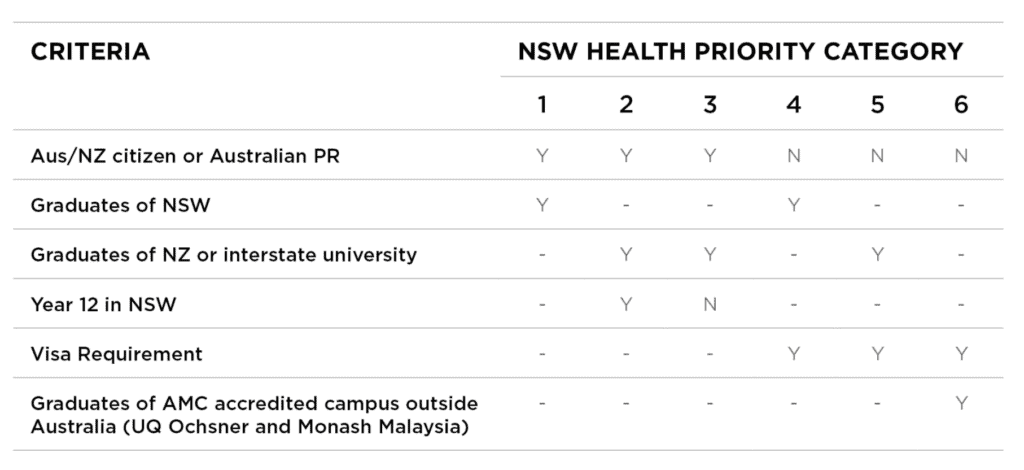
  • Medical Internship Australia. Application Guide For 2024 Posts.

    Medical Internship Australia. Application Guide For 2024 Posts.

    *We will be regularly updating this post as the various States and Territories update their processes. Where information is not currently available for the 2024 clinical year we have used information from the previous year, i.e. 2023. If you notice anything incorrect please let us know in the comments below.

    How do you become an Intern in Australia? Well, it’s that time of the year again when the system of applying for and allocating medical intern posts in Australia system kicks into gear. So now is the perfect time to explain the process. For four years I was responsible for running the largest Intern application system in Australia for 4 years. The NSW Intern application system. So I’d like to share with this year’s medical graduates some of the wisdom I gained from that experience.

    (Disclaimer: All information here has been sourced in good faith but things do change so you should always do your own due diligence in such matters, we are providing this information to aid you in your application but take no responsibility for any outcomes)

    As has been the case in past years the main Intern application and allocation dates are aligned across Australia so that every State and Territory opens and closes their systems at the same time and makes offers at the same times. There are some variations to this in relation to special priority categories in some States and Territories. The key things that all medical graduates should consider in preparing their medical internship application for 2023 year are as follows:

    • Applications open on 8th May 2023.
    • Applications close on 8th June 2023.
    • Make sure that you have an Intern Placement Number otherwise, you won’t be able to apply.
    • You should research the application requirements now as there may be some “surprises”. As soon as the application system opens, register or log in and ensure that you have everything you need to complete your application.
    • Understand where you sit on the priority list for any State or Territory you are applying to.
    • If you are required to attend an interview. Make sure that you have obtained leave from your medical school requirements to attend.
    • Also, consider that the interview is likely to be either via phone or video this year.
    • Give yourself time to request referees, put together a Resume, if required, and find other documents that you may need.
    • Offers for Rural and other Special Pathways will come out starting from Monday 17th July 2023.
    • The first offers for all other main pathways will come out on Wednesday, 19th July 2023.
    • Generally, you only have 48 hours to accept. So make sure that you have regular access to your email.
    • The National Close Date for 2023 Intern Recruitment is Friday 17th November 2023. After which all remaining vacant intern positions move into the Late Vacancy Management Process.
    • Stay in touch with your medical school. you may be worried about completing your degree on time but they are all working very hard with the other institutions to give you the best chance of completion.

    Number of Intern Positions Available Across Australia in 2024

    JurisdictionIntern Numbers 2024Intern Numbers 2023IncreasePopulationInterns per 100K Person**Annual Salary
    New South Wales1,135.51,10035.5 8,193,54913.9$71,283
    Victoria960.589169.5 6,656,28114.4$79,138
    Queensland862805575,354,80116.1$78,941
    Western Australia390*390 2,805,01913.9$82,893 – $109,650
    South Australia311301101,828,70117.0$79,414
    Tasmania1059213571,87318.4$75,315
    Australian Capital Territory95950459,04820.7$75,836
    Northern Territory655015250,60225.9$78,757
    Commonwealth Private Hospital Stream115*115varies
    TOTAL4,0393,83920126,119,87415.5
    * indicates based on 2023 numbers
    ** From https://population.gov.au/

    Tip #1. Your Medical Intern Placement Number.

    The IPN is a unique nine-digit number that has been generated by AHPRA and has been provided to medical schools for distribution to all 2023 final-year medical students. The number is used as part of the national audit process (which ensures that intern positions across the country are made available to as many applicants as possible) as well as to streamline registration.

    This number is not the same number as your AHPRA registration number or student number. If you have not received your IPN you should check with your school.

    If you are not an Australian medical student you won’t be issued an IPN. If you are applying as a non-Australian medical student you do not require an IPN. However, please note that unless you are a New Zealand medical student your chances of gaining an internship are very slim.

    Tip #2. Other Things You Will Likely Need to Become an Intern in Australia. 

    The majority of States and Territories require you to upload an academic transcript as proof that you are indeed a medical student. 

    They will also request evidence that you satisfactorily meet the AHPRA English Language requirements. This may seem a bit ridiculous given that you have been attending medical school in English for the last 4 or 5 years. But it is the law. So check whether you may need to submit an up-to-date English test result or some other form of documentary evidence such as a high school certificate.

    Most States and Territories will also request a CV or Resume. For tips on your CV or Resume see our ultimate guide to CVs or watch a video series about this.

    Some States and Territories have a CV template that they suggest that you use to fill in your information. In the case of Victoria, you are no longer required to use the suggested template (change from last year). It’s probably fairly harmless to use the template for the other States and Territories. But if you are thinking about your future career, then now is a good time to be designing your own CV. The risk of using the template is that you don’t stand out from other candidates.

    You will need to also provide proof of your identity, citizenship, residency, or visa. And if you have had a name change along the way you will probably also need to provide some documentation in relation to this.

    Why All This Information?

    The State and Territory bodies who administer the Intern application process have a responsibility to ensure that you are eligible to apply for provisional registration at the end of the year in order to work as an Intern.  They collect this information to check that everything is in order so that you are indeed eligible to apply. Employers can get rightly annoyed when told that someone who has been allocated to work with them as an Intern will have a several-month delay whilst they resit an English language test.

    However, it’s your responsibility to ensure that you are eligible for registration. So you should also be checking these things yourself. 

    It’s hard to fathom given the amount of communication from health departments, medical schools and student colleagues. But every year there are a handful of medical students who forget to apply for their internship. This means having to wait another year. Don’t let that be you.

    Dr Anthony Llewellyn | Career Doctor

    Tip #3. Research and Apply Early.

    It’s hard to fathom given the amount of communication from health departments, medical schools, and student colleagues. But every year there are a handful of medical students who forget to apply for their internship. This means having to wait another year. Don’t let that be you.

    There are even more students who leave their applications to the last minute. Only to find that they are missing a vital document. For example, this could be evidence you need to substantiate that English is your first language, such as a high school certificate. Or perhaps your last name has changed whilst you have been in medical school? Or maybe you need to submit a CV with your application?

    As soon as the application page opens for each State and Territory you are going to apply to make sure you register. And then go as far through the process of applying as possible so you can see if there is some sort of document you need to obtain.

    Tip #4. Practice Your Interview Technique, Including Video Interview Technique.

    As part of your application to become and Intern in Australia you may need to undertake an interview. This could take the form of a faced to face interview or a video interview. The COVID pandemic resulted in a shift to a preference for video interviewing job applicants in Medicine in Australia. Many employers now see an inherent advantage to this. So you should still be prepared for the fact that this year your interview may be conducted on video.

    There’s a lot more than you think to video interviewing. For a rundown on this check out this recent post.

    Tip #5. Know Where You Sit In The Priority List.

    ts important to know where you sit on the priority list. Each State and Territory has a slightly different order but in essence, it goes something like this:

    1. If you are an Australian Citizen or Permanent Resident and went to Medical School in that State or Territory you are top of the list.
    2. If you are an Australian Citizen or Permanent Resident and went to Medical School in another State or Territory or New Zealand you are probably second.
    3. If you are an international student who studied Medicine in Australia you are probably next.

    Tip #6. Know the Key Dates, including Offer Dates.

    As noted above it’s crucial that you know the key dates. If you miss your application submission date (and it does happen) there is no allowance for a last-minute submission. You also need to make sure you are available to accept your offer. Generally, the window for offer acceptances is quite narrow (often 48 hours).

    For this year the day on which the first round of offers can be made nationally is 17th July 2023 for the rural and other special pathways. The first date that offers can be made to the main group of applicants is 19th July 2023 and most offers will come out on that day. Thereafter there is a series of offer windows for 2nd and 3rd and 4th rounds etc… in between which there is a mandated pause, which allows the National Intern Audit process to run. This is a system that works to ensure that vacancies are being freed up as soon as possible by highlighting medical students who may have an offer in more than one jurisdiction and ensuring that they accept one offer and decline others.

    The nationally coordinated offer system concludes on 17th November 2023. Technically this is the last date that the Medical Board can guarantee that they will be able to process your registration application in order for you to commence your internship on time the following year in 2023.

    However, there are generally still vacancies after this point and so the National Intern Audit Office switches over to an ad hoc coordinated late vacancy management process from 4th December 2023. This runs up until 22nd March 2024, which is around the 1st term to 2nd term changeover for most interns. So it is still possible to commence your internship in 2024 but you might have to finish one or two terms in the following year.

    The National Intern Audit.

    States and territories share intern applicant information at pre-agreed dates. This data is then used to identify applicants who have applied for and/or accepted intern positions in more than one state/territory. Applicants who have accepted more than one intern position will be contacted by the National Audit Data Manager by phone or email and given 48 hours to withdraw from all intern positions, except the one where they intend to undertake their intern year.

    If you don’t respond to the National Audit Data Manager and/or do not withdraw from all positions except one, the relevant states/territories where you have accepted an offer will be advised and all offers, except for the first offer you received may be withdrawn.

    The Late Vacancy Management Process.

    The Late Vacancy Management (LVM) Process runs from Monday 4 December 2023 to Friday 22 March 2024. The process ensures any late vacancies are offered to eligible intern applicants who have not yet accepted an internship position.

    The Late Vacancy Management Process is coordinated by the National Audit Data Manager on behalf of states and territories. So you should ensure you have updated your contact details if you are going overseas during the Late Vacancy Management Process period.

    The National Audit Data Manager will send out emails on Monday 27 November 2023 to participants who will need to opt into the Late Vacancy Management Process if they still wish to receive an offer to be an Intern in Australia.

    If an applicant does not respond to this email, they will no longer be eligible to receive an internship offer, and their application will no longer be considered in any Australian jurisdictions.

    The process is open to medical graduates of AMC-accredited medical schools who have applied for and are not holding a 2024 intern position through the Commonwealth or states and territories at the National Close Date for Intern Recruitment (17 November 2023). Participation in the LVM is an opt in process – you must confirm that you want to participate in the LVM by responding to the National Audit Data Manager by e-mail.

    Priorities Within Priorities.

    Some States and Territories also have priority pathways to ensure that groups such as Aboriginal and Torres Strait Islanders and doctors who wish to work rurally or regionally can obtain their preferred placement early.

    So if you are an International student and like the idea of working rurally, it’s probably a good idea to consider a rural pathway as it will likely boost your chances of gaining an Intern position earlier in the process.

    Further Information on Each Jurisdiction

    New South Wales

    Intern in Australia NSW
    Sydney Harbour Bridge, New South Wales.

    Intern Positions = 1,135.5 (including 210 rural preferential) across 15 Networks
    Annual Salary = $71,283
    Length of Contract = normally 2 years
    Professional Development Allowance = nil

    The 4 Pathways in NSW


    You have the option of applying through one of 4 pathways:
    – Aboriginal Recruitment Pathway
    – Rural Preferential Pathway
    – Regional Allocation Pathway
    – Optimised (or Main) Pathway

    Only applicants who go through the Rural Preferential Pathway need to submit a CV and attend an interview.  All other pathways are based on applications only. A key advantage of the Aboriginal, Rural, and Regional Allocation Pathways is that you are far more likely to be given your preferred hospital network.

    c/- HETI https://www.heti.nsw.gov.au/education-and-training/courses-and-programs/medical-graduate-recruitment

    Intern Placement Priorities in NSW:


     Priority 1 – Medical graduates of NSW universities who are Australian/New Zealand citizens or Australian permanent residents (Commonwealth Supported Place and Domestic Full Fee paying). This priority category is guaranteed an intern position in NSW. 

    Priority 2 – Medical graduates of interstate or New Zealand universities who completed Year 12 studies in NSW who are Australian/New Zealand citizens or Australian permanent residents (Commonwealth Supported Place, Domestic Full Fee paying or NZ equivalent). 

    Priority 3 – Medical graduates of interstate or New Zealand universities who completed Year 12 studies outside of NSW who are Australian/New Zealand citizens or Australian permanent residents (Commonwealth Supported Place, Domestic Full Fee paying or NZ equivalent). 

    Priority 4 – Medical graduates of NSW universities who are not Australian/New Zealand citizens or Australian permanent residents and who hold a visa that allows them to work or are able to obtain a visa to work.

    Priority 5 – Medical graduates of interstate or New Zealand universities who are not Australian/New Zealand citizens or Australian permanent residents and who hold a visa that allows them to work or are able to obtain a visa to work in Australia. 

    Priority 6 – Medical graduates of Australian Medical Council accredited universities with campuses that are located outside of Australia or New Zealand who are not Australian/New Zealand citizens or Australian permanent residents and who hold a visa that allows them to work or are able to obtain a visa to work in Australia.

    Victoria

    Trains leaving the Melbourne CBD passing the Melbourne Cricket Ground

    Intern Numbers = 960.5
    Annual Salary = $79,138
    Length of Contract = 1 year
    Professional Development Allowance = $65 per week for FT Intern = $3,380

    Hospital / NetworkIntern Numbers for 2024
    Albury / Wodonga Health15
    Alfred Health60
    Austin Health65
    Bairnsdale Regional Health15
    Barwon Health45
    Bendigo Health40
    Eastern Health70
    East Grampians Health Service8
    Echuca Regional Health5
    Goulburn Valley Health32
    Grampians Health Ballarat34
    Latrobe Regional Hospital31
    Melbourne Health77
    Mercy Health13
    Mildura Base Public Hospital10
    Monash Health124
    North East Health Wangaratta9
    Northern Health50
    Peninsula Health43
    Portland District Health2
    South West Health Care17
    St Vincents Health65
    Western Health95.5
    Victorian Rural Generalist Program – Barwon South West5
    Victorian Rural Generalist Program – Gippsland5
    Victorian Rural Generalist Program – Grampians5
    Victorian Rural Generalist Program – Hume Murray to the Mountains15
    Victorian Rural Generalist Program – Loddon Mallee5
    TOTAL960.5

     
    Internship in Victoria works around a computer matching system which is administered by the Postgraduate Medical Council of Victoria. The system had a significant overhaul in the previous year.

    The Allocation & Placement Service is a mathematical process that matches the preferences of both candidates and Health Services and is designed to be “impartial and transparent”. 

    Candidates create an account and then register with the Intern match. The second step is to preference your preferred services. At the same time, the health services also place preferences. The matching process successful candidates to positions according to rankings.

    For Victoria, you will need to submit referees as well as a CV. In past years this had to be on the quite unattractive PMCV standardised CV Template. The status of this template has now been downgraded to a “guide”. You don’t have to put a photo on your CV. I would recommend using your own CV template and not include a photo.

    In 2020 Victorian Health services began the use of video-recorded interviews. This continues for 2023 for certain candidates. The system appears to be being used as an efficient way for certain services or hospitals to review applications without having to arrange formal interview panel days and for candidates to appear in person.

    The way these interviews work is you are usually allocated a specific time to log into the system. Once you have gone through a couple of orientation steps you are usually given a series of questions and asked to record your answers. Generally, you don’t get a second go if you are not happy and the time is limited. It is vital therefore that you practice before you do your interview and ensure you have optimised your video environment.

    You are able to complete your recording at any time during the specified video interview period. All candidates are required to answer 3 questions. Questions are randomly selected from 3 different question banks. There is one additional question if you are applying for the Regional Pathway.

    Response times are 2 minutes per question. You get one minute to read the question and prepare your answer before recording.

    All health services can use these recordings to rate you along with your CV and referee reports.

    Metro hospitals may conduct live interviews with shortlisted candidates at any time before 3 July. Although I understand many do not and just rely on the candidates’ CV, referees and video interviews.

    Interns can be allocated to one of 22 hospitals and networks. This includes a small number of community-based internships where the focus is more on community-based models of care, including working in primary care and smaller hospitals.

    You can elect to be prioritised for an internship by entering the Victorian Rural Preferential Allocation (VRPA) match. Where you can be allocated to one of 5 rurally based networks. This pathway involves a live interview. First-round offers for VRPA come out on 18th July on the national rural allocation date.

    Intern Placement Priorities in Victoria:

    VRPA Priority Group 1 – Australian citizens or permanent residents and New Zealand citizens graduating from Victorian medical schools including CSP and domestic full fee-paying students (i.e. graduates of University of Melbourne, Monash University, Deakin University and University of Notre Dame: Melbourne & Ballarat Clinical Schools).

    VRPA Priority Group 2 – Australian permanent resident graduates of interstate universities who meet the following criteria:

    • Completed their Year 12 schooling in Victoria; OR
    • Previously lived in rural Victoria (Modified Monash Model (MMM)1 – MM2 classification or higher) and worked in a rural healthcare setting; OR
    • Graduates of the University of New South Wales who have undertaken their last two years of clinical placement at Albury Wodonga Health clinical school.

    As well as Australian temporary residents graduating from Victorian medical schools (i.e. graduates of the University of Melbourne, Monash University, Deakin University and the University of Notre Dame: Melbourne & Ballarat Clinical Schools).

    Priority Group 1 – Australian citizens or permanent residents and New Zealand citizens graduating from Victorian medical schools including CSP and domestic full fee-paying students (i.e. graduates of University of Melbourne, Monash University, Deakin University and University of Notre Dame: Melbourne & Ballarat Clinical Schools).

    Priority Group 2 – Australian temporary resident graduates of Victorian medical schools. As well as Interstate Special Considerations*.

    Priority Group 3 – Australian citizens or permanent residents and New Zealand citizens graduating from interstate or New Zealand medical schools; Australian temporary resident graduates of interstate universities; New Zealand temporary resident graduates of New Zealand universities; Graduates from an overseas campus of an Australian/New Zealand University accredited by the Australian Medical Council (i.e. Monash University, Malaysia or Ochsner).

    *There are a number of special consideration categories available including for significant medical, disability and carer responsibilities. Check with the PMCV directly for this.

    Indigenous Internships

    Both South West Health Care (based on Warnambool) and Melbourne Health have a small number of Internships reserved for Indigenous graduates.

    The Victorian Rural Medical Scholarship Scheme

    The Victorian Rural Medical Scholarship (VRMS) supports career pathways to rural medical practice and assists rural and regional health services to attract, employ and retain medical graduates. The VRMS supports medical students with a commitment to working in rural and regional Victoria by providing financial assistance towards living and tertiary expenses in the final year of their medical degree and into their rural intern year.

    The VRMS is administered by the PMCV on behalf of the Department of Health of Victoria. Scholarships valued at $20,000 each are available to be
    awarded to final year medical students in Victoria. Scholarship recipients are required to commit to a two- year return of service in rural or regional Victoria (within three years from graduating from medical school).

    Queensland

    Story Bridge Brisbane

    Intern Numbers = 862 (including 68 rural generalist intern positions)
    Annual Salary = $78,941
    Length of Contract = 1 year
    Professional Development Allowance = nil for Interns but $2,311 for RMOs
     
    Queensland has possibly the most complex internal allocation system of all jurisdictions. With a number of pathways and a combination of allocating certain priority groups and merit selection for others.

    Queensland Health conducts the annual intern allocation process in Queensland. To apply you will need to use the online portal and upload a range of documents, including a curriculum vitae and referee details. Note: Queensland Health has also produced an unattractive CV template for you to use. But this also has the status of “guide only”, therefore I recommend you use your own.

    Interns can be allocated to one of 20 Employment Hospitals.

    There are 4 Intern priority groups in Queensland:

    Group A – Medical graduates of Queensland universities who are Australian/New Zealand citizens or Australian permanent residents; and:- are seeking an internship commencing in the year immediately following graduation; OR – received Review Committee approval from a previous campaign to defer commencement of their internship.

    Group B – Medical graduates of Australian (interstate) or New Zealand universities who are Australian/New Zealand citizens or Australian permanent residents; OR Medical graduates of Queensland universities who are Australian/New Zealand citizens or Australian permanent residents who do not meet the criteria outlined in Group A.

    Group C – Medical graduates of Australian (Queensland or interstate) or New Zealand universities who are NOT Australian / New Zealand citizens or Australian permanent residents who: – – currently hold a visa that allows them to work in Australia; OR- will need to obtain a visa to work in Australia.

    Group D – Medical graduates of Australian University campuses outside of Australia accredited by the Australian Medical Council (AMC); OR Medical graduates of international universities who have not completed an internship in Australia or another country and have either: – obtained the AMC Certificate – successfully completed the AMC MCQ (multiple choice questionnaire).

    Note: Queensland is one of the few jurisdictions that offer an opportunity for IMG doctors to complete an internship in Australia. The number of doctors who are successful in doing so each year is rarely more than a handful.

    There are 3 pathways for Intern Allocation in Queensland.

    1. The Rural Generalist Program offers an opportunity to select a rural hospital centre as part of a program that is a pathway to working as a Rural GP. Applications open March and close extremely early (March) for this pathway.
    2. Aboriginal and Torres Strait Islander Intern Allocation Initiative. The purpose of the initiative is “to promote the success of Aboriginal and Torres Strait Islander medical graduates in the Queensland Health workforce”. Eligible applicants can apply to the Aboriginal and Torres Strait Islander Intern Allocation Initiative to be allocated to their first preferenced hospital. Applications are reviewed by a panel that includes Aboriginal and Torres Strait Islander representation.
    3. The General Intern Campaign.

    The General Intern Campaign Allocation Process.

    In Queensland, intern applicants are classified into two categories;

    Guaranteed offer graduates – Medical graduates who are guaranteed an offer of an intern position in Queensland for their immediate postgraduate year. Allocation to an intern position may be automatic or via random ballot, based on hospital preferences nominated by the individual in their intern application form.

    Not guaranteed offer graduates – Medical graduates who are not guaranteed an intern offer. A merit selection process is undertaken to determine if an offer of an intern position will be made.

    There is no inherent prioritisation across applicant groups, the categorisation of these groups are used for reporting for the intern campaign. Each participating Hospital and Health Service establishes individual assessment processes to merit select from their available applicant pool and are not obligated to sequentially select through the applicant groups. Applicants who do not meet the outlined criteria for Groups A, B, C or D may be considered at the discretion of each participating hospital.

    Merit Selection for Groups B-D.

    Group A Applicants are allocated according to a Balloting Process.

    Following the completion of first-round offers, the Position Status Report (PSR) is updated.

    This is an updated list of available positions remaining.

    Applicant group B-D candidates have 48 hours to change their preferences if they wish to.

    Queensland Health hospitals then assess applications and conduct their own meritorious selection processes. You should contact each Hospital and Health Service directly to find out what they look for in an intern.

    If vacancies become available after the First and Second Round offers, individual hospitals will meritoriously select from the remaining applicants for available vacancies. Recruitment to fill available vacancies will continue until the national closing date for intern recruitment. After the closing date, any further vacancies that arise will be filled via the Late Vacancy Management Process (LVMP).

    Western Australia

    Perth City Scape

    When contacted WA Health and the PMC of WA indicated that they could not make the 2024 Intern numbers available, as these are subject to confirmation by the Primary Employing Health Services.

    Estimated Numbers ≅ 390-395 (based on 2023 Clinical Year)
    Annual Salary = $82,893 – $109,650 (rates payable differ according to your location and industrial agreement)
    Length of Contract = 3 years in most cases with the ability to transfer to a different PEH if all internship requirements are met (IMGs may have shorter contracts tied to their visa status)
    Professional Development Allowance = $5,984

    WA Intern Eligibility and Priorities

    WA does not have a formal priority list. However, in order to apply for an internship in WA you must:

    • complete an application
    • be a graduate from a university accredited by the Australian Medical Council OR be a graduate from a university in a competent authority country AND be an Australian Citizen or Permanent Resident or New Zealand Citizen
    • possess a valid Intern Placement Number
    • have not previously commenced or completed an internship or worked as a doctor either in Australia or overseas
    • meet the Medical Board’s English language skills registration standard
    • be eligible to work in Australia

    So Western Australia is one of the few options for IMGs to do an Internship in Australia. Although you can see from the above it is quite limited.

    In WA all interns are employed by a Primary Employing Health Service (PEHS). 

    Each PEHS is a major tertiary hospital in WA that has been accredited to directly employ interns and provide an intern training program.

    The six PEHSs in WA and their seconding/rotating health sites are:

    Employing Health ServiceMetro PlacementsRural Placements
    Fiona Stanley Fremantle Hospitals Group (Fiona Stanley Hospital)Fiona Stanley Hospital
    Fremantle Hospital
    Rockingham General Hospital
    Albany Health Service
    Broome Regional Hospital
    Northam Health Service
    Joondalup Health CampusJoondalup Health CampusKalgoorlie Regional Hospital
    Royal Perth Bentley Group (Royal Perth Hospital)Royal Perth Hospital
    Armadale Health Service
    Bentley Hospital
    Osborne Park (Women and Newborn Service)
    Perth Children’s Hospital
    Bunbury Hospital
    Hedland Health Campus
    Kalgoorlie Regional Hospital
    Sir Charles Gairdner Osborne Park Health Care Group (Sir Charles Gairdner Hospital)Sir Charles Gairdner Hospital
    Graylands Hospital
    Hollywood Private Hospital
    Joondalup Health Campus
    Osborne Park (Women and
    Newborn Service)
    Perth Children’s Hospital
    Geraldton Regional Hospital
    Hedland Health Campus
    Karratha Health Campus
    St John of God Health Care (St John of God Midland Public Hospital)St John of God Midland
    Public Hospital
    St John of God Subiaco
    Hospital
    St John of God Murdoch
    Hospital
    WA Country Health ServiceAlbany Health Campus
    Broome Regional Hospital
    Bunbury Hospital
    Geraldton Regional Hospital

    Each PEHS hosts an information night. You can also choose to work as a rural intern by applying to work through Western Australia Country Health Service.

    The intern application process is coordinated by the Postgraduate Medical Council of Western Australia but you apply through the WA Jobs site called MedJobsWA. You submit one application and rank each PEHS from most to least preferred. Selection occurs through panels representing each of the PEHSs. As part of your application, you need to provide a CV and cover letter and address the intern selection criteria, you will require a range of other documents as well as nominate 2 referees. If successful you will receive a contract for 3 years, which provides you with job security.

    South Australia

    The River Torrens in the city of Adelaide

    Intern Numbers = 311 (including 18 rural intern posts)
    Annual Salary = $79,414
    Length of Contract = 3 years in most cases (IMGs may have shorter contracts tied to their visa status)
    Professional Development Allowance = nil

    SA MET (South Australia Medical Education and Training) conducts the annual Intern application process in South Australia. There are 3 Adelaide-based Local Health Networks and 3 smaller country-based networks to which you can apply for the priority Rural Intern pathway. It should be noted that whatever network you are allocated to you may request or be required to undertake one or more rotations in other networks.

    The Rural Intern Pathway is a strength-based recruitment process for applicants who are interested in undertaking their internship (and potentially subsequent years) in rural hospitals within Country Health SA (CHSA). Rural intern positions provide broad opportunities in unique settings and are best suited for medical graduates with a history of living or working in rural areas or a desire to commence a career in the country. 

    Those applying for the rural intern pathway undertake an interview from 26 June to 30 June and offers come out on the national rural allocation date of 17th July.

    Barossa Hills Fleurieu Local Health Network (BHFLHN)
    Central Adelaide Local Health Network (CALHN)
    Eyre and Far North Local Health Network (EFNLHN)
    Flinders and Upper North Local Health Network (FUNLHN)
    Limestone Coast Local Health Network (LCLHN)
    Northern Adelaide Local Health Network (NALHN)
    Riverland Mallee Coorong Local Health Network (RMCLHN)
    Southern Adelaide Local Health Network (SALHN)

    SA Intern Priorities:

    Like most other jurisdictions, South Australia prioritises its medical graduates first, then graduates from other States and Territories. International Students are given lower priority than Australian Citizens, Australian Permanent Residents and New Zealand Citizens.

    Aboriginal and Torres Strait Islander applicants are given priority preference by being placed in the first subcategory for categories 1 and 2.

    International Medical Graduates from non-Australian medical schools can apply for the rural intern pathway so long as they have only graduated in the last 2 years and have completed the AMC Part 1, and can meet the other requirements (which are extensive) and include meeting the Medical Board English language requirements, completing electronic medical record training and have residency status or a visa that allows you to work unrestricted. They must also not have commenced or completed an internship.

    International Medical Graduates from non-Australian medical schools can also apply for the main round but in this case must have completed both AMC Part 1 and Part 2.

    Rural Intern Pathway

    Applications for the Rural Intern Pathway are included in the standard South Australian application for internship.

    All applicants are asked to preference all eight rural networks as well as the three metropolitan health networks.

    Eligible applicants wishing to apply for the Rural Intern Pathway must preference a rural site as their FIRST preference. Rural Intern Pathway applicants who preference a rural LHN as their first preference are asked additional questions within their application form. And must participate in interviews conducted by a selection panel from the rural LHNs.

    SA Health determines which applicants will receive rural internship offers using a preference matching process and the ranked list provided by the LHNs.

    The placement of applicants into rural intern positions will occur prior to the placement of applicants into metropolitan intern positions. SA Health will match applicants to specific rural LHNs as instructed.

    Metro Internship Allocation

    Within the respective South Australian category groups, applicants are randomly allocated to their highest possible Local Health Network preference.
    If an offer is made, applicants must respond via the electronic application system within the specified timeframe. Where an applicant has been made an offer and no response received, the offer will be automatically declined. Applicants are only eligible to receive one offer for an internship in South Australia.

    South Australia is one of few States that specifically permits medical graduates from other countries to apply for internship positions. But they are at the very bottom of the priority list. Please see the above information about the rural internship.

    In addition to a CV and referees, in order to apply for an internship in South Australia, you will need to provide a certificate confirming that you have completed the SA Health online electronic medical record (Sunrise EMR & PAS) training.

    Tasmania

    Hobart in Australia

    Estimated Number  = 106
    Annual Salary = $75,315
    Length of Contract = 1 year
    Professional Development Allowance = nil for Interns but RMOs get an allowance of $2040 per annum

    Internships are coordinated in Tasmania via the Department of Health and Human Services.
     
    All applicants are required to apply online. As part of your application, you are asked to preference all of the 3 available sites:

    SiteNumber of Positions
    North (Launceston General Hospital)40
    South (Royal Hobart Hospital)46
    North-West (North-West Regional Hospital Burnies and Mersey Community Hospital, Latrobe)19

    Rural Option

    You can also preferentially apply for one of 5 places on the Tasmanian Rural Generalist Program. You will be allocated to one of the above sites based on your preference but also undertake a 13-week rural GP placement as part of your internship.

    Applying


    Applicants must be graduates of or graduating from an Australian Medical Council-accredited University.  

    All applicants are required to apply online. Only one application is required; you will be asked to indicate your preferred place of employment (Hobart, Launceston, North West Region) via the application form.  Applicants must list each site in order of preference.

    The online application form ensures all the information required to assess your application is provided. The form includes information on eligibility to work in Australia and details on how to submit electronic reference requests.

    The online application form requires you to include your University Student Number and your Australian Health Practitioner Regulation Agency (AHPRA) Intern Placement Number.

    Candidates are required to attach a CV/Resume and any other relevant information to their application.

    A written statement addressing the selection criteria is NOT required. 

    Intern Placement Priorities:

    The Tasmanian Department of Health currently gives priority, in order, to:

    1. Australian permanent resident Tasmanian-trained Australian Government supported and full-fee paying medical graduates.
    2. Australian temporary resident Tasmanian-trained full-fee paying medical graduates.
    3. Australian permanent resident interstate-trained Australian Government supported and full-fee paying medical graduates.
    4. Australian temporary resident interstate-trained full-fee paying medical graduates.
    5. Medical graduates of an Australian Medical Council-accredited overseas University.

    Selection

    The Tasmanian Department of Health will conduct a ballot-based allocation system for placing Priority 1 (Australian permanent resident Tasmanian-trained Australian Government supported and full-fee paying medical graduates) and Priority 2 (Australian temporary resident Tasmanian-trained full-fee paying medical graduates) applicants.

    It is not clear at this stage how further positions are filled according to the remaining priorities.

    Northern Territory

    ocean coast in Darwin, Northern Territory Australia

    Intern Numbers = 65
    Annual Salary = $78,757
    Length of Contract = 1 year
    Professional Development Allowance = $3,295 per annum with the option to apply for an additional $3,000 or $3,000 for HELP relief.

    The NT Prevocational Medical Assurance Services (PMAS) conducts a central review of eligible applicants and all intern positions are allocated within the two NT Health Services:

    • Top End Health Service (TEHS) – based upon Royal Darwin Hospital (RDH) (45 posts)
    • Central Australia Health Service (CAHS) – based upon Alice Springs Hospital (ASH) (20 posts)

    Each Health Service has a primary employing health service as well as additional placement hospitals as per below:

    C/- NTPMAS Guide

    Eligible applicants are allocated intern positions in line with the Northern Territory category groups. Within the relevant category groups, applicants are allocated to their highest possible Health Service preference, pending the availability of a position.

    Intern Priority Categories:

    According to the NTMETC the applicant eligibility categories in order of selection for Internship in the Northern Territory are:

    Previously there was an F and G category that provided an option for IMG doctors. It is not clear whether this has been removed for the 2023 year.

    As part of your application, you are required to submit a curriculum vitae of no more than 2 A4 pages and address the selection criteria. Applications are submitted to the NT Government employment portal.

    Overall the intern allocation process is based on an applicant’s category group, Health Service preference, and the number of positions available in each health service.

    The two NT Health Services are responsible for selecting applicants and making their offers of employment, applicants are advised via email.  The Health Service responsible for making the offer of employment will after receiving an acceptance from an applicant arrange an employment contract for an Internship position within their health service to be provided prior to commencing their internship.

    Australian Capital Territory

    The Australian War Memorial in Canberra

    Intern Numbers = 95
    (6 of these positions are normally guaranteed to NSW medical students)
    Annual Salary = $75,836
    Length of Contract = 2 year
    Professional Development Allowance = $1,040 per annum + $900 Mobile Allowance + $4,000 Relocation Allowance.
     
    If you want to apply for an internship position in the Australian Capital Territory you do so via the ACT Health Recruitment page.

    Most of your time is spent at the Canberra Hospital. But ACT is interesting as it is one of the few chances you may have as an Intern to work in 2 separate States and Territories. Rotations may include secondments to Calvary Public Hospital, Goulburn Base Hospital, and South East Regional Hospital (SERH) at Bega. Because the ACT utilises some positions in NSW for intern posts there is a reciprocal arrangement whereby a number of NSW graduates are guaranteed an intern post in the ACT.

    Priority is given to:
    – Australian Graduates of ANU
    – A maximum of 6 graduates of NSW Universities
    – Graduates of other Universities who completed Year 12 in ACT

    ACT Intern Priority List:

    The Commonwealth – Private Hospital Stream

    **2023 Information not yet available**

    The Private Hospital Stream (PHS) funds private hospitals to deliver medical internships and support junior doctors to work in expanded settings. It focuses on supporting training for junior doctors in rural, regional and remote areas in Modified Monash (MM) 2 to 7 locations.

    This includes fostering partnerships between private hospital providers, rural public hospitals and other training settings (such as Aboriginal Medical Services) working as part of expanded training networks.

    Annual Salary and conditions should reflect the annual salary for an intern in the State or Territory you are working in.

    Internships and places

    The PHS supported up to 115 internships and up to 80 PGY 2 and 3 eligible junior doctor places in the 2020, 2021, 2022 and 2023 training years.

    Expression of Interest (EOI) internships

    An annual EOI internship process is run for junior doctors to express interest in a PHS-funded medical internship place.

    This process is only for PGY 1-funded places. It opens each year after state and territory governments have offered and filled their internship positions.

    Eligibility

    The program divides applicants into 2 categories – Priority One and Priority Two.

    Priority One eligibility criteria

    The Priority One category is for final year medical students who meet all eligibility criteria for an internship under the PHS.

    You are Priority One if you:

    • are a full-fee-paying international student completing your medical degree during the current calendar year from a medical school in Australia, having completed all of your medical degree in Australia (university-approved, short-term elective rotations completed overseas are allowed)
    • have met the Medical Board of Australia (MBA) English language proficiency requirements for registration purposes
    • are not an Australian Citizen
    • commit to getting a visa to work in Australia during your internship year.

    Priority Two eligibility criteria

    You are Priority Two if you:

    • have MBA provisional registration as a medical practitioner
    • have met the MBA English language proficiency requirements for registration purposes
    • commit to getting a visa to work in Australia during your internship year.

    Who is not eligible

    You are not eligible to apply for the PHS if you:

    • do not meet the Priority One or Priority Two eligibility criteria
    • have accepted an internship position from a state or territory government.

    Recruitment process

    The recruitment process aligns with the state and territory government recruitment processes and the national audit process.

    Suitable applications are forwarded to the PHS participating private hospitals by the due dates each year.

    The PHS participating private hospitals do eligibility checks. They will contact eligible applicants they want to interview.

    You should not make direct contact with the hospitals.

    Category prioritisation

    PHS participating private hospitals must fill PGY 1 places with Priority One applicants first.

    If there are still places available after the Priority One list is finished, the hospitals can then recruit Priority Two applicants.

    PGY 2 and 3 funded places

    PHS-participating private hospitals make their own recruitment and employment arrangements for PGY 2 and 3 junior doctors. This allows them to meet their own service needs.

    PHS-funded hospitals

    The Commonwealth funded the following private hospitals to deliver the PHS from 2020 to 2023:

    • Mater Health Services North Queensland (PGY 1 places)
    • Mercy Health and Aged Care Central Queensland – Friendly Society Hospital, Bundaberg; Mater Private Hospital, Bundaberg; Bundaberg Base Hospital, Bundaberg; Mackay Base Hospital, Mackay; Mater Misericordiae Hospital, Mackay (PGY 1, 2 and 2 places)
    • MQ Health, New South Wales (Macquarie University Hospital) (PGY 1 places)
    • St John of God Ballarat Hospital, Victoria – Grampians Intern Training Program (PGY 1 places)
    • Mater Hospital Sydney (PGY 1 places)
    • St Vincent’s Private Hospital Sydney (PGY 1 places)
    • Ramsay Health Care, Western Australia (Joondalup) (PGY 1, 2 and 3 places)
    • Greenslopes Private Hospital, Queensland (PGY 1, 2 and 3 places)
    • Calvary Health Care Riverina, New South Wales (PGY 2 places)

    How To Decide Where to Apply for Your Internship?

    There are lots of considerations when it comes to putting in your Intern application. Everyone is a bit different. Some graduates feel like they would like to be close to home and family whilst going through their transition to Intern. Others see it as a chance to get away and explore a new place and location. And then others focus on the long-term career prospects of certain locations.

    I think this last consideration is a little overrated for most. You can generally experience a wide range of medicine in your first couple of years of medicine after graduation and there is scant evidence that this affects your prospects of applying for specialty training posts.

    That being said if you have an interest in anything other than Medicine, Surgery or Emergency Medicine as a future career you should probably investigate whether this particular specialty is offered at the hospitals or networks to which you apply.

    Unfortunately, the internship model in Australia is quite antiquated and we have continued to use the experience as a proxy for competency when a large portion of the medical education world has moved on. The result has been the mandating of the 3 core terms for the internship of Medicine, Surgery, and Emergency Medicine. There is really no solid educational basis for this approach and one of the unfortunate outcomes is that all the other specialties get squeezed out and few interns get to experience psychiatry, general practice, obstetrics, paediatrics, pathology etc… which ultimately does have an effect on recruitment to these specialties.

    So the basic message is this. If you are really dead set keen on doing radiology as a career you should try to track down the very few locations that might offer this rotation to either interns or residents.

    Each year the Australian Medical Students’ Association produces a very useful Intern Guide with lots of information about the composition of intern training networks across the country. The 2023 version is not available but here’s a link to the 2022 version.

    Frequently Asked Questions

    Is There Any Restriction On Where I Can Complete My Internship?

    To meet the Medical Board of Australia’s requirements for general registration, an internship can be completed in any state or territory of Australia.

    Can I Apply to More Than One State or Territory for an Intern Position?

    Yes, you will need to apply separately to each state and territory where you would like to work. You will need to complete a separate application for each position, submit the documents, provide the information required and meet the selection requirements. As part of the application process, each state and territory requires you to include your intern Placement Number (IPN).

    What is an Intern Placement Number?

    The Intern Placement Number is a unique nine-digit number that has been generated by the Australian Health Practitioner Regulation Agency (AHPRA) and has been provided to medical schools for distribution to all 2023 final-year medical students. If you do not have an Intern Placement Number issued or you have misplaced it, you must contact your medical school to have the number issued or reissued. Do not contact AHPRA. Note: The Intern Placement Number is not your University Student Identification

    I Am Not an Australian Medical Student. How Do I Obtain an Intern Placement Number?

    In this situation, you do not require an IPN and will not be issued one. You can still apply for internships. But unless you are a New Zealand medical student your chances of gaining a place are very very limited.

    What If I Have Special Circumstances Which Make It Hard For Me To Work In Certain Places?

    All States and Territories Have processes for considering special circumstances. Some of the types of circumstances that are generally approved are: where you may have certain health conditions that mean you need to be close to certain hospitals or specialists; where you have dependents, such as young children, and are unable to relocate due to care arrangements; and where you and your partner want to work as doctors in the same location. Generally, requests to stay in certain locations, for reasons such as work commitments of partners or needs of school-aged children are not granted.

    I Have Received My Intern Offer. But I Would Like to Defer It. Is This Possible?

    This will partly depend on how long you wish to defer. If you just wish to defer for a few months. Once you have your offer and are in discussions with your new employer make enquiries. It may be possible to negotiate a later start with your employer. Most employers will generally prefer that you start on time so that you are not out of sync with your colleagues. But there might be some advantage for the employer in you attending orientation but then starting a bit later as it will probably help them to fill out roster gaps. On the other hand. If you wish to defer for a complete year. Then you will need to check the policy of the State or Territory that has provided you with an Intern offer. In some cases (for example Victoria) you will be permitted to defer and your place will be held for you the following year. In most other cases you will need to reapply the following year and check whether your priority status has altered. In most cases, you have the same priority status. But, for example, the ACT no longer guarantees you an internship and you start off at a minimum of Category 4. Also, bear in mind that it is unclear how long you can defer commencing your internship. However, the Medical Board of Australia expects that once you have commenced your internship you will have completed this process within 3 years.

    I am a Doctor With a Medical Degree From Outside Of Australia. Can I Apply For an Internship?

    Unless you obtained your medical degree from a New Zealand Medical School. Then the brief answer to this question is no. I would love to stop there. And I really think you should as well. But there are rare circumstances where you may be able to obtain an internship with a medical degree from outside of Australia. But the Medical Board of Australia strongly advises against this option and so do I. For good reasons. Firstly the whole Australian medical internship system is designed to ensure that Australian medical graduates are able to undertake an internship. Not for overseas graduates. Secondly (and as a result of the first point) it is very rare to be offered the chance. Some States and Territories will not even consider an application from an IMG for an internship. Others will only do so in limited circumstances, for example, the Northern Territory will accept applications from IMGs who may have done a medical student elective or clinical observership in the Northern Territory and who have experience in rural, remote and indigenous health locations. But even then these applicants are at the bottom of the priority list for obtaining an internship. South Australia will accept applications. But again you are bottom of the list. Queensland will also accept applicants, but only if you have never worked as a doctor. And again you are bottom of the list. A final note on this question is that the majority of IMGs who do obtain a medical internship position each year in Australia generally have Australian citizenship or permanent residency.

    I Have Heard That Some Graduates Miss Out On Internships. Is This True?

    Whilst it is theoretically a possibility that some medical graduates miss out on Internships according to annual reports provided by organisations like HETI and the PMCV at the end of intern applications no one is actually left at the end of the process without an offer. In fact, in some circumstances, there are vacant intern positions that are not able to be filled. Only Australian citizens and permanent residents are guaranteed an intern position under the COAG agreement. However, there are generally enough intern positions available for those students who have come to Australia to study medicine and the Commonwealth Private Hospital program offers additional spaces for those that may miss out. That being said. It is also clear that many graduates choose to drop out of the application process themselves. So not everyone who applies gets an offer. The assumption is that some graduates take up similar intern opportunities in other countries upon graduation.

    Can I Submit a Late Application?

    Acceptance of late applications is at the discretion of each state and territory.

    When Will Offers Be Made in 2023?

    All states and territories will commence making offers for Rural Pathways on Monday 17 July 2023 and will commence making offers for all other pathways on Wednesday 19 July 2023. The National Close Date for 2023 Intern Recruitment is Friday 17 November 2023.

    What if I Receive More Than One Offer?

    You need to decide where you would like to undertake your internship and accept this position and decline all other positions. You should not hold onto more than one offer as this negatively impacts both the hospital that will have a vacancy if you fail to start work because you have started in another position in another state, and other applicants who would like to work at that hospital who do cannot receive an offer for that vacant position.

    What is the National Audit?

    States and territories share intern applicant information at pre-agreed dates. This data is then used to identify applicants who have applied for and/or accepted intern positions in more than one state/territory. Applicants who have accepted more than one intern position will be contacted by the National Audit Data Manager by phone or email and given 48 hours to withdraw from all intern positions, except the one where they intend to undertake their intern year.

    What if I Don’t Respond to the National Audit Data Manager?

    If you don’t respond to the National Audit Data Manager and/or do not withdraw from all positions except one, the relevant states/territories where you have accepted an offer will be advised and all offers, except for the first offer you received may be withdrawn.

    What is the Late Vacancy Management Process?

    The Late Vacancy Management (LVM) Process runs from Monday 4 December 2023 to Friday 22 March 2024.

    The process ensures any late vacancies are offered to eligible intern applicants who have not yet accepted an internship position. The Late Vacancy Management Process will be coordinated by the National Audit Data Manager on behalf of states and territories. Please ensure you have updated your contact details if you are going overseas during the Late Vacancy Management Process period.

    The National Audit Data Manager will send out emails to participants who will need to opt into the Late Vacancy Management Process if they still wish to receive an internship position offer in Australia.

    Note: if an applicant does not respond to this email, they will no longer be eligible to receive an internship offer and their application will no longer be considered in any Australian jurisdictions.

    Who can participate in the Late Vacancy Management Process?

    The process is open to medical graduates of AMC-accredited medical schools who have applied for and are not holding a 2023 intern position through the Commonwealth or states and territories at the National Close Date for Intern Recruitment (17 November 2023). Participation in the LVM is an opt-in process -you must confirm that you want to participate in the LVM by responding to the National Audit Data Manager by e-mail.

    Can International Medical Graduates Apply to Become an Intern in Australia?

    With very few exceptions, International Medical Graduates (IMGs) cannot apply to become an Intern in Australia. Even if you are able to apply your chances of obtaining an intern post are quite low and you should explore other options.

    This situation is not to be confused with International Students who study for their medical degree in Australia who are eligible to apply.

    You won’t be able to apply if you have already completed an internship or worked clinically in another jurisdiction.

    The States and Territories that do allow IMGs to apply are Queensland, South Australia and the Northern Territory as well as Western Australia (for Australian or New Zealand graduates of competent authority medical schools only).

    Can International Students Apply to Become an Intern in Australia?

    International Students who undertake an Australian medical degree are eligible to apply to become an Intern in Australia.

    Can I Swap Intern Posts?

    As a general rule the jurisdictions either do not permit or strongly discourage the swapping of Internship posts. Medical Student bodies regularly lobby for there to be a swap process.
    Swaps are problematic for a number of reasons.
    Firstly the jurisdictions have set up processes to try to ensure that the outcome of allocations is as fair as possible to the most number of graduates. So it is generally the case at the end of this process that there are very few legitimate swap arrangements available, i.e. if you find yourself with an Intern post that you are not happy with it is unlikely that there is anyone who will be willing to swap with you as they will probably be happy with their allocation.
    Secondly, the whole process of swaps causes additional bureaucratic headaches when the jurisdictions are attempting to focus on getting through all of the allocations and providing as many applicants as possible an offer.
    Thirdly, the ability to swap could place certain applicants in a situation of duress, where they are put under pressure to swap.
    Fourthly, it is very likely that more than one applicant might want to swap. So it may be seen as unfair to allow swaps when not everyone who wants to swap can.

    Can I Defer my Intern Offer?

    If you are considering taking a year off between graduating and commencing medical school then you will be wanting to explore your options for deferral. The process varies from jurisdiction to jurisdiction. Jurisdictions will not hold onto your internship post for you. You will be expected to reapply the following year. And you will generally be in the same priority category again.

    For Victoria, you need to apply for a deferral in order to be able to enter the PMCV Match in the following year.
    You should also be aware that the Medical Board of Australia has specific requirements for registration that limit the time that an individual may defer undertaking their internship in order to obtain registration to 3 years from commencement. After which you may need to seek special approval from the Medical Board of Australia.

    Can I Be Allocated to the Same Spot as My Partner?

    Yes. It does happen. Medical Students do meet and fall in love during their medical school days. Jurisdictions do allow for genuine partners to work in the same facility or network.
    You may, however, have to compromise a bit in terms of your network preferences as in order to accommodate your request you may need to be matched to a less popular network.
    Depending on your jurisdiction you will either have to make a joint couple application or apply under special consideration.

    Can I Do My Intern Part Time or Job Share?

    Yes. It is possible to do your Intern in Australia part-time. In general, the hospital networks prefer you do this as part of a job-share arrangement with another part-time Intern.

    Job share and part-time employment are defined as a person or persons voluntarily seeking to work less than full-time hours. Medical graduates may request to complete their internship on a part-time or job share arrangement through the annual centralised applications.

    To avoid discrimination you are first allocated your position and then your hospital or network is informed of your request to work part-time. Hospitals and networks are then required to negotiate with you the terms of your employment. Interns must work a minimum of 0.5FTE so that the internship may be completed within a two-year period.

    What If I Have Special Circumstances?

    Every State and Territory has a Special Circumstances or Special Consideration policy. These policies are generally quite strict and generally only cover:
    – needing to be close to immediate partners and dependents
    – caring for young or elderly persons
    – access to specialised medical care

    If approved for special circumstances you will not necessarily be placed in the hospital or network of your choice. For example, if you are applying in NSW and you have young children and your partner works in Sydney and it is not possible for your partner to relocate, then you will be approved to be allocated to one of the Sydney-based networks.

    (Disclaimer: All information here has been sourced in good faith but things do change so you should always do your own due diligence in such matters, we are providing this information to aid you in your application but take no responsibility for any outcomes)We’d welcome feedback from any Intern programs in relation to the accuracy of the above information.

  • The Competent Authority Pathway Explained.

    The Competent Authority Pathway Explained.

    One of the most common requests I receive from International Medical Graduates (IMGs) on this blog or my YouTube channel is to explain the competent authority pathway process and/or answer who is eligible for the AHPRA competent authority pathway. There is a big reason for this. You see, the competent authority pathway is the most straightforward pathway for a doctor outside of Australia to gain work in Australia. Let me explain.

    Competent Authority Pathway TL;DR

    Any doctor who graduates from medical school in any of the four competent authority pathway countries and has completed the required one or two years of supervised experience is generally eligible to work as a doctor in Australia under a year of provisional registration. After which, if their performance is deemed suitable, they will be invited to apply for general registration. The four competent authority pathway countries are the United Kingdom, the United States, Republic of Ireland and Canada. The pathway is the best option for any trainee or prevocational trainee from these countries. IMG doctors from other countries can become eligible for the competent authority pathway by completing the USMLE, PLAB or LMCC process and obtaining the necessary experience. The PRES (Ireland) is not recognised by the Medical Board of Australia.

    Doctors from the United Kingdom, Ireland, Canada and the United States have a strong track record of success in coming to Australia. These 4 countries comprise what is known as the competent authority pathway countries in Australia.

    For example, for the years 2016 to 2021, 2077 UK Specialists were approved to work in Australia the next biggest group was specialists from India at 485.

    And in the same time period many more UK, US, Irish and Canadian trainee doctors made the move to Australia during that time via what is called the competent authority pathway Australia.

    So the prospects for working in Australia as a doctor from Ireland, the United States, the United Kingdom and Canada are excellent.

    There is largely a historical rationale for this situation. It is based on the premise that all these jurisdictions have similar approaches to medical school training and similar standards.

    New Zealand is not included in the list above as its medical schools are accredited by the same body as Australian medical schools – the Australian Medical Council. So doctors from New Zealand in Australia are generally treated identically (almost) as those from Australia. There is no need for a competent authority pathway New Zealand style, except for IMG doctors who qualify in New Zealand (see FAQs).

    Historically UK medical qualifications have been recognized by the Australian Medical Council and the Medical Boards in Australia as being of high quality. The reason for this is quite simple. Australia inherited its medical training system from the United Kingdom, and to this day, both its undergraduate and postgraduate training systems remain pretty similar to those in the UK.

    For this reason, again, Australia has recognized doctors from Ireland as having a higher quality. Because, once again, our training and regulatory systems are pretty similar.

    The reasons why doctors from the United States and Canada are also recognised as being of higher quality are less clear. It is undoubtedly the case that these systems whilst somewhat different in their approaches to training are on par in terms of outcomes and the quality of health care in these countries.

    An IMG doctor may, at this point, question why it is that these 4 countries are given priority status above other countries for the purpose of registering IMG doctors in Australia. This is, in my opinion a reasonable question. Unfortunately, there is no clear information about this on the Medical Board of Australia website. Nor does there appear to be a process for a new country to apply for competent authority status.

    In any case, the main point of this post is to outline how an individual doctor can achieve eligibility and utilise this pathway.

    Step 1 For Any UK Doctor Wanting to Work in Australia. Work Out Your Pathway.

    The first step that any IMG doctor wishing to work in Australia needs to consider is which pathway they will be utilising. Often times you will be eligible for more than one pathway.

    So, for example, a Specialist Anaesthetist, from the United States would in fact be eligible for all 4 pathways. Let me explain:

    • They would be eligible to attempt the Standard Pathway (as this is open to all IMG doctors);
    • They would be eligible to register via Competent Authority (as they achieved their medical degree in the United States and trained in the United States);
    • They would be eligible for the Short Term Training in a Medical Specialty Pathway (as they are a qualified specialist); and finally
    • They would be eligible for the Specialist Pathway (as they are a Specialist IMG), and this is, of course the pathway they would most likely be opting for.

    As a side note, even if you are a Specialist from a Competent Authority Pathway country, you end up being registered via your Competent Authority status and are given provisional (as opposed to limited) registration as your first registration.

    In summary, if you are a trainee doctor from any of the Competent Authority countries, you should choose the Competent Authority pathway. There are no advantages to the other 2 pathways.

    And, if you are a Specialist IMG doctor from any of the Competent Authority countries, you should choose the Specialist pathway. Unless you are certain you only want to come to Australia to train for a limited period of time. In this case, choose the Competent Authority pathway as it will allow you to stay longer than the maximum period of 2 years under the Short Term Training pathway.

    competent authority

    Competent Authority Pathway Course

    A Free Course For Trainee Doctors

    This course covers all the required steps for working as a doctor in Australia if you are a trainee doctor from Ireland, the UK, US or Canada.

    The Competent Authority Pathway. The Option For Trainee Doctors from the UK, Ireland, Canada and USA

    If you are a trainee doctor (or Prevocational Trainee) in the UK, Ireland, Canada or the USA. Then you are looking at the competent authority pathway for working in Australia.

    The competent authority pathway assigns a preferential status to any doctor who has completed their primary medical training in one of the following countries: the United Kingdom, Canada, the United States, and the Republic of Ireland.

    The Competent Authority Pathway. A Possible Option for IMG Doctors from the UK, Canada and USA

    In addition, if you are an international medical graduate and you have achieved general registration in the United States, Canada, or the United Kingdom (but not the Republic of Ireland), you may also be eligible for the competent authority pathway.

    What are the steps involved in the competent authority pathway?

    You can find out more about the competent authority pathway on the Medical Board of Australia website.

    The key steps for the competent authority pathway are as follows:

    1. Securing an employment offer.
    2. Applying to the Australian Medical Council for primary source verification.
    3. Applying for registration to the Medical Board of Australia.
    4. Completing 12 months of supervised practice.
    5. Applying again to the Medical Board of Australia for general registration.

    Eligibility for Competent Authority

    You can do a “self-assessment of your eligibility for the competent authority pathway on the Medical Board of Australia website here.

    The essential Competent Authority pathway requirements for graduates of UK, USA, Canada, Ireland are.

    You need to be a graduate of a medical course conducted by a medical school in one of the Competent Authority countries

    AND

    Successfully complete the experiential component required in that country. It is a requirement that this experience is in a supervised position. For the UK, Canada and Ireland you need a minimum 12months supervised experience. For the United States, you need a minimum of 2 years.

    The essential Competent Authority pathway requirements for IMGs who have qualified in UK, USA and Canada are.

    You need to have completed the AMC Certificate equivalent in the UK, USA or Canada. So the PLAB or the USMLE or the LMCC. You must complete all steps of this qualification.

    Plus

    Successfully complete the experiential component required in that country. It is a requirement that this experience is in a supervised position. For the UK, Canada and Ireland, you need a minimum of 12 months of supervised experience. For the United States, you need a minimum of 2 years.

    No, the MRC… Does Not Count. Nor does just getting registered.

    For this reason, doctors who have completed medical school in another European Union country are often unable to register in Australia via working in the United Kingdom as they are usually not required to complete the PLAB. Similarly, many doctors for Gulf State and Asian countries meet one of the multitudes of Royal College exams in the UK and are able to gain registration in the UK without needing to complete the PLAB. Unfortunately, skipping the PLAB means that you are not eligible for the Competent Authority Pathway.

    What about the UKMLA?

    There is no word yet from the Medical Board of Australia about the United Kingdom Medical Licensing Examination. But I would expect that this would be recognised.

    What types of jobs can I apply for as a Competent Authority Pathway Trainee?

    You can pretty much apply for any sort of trainee job. There are often a number of postgraduate years 2 or 3 general jobs on offer. They have generally termed Resident Medical Officers in most States and Territories, but may also be called House Officers or Hospital Medical Officers in some places.

    Above these sorts of posts come specialty training positions. Australia’s specialty training system is pretty much parallel with the United Kingdom. So you tend to enter specialty training around postgraduate year 3. These positions are generally referred to as Registrar positions. But you might also see them advertised as Senior House Officer or Trainee or Advanced Trainee.

    One key thing to look out for is that most of these jobs will not accept an overseas applicant.

    A key thing to look for is the phrase “eligible for registration” in the selection criteria.

    It is very important to try and secure an employment offer. Whilst you can apply to the Australian Medical Council to check your primary medical degree at any stage. You won’t be able to gain registration until you have an offer of employment. This is because the Medical Board needs to see a supervision plan from your employer.

    Outside of general practice, the majority of employment opportunities for trainee doctors occur within public hospitals. So your best places for finding suitable job postings are on the State and Territory health department recruitment sites. We have a listing of these on our international doctors’ resource page.

    What Type of Supervision Do I Need Or Get?

    The Medical Board of Australia is very vigilant around supervision standards for IMG doctors. What sort of supervision you receive will depend on several factors, including:

    • Your qualifications
    • Your previous experience, especially in the type of position for which you have applied
    • Whether you have practised recently and the scope of your recent practice
    • The requirements of the position, including the type of skills required for the position
    • The position itself, including the level of risk, the location of the hospital or practice and the availability of support (supervisors)
    • The seniority of the position for a hospital position

    In general, you will either be approved for Level 1 or Level 2 Supervision. There are 4 Levels, and the higher up you go, the less direct oversight you require.

    Level 1 Supervision.

    Level 1 Supervision requires your supervisor (or alternative supervisor) to be present in the hospital or practice with you at all times, and you must consult with them about all patients. Remote supervision (for e.g. by telephone) is not permitted. This type of supervision is generally recommended when you are very junior yourself or entering a junior role with which you are not very familiar. In Australian major public hospitals, there are many layers of other doctors from who you can get supervision. So Level 1 is not too much of an issue in these circumstances.

    Level 2 Supervision.

    Level 2 Supervision, which most competent authority trainees approved to work in Australia will usually be approved for. Level 2 is a step up from Level 1 Supervision. Supervision must primarily be in person, but your supervisor can leave you to do work on your own, and you can discuss by phone. You should consult with them on a regular (daily) basis about what you have been doing with patients. But do not need to discuss every case.

    Level 3 Supervision.

    Level 3 Supervision is what you might receive if you are working in an Advanced Trainee role in the UK and transferring to something similar in Australia. In this case, you have much more primary responsibility for the patient. Your supervisor needs to make regular contact with you but can be working elsewhere and available by phone or video.

    What happens after I commence my position?

    Once you are approved for registration, and you have your visa issues sorted, you will be able to commence work. Generally, your employer helps you out with all these things. You will be working under “provisional registration” by the Medical Board of Australia.

    Generally, all you need to do for these 12 months is to pay attention, show that you can learn and grow and get regular feedback from your supervisors. Your supervisors will need to complete regular reports for the Medical Board of Australia, and it is your responsibility, not theirs, to see that they are completed and returned on time. If all the reports go well you can be recommended at the end of the 12 months for general registration.

    You will probably be looking for another job or negotiating an extension around this time. With general registration, you may be able to apply for a skilled visa and look at applying for permanent residency.

    Permanent residency is crucial for applying for some specialist training programs. See below.

    Specialist Pathway Course

    Specialist Pathway Course

    Free Course

    You can enrol now in this free course that will step you through all the requirements for working as a specialist doctor in Australia

    The Specialist Pathway. The Option For UK, USA, Irish and Canadian Specialists

    For Competent Authority Pathway country specialists, your option for working in Australia is called the Specialist Pathway.

    Once again, this starts with becoming verified as a doctor with the Australian Medical Council and should again coincide with an active search for a position.

    You may be lucky enough to be in a targeted specialty area where you might successfully be approved for what is called an Area of Need position, in which case the employer or recruitment agent will provide you with a lot of support and will likely pick up the costs of being assessed.

    However, Area of Need is becoming extremely rare these days, and I don’t advise actively looking for such a post as you will likely waste lots of time.

    For most International Doctor specialists, you will approach the college directly to be assessed for specialist recognition. This is not something to be trifled with. The paperwork requirements and the cost (generally around $10,000 AUD or more) are considerable.

    On the plus side, the colleges all have reasonably helpful information on their websites, including the application forms and a little bit about their criteria for assessment.

    The Key Steps for the Specialist Pathway Are As Follows:

    1. Apply to the Australian Medical Council for primary degree and postgraduate degree source verification
    2. Apply to the relevant college for a comparability assessment.
    3. Apply for a suitable job offer.
    4. Apply for registration with the Medical Board of Australia.
    5. Complete 12 to 24 months of supervised practice +/- examinations.
    6. Applying again to the Medical Board of Australia for specialist registration.

    Finding Out What You Need To Do.

    We have saved you the trouble of finding those pages by putting them on our International Doctors resource page here.

    The majority of UK specialties (but not all) map to a similar college or specialty in Australia. This is similar for Ireland and Canada. The United States has a more complex arrangement of specialties and subspecialties. But generally working out which specialty goes into which Australian college is generally not too confusing. We have put together a summary of the Australian specialist medical colleges here.

    After you go through your specialist assessment, you are given an outcome.

    In most cases for Competent Authority specialists, you will be deemed substantially comparable. This essentially means that you will need to work under some form of peer review for up to 12 months and so long as your reports are satisfactory, you will be recommended for specialist registration at the end.

    Occasionally Competent Authority Pathway specialists are deemed to be partially comparable (a situation where this may occur is if you have just recently finished specialty training but have not worked as a specialist for very long). In this situation, you will need to work under supervision for longer and face some formal examinations.

    Rarely are Competent Authority country specialists deemed not to be comparable by the college. This only happened to 6 out of 409 UK doctors in 2017 (less than 1%). If you are deemed to be not comparable, this means you cannot directly become a specialist in Australia. You will probably have to go through the competent authority route and re-enter training in Australia.

    How to Maximize Your Chances of Getting a Substantially Comparable Outcome.

    To ensure that you are seen as substantially comparable by the relevant college, I would recommend the following:

    • You should have your Certificate of Completion of Training and relevant college Fellowship for the UK or equivalent for other countries e.g. Board Certificate for the US.
    • You should ideally have worked substantively at a Consultant level in your field for 3 years or more
    • You should be able to demonstrate good standing with your medical board and your employers
    • You should be able to demonstrate ongoing continuing professional development
    • You should prepare for your interview with the college as if it were an important job interview

    Can you enter training in Australia if you are a Competent Authority Pathway doctor?

    To undertake formal specialty training in Australia you need to be accepted into a college training program. In all circumstances, you will need general registration and in many cases permanent residency or citizenship.

    After receiving your general registration Competent Authority pathway doctors can apply for specialty training in the same way that Australian-trained doctors do. And if accepted will go through the exact training program and experience. Some colleges may offer some recognition of prior learning that you have done already. But this is often quite limited and may at best normally shave one year from your training.

    Can you do your internship in Australia as a UK, US, Irish or Canadian doctor?

    Basically no. Internship in Australia is a provisional year that only applies to medical graduates from medical schools in Australia and New Zealand. There is a “loophole” that only applies to doctors who have not been able to complete an internship or equivalent in their own country. But the Medical Board warns that this is not a great option and is only granted in limited cases. You are far better off applying for the Foundation Program in the UK and completing at least Foundation Year 1, completing the Internship program in Ireland, completing 1 year of residency in Canada or 2 years in the United States.

    How many Competent Authority doctors are working in Australia?

    There is no one public data source to tell us how many Competent Authority doctors are currently working in Australia.

    From data collected by the Australian Government, we know that for trainee doctors for 2018:

    • 639 applications were made for provisional registration via the competent authority pathway by UK doctors with 623 granted provisional registration.
    • An additional 36 applications were made for provisional registration via the competent authority pathway by doctors who had completed the PLAB in the UK, with most of these also being granted provisional registration.
    • 263 applications were made for provisional registration via the competent authority pathway by doctors from Ireland with 257 granted provisional registration.
    • 40 applications were made for the competent authority pathway by US doctors with 30 granted provisional registration through that pathway.
    • 21 applications were made for registration under the Competent Authority Pathway by Canadian doctors with 20 being granted.

    How hard is it to become a specialist in Australia if you are from a Competent Authority country?

    Specialist doctors from the competent authority countries are not automatically granted specialist recognition. However, most are. For example, in 2019 there were 430 applications made for specialist assessment to the Australian colleges by UK doctors and of these, the majority were deemed substantially comparable.

    UK doctors tend to get a very favourable outcome in comparison to doctors from most other countries. The UK has generally the highest rate for doctors being seen as substantially comparable. Even when comparing to the other competent authority countries of the United States, Canada and the Republic of Ireland.

    Are there any particular specialties that are easier to apply for?

    The majority of specialties have some vacancies and will provide opportunities for Competent Authority IMG doctors from time to time. This is particularly the case if you are prepared to go outside of the major cities. Some areas of medicine are more popular and so finding jobs in areas such as most surgical fields, as well as other fields such as cardiology can be pretty difficult.

    On the other end of the spectrum general practice, psychiatry, and most parts of critical care medicine are often always looking for doctors.

    Costs of Moving To Australia and Working As a Doctor.

    There are many costs to consider when considering moving to Australia to work as a doctor.

    There are some direct costs to consider. Most relate to the bureaucratic process of being assessed and gaining registration.

    Some of the costs you may be up for include:

    AUD (unless otherwise noted)
    Establish a Portfolio with the Australian Medical Council$600
    Registering with EPIC and having one primary degree checked $130 USD + $100 USD
    Medical Board Application Fee for Provisional Registration$430
    Medical Board Application Fee for Specialist or General Registration $860
    Medical Board Provisional Registration Fee$430
    Medical Board General or Specialist Registration Fee$860
    College Specialist Assessment Fees*$7,000-$15,000
    College Placement Fees (for a period of supervision)*$8,000-$30,000
    as of 2023

    *Only applicable to Specialist Pathway

    Compared to the regulatory costs for other pathways, the Competent Authority Pathway is quite cheap.

    The Cost of Your Time and Effort.

    To all of this cost, you will need to factor in the cost of your own time. It takes some time effort and persistence to deal with the paperwork and track down the records you need, particularly for the specialist pathway.

    In addition, you will probably have to pay costs in your own country for things like records of schooling and certificates of good standing.

    There are also visa costs.

    And then there is the cost of airfares and transporting your belongings halfway across the world.

    Depending on where you work in Australia, you may find that the cost of living is higher or lower than you are used to. House prices and therefore house rental rates have gone through the roof in Australia in the last decade or so but are starting to come down.

    You will probably have to factor in some initial extra hotel or short-term rental charges whilst settling in, and you may find if you have children that you have to pay to enrol them in school as public schooling is only generally free if you are a citizen or permanent resident.

    If you are lucky and in one of the specialty areas of demand, your employer may offer to pay for some of these costs. It’s certainly worth asking about it.

    Why do UK doctors move to Australia?

    ‍Compared to the United Kingdom, Australia generally offers improved quality of life, work-life balance, finances, and weather. For these reasons, Australia is a popular destination for doctors worldwide. In addition, the UK medical degree and specialty qualifications are well recognised by the Australian Medical Council, Medical Board of Australia and Australian specialty colleges, which makes the transfer easier than for most other countries.

    Are there other options for working as a UK doctor in Australia?

    Answer. The Competent Authority Pathway and the Specialist Pathway are the best two pathways for UK doctors to work in Australia. The other pathways do not offer any more advantages and actually have many disadvantages.

    Should I use a medical recruitment company if considering working in Australia?

    Answer. It is possible to deal directly with employers in Australia as a UK doctor. In general, however, when moving from one country to another most doctors find it useful to engage with a medical recruitment company as they can tend to take some of the stress out of the planning for you and help with all the paperwork and negotiating with prospective employers. Some medical recruitment companies also provide migration services and relocation services as well. We have written more on this subject here

    How much do doctors earn in Australia?

    For many, this is the most important question. And the reason that UK doctors seek to work in Australia. Generally, doctors are paid better in Australia compared to the UK but finances are more complicated than just salaries because you obviously need to consider other factors such as taxes, housing, insurance, schooling, and transportation (Australia is a big place) which can vary.

    The cost of living in Australia is generally on a par with that of living in the other competent authority countries.

    Salaries also differ in Australia depending on the state or territory. But generally, an intern (PGY1 or FY1) earns between $70,000 and $80,000 AUD baseline salary in Australia. After completing the internship your salary will vary somewhere between $80,000 to $160,000 AUD as you progress through your training.

    Consultant salaries in Australia can be quite considerable.

    GPs earn the least but still generally manage to earn over $200,000 AUD if they work full time and some specialties can earn as much as $600,000 AUD on average.

    What is the Australian equivalent of the GMC (General Medical Council)?

    This is a little complicated as the General Medical Council in the UK has both registration and performance and safety functions as well as verification functions.
    You would think that by virtue of its name the Australian Medical Council is the same as the GMC. But it is not. The AMC accredits medical training insitutions such as medical schools and specialty colleges as well as some aspects of the verification of IMG doctors.
    The Medical Board of Australia is responsible for the registration process as well as reviewing maintenance and upholding of standards, dealing with complaints against doctors and reviewing their performance if needed.
    The competent authority pathway really belongs to the Medical Board. It is not really an AMC competent authority pathway.

    How do I become an IMG in Australia?

    Assuming that you mean as an IMG doctor how can I work in Australia. You do this by attempting and completing one of the 4 pathways eligible to IMG doctors.

    Can I work in Australia with GMC registration?

    Most doctors who have registration in the United Kingdom with the General Medical Council can gain registration in Australia under either the Competent Authority Pathway or Specialist Pathway. However, it is essential to note that it is not a direct transfer between registering authorities. There is always a provisional registration period.

    I qualified in New Zealand under the NZREX. Am I eligible for the Competent Authority pathway?

    Yes. If you have completed all the requirements for the NZREX, including the supervised experience requirement you qualify for the Competent Authority Pathway via New Zealand. Well done! You are in a very niche part of the pathway.

    I completed an Osteopathic Medicine program in the United States. Am I eligible for the Competent Authority pathway?

    Yes. The Medical Board of Australia recognises medical graduates of Osteopathic Medicine programs in the United States. The requirements are similar to other US doctors and IMG doctors who qualify in the United States.
    You are required to complete all phases of the Comprehensive Osteopathic Medical Licensing Examination (COMLEX-USA) as well as a minimum of 2 years of graduate medical education in a residency program accredited by either the ACGMR or American Osteopathic Association.

  • A Guide to Medical Internship In Australia

    A Guide to Medical Internship In Australia

    Internship

    For four years I was the Executive Medical Director at the Health Education and Training Institute of NSW. Amongst one of my many responsibilities was the oversight of the allocation of the 1000+ NSW medical internships each year, as well as governance of the accreditation and training system for medical internships and medical residents in NSW. So basically I know quite a bit about how medical internships operate in Australia. Some of these came from the heavy burden of responsibility but much of my insights were also gained from interacting with interns as part of regular stakeholder meetings which are really important if you truly want to have a high-quality process.

    This post will form part of a guide to the medical training continuum that it exists in Australia. Which will describe the processes by which people become doctors and how they end up working in certain areas or careers in medicine. In so doing you will understand how medical internships fit into this continuum.

    Before getting into depth and details. Let’s go over the quick facts about a medical internship in Australia.

    • The purpose of medical internships is generally seen to be about providing an opportunity to consolidate after medical school and be assessed as a safe practitioner prior to general registration.
    • Medical internships are intended to provide graduates from Australian medical schools a provisional year of experience and are not intended for other doctors, such as international medical graduates.
    • In 2022 there are approximately 3,779 intern posts in Australia for medical internships.
    • Applications open in about May every year and allocations occur from around July to November.
    • An internship requires you to successfully complete a full year of work, including mandatory terms in medicine, surgery, and emergency medicine.
    • Interns get paid somewhere between $71,000 and $83,000 per annum, not accounting for additional income from things like overtime.

    What Is the Purpose of the Medical Internship?

    Put simply the medical internship forms a provisional or pre-registration year between medical school and working as a clinical doctor. It can be considered as a final test or assessment of a trainee doctor’s capabilities prior to being able to work independently.

    Historically the internship formed the final barrier to general registration after which doctors could work independently in a number of roles, including as general practitioners. At one point in history, medical schools were, in fact, more clearly focussed on preparing their graduates for general practice.

    However, the amount of medical knowledge and the nature of the general practice, in particular, has expanded so significantly that sending doctors out into the community to work independently after only an internship is no longer considered safe. And the option to work as what is termed a “non-vocationally registered doctor” in general practice was closed down in 1996.

    So whilst officially the successful completion of the internship is the last step in obtaining general registration. The reality for trainee doctors now is that they continue to work in supervised roles for a number of years after completing an internship.

    In fact, the nature and purpose of the internship in Australia have recently come into question with a national report recommending significant changes. See more about this below.

    Who Is Eligible For a Medical Internship?

    As I have highlighted in other posts medical intern positions are reserved for students graduating from Australian medical schools. This includes both Australian citizens and permanent residents who are enrolled in these schools as well as international students. By virtue of the close relationship between the countries of Australia and New Zealand, which includes sharing a medical school accreditation system, graduates of the two New Zealand medical schools are also able to apply for internships in Australia, although generally very few do.

    A common misconception is that IMGs are eligible to apply for internships. Whilst technically they can in limited circumstances the reality is that most do not need to and that the chances of obtaining an internship as an IMG are extremely limited.

    The reasons for this misunderstanding are complex but possibly stem from both the fact that the “provisional year” that IMGs undertaking the standard pathway process towards general registration is quite similar to the one that interns are required to complete. And that it is a requirement for registration that you have completed an equivalent internship process in another country.

    There are simply not enough internship positions available each year to permit the many hundreds of IMGs in Australia to also undertake a provisional year and so these doctors have to look for alternative posts, usually resident medical officer positions.

    How Many Interns Are There?

    The number of intern positions in Australia goes up at a steady but small pace every year. The number is fluid as there are often a handful of increases after each State and Territory publishes its official numbers around Mar/April of each year. Also, there are sometimes a few late withdrawals which bring down the total number of positions occupied.

    The most significant way the total numbers tend to be reduced is via the Junior Doctor Training Program Private Hospital Stream, which provides capacity, particularly for international students who are unable to secure a place. In past years the total number of positions has tended to be significantly undersubscribed at the final analysis

    You also need to take into account that a small number of the positions may also split amongst 2 doctors undertaking a job-share arrangement (this is pretty rare but is possible).

    For the 2023 clinical year the approximate number of Intern posts in Australia is as follows:

    Table of Intern Post Numbers.

    State / TerritoryNumber
    NSW1100
    Victoria891
    Queensland805
    Western Australia330
    South Australia301
    Australian Capital Territory95
    Tasmania92
    Northern Territory50
    Junior Doctor Training Program Private Hospital Stream*115
    TOTAL3779

    The deeper question is why this particular number of Interns?

    The major driver of increases in Intern numbers is generally the number of medical students graduating from Australian medical schools. Failure to provide provisional registration opportunities for these graduates has downstream effects on the other parts of the medical training continuum or pipeline illustrated above. A fair deal of work goes into working out how many medical students Australia needs. This is mainly based on predicting how many overall doctors Australia needs now and into the future. But as Medicine is a complex field with various specialties and future changes in practice and service need are also hard to predict, medical workforce planning is not an exact science. It is also safe to say that a fair bit of politics is involved in the internship debate. Announcing new medical schools, particularly in rural and regional areas is a popular thing to do for political parties. And with each new medical school, there comes a need for more internships. Finally, hospitals themselves grow and new hospitals are also often being built. Many of these new hospitals need “junior doctors” to run them. So this also drives up the demand for positions.

    How Do You Apply for Internship?

    In a nutshell, you fill in a form (online) for each State and Territory you are applying to. You will need to submit a number of details. It’s worth checking ahead of time what these are. Because you may be asked to do things like certifying your English language proficiency, your change of name, citizenship, or visa status.

    You will also need your Intern Placement Number (IPN). The Intern Placement Number is a unique nine-digit number that is generated by the Australian Health Practitioner Regulation Agency (AHPRA) and is provided to all medical schools to issue to their graduating students. The IPN helps to track candidates through the system.

    Note: The Intern Placement Number is not your University Student Identification Number!

    In most States and Territories you will also be asked to submit a Resume and referees. This is not the case for NSW (other than its Rural Preferential Recruitment pathway).

    Most but not all of the application processes require you to participate in some interviews.

    What Is the Process of Allocation? Are There Any Special Options?

    Most of the jurisdictions use some form of software program or database to fairly allocate or match graduates to placements.

    Within these systems, there are usually options for you to apply for rural placement options. In which case you will generally be allocated first. NSW also offers a preferential option for Aboriginal graduates to be placed and the other States and Territories really should be doing the same.

    There are also processes for applying for special consideration (e.g. requesting certain locations due to carer responsibilities or health reasons).

    Some jurisdictions will allow you to be allocated with your partner (if you happen to be in the same graduating class). Victoria even allows you to defer your placement for a year.

    For medical students who are classed as international the Junior Doctor Training Program Private Hospital Stream provides an opportunity to gain an internship outside of the normal jurisdictional processes. Australian medical students are not eligible to apply for this scheme. Notably, if the scheme is undersubscribed this is also one of the few ways that International Medical Graduates can gain a medical internship experience in Australia.

    How And When You Are Allocated Depends On A Few Key Factors.

    The main things that will affect how and when you are allocated are:

    • If you are a citizen or permanent resident
    • If you are graduating from a medical school in that State or Territory

    If the answer to both of these questions is yes. You will normally be given the highest priority for that particular allocation process.

    The rankings then vary for each State and Territory. But in general medical graduates with citizenship or permanent residency get higher preference than students on visas.

    When Do Applications Occur And When Are Offers Made?

    Each State and Territory is slightly different. But in general, most of the dates are aligned.

    Applications are normally open for around a month in May each year.

    The first round of allocations normally occur in July and continue till around November. Offer timings are coordinated across all the jurisdictions

    After this, there is what is called a Late Vacancy Management Process where each State and Territory is free to make offers as they need to.

    The Junior Doctor Training Program Private Hospital Stream process is advertised as an EOI process later in the year and its allocations are done separately and normally after most of the jurisdiction places have been allocated to.

    Does Anyone Ever Miss Out On An Internship?

    Since about 2012 there have been concerns that some types of students (particularly international students) are at risk of missing out on a medical internship. There is no hard evidence that this is actually the case. Whilst the final figures for the intern allocation process are hard to come by. Information from organizations like HETI indicates that very few applicants are left in the system by the time of the start of the new intern year. Through a combination of the State and Territory and Commonwealth internship process, as well as opportunities to do internships overseas it appears that at least for now all graduates are gaining an internship position.

    Applicants who do miss out in one year are eligible to apply in the following year. I have not heard of any doctor who has been in this situation due to having missed out the year before.

    What Happens During the Internship?

    You are given 2 weeks to gain an orientation to your hospital or network, which normally includes a period of overlap with a current intern.

    After this most interns tend to work in either rotation of 4 blocks (12 weeks) or 5 blocks (10 to 11 weeks). By Medical Board requirement these blocks have to include a medical rotation, a surgery rotation, and an emergency medicine rotation. Most interns also have to work a relief term (where they cover other interns on leave and often take their own leave). So this usually doesn’t leave much room for any choices in terms. Mostly you will be offered the choice of one additional rotation, which could be another medical or surgical term or perhaps from another specialty like psychiatry.

    What’s the Job Like?

    It’s been many decades since I have been an Intern. So I have to rely on what the Interns that I work with tell me and what I observe from them.

    The positive aspects of the job are often reported to be the amount of support and supervision reported from not just more senior medical colleagues but other health professionals and managers. Everyone tends to recognize that you are new and are keen to help where possible. Added to this is the collegiality and help that you can expect from your colleagues. Plus you are now getting paid!

    The key downside tends to be the feeling that you are often employed as a glorified administrative assistant. Interns tend to confront and deal with the brunt of the “paperwork” (really computer work) in the hospital and some days can seem like an endless parade of updating the notes, completing discharge summaries, following up consults, and checking on results.

    Many interns that I speak to tell me that the best learning experiences often come after hours when you are doing things like evening and overnight cover. These are the times when you can feel like you are truly using your medical knowledge to address things like urgent patient reviews.

    However, the amount of overtime and after-hours cover that Interns get exposed to has significantly reduced over the last 2 decades.

    You can also expect to get some regular formal teachings (about half a day a week or fortnight). But most of your learning and teaching will occur opportunistically on ward rounds and in other clinical episodes. Being proactive and asking for feedback and opportunities from seniors is a vital key to getting the most out of the experience.

    How Much Do Medical Interns Get Paid?

    This varies around the country. The lowest annual wage currently is in the ACT at a little over $68,000 per annum and the highest is in Western Australia at a bit over $78,000. Depending on where you are working you should factor in about 25 to 50% extra for doing some overtime or working weekends and evenings and accumulating penalty rates.

    What Do You Learn During Internship?

    There are formal outcome statements for Internship written by the Medical Board of Australia. Funnily enough these align with the Medical Graduate Outcome Statements and like most Medical Competency Frameworks resemble the CanMEDS Framework.

    If I was to be critical of one aspect of these statements is the lack of inclusion of the word “communication” in the top-level domains. It seems strange that we would not feel this is important at the Intern level.

    Whilst I was at HETI I also sponsored the writing of a more detailed curriculum for internship.

    Whether you achieve all of these outcomes or not is a bit of a moot point as the individual sign-off is more dependent on supervisor reports than a focus on the curriculum. The postgraduate medical councils do however try to assess whether the hospitals are attempting to implement a learning framework.

    On a practical level you can expect to consolidate the medical knowledge you gained in medical school and develop or improve a whole range of new skills, particularly tactical skills like personal and team time management, collaboration, and of course verbal and written communication.

    How Is Internship Completed?

    As hinted at above currently you complete an internship by. Successfully completing 47 weeks of full-time work, including successfully completing specific terms comprising 8 weeks of emergency medicine, 10 weeks of medicine, and 10 weeks of surgery.

    Your terms and rotations are assessed by completing a mid and end-of-term supervisor report. Your supervisor is generally a consultant and they are meant to sit down with you and go through a series of questions and ratings that assess things like your knowledge, prescribing, procedures, communication, teamwork, and professionalism.

    Hospitals and networks have committees to review the progress of all interns, including flagging those that they may have a concern about or whom they may feel need additional support. These committees receive the supervisor reports. They may have some additional requirements for your progression, such as a minimum attendance at teaching sessions. But largely they rely on the supervisor reports to assess your progress.

    If your supervisor reports are satisfactory you will probably be signed off at the end of the year.

    If not. You may need a bit more time to complete the requirements. This might be due to a performance issue or maybe because you had to have some time off for another reason. This is usually not a problem. In the case of some States, you have a 2 or more year contract so there is some leeway. But at most hospitals, they will give you some more time if you need it.

    What Happens After Internship?

    Once the hospital is satisfied with your completion of the internship you will be recommended to the Medical Board for general registration. For most doctors, not much else different happens as they elect to stay in the hospital system for another year as a resident medical officer. You will be able to call yourself something other than Intern and get a slight bump in your pay.

    In some cases, you can apply to enter into specialty training (General Practice is one of the big ones where you can apply as a PGY2). But most choose to wait another year before trying.

    Question: You Say That International Medical Graduates Cannot Apply for Australian Internships. So What Are My Options?

    Answer.

    What you are generally looking for is what is called a Resident Medical Officer position (sometimes House Officer in certain States) role. Most of these are not advertised as intended for IMGs. But some are. The key things for you to be looking at are the Selection Criteria and an indication that they will take someone who is “eligible for registration.” See this video for a deeper explanation.

    Question: Can I Apply to New Zealand?

    Answer.

    Yes. All Australian graduates are eligible to work in New Zealand without having to sit further exams. As mentioned this is a reciprocal thing as NZ graduates can apply to work as interns in Australia as well.

    New Zealand intern/ house surgeon positions are offered to doctors by the District Health Boards (DHB) that administer the hospitals. Job offers are allocated to graduates through a system called ACE (Advanced Choice of Employment), which matches applicants’ preferences to available DHB positions. There is a special portal for Australian graduates to apply for access to these posts.

    Question: Are There Any Planned Changes to Internship?

    Answer.

    Yes, there are.

    In 2015. The Council of Australian Governments received the final independent report into the Australian Intern system. This report noted a number of problems with the current model of internship in Australia which has largely been unaltered for many decades. These included finding that:

    1. While the concept of a general internship remained valid, the current model was not fit for purpose, particularly in light of major changes in the health system and in medical education.
    2. The internship is currently not aligned with societal health care needs, plays a limited role in supporting generalist practice and has variability in the quality of the learning experience.
    3. While the internship has a role in career planning, a more holistic approach to planning is needed than the current reliance on clinical exposure.
    4. There is a need for expansion in intern training settings for educational and capacity reasons and to align the internship with modern health care delivery.

    There were many recommendations made, some of which have been enacted already, such as the introduction of a national training survey to ascertain how the internship is performing. Many others remain in a state of development. But you should expect to see in the next coming years:

    • Formalization of a 2-year approach to the prevocational training phase, which already occurs in some States.
    • Reduced emphasis on the amount of time spent in certain terms and experiences
    • Greater emphasis on learning goals and outcomes as well as better processes for assessing these

    Reflecting back on this report and the progress that has been made in 5 years. My personal opinion is that this was a missed opportunity to do something more radical. I’m really surprised that politicians essentially accepted that the length of the internship period needed to be actually extended, rather than some option for reducing the overall time for producing specialist doctors.

    The rotating internship was abolished in Canada in the 1990s and replaced with a system of matching into specialty training similar to the United States. From all accounts, the sky did not fall in.

  • Can a UK Doctor Work in Australia? Yes. Step By Step Guide.

    Can a UK Doctor Work in Australia? Yes. Step By Step Guide.

    Any doctor who has worked for more than a few months in Australia will likely have worked alongside a UK doctor who has decided to work in Australia. Whether this is for a short-term working holiday or a permanent move. Although you may graduate with a medical degree from the United Kingdom, you may not want to work there for your entire career (or ever!). For UK doctors it is certainly worth considering what your options are in Australia.

    Can a UK doctor work in Australia?

    The short answer is, yes. The United Kingdom provides the largest source of overseas doctors or International Medical Graduates (IMGs) working in Australia. This is because the undergraduate and postgraduate training systems between the UK and Australia are quite similar which makes transferring between the two a relatively simple process. At least on the Australia end of the transfer.

    UK doctors have good success coming to Australia. For the years 2016-2021, 1261 UK specialists were approved to work in Australia under what is called the specialist pathway (which includes 2 years heavily affected by COVID-19). And many more UK trainee doctors made the move to Australia during that time via what is called the competent authority pathway.

    So the prospects for working in Australia as a UK doctor are extremely good. UK medical qualifications are recognised by the Australian Medical Council and Medical Board in Australia as being of high quality. However, there are a number of processes and requirements that need to be met in order for registration to be granted.

    In order to give you the detail you need. I have highlighted that there are two main options for getting registered. So we will talk about these first and then go into some other common questions.

    Step 1 For Any UK Doctor Wanting to Work in Australia. Work Out Your Pathway.

    The Competent Authority Pathway. The Option For Trainee UK Doctors Australia.

    If you are a trainee doctor in the UK. Then you are looking at the competent authority pathway for working in Australia.

    The competent authority pathway assigns a preferential status to any doctor who has completed their primary medical training in one of the following countries: the United Kingdom, Canada, the United States, and the Republic of Ireland.

    There is largely a historical rationale for this situation. It is based on the premise that all these jurisdictions have similar approaches to medical school training and similar standards.

    New Zealand is not included in the list above as its medical schools are accredited by the same body as Australian medical schools, the Australian Medical Council. So doctors from New Zealand in Australia are generally treated identically as those from Australia.

    If you are an international medical graduate and you have achieved general registration in the United States, Canada, or the United Kingdom (but not the Republic of Ireland) you are also eligible for the competent authority pathway.

    What are the steps involved in the competent authority pathway?

    You can find out more about the competent authority pathway on the Medical Board of Australia website.

    The key steps for the competent authority pathway are as follows:

    1. Securing an employment offer.
    2. Applying to the Australian Medical Council for primary source verification.
    3. Applying for registration to the Medical Board of Australia.
    4. Completing 12 months of supervised practice.
    5. Applying again to the Medical Board of Australia for general registration.

    Eligibility for Competent Authority

    You can do a “self-assessment of your eligibility for the competent authority pathway on the Medical Board of Australia website here.

    The essential requirements are:

    You need to be a graduate of a medical course conducted by a medical school in the United Kingdom which is accredited by the General Medical Council

    AND

    Successfully complete Foundation Year 1, or complete 12 months of supervised training (internship equivalent) in the United Kingdom, or complete 12 months of supervised training (internship equivalent) in another Medical Board of Australia approved competent authority country, which is also approved by the GMC.

    OR if you are an IMG who has been working in the United Kingdom you need to

    Successfully complete the Professional and Linguistic Assessments Board (PLAB) test

    AND

    Successfully complete the Foundation Year 1, or 12 months supervised training (internship equivalent) in the United Kingdom, or 12 months supervised training (internship equivalent) completed in another Medical Board Australia approved competent authority country, approved by the GMC.

    For this reason, doctors who have completed medical school in another European Union country are often unable to get registered in Australia via working in the United Kingdom as they are often not required to complete the PLAB.

    How Do I Prove My Supervised Training? What Evidence is Required?

    From the Medical Board of Australia, current at the time of posting – please do your own checks.

    As per above the requirement to prove 12 months of supervised training is fairly liberal and essentially requires you to demonstrate that you have practised at an FY1 level or superior for the minimum of 12 months.

    What types of jobs can I apply for as a UK Trainee?

    You can pretty much apply for any sort of trainee job. There are often a number of postgraduate year 2 or 3 general jobs on offer. They are generally termed Resident Medical Officers in most States and Territories, but may also be called House Officers or Hospital Medical Officers in some places.

    Above these sorts of posts, come the specialty training positions. Australia’s specialty training system is fairly much in parallel with the United Kingdom. So you tend to enter specialty training around postgraduate year 3. These positions are generally referred to as Registrar positions. But you might also see advertised as Senior House Officer or Trainee or Advanced Trainee.

    One key thing to look out for is that most of these jobs will not accept an overseas applicant.

    A key thing to look for is the phrase “eligible for registration” in the selection criteria.

    It is very important to try and secure an employment offer. Whilst you can apply to the Australian Medical Council to check your primary medical degree at any stage. You won’t be able to gain registration until you have an offer of employment. This is because the Medical Board needs to see a supervision plan from your employer.

    Outside of general practice, the majority of employment opportunities for trainee doctors occur within public hospitals. So your best places for finding suitable job postings are on the State and Territory health department recruitment sites. We have a listing of these on our international doctors’ resource page.

    What Type of Supervision Do I Need Or Get?

    The Medical Board of Australia is very vigilant around supervision standards for IMG doctors. What sort of supervision you receive will depend on a number of factors, including:

    • your qualifications
    • your previous experience, especially in the type of position for which you have applied
    • whether you have practised recently and the scope of your recent practice
    • the requirements of the position including the type of skills required for the position
    • the position itself, including the level of risk, the location of the hospital or practice and the availability of supports (supervisors)
    • the seniority of the position, for a hospital position

    In general, you will either be approved for Level 1 or Level 2 Supervision. There are 4 Levels and the higher up you go the less direct oversight you require.

    Level 1 Supervision.

    Level 1 Supervision requires your supervisor (or alternative supervisor) to be present in the hospital or practice with you at all times and you must consult with them about all patients. Remote supervision (for e.g. by telephone) is not permitted. This type of supervision is generally recommended when you are very junior yourself or entering a junior role with which you are not very familiar with. In Australian major public hospitals, there are many layers of other doctors from who you can get supervision from. So Level 1 is not too much of an issue in these circumstances.

    Level 2 Supervision.

    Level 2 Supervision, which is what most UK trainees approved to work in Australia will normally be approved for is a step up from Level 1 Supervision. Supervision must primarily be in person but your supervisor can leave you to do work on your own and you can discuss by phone. You should discuss with them on a regular (daily) basis what you have been doing with patients. But do not need to discuss every case.

    Level 3 Supervision.

    Level 3 Supervision, is what you might receive if you are working in an Advanced Trainee role in the UK and transferring to something similar in Australia. In this case, you have much more primary responsibility for the patient. Your supervisor needs to make regular contact with you but can be working elsewhere and available by phone or video.

    What happens after I commence my position?

    Once you are approved for registration and you have your visa issues sorted you will be able to commence work. Generally, your employer helps you out with all these things. You will be working under what is called “provisional registration” by the Medical Board of Australia.

    Generally, all you need to do for these 12 months is to pay attention, show that you can learn and grow and get regular feedback from your supervisors. Your supervisors will need to complete regular reports for the Medical Board of Australia and it is your responsibility, not theirs to see that they are completed and returned on time. If all the reports go well you will be able to be recommended at the end of the 12 months for general registration.

    You will probably be starting to look for another job or negotiating an extension around this time. With general registration, you may be able to apply for a skilled visa, as well as be looking at applying for permanent residency.

    Permanent residency is crucial for applying for most specialty training programs. See below.

    The Specialist Pathway. The Option For UK Specialists

    For UK specialists your option for working in Australia is what is called the Specialist Pathway.

    Once again this starts with becoming verified as a doctor with the Australian Medical Council and should again coincide with an active search for a position.

    You may be lucky enough to be in a targeted specialty area where you might successfully be approved for what is called an Area of Need position, in which case the employer or recruitment agent will provide you with a lot of support and will likely pick up the costs of being assessed.

    For most International Doctor specialists however these days you will be approaching the college directly to be assessed for specialist recognition. This is not something to be trifled with. The paperwork requirements and the cost (generally around $10,000 AUD or more) are considerable.

    On the plus side, the colleges all have reasonably helpful information on their websites, including the application forms and a little bit about their criteria for assessment.

    The Key Steps for the Specialist Pathway Are As Follows:

    1. Apply to the Australian Medical Council for primary degree and postgraduate degree source verification
    2. Apply to the relevant college for a comparability assessment.
    3. Apply for a suitable job offer.
    4. Apply for registration with the Medical Board of Australia.
    5. Complete 12 to 24 months of supervised practice +/- examinations.
    6. Applying again to the Medical Board of Australia for specialist registration.

    Finding Out What You Need To Do.

    We have saved you the trouble of finding those pages by putting them on our International Doctors resource page here.

    The majority of UK specialties (but not all) map to a similar college or specialty in Australia. So working out which specialty goes into which Australian college is generally not too confusing. We have put together a summary of the Australian specialist medical colleges here.

    After you go through your specialist assessment you are given an outcome.

    In the majority of cases for UK specialists, you will be deemed substantially comparable. This essentially means that you will need to work under some form of peer review for up to 12 months and so long as your reports are satisfactory you will be recommended for specialist registration at the end.

    Occasionally UK specialists are deemed to be partially comparable (a situation where this may occur is if you have just recently finished specialty training but have not worked as a specialist for very long). In this situation, you will need to work under supervision for longer and may well also face some formal examinations.

    Rarely are UK specialists deemed not to be comparable by the college. This only happened to 6 out of 409 UK doctors in 2017 (less than 1%). If you are deemed to be not comparable, this means you cannot directly become a specialist in Australia. You will probably have to go through the competent authority route and re-enter training in Australia.

    How to Maximize Your Chances of Getting a Substantially Comparable Outcome.

    To ensure that you are seen as substantially comparable by the relevant college I would recommend the following:

    • You should have your Certificate of Completion of Training and relevant college Fellowship
    • You should ideally have worked substantively at a Consultant level in your field for 3 years or more
    • You should be able to demonstrate good standing with the GMC and your employers
    • You should be able to demonstrate ongoing continuing professional development
    • You should prepare for your interview with the college as if it were an important job interview

    Can you enter training in Australia if you are a UK doctor?

    To undertake formal specialty training in Australia you need to be accepted into a college training program. In all circumstances, you will need general registration and in many cases permanent residency or citizenship.

    After receiving your general registration UK doctors can apply for specialty training in the same way that Australian-trained doctors do. And if accepted will go through the exact training program and experience. Some colleges may offer recognition of prior learning for any UK training you have done already. But this is often quite limited and may at best normally shave one year off of your training.

    Can you do your internship in Australia as a UK doctor?

    Basically no. Internship in Australia is a provisional year that only applies to medical graduates from medical schools in Australia and New Zealand. There is a “loophole” that only applies to doctors who have not been able to complete an internship or equivalent in their own country. But the Medical Board warns that this is not a great option and is only granted in limited cases. You are far better off applying for the Foundation Program in the UK and completing at least Foundation Year 1.

    How many UK doctors are working in Australia?

    There is no one public data source to tell us how many UK doctors are currently working in Australia.

    From data collected by the Australian Government, we know that for UK trainee doctors for 2018 (latest available year):

    • 639 applications were made for provisional registration via the competent authority pathway by UK doctors with 623 granted provisional registration
    • An additional 36 applications were made for provisional registration via the competent authority pathway by doctors who had completed the PLAB in the UK, with most of these also being granted provisional registration

    We also now know that for the year 2021 40 UK-trained specialists applied to work in Australia with all being deemed comparable.

    2021 was not a very indicative year however as it was strongly affected by COVID-19

    In 2019, 249 UK specialists applied for comparability in Australia with 240 being granted approval.

    In 2017, 430 UK specialists applied for comparability in Australia with 418 being granted approval.

    How hard is it to become a specialist in Australia if you are from the UK?

    Specialist doctors from the United Kingdom are not automatically granted specialist recognition. However, most are. As you can see from above in 2019 there were 430 applications made for specialist assessment to the Australian colleges by UK doctors and of these, the majority were deemed substantially comparable.

    UK doctors tend to get a very favourable outcome in comparison to doctors from most other countries. The UK has generally the highest rate for doctors being seen as substantially comparable. Even when comparing to the other competent authority countries of the United States, Canada and the Republic of Ireland.

    We hope that you found this summary about how UK doctors can work in Australia useful. If you have any questions or queries or just want to relate your experience. Please feel free to leave a comment below. We would love to hear from UK doctors who have made the journey to Australia.

    Are there any particular specialties that are easier to apply for?

    The majority of specialties have some vacancies and will provide opportunities for the UK and other IMG doctors from time to time. This is particularly the case if you are prepared to go outside of the major cities. Some areas of medicine are more popular and so finding jobs in areas such as most surgical fields, as well as other fields such as cardiology can be quite difficult.

    On the other end of the spectrum general practice, psychiatry and most parts of critical care medicine are often always looking for doctors.

    Costs of Moving To Australia and Working As a Doctor.

    There are lots of costs to consider when thinking about moving to Australia to work as a doctor.

    There are some direct costs to consider. Most of which relate to the bureaucratic process of being assessed and gaining registration.

    Some of the costs you may be up for, include:

    AUD (unless otherwise noted)
    Establish a Portfolio with the Australian Medical Council$500
    Registering with EPIC and having one primary degree checked $125 USD + $80 USD
    Medical Board Application Fee for Provisional Registration$382
    Medical Board Application Fee for Specialist or General Registration $764
    Medical Board Provisional Registration Fee$382
    Medical Board General or Specialist Registration Fee$764
    College Specialist Assessment Fees$6,000-$11,000
    College Placement Fees (for a period of supervision)$8,000-$24,000

    Further, if you are required to undertake further exams there will be a cost for this as well. As an example, RACS charges an exam fee is $8,495.

    The Cost of Your Time and Effort.

    To all of this cost, you will need to factor in the cost of your own time. It takes a lot of effort and persistence to deal with the paperwork and track down the records you need.

    In addition, you are probably going to have to pay costs in your own country for things like records of schooling and certificates of good standing.

    There are also visa costs.

    And then there is the cost of airfares and transporting your belongings halfway across the world.

    Depending on where you work in Australia you may find that the cost of living is higher or lower than you are used to. House prices and therefore house rental rates have gone through the roof in Australia in the last decade or so but are starting to come down.

    You will probably have to factor in some initial extra hotel or short-term rental charges whilst settling in and you may find if you have children that you have to pay to enrol them in school as public schooling is only generally free if you are a citizen or permanent resident.

    If you are lucky and in one of the specialty areas of demand your employer may offer to pay for some of these costs. It’s certainly worth asking about it.

    UK doctor work in Australia
    UK Doctors in Australia

    Question: Why do UK doctors move to Australia?

    ‍Compared to the United Kingdom, Australia generally offers improved quality of life, work-life balance, finances, and weather. For these reasons, Australia is a popular destination for doctors around the world. In addition, the UK medical degree and specialty qualifications are well recognised by the Australian Medical Council, Medical Board of Australia and Australian specialty colleges, which makes the transfer easier than for most other countries.

    Question: Are there any other options for working as a UK doctor in Australia?

    Answer. The Competent Authority Pathway and the Specialist Pathway are the only two pathways for UK doctors to work in Australia.

    Question: Should I use a medical recruitment company if I am considering working in Australia?

    Answer. It is possible to deal directly with employers in Australia as a UK doctor. In general, however, when moving from one country to another most doctors find it useful to engage with a medical recruitment company as they can tend to take some of the stress out of the planning for you and help with all the paperwork and negotiating with prospective employers. Some medical recruitment companies also provide migration services and relocation services as well. We have written more on this subject here. And a list of medical recruitment companies is available here.

    Question: How much do doctors earn in Australia?

    For many, this is the most important question. And the reason that UK doctors seek to work in Australia. Generally, doctors are paid better in Australia compared to the UK but finances are more complicated than just salaries because you obviously need to consider other factors such as taxes, housing, insurance, schooling, and transportation (Australia is a big place) which can vary.

    The cost of living in Australia is generally on a par with that of living in the United Kingdom.

    Salaries also differ in Australia depending on the state or territory. But generally, an intern (PGY1 or FY1) earns between $70,000 and $80,000 AUD baseline salary in Australia. After completing the internship your salary will vary somewhere between $80,000 to $160,000 AUD as you progress through your training.

    Consultant salaries in Australia can be quite considerable. GPs earn the least but still generally manage to earn over $200,000 AUD if they work full time and some specialties can earn as much as $600,000 AUD on average.

    A key difference between the UK and Australia is the opportunity to earn considerably as a private practitioner.

  • Medical Internship Australia. Application Guide For 2023 Posts.

    Medical Internship Australia. Application Guide For 2023 Posts.

    *We will be regularly updating this post as the various States and Territories update their processes. Where information is not currently available for the 2023 year we have used information from the previous year, i.e. 2022. If you notice anything incorrect please let us know in the comments below.

    It’s that time of the year again when the whole medical internship Australia system kicks into gear. The time when each of the States and Territories in Australia opens up their process to allow applications for medical internships for the following year. For four years I was responsible for running the largest Intern application system in Australia for 4 years. The NSW Intern application system. So I’d like to share with this year’s medical graduates some of the wisdom I gained from that experience.

    (Disclaimer: All information here has been sourced in good faith but things do change so you should always do your own due diligence in such matters, we are providing this information to aid you in your application but take no responsibility for any outcomes)

    As has been the case in past years the main Intern application and allocation dates are aligned across Australia so that every State and Territory opens and closes their systems at the same time and makes offers at the same times. There are some variations to this in relation to special priority categories in some States and Territories. The key things that all medical graduates should consider in preparing their medical internship application for 2023 year are as follows:

    • Applications open on 9th May 2022.
    • Applications close on 6th June 2022.
    • Make sure that you have an Intern Placement Number otherwise you won’t be able to apply.
    • You should research the application requirements now as there may be some “surprises”. As soon as the application system opens, register or log in and ensure that you have everything you need to complete your application.
    • Understand where you sit on the priority list for any State or Territory you are applying to.
    • If you are required to attend an interview. Make sure that you have obtained leave from your medical school requirements to attend.
    • Also, consider that the interview is likely to be either via phone or video this year.
    • Give yourself time to request referees, put together a Resume, if required, and find other documents that you may need.
    • Offers for Rural and other Special Pathways will come out on 18th July. The first offers for all other main pathways will come out on Wednesday, 20th July. So make sure that you have regular access to your email as your time for accepting offers can be quite short.
    • The National Close Date for 2023 Intern Recruitment is Friday 18th November 2022. After which all remaining vacant intern positions move into the Late Vacancy Management Process.
    • Stay in touch with your medical school. you may be worried about completing your degree on time but they are all working very hard with the other institutions to give you the best chance of completion.

    Tip #1. Your Medical Intern Placement Number.

    The IPN is a unique nine-digit number that has been generated by AHPRA and has been provided to medical schools for distribution to all 2022 final-year medical students. The number is used as part of the national audit process (which ensures that intern positions across the country are made available to as many applicants as possible) as well as to streamline registration.

    This number is not the same number as your AHPRA registration number or student number. If you have not received your IPN you should check with your school.

    If you are not an Australian medical student you won’t be issued an IPN. If you are applying as a non-Australian medical student you do not require an IPN. However, please note that unless you are a New Zealand medical student your chances of gaining an internship are very slim.

    Tip #2. Other Things You Will Likely Need. 

    The majority of States and Territories require you to upload an academic transcript as proof that you are indeed a medical student. 

    They will also request evidence that you satisfactorily meet the AHPRA English Language requirements. This may seem a bit ridiculous given that you have been attending medical school in English for the last 4 or 5 years. But it is the law. So check whether you may need to submit an up-to-date English test result or some other form of documentary evidence such as a high school certificate.

    Most States and Territories will also request a CV or Resume. For tips on your CV or Resume see our ultimate guide to CVs or watch a video series about this.

    Some States and Territories have a CV template that they suggest that you use to fill in your information. In the case of Victoria, you are no longer required to use the suggested template (change from last year). It’s probably fairly harmless to use the template for the other States and Territories. But if you are thinking about your future career, then now is a good time to be designing your own CV. The risk of using the template is that you don’t stand out from other candidates.

    You will need to also provide proof of your identity, citizenship, residency, or visa. And if you have had a name change along the way you will probably also need to provide some documentation in relation to this.

    Why All This Information?

    The State and Territory bodies who administer the Intern application process have a responsibility to ensure that you are eligible to apply for provisional registration at the end of the year in order to work as an Intern.  They collect this information to check that everything is in order so that you are indeed eligible to apply. Employers can get rightly annoyed when told that someone who has been allocated to work with them as an Intern will have a several-month delay whilst they resit an English language test.

    However, it’s your responsibility to ensure that you are eligible for registration. So you should also be checking these things yourself. 

    It’s hard to fathom given the amount of communication from health departments, medical schools and student colleagues. But every year there are a handful of medical students who forget to apply for their internship. This means having to wait another year. Don’t let that be you.

    Dr Anthony Llewellyn | Career Doctor

    Tip #3. Research and Apply Early.

    It’s hard to fathom given the amount of communication from health departments, medical schools, and student colleagues. But every year there are a handful of medical students who forget to apply for their internship. This means having to wait another year. Don’t let that be you.

    There are even more students who leave their applications to the last minute. Only to find that they are missing a vital document. For example, this could be evidence you need to substantiate that English is your first language, such as a high school certificate. Or perhaps your last name has changed whilst you have been in medical school? Or maybe you need to submit a CV with your application?

    As soon as the application page opens for each State and Territory you are going to apply to make sure you register. And then go as far through the process of applying as possible so you can see if there is some sort of document you need to obtain.

    Tip #4. Practice Your Video Interview Technique.

    If you are one of the many students who may need to undertake an interview for your internship choices as occurs in certain situations, such as rural preferential recruitment and certain States such as Victoria. The COVID pandemic resulted in a shift to a preference for video interviewing job applicants in Medicine in Australia. Many employers now see an inherent advantage to this. So you should still be prepared for the fact that this year your interview may be conducted on video.

    There’s a lot more than you think to video interviewing. For a rundown on this check out this recent post.

    Tip #5. Know Where You Sit In The Priority List.

    ts important to know where you sit on the priority list. Each State and Territory has a slightly different order but in essence, it goes something like this:

    1. If you are an Australian Citizen or Permanent Resident and went to Medical School in that State or Territory you are top of the list.
    2. If you are an Australian Citizen or Permanent Resident and went to Medical School in another State or Territory or New Zealand you are probably second.
    3. If you are an international student who studied Medicine in Australia you are probably next.

    Tip #6. Know the Key Dates, including Offer Dates.

    As noted above it’s crucial that you know the key dates. If you miss your application submission date (and it does happen) there is no allowance for a last-minute submission. You also need to make sure you are available to accept your offer. Generally, the window for offer acceptances is quite narrow (often 48 hours).

    For this year the day on which the first round of offers can be made nationally is 18th July for the rural and other special pathways. The first date that offers can be made to the main group of applicants is 20th July and most offers will come out on that day. Thereafter there is a series of offer windows for 2nd and 3rd and 4th rounds etc… in between which there is a mandated pause, which allows the National Intern Audit process to run. This is a system that works to ensure that vacancies are being freed up as soon as possible by highlighting medical students who may have an offer in more than one jurisdiction and ensuring that they accept one offer and decline others.

    The nationally coordinated offer system concludes on 18th November 2022. Technically this is the last date that the Medical Board can guarantee that they will be able to process your registration application in order for you to commence your internship on time the following year in 2023.

    However, there are generally still vacancies after this point and so the National Intern Audit Office switches over to an ad hoc coordinated late vacancy management process from December 2023. This runs up until 24th March 2023, which is around the 1st term to 2nd term change over for most interns. So it is still possible to commence your internship in 2023 but you might have to finish one or two terms in the following year.

    Priorities Within Priorities.

    Some States and Territories also have priority pathways to ensure that groups such as Aboriginal and Torres Strait Islanders and doctors who wish to work rurally or regionally can obtain their preferred placement early.

    So if you are an International student and like the idea of working rurally it’s probably a good idea to consider a rural pathway as it will likely boost your chances of gaining an Intern position earlier in the process.

    More Information on Each Jurisdiction

    New South Wales

    Medical Internship Australia NSW 2023
    Sydney Harbour Bridge, New South Wales.

    Intern Positions = 1,100 (including 202 rural preferential) across 15 Networks
    Annual Salary = $71,283
    Length of Contract = normally 2 years
    Professional Development Allowance = nil
    Orientation = 23rd January 2023
    Term 1 Start – 30th January 2023

    The 4 Pathways in NSW


    You have the option of applying through one of 4 pathways:
    – Aboriginal Recruitment Pathway
    – Rural Preferential Pathway
    – Regional Allocation Pathway
    – Optimised (or Main) Pathway

    Only applicants who go through the Rural Preferential Pathway need to submit a CV and attend an interview.  All other pathways are based on applications only. A key advantage of the Aboriginal, Rural, and Regional Allocation Pathways is that you are far more likely to be given your preferred hospital network.

    c/- HETI https://www.heti.nsw.gov.au/education-and-training/courses-and-programs/medical-graduate-recruitment

    Intern Placement Priorities in NSW:


     Priority 1 – Medical graduates of NSW universities who are Australian/New Zealand citizens or Australian permanent residents (Commonwealth Supported Place and Domestic Full Fee paying). This priority category is guaranteed an intern position in NSW. 

    Priority 2 – Medical graduates of interstate or New Zealand universities who completed Year 12 studies in NSW who are Australian/New Zealand citizens or Australian permanent residents (Commonwealth Supported Place, Domestic Full Fee paying or NZ equivalent). 

    Priority 3 – Medical graduates of interstate or New Zealand universities who completed Year 12 studies outside of NSW who are Australian/New Zealand citizens or Australian permanent residents (Commonwealth Supported Place, Domestic Full Fee paying or NZ equivalent). 

    Priority 4 – Medical graduates of NSW universities who are not Australian/New Zealand citizens or Australian permanent residents and who hold a visa that allows them to work or are able to obtain a visa to work.

    Priority 5 – Medical graduates of interstate or New Zealand universities who are not Australian/New Zealand citizens or Australian permanent residents and who hold a visa that allows them to work or are able to obtain a visa to work in Australia. 

    Priority 6 – Medical graduates of Australian Medical Council accredited universities with campuses that are located outside of Australia or New Zealand who are not Australian/New Zealand citizens or Australian permanent residents and who hold a visa that allows them to work or are able to obtain a visa to work in Australia.

    Victoria

    Trains leaving the Melbourne CBD passing the Melbourne Cricket Ground

    Intern Numbers = 891
    Annual Salary = $79,138
    Length of Contract = 1 year
    Professional Development Allowance = $65 per week for FT Intern = $3,380
    Term 1 Start Date = 16th January 2023
    Orientation varies but is usually the week before
     
    Internship in Victoria works around a computer matching system which is administered by the Postgraduate Medical Council of Victoria. The system had a significant overhaul in the previous year.

    The Allocation & Placement Service is a mathematical process that matches the preferences of both candidates and Health Services and is designed to be “impartial and transparent”. 

    Candidates create an account and then register with the Intern match. The second step is to preference your preferred services. At the same time, the health services also place preferences. The matching process successful candidates to positions according to rankings.

    For Victoria, you will need to submit referees as well as a CV. In past years this had to be on the quite unattractive PMCV standardised CV Template. The status of this template has now been downgraded to a “guide”. You don’t have to put a photo on your CV. I would recommend using your own CV template and now included a photo.

    In 2020 Victorian Health services began the use of video-recorded interviews. This continues for 2022 for certain candidates. The system appears to be being used as an efficient way for certain services or hospitals to review applications without having to arrange formal interview panel days and for candidates to appear in person.

    The way these interviews work is you are usually allocated a specific time to log into the system. Once you have gone through a couple of orientation steps you are usually given a series of questions and asked to record your answers. Generally, you don’t get a second go if you are not happy and the time is limited. It is vital therefore that you practice before you do your interview and ensure you have optimised your video environment.

    All health services can use these recordings to rate you along with your CV and referee reports.

    Metro hospitals may conduct live interviews with shortlisted candidates at any time before 3 July. Although I understand many do not and just rely on the candidates’ CV, referees and video interviews.

    Interns can be allocated to one of 22 hospitals and networks. This includes a small number of community-based internships where the focus is more on community-based models of care, including working in primary care and smaller hospitals.

    You can elect to be prioritised for an internship by entering the Victorian Rural Preferential Allocation (VRPA) match. Where you can be allocated to one of 5 rurally based networks. This pathway involves a live interview. First-round offers for VRPA come out on 18th July on the national rural allocation date.

    Intern Placement Priorities in Victoria:

    VRPA Priority Group 1 – Australian citizens or permanent residents and New Zealand citizens graduating from Victorian medical schools including CSP and domestic full fee-paying students (i.e. graduates of University of Melbourne, Monash University, Deakin University and University of Notre Dame: Melbourne & Ballarat Clinical Schools).

    VRPA Priority Group 2 – Australian permanent resident graduates of interstate universities who meet the following criteria:

    • Completed their Year 12 schooling in Victoria; OR
    • Previously lived in rural Victoria (Modified Monash Model (MMM)1 – MM2 classification or higher) and worked in a rural healthcare setting; OR
    • Graduates of the University of New South Wales who have undertaken their last two years of clinical placement at Albury Wodonga Health clinical school.

    As well as Australian temporary residents graduating from Victorian medical schools (i.e. graduates of the University of Melbourne, Monash University, Deakin University and the University of Notre Dame: Melbourne & Ballarat Clinical Schools).

    Priority Group 1 – Australian citizens or permanent residents and New Zealand citizens graduating from Victorian medical schools including CSP and domestic full fee-paying students (i.e. graduates of University of Melbourne, Monash University, Deakin University and University of Notre Dame: Melbourne & Ballarat Clinical Schools).

    Priority Group 2 – Australian temporary resident graduates of Victorian medical schools. As well as Interstate Special Considerations*.

    Priority Group 3 – Australian citizens or permanent residents and New Zealand citizens graduating from interstate or New Zealand medical schools; Australian temporary resident graduates of interstate universities; New Zealand temporary resident graduates of New Zealand universities; Graduates from an overseas campus of an Australian/New Zealand University accredited by the Australian Medical Council (i.e. Monash University, Malaysia or Ochsner).

    *There are a number of special consideration categories available including for significant medical, disability and carer responsibilities. Check with the PMCV directly for this.

    Queensland

    Story Bridge Brisbane

    Estimated Numbers = 805 (including 61 rural generalist intern positions)
    Annual Salary = $78,941
    Length of Contract = 1 year
    Professional Development Allowance = nil for Interns but $2,311 for RMOs
    Term 1 Start Date = 23rd January 2023
    Orientation varies but is usually the week before
     
    Queensland has possibly the most complex internal allocation system of all jurisdictions. With a number of pathways and a combination of allocating certain priority groups and merit selection for others.

    Queensland Health conducts the annual intern allocation process in Queensland. To apply you will need to use the online portal and upload a range of documents, including a curriculum vitae and referee details. Note: Queensland Health has also produced an unattractive CV template for you to use. But this also has the status of “guide only”, therefore I recommend you use your own.

    Interns can be allocated to one of 20 Employment Hospitals.

    There are 4 Intern priority groups in Queensland:

    Group A – Medical graduates of Queensland universities who are Australian/New Zealand citizens or Australian permanent residents; and:- are seeking an internship commencing in the year immediately following graduation; OR – received Review Committee approval from a previous campaign to defer commencement of their internship.

    Group B – Medical graduates of Australian (interstate) or New Zealand universities who are Australian/New Zealand citizens or Australian permanent residents; OR Medical graduates of Queensland universities who are Australian/New Zealand citizens or Australian permanent residents who do not meet the criteria outlined in Group A.

    Group C – Medical graduates of Australian (Queensland or interstate) or New Zealand universities who are NOT Australian / New Zealand citizens or Australian permanent residents who: – – currently hold a visa that allows them to work in Australia; OR- will need to obtain a visa to work in Australia.

    Group D – Medical graduates of Australian University campuses outside of Australia accredited by the Australian Medical Council (AMC); OR Medical graduates of international universities who have not completed an internship in Australia or another country and have either: – obtained the AMC Certificate – successfully completed the AMC MCQ (multiple choice questionnaire).

    Note: Queensland is one of the few jurisdictions that offer an opportunity for IMG doctors to complete an internship in Australia. The number of doctors who are successful in doing so each year is rarely more than a handful.

    There are 3 pathways for Intern Allocation in Queensland.

    1. The Rural Generalist Program offers an opportunity to select a rural hospital centre as part of a program that is a pathway to working as a Rural GP. Applications open (8th March) and close extremely early (22nd March) for this pathway.
    2. Aboriginal and Torres Strait Islander Intern Allocation Initiative. The purpose of the initiative is “to promote the success of Aboriginal and Torres Strait Islander medical graduates in the Queensland Health workforce”. Eligible applicants can apply to the Aboriginal and Torres Strait Islander Intern Allocation Initiative to be allocated to their first preferenced hospital. Applications are reviewed by a panel that includes Aboriginal and Torres Strait Islander representation.
    3. The General Intern Campaign.

    The General Intern Campaign Allocation Process.

    An interesting aspect of the previous Queensland application portal is that you could see a live indication of where other applicants have preferenced other hospitals. This was presumably designed to encourage medical students to consider other hospitals and get the student group itself to work out the allocation. Queensland Health has instead now put in place an interesting “rollback” system.

    For the General Intern Allocation process. Group A applicants are allocated via a ballot process. The first consideration is whether a hospital is undersubscribed or oversubscribed with Group A (top priority applicants)

    If the hospital is undersubscribed all Group A applicants are offered their posts at this hospital.

    If the hospital is oversubscribed with Group A applicants. All Group A applicant candidates for oversubscribed hospitals are placed in a pool and assigned a number. Oversubscribed hospitals are drawn randomly and applicants with first preference for this hospital are also drawn randomly. The process continues until all applicants are offered their next available preference for hospitals and are placed.

    After this, a “roll-back” process may occur. The roll-back process only applies to Applicant Group A candidates who tentatively accepted their first-round offer (because they did not receive their first preference). The roll-back occurs after the ballot and first-round offers have been finalised and aims to match Applicant Group A candidates to a higher preference hospital should a vacancy become available due to another Applicant Group A candidate declining their offer.

    The whole roll-back process happens in 1 day.

    If an applicant is unavailable on the day of rollback they can nominate a proxy to be available via phone.

    Merit Selection for Groups B-D.

    Following the completion of first-round offers, the Position Status Report (PSR) is updated.

    This is an updated list of available positions remaining.

    Applicant group B-D candidates have 48 hours to change their preferences if they wish to.

    Queensland Health hospitals then assess applications and conduct their own meritorious selection processes. You should contact each Hospital and Health Service directly to find out what they look for in an intern.

    If vacancies become available after the First and Second Round offers, individual hospitals will meritoriously select from the remaining applicants for available vacancies. Recruitment to fill available vacancies will continue until the national closing date for intern recruitment. After the closing date, any further vacancies that arise will be filled via the Late Vacancy Management Process (LVMP).

    Western Australia

    Perth CityScape

    **2022 Information not currently available**

    Estimated Numbers ≅ 330 (based on 2021)
    Annual Salary = $79,479
    Length of Contract = 3 years in most cases (IMGs may have shorter contracts tied to their visa status)
    Professional Development Allowance = nil
    Term 1 Start Date = Not Available
    Orientation varies but is usually the week before

    WA Intern Eligibility and Priorities

    WA does not have a formal priority list. However, in order to apply for an internship in WA you must:

    • complete an application
    • be a graduate from a university accredited by the Australian Medical Council
    • possess a valid Intern Placement Number
    • have not previously worked as an intern either in Australia or overseas
    • meet the Medical Board’s English language skills registration standard
    • be eligible to work in Australia

    In WA all interns are employed by a Primary Employing Health Service (PEHS). 

    Each PEHS is a major tertiary hospital in WA that has been accredited to directly employ interns and provide an intern training program.

    The six PEHSs in WA are:

    • Fiona Stanley Fremantle Hospitals Group (Fiona Stanley Hospital)
    • Joondalup Health Campus
    • Royal Perth Bentley Group (Royal Perth Hospital)
    • Sir Charles Gairdner Osborne Park Health Care Group (Sir Charles Gairdner Hospital)
    • St John of God Health Care (St John of God Midland Public Hospital)
    • WA Country Health Service

    Each PEHS normally holds an information night. You can also choose to work as a rural intern by applying to work through Western Australia Country Health Service.

    Intern Applications in WA open on 9th May. Information nights are as follows:

    • Sir Charles Gardiner 9 May
    • St John of God Midland 11 May
    • WA Country Health Service 12 May
    • Royal Perth 13 May
    • Joondalup Health Campus 17 May
    • Fiona Stanley 18 May

    The process is coordinated by the Postgraduate Medical Council of Western Australia but you apply through the WA Jobs site and selection occurs through panels representing each of the PEHSs. As part of your application, you need to provide a cover letter and address the intern selection criteria, a CV and will require a range of other documents as well as to nominate 3 referees. If successful you will receive a contract for 3 years.

    South Australia

    The River Torrens in the city of Adelaide

    Estimated Number = 301 (including 18 rural intern posts)
    Annual Salary = $77,084
    Length of Contract = 3 years in most cases (IMGs may have shorter contracts tied to their visa status)
    Professional Development Allowance = nil
    Term 1 Start Date = 6th February 2023
    Orientation varies but is usually the week before

    SA Health Careers conducts the annual Intern application process in South Australia. There are 3 Adelaide-based Local Health Networks and 3 smaller country-based networks to which you can apply for the priority Rural Intern pathway. It should be noted that whatever network you are allocated to you may request or be required to undertake one or more rotations in other networks.

    The Rural Intern Pathway is a strength-based recruitment process for applicants who are interested in undertaking their internship (and potentially subsequent years) in rural hospitals within Country Health SA (CHSA). Rural intern positions provide broad opportunities in unique settings and are best suited for medical graduates with a history of living or working in rural areas or a desire to commence a career in the country. 

    Those applying for the rural intern pathway undertake an interview from 27 June to 1 July and offers come out on the national rural allocation date of 18th July.

    SA Intern Priorities:

    International Medical Graduates from non-Australian medical schools can apply for the rural intern pathway so long as they have only graduated in the last 2 years and have completed the AMC Part 1, and can meet the other requirements which are extensive and include meeting the Medical Board English language requirements, completing electronic medical record training and have residency status or a visa that allows you to work unrestricted.

    South Australia’s main round intern allocation priorities are the most complex of all jurisdictions.

    Aboriginal and Torres Strait Islander applicants are given priority preference by being placed in the first subcategory for categories 1 and 2.

    From 2022 Guide C/- SAMET

    Within the respective South Australian category groups, applicants are randomly allocated to their highest possible Local Health Network preference.
    If an offer is made, applicants must respond via the electronic application system within the specified timeframe. Where an applicant has been made an offer and no response received, the offer will be automatically declined. Applicants are only eligible to receive one offer for an internship in South Australia.

    South Australia is one of few States that specifically permits medical graduates from other countries to apply for internship positions. But they are at the very bottom of the priority list. Please see the above information about the rural internship.

    In addition to a CV and referees, in order to apply for an internship in South Australia, you will need to provide a certificate confirming that you have completed the SA Health online electronic medical record (Sunrise EMR & PAS) training.

    Tasmania

    Hobart in Australia

    **2022 Information not currently available**

    Estimated Number  = 92 (Based upon last year).
    Annual Salary = $73,586
    Length of Contract = 1 year
    Professional Development Allowance = nil for Interns but RMOs get an allowance of $2040 per annum
    Term 1 Start Date = 9th January 2023
    Orientation = 4rd January 2023

    Internships are coordinated in Tasmania via the Department of Health and Human Services.
     
    All applicants are required to apply online. As part of your application you are asked to preference all of the 3 available sites:
    – Hobart
    – Launceston
    – North West Region

    You can also preferentially apply for the Tasmanian Rural Generalist Program. You will be allocated to one of the above sites based on your preference but also undertake a 13 week rural GP placement as part of your internship.

    Candidates need to attach a CV/Resume and any other relevant information to their application and must arrange the completion of two electronic referee reports:

    – One (1) referee that is employed in a clinical role (Clinical Academic) with the University where you are studying/or studied medicine and is aware of your studies in the past 12-24 months; AND

    – One (1) that is – a senior clinician (>4 years’ experience post general registration) who has observed you (you have worked with) during your clinical placements in the past 12-24 months, and can comment on your suitability for hospital-based practice.

    Intern Placement Priorities:

    In the past, The Tasmanian Health Service currently has given priority order to:
    1. Australian permanent resident Tasmanian-trained Australian Government supported and full-fee paying medical graduates.
    2. Australian temporary resident Tasmanian-trained full-fee paying medical graduates.-
    3. Australian permanent resident interstate-trained Australian Government supported and full-fee paying medical graduates.
    4. Australian temporary resident interstate-trained full-fee paying medical graduates.
    5. Medical graduates of an Australian Medical Council accredited overseas University.

    At this point, it is not clear how selection will work for 2022. In past years there has been an interview process. However, the information to date indicates that priority 1 candidates will be placed on a ballot and allocated according to preferences. This seems to indicate there will be no interview or merit-based selection at least for this group.

    Northern Territory

    ocean coast in Darwin, Northern Territory Australia

    **2022 Information not currently available**

    Estimated Number = 50 (24 for Central Australia Health Service, unknown for Top End Health Service)
    Annual Salary = $78,750
    Length of Contract = 1 year
    Professional Development Allowance = $3,295 per annum with option to apply for additional $3,000 or $3,000 for HELP relief.
    Term 1 Start Date = Not Available
    Orientation varies but is usually the week before

    The NT Prevocational Medical Assurance Services (PMAS) conducts a central review of eligible applicants and all intern positions are allocated within the two NT Health Services:
    Top End Health Service (TEHS) – based upon Royal Darwin Hospital (RDH)
    Central Australia Health Service (CAHS) – based upon Alice Springs Hospital (ASH)

    Each Health Service has a primary employing health service as well as additional placement hospitals as per below:

    C/- NTPMAS Guide

    Eligible applicants are allocated intern positions in line with the Northern Territory category groups. Within the relevant category groups, applicants are allocated to their highest possible Health Service preference, pending availability of a position.

    Intern Priority Categories:

    The applicant eligibility categories in order of selection for Internship in the Northern Territory are:

    CategoryCriteria
    ANT Medical Program Bonded Scheme / Return of Service Obligation (RoSO) applicants (guaranteed placement)
    BNT Indigenous applicants who have completed medical degrees at accredited Australian and New Zealand medical schools who are:
    NT Indigenous scholarship holders;
    Identified as an NT Indigenous resident.
    CNon-NT Indigenous applicants.
    DNT applicants (non-Indigenous) who have completed medical degrees at accredited Australian and New Zealand medical schools who are: NT scholarship holders;
    Identified as NT residents (may include non-bonded JCU/Flinders NTMP students).
    EAustralian applicants (non-Indigenous / non-NT residents):
    Previous experience working/studying in NT (JCU/Flinders/Other university student placements);
    Previous experience in a rural, remote and Indigenous health location/s (eg. Aboriginal Medical Services, Rural Clinical Schools, involvement in Rural Student Clubs and those applicants who come from rural, and remote locations).
    FInternational applicants on a student visa, now an Australian medical graduate who has:
    Previous experience working/studying in NT (JCU/Flinders/Other university student placements);
    Previous experience in a rural, remote and Indigenous health location/s (e.g. Aboriginal Medical Services, Rural Clinical Schools, involvement in Rural Student Clubs and those applicants who come from rural, and remote locations).
    GInternational medical degree applicants who have:
    Previous experience in NT student placements/clinical observers;
    Experience in rural, remote and Indigenous health locations.


    As part of your application, you are required to submit a curriculum vitae of no more than 2 A4 pages and address the selection criteria. Applications are submitted to the NT Government employment portal.

    Overall the intern allocation process is based on an applicant’s category group, Health Service preference, and the number of positions available in each health service.

    The two NT Health Services are responsible for selecting applicants and making their offers of employment, applicants are advised via email.  The Health Service responsible for making the offer of employment will after receiving an acceptance from an applicant arrange an employment contract for an Internship position within their health service to be provided prior to commencing their internship.

    *NT is one of a few jurisdictions which will consider IMG applicants. Generally, you will have to have had previous experience in the NT.

    Australian Capital Territory

    The Australian War Memorial in Canberra


    **No current information for 2022**

    Below is the information for last year.

    Estimated Numbers = 95
    (6 of these positions are normally guaranteed to NSW medical students)
    Annual Salary = $74,826
    Length of Contract = 1 year
    Professional Development Allowance = $1,040 per annum
    Term 1 Start Date = Not Available
    Orientation varies but is usually the week before
     
    If you want to apply for an internship position in the Australian Capital Territory you do so via the ACT Health Recruitment page.

    Most of your time is spent at the Canberra Hospital. But ACT is interesting as it is one of the few chances you may have as an Intern to work in 2 separate States and Territories. Rotations may include secondments to Calvary Public Hospital, Goulburn Base Hospital, and South East Regional Hospital (SERH) at Bega. Because the ACT utilises some positions in NSW for intern posts there is a reciprocal arrangement whereby a number of NSW graduates are guaranteed an intern post in the ACT.

    Priority is given to:
    – Australian Graduates of ANU
    – A maximum of 6 graduates of NSW Universities
    – Graduates of other Universities who completed Year 12 in ACT

    ACT Intern Priority List:

    Category 1a (Guaranteed First Round Offer) – Domestic Graduates of the Australian National University Medical School

    Category 1b Guaranteed First Round Offer (capped at SIX) – Domestic Graduates of NSW Universities.

    Category 1c Guaranteed First Round Offer – Aboriginal and Torres Strait Islander Graduates of other Australian Universities (who provide a statutory declaration regarding Aboriginality)

    Category 2 First Round Offer Not Guaranteed – Graduates of other Australian Universities who completed Year 12 studies in the ACT.

    Category 3 First Round Offer Not Guaranteed – International Student Graduates of the Australian National University Medical School.

    Category 4 First Round Offer Not Guaranteed – Graduates of other Australian Universities.

    Category 5 First Round Offer Not Guaranteed – Graduates of Australian University campuses outside of Australia accredited by the Australian Medical Council.

    The Commonwealth – Private Hospital Stream

    **2022 Information not yet available**

    The Private Hospital Stream (PHS) funds private hospitals to deliver medical internships and support junior doctors to work in expanded settings. It focuses on supporting training for junior doctors in rural, regional and remote areas in Modified Monash (MM) 2 to 7 locations.

    This includes fostering partnerships between private hospital providers, rural public hospitals and other training settings (such as Aboriginal Medical Services) working as part of expanded training networks.

    Annual Salary and conditions = should reflect the annual salary for an intern in the State or Territory you are working in.

    Internships and places

    The PHS supported up to 115 internships and up to 80 PGY 2 and 3 eligible junior doctor places in the 2020, 2021 and 2022 training years.

    Expression of Interest (EOI) internships

    An annual EOI internship process is run for junior doctors to express interest in a PHS-funded medical internship place.

    This process is only for PGY 1 funded places. It opens each year after state and territory governments have offered and filled their internship positions.

    Eligibility

    The program divides applicants into 2 categories – Priority One and Priority Two.

    Priority One eligibility criteria

    The Priority One category is for final year medical students who meet all eligibility criteria for an internship under the PHS.

    You are Priority One if you:

    • are a full-fee-paying international student completing your medical degree during the current calendar year from a medical school in Australia, having completed all of your medical degree in Australia (university-approved, short-term elective rotations completed overseas are allowed)
    • have met the Medical Board of Australia (MBA) English language proficiency requirements for registration purposes
    • are not an Australian Citizen
    • commit to getting a visa to work in Australia during your internship year.

    Priority Two eligibility criteria

    You are Priority Two if you:

    • have MBA provisional registration as a medical practitioner
    • have met the MBA English language proficiency requirements for registration purposes
    • commit to getting a visa to work in Australia during your internship year.

    Who is not eligible

    You are not eligible to apply for the PHS if you:

    • do not meet the Priority One or Priority Two eligibility criteria
    • have accepted an internship position from a state or territory government.

    Recruitment process

    The recruitment process aligns with the state and territory government recruitment processes and the national audit process.

    Suitable applications are forwarded to the PHS participating private hospitals by the due dates each year.

    The PHS participating private hospitals do eligibility checks. They will contact eligible applicants they want to interview.

    You should not make direct contact with the hospitals.

    Category prioritisation

    PHS participating private hospitals must fill PGY 1 places with Priority One applicants first.

    If there are still places available after the Priority One list is finished, the hospitals can then recruit Priority Two applicants.

    PGY 2 and 3 funded places

    PHS participating private hospitals make their own recruitment and employment arrangements for PGY 2 and 3 junior doctors. This allows them to meet their own service needs.

    PHS-funded hospitals

    The Commonwealth funded the following private hospitals to deliver the PHS from 2020 to 2022:

    • Mater Health Services North Queensland (PGY 1 places)
    • Mercy Health and Aged Care Central Queensland – Friendly Society Hospital, Bundaberg; Mater Private Hospital, Bundaberg; Bundaberg Base Hospital, Bundaberg; Mackay Base Hospital, Mackay; Mater Misericordiae Hospital, Mackay (PGY 1, 2 and 2 places)
    • MQ Health, New South Wales (Macquarie University Hospital) (PGY 1 places)
    • St John of God Ballarat Hospital, Victoria – Grampians Intern Training Program (PGY 1 places)
    • Mater Hospital Sydney (PGY 1 places)
    • St Vincent’s Private Hospital Sydney (PGY 1 places)
    • Ramsay Health Care, Western Australia (Joondalup) (PGY 1, 2 and 3 places)
    • Greenslopes Private Hospital, Queensland (PGY 1, 2 and 3 places)
    • Calvary Health Care Riverina, New South Wales (PGY 2 places)

    How To Decide Where to Apply for Your Internship?

    There are lots of considerations when it comes to putting in your Intern application. Everyone is a bit different. Some graduates feel like they would like to be close to home and family whilst going through their transition to Intern. Others see it as a chance to get away and explore a new place and location. And then others focus on the long-term career prospects of certain locations.

    I think this last consideration is a little overrated for most. You can generally experience a wide range of medicine in your first couple of years of medicine after graduation and there is scant evidence that this affects your prospects of applying for specialty training posts.

    That being said if you have an interest in anything other than Medicine, Surgery or Emergency Medicine as a future career you should probably investigate whether this particular specialty is offered at the hospitals or networks to which you apply.

    Unfortunately, the internship model in Australia is quite antiquated and we have continued to use the experience as a proxy for competency when a large portion of the medical education world has moved on. The result has been the mandating of the 3 core terms for internship of Medicine, Surgery, and Emergency Medicine. There is really no solid educational basis for this approach and one of the unfortunate outcomes is that all the other specialties get squeezed out and few interns get to experience psychiatry, general practice, obstetrics, paediatrics, pathology etc… which ultimately does have an effect on recruitment to these specialties.

    So the basic message is this. If you are really dead set keen on doing radiology as a career you should try to track down the very few locations that might offer this rotation to either interns or residents.

    Each year the Australian Medical Students’ Association produces a very useful Intern Guide with lots of information about the composition of intern training networks across the country. The 2022 version is not available but here’s a link to the 2021 version.

    Related Questions

    Is There Any Restriction On Where I Can Complete My Internship?

    To meet the Medical Board of Australia’s requirements for general registration, an internship can be completed in any state or territory of Australia.

    Can I Apply to More Than One State or Territory for an Intern Position?

    Yes, you will need to apply separately to each state and territory where you would like to work. You will need to complete a separate application for each position, submit the documents, provide the information required and meet the selection requirements. As part of the application process, each state and territory requires you to include your intern Placement Number (IPN).

    What is an Intern Placement Number?

    The Intern Placement Number is a unique nine-digit number that has been generated by the Australian Health Practitioner Regulation Agency (AHPRA) and has been provided to medical schools for distribution to all 2022final year medical students. If you do not have an Intern Placement Number issued or you have misplaced it, you must contact your medical school to have the number issued or reissued. Do not contact AHPRA.
    Note: The Intern Placement Number is not your University Student Identification Number.

    I Am Not an Australian Medical Student. How Do I Obtain an Intern Placement Number?

    In this situation, you do not require an IPN and will not be issued with one. You can still apply for internships. But unless you are a New Zealand medical student your chances of gaining a place are very very limited.

    What If I Have Special Circumstances Which Make It Hard For Me To Work In Certain Places?

    All States and Territories Have processes for considering special circumstances. Some of the types of circumstances that are generally approved are: where you may have certain health conditions that mean you need to be close to certain hospitals or specialists; where you have dependents, such as young children, and are unable to relocate due to care arrangements; and where you and your partner want to work as doctors in the same location. Generally, requests to stay in certain locations, for reasons such as work commitments of partners or needs of school-aged children are not granted.

    I Have Received My Intern Offer. But I Would Like to Defer It. Is This Possible?

    This will partly depend on how long you wish to defer. If you just wish to defer for a few months. Once you have your offer and are in discussions with your new employer make enquiries. It may be possible to negotiate a later start with your employer. Most employers will generally prefer that you start on time so that you are not out of sync with your colleagues. But there might be some advantage for the employer in you attending orientation but then starting a bit later as it will probably help them to fill out roster gaps. On the other hand. If you wish to defer for a complete year. Then you will need to check the policy of the State or Territory that has provided you with an Intern offer. In some cases (for example Victoria) you will be permitted to defer and your place will be held for you the following year. In most other cases you will need to reapply the following year and check whether your priority status has altered. In most cases, you have the same priority status. Also bear in mind that it is unclear how long you can defer commencing your internship. However, the Medical Board of Australia expects that once you have commenced your internship you will have completed this process within 3 years.

    I am a Doctor With a Medical Degree From Outside Of Australia. Can I Apply For an Internship?

    Unless you obtained your medical degree from a New Zealand Medical School. Then the brief answer to this question is no. I would love to stop there. And I really think you should as well. But there are rare circumstances where you may be able to obtain an internship with a medical degree from outside of Australia. But the Medical Board of Australia strongly advises against this option and so do I. For good reasons. Firstly the whole Australian medical internship system is designed to ensure that Australian medical graduates are able to undertake an internship. Not for overseas graduates. Secondly (and as a result of the first point) it is very rare to be offered the chance. Some States and Territories will not even consider an application from an IMG for an internship. Others will only do so in limited circumstances, for example, the Northern Territory will accept applications from IMGs who may have done a medical student elective or clinical observership in the Northern Territory and who have experience in rural, remote and indigenous health locations. But even then these applicants are at the bottom of the priority list for obtaining an internship. South Australia will accept applications. But again you are bottom of the list. Queensland will also accept applicants, but only if you have never worked as a doctor. And again you are bottom of the list. A final note on this question is that the majority of IMGs who do obtain a medical internship position each year in Australia generally have Australian citizenship or permanent residency.

    I Have Heard That Some Graduates Miss Out On Internship. Is This True?

    Whilst it is theoretically a possibility that some medical graduates miss out on Internships according to information provided by HETI for the most recent year of intern applications no one was actually left at the end of the process without an offer. Only Australian citizens and permanent residents are guaranteed an intern position under the COAG agreement. However, there are generally enough intern positions available for those students who have come to Australia to study medicine and the Commonwealth Private Hospital program offers additional spaces for those that may miss out. That being said. It is also clear that many graduates choose to drop out of the application process themselves. So not everyone who applies gets an offer. The assumption is that some graduates take up similar intern opportunities in other countries upon graduation.

    Can I Submit a Late Application?

    Acceptance of late applications is at the discretion of each state and territory.

    When Will Offers Be Made in 2022?

    All states and territories will commence making offers for Rural Pathways on Monday 18 July 2022 and will commence making offers for all other pathways on Wednesday 20 July 2022. The National Close Date for 2023 Intern Recruitment is Friday 18 November 2022.

    What if I Receive More Than One Offer?

    You need to decide where you would like to undertake your internship and accept this position and decline all other positions. You should not hold onto more than one offer as this negatively impacts both the hospital that will have a vacancy if you fail to start work because you have started in another position in another state, and other applicants who would like to work at that hospital who do cannot receive an offer for that vacant position.

    What is the National Audit?

    States and territories share intern applicant information at pre-agreed dates. This data is then used to identify applicants who have applied for and/or accepted intern positions in more than one state/territory. Applicants who have accepted more than one intern position will be contacted by the National Audit Data Manager by phone or email and given 48 hours to withdraw from all intern positions, except the one where they intend to undertake their intern year.

    What if I Don’t Respond to the National Audit Data Manager?

    If you don’t respond to the National Audit Data Manager and/or do not withdraw from all positions except one, the relevant states/territories where you have accepted an offer will be advised and all offers, except for the first offer you received may be withdrawn.

    What is the Late Vacancy Management Process?

    The Late Vacancy Management (LVM) Process runs from Monday 5 December 2022 to Friday 24 March 2023.
    The process ensures any late vacancies are offered to eligible intern applicants who have not yet accepted an internship position. The Late Vacancy Management Process will be coordinated by the National Audit Data Manager on behalf of states and territories. Please ensure you have updated your contact details if you are going overseas during the Late Vacancy Management Process period.
    The National Audit Data Manager will send out emails on Friday 25 November 2022 to participants who will need to opt into the Late Vacancy Management Process if they still wish to receive an internship position offer in Australia.
    Note: if an applicant does not respond to this email, they will no longer be eligible to receive an internship offer and their application will no longer be considered in any Australian jurisdictions.

    Who can participate in the Late Vacancy Management Process?

    The process is open to medical graduates of AMC accredited medical schools who have applied for and are not holding a 2023 intern position through the Commonwealth or states and territories at the National Close Date for Intern Recruitment (18 November 2022). Participation in the LVM is an opt-in process -you must confirm that you want to participate in the LVM by responding to the National Audit Data Manager by e-mail.

    (Disclaimer: All information here has been sourced in good faith but things do change so you should always do your own due diligence in such matters, we are providing this information to aid you in your application but take no responsibility for any outcomes)We’d welcome feedback from any Intern programs in relation to the accuracy of the above information.

  • Medical Internship Australia 2021. For the 2022 Clinical Year.

    Medical Internship Australia 2021. For the 2022 Clinical Year.

    *We will be regularly updating this post as the various States and Territories update their processes. Where information is not currently available for the 2021 year we have used information from the previous year, i.e. 2020.

    It’s that time of the year again, where the whole medical internship Australia system kicks into gear. The time when each of the States and Territories in Australia open up their process to allow applications for medical internships for the following year. For four years I was responsible for running the largest Intern application system in Australia for 4 years. The NSW Intern application system. So I’d like to share with this year’s medical graduates some of the wisdom I gained from that experience.

    (Disclaimer: all information here has been sourced in good faith but things do change so you should always do your own due diligence in such matters, we are providing this information to aid you in your application but take no responsibility for any outcomes)

    As has been the case in past years the main Intern application and allocation dates are aligned across Australia so that every State and Territory opens and closes their systems at the same time and makes offers at the same times. There are some variations to this in relation to special priority categories in some States and Territories. The key things that all medical graduates should consider in preparing their medical internship application for the 2022 year in 2021 are as follows:

    • Applications open on 4th May 2021.
    • Applications close on 3rd June 2021.
    • Make sure that you have an Intern Placement Number otherwise you won’t be able to apply.
    • You should research the application requirements now as there may be some “surprises”. As soon as the application system opens, register or log in and ensure that you have everything you need to complete your application.
    • Understand where you sit in the priority list for any State or Territory you are applying to.
    • If you are required to attend an interview. Make sure that you have obtained leave from your medical school requirements to attend.
    • Also, consider that the interview is likely to be either via phone or video this year.
    • Give yourself time to request referees, put together a Resume, if required and find other documents that you may need.
    • The first main round offers come out from 12th July. So make sure that you have regular access to your email as your time for accepting offers can be quite short.
    • Stay in touch with your medical school. you may be worried about completing your degree on time but they are all working very hard with the other institutions to give you the best chance of completion.

    Tip #1. Your Medical Intern Placement Number.

    The IPN is a unique nine-digit number that has been generated by AHPRA and has been provided to medical schools for distribution to all 2021 final-year medical students. The number is used as part of the national audit process (which ensures that intern positions across the country are made available to as many applicants as possible) as well as to streamline registration.

    This number is not the same number as your AHPRA registration number or student number. If you have not received you IPN you should check with your school.

    If you are not an Australian medical student you won’t be issued an IPN. If you are applying as a non-Australian medical student you do not require an IPN. However, please note that unless you are a New Zealand medical student your chances of gaining an internship are very slim.

    Tip #2. Other Things You Will Likely Need. 

    The majority of States and Territories require you to upload an academic transcript as proof that you are indeed a medical student. 

    They will also request evidence that you satisfactorily meet the AHPRA English Language requirements. This may seem a bit ridiculous given that you have been attending medical school in English for the last 4 or 5 years. But it is the law. So check whether you may need to submit an up-to-date English test result or some other form of documentary evidence such as a high school certificate.

    Most States and Territories will also request a CV or Resume. For tips on your CV or Resume see our ultimate guide to CVs or watch a video series about this.

    Some States and Territories have a CV template that they suggest that you use to fill in your information. In the case of Victoria, you are required to use this template. It’s probably fairly harmless to use the template for the other States and Territories. But if you are thinking about your future career, then nows is a good time to be designing your own CV. The risk of using the template is that you don’t stand out from other candidates.

    You will need to also provide proof of your identity, citizenship, residency, or visa. And if you have had a name change along the way you will probably also need to provide some documentation in relation to this.

    Why All This Information?

    The State and Territory bodies who administer the Intern application process have a responsibility to ensure that you are eligible to apply for provisional registration at the end of the year in order to work as an Intern.  They collect this information to check that everything is in order so that you are indeed eligible to apply. Employers can get rightly annoyed when told that someone who has been allocated to work with them as an Intern will have a several-month delay whilst they resit an English language test.

    However, it’s your responsibility to ensure that you are eligible for registration. So you should also be checking these things yourself. 

    It’s hard to fathom given the amount of communication from health departments, medical schools and student colleagues. But every year there are a handful of medical students who forget to apply for their internship. This means having to wait another year. Don’t let that be you.

    Dr Anthony Llewellyn | Career Doctor

    Tip #3. Research and Apply Early.

    It’s hard to fathom given the amount of communication from health departments, medical schools, and student colleagues. But every year there are a handful of medical students who forget to apply for their internship. This means having to wait another year. Don’t let that be you.

    There are even more students who leave their applications to the last minute. Only to find that they are missing a vital document. For example, this could be evidence you need to substantiate that English is your first language, such as a high school certificate. Or perhaps your last name has changed whilst you have been in medical school? Or maybe you need to submit a CV with your application?

    As soon as the application page opens for each State and Territory you are going to apply to make sure your register. And then go as far through the process of applying as possible so you can see if there is some sort of document you need to obtain.

    Tip #4. Practice Your Video Interview Technique.

    If you are one of the many students who may need to undertake an interview for your internship choices as occurs in certain situations, such as rural preferential recruitment and certain States such as Victoria. Then you should be prepared for the fact that this year your interview is unlikely to be held in person and very likely to be conducted on video.

    There’s a lot more than you think to video interviewing. For a rundown on this check out this recent post.

    Tip #5. Know Where You Sit In The Priority List.

    ts important to know where you sit on the priority list. Each State and Territory has a slightly different order but in essence, it goes something like this:

    1. If you are an Australian Citizen or Permanent Resident and went to Medical School in that State or Territory you are top of the list.
    2. If you are an Australian Citizen or Permanent Resident and went to Medical School in another State or Territory or New Zealand you are probably second.
    3. If you are an International student who studied Medicine in Australia you are probably next.

    Tip #6. Know the Key Dates, including Offer Dates.

    As noted above it’s crucial that you know the key dates. If you miss your application submission date (and it does happen) there is no allowance for a last-minute submission. You also need to make sure you are available to accept your offer. Generally, the window for offer acceptances is quite narrow (often 48 hours).

    For this year the day on which the first round of offers can be made nationally is 12th July and most offers will come out on that day. Thereafter there is a series of offer windows for 2nd and 3rd and 4th rounds etc… in between which there is a mandated pause, which allows the National Intern Audit process to run. This is a system that works to ensure that vacancies are being freed up as soon as possible by highlighting medical students who may have an offer in more than one jurisdiction and ensuring that they accept one offer and decline others.

    Priorities Within Priorities.

    Some States and Territories also have priority pathways to ensure that groups such as Aboriginal and Torres Strait Islanders and doctors who wish to work rurally or regionally can obtain their preferred placement early.

    So if you are an International student and like the idea of working rurally it’s probably a good idea to consider a rural pathway as it will likely boost your chances of gaining an Intern position earlier in the process.

    More Information on Each Jurisdiction

    New South Wales

    Intern Positions ≅ 1,041 (including 173 rural preferential) across 15 Networks
    Annual Salary = $69,649

    The Health Education & Training Institute runs the country’s largest Intern application process. Offering over 1,000 internships.

    Interns can be allocated to one of 15 networks of hospitals. The offer is for a 2-year contract to cover both internship and residency.

    You have the option of applying through one of 4 pathways:
    – Aboriginal Recruitment Pathway
    – Rural Preferential Pathway
    – Regional Allocation Pathway
    – Optimised (or Main) Pathway

    Only applicants who go through the Rural Preferential Pathway need to submit a CV and attend an interview.  All other pathways are based on applications only. A key advantage of the Aboriginal, Rural, and Regional Allocation Pathways is that you are far more likely to be given your preferred hospital network.
     
    Intern Placement Priorities:
     
    Priority 1 – Medical graduates of NSW universities who are Australian/New Zealand citizens or Australian permanent residents (Commonwealth Supported Place and Domestic Full Fee paying). This priority category is guaranteed an intern position in NSW. 

    Priority 2 – Medical graduates of interstate or New Zealand universities who completed Year 12 studies in NSW who are Australian/New Zealand citizens or Australian permanent residents (Commonwealth Supported Place, Domestic Full Fee paying or NZ equivalent). 

    Priority 3 – Medical graduates of interstate or New Zealand universities who completed Year 12 studies outside of NSW who are Australian/New Zealand citizens or Australian permanent residents (Commonwealth Supported Place, Domestic Full Fee paying or NZ equivalent). 

    Priority 4 – Medical graduates of NSW universities who are not Australian/New Zealand citizens or Australian permanent residents and who hold a visa that allows them to work or are able to obtain a visa to work.

    Priority 5 – Medical graduates of interstate or New Zealand universities who are not Australian/New Zealand citizens or Australian permanent residents and who hold a visa that allows them to work or are able to obtain a visa to work in Australia. 

    Priority 6 – Medical graduates of Australian Medical Council accredited universities with campuses that are located outside of Australia or New Zealand who are not Australian/New Zealand citizens or Australian permanent residents and who hold a visa that allows them to work or are able to obtain a visa to work in Australia.

    HETI Medical Graduate Recruitment Page

    HETI Prevocational Training Application Program Portal

    Victoria

    Estimated Numbers = 820
    Annual Salary = $79,138
     
    Internship in Victoria works around a computer matching system which is administered by the Postgraduate Medical Council of Victoria. The system had a significant overhaul in the previous year.

    The Allocation & Placement Service is a mathematical process that matches the preferences of both candidates and Health Services and is designed to be “impartial and transparent”. 

    Candidates create an account then register with the Intern match. The second step is to preference your preferred services. At the same time, the health services also place preferences. The matching process successful candidates to positions according to rankings.

    For Victoria, you will need to submit a CV. In past years this MUST BE on the quite unattractive PMCV standardised CV Template. You don’t have to put a photo on your CV. And I would not recommend doing so.

    In 2020 Victorian Health services began the use of video-recorded interviews. The way these interviews work is you are usually allocated a specific time to log into the system. Once you have gone through a couple of orientation steps you are usually given a series of questions and asked to record your answers. Generally, you don’t get a second go if you are not happy and the time is limited. It is vital therefore that you practice before you do your interview and ensure you have optimised your video environment.

    All health services can use these recordings to rate you.

    Metro hospitals can then elect to also do live interviews. Although I suspect many will not.

    Interns can be allocated to one of 22 hospitals and networks. This includes a small number of community-based internships where the focus is more on community-based models of care, including working in primary care and smaller hospitals.

    You can elect to be prioritised for an internship by entering the Victorian Rural Preferential Allocation (VRPA) match. Where you can be allocated to one of 5 rurally based networks. This pathway involves a live interview. First-round offers for VRPA come out on 5th July, which is one week before the national first-round offer date of 12th July.

    Intern Placement Priorities:

    Priority Group 1 – Graduates from Victorian medical schools holding Australian or New Zealand citizenship or permanent residency, including domestic full fee paying and Commonwealth Supported Place students.

    Priority Group 2 – Australian temporary resident graduates of Victorian medical schools. Interstate Special Consideration candidates (approved by PMCV).

    VRPA Priority Group 2 – Australian permanent resident graduates of interstate universities who meet the following criteria: Completed their Year 12 schooling in Victoria; or Graduates of the University of New South Wales who have undertaken their last two years of clinical placement at Albury Wodonga Health clinical school.

    Priority Group 3 – Australian permanent resident graduates of interstate or New Zealand universities (including previous residents of Victoria); Australian temporary resident graduates of interstate universities; New Zealand temporary resident graduates of New Zealand universities; and Graduates from an overseas campus of an Australian/New Zealand University accredited by the Australian Medical Council (e.g. Monash University – Sunway Campus, Malaysia and University of Queensland Oschner campus).

    PMCV Standardised CV Template

    PMCV Internship Information

    PMCV Match Portal

    Queensland

    Estimated Numbers = 784 (including 65 rural generalist intern positions)
    Annual Salary = $80,913
     
    Queensland has possibly the most complex internal allocation system of all jurisdictions.

    Queensland Health conducts the annual intern allocation process in Queensland.

    Interns can be allocated to one of 20 Employment Hospitals.

    There are 3 pathways for Intern Allocation in Queensland.

    – The Rural Generalist Program offers an opportunity to select a rural hospital centre as part of a program that is a pathway to working as a Rural GP. Applications open (2nd March) and close extremely early (16th March) for this pathway.
    – Aboriginal and Torres Strait Islander Intern Allocation Initiative. The purpose of the initiative is “to promote the success of Aboriginal and Torres Strait Islander medical graduates in the Queensland Health workforce”. Eligible applicants can apply to the Aboriginal and Torres Strait Islander Intern Allocation Initiative to be allocated to their first preferenced hospital.
    – The General Intern Campaign.

    An interesting aspect of the previous Queensland application portal is that you could see a live indication of where other applicants have preferenced other hospitals. This was presumably designed to encourage medical students to consider other hospitals and get the student group itself to work out the allocation. From the information this year it appears that you will not be able to see how many have applied for what hospital. Rather they have put in place an interesting “rollback” system.

    The roll-back process only applies to Applicant Group A candidates who tentatively accepted their first-round offer (because they did not receive their first preference). The roll-back occurs after the ballot and first-round offers have been finalised and aims to match Applicant Group A candidates to a higher preference hospital should a vacancy become available due to another Applicant Group A candidate declining their offer.

    The whole roll-back process happens in 1 day.
    If an applicant is unavailable on the day of rollback they can nominate a proxy to be available via phone.
    All applicants (or their proxies) participating in the roll-back process need to be:
    • contactable on the day.
    • ready to accept or decline the roll-back offer at the time of the telephone call from the Intern Campaign Coordinator.
    Proxy details need to be emailed to the Intern Campaign Coordinator before the day.
    If you or your proxy is not contactable by phone you will miss out on the offer. They apparently do not leave voicemails!
     
    Intern Allocation Priorities:

    Group A
    Medical graduates of Queensland universities who are Australia/New Zealand citizens or Australian permanent residents; and are seeking an internship commencing in the year immediately following graduation;
    OR 
    received Review Committee approval from a previous campaign to defer commencement of the internship

    For Group A Applicants.

    Candidates who nominate an ‘undersubscribed’ or equal in numbers hospital as first preference are automatically allocated to that facility.

    If a hospital is oversubscribed, candidates who have chosen that hospital are randomly selected and offered their next preference until that oversubscribed hospital is at quota.

    Group B
    Medical graduates of Australian (interstate) or New Zealand universities who are Australian/New Zealand citizens or Australian permanent residents;
    OR
    Medical graduates of Queensland universities who are Australian/New Zealand citizens or Australian permanent residents who do not meet the criteria outlined in Group A

    Group C
    Medical graduates of Australian (Queensland or interstate) or New Zealand universities who are NOT Australian / New Zealand citizens or Australian permanent residents who: 
    currently hold a visa that allows them to work in Australia;
    OR
    will need to obtain a visa to work in Australia

    Group D
    Medical graduates of Australian University campuses outside of Australia accredited by the Australian Medical Council.
    OR
    Medical graduates of international universities who have not completed an internship in Australia or another country and have either: 
    – obtained the AMC Certificate (and are eligible for provisional registration)
    – successfully completed the AMC MCQ (multiple choice questionnaire) (and are eligible for limited registration).

    Merit Selection for Groups B-D.

    A merit selection process for applicants in Groups B-D for intern positions is conducted by each individual hospital and is tailored specifically for their service. The selection methods are designed by the hospital but commonly include shortlisting, interviews, and referee checks.

    In order to apply for an internship in Queensland, you will need to submit a CV, regardless of whether you are undergoing merit selection and 2 referees. Queensland Health offers “for your convenience” a CV template. If I were you I would conveniently ignore this template and organise your own resume.


    *Queensland is one of a few jurisdictions that does permit International Medical Graduates to apply for positions as part of the last Applicant Group.

    CV template

    2021 Queensland Intern Campaign Home Page

    Application Guide

    Application Portal.

    Application Portal

    Postgraduate Medical Council of Western Australia

    South Australia

    Estimated Number = 285 (including 12 rural intern posts)
    Annual Salary = $77,084

    SA Health Careers conducts the annual Intern application process in South Australia. There are 3 Adelaide-based Local Health Networks and 3 smaller country-based networks to which you can apply for the priority Rural Intern pathway. Although only two of these appear to be offering intern posts for 2022.

    The Rural Intern Pathway is a strength-based recruitment process for applicants who are interested in undertaking their internship (and potentially subsequent years) in rural hospitals within Country Health SA (CHSA). Rural intern positions provide broad opportunities in unique settings and are best suited for medical graduates with a history of living or working in rural areas or a desire to commence a career in the country. 

    Those applying for the rural intern pathway undertake an interview and offers come out a week early on 5th July.

    International Medical Graduates from non-Australian medical schools can apply for the rural intern pathway so long as they have only graduated in the last 2 years and have completed the AMC Part 1.

    Intern Allocation Priorities:

    South Australia’s intern allocation priorities are the most complex of all jurisdictions.

    Aboriginal and Torres Strait Islander applicants are given priority preference by being placed in the first subcategory for categories 1 and 2.

    Category 1 Australian Citizens, Australian Permanent Residents, and New Zealand Citizens
    1.1: Medical graduates from a South Australian university who identify as Aboriginal and Torres Strait Islander (ATSI)
    1.2: Medical graduates from a South Australian university – Commonwealth-supported (HECS-HELP) or SA Bonded Medical Scholarship Scheme (SABMSS)
    1.3: Medical graduates from a South Australian university – full-fee paying

    Category 2 Australian Citizens, Australian Permanent Residents and New Zealand Citizens
    2.1: Medical graduates from an interstate or New Zealand university who identify as Aboriginal or Torres Strait Islander (ATSI)
    2.2: Medical graduates from an interstate or New Zealand university who completed Year 12 in South Australia
    2.3: Medical graduates from an interstate or New Zealand university
    2.4: Medical graduates from an overseas university who completed Year 12 in South Australia
    2.5: Medical graduates from an overseas university 

    Category 3 Australian Temporary Residents and New Zealand Permanent Residents
    3.1: Medical Students from a South Australian University 

    Category 4 Australian Temporary Residents and New Zealand Permanent Residents
    4.1: Medical graduates from an interstate or New Zealand University 

    Category 5 Australian Temporary Residents and New Zealand Permanent Residents
    5.1: Medical graduates who have spent two or more semesters in an overseas campus of an Australian or New Zealand University (eg Monash Sunway campus, UQ New Orleans campus)
    5.2: Medical graduates of an overseas university

    South Australia is one of few States that specifically permits medical graduates from other countries to apply for internship positions. But they are at the very bottom of the priority list. Please see the above information about the rural internship.

    In addition to a CV and referees, in order to apply for an internship in South Australia, you will need to provide a certificate confirming that you have completed the SA Health online electronic medical record (Sunrise EMR & PAS) training. 

    SA MET Internship Guide

    SA Health Careers Link

    Tasmania

    Only partial information is available for 2021 so far.

    Estimated Number  = 90 (Based upon last year).
    Annual Salary = $71,932
    Internships are coordinated in Tasmania via the Department of Health and Human Services.
     
    All applicants are required to apply online. As part of your application you are asked to preference all of the 3 available sites:
    – Hobart
    – Launceston
    – North West Region

    Candidates need to attach a CV/Resume and any other relevant information to their application and must arrange completion of two electronic referee reports:

    – One (1) referee that is employed in a clinical role (Clinical Academic) with the University where you are studying/or studied medicine and is aware of your studies in the past 12-24 months; AND

    – One (1) that is – a senior clinician (>4 years’ experience post general registration) who has observed you (you have worked with) during your clinical placements in the past 12-24 months, and can comment on your suitability for hospital-based practice.

    Intern Placement Priorities:

    The Tasmanian Health Service currently gives priority, in order, to:
    1. Australian permanent resident Tasmanian-trained Australian Government supported and full-fee paying medical graduates.
    2. Australian temporary resident Tasmanian-trained full-fee paying medical graduates.-
    3. Australian permanent resident interstate-trained Australian Government supported and full-fee paying medical graduates.
    4. Australian temporary resident interstate-trained full-fee paying medical graduates.
    5. Medical graduates of an Australian Medical Council accredited overseas University.

    At this point, it is not clear how selection will work for 2021. In past years there has been an interview process. However, the information to date indicates that priority 1 candidates will be placed on a ballot and allocated according to preferences. This seems to indicate there will be no interview or merit-based selection at least for this group.

    Recruitment Link

    Ularu

    Northern Territory

    Northern Territory
    Estimated Number = 50 (24 for Central Australia Health Service, unknown for Top End Health Service)
    Annual Salary = $78,750

    The NT Prevocational Medical Assurance Services (PMAS) conducts a central review of eligible applicants and all intern positions are allocated within the two NT Health Services:
    Top End Health Service (TEHS) – based upon Royal Darwin Hospital (RDH)
    Central Australia Health Service (CAHS) – based upon Alice Springs Hospital (ASH)

    Eligible applicants are allocated intern positions in line with the Northern Territory category groups. Within the relevant category groups, applicants are allocated to their highest possible Health Service preference, pending availability of a position.

    Intern Priority Categories:

    Category A NT Medical Program Bonded Scheme / Return of Service Obligation (RoSO) applicants (guaranteed placement)
    Category B NT Indigenous applicants who have completed medical degrees at accredited Australian and New Zealand medical schools who are:
    – NT Indigenous scholarship holders
    – Identified as an NT Indigenous resident
    Category C
    Non NT Indigenous applicants.
    Category D
    NT applicants (non-Indigenous) who have completed medical degrees at accredited Australian and New Zealand medical schools who are:
    – NT scholarship holders
    – Identified as an NT resident (may include non-bonded JCU/Flinders NTMP students)
    Category E
    Australian applicants (non-Indigenous / non NT residents):
    – Previous experience working/studying in NT (JCU/Flinders/Other university student placements)
    – Previous experience in a rural, remote and Indigenous health location/s (eg. Aboriginal Medical Services, Rural Clinical Schools, involvement in Rural Student Clubs and those applicants who come from rural, and remote locations)
    Category F
    International applicants on a student visa, now an Australian medical graduate who has:
    – Previous experience working/studying in NT (JCU/Flinders/Other university student placements)
    – Previous experience in a rural, remote and Indigenous health location/s (e.g. Aboriginal Medical Services, Rural Clinical Schools, involvement in Rural Student Clubs and those applicants who come from rural, and remote locations)
    Category G
    International medical degree applicants who have:
    – Previous experience in NT student placements/clinical observers
    – Experience in rural, remote, and Indigenous health locations.

    Overall the intern allocation process is based on an applicant’s category group, Health Service preference, and the number of positions available in each health service.

    The two NT Health Services are responsible for selecting applicants and making their offers of employment, applicants are advised via email.  The Health Service responsible for making the offer of employment will after receiving an acceptance from an applicant arrange an employment contract for an Internship position within their health service to be provided prior to commencing their internship.

    NT Department of Health Intern Recruitment Link (includes information on Categories)
    *NT is one of a few jurisdictions which will consider IMG applicants. Generally, you will have to have had previous experience in the NT.

    NTPMAS Site

    Intern Priority List

    Recruitment Page.

    The Commonwealth – Junior Doctor Training Program Private Hospital Stream

    Intern Positions TBD

    The information below is for the previous year.

    Annual Salary = will depend on which State or Territory you are employed in.

    The Commonwealth provides an additional Internship program for international students who study at Australian medical schools.

    *Any excess posts may be applied for by other IMGs in Australia

    The main function for this program over the years has been to provide additional opportunities for international students studying Medicine in Australia a chance to complete their internship.  This is done by tendering to various private hospitals for additional intern positions.

    The program was retitled in 2020 to the Junior Doctor Training Program Private Hospital Stream when there were 115 positions on offer.

    Normally there is not as much information about the program available until a mad flurry at the end of the year.  And 2020 seems to be no different. They are still sorting out which hospitals will provide internships.  After which there will probably be some information about how to apply.

    For now we know that the eligibility requirements are that you must either be an international full fee-paying medical graduate from an onshore Australian medical school. This is Priority One. If not all positions are filled by priority one medical graduates then the private hospitals may then recruit other medical graduates who have provisional registration. This is the Priority Two category. I am not sure how this priority category two helps any IMG as they must already have provisional registration. I guess it might help some IMGs already employed and on the standard pathway jump into a better training program.

    Eligibility Requirements for Intern (PGY 1) Junior Doctor Training Places under the Junior Doctor Training Program Private Hospital Stream

    Under the PHS, participating private hospitals must prioritise international full fee-paying medical graduates from onshore Australian medical schools (Priority One). Should these places not be filled, private hospitals may then recruit other medical graduates eligible for provisional registration (Priority Two). This means that the Commonwealth Scheme provides one of the few opportunities for IMGs who are applying via the standard pathway process to gain an internship position in Australia.

    To do so you will need to have met the Medical Board of Australia provisional registration requirements as a medical practitioner. And also have met the English language proficiency requirements for registration purposes. And commit to obtaining an appropriate visa to work in Australia during the internship year.
    Private Hospitals funded to deliver the Private Hospital Stream from 2020-2022 are:
    – Mater Health Services North Queensland (delivering PGY1 places)
    – Mercy Health and Aged Care Central QLD – Friendly Society Hospital, Bundaberg; Mater Private Hospital, Bundaberg; Bundaberg Base Hospital, Bundaberg; – — — Mackay Base Hospital, Mackay; Mater Misericordiae Hospital, Mackay (delivering PGY1, PGY2 and PGY3 places)
    – MQ Health (Macquarie University Hospital) (delivering PGY1 places)
    – St John of God Ballarat Hospital – Grampians Intern Training Program (delivering PGY1 places)
    – Mater Hospital Sydney (delivering PGY1 places)
    – St Vincent’s Private Hospital Sydney (delivering PGY1 places)
    – Ramsay Health Care WA (Joondalup) (delivering PGY1, PGY2 and PGY3 places)
    – Greenslopes Private Hospital (delivering PGY1, PGY2 and PGY3 places)
    – Calvary Health Care Riverina (delivering PGY2 places)

    Link to Program details

    How To Decide?

    There are lots of considerations when it comes to putting in your Intern application. Everyone is a bit different. Some graduates feel like they would like to be close to home and family whilst going through their transition to Intern. Others see it as a chance to get away and explore a new place and location. And then others focus on the long-term career prospects of certain locations.

    I think this last consideration is a little overrated for most. You can generally experience a wide range of medicine in your first couple of years of medicine after graduation and there is scant evidence that this affects your prospects of applying for specialty training posts.

    That being said if you have an interest in anything other than Medicine, Surgery or Emergency Medicine as a future career you should probably investigate whether this particular specialty is offered at the hospitals or networks to which you apply.

    Unfortunately, the internship model in Australia is quite antiquated and we have continued to use the experience as a proxy for competency when a large portion of the medical education world has moved on. The result has been the mandating of the 3 core terms for internship of Medicine, Surgery, and Emergency Medicine. There is really no solid educational basis for this approach and one of the unfortunate outcomes is that all the other specialties get squeezed out and few interns get to experience psychiatry, general practice, obstetrics, paediatrics, pathology etc… which ultimately does have an effect on recruitment to these specialties.

    So the basic message is this. If you are really dead set keen on doing radiology as a career you should try to track down the very few locations that might offer this rotation to either interns or residents.

    Each year the Australian Medical Students’ Association produces a very useful Intern Guide with lots of information about the composition of intern training networks across the country. The 2020 version did not appear to eventuate. So I can only assume they are no longer compiling this. But here’s a link to the 2019 version.

    Related Questions

    What If I Have Special Circumstances Which Make It Hard For Me To Work In Certain Places?

    All States and Territories Have processes for considering special circumstances. Some of the types of circumstances that are generally approved are: where you may have certain health conditions that mean you need to be close to certain hospitals or specialists; where you have dependents, such as young children, and are unable to relocate due to care arrangements; and where you and your partner want to work as doctors in the same location. Generally, requests to stay in certain locations, for reasons such as work commitments of partners or needs of school-aged children are not granted.

    I Have Received My Intern Offer. But I Would Like to Defer It. Is This Possible?

    This will partly depend on how long you wish to defer for. If you just wish to defer for a a few months. Once you have your offer and are in discussions with your new employer make enquiries. It may be possible to negotiate a later start with your employer. Most employers will generally prefer that you start on time, so that you are not out of sync with your colleagues. But there might be some advantage for the employer in you attending orientation but then starting a bit later as it will probably help them to fill out roster gaps. On the other hand. If you wish to defer for a complete year. Then you will need to check the policy of the State or Territory that has provided you an Intern offer. In some cases (for example Victoria) you will be permitted to defer and your place will be held for you the following year. In most other cases you will need to reapply the following year and check whether your priority status has altered. In most cases you have the same priority status. Also bear in mind that it is unclear how long you can defer commencing your internship. However, the eMedical Board of Australia expects that once you have commenced your internship you will have completed this process within 3 years.

    I Am a Doctor With a Medical Degree From Outside Of Australia. Can I Apply For Internship?

    Unless you obtained your medical degree from a New Zealand Medical School. Then the brief answer to this question is no. I would love to stop there. And I really think you should as well. But there are rare circumstances where you may be able to obtain an internship with a medical degree from outside of Australia. But the Medical Board of Australia strongly advises against this option and so do I. For good reasons. Firstly the whole Australian medical internship system is designed to ensure that Australian medical graduates are able to undertake an internship. Not for overseas graduates. Secondly (and as a result of the first point) it is very rare to be offered the chance. Some States and Territories will not even consider an application from an IMG for internship. Others will only do so in limited circumstances, for example, the Northern Territory will accept applications from IMGs who may have done a medical student elective or clinical observership in the Northern Territory and who have experience in rural, remote and indigenous health locations. But even then these applicants are at the bottom of the priority list for obtaining an internship. South Australia will accept applications. But again you are bottom of the list. Queensland will also accept applicants, but only if you have never worked as a doctor. And again you are bottom of the list. A final note on this question is that the majority of IMGs who do obtain a medical internship position each year in Australia generally have Australian citizenship or permanent residency.

    I Have Heard That Some Graduates Miss Out On Internship. Is This True?

    Whilst it is theoretically a possibility that some medical graduates miss out on Internship according to information provided by HETI for the most recent year of intern applications no-one was actually left at the end of the process without an offer. Only Australian citizens and permanent residents are guaranteed an intern position under the COAG agreement. However, there are generally enough intern positions available for those students who have come to Australia to study medicine and the Commonwealth Private Hospital program offers additional spaces for those that may miss out. That being said. It is also clear that many graduates choose to drop out of the application process themselves. So not everyone who applies gets an offer. The assumption is that some graduates take up similar intern opportunities in other countries upon graduation.

    I Am Not an Australian Medical Student. How Do I Obtain an Intern Placement Number?

    In this situation you do not require an IPN and will not be issued with one. You can still apply for internships. But unless you are a New Zealand medical student your chances of gaining a place are very very limited.

    (Disclaimer: all information here has been sourced in good faith but things do change so you should always do your own due diligence in such matters, we are providing this information to aid you in your application but take no responsibility for any outcomes)We’d welcome feedback from any Intern programs in relation to the accuracy of the above information.
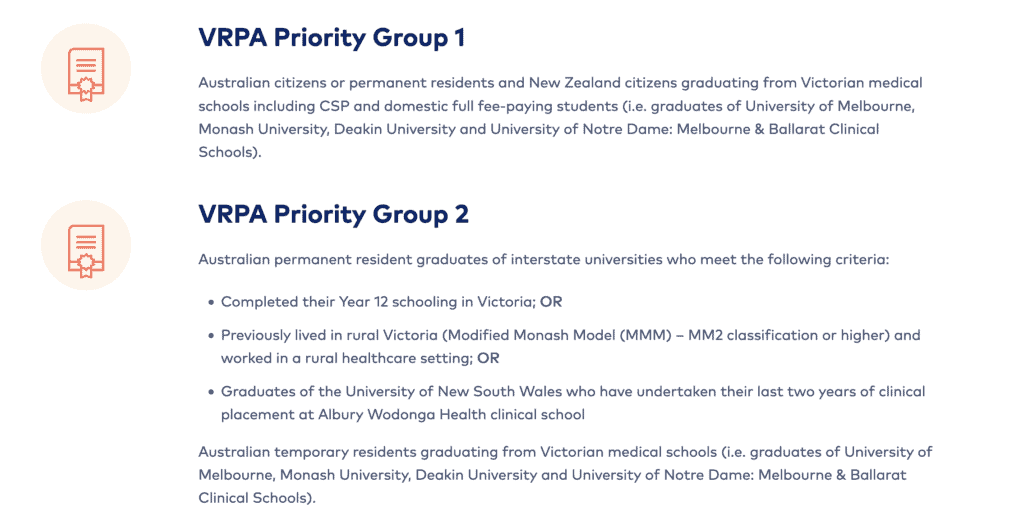
  • What is Recency of Practice? Huge Implications for Doctors.

    What is Recency of Practice? Huge Implications for Doctors.

    Recency of practice is an important concern for medical practitioners in Australia. It’s something you must address both when you register with the Medical Board of Australia for the first time, as well as each time you apply for re-registration. Most doctors tend to focus on the Medical Board standard in relation to recency of practice. But you will also find that most employers have their own expectations and standards around recency of practice. In this post, I am going to guide you through what you need to know about recency of practice, so that you can be appropriately addressing this issue both with the Medical Board as well as with employers.

    So, firstly let us define what we mean by recency of practice for doctors in Australia. According to the Medical Board of Australia, every registered medical practitioner is required to demonstrate recency of practice, which is defined as working a minimum amount of four weeks full time within your scope of practice in one year (one registration period) or 12 weeks full time within your scope of practice across 3 years (3 registration periods).

    From an employment perspective, whilst employers need to be mindful of the Medical Board standard they will generally apply their own standards. A good rule of thumb is if it has been more than 2 or 3 years since you have done a significant amount of clinical work this may be seen as a negative by a prospective employer.

    So, in the rest of this post, we will discuss some of the finer details of the recency practice standard, what might happen if you are found to not be recent enough in practice as well as the options for addressing recency of practice from both a Medical Board as well as employer perspective.

    Why have a recency of practice standard?

    It is important that doctors remain current in the type of clinical medicine that they practice. Most laypeople would consider a situation where a doctor had for example not practiced medicine at all for 5 years and not engaged in any continuing professional development during this time as one where such a doctor may pose a risk to the public if they were to return to clinical medicine with no initial support or oversight.

    The question, therefore, is how much recency of practice is enough? Interestingly the Australian Health Practitioner’s Regulation Agency (AHPRA) which oversights the National Boards, including the Medical Board, has reviewed this question a few times. In their most recent report they comment that:

    Research undertaken for this and previous reviews of the ROP registration standards did not provide a definitive answer to the question of how much recent practice a health practitioner needs to maintain their skills and knowledge, or whether minimum hours to maintain competence vary according to the profession, type and scope of practice. National Boards have drawn on the research that is available as well as their regulatory experience and the experience of other National Boards to set requirements for recent practice.

    AHPRA 2019 Report

    They concluded that the revised registration standards balance public safety versus the regulatory burden of allowing practitioners some level of flexibility in their working arrangements.

    Scope is just as important as recency.

    It is important to note that the Medical Board still expects doctors to recognise their own limitations. Even if they have met the recency of practice requirements they should still consider if what they are doing is within their current scope of practice or whether they should be self-limiting themselves or engaging in further training, assessment, and oversight.

    Scope of practice can be a bit difficult to define at times. The Medical Board of Australia defines it as follows:

    Scope of practice means the professional role and services that an individual health practitioner is trained, qualified and competent to perform.

    Medical Board Australia

    Most specialty colleges, for example, will have a statement on their website in relation to the type of clinical practice that they consider a Fellow of the college can safely engage in as a current Fellow of that college.

    If you are working as an International Medical Graduate in Australia you may have some limits on your (scope of) practice imposed as part of your registration by the Medical Board. Typically these may be about only working in a particular area of medicine or only working in certain locations where supervision has been approved.

    How do you prove recency of practice with the Medical Board of Australia?

    Primarily and initially it’s an honesty system. Whenever you apply for registration or a new form of registration or apply to re-register you must indicate to the Medical Board that you meet the recency of practice standard.

    The Medical Board does, however, expect that you keep a record of evidence to prove your recency of practice. And also indicates that it does from time to time audit for compliance and will look into your recency of practice further if it receives a notification about you.

    What can happen if I give the wrong information to the Medical Board about my recency of practice?

    In confirming your recency of practice you are confirming that you comply with the law. Deliberately lying about your recency of practice therefore can have serious consequences if you are found out. Even if you were not deliberately attempting to lie about your recency of practice if it turns out that you were non-compliant you could be in trouble.

    What happens to my registration if I am not recent enough in my practice?

    If you don’t meet the recency of practice standard then the Board can impose conditions on your registration or refuse your registration.

    It is up to you to provide information to the Medical Board to help it decide whether you can safely continue with your registration.

    Requirements for medical practitioners with non-practising registration or medical practitioners who are not registered and wish to return to practice (includes international medical graduates).

    Have had 2 or more years of clinical experienceNot practising for up to 12 monthsNo additional requirements to be met
    Have had 2 or more years of clinical experienceNot practising for between 12 months and 3 yearsBefore re-commencing must complete the equivalent of 1 year’s relevant CPD
    Have had 2 or more years of clinical experienceNot practising for more than 3 yearsNeed to provide a plan for professional development and re-entry into practice
    Have had less than 2 years of clinical experienceNot practising for more than 12 monthsRequired to recommence in a supervised training position
    C/- Medical Board of Australia
    REGISTRATION STANDARD:
    Recency of practice
    1 October 2016

    For those doctors who are required to catch up with Continuing Professional Development the easiest path for doing this is via a college CPD program if you are a member of such a college. Many IMGs will register with the RACGP for this purpose, although it should be noted that RACPG CPD is technically only relevant to general practice and not hospital medicine, although clearly there is overlap.

    If you have been out for more than 3 years and are a member of a college then you will normally find that the college provides a re-entry program option that will satisfy the Medical Board requirement. Generally, this will involve working under the oversight of a college fellow for a period of time.

    What if I am changing scope of practice?

    Again according to the Medical Board, if you are changing your field or scope of practice, you may need to undertake further training to ensure your competency.

    If the change is to a subset of your current practice, i.e. you are narrowing your current practice, there are no additional requirements.

    If you are changing your practice in a way that your peers might view as requiring you to undertake more training or you are changing to an entirely different field of practice then you will be required by the Medical Board to consult with the relevant specialist college to develop a professional development plan before entering the new field of practice.

    Why do employers have a different interpretation of recency of practice?

    Employers are of course obliged to take the Medical Board recency of practice standards into account when considering applicants for job positions. However, employers can and often do make their own interpretations around recency of practice.

    Because working supervised is an option for addressing issues around recency of practice employers may consider doctors for posts where the doctors have been out of practice for significant periods.

    However, it is my experience, particularly when it comes to trainee positions and international medical graduates that employers are unlikely to see large gaps in clinical practice favourably. Employers usually have several applications to consider and they will tend to take the easier path of employing a doctor who is either just moving between jobs or has 2 years or less time out of medicine.

    What are the options for addressing recency of medical practice?

    Option 1. Work under supervision to obtain recency of practice

    As the Medical Board itself indicates if you have recency of practice issue then working under supervision is an option for addressing this matter. A key point of this standard is to ensure that doctors who are not recent enough in their practice are given some oversight to return to work.

    So in theory this means that if you are applying for a resident or registrar (trainee) role recency of practice should not really be an issue from a registration standpoint. But as we have highlighted above it may cause a problem in terms of your candidacy versus other candidates who do have recency of practice.

    Option 2. Gain some clinical experience elsewhere to gain recency of practice

    If working under supervision in Australia is not really an option for you then your next option is to regain clinical experience by working in another country. The Medical Board indicates that it considers clinical practice in overseas countries as meeting the standard of recency of practice.

    This is generally an option for most IMGs and something I tend to recommend if they have been more than 2 years away from clinical medicine.

    I will generally advise that you try to work for 3 months back in your own country, or another country where you have a registration, as this will then help you to both meet the Medical Board’s recency of practice standard as well as provide some reassurance to employers.

    Are courses and observerships useful for recency of medical practice?

    In a couple of words not really. Neither really helps that much.

    Certainly, from a Medical Board perspective, observerships do not count as clinical practice towards the recency of practice requirement. Courses may be of assistance if you are required to undertake CPD relevant to your scope of practice.

    From an employer’s perspective, a relevant course might help a fractional amount and an observership may also assist in a small way. The key benefit for an observership may be in being able to nominate a referee who has recent contact with you in the Australian health context. However, the merits of an observership are marginal compared to actual clinical practice.

    Disclaimer. This post was written having researched the current standards for recency of practice. You should always consult an expert to gain individual advice on your circumstances, check out the official advice, and be mindful that guidelines and policies do change over time.

    Related Questions.

    Who Does Recency of Practice Apply to?

    The recency of practice registration standard applies to all registered medical practitioners, except those with non-practising registration and recent graduates applying for provisional registration to undertake an accredited intern position.

    Who Does Recency of Practice Not Apply to?

    Recency of practice does not apply to non-practising clinicians or interns provisionally registered. It also does not apply to registered students.

    Does Recency of Practice Only Affect International Medical Graduates?

    No. The recency of practice standard affects all medical practitioners seeking registration or re-registration in Australia, including locally trained doctors.

    What is Meant by Scope of Practice?

    Scope of practice generally refers to the areas of medicine you are deemed fit to practice within.

    If I Work More Than 38 Hours in a Week. Can I count These Additional Hours Towards Demonstrating Recency of Practice?

    No. You may only accumulate 38 hours in one week. Additional time will not count towards the standard.

    What If I Work Part-Time?

    Doctors who work part-time must still complete the same minimum number of hours of practice – this can obviously be completed part-time over more weeks, for e.g. working 20 hours per week for 8 weeks of the year would meet the standard.

    Will Doing a Certain Course Help My Recency of Practice?

    From a Medical Board perspective courses and degrees do not assist in any way with the recent of practice standard. From an employer perspective, they might assist in a very marginal way but really nothing beats recent clinical practice.

    Will Doing an Observership Help My Recency of Practice?

    From a Medical Board perspective, observerships do not count as clinical practice towards recent of practice. From an employer perspective, an observership may assist in a small way. The key benefit may be in being able to nominate a referee who has recent contact with you in the Australian health context. However, the merits of an observership are marginal compared to actual clinical practice.

    Does Overseas Experience Count?

    Absolutely. The Medical Board “accepts practice outside Australia for the purposes of meeting the recency of practice registration standard.”
  • Getting Registered In Australia. The Four Options for International Doctors.

    Getting Registered In Australia. The Four Options for International Doctors.

    *The process of getting a job and getting registered as a doctor in Australia is complex, it’s important to understand that you do need to get individual advice on your circumstance. Circumstances do vary for individuals and also things change over time.

    If you are an ad doctor looking for some general information about your options for getting registered in Australia, then this post is for you. I spend a lot of time on Zoom calls these days explaining to doctors from overseas countries (International Medical Graduates or IMGs) what their options are for working as a doctor in Australia. It’s quite a complex process. And inevitably at some point, it makes sense to talk one on one. Particularly if you are starting to get serious about the idea of working as a doctor in Australia. If that’s you I’d recommend booking a strategy call.

    With that being said. Let’s look at the four pathways available for IMG doctors to become registered in Australia from overseas. And let me be quite clear here. These are not the main pathways. They are the only pathways available for getting registered in Australia, at the time of writing this post. If you are a doctor coming from overseas to Australia your pathways to registration are:

    • The Standard Pathway, which is a general registration pathway for doctors from any country who do not have specialist qualifications and are looking to start at junior doctor level in Australia.
    • The Competent Authority Pathway, which is a restricted pathway that enables both specialist and non-specialist doctors from the United Kingdom, United States of America, Republic of Ireland and Canada to commence their work in Australia.
    • The Specialist Pathway, which is a pathway that can ultimately lead to recognition as a specialist in Australia and requires you to be initially assessed by the relevant medical specialty college.
    • The Short Term Training in a Medical Specialty Pathway, which allows for time-limited registration, so that advanced trainees and specialists from other countries can obtain some top-up training in Australia.

    It All Comes Down To the Medical Board of Australia.

    So the first thing to know about getting registered in Australia is that it’s the same final authority wherever you work in the country. No matter what state or territory you are in, it’s all conducted through what’s called the Medical Board of Australia under the overarching umbrella of the Australian Health Practitioners Regulation Agency.

    This is actually a reasonably new thing in Australia. Prior to 2010, the various state and territory medical boards were responsible for registration, which actually made the process even more complex.

    Under the Medical Board of Australia, there are essentially four pathways to becoming registered as a doctor in the country. And if you’re an IMG, you can find some very helpful information about these pathways on the board website.

    There are even handy flow charts that can help you make some decisions about which option might be best for you.

    But It All Starts with the Australian Medical Council.

    Whilst the endpoint for registration for IMGs is the Medical Board the starting point is always the Australian Medical Council. For some IMGs (those attempting the Standard Pathway) you will have a lot to do with the AMC. But for the rest it’s really a very quick but mandatory step where you have to get your medical degrees verified.

    Why Have Pathways to Registration?

    Pathways to registration in this country for international medical graduates are essentially comparisons against the process by which Australian and also New Zealand medical graduates are given registration.

    Australian graduates first become registered in the system upon graduating from medical school as interns and progress through what is called provisional registration to general registration. After this most Australian doctors hope to eventually add what is called specialist registration to their registration status at some point.

    The four pathways to getting registered in Australia are therefore pathways that lead to a form of initial or provisional registration. But which ultimately lead to the IMG being able to gain either general or specialist registration. This is with one notable exception. The Short Term Specialist Training Pathway, which is a time-limited pathway that does not lead to either general or specialist training.

    The Competent Authority Pathway.

    The competent authority (CA) pathway essentially recognises that doctors that come from other healthcare systems, with similar systems, and processes, and standards to the Australian context, have a level of equivalence.

    The competent authority pathway is for both non-specialists as well as specialist doctors. It is a streamlined process for becoming granted registration in Australia. The board has approved a number of international authorities as competent in their assessment of doctors for medical registration. The reason that these authorities are deemed competent (and others are not) is unclear but historically well before the advent of the Medical Board of Australia, these jurisdictions were given preferred status by the old State and Territory Medical Boards. Arguably these countries do have medical training systems that are equivalent to Australia.

    The authorities are:

    • the General Medical Council in the UK for local UK graduates as well as international graduates who go through the PLAB pathway.
    • the Medical Council of Canada.
    • the Educational Commission for Foreign Medical Graduates of the United States and the United States Medical Licensing Exam (essentially, anyone who has the USMLE certificate).
    • the Medical Council of Ireland.
    • And the Medical Council of New Zealand*

    *The Medical Council of New Zealand is only listed here for IMG doctors who go through what’s called the NZREX process. Something akin to the AMC Standard Pathway process in Australia. Actual medical graduates of medical schools in New Zealand are considered absolutely equivalent to Australian graduates of Australian medical schools because these schools are actually also accredited by the Australian Medical Council.

    So if you have primary qualifications in medicine awarded by a training institute, which is recognised in the competent authority jurisdictions and also recognised by the Australian Medical Council you will normally be permitted to apply to work as a doctor in Australia under this pathway.

    This is on the proviso that you have completed some clinical training or assessment within that authority. This differs from jurisdiction to jurisdiction but is either a year of training or two. So, for example, in the UK, that would be the first foundation years. Whereas in the US it would mean completing 2 residency years in an ACGME accredited post.

    Why Is The Competent Authority Pathway Attractive?

    If you are eligible for the Competent Authority Pathway in Australia this is generally a good thing as it is considered to be the easiest pathway to getting registered and being able to start working here.

    Often times employers will also prefer say a UK-trained doctor over a doctor from Sri Lanka when there is a need to employ an IMGs.

    If you are eligible for the Competent Authority pathway essentially all you need to do is convince an employer to offer you a suitable position and have the intended supervision for this position assessed by the Medical Board of Australia.

    Once you are approved for registration you work for 12 months under provisional registration and will need to complete satisfactory supervisor reports. If all goes well at the end of this process you are able to apply for general registration. There’s no need for examinations or other forms of assessment (other than supervisor reports).

    (It should be noted that sometimes doctors from CA countries who are applying for specialist registration also work for 12 months under this pathway. In this situation you do not gain general registration at the end of the process you gain specialist registration in your particular specialty.)

    The Standard Pathway.

    The next pathway is the most common pathway that the majority of IMGs attempt in order to work as doctors in Australia.

    The standard pathway applies to IMGs who are not eligible for the competent authority pathway and who do not have specialist qualifications. To come in through this category, you need to have a recognised primary qualification in medicine. But before you can apply to the Medical Board of Australia for registration or approach employers for jobs, you have to go through some additional steps with the Australian Medical Council.

    These steps include the mandatory check of your degree, which all IMGs have to do. But also include sitting for the AMC Certificate examinations, which is a 2 part examination, consisting of a Part 1 MCQ Exam, and then a Part 2 Clinical Examination.

    You can actually begin to apply for jobs once you have successfully passed the AMC Part 1. But you will only be able to gain general registration once you have completed the full certificate.

    We have a guide to the AMC exam here. The AMC Exam, particularly the clinical exam, is generally considered to be a very tough and difficult examination to complete. Despite this, there are quite a few IMG doctors who have obtained their certificate but have been unable to find employment as a doctor in Australia.

    The Specialist Pathway.

    The final main pathway for most IMGs is the specialist pathway. This pathway is for overseas trained specialists so that they can apply to be assessed against the capability of a similar Australian-trained specialist. A process that is called “comparability”.

    This process includes IMGs applying for what is called Area of Need positions, which are extremely rare to find these days. As well as specialist IMGs just going for assessment with the college.

    As with all other pathways, you need to have a recognised primary degree first. But then just to create more confusion IMGs applying for the specialist pathway don’t apply to the AMC or the Medical Board for assessment they apply to the relevant specialist college. Which then performs an assessment.

    So if, for example, you’re a specialist from a competent authority country, it can be very confusing because you can apply to the Medical Board of Australia for provisional registration under the competent authority pathway to work in a supervised position.

    But at the same time, you need to also apply it to the college to assess your specialty training and experience and qualifications in order to get registered as a specialist and come through the specialist pathway.

    Applying for the Specialist Pathway assessment involves quite a bit of time and money. In general, you will need to fill out an extensive application outlining all of your past experiences to date. The more complete and detailed you make this generally the better the outcome. The college may just reject you based on your application. But generally, in the case of most colleges you are then invited to an interview to further explore your credentials.

    There are only 3 outcomes for this assessment process:

    1. You are deemed not comparable.
    2. You are deemed partially comparable.
    3. You are deemed substantially comparable.

    Being deemed not comparable means you need to think about other pathways.

    Being deemed partially comparable or substantially comparable means that the college views you as either being within 2 years (partially comparable) or 1 year (substantially comparable) of becoming a specialist in Australia.

    If you achieve comparability you will still need to secure an appropriate post where you can receive oversight by other specialists in your field. In the case of partially comparable, it is also likely that you will need to sit further examinations.

    If you gain a post and complete all the requirements you will finally be recommended to the Medical Board for specialist registration.

    We will eventually have a more detailed post about the specialist pathway. But in the meantime the following 2 blog posts are useful:

    As well as our series of videos on the Specialist Pathway on YouTube.

    The Short Term Specialist Training Pathway. The Final Pathway.

    There is actually a fourth pathway option. This option is not as well known to IMGs as the other 3 options. And this is perhaps because it is not a pathway to permanent registration in Australia.

    The final pathway is called the Short Term Training in a Medical Specialty Pathway, or Short Term Specialist Training Pathway. This pathway is limited to IMG doctors who are either already specialists or in the advanced or final phase of their specialty training. Ostensibly the pathway is designed to facilitate additional “top-up” training or experience, i.e. it is designed to give a specialist from another country some additional training and experience to help when they return to their own country.

    The pathway is therefore strictly limited to 2 years and you generally have to complete a form indicating that you are intending to return to your own country at the end of this period of registration.

    To be eligible for this pathway you first need to secure a job offer (usually an Advanced Training post) from an employer. Like all other pathways, you need to verify your degree with the AMC. You also need to apply to the specialist college for assessment of your credentials against the post you have secured.

    Unlike the specialist pathway, the college assessment is only paper-based, requires less information, and generally easier to pass.

    Is Short Term Specialist Training A Pathway to Working Permanently in Australia?

    Even prior to the advent of the one Medical Board there were registration categories in existence that enabled trainee doctors from other countries to come to Australia and work for a limited period of time.

    It was not uncommon for these doctors to take the opportunity whilst working in Australia to pursue other forms of registration and the case is the same still with the Short Term Specialist Training Pathway.

    So, whilst the pathway itself is designed to be time-limited and there is a requirement to state your intention to return at the end of your registration period. There is really no way of enforcing this and there is nothing to say that you might change your mind halfway through the process.

    And I have certainly seen a number of IMG doctors use this particular pathway as a “stepping stone” to a more permanent registration category.

    Whilst, specialist colleges are not permitted to take into account any experience you have gathered under the Short Term Specialist Training Pathway, it is hard for them to ignore the fact that you have already worked successfully in the Australian context and also hard to ignore references from Australian College Fellows attesting to your capability.

    Similarly, if you have proven your work capability in an Australian health service then this tends to dramatically improve your prospects with employers in Australia for other jobs over and above most other things, including things like qualifications and observerships.

    Related Questions.

    I Have More Questions About the Standard Pathway and AMC Exams.

    We recommend you check out this extensive post that we wrote.

    Where Can I Find More Information About the Specialist Colleges?

    We have you covered in this post

    Do I Need to Pass an English Test?

    Unless you have high schooled and trained in English in a small number of countries that the Medical Board recognises it is likely that you will have to pass one of the English competency tests. This is a requirement prior to obtaining registration and may also be required prior to other assessments, such as specialty college assessments. We have a detailed guide about this issue here.

  • Medical Internship 2020 / 2021 Australia

    Medical Internship 2020 / 2021 Australia

    *We will be regularly updating this post as information is updated about the Medical Internship process in Australia. The situation is fluid and has been disrupted somewhat due to COVID-19.

    It’s that time of the year again. The time when each of the States and Territories in Australia open up the process of applications for medical internships for the following year. For four years I was responsible for running the largest Intern application system in Australia for 4 years. The NSW Intern application system. So I’d like to share with this year’s medical graduates some of the wisdom I gained from that experience.

    (Disclaimer: All information here has been sourced in good faith but things do change so you should always do your own due diligence in such matters, we are providing this information to aid you in your application but take no responsibility for any outcomes)

    Intern applications and allocations are normally coordinated across Australia so that every State and Territory opens and closes their systems at the same time and makes offers at the same times. It still appears that this will be the case in 2020, despite COVID-19. The key things that all medical graduates should consider in preparing their medical internship application for the 2021 year in 2020 are as follows:

    • Applications open on 4th May 2020.
    • Applications close on 4th June 2020.
    • Make sure that you have an Intern Placement Number otherwise you won’t be able to apply.
    • You should research the application requirements now as there may be some “surprises”. As soon as the application system opens, register or log in and ensure that you have everything you need to complete your application.
    • Understand where you sit in the priority list for any State or Territory you are applying to.
    • If you will need to attend an interview. Make sure you have gotten leave from your medical school requirements to attend.
    • Also, consider that the interview is likely to be either via phone or video this year.
    • Give yourself time to request referees, put together a Resume, if required and find other documents that you may need.
    • First offers come out from 13th July 2020. So make sure that you have regular access to your email as your time for accepting offers can be quite short.
    • Stay in touch with your medical school. you may be worried about completing your degree on time but they are all working very hard with the other institutions to give you the best chance of completion.

    Tip #1. Your Medical Intern Placement Number.

    The IPN is a unique nine-digit number that has been generated by AHPRA and has been provided to medical schools for distribution to all 2020 final year medical students. The number is used as part of the national audit process (which ensures that intern positions across the country are made available to as many applicants as possible) as well as to streamline registration.

    This number is not the same number as your AHPRA registration number or student number. If you have not received you IPN you should check with your school

    Tip #2. Other Things You Will Likely Need. 

    The majority of States and Territories require you to upload an academic transcript as proof that you are indeed a medical student. 

    They will also request evidence that you satisfactorily meet the AHPRA English Language requirements. This may seem a bit ridiculous given that you have been attending medical school in English for the last 4 or 5 years. But it is the law. So check whether you may need to submit an up-to-date English test result or some other form of documentary evidence such as a high school certificate.

    Most States and Territories will also request a CV or Resume. For tips on your CV or Resume see our ultimate guide to CVs or watch a video series about this.

    Some States and Territories have a CV template that they suggest that you use to fill in your information. In the case of Victoria, you are required to use this template. It’s probably fairly harmless to use the template for the other States and Territories. But if you are thinking about your future career, then nows is a good time to be designing your own CV. The risk of using the template is that you don’t stand out from other candidates.

    You will need to also provide proof of your identity, citizenship, residency, or visa. And if you have had a name change along the way you will probably also need to provide some documentation in relation to this.

    Why All This Information?

    The State and Territory bodies who administer the Intern application process have a responsibility to ensure that you are eligible to apply for provisional registration at the end of the year in order to work as an Intern.  They collect this information to check that everything is in order so that you are indeed eligible to apply. Employers can get rightly annoyed when told that someone who has been allocated to work with them as an Intern will have a several-month delay whilst they resit an English language test.

    However, it’s your responsibility to ensure that you are eligible for registration. So you should also be checking these things yourself. 

    It’s hard to fathom given the amount of communication from health departments, medical schools and student colleagues. But every year there are a handful of medical students who forget to apply for their internship. This means having to wait another year. Don’t let that be you.

    Dr Anthony Llewellyn | Career Doctor

    Tip #3. Research and Apply Early.

    It’s hard to fathom given the amount of communication from health departments, medical schools and student colleagues. But every year there are a handful of medical students who forget to apply for their internship. This means having to wait another year. Don’t let that be you.

    There are even more students who leave their applications to the last minute. Only to find that they are missing a vital document. For example, this could be evidence you need to substantiate that English is your first language, such as a high school certificate. Or perhaps your last name has changed whilst you have been in medical school? Or maybe you need to submit a CV with your application?

    As soon as the application page opens for each State and Territory you are going to apply to make sure your register. And then go as far through the process of applying as possible so you can see if there is some sort of document you need to obtain.

    Tip #4. Practice Your Video Interview Technique.

    If you are one of the many students who may need to undertake an interview for your internship choices as occurs in certain situations, such as rural preferential recruitment and certain States such as Victoria. Then you should be prepared for the fact that this year your interview is unlikely to be held in person and very likely to be conducted on video.

    There’s a lot more than you think to video interviewing. For a rundown on this check out this recent post.

    Tip #5. Know Where You Sit In The Priority List.

    ts important to know where you sit on the priority list. Each State and Territory has a slightly different order but in essence, it goes something like this:

    1. If you are an Australian Citizen or Permanent Resident and went to Medical School in that State or Territory you are top of the list.
    2. If you are an Australian Citizen or Permanent Resident and went to Medical School in another State or Territory or New Zealand you are probably second.
    3. If you are an International student who studied Medicine in Australia you are probably next.

    Priorities Within Priorities.

    Some States and Territories also have priority pathways to ensure that groups such as Aboriginal and Torres Strait Islanders and doctors who wish to work rurally or regionally can obtain their preferred placement early.

    So if you are an International student and like the idea of working rurally it’s probably a good idea to consider a rural pathway as it will likely boost your chances of gaining an Intern position earlier in the process.

    More Information on Each Jurisdiction

    New South Wales

    Intern Positions ≅ 1,039 (including 170 rural preferential)
    Annual Salary = $69,649

    The Health Education & Training Institute runs the countries largest Intern application process. Offering over 1,000 internships.

    Interns can be allocated to one of 15 networks of hospitals. The offer is for a 2-year contract to cover both internship and residency.

    You have the option of applying through one of 4 pathways:
    – Aboriginal Recruitment Pathway
    – Rural Preferential Pathway
    – Regional Allocation Pathway
    – Optimised (or Main) Pathway

    Only applicants who go through the Rural Preferential Pathway need to submit a CV and attend an interview.  All other pathways are based on applications only.

    Intern Placement Priorities:

    Priority 1 – Medical graduates of NSW universities who are Australian/New Zealand citizens or Australian permanent residents (Commonwealth Supported Place and Domestic Full Fee paying). This priority category is guaranteed an intern position in NSW. 

    Priority 2 – Medical graduates of interstate or New Zealand universities who completed Year 12 studies in NSW who are Australian/New Zealand citizens or Australian permanent residents (Commonwealth Supported Place, Domestic Full Fee paying or NZ equivalent). 

    Priority 3 – Medical graduates of interstate or New Zealand universities who completed Year 12 studies outside of NSW who are Australian/New Zealand citizens or Australian permanent residents (Commonwealth Supported Place, Domestic Full Fee paying or NZ equivalent). 

    Priority 4 – Medical graduates of NSW universities who are not Australian/New Zealand citizens or Australian permanent residents and who hold a visa that allows them to work or are able to obtain a visa to work.

    Priority 5 – Medical graduates of interstate or New Zealand universities who are not Australian/New Zealand citizens or Australian permanent residents and who hold a visa that allows them to work or are able to obtain a visa to work in Australia. 

    Priority 6 – Medical graduates of Australian Medical Council accredited universities with campuses that are located outside of Australia or New Zealand who are not Australian/New Zealand citizens or Australian permanent residents and who hold a visa that allows them to work or are able to obtain a visa to work in Australia.

    HETI Medical Graduate Recruitment Page.

    HETI Prevocational Training Application Program Portal.

    Victoria

    Estimated Numbers = 820
    Annual Salary = $79,138

    Internship in Victoria works around a computer matching system which is administered by the Postgraduate Medical Council of Victoria. The system appears to have had a significant overall this year and looks to be much more user friendly.

    Portal

    There is no other information available at this stage.

    Below is information from last year.

    Once you have submitted all your details and preferences the match informs the various hospitals and health networks who then conduct a selection process.  Some but not all hospitals and networks perform interviews.  Your selection may just be based on where you sit in the priority list plus your CV and referee reports.

    Interns can be allocated to one of 22 hospitals and networks. This includes a small number of community based internships where the focus is more on community based models of care, including working in primary care and smaller hospitals.

    For Victoria you will need to submit a CV. This MUST BE on the quite unattractive PMCV Standardised CV Template. You don’t have to put a photo on your CV. And I would not recommend doing so.
    Intern Placement Priorities:

    Priority Group 1 – Australian permanent residents or citizens and New Zealand citizens graduating from a Victorian medical schools including CSP and domestic full fee paying students (i.e. graduates of University of Melbourne, Monash University, Deakin University and University of Notre Dame: Melbourne & Ballarat Clinical Schools).

    Priority Group 2 – Australian temporary resident graduates of Victorian medical schools  Interstate Special Consideration candidates (approved by DHHS)

    Priority Group 3 – Australian permanent resident graduates of interstate or New Zealand universities (including previous residents of Victoria); Australian temporary resident graduates of interstate universities; New Zealand temporary resident graduates of New Zealand universities; and Graduates from an overseas campus of an Australian/New Zealand University accredited by the Australian Medical Council (e.g. Monash University – Sunway Campus, Malaysia)

    Queensland

    Estimated Numbers = 776 (including 67 rural generalist)
    Annual Salary = $78,941

    Queensland Health conducts the annual intern allocation process in Queensland. Interns can be allocated to one of 20 primary allocation centres. An interesting aspect of the Queensland application portal is that you can see a live indication of where other applicants have preferenced other hospitals. This is presumably designed to encourage medical students to consider other hospitals and get the student group itself to work out the allocation. I have no indication whether its a useful process or not. If you know anything about this. Leave a comment below.

    Intern Allocation Priorities:

    Group A
    Medical graduates of Queensland universities who are Australia/New Zealand citizens or Australian permanent residents; and are seeking an internship commencing in the year immediately following graduation;
    OR 
    received Review Committee approval from a previous campaign to defer commencement of internship

    Group B
    Medical graduates of Australian (interstate) or New Zealand universities who are Australian/New Zealand citizens or Australian permanent residents;
    OR
    Medical graduates of Queensland universities who are Australian/New Zealand citizens or Australian permanent residents who do not meet the criteria outlined in Group A

    Group C
    Medical graduates of Australian (Queensland or interstate) or New Zealand universities who are NOT Australian / New Zealand citizens or Australian permanent residents who: 
    currently hold a visa that allows them to work in Australia;
    OR
    will need to obtain a visa to work in Australia

    Group D
    Medical graduates of Australian University campuses outside of Australia accredited by the Australian Medical Council.
    OR
    Medical graduates of international universities who have not completed an internship in Australia or another country and have either: 
    – obtained the AMC Certificate (and are eligible for provisional registration)
    – successfully completed the AMC MCQ (multiple choice questionnaire) (and are eligible for limited registration)

    The Queensland Rural Generalist Pathway (QRGP) offers graduating medical students the opportunity to explore a wide variety of clinical training and develop the advanced skill set required to support the health needs of rural communities. It’s a priority pathway that you can opt for first.

    If you are not interested in the Rural Generalist pathway then you need to work out which category you are in.

    Intern Application Info Page.

    How To Apply.

    Application Portal.

    *Queensland is one of a few jurisdictions that does permit International Medical Graduates to apply for positions as part of the last Applicant Group.

    South Australia

    Estimated Number = 260
    Annual Salary = $77,084

    SA Health Careers conducts the annual Intern application process in South Australia. There are 3 Adelaide based Local Health Networks and one small Country Health Network (based at Mt Gambier & Whyalla) to which you can apply for the priority Rural Intern pathway.

    The Rural Intern Pathway is a strength based recruitment process for applicants who are interested in undertaking their internship (and potentially subsequent years) in rural hospitals within Country Health SA (CHSA). Rural intern positions provide broad opportunities in unique settings and are best suited for medical graduates with a history of living or working in a rural areas or a desire to commence a career in the country. 

    Intern Allocation Priorities:

    Category 1 Australian Citizens, Australian Permanent Residents and New Zealand Citizens
    1.1: Medical graduates from a South Australian university who identify as Aboriginal and Torres Strait Islander (ATSI)
    1.2: Medical graduates from a South Australian university – Commonwealth-supported (HECS-HELP) or SA Bonded Medical Scholarship Scheme (SABMSS)
    1.3: Medical graduates from a South Australian university – full-fee paying

    Category 2 Australian Citizens, Australian Permanent Residents and New Zealand Citizens
    2.1: Medical graduates from an interstate or New Zealand university who identify as Aboriginal or Torres Strait Islander (ATSI)
    2.2: Medical graduates from an interstate or New Zealand university who completed Year 12 in South Australia
    2.3: Medical graduates from an interstate or New Zealand university
    2.4: Medical graduates from an overseas university who completed Year 12 in South Australia
    2.5: Medical graduates from an overseas university 

    Category 3 Australian Temporary Residents and New Zealand Permanent Residents
    3.1: Medical Students from a South Australian University 

    Category 4 Australian Temporary Residents and New Zealand Permanent Residents
    4.1: Medical graduates from an interstate or New Zealand University 

    Category 5 Australian Temporary Residents and New Zealand Permanent Residents
    5.1: Medical graduates who have spent two or more semesters in an overseas campus of an Australian or New Zealand University (eg Monash Sunway campus, UQ New Orleans campus)
    5.2: Medical graduates of an overseas university

    South Australia is one of few States that specifically permits medical graduates from other countries to apply for internship positions. But they are at the very bottom of the priority list.

    If you are not a South Australian medical student, in order to apply for an internship in South Australia you will need to provide a certificate confirming that you have completed the SA Health online electronic medical record (Sunrise EMR & PAS) training. 

    Western Australia

    Estimated Numbers = 310 (based on 2020)
    Annual Salary = $78,749

    In WA all interns are employed by a Primary Employing Health Service (PEHS). 

    There are 4 PEHSs and each PEHS is a major tertiary hospital in WA which have been accredited to directly employ interns and provide a high-quality intern training program. Each PEHS normally holds an information night. There is no information available about these at the moment. You can also choose to work as a rural intern by applying to work through Western Australia Country Health Service.

    The process is coordinated by the Postgraduate Medical Council of Western Australia but you apply through the WA Jobs site and selection occurs through panels representing each of the PEHSs. As part of your application, you need to provide a cover letter and CV and will require a range of other documents as well as to nominate 3 referees. If successful you will receive a contract for 3 years.

    Application Portal

    Key Dates

    Northern Territory

    Estimated Number = 50
    Annual Salary = $78,750

    The NT Prevocational Medical Assurance Services (PMAS) conducts a central review of eligible applicants and all intern positions are allocated within the two  NT Health Services:
    Top End Health Service (TEHS) – Royal Darwin Hospital (RDH)
    Central Australia Health Service (CAHS) – Alice Springs Hospital (ASH)

    Eligible applicants are allocated intern positions in line with the Northern Territory category groups. Within the relevant category groups applicants are allocated to their highest possible Health Service preference, pending availability of a position.

    Overall the intern allocation process is based on an applicant’s category group, Health Service preference and the number of positions available in each health service.

    The two NT Health Services are responsible for selecting applicants and making their offers of employment, applicants are advised via email.  The Health Service responsible for making the offer of employment will after receiving an acceptance from an applicant arrange an employment contract for an Internship position within their health service to be provided prior to commencing internship.

    NTPMAS Site

    NT Department of Health Intern Recruitment Link (includes information on Categories)

    *NT is one of a few jurisdictions which will consider 

    Australian Capital Territory

    Estimated Numbers = 95
    Annual Salary = $74,826
    (6 of these positions are normally guaranteed to NSW medical students)

    If you want to apply for an internship position in the Australian Capital Territory you do so via the ACT Health Recruitment page.

    Most of your time is spent at the Canberra Hospital. But ACT is interesting as it is one of the few chances you may have as an Intern to work in 2 separate States and Territories. Rotations may include secondments to Calvary Public Hospital, Goulburn Base Hospital and South East Regional Hospital (SERH) at Bega. 

    Priority is given to:
    – Australian Graduates of ANU
    – Maximum 6 graduates of NSW Universities
    – Graduates of other Universities who completed Year 12 in ACT
    – International Fee Paying Graduates of ANU
    – Graduates of other Australian Universities
    – Graduates of Australian University campuses outside of Australia

    Other details are limited at this stage. 

    Intern Priority List

    Recruitment Page.

    Tasmania

    Estimated Number  = 90
    Annual Salary = $70,315
    Internships are coordinated in Tasmania via the Department of Health and Human Services.

    All applicants are required to apply online. As part of your application you are asked to preference all of the 3 available sites:
    – Hobart
    – Launceston
    – North West Region

    Candidates need to attach a CV/Resume and any other relevant information to their application and must arrange completion of two electronic referee reports:

    – One (1) referee that is employed in a clinical role (Clinical Academic) with the University where you are studying/or studied medicine and is aware of your studies in the past 12-24 months; AND

    – One (1) that is – a senior clinician (>4 years’ experience post general registration) who has observed you (you have worked with) during your clinical placements in the past 12-24 months, and can comment on your suitability for hospital-based practice.

    Intern Placement Priorities:

    The Tasmanian Health Service currently gives priority, in order, to:
    – Australian permanent resident Tasmanian-trained Australian Government supported and full-fee paying medical graduates.
    – Australian temporary resident Tasmanian-trained full-fee paying medical graduates.-
    – Australian permanent resident interstate-trained Australian Government supported and full-fee paying medical graduates.
    – Australian temporary resident interstate-trained full-fee paying medical graduates.
    – Medical graduates of an Australian Medical Council accredited overseas University.

    Selection occurs via face-to-face interviews (likely to change). Following interview successful applicants will be placed in an order of merit with applicant performance at interview accounting for 70% of the overall score, and each referee report accounting for 15% of the overall score. Vacant positions are offered in order of merit and the Tasmanian Health Service Priority Placement Framework.

    Recruitment Link

    Commonwealth – Junior Doctor Training Program Private Hospital Stream

    Intern Positions TBD
    Annual Salary = will depend on which State or Territory you are employed in.

    The Commonwealth provides an additional Internship program for international students who study at Australian medical schools.

    *Any excess posts may be applied for by other IMGs in Australia

    The main function for this program over the years has been to provide additional opportunities for international students studying Medicine in Australia a chance to complete their internship.  This is done by tendering to various private hospitals for additional intern positions.

    The program was retitled in 2020 to the Junior Doctor Training Program Private Hospital Stream when there was 115 positions on offer.

    Normally there is not as much information about the program available until a mad flurry at the end of the year.  And 2020 seems to be no different. They are still sorting out which hospitals will provide internships.  After which there will probably be some information about how to apply.

    For now we know that the eligibility requirements are that you must either be an international full fee paying medical graduate from an onshore Australian medical school. This is Priority One. If not all positions are filled by priority one medical graduates then the private hospitals may then recruit other medical graduates who are eligible for provisional registration. This is the Priority Two category.

    Eligibility Requirements for Intern (PGY 1) Junior Doctor Training Places under the Junior Doctor Training Program Private Hospital Stream

    Under the PHS, participating private hospitals must prioritise international full fee paying medical graduates from onshore Australian medical schools (Priority One). Should these places not be filled, private hospitals may then recruit other medical graduates eligible for provisional registration (Priority Two). This means that the Commonwealth Scheme provides one of the few opportunities for IMGs who are applying via the standard pathway process to gain an internship position in Australia.

    To do so you will need to have met the Medical Board of Australia provisional registration requirements as a medical practitioner. And also have met the English language proficiency requirements for registration purposes. And commit to obtaining an appropriate visa to work in Australia during the internship year.
    Private Hospitals participating in delivering the Private Hospital Stream in past years were:
    – Mater Health Services North Queensland Limited
    – Mercy Health and Aged Care Central QLD
    – MQ Health (Macquarie University Hospital)
    – St John of God Health Care Inc.
    – St Vincent’s Private Hospital Limited
    – St Vincent’s Private Hospital Sydney
    – Ramsay Health Care
    – Greenslopes Private Hospital
    – Joondalup Hospital

    Link to Program details

    How To Decide?

    There are lots of considerations when it comes to putting in your Intern application. Everyone is a bit different. Some graduates feel like they would like to be close to home and family whilst going through their transition to Intern. Others see it as a chance to get away and explore a new place and location. And then others focus on the long-term career prospects of certain locations.

    I think this last consideration is a little overrated for most. You can generally experience a wide range of medicine in your first couple of years of medicine after graduation and there is scant evidence that this affects your prospects of applying for specialty training posts.

    That being said if you have an interest in anything other than Medicine, Surgery, or Emergency Medicine as a future career you should probably investigate whether this particular specialty is offered at the hospitals or networks to which you apply.

    Unfortunately, the internship model in Australia is quite antiquated and we have used the experience as a proxy for competency. The result has been the mandating of the 3 core terms for internship of Medicine, Surgery, and Emergency Medicine. There is really no solid educational basis for this approach and one of the unfortunate outcomes is that all the other specialties get squeezed out and few interns get to experience psychiatry, general practice, obstetrics, paediatrics, pathology, etc… which ultimately does have an effect on recruitment to these specialties.

    So the basic message is this. If you are really dead set keen on doing radiology as a career you should try to track down the very few locations that might offer this rotation to either interns or residents.

    Each year the Australian Medical Students’ Association produces a very useful Intern Guide with lots of information about the composition of intern training networks across the country. We are currently waiting on the 2020 version. But here’s a link to the 2019 version.

    Related Questions

    Question: What If I Have Special Circumstances Which Make It Hard For Me To Work In Certain Places?

    Answer: All States and Territories Have processes for considering special circumstances. Some of the types of circumstances that are generally approved are: where you may have certain health conditions that mean you need to be close to certain hospitals or specialists; where you have dependents, such as young children, and are unable to relocate due to care arrangements; and where you and your partner want to work as doctors in the same location.

    Generally requests to stay in certain locations, for reasons such as work commitments of partners or needs of school aged children are not granted.Question: I Have Received My Intern Offer. But I Would Like to Defer It. Is This Possible?

    Answer: This will partly depend on how long you wish to defer for. 

    If you just wish to defer for a a few months. Once you have your offer and are in discussions with your new employer make enquiries. It may be possible to negotiate a later start with your employer. Most employers will generally prefer that you start on time, so that you are not out of sync with your colleagues. But there might be some advantage for the employer in you attending orientation but then starting a bit later as it will probably help them to fill out roster gaps.
     
    On the other hand. If you wish to defer for a complete year. Then you will need to check the policy of the State or Territory that has provided you an Intern offer. In some cases (for example Victoria) you will be permitted to defer and your place will be held for you the following year. In most other cases you will need to reapply the following year and check whether your priority status has altered. In most cases you have the same priority status.

    Also bear in mind that it is unclear how long you can defer commencing your internship. However, the Medical Board of Australia expects that once you have commenced your internship you will have completed this process within 3 years.
    Question: I Am a Doctor With a Medical Degree From Outside Of Australia. Can I Apply For Internship?

    Answer: Unless you obtained your medical degree from a New Zealand Medical School. Then the brief answer to this question is no.

    I would love to stop there. And I really think you should as well. But there are rare circumstances where you may be able to obtain an internship with a medical degree from outside of Australia. But the Medical Board of Australia strongly advises against this option and so do I. For good reasons. Firstly the whole Australian medical internship system is designed to ensure that Australian medical graduates are able to undertake an internship. Not for overseas graduates. Secondly (and as a result of the first point) it is very rare to be offered the chance.

    Some States and Territories will not even consider an application from an IMG for internship. Others will only do so in limited circumstances, for example, the Northern Territory will accept applications from IMGs who may have done a medical student elective or clinical observership in the Northern Territory and who have experience in rural, remote and indigenous health locations. But even then these applicants are at the bottom of the priority list for obtaining an internship. South Australia will accept applications. But again you are bottom of the list. Queensland will also accept applicants, but only if you have never worked as a doctor. And again you are bottom of the list.

    A final note on this question is that the majority of IMGs who do obtain a medical internship position each year in Australia generally have Australian citizenship or permanent residency.Question: I Have Heard That Some Graduates Miss Out On Internship. Is This True?

    Answer: Whilst it is theoretically a possibility that some medical graduates miss out on Internship according to information provided by HETI for the most recent year of intern applications no-one was actually left at the end of the process without an offer.

    Only Australian citizens and permanent residents are guaranteed an intern position under the COAG agreement. However, there are generally enough intern positions available for those students who have come to Australia to study medicine and the Commonwealth Private Hospital program offers additional spaces for those that may miss out.

    That being said. It is also clear that many graduates choose to drop out of the application process themselves. So not everyone who applies gets an offer. The assumption is that some graduates take up similar intern opportunities in other countries upon graduation.

    (Disclaimer: all information here has been sourced in good faith but things do change so you should always do your own due diligence in such matters, we are providing this information to aid you in your application but take no responsibility for any outcomes)

    We’d welcome feedback from any Intern programs in relation to the accuracy of the above information.

  • Mobilizing the Doctor Workforce to Fight COVID-19 Should Include IMGs.

    Mobilizing the Doctor Workforce to Fight COVID-19 Should Include IMGs.

    With recent announcements, it appears that Australia has lost the initial attempt to tightly contain the spread of the coronavirus. Including reports that it is now starting to spread within the health workforce itself. There is a need to consider how we can develop plans to ensure that we have enough doctors, nurses, allied health and other important staff to cope with a predicted environment where there are increased cases of viral illnesses presenting to our health services and large amounts of staff either sick or in isolation.

    It has been suggested that we will need to pull staff from some of the existing pools that we tend to rely upon to deal with shortages, such as locum or casual staff pools. But these sources are often already closely tapped. It has also been suggested that we may need to bring doctors and other health professionals back from leave or out of retirement. Which may help to an extent.

    A Big Group of Doctors Has Not Been Thought About So Far.

    What doesn’t seem to have been considered so far is that there is another large group of doctors already in this country who are champing at the bit to get involved in helping with this potential increased demand on our health system.

    There Are Literally Hundreds of IMGs Who Could Fill Basic Posts In Hospitals.

    According to the latest sources from the Australian Medical Council, there were 660 international medical graduates vetted to commence supervised training posts, as part of what is called the standard pathway process, in 2019 by obtaining what is called the AMC Certificate (normally a 2-step examination process).

    It is difficult to know exactly how many of these doctors have been able to obtain positions. As it is hard to get a link between those who obtained an AMC Certificate and registration status.

    According to the Federal Governments workforce data set, I could only find data on the number of doctors who had completed the AMC process and been granted provisional registration for 2018. The number of completions was 862 and the number provisionally registered that year was 76. Now some of these doctors may have already obtained limited registration, for which there is no accessible data.

    But I think it is reasonably safe to assume, given that the number will accumulate on a yearly basis, that we are talking hundreds if not over a thousand IMG doctors with an AMC Certificate who have not been able to obtain a position. The number of IMGs who contact me in these circumstances backs up this feeling.

    There Are Also Quite a Few Specialist IMGs Who Could Help Out As Well.

    Whilst the data from the Medical Board of Australia is a little bit older we know that in 2018 755 specialist IMG doctors were approved by medical colleges to commence supervised postings to work towards specialist recognition. Whilst in the same year only 614 specialist doctors were recommended or not recommended for specialist recognition. Whilst we are talking separate groups here (i.e. those at the start of the application versus those at the end), again anecdotally I am aware of many IMG specialists who have been granted approval to work as a specialist under supervision who have been now trying for a position for over 2 years.
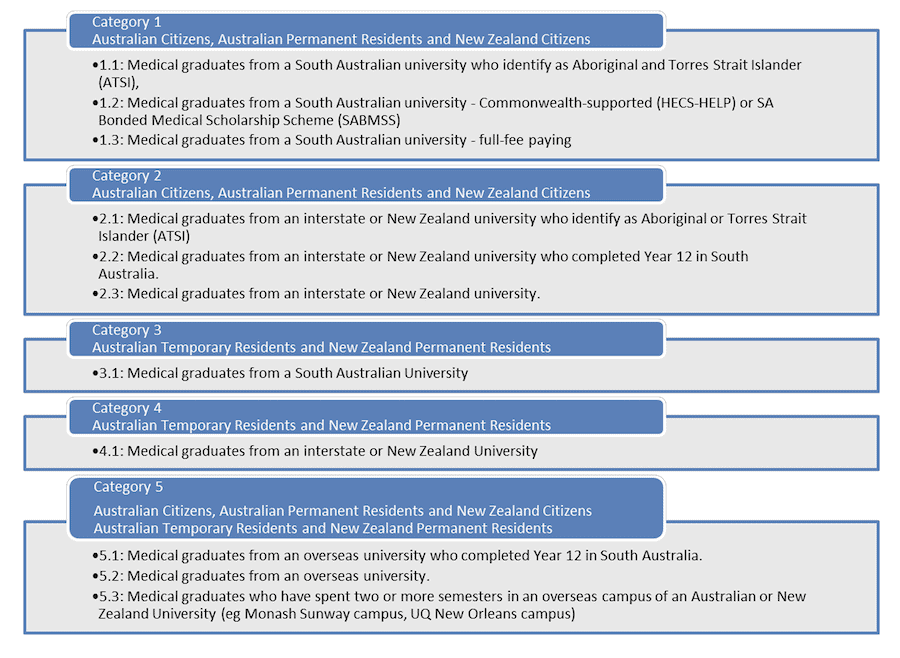

    So whilst the number of specialist IMGs who have been approved and are still waiting is likely to be far less than those on the standard pathway it is still likely to be in the hundreds of doctors.

    Why Are These Doctors Not Employed Already?

    The problem for most of these doctors is not their lack of competency or capability. This has already been assessed. It’s just that there are limited available places for them and strong and stiff competition for them. When they do get a chance of a job they generally do very well. And are often willing to work in places and circumstances that locally trained doctors do not.

    Many of these doctors would jump at the chance to work for 3 months to help out with our current emerging health system crisis.

    Just to be clear, I am not talking about using or exploiting IMG doctors to help staff temporary virus clinics or our emergency rooms to save local doctors from being exposed. The most logical way to deploy this workforce would be to relieve or fill in for medical staff in regular roles, such as working on hospital wards to ensure that we are able to continue to manage the regular health needs of patients with other conditions.

    What Would Need To Change To Make This Happen?

    One of the big problems with getting IMGs up and running in positions in Australia has always been the bureaucracy involved. This includes paperwork to establish that they are not competing for a post with an Australian trained doctor, paperwork to satisfy the registration requirements and paperwork to obtain a working visa.

    It is important that we maintain a certain standard of care in the registration requirements of doctors. But given that we are anticipating that there will be many vacancies at various levels in the system. It is reasonable to assume that many of these will be in posts that are supervised and supervisable for which an IMG doctor could be deployed.

    Conversely, a system whereby such an IMG doctor could be more quickly be granted a short period of registration (say 3 months) would provide ease for the system but also reduce the risk of such a doctor not being supervised properly.

    It would also then give the IMG actual experience in the Australian health care system, which is something that would tremendously help their resume and case for future employment opportunities.

  • Indian Doctors Australia: Jobs, Chances, Salary, Registration.

    Indian Doctors Australia: Jobs, Chances, Salary, Registration.

    Many doctors from India have successfully migrated to work in Australia. Doctors from India were the fourth-highest country to be granted a visa to work as a doctor in Australia in 2017. After the United Kingdom, the Republic of Ireland and Malaysia. As someone who has worked in Medical HR for more than two decades, I have found Indian doctors on the whole to be a really good group of doctors to work with.

    Can Indian doctors work in Australia? The answer is, of course, yes. India provides one of the largest sources of overseas doctors or International Medical Graduates (IMGs) working in Australia at both a trainee doctor as well as specialist level. Of course, no doctor coming from another country is absolutely guaranteed to be able to work in Australia.

    Just like doctors from other countries. Doctors from India are limited in regards to what doctor jobs they can initially apply for in Australia. Once employed you receive the same rates of salary and pay as other doctors, with some possible restrictions on where you can work. Salary packages vary from about $70,000 AUD for a very junior level job to $300,000 AUD and much more for consultant-type positions. There are two main ways that Indian doctors need to either apply for initial registration. Both are quite hard.

    • The Standard Pathway is the process if you are not a specialist. It requires sitting for the Australian Medical Council exams, which have an overall pass rate of about 60% for the MCQ component and 25% for the clinical component.
    • The Specialist Pathway is the process if you are a specialist. Between the years 2015 and 2021, 729 specialist Indian doctors applied to a specialist medical college for assessment. 244 were deemed to not be comparable. 401 were deemed to be partially comparable and only 84 were deemed to be substantially comparable (a 66% rate of being found comparable.

    So the prospects for working in Australia as an Indian doctor are good for many but challenging for some. So it’s important to give you a little bit more detail. There are also other options for getting registered which I will outline.

    So let’s dig into a bit more of the details of the top of Indian Doctors Australia.

    Get a Guide

    A bundle of resources written by a local Australian expert covering how Indian doctors can work in Australia.

    Only $5.70 AUD

    The Standard Pathway. The Option for Trainee Indian Doctors Australia.

    If you are a trainee doctor from India and do not have specialty status then the Standard Pathway is the main option for you.

    The major hurdle in this process is pursuing the Australian Medical Council examinations, which we have written about in more depth here.

    In order to be able to sit for the AMC, you must first establish what is called a portfolio

    1. You first create a registration with the AMC website.
    2. You should also check that your medical degree is awarded by an institution recognized by the AMC. The AMC recognizes most but not all medical schools which are listed with the World Directory of Medical Schools. There is a handy search on the AMC site.
    3. You must then also create an EPIC account and confirm your identity with the ECFMG (located in the United States).
    4. You get an EPIC id in about 3 working days, which you use to establish your AMC portfolio.
    5. You upload your qualifications to EPIC. As you do so YOU MUST REQUEST that EPIC send a report to the AMC.
    6. EPIC notifies you and the AMC when they have completed their check.

    This whole process will cost you $500 AUD to register with the AMC and about $205 USD for EPIC (more if you are wanting more than one qualification verified).

    Once EPIC reports back in the affirmative to the AMC you will be allowed to request to sit for the AMC Part 1 Examinations.

    There is no actual work experience requirement to sit the AMC Part 1 Examination and you can, in fact, start preparing for this whenever you like. But of course, you will not be able to sit the exam without a verified medical degree. So you can start studying for it in medical school but won’t be able to sit it till after you graduate.

    The Part 1 MCQ Examination

    The AMC Computer Adaptive Test (CAT) MCQ Examination is a computer-administered fully integrated multi-choice question examination delivered in one sitting that lasts 3 and a half hours.

    There are regular invigilated examinations in Australia as well as a number of sessions available in the examination across the world.

    The examination itself consists of 150 “A-type MCQs”. You must select the one correct response from amongst the five options. 120 of the questions are “live” questions, which means they count towards your score. The remaining 30 questions are being piloted and don’t count towards your final score. You do not know which questions are being piloted so you have to give your best for all 150.

    You are expected to complete all 150 items and must complete the 120 scored items. Failure to complete all 120 scored items in the examination may lead to insufficient information for a reliable determination of your ability and therefore a result on the AMC adaptive scale.

    You should practice as many MCQs as you can. There is also an official online practice exam through the AMC website.

    Because the MCQ exam is computerized you will receive your result fairly quickly in about 4 weeks. You get a printout that indicates where you performed overall, as well as the range for all candidates appearing for that particular exam. You also get a breakdown of your performance in the question domains. This is useful if you don’t pass to know where to put your efforts next time.

    You need to score 250 or more to pass. Less than 60% of candidates pass. Although this score is probably depressed somewhat by those candidates sitting more than once.

    It currently costs $2,920 AUD to sit for the MCQ.

    The AMC Clinical Examination Part 2

    Once you pass the AMC MCQ exam, you are then able to appear for the AMC Clinical exam. These are all held in Melbourne at the AMC’s purpose-built examination National Testing Centre or online.

    Clinical Exam Format

    The Clinical exam format is a 20-station multidisciplinary structured clinical exam that assesses your skills in Medicine, Surgery, Gynecology and Obstetrics, Pediatrics, and Psychiatry. There are 14 scored stations, 2 pilot (non-scored) stations and 4 rest (non-scored) stations.

    As of 2019, the result is graded as either a clear pass or a clear fail. Prior to this borderline candidates were offered a retest. However, the AMC found that the time between examination and retest was becoming so long that the results were not meaningful.

    You must pass 10 or more of the stations to pass the exam. The pass rate is incredibly low. About 28%

    It is recommended that you should study the Handbook of Clinical Assessment and practice roleplays as much as you can. You may want to attend a course. Candidates also study different notes such as Karen notes, and the VMPF notes. John Murtagh’s General Practice is also worth revising.

    It is extremely wise to form a study group and there are many groups around where you can practice what is called “recalls”, which is when a candidate who has previously sat the exam attempts to reconstruct the station.

    The cost of sitting the Clinical Examination is currently $3,730 AUD ($400 extra for the online version).

    When and What types of jobs can I apply for as an Indian Trainee?

    You can apply for a range of trainee jobs. The main limitation is whether the employer will accept an IMG. Which for the majority of cases they will not.

    You can actually start applying for jobs after you have passed your AMC Part 1 Examination. But you will need a valid English language test if you do.

    There are often a number of postgraduate year 2 or 3 general jobs on offer. They are generally termed Resident Medical Officers in most States and Territories, but may also be called House Officers or Hospital Medical Officers in some places.

    Above these sorts of posts, come the specialty training positions. In Australia, you tend to enter specialty training around postgraduate year 3. These positions are generally referred to as Registrar positions. But you might also see advertised as Senior House Officer or Trainee or Advanced Trainee.

    One key thing to look out for is that most of these jobs will not accept an overseas applicant.

    A key thing to look for is the phrase “eligible for registration” in the selection criteria.

    It is very important to try and secure an employment offer. Whilst you can apply to the Australian Medical Council to check your primary medical degree at any stage. You won’t be able to gain registration until you have an offer of employment. This is because the Medical Board needs to see a supervision plan from your employer.

    Outside of general practice, the majority of employment opportunities for trainee doctors occur within public hospitals. So your best places for finding suitable job postings are on the State and Territory health department recruitment sites. We have a listing of these on our international doctors’ resource page.

    What Type of Supervision Do I Need Or Get?

    The Medical Board of Australia is very vigilant about supervision standards for IMG doctors. What sort of supervision you receive will depend on a number of factors, including:

    • your qualifications
    • your previous experience, especially in the type of position for which you have applied
    • whether you have practised recently and the scope of your recent practice
    • the requirements of the position including the type of skills required for the position
    • the position itself, including the level of risk, the location of the hospital or practice and the availability of supports (supervisors)
    • the seniority of the position, for a hospital position

    In general, you will either be approved for Level 1 or Level 2 Supervision. There are 4 Levels and the higher up you go the less direct oversight you require.

    Level 1 Supervision.

    Level 1 Supervision requires your supervisor (or alternative supervisor) to be present in the hospital or practice with you at all times and you must consult with them about all patients. This is the level of supervision that most Indian doctors will receive Remote supervision (e.g. by telephone) is not permitted. This type of supervision is generally recommended when you are very junior yourself or entering a junior role which you are not very familiar with. In Australian major public hospitals, there are many layers of other doctors who you can get supervision from. So Level 1 is not too much of an issue in these circumstances.

    Level 2 Supervision.

    Level 2 Supervision, is what most other Indian trainees approved to work in Australia will be approved for. It is a step up from Level 1 Supervision. Supervision must primarily be in person but your supervisor can leave you to do work on your own and you can discuss it by phone. You should discuss with them on a regular (daily) basis what you have been doing with patients. But do not need to discuss every case.

    Level 3 Supervision.

    Level 3 Supervision, is what you might receive if you are working in an Advanced Trainee role in India and transferring to something similar in Australia. In this case, you have much more primary responsibility for the patient. Your supervisor needs to make regular contact with you but can be working elsewhere and available by phone or video.

    What happens after I commence my position?

    Once you are approved for registration and you have your visa issues sorted you will be able to commence work. Your employer should help you out with all these things. You will be working under what is called “provisional registration” by the Medical Board of Australia. Generally, all you need to do for these 12 months is to show that you can learn and grow and get regular feedback from your supervisors. Your supervisors will need to complete regular reports for the Medical Board of Australia and it is your responsibility, not theirs to see that they are completed and returned on time. If all the reports go well you will be able to be recommended at the end of the 12 months for general registration.

    The other thing that you need to watch out for is that your employer is ensuring that you gain exposure to the types of experiences that the Medical Board requires for this year. Generally, these shadow the experience that Australian interns go through.

    Depending on whether you have completed AMC Part 2 or not. You will need to try and sit and pass this in these 12 months. Although you may be able to get an extension.

    If you are lucky enough you may be employed in one of the 20 or so health services which offer Workplace-based assessment as an alternative to the AMC Clinical exam. Candidates find this process far easier to complete.

    You will probably be starting to look for another job or negotiating an extension around the end of your 12 months. With general registration, you may be able to apply for a skilled visa, as well as be looking at applying for permanent residency.

    Permanent residency is crucial for applying for most specialty training programs. See below.

    indian doctor australia

    The Specialist Pathway. The Option For Specialist Indian Doctors Australia.

    For Indian specialists, your option for working in Australia is what is called the Specialist Pathway.

    Once again this starts with becoming verified as a doctor with the Australian Medical Council and should again coincide with an active search for a position.

    You may be lucky enough to be in a targeted specialty area where you might successfully be approved for what is called an Area of Need position, in which case the employer or recruitment agent will provide you with a lot of support and will likely pick up the costs of being assessed.

    For most International Doctor specialists however these days you will be approaching the college directly to be assessed for specialist recognition. This is not something to be trifled with. The paperwork requirements and the cost (generally around $10,000 AUD or more) is considerable.

    On the plus side, the colleges all have reasonably helpful information on their websites, including the application forms and a little bit about their criteria for assessment.

    Finding Out What You Need To Do.

    We have saved you the trouble of finding those pages by putting them on our International Doctors resource page here.

    The majority of Indian specialties (but not all) map to a similar college or specialty in Australia. So working out which specialty goes into which Australian college is generally not too confusing. We have put together a summary of the Australian specialist medical colleges here.

    After you go through your specialist assessment you are given an outcome.

    As I have noted the majority of cases for Indian specialists are either deemed not comparable or substantially comparable.

    If you are deemed not to be comparable by the college. This means you cannot directly become a specialist in Australia. You will probably have to go through the standard pathway to work as a doctor in Australia.

    If you are deemed to be partially comparable (a situation where this commonly may occur is if you have just recently finished specialty training but have not worked as a specialist for very long). In this situation you will need to work under supervision for longer and may well also face some formal examinations.

    Substantially comparable is the best result. This essentially means that you will need to work under some form of peer review for up to 12 months and so long as your reports are satisfactory you will be recommended for specialist registration at the end.

    How to Maximize Your Chances of Getting a Substantially Comparable Outcome.

    To ensure that you are seen as substantially comparable by the relevant college I would recommend the following:

    • You should have your Certificate of Completion of Training and relevant college Fellowship
    • You should ideally have worked substantively at a Consultant level in your field for 3 years or more
    • You should be able to demonstrate good standing with your Medical Board and your employers
    • You should be able to demonstrate ongoing continuing professional development
    • You should prepare for your interview with the college as if it were an important job interview

    Can you enter training in Australia if you are an Indian doctor?

    To undertake formal specialty training in Australia you need to be accepted into a college training program. In all circumstances, you will need general registration and in some cases permanent residency or citizenship.

    After receiving your general registration you can apply for specialty training in the same way that Australian-trained doctors do. And if accepted will go through the exact training program and experience. Some colleges may offer recognition of prior learning for any training you have done already. But this is often quite limited and may at best normally shave one year off of your training.

    An Alternative But Limited Option.

    There is an alternative but time-limited pathway for Indian doctors who are just seeking a short-term experience in Australia to add to their training in India. This is called the Short-Term Training in a Medical Specialty Pathway. To do this you must be offered a training position first and you must have either completed your training in India or be less than two years from completion. So this is a program mainly for early career specialists or advanced trainees.

    In this pathway you go through the same steps with the AMC as per the competent authority pathway to gain registration. You will not, however, be able to apply for specialist assessment as part of this pathway. But if you gain general registration you may then be able to apply for another position and then apply for specialist assessment.

    Can you do your internship in Australia as an Indian doctor?

    Basically no. Internship in Australia is a provisional year that only applies to medical graduates from medical schools in Australia and New Zealand. There is a “loophole” which only applies to doctors who have not been able to complete an internship or equivalent in their own country. But the Medical Board warns that this is not a great option and is only granted in limited cases. You are far better off completing the requirements for general registration in India.

    How many Indian doctors are working in Australia?

    There is no one public data source to tell us how many Indian doctors are currently working in Australia.

    From data collected by the Australian Government, we know that:

    • 171 working visas were granted to Indian doctors to work in Australia in the year 2017.
    • 729 applications were made for specialist assessment, of which 244 were deemed not comparable, 401 partially comparable and only 84 substantially comparable (2015-2021).

    How hard is it to become a specialist in Australia if you are from India?

    As we have noted. Many Indian doctors struggle to gain recognition as a specialist. This normally occurs in the first step. The initial specialist college assessment. Once Indian doctors are granted comparability. Most go on to complete the process.

    Are there any particular specialties that are easier to apply for?

    The majority of specialties have some vacancies and will provide opportunities for Indian and other IMG doctors from time to time. This is particularly the case if you are prepared to go outside of the major cities. Some areas of medicine are more popular and so finding jobs in areas such as most surgical fields, as well as other fields such as cardiology can be quite difficult.

    On the other end of the spectrum general practice, psychiatry and most parts of critical care medicine are often always looking for doctors.

    Costs of Moving To Australia and Working As a Doctor.

    There are lots of costs to consider when thinking about moving to Australia to work as a doctor.

    There are some direct costs to consider. Most of which relate to the bureaucratic process of being assessed and gaining registration.

    Some of the costs you may be up for, include:

    AUD (unless otherwise noted)
    Establish a Portfolio with the Australian Medical Council$600
    Registering with EPIC and having one primary degree checked $125 USD + $80 USD
    Medical Board Application Fee for Provisional Registration$430
    Medical Board Application Fee for Specialist or General Registration $860
    College Specialist Assessment Fees$6,000-$11,000
    College Placement Fees (for the period of supervision)$8,000-$24,000

    Further, if you are required to undertake further exams there will be a cost for this as well. As an example, RACS charges exam fee is $8,495.

    The Cost of Your Time and Effort.

    Adding to all of this financial cost, you will need to factor in the cost of your own time. It takes a lot of effort and persistence to deal with the paperwork and track down the records you need.

    In addition, you are probably going to have to pay costs in your own country for things like records of schooling and certificates of good standing.

    There are also visa costs.

    And then there is the cost of airfares and transporting your belongings halfway across the world.

    Depending on where you work in Australia you may find that the cost of living is higher or lower than you are used to. House prices and therefore house rental rates have gone through the roof in Australia in the last decade or so but are starting to come down.

    You will probably have to factor in some initial extra hotel or short-term rental charges whilst settling in and you may find if you have children that you have to pay to enrol them in school as public schooling is only generally free if you are a citizen or permanent resident.

    If you are lucky and in one of the specialty areas of demand your employer may offer to pay for some of these costs. It’s certainly worth asking about it.

    The Competent Authority Pathway. An Option For Some Indian Doctors.

    If you have already worked in the United Kingdom, Canada or the United States then you may be able to apply to work in Australia under what is called the competent authority pathway.

    The competent authority pathway assigns a preferential status to any doctor who has completed their primary medical training in one of the following countries: the United Kingdom, Canada, the United States and the Republic of Ireland.

    There is largely an historical rationale for this situation. It is based on the premise that all these jurisdictions have similar approaches to medical school training and similar standards.

    New Zealand is not included in the list above as its medical schools are accredited by the same body as Australian medical schools, the Australian Medical Council. So doctors from New Zealand in Australia are generally treated identically to those from Australia.

    If you are an international medical graduate and you have achieved general registration in the United States, Canada or the United Kingdom (but not the Republic of Ireland) you are also eligible for the competent authority pathway.

    What are the steps involved for the competent authority pathway?

    You can find out more about the competent authority pathway on the Medical Board of Australia website.

    The key steps are as follows:

    1. Securing an employment offer
    2. Applying to the Australian Medical Council for primary source verification
    3. Applying for registration to the Medical Board of Australia
    4. Completing 12 months of supervised practice
    5. Applying again to the Medical Board of Australia for general registration.

    Eligibility for Competent Authority

    You can do a “self-assessment of your eligibility for the competent authority pathway on the Medical Board of Australia website here.

    The essential requirements for Indian doctors applying via the competent authority pathway are:

    You need to have completed the appropriate process in Canada, the United States or the United Kingdom to become fully registered in that country. This involves an assessment of your English language skills, examinations and a period of supervised training.

    So for example, if you have worked in the United Kingdom, you need to successfully complete the Professional and Linguistic Assessments Board (PLAB) test

    AND

    Successfully complete the Foundation Year 1, or 12 months supervised training (internship equivalent) in the United Kingdom, or 12 months supervised training (internship equivalent) completed in another Medical Board Australia approved competent authority country, approved by the GMC.

    Conclusion.

    We hope that you found this summary about how Indian doctors can work in Australia useful. If you have any questions or queries or just want to relate your experience. Please feel free to leave a comment below. We would love to hear from Indian doctors who have made the journey to Australia.

    Related Questions.

    Question: Are there any other options for working as an Indian doctor in Australia?

    Answer.
    Some doctors just want to come to Australia for a limited period of time as an opportunity to train in another country.
    As we have highlighted above there is an alternative but time-limited pathway for Indian doctors who are just seeking a short-term experience in Australia to add to their training in India. This is called the Short-Term Training in a Medical Specialty Pathway. To do this you must be offered a training position first and you must have either completed your training in India or be less than two years from completion. So this is a program mainly for early career specialists or advanced trainees.

    Question: Should I use a medical recruitment company if I am considering working in Australia?

    Answer.
    It is possible to deal directly with employers in Australia as an Indian doctor. In general, however, when moving from one country to another most doctors find it useful to engage with a medical recruitment company as they can tend to take some of the stress out of the planning for you and help with all the paperwork and negotiating with prospective employers. Some medical recruitment companies also provide migration services and relocation services as well. We have written more on this subject here. And a list of medical recruitment companies is available here.
    Unfortunately, for most Indian doctors medical recruitment companies will be unlikely to be able to help you until you have either achieved general registration via the Standard Pathway or possibly until you have received a favourable outcome via the specialist pathway process.
    See more about the pros and cons of medical recruitment companies here.
  • UK Doctors Australia: Job Prospects, Registration & Costs.

    UK Doctors Australia: Job Prospects, Registration & Costs.

    Any doctor who has worked for more than a few months in Australia will likely have worked alongside a UK doctor who has decided to work in Australia. Whether this is for a short-term working holiday or a permanent move. As someone who has worked in Medical HR for more than two decades, I have found that UK doctors on the whole to be a really good group to work with. So let’s talk about UK Doctors Australia.

    Can UK doctors work in Australia? The answer is, of course, yes. The United Kingdom provides the largest source of overseas doctors or International Medical Graduates (IMGs) working in Australia. Of course, no doctor coming from another country is absolutely guaranteed to be able to work in Australia.

    But because the UK medical training system is recognized by the Medical Board of Australia as being on par, UK doctors have good success with either becoming generally registered through what is called the competent authority pathway or being recognized as a specialist through the specialist pathway. In 2017 (the latest year we have figures for) 430 UK doctors were recommended for specialist registration, with many more achieving general registration.

    So the prospects for working in Australia as a UK doctor are extremely good. But it’s important to give you a little bit more detail. As I have highlighted there are two main options for getting registered. So we will talk about these first and then go into some other common questions.

    The Competent Authority Pathway. The Option For Trainee UK Doctors Australia.

    If you are a trainee doctor in the UK. Then you are looking at the competent authority pathway for working in Australia.

    The competent authority pathway assigns a preferential status to any doctor who has completed their primary medical training in one of the following countries: the United Kingdom, Canada, the United States, and the Republic of Ireland.

    There is largely a historical rationale for this situation. It is based on the premise that all these jurisdictions have similar approaches to medical school training and similar standards.

    New Zealand is not included in the list above as its medical schools are accredited by the same body as Australian medical schools, the Australian Medical Council. So doctors from New Zealand in Australia are generally treated identically as those from Australia.

    If you are an international medical graduate and you have achieved general registration in the United States, Canada, or the United Kingdom (but not the Republic of Ireland) you are also eligible for the competent authority pathway.

    What are the steps involved for the competent authority pathway.

    You can find out more about the competent authority pathway on the Medical Board of Australia website.

    The key steps are as follows:

    1. Securing an employment offer
    2. Applying to the Australian Medical Council for primary source verification
    3. Applying for registration to the Medical Board of Australia
    4. Completing 12 months supervised practice
    5. Applying again to the Medical Board of Australia for general registration.

    Eligibility for Competent Authority

    You can do a “self-assessment of your eligibility for the competent authority pathway on the Medical Board of Australia website here.

    The essential requirements are:

    You need to be a graduate of a medical course conducted by a medical school in the United Kingdom which is accredited by the General Medical Council

    AND

    Successfully complete Foundation Year 1, or complete 12 months supervised training (internship equivalent) in the United Kingdom, or complete 12 months supervised training (internship equivalent) another Medical Board of Australia approved competent authority country, which is also approved by the GMC.

    OR if you are an IMG who has been working in the United Kingdom you need to

    Successfully complete the Professional and Linguistic Assessments Board (PLAB) test

    AND

    Successfully complete the Foundation Year 1, or 12 months supervised training (internship equivalent) in the United Kingdom, or 12 months supervised training (internship equivalent) completed in another Medical Board Australia approved competent authority country, approved by the GMC.

    For this reason, doctors who have completed medical school in another European Union country are often unable to get registered in Australia via working in the United Kingdom as they are often not required to complete the PLAB.

    What types of jobs can I apply for as a UK Trainee?

    You can pretty much apply for any sort of trainee job. There are often a number of postgraduate year 2 or 3 general jobs on offer. They are generally termed Resident Medical Officer in most States and Territories, but may also be called House Officer or Hospital Medical Officer in some places.

    Above these sorts of posts, come the specialty training positions. Australia’s specialty training system is fairly much in parallel with the United Kingdom. So you tend to enter specialty training around postgraduate year 3. These positions are generally referred to as Registrar positions. But you might also see advertised as Senior House Officer or Trainee or Advanced Trainee.

    One key thing to look out for is that most of these jobs will not accept an overseas applicant.

    A key thing to look for is the phrase “eligible for registration” in the selection criteria.

    It is very important to try and secure an employment offer. Whilst you can apply to the Australian Medical Council to check your primary medical degree at any stage. You won’t be able to gain registration until you have an offer of employment. This is because the Medical Board needs to see a supervision plan from your employer.

    Outside of general practice, the majority of employment opportunities for trainee doctors occur within public hospitals. So your best places for finding suitable job postings are on the State and Territory health department recruitment sites. We have a listing of these on our international doctors’ resource page.

    What Type of Supervision Will I Need Or Get?

    The Medical Board of Australia is very vigilant around supervision standards for IMG doctors. What sort of supervision you receive will depend on a number of factors, including:

    • your qualifications
    • your previous experience, especially in the type of position for which you have applied
    • whether you have practiced recently and the scope of your recent practice
    • the requirements of the position including the type of skills required for the position
    • the position itself, including the level of risk, the location of the hospital or practice and the availability of supports (supervisors)
    • the seniority of the position, for hospital position

    In general, you will either be approved for Level 1 or Level 2 Supervision. There are 4 Levels and the higher up you go the less direct oversight you require.

    Level 1 Supervision.

    Level 1 Supervision requires your supervisor (or alternative supervisor) to be present in the hospital or practice with you at all times and you must consult with them about all patients. Remote supervision (for e.g. by telephone) is not permitted. This type of supervision is generally recommended when you are very junior yourself or entering a junior role with which you are not very familiar with. In Australian major public hospitals, there are many layers of other doctors from who you can get supervision from. So Level 1 is not too much of an issue in these circumstances.

    Level 2 Supervision.

    Level 2 Supervision, which is what most UK trainees approved to work in Australia will normally be approved for is a step up from Level 1 Supervision. Supervision must primarily be in person but your supervisor can leave you to do work on your own and you can discuss by phone. You should discuss with them on a regular (daily) basis what you have been doing with patients. But do not need to discuss every case.

    Level 3 Supervision.

    Level 3 Supervision, is what you might receive if you are working in an Advanced Trainee role in the UK and transferring to something similar in Australia. In this case, you have much more primary responsibility for the patient. Your supervisor needs to make regular contact with you but can be working elsewhere and available by phone or video.

    What happens after I commence my position?

    Once you are approved for registration and you have your visa issues sorted you will be able to commence work. Generally, your employer helps you out with all these things. You will be working under what is called “provisional registration” by the Medical Board of Australia.

    Generally, all you need to do for these 12 months is to pay attention, show that you can learn and grow and get regular feedback from your supervisors. Your supervisors will need to complete regular reports for the Medical Board of Australia and it is your responsibility, not theirs to see that they are completed and returned on time. If all the reports go well you will be able to be recommended at the end of the 12 months for general registration.

    You will probably be starting to look for another job or negotiating an extension around this time. With general registration, you may be able to apply for a skilled visa, as well as be looking at applying for permanent residency.

    Permanent residency is crucial for applying for most specialty training programs. See below.

    The Specialist Pathway. The Option For UK Specialists

    For UK specialists your option for working in Australia is what is called the Specialist Pathway.

    Once again this starts with becoming verified as a doctor with the Australian Medical Council and should again coincide with an active search for a position.

    You may be lucky enough to be in a targeted specialty area where you might successfully be approved for what is called an Area of Need position, in which case the employer or recruitment agent will provide you a lot of support and will likely pick up the costs of being assessed.

    For most International Doctor specialists however these days you will be approaching the college directly to be assessed for specialist recognition. This is not something to be trifled with. The paperwork requirements and the cost (generally around $10,000 AUD or more) are considerable.

    On the plus side, the colleges all have reasonably helpful information on their websites, including the application forms and a little bit about their criteria for assessment.

    Finding Out What You Need To Do.

    We have saved you the trouble of finding those pages by putting them on our International Doctors resource page here.

    The majority of UK specialties (but not all) map to a similar college or specialty in Australia. So working out which specialty goes into which Australian college is generally not too confusing. We have put together a summary of the Australian specialist medical colleges here.

    After you go through your specialist assessment you are given an outcome.

    In the majority of cases for UK specialists, you will be deemed substantially comparable. This essentially means that you will need to work under some form of peer review for up to 12 months and so long as your reports are satisfactory you will be recommended for specialist registration at the end.

    Occasionally UK specialists are deemed to be partially comparable (a situation where this may occur is if you have just recently finished specialty training but have not worked as a specialist for very long). In this situation, you will need to work under supervision for longer and may well also face some formal examinations.

    Rarely are UK specialists deemed not to be comparable by the college. This only happened to 6 out of 409 UK doctors in 2017 (less than 1%). If you are deemed to be not comparable, this means you cannot directly become a specialist in Australia. You will probably have to go through the competent authority route and re-enter training in Australia.

    How to Maximize Your Chances of Getting a Substantially Comparable Outcome.

    To ensure that you are seen as substantially comparable by the relevant college I would recommend the following:

    • You should have your Certificate of Completion of Training and relevant college Fellowship
    • You should ideally have worked substantively at a Consultant level in your field for 3 years or more
    • You should be able to demonstrate good standing with the GMC and your employers
    • You should be able to demonstrate ongoing continuing professional development
    • You should prepare for your interview with the college as if it were an important job interview

    Can you enter training in Australia if you are a UK doctor?

    To undertake formal specialty training in Australia you need to be accepted into a college training program. In all circumstances, you will need general registration and in many cases permanent residency or citizenship.

    After receiving your general registration UK doctors can apply for specialty training in the same way that Australian trained doctors do. And if accepted will go through the exact training program and experience. Some colleges may offer recognition of prior learning for any UK training you have done already. But this is often quite limited and may at best normally shave one year off of your training.

    An Alternative But Limited Option.

    There is an alternative but time-limited pathway for UK doctors who are just seeking a short-term experience in Australia to add to their training in the UK. This is called the Short Term Training in a Medical Specialty Pathway. To do this you must be offered a training position first and you must have either completed your training in the UK or be less than two years from completion. So this is a program mainly for early-career specialists or advanced trainees.

    In this pathway, you go through the same steps with the AMC as per the competent authority pathway to gain registration. You will not, however, be able to apply for specialist assessment as part of this pathway. But if you gain general registration you may then be able to apply for another position and then apply for specialist assessment.

    Can you do your internship in Australia as a UK doctor?

    Basically no. Internship in Australia is a provisional year that only applies to medical graduates from medical schools in Australia and New Zealand. There is a “loophole” that only applies to doctors who have not been able to complete an internship or equivalent in their own country. But the Medical Board warns that this is not a great option and is only granted in limited cases. You are far better off applying for the Foundation Program in the UK and completing at least Foundation Year 1.

    How many UK doctors are working in Australia?

    There is no one public data source to tell us how many UK doctors are currently working in Australia.

    From data collected by the Australian Government, we know that for 2017 (latest available year):

    • 718 applications were made for provisional registration via the competent authority pathway by UK doctors with 701 granted provisional registration
    • An additional 43 applications were made for provisional registration via the competent authority pathway by doctors who had completed the PLAB in the UK, with 31 being granted provisional registration
    • 409 applications were made for specialist assessment, only 6 of which were deemed not comparable, 36 partially comparable and 367 substantially comparable.
    • 430 UK doctors were recommended for specialist recognition with 12 not being recommended

    How hard is it to become a specialist in Australia if you are from the UK?

    Specialist doctors from the United Kingdom are not automatically granted specialist recognition. However, most are. As you can see from above in 2017 there were 409 applications made for specialist assessment to the Australian colleges by UK doctors and of these, the majority were deemed substantially comparable.

    UK doctors tend to get a very favourable outcome in comparison to doctors from most other countries. The UK has generally the highest rate for doctors being seen as substantially comparable. Even when comparing to the other competent authority countries of the United States, Canada and the Republic of Ireland.

    We hope that you found this summary about how UK doctors can work in Australia useful. If you have any questions or queries or just want to relate your experience. Please feel free to leave a comment below. We would love to hear from UK doctors who have made the journey to Australia.

    Are there any particular specialties that are easier to apply for?

    The majority of specialties have some vacancies and will provide opportunities for the UK and other IMG doctors from time to time. This is particularly the case if you are prepared to go outside of the major cities. Some areas of medicine are more popular and so finding jobs in areas such as most surgical fields, as well as other fields such as cardiology can be quite difficult.

    On the other end of the spectrum general practice, psychiatry and most parts of critical care medicine are often always looking for doctors.

    Costs of Moving To Australia and Working As a Doctor.

    There are lots of costs to consider when thinking about moving to Australia to work as a doctor.

    There are some direct costs to consider. Most of which relate to the bureaucratic process of being assessed and gaining registration.

    Some of the costs you may be up for, include:

    AUD (unless otherwise noted)
    Establish Portfolio with Australian Medical Council$500
    Registering with EPIC and having one primary degree checked $125 USD + $80 USD
    Medical Board Application Fee for Provisional Registration$382
    Medical Board Application Fee for Specialist or General Registration $764
    Medical Board Provisional Registration Fee$382
    Medical Board General or Specialist Registration Fee$764
    College Specialist Assessment Fees$6,000-$11,000
    College Placement Fees (for a period of supervision)$8,000-$24,000

    Further, if you are required to undertake further exams there will be a cost for this as well. As an example, RACS charges an exam fee is $8,495.

    The Cost of Your Time and Effort.

    To all of this cost, you will need to factor in the cost of your own time. It takes a lot of effort and persistence to deal with the paperwork and track down the records you need.

    In addition, you are probably going to have to pay costs in your own country for things like records of schooling and certificates of good standing.

    There are also visa costs.

    And then there is the cost of airfares and transporting your belongings halfway across the world.

    Depending on where you work in Australia you may find that the cost of living is higher or lower than you are used to. House prices and therefore house rental rates have gone through the roof in Australia in the last decade or so but are starting to come down.

    You will probably have to factor in some initial extra hotel or short-term rental charges whilst settling in and you may find if you have children that you have to pay to enroll them in school as public schooling is only generally free if you are a citizen or permanent resident.

    If you are lucky and in one of the specialty areas of demand your employer may offer to pay for some of these costs. It’s certainly worth asking about it.

    UK doctors Australia

    Related Questions.

    Question: Are there any other options for working as a UK doctor in Australia?

    Answer. The Competent Authority Pathway and the Specialist Pathway are the only two pathways for UK doctors to work in Australia.

    Question: Should I use a medical recruitment company if I am considering working in Australia?

    Answer. It is possible to deal directly with employers in Australia as a UK doctor. In general, however, when moving from one country to another most doctors find it useful to engage with a medical recruitment company as they can tend to take some of the stress out of the planning for you and help with all the paperwork and negotiating with prospective employers. Some medical recruitment companies also provide migration services and relocation services as well. We have written more on this subject here. And a list of medical recruitment companies is available here.