Category: Medical Education

  • 5 Key Take Aways From the New National Medical Training Survey

    5 Key Take Aways From the New National Medical Training Survey

    This week the Medical Board of Australia released the findings of the first-ever national medical training survey (MTS). As someone who has previously championed and developed these types of reports on the New South Wales level, it is truly pleasing to see this report launched. And boy did they release some findings!

    With the results of 59 headline questions reported across several different segments, including interns, prevocational and unaccredited trainees, IMGs and specialty trainees. With the main report running 249 pages, several other reports drilling down to College level, State and Territory level and even an Aboriginal and Torres Strait Islander report.  As well as an online interactive dashboard and a page where you can customize your own reports. There’s truly something for everyone in it. 

    So, what are some of the key findings from this report? Key points from this survey are that greater than 75% of doctors in training are happy with their training and workplace, however, 22% had experienced some form of bullying, harassment or discrimination. Most doctors in training are working safe hours but a concerning amount are still working in excess of 60 hours and even 90 hours per week, with surgery being one particularly bad specialty for this. Contrastingly far too many doctors in training aspire to enter a specialty like surgery than there is the actual capacity or need for. The survey shows that individual doctor career plans are out of alignment with medical workforce planning. Finally, even though we do have information about how medical schools are now performing as part of the medical training pipeline this information is surprisingly absent from the survey.

    Let’s drill a bit further into some of the key initial findings from the survey.

    Overall Impressions Of the Medical Training Survey.

    The Medical Training Survey will be run each year to get feedback from doctors in training in Australia (and in time their supervisors) to (according to the Medical Board of Australia):

    • better understand the quality of medical training in Australia
    • identify how best to improve medical training in Australia, and
    • recognize and deal with potential issues in medical training that could impact on patient safety, including environment and culture, unacceptable behaviours and poor supervision.

    It will take a while to assess the impact of this report. What we will need to see over time is the collection of data and the monitoring of trends to see whether the presence of the survey itself can spur on positive change.

    There is some hope that it might do that.  As similar surveys which have been running in the United Kingdom for some time now have shown improvements on parameters such as the extent to which Foundation doctors felt adequately prepared for their posts by their medical school has improved over time.
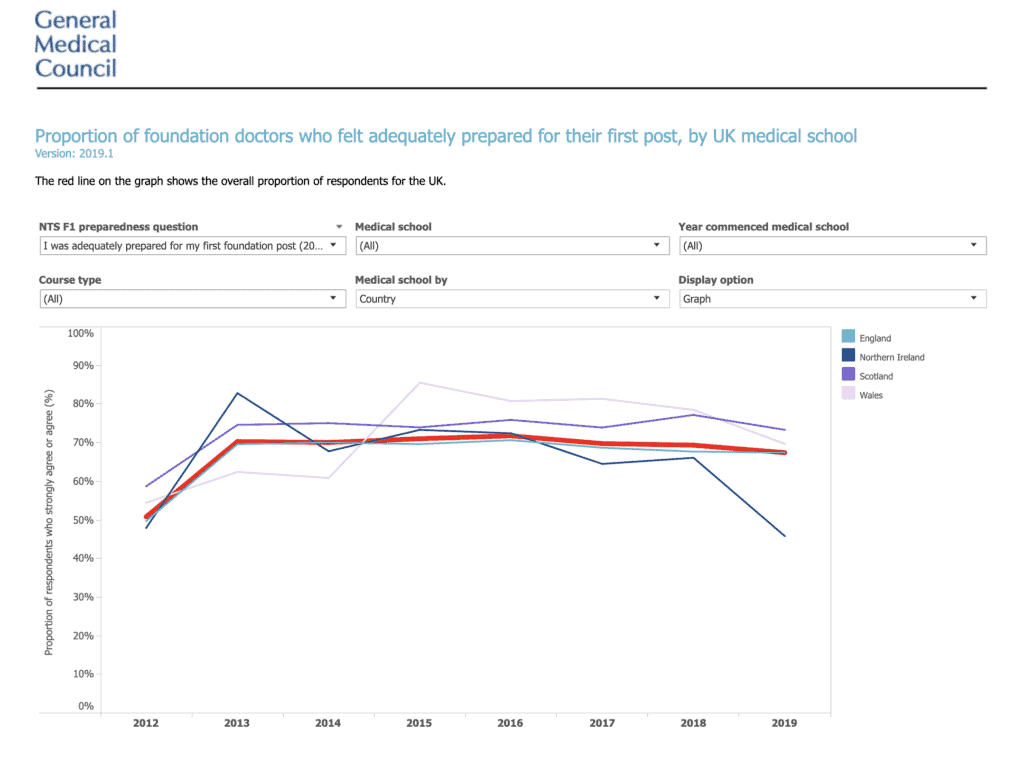
    GMC Foundation Results

    Image from the UK medical training survey depicting a sharp rise in “preparedness” from 2012 to 2013 (previous surveys would show this trend as going upwards from a lower level, but the 70% appears to be a natural barrier to further improvement). Source gmc-uk.org

    Overall Most Trainee Doctors Are Happy.

    With all the negative stories associated with the lot of trainee doctors in Australia over the past few years.  It may be tempting to conclude that trainee doctors in Australia are a deeply unhappy lot.  However, that’s simply not the case.

    And whilst, those stories should not be ignored and whilst there is empirical evidence of trainee doctors in Australia being exposed to adverse experiences in the workplace at unacceptable rates.  This experience is thankfully not the experience of the majority.

    In fact, 78% of the survey respondents indicated that they would recommend their current training position to other doctors (agreed or strongly agreed), followed closely by 76% of respondents being comfortable recommending their workplace as a place to train (again agreed or strongly agreed).
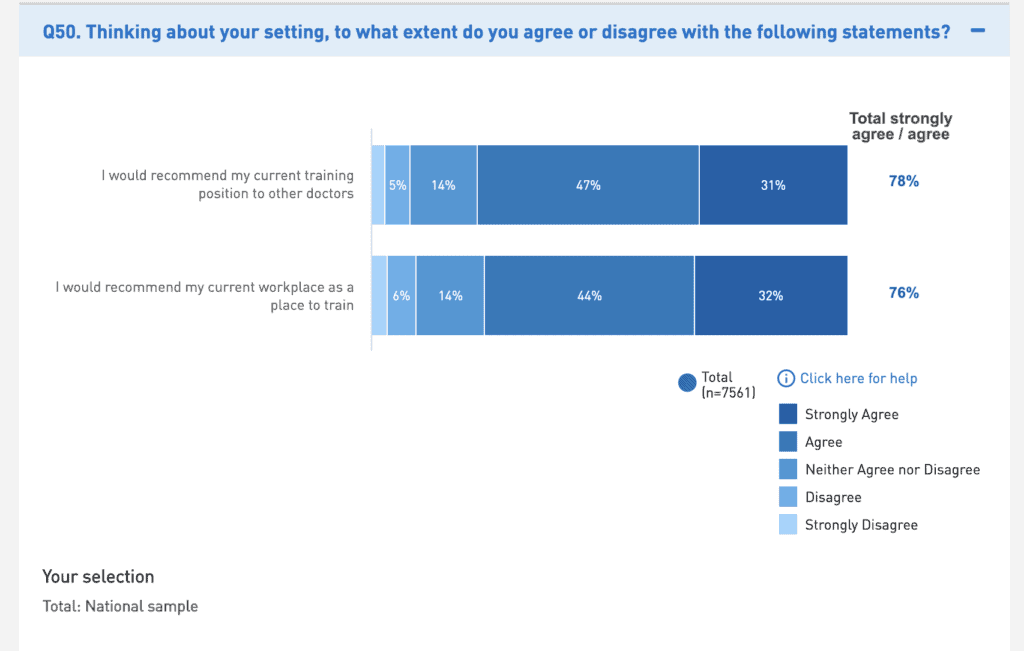
    Medical Training Survey snapshot

    International Doctors Are Even Happier According to the Medical Training Survey.

    I get asked a lot by international doctors if hospitals in Australia are good environments for IMGs.

    Here’s a table that shows you that overall IMGs are actually even happier than interns about their training post and workplace.
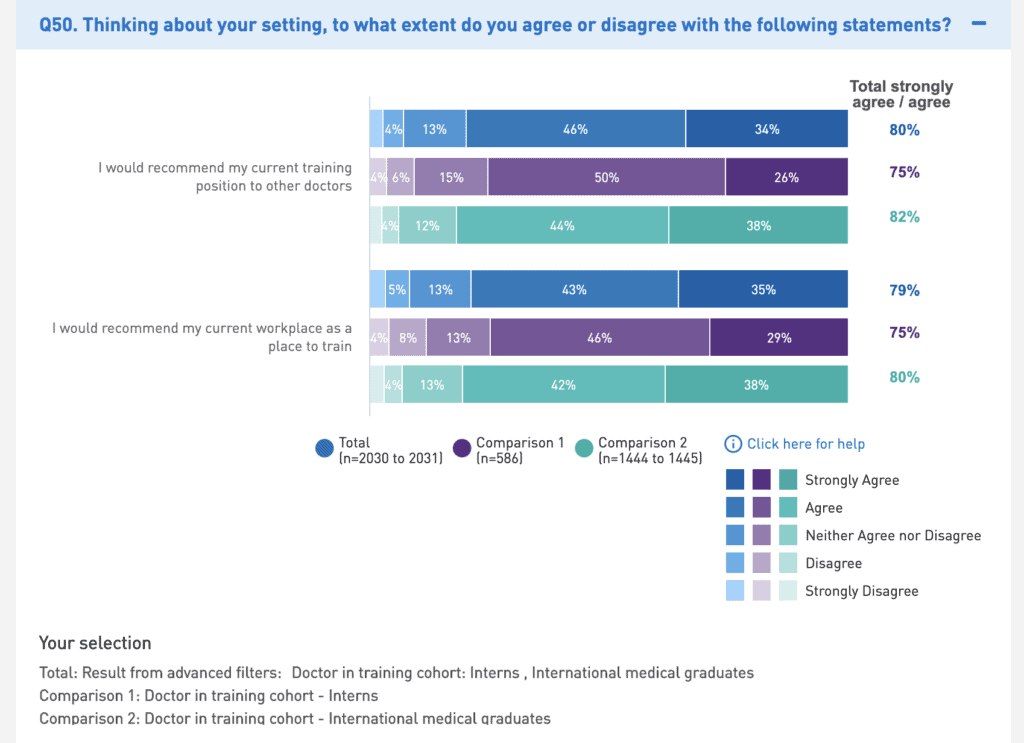
    82% IMGs would recommend their training post to another doctor, compared to 75% of interns. And 80% of IMGs would recommend their workplace to another doctor, compared to 75% of interns.

    Doctors In Training Are Still Working Too Much.

    The survey shows that the majority of doctors in training are now working under 49 hours per week.  However, 17% are in a risky area of working up to 59 hours a week and there are concerning outliers with 13% reporting working greater than 60 hours per week, including up to 90 hours or beyond.
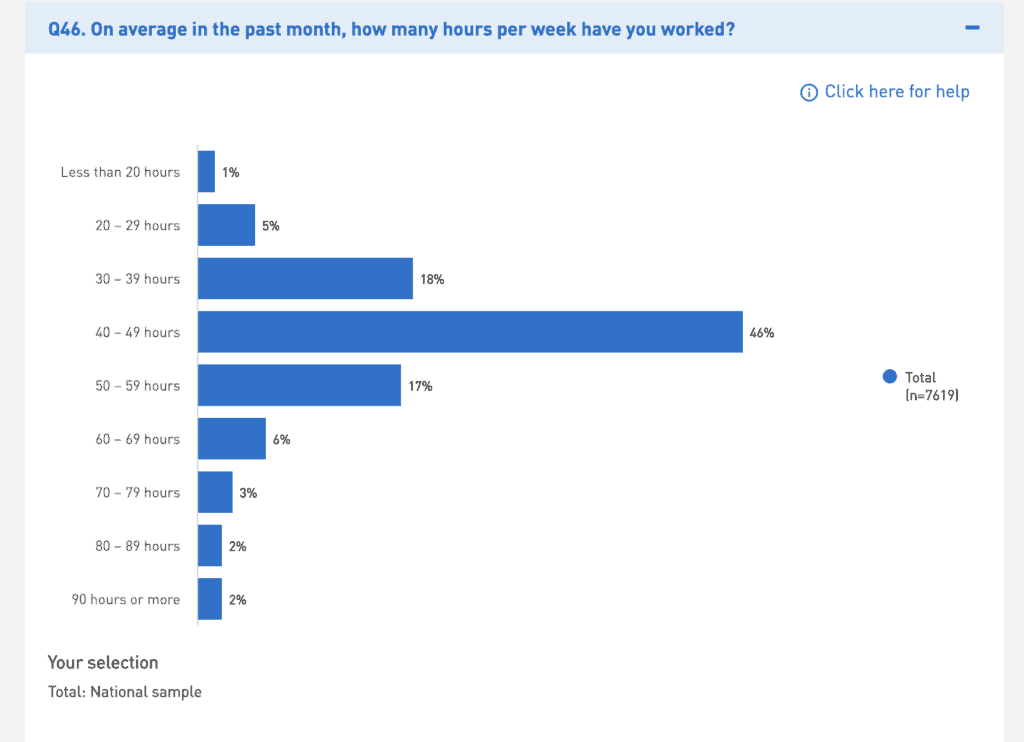
    What is also interesting is that whilst one might expect that excessive work hours are more of a problem for specialty trainees when one compares the figures between, say interns and specialty trainees the difference is the other way with 16% of interns working over 60 hours a week and only 12% of specialty trainees working over 60 hours per week.

    But if we go a bit more granular and check out a specialty like surgery, we see more of what we expect to see.
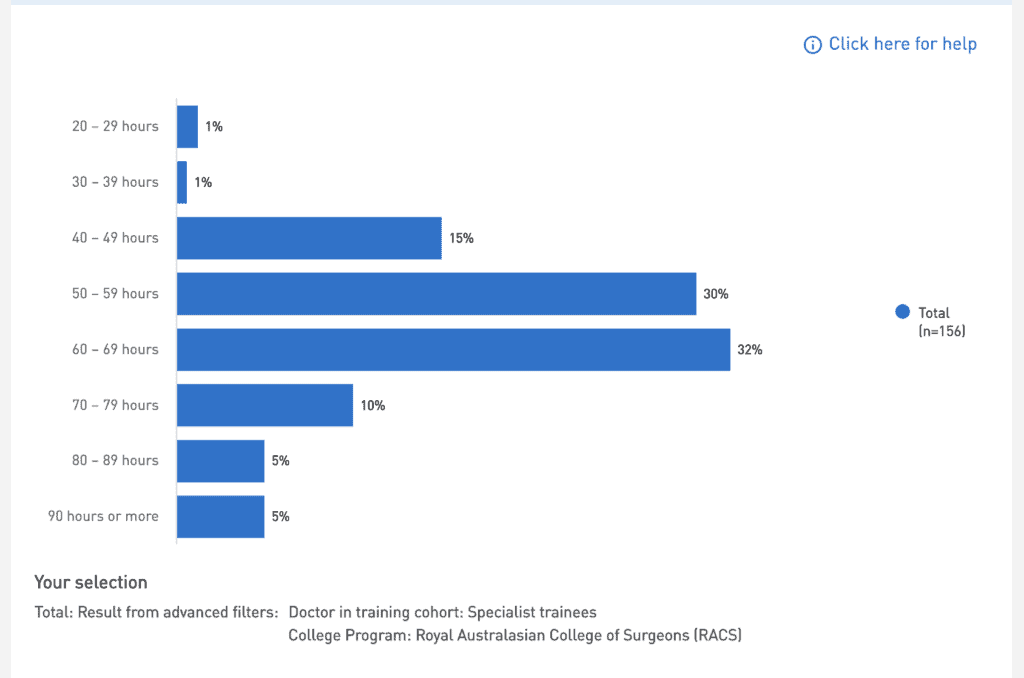
    52% of RACS trainees report working greater than 60 hours a week. If you spot a worse group than this on the survey, I’d love to know about it.

    Where Did That Unrostered Overtime Go?

    Also, only 47% of doctors in training report being paid for unrostered over time, which is a deep concern.
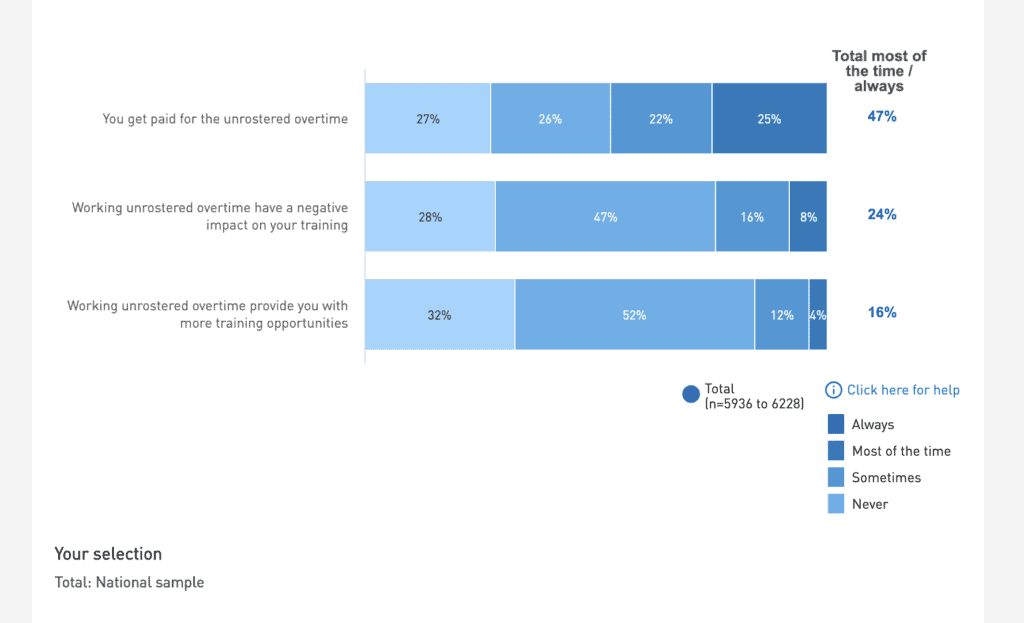
    There Are Still Too Many Doctors In Training Being Exposed to Bad Behaviour.

    22% of doctors in training report personal experience of bullying, harassment or discrimination and 27% report witnessing this.  This is on part with other reports conducted around this issue, including one I helped write a few years back.
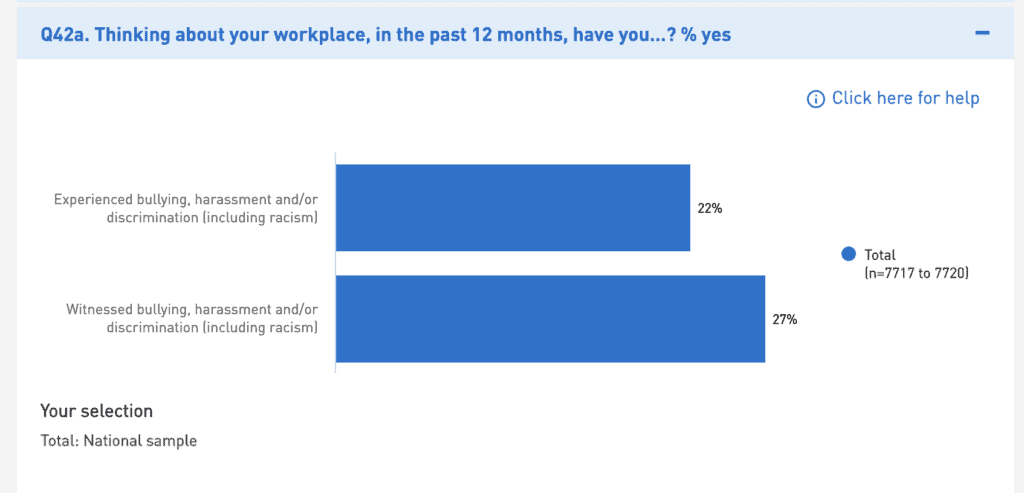
    Similar to our report findings only 35% of the recipients and 29% of the witnesses reported reporting this behaviour.  Which again is consistent with other studies.  What is most worrying is the level of non-witness report as this is probably the key statistic to be focussing in on here.

    If there is a silver lining to all of this it is that 52% of recipients who reported bullying, harassment or discrimination received a follow up to their report.  Now 52% may not seem all that great.  But this is actually a pretty good baseline result given what we know so far about the skills and capabilities of senior colleagues in handling the difficult issue of bullying, harassment and discrimination.

    Career Aspirations Greatly MisMatch the Reality.

    The MTS also included questions about career planning and intentions. Apparently 16% of Interns were unsure whether they did or did not have a training plan.  In my book that means you don’t have a plan.

    But check out the next table for an example of poor expectations management! 
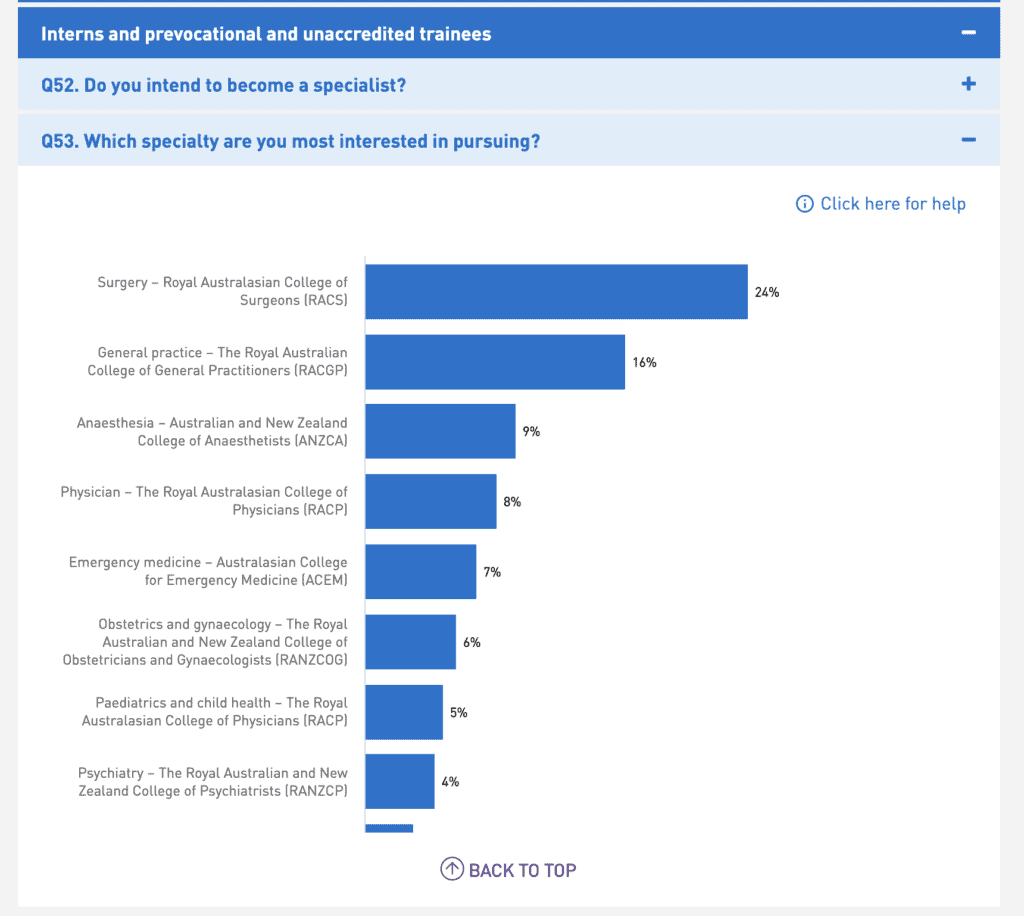
    According to another medical workforce data set, the Health Workforce Australia, Medical Education and Training Dataset there were 1051 accredited surgical training positions in Australia. Now bear in mind that these 1051 positions aren’t just occupied by an individual doctor for one year but several years in order to complete a training program.

    Contrast this with the fact that 26% of the interns, resident medical officers, senior residents and unaccredited trainees indicated they were most interested in pursuing surgery as a career.  That’s a raw number of 351 of survey respondents alone. If we scaled it up to include those in these cohorts who did not complete the survey then we are probably talking 1500 to 2000, when the true capacity is around 200 to 300 per annum.

    If we look at the other end of the spectrum we then see a specialty such as psychiatry which traditionally struggles to attract trainee doctors sitting at only 4% when in fact it has capacity for and needs more trainees than surgery.  By the way, psychiatry also ranks in the top 5 professions for salary in Australia, along with Surgery.  Just saying.

    I was disappointed to see that this particular question was not asked of international medical graduates.  This would be important information to have.

    We Are Not Connecting the Dots (Yet) Between Medical School and Doctors In Training.

    So the last key finding is really a non-finding. I was surprised to see with all the effort that went into making this survey right a failure to ask a really obvious question about the transition from medical school to being a doctor-in-training. 

    As we have alluded to in the United Kingdom survey this has been a key and consistent question in their national report.  And it is an important one as we need to ensure that various parts of the medical training continuum are connecting with each other.

    What is even more surprising is that this question does get asked in Australia. It is asked as part of a survey led by the Australian Medical Council but with the participation of the Medical Board of Australia in a separate survey called the Preparedness for Internship Survey. This survey showed that 74% of respondents (interns) felt their medical school training had been sufficient.

    I believe it’s a mistake not to include this question in the national training survey as it helps us to connect some important dots with other questions.  Hopefully, over time, the Medical Board will find a way of combining the results of both surveys.

    I would encourage you to go and have a look at the survey yourself. Play around with it and see what you find.

    In this post, I haven’t even touched on things like the differences between various States and Territories or touched on very much issues around specialty training or other specific groups.

    I would love to get your feedback on the type of follow up post you would like to see to this one.

    Question. What is the Medical Training Survey (MTS)?

    Answer. The Medical Training Survey is a national, profession-wide survey of all doctors in training in Australia. It is conducted in a confidential way to get national, comparative, profession-wide data. With the aim of strengthening medical training in Australia.

    The survey is designed to be quick to complete and done on all manner of online devices and has the support of key stakeholders, such as doctors in training groups, employers, educators, the AMA and regulatory bodies.

    Question. How does The Medical Training Survey happen?

    Answer. The Medical Training Survey is open during August and September of each year, which coincides with the medical registration renewal period for most doctors in Australia.

    The survey is run independently by research agency EY Sweeney.  The survey is confidential, and data is gathered from online entry. Only aggregated data is ever reported, with the minimum threshold being ten (10) data points on any item and group to report back.

    Question. Who can do the survey?

    Answer. All doctors in training in Australia can do the survey. This includes interns, hospital medical officers, resident medical officers, non-accredited trainees, postgraduate trainees, principal house officers, registrars, specialist trainees and international medical graduates. Career medical officers who intend to undertake further postgraduate training in medicine can also participate.
  • How to Deal With Bullies In Medicine. 8 Tips For Surviving.

    How to Deal With Bullies In Medicine. 8 Tips For Surviving.

    Recently a trainee doctor left me a message on the website asking for some help with dealing with a number of senior colleagues who were bullying them in the workplace. Unfortunately, he or she did not leave any contact details. But given that this is certainly not the first time I have been asked for help in this manner I thought it would be a good idea for me to share some thoughts on the subject of how to deal with bullies in medicine.

    I want to make this a practical post for any of your struggling with dealing with difficult behaviour in the hospital or community medicine. I’m more than happy to write an article on the causes or potential solutions to bullying and in fact, have done so in the past. But this post is for those of you already immersed in the problem with no hope of a rapid culture change program to bail you out right now.

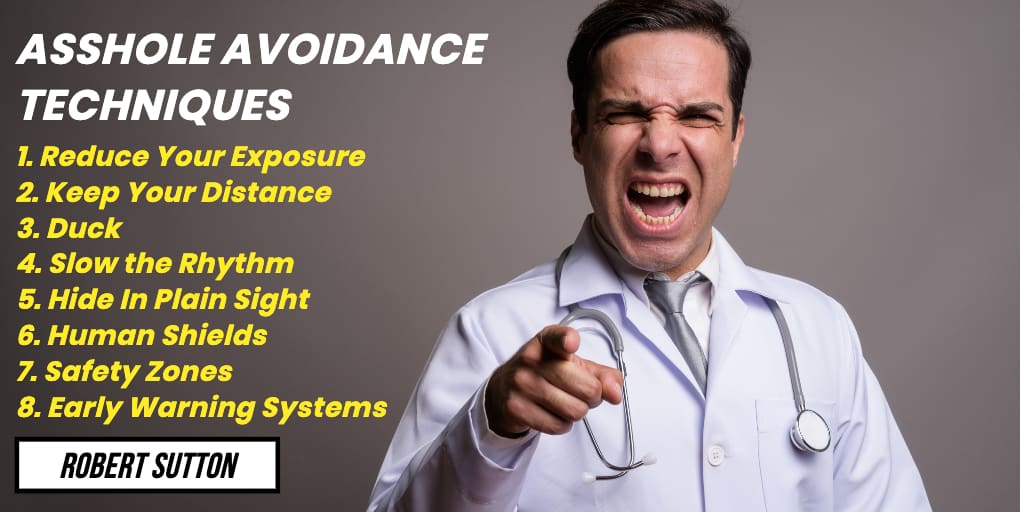
    So here are a few practical tips for things you can do or try if you are encountering a bully in medicine. You can:

    • use distance to avoid the doctor bully
    • dodge and avoid encounters with the doctor bully
    • slow down the rhythm of encounters with the doctor bully
    • become invisible to the doctor bully
    • find someone who can act as a “bully blocker” to the doctor bully
    • tag-team with partners to deal with the doctor bully
    • find or establish safety zones for recovery from the doctor bully
    • establish an early warning system to avoid doctor bullies

    I do however emphasise that this is a list of tactics for dealing with the acute issue of a bully in the workplace. For long term problems, there is a need for a more systemic approach. But given that hospital cultures often take years and many trainee doctors rotate every 10 to 26 weeks or so, some practical tips are justifiable.

    So let’s explore these tips one by one in more detail below.But first, let’s credit the source of inspiration which is Professor Robert Sutton who is, in my opinion, the world’s leading authority on workplace bullies or what he terms “assholes”. He has written a number of books on the topic all of which I would highly recommend. But the inspiration for this particular article comes from one of his later books. The Asshole Survival Guide.

    Tip 1 Keeping Your Distance From Bullies in Medicine

    This may seem obvious but most places where we work in Medicine afford us a fair deal of space. As Sutton points out in his book generally the closer you are to someone in the workplace the more often you communicate. Which is great if you get on with that person, but if that person is a bully then closeness is a bit of a problem. You may not be able to get the bully to move away from you but perhaps there are opportunities for you to move a bit further away to avoid being in the line of fire?

    For example, can you move desks or change your presence in the ward round line? Maybe rather than accompanying them in the lift, suggest you are happy to wait for the next one or take the stairs instead. Or rather than sit opposite them in a meeting, sit on the same side of the room but a few chairs down so that its harder to make immediate eye contact?

    If you are in some sort of position to get the bully themselves to move you might try to the trick that a few university professors used to move on a rather pompous colleague. They offered the colleague a new and better office away from the main campus and the colleague took the bait and was rarely seen again.

    Tip 2 Dodging and Weaving Bullies in Medicine

    This next tip may take a bit of creativity. But if you think about it there are often all kinds of reasons not to be near a bully when you are working in a hospital or other health care environment. Perhaps a sick patient needs to be urgently reviewed. Perhaps there is a relative that needs to speak with a doctor. Perhaps you can be off collecting the XRays for the XRay meeting (OK yep I know these are mainly on the computer these days but you get where I am going with this).

    Tip 3 Slowing the Rhythm of Bullies in Medicine

    This next tip is especially effective if the doctor who is bullying you is keen on having a series of communication exchanges with you, and can work especially well if it’s something like email.

    To perfect this you will need to adopt a “passive-aggressive” approach. What you are trying to do is break the momentum of the bully so that they don’t get rewarded by the bully exchange and eventually get bored and move on.

    When a bully comes at you in full throttle it is tempting to try to respond and defend yourself. But this actually gives the bully a response and a dopamine rush which is exactly why they are engaging in the behaviour.

    So rather than fight back directly. Offer to take on board the bullies comments (criticisms) and do some research or some thinking, and indicate you will get back to them. And then take your time. Chances are they won’t follow up.

    If its an aggressive email. Park it and respond at another time. Chances are there are a number of issues that need responding to in the email. Just pick the lease controversial one and respond to it. Ignore the others and wait to see how the bully responds.

    Tip 4 Hide In Plain Sight From Bullies in Medicine

    We obviously do have to turn up to work, do our job and associate with those doctor bullies. But bullies often only notice you when they believe you’ve done something wrong or offensive. You might find it easier to “be there” but not being noticeable.

    How does this work? Try being boring. Do consistent work but not good work (at least not good work that is noticed by the bully). Be quiet when others are talking in the presence of the bully. Let them be noticed not you. Find opportunities to be more engaged in other things, such as lingering over your breaks or taking a bit longer to perform that cannula that needs to be done. Anything that has you there but in the background.

    For those of you who like wearing crazy socks to work (and I’m certainly a fan of crazy socks) perhaps this rotation is the time to get the beige ones out of the bottom of the pile instead.

    Tip 5 Find a Human Shield For Bullies in Medicine

    In Medicine, there is often several layers of hierarchy. You may for example, as a resident, find that your bully is a burnt-out senior consultant but that there are sympathetic junior consultants or specialty trainees willing to help act as a buffer or barrier for you.

    Treat these people kindly (the buffers not the bullies). Not only do we obviously need more of them in Medicine. But you will also find that they can help you more if you can minimise the attention you might draw from the bully by not only doing your job well but supporting the doctor buffering you in their job.

    Tip 6 Form a Team Against Bullies in Medicine

    As an alternative to finding a human shield, you may be able to collaborate with your peers to alternate your exposure to bullies and assholes in the workplace. Taking it, in turn, to be in the firing line and supporting and debriefing each other as you go.

    Perhaps you can make a compact with your colleague to never leave each other alone with your bully.

    Tip 7 Safe Zones For Bullies in Medicine

    The ultimate safe zone for trainee doctors to shield them from a senior bully colleague is the resident doctors’ lounge. A surprising amount of work can be done from most lounges these days with the aid of IT – checking results, calling for consults, and completing discharge summaries for example.

    Psychologically you also know that you are safe for the time that you are in the lounge and of course you often have the support of your colleagues available.

    Want a more immediate safe zone? Try the bathroom. If the bully is in full throttle and you are feeling the tears start to well up a quick dart to the bathroom could be the fix to calm your feelings and restore your resolve.

    Tip 8 Early Warning Systems

    Many bullies have good and not so good days. Having systems in place to prepare the team for a bully on a bad day can be helpful so that people can prepare, leave or hide, hide in plain sight or group together.

  • 11 Creative Ideas To Change The Sick Medical Culture Today

    11 Creative Ideas To Change The Sick Medical Culture Today

    By the Creative Careers in Medicine Team and Anthony Llewellyn

    We were all appalled to read yet another blog post about yet another trainee doctor badly treated on a regular basis by the medical culture system that we all belong to. Who are we? A group of clinicians who aggregate around an idea that we can be innovative in medicine and bring solutions to the table. Our thoughts naturally turned to rage as we reflected on the story of Dr. Yumiko Kadota, a plastic surgical trainee at Bankstown-Lidcombe hospital, who was forced by her medical culture to be on-call for 180 hours straight amongst a litany of appalling work practices.

    But then we thought about it more deeply and decided as a group we should turn our thoughts to the problem. The problem is how do we change the terrible and sick culture in medicine and healthcare more generally? One issue that is readily apparent is that, if there was an obvious solution, someone would have found it by now. The traditional approaches of policy changes and awareness campaigns and training have not been particularly effective. Amongst our creative solutions to solving the problem with the medical culture we propose:

    • closing the accreditation gaps to ensure that all trainee doctors are subject to external accreditation
    • treating trainee doctors more like pilots
    • having clear rules and a chain of responsibility for wellbeing issues such as fatigue
    • using social networks to share good and bad information about trainee posts to shine a light on poor hospital practices
    • rewarding good teachers and supervisors with more trainees and taking trainees away from the poor ones
    • consultants giving up some of their pay in a genuine effort to demonstrate respect for trainee doctors and fix some of the systemic problems with work conditions

    Our group is broad and comes from a range of backgrounds. Holding expertise in both medicine and other fields. This blog post was a joint effort by several individuals. We would love to tell you who each member was that contributed. But I am sure that you will understand why many of our members wish to remain anonymous.
    So. Here is a more in-depth look at some of our creative proposals

    1. Close The Accreditation Gap.

    One of the key issues in Dr. Kadota’s case is that even though she is a trainee doctor, she is not a doctor actually in training. Paradoxically and perversely Dr. Kadota is in training to become a doctor-in-training. This situation is due to bottle-necks in certain popular training programs, like plastic surgery. It leaves a situation ripe for exploitation where trainees in unaccredited roles can be exploited by hospitals because they are not officially backed up by the college and the hospitals know that there are many willing trainees ready to replace them. It creates a situation of what is commonly called “service roles”, which can also be interpreted as roles where you don’t get taught.

    The solution is for the colleges to take formal responsibility for unaccredited trainees in their specialty areas. To ensure that there is a level of standard for the training and welfare of these trainees. If the colleges are unable or unwilling to do so then other authorities such as the Health Education and Training Institute, which in NSW already accredits hospitals for intern and resident teaching should be brought in to set and monitor standards.

    2. Acknowledge That Fatigue Impacts Performance & Utilise a Pilot Style Regulation of Doctors.

    The aviation and other transport industries have strict rules in place enacted by CASA regarding how much sleep someone needs to have in order to operate a heavy vehicle that may also be carrying passengers. This is based surrounding a strong research base acknowledging that fatigue can have a detrimental impact on concentration and performance and at some levels, as great as being intoxicated. 

    Why should doctors not also be viewed in the same way? Medicine is a challenging job in that every decision can potentially affect the lives of their patients, themselves, or their colleagues. Fatigue can impact medication prescriptions and errors, surgical errors, patient identification errors. It can also impact a doctor’s well-being, impact their families and result in car crashes (and deaths) on the way home from shifts. Fatigue has the potential to kill and can be costly for organizations. 

    Recent reports have highlighted the power imbalance that Specialty trainees, especially those in niche fields of medicine, have been treated poorly without representation of a college. They should be treated and respected as rare and valuable resources not flogged mercilessly because there are not yet accredited trainees or because there is a shortage of them. There are other ways of covering a specialty roster. Many hospitals in Australia do not have a 24-hour plastic surgery trainee doctor on call. Some don’t even have a plastic surgeon at all. It is time to review rostering and to think laterally about how to ensure safety for patients and doctors.

    3. Adopt a Chain of Responsibility Approach.

    Following on from the linkage to the airport industry. The heavy trucking industry has adopted legislation that makes everyone in the chain potentially responsible for adverse outcomes. If you put pressure on a truck driver to cut corners in order to save money for your business and that leads to unsafe driving you can be held criminally accountable for your action.

    We suggest making those in charge of rosters responsible in some way for supporting poor roster practices. It is not as if there have not been guidelines in place for some time to say what is and what is not acceptable. The AMA’s National Code of Practice for Safe Working Hours was developed in 1999 and significantly redeveloped and refined since then. We have a tool. We can use it.

    If a senior doctor authorizes an unsafe roster then there should be a penalty to both that doctor as well as the hospital. Be it financial or some other sanction. Heads of the Department will soon stop approving such rosters and either fight for change, advocate for resources or quit their role because they are not getting enough support from the hospital general manager. This pushes the problem higher up the food chain until someone decides to intervene.

    4. Inform patients about how this affects them.

    For many years junior doctors and their advocates have attempted to change the system. The Australian Medical Association issued the first AMA National Code of Practice – Hours of Work, Shiftwork and Rostering in 1999. In 2007, the Royal Australasian College of Surgeons (RACS) published the Standards for Safe Working Hours and Conditions for Fellows, Surgical Trainees, and International Medical Graduates. Yet the practice of junior doctors working unsafe hours continues.

    What do we mean by unsafe hours?

    As we have noted above. There is clear evidence that fatigue affects the health of the person with fatigue. There are many stories of doctors crashing their vehicles driving home from work. Medical trainees with fatigue are three times more likely to have an injury related to a sharp instrument like a needle-stick injury. Fatigue in pregnancy can increase the risk of miscarriage, premature labour, and low birth weight. There are many more documented effects of fatigue on the health of the person with fatigue. We know it is bad for doctors. We also know that doctors have higher rates of depression, anxiety, and suicide than the general population.

    The evidence in medicine is less clear whether fatigue leads to unsafe care or medical error. But what we do know is that the effects of working continuously for 18 hours are equal to having a blood alcohol concentration of 0.05g/% and that 24 hours to a BAC of 0.10g/% or twice the legal driving limit in Australia. The RACS publication also states that approximately 33% of surgical errors are attributed to fatigue or an excessive workload.

    Yet there are paradoxes, the Royal Australasian College of Surgeons RACS also recommends that a workweek of 65 hours is ideal for surgical training. This is based upon a review of the evidence and an acknowledgment that a certain amount of hours are required to develop to the level of expert. This takes into account factors such as working enough hours to gain the necessary skills to be a surgeon.

    So what does that mean for patients?

    Potentially that the doctor who is about to operate on you has not slept for 24 hours. Potentially that there is an increased risk of an error being made during your operation.

    So what can patients and their families do?

    When the doctor is explaining the operation, the benefits and risks of having the operation, or not having the operation, consider asking them whether they are in the high-risk fatigue category. Perhaps patients can help empower doctors to speak up.

    If a patient declines a treatment because they believe that their doctor is not safe to operate and no other trainee doctor is available to take over, then more senior doctors would have to be brought in (if urgent) or if not urgent the issue placed on hold until there is a well-rested doctor available.

    Dr. Kadota’s story highlighted a situation where there was pressure to move patients through the system. Not necessarily because of any clinical urgency, but because other KPIs demanded that the plastic surgical trainee is woken for non-urgent matters.

    This situation would not arise in many of the hospitals in Australia. Because in many hospitals in Australia there is no 24-hour plastic surgical service.

    5. Address The Supply and Demand Problem.

    Part of the problem highlighted in Dr. Kadota’s case is a demonstration of the issues of supply versus demand. Doctors are in relatively short supply in certain areas and specialties. The short supply means that doctor-impairment is tolerated by hospitals and society (i.e. a drunk/fatigued/depressed/burnt-out doctor is better than a no-doctor).

    Another part of the problem is the ‘naturality-of-outcomes’ in medicine – how is a member of the public meant to differentiate whether death or medical complications arose from ‘bad luck’, or an ‘impaired doctor’ who missed something? They can’t, and therefore the prospect of doctor impairment is never considered.

    Finally, there’s the culture of obfuscation. When was the last time you as a doctor filed an incident report after discovering another doctor’s mistake, or noticing another doctor was tired/fatigued/emotional? Aviation, rail, and other transport industries have “fatigue-leave”, “normalised-incident-reporting”, supporting-fitness-for-work programs, and actively address the ‘authority gradient’ that exists between hierarchy, for eg. Captains and First Officers.

    While the determinants of why bullying and burnout occur in medicine are complex, medicine like any industry obeys market forces across human needs. Success may lie in understanding that market and making the nurture-of-doctors a market commodity.

    This can be done by better demonstrating that doctors who are well and cared for have better patient outcomes; have higher patient throughputs; save money, and improve patient satisfaction.

    6. Alternative Models of Care

    Following on from the above point. There are plenty of models in health where other doctors and other health professionals can take on some or all of the roles of a particular doctor who is in short supply.

    This can be as simple as changing the process for who takes the first call from another doctor.

    In Dr. Kadota’s case, she was apparently being woken in the middle of the night to receive calls about booking outpatient appointments. This function could easily be handed off to an administrative role.

    Some teams will utilize experienced nurses to take the first call and triage the need and priority. A great example of how this happens are stroke teams and mental health teams.

    This can be a fantastic opportunity for another member of the health care team to upskill in this role.

    But of course, we have to be careful that we are not pushing the problem onto another part of the healthcare team by ensuring that everyone receives decent support and working conditions.

    7. Use Social Media and Networks.

    Sites like messly enable trainee doctors to connect and share information about hospitals. The good the bad and the ugly. Call it a name and shame exercise if you will but since the United Kingdom started asking its medical graduates whether their medical school did a good job in preparing them for internship (called foundation year in the UK) the satisfaction reports have gone up significantly over time and some pretty prestigious institutions were forced to lift their game.

    One can imagine for example a public version of TripAdvisor for rotational hospitals where we get to see what the “well-appointed family-friendly 3 bedroom unit” truly looks like before they get sent there. The public can also see what’s happening and hold the system accountable.

    8. Mass Exodus?

    Miko’s story has resonated strongly with one eminent specialist in our group. This person has been working as a specialist for a few years but has become increasingly disillusioned with the hospital system that does not support its workforce.

    Workforce cuts meant already overburdened staff having to take up additional work, compromising patient care. The staff had attempted to highlight the results of this, ranging from patient harm due to inadequate resourcing to the insidious deteriorating physical and mental health of the members of the team. Incidents reports were submitted, discussions were had at the appropriate committees, and even letters were written to management and the district CEO. Yet there was never a response, only non-responses or moves to hold the issue to the next meeting “let’s put a pin in it” when it was not discussed.

    Miko’s treatment at this hospital is reflective of a wider systemic disease in the public (and private) hospital systems: the pursuit of KPIs or profit prioritized over the welfare of staff and patients. But more concerningly is the indifference of the healthcare system (Department of Health, State bodies, District Boards, and Hospital Management) to recognizing this disease and curing it. Failure to address this hurts staff and ultimately patients.

    The core business of hospitals and the healthcare system is to care for the unwell, return them to health, and keep them healthy. This was the goal of the specialist in our group when they took up their specialist position in the public sector. After a few years, it was clear to the specialist that the hospital system disincentives and does not empower staff at the coal face to improve or address concerns or problems that are occurring. For these reasons, the specialist felt they had to leave as they were powerless to be able to change the system to the benefit of their colleagues and patients. Change that would have prevented Miko’s story can only come from within the health system. External pressures may drive this – Department of Health directives, The Media exerting pressure or Health Board Director prosecutions for failure to appropriately implement workplace health and safety procedures for staff.

    Whatever the drivers are, it will be management and health care providers who create and implement solutions that support staff to work safely and innovate for the patients we serve.

    Let’s hope it does not come to a mass exodus of medical staff leaving the system.

    9. Make Supervision a Formal Credentialing Matter.

    Senior medical staff has to go through an appointment and vetting process to get a role in any hospital in Australia. This process considers their training, qualifications, experience, and expertise and determines what they are and are not permitted to do. Sometimes referred to as a scope of practice. It’s generally about what sort of patients they are allowed to have admitted under their name, as well as what treatments, investigations, procedures, and surgeries they can conduct.

    Nowhere in this process is there a consideration of their ability to teach, lead, supervise or just treat more junior staff members fairly. Having a trainee under your supervision should not be a right it should be earned. We should start by demonstrating this by not making the right to supervise and have trainee doctors in your team an automatic privilege.

    10. Give The Best Teachers and Supervisors More of the Trainees.

    If a senior doctor is unable to provide good supervision to a trainee, chances are they are not getting the best out of this particular valuable resource. Give more trainee doctors to the best supervisors and teachers in the hospitals. Let them lead “super-teams” that get the work done in a challenging but rewarding manner. Those supervisors who demonstrate poor supervision skills should be left to do the work of the consultant and the trainee.

    There are many potential outcomes of this scenario. All of them are likely to lead to better patient care. In one. The poorly performing supervisors up their game through training and coaching and regain their trainee doctors. On the other, the poorly performing supervisors leave the hospital and their places are taken over time by new consultants who have been trained to be the best supervisors by the best supervisors.

    11. Senior Doctors Forfeit a Pay Rise To Fix The Mess

    Personal Opinion By Anthony Llewellyn

    In some states of Australia, the Award for trainee doctors is pretty reasonable. In Victoria, for example, trainee doctors get access to annual leave, as well as study leave, exam leave, and even have access to a professional development fund.

    In NSW however, where Doctor Kadota worked, we pay our trainee doctor’s the worst salaries in the country and we have an Award with all manner of antiquities and outdated conditions because it has not been updated for at least 4 decades. Trainee doctors struggle to get access to leave to study and prepare for exams and being sent to a hospital 150 kilometers away is not necessarily considered a rotation, where you get additional payments to support the fact that you are away from home. 35-year-old professionals (that’s what a trainee doctor is) are often offered an un-family friendly one-bedroom unit for their 6-month rural opportunity when they are living in a 4 bedroom house back at home with their spouse 2 kids and pets.

    Every time there has been an attempt to bring in sensible and civilizing new conditions to the Junior Doctors Award in NSW it has been met by resistance. The most recent attempt to fix a problem was a simple proposition that we should recognize that specialty trainees are in fact specialty trainees and should be paid as such. It met heavy resistance from NSW Health and ended in a farcical status quo.

    The main reason for this blinkered intransigence. Money. Every proposed award change is run over with an economic pen to see how much it will cost the bottom line. So that instead of making actual improvements to working conditions every year all that happens is a blanked percentage pay rise.

    As a consultant who works in NSW Health, I value the work that the trainee doctors do. I could not do my work without them. I get paid well enough. Well enough that I could and would give up my next annual salary increase if I knew and it was promised that this would go to fixing up some of the problems that trainee doctors experience.

    You can find Creative Careers in Medicine here on the web and join the facebook group here.

  • The Benefit Of Buddy Systems in Medicine

    The Benefit Of Buddy Systems in Medicine

    Starting a new job in Medicine can be exciting, but it can also be very stressful. How often have you started a new rotation or a new job and felt a bit lost on the first day? Have you ever had an experience where you can honestly say that you “hit the ground running?” Assigning a workplace buddy can help ease the transition for new employees into their new roles can be very beneficial for all involved, especially during the onboarding process.

    What is a Buddy System?

    Buddy systems have been used in other industries and schools for many years and proven to be effective ways of ensuring that employees get off to a good start. This has all sorts of benefits to both employee and the organisation.

    Simply put a buddy system involves assigning a new employee a workplace buddy. The buddy is an existing doctor who guides the new doctor through the first few weeks or months on the job. In Australia we have started to see the rise (or in some cases rebirth) of buddy programs, sometimes also referred to as mentor programs. In particular it is now common in the State of NSW, for the second of the 2 weeks of Intern induction to consist of a “buddy week”, where the new intern gets the chance to understudy a finishing intern in their first new rotation. Whilst these buddy weeks are quite popular they do have their limitations. The key one being that because the relationship is very brief it only really permits a small transfer of knowledge and in particular doesn’t afford the new intern doctor a chance to reflect and ask questions of their buddy about the hidden curriculum of the workplace.

    Evidence has emerged that longer relationships between new employees and existing employees in Medicine can help reduce stress, and improve morale, sense of support and job satisfaction.

    Buddy systems should include a formal documented process that outlines the buddies’ responsibilities as well as what items they should cover over the first few weeks or months of employment. The buddy system should also encourage the new employee to share tips, tools, knowledge, and techniques they have learned about the workplace. A buddy also potentially gives the new doctor a psychologically safe opportunity to offer confidential feedback about how their onboarding process is going. For these reasons the closer the buddy is to the new doctor in terms of peer relations the better.

    Why Implement a Buddy System?

    The last thing we should hear from a doctor on their first day is “Nobody knew I was starting today.” At the end of their first few weeks in the job we want new interns to feel that they made the right decision to study medicine and for other doctors starting new jobs we want them to feel that they accepted the right position.

    First impressions are key. The initial enthusiasm that interns experience to have “finally made it” can be either lifted or ruined, depending on their start. What happens during the first few days can determine the long-term perception of the job and the organization. Studies have shown that a large number of employees quite within 6 months of taking up a job. Often citing a poor onboarding process or lack of clarification about their role as the key reason for doing so.

    Regardless of whether there is a formal process in place or not, onboarding is going to happen; the real issue is the quality of the experience. When onboarding is done well it sets up new doctors for long-term success. If an orientation consists of handing the new intern a pile of forms to fill out on their first day, then there are going to be future problems, which is where a buddy system may come in handy.

    Implementing a buddy system can be part of an effective onboarding program that provides new doctors with a way of resolving questions regarding work processes. Some of which may be difficult to predict and / or hard to deal with in a formal orientation seminar. This socialization and support can make a big difference.

    In particular, a buddy can help with the last 3 of the 4 C’s of onboarding: Compliance, Clarification, Culture and Connection.

    The buddy system is not only valuable to the new doctor. Its obviously also an opportunity for existing doctors to develop skills as a mentor and may foster the early development of a range of people management and leadership skills.

    From a bottom line point of view a well executed buddy system will likely reduce the number of doctors leaving a hospital or organisation, particularly early. And this will save the hospital a lot of money in re-recruitment costs.

    But at a deeper level buddy systems can improve employee engagement with the organisation which can be a vital component of instilling a positive workplace culture. Which in itself is likely to lead to better outcomes in terms of both patient care and cost.

    Benefits To BuddyBenefits To New Doctor
    RecognitionOne-on-one assistance and single point of comfortable contact
    Expand NetworkJump start on networking
    Opportunity To LeadSmoother acclimation
    Fresh PerspectiveKnowledge of “how things really get done”

    What Is a Buddy?

    A buddy is someone who partners with a new doctor during their first few months of employment. He or she is a colleague assigned to assist the new doctor to get through this period. They can provide insight into the daily activities of the hospital and help the new doctor fit in more quickly.

    An effective buddy is a good communicator, has an interest in the development of others and is the type of doctor the organisation hopes to emulate (fits with the value system). They will generally take the new doctor around their hospital and orientate them and introduce them to key people who can help them out.

    A Good Buddy

    • Is known as a good performer and well regarded;
    • Is willing and able to mentor others;
    • Has the time to be available;
    • Knows the new doctors job;
    • Is a peer of the new doctor;
    • Has good communications and interpersonal skills.

    A good buddy should be a good representative for the culture and values of the hospital and organisation and be familiar enough with the formal and informal organizational structures to be a reliable source of information.

    Buddies Should Not Be

    A buddy is definitely not a supervisor and probably should not be a mentor (at least in the first few months). This helps to make the task of the buddy more limited and definable. Learning how to be an effective buddy can be useful as a foundation step to learning how to be a mentor or supervisor. The buddy is are available to answer straightforward questions about how the hospital operates. It is important to make clear to both the new doctor and the buddy that the buddy is not being asked to develop the new doctor and is not accountable for performance. This makes the buddies role easier in terms of being able to support the new doctor without fear of reprisal.

    If a doctor does not want this extra responsibility, then they should not be assigned the buddy role. Some doctors simply don’t want the responsibility or are not ready. Worse, some doctors are not well suited temperamentally for the role. A doctor who is known to be someone who gossips at work is probably not a good fit for a buddy role. The last thing a new doctor wants to hear about is gossip and speculation in their first few weeks.

    What Do Buddies Do? What Training and Support Do They Need?

    Buddies should be given the skills and knowledge to be able to:

    • Teach or tutor, for e.g. explain an unfamiliar task;
    • Explain tactical matters, such as how to submit a time-sheet and where the pathology forms go;
    • Talk about and explain the hospital’s structure, written as well as unwritten rules;
    • Share insights on how things are done in the hospital;
    • Involving the new doctor in social activities, such as coffee and lunch with new team.

    Buddies can benefit from some training and support in their role. But probably the best thing that can be provided is a suggested list of task and a timeline for completing them.

    Generally speaking the buddy is encouraged to meet more frequently with the new doctor e.g. daily for the first week, weekly for the first month, monthly for the next few months and gracefully exit from the relationship. Its helpful to set a solid time frame for when the relationship finishes (6-months is generally good).

    During the first few meetings the buddy works to help with urgent and practical questions. As the relationship matures and the new doctor finds their feet the explaining turns into more of the “why things are done this way around here.”

    Tips for Being a Buddy

    If you are asked to be a buddy, here are some tips that can help you:

    • Keep a list and timetable of what things the new doctor needs to know or be shown;
    • Be patient. Relationships take time to develop. Your new colleague is unlikely to open up to you until they have spent a bit of time getting to know you and you have earnt their trust;
    • You are not the expert on everything, instead think about who else can answer questions you don’t know the answer to and introduce them to the new doctor;
    • Don’t try to cover everything at once. Remember the new doctor is going to feel overwhelmed in the first few weeks. So try to avoid cognitive overload. Leave the deeper discussion till later;
    • Stay positive. New doctors will grow into their roles in time with appropriate support and confidence is infectious. Maintain a positive, teaching attitude;
    • If possible try to identify the new doctor’s personality and communication style and adapt;
    • Be open and don’t judge. Your new doctor is relying on you to be a safe place to get answers to their many questions.

    Remember. Despite the best efforts of the manager who asked you to be buddy. Sometimes buddy relationships don’t work out. Don’t be afraid to approach your manager to express concern and/or suggest an alternative buddy.

    Troubleshooting Problems With Buddy Programs

    There are some practical problems with assigning buddies in hospitals. Firstly, there are often not enough experienced buddies to go around. Especially with 100+ new interns starting all at the same time. Secondly, often those who are identified to act as buddies are taking leave or moving on at the same time as when the new doctors are arriving.

    One way to get smart about this issue is to gather information and consider the level of readiness of the new doctors. There are likely to be some in this group that require more support than others. Typically some may have already studied as student or worked in the hospital already and have a level of familiarity. These new doctors can probably more safely be assigned less experienced buddies and you can save your best buddies for the completely new doctor.

    Setting up regular training and check ins with your buddy group can identify gaps and issues. This can be triangulated with sessions with the new doctors themselves.

    Facts

    Cognisco in 2008, estimated that UK & US businesses lose $37 billion annually because employees do not fully understand their jobs. According to their white paper, “$37 billion: Counting the Cost of Employee Misunderstanding.”

    Summary

    Creating a buddy system for new doctors requires some time investment and buddy choice should be carefully considered. However, this is not a difficult or expensive option to implement.

    Make sure you’ve chosen a willing and effective buddy; create some documents to support them and the new doctor. Set an end date for the formal buddy relationship. Watch for the things that do not work so you can guide both the experienced and new doctors.

    A buddy system can dramatically reduce the time a new doctor requires to be productive and aid retention. An additional benefit of a buddy program is that it allows for corporate knowledge sharing and positive recognition for the buddy.

    References:

    Cooper, J. & Wight, J. (2014). Implementing a buddy system in the workplace. Paper presented at PMI® Global Congress 2014—North America, Phoenix, AZ. Newtown Square, PA: Project Management Institute.

    Sonia Chanchlani, Daniel Chang, Jeremy SL Ong and Aresh Anwar. The value of peer mentoring for the psychosocial wellbeing of junior doctors: a randomised controlled study. Med J Aust 2018; 209 (9): 401-405. || doi: 10.5694/mja17.01106 

  • A #MedEd Starter

    A #MedEd Starter

    This post was originally written as a flipped resources session for a teaching session I took  with some Psychiatry Trainees.

    The aim of this post and the teaching session is to touch on some practical issues in relation to becoming a better medical educator.

    Presentations

    There are many more bad presentations than good

    Giving a presentation is a core skill for most doctors.  It is something you are often requested to do, whether this be for some medical students, a Grand Rounds or a scientific meeting.

    It is often said that there is a real “art” to giving a good presentation.  But I’d like to call BS on that and suggest to you that actually its a science and we know a lot about what makes an effective presentation and most of the time we largely choose to ignore this.

    Some resources you might find helpful include this wonderful TEDx Talk by David J Phillips on “How to Avoid Death By Powerpoint”.  For me watching this video about 4 years ago was a game changer.  It made a massive difference to my slide presentations, partly by paradoxically lengthening the number of slides (whilst reducingthe overall content).  Before watching this video I had converted from powerpoint over to Prezi.  But it turns out I was trying to solve the wrong problem.  I thought that powerpoint made bad presentations.  Actually its people that use powerpoint to make bad presentations.  And to a lesser extent the default settings of powerpoint are also to blame.

    Death by PowerPoint David JP Phillips

    Another great resource just released by Queensland Medical Educator Kate Jurd is this eLearning Resource.

    If I was to give my 4 top tips for more effective presentations they would be this:

    1. Think firstly whether the presentation you are going to deliver will be enhanced by slides or whether it may be better (and more novel for the audience) if you don’t use slides.  There are several other options, including just an oral presentation.  I often find that if I have a good case prepared and perhaps a white board for demonstration purposes I can provide a more interactive and passionate and lively session.
    2. If you must use slides try not make your last slide “Any Questions”.  This just creates doubt and ruins any impact you have just made.  Leave the audience with the key point and a Call To Action. 
    3. There are many great places to find creative commons licensed images to enhance a presentation.  Pixabay is my general go to.

    4. Light Text, Dark Background.

    Some resources for improving your presentations:

    The Informal Teaching Session

    Many experiments have demonstrated that passion for one’s subject is the best means for engaging learners.  Whilst, the results of these experiments have been overinterpreted to infer that students learn more effectively from engaged and passionate teachers. It remains likely that being a passionate teacher is one of the ingredients to effective learning.

    There are 4 principles that form a good starting basis to an effective teaching or learning session which I always give to new medical educators.  They are FAIR and are from Ronald Harden.  You can source them from the following text (available in many medical libraries and from me if you ever work as an Education Registrar or the like with me).

    Essential Skills for a Medical Teacher

    Lets go through them in a bit more detail.

    • F – Feedback 
    • A – Activity
    • I – Individualisation
    • R- Relevance

    Feedback is fundamental as it can help to correct problems for learners, clarify learning goals and reinforce good performance (motivate learning).  More on this later.

    Active Learning has been shown to accelerate learning.  By actively involving the learner in the process.  By getting them doing things (rather than listening or observing) more cognitive processes are engaged.  There are many options for “activating learners”.  Here are a few ideas:

    • Find out what the learner already knows about the topic
    • Give the learner a problem to solve related to their new knowledge
    • Give the learner a test
    • Get the learner to carry out a procedure
    • Ask the learner to reflect on their learning
    • Ask the learner to share their knowledge with other students

    Individualisation

    • Where possible make sure that the learning your are involved with is attached to a clearly accessible and understandable syllabus.  A syllabus is a document that communicates course information and defines learning expectations. Done well it can translate the curriculum into something actually understandable by students (as well as most teachers!).  And usually includes a list of resources for the students to use to help them in their learning
    • Provide a range of different resources in different modalities to assist learners.  I often try to provide a mix of book recommendations along with blog posts and link to videos and where possible also examples of any assessments (if the course includes an assessment). 
    • Provide opportunities for the learner to come back and repeat the learning exercise.

    Relevance is particularly important in view of the ever-expanding mass of medical knowledge.  There is a temptation for everyone to view their own component of Medicine as vital for everyone else to know about.  Some strategies that clinical educators may want to apply to ensure that their teaching is relevant, include:

    • Asking the Learner.  Medical Students and Trainee Doctors will be aware of the next gaps in their knowledge and have a reasonable view on what they are attempting to learn or master.  Bear in mind that the learners view of what is important may not be the total picture and may often reflect what the learner perceives as the next steps in learning  (see Zone of Proximal Development below) as well as what they think will be on the test.
    • Obtain Feedback from the Learner.  Find out from the learner if what you are teaching and in the way you are teaching is helpful.
    • Find out what the learner needs to know.  It is not uncommon to be confronted by a situation where there are learners who would like some impromptu teaching.  In such circumstances, with no clear understanding of the curriculum, we tend to either ask the students or use our best judgement.   This may lead to teaching and learning which is perhaps useful but not what the learner “needs” to know.  If you regularly teach medical students or trainee doctors make enquiries about their curriculum, syllabus or learning outcomes. When you get your hand on a document like this find some things in it that you feel comfortable or passionate in teaching.

    Feedback

    Lets look at feedback in a bit more depth.  Feedback is a core skill for anyone working in mental health.  We use it constantly with our patients but its also an important skill for working with colleagues.

    There are many models and approaches to feedback.  There are none that really stand out in terms of being better than others.  What is more important is how quickly or immediately you provide feedback.  The closer to the activity the better as the student or learner will be able to better relate your feedback.  As well as being specific.  Although specific does not necessarily mean detailed.  Sometimes you observe more than one thing that you would like to give feedback.  Its often best to decide on the key piece of feedback.  Be specific about that and leave the rest for another time.  This helps to avoid “cognitive overload”.  More about this below.

    If you are starting out its probably a good idea to find a model that makes sense to you and use it.  But bear in mind the need to be flexible in your approach.

    One model I recently came across which I like is from Michael Gisondi at the ICE Net Blog and is called the “Feedback Formula”

    1. Ask permission
    2. State your intention
    3. Name the behavior
    4. Describe the impact
    5. Inquire about the learner experience
    6. Identify the desired change

    To quote Michael a good summary of the research on feedback is:


    (1) feedback is important, and (2) the quality of feedback varies widely. 

    Michael Gisondi

    Psychological Safety

    One important principle of feedback is Psychological Safety. It is a term that you may hear a lot if you are ever involved in Simulation Training.  Psychological safety is a shared belief amongst members of a team that the team is safe for interpersonal risk-taking. It can be defined as “being able to show and employ one’s self without fear of negative consequences of self-image, status or career”. In psychologically safe teams, team members feel accepted and respected. It is also the most studied enabling condition in group dynamics and team learning research.

    If you are wanting to establish a psychologically safe space with a new learner (someone you are not familiar with).  Be aware that it takes time to do so.  A good rule of thumb is you need to ask a novice learner 3 times if there is something they wish to learn or are worried about before they will take you seriously.  So persist.

    The Basic Assumption

    The Basic Assumption© was developed by the Center for Medical Simulation at Harvard. It is a useful concept to carry with you as you engage with feedback.  It encourages you to have a curious mind when delving into the reasons for learners actions.

    “I believe that trainees are intelligent, capable, care about doing their best and want to improve.”

    Center for Medical Simulation, Harvard

    Practice Your Feedback

    Review some of the vignettes from the Teaching to Teach Series below and think about the process of feedback in each vignette.

    First, think about the learner and what sort of feedback you would like to give them.

    Then think about the teacher in the situation.  How would you appraise their feedback skills?  What feedback would you give them about their feedback?

    The Intern – 3 Part Video Series

    Teaching Medical Students

    Learning Theory

    In order to be a better clinical educator its worth knowing a little bit about educational theory.  If you have read this post all the way through then you have already learnt some theory in relation to feedback, as well as Cognitive Load and Action Learning.

    A great source to get started with Learning Theory is the ICE (International Clinical Educators) Net Blog which is supported by the Royal College of Physicians and Surgeons of Canada.

    A good starting post is

    In this post you will learn that knowledge is constructed (often socially) rather than transferred and learning involves a process of building new knowledge on top of existing knowledge.  So new learning is influenced by past learning experiences.  Authenticity and emotion can be useful tools to improve learning and retention of knowledge.  Along with regular challenges (assessments) to ensure embedding of knowledge.

    You will also read in this post that contrary to popular belief matching your teaching approach to learning styles is definitely not practical and probably not based in sound evidence.  And also that Adult Learning Theory is probably not a great theory.

    The ICENet also did a series of 9 posts looking at other relevant Learning Theories which are worth making your way through:

  • Time Management and the Flipped Ward Round

    Time Management and the Flipped Ward Round

    I have recently been reviewing several Leadership and Management modules produced by the Royal College of Psychiatrists in the United Kingdom.

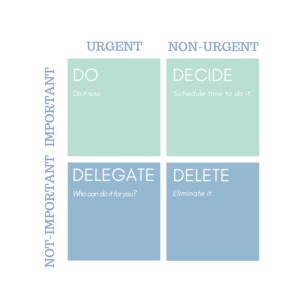
    I was reminded during the course of this module that it was Dwight Eisenhower that developed this famous decision matrix which you may have seen once or twice in your life:

    Eisenhower Box

    Author’s Own Design

    The “Eisenhower Box” apparently enabled Dwight to sustain high levels of productivity over significant periods of time.

    I often think that knowing how and what to prioritize is a key challenge in any transition in a medical career.  One can see this challenge for example when Advanced Trainees take on the Consultant role.  Suddenly the doctor is responsible for a significant number of more patients and normally now has trainees and other health professionals reporting to him or her about these patients.

    The tendency is to retreat to the medical expert role and continue to review all patients as if the doctor was still the trainee rather than to work through the other members of the team and more judiciously intervene.  In Organizational Psychology this phenomenon is referred to as the Peter Principle* and Ken Blanchard (he of the “One Minute Manager” fame) wrote a book about this problem called the “One Minute Manager Meets the Monkey” which I highly recommend to readers that have made it thus far in this post.

    *The Peter principle is a concept in management theory formulated by Laurence J. Peter and published in 1969. The theory is that the selection of a candidate for a position is based on the candidate’s performance in their current role, rather than on abilities relevant to the intended role. Thus, employees only stop being promoted once they can no longer perform effectively, and ‘managers rise to the level of their incompetence.’

    Peter Drucker followed on from Dwight shortly after and in “The Effective Executive” spoke about effective prioritization as requiring rules about delegating, developing action plans, running efficient meetings and choosing what you can best contribute to “What is it that only I can do?”

    For us to cope with managing our workload, many of us will generate to-do lists.  However, the problem with a to-do list (particularly an unstructured one) is that tasks rarely diminish over time as the list tends to get longer because more items are added than come off, the list itself does not guarantee task completion and the visual presence of an ever-increasing list can increase stress levels.

    To-Do lists are okay but I’d recommend adding a prioritization process or ranking process e.g. the Eisenhower Box.  By being proactive and applying a regular discipline of prioritization you will be amazed how more control of work you will feel and will probably notice that you are scheduling time for non-urgent but important activities as well as time to effectively delegate and maybe even cancelling a few unimportant activities out from your diary.

    “What is important is seldom urgent and what is urgent is seldom important.”

    – Dwight Eisenhower, 34th President of the United States.

    The Flipped Ward Round:

    Finally, after all this discussion of time and prioritization, I’d like to introduce to the world a prioritization technique or tip that I have used for some time.  I call this the “Reversed List” or the “Flipped Ward Round”.

    As a Psychiatrist who has generally been in management or educational roles my clinical time has often been fractional.  I have over the years found it particularly helpful to briefly fill in for my colleagues during their periods of leave rather than having a regular clinical load myself.  This has been highly popular for my colleagues with the added benefit of giving me greater exposure to a range of services.

    In doing these intra-service locums I would, of course, inherit established processes around the review of patients whether this be a patient list or a ward round process itself.  In general, these processes would include a very static order process, i.e. the format for a ward round discussion would generally start with a discussion of Mr Jones in Bed 1, then Mrs Smith in Bed 2 and so on and so forth down to Ms Brown in Bed 24.  For those readers familiar with the pitfalls of meetings where time is not allotted to agenda items you are no doubt aware that the same problem can occur on ward rounds, i.e. there is an overgenerous discussion of those cases at the top of the list and inadequate time allocated to those patients at the bottom of the list.  This can, of course, lead to issues not being properly addressed for such patients, errors of omission and unnecessarily lengthy stay.

    So, my approach to this problem.  Simple.  As the consultant covering I found it fairly easy to convince the rest of the team to indulge me in a simple experiment.  “What if we start at the bottom of the list this time?”  It would often lead to some interesting discussions about patient problems that had been overlooked up until that point.

    I wonder if there is something in this for us as medical educators as well?  Do we get hooked on to do lists?  Do we tend to dwell too much at the top of these and neglect important issues at the bottom?  When we design new courses do we often find ourselves flagging for ideas toward the end?  Do the topics at the end of a seminar series get as well covered as those at the start?

  • The Relevance of Personal Learning Environments in #MedEd

    The Relevance of Personal Learning Environments in #MedEd

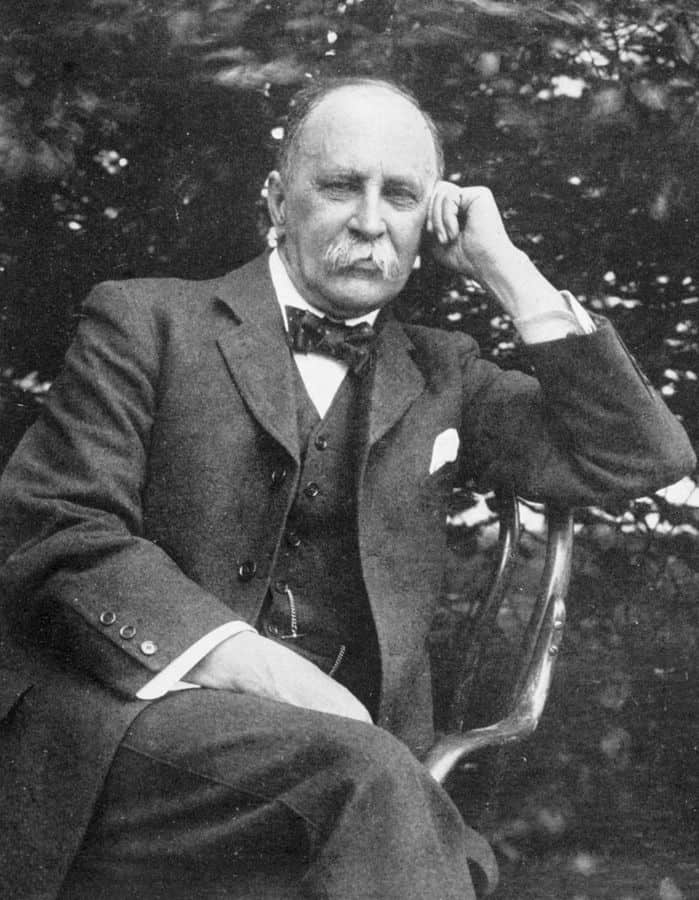
    Sir William Osler

    Sir William Osler was said to be the “Father of Modern Medicine” and the first to bring medical students from the lecture hall to the clinical bedside.

    Source – Prof Oliver Wong, Wellcome Images Library *

    Part 1 – The Medical Educator

    Credit where it’s due, Mike D’Alessandro appears to be the first doctor to write about the potential of Personal Learning Environments in Medical Education, writing here about the development of a course using the concept in the Journal of Pediatric Radiology in 2011.

    A personal learning environment helps learners take control of and manage their own learning. By entering cases into a learning portfolio you store your experience, reflection, knowledge, and wisdom and create your own knowledge management and E-memory system. Furthermore, by participating in a community of practice where you contribute content, engage in conversations, and make connections you are enabling peer-to-peer and master-to apprentice teaching. In the future, it is hoped that tying your learning to your practice and being awarded continuing medical education credit for it will fulfill a larger role in the process of Maintenance of Certification and Continuing Professional Development.

    Recently I presented the concept at a meeting of Clinician Educators at the 2015 International Conference on Residency in Vancouver. For want of a better definition, this was a group of medical educationalists, those that have a role (or several roles) in teaching medicine to other doctors. The participants appeared to find the concept helpful to their own practice. Many had already thought about their personal learning networks in a technology sense, see here recent ICE blog by Felix Ankel and Anand Swaminathan but only perhaps in the sense of how they might share information about medical education. The PLE concept can be seen as extending the Personal Learning Network (PLN) further into additional areas such as storing, remembering, and retrieving. Many of those who attended could also see that both the technological and the non-technological were valid in constructing their own personal learning networks with many reflecting on how, for example, the concept of peer review is drawn into a PLE.

    The Clinician Educators present could see some of the opportunities as wells as challenges presented by the PLE concept. We looked at some of the questions posed by Hicks and Sinkinson in their 2014 open-source article:

    1. What capacities and practices will learners and teachers need to develop?
    2. How will the learner and teacher role be defined within these approaches?
    3. What barriers will inhibit the exploration of these approaches?
    4. What components of the traditional approach should be protected and maintained?
    If we focus on each of these questions in turn:

    For question one – if we do accept the PLE concept then the medical educator of today and tomorrow will need to develop capacities and practices to be informed of the types and kinds of learning environments his/her medical learner is involved with. It obviously will be important to attempt to ascertain what sorts of sources of information learners are using and sharing, for e.g. blogs and podcasts, and consider the credibility of some of the more common sources at least. However, it is likely to quickly challenge the time and resources of the medical educator if they endeavour to map each of their learner’s PLE (not to mention that perhaps the learner may not wish to give access to certain aspects of their PLE.

    This then turns us to question two and the potential importance of the medical educator focusing on their role as both a facilitator of learning but also a facilitator of critical analysis and thinking, so as to encourage the medical learner not to believe everything that is written on the internet and perhaps also consider the risks of “group-think” in the construction of knowledge.

    For question three, many barriers may inhibit the medical educator, some of which may not be in their own control to address, for example working within institutions that close off their learning management systems and e-portfolio systems and even worse parts of the internet itself.

    Finally for question four, if the medical educator manages to successfully address some of the issues raised by the previous questions there opens up a possible opportunity for them to focus on those aspects of learning that truly have an impact on their particular training endeavour by, for example, removing the need to teach and provide information sources for a large swathe of the curriculum and then focusing more on issues such as practical skills development, work-place based assessment or developing reflective-practice skills in the medical learner.

    The above is by no means a comprehensive assessment of the impact of these questions on medical education but hopefully might guide the reader to why I think this is an area worthy of further investigation.

    Next blog I will attempt to touch on a definition of PLEs as well as speak to the potential relevance to medical learners.

  • The Impostor Syndrome in Medical Education

    The Impostor Syndrome in Medical Education

    Recently I hosted an inaugural Medical Education event in my local area. One of the key repeated claims from many of our speakers was of Impostor Syndrome (IS).  It became quite a theme through the Conference.  The typical argument went something along the line of “well really I don’t consider myself to be a medical educationalist first and foremost so I was a bit surprised to be asked to give a talk on the medical education topic of …”

    Given that the participant feedback indicated a high quality of presentation and content from our speakers, the claim of Impostor Syndrome seemed to be most justified.

    The Impostor Syndrome was first hypothesized by a pair of female Clinical Psychologists Pauline Clance and Suzanne Imes in 1978 to describe a phenomenon they had observed in their practices amongst high-achieving individuals (predominantly women) who struggled to accept their accomplishments despite contrary external evidence and constantly feared being placed in an expert role as they might be discovered to be a fraud.

    Is it surprising that medical educationalists feel like imposters or is it a broader phenomenon in medicine itself?  Well, in a 2008 article in the Journal of General Internal Medicine, of the 48 participating Internal Medicine residents 44% were found on the survey to exhibit signs of “impostorisim”.  It’s probably not surprising that, particularly at times of transition in our medical careers, we as doctors might feel a bit more fraudulent, for example when transitioning from an undergraduate to a postgraduate as the JGIM article shows or when someone gets asked to talk at a medical education conference for the first time not many of us appear to deliberately set out to become medical educators.

    I’ve recently been undergoing a transition back into some clinical practice and feeling the IS myself a bit.  I felt that my first day in outpatient practice was possibly my worst workday in a long time.  I was particularly troubled by the amount of time it took me to document my patient encounters.  To deal with this I found it reassuring to discuss my experience and cases within a peer review group and get some of my documentation confidentially checked by a peer.  I soon discovered that my experience was quite normal.

    By the way, Impostor Syndrome is not a mental disorder it didn’t make it into the latest DSM5. But there are still reasons, in my opinion, to take this issue on seriously.

    One worrying possible consequence of Impostor Syndrome is its potential impact on patient care.  I observed this issue at play some time ago in my psychiatry training program.  A colleague and I noticed a pattern in the psychiatry trainees and their behavior when on-call after hours.  We noticed that there was an inverse relationship between the seniority of the trainees and the number of times that they would call the Consultant to review a patient.

    We had some reasonable data on the numbers of patients presenting and were aware of how many patients were being admitted overnight and so we could compare this with the actual frequency of calls.  This would often get to a point of comedic-tragedic proportions where I can recall having meetings with trainees around wanting to write detailed policies about when trainees should call the Consultant.  I pointed out at the time that this didn’t seem to be the real problem as the Consultants were always happy to be called and if we wrote a policy and a trainee didn’t follow it (which I assessed was a high probability) this would create even more problems for the trainee.

    When I talked to the trainees about why it was they called more as a senior trainee versus a junior trainee the responses indicated that junior trainees felt they were not experienced enough and didn’t know enough to call the Consultant (were worried about embarrassing themselves) whereas senior trainees highly valued the opportunity to discuss with a Consultant because they felt it was more of a peer relationship and they even confessed that perhaps they were calling a little more than they felt they really needed to because they had already made a good assessment and plan ”bounce things off the Consultant”.

    I’ve talked to other colleagues from other disciplines about this observation and they have observed it as well.  By definition, its not true Impostor Syndrome but it’s something quite close; doctors close in experience and/or capability and/or seniority to other doctors are less anxious about revealing a weakness than those further apart.

    I haven’t been an on-call Consultant for a little while but when I was I tried a simple experiment in countering this problem.  Each morning after my on-call I would send the trainee doctor a quick email thanking them for being on-call and giving them some feedback on the presentations from the night before.  If I hadn’t been called at all I would remind them that I was on-call and still hoped the night went well for them.  My experiment didn’t last long enough for me to know whether it had an effect on the Trainee Impostor Syndrome but as I am shortly returning to on-call again I think I might give it another go.

    What about you?  Have you encountered Impostor Syndrome in your work?  Have you developed any methods of addressing the seniority gap in patient handover?

    Footnote:  We were very fortunate indeed to have Jason Frank as our international speaker for our Conference. There were many points as to why we decided to hold a local #MedEd event but the primary reason was that we wanted an event where we could bring all the key players in the medical training pipeline together in one room for two days.  On that measure our event was a great success as it spawned a lot of collaborative conversations from organizations that attended including after the event.  It’s often stated that the real learning at a Conference happens at the sidelines.