Category: Salaries

  • What Every Australian Trainee Doctor Earns. Junior Doctor Salary Guide

    What Every Australian Trainee Doctor Earns. Junior Doctor Salary Guide

    I often get asked about junior doctor salary rates. Personally, I hate the term “junior doctor”. Most trainee doctors I know are very mature and have often had a meaningful adult life before medicine. But unfortunately, this appears to be the most common term used for the group of doctors who are “pre-specialist”. So here is a comprehensive breakdown for you. Along with some additional interesting observations.

    As of 2025 If you are an intern doctor in NSW (postgraduate year 1) you are earning an annual full-time salary (before tax) of $76,000 AUD and you are officially on the lowest-paid junior doctor salary in Australia. On the other end of the spectrum if you are living in Western Australia and are a Senior Registrar Year 2, then you are on $192,371 AUD of annual junior doctor salary. And you are officially the best-paid trainee doctor in Australia. Although, because you have been at this training gig now for about 10 years. It is very likely that a lot of your colleagues have finished being trainee doctors by now and are earning far superior salaries as specialists.

    The rest of you are somewhere in between in your junior doctor salary. And if you refer to this handy table below you will be able to see how much salary you should be making (at least officially). And if you are thinking about moving States or Territories or are an IMG doctor thinking about working in Australia. You can also use this table to get a bit of an estimate of your salary expectations. But be warned some employers are known to play it hardball and discount your prior clinical experience and try to start you off on lower salary rates.

    So how much does a junior doctor in Australia make? What is the lowest salary for a junior doctor in Australia? And what does a first year doctor salary in Australia look like? You can answer all of these questions in the table below. And if you would prefer this in hourly or monthly rates we have these covered in tables at the end of this post.

    [ninja_tables id=”128185″]

    *Western Australia pays a significantly higher rate for doctors working for the Country Health Service north of the 26 degree latitude. Intern annual salary is $119,165 and Senior Registrar as much as $293,564 as of September, 2025

    Thanks to one of our readers that pointed out we had the incorrect rates for WA Health in a previous version.

    Sources:

    NSWVictoriaQueenslandWestern AustraliaSouth AustraliaTasmaniaACTNorthern TerritoryGeneral Practice
    Sources

    By the way. This is one of those posts where if you spot something wrong or out of date. I would really love to know. Leave me a comment below.

    So let’s cut to the chase what does every trainee doctor in Australia earn? Or. What does their junior doctor salary look like?

    How do these junior doctor salary rates compare with reported incomes?

    Now. Please bear in mind I have just shown you the official annual junior doctor salary for each trainee doctor type in Australia. I have even included for you General Practice Registrar’s Salaries, with thanks to the GP Registrars Association. But these are baseline salaries. They are the junior doctor salary you would get paid if you came to work from 8.30 to 5 pm each weekday. had a half-hour lunch break. Left on time every day. Took your 4 weeks of annual leave and a monthly rostered day off. And never worked an evening or overnight shift or weekend overtime or on-call.

    We all know that working as a trainee doctor is just not like that. i.e. these are not the true take-home junior doctor salary rates.

    To work out what these look like we need to dig a little deeper. One additional source of data is the Australian Taxation Office.

    What does the Australian Taxation Office say about junior doctor salary rates in Australia?

    According to Australian Taxation Office data

    Resident Medical Officers earned an average of $128,145 AUD of average taxable income in the 2021 to 2022 financial year. Which is approximately the current annual pay rate of a first year Registrar in Victoria or a third year registrar in New South Wales, again employed full-time.

    However, due to the way, the classification system works it’s not clear whether this category includes all trainee doctors. The figure is based upon 16,883 individual tax returns.

    According to. the Health Workforce Data Set in 2019, there were 16,526 Specialists in Training in Australia. Along with 12,098 Hospital Non-Specialists, a category that mostly includes prevocational trainee doctors, i.e. interns and resident medical officers. There were also 31,102 General Practitioners, a category that will include GP trainees.

    So were are likely comparing some apples with some oranges here.

    But the point is that there are probably another 15,000 – 20,000 tax returns completed by medical practitioners who are specialists in training, where they put a different occupation group down. on their form. Presumably the specialty they were training in.

    So the ATO data will likely reflect a junior doctor salary of a doctor in their earlier years of training. And are therefore fairly consistent with the salary rates in the big table above.

    The Junior Doctor Awards and Enterprise Agreements

    The other source of information is the Junior Doctor Awards and Enterprise Agreements.

    If you are an international reader you may be a little unfamiliar with the concept of an Award or Enterprise Agreement.

    In Australia, responsibility for industrial law is primarily the responsibility of State and Territory governments. Which explains why pay rates and conditions for doctors vary so widely in the above table.

    Awards are legal documents that outline the minimum pay rates and conditions of employment for certain categories of employees. Awards apply to employers and employees depending on the industry they work in and the type of job worked. Awards are authorised through a special legal court of law called an Industrial Relations Commission.

    For much of Australia’s history Awards were the main form of employment agreements. In the 1990s Enterprise Agreements were introduced.

    Awards don’t apply when an employer has an Enterprise agreement in place. Enterprise agreements set out minimum employment conditions and can apply to one business or a group of businesses.

    So the main difference between these two documents is Awards apply to the whole industry whereas Enterprise Agreements apply to a business or group of businesses.

    In essence, these legal documents look and read very similar to each other. Despite the ability to have Enterprise Agreements now in several States and Territories, there has only ever been one Enterprise Agreement for doctors working in public hospitals per State or Territory.

    Overtime, Penalty Rates and On-Call

    In Australia, it has been the historical practice that employees are further compensated for having to work additional or extra hours (commonly referred to as overtime). For these additional hours, you will generally get paid somewhere between 50% more (commonly referred to as time and a half) or 100% more (referred to as double time).

    Shift work and penalty rates are important aspects of employment for trainee doctors, especially in healthcare services where hospitals operate around the clock.

    Shift Work for Trainee Doctors:

    1. Nature of Shift Work: Trainee doctors often work in shift patterns to ensure continuous patient care. These shifts can include regular daytime hours, as well as evening, night, and weekend shifts. Shift work may also involve being on call, where the doctor must be available to work if needed.
    2. Rostering: Shifts are usually determined by a roster set out by the hospital or healthcare facility. This roster aims to balance the training needs of the doctor with the operational requirements of the hospital.
    3. Duration and Frequency: The duration of shifts can vary, but long shifts (sometimes 12 hours or more) are not uncommon in the medical field. The frequency of shifts, including night and weekend work, depends on the hospital’s policies and the specific department.

    Penalty Rates for Trainee Doctors:

    1. What Are Penalty Rates?: Penalty rates are higher rates of pay that are provided to employees for working outside of normal working hours, such as late nights, weekends, or public holidays. They are designed to compensate for the unsocial hours and increased demands of working these periods.
    2. Calculation of Rates: Penalty rates are typically calculated as a percentage above the standard pay rate. For example, a trainee doctor might receive a 150% pay rate (time and a half) for working on a weekend or a 200% rate (double time) for public holidays.
    3. Variation by State and Sector: Penalty rates can vary depending on the state or territory in Australia, as well as whether the doctor is working in the public or private sector.
    4. Impact on Income: For many trainee doctors, penalty rates can significantly increase their income, reflecting the demanding nature of their work schedule.

    It’s important for trainee doctors to be aware of their work conditions, including shift patterns and entitlements to penalty rates, as these significantly impact their work-life balance and overall compensation. These details should be clearly outlined in their employment contracts and governed by the relevant industrial agreements.

    Finally, you may be required to be on-call as part of your job. This is often the case for Registrars who are covering certain specialties in the hospital, where the hospital does not generally need a trainee to be in the hospital all of the time. Typical examples would be psychiatry or gastroenterology or Ear Nose and Throat Surgery. Traditionally, this was intended to be for the purpose of “calling you back in” so you could review an urgent patient after hours. Nowadays with ith the advent of improved telecommunications being on-call is often for the purpose of giving advice about the patient, without necessarily needing to go back in.

    On-call arrangements are probably one of the most hated components of Awards or Enterprise Agreements. As an example, being on-call in NSW attracts a very paltry $16.60 for a 24-hour period if you were already on duty that day. This does not include payments for attending whilst on-call which are covered by overtime. But it’s not a lot of money if all you are doing is giving phone advice all night. The situation is similar in Queensland, Western Australia and Victoria. Although Victoria at least has a clause about limiting the number of unnecessary phone calls.

    When one considers overtime, penalty rates and on-call one can see how your take-home junior doctors salary pay will likely lift significantly with even a few additional hours per week which is quite common for most trainee doctors.

    Other Benefits to Bear in Mind

    There are a range of other benefits and leave entitlements that you will normally be eligible for whilst working as a trainee doctor in Australia.

    The National Employment Standards and Trainee Doctors.

    Trainee doctors like all employees in Australia are supported under a national set of common employment conditions

    The National Employment Standards (NES) in Australia significantly impact trainee doctors, providing a foundational framework for their employment conditions. These standards offer a set of minimum entitlements that apply to all employees, including those in the healthcare sector. Here’s how they specifically affect trainee doctors:

    1. Working Hours and Rest Breaks: The NES sets limits on weekly working hours and mandates rest breaks and days off. This is crucial for trainee doctors, who often work long and irregular hours, helping to prevent burnout and ensuring they can provide quality care.
    2. Annual Leave: Trainee doctors are entitled to four weeks of paid annual leave per year, as per the NES. This ensures they have adequate time for rest and recuperation, away from the demanding hospital environment.
    3. Personal/Carer’s and Sick Leave: The NES allows for 10 days of paid personal/carer’s leave per year, plus additional unpaid carer’s leave if needed. This is vital for trainee doctors to manage their health and care responsibilities.
    4. Parental Leave: Trainee doctors are entitled to unpaid parental leave for the birth or adoption of a child. This includes maternity, paternity, and adoption leave, ensuring they can spend time with their new child without the fear of losing their job.
    5. Public Holidays: The NES provides for paid leave on national public holidays, a benefit that contributes to the work-life balance for trainee doctors.
    6. Notice of Termination and Redundancy Pay: These provisions under the NES protect trainee doctors in cases of job termination or redundancy, ensuring fair treatment and adequate notice or compensation.
    7. Flexibility in the Workplace: The NES allows for requests for flexible working arrangements, which can be particularly beneficial for trainee doctors balancing work with training or family commitments.
    8. Long Service Leave: While governed more specifically by state legislation, the NES acknowledges long service leave, allowing trainee doctors to accumulate leave over time for extended breaks.

    In essence, the NES provides a safety net of minimum employment conditions for trainee doctors, helping to safeguard their well-being and rights in a demanding and often high-pressure profession. It ensures a degree of uniformity and fairness across the healthcare sector and supports the sustainability of medical careers in Australia.

    Below is a more fuller description of each benefit available.

    Superannuation

    Superannuation is a pension program in Australia, designed to provide retirement income to our citizens. It is a compulsory system where employers are required to make contributions to a superannuation fund on behalf of their employees. This fund accumulates over time and is invested, with the aim to grow the savings for the employee’s retirement. As of July 2023, the current superannuation guarantee rate is 11% of an employee’s ordinary time earnings. This means employers must contribute an amount equal to 11% of their employees’ salaries and wages into their superannuation fund, ensuring a secure financial foundation for their retirement years. This rate of superannuation is expected to reach 12% by July 2025.

    Higher Duties Allowances and In-Charge Allowances

    A “higher duty allowance” and an “in charge allowance” are types of additional payments commonly found in various employment sectors, including healthcare. They usually amount to a few tens or hundreds of dollars extra per shift. Here’s a brief explanation of each:

    1. Higher Duty Allowance: This is a type of compensation provided to an employee when they temporarily take on higher-level responsibilities or duties that are above their regular job classification. For instance, in a healthcare setting, a nurse or a doctor might receive a higher duty allowance when they temporarily fill a position at a higher level, such as acting in a managerial or specialized role. This allowance is meant to compensate for the increased workload and the higher level of responsibilities.
    2. In Charge Allowance: This allowance is typically given to an employee who takes on the role of being ‘in charge’ of a shift, unit, or department, often in the absence of the regular supervisor or manager. In healthcare, this could apply to a nurse or other medical professional who oversees the operations of a ward or unit during a particular shift. The allowance is a recognition of the additional responsibilities and decision-making requirements that come with managing operations and supervising other staff in the absence of the usual leadership.

    Both allowances are ways of acknowledging and compensating employees for taking on more significant responsibilities, either on a temporary or ongoing basis, and are important for morale and motivation in the workplace.

    Travel and Accommodation Allowances

    Travel and accommodation allowances are forms of financial reimbursement provided to employees to cover expenses incurred when they are required to travel for work purposes. Here’s a brief overview of each:

    1. Travel Allowance: This allowance is designed to cover the cost of travel-related expenses, such as transportation, meals, and incidental costs, incurred by an employee while traveling for work. It can be structured in various ways: as a per diem, where a set daily amount is provided; as a reimbursement for actual expenses based on receipts; or as a mileage allowance for using a personal vehicle. For example, a doctor who needs to attend a medical conference in a different city might receive a travel allowance to cover airfare, taxi fares, and meals.
    2. Accommodation Allowance: This allowance specifically covers lodging expenses when an employee is required to stay away from their usual place of residence due to work-related travel. It is intended to cover costs such as hotel or motel charges and may sometimes include additional funds for meals if not already covered under a separate travel allowance. An example would be providing a healthcare professional with an accommodation allowance when they are sent to a rural area for a temporary assignment or training.

    If you area a trainee doctor and you are seconded to another region for a short stint as part of your employment contract (for e.g. 13 weeks or 6 months) you will generally be offered accommodation by the hospital you are working at. It’s unusual to be offered subsidy to find your own accommodation. But as a past medical administrator I have approved such requests when the trainee has given me reasonable notice (I had a trainee who wanted to rent a place he could have his pet at as part of a required rural rotation. He gave me about a year’s notice so I was happy to negotiate with the local manager and arrange an approval for this).

    Both allowances are important for ensuring that employees are not financially disadvantaged when they are required to travel for their job. They are typically governed by the government employment agreements (awards and enterprise bargain agreements), and may also be subject to tax considerations depending on the regulations in the specific country or region.

    junior doctor salary exam leave

    Professional Development, Learning, Training, Exam Leave

    Other Award and Agreement conditions vary somewhat between State and Territory. Over the past few years most States and Territories, with the notable exception of NSW have brought in some form of paid professional development funding and leave for trainee doctors. For example, Victoria might be considered the most progressive jurisdiction due to the fact that it provides for both a professional development allowance and professional development leave for all trainee doctors, including interns.

    [ninja_tables id=”128917″]

    Employee Assistance Programs and Trainee Doctors

    Employee Assistance Programs (EAPs) are supportive services offered by employers, including healthcare institutions for trainee doctors, to assist employees with personal or work-related issues that might impact their job performance, health, and well-being. EAPs are a critical resource in high-stress professions like healthcare.

    1. Scope of Services: EAPs typically offer a range of confidential and free counseling services, addressing issues such as stress, mental health, family problems, financial concerns, and workplace conflicts. These programs are designed to provide short-term support, with referrals to more specialized services if needed.
    2. Accessibility and Confidentiality: One of the key features of EAPs is their confidentiality, ensuring that employees can seek help without fear of stigma or repercussions at work. Services are often available 24/7, providing easy and immediate access for employees.
    3. Professional Support: EAPs are usually staffed by trained professionals like psychologists, counselors, and social workers who are equipped to provide expert assistance and guidance.
    4. Benefits for Trainee Doctors: For trainee doctors, EAPs are especially beneficial. The medical field can be exceptionally demanding, with long hours, high-stress situations, and emotional challenges. EAPs offer a valuable outlet for managing these pressures, promoting mental health and resilience.
    5. Workplace Well-being: EAPs contribute to a healthier workplace by addressing the root causes of work-related stress and improving overall employee well-being. This, in turn, can lead to increased job satisfaction, higher productivity, and reduced absenteeism.
    6. Preventive Approach: By providing early intervention, EAPs help prevent the escalation of issues, supporting not just the individual employee but also the broader workplace environment.

    Some employers choose to go beyond free professional counseling programs and offer other additional employee benefits, such as on-site recreational facilities or access to reduced cost gym memberships.

    Employee Assistance Programs are an essential part of modern employee benefits packages, reflecting a holistic understanding of the interplay between personal well-being and professional performance. For trainee doctors, EAPs represent a crucial support system, aiding them in navigating the complexities of both their professional and personal lives.

    Other Types of Leave for Trainee Doctors in Australia

    Doctors coming from most other countries will be surprised how many actual days of leave workers in Australia get. There are a plethora of leave types many of them quite standard across all sectors of the workforce.

    Annual Leave

    In Australia, the annual leave entitlements for trainee doctors, like all employees, are governed by national employment standards and specific industry agreements. Here’s how it typically works:

    1. Entitlement: Trainee doctors in Australia are usually entitled to four weeks of paid annual leave per year. This entitlement is a standard in line with the National Employment Standards (NES) set forth by the Fair Work Act.
    2. Accrual: Annual leave accrues progressively during the year, based on the number of normal hours worked (additional hours and overtime do not count).
    3. Taking Leave: To take annual leave, trainee doctors generally need to request and have their leave approved by their employer. This process often requires consideration of the staffing needs of the hospital or healthcare facility, as well as the educational requirements of the trainee’s program.
    4. Payment During Leave and Leave Loading: While on annual leave, trainee doctors are paid at slightly higher than their regular base pay. The standard rate for leave loading is often 17.5% of the employee’s ordinary earnings. This means that when an employee takes annual leave, they receive their usual pay plus an additional 17.5%. The leave payments do not include overtime or other special allowances they might normally receive.
    5. Public Holidays: Public holidays that fall during a period of annual leave do not typically count as annual leave days. So you do not lose a day if your annual leave falls on a public holiday.
    6. Carry-over and Cashing Out: Depending on the terms of their employment and relevant industrial agreements, trainee doctors may be able to carry over unused annual leave to the next year or, in some cases, cash out their unused leave.

    It’s important to note that specific details can vary depending on the state or territory, the healthcare institution, and any applicable enterprise agreements or contracts. Trainee doctors should refer to their individual employment contracts and consult with their HR department for detailed information regarding their annual leave entitlements.

    Rostered Days Off

    Rostered Days Off (RDOs) are scheduled days when an employee is not required to work, despite normally being part of their regular work schedule. This system is often used in industries with extended working hours or shift work, like healthcare, construction, or emergency services. Here’s how RDOs work for trainee doctors:

    1. Accrual: RDOs typically accrue over time. For instance, an employee might work extra hours each day or week, which then accumulate to provide a full day off on a regular basis. Typically trainee doctors in Australia work 40 hours of normal employment per week but are paid for 38 hours. The extra 2 hours goes towards their RDO.
    2. Scheduling: RDOs are usually planned and agreed upon in advance and are part of the employee’s work schedule or roster. This helps in ensuring that both the employer’s operational needs and the employee’s rest periods are balanced effectively.
    3. Purpose: The primary goal of RDOs is to provide employees with additional rest time, recognizing the demands of extended working hours or intense workloads. It’s a way to ensure work-life balance and reduce the risk of burnout, especially in high-stress jobs.
    4. Payment: Employees are typically paid for RDOs, as these days off are considered part of their normal working hours.
    5. Impact on Work Patterns: In sectors like healthcare, where staffing needs are constant, RDOs must be carefully managed to ensure that all shifts are adequately covered. This might involve rotating schedules or flexible staffing arrangements. In some parts of the hospital, such as operating theatres and clinics Low Activity Days maybe scheduled to allow employees to take RDOs.

    Public Holiday Leave

    As a trainee doctor in Australia you are entitled to leave for public holidays. If you are required to work on a public holiday you will be paid a higher rate than normal and accrue a leave day.

    Australia has a variety of public holidays, which include both national and state/territory-specific holidays. The number and dates of these holidays can vary depending on the state or territory.

    National Public Holidays:

    1. New Year’s Day (January 1st)
    2. Australia Day (January 26th)
    3. Good Friday (date varies each year as it’s based on the Christian calendar)
    4. Easter Monday (the day after Easter Sunday)
    5. ANZAC Day (April 25th)
    6. Christmas Day (December 25th)
    7. Boxing Day (December 26th)

    Additional Public Holidays (Varies by State/Territory):

    • Labour Day: Celebrated on different dates in different states.
    • Queen’s Birthday: Usually observed on the second Monday in June, except in Western Australia and Queensland.
    • Melbourne Cup Day: Only in Victoria, on the first Tuesday of November.

    State-Specific Holidays:

    • Each state and territory may have its own specific public holidays. For example, Adelaide Cup Day in South Australia, Canberra Day in the Australian Capital Territory, and Royal Queensland Show (Ekka) Day in Brisbane, Queensland.

    Total Number of Public Holidays:

    • The total number of public holidays can range from 8 to 13 days annually, depending on where one lives and works in Australia.

    When a standard public holiday falls on a weekend, a substitute public holiday may be observed on the next non-weekend day, usually a Monday.

    Sick Leave

    Sick leave is a critical employment benefit that allows employees, including trainee doctors, to take time off work due to illness or injury without loss of income. In Australia, full-time employees are typically entitled to a set number of paid sick leave days per year, with the standard entitlement being 10 days per annum for full-time employees. Part-time employees receive a pro-rata amount based on their hours worked.

    One of the key features of sick leave in Australia is its accumulative nature. If an employee doesn’t use all of their allocated sick leave in a given year, the unused days can be carried over to the next year, accumulating over time. This means that if an employee has a serious illness or injury that requires extended time off, they may have a reserve of sick leave days to draw from. Sick leave accumulation provides an important safety net, ensuring that employees do not suffer financial hardship due to illness or injury.

    Long Service Leave

    Long Service Leave (LSL) is an employment benefit with a unique and interesting history, particularly in Australia. Its origins are traced back to the 19th century and are closely linked to the country’s colonial past.

    1. Origins in Colonial Australia: Long Service Leave originated during the colonial era in Australia. It was initially introduced to allow public servants and later, other employees, the opportunity to visit their homelands, typically in the UK and Europe, after a period of service in Australia. Given the long sea voyage required at the time, an extended leave period was necessary.
    2. Evolution Over Time: Over the years, as travel times decreased and Australia’s identity and workforce evolved, so the purpose of LSL shifted. It became a means to acknowledge and reward long-term service and loyalty to an employer, and to provide an extended break for rest and rejuvenation.
    3. Legislation and Standardization: By the mid-20th century, LSL was legislated in various Australian states, with standard entitlements typically being after 10 years of continuous service. The specifics, such as the amount of leave and conditions for eligibility, can vary between jurisdictions and are outlined in employment laws and agreements.
    4. Global Perspective: While Long Service Leave is particularly characteristic of the Australian employment landscape, similar concepts do exist in other countries, albeit under different terms and conditions. For example, in some European countries, ‘sabbatical leave’ is offered, allowing for extended breaks for personal or professional development. However, the specific concept of LSL as it is known in Australia, particularly with its historical ties and specific conditions, is quite unique to the country.

    Generally, most trainee doctors do not benefit from LSL as a trainee, as they are normally finished with their training before the 10 year period accumulates. However, because most trainee doctors work in the public sector, if you continue to work in the public sector as a Consultant you will shortly be eligible for LSL. And the bonus is that you will be paid at your current rate (e.g. Consultant rates).

    A key aspect of long service leave, especially within the public sector, is its portability across government jobs. This means that when an individual moves from one government job to another, their accumulated long service leave entitlements can often be transferred or ‘ported’ to their new position. This portability ensures continuity of service benefits, recognizing the total contribution of an individual to public service, regardless of changes in specific government employment. The ability to port long service leave is particularly beneficial for professionals like trainee doctors who might move between different public hospitals or health services or states and territories, allowing them to retain and build upon their long service leave entitlements.

    Family and Carer’s Leave

    Family and Carers Leave is a provision in Australian employment law, designed to support employees, including trainee doctors, in balancing their work commitments with family responsibilities. This type of leave allows employees to take time off to care for a family member who is sick or needs assistance due to an unexpected emergency. Here’s a more detailed look:

    1. Entitlement: Under the National Employment Standards (NES), all Australian employees, including full-time, part-time, and casual employees, are entitled to unpaid carer’s leave. Full-time and part-time employees also have an entitlement to paid personal/carer’s leave.
    2. Paid Personal/Carer’s Leave: Full-time employees are typically entitled to 10 days of paid personal/carer’s leave per year, which can be used for their own illness or injury, or to provide care or support to a family or household member who is ill, injured, or experiencing an emergency. Part-time employees are entitled to a pro-rata amount based on their regular hours of work.
    3. Unpaid Carer’s Leave: In addition to the paid entitlement, employees can also take two days of unpaid carer’s leave whenever they need to care for a family member or a member of their household who is sick or in case of an emergency. This leave is available to all employees, including casuals.
    4. Notice and Evidence Requirements: Employees are required to notify their employer as soon as possible about the need to take carer’s leave and may need to provide evidence, such as a medical certificate, to support their leave request.
    5. Impact on Trainee Doctors: For trainee doctors, who often work in high-pressure environments with demanding schedules, access to family and carer’s leave is essential. It provides them with the flexibility to attend to personal and family health needs without the added stress of job insecurity or loss of income.

    Parental Leave

    Certainly. In Australia, trainee doctors, like all employees, are entitled to maternity, paternity, and adoption leave.

    1. Maternity Leave: Female trainee doctors in Australia are entitled to maternity leave as per the National Employment Standards (NES). Typically, they can avail up to 12 months of unpaid leave, with the possibility to request an additional 12 months. Additionally, they may be eligible for the Australian Government’s Paid Parental Leave scheme, which offers up to 18 weeks of pay at the national minimum wage. Some hospitals or health services may provide additional paid maternity leave benefits as part of their employment agreements.
    2. Paternity/Partner Leave: Male trainee doctors or partners, including same-sex partners, are entitled to paternity leave. Under the NES, they can take up to two weeks of paid leave at the national minimum wage under the Paid Parental Leave scheme (under most hospital agreements this will be paid at your normal rate). Fathers are also entitled to up to 12 months of unpaid leave to care for their child, which can be extended for another 12 months upon request.
    3. Adoption Leave: Trainee doctors who are adopting a child have similar entitlements to those on maternity or paternity leave. They can take up to 12 months of unpaid adoption leave, with the option to request an additional 12 months. The Paid Parental Leave scheme may also apply, offering financial support during the initial period following the adoption.

    In all cases, there are specific eligibility criteria, such as length of service and the requirement to be the primary caregiver. Furthermore, many hospitals and health services have their own policies that might provide more generous leave provisions than the minimum standards. These leaves are crucial for trainee doctors, allowing them to balance their demanding professional responsibilities with significant family life events.

    Defence Force Leave

    Defence Force Leave is a special form of leave for trainee doctors, who are members of the Australian Defence Force (ADF) Reserve. This leave enables them to fulfill their defence force commitments without impacting their civilian employment. Here’s a detailed look:

    1. Entitlement and Purpose: Defence Force Leave allows reservists to take time off from their civilian job to engage in various Defence Force activities, including training and operational deployments. This leave is essential for reservists to fulfill their military obligations while maintaining their civilian careers.
    2. Types of Leave: The leave can be categorized into two types – voluntary and obligatory. Voluntary defence service includes activities like training and exercises, while obligatory service refers to situations where a reservist is called upon for operational duties.
    3. Duration: The duration of Defence Force Leave varies based on the nature and requirement of the military service. It can range from a few days for short training exercises to several months for operational deployment.
    4. Paid and Unpaid Leave: Some periods of Defence Force Leave may be paid leave, particularly for short-term commitments or annual training obligations. However, longer deployments or extended training might be unpaid. Specifics depend on the employer’s policies and the nature of the service.
    5. Job Protection and Benefits: Employees on Defence Force Leave are typically protected by legislation that ensures they can return to their civilian job with the same terms and conditions. Their absence for defence service does not adversely affect their career progression, including entitlements like annual leave accumulation.
    6. Significance for Trainee Doctors: For trainee doctors who are Defence Force reservists, this leave is particularly valuable. It allows them to continue their medical training and career development while also serving their country. Hospitals and healthcare employers usually have policies in place to support these dual responsibilities.

    Family Violence Leave

    Family Violence Leave is a relatively recent but vital addition to workplace entitlements in Australia. It is designed to support employees, including trainee doctors, who are experiencing family violence. This type of leave provides necessary time off to attend to issues arising from family violence, acknowledging the profound impact such circumstances can have on an individual’s life and work. Here’s an overview:

    1. Entitlement: Under the National Employment Standards (NES), employees, including trainee doctors, are entitled to unpaid family and domestic violence leave. This allows them to deal with the impact of family violence without the added worry of losing their job or income.
    2. Duration and Conditions: The NES provides for five days of unpaid leave per year, which can be taken in single or multiple-day spans. Employees are eligible for this leave from the day they start their job, and it doesn’t accumulate year-to-year if not used.
    3. Purpose of Leave: Family Violence Leave can be used for various purposes, such as making safety arrangements for the employee or a close family member, attending court hearings, or accessing police services. The aim is to provide time and space to manage the complexities and challenges that arise from such situations.
    4. Confidentiality and Sensitivity: Given the sensitive nature of family violence, requests for leave are handled with strict confidentiality. Employers are required to protect the privacy of the employee taking this leave.
    5. Importance for Trainee Doctors: In the demanding and high-stress environment of healthcare, having access to Family Violence Leave is particularly important. It ensures that trainee doctors dealing with family violence can seek support and manage their personal circumstances without fear of repercussion in their professional lives.
    6. Workplace Support: Many healthcare employers also offer additional support services, such as counseling or referral to professional help, to assist employees experiencing family violence.

    Civic Duties

    Civic Duty Leave in Australia encompasses not only Jury Service Leave but also provisions for other types of civic responsibilities, such as participating in elections or serving in emergency services. This is particularly relevant for employees like trainee doctors, who may need to balance these duties with their professional obligations. Here’s an overview:

    1. Jury Service Leave: As previously mentioned, this allows employees to fulfill jury duties without loss of income or job security. Employers often provide paid leave for a set period, and longer services might be compensated by the government.
    2. Election Duty Leave: Individuals involved in conducting or working at elections may be entitled to take leave from their jobs. This can include roles like polling station officers or electoral officials. In many cases, this type of leave is unpaid, but it allows employees to participate in the democratic process without fear of losing their job.
    3. Emergency Services Leave: Trainee doctors who are also members of volunteer emergency services, such as the State Emergency Service (SES) or rural fire services, may be entitled to leave for duties related to these roles. This leave is crucial during times of natural disasters or emergencies when these volunteers are called upon to provide essential services. Employers generally support this leave, recognizing the importance of these services to the community. In some cases, this leave may be paid, especially for extended emergency situations, or it may be unpaid but protected, ensuring job security.
    4. Other Civic Duties: This can also include other types of leave for civic responsibilities, such as attending mandatory government appointments or participating in community service activities.

    Cashing Out Leave

    Cashing out leave is a practice in Australian employment, including for trainee doctors, where employees can exchange a portion of their accrued leave entitlements for a corresponding financial payment. This option offers flexibility in managing leave balances and provides a financial benefit. Here’s a closer look:

    1. Types of Leave Eligible for Cashing Out: Typically, the types of leave that can be cashed out include annual leave. It’s important to note that not all types of leave, such as personal/carer’s leave, are eligible for cashing out.
    2. Conditions and Limits: Cashing out leave is subject to certain conditions to ensure that the employee’s well-being and leave entitlements are not adversely affected. For instance, an employee must retain a minimum balance of annual leave (often four weeks) after the cashing out. Additionally, there are often limits on the amount of leave that can be cashed out in a given year.
    3. Employment Agreements and Policies: The specifics of cashing out leave, including the rate of payment and any restrictions, are typically outlined in the relevant industrial awards, enterprise agreements, or employment contracts. It’s important for trainee doctors to refer to these documents to understand their specific entitlements and conditions.
    4. Voluntary Agreement: Cashing out leave must be a mutual agreement between the employer and the employee. It cannot be forced or demanded unilaterally by either party.
    5. Benefit for Trainee Doctors: For trainee doctors, who may accrue significant amounts of leave due to demanding work schedules, the option to cash out can provide a welcome financial boost. It can be particularly beneficial in circumstances where taking time off might not be feasible due to work commitments or training requirements.
    6. Tax Implications: The cashed-out portion of leave is treated as income and is subject to taxation. Employees should be aware of these implications when considering cashing out their leave.

    Cashing out leave is a practical option that provides financial flexibility to employees, including those in demanding fields like medical training, while ensuring that their primary entitlement to rest and recuperation through leave is preserved.

    Junior Doctor Salary NSW, Junior Doctor Salary Victoria, Junior Doctor Salary Qld, Junior Doctor Salary WA, Junior Doctor Salary SA, Junior Doctor Salary Tas, Junior Doctor Salary ACT, Junior Doctor Salary NT


    Frequently Asked Questions

    How do I go up in pay?

    The general rule is that after 12 months’ service at one level you go up a further pay grade by year within the same band. So Interns and RMOs progress up the RMO pay scale until they hit the top level. You need to be selected to a Registrar spot in order to progress up the Registrar pay scale. You do not need to work full time for 12 months to progress to the next year. You can be working part-time.

    What are the normal starting dates for trainee doctors in Australia?

    The academic term loosely goes from late January one year to late January the following. But varies in different states and territories and by seniority with more senior positions turning over a bit later to enable a smoother handover of patients at a critical time for patient care. For exact details we have you covered in this post here.

    If I am from another country. What sort of salary will I be offered?

    This can vary considerably. Most employers will generally recognise at least some part of your experience. However, often IMG doctors are going into more junior roles in Auatralia compared to the ones they may be filling overseas. So, for example if you are a Consultant Surgeon in your country but you are taking up an RMO position via the Standard Pathway you are not going to be paid as a Consultant here. The most you can probably hope for is the highest level of RMO salary level possible. If you are being offered something less than you think you should it doesn’t hurt to ask. But do so politely.

  • When Do I Start? Australian Trainee Doctor Term Dates for 2023

    When Do I Start? Australian Trainee Doctor Term Dates for 2023

    Suppose you are a trainee doctor in Australia or perhaps considering working as a trainee doctor in Australia. You may wonder what your commencement dates are and/or when you might be changing terms. Well, wonder no more. We have compiled the 2023 Australian Trainee Doctor Term Dates for 2023 just for you.

    As an added bonus, we have also attached a salary guide. You can get more information about trainee doctor salaries and conditions here and here.

    Australian doctor training and trainee doctor term dates operate on an “academic year” that traditionally runs from mid to late January (sometimes February) each year to around the same date 12 months later the following year. Generally, the entire academic year runs for a 52-week period. But occasionally (about every four years), it runs for 53 weeks – to avoid slowly creeping back into the Christmas period.

    There have been past efforts to harmonise trainee doctor term dates across States and Territories and include an overlap period where interns can buddy up with last year’s interns. But as you can see from the tabbed document below, trainee doctor term dates now vary widely from the commencement of 9th January 2023 for interns in Tasmania and Western Australia to 23rd January for interns in NSW, Queensland and the NT.

    For IMG doctors wondering. Yes. It is entirely possible to start your position in Australia outside of these particular trainee doctor term dates. Services won’t make you wait till the next changeover. This can often be useful as you might get a chance to work alongside a colleague for a week or two before “flying solo”, as they say.

    Trainee Doctor Term Dates for 2023

    Interns:

    Intern orientation23 January 202329 January 20231
    Term 130 January 202316 April 202311
    Term 217 April 20232 July 202311
    Term 33 July 202310 September 202310
    Term 411 September 202319 November 202310
    Term 520 November 20234 February 202411
    Year23 January 20234 February 202454

    Base Pay = $71283

    RMOs:

    Term 16 February 202316 April 202310
    Term 217 April 20232 July 202311
    Term 33 July 202310 September 202310
    Term 411 September 202319 November 202310
    Term 520 November 20234 February 202411
    Year6 February 20234 February 202452

    Salary $83554 to $112996

    Registrars:

    Term 16 February 20237 May 202313
    Term 28 May 20236 August 202313
    Term 37 August 20235 November 202313
    Term 46 November 20234 February 202413
    Year6 February 20234 February 202452

    Salary $104084 to $146672

    Interns:

    Term 116/01/202326/03/202310
    Term 227/03/202304/06/202310
    Term 305/06/202313/08/202310
    Term 414/08/202322/10/202310
    Term 523/10/202314/01/202412

    Salary = $79138

    RMOs:

    Term 106/02/202316/04/202310
    Term 217/04/202325/06/202310
    Term 326/06/202303/09/202310
    Term 404/09/202312/11/202310
    Term 513/11/202304/02/202412

    Salary = $87,387 to $147571

    Registrars:

    Term 106/02/202307/05/202313
    Term 208/05/202306/08/202313
    Term 307/08/202305/11/202313
    Term 406/11/202304/02/202413

    Salary = $119865 to $164981

    Interns & RMOs (JHOs & SHOs)

    Term5 x Terms for Interns/JHOs/SHOsDuration
    123 January 2023 – 2 April 202310 weeks
    23 April 2023 – 11 June 202310 weeks
    312 June 2023 – 20 August 202310 weeks
    421 August 2023 – 29 October 202310 weeks
    530 October 2023 – 21 January 202412 weeks

    Intern Salary = $78,941

    RMO Salary = $85,521 to $124,991

    PHOs & Registrars

    Term4 x Terms for PHOs and RegistrarsDuration
    16 February 2023 – 14 May 202314 weeks
    215 May 2023 – 6 August 202312 weeks
    37 August 2023 – 12 November 202314 weeks
    413 November 2023 – 4 February 202412 weeks
    Term3 x Terms for PHOs and RegistrarsDuration
    16 February 2023 – 11 June 202318 weeks
    212 June 2023 – 8 October 202317 weeks
    39 October 2023 – 4 February 202417 weeks
    Term2 x Terms for PHOs and RegistrarsDuration
    16 February 2023 – 6 August 202326 weeks
    27 August 2023 – 4 February 202426 weeks

    Salary = $113,481 to $159,479

    Intern/RMO Term Dates 2023
    TermStart DateEnd DateDuration
    Intern Orientation09 January 202313 January 20231 week
    Term 116 January 202326 March 202310 weeks
    Term 227 March 202311 June 202311 weeks
    Term 312 June 202320 August 202310 weeks
    Term 421 August 202329 October 202310 weeks
    Term 530 October 202314 January 202411 weeks

    Intern Salary = $82,893.00

    RMO Salary = $90,978.00 to $109,650.00

    St John of God Midland Term Dates 2023
    TermStart DateEnd DateDuration
    Intern Orientation09 January 202313 January 20231 week
    Term 116 January 202316 April 202313 weeks
    Term 217 April 202316 July 202313 weeks
    Term 317 July 202315 October 202313 weeks
    Term 416 October 202314 January 202413 weeks
    Perth Children’s Hospital RMO Term Dates 2023
    TermStart DateEnd DateDuration
    Term 116 January 202316 April 202313 weeks
    Term 217 April 202316 July 202313 weeks
    Term 317 July 202315 October 202313 weeks
    Term 416 October 202314 January 202413 weeks
    King Edward Memorial Hospital RMO Term Dates 2023
    TermStart DateEnd DateDuration
    Term 116 January 202312 March 20238 weeks
    Term 213 March 202314 May 20239 weeks
    Term 315 May 202316 July 20239 weeks
    Term 417 July 202317 September 20239 weeks
    Term 518 September 202319 November 20239 weeks
    Term 620 November 202314 January 20248 weeks
    Registrar Term Dates 2023
    TermStart DateEnd DateDuration
    Term 106 February 202307 May 202313 weeks
    Term 208 May 202306 August 202313 weeks
    Term 307 August 202305 November 202313 weeks
    Term 406 November 202304 February 202413 weeks

    Registrar Salary = $115,028.00 to $115,028.00

    Interns

    Term 1: Wednesday 11/01/2023 – Tuesday 28/03/2023   (includes compulsory orientation)

    Term 2: Wednesday 29/03/2023 – Tuesday 06/06/2023

    Term 3: Wednesday 07/06/2023 – Tuesday 22/08/2023

    Term 4: Wednesday 23/08/2023 – Tuesday 31/10/2023

    Term 5: Wednesday 01/11/2023 – Tuesday 16/01/2024

    Intern Salary = $79,414.00

    RMOs and Registrars

    Term 1:  Monday 06/02/2023 – Tuesday 09/05/2023

    Term 2:  Wednesday 10/05/2023 – Tuesday 08/08/2023

    Term 3:  Wednesday 09/08/2023 – Tuesday 07/11/2023

    Term 4:  Wednesday 08/11/2023 – Sunday 04/02/2024

    RMO Salary = $79,414.00 to $140,058.00

    Registrar Salary = $140,058.00 to $150,164.00

    Interns

    Orientation 3rd January 2023 to 7th January 2023

    Interns and RMOs

    Term 1 9th January 2023 to 16th April 2023 (14 weeks)

    Term 2 17th April 2023 to 16th July 2023 (13 weeks)

    Term 3 17th July 2023 to 15th October 2023 (13 weeks)

    Term 4 16th October 2023 to 15th January 2024 (13 weeks)

    Intern Salary = $ 75,315.00

    RMO Salary = $ 79,578.00 to $ 116,260.00

    Registrars / Senior RMOs / Basic Trainees

    Term 1 6th February 2023 to 7th May 2023 (13 weeks)

    Term 2 8th May 2023 to 16th July 2023 (13 weeks)

    Term 3 17th July 2023 to 15th October 2023 (13 weeks)

    Term 4 16th October 2023 to 15th January 2024 (13 weeks)

    Registrar Salary = $ 116,260.00 to $ 116,260.00

    Term Dates unavailable

    The 2022 Year ends on 5th February 2023 for Interns and RMOs.

    Intern Orientation commences 23rd January 2023 and Buddy week is 30th January 2023

    Intern Salary = $ 75,836.00

    RMO Salary = $ 75,836.00 to $ 119,121.00

    Registrar Salary = $ 109,929.00 to $ 154,436.00

    JMO term dates 2023

    • Term 1: Monday 23 January to Sunday 23 April 2023
    • Term 2: Monday 24 April to Sunday 23 July 2023
    • Term 3: Monday 24 July to Sunday 22 October 2023
    • Term 4: Monday 23 October to Sunday 21 January 2024

    Intern Salary = $ 154,436.00

    RMO Salary = $ 91,319.00 to $ 91,319.00

    Registrar Salary = $ 91,319.00 to $ 161,831.00

    *Some RMOs are on a 4-term schedule. Many Registrars work two 6-month semesters, i.e. Term 1 & 2 and Term 3 & 4.

    **Salary rates are current as of the latest published award documents or enterprise agreements.

    References for Trainee Doctor Term Dates 2023

  • 2 Big Reasons Why General Practice is in Crisis in Australia

    2 Big Reasons Why General Practice is in Crisis in Australia

    Over the past few weeks, there has been a number of media articles about a growing crisis in General Practice in Australia, including this informative article in the SMH. 2 significant pieces of government information landed this week which help to shine further light on why General Practice is in crisis in Australia.

    Tax Office Data Shows General Practice Falling Behind Other Specialties

    The first piece of data came from the Australian Taxation Office which showed that for the financial year 2019-2020 incomes for general practitioners, whilst relatively healthy compared to other occupations in Australia continue to lag well behind all other medical specialties in Australia, apart from Pathologists. This information has been well reported in the media.

    Medical Board Report Explicitly Shows That General Practice is in Crisis and on a Steep Downward Trajectory.

    Some even more interesting information that has been missed by the mainstream media so far is that this week the Medical Board of Australia finally delivered its annual report on the assessment of Specialist International Medical Graduates for entry to work in Australia for 2021.

    This report documents how each specialty college, including the 2 specialist General Practice colleges, in Australia assesses specialist doctors from other countries (SIMGs) in terms of their comparability to the equivalent Australian specialist under what is termed the Specialist Pathway. This assessment, therefore, determines the suitability of SIMGs to practice and apply to work in Australia.

    As someone who regularly assists SIMG doctors with the process in Australia. I regularly monitor these reports. And for 2021, I was prepared to see that there had been a reduction in the number of applications and assessments for SIMGs. But even I was blown away by what this report revealed.

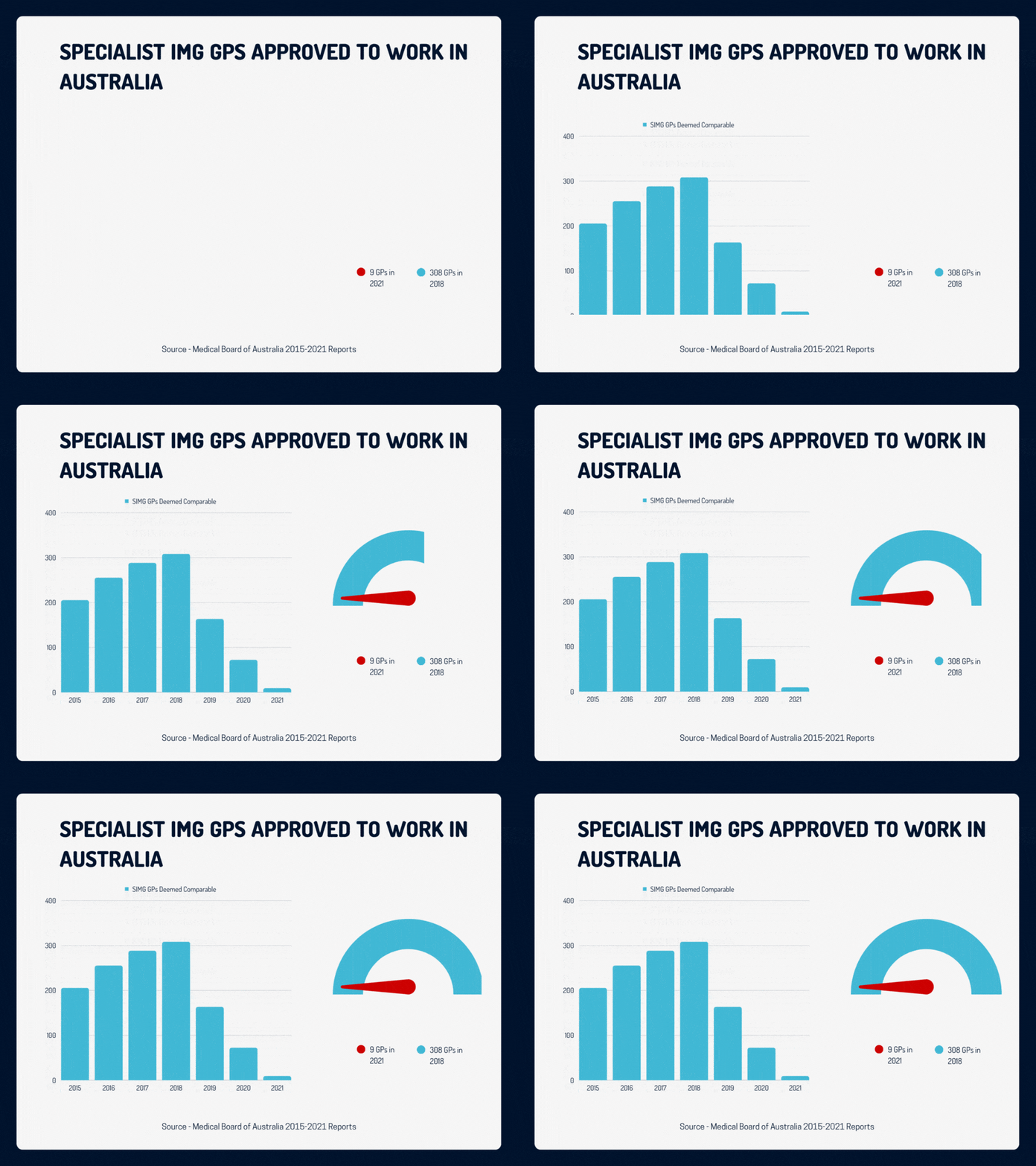
    The number of assessments and approvals of SIMGs was significantly down across the board. Between the years 2015 and 2021, the average number of SIMG doctors deemed as comparable (and therefore eligible to apply for work as a specialist in Australia) across all specialties was 590 Specialist IMGs.

    In the year 2020 which was the first year to be affected by COVID-19 this number took a small dip down to 491 SIMGs approved as comparable. But in 2021 this number has crashed to only 177 SIMGs being approved!

    Only 9 International Doctors Were Approved to Work as General Practitioners in Australia in 2021.

    For General Practice the picture has become even dimmer. In 2020 84 Specialist IMG GPs approved as comparable across the 2 general practice colleges. In 2021 this number sunk even lower to just 9 overseas trained GPs approved to seek employment in Australia!!

    To me, this is the strongest indicator or confirmation to date that General Practice is in Crisis in Australia.

    general practice is in crisis in Australia

    This number of only 9 Specialist IMG GPs comes off a high water mark of 308 approvals in 2018. If you look at the graphic below you will see that normally Australia relies on around 200 to 300 General Practitioners from overseas being approved to work in Australia under the Specialist Pathway under its strategy of providing a sufficient general practice workforce.

    What is most worrying on this graph is that even before 2020, there was a significant dip in approvals in the year 2019. The message here is that it would be foolhardy just to attribute the current concerns about the General Practice workforce to the impacts of COVID-19.

    We need to understand the reasons why both overseas trained doctors and Australian medical graduates are not embracing General Practice as a specialty in the numbers that they used to and which we need them to.

    A long-term freeze on the indexation of Medicare billing items has undoubtedly hurt General Practice more than other specialties as it is generally more difficult for GPs than other specialists to charge gap fees in order to keep up with the costs of running a practice.

    Regular government changes to the processes of alternate pathways for IMG doctors to enter General Practice, such as the phasing out of the General Practice Experience Pathway for the new Fellowship Support Program also cause confusion.

    The Australian General Practice Training Program, which is the main program by which Australian medical graduates can train to become a General Practitioner is also undergoing significant change in 2023. Moving responsibility for training from the previous Regional Training Providers back to the Specialist General Practice Colleges. Hopefully, this change will be as smooth as possible and not lead to further disruption in this vital workforce.

  • Do Doctors Get Paid to Train in Australia? Yes, They Do.

    Do Doctors Get Paid to Train in Australia? Yes, They Do.

    This blog is open to comments, I also run a YouTube Channel and a Facebook group and frankly way too many other ways for people to contact me. So no surprise. I do get a lot of questions and queries on a daily basis. One of the surprisingly common and interesting questions that I do get a lot from doctors from other countries is “do doctors get paid to train in Australia?”. Being paid for work is part of our culture in Australia. But I am aware that in other systems you may not necessarily be paid when you train in medicine or even have to pay for your training.

    So let’s try to clear up this question in this blog post. Along with answering some related questions that come up around this topic.

    From the time after you graduate from medical school in Australia, you will be entitled to and will receive payment for your services as a doctor. This includes any further career stage which might be referred to under the label of training. So you get paid to be an Intern, you get paid to be a Resident and you get paid to be a Registrar (which is what most doctors who are undertaking specialty training in Australia are referred to).

    Therefore, you also get paid when you are doing surgical training, physician training, psychiatry training, emergency training, general practice training etcetera. You also get paid when you become a specialist doctor or consultant, although in some cases you may be working for yourself, in which case, you are paying yourself out of the revenue you collect.

    What does all of the above means for international medical graduates (IMGs)?

    Do IMG Doctors Get Paid to Train in Australia?

    The answer is again yes. If you are an IMG doctor and you get appointed to any training position, whether this is a resident position for the purposes of completing the standard pathway process or a specialty training (Registrar) post as part of any of the competent authority, the specialist, or the short term training in a medical specialty pathways. You will get paid.

    Whilst wage theft and the exploitation of overseas workers in Australia have become a real concern in Australia over the past decade or so. I am not aware of any such situations that have involved international medical graduates. If you do know of such a circumstance I would be interested to hear from you.

    Do IMG Doctors Get Paid Differently to Australian Doctors?

    This is a more complicated question to answer.

    As a general rule if you are an IMG doctor and you are recruited to a position you will be paid under the same classification as any Australian doctor also doing the same job. So if, for example you are appointed to a Resident position you will be paid as a Resident.

    However, for most classifications, there are steps or levels that increase based on your years’ of experience. Sometimes the employer may try to start you out at the bottom of this classification scale, even though you may actually have more experience, citing that you don’t have any experience in Australia. So in this case you may end up being paid slightly less. In my experience, most employers in Australia will try to recognise your experience and pay you at a higher rate if you are eligible. This is a grey area in terms of what is correct. So it’s definitely worth querying things if you feel you are on the wrong end of the stick.

    Why Do Doctors Get Paid to Train in Australia?

    The answer to the question of why doctors get paid whilst training is that they are performing real and substantial services in these roles. The training is on top of this work or embedded into this work. They are generally not taking large amounts of time away from the workplace to attend things like lectures and seminars or workshops. Much of the training occurs within the workplace and a lot of the additional studying occurs in the doctor’s own time after work.

    Many Doctors Do Have to Pay to Train

    Hang on. What’s that? You just said that doctors get paid to train. But now you are saying they also have to pay?

    Doctors do get paid to train in Australia. But there are some costs associated with being a trainee doctor in Australia.

    There are the normal regular costs like paying your medical registration every year and having a car so you can get to work.

    But there are also some specific costs associated with being a trainee doctor.

    As an intern, you generally won’t have any particular costs associated with your training as it will normally be provided for you by the hospital.

    As a resident doctor, you will probably be thinking about paying for some courses that might help you get into a particular training program. So things like emergency courses and anatomy courses and radiology courses and the like.

    As a specialty trainee doctor, you will have to pay college membership fees, you may also have to pay for a formal education course and you will have to pay to sit examinations.

    Personal costs for training as a trainee doctor in Australia can rack up to several thousand dollars and even pass into the tens of thousands of dollars range. But this is generally over a significant period of around 5 to 10 years.

  • How Much Do Interns Make in Australia? It Depends.

    How Much Do Interns Make in Australia? It Depends.

    We are approaching that time of the year again in Australia. The time where the majority of trainee doctors go up one step of responsibility on the ladder. It’s also the time that our newly graduated medical students commence their first paid position as a doctor. Commonly referred to as the internship. You might be keen to know how much you are going to be paid and how this compares to other States and Territories. How much do interns make? You may be surprised how much it actually varies.

    Interns across Australia are paid according to State or Territory based Awards or Enterprise Agreements. The annual rate of Intern pay varies considerably with NSW Interns being paid the worst and Western Australian Interns being paid the best. In order of ascending annual Intern salaries are as follows: New South Wales $71,283, Tasmania $73,586, Australian Capital Territory $74,826, South Australia $77,084, Northern Territory $78,757, Queensland $78,941, Victoria $79,138, Western Australia $79,479

    NSWTasACTSANTQldVicWA
    $71,283.00$73,586.00$74,826.00$77,084.00$78,757.00$78,941.00$79,138.09$79,479.00
    as of Jul 2021as of Jul 2021as of Dec 2020as of Apr 2020as of Jan 2021as of Jul 2021as of Jan 2021as of Oct 2020
    as of the latest publicly available Award document or equivalent

    How Much Do Interns Make? There Is A Wide Variation In the Entry Doctor Pay Rate

    The results above reveal that there is a wide variation of $8,196 or a 9.5% difference between the lowest paid annual salary and the best paid annual salary. Interestingly this gap has closed somewhat since we looked at it a couple of years ago.

    The reason for the large variation is that each State and Territory sets its wages for public employees separately through something called an Award or an Agreement.  These are formal documents that state the conditions of employment.  They include matters such as the hours of work, the leave available and of course how much you get paid.

    These Awards or Agreements are generally only comprehensively reviewed every few years at best. In the meantime State and Territory governments generally negotiate with the employee’s unions for an across the board annual wage increase somewhere around the rate of inflation.

    Doctors like other public employees do not generally contract as individuals for their services with hospitals.  So everyone gets the same conditions based on what role they are employed in and what year they are at.

    According to the Australian Bureau of Statistics Full Time Adult Average Annual Ordinary Earnings was $93,729 in 2021.  So bearing in mind that it takes a minimum of 5 years of university study (with a fair collection of higher education debt to pay off) to get to this point we can certainly not consider Interns to be extremely well paid.

    But it’s not all that doom and gloom. Whilst, Interns certainly do not work the amount of overtime they used to 10 or 20 years ago. Overtime provisions, as well as loadings (working rostered hours on an evening, night or weekend) under most Awards and Agreements, can lift the annual take-home pay of an Intern significantly. For e.g. most overtime starts off being paid at 150% and rapidly goes to 200%.

    So, if we take this into account when asking the question how much do interns make. If an Intern works on average 50 hours per week they are likely to hit Full-Time Adult Average Annual Ordinary Earnings, even in a State such as NSW.

    Medical Intern Salaries 2022

    It Goes Up From Here

    And, of course, it does improve significantly from this position. By the time a doctor becomes a Registrar in Victoria, for example, their regular pay has increased to $120,000 per annum (after a period of 2 or 3 years). And as we have recently pointed out in another post. Salaries and incomes for specialist doctors in Australia are amongst the best of all occupations in Australia.

    A Special Bonus For Interns

    An additional bonus for Interns comes at the first tax time. In Australia, the Financial Tax Year runs from July to June. So, because you have not been paying much in the way of taxes for the first half of the financial year, you end up paying more tax than you need to in your first 6 months of Internship and get a reasonable return come tax time. For this reason, some Interns seek to work extra overtime before 30th June.

    What’s Going On in NSW?

    NSW has the highest number of intern positions in the country. So it may be that you came to this blog post wondering how much do interns make in NSW.

    When I was an Intern, NSW paid some of the best salaries for trainee doctors in the country. States like Western Australia (which is now first) were actually towards the bottom of this list.

    Given that NSW is the biggest State in Australia by population and one of the richest States economically. And given that Sydney (NSW’s capital city) is probably the least affordable place in Australia to live it makes little sense that NSW Interns get paid the least.

    It’s hard to know exactly why this situation has occurred. It is possible that the industrial groups that represent doctors in other States and Territories have been more successful in representing trainee doctors over the years.

    This certainly seems to be the case if one looks at the Enterprise Agreement for doctors in Victoria.  Which even includes an allowance for continuing medical education, as well as separate provisions for internal training leave, examination leave and conference leave.

    So whilst the question of how much do interns make is an important factor in determining which State or Territory is the best to be an intern. We do need to take into consideration a range of other factors.

  • The Highest Paid Doctors in Australia. A Comprehensive Breakdown.

    The Highest Paid Doctors in Australia. A Comprehensive Breakdown.

    A couple of years ago I wrote this post reflecting the fact that according to the Australian Taxation office doctors are extremely well paid in Australia. This blog is both an update to that post. But also a focus on who are the highest paid doctors in Australia? This time I am going to try to go into more detail as I had lots of questions last time, likes “what about pathologists?” or “I’m a neurosurgeon is that any different from an orthopaedic surgeon.

    First for the overview:

    Just like 2 years ago if we look at things at a macro level not much has changed and doctors still maintain their high rankings in the ATO data, with Surgeons sitting at number 1 on an average taxable income of $394,303 AUD. Followed by Anaesthetists at number 2 on $386,065 AUD, Internal Medicine Specialists at number 3 on $304,752 AUD and Psychiatrists ($235,558 AUD) and Other Medical Specialists ($222,933 AUD) at 5th and 6th. Just squeezed out for number 4 by Financial Dealers. This is in fact the same as it was 2 years ago.

    But if we go down to a more granular level and look at subclassifications where Surgeons are divided into specialties like Neurosurgery and Orthopaedics and Internal Medicine Specialists are divided into specialties like Cardiology and Paediatrics we see that some medical specialists do even better with medical professionals dominating 34 of the top 50 occupations for average taxable income in Australia.

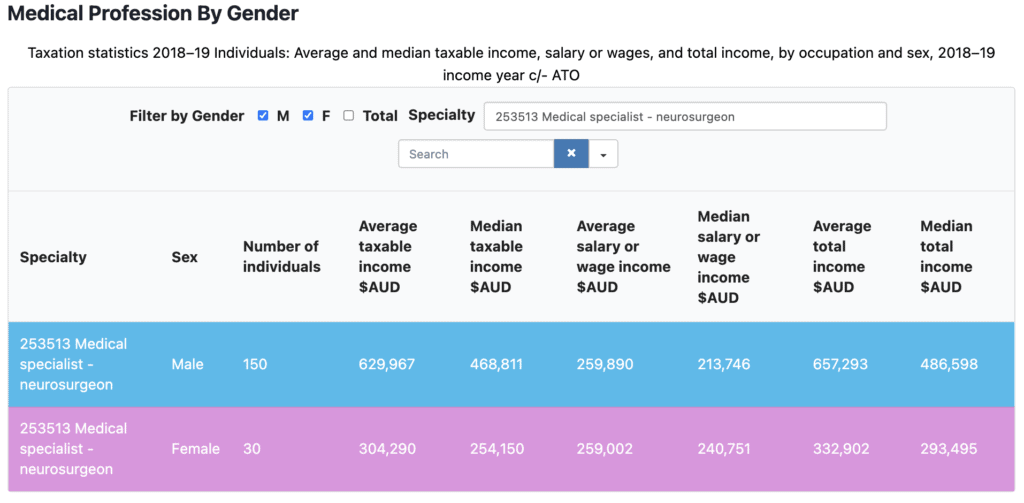
    With the highest paid occupations and the highest-paid doctors being Neurosurgeons coming number 1 at $575,687 AUD, followed by Ophthalmologists at 2 with $524,804 AUD and Ear Nose and Throat Surgeons 3 at $468,525 AUD. What is also interesting is the huge discrepancy in earnings between male and female doctors of all specialties with a male Neurosurgeon earning more than double the average taxable income of a female Neurosurgeon $629967 AUD vs $304,290 AUD.

    Read on further for some further analysis and discussion about medical specialist salary in Australia.

    Australia’s Highest Paid Doctors Still Do Very Well in Comparison to Other Occupation Groups

    Here’s a list of the top ten occupation groups by Average Taxable Income for 2018 to 2019 (the most up to date figures).

    [ninja_tables id=”126355″]

    Surgeons sit at number 1 on the list on an average taxable income of $394,303 AUD. Followed by Anaesthetists at number 2 on $386,065 AUD, Internal Medicine Specialists at number 3 on $304,752 AUD and Psychiatrists ($235,558 AUD) and Other Medical Specialists ($222,933 AUD) at 5th and 6th. Just squeezed out for number 4 by Financial Dealers. This is in fact the same as it was 2 years ago.

    In fact, according to the ATO Surgeons have been topping the list (for occupation groups) since 2010.

    Now some of you with a keen eye will have noticed that if we look at the fifth and final column would have noticed that if we go on median taxable income then it is actually the Surgeons colleagues the Anaesthetists who are the better paid. What’s all that about then?

    Well, first we have to understand what is meant by taxable income.

    According to the ATO: Your taxable income is “the income you have to pay tax on” (d’oh!).

    More precisely.

    The taxable amount is the amount left after you claim a deduction for all the expenses you can. These amounts reduce the amount of assessable income you pay tax on.

    Australian Taxation Office

    Assessable income − allowable deductions
    = taxable income

    So we have average taxable income and median taxable income. If we recall our statistics from high school average generally refers to the mean.

    We calculate the mean by adding up all the values (in this case taxable incomes of Surgeons) and divide the sum by the total number of values (the number of Surgeons who completed a tax return). The median is calculated by listing all numbers (taxable incomes) in ascending order and then locating the number in the centre of that distribution.

    Now. I’m only speculating here. But the most likely answer to why the big difference is variance.

    And this is borne out when you look at some of the more detailed tables below.

    Whilst the ATO doesn’t help us out with confidence intervals or ranges. It’s most likely that the statistics for Surgeons are more skewed by a small but significant group of Surgeons doing particularly well as some of the highest paid doctors in the country.

    Another way to look at it is. Working in Anaesthetics you can make some really good but steady income. But you are probably less likely to be declaring $1million per annum. Whereas as a Surgeon you are more likely to have that opportunity.

    And of course, we need to also account for the fact that the ATO does not collect statistics on hours of work. It’s a safe bet that many doctors are doing more than 40 hours a week. But there will be a number who will also be working part-time. We know that different occupations in medicine tend to have different percentages of doctors who work full time versus part-time. So this will have some impact as well.

    For example in a fairly recent Australian Institute of Health and Welfare Report average weekly hours worked across 20 specialties varied from 38.2 hours per week (Psychiatrists) to 54.1 hours per week (Intensive Care Physicians).

    When We Look Even Further Australian Doctors Are Almost Universally Well Paid

    As I said the last time I blogged about these statistics I had lots of questions about different scenarios. Like what if I am this particular type of Surgeon? Or you haven’t talked about Pathologists. Or what about if I work privately versus publicly.

    So let me attempt to address as many of your questions as possible in the next 3 tables.

    Firstly below I have listed the top 51 occupations by taxable income in Australia for 2018 to 2019 again according to the ATO. Why 51? Well. If you go through this table you will see that 32 of the 51 occupations here are medical practitioner occupations.

    So medical practitioners also occupy 32 of the top 51 occupations in Australia.

    [ninja_tables id=”126336″]

    Now. What you might be surprised to know is this. There are only 2 other medical occupations that are not on this list. Which are 253000 Doctor – Specialist – type not specified, which sits at 217 at $137,480 Average Taxable Income and 253112 Medical Officer – Resident which sits at 422 on the list at $107,191 Average Taxable Income. And arguably these are the two categories that will cover most trainee doctors.

    The list is of occupations is 3535 long by the way. So even if you are a Medical Officer – Resident you are already sitting in the top 12%.

    And if you are a specialist you are doing very well in comparison to most other occupations.

    So if you have a particular thesis that a certain occupation in medicine is poorly done by. Then I’m sorry to burst your bubble. But the data doesn’t support you. At least if you are comparing doctors to the rest of Australia.

    Another way of putting it would be that the highest paid doctors in Australia are doctors. But clearly to paraphrase George Orwell. Some doctors are more highest paid doctors than other doctors.

    The Highest of the Highest Paid Doctors in Australia Are Proceduralists

    Have a look at the top of the table. Neurosurgeons have the highest average taxable income in Australia at $575,687 AUD. Then come Ophthalmologists, ENT Surgeons, Cardiologists, Urologists, Orthopaedic Surgeons, Plastic Surgeons, Vascular Surgeons and Gastroenterologists.

    It’s only at number ten that a non-medical practitioner occupation makes an appearance. And that’s Judges!

    What do the top nine all have in common? They perform procedures. There is a common conception that if your medical specialty includes significant procedural work (for which you can bill) you will do better from a monetary perspective. And here is some evidence that supports that idea, i.e. the highest paid doctors are procedural doctors.

    If we go down the list further. The next 6 specialists are also involved in procedures. It is not till we hit Medical Oncologist on the list at 17 that we encounter a medical specialist who arguably does not have the opportunity to perform a lot of procedures.

    Oh. And then we hit our next non-doctor at 18. The Financial Investment Manager.

    I am often asked by international medical graduates which specialties are hard to get into in Australia. With the exception of Radiologists and perhaps Oncologists. This list of the top 18 highest paid doctors is a good reference of specialties where you are more likely to struggle.

    Another 6 medical occupations (total of 24) come before State Governors at 28 on the list of highest paid occupations. (I’m also wondering how there are 23 returns for State Governors, given there are only 6 States, 2 Territories and one Commonwealth?)

    General Physicians make on average slightly more than Magistrates and Psychiatrists are only just beaten by Members of Parliament. There are only 3 medical occupations that make less on average than Dentists and Cricketers.

    Surprisingly, General Practitioner is not last on the list of Medical Practitioners. Its Pathologist.

    Which Doctor Occupation Am I In?

    Now you may be wondering what is covered by these doctor groups. As I said I got lots of questions about this last time.

    To understand the way the ATO classifies occupations we need to refer to the ANZSCO classification system.

    The Australian and New Zealand Standard Classification of Occupations (2013 version 1.3) is a joint collaboration between the Australian Bureau of Statistics (ABS) and its New Zealand counterpart, StatsNZ.

    According to the ABS:

    ANZSCO provides a basis for the standardised collection, analysis and dissemination of occupation data for Australia and New Zealand. The use of ANZSCO has resulted in improved comparability of occupation statistics produced by the two countries. 

    ABS

    ANZSCO has a 5 level hierarchy starting with Major Groups, Sub-Major Groups, Minor Groups, Unit Groups and finally Occupations.

    So when the media claims that Surgeons are the highest-paid occupation in Australia they are technically not correct. They should be referring to Neurosurgeons (see below).

    There are 8 Major Groups

    • Managers
    • Professionals
    • Technicians and Trade Workers
    • Community and Personal Service Workers
    • Clerical and Administrative Workers
    • Sales Workers
    • Machinery Operators and Drivers
    • Labourers

    With the notable exception of perhaps medical administrators (who perhaps are technically classified under Managers), all other medical practitioners are classified under Professionals > Health Professionals > Medical Practitioners.

    I also suspect however that Directors of Medical Services and the like do not classify themselves as Medical Administrators as the average taxable income of $55,000 really does not make sense for this occupation. So I suspect they are selecting another medical occupation when completing their tax return.

    This brings me to an important point. The ATO doesn’t audit (as far as I know) what occupation you put down on your tax return. So there is an element of discretion here.

    On this point. It’s possible that some university academic doctors also elect to classify themselves as Educational Professionals > Tertiary Education Teachers > University Lecturers and Tutors.

    But returning to our classification of Professionals > Health Professionals > Medical Practitioners. Medical Practitioners is the Minor Sub Group.

    The Occupational Groups below this Minor Sub Group with their Occupation Sub Set are:

    Occupation GroupOccupationsOther Titles or Specialisations
    2531 General Practitioners and Resident Medical Officers253111 General Practitioner
    253112 Resident Medical Officer
    General Medical Practitioner
    Medical Intern
    2532 Anaesthetists253211 AnaesthetistIntensive Care Anaesthetist
    Obstetric Anaesthetist
    Pain Management Specialist
    2533 Specialist Physicians253311 Specialist Physician (General Medicine)
    253312 Cardiologist
    253313 Clinical Haematologist
    253314 Medical Oncologist
    253315 Endocrinologist
    253316 Gastroenterologist
    253317 Intensive Care Specialist
    253318 Neurologist
    253321 Paediatrician
    253322 Renal Medicine Specialist
    253323 Rheumatologist
    253324 Thoracic Medicine Specialist
    253399 Specialist Physicians nec*
    Intensive Care Medicine Specialist & Intensivist are alternative for Intensive Care Specialist

    The only specialisation options for paediatrician are Neonatologist and Paediatric Thoracic Physician

    Occupations in the nec group include: 
    Clinical Allergist
    Clinical Geneticist
    Clinical Immunologist
    Clinical Pharmacologist
    Geriatrician
    Infectious Diseases Physician
    Musculoskeletal Physician (NZ)
    Occupational Medicine Physician
    Palliative Medicine Physician
    Public Health Physician
    Rehabilitation Medicine Physician
    Sexual Health Physician
    Sleep Medicine Physician
    2534 Psychiatrists253411 PsychiatristSpecialisations: 
    Adolescent Psychiatrist
    Child and Adolescent Psychiatrist
    Child Psychiatrist
    Forensic Psychiatrist
    Geriatric Psychiatrist
    Medical Psychotherapist
    2535 Surgeons253511 Surgeon (General)
    253512 Cardiothoracic Surgeon
    253513 Neurosurgeon
    253514 Orthopaedic Surgeon
    253515 Otorhinolaryngologist
    253516 Paediatric Surgeon
    253517 Plastic and Reconstructive Surgeon
    253518 Urologist
    253521 Vascular Surgeon
    Alternative Titles for Otorhinolaryngologist are
    Ear, Nose and Throat Specialist
    Head and Neck Surgeon
    2539 Other Medical Practitioners253911 Dermatologist
    253912 Emergency Medicine Specialist
    253913 Obstetrician and Gynaecologist
    253914 Ophthalmologist
    253915 Pathologist
    253917 Diagnostic and Interventional Radiologist
    253918 Radiation Oncologist
    253999 Medical Practitioners nec
    Specialisations for Pathologists are:
    Clinical Cytopathologist
    Forensic Pathologist
    Immunologist

    Occupations under Medical Practitioner nec are:
    Nuclear Medicine Physician
    Sports Physician
    c/- Australian Bureau of Statistics

    *nec = not elsewhere classified

    In any case, you can now go look up the code that best represents your specialty and get some more detailed information of your earning potential from either the table above or the next one below. I’d recommend the next one.

    And if you still can’t find yourself on the list. Feel free to have a wander through the ANZSCO information yourself.

    The Highest Paid Doctors in Australia Are Men

    You may not be all that shocked to know that male doctors do better than their counterparts.

    What shocked me however was the extent to which this occurs. Try clicking on ‘M’ and ‘F’ and leaving ‘Total’ off on the table below.

    [ninja_tables id=”126342″]

    You see a wall of blue.

    Click on the pagination tabs to see some pink.

    If we filter for M & F and Neurosurgeon we get the following result:

    Male Neurosurgeons are the highest paid doctors

    What’s most curious to note here is that the 30 female Neurosurgeons almost match their 150 male colleagues in terms of average wage income. This would indicate to me that they are earning similar salaries from public health service roles. In fact, the median salary or wage result tends to indicate to me that proportionately female Neurosurgeons might be working more in the public health system than their male counterparts. It’s clearly non-salary or wage income that is making the difference here.

    This will undoubtedly be partly related to other income through operating a private service. But is probably also due to income from other sources such as investments.

    This leads to the following result. In the top paid occupation in Australia, men more than double the average taxable income of women.

    And it’s the same result for each specialty. There’s not one specialist occupation in Medicine where women do better than men in terms of average taxable income.

    How Does this Income Compare to Salary Information?

    Most general practitioner specialists and trainees work in the private sector in Australia. As do a significant number of other specialists. So the ATO data will reflect that many doctors are working for themselves on a fee for service or contractual basis. If a doctor wants to earn a more regular income or salaried wage then they will generally opt to find employment in the public hospital system as a Staff Specialist.

    As a point of reference to the ATO data, a full-time employed Staff Specialist in the NSW Health system will generally be earning between $246059 and $303643 depending on their year’s of experience and level of seniority. Although they may earn as much as $484799 if they opt to split their private billings with the health service.

    So whilst you clearly need to be doing some private practice to hit the top of the income tables. You can see that for most specialties you can actually do better than the average amongst your peers by working in public.

    In a future post, I will update you on the salaried rates of pays for trainee doctors.

  • Intern, Resident and Registrar Salary Australia. 2020 Guide.

    Intern, Resident and Registrar Salary Australia. 2020 Guide.

    We have an updated salary guide at this post.

    On this blog we want to give you the best information possible about Medical Careers. That obviously includes information about pay rates and related conditions. We have already given you the low down on Interns and Residents, as well as Specialists. So its high time we discussed Specialty Trainees. Right?

    In this post we are going to talk about Specialty Trainees, also referred to as Registrars and how much they earn. Specialty Trainee Registrars working full-time in the hospital system will earn between $89,649 as a first-year Registrar in Tasmania up to $161,766 per annum working at the most senior Registrar level in Western Australia. General Practice Trainee Registrars working full-time are guaranteed $75,328 per annum in their first year of training. Going up to a guaranteed $96,724 per annum in their 3rd and final year of training.

    Once again it’s important to emphasize that these salaries are base salaries for full-time employees. Specialty Registrars are often required to work considerable amounts of overtime and on-call which will increase their pay rate significantly. And General Practice Registrars are able to negotiate with their employers above the guaranteed rate of pay. Often this will be on the basis of a proportion of the Medicare revenue that they generate for the practice. So, again they can possibly earn significantly more.

    Specialty Trainees Can and Often Do Earn Much, Much More.

    We can see evidence of the fact that Registrars do earn much more than their base rate of pay. “Other Medical Practitioners”, which is where most Registrars classify themselves for tax purposes with the Australian Tax Office earned on average $204,387 of taxable income in 2016/17 according to the ATO.

    Whilst these figures are likely to be conflated by General Practitioners and other Specialists indicating this category as their profession as well they do back up the contention that most trainee doctors earn significantly more than their base salary due to working excessive hours with specialty trainees at most risk of working excessive hours and amongst these Intensive Care and Surgical trainees being at the highest risk of fatigue.

    Its certainly been my observation over the years that surgical trainees in particular work long hours. This is generally a combination of rostered and unrostered overtime as well as being “on-call”. I was literally at a meeting last week where an administrator reported that the surgical trainees at her hospital were the best paid doctors last year due to their workload. Meaning that they were paid even more than the specialists.

    Its easy to see why and how this would be the case. Lets take a typical situation of a medium hospital which employs 3 General Surgical trainees. Each is on the roster approximately 1 in 3 on top of their normal 40 hours per week. This means being on call around 2 weeknights per week and 1 weekend in 3.

    Let’s assume one of these surgical trainees does slightly more than their share of weeknights in a month (4 weeks). 8 in total. But only one weekend. Let’s say that they get called on average 2 times per weeknight and 15 times over the course of that weekend.

    In New South Wales each of these call-backs would amount to a period of 4 hours of overtime. This is initially paid at time and a half for the first two hours and thereafter double time.

    So we have:

    • 160 hours of normal time
    • 2 callbacks X 8 = 64 hours of overtime for the weeknights
    • 15 callbacks for the weekend = 60 hours

    This gives us a total of 284 hours for that 4 week period. Which is close to double the base hours! But wait. Because those overtime hours get paid initially as time and a half and then very quickly as double time. The total amount of hours paid becomes about 400 hours!

    Now this example is obviously not typical for every specialty and there are some specialties which may not have to do as much overtime and not get called in as much. But it is also not the most extreme example either as the case of Dr. Yumiko Kadota has demonstrated to us.

    Breakdown By State and Territory.

    We have compiled below a table that demonstrates the current base rates of pay for Intern, Resident, Senior Resident, Registrar and Senior Registrar for each State and Territory in Australia.

    Please bear in mind a number of things. Once again we are talking Full-Time Annual Salary. Also, as I have pointed out above the actual take-home pay can vary considerably. Also, the Awards and agreements for each State and Territory are set independently and at different times from each other. So over time, the tendency is for there to be movement both up and down through the table.

    What is apparent, however, as we have pointed out on our other blog posts about Interns and Residents is that Western Australia is clearly the best place to work if your sole interest is finances. Victoria is next best and rates a special mention as its Enterprise Agreement contains a lot of additional friendly provisions that others do not.

    $31,000 in difference between the highest rate of pay between Western Australia and Tasmania is a bit hard to fathom and justify. It’s almost a 20% difference.

    State / TerritoryInternResidentSenior Resident*RegistrarSenior Registrar**
    Western Australia***[]$78,479$86,328$94,960$109,678$161,766
    Victoria$74,563$79,391$86,060$116,460$155,477
    New South Wales[]$69,649$81,639$89,793$101,698$143,398
    Australian Capital Territory***[]$68,094$79,682$87,410$98,704$138,667
    Queensland$73,306$79,413$85,521$105,377$134,389
    Northern Territory$71,350$82,731$88,629$98,413$134,113
    South Australia$73,370$80,041$86,710$100,717$133,400
    Tasmania$68,936$72,837$89,649$89,649$126,854

    *Being appointed to a specialty trainee position does not automatically mean appointment to a Registrar role in all States and Territories. For some, for example NSW, the entry point is the Senior Resident Medical Officer position.

    **Not all States and Territories have a Senior Registrar role. We have used the maximum Registrar pay grade where there is no Senior Registrar role.

    ***The Australian Capital Territory Enterprise Agreement expired in July 2017. Therefore we expect that the salaries quoted here will increase significantly when there is a finalization of the new agreement. Similarly, the WA Agreement experied in 2018.

    What About General Practice?

    Ok. So far I have ignored General Practice. But this has not been deliberate. It’s because General Practice is a different set of circumstances to the other specialty training cases. This is because General Practice works more on a national basis. Because there is an Australia-wide minimum set of pay standards.

    So, according to the General Practice Registrar Association website the current base rate of pay for a first-year General Practice Registrar is $75,328.23 per year and for a Registrar in their final year (which is either 3rd or 4th year) $96,724.43 per year. Again, this is for full-time work.

    Now, whilst these rates appear to be somewhat lower than for Specialty Trainees paid as Registrars you should bear in mind four things about General Practice training.

    The first is that General Practice training is a minimum of 4 years, whereas most other specialties are 5 years and possibly longer. So there is no need for higher Registrar levels in general practice.

    The second is that is actually possible to enter General Practice training in your PGY2 hospital year. So when you enter your first actual GP training post you are actually in your second year of training.

    The third is that the pay agreements are a minimum standard as part of an employment contract below which your employer may not go. But it is quite common for GP trainees to negotiate a better agreement with their employer, by agreeing to collect a share of their Medicare billings. So it is possible to do far better than these minimum amounts. Although, clearly this partly has to do with your own productivity as a GP trainee. And I don’t have any meaningful information to tell you how much this can increase salaries.

    The fourth and final thing is that clearly, GP trainees become specialists earlier. So whilst other specialists can and do eventually earn more than GPs. You get there first as a GP and so you get a head start on the rest of the field. Also, GPs are generally working less time than other specialists. So in theory more able to enjoy their very reasonable salary.

    Time To Complete Training and Other Costs.

    It has been suggested to me by my readers and viewers that in order to tell the complete picture I should talk about the time it takes one to complete training as well as some of the other costs involved in getting there.

    Whilst I agree that this probably does make the picture a little bit more complex for Specialty groups such as Surgeons. As I have also pointed out. Whilst one is working as a Surgical Trainee, either accredited or unaccredited you are in a group of doctors who are going to be earning quite a bit due to the amount of time worked. Now. This observation in itself is not really an attractive reason to enter Surgical training in my opinion.

    But it does mean that if you are successful in getting your way through Surgical training to your FRACS you are probably going to end up earning one of the highest incomes of doctors across your medical career.

    This is all pretty relative when we consider that most medical professions are in or close to the top ten occupations in terms of average income in Australia.

    Some key things to observe here are:

    • Some specialties are somewhat easier to get into at an earlier stage of training, examples being Emergency Medicine, Psychiatry, Physician Training and Emergency Medicine.
    • Other specialties have long waiting lists where you might end up becoming a very, very senior Resident before you get onto the program. Examples here are Surgery, Ophthalmology and Dermatology
    • Costs of training fees and exam fees can also vary significantly. Annual College fees usually start at over a thousand dollars for most Colleges. Examination fees can be a few thousand dollars to over ten thousand dollars. These costs are all tax deductible.
    • You may also need to or find it desirable to enter a formal training course. Some Colleges make this mandatory. This will also cost you a few thousand dollars. Again. This is also tax deductible.
    • Depending on your specialty there may be some equipment that you need to buy. For example, some of the surgical specialties utilise special equipment (think Ear, Nose and Throat).

    Other Related Questions.

    Question: What Other Benefits Do You Get As a Specialty Trainee?

    Answer.

    There are a range of other benefits that you get when working as an employed doctor in Australia.

    • On top of your salary, your employer is required to pay an additional 9.5% into a superannuation fund to assist with your retirement.
    • As an employee, you are covered by workers compensation for any injury or accident that might occur at work. Although payouts are often fairly poor and below what most professionals earn. So you may wish to consider taking out additional income protection insurance.
    • If you are asked to be on-call you will get a small allowance for this and be paid if you are called back into work.
    • You may get an allowance or even a mobile phone provided to you if you are required to be on call.
    • You might get some meal allowances for shifts.
    • If you have been seconded a reasonable distance from your normal place of appointment you will generally be provided with free temporary accommodation (you may need to pay a bond) and a travel allowance, for example, a free air ticket back home every 13 weeks or so.
    • You will get at least 4 weeks of annual leave per year.
    • Most doctors will also get one extra day off per month. Called a Rostered Day Off or RDO.
    • You will get a certain amount of sick leave every year which you can accumulate if you don’t use.
    • You also get access to other types of leave, such as leave to take your child to the doctor.

    Question: If I Am a Specialty Trainee From Overseas. How Much Will I Get Paid?

    Answer.

    You should be paid the same as the equivalent doctor in Australia. But this is a case where it’s always best to check. Once you are offered a position you should make sure that the employer is taking into account your current status as a trainee doctor overseas and in particular the amount of years of experience you have had. Some employers may indicate that they only take into account years of clinical experience worked in Australia. This can be a grey point. When pushed they will generally recognise your overseas experience as well.

    Special thanks to Dr Rachel Seaniger for the research conducted on this post

  • Locum Doctors Australia. How To Become One and How to Stay Current.

    Locum Doctors Australia. How To Become One and How to Stay Current.

    A recent series of articles in the Sydney Morning Herald highlighted the rising rate of medical locum doctor usage in Australia. The articles indicated that an average of 16.5% of doctors working in the NSW Health system are locum doctors. So it seems there is a trend towards locumming as either a career or a break in one’s career in Medicine. In this article, I would like to briefly cover how you can become a locum As well as address an important issue for locum doctors which is about staying current and registered as a locum doctor.

    So firstly what are the basic requirements for locumming as a doctor in Australia? The key requirements are that you either have general registration and/or specialist registration. You can either locum as a Specialist (includes General Practice) in which case you need specialist registration. Or you can locum against a vacant hospital role (usually a trainee role) in which case you need general registration. By their very nature locum positions are temporary and therefore not open to doctors on other types of registration because they require a level of independent practice. So this means as a minimum you will need to be at postgraduate year 2 and have your general registration. Beyond this basic requirement, you will need to be a citizen or permanent resident, which is most locum doctors in Australia. Or possibly be on a visa which permits you to work as a locum. You will most likely need to register with at least one medical recruitment or locum agency. You will probably need to either not be currently employed as a doctor or on a break from your role. And you will likely need to consider setting up a limited company to collect payments that you make as a locum doctor.

    Beyond these basic requirements, there are a number of other considerations for doctors who work as locums, which I will now go into.

    Registration Requirements

    As we have noted the nature of locum jobs is that they are temporary and time-limited and notwithstanding the current reporting on their usage, they are not generally seen as a permanent workforce solution. Locums are also often seen as quick and urgent solutions to filling a gap due to an unforeseen circumstance. For these reasons, it is generally not possible to set up a locum appointment for anyone who may need one of the special types of registrations available under the Medical Board of Australia where certain supervisory requirements may need to be demonstrated to be in place. In fact, often the reason a locum is being sought is that there is a lack of supervisors available. So this generally means that International Medical Graduates can generally not obtain a locum position. Although there have been some limited circumstances where it has been possible. This has generally been around deputizing services for general practice where medical recruitment agencies themselves have set up a service and essentially employ the IMG doctor.

    Locum Doctors

    Provider Numbers

    Locum positions (even ones for trainee doctors) are often advertised with a request for the locum to have a provider number. This may be just for referring purposes or for billing purposes as well. Performing locums in private practice, such as general practice is fairly impossible without a provider number as you will not be able to charge patients Medicare fees for the services you provide and the locum position will therefore not be viable.

    Provider numbers can be quite confusing and complex. Part of the problem is that each provider number is generally linked to one medical practitioner and one location. Technically you need a provider number for each and every location that you provide services at or from. This can obviously be hard to predict if you are locumming. There are some solutions to this issue in relation to general practice but often what needs to occur is to fill in a form for another provider number. As it takes time for Medicare to approve this as a locum you need to be on to this issue promptly.

    Other Skill and Experience Requirements

    Services advertising for Specialist Locums are generally happy to accept anyone with the appropriate Fellowship (although there are some exceptions). For general locums, the amount of experience you have as a doctor will count towards how eligible you are for a locum as well as how much you will be paid. Having additional skills such as the various advanced life support training certificates or experience in paediatric emergencies will also open up the number of posts available to you as well as the rates you can collect. So, whilst you can technically locum as a PGY2 your prospects may be even better if you wait until PGY3 or PGY4.

    Working as a Locum On a Visa

    As mentioned above there are limited circumstances where a locum doctor may be able to work under a visa arrangement. Generally speaking, this would occur when you have general registration or specialist registration and the medical recruitment agency can obtain a visa on your behalf.

    In most cases, you are probably better off working under a more secure form of employment until you are able to apply for permanent residency and then looking into locum work. This way you will not be obligated to one particular locum company.

    Working With Medical Recruitment (Locum) Agencies

    I’ve previously written in more detail about working with medical recruitment agencies. However, a key question about becoming a locum is whether you can work with a locum agency. This is because whilst it is possible to directly contract yourself for locum roles. Most doctors do find it easier and more productive to engage with a locum agency.

    For the most part, most doctors find working with a locum agent to be a valued and essential part of the role. Someone who understands their requirements and negotiates on their behalf. But this is not always the experience. If you are not the sort of person who is good at negotiating conditions of employment you may find locum work difficult. Locum agents play a difficult role in attempting to keep the employer and doctor happy at the same time. Sometimes the conditions of the job are not as agreed to initially or sometimes you may feel pressured to take on a role that you don’t wish to do. So being able to stand up for yourself in this situation is an important consideration.

    Can You Work As a Locum Whilst Employed?

    If you have a permanent position with an employer, such as a hospital, it may still be possible to do the odd shift or week of locumming. But beyond this and even including this it can get difficult. Apart from the fact that you obviously need to have the time off work to do locum shifts. There is also the need to consider that you will probably be working in a situation of conflict of interest. Most employers have a process whereby full-time employees are obliged under the code of conduct to declare any additional work undertaken with the option for the employer to indicate to the doctor that they cannot undertake that additional employment if it conflicts with them completing their other duties.

    Even if you work part-time it may be difficult to work part-time in a permanent position and locum as most locums are done in blocks of weeks rather than days.

    So essentially whilst you may be able to do a small amount of locuming whilst employed. If you are planning on doing more than a little bit you cannot really do this whilst also employed.

    Getting Paid As a Locum

    There are essentially two options here and sometimes it comes down to the employer’s choice. Some employers will opt to pay you through payroll in which case they will also pay the ATO the requisite amount of tax on your behalf and should also pay superannuation on your behalf. Your Locum Agency then charges them an additional fee for placement. Others will pay you a set amount as part of an invoice you submit for the contract. This is often paid directly to the locum agency where the agency takes out its commission and then pays you out.

    If there is a choice between PAYG and invoicing you can opt for either option.

    As a locum, you are not going to be paid a regular fortnightly salary. So this means that you need to be prepared for being paid late, having to chase up on income every now and then and have some amount of cash in the bank to keep up all your regular payments (rent, mortgage, food, car, telephone bill etc…) in the interim.

    You will also most likely need to set aside some of your income for tax purposes. Otherwise, you will get hit with a large bill come tax time and needing to take out a loan to pay it.

    Some doctors find financial management a hassle. Good locum agencies will generally help you by chasing up on payments and providing your reports. But if you like a less complex set of financial circumstances then locumming is probably not for you.

    Running a Company

    Eventually, most doctors who locum set up a company in which to collect their earnings. There are several reasons for this. Part of which is that some health services like Queensland will not pay locums as what is called a sole trader. The other main reasons are to reduce tax obligations and protect your personal assets.

    Running a company does not need to be overly complex. Most accountants will gladly help you to set up a simple company for a small fee. You do need to do some regular book-keeping and complete some additional tax forms quarterly and annually. It makes sense to set up a separate company bank out to make the book work easier.

    Many doctors actually find the idea of being the Managing Director of their own company a little bit exciting. You get to pick your own company name and you can even get a logo, letterhead and website if you really want to. But if you have aspirations to be a Company Director you might find this aspect of locum work that leads you to question whether you want to be a locum.

    Indemnity Considerations

    You will probably need to revise your medical indemnity upwards if you engage in locum work. When you work as a locum for a public hospital you should probably still be state government employer indemnified. But it is important to check arrangements each and every time.

    Personal Considerations

    On a personal level becoming a locum generally means traveling around a lot. Spending time on the road in the car or at the airport. Living out of a suitcase in a hotel or serviced apartment. If you have regular activities like sporting, academic or social pursuits these can be severely disrupted by locum work.

    If you have a family you may have some options for them to travel with you to locums. Depending on how needy the hospital or employer is they may even upgrade your accommodation to family accommodation at no extra cost. But at the minimum, you will probably have to pay for them to travel with you. Additional costs such as extra food will probably reduce the financial benefit of doing locums with your family in tow.

    Maintaining Registration and Professional Development

    I wanted to spend the remainder of this post discussing the issues around continuing professional development for locums.

    The Medical Board of Australia has signaled that it will take an increasingly active stance in the process of revalidating doctors (confirming their ongoing suitability to practice) in order to uphold community expectations for quality and safety.

    Locum doctors are often left in a vulnerable area when it comes to continuing professional development and demonstrating their ongoing fitness to practice.

    And. By the way. As a locum doctor, you are going to also have to think about how you pay for your CPD. Because the hospital is not going to pay for it.

    On the other hand, you are probably saving heaps in College fees.

    Specialist locums can generally maintain their continuing professional development through their college’s CPD program.

    However, locum doctors without fellowship who are simply relying on their general registration face a more difficult set of circumstances as there is generally no professional organization that can fully support their professional development requirements.

    Under its Professional Performance Framework the Medical Board has stated that:

    All doctors will:

    – have a CPD home and participate in its CPD program 
    – do CPD that is relevant to their scope of practice
    – base their CPD on a personal professional development plan
    – do at least 50 hours of CPD per year, that includes a mix of:reviewing performance
    measuring outcomes, and educational activities.

    Medical Board of Australia

    The current Medical Board requirements for medical practitioners who have general registration only (i.e. do not have specialist registration) indicate that such doctors must

    • complete a minimum of 50 hours of CPD per year (self-directed program), which must include
      • at least one practice-based reflective element; clinical audit or peer review or performance appraisal, as well as participation in activities to enhance knowledge such as courses, conferences and online learning, or
    • meet the CPD requirements of a specialist medical college that is relevant to their scope of practice.

    Most doctors can make a plan to engage in courses, conferences and online learning. However, the tradition of clinical audit, peer review and performance appraisal is patchy within medicine in general and it’s likely that locums with general registration may struggle to revalidate if they are unable to plan for these mandated activities each year and possibly have some support for doing them.

    Let’s look at each of the mandated practice-based reflections in turn and consider how it might be implemented for a locum doctor.

    Clinical Audit

    A clinical audit compares actual clinical practice against established standards of practice. The audit has two main components: An evaluation of the care that the individual practitioner provides, and a quality improvement process. The evidence required by the Medical Board is a certificate confirming completion of clinical audit or a short summary of recommendations and implemented changes or a description of the process that was undertaken and a reflection on what was learnt.

    Practically engaging in a clinical audit may be difficult for locum doctors because of time constraints for each placement as well as the ability to access and review clinical records at a later point in time.

    Peer Review

    Peer review meetings are undertaken by and with peers with the aim of updating knowledge and improving practice through the presentation of one’s own work to one’s peers with the expectation of a free and frank review. Evidence of peer review acceptable to the Medical Board includes documented account of case review or discussion with peer or team and a reflection on what was learned or evidence of log book or diary entry and a reflection on what was learned or a description of peer review activity and a reflection on what was learned.

    The practical problem for locum doctors engaging in peer review is coordinating meeting times and locations so that peer group members can regularly attend. This might be overcome with the use of technology and holding peer review meetings online. Although it would be important to consider the security implications of online discussions.

    An exciting aspect of a locum peer review group would be the potential to incorporate locum doctors working across a range of specialty areas into a group where one could imagine a breadth of generalist knowledge could be imparted throughout the group.

    Performance Appraisal

    Performance appraisal incorporates activities that allow the practitioner to review their practice /performance. The Medical Board will accept documentation to show how the practitioner reviewed or improved their practice or performance and a reflection on what was learned or a description of the process undertaken and a reflection of what was learned from the appraisal.

    In my opinion, this is probably the simplest of the 3 options for mandated peer-based reflection in order to achieve compliance and could be effectively completed with a performance coach.

    What the Medical Board Doesn’t Accept as Evidence of CPD

    The Medical Board is becoming quite circumspect in relation to CPD evidence. Here is a list of things that the Board will not accept as evidence of 50 hours of CPD per annum.

    Receipts of Courses
    Course Itineraries
    Course Agendas
    Course Programs
    Conference Itineraries
    Conference Agendas
    Non planned and non measured reading online
    Web-surfing
    Statutory declarations stating 50 hours of journal reading was undertaken
    Agendas of journal clubs

    Generally speaking, the Medical Board requires more definitive evidence of the 50 hours of CPD, examples of which would include certificates of attendance, certificates of completion, evidence of questions being attempted and log books of readings.

    Related Questions.

    What Areas of Medicine Can I Locum In?

    Locums can pretty much find work in any area of Medicine these days. At a Consultant level hospitals are often looking for locums in all of the common specialties, including Physicians, Surgeons, Psychiatrists, and Critical Care Physicians. There are also a surprising amount of Medical Administration locums advertised on a regular basis. And of course, there is general practice.

    At a non-Consultant level, you can also easily find locums in all range of specialties but critical care (mainly emergency) and psychiatry tend to be the most common along with medical registrar roles.

    How Do I Choose a Locum Company?

    We have written another post for you on this question. Feel free to have a read of it.

    How Long Should I Locum For?

    It’s difficult to categorically answer this question. Some doctors have turned locumming into a long term career quite successfully. Some doctors go into locumming planning that it will just be a temporary year or two away from training or permanent work but then find themselves enjoying the work and the lifestyle it provides.

    Perhaps the question should be “How Long Should I Locum For. Before I Consider Locumming to Be a Career?” As I have indicated above. Whatever part of Medicine you are in it is important to maintain your standards and professional development.

    I’d recommend that if you have been locumming for more than two years then you should review your professional development approach.

    Even if you are a Specialist and under a College CPD framework you probably want to think about how working as a Specialist Locum affects you differently than working in a permanent role and a team. Establishing a Peer Review group with other Locums in your Specialty may make sense or perhaps joining an existing Peer Review group of Specialists who work in your field in permanent roles.

    As a non-registered doctor, there will come a point where it is difficult to maintain your professional development through a College. There are a few alternatives, such as enrolling in Masters programs at University but the CPD from these programs only lasts as long as the program lasts.

    Again a Peer Review group probably makes sense as well as organizing for a regular performance assessment. You should also try to develop a CPD plan at the start of each year to address current gaps in skills and knowledge and consider asking your locum employers for feedback on your strengths and weaknesses.

    A career coach may be useful in guiding you through some of these processes.

    Is it Possible to Make a Career As a Locum?

    Yes. One could make a strong argument for obtaining a Fellowship first to support the locum choice. But there are doctors who have forged a career successfully locumming. At the present time, there is high demand for locums and there has never really been a time when a degree of locum doctors have been necessary to compliment doctors working in permanent roles. As we have highlighted above a key consideration is how you stay current in your practice.

  • How Much Do Specialty Trainee Doctors Earn? Registrar Pay Rates

    How Much Do Specialty Trainee Doctors Earn? Registrar Pay Rates

    On this blog, we want to give you the best information possible about Medical Careers. That obviously includes information about pay rates and related conditions We have already given you the low down on Interns and Residents, as well as Specialists. So its high time we discussed Specialty Trainees or registrar pay rates. Right?

    In this post we are going to talk about Specialty Trainees, also referred to as Registrars and how much they earn. Specialty Trainee Registrars working full-time in the hospital system will earn between $89,649 as a first-year Registrar in Tasmania up to $161,766 per annum working at the most senior Registrar level in Western Australia. General Practice Trainee Registrars working full-time are guaranteed $75,328 per annum in their first year of training. Going up to a guaranteed $96,724 per annum in their 3rd and final year of training.

    Once again it’s important to emphasize that these salaries are base salaries for full-time employees. Specialty Registrars are often required to work considerable amounts of overtime and on-call which will increase their pay rate significantly. And General Practice Registrars are able to negotiate with their employers above the guaranteed rate of pay. Often this will be on the basis of a proportion of the Medicare revenue that they generate for the practice. So, again they can possibly earn significantly more.

    resident doctor pay

    Specialty Trainees Can and Often Do Earn Much, Much More.

    We can see evidence of the fact that Registrars do earn much more than their base rate of pay. “Other Medical Practitioners”, which is where most Registrars classify themselves for tax purposes with the Australian Tax Office earned on average $204,387 of taxable income in 2016/17 according to the ATO.

    Whilst these figures are likely to be conflated by General Practitioners and other Specialists indicating this category as their profession as well they do back up the contention that most trainee doctors earn significantly more than their base registrar pay rates due to working excessive hours with specialty trainees at most risk of working excessive hours and amongst these Intensive Care and Surgical trainees being at the highest risk of fatigue.

    Its certainly been my observation over the years that surgical trainees in particular work long hours. This is generally a combination of rostered and unrostered overtime as well as being “on-call”. I was literally at a meeting last week where an administrator reported that the surgical trainees at her hospital were the best paid doctors last year due to their workload. Meaning that they were paid even more than the specialists.

    Its easy to see why and how this would be the case. Lets take a typical situation of a medium hospital which employs 3 General Surgical trainees. Each is on the roster approximately 1 in 3 on top of their normal 40 hours per week. This means being on call around 2 weeknights per week and 1 weekend in 3.

    Let’s assume one of these surgical trainees does slightly more than their share of weeknights in a month (4 weeks). 8 in total. But only one weekend. Let’s say that they get called on average 2 times per weeknight and 15 times over the course of that weekend.

    In New South Wales each of these call-backs would amount to a period of 4 hours of overtime. This is initially paid at time and a half for the first two hours and thereafter double time.

    So we have:

    • 160 hours of normal time
    • 2 callbacks X 8 = 64 hours of overtime for the weeknights
    • 15 callbacks for the weekend = 60 hours

    This gives us a total of 284 hours for that 4 week period. Which is close to double the base hours! But wait. Because those overtime hours get paid initially as time and a half and then very quickly as double time. The total amount of hours paid becomes about 400 hours!

    So you see it’s not all just about the base registrar pay rate.

    Now, this example is obviously not typical for every specialty and there are some specialties that may not have to do as much overtime and not get called in as much. But it is also not the most extreme example either as the case of Dr. Yumiko Kadota has demonstrated to us.

    Breakdown of Registrar Pay Rates and Other Rates By State and Territory.

    We have compiled below a table that demonstrates the current base rates of pay for Intern, Resident, Senior Resident, Registrar and Senior Registrar for each State and Territory in Australia.

    Please bear in mind a number of things. Once again we are talking Full-Time Annual Salary. Also, as I have pointed out above the actual take-home pay can vary considerably. Also, the Awards and agreements for each State and Territory are set independently and at different times from each other. So over time, the tendency is for there to be movement both up and down through the table.

    What is apparent, however, as we have pointed out on our other blog posts about Interns and Residents is that Western Australia is clearly the best place to work if your sole interest is registrar pay rates. Victoria is next best and rates a special mention as its Enterprise Agreement contains a lot of additional friendly provisions that others do not.

    $31,000 in difference between the highest rate of pay between Western Australia and Tasmania is a bit hard to fathom and justify. It’s almost a 20% difference.

    State / TerritoryInternResidentSenior Resident*RegistrarSenior Registrar**
    Western Australia$78,479$86,328$94,960$109,678$161,766
    Victoria$74,563$79,391$86,060$116,460$155,477
    New South Wales$67,950$79,648$87,603$99,218$139,900
    Australian Capital Territory***$68,094$79,682$87,410$98,704$138,667
    Queensland$73,306$79,413$85,521$105,377$134,389
    Northern Territory$71,350$82,731$88,629$98,413$134,113
    South Australia$73,370$80,041$86,710$100,717$133,400
    Tasmania$68,936$72,837$89,649$89,649$126,854

    *Being appointed to a specialty trainee position does not automatically mean appointment to a Registrar role in all States and Territories. For some, for example NSW, the entry point is the Senior Resident Medical Officer position.

    **Not all States and Territories have a Senior Registrar role. We have used the maximum Registrar pay grade where there is no Senior Registrar role.

    ***The Australian Capital Territory Enterprise Agreement expired in July 2017. Therefore we expect that the salaries quoted here will increase significantly when there is a finalization of the new agreement.

    What About General Practice?

    Ok. So far I have ignored General Practice. But this has not been deliberate. It’s because General Practice is a different set of circumstances to the other specialty training cases. This is because General Practice works more on a national basis. Because there is an Australia-wide minimum set of pay standards.

    So, according to the General Practice Registrar Association website the current base rate of pay for a first-year General Practice Registrar is $75,328.23 per year and for a Registrar in their final year (which is either 3rd or 4th year) $96,724.43 per year. Again, this is for full-time work.

    Now, whilst these rates appear to be somewhat lower than for Specialty Trainees paid as Registrars you should bear in mind four things about General Practice training.

    The first is that General Practice training is a minimum of 4 years, whereas most other specialties are 5 years and possibly longer. So there is no need for higher Registrar levels in general practice.

    The second is that is actually possible to enter General Practice training in your PGY2 hospital year. So when you enter your first actual GP training post you are actually in your second year of training.

    The third is that the pay agreements are a minimum standard as part of an employment contract below which your employer may not go. But it is quite common for GP trainees to negotiate a better agreement with their employer, by agreeing to collect a share of their Medicare billings. So it is possible to do far better than these minimum amounts. Although, clearly this partly has to do with your own productivity as a GP trainee. And I don’t have any meaningful information to tell you how much this can increase salaries.

    The fourth and final thing is that clearly, GP trainees become specialists earlier. So whilst other specialists can and do eventually earn more than GPs. You get there first as a GP and so you get a head start on the rest of the field. Also, GPs are generally working less time than other specialists. So in theory more able to enjoy their very reasonable salary.

    Time To Complete Training and Other Costs.

    It has been suggested to me by my readers and viewers that in order to tell the complete picture I should talk about the time it takes one to complete training as well as some of the other costs involved in getting there.

    Whilst I agree that this probably does make the picture a little bit more complex for Specialty groups such as Surgeons. As I have also pointed out. Whilst one is working as a Surgical Trainee, either accredited or unaccredited you are in a group of doctors who are going to be earning quite a bit due to the amount of time worked. Now. This observation in itself is not really an attractive reason to enter Surgical training in my opinion.

    But it does mean that if you are successful in getting your way through Surgical training to your FRACS you are probably going to end up earning one of the highest incomes of doctors across your medical career.

    This is all pretty relative when we consider that most medical professions are in or close to the top ten occupations in terms of average income in Australia.

    Some key things to observe here are:

    • Some specialties are somewhat easier to get into at an earlier stage of training, examples being Emergency Medicine, Psychiatry, Physician Training and Emergency Medicine.
    • Other specialties have long waiting lists where you might end up becoming a very, very senior Resident before you get onto the program. Examples here are Surgery, Ophthalmology and Dermatology
    • Costs of training fees and exam fees can also vary significantly. Annual College fees usually start at over a thousand dollars for most Colleges. Examination fees can be a few thousand dollars to over ten thousand dollars. These costs are all tax deductible.
    • You may also need to or find it desirable to enter a formal training course. Some Colleges make this mandatory. This will also cost you a few thousand dollars. Again. This is also tax deductible.
    • Depending on your specialty there may be some equipment that you need to buy. For example, some of the surgical specialties utilise special equipment (think Ear, Nose and Throat).

    Other Related Questions.

    Question: What Other Benefits Do You Get As a Specialty Trainee?

    Answer.

    There are a range of other benefits that you get when working as an employed doctor in Australia.

    • On top of your salary, your employer is required to pay an additional 9.5% into a superannuation fund to assist with your retirement.
    • As an employee, you are covered by workers compensation for any injury or accident that might occur at work. Although payouts are often fairly poor and below what most professionals earn. So you may wish to consider taking out additional income protection insurance.
    • If you are asked to be on-call you will get a small allowance for this and be paid if you are called back into work.
    • You may get an allowance or even a mobile phone provided to you if you are required to be on call.
    • You might get some meal allowances for shifts.
    • If you have been seconded a reasonable distance from your normal place of appointment you will generally be provided with free temporary accommodation (you may need to pay a bond) and a travel allowance, for example, a free air ticket back home every 13 weeks or so.
    • You will get at least 4 weeks of annual leave per year.
    • Most doctors will also get one extra day off per month. Called a Rostered Day Off or RDO.
    • You will get a certain amount of sick leave every year which you can accumulate if you don’t use.
    • You also get access to other types of leave, such as leave to take your child to the doctor.

    Question: If I Am a Specialty Trainee From Overseas. How Much Will I Get Paid?

    Answer.

    You should be paid the same as the equivalent doctor in Australia. But this is a case where it’s always best to check. Once you are offered a position you should make sure that the employer is taking into account your current status as a trainee doctor overseas and in particular the amount of years of experience you have had. Some employers may indicate that they only take into account years of clinical experience worked in Australia. This can be a grey point. When pushed they will generally recognise your overseas experience as well.

    Special thanks to Dr Rachel Seaniger for the research conducted on this post

  • Salary of Australian Doctors | Doctors Pay Scale

    Salary of Australian Doctors | Doctors Pay Scale

    Not surprisingly, one of the more popular topics on this blog is the subject of income or salary of Australian doctors. We have recently written about how much an Intern is paid and how much a Resident is paid. Of particular interest to many is how much a doctor earns when they have completed all their training and achieves the status of a Surgeon or a Physician or a General Practitioner or one of the many other specialties in Australia. A recent report from the Australian Tax Office has confirmed that doctors in Australia are amongst the best paid in the country.

    If we take our entry point as internship and our peak point an Australian surgeon. Then a good guide as to how much one can earn as a doctor in Australia is somewhere between $68,000 AUD and $395,000 AUD per annum.

    Of course not every doctor will earn $395,000 per annum and there are many factors that affect the earnings of a doctor. And a number of doctors also earn even more than $395,000. Let’s dive into the earnings in a bit more detail and also look at some of the cost factors for doctors.

    Surgeons, Anaesthetists, Physicians, Psychiatrists and ‘Other Medical Practitioners’ Amongst the Top Ten Earners in Australia.

    What is impressive is that 5 of the ten top occupations by earnings come from the medical profession, with Surgeons leading with an average taxable income of $394,866, followed by Anaesthetists in second with $367,343 and Internal Medicine Specialists in third with $299,378. Psychiatrists are in fifth with $216,075 and ‘Other Medical Practitioners’ in sixth with $204,387.

    OccupationAverage Taxable Income
    Surgeons$398,866
    Anaesthetists$367,343
    Internal Medicine Specialists$299,378
    Financial Dealer$261,008
    Psychiatrist$216,075
    Other Medical Practitioner$204,387
    Judicial / Legal Professionals$195,703
    Mining Engineer$167,345
    CEO or Managing Director$157,643
    Engineering Manager$147,451

    This is even more impressive when one considers that the ATO lists around 1,100 occupations to select from when one compiles their tax return.

    You have probably already spotted one potential problem with these figures, which is that they rely on the person completing the tax return to select the appropriate occupation.

    The other possible occupations for doctors to choose under the ATO categories are: General Medical Practitioner and Doctor specialist – type not identified. Both of which earned about $140,000 AUD per annum in 2016/17.

    Presumably most surgeons select surgeon for an occupation and anaesthetists select anaesthetics etcetera. However, its not clear what occupations trainee doctors select. Most will likely select “Other Medical Practitioner”. Some may select the specialty that they are training in and this will reduce the overall average as trainee doctors earn less than specialists.

    There were 28,307 doctors who selected “Other Medical Practitioners” in 2016/17, versus for e.g. 3,951 for Surgeons, so this number would incorporate most of the trainee doctors in Australia. But it might also be joined by for e.g. Emergency Physicians and Obstetricians and Gynaecologists, who don’t have another obvious occupation to select. Not many doctors selected Doctor specialist -type not identified (only 37).

    In any regard its fairly plausible to say that trainee doctors are also in the top ten earners in Australia.  And this certainly stacks up when one considers the publicly available information about trainee doctor salaries in Australia and one factors in overtime.

    The average of these salaries will also be influenced by doctors working part-time and doctors working in the public sector (although as we show below by not too much).

    Some interesting information is discerned when one digs into the detail provided by the ATO.

    The ATO provides more detailed breakdowns on a State or Territory level so let’s look at Surgeons, Anaesthetists, Physicians and Psychiatrists in NSW:

    OccupationAverage taxable incomeAverage salary or wage incomeAverage total income
    Surgeons$324,965$65,881$340,511
    Anaesthetists$335,301$68,794$348,323
    Physicians$283,577$63,489$296,034
    Psychiatrists$213,160$58,305$224,159

    So what we notice here is that there is a very low level of average salary or wage income compared to the actual salary. This likely reflects the fact that many specialists do not earn the majority of their income as a paid wage but rather through contractual work and Medicare and private billings.

    Is There a Difference Between Public and Private Earnings in the Salary of Australian Doctors?

    In short. Yes. But what we see when we compare the above average taxable income with some of the rates that Specialists are paid in Australia for working in the public hospital system is something quite comparable.

    Let’s take NSW again.

    Salaried Staff Specialists.

    First, let us look at Staff Specialists. These are Consultants who are employed on a salary basis in NSW hospitals. Generally, they work full time in the hospital system and don’t work in the private sector.

    They may, however, see some private patients within the hospital system for which there is sometimes the capacity to share in part of the revenue.

    A first-year Staff Specialist working full time will earn a minimum of $234,556 if they do not see private patients. So we are already above the average taxable income of a Psychiatrist.

    This income can go up to $342,060 if the doctors sees a large number of private patients and splits this revenue with the hospital. Going past the average taxable income of Physicians.

    The staff specialist rates increment every year until year 5.  Once you have worked as a Staff Specialist for 7 years you are eligible to apply for Senior Staff Specialist status.

    At this point, you will earn a minimum salary of $316,891 and a maximum salary of $462,133.

    At this point, the Specialist is on par with the average taxable income of a Surgeon.

    Add to this a generous professional development allowance of up to $35,000 and the possibility of a managerial allowance of an extra $9,000 to $23,000 for being the head of department or such. Being publicly employed is a well-remunerated experience for specialist doctors.

    Visiting Medical Officers.

    Visiting Medical Officer is the term given to a Specialist that contracts their services to a hospital. There are various ways that this occurs but lets stick with the most common one which is a sessional rate which is paid on an hourly basis.

    Again sticking with NSW, a senior surgeon on a sessional VMO contract will earn $234.75 per hour plus $46.55 for background practice costs. That’s $281.30 per hour.

    Were that surgeon to work 40 hours per week, just for the hospital for 48 weeks a year. That amounts to $540,096 AUD per annum. So about $80,000 more than what one could possibly earn as a Staff Specialist.

    Of course, VMOs don’t generally just work for the public hospital system. They often consult from rooms and work in private hospital settings where they can generate greater revenue.

    But to bring it back to reality a little bit. Working as a contractor means that you are not paid for your leave. You do not receive a professional development fund. And you have to carry your own Indemnity Insurance.

    How Much Do Specialists Make Working in the Private Sector?

    This question is a little bit more difficult to answer. Because there are no real reliable sources of information other than the broad information provided by the Australian Tax Office.

    In addition, different specialists do different things. Some solely or primarily work in rooms, for example many Psychiatrists, General Practitioners and Physicians. Others work between rooms and hospitals, including most Surgeons and Anaesthetists.

    Even the costs of running rooms can be considerable. Psychiatrists tend to have the lowest costs as they generally just need a comfortable office, reception and waiting room and a small amount of equipment. Versus, for example, Obstetricians and Gynaecologists who need a large amount of equipment to perform their job in rooms.

    As we have also mentioned once you are in the private sector you are not just earning you are paying out expenses, which includes your own wage as well as the staff you employ, rent, various insurances, your own costs of professional development.

    Also, when you go on leave you don’t get paid. But your staff generally do.

    That being put aside we can do some rough estimations.

    I’m going to use my own background specialty of Psychiatry for a simple example.

    Lets say I work as a Psychiatrist solely in private rooms and charge patients for either half hour or 1 hour sessions. If I apply Australian Medical Association rates (which most specialists in private do). And I saw 4 patients for an hour and 8 patients for a half hour every day for 5 days a week for 47 weeks of the year (4 weeks leave and some adjustment for public holidays).

    I would generate around $3,100 AUD in fees per day OR about $730,000 AUD per annum. This could go up somewhat if I charged for different items OR engaged in writing medico-legal reports.

    This seems a lot and its and it is. And it doesn’t take into account all the costs I mentioned above. 

    For Specialists who are able to charge for procedures. Earnings scale up even more significantly. It is certainly not inconceivable therefore to see how some Surgeons in particular are making more than $1million per annum

    Related Questions.

    Question: How long does it take to become a Specialist in Australia?

    Answer. A long time. 

    First, you need to go to medical school which is generally a minimum of 5 years for an undergraduate program. After graduating you then complete one or two provisional years which are called intern and resident years. You then apply for specialty training which in some cases is quite competitive (for example surgery) and therefore may take several years to get in. Most specialty training is a minimum of 5 years. Although General Practice training can take as little as 3 years.

    So from entering into medical school to becoming a specialist may take you a minimum of 9 years but is more likely to take you about 12 or more.

    For part of this time you are at medical school, incurring debt and with limited scope to work. But as we have pointed out above once you enter the hospital system you start to earn a decent wage helping you to pay off those debts. As a trainee you are probably already in the top ten of earners in the country. But you will have significant costs in terms of paying for your training. Exam fees and College fees tend to be in the several thousands of dollars. And you will be making this money partly due to working long hours.

    Question: How much tax do Specialists pay?

    Answer. This obviously depends on the Specialist and how much they earn. In Australia there are quite a few deductible expenses. So doctors are generally able to deduct things like equipment, insurance, college and exam fees, medical board fees even sometimes travel and accomodation. This will reduce the taxable income somewhat. Also many doctors who work privately will establish companies or trusts through which they collect some of their earnings. They may leave some of this money in these entities paying a lower corporate tax on the profits than if they were to pay themselves.

    If we create an example of a full time Senior Staff Specialist in NSW who is not earning additional from their private billings. And has $20,000 in deductible expenses. They will have a taxable income of $296,891. Assuming that they have already cleared their university debts and have private health insurance, so don’t need to pay a medicare levy. Such a doctor would pay $106,860 in tax.

    Question: How many doctors pay tax?

    Answer. A fun fact is that if you count up all the doctors who filed a tax return according to the ATO figures there were 80,482 tax returns filed by doctors in 2016/17.

    This post was compiled with acknowledgement to the Australian Taxation Office for some of the information in this post.

  • Resident Doctors Salary Australia: Pay Rates & Titles Explained.

    Resident Doctors Salary Australia: Pay Rates & Titles Explained.

    Image by jennycepeda on Pixabay

    Resident Medical Officer. Or just plain “Resident”. Is the job title that is most commonly applied to Australian doctors working in their 2nd year of Medicine in Australia. This title can also be given to a doctor working in their 3rd year or later. However, Resident is not the only title used and the situation can be confusing. Add to this, that being a resident doctor in Australia is not the same as being a resident doctor in a country like the United States. What trainee doctors get called and what doctors salary they get paid after their internship can become terribly confusing. Both for Australian doctors as well as doctors from other countries. So I pulled together this post to help clear it up.

    Firstly, let’s address the key question. What does a Resident Doctor get paid in Australia? As of 2019, a Resident Medical Offcier (RMO) in Australia will make anywhere between $72,837, in Tasmania, which is the lowest rate and $86,328 AUD in Western Australia, which is the highest rate. Bear in mind that this is base annual Full-Time salary. Most Resident doctors are employed Full-Time but work additional overtime hours as well as shiftwork. So take home salaries can increase rapidly and it would not be unreasonable to see about 25-50% more salary on top of this.

    To further clarify, these are the rates paid to doctors in their second year of work in the hospital system. Or what is commonly referred to as a Postgraduate Year 2 (PGY2) doctor. The rates do increase if you are more experienced.

    So let’s dive in a bit deeper to the situation. To see how pays compare across the various States and Territories in Australia. As well as what sort of title you might have if you are working at a PGY2 level in one of those particular States and Territories.

    Resident Doctors Salary By State and Territory

    State or TerritoryCommon TitleBase Full Time Annual Pay (AUD)
    Western AustraliaResident Medical Officer$86,328
    Northern TerritoryResident Medical Officer$82,731
    South AustraliaResident Medical Officer$80,041
    Australian Capital TerritoryResident Medical Officer$79,682
    New South WalesResident Medical Officer$79,648
    QueenslandJunior House Officer*
    OR
    Resident Medical Officer
    $79,413
    VictoriaHospital Medical Officer*$79,391
    TasmaniaResident$72,837

    Information accurate as of February 2019. Rates of pay are regularly altered on an annual basis at different times depending on the State or Territory industrial framework.

    *Interns (PGY1 doctors) are also employed as Junior House Officers and Hospital Medical Officers in Queensland and Victoria respectively. So the titles are interchangeable and you should check if the position is for a PGY1 or greater.

    An Explanation of Titles

    As I have noted the most common position title you will probably see in most States and Territories is some version of “Resident Medical Officer”. So you might also see just plain “Resident” or the abbreviated version of “RMO”.

    If you see “Senior Resident Medical Officer” this means the position suits someone slightly more senior. Usually someone in their PGY3 or third year of medicine.

    However, employers generally have a choice or even free reign to call these positions whatever they like. Some will stick to the title under the Award or Enterprise Agreement (see below). Some will go for the more generally understood Resident Medical Officer.

    But you may also see titles like “Medical Practitioner” or “Trainee” or “Unaccredited Trainee.”

    Addressing the Confusion.

    If you are confused as to what level the position is there are a few things that you can do:

    Firstly, you can look at the details of the job description:

    • It will often tell you the level under the Award or EBA.
    • There may be a description of how many years of experience you need.
    • You might be able to infer that it is a resident level job because you will report to Registrars or specialty trainees. If you are reporting directly to Consultants then it is a much more senior position.
    • Finally, you might be able to work it out from the salary range.

    If none of that works you can try contacting the person who advertised the position. They will normally have an email contact and often a phone number listed.

    Western Australia Leads Again.

    There are some interesting observations about this list when one compares it to the Intern pay table. Firstly, Western Australia remains the clear leader in trainee doctor pay rates. And in fact, Western Australia continues to stay ahead as one enters into the specialty trainee doctor pay scales. On at least an annual base salary basis it has to be said that Western Australia pays its trainee doctors the best.

    The strong improver on the list is NSW. Which leaps over Tasmania and just squeezes past Victoria and Queensland to no longer be last. Tasmania is in fact well and truly last being almost $7,000 in the rear of Victoria which is second last.

    The two largest States in Australia (by population), being Queensland, Victoria and NSW are actually extremely close in what they pay Resident doctors. There is really not that much difference between them.

    Not All Are Equal.

    But this is oversimplifying the situation.

    Whilst Victoria and NSW pay their Resident doctors approximately the same rate of pay. The Enterprise Agreement for doctors in Victoria (see below for what one of these is) is arguably the most modern in the country. And includes a suite of additional benefits which are not given to doctors in NSW. NSW arguably has the most out of date Award of all the trainee doctors Awards or EBAs in the country.

    There are some things you get when you work as a Resident in Victoria. Which you don’t get when you work as a Resident in NSW. These include a provision of up to $3,000 for continuing professional development, as well as specific provision examination leave as well as conference leave.

    How Are Doctor Pay Rates Determined in Australia?

    You may be wondering why there is such a difference in pay rates for trainee doctors in Australia? And also why I am quoting you pay rates by State and Territory with confidence? And not digging into individual rates of pays at certain hospitals or health networks.

    To understand all of this one has to briefly explain what is called the industrial relations system in Australia. Before Australia became a sovereign country it was actually already a collection of individual States. With their own parliamentary and judicial systems based on the UK system. These systems continued with the Federation of Australia, with a division of authorities and responsibilities between the Commonwealth and State parliaments. One responsibility that was maintained by the State’s was the ability to determine labour laws. Or the laws that regulate who can work, how and when and for how much.

    On top of this federal system, Australia has always had a strong trade union movement that has worked collectively for its members to secure improvements to work conditions. Over time a system developed in Australia to determine disputes between workers (represented by trade unions) and employers on both a State and later Federal level.

    The Arbitration System.

    This system was and is called “arbitration” and basically involves a court hearing both sides arguments and making a determination.

    So basically whenever there is a dispute over conditions it is determined on an industry basis and either for the whole State or the whole country. Disputes are generally not heard on an employer or workplace basis. Although this has changed a bit of recent times.

    The arbitration courts developed and updated legal documents called Awards. These Awards contained all the rules about what certain workers were required to do, how they got paid and what other “entitlements” (such as leave) they would have.

    Awards are determined based on industrial classifications. So for example, in NSW there is an Award which is called the Public Medical Hospital Officers Award which covers all trainee doctors employed in NSW hospitals.

    More recently in certain States the Award system has altered slightly to a process of what is called enterprise bargaining. Essentially, the employer and the union representing the workers agree to put aside the Award and develop a contract that both parties agree to.

    Awards and EBAs Outline the Conditions of Employment for Everyone.

    Whether it is an Award or Enterprise Bargaining Agreement (EBAs) both documents outline the conditions of employment for all employees of that classification.

    Awards and EBAs normally outline rates of pay based upon years of experience with some progression steps. So for example in Tasmania, you will start out as a Medical Practitioner Level 1 (Intern). And after one year automatically progress to a Medical Practitioner Level 2 (Resident year 1). And the next year move up to a Medical Practitioner Level 3 (Resident year 2). But you have to be appointed to a Medical Practitioner Level 5 (as either a Senior Resident year 1 or Registrar year 1) before you can progress up to this particular salary point.

    So there are names attached to the classification or grading levels under the Awards and EBAs. And these are often also used for the actual position title when you see a job advertised.

    Additional Benefits.

    As I have mentioned most trainee doctors work full time and on top of this are expected to do a certain amount of overtime. As well as what are called penalty rates on top of their normal work hours. Normal work hours in Australia are generally Monday to Friday 8.30am to 5.00pm but can also sometimes vary to be something like 7.30am to 4.00pm.

    You generally work 40 hours per week if your are full time. So if you work 8.30am to 5.00pm you get paid 8 hours for that day’s work. The additional 30 minutes is meant to be an unpaid lunch break.

    Penalty Rates.

    Penalty rates are extra amounts of pay you accumulate per hour for working your normal hours in a less favourable time period. So, for example, working evening shifts or night shifts or working on the weekends. You might get paid anywhere between an additional 25% to 75% for a penalty rate shift depending on how undesirable it might be.

    Overtime.

    Overtime is different from penalty rates in that whilst you are also working outside the normal working hours you are doing so on top of your normal 40 hours per week. Overtime rates usually start at time-and-a-half, i.e. you get paid 150% of your normal hourly rate and in most circumstances quickly escalate to double-time (200%).

    The system for penalty rates and overtime does vary a little bit amongst the different State and Territories a little bit. So you need to check out the individual Awards and EBAs to know exactly what you get paid and for what.

    Some Other Benefits.

    There are a range of other benefits that you get when working as an employed doctor in Australia.

    • On top of your salary, your employer is required to pay an additional 9.5% into a superannuation fund to assist with your retirement.
    • As an employee, you are covered by workers compensation for any injury or accident that might occur at work. Although payouts are often fairly poor and below what most professionals earn. So you may wish to consider taking out additional income protection insurance.
    • If you are asked to be on-call you will get a small allowance for this and be paid if you are called back into work.
    • You may get an allowance or even a mobile phone provided to you if you are required to be on call.
    • You might get some meal allowances for shifts.
    • If you have been seconded a reasonable distance from your normal place of appointment you will generally be provided with free temporary accommodation (you may need to pay a bond) and a travel allowance, for example, a free air ticket back home every 13 weeks or so.
    • You will get at least 4 weeks of annual leave per year.
    • Most doctors will also get one extra day off per month. Called a Rostered Day Off or RDO.
    • You will get a certain amount of sick leave every year which you can accumulate if you don’t use.
    • You also get access to other types of leave, such as leave to take your child to the doctor.

    What About Health Insurance?

    Unlike in the United States and some other countries Australian employers do not provide health insurance. If you are a citizen or permanent resident you will be well covered for basic care under the Federal Government’s universal health care scheme. If you are on a temporary visa you will likely need to take out some form of insurance. Unless your country has a reciprocal agreement in place (for e.g. between the United Kingdom and Australia).

    Related Questions.

    Question: What About Medical Indemnity?

    Answer.

    Medical Indemnity or professional liability insurance is not a requirement if you are only working as a doctor in a public facility or health service. This is because you are indemnified by the employer’s insurance. However, it is generally advisable to sign up to one of the Medical Defence Organisations anyway as it generally only costs a few hundred dollars and means that you have an independent provider to turn to whenever you have a medico-legal concern or question.

    If you are working in general practice or a private hospital then you will need some form of indemnity. Again, this may be provided for you. But you should check the details of the cover and particularly ensure that “tail cover” is in place (cover for after you leave the position).

    Question: When Do You Become a Registrar?

    Answer.

    Generally speaking in Australia most doctors enter into vocational or specialty training at postgraduate year 3. These positions are most commonly referred to as “Registrar” posts. But again there are other titles and it can become just as confusing. I plan to write a post about this matter at a later date.

    In some cases you can enter specialty training as soon as PGY2 and of course you can also delay it to later into your training.

    If you see a position advertised as “Registrar” or “Trainee” it is generally a specialty training post. If you see the words “Unaccredited Trainee” this means that you will work at the level of a specialty trainee but won’t receive any formal training. Unaccredited trainee positions can be exploited by hospitals as they are not subjected to College accreditation and standards.

    Question: How Much Does An Intern Get Paid?

    Answer.

    Generally somewhere between $68,000 and $79,000 AUD as a base salary. For more information go here.

    Question: Can I Negotiate My Pay & Conditions?

    Answer.

    Unlike some other countries, individual pay negotiation is unusual in Australia

    This is not to say that you cannot ask about certain things. But you have to bear in mind that the system is designed to be equal for everyone else at your same level, so employers will be reluctant to give you something that might give you an advantage over colleagues.

    Employers will also generally be limited to changing things according to how they are already covered in the Award or Enterprise Agreement (see above) or things that are not specifically covered by the Award or Enterprise Agreement.

    So examples of things you might be able to negotiate are:

    • Your commencement grade. Some employers will try to offer to employ you at the lowest grade possible, ignoring your past experience. You should always check on this as once you accept a certain pay grade its hard to negotiate to change it. Whilst you are in the “acceptance phase”, i.e. you have the contract you may be able to highlight to the employer that you have in fact worked more years as a doctor already and should be started as for example a Resident Year 4, rather than a Resident Year 2.
    • Where you are going to work. Often as a Resident you will be employed to a primary hospital which has secondments or even just a network of locations. You should always ask questions about the types of rotations and see if you can lock in where you will be working for the length of your contract. This may be particularly important if you need certain rotations to satisfy the Medical Board of Australia for registration purposes or you have specific personal or family arrangements. You probably won’t be able to get out of a secondment but you might be able to choose where you go and when you go there.
    • Relocation expenses. Employers generally have some discretion to pay for relocation because this issue is generally not covered by the Award or EBA and its a once-off expense. It may depend on how desperate they are to have you. But it doesn’t hurt to ask politely.

    If you have a question about Resident job titles or pay conditions. Feel free to post it below.

  • Medical Recruitment Agencies: Should You Use One? Independent Review

    Medical Recruitment Agencies: Should You Use One? Independent Review

    A question I am often asked by other doctors is when is a medical recruitment agency a good idea. Not surprisingly when you google this topic you get a list of articles written by medical recruitment agencies so I felt it would be useful to add an independent perspective.

    Some of the key reasons you may want to use a medical recruitment agency, also known as a locum company, include:

    • obtaining short term work (otherwise known as locum work), recruitment agencies are adept at filling gaps in hospital rosters and negotiating better rates on your behalf;
    • to gain access to a more extensive list of permanent roles and opportunities, recruitment agents can help to cut down your own effort in the job search; and
    • to help you find a doctor job opportunities in another location, for example relocating to another country, many recruitment agents will provide a comprehensive set of services that include assisting with obtaining the job, handling the regulatory and visa paperwork and even relocation services.

    A quick reminder that if you are considering working with a medical recruitment agency. We do appreciate if you reach out to AdvanceMed first as we will be able to guide you. And if it does make sense to work with a medical recruitment agency, AdvanceMed may receive a referral fee, which helps us to continue to produce free content, such as this blog post.

    So what are the circumstances where you would probably not wish to use a recruitment agency? Let’s examine these before going into more detail about the advantages of recruitment agencies.

    When Is It Not Helpful To Use a Medical Recruitment Agent?

    The simple answer to the above question is to consider the economic concept of supply and demand. Medical Recruitment Agencies are companies that specialise in finding candidates for hospitals and health services. They are normally called upon when the hospital and health service has exhausted all its usual recruitment strategies and tactics. There is one particular exception to this which will discuss shortly.

    But for the most part, you can now see the sorts of scenarios where a recruitment agency can be useful to a hospital or health service and therefore also a smart move for the doctor themselves.

    If, however, the hospital or health service is not having difficulty attracting candidates for jobs then it is generally not useful to go through a medical recruitment agent. And, in fact, it can possibly hurt your chances.

    Let me explain.

    If, as is often the case, a hospital advertises a post for a basic unaccredited surgical trainee role for 6-months as part of an activity to cover a gap in its roster of trainees. Then that hospital is likely to get a number of applications, including from trainee doctors already working in the hospital who are keen to get their first job working in surgery. If you apply for this job via an agency it will cost the hospital an additional premium on top of your wages to hire you. Because this is how recruitment agencies make money. So it’s likely that you might be overlooked for an interview just because of this.

    So the sorts of situations where its wiser to apply directly to hospitals and health services in Australia, include:

    • Applying for general entry level jobs, such as Resident Medical Officer and House Officer roles, particularly if you are an International Medical Graduate, as you will be competing against a number of other candidates;
    • Jobs you are already aware of in your local network; and
    • Jobs you have already been invited to apply for.

    As indicated above. Some International Medical Graduates, in particular, will find that medical recruitment agencies may either be unwilling to accept them or provide little support. Particularly, if you are going via the standard pathway to registration. You can see that this makes business sense from the medical recruitment agency. The odds of successfully placing an IMG who has the AMC Part 1 exam and no permanent residency or citizenship are extremely low.

    Similarly, many Specialist IMGs (SIMGs) may find that medical recruitment agencies are unable to help or support until after you receive a favourable college specialist assessment.

    What Sort Of IMGs Are The Medical Recruitment Agencies In Australia Interested In?

    You can best tell what sort of IMGs the recruitment agencies in Australia are interested in by looking at the types of jobs that they advertise.

    It basically boils down to three key criteria:

    • what area of medicine you would like to work in;
    • what country you have trained in; and
    • where you are prepared to work.

    Areas of Medicine That Often Require IMGs

    There are generally always gaps in most areas of medicine in a country like Australia, particularly in rural or regional areas. Areas such as general practice, psychiatry, and emergency or critical care medicine are often in high demand for additional staff. This is because there is quite a high demand for these specialties and this demand often outstrips their popularity amongst doctors.

    As a broad rule the more “general” you are in your skills or interests as a doctor the more likely you are to find employment. As an example, a general physician is likely to have many more opportunities than a cardiologist. And a general surgeon has more opportunities than a cardiothoracic surgeon.

    In addition specialties and subspecialties where procedures are performed generally have an oversupply of doctors in Australia. This partly reflects a similar situation in other countries. But also partly reflects that the remuneration available for performing procedures outstrips consulting activities.

    Preferred Countries

    Medical Recruitment Agencies will prefer to work with doctor candidates from the following countries:

    • New Zealand
    • United Kingdom
    • Republic of Ireland
    • United States of America
    • Canada

    Doctors from New Zealand have almost the same status as Australia and can easily obtain registration. Doctors from the UK, Republic of Ireland, US, and Canada are able to more easily gain general registration through the competent authority process. Specialists from these countries also find that they are more easily able to progress through the specialist registration process.

    As an example, doctors from the UK dominate the number of doctors who apply for specialist registration each year. In 2017 252 UK doctors out of a total of 309 doctors applied for special recognition as a GP. We don’t know how many were deemed comparable in General Practice but we do know that overall 99% of UK doctors who applied for specialist recognition were deemed either partial or substantially comparable. With 89% being deemed substantially comparable.

    So, as a medical recruitment agency, armed with that knowledge you will obviously see a UK doctor as a “good bet” to gain registration and therefore worth working with.

    Where Are You Prepared To Work?

    The other consideration taken into account is where you would like to work in Australia. The highest proportion of vacancies for medical jobs is generally the inverse of where the population centers are. So if you are prepared to work in remote and rural areas you are likely to have several employers interested in you. Whereas, if you want to work in the heart of Sydney you are going to struggle.

    So the ideal IMG candidate from a recruitment agency would probably be an experienced General Practitioner from the United Kingdom looking to relocate to Australia to a small town for family and lifestyle reasons.

    And the ideal non-candidate from a recruitment agency would probably be an IMG with only a primary medical degree, from a non-competent authority country, who has passed AMC Part 1 (but not 2) and is only prepared to work in a capital city.

    Using Medical Recruitment Agencies For Locum (Short Term) Work

    We have spent a fair bit of time so far talking about International Medical Graduates and medical recruitment agencies but of course, medical recruitment agencies also work with doctors with established qualifications and registration in Australia.

    Working short term jobs is generally referred to as doing a “locum”, which comes from the Latin locum tenens, a phrase that means “to hold the place of, to substitute for.” 

    This can be a great option for both trainee doctors as well as specialist doctors. Some of the advantages of locumming include:

    • you are generally paid at a much higher rate than if you are working for the hospital or service that you are filling in for;
    • you can take breaks between locum shifts to do other things like study or go on a holiday;
    • you can select between opportunities;
    • you can try out different jobs and different places.

    Possibly one of the best reasons I have seen for doctors to do a locum is when they have just completed their specialist training and are wanting to try out different locations and services where they might want to take up a more permanent position.

    But there are also potential downsides to locumming. Firstly, whilst you can to some extent pick and choose what you do. If you are too choosy then you might start to not get offered any shifts. Secondly, the types of locum jobs on offer might not exactly be in the field of medicine you want to practice and you might have to take on other roles. Thirdly, with extra pay also generally comes the expectation that you are able to work at a higher capacity and level of responsibility with very little orientation or training and this might push you past your comfort zone. Finally, if you are a trainee doctor locumming then you will have to consider how you prove to the Medical Board that you have been maintaining your professional development.

    Using Medical Recruitment Agencies To Expand Your Access To Jobs

    Medical Recruitment agencies can also be useful options for busy doctors who would like assistance in finding permanent jobs. With some agencies, you can just sign up and indicate that you are looking for jobs in certain specialties and certain areas and wait until they have identified one for you.

    Now in most cases, if you have the time to look for yourself you can probably identify these vacancies. But an agency might cut down that work for you and also help you to get your application in early and serve you up to the employer as what is called a “hot prospect”. That’s a candidate that potentially has other offers. Which normally motivates the employer to want to speak to you.

    Sometimes medical recruitment agencies are directly employed by hospitals and health services to identify candidates. This is commonly referred to as “headhunting.” In this case, it is unlikely that the position is being widely advertised or possibly that it has been advertised previously.

    This approach is generally used in one of two cases and mostly for senior medical practitioner posts.

    Firstly, the hospital or service may have a critical doctor leadership position that they are trying to fill and want to spend some extra money to ensure that they can find a great candidate or hopefully more than one great candidate.

    Secondly, the hospital or service may have critical long-term vacancies that they have struggled to fill in the normal ways.

    In both these circumstances, the agency is really your only route to applying for the job.

    But you do not necessarily need to be registered for the vacancy. Often times the agency will seek you out. Most often via social media profiles. This is another good reason to start a LinkedIn profile by the way.

    Using Medical Recruitment Agencies To Relocate

    If you are from another country and looking to secure a position in Australia. And you are in a preferred category. Then going with a medical recruitment company may make a lot of sense. It is quite possible to gain a specialty position in Australia as a SIMG and often time the hospitals or health services will provide a lot of assistance. But a medical recruitment company can also make the process a bit easier for you by streamlining the process, handling some of the paperwork for you, and, of course, negotiating on your behalf.

    The same can go if you are just moving between places in Australia. Although I haven’t seen a lot of specialists who are already registered and working in Australia using medical recruitment agencies to move States, particularly since we brought in a national medical registration system.

    How To Pick A Good Medical Recruitment Agency

    I’d be interested in getting feedback from other readers in the comment sections below about how they have gone about picking medical recruitment agencies.

    There is no formal specific regulation of commercial recruitment agencies in Australia. Although they are subject to certain general laws, such as the Fair Trading Act 1987 in NSW. Some State bodies do require that agencies undertake additional certification before they are able to work with public employers.

    Medical Recruitment Agencies can apply to be members of peak professional groups such as the Recruitment & Consulting Services Association (RCSA) or the Australian Association of Medical Recruitment Agents (AAMRA). The RCSA has a code of professional practice and offers certification. So you can look for these to ensure that the agency is adhering to industry standards and practices.

    It does of course partly depend on what reason you are looking to sign up to a medical recruitment agency. Some agencies tend to specialise more in permanent work and others in locum work. Some specialise in recruiting in certain areas of medicine.

    Most agencies will at least partially list what sort of jobs they have going on their website without requiring you to register and this will give you a better guide as to what areas they work in. The number of job listings also gives you a bit of an indication as to how well established they may be and how successful they are.

    However, you should not necessarily disregard up-and-coming recruitment agencies. These are generally formed when a good recruiter decides to leave one of the big agencies and strike it out on his or her own. Sometimes this means you get personalised service, Jerry MaGuire style.

    Probably the best way to decide on a company is to ask around any colleagues who have worked with one in the past and get their recommendations. I’d recommend signing up to more than one initially so that you can compare the overall quality of the service.

    A List of Some of the Major Medical Recruitment Companies in Australia

    A List of Some of the Boutique Medical Recruitment Companies in Australia

    Related Questions

    How much do medical recruitment agencies make?

    Medical recruitment agencies generally work on a commission which they generally take from the employer. So if they don’t place a doctor they do not get paid. Commissions can vary widely but can be as high as 20% in some cases. As a doctor, it is important to understand that this commission does not come from your package it is calculated on top of your package. So if you are on a permanent placement you should get the same rates of pay as your peers. And if you are on a short-term locum placement you are obviously getting premium rates of pay anyway.

    Do I need to be signed up to a medical recruitment company to do a locum?

    No. But it often helps. I have myself arranged to do some locums directly with services and it is possible and the service likes not having to pay the additional premium. But if you are thinking of doing locums regularly then an agent is probably the better way to go.

    Do I need to sign up to just one agent or can I sign with more?

    If you are working as a locum you are not obliged to sign with one company. In fact, it probably makes sense to sign with more than one initially. As no one company has access to all the jobs that may be available. You also may find that by working with a range of agencies you find one or two that suit your needs better. Many doctors who work for a while will settle with one particular agency as their preferred agent.

    Can I Work Locums As An International Medical Graduate?

    It is essentially impossible to work as a locum as an IMG because of the requirement to be supervised in your initial registration period. Certainly, after you have obtained general or specialist registration you may then be able to do locums. But you may still be limited because of visa requirements.

    What happens to my continuing professional development when I work as a locum?

    If you are locumming as a specialist then you should continue to perform whatever continuing professional development (CPD) requirements are expected of you in that specialty and under your college. You should also consider whether your locum work is taking you out of your normal scope of practice and whether you need to tailor your CPD program accordingly.
    If you are not a qualified specialist then you will need to actively consider your CPD. The Medical Board assumes that doctors working as prevocational trainees and trainees under a college program are doing sufficient CPD. But once you are not in formal training the Medical Board expects that you will put together a plan and requires a self-directed program of at least 50 hours of CPD to be completed in an annual period from 1 October to 30 September each year. The 50 hours must include a mandatory practice-based self-assessed reflective element/activity of either: a clinical audit, OR a peer review OR a performance appraisal.

  • Yes. Medical Interns Get Paid In Australia – Medical Intern Pay

    Yes. Medical Interns Get Paid In Australia – Medical Intern Pay

    A question we get asked reasonably frequently is about medical intern pay and specifically whether medical interns get paid in Australia. Often this comes from doctors working in other countries. We think the main confusion occurs around the concept of an intern in a medical setting and an intern in a corporate setting.

    In relation to the question of whether medical interns get paid in Australia. The answer is an unequivocal yes. Medical Interns are paid a salary of between $68,000 AUD and $79,000 AUD base salary per annum for full-time work, depending on which State or Territory of Australia they are in. The majority of interns are employed on a full-time basis and they can often earn a little be more due to working shifts and overtime.

    So the question then arises as to why medical interns are paid and other interns are not? As well as whether there are other situations where a doctor might be employed in a non-paid capacity. Feel free to read on further where we answer these questions and discuss the topic of medical intern pay.

    Medical Intern Pay

    Why Are Medical Interns Paid and Other Interns in the Corporate Sector Normally Not paid?

    According to the online etymology dictionary, the word intern comes from the French word “interner“, meaning send to the interior or confine, which itself derives from the Latin word “internus“, meaning within or internal.

    the French word “interne” means ‘assistant doctor’ and the word means one working under supervision as part of professional training”

    So it seems that the concept of the medical intern or doctor intern came first. This, in turn, stems from the concept of an apprenticeship, which arose in the middle ages under the guild system. Agricultural methods and technology had become more advanced, requiring fewer workers in the fields. So people started leaving the farm to take up trades in their early to mid-teens.

    Apprentices would pay a guild master to teach them the trade. Apprentices typically lived with the master for a decade, if not longer, and couldn’t marry or earn wages during the apprenticeship. At the end of the apprenticeship, the apprentice became a member of the guild and a “journeyman”, which meant he could earn his own wages.

    Medical Interns Were Probably Not Paid At Some Point.

    Therefore it’s also likely at some point even medical interns were unpaid. The apprenticeship model in medicine evolved into the concept of a medical internship year probably sometime in the early 1900s. And intern doctors became doctors who were recent graduates of medical schools who were unlicensed but able to work under supervision strictly in hospitals.

    So at some point, medical intern pay was introduced for these doctors. You generally needed to complete your intern year to be able to go out on your own and start a practice. But many doctors stayed on longer and these trainees were often housed by the hospitals. This is where the term resident comes from.

    For some time now. Since the end of the second world war, at least we have had medical intern pay. This is a reasonable proposition as they have already undertaken a large degree of unpaid higher education (generally more than any other profession) to get to this point and they now contribute significantly to the operation of many hospitals.

    According to Taylor Research group, corporate intern programs originated in the United States in the 1960s as both businesses and government agencies saw the merit of providing short term opportunities for prospective future employers to gain some work experience in their summer breaks. However, it has only been in the late 1990s that government and corporate internships have become common in college campuses in the United States and also only in the last couple of decades have they started to become more common in other countries.

    Because these internships are generally shorter and limited in time and focused around providing current students with a work experience opportunity most internships have been offered on a voluntary basis. This is not to say that no corporate internship provides payment or other benefits. In some cases, there may be allowances for things like travel or accommodation or other expenses. And of course, the premise of an internship in the corporate sector is that one receives free on the job training.

    Are there situations where you might not get paid for working as a doctor in Australia?

    There should really be no situation where a doctor performs work in Australia and is not paid for this. Certainly, all true medical internship positions are paid under an Award based system. Which is a set of rules that are commonly applied to a group of employees across a certain industry sector and by which the employer must abide.

    Sometimes the concept of a clinical placement or clinical observership can be confused with a medical internship. These are actually quite different things.

    A clinical placement in medicine in Australia normally occurs as part of the formal requirement for workplace-based experience in a medical school program. Students are assigned to placements under supervision in hospitals, general practices, and other settings.

    A clinical observership is a period of time where a doctor observes another doctor or clinical team in a non-active capacity. The most common reason for this is to permit doctors from other countries to familiarise themselves with the Australian health care system and gain exposure to patients. Most such placements last around 4 to 8 weeks.

    How do I find a Clinical Observership?

    If you are an international medical graduate a clinical observership is not only a great opportunity to gain exposure to the medical system in Australia but it may provide you with an opportunity to make connections with potential future employers. So it’s not surprising then that clinical observerships are highly sought after.

    Most clinical observerships tend to be arranged through personal connections. For example, you may know a senior clinician in a hospital who is able to arrange a clinical observership for you. Some hospitals may offer formal observership programs such as Northern Health in Melbourne, in which case the criteria for gaining an observership is quite high.

    Be aware that the hospital may be using observerships to test out potential employees. So it’s probably best to have some grounding in what sort of things employers look for in medical officers before embarking on an observership.

    Where is the best place for medical Intern pay in Australia?

    In order to work out where the best place to work as a medical intern in Australia is we would need to take a number of factors into consideration including remuneration, career opportunities, work conditions, the desirability of location and cost of living.

    If we are to look just at remuneration then Western Australia is definitely the best place to work in Australia as an intern as the wages for interns in Western Australia are the best in the country.

    Coupled with this Western Australia has some very nice places to live and has recently become a far better prospect for the cost of living, in particular renting and buying a house, since the decline in the mining boom that grossly affected housing prices there.

    Where is the worst place to work for medical Intern pay in Australia?

    If we were to use the same factors that make Western Australia the best place to work in Australia then New South Wales, in particular, Sydney would be easily the worst place to work as a medical intern in Australia. The pay rates for interns in NSW are the worst in the country and it doesn’t get better as you progress as a trainee. And, of course, Sydney is the most expensive city to live in in Australia.

    But it’s not all bad. New South Wales has a lot of training opportunities and Interns in NSW are offered a 2-year contract, whereas Interns in other parts of the country are only given one year. This makes a great difference as it can take the pressure off in your first year because you are not worried about impressing your employer to get another job the following year.

    Related Questions

    Exactly how much can medical interns make from shift-work and overtime?

    Whilst the base salary of an intern in Australia is somewhere between $68,000 and $79,000 AUD it is possible to do considerably better than this. Most interns are required to do a level of overtime and what is called shift work (work outside the normal hours) both of which are paid at a higher level than normal work. For example, most overtime (work in excess of 40 hours) is paid at double time in Australia.

    So you can see that that base salary can improve quite significantly. But of course, it also means you are working longer hours, which may not necessarily be a good thing.

    How much does a Resident Medical Officer earn?

    A Resident Medical Officer is someone who is at least a year more senior than an Intern. In their first year, a Resident Medical Officer will earn considerably more money than an Intern. For example in NSW interns earn a base salary of around $66,000 AUD and first-year residents earn a base salary of around $77,000 AUD.

    Do corporate Interns ever get paid?

    Corporate internships are sometimes paid. Using non-paid employees to do the work of employed workers can get employers into trouble with regulator authorities, particularly in countries like Australia. So generally corporate internships that are of longer duration do tend to get paid.

    Is there somewhere I can find out more information about pay rates for doctors in Australia?

    Interestingly there is no one place to find out about doctor pay rates across the country. We have written a blog post that summarizes the pay rates for interns across Australia here and we hope to have the time to summarize the rest for you. Check back regularly.

  • How Much Does An Intern Get Paid In Australia? Doctors Pay Rates

    How Much Does An Intern Get Paid In Australia? Doctors Pay Rates

    One of the questions I am most asked by doctors from other countries is: “What is the pay like for doctor’s in Australia?”

    We are approaching the period here in Australia where we introduce a large number of graduated doctors to the Australian health care system as Interns.

    So at AdvanceMed we thought that we would review what the rates of pay are for Interns in Australia. The findings are quite interesting.

    A Wide Variation In the Entry Doctor Pay Rate

    The results above reveal that there is a wide variation of over $10,000 per annum in an intern salary from NSW, which pays the lowest at $67,950 to Western Australia which pays the best at $78,479 per annum.

    The reason for the large variation is that each State and Territory sets its wages for public employees separately through something called an Award or an Agreement.  These are formal documents that state the conditions of employment.  They include matters such as the hours of work, the leave available and of course how much you get paid.

    Doctors like other public employees do not generally contract as individuals for their services with hospitals.  So everyone gets the same conditions.

    According to the Australian Bureau of Statistics Full Time Adult Average Annual Ordinary Earnings is was $82,752 in 2018.  So bearing in mind that it takes a minimum of 5 years of university study (with a fair collection of higher education debt to pay off) to get to this point we can certainly not consider Interns to be extremely well paid.  

    But its not all that doom and gloom.  Whilst, Interns certainly do not work the amount of overtime they used to 10 or 20 years ago.  Overtime provisions, as well as loadings (working rostered hours on an evening, night or weekend) under most Awards and Agreement can lift the annual take home pay of an Intern significantly. For e.g. most overtime starts off being paid at 150% and rapidly goes to 200%. So, if an Intern works on average 50-60 hours per week they are likely to hit Full Time Adult Average Annual Ordinary Earnings, even in a State such as NSW.

    It Goes Up From Here

    And, of course it does improve significantly from this position. By the time a doctor becomes a Registrar in Victoria for example, their regular pay has increased to $105,000 per annum (after a period of 2 or 3 years). And a first year Staff Specialist in NSW can earn upwards from $234,566 per annum.

    A Special Bonus For Interns

    An additional bonus for Interns comes the first tax time. In Australia the Financial Tax Year runs July to June. So, because you have not been paying much in the way of taxes for the first half of the financial year, you end up paying more tax than you need to in your first 6 months of Internship and can get a reasonable return come tax time. For this reason, some Interns seek to work extra overtime before 30th June.

    What’s Going On in NSW?

    When I was an Intern, NSW paid some of the best salaries for trainee doctors in the country. States like Western Australia (which is now first) were actually towards the bottom of the list.

    Given that NSW is the biggest State by population, one of the richest States economically. And given that Sydney (NSW’s capital city) is probably the least affordable place in Australia to live it makes little sense that NSW Interns get paid the least.

    Its hard to know exactly why this situation has occurred. Its possible that the industrial groups that represent doctors in other States and Territories have been more successful in representing trainee doctors over the years.

    This certainly seems to be the case if one looks at the Enterprise Agreement for doctors in Victoria.  Which even includes an allowance for continuing medical education, as well as separate provisions for internal training leave, examination leave and conference leave.

    This situation puts the NSW trainee doctors Award to shame. This instrument has not been modified in any significant way since the 1990s (possibly longer).