Tag: AMC

  • How To Write a Cover Letter Or Email. 5 Sentences May Be All You Need.

    How To Write a Cover Letter Or Email. 5 Sentences May Be All You Need.

    If you are applying for a job you may have been asked to provide some sort of cover letter as part of the process. When I say cover letter this might in fact be an email these days or even just some notes as part of the online application process. Many doctors can be confused about the purpose of a cover letter and what to put in. So let’s break it down.

    The key issues to address when writing a cover letter or cover email for a job are the following:

    1. Check if a cover letter or email is even required. Some organizations may specifically request you don’t send in a cover letter or email.
    2. Make sure that your CV or Resume is tailored to the position and explains how you are a good candidate and meet all the criteria.
    3. Write a short cover letter or email that specifically mentions the position you are applying for, highlights a key strength you bring to the position and invites the reader to review your CV or Resume.
    4. Finish your cover letter by indicating that you are open to other suitable positions.

    All of the above should take you about 4 or 5 sentences. So the end result will be very brief whether its a cover letter or email. You may have been told elsewhere that the a cover letter should be longer and fully address the selection criteria. But I’m going to show you why the “less is more” approach is better. And also cover some other important issues when writing your cover letter.

    Don’t Write a Cover Letter if They Ask You Not To.

    This should be a fairly obvious point. But if the hospital or organisation asks you not to write a cover letter. As for e.g. NSW Health does. Then don’t do it.

    In the days before the internet and web applications cover letters served a different purpose. One function was for candidates to address selection criteria in writing. However, online recruitment systems now allow you to do this by setting up form boxes to complete.

    So if the system says not to submit a cover letter then you should obviously concentrate your efforts on filling in the online application and ensuring that your CV covers the key selection criteria in depth.

    Write a Brief Cover Letter. So They Read Your Resume.

    Assuming that you have taken the time to properly construct a Resume that is tailored to the position. Then you want the person recruiting to read this document. Your cover letter’s main purpose then is to get them to take that action. And if you put in too much detail they may not take that action.

    So try this formula which I partly credit Andy La Cavita for some of the concepts here.

    First Sentence

    Address your letter or email to the person recruiting.

    e.g.

    Dear Dr Jones, I am writing to apply for the position of Senior Resident Medical Officer at the Regional Hospital*

    *Use the exact title of the position as it reads in the job advert and position

    Second Sentence

    Tell them why you are a really good candidate for the job. Think about the key strength that you can bring to the role. Is it experience? Is it additional qualifications? Is it something even more unique? For example, for a surgical position, you might something like:

    I offer 6 years of clinical experience, including 4 years of excellent performance in surgical registrar roles, which makes me a good candidate for the position.

    It is important to finish this sentence by indicating that you are a good candidate. You can use other words like outstanding or great. But the key thing here is that recruiters don’t want to hire mediocre or below average people for their jobs. So signal that you are not one of those candidates.

    Third Sentence

    If there are any key must haves. Make sure that they know you have these. There are certain requirements for medical posts that you just “won’t pass go” on if you don’t have them. So you want to make sure that these are highlighted to avoid being prematurely culled.

    A great example of this is International Medical Graduates applying for positions where an IMG will be considered. Often times employers will want to see that you have met the basic requirements for being registered and therefore eligible to apply. So you might use an example such as:

    I have recently completed my AMC Certificate with outstanding marks and I have a current IELTS test score with an average of 8.0. I also hold Permanent Resident status.

    For other College training positions a sentence like

    I am registered as a trainee with College having made good progress in my training requirements to date.

    Fourth Sentence

    Let them know about your CV or Resume.

    The key here is to create intrigue.

    First, obviously, make sure that your Resume is tailored and has a personal statement or career goal statement in alignment with the position.

    Then write a sentence similar to the below.

    I have taken the time to read the position description and put together a CV that highlights several key strengths that I would bring to this position.

    You are telling the recruiter several things in this short sentence.

    Firstly, you have taken the time to really consider the job role that they probably wrote and put some effort into. So you are sincere in your interest and not just simply fishing. Secondly, that you have bothered to align your career with that of the job in an effort to demonstrate to the person recruiting how you might be a good candidate. And thirdly, that it will be worth their while reading your CV, because there are some exciting aspects to it.

    Fifth and Final Sentence

    Close off with a call to action. Your best case scenario is to get a meeting before the proper interview. So aim for this.

    I’d welcome the opportunity to speak with you if you feel that I am a good candidate for this job or any other suitable job in the hospital.

    You are telling them that you would like a phone call or in person meeting. You are also indicating that you are not just interested in the job but the hospital or organisation in general. Managers and doctors in recruiting roles also like to feel that candidates are seeking out their organisation because of its reputation. Also, there often job opportunities coming up that have not yet been advertised. So you are establishing an insider run for these as well.

    And that’s it.

    You have now either written a four or five sentence letter or email that:

    • Establishes your interest in the job and the organization
    • Signals that you are a strong candidate
    • Highlights a key strength
    • Checks off on any “must haves”
    • Intrigues the reviewer to want to read more in your Resume
    • Sets you up for an initial conversation

    Related Questions.

    Question. How Do I Make Sure I Address the Selection Criteria In My Resume?

    Answer.

    Some criteria will be easy to demonstrate, for e.g. your medical degree and registration status. Just make sure these are listed briefly in the correct section on the front page. You should use the opening personal or career statement on your CV to cover off on the remaining criteria. You may not be able to go into depth for all criteria. Where it makes better sense to do so indicate that certain criteria are covered under your work experience, education etc… and then ensure that you use further narrative in those sections to make your case.

    Question. What If They Ask For a Personal Statement or Letter Addressing Selection Criteria?

    Answer.

    If there is a definite request for a Personal Statement or letter addressing the criteria. Then you should obviously write one. In which case, there is not much sense repeating yourself too much in your CV. Include a briefer personal statement or career statement and then concentrate on other aspects of your CV.

    Question. How Do I Find the Selection Criteria?

    Answer.

    You would think that it would be fairly obvious on a job description what the selection criteria are.

    But sadly in my experience, this is not always the case. Sometimes these are listed under the heading Selection Criteria. That heading might read Requirements instead. Sometimes you may also see Sections like Required Skills and Qualifications.

    When in doubt you should try to contact the person recruiting to clarify the actual Criteria by which you will be evaluated.

  • Medical Internship 2019 Guide. With 5 Tips For Applying.

    It’s that time of the year again. The time when each of the States and Territories in Australia opens up the process of applications for medical internships for the following year. For four years I was responsible for running the largest Intern application system in Australia for 4 years. The NSW Intern application system. So I’d like to share with this year’s medical graduates some of the wisdom I gained from that experience.

    (Disclaimer: All information here has been sourced in good faith but things do change so you should always do your own due diligence in such matters, we are providing this information to aid you in your application but take no responsibility for any outcomes)

    Intern applications and allocations are coordinated across Australia so that every State and Territory opens and closes their systems at the same time and makes offers at the same times. The key things that all medical graduates should consider in preparing their medical internship application for 2019 are as follows:

    • Applications open on 8th May 2019.
    • Applications close on 7th June 2019.
    • Make sure that you have an Intern Placement Number otherwise you won’t be able to apply.
    • You should research the application requirements now as there may be some “surprises”. As soon as the application system opens, register or log in and ensure that you have everything you need to complete your application.
    • Understand where you sit in the priority list for any State or Territory you are applying to.
    • If you will need to attend an interview. Make sure you have gotten leave from your medical school requirements to attend.
    • Give yourself time to request referees, put together a CV and find other documents that you may need.
    • First offers come out from 15th July 2019. So make sure that you have regular access to your email as your time for accepting offers can be quite short.

    Tip #1. Your Medical Intern Placement Number.

    The IPN is a unique nine-digit number that has been generated by AHPRA and has been provided to medical schools for distribution to all 2019 final year medical students. The number is used as part of the national audit process (which ensures that intern positions across the country are made available to as many applicants as possible) as well as to streamline registration.

    This number is not the same number as your AHPRA registration number or student number. If you have not received you IPN you should check with your school

    Tip #2. Other Things You Will Likely Need. 

    The majority of States and Territories require you to upload an academic transcript as proof that you are indeed a medical student. 

    They will also request evidence that you satisfactorily meet the AHPRA English Language requirements. This may seem a bit ridiculous given that you have been attending medical school in English for the last 4 or 5 years. But it is the law. So check whether you may need to submit an up-to-date English test result or some other form of documentary evidence such as a high school certificate.

    Most States and Territories will also request a CV or Resume. For tips on your CV or Resume see our ultimate guide to CVs or watch the video below.

    Some States and Territories have a CV template that they suggest that you use to fill in your information. In the case of Victoria, you are required to use this template. It’s probably fairly harmless to use the template for the other States and Territories. But if you are thinking about your future career, then nows is a good time to be designing your own CV. The risk of using the template is that you don’t stand out from other candidates.

    You will need to also provide proof of your identity, citizenship, residency or visa. And if you have had a name change along the way you will probably also need to provide some documentation in relation to this.

    Why All This Information?

    The State and Territory bodies who administer the Intern application process have a responsibility to ensure that you are eligible to apply for provisional registration at the end of the year in order to work as an Intern.  They collect this information to check that everything is in order so that you are indeed eligible to apply. Employers can get rightly annoyed when told that someone who has been allocated to work with them as an Intern will have a several-month delay whilst they resit an English language test.

    However, it’s your responsibility to ensure that you are eligible for registration. So you should also be checking these things yourself. 

    Tip #3. Research and Apply Early.

    It’s hard to fathom given the amount of communication from health departments, medical schools, and student colleagues. But every year there are a handful of medical students who forget to apply for their internship. This means having to wait another year. Don’t let that be you.

    There are even more students who leave their applications to the last minute. Only to find that they are missing a vital document. For example, this could be evidence you need to substantiate that English is your first language, such as a high school certificate. Or perhaps your last name has changed whilst you have been in medical school? Or maybe you need to submit a CV with your application?

    As soon as the application page opens for each State and Territory you are going to apply to make sure your register. And then go as far through the process of applying as possible so you can see if there is some sort of document you need to obtain.

    Tip #4. Know Where You Sit In The Priority List.

    It’s important to know where you sit in the priority list. Each State and Territory has a slightly different order but in essence, it goes something like this:

    1. If you are an Australian Citizen or Permanent Resident and went to Medical School in that State or Territory you are top of the list.
    2. If you are an Australian Citizen or Permanent Resident and went to Medical School in another State or Territory or New Zealand you are probably second.
    3. If you are an International student who studied Medicine in Australia you are probably next.

    Priorities Within Priorities.

    Some States and Territories also have priority pathways to ensure that groups such as Aboriginal and Torres Strait Islanders and doctors who wish to work rurally or regionally can obtain their preferred placement early.

    So if you are an International student and like the idea of working rurally its probably a good idea to consider a rural pathway as it will likely boost your chances of gaining an Intern position earlier in the process.

    South Australia

    Intern Positions ≅ 260
    Annual Salary = $73,370
     
    Intern Positions in South Australia are administered via SA Health Careers


    Northern Territory

    Intern Positions ≅ 50 
    Annual Salary = $71,350
     
    In the Northern Territory Internship is organised by the Northern Territory Prevocational Medical Education Assurances Service.

    New South Wales

    Intern Positions ≅ 1,000+
     Annual Salary = $67,950
     
    Intern Positions in New South Wales are administered via HETI.
     

    Victoria

    Intern Positions ≅ 820
     Annual Salary = $74,639
     
    Intern Positions in Victoria are managed by the Postgraduate Medical Council of Victoria


    Commonwealth Program

    Intern Positions up to 115
    Annual Salary = uncelar
     
    The Commonwealth provides an additional Internship program for international students who study at Australian medical schools.
    *Any excess posts may be applied for by other IMGs in Australia
       

    Western Australia

    Intern Positions ≅ 310
    Annual Salary = $78,749
     
    In Western Australia Intern Applications are coordinated by the Postgraduate Medical Council of Western Australia (PMCWA).
     

    Queensland

    Intern Positions ≅ 840 
    Annual Salary = $73,306
     
    Intern Positions in Queensland are administered via Queensland Health.


    Canberra

    Intern Positions ≅ 95
    Annual Salary = $68,094
     
    Intern Positions in ACT are administered by ACT Health.
     

    Tasmania

    Intern Positions ≅ 90
    Annual Salary = $68,936
     
    Intern Positions in Tasmania are administered by the Department of Health and Human Services.
      

    Western Australia.

    Annual Salary = $78,749

    Estimated Numbers = 310

    In WA all interns are employed by a Primary Employing Health Service (PEHS). 

    There are 4 PEHSs and each PEHS is a major tertiary hospital in WA which have been accredited to directly employ interns and provide a high-quality intern training program.

    Each PEHS holds an information night.

    You can also choose to work as a rural intern by applying to work through Western Australia Country Health Service.

    The process is coordinated by the Postgraduate Medical Council of Western Australia but you apply through the WA Jobs site and selection occurs through panels representing each of the PEHSs.

    As part of your application, you need to provide a cover letter and CV and will require a range of other documents as well as to nominate 3 referees.

    If successful you will receive a contract for 3 years.

    Application Link

    Application Guide 

    Northern Territory.

    Annual Salary = $71,350

    Estimated Number = 50 

    The NT Prevocational Medical Assurance Services (PMAS) conducts a central review of eligible applicants and all intern positions are allocated within the two  NT Health Services:

    • Top End Health Service (TEHS) – Royal Darwin Hospital (RDH)
    • Central Australia Health Service (CAHS) – Alice Springs Hospital (ASH)

    Eligible applicants are allocated intern positions in line with the Northern Territory category groups. Within the relevant category groups, applicants are allocated to their highest possible Health Service preference, pending availability of a position.

    Overall the intern allocation process is based on an applicant’s category group, Health Service preference, and the number of positions available in each health service.

    The two NT Health Services are responsible for selecting applicants and making their offers of employment, applicants are advised via email.  The Health Service responsible for making the offer of employment will after receiving an acceptance from an applicant arrange an employment contract for an Internship position within their health service to be provided prior to commencing the internship.

    NTPMAS Site

    NT Department of Health Intern Recruitment Link (includes information on Categories)

    South Australia.

    Annual Salary = $73,370

    Estimated Number = 260

    SA Health Careers conducts the annual Intern application process in South Australia.

    There are 3 Adelaide-based Local Health Networks and one small Country Health Network (based at Mt Gambier & Whyalla) to which you can apply for the priority Rural Intern pathway.

    The Rural Intern Pathway is a strength-based recruitment process for applicants who are interested in undertaking their internship (and potentially subsequent years) in rural hospitals within Country Health SA (CHSA). Rural intern positions provide broad opportunities in unique settings and are best suited for medical graduates with a history of living or working in rural areas or a desire to commence a career in the country. 

    Intern Allocation Priorities:

    • Category 1 Australian Citizens, Australian Permanent Residents and New Zealand Citizens

    1.1: Medical graduates from a South Australian university who identify as Aboriginal and Torres Strait Islander (ATSI)
    1.2: Medical graduates from a South Australian university – Commonwealth-supported (HECS-HELP) or SA Bonded Medical Scholarship Scheme (SABMSS)
    1.3: Medical graduates from a South Australian university – full-fee paying

    • Category 2 Australian Citizens, Australian Permanent Residents and New Zealand Citizens

    2.1: Medical graduates from an interstate or New Zealand university who identify as Aboriginal or Torres Strait Islander (ATSI)
    2.2: Medical graduates from interstate or New Zealand university who completed Year 12 in South Australia
    2.3: Medical graduates from an interstate or New Zealand university
    2.4: Medical graduates from an overseas university who completed Year 12 in South Australia
    2.5: Medical graduates from an overseas university 

    • Category 3 Australian Temporary Residents and New Zealand Permanent Residents

    3.1: Medical Students from a South Australian University 

    • Category 4 Australian Temporary Residents and New Zealand Permanent Residents

    4.1: Medical graduates from an interstate or New Zealand University 

    • Category 5 Australian Temporary Residents and New Zealand Permanent Residents

    5.1: Medical graduates who have spent two or more semesters in an overseas campus of an Australian or New Zealand University (eg Monash Sunway campus, UQ New Orleans campus)
    5.2: Medical graduates of an overseas university

    South Australia is one of few States that specifically permits medical graduates from other countries to apply for internship positions. But they are at the very bottom of the priority list.

    If you are not a South Australian medical student, in order to apply for an internship in South Australia you will need to provide a certificate confirming that you have completed the SA Health online electronic medical record (Sunrise EMR & PAS) training. 

    SA Health Careers Link

    SA Intern Application Job Pack (with priority categories

    Queensland.

    Annual Salary = $73,306 

    Estimated Numbers = 840

    Queensland Health conducts the annual intern allocation process in Queensland.

    Interns can be allocated to one of 19 hospitals.

    An interesting aspect of the Queensland application portal is that you can see a live indication of where other applicants have preferenced other hospitals. This is presumably designed to encourage medical students to consider other hospitals and get the student group itself to work out the allocation.

    I have no indication whether it’s a useful process or not. If you know anything about this. Leave a comment below.

    Intern Allocation Priorities:

    Group A
    Medical graduates of Queensland universities who are Australia/New Zealand citizens or Australian permanent residents; and

    • are seeking an internship commencing in the year immediately following graduation; OR 
    • received Review Committee approval from a previous campaign to defer commencement of internship

    Group B
    Medical graduates of Australian (interstate) or New Zealand universities who are Australian/New Zealand citizens or Australian permanent residents;
    OR
    Medical graduates of Queensland universities who are Australian/New Zealand citizens or Australian permanent residents who do not meet the criteria outlined in Group A

    Group C
    Medical graduates of Australian (Queensland or interstate) or New Zealand universities who are NOT Australian / New Zealand citizens or Australian permanent residents who: 

    • currently hold a visa that allows them to work in Australia; OR
    • will need to obtain a visa to work in Australia

    Group D
    Medical graduates of Australian University campuses outside of Australia accredited by the Australian Medical Council.
    OR
    Medical graduates of international universities who have not completed an internship in Australia or another country and have either: 

    • obtained the AMC Certificate (and are eligible for provisional registration)
    • successfully completed the AMC MCQ (multiple choice questionnaire) (and are eligible for limited registration)

    The Queensland Rural Generalist Pathway (QRGP) offers graduating medical students the opportunity to explore a wide variety of clinical training and develop the advanced skill set required to support the health needs of rural communities. It’s a priority pathway that you can opt for first.

    If you are not interested in the Rural Generalist pathway then you need to work out which category you are in.

    Intern Application Info Page.

    How To Apply.

    Application Portal.

    New South Wales.

    Annual Salary = $67,950 

    Estimated Numbers = 1000

    The Health Education & Training Institute runs the countries largest Intern application process. Offering over 1,000 internships.

    Interns can be allocated to one of 15 networks of hospitals. The offer is for a 2-year contract to cover both internship and residency.

    You have the option of applying through one of 4 pathways:

    • Aboriginal Recruitment Pathway
    • Rural Preferential Pathway
    • Regional Allocation Pathway
    • Optimised (or Main) Pathway

    Only applicants who go through the Rural Preferential Pathway need to submit a CV and attend an interview.  All other pathways are based on applications only.

    Intern Placement Priorities:

    Priority 1 – Medical graduates of NSW universities who are Australian/New Zealand citizens or Australian permanent residents (Commonwealth Supported Place and Domestic Full Fee paying). 

    This priority category is guaranteed an intern position in NSW. 

    Priority 2 – Medical graduates of interstate or New Zealand universities who completed Year 12 studies in NSW who are Australian/New Zealand citizens or Australian permanent residents (Commonwealth Supported Place, Domestic Full Fee paying or NZ equivalent). 

    Priority 3 – Medical graduates of interstate or New Zealand universities who completed Year 12 studies outside of NSW who are Australian/New Zealand citizens or Australian permanent residents (Commonwealth Supported Place, Domestic Full Fee paying or NZ equivalent). 

    Priority 4 – Medical graduates of NSW universities who are not Australian/New Zealand citizens or Australian permanent residents and who hold a visa that allows them to work or are able to obtain a visa to work.

    Priority 5 – Medical graduates of interstate or New Zealand universities who are not Australian/New Zealand citizens or Australian permanent residents and who hold a visa that allows them to work or are able to obtain a visa to work in Australia. 

    Priority 6 – Medical graduates of Australian Medical Council accredited universities with campuses that are located outside of Australia or New Zealand who are not Australian/New Zealand citizens or Australian permanent residents and who hold a visa that allows them to work or are able to obtain a visa to work in Australia.

    HETI Medical Graduate Recruitment Page.

    HETI Prevocational Training Application Program Portal.

    Australian Capital Territory.

    Annual Salary = $68,094

    Estimated Numbers = 95

    (6 of these positions are normally guaranteed to NSW medical students)

    If you want to apply for an internship position in the Australian Capital Territory you do so via the ACT Health Recruitment page.

    Most of your time is spent at the Canberra Hospital. But ACT is interesting as it is one of the few chances you may have as an Intern to work in 2 separate States and Territories. Rotations may include secondments to Calvary Public Hospital, Goulburn Base Hospital, and South East Regional Hospital (SERH) at Bega. 

    Other details are limited at this stage. 

    Recruitment Page.

    Victoria.

    Annual Salary = $74,639

    Estimated numbers = 820

    Internship in Victoria works around a computer matching system which is administered by the Postgraduate Medical Council of Victoria.

    Once you have submitted all your details and preferences the match informs the various hospitals and health networks who then conduct a selection process.  Some but not all hospitals and networks perform interviews.  Your selection may just be based on where you sit on the priority list plus your CV and referee reports.

    Interns can be allocated to one of 22 hospitals and networks. This includes a small number of community-based internships where the focus is more on community-based models of care, including working in primary care and smaller hospitals.

    For Victoria, you will need to submit a CV. This MUST BE on the quite unattractive PMCV Standardised CV Template. You don’t have to put a photo on your CV. And I would not recommend doing so.

    Intern Placement Priorities:

    Priority Group 1 – Australian permanent residents or citizens and New Zealand citizens graduating from Victorian medical schools including CSP and domestic full fee-paying students (i.e. graduates of University of Melbourne, Monash University, Deakin University and University of Notre Dame: Melbourne & Ballarat Clinical Schools).

    Priority Group 2 – Australian temporary resident graduates of Victorian medical schools  Interstate Special Consideration candidates (approved by DHHS)

    Priority Group 3 – Australian permanent resident graduates of interstate or New Zealand universities (including previous residents of Victoria); Australian temporary resident graduates of interstate universities; New Zealand temporary resident graduates of New Zealand universities; and Graduates from an overseas campus of an Australian/New Zealand University accredited by the Australian Medical Council (e.g. Monash University – Sunway Campus, Malaysia)

    PMCV Computer Match.

    Candidates Guide.

    Tasmania.

    Annual Salary = $68,936 

    Estimated Number  = 90.

    Internships are coordinated in Tasmania via the Department of Health and Human Services.

    All applicants are required to apply online. As part of your application you are asked to preference all of the 3 available sites:

    • Hobart
    • Launceston
    • North West Region

    Candidates need to attach a CV/Resume and any other relevant information to their application and must arrange completion of two electronic referee reports:

    One (1) referee that is employed in a clinical role (Clinical Academic) with the University where you are studying/or studied medicine and is aware of your studies in the past 12-24 months; AND

    One (1) that is – a senior clinician (>4 years’ experience post general registration) who has observed you (you have worked with) during your clinical placements in the past 12-24 months, and can comment on your suitability for hospital-based practice.

    Intern Placement Priorities:

    The Tasmanian Health Service currently gives priority, in order, to:

    1. Australian permanent resident Tasmanian-trained Australian Government supported and full-fee paying medical graduates.
    2. Australian temporary resident Tasmanian-trained full-fee paying medical graduates.
    3. Australian permanent resident interstate-trained Australian Government supported and full-fee paying medical graduates.
    4. Australian temporary resident interstate-trained full-fee paying medical graduates.
    5. Medical graduates of an Australian Medical Council accredited overseas University.

    Selection occurs via face-to-face interviews. Following the interview, successful applicants will be placed in an order of merit with applicant performance at the interview accounting for 70% of the overall score, and each referee report accounting for 15% of the overall score.  Vacant positions are offered in order of merit and the Tasmanian Health Service Priority Placement Framework.

    Intern Information Page.

    Tip #5. Commonwealth Program.

    Annual Salary = uncertain. 
    Likely to be based on the Award for the State that you are working in.

    Number = up to 115.

    The Commonwealth Internship Program is my final tip. 

    This is because it is a program that runs separately and in addition to the State and Territory internship programs. And you may have not been informed of its existence OR thought to apply for it.

    The main function of this program over the years has been to provide additional opportunities for international students studying Medicine in Australia a chance to complete their internship.  This is done by tendering to various private hospitals for additional intern positions.

    The program has been retitled this year as the Junior Doctor Training Program Private Hospital Stream and there will be a total of up to 115 positions on offer.

    Normally there is not as much information about the program available until a mad flurry at the end of the year.  And 2019 seems to be no different. They are still sorting out which hospitals will provide internships.  After which there will probably be some information about how to apply.

    For now, we know that the eligibility requirements are that you must either be an international full fee-paying medical graduate from an onshore Australian medical school. This is Priority One. If not all positions are filled by priority one medical graduates then the private hospitals may then recruit other medical graduates who are eligible for provisional registration. This is the Priority Two category.

    Eligibility Requirements for Intern (PGY 1) Junior Doctor Training Places under the Junior Doctor Training Program Private Hospital Stream
    Under the PHS, participating private hospitals must prioritize international full fee-paying medical graduates from onshore Australian medical schools (Priority One). Should these places not be filled, private hospitals may then recruit other medical graduates eligible for provisional registration (Priority Two).

    This means that the Commonwealth Scheme provides one of the few opportunities for IMGs who are applying via the standard pathway process to gain an internship position in Australia.

    To do so you will need to have met the Medical Board of Australia provisional registration requirements as a medical practitioner. And also have met the English language proficiency requirements for registration purposes. And commit to obtaining an appropriate visa to work in Australia during the internship year.

    Private Hospitals participating in delivering the Private Hospital Stream in 2019 are:

    • Mater Health Services North Queensland Limited
    • Mercy Health and Aged Care Central QLD
    • MQ Health (Macquarie University Hospital)
    • St John of God Health Care Inc.
    • St Vincent’s Private Hospital Limited
    • St Vincent’s Private Hospital Sydney
    • Ramsay Health Care
    • Greenslopes Private Hospital
    • Joondalup Hospital

    Link to Program details

    How To Decide?

    There are lots of considerations when it comes to putting in your Intern application. Everyone is a bit different. Some graduates feel like they would like to be close to home and family whilst going through their transition to Intern. Others see it as a chance to get away and explore a new place and location. And then others focus on the long-term career prospects of certain locations.

    I think this last consideration is a little overrated for most. You can generally experience a wide range of medicine in your first couple of years of medicine after graduation and there is scant evidence that this affects your prospects of applying for specialty training posts.

    That being said if you have an interest in anything other than Medicine, Surgery or Emergency Medicine as a future career you should probably investigate whether this particular specialty is offered at the hospitals or networks to which you apply.

    Unfortunately, the internship model in Australia is quite antiquated and we have used the experience as a proxy for competency. The result has been the mandating of the 3 core terms for internship of Medicine, Surgery, and Emergency Medicine. There is really no solid educational basis for this approach and one of the unfortunate outcomes is that all the other specialties get squeezed out and few interns get to experience psychiatry, general practice, obstetrics, paediatrics, pathology etc… which ultimately does have an effect on recruitment to these specialties.

    So the basic message is this. If you are really dead set keen on doing radiology as a career you should try to track down the very few locations that might offer this rotation to either interns or residents.

    Each year the Australian Medical Students’ Association produces a very useful Intern Guide with lots of information about the composition of intern training networks across the country. We are currently waiting on the 2019 version. But here’s a link to the 2018 version.

    Related Questions

    Question: What If I Have Special Circumstances Which Make It Hard For Me To Work In Certain Places?

    Answer: All States and Territories Have processes for considering special circumstances. Some of the types of circumstances that are generally approved are: where you may have certain health conditions that mean you need to be close to certain hospitals or specialists; where you have dependents, such as young children, and are unable to relocate due to care arrangements; and where you and your partner want to work as doctors in the same location.

    Generally, requests to stay in certain locations, for reasons such as work commitments of partners or needs of school aged children are not granted.

    Question: I Have Received My Intern Offer. But I Would Like to Defer It. Is This Possible?

    Answer: This will partly depend on how long you wish to defer for. 

    If you just wish to defer for a a few months. Once you have your offer and are in discussions with your new employer make enquiries. It may be possible to negotiate a later start with your employer. Most employers will generally prefer that you start on time, so that you are not out of sync with your colleagues. But there might be some advantage for the employer in you attending orientation but then starting a bit later as it will probably help them to fill out roster gaps.
     
    On the other hand. If you wish to defer for a complete year. Then you will need to check the policy of the State or Territory that has provided you an Intern offer. In some cases (for example Victoria) you will be permitted to defer and your place will be held for you the following year. In most other cases you will need to reapply the following year and check whether your priority status has altered. In most cases you have the same priority status.

    Also bear in mind that it is unclear how long you can defer commencing your internship. However, the Medical Board of Australia expects that once you have commenced your internship you will have completed this process within 3 years.

    Question: I Am a Doctor With a Medical Degree From Outside Of Australia. Can I Apply For Internship?

    Answer: Unless you obtained your medical degree from a New Zealand Medical School. Then the brief answer to this question is no.

    I would love to stop there. And I really think you should as well. But there are rare circumstances where you may be able to obtain an internship with a medical degree from outside of Australia. But the Medical Board of Australia strongly advises against this option and so do I. For good reasons. Firstly the whole Australian medical internship system is designed to ensure that Australian medical graduates are able to undertake an internship. Not for overseas graduates. Secondly (and as a result of the first point) it is very rare to be offered the chance.

    Some States and Territories will not even consider an application from an IMG for internship. Others will only do so in limited circumstances, for example, the Northern Territory will accept applications from IMGs who may have done a medical student elective or clinical observership in the Northern Territory and who have experience in rural, remote and indigenous health locations. But even then these applicants are at the bottom of the priority list for obtaining an internship. South Australia will accept applications. But again you are bottom of the list. Queensland will also accept applicants, but only if you have never worked as a doctor. And again you are bottom of the list.

    A final note on this question is that the majority of IMGs who do obtain a medical internship position each year in Australia generally have Australian citizenship or permanent residency.

    Question: I Have Heard That Some Graduates Miss Out On Internship. Is This True?

    Answer: Whilst it is theoretically a possibility that some medical graduates miss out on Internship according to information provided by HETI for the most recent year of intern applications no-one was actually left at the end of the process without an offer.

    Only Australian citizens and permanent residents are guaranteed an intern position under the COAG agreement. However, there are generally enough intern positions available for those students who have come to Australia to study medicine and the Commonwealth Private Hospital program offers additional spaces for those that may miss out.

    That being said. It is also clear that many graduates choose to drop out of the application process themselves. So not everyone who applies gets an offer. The assumption is that some graduates take up similar intern opportunities in other countries upon graduation.

    (Disclaimer: all information here has been sourced in good faith but things do change so you should always do your own due diligence in such matters, we are providing this information to aid you in your application but take no responsibility for any outcomes)

    We’d welcome feedback from any Intern programs in relation to the accuracy of the above information.


  • GP Training How To: Pathways, Length, Difficulty & Options for IMGs

    GP Training How To: Pathways, Length, Difficulty & Options for IMGs

    Dr Rebecca Stewart guest blogs for us on an important question. Rebecca is a GP and Medical Educator who is passionate about supporting competence and excellence in medical education, research, and evaluation. Rebecca provides individualized support for GP training, including GPs attempting Fellowship examinations and has developed a suite of study resources, including the first research and curriculum-based study planning App for Australian General Practice visit MedEd Experts

    Begin with the end in sight: Pathways in Australian General Practice.

    Writing this blog was a hard slog. Navigating through the intricacies of working in Australian General Practice must be one of the most confusing and disorientating journeys I’ve ever been on – and I have been trained and work in Australian General Practice! I cannot imagine how a trainee doctor or a doctor from overseas who is less familiar with the environment would find their way without some guidance. So I hope in writing this blog as an expert I can make your journey to working independently as a GP in Australia a little smoother.

    Before we get too much into the detail. Let’s answer the key question here. How can overseas trained doctors (International Medical Graduates) work in General Practice in Australia? The short explanation is that you firstly need to be assessed for and given registration to work in a general practice position. As a minimum this requires you to have passed the AMC Part 1 Exam and meet the AHPRA requirements for English. You also need a job offer with appropriate supervision. At this point there are various options under what is called the 3GA position to work in a post in general practice where you can offer Medicare services.

    The road to GP Fellowship can be long and tortuous and requires considerable personal and academic commitment – so before you set off, plan your route to ensure a straight trajectory. Many of the doctors that I work with in preparation for (and/or repeatedly attempting) Fellowship exams started their ‘trip to Fellowship’ late. Or stumbled along the path. Repeatedly finding hazards, including AHPRA Registration hurdles.

    Working independently in General Practice should be enjoyable and challenging and doesn’t have to be tortuous.

    Some Initial Questions to Ask Yourself.

    Before you embark on your journey into General Practice in Australia ask yourself the following questions:

    1. Where do you wish to be working in five years? I.e. what type of medicine would you like to practice and what skillsets will you need?
    2. Are you subject to 19AA or 19AB legislation? Otherwise known as Vocational Registration and the Moratorium
    3. Are you here on a Visa or are you a permanent resident?
    4. Do you want to work in an urban or rural area?
    5. Can you afford to self-fund your General Practice training?
    6. Are you working under any AHPRA registration restrictions?
    7. Can you afford to work under A1 or A2 rebates?

    If you’re not sure what these questions are about then this blog is definitely for you and you should read on.

    There are two key concepts that need to be considered. The first is working in General Practice. The second is the training and assessment required to be undertaken in order to achieve a GP Fellowship.

    If you intend to stay living and working in Australia in General Practice in the long term then you both need a job as well as a Fellowship.

    Working in General Practice.

    To work in Australian General Practice, you need to be able to access Medicare for your patients.

    An explanation of Medicare deserves its own blog post. But for now the basic thing you need to understand is that in Australia there is a system of universal health insurance which funds by far the majority of health services in Australia, this includes both community provided services as well as hospital services. All Australian citizens and permanent residents are covered under this scheme. In addition a number of other people living in Australia whose governments have reciprocal arrangements with Australia are also covered under Medicare.

    The Australian Government provides funding for services by way of rebating items which doctors are able to charge for. These are called Medicare items.

    If you are not able to charge for Medicare in General Practice you are at a serious disadvantage as most patients will not be able to afford to see you or will choose to go see a GP who can access Medicare.

    There are two levels of rebates available for GPs. A1 which entitles the patient to 100% of the rebate, and A2 where the patient can only claim 80% of the Medicare rebate.

    Medicare Provider Numbers.

    To access Medicare you need a Medicare Provider Number. A Provider Number is required for each place of practice and profession your practice in. Provider numbers are available by filling in a form , or through Provider Digital Access/PRODA .

    Doctors in Australia are not automatically eligible for a provider number. You are only eligible for a Provider Number if:

    • You are a recognised specialist, which the government divides in to General Practitioner and consultant physicians (basically all other specialists); OR
    • You are in an approved placement under 3GA (see below) of the Health Insurance Act 1973 ; OR
    • You are a temporary resident doctor with an exemption under section 19AB of the Health Insurance Act 1973 and working in accordance with that exemption.

    Why Do You Need a Provider Number?

    A bit of background is required in order to answer this question. In 1996, Section 19AA of the Health Insurance Act was introduced to recognise General Practice as a vocational specialty in its own right. Prior to this any doctor with General Registration could set up shop as a General Practitioner and charge for General Practice items under Medicare. After 1996 a system of Vocational Registration was introduced, whereby doctors now need to demonstrate (generally through gaining a Fellowship) that they are qualified to work as a general practitioner.

    Doctor’s subject to Section 19AA are:

    • Those doctors who attained Australian Medical Board registration on or after 1/11/96; and
    • Permanent residents; and
    • Those doctors who do not hold continued recognition with the Royal Australian College of General Practice (RACGP) or Australian College of Rural and Remote Medicine (https://www.acrrm.org.au/).

    You gain continued recognition with the RACGP or ACRRM by either completing their Fellowship requirements or having been “grandfathered” into either College prior to 1996.

    So basically, whilst there are some doctors who can gain an exception to 19AA or Vocational Registration. These doctors are slowly dwindling in number over the years.

    What Happens If You Are Not Vocationally Registered?

    Any doctor who is not vocationally registered must be on what is called an approved 3GA program in order to access Medicare Benefits. This is regardless of whether this doctor has trained in Australia or overseas.

    Your 19AA restriction ends when you attain recognition (Fellowship) with a specialist college.

    For more information about this, see this Fact Sheet .

    3GA Programs.

    To enable access to a Provider Number and ensure your patients receive 100% of the Medicare rebate, working within a 3GA program is essential.

    You also have to take into account any 19AB requirements (which may restrict you to working in certain areas of workforce shortage).

    You can change from one 3GA program to another but your cannot be on programs simultaneously.

    These are more than 9 3GA programs. So it can be quite confusing which one to apply for and which one is best.

    IMG doctors who have completed their AMC Part 1 and satisfy the AHPRA English requirements are able to apply for most of the 3GA programs listed below. So long as they have an offer of employment and suitable supervisory arrangements.

    However, in my experience it can be challenging to go through both the AMC process and work in general practice. So it may be better to focus on getting yourself up to general registration first, obtaining permanent residency and then commencing general practice training via the main 3GA program the Australian General Practice Training Program.

    Lets start with the main one.

    The Australian General Practice Training Program.

    The Australian General Practice Training Program is a key 3GA program and the main pathway for doctors trained in Australia to enter into training in general practice and charge for Medicare items whilst undertaking their training.

    It is also a pathway for any IMG who may obtain general registration through the Standard Pathway process by completing the requirements for the AMC Certificate and a year of supervised practice.

    Under the Australian General Practice Training Program (AGPT):
    * You can train towards Fellowship with RACGP or ACRRM
    * You can apply for either general or rural streams. For most IMG doctors you will have to apply for the rural stream as you will be restricted to areas of District of Workforce Shortage.
    * Applications open in April each year.
    * There is a Selection process
    * And Eligibility Criteria
    * Training year commences in January

    The AGPT is Commonwealth Government funded and includes comprehensive in-practice supervision and training, and external education supports including resources, workshops and Medical Educator support.

    The costs for undertaking the program are nil to low.

    There are 1350 places for AGPT under the RACGP and 150 places under the ACRRM each year.

    The RACCGP Practice Experience Program.

    The RACGP Practice Experience Program (PEP): is a self-directed education program designed to support non-vocationally registered (non-VR) doctors on their journey to RACGP Fellowship. To be eligible to apply you have to demonstrate that you have a significant level of prior experience in general practice in Australia. The program is currently a 12 – 18-month program with a mid and end of year intake. It includes education resources and Medical Educator feedback and support.

    The program costs the applicant $2,000 per 6 months and there is some Commonwealth funding support.

    See here for the Eligibility criteria for this program.

    ACRRM Independent Pathway.

    The ACRRM Independent Pathway is similar in nature to the AGPT program in both application and structure. However, there is more flexibility in location and no streaming in the program. The program is designed to address areas of workforce shortage by supporting applicants in such positions. There are prior experience requirements and you need to self-fund your participation (approximately $30,000 in total).

    It is possible to do a procedural/advanced skill component as part of the program.

    Here are the Eligibility criteria for the program.

    ACRRM Non-Vocationally Registered Support Program

    The ACRRM Non-Vocationally Registered Support Program is similar to the ACRRM Independent Pathway. With the main difference being that there is up to $15,000 Commonwealth support provided.

    Rural Locum Relief Program.

    The Rural Locum Relief Program (RLRP) aims to ensure that Australian rural and remote communities have access to appropriately experienced and skilled medical practitioners.

    The RLRP allows medical practitioners, in rural and remote areas who are subject to Section 19AA of the Act and who meet eligibility criteria of the program, to have temporary access to Medicare rebates when providing short term services through approved placements.

    Eligibility

    Applicants eligible for the RLRP fall into two broad categories:

    • Category 1 applicants: Australian and New Zealand graduates, Australian Citizens and Permanent Resident Overseas Trained Doctors (OTDs) who are subject to Section 19AA of the Act only
    • Category 2 applicants: Australian Citizens, Permanent Resident OTDs and foreign graduates of an accredited medical school who are subject to both Sections 19AA and 19AB of the Act (the ten year moratorium)

    You need two years prior GP experience for the RACGP pathway. The amount of time you can spend on the program differs in length in each State and territory but is 2-4 years on average. Its quite a flexible program. And probably has to be given that you are moving around doing locum jobs. For each placement you need an onsite VR mentor and you have to be be working in a rural area. (RRMA 3-7 for the technical specifics). There is minimal structure. The only real support is a mentor.

    Under the Rural Locum Relief Program it is possible to sit either the RACGP or ACRRM Fellowship exams. And there is funding support for doctors to sit these exams.

    The Remote Vocational Training Scheme.

    Under the Remote Vocational Training Scheme (RVTS): doctors can train towards FRACGP or FACRRM. You must be working in a rural area or Aboriginal Medical Service

    The scheme requires a minimum of 2 years GP experience in the practice you are working in

    This is a well-structured and funded program with remote supervision and external Medical Educator support and resources.

    Go here for the Eligibility criteria

    More Doctors for Rural Australia Program.

    The More Doctors for Rural Australia (MDRAP) Program enables access to Medicare before you transition to a college program.

    After Hours Medical Deputising Program.

    Under the After Hours Medical Deputising (AMDS) Programs :
    you are able to train towards RACGP or ACRRM Fellowships. You can work in both metropolitan and regional areas, in clinics or home visits.

    All work is after-hours: 6 pm – 8am weekdays, Saturday after 12, Sunday and public holidays.

    An interesting component of this program is that higher billing rates are possible in some after-hours segments.

    However, your experience under this program is assessed at 50% of the actual time worked as after hours deputising is not considered comprehensive and holistic general practice and is capped at 2.5 years.

    Your limited scope of practice can also make it more difficult to contextually apply knowledge for Fellowship exams.

    Special Approved Placement Program.

    The Special Approved Placement Program (SAPP) :is a program for doctors with extenuating circumstances. Its main aim is to assist doctors to become eligible for another program.

    Other Programs.

    There are a range of other programs available, however, the Commonwealth Government has signalled that they will be phasing most of these out in the not too distant future.

    No new participants are being admitted to these programs after 1/11/18 and existing participants will have five years to attain Fellowship or will be moved to less favourable rebates.

    With So Many 3GA Schemes It Couldn’t Possibly Go Wrong. Could It?

    Yes it can. And frequently. As noted above your time on these schemes is generally limited and aimed at you progressing towards a fellowship.

    Here’s a case example to illustrate the point.

    Dr X is an IMG who works in a small rural town. He has gained permanent residency, and is therefore subject to Section 19AA of the Health Act, and is an IMG so also subject to Section 19AB. He has a Provider Number through the Rural Locum Relief Program and was enrolled to sit Fellowship exams which he has attempted multiple times, but due to personal circumstances had to withdraw at the last minute. In the meantime, his AHPRA Registration requires renewal, including evidence of progression towards Fellowship, which due to exam withdrawal is now problematic. He is currently not eligible to enrol for the next exam cycle due to a likely lapsed Medical Board Registration, which is required for enrolment. This is a common example of the complexities of the system and the need to ensure that you have a good understanding of all of the factors for both working and training in General Practice.

    What Is a District of Workforce Shortage?

    Section 19AB of the Health Insurance Act requires Overseas Trained Doctors (OTDs) and Foreign Graduates of Accredited Medical Schools (FGAMS) to practice in an area of District Workforce Shortage for ten years after their first Australian Medical Board Registration.

    Whilst many doctors think that this means you will be consigned to a very remote or rural location for ten years. This is often not the case as many parts of the larger cities in Australia are considered to be areas of District of Workforce Shortage.

    If you want to visualise this concept you can pop over to the highly helpful doctor connect website.

    Exemptions and reductions in the ten year moratorium are available in some cases to this requirement. For more information, see this Fact Sheet .

    Training in General Practice.

    Vocational registration is attained with Fellowship of either the RACGP or ACRRM. There are significant differences in these programs. So its worth investigating both options before you decided which one is best for you.

    Phasing Out of 3GA Programs.

    The Commonwealth has indicated that by 30 June 2023 many of the existing 3GA programs will be phased out. Doctors will need to attain Fellowship or join a college-led Fellowship training Program to maintain A1 rebates.

    Let’s make an itinerary.

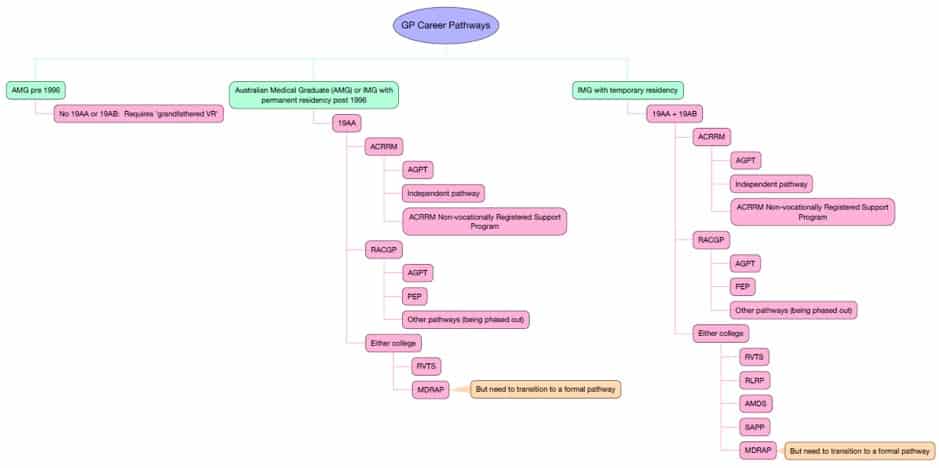
    Your route may seem complex. The following diagram is aimed to assist you in reviewing all the options available to you.

    GP Career Paths

    The options have been simplified to provide guidance so please revise all eligibility criteria prior to planning your approach.  View a pdf of the flowchart here.

    Destination Fellowship.

    Vocational Registration is given to work in General Practice when you have attained a Fellowship with the RACGP or ACRRM.

    The eligibility for each exam depends on your previous experience in General Practice and what pathway you are on. Check the RACGP and ACRRM exam eligibility for your individual circumstance.

    The assessment and Fellowship for the two colleges differ considerably (see table below). ACRRM Fellowship also requires completion of an Advanced Skill (for e.g. Anaesthetics, Obstetrics). Advanced Skills can also be completed as part of a Fellowship of Advanced Rural General Practice (FARGP) with the RACGP.

    RACGP Assessments include:

    • Applied Knowledge Test (AKT)
    • Key Features Paper (KFP)
    • Objective Structured Clinical Examination (OSCE)

    ACRRM Assessments include

    • Procedural Logbook
    • MCQ
    • Multi-source Feedback
    • Case Based Discussion
    • Structured assessments using multiple patient scenarios (StAMPS)
    • Advanced Skill Assessments – StAMPS and/or a Project

    One you have decided that GP is the career for you, it is not only critical to ensure you are on the right pathway, but to map out when you might complete the Fellowship assessments. Many of the doctors that I work with underestimate the degree of difficulty of the assessments. Some sit the exams without adequate preparation as either they ‘will just give it a go to see what it’s like’ or they are pressured to sit due to other factors including AHPRA Registration requirements.

    An unsuccessful exam attempt usually impacts upon personal and professional confidence and makes a huge hole in your hip pocket. RACGP has recently introduced a capping on exam attempts and ACRRM has a strict policy regarding multiple attempts so it is better to plan for success in the first instance.

    Do I need a Trip Advisor?

    If you’re deciding on what journey to take in medicine, Dr Anthony Llewellyn is an experienced health public sector executive, medical educationalist and coach. Contact him at AdvanceMed .

    If you’ve already headed a little way down the Fellowship path (any speciality) and are feeling a bit lost, then a chat with Dr Ashe Coxon at Medical Career Planning might help. Dr Coxon is a GP, Medical Educator and Medical Career Consultant.

    If trudging down the GP Fellowship road, then Medical Education Experts is here to support your journey with individualised coaching and learning resources .   We have a MAP , a GPS System and a Compass that will keep you on track when planning your study for exams.

    Its More Fun To Travel In a Group.

    Find some colleagues to enjoy the ride with, and if you’re feeling a bit lost and confused, ask for some professional advice.

    Useful Resources and Links:

    Related Questions.

    Question: What is General Practice?

    Answer.

    In Australia General Practice is considered to be its own medical specialty. In other countries this specialty might be referred to as either family medicine or primary care medicine.

    According to the RACGP in Australia, a GP:

    • is most likely the first point of contact in matters of personal health;
    • coordinates the care of patients and refers patients to other specialists;
    • cares for patients in a whole of person approach and in the context of their work, family and community;
    • cares for patients of all ages, both sexes, children and adults across all disease categories;
    • cares for patients over a period of their lifetime;
    • provides advice and education on health care
    • performs legal processes such as certification of documents or provision of reports in relation to motor transport or work accidents.

    Question: Can I Be On More Than One 3GA Program At a Time?

    Answer.

    No. You can change from one 3GA program to another but your cannot be on programs simultaneously.

    Question: What Happens After I Complete 10 Years In a District of Workforce Shortage?

    Answer. Basically you are now free to work anywhere you chose in Australia. Its likely by this point that you will also have been able to apply for permanent residency and even citizenship. So you will essentially be the same as every Australian born and trained GP.

  • PLAB to Work in Australia? Alternative or Exemption to AMC Exam?

    PLAB to Work in Australia? Alternative or Exemption to AMC Exam?

    For many international medical graduates (IMGs) the pathway to being registered as a doctor involves the Australian Medical Council exams. But for doctors who have worked in more than one country already there are sometimes other options, such as the PLAB. But you need to be careful that you meet all the required criteria for your PLAB to be recognised.

    Doctors sometimes ask whether the Professional Linguistics Assessment Board (PLAB) is accepted or recognized in Australia. The simple answer to this question is yes. The PLAB will be recognized by the Medical Board of Australia and this will mean that you are not required to sit the AMC exams. You will be able to apply for registration via the competent authority pathway. As a bonus, you will also be exempt having to prove your English language proficiency. However, it is important to check the full requirements. In particular, doctors who complete the PLAB must also complete 12 months of supervised training in the United Kingdom. If you have not completed this training your PLAB will not be accepted.

    Lets dive a little deeper into the requirements of the PLAB. Why it is that the PLAB is accepted in Australia. As well as the other options for not having to undertake the AMC examinations.

    What is the Purpose of the AMC Examination?

    The AMC Examinations are the main route by which doctors from most other countries can apply to become registered as a doctor in Australia. Without medical registration in Australia it is illegal to work as a doctor.

    The AMC exams consist of a written (multiple choice) examination and clinical examination and are set at the equivalent standard as what would be expected of an Australian medical school graduate commencing their first working year in Australia, which is called an internship.

    Australia sets high standards for medical practice and therefore, with a few exceptions, we do not directly recognize the output of medical schools from many countries. So the AMC Examinations have been established as a process for testing the capability of IMGs.

    So Who Needs to Sit AMC Examinations?

    If you have graduated from the United Kingdom, New Zealand, Republic of Ireland, Canada or the United States you are not able to sit the AMC exams. Because you are not required to do so.

    If you are from any other country you are able to sit the AMC examinations. However, if you have specialist qualifications you probably want to try the specialist pathway instead.

    Also, if you are not from the United Kingdom, New Zealand, Republic of Ireland, Canada or the United States. But have worked in the United Kingdom, New Zealand, Canada or the United States. You may also be able to avoid the AMC Exam process and can apply via Competent Authority.

    Notice though we did not say “Republic of Ireland”. If you are an IMG who has worked in the Republic of Ireland before this does not help you avoid the AMC exams.

    Read on.

    The Competent Authority Pathway.

    The Medical Board of Australia recognizes the medical school training systems of the United Kingdom, New Zealand, Republic of Ireland, United States of America and Canada as equivalent to the Australian medical system and therefore does not require medical graduates from these countries to sit additional examinations to prove that they are capable of working as a doctor in Australia.

    New Zealand medical school graduates are treated as identical to Australian graduates. In fact New Zealand Medical Schools are accredited by the Australian Medical Council as well. New Zealand doctors can apply directly for general registration, so long as they have completed an intern year in either Australia or New Zealand.

    Graduates of the UK, Rep Ireland, US and Canada can apply for registration in Australia so long as they have also completed the basic requirements for being registered as a doctor in their country. You will also need a job offer prior to applying for registration. So long as the Medical Board is satisfied that you will be provided with sufficient level of supervision for 12 months you can work under “provisional registration”. Once this period is complete and you have returned satisfactory supervisor reports you will be able to apply for general registration.

    If You Are Not From the UK, US, Ireland, New Zelaand or Canada You Can Still Come Under the Competent Authority Pathway.

    Some doctors work in a range of countries. Countries like the UK and Canada have similar systems to Australia for allowing IMGs to work in Australia.

    So if you have completed any of the following:

    • PLAB in the UK;
    • NZREX in New Zealand;
    • USMLE in US; or
    • LMCC in Canada

    You are also able to apply for registration via the competent authority pathway and can skip the AMC exams.

    However, as mentioned earlier. You do need to do all the steps. One thing that can sometimes catch IMG doctors out is that they have completed all the examination steps of one of these processes BUT NOT completed the supervision steps. So, for example, have not completed a Foundation Year in the UK. Or have not completed 2 years of ACGME accredited training in the United States.

    The Specialist Pathway.

    The Specialist Pathway is for doctors from any country. Competent Authority or Standard Pathway. It enables a doctor to apply to be recognised as a specialist in Australia.

    So its another pathway which avoids the AMC exams. Which in the case of many specialists may be quite daunting as it will have been some time since you have studied such a broad range of medicine.

    Rather than going through the AMC examination process. The specialist pathway places you directly in contact with the specialist colleges. Who do a review of your training, qualifications, and experience to determine whether you are comparable or not. If you are found to be comparable. You will be offered a period of registration to demonstrate your performance and you may also have to sit further specialty examinations.

    Once again, you need a job offer to complete this process.

    If you are not found to be comparable you will have to either sit the AMC examinations or apply for competent authority if that option is available to you.

    I Really Don’t Want To Do The AMC Exams. Are There Any Other Options?

    There is one final option but its not particularly popular as it is time limited, has certain restrictions and is not meant as a mechanism for making a permanent move to Australia.

    This option is called the Short Term Training in a Medical Specialty Pathway. It is an option for gaining either provisional or limited registration for a period of up to 24-months to undertake additional specialty training in Australia. This registration category is generally made available to Advanced Trainees or Junior Consultants from other countries who are looking to augment their training experience.

    And. Once again. You do need a job offer to apply for the registration.

    Barring enrolling in medical school in Australia. There are no other options for not doing the AMC exams.

    Related Questions.

    Question: Do I Need to Do The Foundation Program to Complete the PLAB Requirements for Australia?

    Answer.

    It is generally a good idea if you can successfully complete the 1st Year of the Foundation Program in the UK. Note you only need to complete one year.

    However, if you are unable to do this the Medical Board of Australia will accept alternative evidence that you have worked successfully in similar posts:


    This is the direct quote from the Medical Board documents:

    There are two ways in which you can demonstrate that you meet the ‘12 months supervised training (internship equivalent) in the UK’ component of the eligibility criteria for category A (as per guidance initially provided in August 2015):

    1. Provide evidence of ‘12 months supervised practice/training in an Approved Practice Setting in the UK’. Acceptable evidence would include:
    a. confirmation in writing from the hospital(s) and/or employer(s) that you have satisfactorily completed 12 months supervised practice/training in the UK, and
    b. confirmation in writing from the hospital(s) and/or employer(s) that the practice setting is an ‘Approved Practice Setting’.

    OR

    2. Provide evidence of ‘a minimum of 12 months practice in the UK’2
    . Acceptable evidence would include:
    a. confirmation in writing and/or certificate of service from the hospital(s) and/or employer(s)that you have had a minimum of 12 months practice in the UK.

    You will also need to provide evidence that you have ‘successfully completed the Professional and Linguistic Assessments Board (PLAB) test since 1975’.

    Medical Board of Australia

    Question: Will I Need to do an English Test?

    Answer. This is a complex question. Its probably best to assume that you do. Even if you are coming from an English speaking country. Until you have established that you do not.

    Generally speaking if you can prove that you have been high-schooled in English and studied Medicine in English you will be fine.

    However, there are many circumstances where this has proven to not be the case. Even choosing to work for a small period in another country where English is not the first language can result in you having to sit an English test.

    For doctors who have completed the PLAB and NZREX. The Medical Board will generally exempt you from the need for an English Test. This is because the PLAB and NZREX include an examination of English.

    Question: Can I Count Part of My PLAB or USMLEs Towards the AMC Multiple Choice Examination?

    Answer. No. The AMC will not recognize partial completion of any of these examinations as a proxy for the exam here.

  • Indian Doctors Australia: Jobs, Chances, Salary, Registration.

    Indian Doctors Australia: Jobs, Chances, Salary, Registration.

    Many doctors from India have successfully migrated to work in Australia. Doctors from India were the fourth-highest country to be granted a visa to work as a doctor in Australia in 2017. After the United Kingdom, the Republic of Ireland and Malaysia. As someone who has worked in Medical HR for more than two decades, I have found Indian doctors on the whole to be a really good group of doctors to work with.

    Can Indian doctors work in Australia? The answer is, of course, yes. India provides one of the largest sources of overseas doctors or International Medical Graduates (IMGs) working in Australia at both a trainee doctor as well as specialist level. Of course, no doctor coming from another country is absolutely guaranteed to be able to work in Australia.

    Just like doctors from other countries. Doctors from India are limited in regards to what doctor jobs they can initially apply for in Australia. Once employed you receive the same rates of salary and pay as other doctors, with some possible restrictions on where you can work. Salary packages vary from about $70,000 AUD for a very junior level job to $300,000 AUD and much more for consultant-type positions. There are two main ways that Indian doctors need to either apply for initial registration. Both are quite hard.

    • The Standard Pathway is the process if you are not a specialist. It requires sitting for the Australian Medical Council exams, which have an overall pass rate of about 60% for the MCQ component and 25% for the clinical component.
    • The Specialist Pathway is the process if you are a specialist. Between the years 2015 and 2021, 729 specialist Indian doctors applied to a specialist medical college for assessment. 244 were deemed to not be comparable. 401 were deemed to be partially comparable and only 84 were deemed to be substantially comparable (a 66% rate of being found comparable.

    So the prospects for working in Australia as an Indian doctor are good for many but challenging for some. So it’s important to give you a little bit more detail. There are also other options for getting registered which I will outline.

    So let’s dig into a bit more of the details of the top of Indian Doctors Australia.

    Get a Guide

    A bundle of resources written by a local Australian expert covering how Indian doctors can work in Australia.

    Only $5.70 AUD

    The Standard Pathway. The Option for Trainee Indian Doctors Australia.

    If you are a trainee doctor from India and do not have specialty status then the Standard Pathway is the main option for you.

    The major hurdle in this process is pursuing the Australian Medical Council examinations, which we have written about in more depth here.

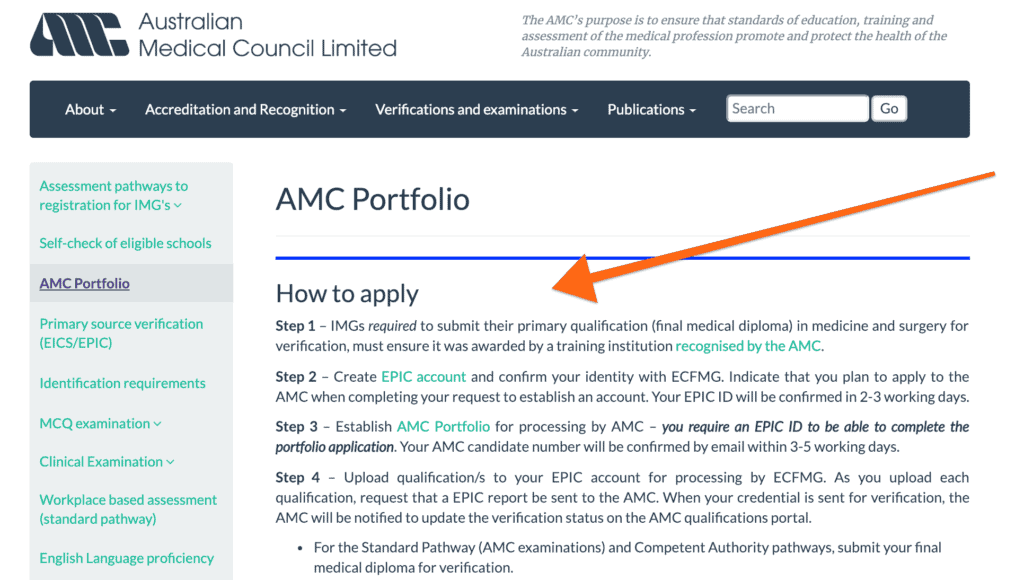
    In order to be able to sit for the AMC, you must first establish what is called a portfolio

    1. You first create a registration with the AMC website.
    2. You should also check that your medical degree is awarded by an institution recognized by the AMC. The AMC recognizes most but not all medical schools which are listed with the World Directory of Medical Schools. There is a handy search on the AMC site.
    3. You must then also create an EPIC account and confirm your identity with the ECFMG (located in the United States).
    4. You get an EPIC id in about 3 working days, which you use to establish your AMC portfolio.
    5. You upload your qualifications to EPIC. As you do so YOU MUST REQUEST that EPIC send a report to the AMC.
    6. EPIC notifies you and the AMC when they have completed their check.

    This whole process will cost you $500 AUD to register with the AMC and about $205 USD for EPIC (more if you are wanting more than one qualification verified).

    Once EPIC reports back in the affirmative to the AMC you will be allowed to request to sit for the AMC Part 1 Examinations.

    There is no actual work experience requirement to sit the AMC Part 1 Examination and you can, in fact, start preparing for this whenever you like. But of course, you will not be able to sit the exam without a verified medical degree. So you can start studying for it in medical school but won’t be able to sit it till after you graduate.

    The Part 1 MCQ Examination

    The AMC Computer Adaptive Test (CAT) MCQ Examination is a computer-administered fully integrated multi-choice question examination delivered in one sitting that lasts 3 and a half hours.

    There are regular invigilated examinations in Australia as well as a number of sessions available in the examination across the world.

    The examination itself consists of 150 “A-type MCQs”. You must select the one correct response from amongst the five options. 120 of the questions are “live” questions, which means they count towards your score. The remaining 30 questions are being piloted and don’t count towards your final score. You do not know which questions are being piloted so you have to give your best for all 150.

    You are expected to complete all 150 items and must complete the 120 scored items. Failure to complete all 120 scored items in the examination may lead to insufficient information for a reliable determination of your ability and therefore a result on the AMC adaptive scale.

    You should practice as many MCQs as you can. There is also an official online practice exam through the AMC website.

    Because the MCQ exam is computerized you will receive your result fairly quickly in about 4 weeks. You get a printout that indicates where you performed overall, as well as the range for all candidates appearing for that particular exam. You also get a breakdown of your performance in the question domains. This is useful if you don’t pass to know where to put your efforts next time.

    You need to score 250 or more to pass. Less than 60% of candidates pass. Although this score is probably depressed somewhat by those candidates sitting more than once.

    It currently costs $2,920 AUD to sit for the MCQ.

    The AMC Clinical Examination Part 2

    Once you pass the AMC MCQ exam, you are then able to appear for the AMC Clinical exam. These are all held in Melbourne at the AMC’s purpose-built examination National Testing Centre or online.

    Clinical Exam Format

    The Clinical exam format is a 20-station multidisciplinary structured clinical exam that assesses your skills in Medicine, Surgery, Gynecology and Obstetrics, Pediatrics, and Psychiatry. There are 14 scored stations, 2 pilot (non-scored) stations and 4 rest (non-scored) stations.

    As of 2019, the result is graded as either a clear pass or a clear fail. Prior to this borderline candidates were offered a retest. However, the AMC found that the time between examination and retest was becoming so long that the results were not meaningful.

    You must pass 10 or more of the stations to pass the exam. The pass rate is incredibly low. About 28%

    It is recommended that you should study the Handbook of Clinical Assessment and practice roleplays as much as you can. You may want to attend a course. Candidates also study different notes such as Karen notes, and the VMPF notes. John Murtagh’s General Practice is also worth revising.

    It is extremely wise to form a study group and there are many groups around where you can practice what is called “recalls”, which is when a candidate who has previously sat the exam attempts to reconstruct the station.

    The cost of sitting the Clinical Examination is currently $3,730 AUD ($400 extra for the online version).

    When and What types of jobs can I apply for as an Indian Trainee?

    You can apply for a range of trainee jobs. The main limitation is whether the employer will accept an IMG. Which for the majority of cases they will not.

    You can actually start applying for jobs after you have passed your AMC Part 1 Examination. But you will need a valid English language test if you do.

    There are often a number of postgraduate year 2 or 3 general jobs on offer. They are generally termed Resident Medical Officers in most States and Territories, but may also be called House Officers or Hospital Medical Officers in some places.

    Above these sorts of posts, come the specialty training positions. In Australia, you tend to enter specialty training around postgraduate year 3. These positions are generally referred to as Registrar positions. But you might also see advertised as Senior House Officer or Trainee or Advanced Trainee.

    One key thing to look out for is that most of these jobs will not accept an overseas applicant.

    A key thing to look for is the phrase “eligible for registration” in the selection criteria.

    It is very important to try and secure an employment offer. Whilst you can apply to the Australian Medical Council to check your primary medical degree at any stage. You won’t be able to gain registration until you have an offer of employment. This is because the Medical Board needs to see a supervision plan from your employer.

    Outside of general practice, the majority of employment opportunities for trainee doctors occur within public hospitals. So your best places for finding suitable job postings are on the State and Territory health department recruitment sites. We have a listing of these on our international doctors’ resource page.

    What Type of Supervision Do I Need Or Get?

    The Medical Board of Australia is very vigilant about supervision standards for IMG doctors. What sort of supervision you receive will depend on a number of factors, including:

    • your qualifications
    • your previous experience, especially in the type of position for which you have applied
    • whether you have practised recently and the scope of your recent practice
    • the requirements of the position including the type of skills required for the position
    • the position itself, including the level of risk, the location of the hospital or practice and the availability of supports (supervisors)
    • the seniority of the position, for a hospital position

    In general, you will either be approved for Level 1 or Level 2 Supervision. There are 4 Levels and the higher up you go the less direct oversight you require.

    Level 1 Supervision.

    Level 1 Supervision requires your supervisor (or alternative supervisor) to be present in the hospital or practice with you at all times and you must consult with them about all patients. This is the level of supervision that most Indian doctors will receive Remote supervision (e.g. by telephone) is not permitted. This type of supervision is generally recommended when you are very junior yourself or entering a junior role which you are not very familiar with. In Australian major public hospitals, there are many layers of other doctors who you can get supervision from. So Level 1 is not too much of an issue in these circumstances.

    Level 2 Supervision.

    Level 2 Supervision, is what most other Indian trainees approved to work in Australia will be approved for. It is a step up from Level 1 Supervision. Supervision must primarily be in person but your supervisor can leave you to do work on your own and you can discuss it by phone. You should discuss with them on a regular (daily) basis what you have been doing with patients. But do not need to discuss every case.

    Level 3 Supervision.

    Level 3 Supervision, is what you might receive if you are working in an Advanced Trainee role in India and transferring to something similar in Australia. In this case, you have much more primary responsibility for the patient. Your supervisor needs to make regular contact with you but can be working elsewhere and available by phone or video.

    What happens after I commence my position?

    Once you are approved for registration and you have your visa issues sorted you will be able to commence work. Your employer should help you out with all these things. You will be working under what is called “provisional registration” by the Medical Board of Australia. Generally, all you need to do for these 12 months is to show that you can learn and grow and get regular feedback from your supervisors. Your supervisors will need to complete regular reports for the Medical Board of Australia and it is your responsibility, not theirs to see that they are completed and returned on time. If all the reports go well you will be able to be recommended at the end of the 12 months for general registration.

    The other thing that you need to watch out for is that your employer is ensuring that you gain exposure to the types of experiences that the Medical Board requires for this year. Generally, these shadow the experience that Australian interns go through.

    Depending on whether you have completed AMC Part 2 or not. You will need to try and sit and pass this in these 12 months. Although you may be able to get an extension.

    If you are lucky enough you may be employed in one of the 20 or so health services which offer Workplace-based assessment as an alternative to the AMC Clinical exam. Candidates find this process far easier to complete.

    You will probably be starting to look for another job or negotiating an extension around the end of your 12 months. With general registration, you may be able to apply for a skilled visa, as well as be looking at applying for permanent residency.

    Permanent residency is crucial for applying for most specialty training programs. See below.

    indian doctor australia

    The Specialist Pathway. The Option For Specialist Indian Doctors Australia.

    For Indian specialists, your option for working in Australia is what is called the Specialist Pathway.

    Once again this starts with becoming verified as a doctor with the Australian Medical Council and should again coincide with an active search for a position.

    You may be lucky enough to be in a targeted specialty area where you might successfully be approved for what is called an Area of Need position, in which case the employer or recruitment agent will provide you with a lot of support and will likely pick up the costs of being assessed.

    For most International Doctor specialists however these days you will be approaching the college directly to be assessed for specialist recognition. This is not something to be trifled with. The paperwork requirements and the cost (generally around $10,000 AUD or more) is considerable.

    On the plus side, the colleges all have reasonably helpful information on their websites, including the application forms and a little bit about their criteria for assessment.

    Finding Out What You Need To Do.

    We have saved you the trouble of finding those pages by putting them on our International Doctors resource page here.

    The majority of Indian specialties (but not all) map to a similar college or specialty in Australia. So working out which specialty goes into which Australian college is generally not too confusing. We have put together a summary of the Australian specialist medical colleges here.

    After you go through your specialist assessment you are given an outcome.

    As I have noted the majority of cases for Indian specialists are either deemed not comparable or substantially comparable.

    If you are deemed not to be comparable by the college. This means you cannot directly become a specialist in Australia. You will probably have to go through the standard pathway to work as a doctor in Australia.

    If you are deemed to be partially comparable (a situation where this commonly may occur is if you have just recently finished specialty training but have not worked as a specialist for very long). In this situation you will need to work under supervision for longer and may well also face some formal examinations.

    Substantially comparable is the best result. This essentially means that you will need to work under some form of peer review for up to 12 months and so long as your reports are satisfactory you will be recommended for specialist registration at the end.

    How to Maximize Your Chances of Getting a Substantially Comparable Outcome.

    To ensure that you are seen as substantially comparable by the relevant college I would recommend the following:

    • You should have your Certificate of Completion of Training and relevant college Fellowship
    • You should ideally have worked substantively at a Consultant level in your field for 3 years or more
    • You should be able to demonstrate good standing with your Medical Board and your employers
    • You should be able to demonstrate ongoing continuing professional development
    • You should prepare for your interview with the college as if it were an important job interview

    Can you enter training in Australia if you are an Indian doctor?

    To undertake formal specialty training in Australia you need to be accepted into a college training program. In all circumstances, you will need general registration and in some cases permanent residency or citizenship.

    After receiving your general registration you can apply for specialty training in the same way that Australian-trained doctors do. And if accepted will go through the exact training program and experience. Some colleges may offer recognition of prior learning for any training you have done already. But this is often quite limited and may at best normally shave one year off of your training.

    An Alternative But Limited Option.

    There is an alternative but time-limited pathway for Indian doctors who are just seeking a short-term experience in Australia to add to their training in India. This is called the Short-Term Training in a Medical Specialty Pathway. To do this you must be offered a training position first and you must have either completed your training in India or be less than two years from completion. So this is a program mainly for early career specialists or advanced trainees.

    In this pathway you go through the same steps with the AMC as per the competent authority pathway to gain registration. You will not, however, be able to apply for specialist assessment as part of this pathway. But if you gain general registration you may then be able to apply for another position and then apply for specialist assessment.

    Can you do your internship in Australia as an Indian doctor?

    Basically no. Internship in Australia is a provisional year that only applies to medical graduates from medical schools in Australia and New Zealand. There is a “loophole” which only applies to doctors who have not been able to complete an internship or equivalent in their own country. But the Medical Board warns that this is not a great option and is only granted in limited cases. You are far better off completing the requirements for general registration in India.

    How many Indian doctors are working in Australia?

    There is no one public data source to tell us how many Indian doctors are currently working in Australia.

    From data collected by the Australian Government, we know that:

    • 171 working visas were granted to Indian doctors to work in Australia in the year 2017.
    • 729 applications were made for specialist assessment, of which 244 were deemed not comparable, 401 partially comparable and only 84 substantially comparable (2015-2021).

    How hard is it to become a specialist in Australia if you are from India?

    As we have noted. Many Indian doctors struggle to gain recognition as a specialist. This normally occurs in the first step. The initial specialist college assessment. Once Indian doctors are granted comparability. Most go on to complete the process.

    Are there any particular specialties that are easier to apply for?

    The majority of specialties have some vacancies and will provide opportunities for Indian and other IMG doctors from time to time. This is particularly the case if you are prepared to go outside of the major cities. Some areas of medicine are more popular and so finding jobs in areas such as most surgical fields, as well as other fields such as cardiology can be quite difficult.

    On the other end of the spectrum general practice, psychiatry and most parts of critical care medicine are often always looking for doctors.

    Costs of Moving To Australia and Working As a Doctor.

    There are lots of costs to consider when thinking about moving to Australia to work as a doctor.

    There are some direct costs to consider. Most of which relate to the bureaucratic process of being assessed and gaining registration.

    Some of the costs you may be up for, include:

    AUD (unless otherwise noted)
    Establish a Portfolio with the Australian Medical Council$600
    Registering with EPIC and having one primary degree checked $125 USD + $80 USD
    Medical Board Application Fee for Provisional Registration$430
    Medical Board Application Fee for Specialist or General Registration $860
    College Specialist Assessment Fees$6,000-$11,000
    College Placement Fees (for the period of supervision)$8,000-$24,000

    Further, if you are required to undertake further exams there will be a cost for this as well. As an example, RACS charges exam fee is $8,495.

    The Cost of Your Time and Effort.

    Adding to all of this financial cost, you will need to factor in the cost of your own time. It takes a lot of effort and persistence to deal with the paperwork and track down the records you need.

    In addition, you are probably going to have to pay costs in your own country for things like records of schooling and certificates of good standing.

    There are also visa costs.

    And then there is the cost of airfares and transporting your belongings halfway across the world.

    Depending on where you work in Australia you may find that the cost of living is higher or lower than you are used to. House prices and therefore house rental rates have gone through the roof in Australia in the last decade or so but are starting to come down.

    You will probably have to factor in some initial extra hotel or short-term rental charges whilst settling in and you may find if you have children that you have to pay to enrol them in school as public schooling is only generally free if you are a citizen or permanent resident.

    If you are lucky and in one of the specialty areas of demand your employer may offer to pay for some of these costs. It’s certainly worth asking about it.

    The Competent Authority Pathway. An Option For Some Indian Doctors.

    If you have already worked in the United Kingdom, Canada or the United States then you may be able to apply to work in Australia under what is called the competent authority pathway.

    The competent authority pathway assigns a preferential status to any doctor who has completed their primary medical training in one of the following countries: the United Kingdom, Canada, the United States and the Republic of Ireland.

    There is largely an historical rationale for this situation. It is based on the premise that all these jurisdictions have similar approaches to medical school training and similar standards.

    New Zealand is not included in the list above as its medical schools are accredited by the same body as Australian medical schools, the Australian Medical Council. So doctors from New Zealand in Australia are generally treated identically to those from Australia.

    If you are an international medical graduate and you have achieved general registration in the United States, Canada or the United Kingdom (but not the Republic of Ireland) you are also eligible for the competent authority pathway.

    What are the steps involved for the competent authority pathway?

    You can find out more about the competent authority pathway on the Medical Board of Australia website.

    The key steps are as follows:

    1. Securing an employment offer
    2. Applying to the Australian Medical Council for primary source verification
    3. Applying for registration to the Medical Board of Australia
    4. Completing 12 months of supervised practice
    5. Applying again to the Medical Board of Australia for general registration.

    Eligibility for Competent Authority

    You can do a “self-assessment of your eligibility for the competent authority pathway on the Medical Board of Australia website here.

    The essential requirements for Indian doctors applying via the competent authority pathway are:

    You need to have completed the appropriate process in Canada, the United States or the United Kingdom to become fully registered in that country. This involves an assessment of your English language skills, examinations and a period of supervised training.

    So for example, if you have worked in the United Kingdom, you need to successfully complete the Professional and Linguistic Assessments Board (PLAB) test

    AND

    Successfully complete the Foundation Year 1, or 12 months supervised training (internship equivalent) in the United Kingdom, or 12 months supervised training (internship equivalent) completed in another Medical Board Australia approved competent authority country, approved by the GMC.

    Conclusion.

    We hope that you found this summary about how Indian doctors can work in Australia useful. If you have any questions or queries or just want to relate your experience. Please feel free to leave a comment below. We would love to hear from Indian doctors who have made the journey to Australia.

    Related Questions.

    Question: Are there any other options for working as an Indian doctor in Australia?

    Answer.
    Some doctors just want to come to Australia for a limited period of time as an opportunity to train in another country.
    As we have highlighted above there is an alternative but time-limited pathway for Indian doctors who are just seeking a short-term experience in Australia to add to their training in India. This is called the Short-Term Training in a Medical Specialty Pathway. To do this you must be offered a training position first and you must have either completed your training in India or be less than two years from completion. So this is a program mainly for early career specialists or advanced trainees.

    Question: Should I use a medical recruitment company if I am considering working in Australia?

    Answer.
    It is possible to deal directly with employers in Australia as an Indian doctor. In general, however, when moving from one country to another most doctors find it useful to engage with a medical recruitment company as they can tend to take some of the stress out of the planning for you and help with all the paperwork and negotiating with prospective employers. Some medical recruitment companies also provide migration services and relocation services as well. We have written more on this subject here. And a list of medical recruitment companies is available here.
    Unfortunately, for most Indian doctors medical recruitment companies will be unlikely to be able to help you until you have either achieved general registration via the Standard Pathway or possibly until you have received a favourable outcome via the specialist pathway process.
    See more about the pros and cons of medical recruitment companies here.
  • UK Doctors Australia: Job Prospects, Registration & Costs.

    UK Doctors Australia: Job Prospects, Registration & Costs.

    Any doctor who has worked for more than a few months in Australia will likely have worked alongside a UK doctor who has decided to work in Australia. Whether this is for a short-term working holiday or a permanent move. As someone who has worked in Medical HR for more than two decades, I have found that UK doctors on the whole to be a really good group to work with. So let’s talk about UK Doctors Australia.

    Can UK doctors work in Australia? The answer is, of course, yes. The United Kingdom provides the largest source of overseas doctors or International Medical Graduates (IMGs) working in Australia. Of course, no doctor coming from another country is absolutely guaranteed to be able to work in Australia.

    But because the UK medical training system is recognized by the Medical Board of Australia as being on par, UK doctors have good success with either becoming generally registered through what is called the competent authority pathway or being recognized as a specialist through the specialist pathway. In 2017 (the latest year we have figures for) 430 UK doctors were recommended for specialist registration, with many more achieving general registration.

    So the prospects for working in Australia as a UK doctor are extremely good. But it’s important to give you a little bit more detail. As I have highlighted there are two main options for getting registered. So we will talk about these first and then go into some other common questions.

    The Competent Authority Pathway. The Option For Trainee UK Doctors Australia.

    If you are a trainee doctor in the UK. Then you are looking at the competent authority pathway for working in Australia.

    The competent authority pathway assigns a preferential status to any doctor who has completed their primary medical training in one of the following countries: the United Kingdom, Canada, the United States, and the Republic of Ireland.

    There is largely a historical rationale for this situation. It is based on the premise that all these jurisdictions have similar approaches to medical school training and similar standards.

    New Zealand is not included in the list above as its medical schools are accredited by the same body as Australian medical schools, the Australian Medical Council. So doctors from New Zealand in Australia are generally treated identically as those from Australia.

    If you are an international medical graduate and you have achieved general registration in the United States, Canada, or the United Kingdom (but not the Republic of Ireland) you are also eligible for the competent authority pathway.

    What are the steps involved for the competent authority pathway.

    You can find out more about the competent authority pathway on the Medical Board of Australia website.

    The key steps are as follows:

    1. Securing an employment offer
    2. Applying to the Australian Medical Council for primary source verification
    3. Applying for registration to the Medical Board of Australia
    4. Completing 12 months supervised practice
    5. Applying again to the Medical Board of Australia for general registration.

    Eligibility for Competent Authority

    You can do a “self-assessment of your eligibility for the competent authority pathway on the Medical Board of Australia website here.

    The essential requirements are:

    You need to be a graduate of a medical course conducted by a medical school in the United Kingdom which is accredited by the General Medical Council

    AND

    Successfully complete Foundation Year 1, or complete 12 months supervised training (internship equivalent) in the United Kingdom, or complete 12 months supervised training (internship equivalent) another Medical Board of Australia approved competent authority country, which is also approved by the GMC.

    OR if you are an IMG who has been working in the United Kingdom you need to

    Successfully complete the Professional and Linguistic Assessments Board (PLAB) test

    AND

    Successfully complete the Foundation Year 1, or 12 months supervised training (internship equivalent) in the United Kingdom, or 12 months supervised training (internship equivalent) completed in another Medical Board Australia approved competent authority country, approved by the GMC.

    For this reason, doctors who have completed medical school in another European Union country are often unable to get registered in Australia via working in the United Kingdom as they are often not required to complete the PLAB.

    What types of jobs can I apply for as a UK Trainee?

    You can pretty much apply for any sort of trainee job. There are often a number of postgraduate year 2 or 3 general jobs on offer. They are generally termed Resident Medical Officer in most States and Territories, but may also be called House Officer or Hospital Medical Officer in some places.

    Above these sorts of posts, come the specialty training positions. Australia’s specialty training system is fairly much in parallel with the United Kingdom. So you tend to enter specialty training around postgraduate year 3. These positions are generally referred to as Registrar positions. But you might also see advertised as Senior House Officer or Trainee or Advanced Trainee.

    One key thing to look out for is that most of these jobs will not accept an overseas applicant.

    A key thing to look for is the phrase “eligible for registration” in the selection criteria.

    It is very important to try and secure an employment offer. Whilst you can apply to the Australian Medical Council to check your primary medical degree at any stage. You won’t be able to gain registration until you have an offer of employment. This is because the Medical Board needs to see a supervision plan from your employer.

    Outside of general practice, the majority of employment opportunities for trainee doctors occur within public hospitals. So your best places for finding suitable job postings are on the State and Territory health department recruitment sites. We have a listing of these on our international doctors’ resource page.

    What Type of Supervision Will I Need Or Get?

    The Medical Board of Australia is very vigilant around supervision standards for IMG doctors. What sort of supervision you receive will depend on a number of factors, including:

    • your qualifications
    • your previous experience, especially in the type of position for which you have applied
    • whether you have practiced recently and the scope of your recent practice
    • the requirements of the position including the type of skills required for the position
    • the position itself, including the level of risk, the location of the hospital or practice and the availability of supports (supervisors)
    • the seniority of the position, for hospital position

    In general, you will either be approved for Level 1 or Level 2 Supervision. There are 4 Levels and the higher up you go the less direct oversight you require.

    Level 1 Supervision.

    Level 1 Supervision requires your supervisor (or alternative supervisor) to be present in the hospital or practice with you at all times and you must consult with them about all patients. Remote supervision (for e.g. by telephone) is not permitted. This type of supervision is generally recommended when you are very junior yourself or entering a junior role with which you are not very familiar with. In Australian major public hospitals, there are many layers of other doctors from who you can get supervision from. So Level 1 is not too much of an issue in these circumstances.

    Level 2 Supervision.

    Level 2 Supervision, which is what most UK trainees approved to work in Australia will normally be approved for is a step up from Level 1 Supervision. Supervision must primarily be in person but your supervisor can leave you to do work on your own and you can discuss by phone. You should discuss with them on a regular (daily) basis what you have been doing with patients. But do not need to discuss every case.

    Level 3 Supervision.

    Level 3 Supervision, is what you might receive if you are working in an Advanced Trainee role in the UK and transferring to something similar in Australia. In this case, you have much more primary responsibility for the patient. Your supervisor needs to make regular contact with you but can be working elsewhere and available by phone or video.

    What happens after I commence my position?

    Once you are approved for registration and you have your visa issues sorted you will be able to commence work. Generally, your employer helps you out with all these things. You will be working under what is called “provisional registration” by the Medical Board of Australia.

    Generally, all you need to do for these 12 months is to pay attention, show that you can learn and grow and get regular feedback from your supervisors. Your supervisors will need to complete regular reports for the Medical Board of Australia and it is your responsibility, not theirs to see that they are completed and returned on time. If all the reports go well you will be able to be recommended at the end of the 12 months for general registration.

    You will probably be starting to look for another job or negotiating an extension around this time. With general registration, you may be able to apply for a skilled visa, as well as be looking at applying for permanent residency.

    Permanent residency is crucial for applying for most specialty training programs. See below.

    The Specialist Pathway. The Option For UK Specialists

    For UK specialists your option for working in Australia is what is called the Specialist Pathway.

    Once again this starts with becoming verified as a doctor with the Australian Medical Council and should again coincide with an active search for a position.

    You may be lucky enough to be in a targeted specialty area where you might successfully be approved for what is called an Area of Need position, in which case the employer or recruitment agent will provide you a lot of support and will likely pick up the costs of being assessed.

    For most International Doctor specialists however these days you will be approaching the college directly to be assessed for specialist recognition. This is not something to be trifled with. The paperwork requirements and the cost (generally around $10,000 AUD or more) are considerable.

    On the plus side, the colleges all have reasonably helpful information on their websites, including the application forms and a little bit about their criteria for assessment.

    Finding Out What You Need To Do.

    We have saved you the trouble of finding those pages by putting them on our International Doctors resource page here.

    The majority of UK specialties (but not all) map to a similar college or specialty in Australia. So working out which specialty goes into which Australian college is generally not too confusing. We have put together a summary of the Australian specialist medical colleges here.

    After you go through your specialist assessment you are given an outcome.

    In the majority of cases for UK specialists, you will be deemed substantially comparable. This essentially means that you will need to work under some form of peer review for up to 12 months and so long as your reports are satisfactory you will be recommended for specialist registration at the end.

    Occasionally UK specialists are deemed to be partially comparable (a situation where this may occur is if you have just recently finished specialty training but have not worked as a specialist for very long). In this situation, you will need to work under supervision for longer and may well also face some formal examinations.

    Rarely are UK specialists deemed not to be comparable by the college. This only happened to 6 out of 409 UK doctors in 2017 (less than 1%). If you are deemed to be not comparable, this means you cannot directly become a specialist in Australia. You will probably have to go through the competent authority route and re-enter training in Australia.

    How to Maximize Your Chances of Getting a Substantially Comparable Outcome.

    To ensure that you are seen as substantially comparable by the relevant college I would recommend the following:

    • You should have your Certificate of Completion of Training and relevant college Fellowship
    • You should ideally have worked substantively at a Consultant level in your field for 3 years or more
    • You should be able to demonstrate good standing with the GMC and your employers
    • You should be able to demonstrate ongoing continuing professional development
    • You should prepare for your interview with the college as if it were an important job interview

    Can you enter training in Australia if you are a UK doctor?

    To undertake formal specialty training in Australia you need to be accepted into a college training program. In all circumstances, you will need general registration and in many cases permanent residency or citizenship.

    After receiving your general registration UK doctors can apply for specialty training in the same way that Australian trained doctors do. And if accepted will go through the exact training program and experience. Some colleges may offer recognition of prior learning for any UK training you have done already. But this is often quite limited and may at best normally shave one year off of your training.

    An Alternative But Limited Option.

    There is an alternative but time-limited pathway for UK doctors who are just seeking a short-term experience in Australia to add to their training in the UK. This is called the Short Term Training in a Medical Specialty Pathway. To do this you must be offered a training position first and you must have either completed your training in the UK or be less than two years from completion. So this is a program mainly for early-career specialists or advanced trainees.

    In this pathway, you go through the same steps with the AMC as per the competent authority pathway to gain registration. You will not, however, be able to apply for specialist assessment as part of this pathway. But if you gain general registration you may then be able to apply for another position and then apply for specialist assessment.

    Can you do your internship in Australia as a UK doctor?

    Basically no. Internship in Australia is a provisional year that only applies to medical graduates from medical schools in Australia and New Zealand. There is a “loophole” that only applies to doctors who have not been able to complete an internship or equivalent in their own country. But the Medical Board warns that this is not a great option and is only granted in limited cases. You are far better off applying for the Foundation Program in the UK and completing at least Foundation Year 1.

    How many UK doctors are working in Australia?

    There is no one public data source to tell us how many UK doctors are currently working in Australia.

    From data collected by the Australian Government, we know that for 2017 (latest available year):

    • 718 applications were made for provisional registration via the competent authority pathway by UK doctors with 701 granted provisional registration
    • An additional 43 applications were made for provisional registration via the competent authority pathway by doctors who had completed the PLAB in the UK, with 31 being granted provisional registration
    • 409 applications were made for specialist assessment, only 6 of which were deemed not comparable, 36 partially comparable and 367 substantially comparable.
    • 430 UK doctors were recommended for specialist recognition with 12 not being recommended

    How hard is it to become a specialist in Australia if you are from the UK?

    Specialist doctors from the United Kingdom are not automatically granted specialist recognition. However, most are. As you can see from above in 2017 there were 409 applications made for specialist assessment to the Australian colleges by UK doctors and of these, the majority were deemed substantially comparable.

    UK doctors tend to get a very favourable outcome in comparison to doctors from most other countries. The UK has generally the highest rate for doctors being seen as substantially comparable. Even when comparing to the other competent authority countries of the United States, Canada and the Republic of Ireland.

    We hope that you found this summary about how UK doctors can work in Australia useful. If you have any questions or queries or just want to relate your experience. Please feel free to leave a comment below. We would love to hear from UK doctors who have made the journey to Australia.

    Are there any particular specialties that are easier to apply for?

    The majority of specialties have some vacancies and will provide opportunities for the UK and other IMG doctors from time to time. This is particularly the case if you are prepared to go outside of the major cities. Some areas of medicine are more popular and so finding jobs in areas such as most surgical fields, as well as other fields such as cardiology can be quite difficult.

    On the other end of the spectrum general practice, psychiatry and most parts of critical care medicine are often always looking for doctors.

    Costs of Moving To Australia and Working As a Doctor.

    There are lots of costs to consider when thinking about moving to Australia to work as a doctor.

    There are some direct costs to consider. Most of which relate to the bureaucratic process of being assessed and gaining registration.

    Some of the costs you may be up for, include:

    AUD (unless otherwise noted)
    Establish Portfolio with Australian Medical Council$500
    Registering with EPIC and having one primary degree checked $125 USD + $80 USD
    Medical Board Application Fee for Provisional Registration$382
    Medical Board Application Fee for Specialist or General Registration $764
    Medical Board Provisional Registration Fee$382
    Medical Board General or Specialist Registration Fee$764
    College Specialist Assessment Fees$6,000-$11,000
    College Placement Fees (for a period of supervision)$8,000-$24,000

    Further, if you are required to undertake further exams there will be a cost for this as well. As an example, RACS charges an exam fee is $8,495.

    The Cost of Your Time and Effort.

    To all of this cost, you will need to factor in the cost of your own time. It takes a lot of effort and persistence to deal with the paperwork and track down the records you need.

    In addition, you are probably going to have to pay costs in your own country for things like records of schooling and certificates of good standing.

    There are also visa costs.

    And then there is the cost of airfares and transporting your belongings halfway across the world.

    Depending on where you work in Australia you may find that the cost of living is higher or lower than you are used to. House prices and therefore house rental rates have gone through the roof in Australia in the last decade or so but are starting to come down.

    You will probably have to factor in some initial extra hotel or short-term rental charges whilst settling in and you may find if you have children that you have to pay to enroll them in school as public schooling is only generally free if you are a citizen or permanent resident.

    If you are lucky and in one of the specialty areas of demand your employer may offer to pay for some of these costs. It’s certainly worth asking about it.

    UK doctors Australia

    Related Questions.

    Question: Are there any other options for working as a UK doctor in Australia?

    Answer. The Competent Authority Pathway and the Specialist Pathway are the only two pathways for UK doctors to work in Australia.

    Question: Should I use a medical recruitment company if I am considering working in Australia?

    Answer. It is possible to deal directly with employers in Australia as a UK doctor. In general, however, when moving from one country to another most doctors find it useful to engage with a medical recruitment company as they can tend to take some of the stress out of the planning for you and help with all the paperwork and negotiating with prospective employers. Some medical recruitment companies also provide migration services and relocation services as well. We have written more on this subject here. And a list of medical recruitment companies is available here.

  • Medical Recruitment Agencies: Should You Use One? Independent Review

    Medical Recruitment Agencies: Should You Use One? Independent Review

    A question I am often asked by other doctors is when is a medical recruitment agency a good idea. Not surprisingly when you google this topic you get a list of articles written by medical recruitment agencies so I felt it would be useful to add an independent perspective.

    Some of the key reasons you may want to use a medical recruitment agency, also known as a locum company, include:

    • obtaining short term work (otherwise known as locum work), recruitment agencies are adept at filling gaps in hospital rosters and negotiating better rates on your behalf;
    • to gain access to a more extensive list of permanent roles and opportunities, recruitment agents can help to cut down your own effort in the job search; and
    • to help you find a doctor job opportunities in another location, for example relocating to another country, many recruitment agents will provide a comprehensive set of services that include assisting with obtaining the job, handling the regulatory and visa paperwork and even relocation services.

    A quick reminder that if you are considering working with a medical recruitment agency. We do appreciate if you reach out to AdvanceMed first as we will be able to guide you. And if it does make sense to work with a medical recruitment agency, AdvanceMed may receive a referral fee, which helps us to continue to produce free content, such as this blog post.

    So what are the circumstances where you would probably not wish to use a recruitment agency? Let’s examine these before going into more detail about the advantages of recruitment agencies.

    When Is It Not Helpful To Use a Medical Recruitment Agent?

    The simple answer to the above question is to consider the economic concept of supply and demand. Medical Recruitment Agencies are companies that specialise in finding candidates for hospitals and health services. They are normally called upon when the hospital and health service has exhausted all its usual recruitment strategies and tactics. There is one particular exception to this which will discuss shortly.

    But for the most part, you can now see the sorts of scenarios where a recruitment agency can be useful to a hospital or health service and therefore also a smart move for the doctor themselves.

    If, however, the hospital or health service is not having difficulty attracting candidates for jobs then it is generally not useful to go through a medical recruitment agent. And, in fact, it can possibly hurt your chances.

    Let me explain.

    If, as is often the case, a hospital advertises a post for a basic unaccredited surgical trainee role for 6-months as part of an activity to cover a gap in its roster of trainees. Then that hospital is likely to get a number of applications, including from trainee doctors already working in the hospital who are keen to get their first job working in surgery. If you apply for this job via an agency it will cost the hospital an additional premium on top of your wages to hire you. Because this is how recruitment agencies make money. So it’s likely that you might be overlooked for an interview just because of this.

    So the sorts of situations where its wiser to apply directly to hospitals and health services in Australia, include:

    • Applying for general entry level jobs, such as Resident Medical Officer and House Officer roles, particularly if you are an International Medical Graduate, as you will be competing against a number of other candidates;
    • Jobs you are already aware of in your local network; and
    • Jobs you have already been invited to apply for.

    As indicated above. Some International Medical Graduates, in particular, will find that medical recruitment agencies may either be unwilling to accept them or provide little support. Particularly, if you are going via the standard pathway to registration. You can see that this makes business sense from the medical recruitment agency. The odds of successfully placing an IMG who has the AMC Part 1 exam and no permanent residency or citizenship are extremely low.

    Similarly, many Specialist IMGs (SIMGs) may find that medical recruitment agencies are unable to help or support until after you receive a favourable college specialist assessment.

    What Sort Of IMGs Are The Medical Recruitment Agencies In Australia Interested In?

    You can best tell what sort of IMGs the recruitment agencies in Australia are interested in by looking at the types of jobs that they advertise.

    It basically boils down to three key criteria:

    • what area of medicine you would like to work in;
    • what country you have trained in; and
    • where you are prepared to work.

    Areas of Medicine That Often Require IMGs

    There are generally always gaps in most areas of medicine in a country like Australia, particularly in rural or regional areas. Areas such as general practice, psychiatry, and emergency or critical care medicine are often in high demand for additional staff. This is because there is quite a high demand for these specialties and this demand often outstrips their popularity amongst doctors.

    As a broad rule the more “general” you are in your skills or interests as a doctor the more likely you are to find employment. As an example, a general physician is likely to have many more opportunities than a cardiologist. And a general surgeon has more opportunities than a cardiothoracic surgeon.

    In addition specialties and subspecialties where procedures are performed generally have an oversupply of doctors in Australia. This partly reflects a similar situation in other countries. But also partly reflects that the remuneration available for performing procedures outstrips consulting activities.

    Preferred Countries

    Medical Recruitment Agencies will prefer to work with doctor candidates from the following countries:

    • New Zealand
    • United Kingdom
    • Republic of Ireland
    • United States of America
    • Canada

    Doctors from New Zealand have almost the same status as Australia and can easily obtain registration. Doctors from the UK, Republic of Ireland, US, and Canada are able to more easily gain general registration through the competent authority process. Specialists from these countries also find that they are more easily able to progress through the specialist registration process.

    As an example, doctors from the UK dominate the number of doctors who apply for specialist registration each year. In 2017 252 UK doctors out of a total of 309 doctors applied for special recognition as a GP. We don’t know how many were deemed comparable in General Practice but we do know that overall 99% of UK doctors who applied for specialist recognition were deemed either partial or substantially comparable. With 89% being deemed substantially comparable.

    So, as a medical recruitment agency, armed with that knowledge you will obviously see a UK doctor as a “good bet” to gain registration and therefore worth working with.

    Where Are You Prepared To Work?

    The other consideration taken into account is where you would like to work in Australia. The highest proportion of vacancies for medical jobs is generally the inverse of where the population centers are. So if you are prepared to work in remote and rural areas you are likely to have several employers interested in you. Whereas, if you want to work in the heart of Sydney you are going to struggle.

    So the ideal IMG candidate from a recruitment agency would probably be an experienced General Practitioner from the United Kingdom looking to relocate to Australia to a small town for family and lifestyle reasons.

    And the ideal non-candidate from a recruitment agency would probably be an IMG with only a primary medical degree, from a non-competent authority country, who has passed AMC Part 1 (but not 2) and is only prepared to work in a capital city.

    Using Medical Recruitment Agencies For Locum (Short Term) Work

    We have spent a fair bit of time so far talking about International Medical Graduates and medical recruitment agencies but of course, medical recruitment agencies also work with doctors with established qualifications and registration in Australia.

    Working short term jobs is generally referred to as doing a “locum”, which comes from the Latin locum tenens, a phrase that means “to hold the place of, to substitute for.” 

    This can be a great option for both trainee doctors as well as specialist doctors. Some of the advantages of locumming include:

    • you are generally paid at a much higher rate than if you are working for the hospital or service that you are filling in for;
    • you can take breaks between locum shifts to do other things like study or go on a holiday;
    • you can select between opportunities;
    • you can try out different jobs and different places.

    Possibly one of the best reasons I have seen for doctors to do a locum is when they have just completed their specialist training and are wanting to try out different locations and services where they might want to take up a more permanent position.

    But there are also potential downsides to locumming. Firstly, whilst you can to some extent pick and choose what you do. If you are too choosy then you might start to not get offered any shifts. Secondly, the types of locum jobs on offer might not exactly be in the field of medicine you want to practice and you might have to take on other roles. Thirdly, with extra pay also generally comes the expectation that you are able to work at a higher capacity and level of responsibility with very little orientation or training and this might push you past your comfort zone. Finally, if you are a trainee doctor locumming then you will have to consider how you prove to the Medical Board that you have been maintaining your professional development.

    Using Medical Recruitment Agencies To Expand Your Access To Jobs

    Medical Recruitment agencies can also be useful options for busy doctors who would like assistance in finding permanent jobs. With some agencies, you can just sign up and indicate that you are looking for jobs in certain specialties and certain areas and wait until they have identified one for you.

    Now in most cases, if you have the time to look for yourself you can probably identify these vacancies. But an agency might cut down that work for you and also help you to get your application in early and serve you up to the employer as what is called a “hot prospect”. That’s a candidate that potentially has other offers. Which normally motivates the employer to want to speak to you.

    Sometimes medical recruitment agencies are directly employed by hospitals and health services to identify candidates. This is commonly referred to as “headhunting.” In this case, it is unlikely that the position is being widely advertised or possibly that it has been advertised previously.

    This approach is generally used in one of two cases and mostly for senior medical practitioner posts.

    Firstly, the hospital or service may have a critical doctor leadership position that they are trying to fill and want to spend some extra money to ensure that they can find a great candidate or hopefully more than one great candidate.

    Secondly, the hospital or service may have critical long-term vacancies that they have struggled to fill in the normal ways.

    In both these circumstances, the agency is really your only route to applying for the job.

    But you do not necessarily need to be registered for the vacancy. Often times the agency will seek you out. Most often via social media profiles. This is another good reason to start a LinkedIn profile by the way.

    Using Medical Recruitment Agencies To Relocate

    If you are from another country and looking to secure a position in Australia. And you are in a preferred category. Then going with a medical recruitment company may make a lot of sense. It is quite possible to gain a specialty position in Australia as a SIMG and often time the hospitals or health services will provide a lot of assistance. But a medical recruitment company can also make the process a bit easier for you by streamlining the process, handling some of the paperwork for you, and, of course, negotiating on your behalf.

    The same can go if you are just moving between places in Australia. Although I haven’t seen a lot of specialists who are already registered and working in Australia using medical recruitment agencies to move States, particularly since we brought in a national medical registration system.

    How To Pick A Good Medical Recruitment Agency

    I’d be interested in getting feedback from other readers in the comment sections below about how they have gone about picking medical recruitment agencies.

    There is no formal specific regulation of commercial recruitment agencies in Australia. Although they are subject to certain general laws, such as the Fair Trading Act 1987 in NSW. Some State bodies do require that agencies undertake additional certification before they are able to work with public employers.

    Medical Recruitment Agencies can apply to be members of peak professional groups such as the Recruitment & Consulting Services Association (RCSA) or the Australian Association of Medical Recruitment Agents (AAMRA). The RCSA has a code of professional practice and offers certification. So you can look for these to ensure that the agency is adhering to industry standards and practices.

    It does of course partly depend on what reason you are looking to sign up to a medical recruitment agency. Some agencies tend to specialise more in permanent work and others in locum work. Some specialise in recruiting in certain areas of medicine.

    Most agencies will at least partially list what sort of jobs they have going on their website without requiring you to register and this will give you a better guide as to what areas they work in. The number of job listings also gives you a bit of an indication as to how well established they may be and how successful they are.

    However, you should not necessarily disregard up-and-coming recruitment agencies. These are generally formed when a good recruiter decides to leave one of the big agencies and strike it out on his or her own. Sometimes this means you get personalised service, Jerry MaGuire style.

    Probably the best way to decide on a company is to ask around any colleagues who have worked with one in the past and get their recommendations. I’d recommend signing up to more than one initially so that you can compare the overall quality of the service.

    A List of Some of the Major Medical Recruitment Companies in Australia

    A List of Some of the Boutique Medical Recruitment Companies in Australia

    Related Questions

    How much do medical recruitment agencies make?

    Medical recruitment agencies generally work on a commission which they generally take from the employer. So if they don’t place a doctor they do not get paid. Commissions can vary widely but can be as high as 20% in some cases. As a doctor, it is important to understand that this commission does not come from your package it is calculated on top of your package. So if you are on a permanent placement you should get the same rates of pay as your peers. And if you are on a short-term locum placement you are obviously getting premium rates of pay anyway.

    Do I need to be signed up to a medical recruitment company to do a locum?

    No. But it often helps. I have myself arranged to do some locums directly with services and it is possible and the service likes not having to pay the additional premium. But if you are thinking of doing locums regularly then an agent is probably the better way to go.

    Do I need to sign up to just one agent or can I sign with more?

    If you are working as a locum you are not obliged to sign with one company. In fact, it probably makes sense to sign with more than one initially. As no one company has access to all the jobs that may be available. You also may find that by working with a range of agencies you find one or two that suit your needs better. Many doctors who work for a while will settle with one particular agency as their preferred agent.

    Can I Work Locums As An International Medical Graduate?

    It is essentially impossible to work as a locum as an IMG because of the requirement to be supervised in your initial registration period. Certainly, after you have obtained general or specialist registration you may then be able to do locums. But you may still be limited because of visa requirements.

    What happens to my continuing professional development when I work as a locum?

    If you are locumming as a specialist then you should continue to perform whatever continuing professional development (CPD) requirements are expected of you in that specialty and under your college. You should also consider whether your locum work is taking you out of your normal scope of practice and whether you need to tailor your CPD program accordingly.
    If you are not a qualified specialist then you will need to actively consider your CPD. The Medical Board assumes that doctors working as prevocational trainees and trainees under a college program are doing sufficient CPD. But once you are not in formal training the Medical Board expects that you will put together a plan and requires a self-directed program of at least 50 hours of CPD to be completed in an annual period from 1 October to 30 September each year. The 50 hours must include a mandatory practice-based self-assessed reflective element/activity of either: a clinical audit, OR a peer review OR a performance appraisal.

  • Australian Medical Council Exam: How Hard? Preparing for AMC Exam.

    Australian Medical Council Exam: How Hard? Preparing for AMC Exam.

    This Post is Part of a Series on All You need to know about the Medical Career Pathway in Australia.

    If you search enough on Google and look enough on facebook you will readily find lots of opinions about the Australian Medical Council examinations process. Given that a lot of the readers of this blog are international doctors we wanted to present you with some factual information about the AMC exams. So we have engaged some real doctors who are currently going through or have been through the process.

    In relation to the question about how hard the Australian Medical Council Exam is. The answer to this obviously depends on a range of factors, including how much time you put into preparing for the exam and how close your own medical school training is to the Australian context. There are actually two separate exams to complete the AMC. A Part 1 Multiple Choice Exam and a Part 2 Clinical Exam. According to the latest report from the AMC in one year, there were 2663 AMC MCQ (Part 1 Exams) sat with 1,559 candidates passing. That’s a pass rate of about 58%. For the AMC Clinical Exam 597 candidates passed out of 2,165 candidates assessed. That’s less than a 28% pass rate. So we would say that the first part of the AMC exam is fairly hard and the second part is extremely hard.

    Read on to find out more about the process of the AMC Exam, including how best to prepare.

    Eligibility Requirements for the Australian Medical Council Exam

    In order to be able to sit for the AMC Exams you must first establish what is called a portfolio

    how to establish a portfolio for the Australian Medical Council Exam
    1. You first create a registration with the AMC website.
    2. You should also check that your medical degree is awarded by an institution recognized by the AMC. The AMC recognizes most but not all medical schools which are listed with the World Directory of Medical Schools. There is a handy search on the AMC site.
    3. You must then also create an EPIC account and confirm your identity with the ECFMG (located in the United States).
    4. You get an EPIC id in about 3 working days, which you use to establish your AMC portfolio.
    5. You upload your qualifications to EPIC. As you do so YOU MUST REQUEST that EPIC send a report to the AMC.
    6. EPIC notifies you and the AMC when they have completed their check.

    This whole process will cost you $500 AUD to register with the AMC and about $205 USD for EPIC (more if you are wanting more than one qualification verified).

    Once EPIC reports back in the affirmative to the AMC you will be allowed to request to sit for the AMC Part 1 Examinations.

    There is no actual work experience requirement to sit the AMC Part 1 Examination and you can, in fact, start preparing for this whenever you like. But of course, you will not be able to sit the exam without a verified medical degree. So you can start studying for it in medical school but won’t be able to sit it till after you graduate.

    The Part 1 MCQ Examination

    The AMC Computer Adaptive Test (CAT) MCQ Examination is a computer-administered fully integrated multi-choice question examination delivered in one sitting that lasts 3 and a half hours.

    There are regular invigilated examinations in Australia as well as a number of sessions available in examination across the world.

    The examination itself consists of 150 “A-type MCQs”. You must select the one correct response from amongst five options. 120 of the questions are “live” questions, which mean they count towards your score. The remaining 30 questions are being piloted and don’t count towards your final score. You do not know which questions are being piloted so you have to give your best for all 150.

    You are expected to complete all 150 items and must complete the 120 scored items. Failure to complete all 120 scored items in the examination may lead to insufficient information for a reliable determination of your ability and therefore a result on the AMC adaptive scale.

    According to the AMC the MCQ Examination

    focuses on basic and applied medical knowledge across a wide range of topics and disciplines, involving understanding of the disease process, clinical examination, diagnosis, investigation, therapy and management, as well as on the candidate’s ability to exercise discrimination, judgment and reasoning in distinguishing between the correct diagnosis and plausible alternatives.

    AMC MCQ Examination Booklet

    So the questions are a mix of more basic knowledge as well as clinically focused. The standard is set at the level of a newly qualified graduate of Australian medical schools, who is about to commence intern training.

    The content is “blueprinted” according to patient groups as follows:

    Adult Health (Medicine)Adult Health (Surgery)Women’s Health (Obs) (Gyn)Child HealthMental HealthPopulation HealthTOTAL
    352515151515120

    There are many different books you can study to pass the exam but there is no right or wrong answer to which book needs to be studied. The AMC has a long list of books and other sources that they recommend for the examination some of which can only be bought in the AMC bookstore.

    You may read all the books in this world and still fail or you may read just one book and pass the exam. Many candidates are currently preferring to study John Murtagh’s General Practice book. Along with this it is important to be practising examination questions. So you really should study the Handbook of Multiple Choice Questions with explanations and try to do as many past papers as possible.

    Some candidates still prefer to do Kaplan USMLE Step 2 lecture notes in place of John Murtagh. The advantage of Murtagh over Kaplan notes is that Murtagh can be studied for the clinical exam also.

    You should practice as many MCQs as you can. There is also an official online practice exam through the AMC website.

    Strict Rules For the MCQ Examination

    Sitting the AMC Exam involves first registering to do the exam with the AMC and then paying the required fee. You then must register with the exam centre vendor which is currently Pearson-Vue. You have a 12-month authorisation period to select an exam. You can change your exam venue within a limited period of time but once you are locked in it is difficult to alter your date and time.

    You need to bring appropriate identification with you on the day.

    There are strict rules for the MCQ exam which you must abide by. You should read all the official instructions carefully. You are not allowed to bring tissues (e.g. Kleenex), paper of any kind, pens/pencils, or rulers. Your mobile phone must be switched off and placed in an allocated area of the room. Bags are also placed in the allocated area of the room. Food and drinks are not allowed in the computer examination room.

    They provide you with a whiteboard and pen for making notes. The whiteboard is collected by examination supervisors at the completion of the examination.

    Family members are not allowed to wait in the examination venue. They must wait outside the building of the examination venue.

    Because the MCQ exam is computerized you will receive your result fairly quickly in about 4 weeks. You get a print out which indicates where you performed overall, as well as the range for all candidates appearing for that particular exam. You also get a breakdown of your performance in the question domains. This is useful if you don’t pass to know where to put your efforts next time.

    You need to score 250 or more to pass. Less than 60% of candidates pass. Although this score is probably depressed somewhat by those candidates sitting more than once.

    It currently costs $2,720 to sit for the MCQ.

    The AMC Clinical Examination Part 2

    Once you pass AMC MCQ exam, you are then able to appear for the AMC Clinical exam. These are all held in Melbourne at the AMC’s purpose built examination centre.

    Clinical Exam Format

    The Clinical exam format is a 20-station multidisciplinary structured clinical exam which assesses your skills in Medicine, Surgery, Gynecology and Obstetrics, Pediatrics, and Psychiatry. There are 14 scored stations, 2 pilot (non-scored) stations and 4 rest (non-scored) stations.

    As of 2019 the result is graded as either clear pass or clear fail. Prior to this borderline candidates were offered a retest. However, the AMC found that the time between examination and retest was becoming so long that the results were not meaningful.

    You must pass 10 or more of the stations to pass the exam. The pass rate is incredibly low. About 28%

    It is recommended that you should study the Handbook of Clinical Assessment and practice roleplays as much as you can. You may want to attend a course. Candidates also study different notes such as Karen notes, and the VMPF notes. John Murtagh’s General Practice is also worth revising.

    It is extremely wise to form a study group and there are many groups around where you can practice what is called “recalls”, which is when a candidate who has previously sat the exam attempts to reconstruct the station.

    The cost of sitting the Clinical Examination is currently $3,530.

    Frequently Asked Questions

    Question: What If the AMC does not recognize my medical school?

    Answer: It is possible that your school is new or has not been considered by the AMC. Check first that it is on the World Directory of Medical Schools. You can enquire of the AMC if they will accept your school but there is no guarantee.

    Question: How often can I sit the MCQ exam?

    Answer: As many times as you want. But given its cost, most people try to only sit it once. Like most other exams your chances of passing are best the first time and diminish over time.

    Question: How often can I sit the Clinical exam?

    Answer: You can sit as many times as you want but there has often been a backlog so the AMC over the years has tended to prioritize newer candidates. Again it costs a lot of money to sit this exam and your chances of passing diminish as you repeat the exercise.

    Question: Do you need to clear one of the English language tests, such as IELTS or OET to sit for the AMC MCQ Part 1?

    Answer: No. It might be wise to put this off till after you have passed the MCQ Part 1 as there is a time limit over which the result can be accepted.

    Question: Do you need to have cleared the English language requirements, such as evidence of comparability or the IELTS or OET to apply for an internship and a work visa?

    Answer: Yes, you definitely do. Unless you can prove your English language proficiency in other ways, which is normally difficult for most IMGs.

    Question: How high should you score in your English test?

    Answer: From a regulatory point of view an overall band score of 7.0. with a minimum of 7.0 in each component is required for the IELTS. Similarly, for the OET, an overall score of B and a minimum of score B in all four components is required. However, many employers will look at these results and look for candidates with even better scores than the minimum.

    Question: Do you need to clear the AMC Clinical Exam Part 2 to apply for a position?

    Answer: No you don’t. But if you get a position prior to completing your Part 2, you will have to clear it as part of your provisional registration before you can apply for general registration. Generally speaking candidates with both AMC Part 1 and 2 are preferred by employers. over just Part 1.

    Question: Are their alternatives to the AMC Exam process?

    Answer: For an IMG coming through the Standard Pathway there is no alternative to sitting the MCQ.

    If you don’t wish to come through the Standard Pathway then your only other options are to try to gain full registration in one of the other competent authority pathway countries first, for e.g. completed the PLAB in the UK. But if your ultimate goal is to work in Australia then this is really delaying things.

    In relation to the clinical examinations, you may be eligible to undertake a workplace-based assessment as an alternative to the AMC Clinical Examination if you are able to gain a position at one of the 10 services which are authorised by the AMC to conduct a workplace-based assessment for the AMC Certificate.

    Services which offer Workplace Based Assessment

    Program providerLocation
    Central Coast
    Local Health District
    Gosford and Wyong,
    New South Wales
    Flinders Rural Health SAMount Gambier Hospital,
    South Australia
    Hunter New England Local Health DistrictNewcastle, Armidale and Tamworth,
    New South Wales
    Illawarra Shoalhaven Local Health DistrictISLHD Hospitals,
    New South Wales
    Launceston General HospitalLaunceston General Hospital;
    North West Regional Hospital,
    Burnie; and Royal Hobart Hospital,
    Tasmania
    Mid North Coast Local Health DistrictKempsey District Hospital (with some support from Port Macquarie Base Hospital), New South Wales
    Monash HealthVictoria
    Rural and Outer Metropolitan United Alliance (ROMUA)Goulburn Valley Health, Shepparton,
    Victoria
    WA Country Health ServiceBunbury, Geraldton and Kalgoorlie,
    Western Australia
    Wide Bay Hospital and Health ServiceHervey Bay and Maryborough Hospitals,
    Queensland
    South West Sydney Local Health DistrictCampbelltown Hospital
    C/- AMC updated Oct 2021

    Useful Resources:

    Australian Medical Council Website

    AMC MCQ Guide

    AMC Clinical Examination Guide

  • US Doctors Australia. There Are Two Main Options for Work.

    US Doctors Australia. There Are Two Main Options for Work.

    Whilst the number of enquiries for help I have had from US doctors is slightly less than say, for example, UK doctors, the prospects for US doctors working in Australia are pretty much on a par. There are a couple of main options for US doctors to work in Australia.

    So the answer to the question can US doctors work in Australia is yes. Of course, no doctor coming from another country is guaranteed to be able to work in Australia. But because the US medical training system is recognised by the Medical Board of Australia as being on a par with that of Australia, US doctors tend to have good success with either becoming generally registered through what is called the competent authority pathway or being recognised as a specialist through what is called the specialist pathway. In 2017 (the latest year we have figures for) 20 out of 23 US specialists were deemed comparable to work in Australia.

    So the prospects for working in Australia as a US doctors are good. But its important to give a little bit more detail. As I have highlighted there are two main options for getting registered so we will talk about these first and then go into some other common questions.

    The Competent Authority Pathway. The Trainee Option For US Doctors Australia.

    If you are a trainee doctor in the US, i.e. a Resident who has not yet achieved specialty status. Then you are looking at the competent authority pathway for working in Australia.

    The competent authority pathway assigns preferential status to any doctor who has completed their primary medical training in one of the following countries: the United Kingdom, Canada, the United States and the Republic of Ireland.

    The rationale for this is largely an historical one and based on the premise that all these jurisdictions have similar approaches to medical school training and similar standards.

    New Zealand is not included in the list above as its medical schools are accredited by the same body as Australian medical schools, the Australian Medical Council. So doctors from New Zealand in Australia are generally treated identically as those from Australia.

    If you are an international medical graduate and you have achieved general registration in the United States, Canada or the United Kingdom (but not the Republic of Ireland) you are also eligible for the competent authority pathway.

    What are the steps involved for the competent authority pathway.

    You can find out more about the competent authority pathway on the Medical Board of Australia website.

    The key steps are as follows:

    1. Securing an employment offer
    2. Applying to the Australian Medical Council for primary source verification
    3. Applying for registration to the Medical Board of Australia
    4. Completing 12 months supervised practice
    5. Applying again to the Medical Board of Australia for general registration.

    Eligibility for Competent Authority

    You can do a “self-assessment of your eligibility for the competent authority pathway on the Medical Board of Australia website here.

    The essential requirements are:

    Successful completion of the United States Medical Licensing Examination Step 1, Step 2 and Step 3 since 1992

    AND

    Successful completion of a minimum of two years of graduate medical education within a residency program accredited by the Accreditation Council of Graduate Medical Education.

    OR

    Successful completion of the National Board of Medical Examiners (NBME) licensing examinations Part I, II and III before 1992

    AND

    Successful completion of a minimum of two years of graduate medical education within a residency program accredited by the Accreditation Council of Graduate Medical Education.

    This means doctors who have trained in US accredited medical schools outside of the United States sometimes find it difficult to come to Australia via the Competent Authority Pathway.

    See if you qualify for a free coaching call to explore your options working in Australia

    [fluentform id=”8″]

    What types of jobs can I apply for as a US Trainee?

    You can pretty much apply for any sort of trainee job. There are often a number of postgraduate years 2 or 3 general jobs on offer, which are generally termed Resident Medical Officer in most States and Territories but may also be called House Officer or Hospital Medical Officer in some places.

    Above these posts normally come the specialty training positions (Australia is a bit different from the US in that there is a period between medical school and specialty training) which are generally referred to as Registrar positions. But you might also see advertised as Senior House Officer or Trainee or Advanced Trainee.

    One key thing to look out for is that most of these jobs will not accept an overseas applicant.

    A key thing to look for is the phrase “eligible for registration” in the selection criteria.

    It is very important to try and secure an employment offer. Whilst you can apply to the Australian Medical Council to check your primary medical degree at any stage. You won’t be able to gain registration until you have an offer of employment. This is because the Medical Board needs to see a supervision plan from your employer.

    Outside of general practice (which is what we call family medicine in Australia), the majority of employment opportunities for trainee doctors occur within public hospitals. So your best places for finding suitable job postings are on the State and Territory health department recruitment sites. We have a listing of these on our international doctors’ resource page.

    What Type of Supervision Will I Need Or Get?

    The Medical Board of Australia is very vigilant around supervision standards for IMG doctors. What sort of supervision you receive will depend on a number of factors, including:

    • your qualifications
    • your previous experience, especially in the type of position for which you have applied
    • whether you have practiced recently and the scope of your recent practice
    • the requirements of the position including the type of skills required for the position
    • the position itself, including the level of risk, the location of the hospital or practice and the availability of supports (supervisors)
    • the seniority of the position, for hospital position

    In general you will either be approved for Level 1 or Level 2 Supervision. There are 4 Levels and the higher up you go the less direct oversight you require.

    Level 1 Supervision requires your supervisor (or alternative supervisor) to be present in the hospital or practice with you at all times and you must consult with them about all patients. Remote supervision (for e.g. by telephone) is not permitted. Level 1 is generally recommended when you are very junior yourself or entering a junior role which you are not very familiar with. In Australian major public hospitals there are many layers of other doctors who you can get supervision from so Level 1 is not too much of an issue in these circumstances.

    Level 2 Supervision, which is what most US trainees approved to work in Australia will normally be approved for is a step up from Level 1 Supervision. Supervision must primarily be in person but your supervisor can leave you to do work on your own and you can discuss by phone. You should discuss with them on a regular (daily) basis what you have been doing with patients. But do not need to discuss every case.

    What happens after I commence my position?

    Once you are approved for registration and you have your visa issues sorted you will be able to commence work. Generally your employer helps you out with all these things. You will be working under what is called “provisional registration” by the Medical Board of Australia. Generally all you need to do for this 12 months is to pay attention, show that you can learn and grow and get regular feedback from your supervisors. Your supervisors will need to complete regular reports for the Medical Board of Australia and it is your responsibility, not theirs to see that they are completed and returned on time. If all the reports go well you will be able to be recommended at the end of the 12 months for general registration.

    You will probably be starting to look for another job or negotiating an extension around this time. With general registration you may be able to apply for a skilled visa, as well as be looking at applying for permanent residency.

    Permanent residency is crucial for applying for most specialty training programs. See below.

    The Specialist Pathway. The Option For Specialists US Doctors Australia.

    For US specialists your option for working in Australia is what is called the Specialist Pathway.

    Once again this starts with becoming verified as a doctor with the Australian Medical Council and should again coincide with an active search for a position.

    You may be lucky enough to be in a targeted specialty area where you might successfully be approved for what is called an Area of Need Position, in which case the employer or recruitment agent will provide you a lot of support and will likely pick up the costs of being assessed.

    For most International Doctor specialists however these days you will be approaching the college directly to be assessed. This is not something to be trifled with. The paperwork requirements and the cost (generally around $5,000 AUD and more) is considerable.

    On the plus side, the colleges all have reasonably helpful information on their websites, including the application forms and a little bit about their criteria for assessment.

    I have saved you the trouble of finding those pages by putting them on our International Doctors resource page here.

    The other issue for US specialists is that there are more than 2x the number of specialties in the US than in Australia. So working out which specialty goes into which Australian college can also be confusing. Fortunately, I have you covered on that as well here.

    After you go through your specialist assessment you are given an outcome. In the majority of cases for US specialists, you are deemed either partially comparable or substantially comparable. Rarely are you deemed not to be comparable by the college. If you are this means you cannot directly become a specialist in Australia. You will have to go through the competent authority route and re-enter training.

    Can you enter training in Australia if you are a US doctor?

    To undertake formal specialty training in Australia you need to be accepted into a college training program. In all circumstances, you will need general registration and in most also at least permanent residency.

    There is an alternative but time limited pathway for US doctors who are just seeking a short term experience in Australia to add to their training in the US. This is called the Short Term Training in a Medical Specialty Pathway. To do this you must be offered a training position first and you must have either completed you training in the US or be less than two years from completion. So this is a program mainly for early career specialists or advanced trainees.

    You go through the same steps with the AMC as per the competent authority pathway to gain registration. You will not, however, be able to apply for specialist assessment as part of this pathway. But if you gain general registration you may then be able to apply for another position and then apply for specialist assessment.

    Can you do your internship in Australia as a US doctor?

    Basically no. Internship in Australia is a provisional year that only applies to medical graduates from medical schools in Australia and New Zealand. There is a “loophole” which only applies to doctors who have not been able to complete an internship or equivalent in their own country. But the Medical Board warns that this is not a great option and is only granted in limited cases. You are far better off starting your ACGME residency program in the US and applying after 2 years or more.

    How many US doctors are working in Australia?

    There no one public data source to tell us how many US doctors are currently working in Australia.

    From data collected by the Australia Government we know that for 2017 (latest available year):

    • 40 applications were made for the competent authority pathway by US doctors with 30 granted provisional registration through that pathway
    • 29 applications were made for specialist assessment, 3 of which were deemed not comparable, 12 partially comparable and 8 substantially comparable, with a further 6 withdrawing their application
    • 12 US doctors were recommended for specialist recognition with 4 not being recommended

    Are Osteopathic Doctors recognised in Australia?

    Yes. The degree Doctor of Osteopathic Medicine (DO USA) is a medical qualification that is recognised for the purposes of medical registration by many international registration authorities.
    The Medical Board of Australia (the Board) has agreed to accept the DO USA as a primary medical qualification for the purposes of medical registration provided that the DO USA was awarded by a medical school which has been accredited by the Commission on Osteopathic College Accreditation of the American Osteopathic Association and recognised by both the Australian Medical Council and the World Directory of Medical Schools.

    How hard is it to become a specialist in Australia if you are from the US?

    Specialist doctors from the United States are not automatically granted specialist recognition. As you can see from above in 2017 there were 29 applications made for specialist assessment to the Australian colleges by US doctors and of these only 20 were deemed to be comparable. In the previous year of 2016 4 applications were deemed to be not comparable, 11 partially comparable and 8 substantially comparable.

    US doctors tend to get a reasonably favourable outcome in comparison to doctors from most other countries. However, many are being seen as partially comparable only which involves more work and effort to then get to the level of specialist recognition.

    If we compare these results to another competent authority country, the United Kingdom then in 2017, 332 UK doctors were deemed substantially comparable, 43 partially comparable and only 5 not comparable.

    Are there any particular specialties that are easier to apply for?

    The majority of specialties have some vacancies and will provide opportunities for US and other IMG doctors from time to time. This is particularly the case if you are prepared to go outside of the major cities. Some areas of medicine are more popular and so finding jobs in areas such as most surgical fields, as well as other fields such as cardiology can be quite difficult.

    On the other end of the spectrum general practice, psychiatry and most parts of critical care medicine are often always looking for doctors.

    Are there any other options for working as a doctor in Australia?

    Some doctors just want to come to Australia for a limited period of time as an opportunity to train in another country.

    As we have highlighted above there is an alternative but time-limited pathway for US doctors who are just seeking a short term experience in Australia to add to their training in the US. This is called the Short Term Training in a Medical Specialty Pathway. To do this you must be offered a training position first and you must have either completed you training in the US or be less than two years from completion. So this is a program mainly for early career specialists or advanced trainees.

    We hope that you found this summary about how US doctors can work in Australia useful. If you have any questions or queries or just want to relate your experience. Please feel free to leave a comment below.

  • A Guide to the Specialist Medical Colleges. List and Links Included.

    A Guide to the Specialist Medical Colleges. List and Links Included.

    *This post has been updated to reflect the current statistics for medical practitioners as per the Medical Board of Australia June 2022.

    If you are a doctor from another country entering Australia. Unless that country is a country like the United Kingdom or United States, you are probably a little confused by what the specialist medical colleges are and do. Even trainee doctors in Australia get confused about the medical colleges. 

    Don’t worry we have you covered in this guide. We even give you the list and links to all of the Colleges with a bit of an explanation of what sorts of fields of medicine they cover.

    What are the specialist medical colleges?

    The specialist medical colleges are member based and training organizations that generally cover a certain aspect of specialist medical training in a country.  The colleges developed historically in the English medical system from trade guilds and so are common in countries which developed their medical systems from the English system, for example, United States, Canada and Australia.  The colleges have official status and a license to uphold the medical standards in their area of medicine.  Examples of specialist medical colleges are:

    Whilst colleges and universities both provide postgraduate education.  Colleges generally differ from universities in two main ways:

    1. Colleges apply an apprenticeship model of training, i.e. you work under supervision of an expert in the specialty. Whereas, universities apply other models of learning.  This difference relates back to the time when colleges emerged from a number of other trade guilds.
    2. Once you have completed college training you are generally invited to become a member of the college where your ongoing professional development is served and where you are expected to teach and supervise new trainees. Whereas, once you complete a university degree you may be asked to join the alumni but there is no expectation to take an active role in the university nor teach other new students.

    The specialty medical colleges generally cover 2 components of the medical training continuum.  The first being postgraduate medical education – the training required to become recognized as a specialist.  The second being ongoing or continuing professional development (CPD), which has historically been known as continuing medical education (CME). This is where the colleges act to support and monitor the standards and currency of current specialists.

    A short list of the 16 Australian Specialist Medical Colleges
    (we include the College of Dental Surgeons here):

    Read on further for more details about these colleges and what they do.

    Now that you know what a specialty medical college is.  Let’s talk more about some of the confusing points of colleges.  What types of colleges there are in Australia and importantly how to work out which college is the right college for you.

    Alternative Approaches to Medical Specialty Colleges.

    In other countries and health systems medical specialist training is delivered through universities and other educational institutions and continuing professional development is monitored by regulatory authorities, medical boards and licensing authorities.  When doctors from these countries they can sometimes be confused about what a college is or does.

    Hybrid Models.

    To add further to the confusion in some countries there is overlap between the role of the specialty medical colleges the universities and other medical authorities. Canada and the United States is a good example of this. In these countries much of the postgraduate training is delivered via university programs but overseen by specialty medical colleges.

    In the United Kingdom the role of the colleges as training providers has also shifted in the last decade or so, with the college role in providing training and determining specialist qualification being reduced.

    The Status of the Specialty Medical Colleges in Australia.

    In Australia the specialty medical colleges remain very powerful.  With the possible exception of general practice (which is a specialty by the way) the specialist medical colleges generally have the oversight of and organize much of the specialty training that occurs in this country as well as continue to monitor the continuing professional development of their members (called Fellows).

    What are the Medical Specialty Colleges in Australia?

    Something that should be pointed out at this point is that most (but not all) of the specialty medical colleges in Australia are also the same college for the country of New Zealand.  This has the handy advantage for Fellows of these particular colleges being able to be recognized and work in either jurisdiction.  You will notice most colleges either refer to themselves and the “Australian and New Zealand College of”… or “Australasian College of”, for this reason.

    See below for a full list of the current Medical Specialty Colleges in Australia along with links to their websites.

    On each College home page, there is usually an easily found link in the menu bar for prospective trainees, as well as international specialists looking for information about the specialist assessment process.  We also have direct links to the specialist assessment pages for SIMGs here.

    Our data sources for the table below come from the Colleges themselves as well as the latest available Medical Board data which you can find here, as well as health workforce data, from the Federal Government. You can find the homepage for this data collection here.

    Royal Australasian College of Physicians

    Number of Fellows: 19,673 Fellows (Aus &NZ) – source RACP.

    Specialist Numbers: 12,672 Adult Medicine, 3,621 Paediatrics, 439 Palliative Medicine, 198 Addiction Medicine, 137 Sexual Health, 452 Public Health Medicine, 591 Rehabilitation Medicine, 308 Occupational and Environmental Medicine – source Medical Board Australia.

    Main Post Nominals (FRACP).

    Actual total slightly higher due to other programs offered, some of which are jointly run with other colleges.

    The RACP is one of the biggest Colleges. It also the most complex in terms of training programs. There are about 37 training programs. Fellowship of the RACP covers a range of aspects of specialty medical training, with a focus on Adult Medicine and Paediatrics

    If you are struggling to work out where your field of medicine fits, chances are it fits within the Physicians College.

    In the two main groups of Adult Medicine and Paediatrics and Child Health there are many subspecialties including General Medicine and General Paediatrics as well as things like Cardiology, Infectious Diseases, Geriatrics and Neonatal Care.

    The RACP also covers 3 Chapter Training Programs in Addiction Medicine, Palliative Medicine as well as Sexual Health Medicine which you can enter after doing your Basic Training with the RACP or via training with another college.

    Finally the RACP also provides 3 Faculty Training Programs in Public Health Medicine, Occupational and Environmental Medicine and Rehabilitation Medicine. Again, you can either enter into these after Basic Physician Training or by completing other prerequisites.

    Fun Fact: The RACP even covers Dermatology for New Zealand!

    Royal Australasian College of Surgeons

    Number of Fellows: 6,842 Total. Comprising: 2,362 General Surgeons, 1,779 Orthopaedic Surgeons, 624 ENT Surgeons, 573 Plastic and Reconstructive Surgeons, 568 Urologists, 325 Neurosurgeons, 246 Vascular Surgeons, 239 Cardiothoracic Surgeons, 126 Paediatric Surgeons (Aus & NZ) – source RACS.

    Specialist Numbers: 2,214 General Surgeons, 1,577 Orthopaedic Surgeons, 547 ENT Surgeons, 516 Plastic and Reconstructive Surgeons, 508 Urologists, 292 Neurosurgeons, 256 Vascular Surgeons, 212 Cardiothoracic Surgeons, 106 Paediatric Surgeons – source Medical Board Australia.

    Post Nominals (FRACS).

    Fellowship of the Royal Australasian College of Surgeons is one of the most highly sought after fellowships. Entry into any one of the 9 specialty training programs is highly competitive.

    The subspecialty areas are:
    Cardiothoracic Surgery, General Surgery, Orthopaedic Surgery, Otolaryngology, Head & Neck Surgery, Paediatric Surgery, Plastic & Reconstructive Surgery, Urology, Vascular Surgery, and Neurosurgery.

    specialist medical colleges - the royal australasian college of surgeons
    Outsiede of the Royal Australasian College of Surgeons Building in Melbourne, Australia
    Attribution: Canley, CC BY-SA 4.0 https://creativecommons.org/licenses/by-sa/4.0, via Wikimedia Commons

    Royal Australasian College of General Practitioners

    Number of Members (includes trainees and other non-Fellows): 40000+ – source RACGP.

    The total number of General Practitioners in Australia 34,654 – source Medical Board Australia.

    Post Nominals (FRACGP).

    The RACGP is by far and away the largest College in Australia. It is also one of the few colleges which is not involved in training within New Zealand. However, if you do have the FRACGP, you will receive reciprocal recognition in New Zealand.

    General Practice is recognized as a specialty in Australia. In other countries this specialty may be referred to as Family Medicine, a Family Physician or Primary Care

    Training to be a GP is conducted via a few different pathways. The largest one is the Australian General Practice Training Program, which is separate to the RACGP.

    So the RACGP is a little different to other colleges in that, whilst it still sets training program requirements and conducts examinations, the training itself is done externally to the college.

    The RACGP also provides an alternative training program where with a small amount of additional training you can be recognised as a rural GP (FARGP).

    Royal Australian and New Zealand College of Psychiatrists

    Number of Fellows: 4,678 – source RANZCP.

    Number of Specialists: 4,409 – source Medical Board Australia.

    Post Nominals (FRANZCP).

    The RANZCP is one of the last true generalist specialist colleges in Australia. Its training program runs for 5 years and includes mandatory training in Adult Psychiatry, Consultation-Liaison Psychiatry (General Hospital Psychiatry), Child and Adolescent Psychiatry as well as a range of other types of experiences and assessments.

    Towards the end of training, trainees can elect to undertake Advanced Training in a certain area of Psychiatry, including Child and Adolescent, Consultation-Liaision, Adult Psychiatry, Old Age Psychiatry, Neuropsychiatry, Forensic Psychiatry and Psychotherapy, however all trainees emerge from the program considered competent to work in all fields of the specialty.

    It is expected that the position on generalism in Psychiatry will change in the not too distant future.

    Australian and New Zealand College of Anaesthetists

    Number of Fellows: 6,000 specialist anaesthetists and 460 pain specialists (Aus & NZ) – source ANZCA.

    Specialist Numbers: 5,793 Anaesthetists, 383 Pain Medicine – source Medical Board Australia.

    Post Nominals (FANZCA).

    ANZCA ANZCA is responsible for the training, examination and specialist accreditation of anaesthetists and pain medicine specialists in Australia and New Zealand. In any given year there are about 1500 trainees undergoing training accredited by ANZCA in Australia and New Zealand. The College also has a number of trainees in Singapore, Malaysia and Hong Kong.

    Australian College for Emergency Medicine

    Number of Fellows: 3,850 – source ACEM.

    Specialist Numbers: 3,098 – source Medical Board Australia.

    Post Nominals (FACEM).

    At 35 years ACEM is one of the newer colleges in Australia. It is also one of the first colleges in the world that represented the specialty of emergency medicine that emerged (pardon the pun) in the 1970s from hospital casualty department medicine.

    The Association of Casualty Supervisors of Victorian Hospitals (ACSVH) was the first body in Australia to focus on Emergency Medicine. Its formation followed a 1973 report on the Royal Melbourne Hospital’s Casualty Department and observations of similar facilities in Western Australia, the USA and the United Kingdom.

    Australian College for Rural and Remote Medicine

    Number of Fellows: unavailable.

    The total number of General Practitioners in Australia 34,654 – source Medical Board Australia.

    Post Nominals (FACRRM).

    The Australian College of Rural and Remote Medicine is one of two colleges accredited by the Australian Medical Council (AMC) for setting professional medical standards for training, assessment, certification and continuing professional development in the specialty of general practice. It is the only College in Australia dedicated to rural and remote medicine, and is active in supporting junior doctors and medical students considering a career in rural medicine. ACRRM’s training approach is quite different from most other colleges and based partly around modularised learning. ACRRM Fellows receive full vocational recognition for Medicare General Practice Items and are not just restricted to working rurally, they can practise unsupervised anywhere in Australia.

    As a relatively new and small college ACRRM tends to be particularly welcoming to International Medical Graduates.

    However, the FACRRM has more limited recognition overseas in comparison to the FRACGP.

    Royal Australian and New Zealand College of Obstetricians and Gynaecologists

    Number of Fellows: 2,000+ (Aus & NZ) – source RANZCOG.

    Specialist Numbers: 2,265 – source Medical Board Australia.

    Post Nominals (FRANZCOG).

    RANZCOG is the College that deals with the specialty of womens’ and maternal health.

    RANZCOG has recently recognised 5 subspecialty fields within its specialty area:
    Gynaecological oncology, Maternal-fetal medicine, Reproductive endocrinology and infertility Ultrasound, and Urogynaecology.

    Royal College of Pathologists Australia

    Number of Fellows: unavailable.

    Specialist Numbers: 2,375 – source Medical Board Australia.

    Post Nominals (FRCPA).

    The RCPA represents Pathologists and Senior Scientists (working in medicine) in Australasia. Its mission is to train and support pathologists and to improve the use of pathology testing to achieve better healthcare.

    It is novel as a college in that it trains non-medical professionals as well.

    There is some degree of overlap in training and representation with the RACP. Particularly in relation to the areas of haematology and microbiology. Post fellowship diplomas are also available in anatomical pathology, chemical pathology, clinical pathology, forensic pathology, general pathology, immunopathology and genetic pathology.

    A Faculty of Clinical Forensic Medicine also exists within RCPA.

    Royal Australian and New Zealand College of Radiologists

    Number of Fellows: 3,741 – source RANZCR.

    Specialist Numbers: 2,954 Radiologists, 453 Radiation Oncologists – source Medical Board Australia.

    Post Nominals (FRANZCR).

    RANZCR encompasses two Faculties, the Faculty of Clinical Radiology and the Faculty of Radiation Oncology.

    Many Radiologists carry out radiological investigative techniques and with the pace of medical technology, some are now also delivering treatments.

    College of Intensive Care Medicine

    Number of Fellows: 1000+ (Aus & NZ) – source CICM.

    Specialist Numbers: 1,096 – source Medical Board Australia.

    Post Nominals (FCICM).

    The College of Intensive Care Medicine is the body responsible for intensive care medicine specialist training and education in Australia and New Zealand. The College offers a minimum six-year training program, in both general and paediatric intensive care, with a number of assessments, culminating in the Fellowship of the College of Intensive Care Medicine (FCICM). The College has over 1000 Fellows throughout the world.

    The College of Intensive Care Medicine was established in 2008 and formally took over the responsibility for training and certification of intensive care specialists from the Joint Faculty of Intensive Care Medicine (RACP & ANZCA) on 1st January 2010.

    Australasian College of Dermatology

    Number of Fellows: 621 – source ACD.

    Specialist Numbers: 633 – source Medical Board Australia.

    Post Nominals (FACD).

    The ACD is the peak medical college accredited by the Australian Medical Council for the training and professional development of medical practitioners in the specialty of dermatology.

    Royal Australasian and New Zealand College of Ophthalmologists

    Number of Fellows: unavailable.

    Specialist Numbers: 1,067.

    Post Nominals (FRANZCO).
    The Royal Australian and New Zealand College of Ophthalmologists (RANZCO) is the medical college responsible for the training and professional development of ophthalmologists in Australia and New Zealand.

    Royal Australasian College of Medical Administrators

    Number of Fellows: 503 (Aus, NZ and Hong Kong) – source RACMA.

    Specialist Numbers: 355 – source Medical Board Australia.

    Post Nominals (FRACMA).
    The Royal Australasian College of Medical Administrators (RACMA) is a specialist medical college that provides education, training, knowledge and advice in medical management. Recognised by the Australian and New Zealand Medical Councils, it delivers programs to medical managers and other medical practitioners who are training for or occupying Specialist Leadership or Administration positions. Whilst you generally do not require a Fellowship in Medical Administration to work in a leadership role, RACMA is the only college-based training program where you can become a Fellow in the Speciality of Medical Administration.

    RACMA also has significant options for recognition of prior learning.

    Australasian College of Sport and Exercise Physicians

    Number of Fellows: unavailable.

    Specialist Numbers: 158 – source Medical Board Australia.

    Post Nominals (FACSEP).

    ACSEP is the professional body representing Sport and Exercise Physicians and Sport and Exercise Medicine in Australasia. Sport and Exercise Physicians are committed to excellence in the practice of medicine as it applies to all aspects of physical activity. Safe and effective sporting performance at all levels is a major focus. Alongside this is the increasing recognition of the importance of exercise in the prevention and treatment of common and often serious medical conditions, such as arthritis, heart disease, diabetes and many cancers. The goal of all Sports and Exercise Physicians should be to facilitate all members of the community to enjoy exercise safely to 100 years and beyond, knowing that physical activity provides them with the ‘best buy’ to prevent chronic disease.

    Royal Australasian College of Dental Surgeons

    Number of Fellows: unavailable.

    Specialist Numbers: There are 177 Oral and Maxillofacial Surgeons according to the Medical Board Australia.

    Post Nominals (FRACDS(+/-OMS)).

    The RACDS is over 50 years old and Fellows have been providing a broad range of activities to enhance the professional development of both general and specialist dentists through individually mediated studies, examinations and continued professional development. It is responsible for the RACDS OMS Training Program.

    The OMS Training Program is designed to provide trainees with sufficient theoretical and practical background to meet all current standards available in Oral and Maxillofacial Surgery in Australia and New Zealand.

    Eligibility for this program includes the requirement to have both a medical and a dental degree and full registration in both specialties, as well as a year of general surgical experience. So becoming an OMFS surgeon is possibly the longest specialty training program in Australia!

    How To Work Out Which College Is For You If You Are A Specialist International Doctor?

    If you are from overseas it can sometimes be tough to work out how your particular specialty fits into the Australian system or in fact how your training may differ from what occurs in Australia.

    Here’s an example, in the United States Child and Adolescent Psychiatrists train primarily within the field of child and adolescent psychiatry and probably learn more paediatric medicine than any other form of psychiatry.  Whereas in Australia, you have to start out training in general psychiatry and only at the stage of Advanced Training do you undertake significant periods of study in Child and Adolescent Psychiatry.

    This can have significant issues for child psychiatrists as much of their training won’t stack up against the program in Australia.

    If you are considering working here as a specialist here are a few tips to consider when working out which college fits you:

    1. There may be an obvious first starting point. For example, if your field is within the surgical domain, you are likely (but not always) to be covered by the Royal Australasian College of Surgeons. Exceptions might include Ophthalmic Surgeons and Dental Surgeons.
    2.  If you have worked generally for many years and are considered a specialist in your country. But you do not have a certificate or have not undergone a formal specialty training program or course. You are unlikely to be granted specialist status in Australia.
    3. If you cannot work out where your particular specialty fits and it’s not surgically related it probably fits within the Royal Australasian College of Physicians and their many programs. Or as an alternative, it may be covered by General Practice.
    4. You can actually ask the colleges. They will answer some basic questions before charging you to look at your specialist application.  A question like “this is my subspecialty, do you cover it here?” should be answered free of charge.

    How To Work Out Which College Is For You If You Are An Australian Trainee Doctor?

    • For Australian trainee doctors, there are many opportunities to inform themselves about the various specialty trainee options.  Some of the things that you can do include:
    • making a list of specialties that interest you and maximising your exposure to them in medical school and your early days as a medical graduate by choosing electives wisely and being selective about any choices you have about hospitals and rotations
    • reviewing information on the college websites
    • attending careers sessions
    • talking to actual trainees doing the role (this is a great tip as it gives you a very authentic appreciation of what it’s like to work and train in a particular specialty)

    When considering specialty training it’s important to consider the “80:20” rule.  Many doctors are attracted to certain specialties because of their interests in rare conditions or niches within the specialty.  You may well end up being the one right-ventricular surgeon in Australia.  But you probably won’t and you will have to go through a lot of steps to get there if you do.

    It’s best to consider what’s common about the specialty as both a specialist as well as a trainee:

    • What sorts of patients will you be regularly seeing?
    • What sort of hours will you work?
    • Where will you work?
    • Is research or teaching a regular component of the role or a rarity?

    The classic example is Endocrinology. Whilst there are many fascinating conditions in the field of endocrinology. If you are not interested in looking after at least some people with diabetes mellitus you should probably choose something else.

    Below are the rest. More information about these other colleges coming soon.

    The History of Medical Colleges

    In Europe in the 18th century, unqualified people performed certain restricted medical tasks that other qualified practitioners viewed as quackary. This included procedures, such as “cutting out stone” a (a surgical incision to remove urinary calculi from the bladder) or “couching” (dislodging cloudy cataract lenses using pressure or a surgical instrument and pushing it to the back of the eye) as well as bone setting.

    No one knows for sure but it is possible that medical specialisation started in Paris in the wake of the French Revolution when hospital-based medicine started to coalesce around certain clinical conditions and pathologies that correlated. Doctors started to gain more experience in limited fields, and this expertise was encouraged as it appeared to lead to better health outcomes. According to Geffen. “By 1860, there were more than 66 specialty hospitals in London alone. The rise of the hospital system promoted the elite consultant, and specialisation flourished.”

    Related Questions.

    How many specialties are there in Australia?

    The answer to this question is a little more complex than one might think. We have already discovered that there are 15 colleges. 16 if we include the Dental College, which we really should as they include the oral-maxillofacial surgeons.  But we know that there are then a range of subspecialties and other programs housed within some of the colleges, in particular the RACP and RACS.  The Australian Medical Council in its role of accrediting specialty training programs (see below) currently recognises 25 programs.  This number captures all the colleges, as well as the additional programs that the RACP offer and two different programs for Intensive Care Medicine.  The former the Joint Faculty for Intensive Care Medicine is now a defunct program and will be removed at some point in lieu of the more recently established College of Intensive Care Medicine.  This is an example of how college evolve over time and new colleges arise. See below.
    At last count according to the Medical Board of Australia there were around 64 recognised subspecialties in Australia.
    But this doesn’t even compare to the United States, where the Association of American Medical Colleges lists 131 specialties.

    How many specialists are there?

    According to the Medical Board of Australia. As of June 2022, there were 78,887 medical specialists registered, covering a total of 84,602 specialty field recognitions. The latter is larger than the first as some specialists have dual specialist endorsements. For example, an Anaesthetist may be endorsed for both anaesthetics and pain medicine.

    Is General Practice a Specialty?

    In one word. Yes.

    What was the First Specialty COllege?

    Founded in 1518 by a Royal Charter from King Henry VIII, the Royal College of Physicians of London is the oldest medical college in England. It continues to play a pivotal role in raising standards and shaping public health today.

    According to the Royal College of Physicians

    “In the 1500s medical practice in England was poorly regulated. Many ‘physicians’ were working with no formal training or knowledge, and almost certainly killed as many patients as they cured. The leading physicians of the early 16th century wanted the power to grant licenses to those with actual qualifications and to punish unqualified practitioners and those engaging in malpractice.

    A small group of physicians led by the scholar Thomas Linacre petitioned King Henry VIII to establish a college of physicians on 23 September 1518. An Act of Parliament extended its powers from London to the whole of England in 1523.

    Originally called the College of Physicians or the King’s College of Physicians, it only gradually became known as the ‘Royal College of Physicians of London’ during the 17th century. It was only with the restoration of the monarchy, that the RCP started referring to itself consistently as ‘royal’. But from the very beginning its members found their patients from the highest levels of society.

    Royal College of Physicians “Our History”

    What was the Second College?

    The second College in England was the “Company of Barber-Surgeons”, which was established in 1540. It formed out of a trade guild and a London Livery Company that apprenticed and examined trainees within the City of London. As the name suggests, what we now refer to as the medical specialty of surgery arose out of those tradespeople who earned their living from performing haircuts and beard trims and shaves. This makes sense as these tradespeople worked with sharp objects that were good for cutting things other than hair. So its likely that some developed skills at other useful forms of cutting. Initially the barber members of the guild were the most senior members but in time the surgeons became more respected and sought to break away and establish their own identity.

    Who checks on the Colleges?

    The Australian Medical Council is the body that checks the quality of the medical specialty colleges.  Amongst other things they check both on the quality of the specialty training program as well as the continuing professional development program for existing college members. 
    Yes the one that also accredits Medical Schools in Australia and New Zealand as well as prevocational training programs and assesses International Medical Graduates through the standard pathway.
    The AMC reports to the Medical Board of Australia, which has the final determination on college status.

    Why are some called “The Royal…” and others not?

    Most of the earliest colleges in Australia were off-shoots of their respective college in England. The specialist medical colleges in England all were given Royal Assent and the privilege of using the word Royal in the title. This patronage was continued through with most of the original colleges in Australia. You can tell which colleges have recently been established by virtue of the fact that they do not carry the word Royal in their title. For example the Australasian College For Emergency Medicine and the Australian College of Rural and Remote Medicine are relatively new colleges in Australia.

    How do you start a college?

    From a review of the 15 (or 16) medical specialty colleges and 64 or so specialties and subspecialties one might consider that there is not really the need for another college.  But consider this. Medicine is always evolving and specialising. We can’t predict the future completely. But what we can probably predict is that over time certain doctors will probably organise as a new group around a set of health problems or ways of healing or working in health and eventually will want to establish their identity as a college.
    There are a couple of ways that this can work. One is to set up an entirely new college.  Normally what happens is that a group of doctors who are already specialists in another college form a society first and over time build up membership, academic and professional development programs until the time that their is enough momentum for a new college.  This is a difficult and arduous process.  You can’t just call yourself a college and have your members start charging patients for their new specialty services.  There is a process you have to go through to get a college recognised which involves an application to the Australian Medical Council.  Even after you have convinced the AMC the Medical Board can refuse to accept your status and even then the Commonwealth does not necessarily have to agree that College members can access the important Medicare billing system for their patients.


  • Doctor Jobs In Australia. The Best and Easy Way to Search.

    Doctor Jobs In Australia. The Best and Easy Way to Search.

    Probably one of the biggest question I get asked by International Doctors is. How do I find doctor jobs in Australia?

    In this post, I will try to demystify and break down the process for you. Starting with how to identify suitable posts online and then moving on to other strategies, such as personal approaches to employer and networking.

    Now the circumstances do vary a little between if you are working through the standard pathway process, the competent authority pathway process or the specialist pathway process. We will start off by focussing on identifying suitable posts for standard pathway and competent authority pathway doctors and towards the end of the post, I will turn my attention to the specialist pathway.

    By the way, if you don’t know what any of these terms mean. Then I suggest you check out the links to them on the Medical Board website OR watch the explainer video below.

    Finding jobs. General issues.

    There are a number of key steps you need to go through if you are an international doctor or IMG looking for your first post in Australia.

    Whether you are coming through the standard pathway or competent authority pathway your first position needs to be one that offers what is termed “provisional registration”. Think of this as a well-supervised post where you get the chance to demonstrate on the job that you are capable of working at the level of an Australian doctor. A year of provisional registration is a general requirement for all doctors coming via either of these two pathways.

    Herein lies the problem. Employers in Australia are under no obligation to offer positions for candidates that allow for provisional registration. In fact, by law, they are actually required to prefer Australian doctors over international doctors.

    Or to be completely accurate it is a requirement that if an Australian citizen or permanent resident demonstrates suitability for a position that they should be offered that job and it cannot be offered to a candidate from another country.

    Okay. But I know international doctors who have gotten jobs here. How does this happen?

    Labour markets are subject to issues of supply and demand. And there are often gaps in the supply or number of Australian doctors to fill positions particularly in less popular fields or less popular locations.

    So many employers will open the opportunity to international doctors. But usually after trying to recruit an Australian doctor first.

    In fact, if you do actually find a position advertised that will accept international doctors it’s quite likely that there will be very few Australian doctor candidates for this position. If any!  So that boosts your chances a bit.

    “Eligible For Registration”. The Key Magic Words.”

    As an IMG looking for doctor jobs in Australia, you can spend a lot of wasted time reviewing position descriptions and ringing potential employers if you don’t know where to look and what to look for.

    Think of this as similar to the initial review of a research article that you have found in your search for an evidence-based approach to solving a problem.  9 times out of 10 we will read the abstract of an article (or even just the title) and decide from that that the article is not relevant to our needs.

    The same goes for job search and job descriptions. The abstract is the Selection Criteria.

    Usually (but not always) these appear towards the bottom of the job ad or position description. Wherever they are find them and look at the criteria.  In a doctor job ad, there is always one selection criteria. Normally the first one. That describes what qualifications and registration you need.

    The magic phrase you are looking for is “eligible for registration” or words similar to this. 

    For international doctors looking for a doctor job in Australia. Skip to the selection criteria. The magic words you are looking for are: “eligible for registration.”

    Dr Anthony Llewellyn

    This means that employers will consider doctor candidates that need their assistance to apply for registration, ie. someone who has their AMC Part 1 or someone who is applying via the competent authority pathway.

    On the flip side if you see words like “current registration”, “has registration”, “general registration” or “full registration” this means that you are not eligible to apply for this particular job.

    Make sure you check all the selection criteria.

    Just because there is a statement implying that the employer will consider someone who is not yet registered does not mean you should go ahead and start putting in your application. You should take care to do a few other things first.

    Firstly, you should check through all the other selection criteria. There are normally around 6 to 10 of these.  Make sure that you are able to meet all the essential criteria and can give a reasonable impression for any other non-essential (otherwise known as desirable) selection criteria.

    Don’t know the difference between essential and desirable criteria? Watch this video.

    Next. Go through the rest of the job description. Make sure you understand what the role is about and that you are confident you can at least grow into the role with some help.  Pay particular note to where the job is located.  If you are not able to commit to working in this particular location. Then don’t apply.

    Looking online for doctor jobs in Australia

    Looking online is an obvious first place to start if you are looking for your first doctor job in Australia.

    The very first thing you should do if you are looking for jobs online is that you should go and register with all the State and Territory Health Department Portals.  This is where the bulk of jobs that will be suitable for you are posted. I have put a list of these below to help you out.

    You should also register with sites like Seek as most of these systems automatically upload their postings to these general job advertising sites as well in order to increase their reach to prospective candidates.

    Most of these recruitment sites have a system of alerts so you can be notified of suitable job openings.

    So you should definitely turn these alerts ON.

    In most States recruitment is centralized so it’s not necessary to look at each individual hospital or health service.

    However, in Victoria, there is a partial centralization through the central system as well as what is called the match system but many jobs are actually only advertised on individual health service sites.  So you will need to do a bit more looking around and registering if you are interested in a job in Victoria.

    Employment Portals

    As I said above. The types of jobs you are looking for are ones where they will accept someone who required provisional registration.

    The position titles to look at are anything with the word Resident or Resident Medical Officer in the title. These are by far the highest yield job titles.  And are the posts that are most likely to be open to International Doctors coming via either the Standard Pathway or Competent Authority pathway.

    However, you may occasionally see job titles such as:

    • Intern
    • Trainee
    • Unaccredited Trainee
    • Senior Resident Medical Officer

    OR Even

    • Registrar

    These are either less likely to be advertised (especially intern) or less likely to be open to doctors without registration but are worth reviewing.

    In some States. Such as Queensland and Victoria the service will revert to an Award Classification as a title.

    So, if you see something like:

    • House Officer

    OR

    • Junior House Officer

    OR

    • Hospital Medical Officer

    That is also worth reviewing.

    The key phrase in the selection criteria that you will need to look for is

    “ELIGIBLE FOR REGISTRATION”

    This indicates that the employer understands that once you are offered the job there will be a process of applying to the Medical Board for registration.

    If it just says Must Be Registered with the Medical Board or Have current registration.  Then you are not able to apply.

    I recommend in order to save time you skip to the Selection Criteria to see if you are suitable.

    Trickiness with selection criteria

    As a final comment.  You will often see additional Selection Criteria requiring certain amounts of or certain types of experience.  Sometimes they are happy for that experience to be from anywhere.  Sometimes it needs to be from within Australia.  Sometimes they may accept experience from one of the Competent Authority countries.

    This is becoming a real problem lately and it’s actually pretty poor HR practice.

    But it is basically an effort by employers to exclude certain types of candidates either because it cuts down on their workload of interviewing candidates OR because they feel they already have an existing candidate pool with these types of experience.

    Some other ways to find a doctor job in Australia

    Whilst looking online is going to be your best first starting point. A problem is that it’s also going to be everyone else’s best starting point.

    So however clever you think you are at finding those rare jobs that will accept an IMG application you can bet that if you found it then others have as well and have probably shared it with their friends and the dozens of IMG support groups on social media sites like facebook.

    The strategies below are easy to implement. They mainly only require an investment of your time.

    Its amazing how many IMGs ignore these tactics initially. So, if you want to give yourself an edge over the competition, I suggest you think about implementing one or all of them.

    Personal approaches.

    Don’t stop at just filling in applications for current vacant positions.  Make a list of all the hospitals you are interested in working at and find out who the Managers or Doctors there are who are responsible for entry-level doctor recruitment. Send them a short courteous email with your details and a tailored CV. To avoid it looking spammy try to personalize the email with some sort of information that you have researched about the hospital.

    In past roles, I have been added to blind copy (BCC) email lists. It’s pretty obvious when you and a thousand other Medical Administrators have just been sent a CV. I have always trashed these emails. Don’t do this.

    I recommend finishing your short email with the statement:

    I am interested in any resident level job opportunities that you may have. Or any other suitable positions.

    Career Doctor

    Don’t try to call at this stage. Don’t be dismayed if you do not get a response. At best you might get a reply to one out of ten emails. If you do get a reply offer to come and meet with the manager or doctor.

    Make sure your CV is up to scratch

    One reason that you may not get a response is that your CV is not up to scratch. Some of the reasons may be. It contains errors. It might be missing vital information. It may not be well directed to the particular hospital. So before you start emailing brush up on how to write a medical CV in Australia.

    Networking.

    Networking is not often thought about as an opportunity to identify job positions.  But it is.  Most international doctors in my experience tend to hang out with other international doctors. This is perfectly ok if you are studying for things like the AMC exam. But it isn’t going to advance your job prospects. Find ways of hanging out with actual real employed Australian doctors. Some examples of how you might do this are by undertaking a clinical observership, going to medical conferences, becoming a medical school tutor, and enrolling in some of the courses that trainee doctors undertake.

    There are two key advantages to this. Firstly, you are getting better exposure to what it’s like to work in the Australian medical system. Secondly, as you develop friendships with employed doctors you will start to find out about potential job opportunities as well as get assistance with personal referrals to people in the hospital who are in charge of doctor recruitment. This will help you get through the first filter and have a chance to put your case forward.

    Private hospitals.

    Most general practitioners are employed in the private sector.  So that’s where you need to look if you are after a general practice job.  And most general practice doctors have understood this for quite some time.

    Private hospitals on the other hand have been a bit overlooked in terms of possible positions for international doctors.  This is probably because traditionally to work in a private hospital you needed to be an actual Consultant, a Fellow of a College, who can bring patients into the private hospital and allow the private hospital to charge. Or a fairly senior and experienced doctor who can work efficiently for the hospital and particularly free up the Consultants.

    Of late things have been changing. There have been some private hospitals that have started to take medical graduates as part of the intern allocation process. And some hospitals are now seeing IMGs as possible options for providing general ward cover.

    You might try approaching these private hospitals individually or many work as part of a group of hospitals where you can apply for a range of job opportunities.

    Getting out there.

    In my “5 Tips for Working as a Doctor in Australia” video I point out the medical job labor market in Australia is driven by an issue of supply and demand, whereby prestigious hospitals in capital cities are generally sought out by doctors. This means that the cities tend to draw doctors from the regions and the regions from the rural and remote areas.

    As a result. The more prepared you are to get out past the big places like Sydney, Melbourne, and Brisbane. And even bypass the Newcastles and Geelongs. In favour of the Burnies, the Rockhamptons, and the Armidales. The more likely you are to be able to actually meet with someone who might be interested in seeing if you are a good fit to work at their hospital.

    I speak to so many International Doctors about this tip. And so many ignore this really sound piece of advice. It can be hard to move your family if you are established within a like community in a capital city. But you will often find that there is a lot of local support and gratitude that makes it worthwhile at the other end.

    Should I register with a recruitment agent?

    In the above video, I talk about the potential benefits of working with a recruitment agency.  Sometimes the agencies know about other job opportunities that are not well advertised publicly.

    However, it’s not as simple as just registering. Recruitment companies have to make a living. So they are not going to take on any doctor for whom they feel that there is not a real prospect of landing a job.

    In my experience, you are wasting your time contacting recruitment agents if you are on the standard pathway unless you perhaps have a prospect of working in general practice.  

    On the other hand, it may be worth contacting a recruitment agent if you are eligible under the competent authority or have already gone through the specialist assessment process.  Particularly if you work in one of the higher-demand areas, such as critical care, psychiatry, or general medicine.

    I’m a General Practitioner. How do I find a job?

    This is a great question. And, I’m hoping to provide some more information about this for you shortly. Many of the strategies discuss above will work if you are looking for general practice roles.  You are not, however, generally looking for those keywords of “eligible for registration.” And you are unlikely to find many general practice positions advertised on the State and Territory recruitment sites.

    I’m a Specialist. How do I find a job?

    This is a great question. And, I’m hoping to provide some more information about this for you shortly. Many of the strategies discussed above will work if you are looking for specialist positions.  You are not, however, generally looking for those keywords of “eligible for registration.”